
Tipp City City Zoning Code
SECTION 154
09: - LANDSCAPING STANDARDS
§ 154.09(A) - Purpose.
It is the purpose of this section to promote and protect the public health, safety and general welfare by providing for the planting, maintenance, and preservation of trees, shrubs, and other plants within the city. It is further the purpose of this section to:
(1)
Ensure and encourage the planting, maintenance, restoration and survival of trees, shrubs, and groundcover;
(2)
Mitigate against erosion and sedimentation;
(3)
Reduce stormwater runoff and the costs associated therewith;
(4)
Limit glare created by exterior lighting;
(5)
Reduce visual pollution from the urban environment and increasing privacy between incompatible uses;
(6)
Protect and enhance property values and aesthetic qualities; and
(7)
Provide visual screening, where appropriate.
(Ord. 5-14, passed 3-17-2014)
§ 154.09(B) - Applicability.
(1)
The development standards of this section shall apply to new property development and any collective, substantial expansion of existing structures. Substantial expansion of existing structures shall be defined as when the expansion of the structure meets or exceeds 25% of the square footage of the building footprint that existed on the effective date of this code. Exceptions to this expansion include:
(a)
§ 154.09(E) shall apply to any size expansion of a structure where such expansion will decrease the setback between the structure and a residential zoning district.
(b)
Where there is no expansion of a structure but the vehicular use area is expanded, the standards of § 154.09(F) shall apply for the newly expanded areas of the vehicular use area.
(2)
Exemptions. The following uses and activities shall be exempt from these requirements.
(a)
Single-family dwellings;
(b)
Two-family dwellings; and
(c)
Any vehicular use area that contains 5 or fewer parking spaces.
(3)
Landscape Plan Required.
(a)
When a development is subject to the provisions of this section, a landscaping plan shall be submitted with a site plan application, zoning permit application, or zoning compliance permit application, whichever is applicable.
(b)
The landscaping plan shall demonstrate how the development will comply with the provisions of this section, and shall include, at a minimum, the location, size, spacing, species, form, and quality of all existing and proposed materials intended to fulfill the requirements of this section. The landscaping plan shall also illustrate topography, the location of all utilities, private irrigation wells and/or any proposed underground sprinkler system or hose bib attachments.
(Ord. 5-14, passed 3-17-2014)
§ 154.09(C) - Installation.
(1)
Landscaping required as part of this section shall be installed prior to issuance of an occupancy permit or commencement of use. If landscaping is not installed, the applicant shall be required to submit a financial guarantee in accordance with this subsection.
(2)
When a financial guarantee is required, such guarantee shall be in the form of cash, letter of credit, performance bond, or instrument of credit, in an amount equal to 100% of the total value of all plant materials, irrigation, installation, and maintenance and shall be posted with the city.
(Ord. 5-14, passed 3-17-2014)
§ 154.09(D) - Landscaping materials.
(1)
Existing Landscape Material.
(a)
Unless otherwise noted, existing landscape material in healthy condition can be used to satisfy the requirements of this section in whole or in part provided they meet all requirements of this section.
(b)
The Zoning Administrator shall have the authority to determine if any existing landscape material can be used to satisfy the requirements of this section.
(2)
Intersection Visibility. All landscaping shall be subject to the intersection visibility standards established in § 154.10(F)(4)(d)(i).
(3)
Walls and Fences Used for Landscaping.
(a)
Walls and fences used to comply with the standards of this section shall also comply with § 154.06(A)(4)(i).
(b)
Chain link fences with or without wooden or synthetic slat material shall not be allowed when used to satisfy the buffer requirements of this section.
(4)
Planting Standards. All plants utilized in the fulfillment of the requirements of this section shall meet the following requirements:
(a)
Plants installed shall meet the standards for size, form, and quality set out in the American Standard for Nursery Stock (ANSI Z60.1, latest edition); and
(b)
Trees shall be balled and burlapped or in containers. Shrubs, vines, and ground covers can be planted as bare root as well as balled and burlapped or from containers.
(c)
Plant materials should consist of native and/or drought-tolerant vegetation to the maximum extent feasible.
(d)
All landscaping materials shall be free of noxious weeds, disease, and pests.
(e)
Nursery stock identification tags shall not be removed from any planting prior to inspection and approval of final installation by the city.
(f)
Vegetation shall comply with the minimum size requirements established in Table 154.09-1.
(g)
Trees of species whose roots are known to cause damage to public roadways, sidewalks, or other public works shall not be planted closer than 6 feet to such public works, unless the tree root system is completely contained within a barrier for which the minimum interior dimensions shall be 5 feet square and 5 feet deep, and for which the construction requirements shall be 4 inches thick concrete reinforced with #6 road mesh (6×6×6) or equivalent.
(5)
Species Diversity. To curtail the spread of disease or insect infestation in a plant species, new plantings shall comply with the standards of Table 154.09-2.
(6)
Mounding Specifications.
(a)
Mounding provided in lieu of or in combination with walls, fences, and/or evergreen plantings shall consist of a strip of land as wide as necessary to obtain a maximum slope of 3:1 (angle of repose).
(b)
Mounding may include rocks and other excavated materials, but 1 foot of dirt covered by 6 inches of topsoil shall be provided over the entire mounding. Trees, shrubs, wood, and other non-compactable items shall not be used in the construction of mounding.
(c)
No mounding will be allowed in any required utility easements, except for perpendicular utility easement crossings. Mounding shall provide adequate access to utility easements adjacent to the mounding.
(d)
Mounding shall be planted with a ground cover suitable to prevent erosion, and shall be maintained by the private property owner, in conformance with code, on which the mound rests. Trees may also be planted on the mounding.
(e)
A difference in elevation between areas requiring screening does not constitute an existing earth mound and shall not be considered as fulfilling any screening requirement.
(f)
The drainage patterns shall be considered, maintained and/or modified only with the approval of the City Engineer, when mounding is used.
(g)
The property on which the mound is located is responsible for the maintenance of the mound including but not limited to grass cutting, tree trimming/replacement, etc.
(h)
Where mounding is installed, the applicant shall be responsible for submitting as-built drawings, sketches, and photographs illustrating compliance with the section to the Zoning Administrator prior to the issuance of an occupancy permit.
(Ord. 5-14, passed 3-17-2014)
§ 154.09(E) - Landscape buffering requirements.
Development subject to the requirements of this section shall provide buffering in accordance with this subsection.
(1)
Buffer Types.
(a)
Opaque buffer, Type A. Type A buffer is the most dense buffer required. This buffer is to be completely opaque from the ground to 6 feet above the ground. Buffering shall be provided by any combination of plant material, fence, and/or earthen mound.
(b)
Semi-opaque buffers, Type B. Type B buffer is the intermediate buffer required. This buffer is to be completely opaque from the ground to 3 feet above the ground and at least 50% opaque from 3 feet to 6 feet above the ground. Buffering shall be provided by any combination of plant material, fence, and/or earthen mound.
(c)
Light buffer, Type C. Type C buffer is the least intense buffer required. This buffer is to be at least 30% opaque from the ground to 6 feet from the ground. Buffering shall be provided by any combination of plant material, fence, and/or earthen mound.
(2)
Buffering shall be required as follows:
(a)
Where an industrial district is adjacent to a residential district, a Type A buffer shall be provided by the industrial uses.
(b)
Where an industrial district is adjacent to a business district, a Type B buffer shall be provided by the industrial uses.
(c)
Where a business district is adjacent to a residential district, a Type C buffer shall be provided by the business uses.
(d)
When reviewing a special use application, the Planning Board may require additional buffer treatments or may waive certain requirements based on a case-by-case basis.
(3)
All buffering required by this section shall be installed prior to occupancy or commencement of use, and shall provide the required level of buffering year-round.
(4)
Buffer Establishment. Once a buffer has been approved by the Zoning Administrator and established by the owner, it may not be used, disturbed or altered for any purpose unless otherwise permitted by the city.
(5)
(a)
The landscape buffer shall be provided in a manner and position that will provide separation, screening, and softening between the adjacent land use.
(b)
Buffers required by this section shall be located on the lot subject to the buffer requirement.
(c)
An exception to paragraph (b) above is if a landscape buffer, required by this code, is established on the adjacent lot and the adjacent property owner provides written acceptance that said buffer meets the buffering requirements required between the properties.
(6)
Development within Required Buffers.
(a)
The required buffer shall not contain any development that does not function to meet the standards of this section.
(Ord. 5-14, passed 3-17-2014; Ord. No. 22-19, § 2, 10-7-2019)
§ 154.09(F) - Landscaping requirements for parking areas.
(1)
This section establishes the minimum standards by which parking areas will be screened from adjacent public streets or from adjacent properties. In addition, this section delineates standards for landscaping within the interior of parking areas.
(2)
Whenever required screening is adjacent to parking areas or driveways, such screening shall be protected by bumper blocks, posts or curbing (see § 154.10(C)(5)(g)) to avoid damage by vehicles.
(3)
Perimeter Parking Area Landscaping Required.
(a)
The perimeter parking area landscaping requirements of this section shall apply to all off-street parking adjacent to a public street or to a lot line where the parking area is larger than 2,000 square feet or 10 parking spaces, whichever is less.
(b)
Areas Adjacent to Public Streets.
(i)
Parking areas adjacent to public streets shall be separated from the edge of the right-of-way by a perimeter landscape strip no less than 6 feet in width.
(ii)
The landscape strip shall be planted with 1 tree for each 50 linear feet or fraction thereof and shall include a hedge, wall, or other opaque durable landscape barrier of at least 2 feet in height shall be along the entire length of the landscape strip. See Figure 154.09-A.
Figure 154.09-A: This image illustrates an example the provision of a 2-foot landscape
barrier along the street right-of-way.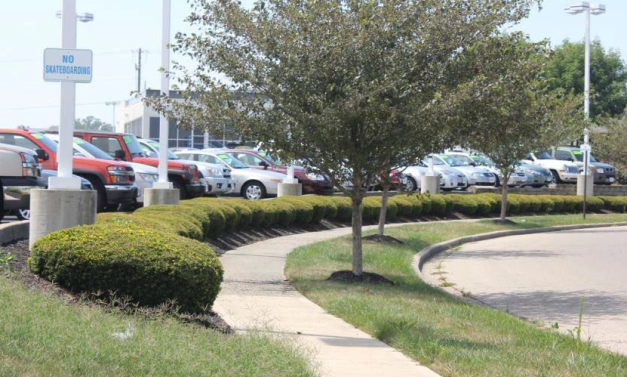
(iii)
If the above 2-foot landscape barrier is constructed of non-living materials, 1 shrub or vine shall be planted every 10 feet along the barrier.
(iv)
The remainder of the required landscaped areas shall be landscaped with grass, ground cover or other landscape treatment.
(v)
Any public right-of-way or areas reserved for future rights-of-way in compliance with the adopted thoroughfare plan shall not be used to satisfy the requirements of this section.
(vi)
Perimeter landscape strips shall be continuous and unbroken except for driveways or sidewalks required to access the parking area.
(c)
Areas Adjacent to Lot Lines. Where a buffer is not required pursuant to § 154.09(E), a perimeter landscaping strip shall be provided between a parking area and any adjacent residential use. Such landscape strip shall comply with the following:
(i)
The landscaping strip shall have a minimum width of 5 feet.
(ii)
The landscape strip shall be planted with 1 tree and 2 shrubs for each 50 linear feet or fraction thereof.
(iii)
The remainder of the required landscaped areas shall be landscaped with grass, ground cover or other landscape treatment.
(iv)
Perimeter landscape strips shall be continuous and unbroken except for driveways or sidewalks required to access the parking area.
(4)
Interior Parking Area Landscaping Required.
(a)
The interior parking area landscaping requirements of this section shall apply to all off-street parking areas where the parking area is larger than 2,000 square feet or 10 parking spaces, whichever is less.
(b)
There shall be a minimum of 10 square feet of interior landscaping areas for every parking space. The applicant shall not be required to count the parking spaces abutting a required landscaping area along the perimeter of the parking area.
(c)
The interior landscaping shall be located within landscaped islands completed separated from the perimeter parking area and shall be scattered throughout the parking area to break up large areas of pavement. See Figure 154.09-B.
Figure 154.09-B: These images show different options for landscaped islands with the
top image illustrating landscaped islands that run the full length of parking spaces.
The bottom image illustrates a smaller landscaped island at the end of a parking bay.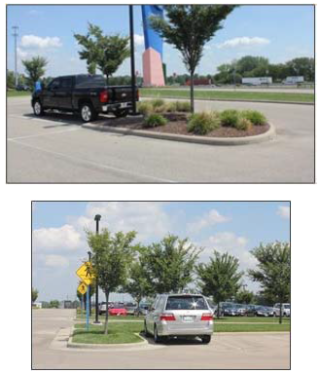
(d)
Landscape islands shall have a minimum size of 100 square feet within a minimum dimension of 5 feet in any direction to provide a suitable living environment for the landscaping.
(e)
A minimum of 1 canopy tree and 3 shrubs is required for every 100 square feet of required interior landscaping area. There shall be at least 1 tree and 3 shrubs in each landscaped island.
(f)
If an existing tree is be used to meet the requirements of this subsection, the landscape island shall be equal in size to the tree's drip line area to protect the root system of the existing tree.
(Ord. 5-14, passed 3-17-2014)
§ 154.09(G) - Screening requirements.
(1)
General Requirements. In addition to the other forms of required landscaping, screening shall be required to conceal specific areas of high visual or auditory impact or hazardous areas from adjacent, less intense uses and from views from public rights-of-way. Such areas shall be screened at all times, unless otherwise specified, regardless of adjacent uses, districts, or other proximate landscaping material.
(2)
Screened Items.
(a)
The following areas shall be screened in accordance with this section:
(i)
Large waste receptacles (e.g., dumpsters and cardboard recycling containers) and refuse collection areas;
(ii)
Off-street loading areas;
(iii)
Pipes, conduit, and cables associated with the building or use;
(iv)
Outdoor service area that is necessary to support common business operations (e.g., outdoor freezer or refrigeration units, storage units, etc.);
(v)
Ground-level or façade-mounted mechanical equipment and utility structures; and
(vi)
Roof top equipment that is not otherwise hidden by the roofline, parapet wall, or other similar feature.
(b)
Screening shall not be required if any of the above items are not visible from adjacent rights-of-way or from adjacent residential lot.
(3)
Screening Methods.
(a)
The following items are permitted for use as screening materials, and more than 1 method may be used on a lot or site.
(i)
Vegetative materials that provide a fully opaque screen to the minimum height necessary to fully screen the facility from off-site views (See Figure 154.09-C.); or
(ii)
An opaque fence or wall consistent with the standards for Buffer Type A in § 154.09(E); or
Figure 154.09-C: This image illustrates a vegetative screen that hides HVAC equipment
and a dumpster.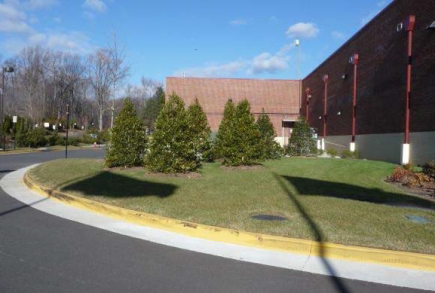
(iii)
Integration into the building design (e.g., false walls).
(b)
Alternative screening materials that are not listed or alternative configurations may be proposed as part of an alternative equivalent compliance application. See § 154.03(G).
(c)
Pipes, conduit, and cables are limited to the back façade of buildings if conditions do not allow for them to be enclosed within the building itself. Pipes, conduit, and cables shall be located as far away from public view as practical and shall be painted a similar color as the building façade to further reduce visibility.
(4)
Configuration of Vegetative Materials.
(a)
In cases where vegetative materials are used for screening in accordance with this subsection, the vegetative materials shall:
(i)
Be planted around the perimeter of the site feature to be screened in a manner that screens the site feature from all off-site views;
(ii)
Be configured in 2 staggered rows or other arrangement that provides maximum screening;
(iii)
Be upright, large evergreen shrubs or hedge sand capable of reaching at least 6 feet in height within 3 years of planting; and
(iv)
Be spaced no farther than 3 feet on-center.
(b)
All sides of the feature shall be screened with the exception that 1 side of the feature may be screened with a gate or other similar feature to allow access while screening the feature when access is not necessary.
(Ord. 5-14, passed 3-17-2014)
§ 154.09(H) - Maintenance.
(1)
All landscaping materials shall be installed and maintained according to accepted nursery industry procedures.
(2)
The owner of the property shall be responsible for the continued property maintenance of all landscaping materials, and shall keep them in a proper, neat and orderly appearance, free from refuse, debris, and weeds at all times.
(3)
All unhealthy or dead plant material shall be replaced within 1 year, or by the next planting period, whichever comes first.
Violation of these installation and maintenance provisions shall be subject to the enforcement provisions of Section 154.13: Enforcement and Penalties.
(Ord. 5-14, passed 3-17-2014)

