
Tipp City City Zoning Code
SECTION 154
11: - SIGN STANDARDS
§ 154.11(A) - Purpose.
Regulating the location, size, placement, and physical characteristics of signs is necessary to enable the public to locate goods, services, and facilities and to receive a wide variety of other messages, commercial and noncommercial, without difficulty and confusion, to encourage the general attractiveness of the community, to enhance public safety, and to protect property values. Accordingly, this section establishes regulations governing the display of signs that will:
(1)
Promote and protect the public health, safety, comfort, morals, and convenience;
(2)
Enhance the economy and the business and industry of the city by promoting the reasonable, orderly, and effective display of signs and thereby encourage increased communication with the public;
(3)
Restrict signs and lights that will increase the probability of traffic congestion and accidents by distracting attention or obstructing vision;
(4)
Reduce conflict among signs and light and between public and private information systems; and
(5)
Promote signs that are compatible with their surroundings.
(Ord. 5-14, passed 3-17-2014)
§ 154.11(B) - Applicability.
(1)
General Applicability.
(a)
It shall hereafter be unlawful for any person to erect, place, or maintain a sign in the city except in accordance with the provisions of this section.
(b)
Unless otherwise provided, this section shall apply to any sign, in any zoning district, that is visible from the public right-of-way or from property other than the property on which the sign is located.
(c)
Any sign already established on the effective date of this section or future amendment thereto, and which sign is rendered nonconforming by the provisions herein, shall be subject to the nonconforming sign regulations of § 154.11(L).
(2)
Exemptions. The following signs are entirely exempt from this section:
(a)
Any sign located entirely within buildings or other structures and/or otherwise not visible from the public right-of-way or from property other than the property on which the sign is located;
(b)
Any sign located on umbrellas or similarly related private patio furniture or seating;
(c)
Any sign on a truck, bus or other vehicle that is used in the normal course of a business for transportation (see also § 154.11(E)(8)); and
(d)
Any noncommercial holiday lighting, signs, or related decorations.
(3)
Zoning Compliance Permit Required. Unless otherwise provided by this section, all signs shall require a zoning compliance permit and a payment of fees. Exceptions to the permit requirement are as follows:
(a)
A zoning compliance permit is not required for the maintenance of a sign or for a change of copy on signs with changeable copy.
(b)
A zoning compliance permit is not required for general maintenance, painting, repainting, cleaning and other normal maintenance and repair of a sign or any sign structure unless a structural change is made that results in anything more than a minor modification. This shall include the replacement of a sign face within a sign cabinet or similar structure where the sign face is designed to be easily removed and replaced.
(c)
The following signs do not require a zoning compliance permit, but are subject to the standards set forth in this section, as well as to general standards and prohibitions related to placement, lighting and maintenance of signs.
(i)
Wall signs with a maximum area of 2 square feet attached to the façade of a residential dwelling;
(ii)
Governmental signs for control of traffic and other regulatory purposes, street signs, warning signs, railroad crossing signs, way-finding signs, and signs of public service companies for the purpose of safety;
(iii)
Commemorative plaques placed by a local, state, or federally recognized historical agency, with a maximum sign area of 48 square feet and maximum height of 6 feet;
(iv)
Interior signs within a stadium, open-air theater, shopping center, arena or other use, which signs can be viewed only by persons within such stadium, open-air theater, shopping center, parks, arena, or other use;
(v)
Certain temporary signs with a commercial message as established in § 154.11(K);
(vi)
Signs without a Commercial Message. Signs that have no commercial message are permitted in all districts without a zoning compliance permit provided they comply with this subsection.
A.
The sign shall not be located in the right-of-way.
B.
The sign shall be removed or replaced when such sign is deteriorated or the sign may be removed by the city in accordance with § 154.11(K)(1)(j) and/or § 154.11(N).
(vii)
Flags and Flag Poles.
A.
Flags of reasonable, customary size and color, emblems and insignia of any governmental agency or political subdivision and temporary displays of a patriotic, religious, charitable or civic character that does not bear a commercial message are permitted in any zoning district.
B.
One flag with a commercial message may be permitted on any lot in a business zoning district provided the flag does not exceed 40 square feet in area.
C.
Flag poles may require a building permit from Miami County depending on their size for structural purposes.
(viii)
Street Address Signs.
A.
Every building is required to post its street address in a visible area for the purposes of identification for safety service personnel. This may be on the building, mailbox, or other visible element.
B.
The signs shall have a minimum height of 3 inches and a maximum height as follows unless they are an integral part of another permanent sign, in which case, the regulations for the permanent sign shall control:
1.
For residential uses, the signs shall be no more than 8 inches in height;
2.
For nonresidential uses that have a building setback of less than 100 feet, the maximum height shall be 12 inches.
3.
For nonresidential uses that have a building setback of between 100 feet and 200 feet, the maximum height shall be 18 inches.
4.
For nonresidential uses that have a building setback of more than 200 feet, the maximum height shall be 24 inches.
C.
All street address signs shall contrast to the color of the surface on which they are mounted and shall be clearly identifiable from the street.
(ix)
Incidental Signs. Incidental signs are allowed on all private property, in addition to all other allowed signs, subject to the standards and limitations set forth in this section.
A.
Incidental signs may be wall signs not larger than 2 square feet and/or detached signs not larger than 4 square feet and with a height of no more than 3 feet.
B.
Such signs are generally intended to provide information and warnings, such as "beware of dog," "no parking," "telephone," "rest rooms," "exit," "entrance," and so on. Such signs, however, may bear any message that is not a commercial message.
C.
Such signs shall not be separately illuminated.
(x)
Window Signs. Window signs are permitted on all principal structures in accordance with the following:
A.
All signs located within, attached or mounted to, or located inside of the building but positioned to be visible from outside of any window, shall be deemed a window sign.
B.
Where window signs are permitted, such sign shall not occupy more than 50% of the window area to which it is attached. See Figure 154.11-A for locations used in the calculation of sign area.
Figure 154.11-A: The window area is illustrated within the dashed line area for the
2 storefronts in the image.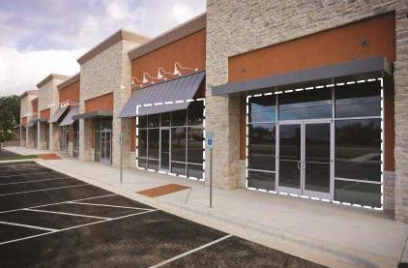
C.
Window signs are not permitted in any window of a space used for residential uses or purposes.
D.
Window signs are permitted in windows on any floor where there is nonresidential activity.
(xi)
Signs in the RA Overlay District. Signs within the RA (Old Tippecanoe City Restoration and Architectural District) shall be generally subject to the sign provisions of the underlying zoning district except as modified by special provisions within § 154.11(J).
(Ord. 5-14, passed 3-17-2014)
§ 154.11(C) - Signs partially exempt from this section.
(1)
The following signs may be erected or constructed without a zoning compliance permit, but may be subject to additional regulations under this section:
(a)
Signs conforming to the Manual of Uniform Traffic Control Devices and bearing no commercial message;
(b)
Signs installed by employees or officials of a state or federal agency in the course of their governmental duties and bearing no commercial message;
(c)
Signs required by a state or federal statute;
(d)
Signs required by an order of a court of competent jurisdiction (applicable to the site to which the sign is located);
(e)
Signs installed by public utilities in their rights-of-way or on their facilities and bearing no commercial message other than such message is necessary to identify the use; and
(f)
Signs installed by a transit company with a franchise or other right to operate in Tipp City, where such signs are installed along its routes and relate to schedules or other information about the transit route.
(2)
Where such sign is erected pursuant to a state statute or a court order, the sign may exceed the size standards of this section or otherwise deviate from the standards set forth in this subchapter to the extent that the statute or court order expressly requires the larger size or other deviation. In all other respects, such signs shall conform to the standards of this section.
(3)
The signs established in § 154.11(C)(1) above shall be allowed in the public right-of-way in Tipp City or on parks or other public property controlled by Tipp City. The following additional signs may also be located in the rights-of-way, in parks, or public property controlled by Tipp City:
(a)
Signs installed and maintained by Tipp City that may contain either commercial and/or noncommercial messages as part of a way-finding program, through which space is made available to users on a nondiscriminatory basis in accordance with separately published criteria and with payment of a fee;
(b)
Additional signs in parks that relate to the use of 1 or more facilities (including temporary uses by particular entities or individuals), provided that such signs shall not be legible from any public right-of-way outside the park and such signs shall bear no commercial message except 1 that relates to a lawful commercial activity or lawful temporary use of a facility within the park;
(c)
Signs for concessionaires and event sponsors inside stadiums, arenas or athletic fields or other such facilities; and
(4)
Sidewalk signs in the CC District are permitted in the right-of-way subject to the standards and conditions in § 154.11(K)(5).
(5)
Banner Sign across Main Street.
(a)
A community activity or special event may be promoted by installing a street banner between the designated utility poles within the RA District. An application for placement of a street banner shall be made to the Clerk of Council; applications for eligible organizations shall be granted on a first-come, first-served basis.
(b)
To be eligible to place a street banner under this section, a community activity or special event must meet all of the following criteria:
(i)
Its primary sponsor must be a governmental entity or a nonprofit organization with an office or other documented presence in Tipp City;
(ii)
As part of the application for the permit, the sponsor must provide documentation that the planned event has received or has applied for all permits that will be necessary to conduct the event, including but not limited to parade permits or leases of space for the event;
(iii)
The event must be open to the general public.
(c)
Limitations on Signs.
(i)
All banners are a standard size, installed by the city. Specifications for the size and materials of such a banner are available from the office of the Clerk of Council.
(ii)
A banner for an activity or event shall be displayed for no more than 2 weeks prior to and/or including the dates of the event.
(iii)
The banner may bear a commercial message promoting the event, but it shall not contain advertisements or identifications for sponsors other than non-profit organizations.
(Ord. 5-14, passed 3-17-2014; Am. Ord. 1-18, passed 1-2-18)
§ 154.11(D) - Sign computations.
(1)
Sign Height.
(a)
The height of a sign shall be computed as the distance from the base of the sign at normal grade to the top of the highest attached component of the sign. If the normal grade where the sign is to be installed is lower than the adjacent public street, the height of a sign can be measured from the grade at the edge of the street pavement nearest the sign, with appropriate topographic documentation, to the top of the highest attached component of the sign.
(b)
The height of a sign may not be artificially increased by the use of mounding.
(2)
Sign Area. The surface of a sign to be included when computing maximum allowable square footage of sign area shall be calculated as follows:
(a)
For sign copy mounted or painted on a background panel, cabinet, or surface distinctively painted, textured, lighted, or constructed to serve as the background for the sign copy, the sign area shall be computed by means of the smallest square, circle, rectangle, triangle, or combination thereof that encompasses the extreme limits of the background panel, cabinet, or surface. See Figure 154.11-B and Figure 154.11-C.
(b)
For sign copy where individual letters or elements are mounted or painted on a building façade where there is no background panel, cabinet, or surface distinctively painted, textured, lighted, or constructed to serve as the background for the sign copy, the sign area shall be computed by means of the combination of the smallest square, circle, rectangle, triangle, or combination thereof that encloses all the letters or elements associated with the sign. See Figure 154.11-B and Figure 154.11-C.
(c)
The calculation of sign area shall not include any supporting framework, bracing, or decorative fence or wall unless such structural support is determined to constitute an integral part of the sign design by means of text or other commercial message, as determined by the Zoning Administrator. See Figure 154.11-B.
Figure 154.11-B: Illustration of sign area calculation for a ground sign with copy
on a distinct cabinet.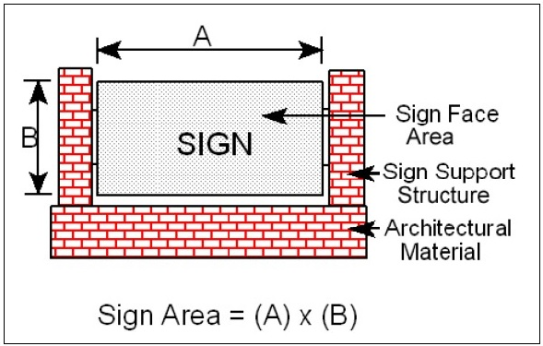
Figure 154.11-C: Illustration of sign area calculation for 2 differently shaped wall
signs with individual letters.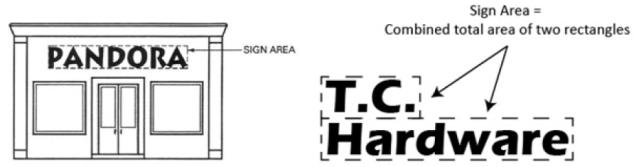
(d)
The sign area for a sign with more than 1 face (multi-faced signs) shall be computed by adding together the area of all sign faces visible from any 1 point.
(e)
When 2 identical sign faces are placed back to back, so that both faces cannot be viewed from any 1 point at the same time, and when such sign faces are part of the same sign structure and are not more than 24 inches apart, the sign area shall be computed by the measurement of 1 of the faces.
(f)
When the calculation for the sign area is based on a width or lineal measurement of the primary façade frontage and when there is a question regarding the interpretation of the façade measurement, the Zoning Administrator shall have the authority to determine what is considered the primary façade and the maximum measurement of such façade. The Zoning Administrator may take into consideration:
(i)
Whether the façade clearly faces a public street or right-of-way;
(ii)
The location of the principal building entrance and/or customer entrance; or
(iii)
Other unique features that clearly demonstrate that the applicable façade is a primary façade for the building.
(g)
The calculation of the width or lineal measurement of the primary façade shall be the measurement of the façade between 2 side façades. The calculation shall be based on viewing the primary façade that is visible from a 90 degree angle (i.e., straight on), regardless of façade insets, offsets, or angles. See Figure 154.11-D.
Figure 154.11-D: Illustration of façade width measurement on varied façade shapes.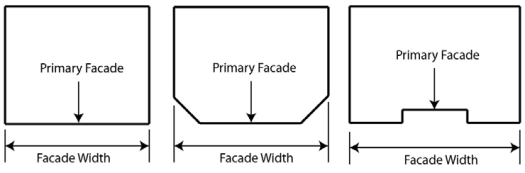
(h)
When calculating street frontage, only the street frontage that lies in the incorporated area of Tipp City shall be used in the calculation.
(Ord. 5-14, passed 3-17-2014)
§ 154.11(E) - Prohibited sign types.
The following types of signs are specifically prohibited within the city:
(1)
Billboards and other off-premise signs unless specifically allowed on temporary signage in § 154.11(K);
(2)
Signs that are applied to trees, bus shelters, utility poles, benches, trash receptacles, newspaper vending machines or boxes, or any other unapproved supporting structure, or otherwise placed in the public right-of-way;
(3)
Pennants, streamers and other similar type devices;
(4)
Signs that employ any parts or elements which revolve, rotate, whirl, spin or otherwise make use of motion to attract attention except for electronic message centers permitted in accordance with this section;
(5)
All portable advertising signs (mobile signs on wheels) except for sidewalk signs permitted in accordance with § 154.11(K)(5);
(6)
Laser lights, beacons and searchlights, except for emergency purposes;
(7)
Balloons with a commercial message or air-activated graphics filled with helium, gas, air or any other gaseous material either suspended from or affixed to a structure, vehicle or ground, intended to be used for commercial purposes.
(8)
Motor vehicles, tractor trailers, or similar vehicles with signs painted on, attached to, or otherwise affixed to the vehicle shall not be parked or stored long-term on a lot as a form of signage. This standard does not apply to vehicles used in the day-to-day business of the applicable use (e.g., delivery vehicles or vehicles used by employees). Vehicles with signage that are parked for more than 24-hours on a lot without a principal use or parked, without any movement, for more than 1 week on a lot with a principal use, shall be considered a violation of this subsection.
(9)
Any sign that utilizes illumination by means of bare bulbs, flames, or both; and
(10)
Roof signs.
(Ord. 5-14, passed 3-17-2014)
§ 154.11(F) - Prohibited sign locations.
Signs may not be installed in any of the following locations:
(1)
In any public right-of-way, except as specifically authorized by this section;
(2)
In any utility easement, intersection visibility areas, or other areas where structures are prohibited;
(3)
In any public park or other public property, except as expressly authorized by this section except as allowed in § 154.11(K)(10);
(4)
On any traffic-control signs, construction signs, fences, except as allowed in § 154.11(K)(10) utility poles, street signs, trees or other natural objects;
(5)
In any location where the view of approaching and intersecting traffic would be obstructed. No sign shall be located so as to interfere with the safe movement of vehicles or pedestrians entering, leaving, or crossing a public right-of-way;
(6)
On a bench, where the sign on such bench is legible from the public right-of-way;
(7)
In any residential area, except as expressly permitted in this section except as allowed in § 154.11(K)(10); and
(8)
On any property without the prior authorization granted by the property owner on which any sign is to be placed.
(Ord. 5-14, passed 3-17-2014; Am. Ord. 1-18, passed 1-2-2018)
§ 154.11(G) - Standards for all permanent signs.
All freestanding signs shall be subject to the following standards, regardless of the district in which they are located:
(1)
General Standards.
(a)
All freestanding signs shall be located in a landscaped area equal to or larger than the total sign area of the applicable sign. Such landscaped area may be an area that fulfills any landscaping requirements of this code.
(b)
The landscaped area shall include all points where sign structural supports attach to the ground.
(c)
Exposed foundations for sign shall be constructed with a finished material such as brick, stone, or wood, or be screened with evergreens to the top of the anchor bolts.
(d)
Freestanding signs shall not be located in such a way that they interfere with the safe movement of vehicular and pedestrian traffic including compliance with the intersection visibility requirements of this code.
(e)
All wiring, fittings, and materials used in the construction, connection and operation of electrically illuminated signs shall be in accordance with the provisions of the applicable building or electrical codes.
(f)
Any sign requiring a structural steel foundation and/or electricity shall obtain foundation and/or electric permits from the Miami County Building Regulations Department.
(g)
Signs shall not resemble the color, shape, design or other characteristics of any common traffic-control device, directional or warning signs directed or maintained by the state, city, or any railroad, public utility, or similar agency concerned with the protection of the public health and safety.
(h)
The back side of all permanent signs (that do not contain a second sign face) and structural supports shall be completely enclosed.
(i)
If any sign projects into a right-of-way, such sign may require a license of encroachment that is issued by City Council.
(2)
Maintenance of Permanent Signs.
(a)
Where a permanent sign is located on a common area controlled by a homeowners' or property owners' association, such association shall be responsible for the maintenance of the sign and surrounding landscaped area. Failure to maintain the sign in good working order in accordance with this section may result in the city maintaining the sign and assessing the applicable property owners for the related costs.
(b)
Where the sign is located on a private property, the property owner shall be responsible for maintenance in accordance with the applicable provisions of this code. Failure of a private property owner to maintain the sign shall be considered a violation of this code.
(3)
Electronic Message Centers. Where an electronic message center is permitted, the following standards shall apply:
(a)
Any message change shall be a static, instant message change.
(b)
Messages can only change once every 10 seconds or more.
(c)
The transition time between messages shall be less than 1 second.
(d)
The electronic message center shall come equipped with an automatic dimming photocell, which automatically adjusts the display's brightness based on ambient light conditions.
(e)
The brightness level shall not increase by more than 0.3 foot candles (or 3.23 lumens per square meter or lux) (over ambient levels) as measured using a foot candle meter at a pre-set distance.
(f)
The procedure and distances for measurement of brightness shall be as established by the International Sign Association's Recommend Night-time Brightness Levels for On-Premise Electronic Message Centers.
(g)
Only liquid crystal display (LCD) and light emitting diodes (LED) technology shall be permitted for electronic message centers. The maximum pitch for LED sign shall be 35 millimeters. The pitch is the industry standard for measuring the distance between light points.
(h)
In case of any malfunction resulting in changes of message that are more frequent than allowed, or a malfunction in the appearance of the messages, the malfunction shall be repaired within 1 business day or the changing mechanism shall be disabled or the sign shall be turned off until repair.
(4)
Lighting. Unless otherwise stated, signs may be illuminated from an internal or external light source provided that the lighting complies with the following standards:
(a)
By a white, steady, stationary light of reasonable intensity, directed solely at the sign and/or otherwise prevented from beaming directly onto adjacent properties or rights-of-way in compliance with this code.
(b)
Light fixtures shall be screened from view by light shields, site grading, or evergreen shrubs. No exposed light sources are permitted.
(c)
The level of illumination emitted or reflected from a sign shall not be of an intensity sufficient to constitute a demonstrable hazard to vehicular traffic on any right-of-way or parking lot from which the sign may be viewed.
(Ord. 5-14, passed 3-17-2014)
§ 154.11(H) - Permanent signs in residential zoning districts.
The following standards apply to signs on lots zoned R-1A, R-1B, R-1C, R-2, R-3, PD, or CD.
(1)
Development/Subdivision Signs. Freestanding, ground-mounted monument signs may be permitted for any subdivision or multi- family dwelling development provided that the sign meets the following requirements:
(a)
A maximum of 1 permanent ground-mounted monument sign may be permitted for each primary entrance to the subdivision or development from a collector or arterial street as determined by the Zoning Administrator.
(b)
Each sign may have a maximum sign area of 32 square feet not including any fencing, wall, supporting brick, stone, or any other material used to frame, brace or otherwise provide structural support for the sign on which the sign is located.
(c)
No such sign or any portion of the structure shall exceed 6 feet in height.
(d)
The sign may only be illuminated through an external light source.
(e)
Such signs shall consist entirely of natural materials, such as wood, brick and stone but may include stone veneer or brick veneer.
(f)
The sign shall be setback 5 feet from the public right-of-way and 20 feet from any adjacent lot lines.
(2)
Permanent Signs for Agricultural or Nonresidential Uses.
(a)
One permanent ground-mounted monument sign may be permitted for any nonresidential use in a residential zoning district provided the sign meets the requirements below. For the purposes of this subsection, nonresidential uses include public and institutional uses as determined by the Zoning Administrator.
(i)
The sign shall be set back 6 feet from the public right-of-way and 10 feet from any adjacent lot lines. The sign shall also be set back 25 feet from any adjacent residential uses.
(ii)
For uses on lots with a lot area of less than 5 acres, the maximum sign area shall be 32 square feet. For uses on lots with a lot area of 5 acres or more, the maximum sign area shall be 50 square feet.
(iii)
No such sign or any portion of the structure shall exceed 6 feet in height.
(iv)
Up to 50% of the sign may include changeable copy signage but such signage shall be limited to a manual changeable copy sign. Electronic message centers shall only be permitted if the sign is located on a lot with a minimum lot area of 5 acres and when the sign is set back a minimum of 50 feet from any lot line that is adjacent to a residential lot. Electronic message centers shall be subject to § 154.11(G)(3).
(b)
One permanent ground-mounted monument sign shall be permitted on any lot that is used primarily for an agricultural use provided the lot has a minimum area of 5 acres and the sign meets the same following standards:
(i)
The sign shall be set back 6 feet from the public right-of-way and 10 feet from any adjacent lot lines. The sign shall also be set back 25 feet from any adjacent residential uses.
(ii)
The maximum sign area shall be 32 square feet.
(iii)
No such sign or any portion of the structure shall exceed 6 feet in height.
(c)
Wall signs are permitted for any nonresidential use in a residential zoning district in accordance with the provisions established in § 154.11(I)(2).
(Ord. 5-14, passed 3-17-2014)
§ 154.11(I) - Permanent signs in nonresidential zoning districts.
The following standards apply to signs on lots zoned OS, GB, HB, LI, LD, or GI.
(1)
General Standards. Signs may bear any message that is not a commercial message or any commercial message related to activities, products or services that are offered on the same lot.
(2)
Wall Signs. Wall signs are permitted on all principal structures in accordance with the following:
(a)
Wall signs shall be mounted on or flush with a wall. A wall sign may be painted directly on a building wall, mounted on the façade wall, or mounted on a raceway.
(b)
A wall sign shall not protrude more than 18 inches from the wall or face of the building to which it is attached, regardless of whether a raceway is used.
(c)
A wall sign may be attached to a building wall or architecturally-integrated extension which faces a street, parking lot or service drive, or may be attached to a canopy or awning which projects beyond the building or is a separate structure (i.e., canopies over fuel dispensers).
(d)
Wall signs shall not extend above the roofline of the building to which it is attached.
(e)
Wall signs may not be attached to a penthouse or roof structure including but not limited to mechanical equipment or roof screening.
(f)
Size.
(i)
This subsection establishes the maximum sign area permitted for wall signs based on the development type.
(ii)
There is no maximum number of wall signs but the total square footage of wall signs located on a single façade shall comply with the requirements of this section.
(iii)
Where there are multiple primary façades (e.g., corner lots or double frontage lots), the maximum wall sign area shall apply to the individual façade. An applicant shall not combine the total amount of wall sign area permitted on all façades and apply it to a single façade.
(iv)
An applicant may locate any portion of permitted wall signage onto a secondary façade provided that:
A.
The maximum wall sign area allowed shall be determined by the primary façades that face a public street;
B.
Such wall sign area shall be deemed transferred from the primary façade to the secondary façade and shall reduce the wall sign area allowed on the primary façade accordingly; and
C.
The maximum wall sign area allowed on a secondary façade shall not exceed the maximum wall sign area permitted on any 1 primary façade (e.g., the area of wall signs allowed on multiple primary façades may not be aggregated onto the secondary façade).
(v)
Buildings with Multiple Tenant Spaces. The maximum wall sign area permitted, per tenant space, shall be equal to 1.5 square feet for every lineal foot of building width assigned to the individual tenant space. Additional wall signs are permitted for each additional façade that faces directly onto a public street. The maximum sign area for the additional wall signs shall be equal to 1.5 square feet for every lineal foot of building width of the façade to which it will be attached.
(vi)
Buildings with Single Tenant Occupancy. The maximum wall sign area permitted shall be equal to 1.5 square feet for every lineal foot of building width. Additional wall signs are permitted for each additional façade that faces directly onto a public street. The maximum sign area for the additional wall signs shall be equal to 1.5 square feet for every lineal foot of building width of the façade to which it will be attached.
(vii)
Large-Scale Commercial and Industrial Buildings (Over 150,000 square feet of floor area). The following shall apply to wall signs on commercial and industrial buildings that have 150,000 square feet or more of floor area:
A.
The maximum wall sign area permitted on any single façade, regardless of the number of signs, shall not exceed 5% of the total façade area.
B.
No wall sign shall exceed 35% of the height of the façade to which it is attached, as measured from the bottom of the letters or message to the top most point of the letters or message.
(3)
Projecting Signs. Projecting signs are permitted on all principal structures in accordance with the following:
(a)
A projecting sign shall be perpendicular to the wall of the building to which it is attached. A projecting sign may also be attached to the ceiling of an outdoor arcade if it complies with the sign area, height, and clearance standards of this section.
(b)
A projecting sign shall be considered a wall sign for purposes of determining the total area of wall signs allowed (i.e., the total combined sign area of wall signs and project signs shall not exceed the maximum sign area permitted for all wall signs).
(c)
A projecting sign shall not be subject to the restrictions on a wall sign regarding the distance between the sign and the wall.
(d)
A projecting sign shall be perpendicular to the wall to which it is affixed and may project up to 3 feet from the front of the building.
(e)
A projecting sign shall in no case project beyond the curb line of a public street or over a public street.
(f)
Where a projecting sign projects over a sidewalk, there shall be at least 9 feet of clearance between the bottom or the sign and the surface of the sidewalk.
(g)
Projecting signs shall not project above the roofline of the building.
(4)
Freestanding Signs.
(a)
Freestanding signs shall include pole signs or ground-mounted monument signs.
(b)
All freestanding signs shall be set back a minimum of 10 feet from any public right-of-way or property boundary line unless such signs are adjacent to a residentially zoned lot, in which case the sign shall be setback a minimum of the height of the sign.
(c)
Up to 75% of 1 ground-mounted monument sign on any lot may include changeable copy signage. The changeable copy sign may be a manual sign or an electronic message center. The electronic message center shall be subject to the provisions of § 154.11(G)(3).
(d)
Number.
(i)
There shall be a maximum of 1 freestanding sign on each lot with a principal building; however principal buildings on lots that have more than 75 feet of frontage on more than 1 public street (not including Interstate 75) shall be permitted to have 1 additional freestanding sign with 1 sign located along each of the public streets.
A.
The total combined area of both signs shall not exceed 1.5 times the maximum permitted area of a single freestanding sign for that use.
B.
The applicant may determine how to allocate the sign area on each of the signs but in no case shall an individual freestanding sign exceed the maximum sign area permitted for freestanding signs in Table 154.11-1.
(ii)
Multi-tenant buildings on lots that have a single street frontage that is 1,500 feet or longer shall be permitted to have 1 additional freestanding sign under the following provisions:
A.
The standards of this § 154.11(I)(4) shall apply.
B.
The 2 signs shall be set back a minimum of 100 feet from each other.
(iii)
Principal buildings located on a lot that is located within 1 of the 3 sign districts approved by City Council in Ordinance 09-10 (see Figure 154.11-E, Figure 154.11-F, and Figure 154.11-G) shall be permitted to have 1 additional freestanding pole sign as follows:
A.
The sign shall have a maximum sign area of 250 square feet.
B.
The maximum height of the sign shall be 90 feet.
C.
The minimum height of the sign shall be 40 feet from grade to the lowest point of the sign face.
(iv)
In all cases, there shall be a maximum of 2 freestanding signs permitted on each lot.
Figure 154.11-E: Image of the Southern Interstate Sign District as approved by City
Council in Ordinance 09-10.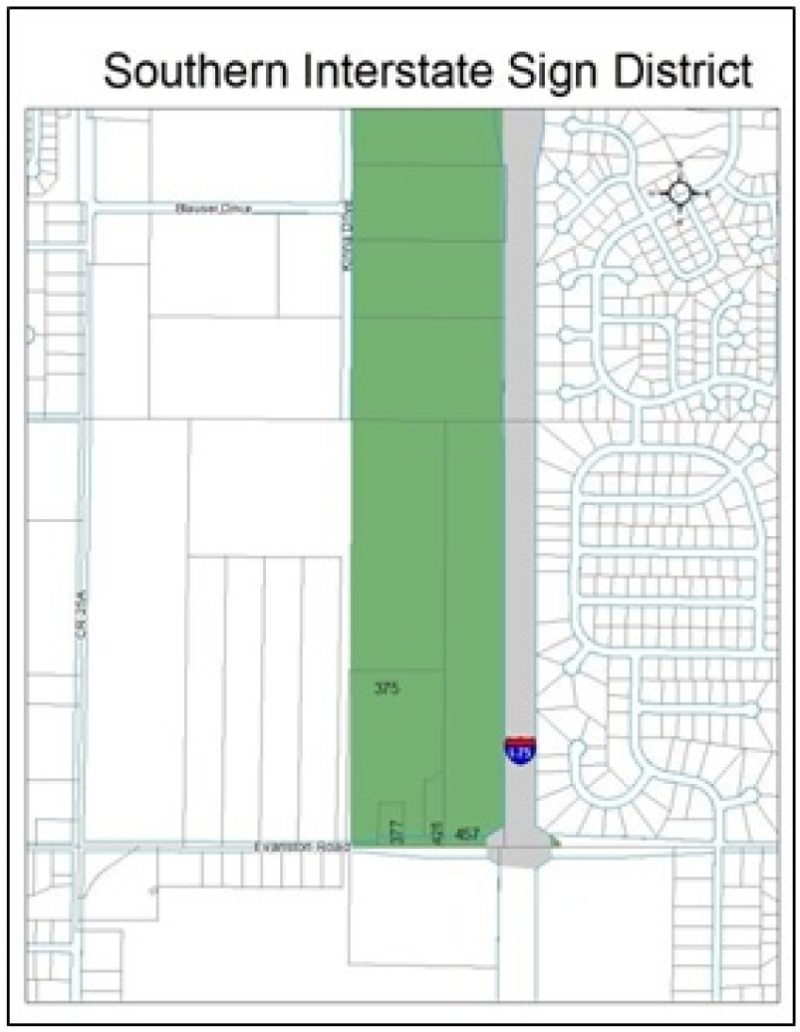
Figure 154.11-F: Image of the Central Interstate Sign District as approved by City
Council in Ordinance 09-10.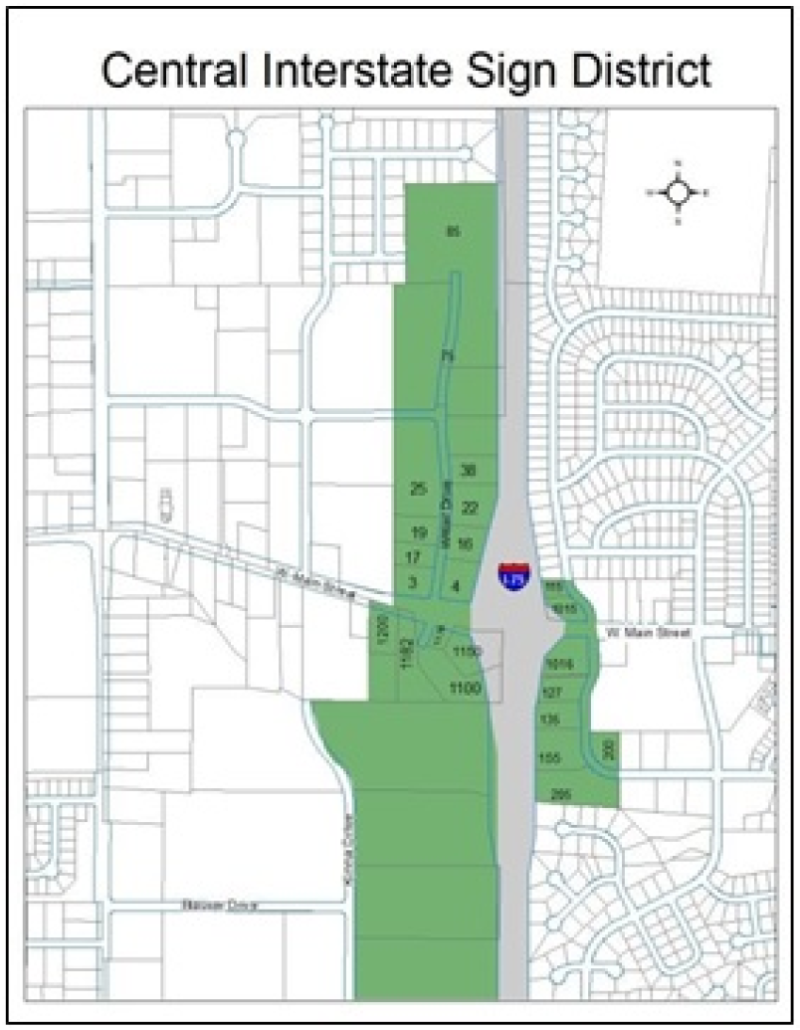
Figure 154.11-G: Image of the Northern Interstate Sign District as approved by City
Council in Ordinance 09-10.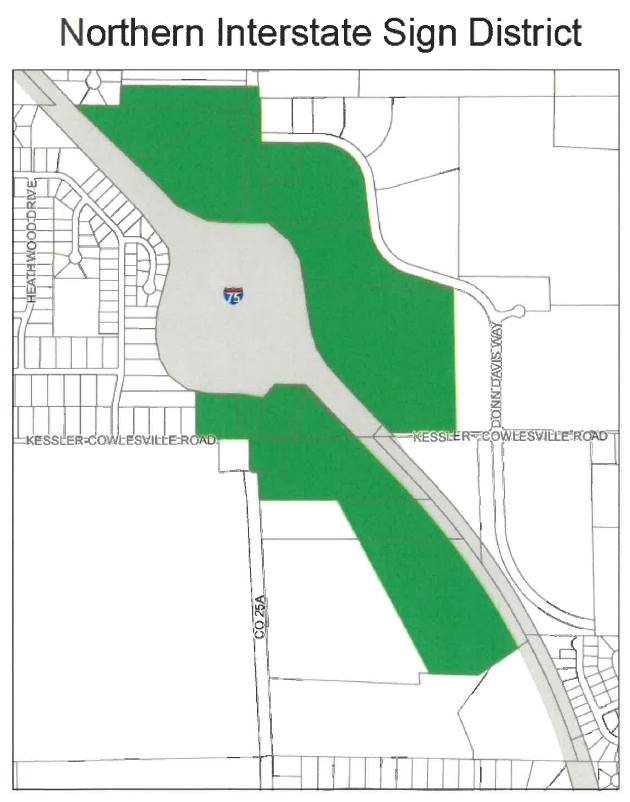
(e)
Size and Height. Unless otherwise specified, the maximum sign area and maximum height of freestanding signs is established in Table 154.11-1.
(5)
Driveway Signs. Permanent signs shall be permitted near driveway entrances to a street and at intersections of internal drives under the following provisions:
(a)
The signs shall be set back 5 feet from all lot lines but in no case shall the sign be set back more than 25 feet from the driveway entrance or intersection of internal drives;
(b)
Two signs may be permitted per individual driveway that intersects with a public street and 1 sign may be permitted per intersection of internal driveways.
(c)
The sign shall not exceed 4 square feet in area and 3 feet in height.
(d)
In cases where a single development has 200,000 square feet or more of gross floor area, the maximum sign area shall be 16 square feet with a maximum height of 6 feet.
(6)
Development/Subdivision Signs. For commercial or industrial subdivisions or parks in the GB, HB, LI, LD, or GI that contain 5 or more nonresidential businesses on individual lots or that are 50 or more acres in size, such subdivision or park may incorporate a subdivision or development sign in accordance with the following:
(a)
The primary development/subdivision sign shall be subject to the same standards as § 154.11(H)(1) with the exception that the maximum sign area shall be 36 square feet.
(b)
The maximum height of a monument sign shall be 10 feet.
(c)
The sign shall be set back a minimum of 75 feet from any residential lot line.
(d)
If this sign is utilized, no other freestanding pole or monument sign shall be located within 100 feet of the subdivision or development sign on the same street or road on which the subdivision or park has access.
(7)
Drive-Through Signs.
(a)
Up to 2 drive-through signs are permitted for each stacking lane in a drive-through facility with a maximum sign area of 36 square feet for each sign. Where only 1 drive-through sign is utilized, the maximum sign area may be increased to 48 square feet.
(b)
Any additional attachments such as pictures or photographs of food and other items shall be included within the maximum sign area.
(c)
Drive-through signage shall not be included in any other allowed signage area for a property under other parts of this section.
(d)
No drive-through sign shall exceed 8 feet in height.
(e)
All drive-through signs shall be internally illuminated.
(f)
Drive-through signs may include digital elements that are similar to an electronic message center provided they comply with the lighting and brightness requirements of § 154.11(G)(3).
(g)
Drive-through signs shall be reviewed and approved as part of the site plan review for the drive-through establishment or, when a drive-through sign is to be added, as part of a separate zoning compliance permit application.
(h)
The drive-through sign shall be located in a landscaped area equal to or larger than the total sign area of the drive-through sign. Such landscape area may also be counted toward any landscaping requirements of this code.
(8)
Additional Signage for Automotive Fuel Sales.
(a)
Where automotive fuel sales are a principal use on a lot, the following signs shall be permitted in addition to any other signage allowed by this section.
(i)
One non-illuminated, double-faced sign not exceeding 6 square feet on a side is permitted for each set of motor fuel pumps;
(ii)
Any other such signs as may be required by law, none of which shall be illuminated or animated unless such illumination or animation is expressly required by the applicable law.
(b)
Signs on any canopies shall be considered a wall sign and shall comply with § 154.11(I)(2).
(9)
Scoreboard Signs.
(a)
Scoreboard signs shall be located on and be accessory to an athletic stadium actively used for athletic events.
(b)
Scoreboard signs shall be permitted at City Park.
(c)
Sponsorship and/or advertising on scoreboard signs is permitted.
(d)
Changeable copy signage and/or electronic message centers on scoreboard signs is permitted.
(e)
Instant replays and/or other non-static messages are permitted.
(f)
Scoreboard signs shall have a maximum height of 35 feet.
(g)
Scoreboard signs shall have a maximum area of 625 square feet.
(Ord. 5-14, passed 3-17-2014; Am. Ord. 22-16, passed 10-3-2016; Am. Ord. 11-17, passed 7-17-2017; Am. Ord. 2-18, passed 1-2-2018; Am. Ord. 3-18, passed 1-2-2018; Ord. No. 37-23, § 1(Exh. A), 12-18-2023)
§ 154.11(J) - Signs in the CC District and the RA Overlay District.
The following additional standards apply to signs on lots in the RA Overlay District. Any signs erected, modified, or otherwise subject to the provisions of this section shall not be subject to the Certificate of Appropriateness requirements for the RA District.
(1)
Sign Standards.
(a)
Electronic message centers shall be prohibited.
(b)
Signs shall be limited to the lintels, windows and awnings. Projecting signs should be limited to the main entrance. Wood signs, wall signs, and free-swinging projecting signs are encouraged.
(c)
Individual plastic or metal letters, neon signs, and interior illumination are prohibited.
(d)
The signage for a particular building or shop shall involve the fewest separate panels or structural components as possible.
(e)
Most buildings have a definite panel or framed zone for sign mounting. This shall be used with the sign taking a complementary shape.
(f)
The sign's location shall not obscure any significant architectural features of the building or site.
(g)
The sign's materials shall be compatible with the period and style of the property, building or site.
(h)
The sign's installation shall not irreparably damage any cornice, ornament or similar architectural detail and shall be the least damaging method feasible for the property, building or site.
(i)
Signs shall be illuminated from an exterior light source (e.g., gooseneck lighting or up- lighting).
(2)
Review of Signs in the RA Overlay District.
(a)
Signs in the RA District shall require a zoning compliance permit. A separate Certificate of Appropriateness review shall not be required.
(b)
The zoning compliance permit shall be reviewed by the Zoning Administrator.
(3)
Special Signs in the RA Overlay District. Several existing signs within the RA Overlay District are considered special signs related to the history of Tipp City and are protected as part of the district. The signs established in this subsection shall not be counted as part of the signage allocated to a business in the RA Overlay District. These signs include:
(a)
The large "Battle Ax" wall mural at the southeast corner of Second and Main;
(b)
The "Gem City Ice Cream" mural at the northwest corner of Second and Main;
(c)
The "Sam & Ethel's" neon sign on Main;
(d)
The "Rexall Drug" sign framework facing East Main; and
(e)
The "Tipp Roller Mills" wall letters on the mill near the canal lock.
(Ord. 5-14, passed 3-17-2014)
§ 154.11(K) - Temporary signs.
(1)
Standards that Apply to all Temporary Signs.
(a)
Temporary signs shall not be mounted, attached, affixed, installed, or otherwise secured in a manner that will make the sign a permanent sign.
(b)
No temporary sign shall be mounted, attached, affixed, installed, or otherwise secured so as to protrude above the roofline of a structure.
(c)
Temporary signs shall not be illuminated.
(d)
Portable, temporary signs are permitted provided they are tied down to prevent damage to other structures or property and are not located on a wheeled or other transport chassis.
(e)
All temporary signs, regardless of the message, are prohibited in the right-of-way unless otherwise provided for in § 154.11(K)(10)(e) and are subject to the intersection visibility standards of this code.
(f)
No temporary sign shall require wiring, fittings, or elements that would traditionally require an electrical permit.
(g)
No temporary sign shall require a foundation or other support that requires a review by the Miami County Building Regulations Department other than a building or structure to which the sign may be temporarily affixed.
(h)
No streamers, spinning, flashing, or similarly moving devices shall be allowed as part of or attachments to temporary signs.
(i)
All temporary signs shall be secured in such a manner as to prevent swinging or other significantly noticeable movement resulting from the wind.
(j)
Because of the nature of materials typically used to construct temporary signs and to avoid the unsightliness of deteriorating signs and all safety concerns which accompany such a condition, temporary signs shall be removed or replaced when such sign is deteriorated. The city may remove any deteriorated sign and charge the expenses for the removal to the owner of the property on which the sign is displayed. Any unpaid charges may be assessed in the form of a lien against the owner of the property.
(2)
Temporary Signs on Properties for Rent or Sale. Temporary signs with a commercial message may be located on properties for sale, lease, or rent in all zoning districts, without a zoning compliance permit when they comply with the following:
(a)
There shall be a maximum of 1 sign per public street frontage.
(b)
For properties in a residential zoning district, the maximum sign area shall be 8 square feet and a maximum height of 4 feet.
(c)
Signs in all other zoning districts shall comply with the following:
(i)
For lots that have less than 100 feet of street frontage, the maximum sign area shall be 16 square feet with a maximum height of 6 feet.
(ii)
For lots that have a street frontage of 100 feet or more, the maximum sign area shall be 32 square feet with a maximum height of 8 feet.
(iii)
For lots that have a minimum street frontage of 500 feet along a major arterial or Interstate 75, and where there is a minimum lot area of 20 acres, the maximum sign area shall be 64 square feet with a maximum height of 10 feet.
(d)
If there are multiple contiguous lots for sale (e.g., a subdivision with individual lots for sale), the maximum sign area and height may be based on the aggregate size of all contiguous lots under a single ownership. Otherwise, the sign area and height shall be based on the individual lot.
(e)
The maximum height provisions shall not apply if the sign is affixed to a building or structure, in which case it may not be affixed in a manner that extends above the roofline.
(f)
Such signs shall be removed within 14 days of the sale, rental, or lease of the property.
(g)
In addition to any other prohibitions on the location of the signs, such signs shall be prohibited in curb lawns.
(3)
Temporary Signs for Model Homes.
(a)
A temporary sign shall be permitted on any lot with a model home provided it complies with the standards for temporary signs on residential properties for rent or lease in § 154.11(K)(2).
(b)
The sign shall not require a zoning compliance permit.
(4)
Temporary Signs for Development Projects.
(a)
One temporary sign shall be permitted for any lawful development or construction project in any zoning district on each public street frontage on which the project abuts.
(b)
The sign shall require a zoning compliance permit.
(c)
The sign shall be permitted for a period of 1 year except that the sign shall be removed within 30 days after completion of construction.
(d)
The sign may contain any commercial message or noncommercial message associated with the use or activities of the lot on which the sign is located.
(e)
The sign shall be set back a minimum of 10 feet from all rights-of-way and 25 feet from any other temporary sign on the lot.
(f)
The maximum sign area shall be 32 square feet and shall not exceed a height of 8 feet.
(5)
Sidewalk Signs. Temporary sidewalk signs may be located on the sidewalk in front of a business establishment in any business zoning district subject to the following:
(a)
There shall be a maximum of 1 sign for each public entrance to a business or other establishment opening onto a public street frontage or private sidewalk.
(b)
Such signs shall only be placed on the sidewalk during the hours the business or other establishment is open.
(c)
Sidewalk signs may be used continuously throughout the year, subject to the standards of this subsection.
(d)
Sidewalk signs shall be set back a minimum of 10 feet from any other sidewalk sign.
(e)
Sidewalk signs in the public right-of-way shall be subject to all other setback requirements established for the applicable right-of-way in § 95.18 of the Tipp City Code of Ordinances.
(f)
The signs shall not be wider than 3 feet and shall not exceed a height of 5 feet. They must be located so as to maintain a clear path for pedestrian including persons with walkers or wheelchairs.
(g)
The maximum sign areas shall be 15 square feet.
(h)
A sidewalk sign in the RA Overlay District shall not require a COA approval but a zoning compliance permit shall be required.
(i)
Any sidewalk sign found to be unsafe or to present a hazard in the opinion of the Zoning Administrator shall be removed immediately.
(6)
Temporary Signs for Special Events.
(a)
For nonresidential uses in residential districts or for any uses in business districts, 1 temporary, on-premise sign may be used in association with a special event on-site.
(b)
The only forms of temporary sign allowed are:
(i)
A banner sign, made of cloth, vinyl or other sturdy and flexible fabric, and affixed to a wall of the building or to the ground; or
(ii)
A window sign.
(c)
A zoning compliance permit shall be required for the sign except that such permit shall not be required for temporary window signs.
(d)
The temporary sign may be displayed for only 30 consecutive days; such sign shall be removed after such period but may be replaced with another temporary window sign for a maximum of 60 days in any calendar year.
(e)
Only 1 temporary sign under this subsection is permitted on any single lot at 1 time.
(f)
Banners shall have ventilated faces to reduce wind load.
(g)
Such signs shall not exceed 32 square feet in area per side (2 sides maximum).
(h)
The maximum height of the signs shall be 6 feet unless affixed to a building or structure, in which case it may not be affixed in a manner that extends above the roofline.
(i)
The sign may contain any commercial message or noncommercial message associated with the use or activities of the lot on which the sign is located.
(j)
The sign shall be set back a minimum of 10 feet from all rights-of-way.
(7)
Temporary Signs for New Businesses. When a new business has received zoning compliance permit and the permanent sign has not been installed, 1 additional temporary sign may be permitted until the permanent sign has been installed, or not more than 60 days, whichever is less. Such sign shall meet the same standards as established in § 154.11(K)(6) above.
(8)
Temporary Signs for Seasonal Businesses/Temporary Uses. When a seasonal business or temporary use is permitted in accordance with this code, 1 temporary sign shall be permitted for such business operation when such sign complies with the following standards.
(a)
The sign shall require a zoning compliance permit.
(b)
The maximum sign area shall be 32 square feet with a maximum height of 6 feet.
(c)
The sign shall be set back 10 feet from any rights-of-way.
(d)
The sign shall be removed when the business or use ceases to operate or upon the expiration of the time limits identified in the applicable zoning permit.
(9)
Other Temporary Signs with a Commercial Message in Residential Zoning Districts. In addition to any temporary sign permitted in residential zoning districts in the above subsections, 1 temporary sign with a commercial message (on-premise sign or off-premise sign) may be permitted on a residential lot in compliance with the following:
(a)
Only 1 sign shall be permitted for a maximum of 14 consecutive days, up to 2 times per calendar year.
(b)
The sign shall not exceed 4 square feet in sign area and shall not exceed 3 feet in height.
(c)
The sign may contain a commercial message that is classified as an on-premise or off- premise sign.
(d)
The sign shall not be located in the right-of-way.
(e)
A zoning compliance permit shall not be required.
(10)
Commercial Signs Located Inside a Stadium, Arena or Athletic Field, or Other Such Facilities Located in a Commercial, Residential, or Other Zoning District Owned by an Educational Institution. Shall comply with the following standards:
(a)
Banners or signs for the purposes of advertising commercial businesses in stadiums, arenas or athletic fields or other such facilities owned by an educational institution such as a school may be attached to the inside of a fence surrounding the stadium, arena, or athletic field or other such facility.
(b)
Only 1 sign permit shall be required to allow banners or signs advertising commercial businesses within the fenced area of a stadium, arena, or athletic field or other such facilities.
(c)
The sign permit shall specify the period in which the banner(s) or sign(s) advertising a commercial business(es) shall be allowed to be erected and removed, which shall coincide with the beginning and ending of each individual sporting event. A permit fee shall not be required.
(d)
Banner(s) or sign(s) advertising commercial business(es) shall be mounted facing the interior of the fenced in stadiums, arenas or athletic fields or other such facilities and shall be placed inside the fenced in area.
(e)
Any banner(s) or sign(s) mounted outside the stadium, arena or athletic field or other such facilities for the purposes of informing the public of school events shall be allowed if the banner or sign does not contain advertising for commercial busienss(es) or sponsor(s) in conformance with § 154.11(K)(6)(a),(d)—(j).
(f)
Signs directing individuals and/or vendors to parking areas for an event shall be permitted in the right-of-way and shall be removed after the event. The sign shall consist of an arrow with the word "Parking" above the arrow. In addition, the sign shall comply with § 154.11(K)(1) except as allowed under this subparagraph. A permit shall not be required. No sign shall exceed 2 feet in height by 3 feet in length.
(g)
Banners or signs shall be maintained in accordance with this § 154.11(K)(1)(j).
(h)
Advertising shall only be allowed on one side of the banner or sign advertising a commercial business.
(i)
A banner or sign advertising commercial businesses shall not exceed 4 feet in height.
(j)
Banners with pictures of athletes or students shall not be considered a sign for the purposes of this section, but shall comply with § 154.11(K)(1)(j) other than the banner may face outwards.
(Ord. 5-14, passed 3-17-2014; Am. Ord. 1-18, passed 1-2-2018)
§ 154.11(L) - Nonconforming signs.
(1)
Conformance Required.
(a)
All pre-existing legal nonconforming signs shall be brought into conformity under any of the following conditions:
(i)
Upon the discontinuance of the present use of property for a period of more than 6 months; or
(ii)
Upon the issuance of a zoning compliance permit for a new sign on the same zoning lot.
(b)
Upon alterations to a nonconforming sign, the following regulations shall apply:
(i)
Any legal nonconforming sign shall not be altered, rebuilt, enlarged, extended, or relocated except in conformity with the provisions of this section.
(ii)
The repainting or refacing of existing nonconforming signs, including a face change, where there are no structural changes shall not be considered an alteration within the meaning of this section. Such work shall not require a zoning compliance permit.
(2)
Existing Signs. Except as otherwise specifically provided, nothing in this section shall require the removal or discontinuance of a legally existing nonconforming permanent display sign, which is attached to the property, as distinguished from a temporary or portable sign, that is not altered, rebuilt, enlarged, extended or relocated.
(3)
Special Signs in the RA Overlay District. Any nonconforming sign that is determined by the Restoration Board to be historically significant in its context or to the community as a whole may be maintained in its historic form and shall not be subject to the removal provisions of § 154.11(N). The Restoration Board may add such sign to the list of special signs in § 154.11(L)(3).
(4)
Maintenance and Repair. All existing non-conforming signs shall be kept in a state of good repair, good working order, and in a safe condition, free from fading, peeling paint, broken, cracked or missing faces, rotting/decaying supporting structures or frames, improperly or partially functioning lighting fixtures, or other aesthetically displeasing characteristics.
(Ord. 5-14, passed 3-17-2014)
§ 154.11(M) - Maintenance.
All signs and related surroundings shall be properly maintained and shall not show signs of rust or corrosion, exposed wiring, chipped paint or faces, cracked, broken, or missing faces, or loose materials. The structural integrity of all sign foundations shall be maintained.
(Ord. 5-14, passed 3-17-2014)
§ 154.11(N) - Administration and enforcement.
(1)
General Provisions.
(a)
The Zoning Administrator shall require compliance with all standards of this chapter. If the sign is not made to comply with the provisions of this section, the Zoning Administrator shall require its removal.
(b)
Every sign, including but not limited to those signs for which permits or for which no permits or permit fees are required, shall be repaired within 10 days of receiving a written notice from the city to repair so that said sign is maintained in a safe, presentable and good structural material condition at all times, including the replacement of defective parts, face wash, painting, repainting, cleaning, and other acts required for the maintenance of said sign.
(c)
Whenever the Zoning Administrator finds a sign in need of repair, support, replacement, cleaning, repainting, or any maintenance service necessary to maintain reasonable and proper appearance and public safety, he or she shall issue an order to the owner allowing 30 days to correct needed repairs or maintenance. If the inspecting official determines that the existing condition of the sign creates an immediate hazard to the health or safety of the general public, he or she shall issue an order to the owner requiring the sign to be removed immediately.
(d)
Failure of an owner to comply with the provisions in this subsection shall be cause for the inspecting official to order the permit issued for the sign void and issue an order for the sign to be removed. The cost of removal will be assessed to the property owner. If the property owner refuses to pay for removal of the sign, the cost of such removal shall be assessed to the property owner's tax records.
(2)
Abandoned Signs. Except as otherwise provided in this chapter, any on-premise sign which is located on property which becomes vacant and unoccupied for a period of 6 months or more, or any sign which pertains to a time, event or purpose which no longer applies, shall be deemed to be abandoned. Permanent signs applicable to a business temporarily vacant because of a change in ownership or management of such business shall not be deemed abandoned unless the property remains vacant for a period of 3 months. An abandoned sign is prohibited and shall be removed by the owner of the sign or owner of the premises.
(3)
Dangerous or Defective Signs. No persons shall maintain or permit to be maintained on any premises owned or controlled by them any sign which is in dangerous or defective condition. Any such sign shall be removed or repaired by the owner of the premises.
(4)
Removal of Signs by the Zoning Administrator.
(a)
The Zoning Administrator shall cause to be removed any sign in violation of this chapter or a sign for which no permit has been issued. The Zoning Administrator shall prepare a notice which shall describe the sign and specify the violation involved and which shall state that if the sign is not removed or the violation is not corrected within 30 days, the sign shall be removed in accordance with the provisions of this section.
(b)
All notices mailed by the Zoning Administrator shall be sent by certified mail. Any conformance time periods provided in this section shall be deemed to commence on the date of mailing of the certified mail.
(c)
The notice shall be mailed to the owner of the property on which the sign is located as shown on the last equalized assessment roll. If known, or with reasonable care should be known, the notice shall be mailed to or delivered to the owner of the sign and the occupant of the property.
(d)
Any person having an interest in the sign or the property may appeal the determination of the Zoning Administrator ordering compliance, removal, or compliance pursuant to § 154.03(M).
(e)
Any signs found to be placed in the public right-of-way, on public property, or elsewhere where placement is prohibited under this section may be confiscated by the city and are subject to immediate removal without notification by the Zoning Administrator or any other city personnel.
(f)
Notwithstanding the above, in cases of emergency, the Zoning Administrator may cause the immediate removal of a dangerous or defective sign without notice.
(5)
Disposal of Signs and Fees.
(a)
Any sign removed by the Zoning Administrator pursuant to the provisions of this section shall become the property of the city and may be disposed of in any manner deemed appropriate by the city. The cost of removal of the sign by the city shall be considered a debt owed to the city by the owner of the sign and the owner of the property, and may be recovered in an appropriate court action by the city or by assessment against the property as hereinafter provided.
(b)
The cost of removal shall include any and all incidental expenses incurred by the city in connection with the sign's removal. Signs may be retrieved for a fine of $10.00 per sign at the Tipp City Government Center, for a period not to exceed 48 hours after removal by the Zoning Administrator or any other city personnel. After the 48 hours, the signs shall be disposed of or destroyed.
(c)
When it is determined by the Zoning Administrator that said sign would be an imminent danger to the public safety, and contact cannot be made with a sign owner or building owner, no written notice shall have to be served. In this emergency situation, the Zoning Administrator may correct the danger, all costs being assessed as contained in the following subdivisions:
(i)
The notice given by the Zoning Administrator shall state not only the remedial action required to be taken, but shall also state that if such action is not taken within the time limits set forth in this chapter, the estimated cost of correcting the unlawful feature of the sign may be assessed against the property on which the sign is located, together with the additional 5% for inspection and incidental costs and an additional 10% penalty for the cost of collection, and collected in the same manner as real estate taxes against the property.
(ii)
In the event that the owner of the premises, or person entitled to the possession, or the owner of the sign shall fail, neglect or refuse to comply with the notice to repair, rehabilitate or demolish the sign to be declared unlawful within 30 days the owner of the premises upon which the sign is located, and the person entitled to possession thereof (if other than the owner of the premises), or all or any of them may be prosecuted for violation of this chapter. The Zoning Administrator may remove the sign declared to be unlawful.
(iii)
If it shall be necessary for the Zoning Administrator to remove a sign pursuant to the provisions hereof, sealed quotes shall be taken when the estimated costs of demolition exceed $500.00. When completed, the Zoning Administrator shall certify to the Director of Finance the legal description of the property upon which the work was done, together with the name of the owner thereof, as shown on the tax rolls of the related municipal area, together with a statement of work performed, the date of performance and the cost thereof.
(iv)
Upon receipt of such statement, the Director of Finance shall mail a notice to the owner of said premises as shown on the tax rolls, at the address shown upon the tax rolls, by certified mail; postage prepaid, notifying such owner that the work has been performed pursuant to this chapter, stating the date of performance of the work, the nature of the work, and demanding payments of the costs thereof (as certified by the Zoning Administrator), together with the 5% for inspection and other incidental costs in connection therewith. Such notice shall state that if said amount is not paid within 30 days of mailing the notice, it shall become an assessment upon and a lien against the property of said owner, describing the same, and will be certified as an assessment against the property together with a 10% penalty, for collection in the same manner as real estate taxes upon the property.
(v)
If the Director of Finance shall not receive payment within a period of 30 days following the mailing of each notice, the Director of Finance shall inform the Council of such fact, and the Council shall thereupon enact an ordinance assessing the whole cost of such work, including the 5% for inspection and other incidental costs in connection therewith upon the lots and tracts of land from which the sign has been removed, together with a 10% penalty for the cost of collection.
(vi)
The Finance Director shall collect the assessment, including the 10% penalty for the cost of collection, in the same manner as other taxes are collected.
(vii)
Each such assessment shall be a lien against each lot or tract of land assessed, until paid, and shall have priority over all other liens except general taxes and prior special assessments.
(viii)
For all purposes hereinafter the owner of the premises shall be presumed to be the owner of all signs thereon, unless the contrary shall appear from facts brought to the attention of the Zoning Administrator.
(Ord. 5-14, passed 3-17-2014)
§ 154.11(O) - Liability for damages.
This section shall not be construed to relieve or to limit in any way the responsibility or liability of any person who erects or owns any sign, for personal injury or property damage caused by the sign, nor shall this section be construed to impose upon the city, its officers, or its employees any responsibility or liability because of the approval of any sign under this section.
(Ord. 5-14, passed 3-17-2014)

