
Tipp City City Zoning Code
SECTION 154
04: - BASE ZONING DISTRICTS AND PRINCIPAL USES
§ 154.04(A) - Establishment of zoning districts.
In support of the purposes of this code, the city is hereby divided into the base zoning districts identified in Table 154.04-1.
(Ord. 5-14, passed 3-17-2014)
§ 154.04(B) - Official zoning map.
(1)
The districts established in Table 154.04-1 and Table 154.05-1 of this code, and shown on the Official Zoning Map (hereafter referred to as the "zoning map"), together with all explanatory matter thereon, are hereby adopted as part of this code.
(2)
The zoning map shall be identified by the signature of the President of Council, attested by the City Clerk, and bearing the following words: This is to certify that this is the Official Zoning Map referred to in § 154.04(B) of the Tipp City Zoning Code, together with the date of the adoption of this code or amendment thereto.
(3)
If, in accordance with the provisions of this chapter and R.C. Chapter 713, changes are made in district boundaries or other matter portrayed on the zoning map, such changes shall be entered on the zoning map promptly after the effective date of the amendment approved by the City Council, with an entry on the zoning map including the amending ordinance number, and the date of passage of the ordinance.
(4)
Regardless of the existence of purported copies of the zoning map which may from time to time be made or published, the Official Zoning Map shall be located in the Community and Economic Development Department and shall be the final authority as to the current zoning status of land and water areas, buildings, and other structures in the city.
(Ord. 5-14, passed 3-17-2014)
§ 154.04(C) - Zoning upon annexation.
(1)
Whenever any area is annexed into the city, the land should be classified as the zoning district(s) (from Table 154.04-1) that most closely conforms with the zoning that existed prior to annexation. Such classification shall be recommended for an interim period by the Planning Board to City Council. City Council shall take action upon the recommendation of the Planning Board after public hearing.
(2)
Within 3 months after the effective date of the annexation, the Planning Board shall recommend the appropriate permanent zoning districts for such area to City Council, and the map shall be amended according to the prescribed procedure set forth in § 154.03(C).
(Ord. 5-14, passed 3-17-2014)
§ 154.04(D) - Interpretation of district boundaries.
(1)
Where an amendment to the zoning map is accompanied by a legal description of the zoning boundary, that legal description shall be interpreted as the official zoning boundary line, regardless of the accuracy of the zoning boundary line drawn on the zoning map.
(2)
Where uncertainty exists as to the boundaries of districts as shown on the zoning map, the following rules shall apply:
(a)
Boundaries indicated as approximately following the centerline of streets, highways, or alleys shall be construed to follow such centerline.
(b)
Boundaries indicated as approximately following platted or deeded lot lines shall be construed as following such lot lines.
(c)
Boundaries indicated as approximately following city limits shall be construed as following such city limits.
(d)
Boundaries indicated as following railroad lines shall be construed to be at the centerline of the railroad property.
(e)
Boundaries indicated as following shore lines shall be construed to follow such shore lines, and in the event of change in the shore line shall be construed as moving with the actual shore line; boundaries indicated as approximately following the centerline of streams, rivers, canals, lakes, or other bodies of water shall be construed to follow such centerline.
(f)
Boundaries indicated as parallel to or extensions of features indicated in subdivisions (a) through (e) above shall be so construed.
(g)
Distances not specifically indicated on the zoning map shall be determined by the scale of the map.
(h)
Where physical or cultural features existing on the ground are at variance with those shown on the zoning map, or in other circumstances not covered by subdivisions (a) through (g) above, the Zoning Administrator shall interpret the district boundaries, appealable to the BZA.
(Ord. 5-14, passed 3-17-2014)
§ 154.04(E) - Zoning district regulations.
The intent of this section is to establish the purpose statements and, where applicable, special regulations that apply to each base zoning district in Tipp City.
(1)
R-1A - Suburban Residential District.
(a)
Purpose. The purpose of the R-1A Suburban Residential District is to provide suitable areas for low-density single family residential development within areas generally located within around the peripheral edges of the city. This district is further intended to function as a transitional area between the areas of urban density development near downtown and the rural areas outside of the city.
(b)
Site Development Standards. Unless otherwise required by an overlay district, the use-specific standards in § 154.04(G), or otherwise approved through an administrative waiver, variance, or similar procedure, all site development standards for the R-1A District are established in § 154.04(H).
(2)
R-1B - Neighborhood Residential District.
(a)
Purpose. The purpose of the R-1B Neighborhood Residential District is to provide for moderate-density single family residential development throughout the city. The district is intended to be in proximity to similarly dense development including commercial services that provide convenience to the residents of the developments.
(b)
Site Development Standards. Unless otherwise required by an overlay district, the use-specific standards in § 154.04(G), or otherwise approved through an administrative waiver, variance, or similar procedure, all site development standards for the R-1B District are established in § 154.04(H).
(3)
R-1C - Urban Residential District.
(a)
Purpose. The purpose of the R-1C Urban Residential District is to provide for moderate to high-density single family residential development, generally located in the central areas of the city.
(b)
Site Development Standards. Unless otherwise required by an overlay district, the use-specific standards in § 154.04(G), or otherwise approved through an administrative waiver, variance, or similar procedure, all site development standards for the R-1C District are established in § 154.04(H).
(4)
R-2 - Two-Family Residential District.
(a)
Purpose. This purpose of the R-2 Two-Family Residential District is to provide for areas of the city where a mixture of single family and two-family dwellings is appropriate within a single neighborhood. This district is generally located in the older neighborhoods of the city but may also serve as a land use transition between lower density residential uses and higher intensity uses such as office and commercial uses.
(b)
Site Development Standards. Unless otherwise required by an overlay district, the use-specific standards in § 154.04(G), or otherwise approved through an administrative waiver, variance, or similar procedure, all site development standards for the R-2 District are established in § 154.04(H).
(5)
R-3 - Multi-Family Residential District.
(a)
Purpose. The purpose of the R-3 Multi-Family Residential District is to provide for areas of multi-family residential development through the city. This district may be located within all areas of the city but should be sited in areas of good access to the transportation network. This district may also serve as a land use transition between lower density residential uses and higher intensity uses such as office and commercial uses.
(b)
Site Development Standards. Unless otherwise required by an overlay district, the use-specific standards in § 154.04(G), or otherwise approved through an administrative waiver, variance, or similar procedure, all site development standards for the R-3 District are established in § 154.04(H).
(6)
OS - Office Service District.
(a)
Purpose. The purpose of this district is to provide for areas of low-intensity office and non-retail commercial uses that support community needs within small-scale developments that often have a residential character. This district may also serve as a land use transition between residential uses and higher intensity uses such as commercial uses and high volume streets.
(b)
Site Development Standards. Unless otherwise required by an overlay district, the use-specific standards in § 154.04(G), or otherwise approved through an administrative waiver, variance, or similar procedure, all site development standards for the OS District are established in § 154.04(H).
(c)
Enclosed Activities. All activities related to the principal use, with the exception of parking and loading, shall take place within a completely enclosed building. Outdoor displays, sales, and storage may only be permitted as part of an approved accessory or temporary use (See Section 154.06: Accessory and Temporary Use Regulations).
(7)
GB - General Business District.
(a)
Purpose. The purpose of the GB General Business District is to provide for areas of the city that will contain a wide variety of commercial and office uses to meet the needs of the city and region.
(b)
Site Development Standards. Unless otherwise required by an overlay district, the use-specific standards in § 154.04(G), or otherwise approved through an administrative waiver, variance, or similar procedure, all site development standards for the GB District are established in § 154.04(H).
(c)
Enclosed Activities. All activities related to the principal use, with the exception of parking and loading, shall take place within a completely enclosed building. Outdoor displays, sales, and storage may only be permitted as part of an approved accessory or temporary use (see Section 154.06: Accessory and Temporary Use Regulations).
(8)
HB - Highway Business District.
(a)
Purpose. This district is intended to provide for intense commercial and office development in close proximity to the interstate and high volume thoroughfares that can provide needed goods and services to residents of the city, region, and beyond. Such district is most appropriately located adjacent to freeway interchanges and intersections of major thoroughfares.
(b)
Site Development Standards. Unless otherwise required by an overlay district, the use-specific standards in § 154.04(G), or otherwise approved through an administrative waiver, variance, or similar procedure, all site development standards for the HB District are established in § 154.04(H).
(c)
Enclosed Activities. All activities related to the principal use, with the exception of parking and loading, shall take place within a completely enclosed building. Outdoor displays, sales, and storage may only be permitted as part of an approved accessory or temporary use (see Section 154.06: Accessory and Temporary Use Regulations).
(9)
CC - Community Center District.
(a)
Purpose. The purpose of the CC Community Center District is to provide for a somewhat restricted variety of retail stores, offices, and residential uses in a mixed use setting in downtown Tipp City. This district is intended to be a walkable neighborhood designed in a traditional manner of historic downtowns.
(b)
Site Development Standards. Unless otherwise required by an overlay district, the use-specific standards in § 154.04(G), or otherwise approved through an administrative waiver, variance, or similar procedure, all site development standards for the CC District are established in § 154.04(H).
(c)
Additional Review. If the property is located in the RA District, the applicant shall first obtain any required certificate of approval in accordance with § 154.03(E) prior to submitting a site plan application.
(10)
LI - Light Industrial District.
(a)
Purpose. The purpose of the LI district is to provide areas for the development of industrial uses that have a minimum impact upon the surrounding environment. This district is primarily designed to accommodate the retention and expansion of existing industrial type uses which can be operated in a clean and quiet manner, subject only to those regulations and performance standards necessary to prohibit congestion and for the protection of adjacent residential and business activities.
(b)
Site Development Standards. Unless otherwise required by an overlay district, the use-specific standards in § 154.04(G), or otherwise approved through an administrative waiver, variance, or similar procedure, all site development standards for the LI District are established in § 154.04(H).
(11)
LD Legacy Development District.
(a)
Purpose. The purpose of the LD Legacy Development District is to provide a mechanism that will transform an existing Industrial District and certain residential properties to a vibrant mixed-use business district that protects and serves the needs of adjacent residences and a variety of business interests including the existing industries. Existing single-family and industrial land use incompatibilities will be resolved as both uses are gradually replaced with small-scale, lower-intensity commercial uses or mixed-uses, although no attempt to hasten their transition will be made. In this regard, land uses and the pedestrian-oriented development pattern of the downtown and surrounding neighborhoods will permeate north and south into the LD District as the downtown grows.
(b)
Development Standards. In addition to other development standards that may apply in this code, the following development standards shall apply specifically to the LD District.
(i)
Building Architecture.
A.
Additions to existing structures should be cohesive with the building materials and colors of the existing structures.
1.
Building features such as windows, doors, or other elements should be consistent and proportional with similar mixed-use buildings in the immediate vincinity.
(c)
Site Development Standards. Unless otherwise required by an overlay district, the use-specific standards in § 154.04(G), or otherwise approved through an administrative waiver, variance, or similar procedure, all site development standards for the LD District are established in § 154.04(H).
(12)
GI - General Industrial District.
(a)
Purpose. The purpose of the GI General Industrial District is to accommodate a broad range of industrial activities, diverse in products, operational techniques, and size which have a greater potential impact upon their environment than those permitted in the LI or LD Districts.
(b)
Site Development Standards. Unless otherwise required by an overlay district, the use-specific standards in § 154.04(G), or otherwise approved through an administrative waiver, variance, or similar procedure, all site development standards for the GI District are established in § 154.04(H).
(13)
PD Planned Development District.
(a)
Purpose. The purpose of the PD Planned Development District is to allow for flexible development design balances with the protection of natural resources, efficient infrastructure and utility design, and the creation of unique open spaces. The intent of the district is to accommodate unified planning and development that is consistent with established land use patterns in Tipp City and that are consistent with the purposes of this code.
(b)
Previous Planned Development Districts.
(i)
The PD District shall replace all planned development districts that existed prior to the effective date of this code including the following district types:
A.
PR - Planned Residential District;
B.
PMH - Planned Mobile/Manufactured Home Residential District;
C.
PC - Planned Commercial District;
D.
PHS - Planned Highway Service District; and
E.
POI - Planned Office/Industrial District.
(ii)
The zoning map may be annotated in a manner that includes a notation on the existence of a previously approved planned development and the previous type of planned district.
(c)
Discontinued District. The PD District is a discontinued district and is maintained in this code to minimize the creation of nonconformities. Applications for amendments to the zoning map to create additional PD Districts shall be prohibited after the effective date of this code, or amendment thereto.
(d)
Previously Approved Preliminary Plans for Planned Developments.
(i)
If a preliminary plan has been approved prior to the effective date of this code, the applicant may continue through the original planned development process regardless of the discontinued status of the district.
(ii)
All applicants who have a preliminary plan approval shall be required to obtain a final plan approval in accordance with this section.
(iii)
The final plan shall conform substantially to the preliminary plan. If desired by the developer, it may be submitted in stages with each stage reflecting a portion of the approved preliminary plan which is proposed to be recorded and developed; provided, however, that such portion conforms to all requirements of these regulations. The required procedure for approval of a final plan shall be:
A.
The final plan and supporting data as established in the planned development application form of this section, shall be filed with the Zoning Administrator who in turn shall forward copies to the Planning Board for certification that the final plan is in conformity with these regulations and in agreement with the approved preliminary plan.
B.
The Planning Board shall hold a public hearing to review the final plan in the same manner, and with the same notice requirements, as a zoning amendment (see § 154.03(B)(8)). After review of the final plan and supporting data, the Planning Board shall approve or deny the plan within 60 days after the close of the public hearing.
C.
The Planning Board shall then forward the final plan together with their recommendations to City Council. City Council shall review the recommendations of the Planning Board at the next regular meeting of the Council, and shall schedule a public hearing and take action to approve or deny the final plan. The City Council shall hold a public hearing to review the final plan in the same manner, and with the same notice requirements, as a zoning amendment (see § 154.03(B)(8)).
(iv)
Recording of the Final Plan.
A.
If City Council approves the final plan, the Zoning Administrator shall see that requirements of the Tipp City Subdivision Regulations have been complied with before the final plan is presented to the Miami County Recorder for recording. The purpose of such recording is to designate with particularity the land subdivided into convenient lots as pertinent to the development as well as the dimension of other lands, not so treated, into common open area, and to designate each building or structure, as well as the use of the land in general.
B.
No final plan within the corporate limits of the city shall be so recorded unless it shall have the approval of City Council.
C.
No building permit shall be issued by the Zoning Administrator until the final plan has been approved and duly recorded.
D.
The Zoning Administrator shall not issue a certificate of occupancy until all utilities have been accepted by the city in accordance with the final plan.
(e)
Modifications and Expansion.
(i)
No expansion of a planned development shall be permitted except if the expansion was approved as part of the original planned development approval (e.g., approved future phases).
(ii)
The Zoning Administrator may approve minor modifications to approved plans related to a planned development provided they are minor in nature, do not alter the uses permitted in the development, and do not alter the overall character and nature of the previously approved plans. The Zoning Administrator may also forward minor modification requests to the Planning Board for review.
(iii)
All other changes shall be considered major modifications and must be reviewed and approved by the Planning Board. Major modifications include, but are not limited to:
A.
Any minor modification the Zoning Administer initially reviews and decides to forward on to Planning Board; or
B.
Changes that the Zoning Administrator determines will alter the concept of intent of the planned development including increases in the number of units per acre, change in location or amount of nonresidential land uses, more than 15% modification in proportion of housing types, significant redesign of roadways, utilities or drainage, may be approved only by submission of a new preliminary plan and supporting data.
(iv)
Any modification reviewed by the Planning Board shall be reviewed during a public hearing in the same manner, and with the same notice requirements, as a zoning amendment (see § 154.03(B)(8)). After review of the modified plan and supporting data, the Planning Board shall approve or deny the plan within 60 days after the close of the public hearing.
(14)
CD - Conservation District.
(a)
Purpose. The purpose of the CD Conservation District is to protect undeveloped land located outside the present limits of urban services from indiscriminate development until urban services can be extended, enabling growth to be preplanned in a coordinated and efficient manner. Furthermore, it is the purpose of the CD District to extend protection from urban encroachment to active agricultural enterprises and areas particularly suitable for preservation of an open space environment in the case of those areas possessing distinctive geologic and/or scenic values.
(b)
Site Development Standards. Unless otherwise required by an overlay district, the use-specific standards in § 154.04(G), or otherwise approved through an administrative waiver, variance, or similar procedure, all site development standards for the CD District are established in § 154.04(H).
(15)
UD-1 - Uptown 1 District.
(a)
Purpose and Intent. The Uptown-1 (UD-1) District is established to facilitate the adaptive redevelopment of the Uptown Area, and more specifically the Tipp Plaza into a vibrant, walkable, and economically strong mixed-use development. The district is intended to accommodate a mix of upscale multi-family residential and commercial uses in an integrated development pattern. The UD-1 District promotes infill development, efficient use of existing infrastructure, and context-sensitive urban design without the constraints of conventional dimensional standards.
(b)
Applicability. The UD-1 District applies to properties within the Tipp Plaza Redevelopment Area, as designated by City Council. These district requirements may be applied through a rezoning process and shall be administered pursuant to the procedures outlined in this section. All applications shall be reviewed and approved by the Zoning Administrator to ensure consistency with the intent and standards of this section.
(c)
Permitted Uses. Inclusion of a use in the categories listed below does not imply that such use is permitted by right; however, the City of Tipp City will not deny a contemplated use outright if the use and design is consistent with the character and quality of the development. All proposed uses shall be subject to review and approval by the City of Tipp City through the applicable administrative process.
(i)
Residential Uses:
A.
Multi-family dwellings.
(ii)
Commercial Uses:
A.
Retail sales and services.
B.
Professional and medical offices.
C.
Restaurants, cafes, and bakeries.
(d)
Site Development Standards. In addition to other development standards that may apply in this code, the following development standards shall apply specifically to the UD-1 District.
(i)
Dimensional Flexibility. No minimum lot area, frontage, yard/setback, or off-street parking requirements shall apply. These elements shall be addressed in the submitted proposal and reviewed by the Zoning Administrator for compatibility with adjacent uses and the surrounding context.
(ii)
Building Form and Design. All development shall incorporate the following architectural standards:
A.
Building Orientation: Primary entrances shall face streets, public spaces, or internal pedestrian routes.
B.
Facade Articulation: Long building walls (over 50 feet) shall be broken up using projections, recesses, changes in material, or architectural detailing.
C.
Transparency: Street-level facades facing public rights-of-way shall include an architecturally appropriate amount of transparent glass.
D.
Materials: Acceptable primary materials include brick, stone, fiber cement siding, metal panel systems, and decorative masonry. EIFS and vinyl siding are discouraged as dominant facade materials without prior approval of the Zoning Administrator.
E.
Signage: Signage shall be integrated with the building design and pedestrian-oriented. Monument and wall signs are preferred.
(iii)
Parking and Loading:
A.
Off-street parking and loading shall be determined on a case-by-case basis by the Zoning Administrator. Shared parking and integration shall be enforced through plat restrictions.
(iv)
Open Space and Landscaping. All developments shall include integrated landscape and open space elements as follows:
A.
Landscaped Areas: Landscaping shall be used to define site entrances, pedestrian corridors, building edges, and parking areas.
B.
Tree Planting: At least one deciduous shade tree shall be planted for every 40 linear feet of street frontage.
C.
Parking Lot Screening: Parking areas visible from the public right-of-way shall include perimeter landscaping with shrubs, low walls, or decorative fencing.
(v)
[Building Height.] Maximum building height is 50 feet.
(e)
Site Plan Review. All new developments, renovations, or changes of use within the UD-1 District must undergo site plan review by the Zoning Administrator to ensure compliance with these zoning regulations.
(Ord. 5-14, passed 3-17-2014; Ord. No. 4-21, § 2, 3-1-2021; Ord. No. 13-25, § 2, 8-4-2025)
§ 154.04(F) - Permitted principal uses.
(1)
General Provisions.
(a)
Table 154.04-2 lists the principal uses allowed within all zoning districts except for the overlay zoning districts as provided for in Section 154.05: Overlay Zoning Districts.
(b)
The requirements of the RA, FA, and WP Overlay Districts may alter how a principal use may be permitted, reviewed, or may prohibit a use that is otherwise permitted in the underlying base zoning district.
(2)
Explanation of Table of Permitted Uses.
(a)
Permitted Uses.
(i)
A "P" in a cell indicates that a use type is allowed by-right in the respective zoning district. Permitted uses are subject to all other applicable standards of this code.
(ii)
Permitted uses are approved administratively by the Zoning Administrator through the site plan review procedure, zoning permit, or zoning compliance permit, as applicable. See § 154.03(F) for the applicability of site plan review, § 154.03(H) for the applicability of a zoning permit, and § 154.03(I) for the applicability of a zoning compliance permit.
(b)
Permitted Uses with Standards.
(i)
A "PS" in a cell indicates that a use type is allowed by-right in the respective zoning district if it meets the additional standards as identified in the last column of Table 154.04-2. Permitted uses with standards are subject to all other standards of this code.
(ii)
Uses permitted with standards are approved administratively by the Zoning Administrator through the site plan review procedure, zoning permit, or zoning compliance permit, as applicable. See § 154.03(F) for the applicability of site plan review, § 154.03(H) for the applicability of a zoning permit, and § 154.03(I) for the applicability of a zoning compliance permit.
(c)
Special Uses.
(i)
An "S" in a cell indicates that a use may be permitted if approved by the Planning Board through the special use review procedure (see § 154.03(D)). Special uses may be subject to use-specific standards as identified in the last column of Table 154.04-2. Special are subject to all other applicable standards of this code.
(ii)
The existence or lack of additional use-specific standards in this code shall not be implied to be the only standards the use is required to meet. Any special use listed in the table shall be subject to the general review standards for all special uses established in § 154.03(D)(5).
(iii)
Special uses shall be reviewed at a public meeting unless a public hearing is specifically required in the use-specific standards.
(d)
Prohibited Uses.
(i)
A blank and/or shaded cell indicates that a use is prohibited in the respective zoning district.
(ii)
In addition to the uses prohibited in § 154.04(F)(2)(d)(i), no building or premises shall be used for the following purposes:
A.
Medical marijuana cultivation, processing, or retail dispensaries.
B.
Self-storage facilities.
(e)
Use-Specific Standards. The numbers contained in the "Use-Specific Standards" column are references to additional standards and requirements that apply to the use type listed. Standards referenced in the "Use-Specific Standards" column apply in all zoning districts unless otherwise expressly stated.
(f)
Use Determination and Unlisted Uses.
(i)
The Zoning Administrator shall make the determination if a proposed use is permitted, permitted with standards, a special use, or a prohibited use under the provisions of this section.
(ii)
The Zoning Administrator may determine that a proposed use is substantially similar to a use that is permitted, permitted with standards, or a special use established in Table 154.04-2 based on the proposed use activities, character of the business, similarity to existing uses within the city, or information on the use as may be available from third-party land use resources such as documentation from the American Planning Association, Urban Land Institute, or similar organizations. If the Zoning Administrator finds that the proposed use is substantially similar to a use established in Table 154.04-2, the application shall be processed in the same manner as the similar use.
(iii)
In finding that a proposed use is similar to a use established in Table 154.04-2, the Zoning Administrator shall make a note of the similar use in the approved application form.
(iv)
If the Zoning Administrator makes the determination that a use is prohibited, the application shall not be processed and the application fee shall be returned.
(v)
If the applicant disagrees with the Zoning Administrator's determination regarding the proposed use, the applicant may choose to take 1 of the following actions:
A.
The applicant may appeal the determination of the Zoning Administrator to the BZA pursuant to § 154.03(M); or
B.
The applicant may present their case to the Planning Board and/or City Council to request that the city initiate a text amendment to address the proposed use and applicable standards.
(Ord. 5-14, passed 3-17-2014; Am. Ord. 3-15, passed 2-2-2015; Am. Ord. 38-15, passed 9-21-2015; Am. Ord. 1-17, passed 1-3-2017; Am. Ord. 6-17, passed 3-6-2017; Am. Ord. 16-17, passed 9-5-2017; Am. Ord. 21-17, passed 10-2-2017; Am. Ord. 35-17, passed 12-4-2017; Am. Ord. 17-18, passed 6-4-2018; Am. Ord. 27-18, passed 10-1-2018; Ord. No. 9-19, § 4(Exh. A), 4-15-2019; Ord. No. 16-21, § 3(Exh. A), 6-21-2021; Ord. No. 10-23, § 3(Exh. A), 5-1-2023; Ord. No. 9-24, §§ 2, 3(Exh. A), 3-18-2024; Ord. No. 30-24, § 3, 11-18-2024)
§ 154.04(G) - Use-specific standards.
(1)
Agriculture (Raising of Livestock), Riding Academies, or Stables. The following standards shall apply to any agriculture (raising of livestock), riding academies, or stables:
(a)
The minimum lot area shall be 10 acres.
(b)
All structures, pens, or corrals housing animals shall be set back a minimum of 200 feet from an adjoining lot line, except where animals are kept in soundproof air conditioned buildings, in which case the building shall be set back a minimum of 100 feet from an adjoining lot line.
(c)
Fencing shall be provided to enclose any activities related to livestock, including grazing.
(d)
Sanitation facilities and/or waste disposal shall be approved by the local health department.
(2)
Adult Family Homes, Adult Group Homes, Small Residential Facilities, or Large Residential Facilities. The following standards shall apply to any adult family homes, adult group homes, small residential facilities, or large residential facilities:
(a)
Facilities shall comply with all standards of the applicable zoning district including, but not limited to, setbacks, maximum height, signage, parking, architectural, open space, etc.
(b)
In order to prevent the concentration of such facilities, no facility shall be located within 1,500 feet of any other adult family home, adult group home, small residential facility, or large residential facility, that existed prior to, on or before November 15, 1990.
(c)
No signage, graphics, display, or other visual representation that is visible from a public street shall be used to identify the facility as anything other than a residence.
(3)
Residential Service Homes. The following standards shall apply to any residential service homes:
(a)
Submission Requirements. An applicant for a residential service home shall submit the following information as part of the special use application:
(i)
Elevations and building configurations that demonstrate how the home will be compatible with the surrounding neighborhood in scale, height, use, and character;
(ii)
Information sufficient to establish the need for the facility in the proposed location, in relationship to the specific clientele served;
(iii)
Identification of all other known residential service homes, adult family homes, adult group homes, small residential facilities, or large residential facilities that exist with the city; and
(iv)
The external services, programs and support systems offered by the appropriate social service, agencies and/or community facilities, along with the specific assistance/services provided for the clientele of the home. This information will be used to determine the level of activity at the home for purposes of determining compatibility with the surrounding neighborhood.
(b)
Facility Requirements.
(i)
No exterior alteration of the structure shall be made which departs from the residential character of the building. All new structures prepared shall be of compatible residential design with the surrounding neighborhood, to the degree possible.
(ii)
In order to prevent the concentration of such facilities, no residential service home shall be located within 1,500 feet of any other residential service home, adult family home, adult group home, small residential facility, or large residential facility.
(iii)
The facility shall have 24-hour supervision consistent with pertinent supporting agency standards subject to review and final approval by the Planning Board.
(iv)
Prior to the issuance of a final certificate of occupancy, the operator or agency shall provide evidence that a valid license has been issued or is obtainable for this proposed special use on the subject property. If licensing is not available, a verified affidavit so stating shall be presented.
(v)
No signage, graphics, display, or other visual representation that is visible from a public street shall be used to identify the facility as a residential service home.
(c)
Findings by the Planning Board. In its review of each proposed facility, the Planning Board shall make specific findings of fact relative to the following criteria. The proposed facility:
(i)
Is licensed by the appropriate authority to provide such service within the state (and the city). If such licensing is not available, a certified affidavit so stating has been presented to document this statement;
(ii)
Is in fact a needed facility in the location proposed, based upon evidence presented to the Planning Board;
(iii)
Will be designed, constructed, operated and maintained so as to be harmonious and appropriate in appearance with the existing officially planned uses in the general vicinity and that such use will not change the essential character of the same area;
(iv)
Will not be hazardous or disturbing to existing or officially planned future neighboring uses from the standpoint of noise, lights, congestion or traffic generation which would be incompatible with the neighborhood environment;
(v)
Will be served adequately by essential public facilities and services such as highways, streets, police and fire protection, drainage and schools; or that the persons or agencies responsible for the establishment of the proposed use shall be able to provide adequately any such services;
(vi)
Will not involve uses, activities and conditions of operation that will be detrimental to any persons, property, or the general welfare; and
(vii)
Will have vehicular approaches to the property which shall be so designed as not to create an interference with traffic on surrounding public thoroughfares.
(4)
Skilled Nursing or Personal Care Facilities. The following standards shall apply to any skilled nursing or personal care facilities:
(a)
The principal building shall be set back a minimum of 100 feet from any adjacent residential zoning district or residential lot.
(b)
All other site development standards of the applicable zoning district shall apply to the site.
(c)
The maximum density of these facilities varies based on the specific type of facility as established below:
(i)
If the proposed facility includes an independent living component (no skilled or personal care services provided), the independent living component shall be limited to the uses and maximum density permitted by the applicable zoning district. In a nonresidential zoning district, that maximum density shall be 6 units per acre. In no case shall the independent living component comprise more than 50% of the dwelling units or rooms in the proposed development.
(ii)
The maximum density of congregate housing or assisted living facilities shall be 10 units per acre in the R-3 and OS Districts and 20 units per acre in the GB and HB Districts, regardless if the unit is a complete dwelling unit with separate kitchen facilities.
(iii)
All other facilities shall comply with the maximum height and setback requirements of the applicable zoning district and any conditions or requirements set forth as part of the special use approval.
(iv)
The Planning Board may set maximum density or intensity requirements as part of the special use approval based on the density or character of surrounding uses.
(d)
The proposed use shall be located along an arterial or collector street, as defined by the City Engineer.
(e)
Prior to the issuance of a final certificate of occupancy, the operator or agency shall provide evidence that a valid license has been issued or is obtainable for this proposed special use on the subject property. If licensing is not available, a verified affidavit so stating shall be presented.
(5)
Conversion of Dwelling into Additional Dwelling Units. A dwelling or building shall not be converted to accommodate an increased number of dwelling units unless:
(a)
The applicable zoning district allows for the proposed number of dwelling units per structure;
(b)
The proposed use complies with all applicable standards of this code; and
(c)
The conversion is in compliance with all other relevant codes and resolutions.
(6)
Multi-Family Dwellings. The following standards shall apply to any multi-family dwellings:
(a)
Multi-Family Dwellings in the CC District.
(i)
Multi-family dwellings are permitted on the upper floors of buildings in the CC district.
(ii)
No common open space shall be required.
(b)
Multi-Family Dwellings in All Other Districts.
(i)
All multi-family dwellings shall be located on a lot that provides common usable open space for all tenants.
(ii)
Common usable open space shall be provided at a rate of 500 square feet for each dwelling unit.
(iii)
Common usable open space shall not include any areas used for storage, accessory buildings, parking, vehicular circulation, or other similar areas as determined by the Zoning Administrator.
(iv)
Only areas with a minimum dimension of 20 feet in all direction shall qualify for computation as usable open space.
(7)
Narrow Lot Developments. Subdivisions that include narrower lots than otherwise required in the applicable zoning district may be approved with a special use approval by the Planning Board provided the development complies with the following:
(a)
The applicant receives a special use approval by the Planning Board prior to initiating the subdivision platting and recording process.
(b)
The special use approval shall provide a preliminary approval to proceed with platting and recording lots that comply with the site development standards established for such uses in § 154.04(H)(3).
(c)
No preliminary plat will be approved by the Planning Board for a narrow lot development without prior approval of such development as a special use.
(d)
After the subdivision is recorded, a zoning permit shall still be required for each single family dwelling unit that is to be constructed. Such dwelling shall be required to comply with the applicable standards of this subsection and any other standards for single family dwellings established in this code.
(e)
Single family dwellings shall be the only permitted principal use in a narrow lot development.
(f)
If the single family dwellings are to have front-loading garages (access from the public street), the width of the garage façade shall not occupy over 60% of the width of the entire front façade of the principal building. Dwellings with garages that have alley access shall be exempt from this requirement. See Figure 154.04-A.
Figure 154.04-A: Illustration of appropriate garage widths on narrow lot developments.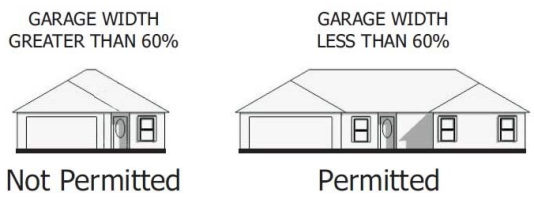
(g)
The Planning Board may require larger setbacks for lots that are adjacent to other subdivisions outside of the proposed narrow lot development.
(8)
Single Family Dwellings. Single family dwellings in the CD District shall only be located on lots with a minimum lot area of 10 acres.
(9)
Zero Lot Line Dwellings. The following standards shall apply to any zero lot line dwellings:
(a)
The minimum lot area shall be 5,500 square feet per dwelling.
(b)
The minimum lot width shall be 40 feet.
(c)
The dwelling shall be set back a minimum of 25 feet from the street right-of-way line regardless of whether the front yard setback is part of an individual lot or part of the common open space.
(d)
There shall be a minimum separation distance of 20 feet between all principal buildings as measured from the exterior side of the buildings' façade.
(e)
No more than 75% of the lot shall be covered by the principal building, all accessory structures, and pavement.
(f)
The Planning Board shall review the elevations of the dwellings to ensure that each dwelling has adequate privacy based on the location of windows and doors as it relates to adjacent buildings.
(g)
Where a zero lot line dwelling is constructed along a lot that is not part of the development or not owned by the same owner, the applicant shall be required to obtain a 5 foot wide perpetual wall maintenance easement along the adjacent lot and parallel with such wall.
(10)
Sexually Oriented Businesses. The following standards shall apply to any sexually oriented business:
(a)
A sexually oriented business shall be set back a minimum of 1,000 feet from any area zoned as a residential district or zoned for residential use.
(b)
A sexually oriented business shall be set back a minimum of 1,000 feet from any nursery school, day care, educational institution (K-12), or cultural institution, whether public or private, governmental, religious or commercial, where such use is attended by persons that are younger than 18 years of age.
(c)
A sexually oriented business shall be set back a minimum of 1,000 feet from any active parks, playgrounds, and ball field.
(d)
A sexually orientated business shall be set back a minimum of 1,000 feet from any other sexually oriented business and 1,000 feet from any 2 of the following establishments:
(i)
Any business authorized to sell beer or intoxicating liquor for consumption on the premises;
(ii)
Pawn shops;
(iii)
Pool or billiard halls;
(iv)
Uses designed to attract minors (e.g., video game arcades, parks, amusement rides, etc.); and
(v)
Night clubs.
(e)
A sexually oriented business shall be set back a minimum of 1,000 feet from any religious place of worship.
(f)
A sexually oriented business shall be set back a minimum of 750 feet from the right-of-way of any divided, limited access highway including but not limited to applicable portions of Interstate 75.
(g)
Advertisements, displays or other promotional materials posted or displayed at a sexually oriented business shall not be shown or exhibited so as to be visible to the public from pedestrian sidewalks or walkways, or from any other public area. This prohibition shall not apply to the signage permitted in accordance with Section 154.11: Sign Standards.
(h)
All building openings, entries, doorways, windows, and the like, at any sexually oriented business shall be located, covered, or screened in such a manner as to prevent any view into the interior of any such sexually oriented business from the exterior of the structure of any public area.
(i)
No screens, loudspeakers or sound equipment shall be used by a sexually oriented business that can be seen or discerned by the public from any public area.
(j)
Any site plan or zoning compliance permit application shall include maps and other information that graphically demonstrates compliance with the location requirements set forth herein, and compliance with all setback, landscaping, screening, parking, loading, signage, yard, and structural requirements of the applicable zoning district.
(k)
Whether the location of a sexually oriented business satisfies the criteria of this chapter shall be determined by measuring the straight-line distance, without regard for intervening structures, from the closest exterior structural wall or section of wall enclosing the sexually oriented business to the nearest lot line of the other use in question.
(11)
Kennels and Animal Boarding. The following standards shall apply to any kennel or any animal boarding activities:
(a)
Care and boarding of animals shall be limited to small animals and may not include cattle, horses, swine, or other similarly sized animals, except in the CD District.
(b)
All activities other than off-street parking and loading/unloading shall be conducted within a fully enclosed structure. Outdoor runs or activity areas shall be permitted in the LI, GB and HB Districts where the area of the outdoor run is set back a minimum of 200 feet from any residential zoning district.
(c)
Structures shall be designed and maintained in a manner to prevent the development of unsanitary conditions that could result in unpleasant odor or vermin nuisance.
(d)
Rooms intended to accommodate animals shall be insulated, or otherwise soundproofed and vented so that animal noises will not be audible at any point on the perimeter of the property.
(e)
A solid wood fence or masonry wall with a minimum height of 6 feet shall be constructed where a kennel or animal board facility is located adjacent to a residential zoning district.
(12)
Veterinarian Offices (No Boarding). The following standards shall apply to any veterinarian offices that do not have overnight boarding:
(a)
The care of animals in veterinarian offices shall be limited to small animals and may not include cattle, horses, swine, or other similarly sized animals, except in the CD District.
(b)
All activities, other than off-street parking and loading/unloading, shall be conducted within a fully enclosed structure.
(c)
Outdoor runs shall be prohibited.
(d)
Boarding of animals shall be prohibited with the exception that a veterinarian office may have provisions for limited overnight stays necessary for the care of sick or injured animals.
(e)
Rooms intended for the care or grooming of animals shall be insulated, or otherwise soundproofed and vented so that animal noises will not be audible at any point on the perimeter of the property.
(13)
Bars, Taverns, and Night Clubs. The following standards shall apply to any bar, tavern, or night club:
(a)
The principal building shall be set back a minimum of 35 feet from any adjacent residential lot.
(b)
New uses shall be set back a minimum of 500 feet from any public or institutional use. Such setback requirement shall not apply to restaurants that have a bar or tavern that comprises less than 50% of the floor area.
(c)
Outdoor speakers shall be prohibited in the CC District. Outdoor entertainment shall be subject to the city's noise ordinance.
(d)
Any outdoor dining shall be subject to the applicable provisions of § 154.06(A).
(14)
Drive-In Restaurants. The following standards shall apply to any drive-in restaurant:
(a)
All driveways shall be set back a minimum of 100 feet from the intersection of 2 arterial roads or 50 feet from the intersection of an arterial road and any other street, as determined by the City Engineer.
(b)
If the drive-in restaurant has a drive-through service, such facility shall also comply with the drive-through standards of § 154.06(A).
(c)
All buildings, structures, parking, and vehicular circulation areas shall be set back a minimum of 50 feet from any lot line that abuts a residential zoning district.
(15)
Commercial Recreation Facilities (Indoors). The following standards shall apply to any indoor commercial recreation facilities:
(a)
All activities related to the principal use, except parking, shall be located within an enclosed building.
(b)
All structures shall be set back a minimum of 50 feet from all lot lines and street rights-of-way.
(c)
When located adjacent to a residential lot, there shall be a solid fence or masonry wall that is at least 6 feet in height that shall be located along the lot line adjacent to the residential use.
(d)
New uses shall be located along an arterial or collector street, as defined by the City Engineer. Access shall not be provided from a street that primarily serves a residential neighborhood.
(16)
Commercial Recreation Facilities (Outdoors). The following standards shall apply to any outdoor commercial recreation facilities:
(a)
All structures shall be set back a minimum of 100 feet from all lot lines and street rights-of-way.
(b)
When located adjacent to a residential lot, there shall be a solid fence or masonry wall that is at least 6 feet in height that shall be located along the lot line adjacent to the residential use.
(c)
The Planning Board may require portions of the site with high activity areas to be enclosed by a fence having a minimum height of 6 feet.
(d)
New uses shall be located along an arterial or collector street, as defined by the City Engineer. Access shall not be provided from a street that primarily serves a residential neighborhood.
(17)
Community Centers, Theaters, Cultural Institutions, and Religious Places of Worship. The following standards shall apply to any community center, theater, cultural institution, or religious place of worship:
(a)
New uses shall be located along an arterial or collector street, as defined by the City Engineer.
(b)
All activities related to the principal use, except parking, shall be located within an enclosed building unless outside activities are approved as a permitted accessory use or if the proposed activity is allowed in the applicable zoning district and it meets all the required standards.
(18)
Automated Teller Machines (ATMs). The following standards shall apply to any ATM:
(a)
ATMs are permitted when attached to a principal building or as a stand-alone unit. ATMs are only permitted in the CC District if they are attached to the principal building (i.e., walk-up ATM).
(b)
ATMs that are part of a drive-through facility shall be located in the side or rear yard.
(c)
ATMs that are built into the side of the principal building and are designed for walk-up customers may be located on any façade and in any yard.
(d)
No part of an ATM structure shall exceed 15 feet in height unless the ATM is built into the side of the principal building.
(e)
ATMs shall be set back a minimum of 50 feet from any adjacent lot that is in a residential zoning district and 20 feet from all other lot lines.
(f)
ATMs that are designed for drive up service by customers in a vehicle shall be subject to the requirements of Section § 154.06(A)(4)(h).
(19)
Medical or Dental Clinics/Offices and 24-Hour Urgent Care. The following standards shall apply to any medical or dental clinic/office or 24-hour urgent care establishment:
(a)
Such uses may include accessory services such as laboratories and pharmacies for the use of patients visiting medical practitioners in the clinic.
(b)
All such accessory services shall be located wholly within the building and shall not include a separate entrance.
(c)
The hours during which these services are provided shall be the same as those during which medical practitioners are receiving patients.
(20)
Funeral Homes and Mortuaries. The following standards shall apply to any funeral homes or mortuaries:
(a)
All hearses, limousines, and other related business vehicles shall be stored within an enclosed building when not in use.
(b)
The required number of off-street parking spaces shall be designed in parallel aisles so as to facilitate the structuring of funeral processions that leave from the funeral home site to travel to the cemetery.
(c)
The principal building and any accessory structure used in conjunction with the typical activities of a funeral home or mortuary shall be set back a minimum of 50 feet from any adjacent residential lot line.
(21)
Bed and Breakfast Establishments. The following standards shall apply to any bed and breakfast establishments:
(a)
The operator of the bed and breakfast establishment shall reside on the property.
(b)
The establishment shall conform to state health and building code requirements and shall show proof of inspection or proof of proper operating licenses by the state and/or county prior to the issuance of the certificate of occupancy.
(c)
Only overnight guests shall be served meals unless otherwise authorized as part of the special use approval.
(d)
The facility shall be limited to no more than 4 guestrooms with a maximum guest capacity as determined by fire and building regulations.
(e)
No external vending machines shall be allowed.
(22)
Hotels and Motels. The following standards shall apply to any hotel or motel:
(a)
When located adjacent to a residential lot, there shall be a solid fence or masonry wall that is at least 6 feet in height that shall be located along the lot line adjacent to the residential use.
(b)
The proposed use shall be located along an arterial or collector street, as defined by the City Engineer.
(23)
Automotive Junk Yard or Salvage Center. The following standards shall apply to any automotive junk yard or salvage center:
(a)
There shall be a minimum lot area of 10 acres.
(b)
All aspects of a junk yard or salvage center shall conform to applicable state and federal regulations
(c)
Any structures associated with the use, with the exception of fencing, shall be set back a minimum of 250 feet from the lot line of any adjacent residential lot line.
(d)
Exterior junk piles or storage of materials shall not exceed 15 feet in height and shall be arranged in a manner (with drives for accessibility) for fire protection purposes.
(e)
No burning of junk or other materials shall be permitted.
(f)
The area of the site where junk or vehicles are stored must be enclosed by a fence with a minimum height of 8 feet with the exception of entrances or exits into the area. Such fence shall be designed to completely screen the use. Such fencing may be incorporated into the screening required by Section 154.09: Landscaping Standards.
(24)
Automotive Repair (Heavy). The following standards shall apply to any automotive repair (heavy):
(a)
A heavy automotive repair establishment shall be subject to the same requirements as an automotive service station as established in § 154.04(G)(25).
(b)
The storage of non-operational vehicles for longer than 1 week shall be permitted if stored in the rear yard and screened by a solid wall or fence with a minimum height of 6 feet.
(c)
The principal building shall be set back a minimum of 100 feet from any adjacent residential lot. Parking for the storage of vehicles, whether operational or non-operational, shall be set back a minimum of 50 feet from any adjacent residential lot.
(25)
Automotive Service Stations, Parts Sales, and Automotive Fuel Sales. The following standards shall apply to any automotive service stations, parts sale, or automotive fuel sales:
(a)
Lot Area and Setback Requirements.
(i)
The principal building shall be set back a minimum of 40 feet from the front lot line. In no case shall the front yard setback be smaller than that required by the applicable zoning district.
(ii)
Fuel pumps shall be set back a minimum of 20 feet from all lot lines and 50 feet from all adjacent residential lot lines.
(iii)
Canopies shall be set back a minimum of 10 feet from all lot lines and 25 feet from all adjacent residential lot lines.
(b)
All hydraulic hoists, oil pits, and all lubricants, greasing, vehicle washing and repair equipment shall be enclosed entirely within a building. No outdoor disassembly or repair of motor vehicles shall be permitted.
(c)
Activities shall be limited to:
(i)
The sale of automotive fuel;
(ii)
The servicing of motor vehicles with minor repair work;
(iii)
Hand washing of vehicles within an enclosed building;
(iv)
The retail sale of vehicle parts and products relating to minor repair work such as, but not limited to, oil, grease, antifreeze, batteries, windshield wipers, etc.
(d)
Space for overnight parking (including any off-street parking for semi-trucks or tractor-trailers), overnight accommodations, or the inclusion of showers within the building shall be prohibited.
(e)
Any major repair work, including automobile body repair and painting, automobile glass work, automobile transmission work, automobile engine overhaul and repair, and radiator repair work shall be classified as "automotive repair (heavy)" and shall be subject to § 154.04(G)(24).
(f)
Vehicles being serviced or awaiting same shall be stored for no longer than 7 days on the site if in unenclosed areas.
(g)
Any removal of pumps or tanks shall be undertaken in accordance with safe accepted practices as prescribed by the National Fire Protection Association and filling depressions to the grade level of the lot.
(h)
The maximum width of any driveway shall be 30 feet as measured at the lot line.
(i)
There shall be no more than 2 driveway openings along any frontage. The spacing of multiple driveways shall be in accordance with § 154.10(F).
(j)
The storage and disposal of solid waste and recyclable materials, including used or discarded motor vehicle parts or equipment, and fluids, shall comply with all applicable federal, state, and local requirements.
(k)
Outdoor solid waste and recyclable storage areas shall be screened in accordance with § 154.09(G).
(26)
Vehicle Washing Establishments. The following standards shall apply to any vehicle washing establishment:
(a)
All structures shall be set back a minimum of 50 feet from any adjacent residential lot line. Any self-service washing establishment or portion of a building used for self- service washing shall be set back a minimum of 150 feet from any adjacent residential lot line.
(b)
Vacuuming and/or steam cleaning equipment may be located outside, but shall not be placed in the yard adjoining a residential zoning district. Such areas shall be set back a minimum of 150 feet from any adjacent residential lot line.
(c)
Mechanical drying equipment and/or hand drying of motor vehicles must be performed on the premises.
(d)
An exit driveway of not less than 40 feet in length shall be provided between the exit doors and the street. Such driveway shall comply with the surfacing requirements of § 154.10(C)(5)(f).
(e)
The use shall be subject to the stacking space requirements of § 154.10(C)(6).
(f)
The proposed use shall be located along an arterial or a major collector street, as defined by the City Engineer.
(27)
Building Materials Sales Yards and Contractor Yards. The following standards shall apply to any building material sales yards and contractor yards:
(a)
The proposed use shall be located along an arterial or a major collector street, as defined by the City Engineer.
(b)
All outdoor storage areas shall comply with the outdoor storage requirements of § 154.06(A).
(28)
Business and Industrial Sales/Service Establishments. Any retail sales (i.e., sales or services to walk-in customers) shall be limited to an area that does not exceed10 percent of the gross floor area.
(29)
Chemical Processing or Manufacturing. The following standards shall apply to any chemical processing or manufacturing:
(a)
As part of any review, the applicant shall provide the city a list of any noxious matter or chemicals used during the manufacturing process and document the safety precautions that will be used to prevent potentially hazardous chemical reactions or contamination.
(b)
If the applicant can demonstrate that due to the specific types of chemicals, material, or processes, that there is no potential for hazardous reactions or contaminate, the Zoning Administrator shall have the authority to review the use as a "light manufacturing and assembly use" or as a "heavy manufacturing facility."
(30)
Reserved.
(31)
Soil and Mineral Extraction Activities. The following standards shall apply to all soil removal or mineral extraction activities:
(a)
The applicant shall be responsible for receiving approval of all applicable permits from the state, federal government, and/or county, where applicable, prior to the Planning Board reviewing the special use application. If city approval is required prior to the issuance of another permit, the Planning Board may approve the special use permit with conditions that prevent the issuance of a zoning permit until all permits are approved.
(b)
The special use application shall be reviewed at a public hearing of the Planning Board with notice given in accordance with § 154.03(B)(8).
(c)
The applicant must demonstrate that such operations will not be detrimental to the vicinity or surrounding properties.
(d)
All equipment used in these operations shall be constructed, maintained, and operated in such a manner as to eliminate so far as practical, noise, vibration, or dust which would injure or be a nuisance to persons living in the vicinity.
(e)
All structures and activity areas shall be set back a minimum of 100 feet from all lot lines and street rights-of-way.
(f)
Such uses shall be enclosed by a fence 6 feet or more in height for the entire periphery of the development. Fences shall be adequate to prevent trespassing and shall be placed no closer than 50 feet to the top or bottom of any slope. No sand or gravel shall be removed or stored or overburden stored within 100 feet of any lot line not owned or controlled by the developer or operator of said business or his agent nor shall such mineral extraction business be conducted closer to any lot line or street so that the area contiguous or adjacent thereto does not have adequate lateral support.
(g)
All work conducted in connection with such operations shall be done between the hours of 7:30 a.m. and 5:00 p.m.
(h)
No rehabilitated slope shall exceed an angle of 45 degrees.
(i)
All areas within any single development shall be rehabilitated progressively as they are worked out or abandoned to a condition of being entirely lacking in hazards, inconspicuous, and blended with the general surrounding ground form so as to appear reasonably natural. Areas shall be completely and continually drained of water when not in use or not supervised by a watchman. All slopes and banks shall be reasonably graded and treated to prevent erosion or any other potential deterioration. Such operations shall be conducted so as not to leave or cause soil banks to exist.
(j)
All equipment and structures shall be removed from the mined area when all mining has been completed.
(k)
Truck routes shall be established for movement in and out of the development in such a way that it will minimize the wear on public streets and prevent hazards and damage to other properties in the community.
(l)
There shall be filed with the City Clerk, a bond, payable to the city and conditioned on the faithful performance of all requirements contained in the approved restoration plan. The rate of the required bond shall be fixed by ordinance of the City Council. The bond shall be released upon written certification of the Zoning Administrator that the restoration is completed and in compliance with the restoration plan.
(m)
Extraction activities located within a WP Overlay District shall also be in compliance with § 154.05(E).
(32)
Active Parks, Playgrounds, and Ball Fields. The following standards shall apply to any active parks, playgrounds, or ball fields:
(a)
All ball fields, playgrounds, and other areas of the park where there is significant activity and potential noise shall be set back a minimum of 100 feet from all adjacent residential lot lines.
(b)
For golf courses, all greens and fairways shall be set back a minimum of 150 feet from all adjacent residential lot lines as measured from the centerline of the green or fairway.
(c)
Only retail uses that are customarily accessory or incidental to the main recreational use shall be permitted and shall include such uses as refreshment stands, souvenir stands, and concession stands.
(33)
Utility Structures. The following standards shall apply to any utility structure:
(a)
Utility structures, to the maximum extent feasible, shall be located to the rear or side of lots.
(b)
If the applicant demonstrates to the Planning Board that the utility structure can only be located in a front yard, the structure shall be landscaped in a manner that will allow access to the unit but otherwise buffer the view of the structure. The applicant shall be required to provide a landscaping plan as part of the subject application.
(c)
Utility structures in the LI and GI districts shall not be subject to this screening requirement.
(34)
Cemeteries. The following standards shall apply to any cemetery:
(a)
The minimum lot area shall be 20 acres.
(b)
Offices, crematoriums, mausoleums, and other buildings or structures necessary to the operation of a cemetery shall be permitted as accessory use to a cemetery.
(c)
New cemeteries shall be located along a collector street, as defined by the City Engineer, or a street with a higher classification.
(d)
All buildings and structures shall be set back a minimum of 50 feet from all lot lines. Burial plots, markers, and similar structures that have a height of less than 15 feet shall only have to be set back a minimum of 30 feet from all lot lines.
(e)
Mausoleums or crematoriums shall be set back a minimum of 200 feet from adjacent lot lines and street right-of-way lines.
(f)
The entire lot shall be enclosed with an ornamental fence, wall or compact planting barrier. Such fence, wall, or planting barrier shall be at least 4feet in height and shall contain the same amount of landscaping as required for Buffer Type C (Light) in § 154.09(E).
(35)
Educational Institutions (All Types). The following standards shall apply to any educational institution:
(a)
All building shall be set back a minimum of 50 feet from all street right-of-way lines and adjoining lot lines.
(b)
The Planning Board may waive the setback requirement if the applicant is proposing to occupy an existing building in the LD District.
(c)
New educational institution buildings shall be located along an arterial or a collector street, as defined by the City Engineer.
(36)
Fraternal, Charitable, and Service Oriented Clubs. The following standards shall apply to any fraternal, charitable, or service oriented clubs:
(a)
Accessory uses necessary to the operation of such use, such as clubhouses, restaurants, bars, swimming pools and similar activities, shall be permitted if they comply with the applicable standards however, such uses where the conduct of business is the principal activity, shall be prohibited.
(b)
New fraternal, charitable, and service oriented clubs shall be located along an arterial or collector street, as defined by the City Engineer.
(37)
Institutions for Human Medical Care. The following standards shall apply to any institutions for human medical care:
(a)
The minimum street frontage shall be 200 feet.
(b)
All structures and activity areas shall be set back a minimum of 50 feet from all lot lines and street rights-of-way.
(c)
New hospitals shall be located along an arterial street, as defined by the City Engineer.
(d)
Helipads may be permitted on the site if the application demonstrates that the setbacks and location of such helipad are so located as to minimize noise and wind impacts on adjacent residential uses or residentially zoned land.
(38)
Nursery Schools or Day Care Centers (Children or Adults). The following standards shall apply to any nursery schools or day care centers:
(a)
For nursery schools or child day care centers, there shall be a minimum of 50 square feet of fenced outdoor play area per child at maximum occupancy.
(b)
All outdoor play areas shall be enclosed by a fence or wall with a minimum height of 5 feet. If the lot abuts a lot that is in a residential zoning district, the fence or wall shall be a minimum of 6 feet tall with a continuous evergreen screen adjacent to the residentially zoned lot.
(c)
An on-site drop-off area shall be provided at the main entrance to the facility sufficient to accommodate 4 automobiles for facilities with 20 or fewer children or adults plus 1 additional vehicle for each additional 10 children or adults served.
(d)
The proposed use shall be located along an arterial or collector street, as defined by the City Engineer.
(e)
Use of outdoor play areas shall be limited to between the hours of 8:00 a.m. and 8:00 p.m.
(f)
The Zoning Administrator has the power to require additional fencing, screening and/or other measures deemed necessary to protect the health, safety and welfare of children using day care centers in commercial, industrial, or other high hazard areas, or to deny a request to locate a facility in such areas based on health and safety considerations.
(39)
Vertical Mixed Use Buildings. The following standards shall apply to any vertical mixed use buildings:
(a)
Residential dwellings are permitted within vertical mixed use buildings when located above the first floor.
(b)
All other use types within the following use categories may be permitted on all floors of the building provided the use type is allowed in the zoning district and the use type complies with all applicable standards:
(i)
Eating and drinking establishments;
(ii)
Indoor recreation and entertainment;
(iii)
Offices;
(iv)
Retail sales and service; and
(v)
Tourism.
(c)
Use types shall be permitted in the manner specified in Table 154.04-2.
(d)
Offices may be located on the ground or first floor but shall not alter the building in any manner as to eliminate the commercial character of the building or to cover any door or window openings on the ground or first floor.
(e)
Areas for the collection and storage of refuse and recyclable materials shall be located on areas of the site that are convenient for both the residential and nonresidential uses. For new vertical mixed-use buildings, such areas shall not be located in front of the building.
(f)
For new vertical mixed use buildings in the GB or HB Districts, the following standards shall apply:
(i)
The design of the site layout shall ensure that the residential units have privacy from other uses on the same or adjacent site.
(ii)
The use of shared parking provisions shall be incorporated into mixed-use projects in compliance with § 154.10(C)(4)(f).
(iii)
Commercial loading areas shall be located away from residential units and shall be screened from view.
(iv)
Areas for the collection and storage of refuse and recyclable materials shall be located on the site in locations that are convenient for both the residential and nonresidential uses.
(v)
A mixed-use project shall be designed to provide residential units with public or private outdoor space, which may be in the form of roof gardens or individual balconies, or other means acceptable to the Planning Board.
(40)
Parking Garages. The following standards shall apply to any parking garage:
(a)
Below-grade parking garages are encouraged over above-grade garages.
(b)
Above grade garages are subject to the following architectural standards except if they are not visible from a public right-of-way:
(i)
Parking garages shall meet the architectural standards established for the applicable zoning district.
(ii)
Parking garages shall be constructed of materials of similar quality to the principal buildings on the site.
(c)
The façades of parking garages that face public streets and are not occupied by commercial, office, institutional, public uses, or civic uses shall be articulated through the use of 3 or more of the following architectural features to make the parking garage appear similar in character to an occupied building:
(i)
Windows or window-shaped openings with decorative mesh or similar features as approved by the city;
(ii)
Masonry columns;
(iii)
Decorative wall insets or projections;
(iv)
Awnings;
(v)
Changes in color or texture of materials;
(vi)
Integrated landscape planters; or
(vii)
Other similar features approved by the city.
(d)
Vehicle entries to off-street parking garages shall be integrated into the placement and design of adjacent buildings or oriented away from the primary street frontage. At a minimum, parking garages shall have user vehicles access from locations that minimize conflicts with pedestrian circulation.
(41)
Public Impound Lots. The following standards shall apply to any public impound lot:
(a)
The public impound lot shall be owned and operated by the municipality.
(b)
The public impound lot shall be effectively screened from any residentially zoned property by means of a masonry wall, earthen mound, opaque fence, or landscaping all of which shall be not less than 6 feet high.
(c)
Vehicles stored in the public impound lot shall be located on a hard surface of asphalt or Portland cement concrete.
(42)
Food Trucks. The following standards shall apply to any food truck:
(a)
No person may operate a food truck in the City of Tipp City without a food truck permit issued by the City.
(b)
The food truck vendor must obtain expressed written consent of the property owner to locate/operate a food truck on private property.
(i)
The written consent must be kept in the food truck at all times that the food truck is on the property.
(c)
Food trucks and vendor locations will be maintained in a clean and sanitary condition at all times.
(i)
The food truck vendor is responsible for the proper disposal of waste and trash associated with operation.
(ii)
Vendors will remove all waste and trash from their location at the end of each day and as needed to maintain cleanliness.
(d)
Electric, gas, and water will be self-contained within the food truck.
(e)
One Temporary Sidewalk Sign is permitted in accordance with Code § 154.11(K)(5).
(f)
The food truck vendor shall obtain all other required state and local permits (ex. Health Department, Fire Department).
(g)
The operation of food trucks are prohibited on Main Street between First Street and the CSX railroad tracks, with the exception that during approved and/or sanctioned downtown events, food trucks can operate anywhere on Main Street.
(43)
Narrow Zero Lot Line Developments. The following standards shall apply to any Narrow Zero Lot Line dwelling:
(a)
Conjoined residential structures shall contain no more than six individual inlots/homes.
(b)
There shall be a minimum separation distance of 20 feet (10 feet each side yard) between conjoined residential structures as measured from the exterior side of the buildings' facade.
(c)
The Planning Board shall review the elevations of the dwellings to ensure that each dwelling has adequate privacy based on the location of windows and doors as it relates to adjacent buildings.
(d)
Developments shall have a minimum green space requirement of 35 percent across the entire subdivision.
(e)
In addition to the off-street parking requirements set forth in § 154.10, developments must also provide an additional 0.25 spaces per dwelling unit of private, off-street surface parking.
(f)
All exterior façades to be sided with a 35 percent minimum combination of wood, brick, stone, manufactured stone, stucco, cementious fiberboard, and/or hardy plank.
(g)
Architectural standards:
(i)
Front façades shall incorporate wall offsets in the form of projections and/or recesses in the facade plane a minimum of every 25 feet of facade frontage.
(ii)
Wall offsets shall have a minimum depth of 2 feet.
(iii)
In addition to wall offsets, front facades shall provide a minimum of three of the following design features for each residential unit that has a facade that faces onto a public or private street (See Figure 154.08-A.):
A.
One or more dormer windows or cupolas;
B.
A recessed entrance;
C.
A covered porch;
D.
Pillars, posts, or pilasters;
E.
One or more bay windows with a minimum twelve-inch projection from the façade plane;
F.
Eaves with a minimum six-inch projection from the facade plane;
G.
A parapet wall with an articulated design, which entails design variation rather than a simple rectilinear form; or
H.
Multiple windows with a minimum four-inch wide trim.
(iv)
To the degree practicable, all roof vents, pipes, antennas, satellite dishes, and other roof penetrations and equipment (except chimneys) shall be located on the rear elevations or configured to have a minimal visual impact as seen from the street.
(Ord. 5-14, passed 3-17-2014; Am. Ord. 6-17, passed 3-6-2017; Am. Ord. 35-17, passed 12-4-2017; Ord. No. 9-19, § 2, 4-15-2019; Ord. No. 20-19, § 2, 8-19-2019; Ord. No. 16-21, § 2, 6-21-2021; Ord. No. 4-23, § 2, 3-20-2023; Ord. No. 10-23, § 2, 5-1-2023; Ord. No. 9-24, § 2, 3-18-2024; Ord. No. 30-24, § 2, 11-18-2024)
§ 154.04(H) - Site development standards.
(1)
Measurements, Computations, and Exceptions.
(a)
Distance Measurements. Unless otherwise expressly stated, distances specified in this code are to be measured as the length of an imaginary straight line joining those points.
(b)
Lot-Area Measurements. The area of a lot includes the total horizontal surface area within the lot's boundaries.
(c)
Reductions in Area Prohibited. No lot, yard, court, parking or other space shall be reduced in area or dimensions so as to make said area or dimensions less than the minimum required by this code; and, if already less than the minimum required by this code, said area or dimensions shall not be further reduced. Exceptions to this standard shall only be granted if a reduction is approved as part of a conservation subdivision, variance approval, or administrative waiver approval.
(d)
Setbacks, Yards, and Lot Type Requirements.
(i)
Measurements. Setbacks refer to the unobstructed, unoccupied open area between the foundation or base of a structure and the property line (lot line) of the lot on which the structure is located. Setbacks shall not contain any structure except when in conformance with this code. See Figure 154.04-B.
Figure 154.04-B: Measurement of typical front, side, and rear yard setbacks.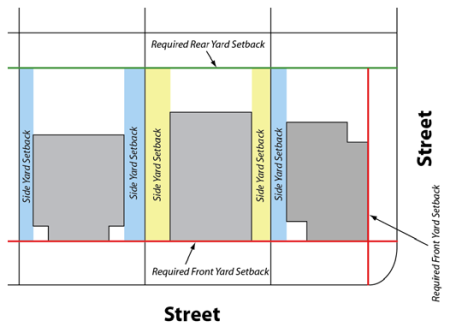
(ii)
Yards Required for Buildings. A yard or other open space required for a building shall not be included as part of a yard or other open space for another building.
(iii)
Front Yard Exception. In any residential district, a front yard setback shall not be required to exceed the average front yard setbacks of the existing front yards within the same block and within 100 feet of the principal building. Modification of the front yard in accordance with this section will not create a nonconforming lot unless the lot or structure does not meet other applicable provisions of this code. See Figure 154.04-C.
Figure 154.04-C: Illustration of the averaging of front yard setbacks. In a district
with a minimum front yard setback requirement of 50 feet, smaller setbacks may be
allowed if the average front yard setbacks are less than 50 feet.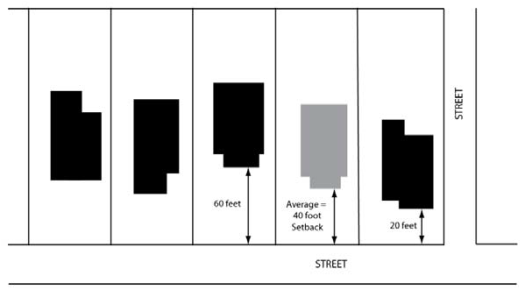
(iv)
Permitted Obstructions in Minimum Required Yards. Every part of a required yard shall be open to the sky and unobstructed except:
A.
As otherwise provided in this section;
B.
For accessory and temporary uses as allowed in Section 154.06: Accessory and Temporary Use Regulations;
C.
For landscaping as allowed in Section 154.09: Landscaping Standards;
D.
For parking and circulation as allowed in Section 154.10: Parking, Access, and Mobility Standards;
E.
For signage as allowed in Section 154.11: Sign Standards;
F.
For the ordinary projections of skylights, sills, belt courses, eaves, cornices and ornamental features projecting into any yard a distance not to exceed 18 inches;
G.
For the ordinary projections of chimneys and flues into any side or rear yard a distance not to exceed 18 inches; and
H.
For open or lattice-enclosed fire escapes, fireproof outside stairways, and balconies opening upon fire towers projecting into a side or rear yard not more than 5 feet.
(v)
Interior Lots.
A.
The required minimum front yard setback shall be measured from the street right-of-way or, where a right-of-way is not identified, the front lot line. See Figure 154.04-D.
B.
The lot line located directly behind the rear of the structure, as determined by the Zoning Administrator, shall be the rear lot line and the rear yard setback shall be applied. See Figure 154.04-D.
C.
All other lot lines shall be considered the side lot line and the side yard setback shall be applied. See Figure 154.04-D.
Figure 154.04-D: Typical yard locations for an interior lot.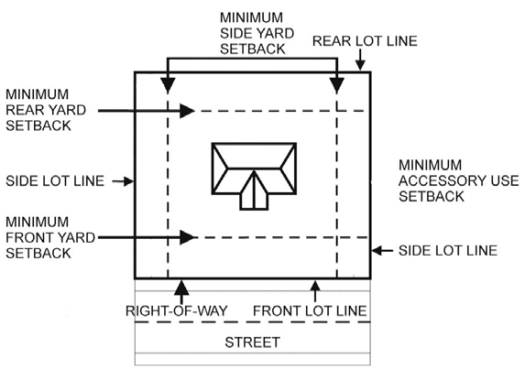
(vi)
Corner Lots. Lots that have street frontage on 2 intersecting streets shall be considered a corner lot, subject to the following:
A.
The required minimum front yard setback shall be provided from each street right-of-way or, where a right-of-way is not identified, the lot line adjacent to the street. See Figure 154.04-E.
B.
The lot line that runs parallel with the lot line along the narrowest street frontage shall be the rear lot line and the minimum rear yard setback shall be applied from such lot line. See Figure 154.04-E.
C.
All other lot lines shall be a side lot line and the minimum side yard setback shall be applied from such lot lines. See Figure 154.04-E.
D.
The minimum lot area of a corner lot shall be 20% larger than the minimum area required for an interior lot.
Figure 154.04-E: Typical yard locations for a corner lot.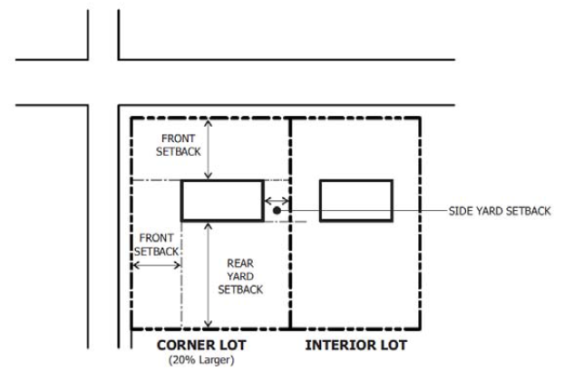
(vii)
Double Frontage Lots.
A.
Where a lot is considered a double (through lot) lot, the required minimum front yard setback shall be provided on all lot lines that abut a street. See Figure 154.04-F.
Figure 154.04-F: Yard locations on double frontage lots.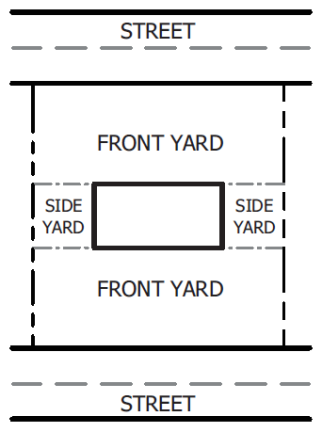
B.
The remaining lot lines not abutting a public road right-of-way shall be considered as side yards and shall have the required minimum side yard setback provided for each side lot line. See Figure 154.04-F.
C.
For the purposes of allowing accessory uses, including fences, that are allowed in a rear yard, the yard that is located to the rear of the principal building shall be considered the rear yard.
D.
Where alleys exist in the city, any lots that have frontage along the alley shall not be considered a through lot and shall either be regulated as an interior lot or corner lot depending on the location of the subject lot within the block.
(viii)
Panhandle Lots. Panhandle lots (flag lots) shall be discouraged and shall only be approved if necessitated by unique topographic features or other special physical conditions as deemed necessary by the Planning Board. Panhandle lots shall be subject to the following regulations:
A.
Flag or panhandle lots shall not be used to avoid the construction of a street.
B.
The stacking of panhandle lots shall be prohibited. See Figure 154.04-G.
Figure 154.04-G: This illustration shows the stacking of panhandle lots, which is
prohibited in Tipp City.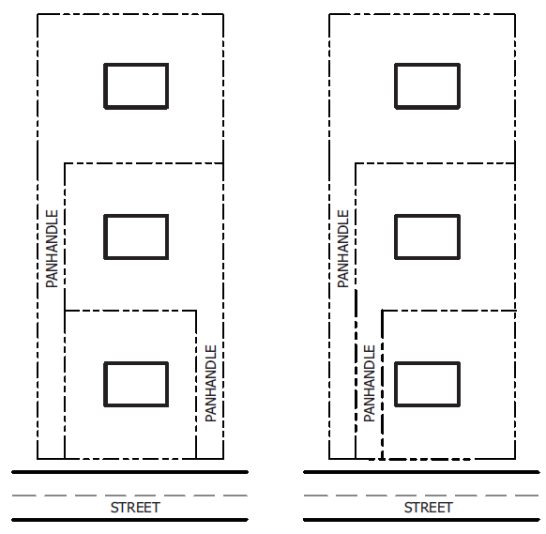
C.
The panhandle shall have a minimum width of 20 feet along the entire width of the panhandle. The maximum width shall be 40 feet.
D.
The minimum front yard setback requirement shall be measured from the lot line that creates the rear lot line of the adjacent lot as illustrated in Figure 154.04-H.
E.
The panhandle portion of the lot shall not be used for storage nor shall any structures be permitted in such portion of the lot.
Figure 154.04-H: Yard and front yard setback locations on a panhandle lot.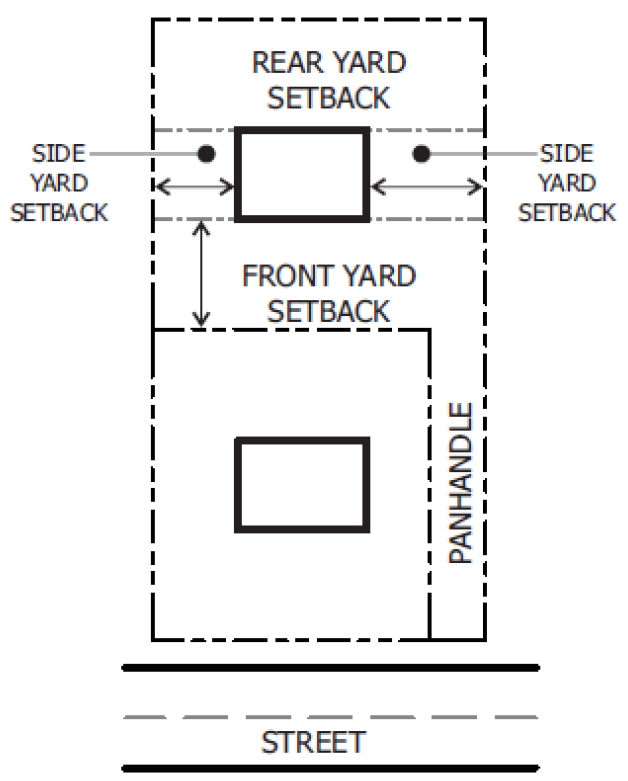
(ix)
Cul-de-Sac or Curved-Street Lot.
A.
For a cul-de-sac lot or a lot abutting a curved street, the front-yard setback shall follow the curve of the front property line (lot line). See Figure 154.04-I.
Figure 154.04-I: Setback line of a lot with frontage on a curved street or cul-de-sac.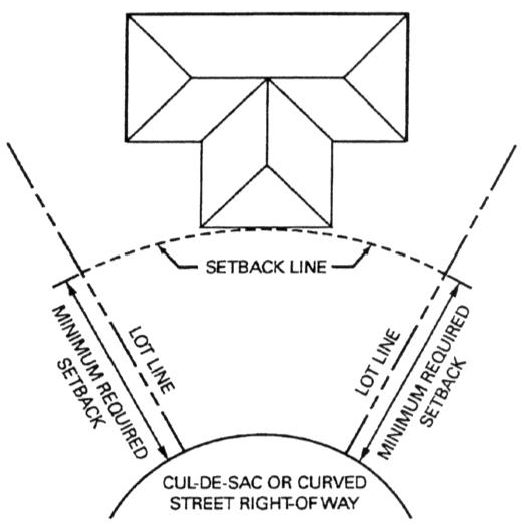
B.
Lots on a cul-de-sac, including panhandle lots, shall be required to have a minimum lot width of 40 feet measured at the right-of-way line.
C.
On a cul-de-sac roadway, knuckle, or eyebrow, the required 40-foot street frontage shall be required and measured at the street right-of-way on the curve of the cul-de-sac, knuckle, or eyebrow.
(x)
Other Lot Configurations. Where there is an instance of a lot configuration not addressed in the previous sections (e.g., interior, corner, panhandle, etc.), or where there is an atypical building orientation on any lot, the Zoning Administrator shall have the authority to make a determination regarding where front, rear, and side yard setbacks are required.
(e)
Lot Width and Street Frontage Measurements. Lot width is the distance between the side lot lines measured along the front yard setback line.
(f)
Height Measurement and Exceptions.
(i)
Height Measurement.
A.
Where specified in stories, building height shall be measured in number of stories above the finished grade for any elevation fronting on a public street including attics, half-stories, mezzanines, and at-grade structured parking. This excludes features that are less than one-half story or completely below grade, such as basements, cellars, crawl spaces, sub-basements, and underground parking structures.
B.
Where specified in feet, the building height shall be measured from grade to the highest point on the roof, regardless of roof type.
Figure 154.04-J: Measurement of building or structure height.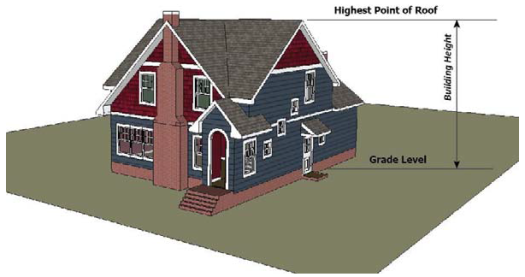
C.
Where specified fencing and wall height shall be measured in accordance with § 154.06(A)(4)(i).
D.
The height of all other structures shall be measured from the lowest grade adjacent to the structure to the highest point of the structure.
(ii)
Exceptions to Height Limits. Height limitations stipulated in this code shall not apply to barns, silos or other agricultural buildings or structures on farms (not located in an improved platted subdivision); to church spires, belfries, cupolas and domes, monuments, chimneys, smokestacks, flag poles; or to parapet walls extending not more than 4feet above the limiting height of the building. The height limitations do not apply to other appurtenances usually required to be placed above the roof level and not intended for human occupancy except where the height of such structures will constitute a hazard to the safe landing and take-off of an aircraft at an established airport.
(2)
General Site Development Standards.
(a)
Height Limit at Street Corners (Traffic Safety Visibility Triangle). Development proposed adjacent to any public or private street, driveway, or alley intersection, in every district shall be designed to provide a clear visibility area for pedestrian and traffic safety in compliance with § 154.10(F)(4)(d)(i).
(b)
Minimum Floor Area Requirements for Dwelling Units. In order to promote healthful living conditions and to stabilize the value and character of residential areas, dwelling units shall be erected, altered, moved, maintained and occupied only in accordance with the minimum floor area requirements established in Table 154.04-6. For the purposes of this calculation, the floor area shall include the total interior floor area of the applicable dwelling unit, excluding any floor area used for stairwells, elevator shafts, garages, basements that are not finished for use for human habitation, or any attached or detached accessory building or structure.
(3)
Site Development Standards for Residential Zoning Districts.
(a)
Table 154.04-7 establishes the minimum site development standards for residential base zoning districts.
(b)
There shall not be more than 1 principal building on an individual lot except as previously approved as part of an existing PD development or as part of an approved condominium project.
(c)
Multi-family dwellings shall be considered as 1 building for the purpose of determining front, side, and rear yard requirements. The entire group as a unit shall be subject to the minimum setbacks for the applicable zoning district and lot type. Each individual building shall meet all yard requirements for the appropriate district as though it were on an individual lot.
(4)
Site Development Standards for Nonresidential Zoning Districts.
(a)
Table 154.04-8 and Table 154.04-9 establish the minimum site development standards for all nonresidential base zoning districts, including the business and special zoning districts.
(b)
There can be more than 1 principal building on an individual lot. When multiple principal buildings are located on an individual lot, the spacing between the buildings shall be reviewed and approved during site plan review to ensure an adequate amount of building spacing and preservation of landscaping areas.
(Ord. 5-14, passed 3-17-2014; Ord. No. 23-19, § 2(Exh. A), 10-7-2019; Ord. No. 16-21, § 4(Exh. B), 6-21-2021)

