
Tipp City City Zoning Code
SECTION 154
08: - ARCHITECTURAL STANDARDS
§ 154.08(A) - Purpose.
The purpose of architectural standards is to ensure the exterior of new construction and additions to existing buildings are well designed, detailed, and crafted to embody high standards of architectural design and to ensure the long-term viability of commercial and industrial structures in the city.
(Ord. 5-14, passed 3-17-2014)
§ 154.08(B) - Multi-family residential architectural standards.
(1)
Multi-Family Dwellings.
(a)
Applicability. The standards of this subsection shall apply to all structures that contain 3 or more dwelling units.
(b)
Architectural Standards.
(i)
Front façades shall incorporate wall offsets in the form of projections and/or recesses in the façade plane a minimum of every 40 feet of façade frontage.
(ii)
Wall offsets shall have a minimum depth of 2 feet.
(iii)
In addition to wall offsets, front façades shall provide a minimum of 3 of the following design features for each residential unit that has a façade that faces onto a public or private street (See Figure 154.08-A.):
A.
One or more dormer windows or cupolas;
B.
A recessed entrance;
C.
A covered porch;
D.
Pillars, posts, or pilasters;
E.
One or more bay windows with a minimum 12 inch projection from the façade plane;
F.
Eaves with a minimum six-inch projection from the façade plane;
G.
A parapet wall with an articulated design, which entails design variation rather than a simple rectilinear form; or
H.
Multiple windows with a minimum four-inch wide trim.
(iv)
To the degree practicable, all roof vents, pipes, antennas, satellite dishes, and other roof penetrations and equipment (except chimneys) shall be located on the rear elevations or configured to have a minimal visual impact as seen from the street.
Figure 154.08-A: Image of a multi-family dwelling that utilizes multiple features
to break up the façade.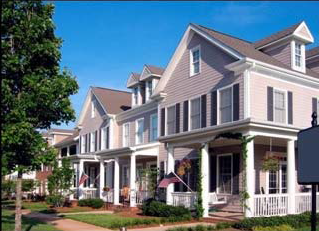
(Ord. 5-14, passed 3-17-2014)
§ 154.08(C) - Nonresidential architectural standards.
Any nonresidential building in the OS, GB, or HB district shall be subject to the following standards if the principal building has a gross floor area of 50,000 square feet or more.
(1)
General Design.
(a)
Buildings shall generally be parallel to the street they front unless an alternate orientation is consistent with adjacent development.
(b)
The primary entrances of buildings shall be oriented:
(i)
Towards a street along the perimeter of the development or towards a public space, if located adjacent to the proposed project; or
(ii)
Towards streets in the interior of the development if none of the building's façades has frontage on a public street.
(2)
Building Entrances. Large retail buildings shall have clearly defined, highly visible customer entrances featuring no less than 3of the following (See Figure 154.08-B.):
(a)
Canopies or porticos;
(b)
Overhangs;
(c)
Recesses/projections;
(d)
Arcades;
(e)
Raised corniced parapets over the door;
(f)
Peaked roof forms;
(g)
Arches;
(h)
Outdoor patios;
(i)
Display windows;
(j)
Architectural detail such as tile work and moldings integrated into the building structure and design; or
(k)
Integral planters that incorporate landscaped areas and places for sitting.
Figure 154.08-B: This building contains multiple elements that emphasize a clearly
defined customer entrance including an arched roof, display windows, distinct recesses,
etc. The building is also designed to reduce overall scale and mass of the structure
with changes in the wall planes.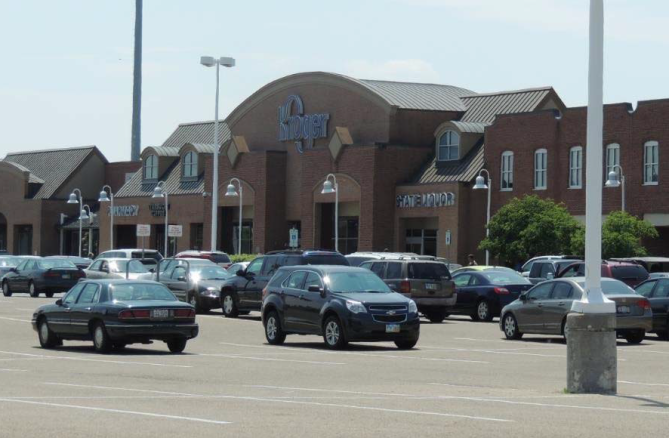
(3)
Building Massing.
(a)
Front façades of large retail buildings shall be articulated to reduce its mass, scale, and uniform appearance. Large retail buildings shall incorporate at least 1 of the following design elements on each façade facing a street (see Figure 154.08-B):
(i)
Changes in wall plane, such as projections or recesses, having a wall offset of at least 1 foot depth, and located a minimum of every 40 feet.
(ii)
Distinct changes in texture and color of wall surfaces;
(iii)
Variations in roof form and parapet heights;
(iv)
Vertical accents or focal points (e.g., pillars or columns of distinct color or material).
(b)
Side or rear façades that are subject to the applicability standards of this subsection and that exceed 40 feet in length shall have façade articulating elements such as columns and/or changes in plane, texture, color, or masonry pattern that show a distinct articulation every 40 feet of the façade length.
(c)
In all cases where an articulation is required above, such articulation shall have a minimum width of 10 feet and shall extend the full height of the first floor of the building.
(d)
The above massing requirements may be waived if the applicant proposes to include landscaping along the façade that complies with the following:
(i)
The landscaping includes trees that have a mature height of at least 20 feet that are planted a minimum of 30 feet on center along the façade;
(ii)
The landscaping includes shrubs planted along the base of the façade foundation at a rate of 2 shrubs for every 10 lineal feet;
(iii)
The landscaping is planted within 15 feet of the applicable building façade; and
(iv)
All landscaping complies with the plant material requirements of § 154.09(D) and the maintenance requirements of § 154.09(H).
(v)
Removal of the landscaping after planting shall be prohibited unless to replace damage or diseased plant materials. The elimination of the landscaping shall be considered a violation of this code.
(4)
Glazing. The primary façade (with customer entrances) or the front façade of large retail buildings shall include glazing in an amount equal to 25% of the first floor façade area. See Figure 154.08-C.
Figure 154.08-C: The top illustration shows a façade with less than 25% glazing of
the front façade while the bottom illustration shows a façade that complies with the
glazing requirements.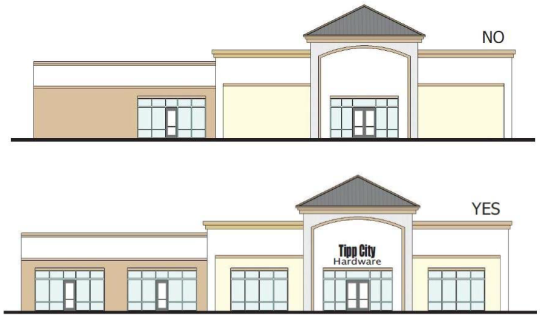
(Ord. 5-14, passed 3-17-2014)

