
Vestavia Hills City Zoning Code
ARTICLE 11
- SIGN REGULATIONS
§11.1.- Purpose.
The purpose of these Sign Regulations is to provide specific regulations for the control of all signs designed or intended to be seen by, or attract the attention of, the public, which may be erected, displayed, maintained, or altered in the City, for the public health, safety, and welfare of the residents. Further, it is the intent of this Ordinance to:
1.
Support implementation of the City of Vestavia Hills Comprehensive Plan 2004 - 2025 and any subsequent adopted amendments;
2.
Encourage the effective use of signs as a means of communication in the City;
3.
Acknowledge the public need of commercial and non-commercial individuality and expression balanced with the public need for an aesthetically pleasing community;
4.
Provide a pleasing overall environmental setting and community appearance deemed vital to the continued economic viability of the City;
5.
Protect and enhance the value of properties and to have signage appropriate to the planned character and development of each area in the City;
6.
Promote quality and consistent signage within the community;
7.
Provide signage standards by which all properties are to adhere;
8.
Assist the applicant in understanding how to apply for signage plan approval as required; and
9.
Promote the public health, safety and welfare of the City by preventing signs from becoming hazards or nuisances.
(Ord. No. 3099, 6-27-22)
§11.2. - Definitions.
For the purposes of this Article, certain words and terms are defined as herein indicated and shall apply to all parts of this Article unless otherwise specified.
Unless specifically defined herein, words or phrases used in this Article shall have the meaning otherwise ascribed to them in this Zoning Ordinance. Otherwise they shall have the same meaning as they have in their common usage.
11.2.1. Abandoned Sign. A sign that no longer correctly directs or exhorts any person, advertises a bona fide business, leaser, owner, product or activity conducted or product available on the premises where such sign is displayed.
11.2.2. Arterial. For the purposes of this Article, a thoroughfare or the applicable segment thereof with four or more lanes or having a posted speed limit of 40 or more miles per hour.
11.2.3. Attached Sign. A sign other than a freestanding sign, including wall signs, projecting signs and awning and canopy signs.
11.2.4. Awning Sign. A sign directly painted or otherwise directly affixed to an awning.
11.2.5. Banner. A flexible substrate on which copy or graphics may be displayed.
11.2.6. Banner Sign. A sign utilizing a banner as its display surface.
11.2.7. Canopy. A multisided overhead structure or architectural projection that is supported: 1) by attachments to a building on one or more sides and either cantilevered from such building or also supported by columns at additional points, or 2) supported by columns, but not enclosed by walls. The surface(s) and/or soffit of an a canopy may be illuminated by means of internal or external sources of light.
11.2.8. Canopy Sign. A sign directly painted or otherwise directly affixed to a canopy. When the sign appears on a canopy detached from the building, it is considered a "detached canopy sign".
11.2.9. Collector. For the purposes of this Article, a thoroughfare or the applicable segment thereof, excluding an "arterial," with three or more lanes or having a posted speed limit of 30 miles or more per hour. A thoroughfare with a continuous two-way left turn lane, shall be considered to have three lanes.
11.2.10. Commercial Message. Words, symbols, logos, pictures or any combination thereof that identify or which direct attention to a business, commodity, service or entertainment sold or offered for sale or a fee.
11.2.11. Copy Area, Sign Copy Area. The area in square feet that can be enclosed by the smallest rectangle or combination thereof that will encompass the actual copy of a sign. Signs that are of a regular geometric shape may be calculated based upon that shape, such as circles and triangles. Spacing between letters or between letters and graphics is counted. Where different height letters are used, the sign copy area is the area of the composite shape formed by circumscribing each letter with the smallest possible rectangle. Logos shall be considered part of the copy area. For attached signs, copy area refers to the message, not to the background.
Calculating copy area

circumscribe each letter, symbol, or graphic (including spacing between each) with
the smallest possible rectangle

Copy area equals the area of the composite shape formed by the individual rectangles
11.2.12. Department. The City of Vestavia Hills Department of Building Safety.
11.2.13. Double-Faced Sign. A sign constructed to display its message on the outer surfaces of two opposite planes. When only one face may be viewed from any vantage point along the thoroughfare, the area of one side (the larger, if applicable) is counted toward allowable sign area. If both faces may be viewed from the same vantage point, the area of both sides is counted.
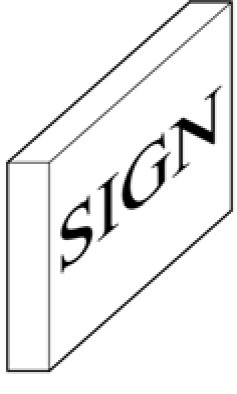
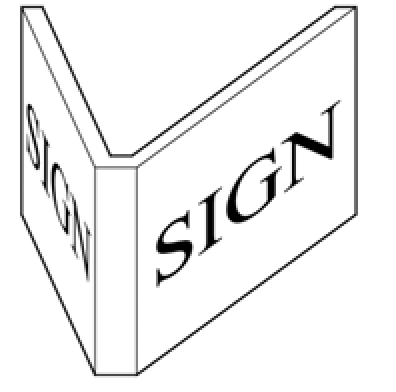
Double-faced signs: For the sign on top, copy area on only one face is counted.
For the sign above, copy area of both faces is counted.
11.2.14. Electrical Sign. Any sign containing electrical wiring attached or equipped to be attached to an electrical energy source.
11.2.15. Freestanding Sign. Any sign erected on a freestanding frame, foundation, mast or pole and not attached in any way to any building.
11.2.16. Holiday Decorations. Decorative elements of a temporary nature intended for the acknowledgement of a holiday or holiday season, exclusive of decorations that contain business, product sales, or service advertising content. Holiday decorations shall not be considered "signs."
11.2.17. Incidental Sign. A non-commercial sign, other than an official sign, providing information or direction for the convenience and necessity of the public.
11.2.18. Integrated Business Center. A group of commercial establishments on one or more parcels of land having shared access and/or shared parking.
11.2.19. Legible. Able to be read by a person of ordinary eyesight standing at ground level at a location on the public right-of-way or on another private property.
11.2.20. Local Street. For the purposes of this Article, a thoroughfare or applicable segment thereof with no more than two lanes and having a posted speed limit less than 30 miles per hour.
11.2.21. Mansard Sign. A sign integrated into a portion of a mansard roof or a mansard roof-like structure at the top of a wall and that does not extend more than two feet above the top of the wall or deck line, whichever is lower.
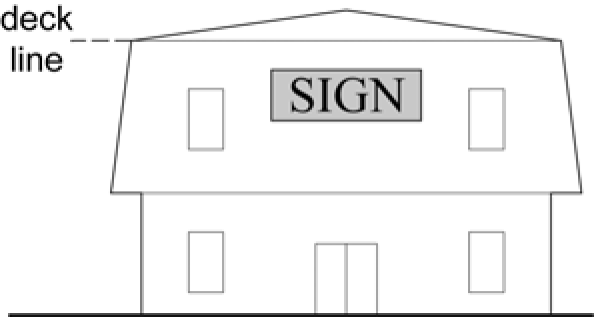
Mansard Sign
11.2.22. Marquee Sign. A changeable message sign mounted on a marquee or canopy.
11.2.23. Message Board. A sign that is designed to allow changing the message through the replacement of individual characters, or through electronic or other means.
11.2.24. Neighborhood. For the purposes of this Article, 1) A building or group of buildings containing ten or more multi-family dwelling units (regardless of ownership); or 2) Any area of 20 or more dwelling units on individual lots located within the same subdivision plat and sharing access to city streets through the same collector or local streets or any combination thereof.
11.2.25. Neighborhood Sign. A freestanding sign located at the principal entrance or entrances to a neighborhood.
11.2.26. Non-commercial Message. Any wording or other displays other than a commercial message. Non-commercial messages are considered to be on-premises messages.
11.2.27. Nonconforming Sign. A sign which is not in conformance with the provisions of this ordinance or amendment heretofore or hereafter enacted, where such sign lawfully existed prior to the enactment of this ordinance or amendment or prior to the application of this ordinance or amendment to its location by reason of annexation.
11.2.28. Off-Premise Sign. A sign that at any time bears a message related to a commercial establishment, activity, product, or service which is sold, produced, manufactured, available or furnished at a place other than the premises on which the sign is located.
11.2.29. Portable Sign. Any sign that is designed to be transported, including, but not limited to, such signs:
1.
With wheels removed;
2.
With chassis or support constructed without wheels;
3.
Designed to be transported by trailer or wheels;
4.
Converted to an A- or T-frame sign;
5.
Attached temporarily to the ground, structure, or other signs; or
6.
Mounted on a vehicle for advertising purposes, parked, and visible from the public right-of-way, except signs identifying the related business when the vehicle is being used in the normal day-to-day operations of that business.
11.2.30. Projecting Sign. An attached sign, other than a wall sign, permanently affixed at more or less a right angle to the exterior façade of the building to which it is attached.
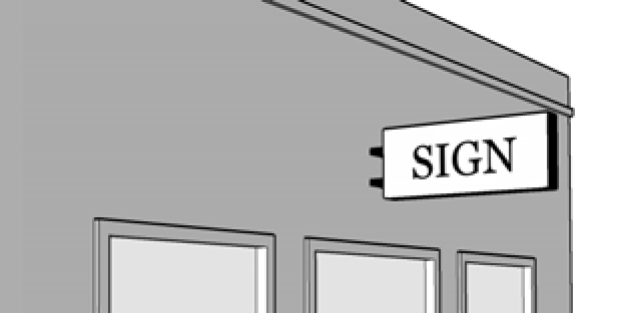
Projecting Sign
11.2.31. Real Estate Sign. Any sign pertaining to the sale, lease, or rental of land or buildings. Includes "Property for Sale," "For Rent," and "For Lease" signs.
11.2.32. Roof Sign. A sign that is mounted on the roof of a building or which is wholly dependent upon a building for support and which projects above the highest point of a building with a flat roof or the eave line of a building with a gambrel, gable or hip roof; or the deck line of a building with a mansard roof. A sign integrated into a mansard roof and that does not project above the deck line of such roof shall be considered a "mansard sign" and not a "roof sign."
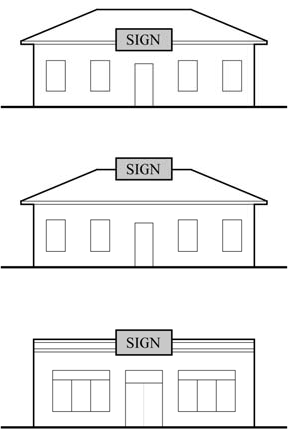
Roof Signs
11.2.33. Sign. Any identification, description, illustration or device illuminated or non-illuminated that directs attention to a product, services, place, activity, person, institution, business, idea, issue or solicitation, including any permanently installed or situated merchandise or any emblem, painting, banner, pennant, placard or temporary sign designed to advertise, identify or convey information.
11.2.34. Sign Area. The entire area of a sign within a single, continuous perimeter enclosing the extreme limits of writing, representation, emblem, or any figure or character, together with any frame or other material or color forming an integral part of the display or used to differentiate such sign from the background against which it is placed.
11.2.35. Sign Copy Area. See "Copy Area".
11.2.36. Sign Face. The entire area of a sign on which copy could be placed.
11.2.37. Sign Height. The vertical distance measured from the adjacent thoroughfare, grade level at the sign or upper surface of the nearest curb other than an elevated roadway, whichever permits the greatest height, to the highest point of said sign.
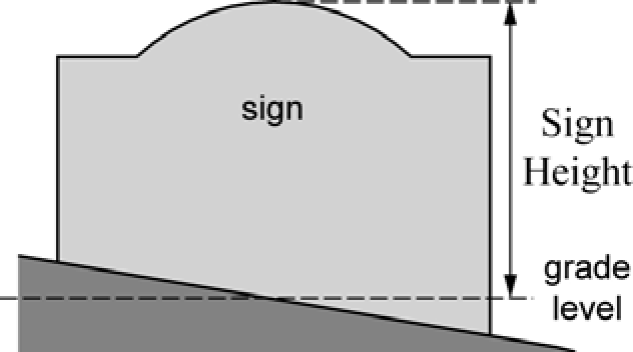
Sign Height (from grade level)
11.2.38. Sign Permit. A permit for the installation of a sign issued by the Building Official once such a sign complies with the regulations of this ordinance and/or any variance granted by the Board of Zoning Adjustment.
11.2.39. Sign Structure. Any structure that supports, has supported, or is capable of supporting a sign, including decorative cover.
11.2.40. Snipe Sign. A sign made of any material when tacked, nailed, posted, pasted, glued, or otherwise attached to: trees, poles, stakes, rocks, fences or other object visible from but not in the public right-of-way; trees, light or utility poles, park benches, bus shelters, waste receptacles, street markers, traffic control devices, guard rails, or similar objects located on public property or right-of-way. Historical markers and official signs identifying a natural feature are not considered "Snipe Signs".
11.2.41. Temporary Sign. A sign intended to display commercial messages of a transitory or temporary nature. Any such sign not permanently embedded in the ground, or not permanently affixed to a building or sign structure that is permanently embedded in the ground, is considered a temporary sign.
11.2.42. Unlawful Sign. A sign erected after the effective date of this ordinance and which is not in conformance with the provisions of said ordinance; a sign which the Building Official may declare as unlawful where it poses a danger to public safety by reason of dilapidation or abandonment; or, a nonconforming sign for which a permit required under a previous sign ordinance was not obtained.
11.2.43. Wall Sign. A sign attached, painted or erected against or on a building wall with the face in a parallel plane to the plane of the building wall.
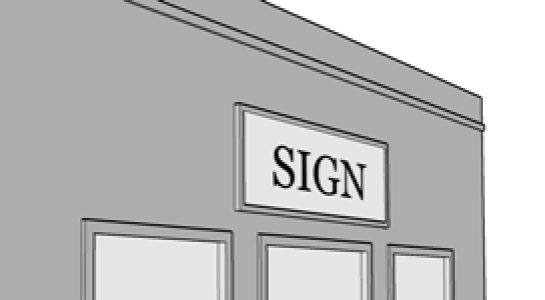
Wall Sign
11.2.44. Window Sign. Any sign attached, affixed, painted or otherwise imprinted on a window, whether applied to the interior or exterior surface of the glass. This shall also include signage attached, affixed, painted or imprinted on glass doors.
11.2.45. Wind Sign. A sign consisting of one or more flags, pennants, ribbons, spinners, streamers or captive balloons or other objects or material fastened in such a manner as to move freely upon being subjected to pressure by wind, whether the sign contains a commercial message or not. Wind signs exclude holiday or community decorations.
(Ord. No. 3099, 6-27-22)
§11.3. - General Provisions.
11.3.1. License Required. Sign contractors must be licensed by the City. No person shall perform any work or service for any person or for any government entity for compensation, in or in connection with the erection, construction, enlargement, alteration, repair, moving, improvement, maintenance, conversion or manufacture of any sign, or any work or service in connection with causing any such work to be done unless such person shall first have obtained a sign contractor's license from the City and paid the license fees provided for by the City License Code, or shall be represented by a duly licensed agent or subcontractor.
11.3.2. Permit Fees. A sign permit fee, as may be set from time to time by the Council, shall accompany each application for a sign permit. Additional building and electrical permit and inspection fees as established by Chapter 5 of the City Code of Ordinances and shall be applied as applicable.
Specific sign permit procedures can be obtained by contacting the Department of Building Safety, hereinafter referred to as "the Department".
11.3.3. Building and Electrical Permits. Building permits and electrical permits for all signs shall be obtained as required by the International Building Code and National Electrical Code, respectively. Compliance with the requirements of the building code and electrical code in effect at the time of any installation, modification or repair of a sign is required, in addition to conformance with this Article and all other applicable codes and ordinances of the City. Applications for required sign permits and related electrical and building permits may be submitted simultaneously and will be processed together, within the time limits established in this Ordinance.
11.3.4. Sign Permit.
1.
Any person, organization, or corporation desiring to erect, construct, enlarge, move, alter, or convert any sign in the City must obtain a "Sign Permit" for each sign as required by §11.3.2, except for those actions that do not require a permit under the provisions of §11.3.5. Application instructions are available from the Department. Application shall be made to the Department. Every sign permit shall become null and void if work has not commenced within 120 days of the issuance date of the permit. If the work permitted by a sign permit is suspended or abandoned for 120 days anytime after commencement, a new permit shall be obtained. Temporary sign permits shall be obtained as required in §11.8. Additionally, any sign permit shall become null and void if the sign varies in any respect from the approved design or location.
2.
All nonconforming signs on a premises shall be removed or shall be made to conform with these regulations as part of the work under any (permanent) sign permit being applied for.
11.3.5. Actions Not Requiring a Permit. The following signs and actions related to signs shall be exempt from the permit requirements of this Ordinance but shall be subject to all other standards of this Ordinance. Certain temporary signs are subject to temporary permits, see §11.8.
1.
Changing of the commercial message on an existing painted or printed sign, marquee, changeable copy sign or a similar conforming sign, whether electrical, illuminated, electronic message center or non-illuminated painted message, provided that the copy on an electronic message board shall not change more frequently than allowed under §11.5.1.
2.
Painting, repainting, cleaning, or other normal maintenance and repair of a sign not involving structural changes. Any maintenance or repair to improve the structural integrity of the sign shall require a Sign Permit and design drawings submitted, if applicable. Repainting the entire sign face shall also require a Sign Permit.
3.
Installation of permanent signs smaller than four square feet where such signs are permitted by this ordinance, contain no commercial message and involve no electrical installation.
4.
Installation of signs exempt from these regulations as defined in §11.4.2.
5.
Installation of signs subject to other standards as defined in §11.4.3.
6.
Installation of signs permitted in all districts as defined in §11.4.4.
7.
Temporary Signs announcing the sale or rent of property. One on-premises sign, not exceeding an area of six and one-half square feet on a residential lot nor 32 square feet on a non-residential lot shall be permitted per lot but shall not interfere with traffic visibility at intersections of public streets and/or private drives; and shall be removed within four days after a sale, lease or rental.
11.3.6. Sign Contractor's Requirements. As a condition to issuance of a business license as required in §11.3.1, all persons engaged in the business of installing or maintaining signs which involves in whole or in part, the erection, alteration, relocation, or maintenance of a sign or other sign work in or immediately adjacent to a public right-of-way shall agree to hold harmless and indemnify the City, its officials, agents, and employees from any and all claims of personal injury or property damage resulting from the erection, alteration, relocation or maintenance of a sign or other sign work.
11.3.7. Permission to Install. No person shall erect, construct, alter, or maintain any sign upon any property or building without the consent of the owner or person entitled to possession of the property or building if any, or their authorized representatives.
11.3.8. Denial. The Department may, in writing, suspend or revoke a permit issued under the provisions of this Ordinance whenever the permit is issued on the basis of a misstatement of fact or fraud. When a sign permit is denied by the Department, a written statement shall be provided to the applicant with the reason for the denial. The applicant may appeal the decision to the BZA.
11.3.9. Time Limits. The Department shall, within five days of receipt of an application for a sign permit: approve the application; deny the application, stating the specific reasons for denial, with reference to specific sections of this ordinance; or return the application to the applicant as incomplete, specifying exactly what additional submittals are required to make the application complete.
11.3.10. Prior Variances. All prior variances on permanent signs not in compliance with this Ordinance shall come in compliance in the time frame specified in this Ordinance. Temporary signs which are inconsistent with the provisions of this ordinance shall be removed or brought into conformance within five days after the passage of this ordinance, regardless of whether such a sign may be subject to a variance allowing such inconsistency. The BZA may grant a subsequent variance in accordance with §12.4.
11.3.11. Administrative Enforcement.
1.
Procedure. If at any time the Department, after an inspection, determines that a sign has been erected, maintained, modified, or abandoned, or any combination thereof, in violation of any provision of this Article, the Department shall proceed in accordance with this subsection. Upon such determination, the Department shall prepare a notice which shall describe the sign and its location and which shall state, if the violation or violations are not corrected within ten working days after receipt for permanent signs or within 24 hours after receipt when violations pertain to temporary, portable, or other non-permanent types of signs, the sign, including the sign face, supports, and all structural members pertaining to said sign, shall be removed and the cost of said removal billed to the property owner and/or sign owner. All notices mailed by the Department shall be sent by certified mail, return receipt requested, or personally served by an employee or agent of the City. Any time periods provided for in this Article relative to compliance shall be deemed to commence on the date of receipt noted on the certified mail return receipt. All notices shall be mailed to the owner of the property on which said sign is located as shown on the latest available tax maps and/or the owner of the sign itself.
2.
Removal of Signs on Private Property. If, after the notice required by §11.3.11.1, the sign owner does not correct the matter identified within 30 working days, the Department may cause to be removed, any sign that endangers the public safety, such as an abandoned, dangerous, or materially, electrically, or structurally defective sign, or a sign for which no sign permit has been issued.
3.
Signs in the Public Right-of-Way. Except where specifically permitted in §11.4.5, any sign erected in the public right-of-way or on public property shall be deemed abandoned and may be removed by the Department without notice or compensation to the owner. Removal by the Department shall not affect penalties applicable for the unlawful erection or placement of the sign in the public right-of-way or on public property.
11.3.12. Substitution of Message. Any sign allowed under this Article, may contain, in lieu of any other message or copy, any lawful noncommercial message.
11.3.13. Maintenance and Other Requirements.
1.
Maintenance of Signs. Every sign, including but not limited to those signs for which permit fees are required, shall be maintained in good structural condition at all times. The Building Official or his authorized agent shall inspect and have the authority to order the painting, repair, alteration, or removal of any sign which has become dilapidated, abandoned, unlawful or which constitutes a physical hazard to public safety after 15 days has lapsed from the Notice of Violation or Certified Letter to the property owner, last known owner, manager or employee of the business. Any repair, painting, alteration or removal will be at the expense of the property owner or business owner, as applicable.
2.
Obsolete Sign Copy. Any sign copy that advertises or identifies a use no longer conducted on the property on which said sign is erected must have the sign copy covered or removed within 30 days after written notification from the Department. However, obsolete sign copy may only be covered for six months, at which time such copy shall have been removed. The Department shall send written notice to that effect. Upon failure to comply with such notice, the Building Official is authorized to cause removal of such sign copy and any expense incident thereto shall be paid by the owner of the building, structure, or land on which the sign is located.
3.
Nonconforming Signs associated with spaces or property remaining unoccupied for a period in excess of 270 consecutive days, shall be removed.
(Ord. No. 3099, 6-27-22)
§11.4. - General Sign Regulations.
11.4.1. Prohibited Signs. It shall be unlawful to erect, cause to be erected, maintain or cause to be maintained, any sign not expressly authorized by, or exempted from these regulations. The following signs are expressly prohibited in all zoning districts:
1.
Banner Signs and their temporary support posts except as allowed for temporary signs in §11.8.
2.
Signs that are in violation of the Building Code or Electrical Code adopted by the City of Vestavia Hills.
3.
Portable signs.
4.
Off-premise signs.
5.
Beacons and searchlights.
6.
Inflatable signs, figures, and tethered balloons.
7.
Roof signs.
8.
Wind signs.
9.
Any sign that simulates or imitates in size, color, lettering or design any traffic sign or signal, or that makes use of words, symbols, or characters in such a manner to interfere with, mislead or confuse pedestrian or vehicular traffic.
10.
Any sign consisting of any moving, rotating, flashing, or otherwise animated light or component, except for permitted message boards.
11.
Strips or strings of lights outlining lot lines or sales areas. This prohibition does not include neon and LED lighting on buildings. If neon or LED is used to depict wording or logos, it will be calculated as part of the overall allowable signage. Outlining or other specialized lighting that does not include a commercial message or logo but that is used as an element of building design may be allowed with approval by the Design Review Board.
12.
Signs that emit audible sound, odor, visible matter such as smoke or steam, or involve the use of live animals.
13.
Signs or sign structures that interfere in any way with free use of any fire escape, emergency exit, or standpipes, or that obstruct any window to such an extent that light or ventilation is reduced to a point below that required by any provision of the Zoning Regulations or any other ordinance of the City;
14.
Signs that are of such intensity or brilliance, including LED and electronic message boards, as to cause glare or impair the vision of motorists, cyclists, or pedestrians, including flashing light signs on parked vehicles; see also §11.5.1 Regulations for Message Boards.
15.
Snipe signs, excluding those specifically permitted under §11.4.5 Signs allowed in Rights-of-Way.
16.
Signs legible from a public right-of-way that use the word "stop" or "danger" or otherwise present or imply the need or requirement of stopping, caution, the existence of danger, or which for any reason are likely to be confused with a traffic control sign specified by the Alabama Manual of Uniform Traffic Control Devices.
17.
Signs with a commercial message on any broadcasting or telecommunications tower or any antenna, except call letters of a broadcasting station.
18.
Vehicles or trailers, which contain commercial messages, where such a vehicle or trailer is parked so that the advertising is legible from the public right-of-way and such vehicle or trailer is not used in the regular conduct of the business which it advertises, to include delivery vehicles.
Nothing in this ordinance shall prohibit or limit the outdoor display of products where such displays are allowed under the zoning ordinance. This ordinance shall, however, apply to any sign, banner, pennant, or other attention-attracting device affixed to a product displayed outdoors.
11.4.2. Exempt Signs. Signs listed in this sub-section are entirely exempt from this Ordinance, except that such signs shall conform to the requirements of the City of Vestavia Hills Building and Electrical Codes, including the application for a building and electrical permits, and any other applicable ordinance or regulation within this jurisdiction.
1.
Any sign installed in a building or enclosed space and not legible from the public right-of-way or from private or public property other than the property on which it is located.
2.
Any sign with a sign area of less than four square feet and less than four feet in height (if freestanding), that is not separately lighted and that is not legible from the public right-of-way or from private or public property other than the property on which it is located.
3.
Official signs.
4.
Stadium signs. Scoreboards and incidental advertising signs intended to be viewed from within a stadium.
5.
Any sign erected within a Planned Unit Development (PUD) established and approved pursuant to the provisions of §6.9 of the Zoning Ordinance as amended.
11.4.3. Signs Subject to Other Standards. Signs listed in this Section shall be exempt from the permit requirements of this Ordinance; but, shall, to the maximum extent allowed by law, be subject to the other standards of this ordinance. Where a sign is erected pursuant to a statute or a court order, the sign may exceed the size standards of this ordinance or otherwise deviate from the standards set forth in this ordinance to the extent that the statute or court order expressly required the larger size or other deviation. In all other respects, such signs shall conform to the standards of this ordinance. This sub-section shall apply to the following types of signs:
1.
Signs conforming to the Manual of Uniform Traffic Control Devices and bearing no commercial message;
2.
Signs bearing no commercial message and installed by employees or officials of the City, a state or federal agency in the course of their governmental duties;
3.
Signs required by a state or federal statute;
4.
Signs required by an order of a court of competent jurisdiction;
5.
Signs installed by public utilities in their rights-of-way or on their facilities and bearing no commercial message other than such messages necessary to identify the use;
6.
Signs installed by a transit company with a franchise or other right to operate in the City, where such signs are installed along its routes and relate to schedules or other information about the transit route;
11.4.4. Signs Permitted in All Districts. The following signs are allowed without a sign permit and are not to be included in determination of the allowable numbers, type and area of a sign that requires a sign permit. If a sign otherwise falling under this section is electrified, it will require an electrical permit. Signs subject to this Section shall conform to the requirements specified:
1.
Address Numbers. Signs used for the purpose of identifying the E-911 address of any building shall not be counted toward sign area provided such signs are not larger than two square foot in area.
2.
Incidental signs, whether freestanding or attached, that are smaller than four square feet in area and less than four feet in height;
3.
Memorial Signs. Signs or tablets, names of buildings and date of erection, when cut into any masonry surface or inlaid so as to be part of the building or when constructed of bronze or other incombustible material, provided that no such sign shall exceed six square feet in area nor shall any such sign be separately illuminated.
4.
Non-commercial Flags. Flags that do not contain a commercial message must be displayed in accordance with the applicable protocol. No premise shall contain more than four flags.
5.
Window Signs. Window signs that total no more than 33 percent of the window area per window. A window sign may be made of paper or other material and will not be considered a banner if affixed to the inside of a window. A lighted window sign is subject to requirements of the City Electrical Code.
6.
Non-commercial Signs. In addition to any other permanent or temporary signage otherwise provided for in this Article, each occupied lot shall be permitted an aggregate sign area of 15 square feet for non-commercial speech, which shall not be illuminated, shall not exceed six and one-half square feet in area per sign and shall not exceed five feet in height. In addition, the following provisions shall apply to non-commercial signage during an election, which shall include 180 days preceding and including the day of a governmental election; and, whenever a run-off election is scheduled, the 180 day period shall be extended through the date of the run-off election:
a.
Signs may be placed on private property, buildings, or motor vehicles. With permission of the owner, signs may be placed on the property and portions of the street right-of-way maintained by the owner, provided that no sign shall be placed in any state right-of-way nor protrude into or over paved or improved streets, sidewalks, or gutters. All signs shall be removed within 48 hours after the election has been determined. For municipal elections, the locational allowances herein shall not apply until the final day of filing of statements for candidacy.
b.
The aggregate non-commercial sign area for non-residentially-zoned, occupied lots shall be increased to 32 square feet Non-commercial signs shall be subject to a maximum sign area of 32 square feet and a maximum height of eight feet.
c.
Motor vehicles displaying signage may not be parked, except in the normal course of business, in a parking lot, on a public street, or similar public location
d.
Notwithstanding the above, any signs deemed a hazard to safety are prohibited and subject to removal by the City.
7.
Property Management Signs. Signage that identifies the entity responsible for the management or leasing of property is permitted in all districts provided it is: 1) incorporated into a permitted freestanding, wall, or projecting sign or 2) is incorporated into or meets the criteria for an exempt sign pursuant to §11.4.2. In no case, shall additional freestanding, wall or projecting sign area or an additional freestanding, wall or projecting sign be permitted for conveying property management information.
11.4.5. Signs allowed in Rights-of-Way. The following signs, and no other signs, are allowed in the public right-of-way:
1.
Signs conforming to the Alabama Manual of Uniform Traffic Control Devices and bearing no commercial message;
2.
Signs bearing no commercial message and installed by employees or officials of the City, a state or federal agency in the course of their governmental duties;
3.
Signs required by a state or federal statute;
4.
Signs required by an order of a court of competent jurisdiction;
5.
Election or campaign signs installed pursuant to §11.4.4.6.a;
6.
Signs installed by public utilities in their rights-of-way or on their facilities and bearing no commercial message other than such messages necessary to identify the user; and
7.
Signs installed by a transit company with a franchise or other right to operate in the City, where such signs are installed along its routes and relate to schedules or other information about the transit route.
(Ord. No. 3099, 6-27-22)
§11.5. - Regulations for Certain Sign Types.
11.5.1. Message Boards. Message boards on which the message is changed electronically shall be permitted only in those districts in which "message board" is listed as a permitted sign type and shall be subject to the following additional restrictions.
1.
Sign display technology shall be programmed so that the message or image on the sign changes no more often than every eight seconds.
2.
There shall be no effects of movement, flashing, scintillation, or similar effects in the individual images.
3.
Changes of image shall be substantially instantaneous as seen by the human eye and shall not use fading, rolling, window shading, dissolving or similar effects as part of the change.
4.
Message boards shall use automatic level controls to reduce light levels at night and under cloudy or other darkened conditions, in accordance with the following standards. All electronic or digital display unit message boards shall have installed ambient light monitors, and shall at all times allow such monitors to automatically adjust the brightness level of the electronic message board based on ambient light conditions. Maximum brightness levels shall not exceed 5,000 nits when measured from the sign's face at its maximum brightness, during daylight hours and 500 nits when measured from the sign face at its maximum brightness between dusk and dawn, i.e., the time of day between sunrise and sunset.
5.
Any sign using video technology which malfunctions, fails, or ceases to operate in its usual or normal programmed manner causing therein motion, movement, flashing or any other similar effects, shall be repaired or disconnected within 24 hours by the owner or operator of such sign.
6.
The area consisting of electric or electronic message board elements shall not exceed 200 square feet.
7.
The following limitations shall apply to the location of signs using video technology for a message board:
a.
A sign on which the video technology includes 100 or more square feet of sign area shall not be erected within 500 feet of property falling in one of the city's residential zoning districts, although this restriction shall not apply to the city's mixed use districts and commercial districts allowing residential uses.
b.
A sign on which the video technology includes 20 or more square feet of sign area but less than 100 square feet of sign area shall not be erected within 200 feet of property falling in one of the city's residential zoning districts, although this restriction shall not apply to the city's mixed use districts and commercial districts allowing residential use.
c.
A sign on which the video technology includes less than 20 square feet of sign area shall not be erected within 100 feet of property zoned and use exclusively for single family uses: it is the express intent of this provision to allow the use of such technology on signs for institutional uses located in residential districts, provided that the required separation is maintained.
11.5.2. Freestanding and Detached Canopy Signs. Except as otherwise provided for integrated business centers, non-residential uses shall be limited to one freestanding sign and one detached canopy sign per establishment. However, establishments fronting on more than one thoroughfare shall be permitted one freestanding sign and one detached canopy sign per frontage, subject to the following:
1.
Freestanding Signs.
a.
The width of the base shall be no less than 80 percent of, and no greater than 120 percent of, the width of the permitted copy area. The BZA may alter the base requirements of the sign, but such shall not be less than 50 percent of the copy area permitted.
b.
Maximum sign height shall be based upon the classification of the street along which the sign is placed, as follows:
(1)
Arterial: fifteen (15) ft
(2)
Collector: ten (10) ft
(3)
Local Street: eight (8) ft
c.
The sign may be illuminated or non-illuminated.
d.
The sign shall be no closer than ten feet to the edge of pavement of any street and no closer than 20 feet from a sign on an adjoining property. No sign shall be placed on the right-of-way.
e.
The sign may contain a message board, which shall count as part of the total copy area permitted.
2.
Detached Canopy Signs.
a.
The sign shall be flat against the surface of the canopy, which shall extend no closer than two feet horizontally to the curb line of any public thoroughfare nor eight feet vertically from the finished surface directly below.
b.
The permanently-affixed copy area shall not exceed an area equal to 25 percent of the surface area of the detached canopy, which surface area shall not be counted as part of the sign area.
11.5.3. Attached Signs. Each establishment shall be allowed attached signage on each facade or on any elevation that faces a public parking lot or a parking lot directly associated with the establishment. No more than two forms of attached signage (i.e., one wall sign and one awning sign) shall be permitted on one elevation, subject to the maximum attached sign area permitted on any one elevation. Attached sign copy area, including the maximum aggregate copy area for attached signage permitted on multiple elevations, shall be as described in Table 11.5.3 and as provided in Paragraphs 1 and 2 following.
1.
For attached signs placed less than 250 feet from the nearest thoroughfare right-of-way: Where an establishment, per this Section, may be permitted attached signage on more than one elevation, the aggregate, attached sign copy area on each elevation shall not exceed the area specified in Row 1. Each such establishment is permitted an aggregate copy area for all permitted attached signs as specified in ROW 2.
For example, if an establishment with a GFA of 2,500 square feet is permitted attached signage on each of two elevations, the amount in Row 2 (40 square feet) is multiplied by "2" to determine how much copy area may be distributed among the two permitted attached sign locations. A total of 80 sq. ft. of attached sign copy area would be permitted with no individual sign being larger than 50 square feet.
2.
For attached signs placed 250 feet or more from the nearest thoroughfare right-of-way: Where an establishment, per this Section, may be permitted attached signage on more than one elevation, the aggregate, attached sign copy area on each elevation shall not exceed the area specified in Row 3. Each such establishment is permitted an aggregate copy area for all permitted attached signs as specified in Row 4.
For example, if an establishment with a GFA of 2,500 square feet is permitted attached signage on each of two elevations, all of which are 250 feet or more from the nearest thoroughfare right-of-way, the amount in Row 4 (48 square feet) is multiplied by "2" to determine how much copy area may be distributed among the two permitted attached sign locations. A total of 96 square feet of attached sign copy area would be permitted with no individual sign being larger than 60 square feet.
3.
Wall Signs. Where permitted, wall signs shall not extend out from the face of the building more than 18 inches.
4.
Projecting Signs. Where permitted, projecting signs may be either illuminated or non-illuminated, provided no other signs for such establishment are located on the same building wall. Additionally:
a.
Such sign(s) shall not project outward more than 36 inches from the face of the building and shall have a minimum clearance of ten feet above the ground level or sidewalk to the lowest point on the sign.
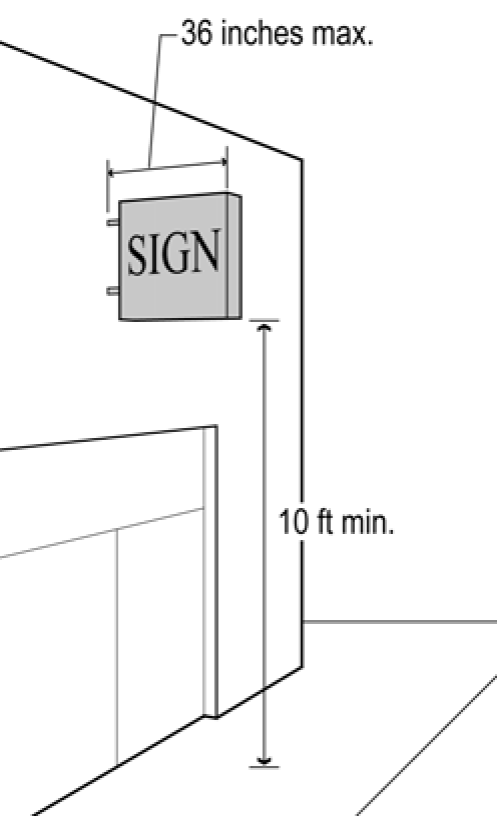
Maximum Projection of Projecting Sign
b.
Such sign(s) shall not project into public right-of-way nor exceed 16 square feet in sign area.
c.
A bottom of a projecting sign shall not extend vertically above the window sill of the second story of a multi-story building to which it is attached.
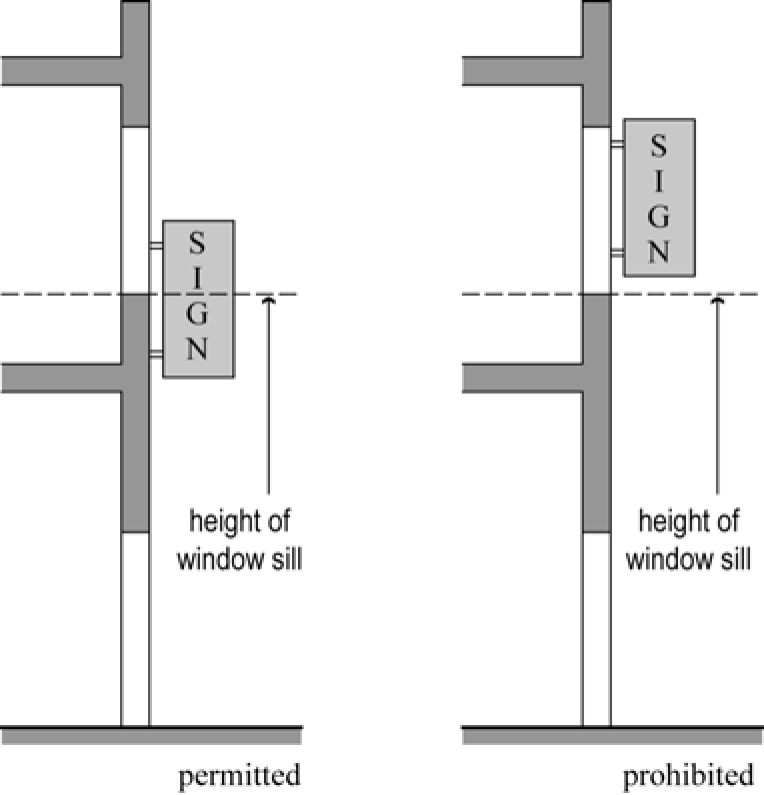
Projecting Sign on multi-story
building
5.
Awning, Attached Canopy and Marquee Signs. Where permitted, awning and attached canopy signs may be painted on, applied to, or otherwise be a part of the fabric or other non-structural material. Additionally,:
a.
The sign shall be flat against the surface of the awning or canopy, which shall extend no closer than two feet horizontally to the curb line of any public thoroughfare nor eight feet vertically from the finished surface directly below.
b.
Awning signs shall not be internally-illuminated.
c.
The permanently-affixed copy area of canopy or marquee signs shall not exceed an area equal to 25 percent of the surface area of the canopy, marquee or architectural projection upon which such sign is affixed or applied, which surface area shall not be counted toward allowable sign area.
(Ord. No. 3099, 6-27-22)
§11.6. - Signs Permitted By District.
11.6.1. Business and Office Districts (B-1, B-1.2, B-2, O-1, O-2). Each City licensed business or other organization shall be permitted the following types of signage. For integrated business centers, refer to §11.7.
1.
Freestanding Signs, subject to §11.5.2. Freestanding signs shall not exceed 40 square feet in copy area, except that where two freestanding signs are permitted, each shall not exceed 32 square feet of copy area.
2.
Detached canopy sign subject to §11.5.2.2.
3.
Attached Signs, subject to §11.5.3.
a.
Wall sign, subject to §11.5.3.3 or projecting sign, subject to §11.5.3.4.
b.
Awning, attached canopy, or marquee sign, subject to §11.5.3.5.
4.
Message Board, subject to §11.5.1. Message board shall be included within, not in addition to, any freestanding or attached sign permitted under Paragraph 1 or 3 above. Not more than one message board shall be permitted per premises.
5.
Temporary signs allowed under §11.8;
6.
Other signs expressly allowed under §11.4.4 Signs Permitted in All Districts or other sections of this Article.
11.6.2. Commercial Districts (B-3). Each City-licensed business or other organization shall be permitted the following types of signage. For integrated business centers, refer to §11.7.
1.
Freestanding Signs, subject to §11.5.2. Freestanding signs shall not exceed 80 square feet in copy area. Each shall be no more than ten feet long.
2.
Detached canopy sign subject to §11.5.2.2.
3.
Attached Signs, subject to §11.5.3.
a.
Wall Sign, subject to §11.5.3.3 or Projecting Sign, subject to §11.5.3.4.
b.
Awning, Attached Canopy, or Marquee Sign, subject to §11.5.3.5.
4.
Message Board, subject to §11.5.1. Message board shall be included within, not in addition to, any freestanding or attached sign permitted under Paragraph 1 or 3 above. Not more than one message board shall be permitted per premises.
5.
Temporary signs allowed under §11.8.
6.
Other signs expressly allowed under §11.4.4 Signs Permitted in All Districts or other sections of this Article.
11.6.3. Institutional (INST-1). Each City licensed business or institution shall be permitted the following types of signage:
1.
Freestanding Sign, subject to §11.5.2. Such sign shall not exceed 32 square feet in copy area. Such sign shall be no more than eight feet long.
2.
Attached Signs, subject to §11.5.3.
a.
Wall Sign. Permitted subject to §11.5.3.3.
b.
Projecting Sign, subject to §11.5.3.4.
c.
Awning, Attached Canopy, and Marquee Signs, subject to §11.5.3.5.
3.
Message Board, subject to §11.5.1. Message board shall be included within, not in addition to, any freestanding or attached sign permitted under Paragraph 1 or 2 above. Not more than one message board shall be permitted per premises.
4.
Places of Public Assembly. Places of assembly shall be allowed one additional freestanding or attached sign not to exceed 20 square feet in copy area or an additional 20 square feet in copy area that may be used to increase the maximum copy area of a freestanding or wall sign otherwise permitted in this §11.6.3.
5.
Temporary signs allowed under §11.8.
6.
Other signs expressly allowed under §11.4.4 Signs Permitted in All Districts or other sections of this Article.
11.6.4. Residential Districts. The following signs shall be permitted for each neighborhood within an E-2, R-1, R-2, R-3, R-4, R-5, R-6, R-7, R-8, R-9 or RC-1 District:
1.
Any dispute over whether a proposed sign will serve a "neighborhood" shall be referred to the Planning Commission for determination of the boundaries of the neighborhood. If the Commission fails to determine the boundaries of the proposed neighborhood within 60 days of the submittal of an application for a neighborhood sign to the Building Official, then the neighborhood shall be deemed to be that area designated in the original application, and the application processed accordingly.
2.
One freestanding sign shall be permitted at each principal entrance to the neighborhood. Sign shall not exceed 32 square feet of copy area. If there are walls on both sides of the entrance to the development or neighborhood, then one wall sign per side is permitted in lieu of a freestanding sign, each not to exceed 16 square feet in copy area.
a.
A "principal entrance" shall be considered to be that place where property included within the neighborhood abuts a collector or thoroughfare shown on the city's master street plan or other transportation plan;
b.
There shall not be more than one "principal entrance" for each 20 dwelling units in a neighborhood, provided that a neighborhood as defined in this Article shall be entitled to at least one such sign;
c.
The permitted signs shall be located on private property owned in common by residents of the neighborhood, or, with the permission of the property owner, on private property owned by one or more individuals and located at a principal entrance to the neighborhood;
d.
The permitted neighborhood sign(s) shall bear no commercial message;
e.
The permitted neighborhood sign(s) may be lighted by direct white light but shall not otherwise be illuminated.
3.
Street signs shall be of the standard design used commonly in the City, or of such other design as may be approved by the Council. Location of such signs shall be approved by the City Engineer.
4.
As a temporary use accessory to the permitted activity of lawful subdivision development, one temporary sign shall be permitted at each principal entrance to the subdivision in accordance with the following:
a.
There shall in no case be more than one such sign for a subdivision or development with 50 or fewer lots included in the subdivision or development and no more than two such signs for any other subdivision or development.
b.
Such sign shall not be illuminated and shall not exceed 24 square feet in area;
c.
Such sign shall be removed upon the earlier of: installation of a permanent neighborhood identification sign; or sale of more than 90 percent of the lots in the subdivision.
d.
Sign permit is renewable on an annual basis.
11.6.5. Signs Allowed for Individual Residential Units in Agricultural and Residential Districts. The following signs shall be allowed for individual dwelling units within an A-1, E-2, R-1, R-2, R-3, R-4, R-5, R-6, R-7, R-8, R-9 or RC-1 District:
1.
One wall sign, not to exceed two square feet in area shall be permitted for each dwelling unit. Such sign may not contain a commercial message. Such sign shall not be illuminated.
2.
Each occupied lot shall be permitted no more than two temporary signs at one time that contain a commercial message, which shall not be illuminated, shall not exceed six and one-half square feet in area and shall not exceed five feet in height. The only commercial messages permitted on such signs are messages related to commercial activity lawfully and temporarily conducted on the premises, including the lawful, occasional sale of personal property (such as through a garage sale or a yard sale) or the sale, rental or lease of the premises. Signs related to the sale of personal property shall be removed within 24 hours after the end of the sale. Signs related to the sale, lease or rental of the premises shall be removed no later than four days from the date on which the deed, lease or other document representing the transaction is completed.
(Ord. No. 3099, 6-27-22)
§11.7. - Signs Permitted for Integrated Business Centers.
For integrated business centers, sign area, height, and number of signs shall be in accordance with the standards of this Section.
11.7.1. Freestanding Signs.
1.
The number, area and height of freestanding signs shall be in accordance with Table 11.7. Allowable sign height is determined by the maximum sign height permitted in §11.5.2.1 plus the additional height permitted in Table 11.7. Spacing between freestanding signs along the same frontage, where permitted, shall be no less than 200 feet.
2.
No freestanding sign shall be built on berms or manmade structures to add height to the sign.
3.
Freestanding signs may include message board elements, subject to §11.5.1. The message board shall be considered part of the permitted aggregate freestanding sign area.
11.7.2. Attached Signs. Tenants shall be allowed attached (wall, projecting or awning/canopy) signage complying with §11.5.3 and in accordance with the following:
1.
Each ground level tenant space with frontage on the exterior of the building shall be allowed attached signage pursuant to §11.5.3.
2.
Except as provided for ground floor tenants in Paragraph 1 above, for multi-story buildings, each tenant space with its own exterior public entrance shall be permitted one attached sign.
3.
For multi-story buildings in which upper level tenants are accessed through a common, ground level entrance, one attached sign not to exceed 20 square feet in copy area in addition to any other permitted attached signage, shall be permitted at such ground level entrance for building and/or tenant identification.
(Ord. No. 3099, 6-27-22)
§11.8. - Temporary Signs in Non-residential Districts.
Temporary signs shall be allowed in non-residential zoning districts as follows:
11.8.1. Applicability. This section shall apply to the following zoning districts: B-1, B-1.2, B-2, B-3, O-1, O-2, Inst-1 and MXD.
11.8.2. Temporary Sign Permits. Each temporary sign allowed by this section shall require a temporary sign permit along with a date sticker that must be attached to such temporary sign. Anyone that is required to have a business license in the city must have a current business license at the address where the temporary sign is to be located before a temporary sign permit can be issued. Temporary signs may be permitted only intermittently throughout the year. A permit is required for each sign. No less than 30 days shall pass before the second permit can be issued. In the event a new business is located at the same address, then the new business license holder shall be exempt from the temporary sign permits issued to the previous occupant.
11.8.3. General Provisions. Unless specifically provided for otherwise in this Section, the following shall apply to all temporary signs in non-residential districts:
1.
A temporary sign may be a wall sign or a freestanding sign, but shall not be permitted in a public right-of-way.
2.
Duration of Display. Each temporary sign shall not be displayed for more than 30 days in a one year period.
3.
There shall be no more than one temporary sign per address at any one time.
4.
Content. Any sign allowed under this section may contain: any noncommercial message; a commercial message pertaining to goods, services or other commercial transactions available on the premises or that will be available on the premises when construction is complete. Signs seeking employees for a business shall be considered to pertain to commercial transactions available on the premises and shall be allowed.
11.8.4. Rules for Types of Temporary Signs.
1.
Temporary Sign Where Permanent Sign not Installed. For any premises which is occupied or for which a building permit has been issued, and for which the permanent sign allowed by §11.6 or §11.7 has not been installed, one temporary sign shall be allowed from the date of occupancy or the date of issuance of the building permit, whichever comes first, until the date of installation of the permanent sign not to exceed 60 days. The temporary sign shall not exceed the size allowed for the permanent sign or 32 square feet, whichever is smaller, and, if freestanding, shall not exceed eight feet in height.
2.
Grand Opening Banners. Each new non-residential use may have one banner per frontage announcing the opening of the establishment. Such banners shall be limited to an aggregate area of 32 square feet per establishment and, if freestanding, shall not exceed eight feet in height. Newly established integrated business centers shall be permitted an aggregate area of 40 square feet but shall be limited to one banner per frontage of such center regardless of the number of new uses.
3.
Other Temporary Signs. Other temporary signs shall not exceed 24 square feet in area and, if detached, shall not exceed six feet in height.
4.
Temporary Signs for Non-Profit Organizations. Temporary signs for non-profit 501(c)-3 organizations, such as for charitable fundraising events, that conform to the limitations of this Section shall require a permit as provided in §11.8.2; however, the permit shall be at no cost. The location, number and size of the signs shall be at the direction of the Mayor. Such signs shall be removed within 48 hours following the event. Failure to remove signs in a timely manner may affect issuance of future permits.
(Ord. No. 3099, 6-27-22)
§11.9. - Nonconforming Conditions.
11.9.1. Conditions. Any sign that is not specifically permitted, or that does not comply with all provisions of this Ordinance, yet which existed and was maintained as such, as of the effective date of this Ordinance, shall be considered a nonconforming sign.
11.9.2. Alterations. A nonconforming sign shall not, after the effective date of this Ordinance, be enlarged, structurally altered, or extended unless such sign shall be made to comply with all the provisions of this Ordinance. Sign faces may be replaced on a nonconforming sign, but no change may be made in the technology of a nonconforming sign unless such sign is made to comply with all of the provisions of this Article.
For purposes of this section, prohibited changes in technology include but are not necessarily limited to: conversion of a single-faced sign to a tri-vision sign; addition of electronic message board technology to a sign; addition of any other form of changeable copy technology - manual, mechanical or electronic - to a sign; conversion from internally lighted to externally lighted or vice versa; or addition of exposed bulbs.
A nonconforming sign may not be replaced by another nonconforming sign. Minor repairs and maintenance of nonconforming signs, such as repainting and electrical repairs, shall be permitted. However, no changes in the location, size, or shape of any nonconforming sign shall be permitted except to make the sign comply with all provisions of this Ordinance.
11.9.3. Compliance. The Department shall require all nonconforming signs to be removed or made to conform to all provisions of this Ordinance, by the owner of the property upon which the sign is located, upon the occurrence of any of the following events:
1.
Damage or deterioration of the sign to the extent that the Department Official or its authorized agent determines that the sign is structurally unsound.
2.
Any proposed alteration or repairs to a sign that would prolong the useful life of the sign or that would involve an expenditure of more than 50 percent of the original cost of the sign.
3.
Within ten years from the effective date of this ordinance; or if a business with a nonconforming sign has a written plan on file in the Department to replace the nonconforming sign within 15 years of the effective date of this ordinance. A written sign replacement plan must include site plan, sign dimensions, sign materials, and location. However, this shall not apply to nonconforming neighborhood signs existing on or prior to the effective date of these regulations. Such nonconforming neighborhood signs shall still be subject to Paragraphs 1 and 2 immediately above.
4.
For any message board on which the message is changed electronically, to achieve compliance with the requirements of §11.5.1 by January 1, 2011.
5.
Where there is any application for a permit for a new or replacement permanent sign on the same site as the nonconforming sign, except that this provision shall not apply to integrated business centers as defined herein.
(Ord. No. 3099, 6-27-22)
§11.10. - Legal Status Provisions.
11.10.1. Generally. If any part, section, subsection, paragraph, subparagraph, sentence, phrase, clause, term, or word of this Article is declared unconstitutional by the valid judgment or decree of any court of competent jurisdiction, the declaration of such unconstitutionality shall not affect any other part, section, subsection, paragraph, subparagraph, sentence, phrase, clause, term, or word of this chapter.
11.10.2. Severability where less speech results. Without diminishing or limiting in any way the declaration of severability set forth above in §11.10.1, or elsewhere in this Ordinance, if any part, section, subsection, paragraph, subparagraph, sentence, phrase, clause, term or word of this chapter is declared unconstitutional shall not affect any other part, section, subsection, paragraph, subparagraph, sentence, phrase, clause, term or word of this Article, even if such severability would result in a situation where there would be less speech, whether by subjecting previously exempt signs to permitting or otherwise.
11.10.3. Severability of provisions pertaining to prohibited signs. Without diminishing or limiting in any way the declaration of severability set forth above in §11.10.1, or elsewhere in this Ordinance, if any part, section, subsection, paragraph, subparagraph, sentence, phrase, clause, term or word of this Article or any other laws declared unconstitutional by valid judgment or decree of any court of competent jurisdiction, the declaration of such unconstitutionality shall not affect any other part, section, subsection, paragraph, subparagraph, sentence, phrase, clause, term or word of this chapter that pertains to prohibited signs, including specifically those signs and sign types prohibited and not allowed under §11.4.1. Furthermore, if any part, section, subsection, paragraph, subparagraph, sentence, phrase, clause, term or word of this ordinance is declared unconstitutional by the valid judgment or decree of any court of competent jurisdiction, the declaration of such unconstitutionality shall not affect any other part, section, subsection, paragraph, subparagraph, sentence, phrase, clause, term or word of this ordinance.
11.10.4. Severability of prohibition on off-premise signs. If any part section, subsection, paragraph, subparagraph, sentence, phrase, clause, term or word of this Article and/or any other provisions of this Ordinance are declared invalid or unconstitutional by the valid judgment or decree of any court of competent jurisdiction, the declaration of such unconstitutionality shall not affect the prohibition on off-premise signs as contained herein.
(Ord. No. 3099, 6-27-22)

