
Vestavia Hills City Zoning Code
ARTICLE 2
- GLOSSARY
For the purposes of this Ordinance, certain words and terms are defined as herein indicated and shall apply to all parts of this Ordinance unless otherwise specified.
§2.1.- General Definitions.
Unless specifically defined herein, words or phrases used in this Ordinance shall be interpreted so as to give them the same meaning as they have in common usage and so as to give this Ordinance its most reasonable application. All words used in the present tense shall include the future tense, all words in the singular number shall include the plural number, and all words in the plural number shall include the singular number, unless the natural construction of the wording indicates otherwise. The words "used for" shall include the meaning "designed for", and the word "structure" shall include the word "building". The word "lot" shall include the words "plot" and "tract" and the word "shall" is mandatory.
2.1.1. Abutting. Touching at one point or along a common side, boundary or property line. Two properties separated by a street or right-of-way are "Adjacent", but not "Abutting". However, for purposes of annexation, two properties separated by a street or right-of-way are considered contiguous and therefore eligible for annexation.
2.1.2. Access Management. The process of providing and managing vehicular access from public streets to private development while preserving the flow of traffic in terms of safety, capacity, and speed.
2.1.3. Accessory Structure. A subordinate structure or a portion of the principal structure, the use of which is incidental to the principal use of the premises, including any detached minor building consisting of masonry or frame walls and roof, at least one story in height or other type of structure necessary as an adjunct to the use and occupancy of a principal structure, except open structures such as pergolas, arbors and other garden houses of similar character. The term "Accessory Structure" shall also include children's playhouses, tree houses, storage houses built on skids and on permanent foundations and any other Structure not expressly exempted in this Section.
2.1.4. Accessory Use. A use which is incidental to and customarily found in connection with the principal use of the premises.
2.1.5. Adjacent. Either abutting or on the opposite side of a common street, right-of-way, or easement that separates it from the subject property. However, properties separated by a freeway or railroad ROW shall not be considered "Adjacent".
2.1.6. Alley. A public or private right-of-way or easement, on which no parcel fronts, providing access for two or more properties along the side or rear of said properties.
2.1.7. Alteration and Altered. The word "Alteration: shall include any of the following:
1.
Any addition to the height or depth of a building or structure.
2.
Any change in the location of any exterior walls of a building or structure.
3.
Any increase in the interior accommodations of a building or structure.
In addition to the foregoing, a building or structure shall be classified as altered when it is repaired, renovated, remodeled, or rebuilt at a cost in excess of fifty (50) percent of its value prior to the commencement of such repairs, renovation, remodeling, or rebuilding.
2.1.8. Applicable District. That zoning district in which a structure, subdivision or property is located or proposed to be located.
2.1.9. Applicant. A landowner, including his heirs, successors and assignees, or developer authorized to represent a property for which an application for development has been filed.
2.1.10. Application for Development or Application. Any application required to be filed and accepted prior to start of construction or development including, but not limited to, an application for a building, design review, or sign permit; for the approval of a subdivision plat or plan; or for the acceptance of a development plan.
2.1.11. Basement. A story partly or wholly underground. For purposes of height measurement a basement shall be counted as a story when more than one-half of its height is above grade level.
2.1.12. Best Management Practices, Stormwater. A collection of structural practices and vegetative measures which, when properly designated, installed and maintained, will provide effective erosion and sedimentation control for all rainfall events.
2.1.13. Block. A unit of land bounded by streets or a combination of streets, public land, public parks, cemeteries, railroad rights-of-way, watercourses, or any other barrier to the continuity of development.
2.1.14. Board of Zoning Adjustment. The Board of Zoning Adjustment of the City of Vestavia Hills, Alabama established pursuant to the provisions of Article 12 and through which, the Board considers requests for variances and special exceptions and hears appeals to decisions of city staff in regard to this Zoning Ordinance.
2.1.15. Buffer. A landscaped strip of land provided between two or more properties, uses, or buildings to mitigate the incompatible characteristics of adjacent uses and/or buildings. Buffers may include berms, shrubs, trees, fences or walls, other screening devices, or a combination of such devices as required by §9.3 Buffers.
2.1.16. Build-to Line. A line parallel to the front lot line establishing the furthest distance a building may be built from such lot line.
2.1.17. Building. Any structure, consisting of a foundation, walls or supports and roof with or without other parts, constructed or used for a residence, business, industry, or other public or private purpose, or accessory thereto, and including greenhouses, stables, garages, roadside stands, manufactured homes, and similar structures, whether stationary or movable, but excluding recreational vehicles/travel trailers, fences, walls, signs and awnings. Features which are structurally essential and connected to the structure shall be considered as part of the structure within the meaning of this Zoning Ordinance.
2.1.18. Building Area. The portion of the lot occupied by the main building, accessory buildings, other structures and impervious surfaces.
2.1.19. Building Code. The code(s) adopted by the City, and as may be amended from time to time by the Council, which governs the design and construction of buildings and structures, including fire, plumbing and electrical codes.
2.1.20. Building Height. The vertical distance measured from the finished grade level at the front of the building to the deck line for mansard roofs, to the uppermost point of the parapet wall for flat roofs, and to the average height between eaves and ridges for gable, hip, and gambrel roofs.
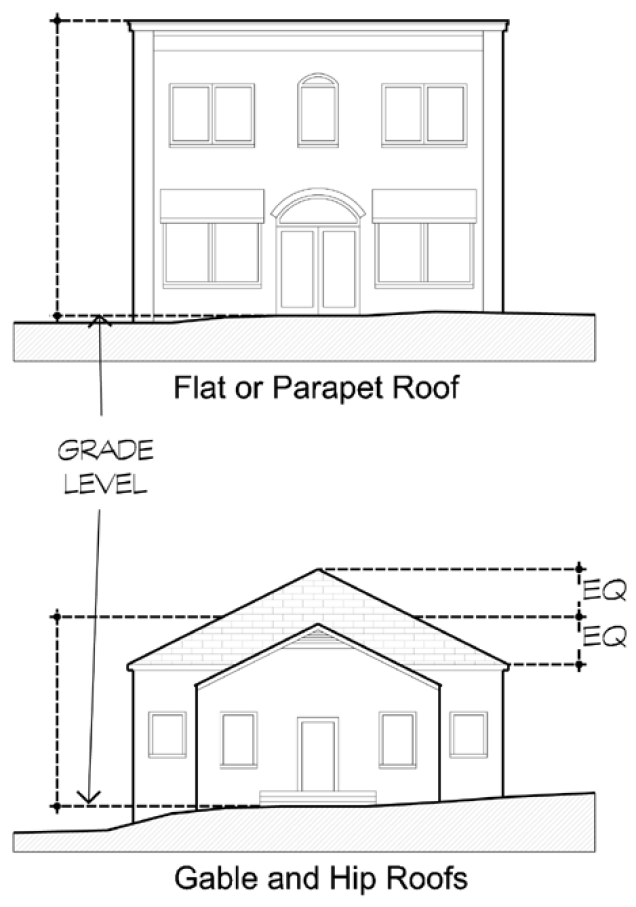
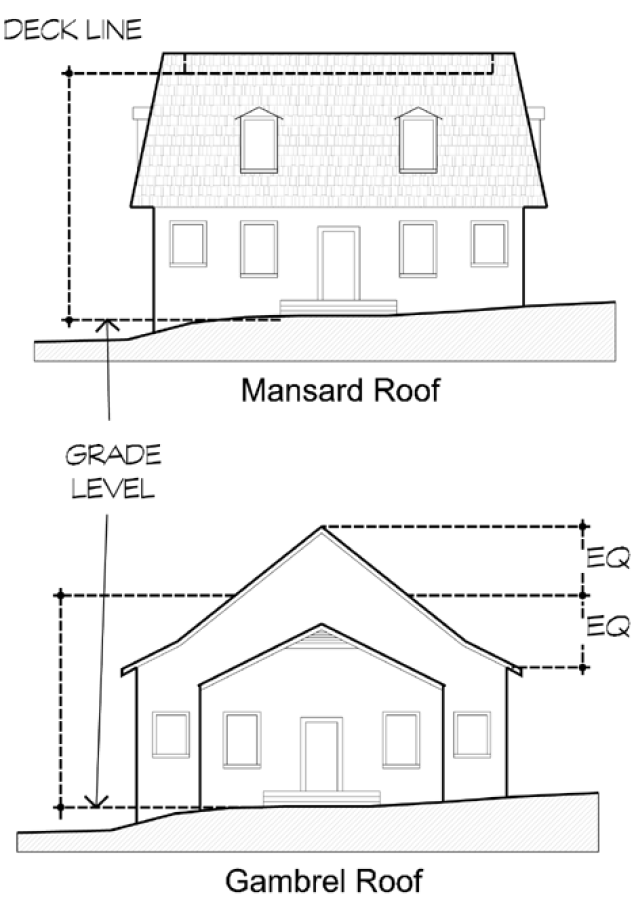
Determining Building Height
2.1.21. Building Line. The perimeter of that portion of a building or structure nearest a lot line, but excluding open steps, terraces, cornices, and other ornamental features projecting from the walls of the building or structure.
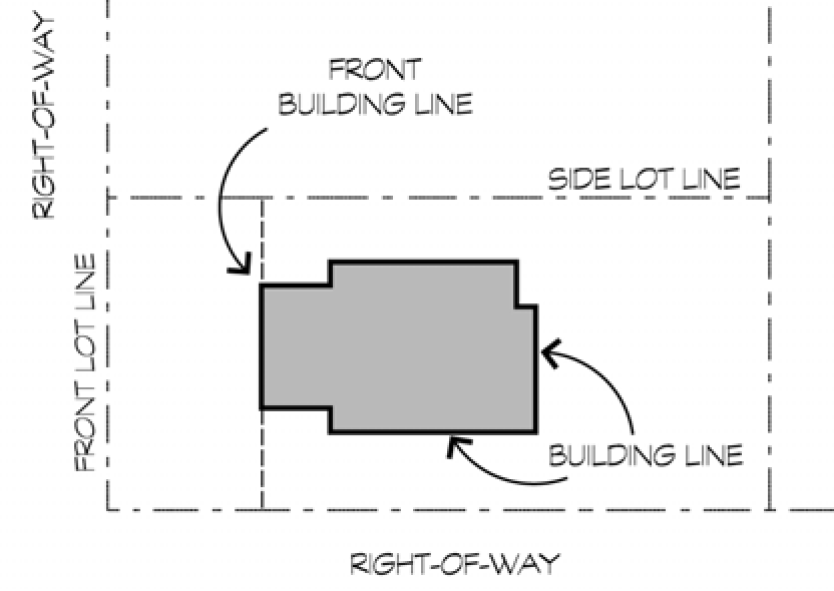
Building Line
2.1.22. Building Official. An official of the City of Vestavia Hills Department of Building Safety designated to administer and enforce the City Building Code and applicable provisions of this Zoning Ordinance.
2.1.23. Caliper. The trunk diameter of a tree measured six inches above grade level.
2.1.24. Certificate of Occupancy. A certificate issued by the Department of Building Safety, with approval of the Fire Marshal, upon completion of a new building or upon a change or conversion of the structure or use of a building, which certifies that all requirements and regulations as provided herein and within all other applicable requirements, have been complied with.
2.1.25. City, The. The City of Vestavia Hills, Alabama unless otherwise indicated by context.
2.1.26. City Council or Council. The City Council of the City of Vestavia Hills, Alabama.
2.1.27. City Engineer. A registered professional engineer, licensed by the State of Alabama, and employed by the City of Vestavia Hills or engaged as a consultant by the City.
2.1.28. City Fire Code or Fire Code. An ordinance adopted by the City providing standards for fire safety and as may be modified from time to time by the City Council.
2.1.29. City Planning Staff. Municipal staff designated to review development plans, including the Zoning Official/City Clerk, Fire Marshal, City Engineer, Building Official and others as needed.
2.1.30. Clear Sight Triangle. See "Sight Triangle, Clear".
2.1.31. Commercial Vehicle. Any motor vehicle licensed by the state as a commercial vehicle.
2.1.32. Commission, The. See "Planning Commission".
2.1.33. Comprehensive Plan. The official public document prepared in accordance with the Code of Alabama, 1975, § 11-52-8 as amended, consisting of maps, charts, and textual material, that constitutes a policy guide to decisions about the future development of the City.
2.1.34. Conditional Use. A use which may be permitted only by the Council following a recommendation by the Commission in accordance with §13.3. The recommendation by the Commission may be to approve or deny the application, which said recommendation is advisory only. Zoning is a legislative matter decided by the Council. The Council is not bound by the recommendation of the Commission.
2.1.35. Condominium. A division of property or interest in property as defined by, created under and subject to the "Alabama Uniform Condominium Act of 1991" and subsequent amendments and revisions.
2.1.36. Conservation Easement. A voluntary agreement between a landowner and a municipal agency or qualified not-for-profit corporation to restrict the development, management, or use of the land in perpetuity or as otherwise defined by the terms of the easement.
2.1.37. Covenant. A restriction upon the use of a property placed in a deed running with the land and enforced by private landowners or homeowner or condominium associations.
2.1.38. Dedication. The deliberate assignment of land by its owners for any general or public uses, reserving to themselves no other rights than such as are compatible with the full exercise and enjoyment of the public uses to which the property has been devoted.
2.1.39. Deed. A legal document conveying ownership of real property.
2.1.40. Density. The number of dwelling units per acre of lot area.
2.1.41. Design Capacity. The maximum number of persons that may be accommodated by a use as determined by its design and by the Building Code.
2.1.42. Developer. Any owner, agent of such owner or tenant with the written permission of such owner, who makes or causes to be made a land development.
2.1.43. Development. Any of the following activities:
1.
The improvement of one lot or more abutting lots, tracts or parcels of land for any purpose involving:
a.
a group of two or more residential or non-residential buildings, whether proposed initially or cumulatively, or a single non-residential building on a lot or lots regardless of the number of occupants or tenure; or
b.
the division or allocation of land or space, whether initially or cumulatively, between or among two or more existing or prospective occupants by means of, or for the purpose of streets, common areas, leaseholds, condominiums, building groups, or other features;
2.
A subdivision of land.
3.
Any man-made change to improved or unimproved real estate, including but not limited to buildings or other structures, mining, dredging, filling, grading, paving, excavation or drilling operations.
2.1.44. Driveway. A private drive providing access between a street or access drive and a parking or other vehicular use area.
2.1.45. Dwelling Unit. One or more rooms located within a building and forming a single habitable unit with facilities, which are used or intended to be used for living, sleeping, cooking and eating purposes by not more than one family.
2.1.46. Easement. A right granted by a landowner to a grantee, allowing for limited use of private land for a public or quasi-public or private purpose, and with which the property owner shall not have the right to make use of the land in a manner that violates the right of the grantee.
2.1.47. Engineer. A professional engineer registered by the State of Alabama Board of Registration for Professional Engineers and Surveyors.
2.1.48. Entity. A person, association, firm, corporation, or organization of any kind.
2.1.49. Erect. To build, construct, reconstruct, move upon or any other physical operation on the premises required for development.
2.1.50. Façade. The exterior wall of a building extending the entire width of a building elevation that faces a public street or any public way.
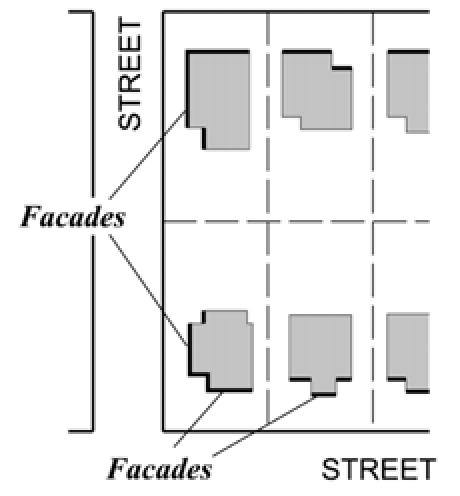
Facades
2.1.51. Family. One or more persons related by blood, marriage, or adoption, or by some other legal custodial relationship, living and cooking together as a single housekeeping unit in a single dwelling unit; or two unrelated individuals living and cooking together as a single housekeeping unit in a single dwelling unit. For purposes of this Ordinance, "family" shall not include any society, club, fraternity, sorority, association, lodge, federation, or like organizations; or any group of individuals who are in a group living arrangement. See also "Housekeeping Unit".
2.1.52. Fence. Any barrier of any material or combination of materials, other than a building, erected to enclose or screen areas of land or used as a means of protection, confinement or buffering. For the purposes of this Ordinance, the "fence" includes the term "wall", but does not include the term "retaining wall".
1.
Buffer Fence. A fence used toward fulfillment of the requirements of §9.3 Buffers.
2.
Privacy Fence. A fence intended to provide a physical and visual barrier between common or public areas and a private area or use. Privacy fences are distinguished from other fences by their height and opaque design.
3.
Screen Fence. A fence used toward fulfillment of the requirements of §9.4 Screening.
2.1.53. Floodplain. An area adjacent to a watercourse, which area is subject to flooding as the result of the occurrence of an intermediate regional flood and which area thus is so adverse to past, current or foreseeable construction or land use as to constitute a significant hazard to public health and safety and to property. Floodplains are identified by the National Flood Insurance Program.
2.1.54. Floodway. The area regulated by Federal, state, or local requirements to provide for the discharge of the base flood so the cumulative increase in water surface elevation is no more than a designated amount (not to exceed one foot as set by the National Flood Insurance Program) within the 100-year floodplain.
2.1.55. Floor Area, Gross. The gross horizontal areas of all floors, measured from the exterior faces of the exterior walls of a building. Unfinished garages, basements and cellars are not included in the calculation of gross floor area.
2.1.56. Fowl. Winged animals other than household pets, including but not limited to, chickens, geese, and ducks, that are kept, bred or raised for commercial purposes.
2.1.57. Frontage.
1.
Frontage, Block. All the property on one side of a street between two intersecting streets measured along the right-of-way line of the street, or if the street is dead-ended, then all of the property on one side between an intersecting street and the dead end of the street.
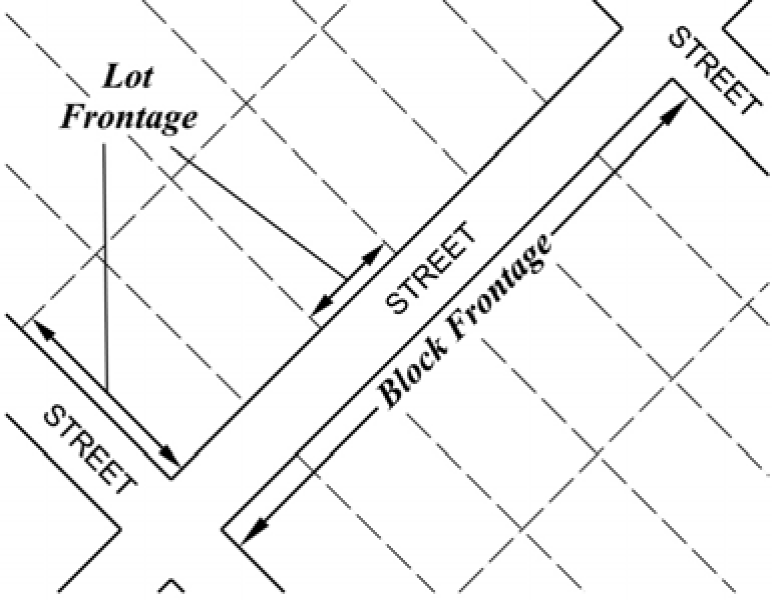
Block and Lot Frontages
2.
Frontage, Lot. The width of a lot as measured along its front lot line.
2.1.58. Grade Level. The average level of the finished ground surface adjacent to the exterior walls of the building.
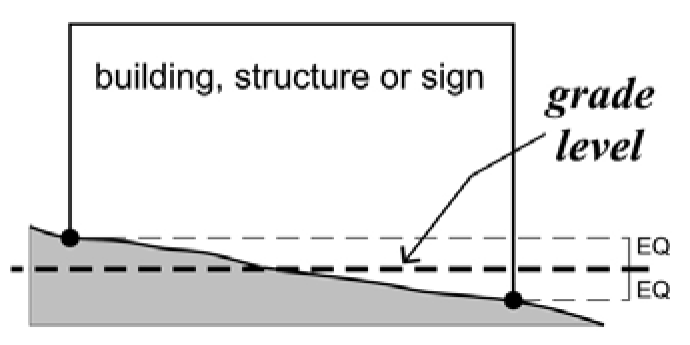
Grade Level
2.1.59. Grading Plan. A map of a proposed development defining existing and proposed elevations, watercourses, vegetative cover and drainage patterns, including one foot contours, spot elevations, and flow arrows. The plan also describes the limits and depths of excavations, fills and removal of native vegetation.
2.1.60. Greenway. An open space corridor that links urban, suburban, and rural communities to natural and scenic areas with a network of connected trails, walkways, and natural preservation areas.
2.1.61. Gross Floor Area. The floor area within the inside perimeter of the exterior walls of the building under consideration, exclusive of vent shafts and courts, without deduction for corridors, stairways, ramps, closets, the thickness of interior walls, columns or other features.
2.1.62. Gross Leasable Area. The total floor area for which the tenant pays rent and that is designed for the tenant's occupancy and exclusive use, including any basements and mezzanines.
2.1.63. Half Story. See "Story, Half Story."
2.1.64. Housekeeping Unit or Single Housekeeping Unit. A family living together in a single dwelling unit, with common access to and common use of all living and eating areas and facilities for the preparation and serving of food within the dwelling unit.
2.1.65. Impervious Surface. A man-made surface that does not allow the passage or infiltration of rain water. This may include improvements such as roadways, sidewalks, driveways, parking lots and patios. Improvements constructed of pervious materials and intended to minimize stormwater runoff can be submitted to the City's Engineer's office for approval.
2.1.66. Improvements. Those physical additions and changes to the land that may be necessary to produce usable and desirable developments including but not limited to driveways, landscaping, streets, sidewalks, curbs and gutters, sewer, and stormwater control facilities.
2.1.67. Interim Use. Any temporary use of land in any area of a planned development, which has been approved as a part of the Master Development Plan and criteria. An interim use can be any use and may or may not be a permitted use or a conditional use in the applicable district.
2.1.68. Intersection Sight Distance. The length of the line of sight between a motorist, stopped at an intersection, and the nearest intersection, driveway, alley or other signalized or non-signalized access point to the left or to the right of the motorist.
2.1.69. Junk. Materials including scrap, copper, brass, rope, rags, batteries, paper, trash, rubber debris, waste iron, steel and other old or scrap ferrous or non-ferrous material, including wrecked, scrapped, ruined, dismantled or junked motor vehicles or parts thereof.
2.1.70. Landscape Architect. A landscape architect registered by the State of Alabama.
2.1.71. Landscaping. Treatment of grade with ground cover, shrubs, trees and other vegetation, and/or ornamentation
1.
Building Landscaping. A landscaped strip between a building and its lot boundary or off-street parking area, as required by §9.2 Site Landscaping.
2.
Frontage Landscaping. A landscaped strip between off-street parking areas or buildings and adjacent public streets as required by §9.2 Site Landscaping.
3.
Interior Landscaping. Landscaping within an off-street parking area as required by §9.2 Site Landscaping.
4.
Perimeter Landscaping. A landscaped strip between an off-street parking area and abutting lots. Perimeter landscaping does not include landscaping between an off-street parking area and buildings on the same lot.
2.1.72. Livestock. Animals of any kind, including fish and fowl, kept, bred or raised for commercial or other purposes, excluding house pets such as domestic cats and dogs, fish, fowl, and other similar animals kept for personal pleasure in accordance with regulations of the Health Department and applicable animal control authority of the applicable County.
2.1.73. Lot. A designated Parcel, tract or area of land established by plat, subdivision, or as otherwise permitted by law, to be separately owned, used, developed, or built upon.
1.
Corner Lot. A lot abutting upon two or more streets at their intersection or on two parts of the same street forming an interior angle of less than 135 degrees.
2.
Flag Lot. A lot that does not meet the lot width requirements of its district within the normally required front yard setback.
3.
Interior Lot. Any lot which is not a corner lot.
4.
Reverse Frontage Lot. A through lot with vehicular access restricted to the street of lesser classification.
5.
Through Lot. A lot that fronts on two parallel streets or that fronts on two streets that do not intersect at the boundaries of the lot.
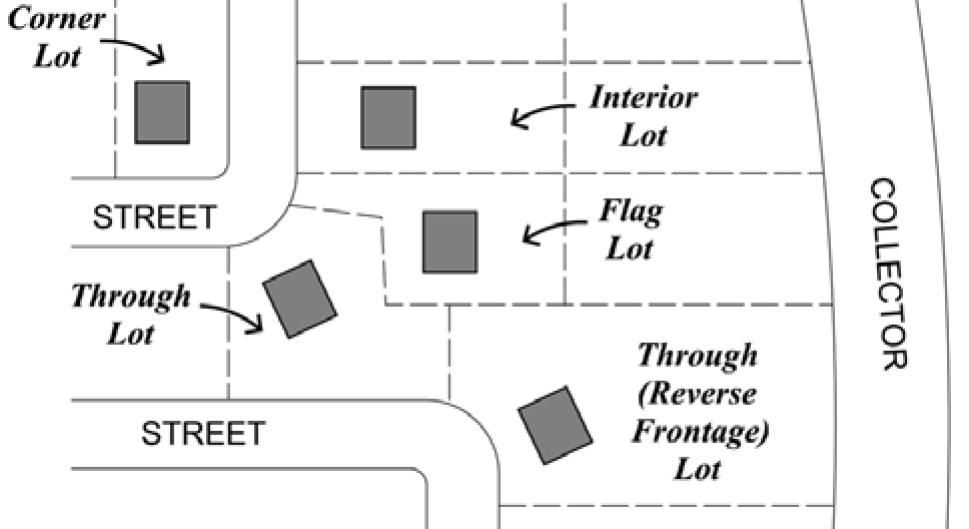
Lot Types
2.1.74. Lot Area. The area contained within the lot lines of a lot, excluding any street right-of-way, but including the area of any easement.
2.1.75. Lot Depth. The average distance between the front and rear lot lines.
2.1.76. Lot Lines.
1.
Front Lot Line. A lot line separating a lot from the street on which it fronts. On corner lots and double-frontage lots, all lot lines abutting a street (except alleys 16' or less in width), shall be front lot lines.
2.
Rear Lot Line. A lot line, which is most distant from a front lot line. In the case of corner lots, the rear lot line shall be that lot line, other than a front lot line, that is shorter in dimension. For the purposes of determining rear yard setbacks on a lot where the side lot lines meet in a point, the "rear lot line" is assumed to be a line not less than ten ft long drawn within the lot between the two side lot lines and parallel to the front lot line, and which is referred to as the "Adjusted Rear Lot Line".
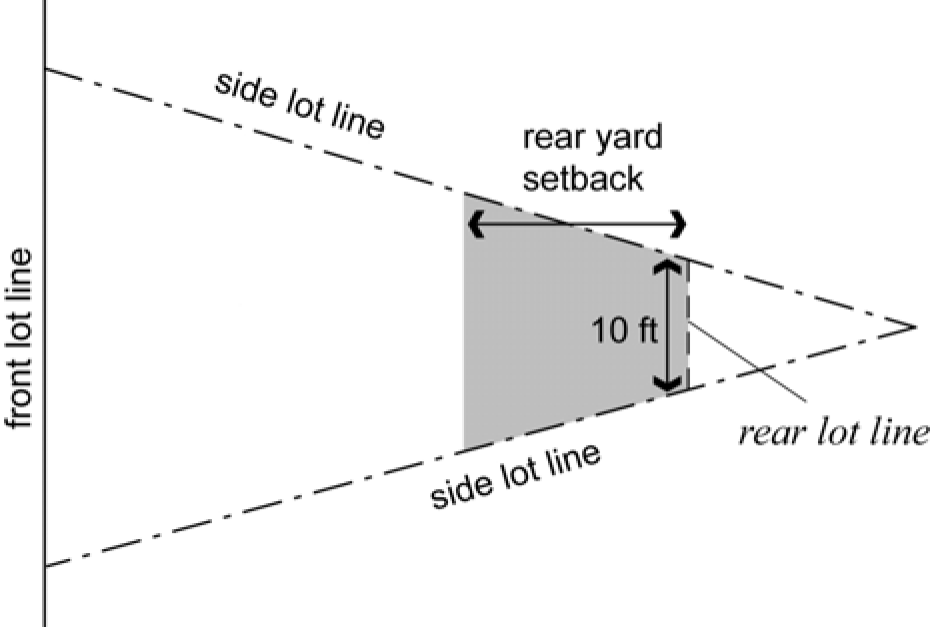
Adjusted Rear Lot Line
3.
Side Lot Line. Any lot line, which is not a front or rear lot line.
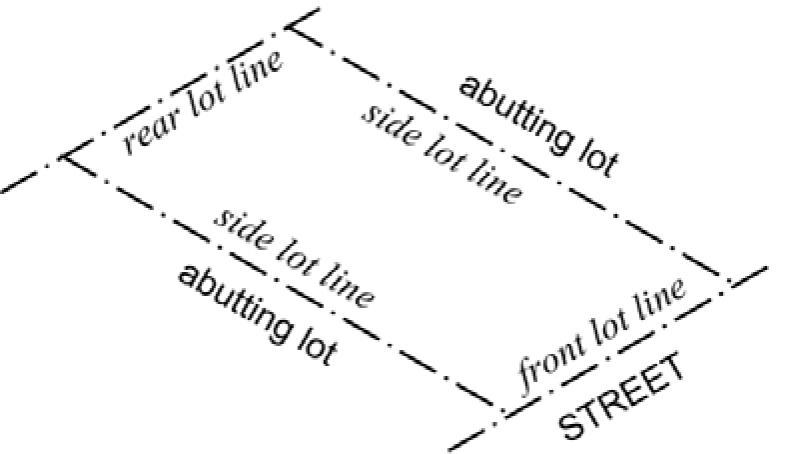
Lot Lines, Interior Lot
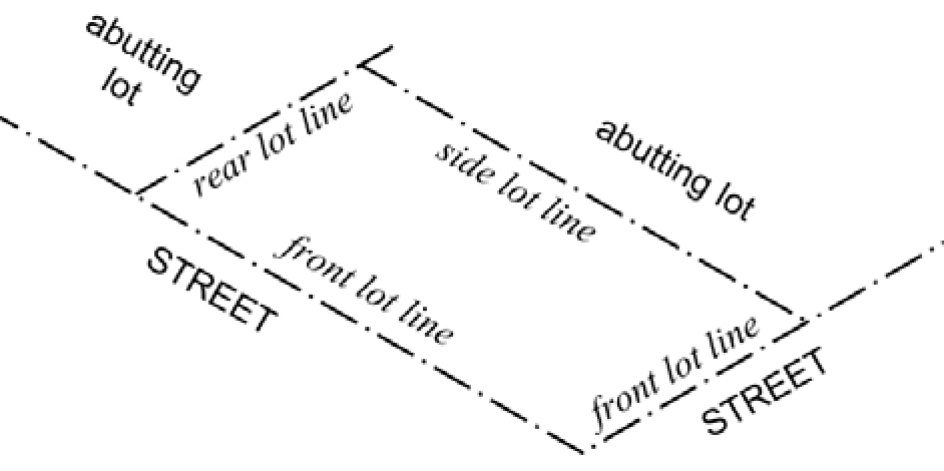
Lot Lines, Corner Lot
2.1.77. Lot Width. In the case of interior lots, the distance between the side lot lines. In the case of corner lots, the distance between the front lot line and the opposing lot line. Such distance shall be measured along a straight line, which is at right angles to the axis of the lot, and shall be measured at the front yard setback line. When a lot abuts on a curved street, the lot width is determined using the arc length.
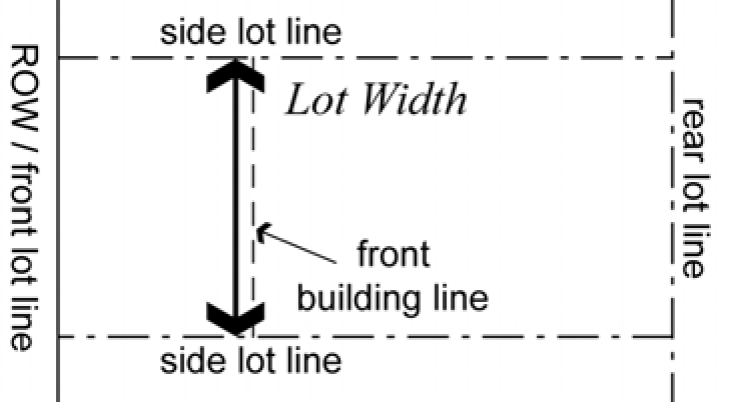
Lot Width, Interior Lot
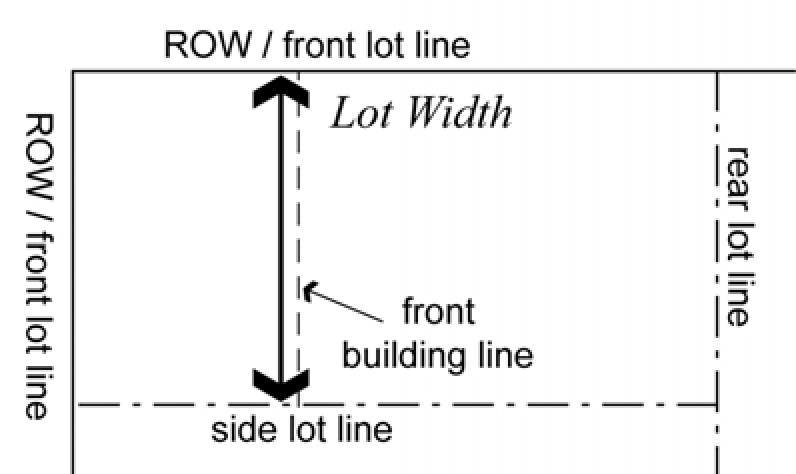
Lot Width, Corner Lot
2.1.78. Lot of Record. A lot that exists as shown on a deed or plat, which has been recorded by the applicable County.
2.1.79. Master Development Plan. A plan required for the review and approval of a planned development, in which necessary information is provided sufficient for the Commission, Council and other reviewers to determine its compliance with the intents and requirements of the applicable provisions of this Ordinance.
2.1.80. Mulch. A material (pine straw, bark chips, wood chips, etc.) placed on the ground to stabilize soil, protect roots, limit weed growth and otherwise promote tree and shrub growth.
2.1.81. Net Floor Area. The actual occupied area, not including unoccupied accessory areas such as corridors, stairways, ramps, toilet rooms, storage areas, mechanical rooms and closets.
2.1.82. Nonconformities. An improvement, premises or use that does not conform to regulations of this Ordinance and/or other regulations of the City, but which lawfully existed prior to the effective date of such regulations.
1.
Nonconforming Improvements. Any improvements made to land not in conformance with the provisions of this Ordinance or other applicable regulations of the City. Improvements, which may be classified as nonconforming, include but are not limited: parking areas, driveways, lighting, sidewalks, buffers and screening, and other landscaping.
2.
Nonconforming Premises. A premises and/or building thereupon not meeting the applicable dimensional requirements of this Ordinance.
3.
Nonconforming Use. The use of any building or land which was lawful at the time of passage of this Ordinance or amendment thereto, but which use does not conform, after the passage of this Ordinance or amendment thereto, with the use regulations of the district in which it is situated.
2.1.83. Open Space. Land, not covered by parking areas, rights-of-way or buildings other than recreational structures, pools and stormwater facilities, which is landscaped or left in a natural state as required by the provisions of this Ordinance.
1.
Common Open Space. Open space within a development held in common ownership and maintained by a property owners' association of all residents for recreation, protection of natural land features, amenities or buffers; is freely accessible to all residents of the development; and is protected by the provisions of this Ordinance to ensure that it remains in such use(s).
2.1.84. Patio. A level, landscaped, and/or surfaced area directly adjacent to a principal building near finished grade and not covered by a permanent roof.
2.1.85. Planned Development. One or more contiguous parcels planned and developed as a single entity according to an approved Master Development Plan.
2.1.86. Planning Commission or Commission. The City of Vestavia Hills Planning and Zoning Commission.
2.1.87. Poultry. Fowl normally raised as food such as chickens, ducks, geese, guineas and turkeys or for commercial uses such as peacocks.
2.1.88. Premises. A lot, parcel, tract or plot of land including all buildings, improvements and structures existing thereon.
2.1.89. Principal Building. A building, in which is conducted the principal use of the lot on which it is situated.
2.1.90. Principal Use. The primary or predominant use of any lot or parcel.
2.1.91. Property Maintenance Code or City Property Maintenance Code. The International Property Maintenance Code as adopted by the City Council, as amended.
2.1.92. Public Hearing. A meeting announced and advertised in advance and open to the public, with the public given an opportunity to talk and participate. Public hearings are advertised and held in accordance with the Code of Alabama, 1975, as amended.
2.1.93. Public Notice. Notice published prior to a Public Hearing, as required by the Code of Alabama, 1975, as amended. Such notice states the time and place of the hearing and the particular nature of the matter to be considered at the hearing. Public notice for rezoning, conditional use and/or variance requests also include the posting of a sign at conspicuous locations along the perimeter of the subject property; the sign is posted at least one week prior to the hearing and describes the nature, date, time, and location of the hearing.
Public notice of a public hearing to consider an application for zoning or rezoning must be provided (published or posted) by the City in accordance with the Code of Alabama, 1975, as amended, including specifically, Title 11-52-77 and Title 11-45-8 and Act 1123 of the 1973 Legislature.
2.1.94. Remote Parking. A parking area not located on the same lot as the use for which the parking is provided.
2.1.95. Retaining Wall. A wall resisting the lateral displacement of soil or other materials to improve or control drainage and erosion.
2.1.96. Ridge Line. The intersection of two roof surfaces forming the highest horizontal line of the roof.
2.1.97. Right-of-Way. Land reserved, used, or to be used for a street, alley, walkway, drainage facility, or other public purpose.
2.1.98. Right-of-Way Line. The line that forms the boundary of a right-of-way, typically corresponding with the front lot line of abutting properties.
2.1.99. Runoff. The portion of rainfall, irrigation water and any other liquids that flows across ground surface and eventually is returned to streams.
2.1.100. Setback. The distance between a building or structure and a lot line. See also "Yard."
2.1.101. Setback Line. A line that is the required minimum distance from any lot line and that establishes the area within which the principal structure must be erected or placed.
2.1.102. Shrub. A woody plant, generally multi-stemmed and smaller than a tree.
2.1.103. Sight Triangle, Clear. An area of unobstructed vision at a street intersection defined by a line of sight between points at a given distance from the intersection of the street centerlines. See also "Intersection Sight Distance".
2.1.104. Site. Area of a lot occupied by a structure.
2.1.105. Stacking Space. A space intended for the queuing of vehicles to a drive-through window, fuel pump, ATM or similar standing point.
2.1.106. Story. That portion of a building included between the surface of any floor and the surface of the floor next above it, or, if there be no floor above it, then the space between the floor and the ceiling next above it.
1.
Half Story. A space under a sloping roof in which space the possible floor area with headroom of five feet or less contains at least 40 percent of the total floor area of the story directly beneath it; or a building story that contains not more than 50 percent of the total floor area of the story directly beneath it.
2.1.107. Street. Any vehicular way that is (1) an existing state, county, or municipal roadway; (2) shown upon a plat approved pursuant to law; (3) approved by other official action; (4) shown on a plat duly filed and recorded in the office of the applicable county tax assessor; (5) shown on the official map or adopted master plan. The term "street" includes the land between the street lines, but excludes alleyways that are 20' or less in width, whether improved or not.
1.
Access Drive. A private street providing access to a development from a street on which the development has only a very narrow street frontage.
2.
Access Street. A minor street, which is parallel and in close proximity to a higher order street and that provides access to abutting properties. Also commonly referred to as a frontage road or service road.
3.
Arterial. A street that distributes traffic to and from collectors. Arterials include U.S. Highway 31, U.S. Highway 280, and Columbiana Road.
4.
Collector. A street that collects traffic from local streets and connects with minor and major arterials. Collector streets include, but are not limited to, Acton Road, Altadena Road, Cahaba Heights Road, Cahaba River Road, Crosshaven Drive, Dolly Ridge Road, Green Valley Road, Massey Road, Rocky Ridge Road, Shades Crest Road, and Tyler Road.
5.
Cul-de-sac. A local street terminating in a vehicular turnaround at one end.
6.
Local Street. A street used primarily to provide access to abutting properties.
2.1.108. Street Centerline. A line running parallel with the street right-of-way which is half the distance between the extreme edges of the official right-of-way width as surveyed, or where not surveyed, half the distance from the edges of pavement.
2.1.109. Structure. Anything constructed or erected, the use of which requires a location on the ground, or attached to something having a location on the ground, including but not limited to buildings, signs, billboards, backstops for tennis courts, fences, or radio tower.
2.1.110. Structural Alterations. Any change in the supporting members of a building or structure, such as bearing walls, columns, beams or girders.
2.1.111. Temporary Building. Portable, mobile or transportable contractor's construction buildings, the use of which is incidental to construction operations being conducted on the same or adjoining lot or tract will be allowed with permit all districts, provided they are not used as a dwelling.
2.1.112. Tree.
1.
Canopy Tree. A deciduous tree, usually single-trunked, with a defined crown of foliage, which attains a mature height of at least 30 feet.
2.
Understory Tree. A deciduous or evergreen tree which attains a mature height of no greater than 30 feet.
2.1.113. Use. The purpose for which land or a building or other structure is designed, arranged, or intended or for which it is or may be occupied or maintained.
2.1.114. Variance. Relief or an adjustment to the literal requirements of this Ordinance granted pursuant to the provisions of Article 12.
2.1.115. Waiver. Limited relief or adjustment to the literal requirements of this Ordinance granted by the Zoning Official.
2.1.116. Wall.
1.
A vertical screen or barrier distinguished from a "fence" in its design and materials. See "Fence."
2.
A vertical exterior or interior surface of a building.
2.1.117. Yard. An open space lying between the principal building and the nearest lot line.
1.
Front Yard. A yard extending the full width of the lot between any building and the front lot line and measured from perpendicular to the front building line.
2.
Rear Yard. A yard extending across the full width of the lot between the principal building and the rear lot line (or adjusted rear lot line) and measured perpendicular to the rear building line.
3.
Required Yard. The minimum required open space between a building or structure and the nearest lot line, unoccupied and unobstructed by any structure from the ground upward.
4.
Side Yard. A yard between the main building and the side lot line and extending from the front yard to the rear yard and measured perpendicular to the side building line.
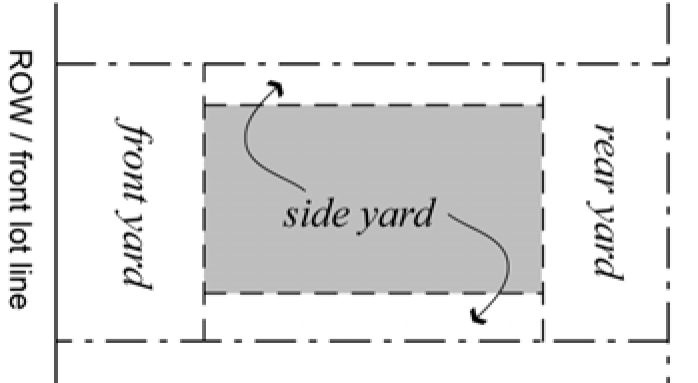
Yards, Interior Lot
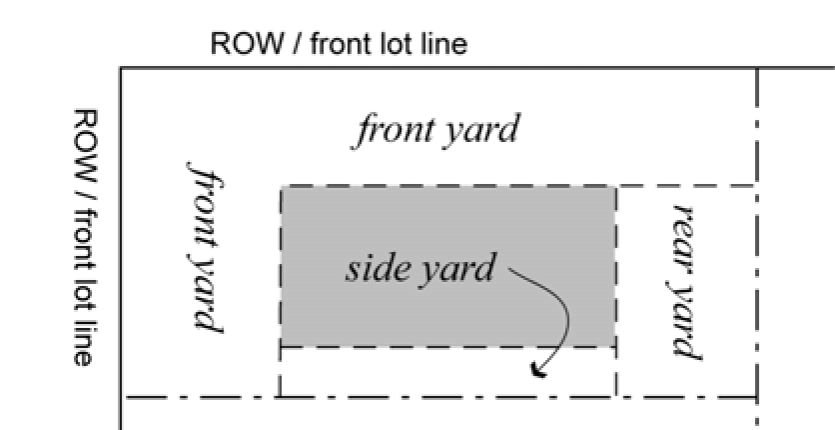
Yards, Corner Lot
2.1.118. Zoning Approval. Certification issued by the Zoning Official stating that an application for development is in conformity with the requirements of this Ordinance.
2.1.119. Zoning Official. The municipal official designated to administer this Zoning Ordinance. The term "Zoning Official" may also include a designated representative of the Zoning Official.
(Ord. No. 3099, 6-27-22)
§2.2. - Use Definitions.
2.2.1. Animal Shelter. Non-profit (e.g., SPCA) or public organization providing shelter for small domestic animals.
2.2.2. Assisted Living Facility. A permanent building, portion of a building, or a group of buildings in which room, board, meals, laundry, and assistance with personal care and other services are provided for not less than 24 hours in any week to a minimum of two ambulatory adults not related by blood or marriage to the owner and/or administrator and licensed by the State of Alabama.
2.2.3. Automotive Repair Service.
1.
Minor Automotive Repair Service. A place of business engaged in the repair and maintenance of automobiles and light trucks including the sale, installation, and servicing of mechanical equipment and parts but not including painting, body work, upholstery work, fabrication of parts, or rebuilding of engines.
2.
Major Automotive Repair Service. A place of business engaged in the repair and maintenance of automobiles and light trucks including the sale, installation, and servicing of mechanical equipment and parts including painting, body work, upholstery work, fabrication of parts, or rebuilding of engines.
2.2.4. Bed and Breakfast. An establishment having guest rooms, which are subordinate and incidental to the main, owner occupied, single-family residential use.
2.2.5. Boarding House. Any building or portion thereof that contains not less than three nor more than nine guest rooms, which are designed or intended to be used, let, or hired out for occupancy by individuals for compensation whether paid directly or indirectly, for a definite period of time longer than 30 days.
2.2.6. Business Support Service. A place of business that supplies support services primarily to business or professional offices or services, such as photocopy, computer, and office equipment, supplies and services.
2.2.7. Caretaker Dwelling. A residence, incidental to a principal use, for an on-site manager, watchman or caretaker employed on the premises.
2.2.8. Clinic. A building or portion of a building where patients are not lodged overnight, but are admitted for examination and treatment.
2.2.9. Club, Private. A building or portion thereof or premises owned or operated by a corporation, association, person for a social, educational or recreational purpose, but not primarily for profit or to render a service which is customarily carried on as a business.
2.2.10. Conservation Subdivision. A residential development, in accordance with §7.3, wherein a portion(s) of the site is set aside as open space.
2.2.11. Construction Service. A place of business engaged in construction activities, incidental storage, and wholesaling of building material (but not a home improvement center which also sells at retail), such as a building contractor, trade contractor, or wholesale building supplies store.
2.2.12. Convenience Store. A retail sales business, which specializes in providing household products and foods. Convenience stores may also provide for any or all of the following as an accessory use: video tape rental, preparation and sale of deli foods.
2.2.13. Country Club. A recreational facility, usually restricted to members and their guests, which generally includes a clubhouse, dining and recreation facilities.
2.2.14. Day Care Center. A care facility, licensed by the State of Alabama Department of Human Resources, which receives more than six children for care during only part of the day.
2.2.15. Day Care Home, Family. A care facility, licensed by the State of Alabama Department of Human Resources, which is a single-family dwelling and which receives children for care during only part of the day.
2.2.16. Donation Bin. A container or receptacle held out to the public as a place for people to drop off clothing or other items as donations to a charitable organization.
2.2.17. Duplex. A building designed and arranged to provide separate sleeping, cooking and kitchen accommodations and toilet facilities for occupancy by two families.
2.2.18. Dwelling. A building containing one or more dwelling units used for residential purposes, but in the case of a building having two or more portions divided by one or more party walls forming a complete separation, each such portion shall be considered a separate dwelling.
1.
Single-family Dwelling. A building designed for or occupied exclusively by one family and having only one dwelling unit from the ground to roof and having independent outside access.
2.
Dwelling, Multi-Family. A building or portion thereof designed for occupancy by four or more families living independently of each other under one roof.
2.2.19. Entertainment.
1.
Indoor Entertainment. A commercial establishment providing spectator entertainment within an enclosed building, including movie theaters and playhouses; and art centers and similar indoor cultural facilities.
2.
Outdoor Entertainment. A commercial establishment providing spectator entertainment in open or partially enclosed or screened facilities, including amphitheaters, sports arenas, racing facilities, and amusement parks.
2.2.20. Farm.
1.
Raising of Crops. The tilling of soil, the raising of crops, horticulture and gardening and including the sale of crops or horticultural products incidental to the operation of a farm.
2.
Raising of Livestock. The keeping or raising of cattle, horses, swine, and/or fowl and including sale of such livestock and dairy products incidental to the operation of a farm.
2.2.21. Farming, Forestry. Operations involving the operation of timber tracts, tree farms, forest nurseries, the gathering of forest products, or performing forest services, including temporary sawmills and chippers for cutting of timber growth on the same premises but excluding lumber yards, mills, and similar activities.
2.2.22. Farm Support Business. A commercial establishment engaged in the sale of farm support goods and services, including the following activities: the sale of feed, grains, fertilizers, pesticides, and similar farm support goods, the provision of warehousing and storage facilities for raw farm products, and the provision of veterinary services to large animals.
2.2.23. Gas Station. A business that includes gasoline sales and that may also include an automatic car wash function and retail sales of food, beverages, and sundries, but which does not include any automotive repair services, sales, or rental. A "Gas Station" that contains a minor automotive repair function is considered a "Service Station".
2.2.24. Group Home. A non-profit or for-profit facility for the sheltered care of persons with special needs, which, in addition to providing food and shelter, may also provide some combination of personal care, social or counseling services and transportation.
2.2.25. Home Improvement Center. A place of business providing building, appliance, yard and garden materials, tools, and supplies at retail and wholesale.
2.2.26. Home Occupation. An occupation or activity carried out for gain which is clearly incidental to use of the premises for dwelling purposes in accordance with §7.1 Home Occupations.
2.2.27. Hotel. A building offering transient lodging accommodations to the general public and which may include other functions, such as restaurants, conference rooms, entertainment, personal services, and recreational facilities. "Hotels" are distinguished from "motels" in that hotel guest rooms are accessible from the interior of the building.
2.2.28. Institution. A nonprofit, religious, or public use, such a s a religious building, library, public or private school, hospital, or government-owned or government-operated building, structure, or land used for public purpose. For the purposes of this Ordinance, institutional uses are further categorized as:
1.
Low Intensity Institutional Use. Civic, service, and fraternal organizations and cultural facilities up to 10,000 sq. ft.; day care centers; pre-schools; elementary schools; group homes with no more than six residents.
2.
Medium Intensity Institutional Use. Nursing homes; civic, service, and fraternal organizations and cultural facilities between 10,000 and 50,000 sq. ft., government buildings up to 12,500 sq. ft.; health institutions up to 50,000 sq. ft.; junior high and middle schools; places of assembly up to 750 seats; stadiums and arenas up to 5,000 seats; other institutions up to 50,000 sq. ft.
3.
High Intensity Institutional Use. Government buildings greater than 12,500 sq. ft.; health institutions greater than 50,000 sq. ft.; places of assembly greater than 750 seats; high schools, universities, colleges, junior colleges; other institutions greater than 50,000 sq. ft.
2.2.29. Kennel. A lot or premises on which three or more dogs are housed, groomed, bred boarded, trained, or sold, all for a fee or compensation.
2.2.30. Laundromat. An establishment providing washing, drying, or dry cleaning machines on the premises for rental use to the general public.
2.2.31. Laundry and Dry Cleaning Establishment. A service establishment engaged in the cleaning or laundering of garments primarily for individuals.
2.2.32. Laundry, Industrial. A service establishment primarily engaged in high volume laundry and garment services, including linen supply; diaper service; industrial laundries; and carpet and upholstery cleaners.
2.2.33. Live-Work. A two-story or taller building designed to accommodate a business on the ground story and one single-family dwelling on the upper story. The business is owned and/or operated by the owner of the dwelling and therefore the building may be designed to accommodate interior access between the business space and the dwelling above.
2.2.34. Lodging. A use in which temporary living quarters are made available to the general public for compensation, including but not limited to hotels and motels.
2.2.35. Lounge. A licensed establishment engaged in the preparation, sale, or serving of liquor for consumption on the premises, including taverns, bars, cocktail lounges, night clubs, private clubs, restaurant lounges, hotel or motel lounges, and similar uses where liquor consumption is a primary or incidental activity on the premises for the establishment. Not included within this definition are establishments that sell or serve only beer or wine as an incidental activity on the premises or establishments that sell liquor, beer, or wine in packages for off-premise consumption.
2.2.36. Maintenance Service. An establishment providing building and yard maintenance services, such as janitorial services, exterminating services, landscape services, and window cleaning services to include incidental covered storage only.
2.2.37. Manufacturing, Light. The manufacture, predominantly from previously prepared materials, of finished products or parts, including processing, fabrication, assembly, treatment, and packaging of such products, and incidental storage, sales, and distribution of such products.
2.2.38. Mixed Use. The co-location of residential uses with non-residential uses on one lot or in one building, as may be permitted within certain districts within this Ordinance.
2.2.39. Motel. A building offering transient lodging accommodations to the general public and which may include other functions, such as restaurants, conference rooms, entertainment, personal services, and recreational facilities. "Motels" are distinguished from "hotels" in that motel guest rooms are accessible from the exterior of the building.
2.2.40. Neighborhood Retail. Retail uses that serve the daily and weekly needs of residents in surrounding neighborhoods and that are housed in buildings of a scale compatible with surrounding residential development. Such uses include but are not limited to delicatessens, small grocery stores, drug stores, convenience stores, hardware stores, clothing stores and jewelry stores. Neighborhood retail does not include appliance, furniture, gasoline or automotive sales.
2.2.41. Neighborhood Services. Service uses that serve the daily and weekly needs of residents in surrounding neighborhoods and that are housed in buildings of a scale compatible with surrounding residential development. Such uses include, but are not limited to, banks, dry cleaning pick-up stations, beauty salons, barber shops, shoe repair, alterations, and fitness centers. Neighborhood services do not include automotive repair services.
2.2.42. Nursery School or Kindergarten. Any premises or portions thereof used for educational work or parental care of children of less than the age required for enrollment in the public school system. Nursery school or kindergarten includes every preschool, nursery school or kindergarten operated separate and apart from another school offering general education courses or from a place of worship. For purposes of this Ordinance, nursery schools or kindergartens operated in conjunction with and on the premises of any such school or place of worship shall be considered a part of such school or place of worship.
2.2.43. Nursing Home. A home for the aged or infirm in which three or more persons not of the immediate family are received, kept or provided with food or shelter or care for compensation, but not including hospitals, clinics or similar establishments devoted primarily to the diagnosis and treatment of the sick or infirm.
2.2.44. Personal Service. A retail establishment providing services involving the care of a person, such as a barber shop, beauty shop, cosmetic studio, dry cleaning and laundry pick-up station, indoor exercise and fitness center, tanning salon, seamstress, tailor, shoe repair shop, key repair shop, travel agency, interior decorator, formal wear rental, and similar uses.
2.2.45. Place of Assembly. Buildings arranged for general assembly for civic, public, social or religious purposes, including banquet rooms, coliseums, community centers, civic centers, places of worship and similar uses.
2.2.46. Place of Worship. Building used for non-profit purposes by a recognized and legally established sect solely for purposes of worship.
2.2.47. Public Facility. Buildings arranged for the purpose of providing public services, not otherwise listed in this section, including government offices, post offices, transit stations, police stations, fire and emergency service stations, civil defense operations, and similar uses.
2.2.48. Public Utility Facility. Facility that provides public utility services to the public at large, including water and sewerage facilities, gas distribution facilities, electric transmission and distribution facilities, and cable transmission and distribution facilities.
2.2.49. Recreation.
1.
Active Recreation. Outdoor recreation that requires dedicated facilities and maintenance, such as swimming, organized sports, tennis and similar activities.
2.
Indoor Recreation. A commercial establishment providing recreational or sports activities to participants within an enclosed building, including bowling alleys, billiard parlors, video game centers, ice and roller skating rinks, and other commercial indoor recreational and sports activities.
3.
Outdoor Recreation. A commercial establishment providing recreation or sports activities to participants in open or partially enclosed or screened facilities, including driving ranges, miniature golf courses, golf courses, swimming pools, tennis courts, and other commercial outdoor recreational and sports activities.
4.
Passive Recreation. Outdoor recreation that does not require significant maintenance or facilities, such as walking, hiking, picnicking, viewing, and environmental education activities. Passive recreation shall also include the impromptu use of an open space for non-organized sports activities or games.
2.2.50. Restaurant.
1.
Fast Food Restaurant. An establishment where food and drink are rapidly prepared for carry out, fast delivery, drive-through, or drive-in and may also include standard sit-down consumption.
2.
Standard Restaurant. An establishment where food and drink are prepared, served, and primarily consumed within the building where guests are seated and served.
2.2.51. Salvage Yard. A lot or structure or part thereof, used primarily for the collecting, storage and sale of junk or for the collecting, dismantling, storage and salvaging of machinery or vehicles not in running condition, or for the sale of parts thereof.
2.2.52. Service Station. Any building, structure, or land used primarily for the dispensing, sale or offering for sale at retail of any automobile fuels, oils or accessories but not including major work such as motor overhaul, body and fender repair or spray painting.
2.2.53. Shopping Center. A group of commercial establishments planned, constructed and managed as a single entity with common parking and driveway facilities.
2.2.54. Telecommunication Facilities. Any cables, wires, lines, wave guides, antennas, structures, and any other facilities or equipment associated with the transmission or reception of electronic communication located near or installed upon a tower or antenna support structure.
2.2.55. Townhouse. A single-family dwelling in a row of at least three such units in which each unit has its own front and rear outdoor access, no unit is located over another, and each unit is separated by one or more vertical common fire-resistant walls.
2.2.56. Triplex. A building containing three dwelling units, each of which has direct access to the outside or to a common hall.
(Ord. No. 3099, 6-27-22; Ord. No. 3099-A, § 1, 1-27-25)
§2.3. - Abbreviations used in this Ordinance.
2.3.1. ac - Acre(s)
2.3.2. ADEM - Alabama Department of Environmental Management
2.3.3. ALDOT - Alabama Department of Transportation
2.3.4. ATM - Automated Teller Machine
2.3.5. bldg - Building
2.3.6. BR - Bedroom or guest accommodation
2.3.7. BZA - Board of Zoning Adjustment
2.3.8. DRB - Design Review Board
2.3.9. DU - Dwelling unit
2.3.10. ft - Foot or Feet
2.3.11. GFA - Gross Floor Area
2.3.12. lf - Linear feet
2.3.13. max. - Maximum
2.3.14. min. - Minimum
2.3.15. MPO - Metropolitan Planning Organization
2.3.16. n/a - not applicable
2.3.17. PUD - Planned Unit Development
2.3.18. ROW - Right-of-way
2.3.19. sq. ft. - Square feet
2.3.20. % - Percent
2.3.21. § - Section, Subsection or similar division of this Ordinance
(Ord. No. 3099, 6-27-22)

