
Vestavia Hills City Zoning Code
ARTICLE 4
- GENERAL REGULATIONS
§4.1.- Uses.
4.1.1. In each district no use other than the specific types specified for that district shall be permitted. Uses not specified as permitted, as Special Exception Uses or as Conditional Uses, are prohibited.
4.1.2. No permit shall be issued for Special Exception Uses, as indicated in the district regulations, except with the written approval of the BZA, and subject to such conditions as said BZA may require to preserve and protect the character of the District and otherwise promote the purposes of this Ordinance.
Special Exceptions, unlike variances, do not require a showing of unnecessary hardship. A Special Exception denotes a species of administrative permission that allows property to be used in a manner which the regulations expressly permit and under conditions specified in this Ordinance though it may not be permissibly used as a substitute for a variance. A use prohibited by this Ordinance may not be authorized by Special Exception. See §12.3 Special Exceptions.
4.1.3. Any use listed in a district as a Conditional Use shall only be permitted upon approval by the Council upon a recommendation by the Commission in accordance with the procedure set forth in § 13.3 Conditional Uses. The recommendation by the Commission may be to approve or deny the application, which said recommendation shall be advisory only. Zoning is a legislative matter decided by the Council. The Council shall not be bound by the recommendation of the Commission.
(Ord. No. 3099, 6-27-22)
§4.2. - General Lot Regulations.
4.2.1. Street Access. No structure shall be constructed on a nonconforming lot that does not abut a public street with a minimum right-of-way width of 40 ft.
4.2.2. Official Street Line. Where an official line has been established for the future widening or opening of a street upon which a lot abuts, such official line shall be considered as the property line.
(Ord. No. 3099, 6-27-22)
§4.3. - Area and Dimensional Regulations.
4.3.1. Open Space and Height. In each district each structure hereafter erected or altered shall be provided with the yards specified, shall be on a lot of the area and width specified and shall not exceed the heights specified in the district schedule. No open space or lot required for a building or structure shall during its life be occupied by or counted as open space for another building or structure.
1.
No lot shall be reduced in area so that yards and other open spaces total less than the minimum area required under this Ordinance.
2.
The sale of lots in an unapproved subdivision is prohibited by the Code of Alabama, 1975, § 11-52-33.
4.3.2. Dimensional Standards for Residential Zoning Classifications. In any residential district, the dimensional standards normally required shall not apply if modification or variations from these standards are shown on an approved preliminary plot plan or subdivision plat provided the same shall have been first approved by the BZA, or the Commission by the authority vested in it by the Subdivision Regulations.
4.3.3. Existing Lots of Record. A single-family dwelling may be constructed on any nonconforming lot in any residential district if said lot contains less than the minimum lot area required in the applicable district, provided the following condition is met:
1.
No structure shall be constructed on a nonconforming lot without front, rear, and side yard setbacks as required in the applicable district.
4.3.4. Lot Width. Minimum lot width shall be measured along the front building line.
4.3.5. Lot Frontage. Lot frontage should be comparable to the minimum lot width. However, where the lot frontage is less than the minimum lot width, the Commission may approve such lots, if having a minimum of 40 feet lot frontage, but all building line restrictions shall remain in full force and effect on such irregularly shaped lots, unless otherwise approved by the Commission. In no case shall the minimum lot frontage be less than 40 feet except as follows:
1.
Townhouses shall have a minimum lot frontage of 18 feet.
2.
Lots on culs-de-sac shall have a minimum lot frontage of 25 feet, measured along the arc.
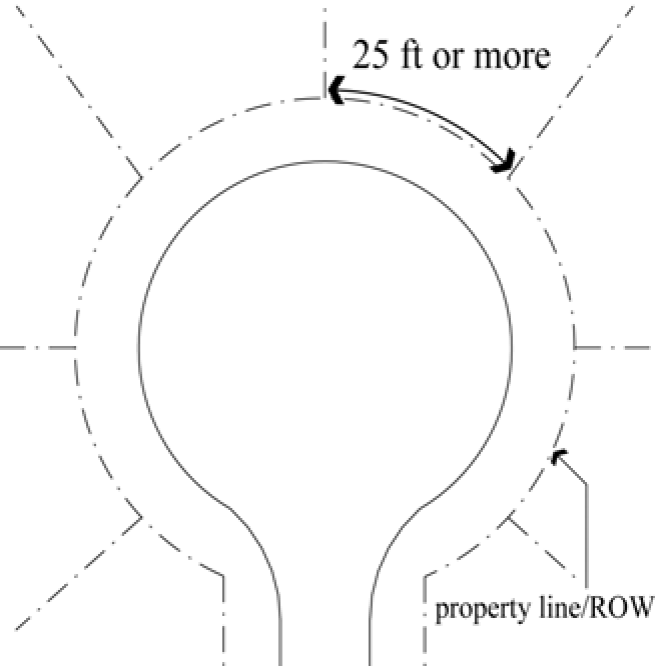
Figure 4.3.5: Lot frontage for culs-de-sac
3.
Non-residential uses in non-residential districts may have a lot frontage width less than 40 feet so long as access to such lot is provided by another frontage greater than 40 feet in width, by an alley or by a shared access approved by the Commission.
4.3.6. General Setback Regulations.
1.
The minimum front yard setback may be reduced where the setbacks of the buildings on abutting lots is less than the normally required front yard setback (see Figure 4.3.6). In such case, the setback may be less than that normally required, but not less than:
a.
For interior lots, the average of the as-built setbacks on the abutting lots.
b.
For corner lots, the as-built setback on the abutting lot per corresponding frontage.
2.
No side yard setback shall be required in excess of 25 feet.
3.
For corner lots in single-family residential districts, the minimum front yard setback shall be observed on both lot frontages abutting street rights-of-way (except alleys 16' or less in width), unless otherwise provided by this Ordinance.
4.
Every part of a required yard shall be open from its lowest point to the sky unobstructed except for:
a.
Accessory uses conforming to §4.4 Accessory Structures.
b.
Uncovered terraces, decks, steps and porches, which are not, in any part, located within five feet of any abutting lot line zoned R-5, R-6, R-7, R-8 and R-9 only. Uncovered steps and stairs, of any height, may encroach no more than 25 percent into a required front yard on a single-family or duplex lot.
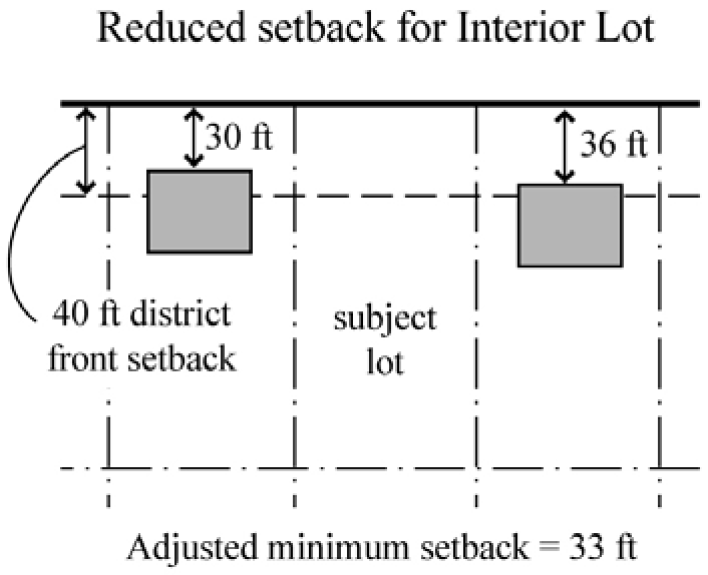
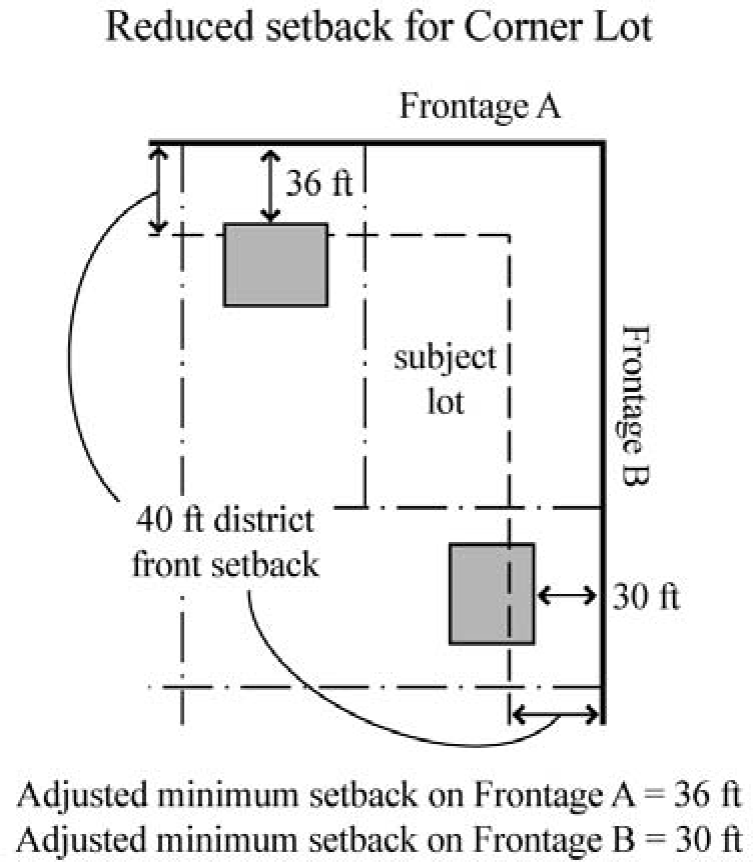
Figure 4.3.6 Reduced front yard setbacks
c.
Roof overhangs, projecting into a required yard no more than three feet but in no case shall they project closer than three feet to any property line.
d.
Bay windows, chimneys, window air condition units and similar architectural features or mechanical components of single-family dwellings and duplexes projecting no more than four feet into a required yard. The cumulative width(s) of such encroachments shall not constitute more than ten percent of the total length of the corresponding wall. In no case shall such projections extend nearer than three feet from any abutting lot line.
e.
Mechanical components of central air conditioning systems, irrigation pumps, grinder pumps, or similar mechanical equipment projecting into a required side yard no more than four feet and no closer than five feet to any lot line, except in subdivisions with side setbacks of a minimum of five feet or less or as may be otherwise approved by the Building Official in the case of zero lot line developments.
f.
Moveable awnings attached to and supported by a building wall may be placed over doors or windows in any required yard, but such awnings shall not project closer than five feet to any lot line. Canopies shall provide a clear space between grade level and the bottom of the valance of at least eight feet. See also §7.2 Gas and Service Stations for gas and service station canopies.
In addition to the aforesaid, a reduction of a front, rear or side yard up to one foot may be approved by the Building Official provided that no portion of the building shall extend closer than three feet to the nearest property line.
5.
On through lots, the required front yard setback shall be provided on each frontage except where a note appears on a recorded plat prohibiting access to one of the abutting frontages. Along such frontage, the minimum rear yard shall be required per the applicable district.
4.3.7. Height Regulations. The maximum building height regulations prescribed in this Ordinance shall not apply to belfries, chimneys, church spires, cooling towers, elevator bulkheads, fire towers, flag poles, television antennae, tanks, water towers, or mechanical equipment rooms that:
1.
Do not separately or in combination with other rooftop structures exceed ten percent of the horizontal roof area; and
2.
No sign, nameplate, display or advertising device of any kind shall be inscribed upon or attached to any such structure or otherwise erected so as to extend above the roof of the principal structure.
4.3.8. Sight Distance Requirements. No planting, fence, building, wall, sign or other structure shall be placed or maintained so as to obstruct the vision of motorists within a clear sight triangle determined by the City Engineer in accordance with the City Public Works and Engineering Standards.
Foundation. Footings and foundations for new constructions and additions installed on a lot or parcel that has an average grade slope exceeding 1/3 shall be designed by a State of Alabama licensed engineer. A geotechnical engineer shall be required to evaluate the site and inspect the footings and foundations.
(Ord. No. 3099, 6-27-22)
§4.4. - Accessory Structures.
4.4.1. Time of Construction. No accessory building shall be constructed until the construction of the principal building, to which it is accessory, has been commenced, and no accessory building shall be used unless the principal building is also being used
4.4.2. Location.
1.
Accessory structures shall be located only in the rear yard and shall not be located nearer than ten feet from the principal dwelling.
2.
Side yard setback. The side yard setback shall be that required of principal structures in the applicable district.
3.
Rear yard setback. Accessory structures shall not be located nearer than 15 feet from the rear lot line.
4.4.3. Height. Accessory structures shall not exceed one story in height nor 16 feet. Greater height may be permitted only by a Special Exception upon request to the BZA in accordance with the provision of §12.3 Special Exceptions.
4.4.4. Building Materials. If the accessory structure is a detached minor building consisting of masonry or frame walls and roof, then in such event said minor building shall be constructed with building materials of the same type and kind as used for the construction of the principal structure on the premises.
4.4.5. Miscellaneous.
1.
The term "accessory structure" shall not include:
a.
Any use not on the same lot to which it is accessory unless authorized by the Board of Zoning Adjustment.
b.
Any use not customarily incidental to a permitted use.
c.
Any use detrimental to a residential neighborhood, if located within a residential area or if abutting residential uses.
d.
An accessory dwelling except where specifically permitted by this Ordinance.
(Ord. No. 3099, 6-27-22)
§4.5. - Fences.
4.5.1. Visibility. No fence or wall shall be permitted between the building line and the front lot line. Fences shall not be placed within the clear sight triangle as determined by the City Engineer.
4.5.2. No fence shall be erected, installed, constructed or otherwise structurally altered in the City except in strict compliance with the terms and provisions of this ordinance.
4.5.3. Any person, firm, corporation, partnerships or other entity desiring to build a fence on any property located within the City shall follow the procedure and comply with the following requirements:
1.
Unless it has been approved as part of a valid Building Permit, no fence shall be erected, installed, constructed or otherwise structurally altered on any property until a fence permit is issued by the City.
2.
No approval for the issuance of a permit shall be made until such time as the Building Official and Fire Marshal have approved the plans and specifications for the erection, installation, construction or structural alteration of said wall or fence and certifies that the same meet the requirement of paragraphs 3 and 4 below.
3.
The person, firm, corporation, partnership or other entity applying for a permit shall submit plans and specifications for the erection, installation, construction or structural alteration of the fence. The plans and specifications shall include the following:
a.
A map or survey of the lot upon which the fence will be located.
b.
The location of the fence on the property.
c.
The dimensions of the fence, including the height, width and length.
d.
Estimated cost.
e.
List and description of materials to be used.
4.
No fence shall be erected, installed, constructed, or otherwise structurally altered unless the material utilized therefore is such that the grade and quality of said material is the same on all sides, including the front and back. Materials are limited to chain link, masonry, vinyl, composite, or wood.
5.
In all residential zoning districts, fences, regardless of material, shall be no higher than eight feet measured from the ground. Any fence exceeding eight feet in height shall require a Conditional Use Approval pursuant to Section 13.3. If Conditional Use Approval is requested, drawings indicating the requested fencing, location, height and materials will be required.
6.
In all residential zoning districts, fences may be located between the front building line and the front setback line provided said fences are open, ornamental in style, finished on both sides and excluding any chain link or privacy wood fencing.
7.
For security purposes, in all residential zoning districts, fences may be located between the front building setback and the front lot line providing that all of the following criteria are met:
a.
The residential property must be a lot of record recorded in the Office of the Judge of Probate; and
b.
The recorded lot must consist of a minimum one acre of property; and
c.
The primary residential unit constructed upon the property must be located a minimum 100 feet from the front lot line; and
d.
The fence and gate shall be constructed so as to be open, ornamental and decorative in style and constructed of finished stone, masonry and/or metal. Said fencing located within the front yard setback shall exclude wood and/or chain link fencing; and
e.
Said fencing shall be located a minimum of two feet inside the front lot line or a minimum of five feet from any public improvements, within the right-of-way, whichever is greater. Said location shall be approved by the City Planner and/or City Engineer in order to mitigate adverse effects to the subject or adjacent properties. NOTE: All public improvements, including utilities, shall be designated on required drawings in the form of a survey and certified by an Engineer and/or Surveyor licensed by the State of Alabama; and
f.
Said security gate shall be set back minimum 40 feet from the edge of pavement or at least two feet inside of the private property line, whichever is greater; and
g.
A Knox switch/switches shall be installed and gate shall be at proper width in order to allow access for emergency vehicles and shall be approved by Fire Marshall prior to permitting.
(Ord. No. 3099, 6-27-22)
§4.6. - Ownership and Management of Common Open Spaces and Facilities.
For all developments involving the creation of open spaces or facilities to be owned and maintained by a homeowner, property owner, or Condominium association, the following shall apply:
4.6.1. Owner's Association. An association representing the owners shall own the common open space or facility in perpetuity. Membership in the association shall be mandatory and automatic for all owners of the subdivision or condominium and their successors. The association shall have lien authority to ensure the collection of dues from all members. The responsibility for maintaining the common open space and/or facilities located thereon shall be borne by the association.
4.6.2. Management Plan. The applicant shall submit a plan for management of open space and/or common facilities that:
1.
allocates responsibility and guidelines for the maintenance and operation of the common open space/facilities including provisions for ongoing maintenance and for long-term capital improvements;
2.
estimates the costs and staffing requirements needed for maintenance and operation of, and insurance for, the common open space/facilities and outlines the means by which such funding will be obtained or provided;
3.
provides that any changes to the plan be approved by the Commission; and
4.
provides for enforcement of the plan.
4.6.3. In the event the party responsible for maintenance of the common open space/facility fails to maintain all or any portion in reasonable order and condition, the City may take any corrective action, to the extent permitted by law, which is deemed necessary and suitable to remedy the situation.
(Ord. No. 3099, 6-27-22)
§4.7. - Condominiums.
The condominium form of ownership is permitted in any and all Zoning Districts although the area and dimensional regulations for certain districts or uses may not directly relate to such form of property ownership, such as minimum lot areas, widths or yards. Therefore, condominiums shall not be held literally to such regulations; but instead shall be consistent with their intent. For example, if this Ordinance requires a minimum lot area of 10,000 sq. ft. for a particular district or use, such area shall be provided, although it is not within a separately owned lot, and shall not be counted toward another part of the same development. Similarly, in a district that requires a ten foot side yard setback; there shall be a 20 foot separation between the sides of buildings in a condominium development.
Furthermore, when a district limits the intensity of development to one principal building per lot, such regulations shall not apply literally in the case of condominiums. In such case, more than one such building shall be permitted so long as the minimum (lot) area is provided per principal building.
(Ord. No. 3099, 6-27-22)
§4.8. - Commercial Vehicles in Residential Districts.
In all residential zoning districts, commercial vehicles, as permitted, shall only be parked behind the front building line or within an enclosed structure.
(Ord. No. 3099, 6-27-22)
§4.9. - Donation Bins.
4.9.1. Donation bins may be located on premises in non-residential districts only and shall not, after the effective date of these regulations, be placed on a premises without written approval of the Zoning Official. The following information shall be provided to the Zoning Official with the request for placement:
1.
Name, address and phone number of the applicant.
2.
Name, address and phone number of the owner of the concerned property and a letter of authority/permission from said owner.
3.
Information as to the manner and schedule for which the bin is to be emptied or removed.
4.9.2. Standards. The Zoning Official shall only approve bin placement in accordance with the following:
1.
Bins shall be set back as required for principal buildings in the applicable non-residential district and may not encumber any required sight triangle, off-street parking or stacking space, circulation or loading/unloading area, buffer, required yard or landscaping area.
2.
All goods shall be regularly removed to avoid overflow and the bin area shall be maintained in a safe, orderly condition.
3.
Bins shall not be placed in any manner that conflicts with conditions imposed on the premises through conditional use, special exception use, variance, design review or similar approval.
(Ord. No. 3099, 6-27-22)
§4.10. - Swimming Pools in Residential Districts.
4.10.1 In all residential zoning districts, pools shall be constructed within the side and/or rear yards with a minimum setback of five feet from any adjacent property line.
4.10.2 All mechanical pool equipment shall be located a minimum of three feet from any adjacent property line.
4.10.2 Decks constructed for above ground pools in Residential District R-1, R-2, R-3 and R-4 shall be located within the regular side setbacks of the respective zoning district.
(Ord. No. 3099, 6-27-22)
§4.11. - Sidewalks.
The Vestavia Hills Planning and Zoning Commission in concurrence with the City Council has adopted an official Sidewalk Master Plan to facilitate the construction of those pedestrian connections by preparing a plan for future facilities in the form of the Sidewalk Master Plan ("the Plan"). The Plan, as currently adopted is hereby incorporated into this Code and located on the City's official website, and, as may be amended from time to time by the Planning and Zoning Commission following a public hearing, shall have the following rules and procedures in order to require the construction of sidewalks and/or collect funds in lieu of sidewalks, where applicable
4.11.1 All sidewalks outlined within the approved Vestavia Hills Subdivision Regulations and other design guidelines shall apply to all projects governed by those policies
4.11.2 If a property is subdivided along an existing public street or if a property is developed or redeveloped within a commercial, institutional, office or multifamily area shown on the City's sidewalk masterplan, the developer shall be required to construct a City standard sidewalk along the frontage of the property or development.
1.
In the event that the developer or his engineer determines that it is infeasible or inadvisable to construct a sidewalk, they must submit, in writing, an appeal to the City Engineer outlining why it is infeasible or inadvisable.
2.
The City Engineer or his designee, will evaluate the appeal using engineering judgement to approve or deny the appeal.
3.
If the appeal is approved, the developer shall contribute to the City's sidewalk fund in lieu of constructing the sidewalk. The linear foot cost of sidewalk will be calculated by the City Engineer or his designee based on the average unit cost for a concrete sidewalk from the three most recent publicly bid sidewalk projects constructed by the City. The City Engineer will use the frontage length multiplied by the concrete sidewalk cost to determine the contribution amount, where frontage is defined by this Ordinance.
4.
The funds shall be contributed prior to project closeout.
5.
The contributed funds will be held within the City designated fund and used solely for the purpose of constructing pedestrian facilities shown on the sidewalk masterplan.
6.
If the appeal is denied the developer will be required to install the City's standard sidewalk as prescribed in Section 4.11.
(Ord. No. 3099-A, § 1, 1-27-25)

