
Vestavia Hills City Zoning Code
ARTICLE 9
- LANDSCAPING REGULATIONS
The City of Vestavia Hills, Alabama, in accordance with Title the Code of Alabama, 1975, § 11-52-70 has determined that some regulation of landscaping property will promote the beauty and aesthetics of the City. Furthermore, the intent of these standards are: to facilitate a harmonious and attractive environment; to prevent erosion; to capture and treat drainage and stormwater runoff; to reduce glare, wind turbulence, carbon monoxide, heat, and noise; to stabilize property values; and to generally preserve and promote the establishment of a healthful and pleasant community.
(Ord. No. 3099, 6-27-22)
§9.1.- General.
A landscape plan for any development subject to design review pursuant to §13.2.2 shall be submitted to the Design Review Board prior to issuance of a Building Permit. If the development includes a request for rezoning or conditional use, then such landscaping plan shall also be presented to the Commission, together with the application for rezoning or conditional use, as applicable.
9.1.1. The landscape plan shall include the following information:
1.
Proposed planting schedule including the type, quantity, spacing, size, installation instructions and common name of all plantings.
2.
Plant materials labeled and shown in relation to lot lines, adjacent streets, buildings and parking areas.
3.
All Buffers required under §9.3, if any.
4.
All Screening required under §9.4, if any.
5.
Approaches to building entrances.
6.
Proposed parking areas and means of vehicular egress and ingress.
7.
Location, size, function and furnishings for proposed open spaces shown in relation to lot lines, adjacent streets, sidewalks, buildings and parking areas.
8.
All utilities and fire connections.
9.
Proposed landscape vehicles, equipment, and materials to be stored on the property.
10.
Soil preparation methods, bedding and mulching, and planting details
9.1.2. Landscaping shall be provided in accordance with the following:
1.
Where existing topographic patterns contribute to beauty and utility of a development, they shall be preserved whenever at all possible, practical and feasible.
2.
Landscape treatment shall be provided to enhance architectural features and to strengthen vistas.
3.
All landscaping shall be installed in accordance with accepted good planting procedures as prescribed by the American Society of Landscape Architects.
4.
This Article establishes requirements for site landscaping, as well as landscaping for Buffers and Screening. Landscaping provided to fulfill Buffer or Screening requirements, may also be counted, in whole or in part, toward site landscaping requirements and vice versa.
5.
Existing trees, plantings and other vegetation, which meet these standards, in whole or in part, may be accepted by the approving authority, to count toward landscaping requirements.
(Ord. No. 3099, 6-27-22)
§9.2. - Site Landscaping.
9.2.1. Applicability. Site landscaping shall be provided with all new multi-family, non-residential and mixed-use developments in accordance with the following standards. Existing premises must conform with these standards as provided in Article 10 Nonconformities. Required site landscape areas include: frontage landscaping, building landscaping, parking lot interior landscaping and parking lot perimeter landscaping as shown in Figure 9.2.
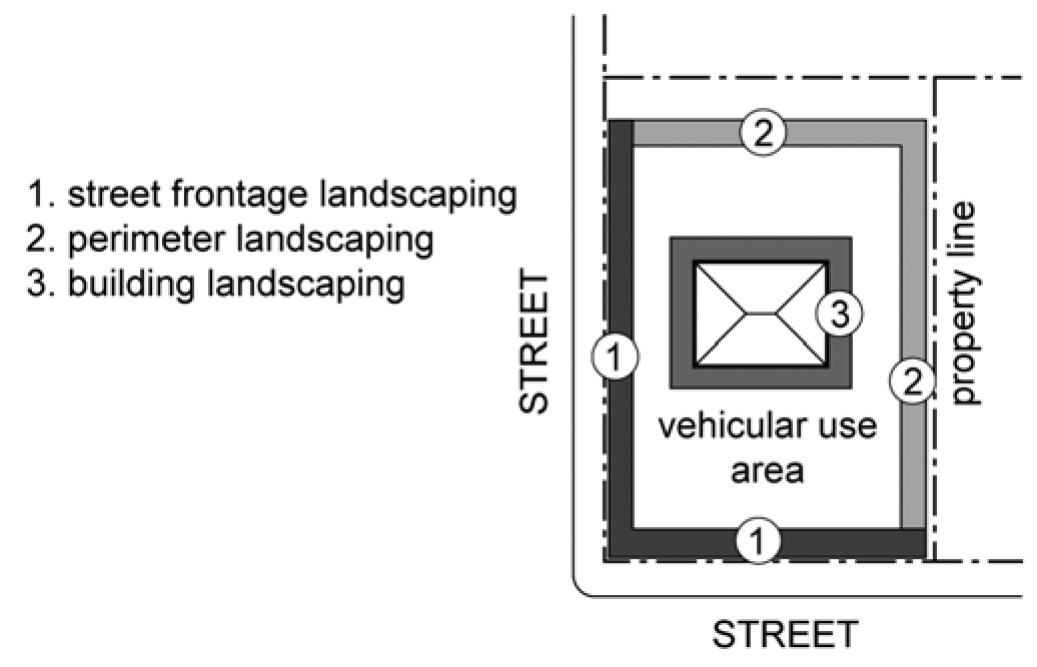
Figure 9.2 Site Landscaping Areas
9.2.2. Frontage and Perimeter Landscaping.
1.
Frontage landscaping shall be provided along lot frontages to reduce the visual impact of and glare from vehicular use areas, enhance the public streetscape, and to control access between private and public space where appropriate. Frontage landscaping is required for the length of parking and vehicular circulation areas that extend within 25 feet of the front lot line(s). Frontage landscaping shall be provided as shown in Table 9.2.2 and as follows:
a.
For the purposes of this Subsection, corner lots shall be considered to have two frontages.
b.
The planting strip shall be located along the outside edge of the vehicular use area
2.
Perimeter Landscaping shall be provided to reduce the visual impact of and glare from vehicular use areas on adjacent property, capture and treat stormwater and to control access between developments where appropriate. Perimeter landscaping is required for the length of parking and vehicular circulation areas that extend within 25 of side and rear lot lines. Perimeter landscaping shall be provided as shown in Table 9.2.2 and as follows:
a.
The planting strip shall be located along the outside edge of the vehicular use area.
b.
Perimeter landscaping requirements may be modified by the Zoning Official in writing where natural conditions make such landscaping unnecessary and/or impractical.
c.
Perimeter landscaping may be waived or reduced between two vehicular use areas on abutting lots, which are connected by a cross access agreement and are of integrated design.
d.
A solid fence of a height of at least 30 inches shall suffice for perimeter landscaping along an alley.
9.2.3. Interior Landscaping shall be provided within off-street parking areas of 25 or more spaces to capture and treat stormwater, create human scale and minimize heat islands by providing shade and reducing reflective surfaces, as follows:
1.
There shall be at least 20 square feet of interior landscaping per parking space.
2.
Every planting area (peninsula, median or island) containing a required tree shall be at least 75 square feet and seven feet in width. Each planting area shall be suitably landscaped with a variety of plant materials including but not limited to ground covers, shrubs, flowering plants, pine straw and mulch.
3.
There shall be a canopy tree within 80 feet or an understory tree within 60 feet of every parking space, which may include trees planted to meet other landscaping requirements.
4.
Landscape islands shall be provided at the end of any parking bay containing 20 or more parking spaces. Trees shall be provided within said islands in accordance with §9.2.3.3 above.
9.2.4. Building Landscaping shall be incorporated along building elevations, which are 35 feet or greater in length and are set back from property lines, to accentuate entrances, reinforce pedestrian accessways to and from parking areas, and to enhance secondary facade areas, as shown in Table 9.2.4 and as follows:
1.
Building landscaping areas shall be located along or shall begin within 15 feet of each building elevation to accommodate a walkway between the building and landscaping. Other required landscaping may be counted toward Building Landscaping requirements if meeting this location requirement.
2.
Required building landscaping may be aggregated into one or more locations along the elevation to allow for pedestrian/vehicular access and loading areas along the building elevation.
(Ord. No. 3099, 6-27-22)
§9.3. - Buffers.
Buffers shall be provided in accord with the requirements of Tables 8.3A and 8.3B and as described in this §9.3. In cases where Buffers are required or deemed necessary for the protection and/or separation of uses on abutting lots, the following provisions shall be the minimum requirements unless otherwise specified by the reviewing authority in individual cases. For the purposes of this Section, "fences" and "walls" shall have the same meaning.
9.3.1. General Requirements. Except as otherwise provided herein, buffers shall be required based on the developing use and the existing, abutting use, regardless of the zoning districts in which they are located.
1.
Required yards, where corresponding with the buffer area, may overlap and may be counted toward a buffer width requirement.
2.
100 percent of the applicable buffer requirements shall be the responsibility of the developing land use, except when the developing use will abut an existing more intensive use established prior to the adoption of these standards and for which no buffer is in place. In this case, the approving authority may require up to 50 percent of the required buffer width on the developing site. In such case, the applicant shall only be required to preserve existing vegetation within the buffer width or replace such vegetation with equivalent landscaping.
3.
Any required buffer abutting a park or greenway may be reduced, if the property owner dedicates land to be set aside, for all or part of the required buffer width, to the City for incorporation into the park or greenway if approved by the Council.
4.
Buffer requirements may be modified by the approving authority for certain cases as follows:
a.
When the proposed use will abut an existing, nonconforming use on a property that is designated for another use in the Comprehensive Plan and is zoned accordingly with said plan, the Buffer may be modified to be consistent with the projected use of the neighboring land.
b.
If the land use relationships between two abutting lots changes so that a lesser Buffer would be required, the width of the previously provided Buffer may be reduced accordingly.
c.
If the required Buffer abuts a public alley, up to one-half of the alley width may be counted toward the buffer width requirement but the landscaping density requirements shall not be reduced.
d.
Whenever the proposed use abuts vacant land, buffer requirements shall be based on the zoning of the abutting property or the use projected by the Comprehensive Plan, whichever requires a lesser buffer. When determining buffer requirements based on the zoning or projected use of abutting vacant land, the Zoning Official shall consider the range of possible future uses and base the requirement on the use(s) that require a lesser buffer.
5.
Golf courses, playfields, stables, swimming pools, tennis courts, and other recreational facilities; parking and other vehicular use areas; Buildings, dumpsters, and Outdoor Storage are prohibited in required Buffers. The approving authority may permit a pedestrian access way through a required Buffer, to allow access between the abutting uses, if desired.
9.3.2. Design Requirements.
1.
Trees and shrubs shall be provided in accordance with Table 9.3B.
2.
Stormwater management and drainage controls required by the City Engineer shall be coordinated with the buffer design and integrated into the overall site design.
3.
The required Buffer width and planting density may be reduced as provided in Table 9.3B when a buffer fence is provided that meets the following standards:
a.
Buffer fences shall be of masonry, ornamental metal, durable wood, or a combination thereof as approved by the reviewing authority. Untreated wood, chain-link, plastic or wire shall not be permitted. No more than 25 percent of the fence surface, required as a part of a buffer, shall be left open. The finished side of the fence shall face abutting property.
b.
Buffer fences shall be a minimum of six feet high and no taller than eight feet. Buffer landscaping shall be placed along the exterior side. If longer than 100 feet in one direction, the fence shall have columns of wood or masonry, spaced no greater than 50 feet on center and which project outward from the fence surface.

Figure 9.3: Buffer Landscaping Rows
9.3.3. Planting Requirements. The required Buffer shall be installed before a Certificate of Occupancy may be approved. Except as herein provided, plantings installed toward buffer requirements shall be in accord with the general requirements and minimum planting specifications set forth in §9.5 Planting, Installation and Maintenance.
1.
Existing natural vegetation, which meets, in whole or in part, buffer planting requirements, may be applied toward the requirements of this Section.
2.
Trees shall be evergreen.
3.
Shrubs shall be evergreen and be 30 inches tall at planting. However, up to 25 percent of the required shrubs: 1) may be deciduous, b) may be two feet tall when planted, provided an average height of three to four feet within four years; and c) when planted on a berm, may be of a lesser height, provided that the combined height of the Berms and planting is at least six feet after four years.
(Ord. No. 3099, 6-27-22)
§9.4. - Screening.
Screening is intended to provide both visual separation of conflicting uses on-site and between adjacent properties and shall be designed to be compatible with the surrounding environment and shall not dominate the view. For the purposes of this section, "fences" and "walls" shall have the same meaning.
9.4.1. Applicability. For all multi-family, non-residential and mixed use developments, the following shall require Screening:
1.
Garbage collection, recycling and refuse handling areas;
2.
Maintenance areas or utility structures associated with a building or development;
3.
Water meters, gas meters, electric meters and air conditioners/mechanical units;
4.
Loading docks or spaces;
5.
Outside runs for veterinary clinics, animal shelters, and kennels;
6.
Outdoor storage of materials, stock, equipment, and vehicles (such as those stored for repair);
7.
Any other uses for which screening may be required by the reviewing authority.
9.4.2. Safety Provisions.
1.
Screening shall not conflict with §4.3.8 Sight Distance Requirements.
2.
Screening shall not block access to any above-ground, pad-mounted transformer and shall provide the minimum clear distance required by the utility company.
3.
Screening shall not impede or divert the flow of water in any drainage way.
9.4.3. Design Requirements. The method of screening, including height and materials, shall be that which is sufficient to visually screen the use. The minimum height needed is preferred. Fences, berms, or landscaping used for other purposes, but that are proposed as part of a required screen and that meet the requirements of this Section, may count toward screening requirements. The design of screening shall be in accord with the following and as approved by the reviewing authority:
1.
Location of uses. Location on site should be the first consideration in screening the uses listed in §9.4.1 above. The reviewing authority may lessen screening requirements when the location of the use to be screened reduces its visibility or other impact to the public and neighboring properties.
a.
Uses requiring screening, when co-located, may be screened together.
b.
Uses that produce objectionable noise or odors shall be located so as to minimize such impacts to the public and abutting properties.
2.
Screening Fences. All screening fences shall comply with the following:
a.
Screening fences shall be of masonry, ornamental metal, vinyl, durable wood, or a combination thereof. Untreated wood, chain-link, plastic or wire shall not be permitted. No more than 25 percent of the fence surface, required as part of a Screen, shall be left open. The finished side of the fence shall face abutting property.
b.
Where screening fences are longer than 50 feet in one direction, evergreen landscaping shall be placed along the exterior side. Where such fences are longer than 100 feet in one direction, required landscaping shall include both trees and shrubs and the fence shall have columns of wood or masonry which project outward from the fence surface. Such columns shall be spaced no greater than 50 feet on center.
c.
Fences located forward of the front building line shall not exceed six feet. Fences located in a required rear or side yard shall not exceed eight feet in height.
3.
Berms. Berms shall be landscaped and stabilized to prevent erosion and shall be a minimum height of four feet. Slopes shall be approved by the City Engineer.
4.
Shrubs and trees. Except as herein provided, plantings installed for screening requirements shall conform to §9.5 following.
a.
Shrubs shall be evergreen and spaced no more than five feet on center.
b.
Trees shall be evergreen and, when used in the absence of a fence, should have a low understory and/or be used together with shrubs to provide an opaque visual Screen.
5.
Screening requirements for specific uses.
a.
Dumpsters, trash refuse, and recycling containers shall not be located forward of the front building line. Enclosures, while allowed within the property setback lines, cannot be included within the required buffer areas or within five feet of a property line. Such containers shall be screened by a combination of opaque fence or masonry wall and plant material on three sides. Opaque gates, designed to complement the screen, shall be installed for access. The fence or wall shall be at least two feet taller than the container.
b.
For restaurants, enclosures shall be sized, as needed, to accommodate the storage of grease containers.
c.
Mechanical equipment on roofs or on site shall be screened so as to not be visible from public streets or adjacent properties. The screening of building-mounted mechanical equipment shall be an integral component of the building design. Mechanical equipment installed on site shall be adequately screened by plant materials and/or fences and shall blend in with site landscaping.
d.
Outdoor storage, where permitted, shall be screened to a height of six feet or two feet taller than the material or equipment to be screened, whichever is greater.
e.
Service areas, loading docks, work yards, and similar uses should be located to minimize their visibility to the public and to any abutting properties to which such functions would be objectionable. Where their location is insufficient to effectively screen the use, required screening shall be at least six feet in height. Loading berths shall be within the building or concealed by means of a screening wall of material similar to and compatible with that of the Building.
(Ord. No. 3099, 6-27-22)
§9.5. - Planting, Installation and Maintenance
9.5.1. Planting.
1.
All plants shall be suitable for local planting conditions and the intended landscaping purpose. All required landscaping areas shall be maintained with mulch (two inches deep at installation), sod or other approved ground cover.
2.
Native, drought-tolerant vegetation shall be used where practicable to avoid excess water consumption for irrigation. Plans submitted for review shall identify such native species.
3.
Required plantings shall be spaced to allow for adequate growth and coverage.
4.
Canopy trees shall have a minimum two-and-one-half inch caliper measured six inches above ground and be a minimum 12 feet in height at time of planting. At time of planting, evergreen trees shall be a minimum seven feet in height and multi-stemmed trees shall be eight feet in height.
5.
Shrubs shall have a minimum height of one foot measured from grade level at the time of planting.
9.5.2. Installation and Inspection.
1.
Required plantings shall be installed at the next seasonal planting opportunity unless a written waiver has been issued by the Zoning Official.
2.
Required landscaping materials shall be installed before a Certificate of Occupancy may be approved.
3.
At the time of installation and upon inspection, minor changes may be approved in writing by the Zoning Official, provided the changes meet the minimum requirements of this Article. Any change, which said Official determines to be a major change, shall require a revised Landscaping Plan be resubmitted for approval.
9.5.3. Maintenance. The Owner shall be responsible for providing, protecting, and maintaining required plantings in a healthy and growing condition. Any dead, missing, or unhealthy plants shall be replanted at the next seasonal planting opportunity, and broken or deteriorated non-living materials shall be replaced. Planted areas shall be maintained in a healthy condition. Screening fences/walls, pavers, irrigation or other improvements shall be maintained in good condition, and any such improvement shall be replaced or repaired within 30 days of its demise. Failure to comply with these maintenance requirements shall constitute a violation of this Ordinance and shall be subject to the remedies and penalties provided in §13.7.
(Ord. No. 3099, 6-27-22)
§9.6. - Tree Preservation Regulations.
9.6.1. These provisions are intended to regulate the removal and/or destruction of trees within the community for the purpose of:
1.
Preserving the existing character of the city, part of which is derived from existing groves of mature pine, oak and other species of trees;
2.
Reducing the effects of noise and air pollution;
3.
Preventing soil erosion and the siltation of drainage improvements and waterway;
4.
Protection and enhancing the aesthetic qualities of the community; and
5.
Adding an element of landscape maturity to new developments in the city thereby enhancing buffering, privacy and increasing the value of property.
9.6.2. Applicability and Exceptions. These regulations shall apply to each Protected Tree within the corporate limits of the City, except a Protected Tree on any lot zoned or used exclusively for single family (attached and/or detached) [except new residential subdivisions as defined in §9.6.5.2] and any property zoned as PUD (planned unit development).
9.6.3. General Regulations. No Protected Tree as defined in this Section shall be removed, relocated, destroyed or otherwise directly or indirectly damaged unless and until a tree permit under this Section has first been issued. The City is authorized to issue an annual permit to public utility companies exempting them from this requirement with respect to the trimming of Protected Trees that may interfere with utility lines located within public right-of-way, upon such terms and conditions as may be determined by the City. No tree permit shall be required for the incidental trimming or pruning of a Protected Tree located on private property by the owner of the property or the owner's agent.
9.6.4. Definitions.
1.
Caliper: The measurement of the diameter of a tree trunk four feet above existing grade.
2.
Protected Tree: Any tree that has a caliper of at least six inches.
9.6.5. Tree Permit.
1.
Any person wishing to remove, relocate, destroy, or otherwise damage a Protected Tree shall, under the provisions of this subsection, make written application to the DRB, which application shall include a landscape plan as provided before in said application or other information that adequately explains the request.
2.
As part of any request for a land disturbance permit for a new subdivision with a minimum of five lots, the applicant shall include, as a part of the application, a tree save plan that will preserve as many trees in the development as practical. The plan shall be approved by the Commission as part of the preliminary plat process (or final plat process if no preliminary is required) with input and recommendations from the City Engineer, the Department of Building Safety and the Vestavia Hills Tree Commission. Once approval of the tree save plan has been secured along with all other requirements concerning a land disturbance permit, the City Engineer may issue a land disturbance permit for said subdivision; or
3.
Application fees for the filing of tree permit requests shall be in accordance with City of Vestavia Hills Schedule of Fees unless it can be demonstrated to the Department of Building Safety that said tree is/has been damaged, diseased, or in danger of falling close to existing or proposed structures.
4.
In the case of tree removal or relocation activities that will be required on a continuing or repetitive basis, the City may issue a blanket tree permit on such terms and for such duration as are determined to be appropriate under the circumstances. Completed applications shall be filed with the Committee a minimum of 15 days prior to the regular scheduled meeting and shall contain the signature of the property owner or a notarized letter assigning an agent to represent signed by the owner.
5.
The DRB will consider approval or denial of the application at the next regularly scheduled meeting following proper filing of the completed application. If approved, a tree permit shall be issued by the Department of Building Safety authorizing the proposed activity.
6.
The Mayor may declare an emergency and impose a temporary moratorium on the enforcement of this requirement, following severe storm events within the city.
9.6.6. Criteria for Issuance of a Tree Permit.
1.
A Tree Permit for the requested activity shall be issued if:
a.
The tree is located in an area where a structure or improvement is to be placed according to a site plan or building permit approved by the City; or
b.
The tree is diseased, damaged, in danger of falling close to existing or proposed structures (approved in A. above), interferes with existing or proposed essential utility services, creates unsafe vision clearance or conflicts with other ordinances or regulations of the City; or
c.
Removal of the tree will not result in any adverse material affect to the appearance of the site, since other Protected Trees of similar age, height, and species are present on the site and/or a sufficient number of replacement trees are proposed to be planted on the site in appropriate locations and of sufficient size to prevent such adverse affect.
d.
The tree is to be removed and relocated as part of (1) the bona fide harvesting or thinning of timber from land currently assessed and managed as forest property; (2) the bona fide thinning of growth from undeveloped property for the purpose of the maintenance of the overall health of the trees and growth on such property; (3) the release from nursery inventory of trees commercially cultivated for the purpose of resale; or (4) the preservation of such tree in connection with the expansion of agricultural operations in the vicinity of such tree.
2.
If, in the determination of the DRB that the application does not meet the above criteria, it will be denied and the reasons communicated to the applicant who may appeal the decision to the Commission within ten working days by filing a written request with the City Clerk in a format or on a form as specified by the department.
9.6.7. Enforcement and Penalties. Whenever the Building Official shall determine that a violation of this Section has occurred, any of the following actions may be initiated singly or in combination:
1.
On any new construction site, a stop work order may be immediately issued to the contractor or property owner. Upon receipt of such order, construction may not be resumed until an approved plan authorizing the removal of the subject trees is presented to the DRB or a remediation proposal is presented to the Chairman and approved by the DRB as provided in subsection (3) below.
2.
On an existing developed site, depending upon the circumstances of the violation, a formal citation may be issued to the violator as determined by the Building Official. A stop work order shall specify the nature of the violation and require that any work not permitted under this Article immediately cease and desist. The property owner shall, within, two weeks, present a remediation proposal to the City for correcting the violation.
3.
Each remediation proposal shall be reviewed by the Building Official, who shall present the proposal to the DRB along with a recommendation for acceptance or rejection, or modification thereof.
4.
Any person violating any of the provisions of this Section shall be guilty of an offense against the City and shall, upon conviction, be punished for each violation as provided in §13.7 Remedies and Penalties for Violation. Each Protected Tree removed, relocated, destroyed, or otherwise damaged without a Tree Permit shall constitute a separate violation.
5.
These regulations shall not be construed to impair: (1) the right of eminent domain granted by State laws to utilities, whether public or private, or (2) their right to design, locate, erect, construct, re-construct, alter, protect or maintain utility poles, towers, lines, conduits, pipes or mains reasonably required in the public service or (3) their right to exercise authority conferred by statute, franchise, certificate of convenience and necessity, license or easement. Maintenance, repair, and extension of any public and private utility lines or related infrastructure are expressly allowed. The preceding will apply to work done by the utility's employees, agents and contractors doing work for the utility.
(Ord. No. 3099, 6-27-22)

