
Vestavia Hills City Zoning Code
ARTICLE 7
- USE-SPECIFIC REGULATIONS
§7.1.- Home Occupations.
Home occupations are permitted uses in any estate or residential zoning classification under the following limitations. For home occupations in a planned unit development, refer to §6.9.5.1.
7.1.1. Limitations.
1.
Home occupations shall be conducted only in the principal dwelling. No more than 25 percent, up to 500 square feet, of the dwelling may be used for a home occupation.
2.
There shall be no outdoor display or storage associated with the home occupation and no commodities shall be sold on the premises other than by phone, mail or internet. No goods shall be delivered to a purchaser on the premises.
3.
No sign may be attached to the dwelling or any part of the real estate advertising any home occupation.
4.
No home occupation shall be permitted if it creates noise, odors, vibrations or traffic congestion, which interferes with the residential qualities of the neighborhood insofar as health, safety, morals, convenience and general welfare are concerned.
5.
In order to be a permitted home occupation, the use must be one which is habitually, customarily, and commonly established as a reasonable incidental, accessory, subordinate and secondary use. The existing dwelling shall not be enlarged to accommodate the home occupation; nor shall any accessory structure be built for the purpose of operating the home occupation.
6.
No home occupation shall be permitted that requires the operation or keeping on premises of a commercial vehicle.
7.
No persons other than members of the family residing on the premises shall be employed by the home occupation.
8.
Home occupations shall be limited to the hours between 7:00 a.m. and 10:00 p.m.
7.1.2. Provided full conformance with the above limitations, the types of home occupations that may be permitted shall include, but not be limited to, the following:
1.
Offices provided no customers or clients shall be allowed on premises.
2.
Phone, mail order and similar sales provided no inventory is stored on the premises and no goods are delivered on the premises by the home owner to any customers.
3.
Music and art lessons, provided there shall be no more than two students receiving instruction at any one time and no students shall be received after 7:00 p.m.
4.
Instruction by a private tutor who offers academic instruction in the several branches of study required to be taught in the public schools of the State of Alabama provided there are no more than five individuals participating in the tutorial instruction at any one time. When complying with this limitation, the home occupation shall not be considered an "Educational Group E" or "Educational Occupancy" for the purposes of the City Building and Fire Codes or City Life Safety Code, respectively. The requirement of "no more than five individuals participating in the tutorial instruction at any one time" shall not mean or include parents that reside in the home or their children, stepchildren or wards.
5.
Crafts, dress making, sewing, tailoring and similar occupations with limited equipment and provided no clients or customers shall be allowed on premises.
The Board of Zoning Adjustment may approve other home occupations per §12.3 Special Exceptions so long as they present no greater impact on the neighborhood than those listed above and provided conditions required by the BZA will be met to limit noise, traffic or other impacts that might otherwise disrupt the residential character of the neighborhood.
(Ord. No. 3099, 6-27-22)
§7.2. - Gas and Service Stations.
7.2.1. Use Limitations.
1.
The following uses shall be prohibited: painting, body work, major repair, dismantling for recovery of parts, and sales or rental of motor vehicles or trailers.
2.
Service stations shall not include more than three service bays.
7.2.2. Area and Dimensional Regulations.
1.
All oil drainage pits and hydraulic lifts shall be located within an enclosed Structure and shall be located no closer than 50 feet to an abutting residential lot line and no closer than 25 feet to any other lot line.
2.
All permitted mechanical repair work shall be conducted within an enclosed structure and shall be located no closer than 50 feet to any abutting residential lot line and no closer than 25 feet to any other lot line.
3.
Fuel pumps, pump islands and other service facilities may occupy required yards; however, such shall be set back at least 15 feet from any lot line. Canopies shall not extend closer than five feet to any lot line.
7.2.3. No storage of vehicles shall be permitted for periods in excess of 30 days. Vehicles shall not be permitted to remain on the property longer than 48 hours unless such vehicles are stored within an enclosed building or within a rear or side yard screened in accordance with §9.4 Screening.
(Ord. No. 3099, 6-27-22)
§7.3. - Conservation Subdivisions.
7.3.1. Intent.
1.
To provide the flexibility to achieve the most effective development on lands that are constrained by natural hazards, environmentally sensitive areas or environmental regulations, which may limit the amount or type of development on such properties;
2.
To enhance quality of life by promoting the creation of accessible greenspace throughout the community;
3.
To protect sensitive, environmental land features to protect the health and safety of residents and neighboring property owners;
4.
To reduce erosion and sedimentation by minimizing land disturbance and removal of vegetation;
5.
To encourage interaction within the community by allowing clustering of homes and orienting them closer to the street, thereby providing gathering places and encouraging the use of parks as focal points within the community;
6.
To encourage street systems that tend to reduce traffic speeds and reliance on main arteries.
7.
To promote construction of convenient walking trails, bike paths, and greenways within new developments that are connected to Adjacent neighborhoods and activity centers to increase accessibility for pedestrians and bicyclists; and
8.
To reduce perceived density by providing a maximum number of lots with direct access to and views of open space.
7.3.2. Applicability. The Conservation Subdivision option is available as a use by right in any zoning district in which single-family detached dwellings may be permitted. The applicant shall comply with all other provisions of this Ordinance and all other applicable regulations, except those which may be modified as specified within this Section.
7.3.3. Ownership of Development Site. The tract of land to be subdivided and/or developed may be held in single, separate, and multiple ownership. If held in multiple ownership, the site shall be developed according to a single plan with common authority and common maintenance responsibility as approved by the City Attorney.
7.3.4. Density Determination. The maximum number of lots shall be determined by the minimum lot size of the Applicable District, the minimum lot size as required by City or County Health Department standards for septic tank use (or similar density limitation where applicable), or the maximum density of the applicable district, whichever is most restrictive. Furthermore, density determination shall also take into account the amount of land necessary for internal streets and other subdivision requirements. In making this calculation, the following shall not be included in the total acreage of the Parcel:
1.
Bodies of open water over 5,000 square feet of contiguous area; and
2.
Wetlands, as defined by the City or by the Army Corps of Engineers pursuant to Section 404 of the Clean Water Act.
7.3.5. Application Requirements.
1.
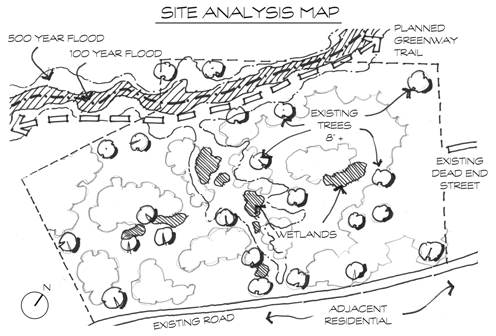
Site Analysis Map Required. Concurrent with the submission of a subdivision plat, the applicant shall prepare and submit a site analysis map. The purpose of the site analysis map is to ensure that important site features have been adequately identified prior to the creation of the site design, and that the proposed open space will meet the requirements of this Section. The site analysis map shall include the following:
a.
Property boundaries;
b.
All streams, rivers, lakes, wetlands, flood hazard boundaries, and other hydrologic features;
c.
All boundaries of applicable regulated buffer areas, easements, and rights-of-way;
d.
Topography at five feet or smaller intervals;
e.
All Primary and Secondary Conservation Areas labeled by type, as described in §7.3.6;
f.
General vegetation characteristics;
g.
General soil types;
h.
Planned location of protected Open Space;
i.
Existing roads and structures; and
j.
Potential connections with existing greenspace and trails.
2.
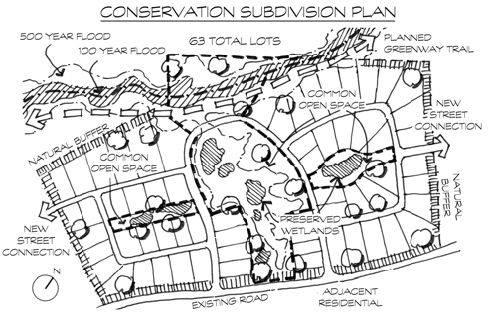
Conservation Subdivision Plan. The developer shall prepare a conservation subdivision plan which yields no more lots than identified under §7.3.4. The conservation subdivision plan shall identify open spaces to be protected in accord with §7.3.6 and may include lots which do not meet the size and setback requirements of the applicable district. The Conservation Subdivision Plan shall include an Open Space Management Plan, as described in §7.3.6 and shall be prepared and submitted prior to the issuance of a land disturbance permit.
3.
Instrument of Permanent Protection Required. An instrument of permanent protection, such as a conservation easement or permanent restrictive covenant and as described in §7.3.6.5, shall be placed on the open space concurrent with the issuance of a land disturbance permit.
4.
Other Requirements. The applicant shall adhere to all other applicable requirements of the applicable district and the Subdivision Regulations.
7.3.6. Open Space Management Plan. For the purposes of conservation subdivisions, open space is defined as the portion of the conservation development or subdivision that has been set aside for permanent protection. Activities within the open space are restricted in perpetuity through the use of a legal instrument approved by the City Attorney.
1.
Standards to Determine Open Space.
a.
The minimum restricted open space shall comprise at least 25 percent of the gross tract area.
b.
The following are considered Primary Conservation Areas and are required to be included within the open space, unless the applicant demonstrates that this provision would constitute an unusual hardship and be counter to the purposes of the Conservation Subdivision:
(1)
The 100-year floodplain;
(2)
Riparian zones of at least 75 feet width along perennial and intermittent stream shown on the United States Geological Survey (USGS) quadrangle topographic maps.
(3)
Slopes above 25 percent of at least 10,000 square feet contiguous area;
(4)
Wetlands determined to be jurisdictional by the Corps pursuant to the Clean Water Act;
(5)
Existing and planned trails that connect the site to neighboring areas; and
(6)
Archaeological sites, cemeteries and burial grounds.
c.
The following are considered Secondary Conservation Areas and should be included within the open space to the maximum extent feasible:
(1)
Important historic sites;
(2)
Existing healthy, native forests of at least one acre contiguous area;
(3)
Individual existing healthy trees greater than eight inches caliper; and
(4)
Other significant natural features and scenic viewsheds, particularly those that can be seen from public streets.
d.
Utility rights-of-way and small areas of impervious surface may be included within the protected open space but cannot be counted towards the 25 percent minimum area requirement (exception: historic Structures and existing trails may be counted). Large areas of impervious surface, such as streets and parking lots shall be excluded from the open space.
e.
At least 33 percent of the open space shall be suitable for passive recreational use.
f.
At least 75 percent of the open space shall be in a contiguous tract, which may be divided by a local Street whose area shall be excluded from the open space. The open space shall adjoin any neighboring areas of open space, other protected areas, and non-protected natural areas that would be candidates for inclusion as part of a future area of protected open space.
g.
The open space shall be directly accessible to the largest practicable number of lots and/or Buildings within the site. Non-abutting lots shall be provided with safe, convenient access to the open space.
2.
The following uses shall be permitted within the open space:
a.
Conservation of natural, archeological or historical resources;
b.
Meadows, woodlands, wetlands, wildlife corridors, game preserves, or similar conservation-oriented areas;
c.
Boardwalks or walking /bicycle trails constructed of porous paving materials;
d.
Passive recreation areas, such as open fields;
e.
Active recreation areas, provided that they are limited to no more than ten percent of the total open space and are not located within Primary Conservation Areas. Active recreation areas may include impervious surfaces. Active recreation areas in excess of this limit must be located outside of the protected open space.
f.
Landscaped Stormwater Management facilities, community wastewater disposal systems and individual wastewater disposal systems located on soils particularly suited to such uses. Such facilities shall be located outside of Primary Conservation Areas;
g.
Easements for drainage, access, and underground utility lines;
h.
Other conservation-oriented uses compatible with the purposes of this Ordinance.
3.
The following uses shall be prohibited within the open space:
a.
Golf courses;
b.
Roads, parking lots and similar impervious surfaces, except as specifically authorized in the previous sections;
c.
Agricultural and forestry activities not conducted according to accepted best management practices;
d.
Impoundments; and
e.
Other activities as determined by the applicant and recorded on the legal instrument providing for permanent protection.
4.
Ownership and Management of Open Space. Ownership and maintenance of the common open space and any facilities thereon shall be as provided for in §4.6 Ownership and Management of Common Open Spaces.
5.
Legal Instrument for Protection of Open Space. The open space shall be protected in perpetuity by a binding legal instrument that is recorded with the deed. The instrument for permanent protection shall include clear restrictions on the use of the open space. These restrictions shall include all restrictions contained in this article, as well as any further restrictions the applicant chooses to place on the use of the open space. The instrument shall be one of the following:
a.
A permanent conservation easement in favor of either:
(1)
a land trust or similar conservation-oriented non-profit organization with legal authority to accept such easements. The organization shall be bona fide and in perpetual existence and the conveyance instruments shall contain an appropriate provision for retransfer in the event the organization becomes unable to carry out its functions; or
(2)
a governmental entity with an interest in pursuing goals compatible with the purposes of this Ordinance, and if the entity accepting the easement is not the City, then a third right of enforcement favoring the City shall be included in the easement.
b.
A permanent restrictive covenant for conservation purposes in favor of a governmental entity.
c.
An equivalent legal tool that provides permanent protection, as approved by the City Attorney.
6.
Tax Assessment of Open Space. Once a legal instrument for permanent protection has been placed upon the open space, the applicant may request the County Tax Assessor to reassess the open space at a lower value to reflect its more limited use.
(Ord. No. 3099, 6-27-22)
§7.4. - Bed and Breakfast.
7.4.1. Use Limitations.
1.
Bed and Breakfasts are permitted only in detached single-family dwellings. Lodging located in a non-residential building is considered either a "hotel" or "motel" and is not subject to the requirements of this §7.4.
2.
The maximum number of allowable guest rooms shall be determined by dividing the gross interior floor area of the principal building (excluding garages) by 500 square feet and, no more than 50 percent of the GFA (excluding garages) of the principal building shall be utilized for guest accommodations. All guest rooms shall be located within the principal building.
7.4.2. Parking. For each approved guest room, there shall be provided one parking space, in addition to those required for the dwelling use. Such additional required parking spaces shall be properly situated on site and screened from adjacent properties. Such parking areas should not detract from the residential character of the neighborhood. Recreational vehicle parking shall be prohibited.
7.4.3. Modifications to Dwelling. Aside from any alterations necessary to ensure the safety of the dwelling, no exterior modifications shall be allowed unless approved by the BZA as a part of the Special Exception approval process. Approved exterior modifications should not detract from the residential character of the dwelling or the neighborhood.
(Ord. No. 3099, 6-27-22)
§7.5. - Mini-warehouses.
7.5.1. No storage space shall exceed 400 square feet in area nor be used for other than storage purposes.
7.5.2. For single-story facilities all storage units shall open onto a paved driveway with a minimum width of ten feet for each direction of travel or 14 feet for one-way travel.
7.5.3. Outdoor storage of goods and materials, other than vehicles, shall be prohibited. Any types of vehicles, including recreational vehicles, if stored on site, shall be fully screened in accordance with §9.4 Screening.
(Ord. No. 3099, 6-27-22)
§7.6. - Veterinary Hospitals, Animal Shelters and Kennels.
7.6.1. No indoor or outdoor pens or runs shall be located within 100 feet of a residential district boundary. Outdoor runs shall be set back no less than 50 feet from all lot lines.
7.6.2. Outdoor runs shall be located to the rear of the building and all such areas visible from a public right-of-way shall be enclosed with a wooden privacy fence or similar weather-resistant, durable, and opaque material. Fences (or walls) shall be no less than four feet nor greater than eight feet in height and shall be subject to the applicable regulations of §9.4 Screening.
7.6.3. All waste material shall be stored in closed containers and screened as required in §9.4 Screening.
7.6.4. Emission of any offensive odors, beyond the lot line, shall not be permitted at any time.
(Ord. No. 3099, 6-27-22)
§7.7. - Day Care Facilities.
Day care facilities, operated within a dwelling, shall comply with the following requirements and all applicable requirements of §7.1 Home Occupations, as applicable
7.7.1. Application of Regulations. The provisions of this Section shall apply to day care facilities providing service for part of a 24-hour day for children under 16 years of age; for the aged; or for persons who are disabled, by persons giving care (excluding care provided by relatives). Day care facilities shall include family day care homes and day care centers. This Section does not apply to baby-sitting or child day care service furnished in places of worship during worship services.
7.7.2. General Provisions. The following general provisions apply to all day care facilities.
1.
All day care facilities shall comply with all applicable State regulations.
2.
Hours of outside play shall be limited to between the hours of 7:00 a.m. and sunset, as defined by the National Weather Service
3.
An outdoor play area shall be provided for child day care facilities in other than the front yard. Play equipment shall be located at least ten feet from an abutting lot line.
4.
Fencing, where permitted by this Ordinance, shall be provided to restrict children from hazardous areas and principal arterial and minor arterial roads. Natural or physical barriers may be used as required fencing so long as such barriers functionally restrict children from these areas.
5.
The expansion of a family day care home to a day care center shall require rezoning to a district in which a day care center is permitted. When applying for rezoning, the applicant shall submit a plan showing any existing or proposed outdoor play areas, outdoor play equipment, fencing, access drives, adjacent streets, adjacent hazardous uses, on-site hazards, merchandise delivery areas, on-site sewage disposal facilities, parking spaces, and the drop-off circulation pattern.
7.7.3. Family Day Care Homes. In addition to the other provisions of this Section, family day care homes shall comply with the following:
1.
The facility must have a current State registration certificate. Proof of registration renewal must be supplied to the Fire Marshal every two years.
2.
There shall be no external evidence of such use. No signs indicating such use may be erected on site.
3.
Family day care homes shall be limited to the care of no more than two non-occupant children at any one time.
4.
Family day care homes shall only be permitted in detached single-family dwellings.
7.7.4. Day Care Centers. In addition to the other provisions of this Section, day care centers shall comply with the following:
1.
A fence with a minimum height of four feet shall physically contain the children within the outdoor play area. Natural or physical barriers may be used in place of fencing so long as such barriers functionally contain children.
2.
If the facility fronts on streets of different classifications, access shall be along the thoroughfare of lesser functional classification.
3.
All pedestrian pathways shall be adequately lit for safety if utilized during non-daylight hours. Specific areas for lighting are entranceways, pedestrian access to the outdoor play areas, sidewalks, drop-off areas, merchandise delivery areas, and all parking areas. Such lighting shall not produce objectionable glare on adjacent properties.
7.7.5. Inspections. The Building Official and/or Fire Marshal shall have the right to enter and inspect the dwelling, building and premises for compliance purposes following advance notice to the owner.
(Ord. No. 3099, 6-27-22)
§7.8. - Accessory Dwellings.
7.8.1. Use Limitations.
1.
No more than one Accessory Dwelling shall be permitted for each principal dwelling.
2.
The gross floor area of the Accessory Dwelling shall not exceed 25 percent of that of the principal dwelling. If housed within a structure also containing parking for the principal dwelling, such parking area may be excluded from the calculation. However, if any parking is provided for the Accessory Dwelling, it shall be included in the calculation.
7.8.2. Location and Setbacks. Accessory Dwellings shall be located to the side or rear of the principal dwelling and shall be set back from side and rear lot lines as required of the principal dwelling.
7.8.3. Access. The Accessory Dwelling shall not have access to abutting streets in addition to that permitted for the principal dwelling.
7.8.4. Design Standards. If visible from the public right-of-way, the design of the Accessory Dwelling shall be consistent with that of the principal dwelling, including colors, materials, roof pitch, etc.
(Ord. No. 3099, 6-27-22)
§7.9. - Telecommunications Facilities.
7.9.1. Purpose. The purpose of these standards is to establish minimum considerations and criteria for the review of telecommunications facilities. It is the City of Vestavia Hill's express intent that the construction of new towers be an option of last resort; to the greatest extent feasible, location of antennae on existing towers and other suitable structures should first be sought. These standards are designed to ensure the compatibility of towers with and avoid adverse impacts to nearby properties and discourage the proliferation of towers throughout the City.
7.9.2. Applicability. All telecommunication facilities are subject to these standards and to statutory review by the Commission and Council in accordance with the Code of Alabama, 1975, § 11-52-11, as amended. Anything contained in this Ordinance to the contrary notwithstanding, telecommunications facilities are conditional uses, which require approval by the Council.
7.9.3. Objectives. The proposed locations and design of all telecommunication facilities shall duly consider the following public health, safety and general welfare objectives:
1.
Structural Safety. The proposed facility will comply with wind loading and other structural standards contained in applicable building and technical codes so as not to endanger the health and safety of residents, employees or travelers in the event of structural failure of the tower due to extreme weather conditions or other acts of God.
2.
View Protection. The proposed facility will be designed to minimize adverse visual impacts to surrounding properties and the public right-of-way, given the topography of the proposed site and surrounding area.
3.
Land Use Compatibility. The proposed facility will be compatible with the surrounding land uses, given the character of the use and development of the location.
4.
Design Harmony. The proposed facility will be designed in harmony with the natural setting and the surrounding development pattern as well as to the highest industry standards.
5.
Existing Communication Services. The proposed facility will comply with FCC and other applicable standards so as not to interfere with existing communication services in the area.
6.
Health Effects. The proposed tower will comply with all applicable federal, state, county and City health standards so as not to cause detrimental health effects to persons in the surrounding area.
7.9.4. Development Criteria. The Building Official and City Engineer shall review all applications for telecommunications facilities for compliance with the applicable standards and criteria listed below. These criteria are considered the minimum necessary to protect the public health, safety and general welfare. The Commission may also impose higher standards if it deems them to be necessary to further the objectives of this Section.
1.
Co-Location. No new tower shall be established if space is structurally, technically and economically available on an existing tower, which would serve the area that, the new tower would serve. Documentation that reasonable efforts have been made by the applicant to achieve co-location shall be submitted in accordance with §7.9.4.2 below. Towers shall be designed to maximize shared use to the greatest extent possible, given the structural and technical limitations of the type of tower proposed. In any event, co-location shall be encouraged. If feasible, each tower shall, at a minimum, be designed for double its intended use for all transmitting and receiving antennae other than microwave dish antennae.
2.
Removal of Obsolete Towers. Any tower that is no longer in use for its original communications purpose shall be removed at the owners' expense. The owner shall provide the Building Official with a copy of the notice of the FCC of intent to cease operations, which shall be given 90 days from the date of ceasing operations to remove the obsolete tower and accessory structures. In the case of multiple operators sharing use of single tower, this provision shall not become effective until all users cease operations.
3.
Setbacks.
a.
Where permitted, the distance between the base of the tower, including guys, accessory facilities and property lines abutting residential districts, public parks and roads must equal 20 percent of the tower height. Property lines adjacent to other uses (e.g. agricultural, industrial) shall require a setback equal to the rear yard setback established for the underlying zone.
b.
Notwithstanding Item a above, when located within or adjacent to a residential district or dwelling, the minimum standard setback from all adjoining residential property boundaries shall be 50 feet.
c.
Site plan review by the Commission may result in reduction of the standard setbacks in exceptional cases where a hardship would result due to unusual conditions on the site or other impracticalities. However, the Commission shall not reduce the setbacks to the detriment of affected residential properties.
4.
Appearance.
a.
Towers shall be of a monopole type and shall maintain an exterior finish so as to reduce the visibility of the structure, unless other standards are required by the FAA.
b.
The design of the tower shall be of a type that has the least visual impact on the surrounding area as determined by the Commission.
c.
The design of the tower compound shall, to the greatest extent possible, maximize use of building materials, colors, textures, screening and landscaping that effectively blend the tower facilities within the surrounding natural setting and built environment.
5.
Lighting. Towers shall not be artificially lighted unless required by FAA or other authority for safety purposes. Where required, the Commission shall review the available lighting alternatives to assure that lighting proposed would cause the least disturbance to the surrounding views. "Dual lighting" (red at night/strobe during the day) shall be preferred unless restricted by the FAA. Security lighting may be permitted in accordance with Item e: Security Devices, below.
6.
Landscaping.
a.
A landscaped buffer shall effectively screen the view of the tower compound from adjacent public ways and residential properties.
b.
The standard buffer shall consist of a minimum eight feet wide landscaped strip outside the dark vinyl coated steel security fencing of the perimeter of the compound. The buffer strip shall be planted with an attractive combination of trees, shrubs, vines and/or ground covers that can achieve the full height of the fence at maturity and enhances the outward appearance of the security fence. For sites within 1,000 feet of a residence, site review by the Commission may impose increased buffer standards to include a decay-resistant, solid wood fence, earth berms and brick or masonry walls in addition to the security fencing. All fencing and landscaping shall be maintained by the lessor/owner.
c.
In isolated non-residential areas, alternative landscaping methods may be accepted, such as the use of earth toned colored, vinyl-coated steel security fencing in combination with four feet of evergreen trees, shrubs, vines and/or other plantings.
d.
In certain locations where the visual impact of the tower would be minimal, such as remote, agricultural or rural locations, or developed heavy industrial areas, the landscaping requirements may be reduced or waived by the Commission.
e.
Existing mature tree growth and natural landforms on the site shall be preserved to the maximum extent possible. In some cases, such as towers located on large, wooded lots, preservation of substantial natural growth around the property perimeter may be a sufficient buffer.
f.
Cellular facilities utilizing underground vaults in lieu of above ground switching gear buildings shall be exempted from any buffer requirements.
7.
Security Devices. The facility shall be fully secured. A minimum eight feet high, dark vinyl coated steel fence shall be installed around the entire perimeter of the compound (measured to the top of the fence or barbed wired, if applicable). Security fencing shall require screening in accordance with landscaping requirements, as defined above. Other security measures shall include locks and alarms. Approved barbed or razor wire and lighting of the compound shall be permitted, if deemed necessary to fully secure the tower compound.
8.
Access. Driveways and onsite parking shall be provided to assure the operator's access to the facility for maintenance or emergency services.
7.9.5. Application. Any application submitted for approval shall submit the following items, in addition to any other required items, to show compliance with these review standards.
1.
Statement of Impact on Health, Safety and Welfare. A brief written statement shall address conformance with the health, safety and welfare objectives of this guideline.
2.
Site Plan. A scaled site plan shall show the location and dimensions of all improvements, including setbacks, drives, parking, fencing, landscaping, and other information necessary to determine compliance with the development criteria of these guidelines.
3.
Rendering. A rendering of the tower, accessory facilities and compound shall depict colors, materials and treatment. If lighting or other FAA requirements for tower color is proposed, evidence of such requirement shall be submitted.
4.
Justification for a New Tower. The applicant shall document a proposal for a new tower that the planned equipment for a proposed tower cannot be accommodated on an existing tower within the proposed service area. The applicant shall submit a written affidavit showing what attempts have been made to share an existing tower or that no such tower exists.
5.
Certification of Shared Use Design. A qualified, registered engineer shall certify that the proposed tower's structural design can accommodate a minimum of two shared users, in accordance with §7.9.4 Development Criteria.
6.
As Built Survey. A qualified, registered engineer shall certify that the proposed tower is to be constructed and installed in accordance with the submitted site plan including the installation of any required buffer yard.
7.
Total anticipated capacity of the structure, including the number and types of antennae that can be accommodated.
8.
Mitigation measures for ice and other hazardous falling debris, including setbacks and de-icing equipment.
7.9.6. Exceptions. Towers camouflaged to resemble woody trees or indigenous vegetation to blend in with the native landscape, and other types of concealment, shall be reviewed by the Design Review Board. Concealment techniques are design methods used to blend a wireless telecommunications facility, including any antennas thereon, unobtrusively into the existing surroundings so as to not have the appearance of a wireless telecommunications facility. Such structures shall be considered wireless telecommunications facilities and not spires, belfries, cupolas, or other appurtenances usually required to be placed above the roof level for purposes of applying height limitations. Due to their height, such structures must be designed with sensitivity to elements such as building bulk, massing and architectural treatment of both the wireless telecommunications facility and surrounding development. Concealed towers on developed property must be disguised to appear as either a part of the structure housing, a principal uses, or an accessory structure that is normally associated with the principal use occupying the property. Concealed towers developed on unimproved property must be disguised to blend in with existing vegetation.
(Ord. No. 3099, 6-27-22)

