
Vestavia Hills City Zoning Code
ARTICLE 8
- PARKING REGULATIONS
§8.1.- Off Street Parking.
There shall be provided, at the time of the erection of any building or at the time any principal building is enlarged or increased in capacity by adding dwelling units, guest rooms, seats, or floor area, or before conversion from one type of use or occupancy to another, permanent off-street parking in the amount specified in Table 8.1. Required parking shall be provided for each use on the site. In calculating required parking, fractions are rounded up to the next whole number; however, when multiple uses are proposed on the same site, the fractional requirement for each use is added together prior to rounding. For the purpose of calculation in non-residential uses, "storage areas, including merchandise storage areas" shall not be a part of the NFA or GFA calculation. For uses not specified, the Building Official shall determine required parking based on the most similar use in Table 8.1.
8.1.1. Certification of Minimum Parking Requirements. Each application for zoning approval shall include the location, number and dimensions of off-street parking spaces, if required, and the means of access. This information shall be in sufficient detail to enable the Zoning Official to determine whether or not the requirements of this Article are met. The Building Permit for the use of any building, structure or land where off-street parking space is required shall be withheld by the Building Official until the provisions of this Article are fully met.
8.1.2. Joint Use Parking Lots. Parking facilities for one use shall not be considered as providing the required parking facilities for any other use on the same or separate lots, except as provided herein:
1.
Under circumstances wherein a combination of uses or other factors might require total parking facilities in excess of actual need, if so determined and certified by the Zoning Official, a commensurate reduction in parking may be approved by the Commission. Two uses, for example, may share one parking facility and the spaces provided therein when the parking demand for the uses occur at wholly separate times. Furthermore, such uses need not be located on the same lot, so long as the requirements of §8.1.3 Remote Parking are met.
2.
Shared parking for mixed-use developments. Subject to approval by the Commission, minimum parking requirements for a mixed-use development may be reduced by calculation of shared parking requirements for the development utilizing the shared parking demand information in Table 8.1.1 and the Worksheet shown in Figure 8.1.1. These parking reductions shall not be available to lodging or residential uses unless such uses are part of a development also including non-lodging, non-residential uses.
Parking reductions may be allowed as part of site plan approval only if it is demonstrated to the satisfaction of the Commission that a combination of the following factors or measures are proposed by the development plan, including but not limited to:
a.
There are no material adverse impacts on parking conditions in the immediate vicinity.
b.
The development plan mitigates vehicular traffic impacts by proposing limited access to and from public streets.
c.
The development plan proposes the creation of new or upgraded sidewalks to help foster non-vehicular accessibility.
8.1.3. Remote Parking. All residential and lodging uses shall have the required parking spaces provided on the lot(s) on which such use is located. For all other uses, if the off-street parking space required by this Ordinance cannot be reasonably provided on the same lot on which the principal use is located, such space may be provided on land within 400 feet of the main entrance to such principal use. Said land shall not be used for other purposes unless adequate provisions for parking have been made for such other use. However, remote parking areas must be zoned the same as the principal use or as may be permitted upon appeal to the BZA.
8.1.4. Maintenance of Parking Capacity. No off-street parking facility shall be reduced to less than the amount required for the use involved.
(Ord. No. 3099, 6-27-22)
§8.2. - Design Standards.
Off-street parking areas shall be improved and maintained as required herein.
8.2.1. General Requirements.
1.
Ingress and egress for parking facilities shall be in accordance with access spacing standards adopted by the City Engineer. Wherever stacking space is deemed necessary by the City Engineer to prevent blocking of traffic, such space shall be required. No parking space shall block designated emergency access. Fire lanes may be required by the Fire Department.
2.
No portion of any parking or stacking space shall be located within the street right-of-way or an easement not intended for such purposes, nor cross a public sidewalk.
3.
Except for detached single-family dwellings and duplexes, no off-street parking space shall be permitted which requires a vehicle to back out into a public street.
4.
Except for single-family dwellings and duplexes, access drives and parking aisles shall not be used to meet minimum parking requirements.
8.2.2. Dimensions. The design and dimensions of the parking area and spaces shall be in accordance with Table 8.2.2, as shown in Figure 8.2.2, and as follows:
1.
Compact car spaces may be provided but shall not exceed a ratio of one compact car space: three standard spaces. Compact Parking Stalls, if used pursuant to this section, may be eight feet stall width and 16 feet stall depth.
2.
Handicapped spaces shall be provided as required by the Building Code.
3.
Up to two feet of vehicle overhang over a wheel stop may count toward the required length of a parking space. However, in such cases, the City Engineer may require additional aisle width. Vehicle overhang shall not project over a lot line, right-of-way, or required sidewalk or landscaped area.
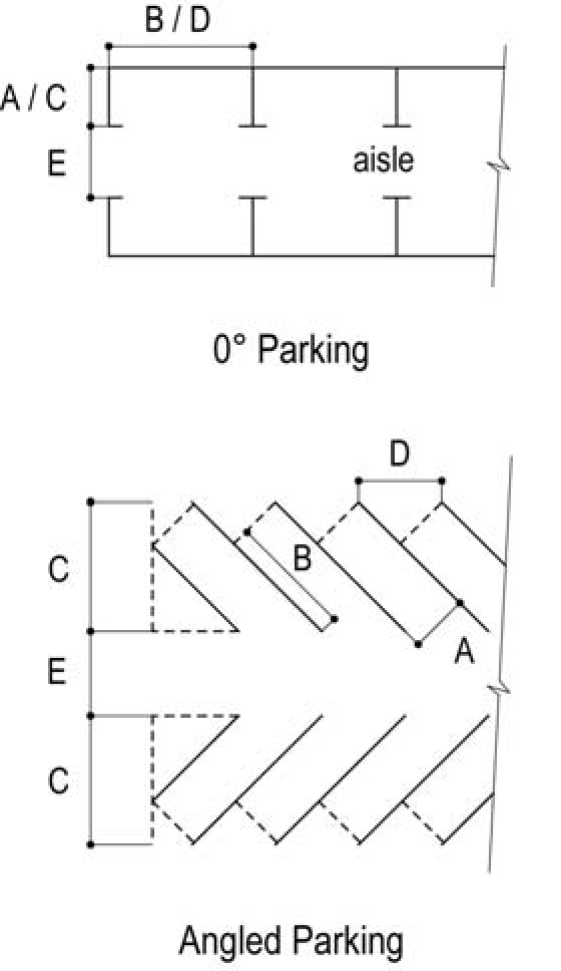
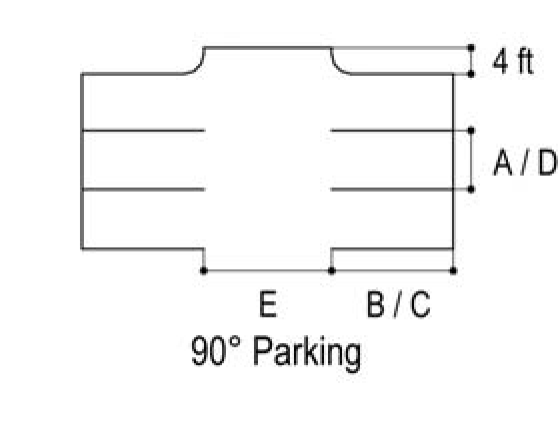
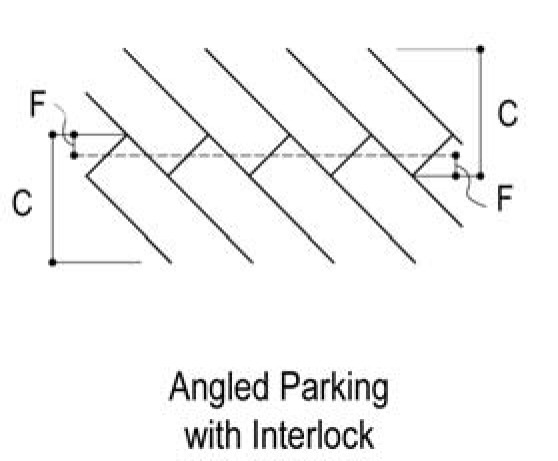
Figure 8.2.2 Parking Lot Dimensions
8.2.3. Paving Standards. All parking and vehicular use areas shall be paved with asphaltic concrete, concrete, paving stone or masonry in accord with standards adopted by the City Engineer. However, the City Engineer may approve pervious parking surfaces in areas susceptible to flooding and/or in zoning districts with restrictive impervious coverage standards. Required parking spaces shall be permanently marked and maintained and shall be accessible from a driveway or aisle such that all vehicles approach the street in a forward motion. Restrictions and exceptions include:
1.
Detached single-family dwellings and duplexes may substitute a ribbon-type driveway or an unpaved all-weather surface, in accord with standards adopted by the City Engineer, in place of a solid-paved surface. Vehicles may approach a street in either a forward or backing motion. This shall not apply to shared driveways serving multiple residences unless approved in writing by the City Engineer.
2.
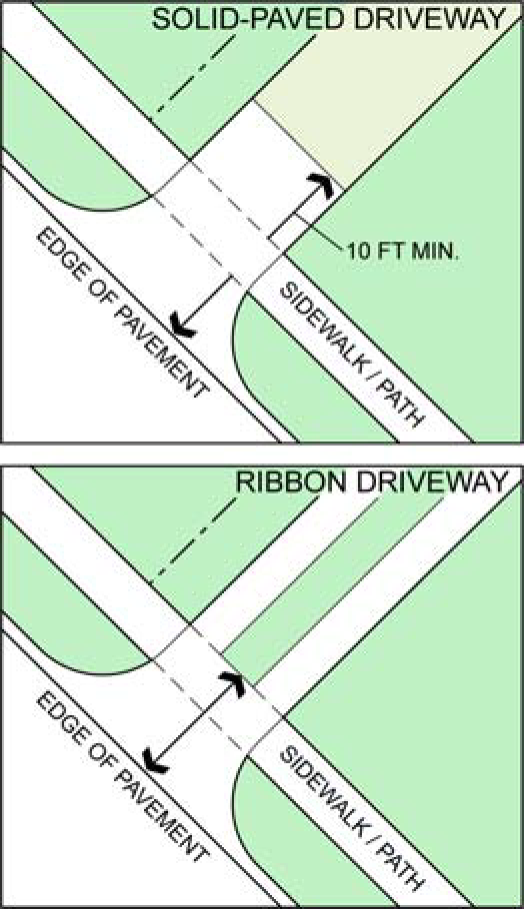
All driveways that cross an existing sidewalk shall be paved from the edge of street pavement to at least ten feet from the back of the sidewalk, regardless of whether the parking on-site is required to be paved or not. See illustration at right. Ribbon-type driveways shall be solid-paved from the back of sidewalk to the edge-of-pavement.
3.
In addition to Paragraph 2, above, all uses, whether required to provide paved parking or an unpaved all-weather surface, driveways shall be required to pave all turn-outs and portions of driveways located within any rights-of-way.
8.2.4. Pavement Markings. The City Engineer may prescribe such traffic markers and or signs as deemed necessary to safely and efficiently manage traffic flow. Parking spaces, except those serving single-family dwellings and duplexes, shall be demarcated with painted lines and/or signs or other markings accepted by the City Engineer. Stacking spaces shall not be individually marked but instead shall be clearly demarcated to direct traffic, as necessary.
8.2.5. Drainage. Off-street Parking facilities shall be drained to prevent damage to abutting property and streets. Landscaping areas shall be graded and designed to receive a reasonable portion of the rainfall from surrounding pavement. Openings for the flow of water shall be provided around any landscaped areas lined with protective curbing.
8.2.6. Dead End Parking. Vehicular use areas shall be designed to provide for safe and convenient circulation within the site. Dead end parking is discouraged. When all other design options have been exhausted, the City may approve a striped area measuring a minimum of 15 feet by the full width of the parking aisle to be used as a vehicular turnaround area. "No Parking" and "Tow Away Zone" signage must be provided in vehicular turnaround areas in order to discourage vehicular parking. Ten or less consecutive parking spaces shall not be considered dead end parking.
8.2.7. Landscaping. Off-street parking areas extending to within 25 feet or less of a lot line, shall be landscaped in accordance with §9.2.2 Frontage and Perimeter Landscaping. Off-street parking areas of 25 or more parking spaces shall be landscaped in accordance with §9.2.3 Interior Landscaping.
(Ord. No. 3099, 6-27-22)
§8.3. - Off-Street Loading.
For all uses involving the receipt or distribution of goods by trucks, there shall be provided off-street loading berths as indicated in Table 8.3 unless modified or waived by the City Engineer. Loading berth(s) shall:
8.3.1. Be a minimum of 12 feet in width, 30 feet in length, and 14 feet in clear height.
8.3.2. Be screened as required in §9.4 Screening.
8.3.3. Not occupy any part of a required buffer, rear yard or front yard.
8.3.4. Not be located or oriented on site so as to require trucks to back onto the property from a public street.
(Ord. No. 3099, 6-27-22)

