
Villa Park City Zoning Code
ARTICLE 11
- REVIEW AND APPROVAL PROCEDURES
11.1.1. - Applicability
The "common provisions" of this section apply to all of the procedures in this article unless otherwise expressly stated.
11.1.2. - Review and Decision-making Authority
The following table provides a summary of the review and approval procedures of this article. In the event of conflict between this table and the detailed procedures contained elsewhere in this article, the detailed procedures govern.
11.1.3. - Applications and Fees
A.
Form of Application
Applications required under this zoning ordinance must be submitted in a form and in such numbers as required by the community development director. Applications must include materials and information as may be required by the community development director to establish that the proposed activity complies with all applicable requirements of this zoning ordinance.
B.
Application Filing Fees
All applications must be accompanied by the fee amount that has been established by the village board.
C.
Application Completeness, Accuracy and Sufficiency
1.
An application will be considered complete and ready for processing only if it is submitted in the required number and form, includes all required information and is accompanied by the required filing fee.
2.
The community development director must make a determination of application completeness within ten (10) business days of application filing.
3.
If an application is determined to be incomplete, the community development director must provide written notice to the applicant along with an explanation of the application's deficiencies. No further processing of the application will occur until the deficiencies are corrected. If the deficiencies are not corrected by the applicant within sixty (60) days, the application will be considered withdrawn.
4.
No further processing of incomplete applications will occur and incomplete applications will be pulled from the processing cycle. When the deficiencies are corrected, the application will be placed in the next processing cycle.
5.
Applications deemed complete will be considered to be in the processing cycle and will be reviewed by staff and other review and decision-making bodies in accordance with applicable review and approval procedures of this zoning ordinance.
6.
The community development director may require that applications or plans be revised before being placed on an agenda for action if the community development director determines that:
a.
The application or plan contains one or more inaccuracies or omissions that will hinder timely or competent evaluation of the plan's/application's compliance with zoning ordinance requirements or other regulations; or
b.
The decision-making body does not have legal authority to approve the application or plan as submitted.
D.
Amended Applications
Applications may be amended at any time before final action upon such terms and conditions as the community development director (if amended before any required hearing), the planning and zoning commission (if amended before final action by the commission), or the village board, directs. Examples of such terms and conditions include requiring republication of the notice, rehearing of the application and/or extension of any time-frames required for village action.
E.
Application Processing Cycles
The community development director, after consulting with the planning and zoning commission, is authorized to promulgate reasonable cycles and timelines for processing applications, including deadlines for receipt of complete applications.
11.1.4. - Public Hearing Notices
A.
Required Public Hearing Notice-Publication in Newspaper
Published notice is required for public hearings required under this zoning ordinance. This required notice must be published at least once in a newspaper of general circulation in Villa Park at least fifteen (15) days before and no more than thirty (30) days before the public hearing. Required notices must include at least the following information:
1.
An address or legal description of the property that is the subject of the hearing;
2.
A summary of the nature of the application; and
3.
The time and place of the hearing.
B.
Courtesy Public Hearing Notices
1.
In addition to providing the required published notice, the village must endeavor to provide or require that applicants provide the following forms of additional courtesy notice of required public hearings:
a.
Posting of a public hearing notice sign on the subject property;
b.
Mailing notices to the taxpayer of record; and
c.
Mailing notices to taxpayers of record within 250 feet of the subject property.
2.
Failure to provide any form of courtesy notice that is not required by state law or any defect in such courtesy notice does not invalidate, impair, or otherwise affect any application, public hearing or decision rendered in respect to the matter under consideration.
11.1.5. - Public Hearing Procedures
A.
Open Meetings Act
All public hearings are subject to the Illinois Open Meetings Act (5 ILCS 120/1 et. Seq.).
B.
General Procedure
Public hearings required by this zoning ordinance must be conducted by the designated hearing body. At the hearing, interested persons must be permitted to submit information and comments, verbally or in writing. The designated hearing body is authorized to establish reasonable rules and regulations governing the presentation of information and comments such as, the limitation of redundant or irrelevant materials and testimony, the order and length of statements or testimony and time limitations.
C.
Continued Public Hearings
1.
Once commenced, a public hearing may be continued by the hearing body. No re-notification is required if the continuance is set for specified date and time and that date and time is announced at the time of the continuance.
2.
If a public hearing is continued or postponed for an indefinite period of time from the date of the originally scheduled public hearing, new public hearing notice must be given before the rescheduled public hearing.
3.
If the applicant requests and is granted a postponement, the applicant must pay any costs of renotification.
11.1.6. - Action by Review and Decision-Making Bodies
A.
Review and decision-making bodies may take any action that is consistent with:
1.
The regulations of this zoning ordinance;
2.
Any rules or by-laws that apply to the review or decision-making body; and
3.
The notice that was given.
B.
Review and decision-making bodies are authorized to continue a public hearing or defer action in order to receive additional information or further deliberate.
C.
When decision-making bodies approve applications with conditions, the conditions must relate to a situation created or aggravated by the proposed use or development and must be roughly proportional to the impacts of the use or development.
11.1.7. - Decision-Making Criteria; Burden of Proof or Persuasion
Applications must address relevant review and decision-making criteria. In all cases, the burden is on the applicant to show that an application complies with all applicable review or approval criteria.
11.1.8. - Required Time-frames for Action
Any time limit specified in this zoning ordinance for any decision or action on behalf of a review or decision-making body may be extended if the applicant agrees to an extension. If a review or decision-making body does not render a decision or take action within any time period required under this zoning ordinance and the applicant has not agreed to an extension of that time limit, the application is deemed denied.
(Ord. No. 4036, § 2(Exh. A), 6-11-18)
11.2.1. - Purpose
The text of this zoning ordinance and the zoning map may be amended from time to time in accordance with the procedures of this section. Zoning ordinance text and map amendments are intended to allow modifications in response to changed conditions or changes in village policy.
11.2.2. - Authority to File
A.
Amendments to the text of this zoning ordinance may be initiated by the village board, the planning and zoning commission, or the community development director.
B.
Amendments to the zoning map may be initiated only by the village board, the community development director or by the owner of the property that is the subject of the proposed zoning map amendment or by the subject property owner's authorized agent.
11.2.3. - Application Filing
Complete applications for zoning map amendments must be filed with the community development director.
11.2.4. - Review and Report—Community Development Director
Upon initiation of a zoning text amendment or receipt of a complete application for a zoning map amendment, the community development director must prepare a report and recommendation on the proposal. The report must be transmitted to the planning and zoning commission before their public hearing on the proposed ordinance text or zoning map amendment.
11.2.5. - Notice of Hearing
Notice of the planning and zoning commission's required public hearing on a zoning ordinance text or zoning map amendment must be published in the newspaper in accordance with 11.1.4-A. Additional notice may also be provided in accordance with 11.1.4-B.

11.2.6. - Hearing and Recommendation—Planning and Zoning Commission
The planning and zoning commission must hold a public hearing on the proposed amendment. Within sixty (60) days of the close of the public hearing, the planning and zoning commission must act by simple majority vote of a quorum to recommend that the proposed text amendment be approved, approved with modifications, or denied and transmit its recommendation to the village board.
11.2.7. - Final Action—Village Board
A.
Within sixty (60) days of receipt of the planning and zoning commission's recommendation, the village board must act to approve the proposed zoning ordinance text or map amendment, approve the proposed amendment with modifications or deny the proposed amendment. The village board may also remand the proposed amendment back to the planning and zoning commission for further consideration.
B.
If the zoning ordinance text or map amendment application is remanded, the village board must specify the reasons and scope of the remand, and further proceedings before the planning and zoning commission must be limited to those identified items. The planning and zoning commission must conduct further proceedings as may be appropriate and return a recommendation on the amendment to the village board within sixty (60) days of the date that the matter is remanded to the planning and zoning commission. Within sixty (60) days of receipt of the planning and zoning commission's recommendation, the village board must take final action on the amendment.
C.
Approval of a zoning ordinance text amendment requires a by simple majority vote of a quorum of the village board. Approval of a zoning map amendment also requires a by simple majority vote of a quorum, unless a valid protest petition has been filed by opponents of the zoning map amendment (see 11.2.8).
11.2.8. - Protest Petitions
A.
If a valid protest petition is filed against any proposed zoning map amendment, passage of the map amendment requires a favorable vote of two-thirds of the entire village board.
B.
A protest petition will be deemed valid if it is signed and acknowledged by the owners of twenty (20) percent of the frontage proposed to be altered, or by the owners of twenty (20) percent of the frontage immediately abutting or across an alley therefrom, or by the owners of the twenty (20) percent of the frontage directly opposite the frontage included within the proposed zoning map amendment area.
C.
A written protest petition opposing a zoning map amendment must be submitted to the village clerk at least five (5) business days before the village board's vote.
D.
When a written protest petition has been submitted, the protest petition must be served by the protesters upon the applicant and upon the applicant's attorney, if any, by certified mail at the applicant's and attorney's addresses, as shown on the application.
11.2.9. - Review and Approval Criteria
A.
Zoning Ordinance Text Amendments
The decision to amend the zoning ordinance text is a matter of legislative discretion that is not controlled by any one standard. In making recommendations and decisions about zoning ordinance text amendments, the planning and zoning commission and village board must consider at least the following factors:
1.
Whether the proposed text amendment is in conformity with the policy and intent of the comprehensive plan; and
2.
Whether the proposed zoning ordinance text amendment corrects an error or inconsistency in the zoning ordinance, meets the challenge of a changing condition or is necessary to implement established village policy.
B.
Zoning Map Amendments
The decision to amend the zoning map is a matter of legislative discretion that is not controlled by any single standard. In making recommendations and decisions about zoning map amendments, the planning and zoning commission and village board must consider at least the following factors:
1.
The existing use and zoning of nearby property;
2.
The extent to which the particular zoning restrictions affect property values;
3.
The extent to which any diminution in property value is offset by an increase in the public health, safety and welfare;
4.
The suitability of the subject property for the zoned purposes;
5.
The length of time that the subject property has been vacant as zoned, considering the context of land development in the vicinity;
6.
The value to the community of the proposed use; and
7.
The comprehensive plan.
11.2.10. - Successive Applications
If a zoning map amendment application is denied, no application may be accepted that proposes reclassification of any portion of the same property for the same zoning classification for twelve (12) months from the date of the village board decision to deny, except on the grounds of substantial new evidence or proof of changed conditions found to be valid by the community development director.
11.2.11. - Pending Rezonings
No permit or license for any building, structure or use may be issued for a period of three (3) months after zoning ordinance text or map amendment has been initiated by village board or the planning and zoning commission in a public meeting, provided that if final action by the village board is not taken on proposed amendment within three (3) months of initiation, the permit may be issued, if otherwise lawful. If within such three-month period, the village board approves zoning ordinance text or map amendment has that prohibits such building, structure or use, no such permit may be issued.
(Ord. No. 4036, § 2(Exh. A), 6-11-18)
11.3.1. - Purpose and Intent
A planned unit development (PUD) are unique and differ substantially from conventional subdivisions and therefore are designated as "special uses" to be administered under this section. Planned unit developments are a complex type of special use, potentially consisting of various land uses and design elements, requiring the establishment of more specific procedures, standards and exceptions from the strict application of the zoning district regulations to guide the recommendations of the planning and zoning commission and the action of the village board. The purpose of this section, therefore, is to provide for an alternative zoning procedure under which land can be developed or redeveloped with innovation, increased amenities and creative environmental and architectural design than would be impossible to achieve under the otherwise standard zoning district regulations while being in general compliance with the planning objectives and intent of the zoning ordinance. Under this procedure, well planned residential, office, commercial/industrial, and MX districts and other types of land uses, individually or in combination, may be developed with design flexibility allowing for full utilization of the topographical and environmental characteristics of the site.
Planned unit developments must have an approved development plan which provides for a unified design, contiguity between various elements and be environmentally compatible with the surrounding area. There should be an increased benefit upon the health, safety and general welfare of the public and particularly, in the immediate surroundings, than developments built in conformity with the underlying district regulations. If building density is increased above densities allowable by the zoning district in which the use would be permitted on a particular portion of a PUD, then the amount of open space, retention of existing vegetation, buffer areas, new landscape, public commons, community open space, and parks shall be evaluated for proportionate increase for the remainder of the planned unit development.
The planned unit development is not intended to be a mechanism solely used for the allowance of increased densities or as a means of circumventing the bulk regulations or zoning standards under this section, rather a planned unit development shall generally provide attributes in excess of conventional village zoning, building and other land use requirements such as, but not limited to, the following:
A.
Providing a maximum choice of the overall living environment through a variety of type, design and layout of residential structures, commercial and industrial buildings, office and research uses and public facilities;
B.
Demonstrating excellence in environmental design and the mitigation of land use factors or impacts;
C.
Promoting a more useful pattern of dedicated open space and recreation areas incorporated as part of the development plan and that is compatible with the immediate vicinity;
D.
Provide public access and pedestrian connectivity via bicycle/recreational paths, sidewalks and/or alternative modes of transportation;
E.
Providing and/or preserving substantial landscaping with emphasis given to streetscape areas, buffer zones, and the provision of significant landscaping (in terms of size of landscape areas and quantity and quality of landscape materials) within the developed portions of the site;
F.
Incorporating a consistent architectural theme which is unique to the specific site and surrounding community through the use of building materials, signage and wayfinding standards as well as design elements. Generic corporate architecture and big box designs are strongly discouraged but not prohibited. Uses should be designed according to the limitation of the site rather than the removal of the limitations. Specific design details such as roof parapets, architectural details, varying roof heights, pitches and materials and building colors and materials should be addressed;
G.
Retain, utilize and incorporate historic features on the project site into the overall project design, if physically and economically feasible;
H.
Promote and strengthen the economic vitality and enhance the aesthetic qualities of unified large scale commercial developments;
I.
Encourage high quality planned industrial park environments and well-designed business centers for single- or multiple-tenant facilities; and/or
J.
Provide/enhance regional public infrastructure such as roadways, water/sanitary service, stormwater management objectives.
11.3.2. - Authority
A.
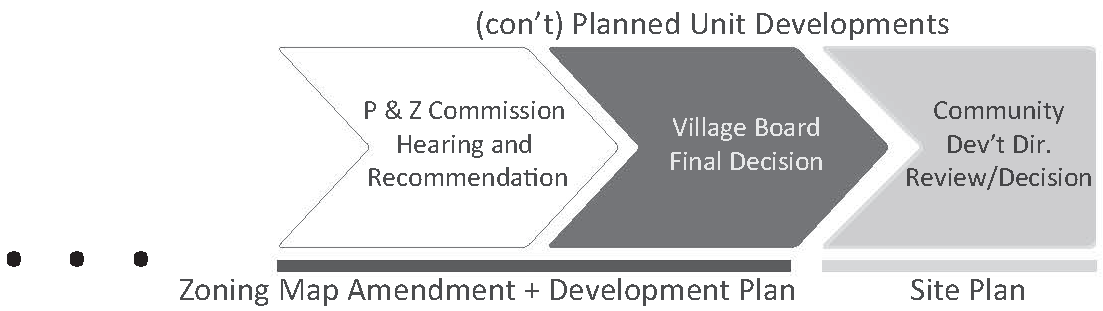
The planning and zoning commission shall review and recommend approval, approval with modification, or denial of applications for planned unit developments. The village board shall have final decision to approve, approve with modification, or deny applications for planned unit developments.
B.
The procedures set forth in this section shall apply to all planned unit developments.
C.
Planned unit developments may be allowed in each of the zoning districts as a special use approved pursuant to the procedures set forth in this section and section 11.4.
11.3.3. - Definition and Size Limitations
A planned unit development is a tract of land which is developed as a unit under single ownership or control. Planned unit developments in manufacturing districts shall be at least two acres in area for consideration.
All land area within a planned unit development must be contiguous; provided that properties separated by highways, streets, public ways, railroads or other public utility rights-of-way may be deemed contiguous for the purpose of qualifying as a planned unit development. Pursuant to the procedures set herein, the establishment of a planned unit development shall be applicable to the addition of property to an existing planned unit development.
11.3.4. - Procedures for Establishment
Planned unit development applications shall be made as hereinafter provided and shall be accompanied by the required plats and documents. Detailed plans, drawings and other information as specified in this section shall be required at the time of the various phases, meetings and hearings as detailed herein. Each stage shall be reviewed and certified by the community development director as being in accordance with the planned unit development requirements before proceeding to the next stages. The approval process shall include the following stages:
A.
Preapplication conference: Introductory meeting held with village staff as set forth in section 11.3.5 of this section.
B.
Concept PUD plan review: An optional informal review of overall concept conducted by the planning and zoning commission to provide constructive feedback to petitioner of the plan as set forth in section 11.3.6 of this section.
C.
PUD development plan: First, a technical review of detailed plans by various village departments at a planning and zoning commission meeting is held; a public hearing is then conducted by the planning and zoning commission; and final determination is made by the village board, as set forth in section 11.3.7 of this section.
D.
PUD site plan: A detailed plan for building and site design for all or a part of the property in compliance with the PUD development plan and approved by the community development director, as set forth in section 11.3.8 of this section.
11.3.5. - Preapplication Conference
A.
Purpose. The purpose of the preapplication conference is to provide information, guidance and assistance to the applicant before preparation of the concept plan so that the applicant may receive informal input on:
1.
Whether the proposed planned unit development will be in conformity with the planning and other development goals and the policies of the Village.
2.
Whether the existing zoning and land use in the general area of the planned unit development is appropriate for a planned unit development.
B.
Procedure. Prior to filing an application for approval of a planned unit development, the petitioner shall be required to contact the community development director or his designee to arrange an informal preapplication meeting with village staff and its consultants.
1.
The preapplication conference is mandatory and shall be held with staff, but is at no charge to the petitioner. At such conference, the applicant shall provide information relating to the following:
a.
The location of the proposed planned unit development;
b.
The land use types and approximate area of proposed land uses;
c.
A list of any and all exceptions to the zoning ordinance and subdivision regulations requested; and
d.
Other information pertinent to the proposed planned unit development.
2.
The preapplication conference shall be an informal communication and discussion of the proposed planned unit development, and no commitments shall be given, nor shall statements or opinions of the village staff and its consultants be deemed binding.
3.
Staff shall review and provide input on the proposal's compatibility with the comprehensive plan and the goals and policies for planning of the village and advise the applicant on the information, documents, exhibits, and drawings on the proposal that should be included in the application to the village for a planned unit development.
11.3.6. - Concept PUD Plan Review
A.
Purpose. The presentation of a concept PUD plan is optional. The purpose of the concept PUD plan is to enable the applicant to obtain the informal feedback from the planning and zoning commission regarding the overall project concept, density and dwelling unit or land use type prior to spending considerable time and expense in the preparation of detailed PUD plans.
B.
Procedure. Not less than forty-five (45) days before the next available planning and zoning commission meeting, the applicant shall submit to the village for review the conceptual planned unit development plan. The submittal shall consist of fifteen (15) paper copies folded to fit in a ten inch by thirteen inch (10" x 13") envelope and one (1) electronic copy of the following documentation, unless waived by the community development director based on the specific PUD:
1.
A completed notarized application form.
2.
The application shall be accompanied by the appropriate filing fee.
3.
An aerial photograph exhibit of the property taken within the last two (2) years. The aerial photograph exhibit shall be one inch equals one hundred feet (1" = 100') scale, but no less than one inch equals four hundred feet (1" = 400') and shall include the following:
a.
Name of the proposed planned unit development.
b.
Outline of property boundaries.
c.
Adjacent area within one-fourth (¼) mile of property.
4.
A zoning plat including a legal description of the property with total property acreage noted to be included in the planned unit development.
5.
A written explanation of the general character of the proposed planned unit development that shall include the following:
a.
A description of all proposed land uses (including open space) with percentages of each use;
b.
Projected densities and housing type for each residential use;
c.
A description of the development standards and design criteria applicable to the proposed planned unit development;
d.
An outline describing why the property should be developed as a planned unit development;
e.
Identification of existing uses and zoning of adjacent properties to the planned unit development;
f.
A list of requested exceptions to applicable village ordinances and codes.
6.
A written description of general site information that should include, but shall not be limited to, the following, if known or available:
a.
Existing site conditions.
b.
Environmental characteristics.
c.
Availability of community facilities and utilities.
d.
Existing covenants.
7.
A conceptual planned unit development sketch or land plan. The sketch or land plan shall provide sufficient detail to demonstrate the physical relationship between the existing land condition, surrounding land uses and the proposed planned unit development, and shall include the following:
a.
North arrow (true meridian), scale and date of preparation.
b.
Name and address of the site planner, or engineer who prepared the plan.
c.
Name of property owner.
d.
Name of petitioner/developer.
e.
Proposed name of the planned unit development.
f.
Location map showing the location of the planned unit development.
g.
Boundary and/or property lines of proposed development and dimensions of the lots into which the property is proposed to be subdivided.
h.
Proposed land uses, and total acreage and percent of the site devoted to each land use including minimum and average lot sizes and proposed dedication of land for school and park sites, if applicable.
C.
Planning and Zoning Commission Review. The planning and zoning commission shall conduct an informal review of the conceptual planned unit development plan and supporting documentation and provide the applicant with general comments on the following:
1.
Compatibility of the proposal with the transportation plan, zoning ordinance, subdivision ordinance and land use planning goals and objectives of the village.
2.
Appropriateness of the proposed land uses.
3.
General layout of open space, streets, parking areas, lots and buildings.
4.
Other information the planning and zoning commission would recommend be prepared for the PUD development plan.
11.3.7. - PUD Development Plan
A.
Purpose. The purpose of the PUD development plan submission is to obtain approval from the Village that the plans the applicant has prepared and will follow are acceptable and that site plans will be approved provided they substantially conform to the PUD development plan. Approval of the PUD development plan shall not constitute authority to proceed with construction of any improvements but rather an approval of the plans as a basis for preparing the PUD site plan.
B.
Procedure. Not less than forty-five (45) days before the planning and zoning commission meeting, the applicant shall file an application with the community development department's office for PUD development plan approval. The applicant shall submit fifteen (15) paper copies folded to fit in a ten inch by thirteen inch (10" x 13") envelope and one (1) electronic copy of the following documentation, unless waived by the community development director:
1.
A completed notarized application form.
2.
The application shall be accompanied by the appropriate filing fees.
3.
Disclosure of beneficiaries form and statement of present and proposed ownership of all land within the development.
4.
An aerial photograph exhibit of the property taken within the last two (2) years of the adjacent area within one-fourth (¼) mile of property. The aerial photograph exhibit shall be one inch equals one hundred feet (1" = 100') scale, but no less than one inch equals four hundred feet (1" = 400').
5.
Written explanation of the character of the planned unit development and the reasons why it has been planned to vary from the conventional zoning ordinance regulations. This explanation shall detail how the proposed planned unit development meets the objectives of all official plans which affect the subject property.
6.
The PUD development plan. The detailed plan which includes at a minimum, the following information:
a.
Section notation stating "PUD Development Plan".
b.
North arrow, scale (not less than one inch equals one hundred feet (1" = 100')) and date of preparation.
c.
Name and address of the site planner, engineer or surveyor who prepared the plan.
d.
Name of property owner.
e.
Name of petitioner/developer.
f.
Proposed name of the planned unit development or subdivision name, which shall not duplicate the name of any plat previously recorded in the Village.
g.
Location map showing the general area of the planned unit development within or proximity to the corporate boundaries.
h.
Legal description prepared by a registered land surveyor.
i.
Boundary lines - bearings and distances.
j.
Site data, including, as applicable:
(1)
Current zoning classification.
(2)
Total area of property in square feet and acreage, and percentage of each proposed land use.
(3)
Square footage and percent of site coverage with buildings.
(4)
Square footage and percent of site coverage with impervious surfaces.
(5)
Square footage and percent of site coverage dedicated to common open space such as stormwater management systems, landscaping and buffers, parks, trail corridors and recreational areas.
(6)
Total number of off street parking and loading spaces provided and method used to calculate the number of required spaces for each land use.
(7)
Total number of buildings.
(8)
Total number of residential dwelling units by type, and the number of bedrooms in each dwelling unit type.
(9)
Gross floor area for all nonresidential buildings/uses.
(10)
Gross and net densities for the overall planned unit development and for each land use.
(A)
Residential Density: Provide information on the density of residential uses, including dwelling units per acre, dwelling units per net acre; gross and net residential density (dwelling units per acre of land devoted to residential sectors of the PUD; gross being all land, net being gross acres minus land used for public or common usage). Information should also be provided for each unit in the planned unit development, if applicable.
(B)
Nonresidential Intensity: Provide information on the type and amount of nonresidential uses including building locations, sizes, floor area ratio, building height, the amount and location of common open space.
(11)
Minimum, maximum and average lot sizes.
(12)
Percent of lot coverage for all uses except detached single-family and duplex.
k.
Depiction of lots:
(1)
Residential lots shall depict lot dimensions; building footprints for all multi-family and single-family attached structures; and dimensioned required yard setbacks.
(2)
Nonresidential lots shall depict building footprints and dimensioned setbacks. Information regarding purpose/use and height of nonresidential buildings shall also be provided.
l.
Other conditions of adjoining land - owners of unplatted land; subdivision plat name, recording date and number of adjoining platted land; actual direction and gradient of ground slope, including any embankments or retaining walls; character and location of major buildings, railroads, power lines and towers.
m.
Existing easements - location, width and purpose.
n.
Location of existing streets in, and adjacent to, the property including: street name, right-of-way width, existing and proposed centerlines, pavement type, walks, trails, curbs, gutters, culverts, etc.
o.
Public improvements such as highways and other major improvements planned by public authorities for future construction on or near the property.
p.
Existing utilities on, and adjacent to, the property including: location, size and invert elevation of sanitary and storm sewers; location and size of water mains; location of gas lines, fire hydrants, electric and telephone lines (above and below ground) and streetlights; direction and distance to, and size of nearest water mains and sewers adjacent to the property showing invert elevations.
q.
Watercourses, marshes, rock outcrop, wooded areas, existing vegetation, isolated trees four inches (4") or more in diameter at three feet (3'), existing structures and other significant features.
r.
Location of all proposed off street parking and loading areas, including dimensions of parking spaces, drive aisles and loading zones.
s.
All sites to be conveyed, dedicated, or reserved for parks, school sites, public buildings, and similar public and quasi-public uses.
t.
Pedestrian and/or bicycle circulation systems.
u.
Limits of jurisdictional and nonjurisdictional wetlands.
v.
Any other data reasonably necessary to provide an accurate overview of the proposed development.
w.
Certificates, seals, and signatures required for the dedication of land and recording of the document.
x.
Common Open Space Documents: All common open space, at the discretion of the village board, shall be:
(1)
Conveyed to a village or public corporation, or conveyed to a not for profit corporation or entity established for the purpose of benefiting the owners and residents of the planned unit development or adjoining property owners of any one or more of them. All lands conveyed hereunder shall be subject to the right of the grantee or grantees to enforce maintenance and improvement of the common open space; or
(2)
Guaranteed by a restrictive covenant describing the open space and its maintenance and improvement, running with the land for the benefit of residents of the planned unit development or adjoining property owners and/or both.
(3)
Such documents shall also provide that the village shall have the right, but not the obligation, to perform necessary maintenance of the common open space, and shall have the authority to place a lien against the individually owned property in the planned unit development for the costs thereof.
(4)
Public and Quasi-Public Facilities; Guarantee of Performance: All public and quasi-public facilities and improvements made necessary as a result of the planned unit development, including, but not limited to, parks, schools, recreational areas, etc., shall guarantee the completion of such, as set forth in the Villa Park subdivision control ordinance, except where varied by the approved final plat.
y.
Covenants, Conditions, Restrictions and Bylaws: Final covenants, conditions and restrictions and/or homeowner association bylaws.
z.
Delinquent Taxes: A certificate shall be furnished from the county tax collector that no delinquent taxes exist and that all special assessments constituting a lien on the whole, or any part, of the property of the planned unit development have been paid.
7.
Landscape plans, prepared and sealed by a licensed Landscape Architect, indicating the name, variety, size, location and quantities of plant material for all common and dedicated areas including parkways, buffer areas, stormwater basins, wetlands, entry areas, medians, and parking lot islands. The landscape plan shall also depict permanent signs and street fixtures, and a detail plan of landscaping for a typical building area.
8.
Engineering plans which shall be drawn on a print of the proposed land use plan. The plan shall illustrate an appropriate location and dimensions of all sanitary sewers, storm sewers, and water lines for all proposed land uses, drainage ditches, culverts and stormwater retention/detention areas, as well as all utility easements, and be accompanied with:
a.
A feasibility report or statement attesting to the capability of the existing sewer system and wastewater treatment facility to service the proposed development.
b.
Stormwater report.
c.
Mass grading plan.
d.
Traffic analysis or study, prepared by a transportation engineer or planner, which analyzes the impact caused by the planned unit development on the street and highway systems.
9.
Architectural drawings. Preliminary architectural drawings for all primary buildings and accessory buildings which include:
a.
Typical elevations (front, rear and side) for proposed residential and nonresidential buildings, which identify materials and color styling proposed for all elements of the building.
b.
Proposed building heights.
c.
Roof plan for all nonresidential structures, which shows the proposed location of all roof mounted mechanical equipment.
10.
Development plan schedule indicating:
a.
Stages in which the project will be built, with emphasis on area, density, use of public facilities, and open space to be developed with each stage.
b.
Each stage as a separate unit. The unit shall be described and mapped on the project. Overall design of each unit shall be shown on the plan and through supporting graphic materials.
c.
Dates for beginning and completion of each stage.
11.
The planning and zoning commission or village board may require preparation and submittal, at the petitioner's expense, of the following for review and evaluation:
a.
Fiscal impact study, detailing the estimated cost which the planned unit development will have on all taxing bodies, and anticipated revenues to such taxing bodies which will be realized from each phase of development. Information shall include detailed estimates on:
(1)
Expected population of the development;
(2)
Impact on service and/or operating costs to be incurred by each taxing body as a result of the development;
(3)
Any major capital investments required, in part or in whole, by each taxing body due to the development.
b.
Proposed covenants, conditions and restrictions and/or homeowner association bylaws.
c.
Environmental analysis or study, prepared by an environmental specialist, which analyzes the major impacts the planned unit development may have on the environment including, but not limited to, the effects on discrete ecosystems, deteriorated air quality in the immediate vicinity and along arterial and collector roadways leading to the planned unit development from a specified distance determined by the village engineer or consultant; any deterioration in the groundwater or surface water quality; effect on sensitive land areas such as floodplains, wetlands, forests, aquifer recharge areas, historic buildings or structures, prairie landscapes, and mineral resource reserves.
d.
Market study indicating the extent of market demand for the uses proposed in the planned unit development including an analysis of demographics, sales potentials, competitive alignment, an assessment of the market share or opportunity gaps, and marketing positioning of each component of the planned unit development.
C.
Planning and Zoning Commission Review. Upon receipt of all the required submittals, the community development director shall distribute copies of the application and supporting documentation to members of the planning and zoning commission. The planning and zoning commission shall review the PUD development plan and supporting documentation and make a recommendation to the village board as to the proposal's compatibility with the Village's planning objectives, transportation plan, recreation master plan, zoning ordinance, subdivision control ordinance, annexation agreement, and other goals and policies for developing the village.
The planning and zoning commission shall conduct a public hearing. After the close of the public hearing, the planning and zoning commission shall recommend to the village board approval or denial of the preliminary planned unit development plan. The recommendation may include conditions of approval intended to be incorporated into final plans and supporting documentation.
D.
Village Board Review. Subsequent to receiving the planning and zoning commission recommendations, the village board shall approve or deny the application for the preliminary planned unit development plan.
11.3.8. - PUD Site Plans
PUD site plans are detailed plans for building and site design for the subject property. PUD site plans may cover all or part of the property included within an approved PUD development plan. Such plans must include all information required to determine whether the proposed development and any permits requested are in compliance with the approved PUD development plan.
A.
Application Filing
PUD site plan applications must be filed with the community development director before the lapse of a PUD development plan.
B.
Review and Action by Community Development Director; Appeals
1.
The community development director must review and take action on the PUD site plan. The community development director must approve the PUD site plan if it complies with the approved PUD development plan, all conditions of PUD development plan approval and all applicable regulations of this zoning ordinance. If the submitted PUD site plan does not comply with the approved PUD development plan, any conditions imposed on that plan or any applicable regulations of this zoning ordinance, the community development director must deny the PUD site plan and advise the landowner in writing of the specific reasons for denial.
2.
In acting on PUD site plans, the community development director is authorized to approve the following minor deviations from an approved PUD development plan:
a.
Any deviation expressly authorized at the time of PUD development plan approval;
b.
The addition of customary accessory uses and structures; and
c.
Changes to the development site or to structures necessitated by engineering, architectural or physical limitations of the site that could not have been foreseen at the time the development plan was approved and that are not otherwise classified as amendments pursuant to section 11.3.9.
3.
No other changes or amendments may be approved as part of the community development director action on a PUD site plan. Any other changes will be considered amendments to an approved PUD development plan. Amendments are subject to section 11.3.9.
4.
If the community development director does not approve the PUD site plan, the landowner may either: (1) resubmit the PUD site plan to correct the plan's inconsistencies and deficiencies, or (2) within sixty (60) days of the date of notice of disapproval, appeal the decision of the community development director. If an appeal is filed, the PUD site plan must be processed in the same manner as a PUD development plan, with review and recommendation by the planning and zoning commission and a final decision by the village board.
C.
Effect of Approval
Approval of a PUD site plan must occur before any building permits are issued for the PUD. PUD site plan approval does not constitute effective dedication of rights-of-way or any other public improvements, nor will the filed plan be the equivalent of or an acceptable alternative for the final platting of land prior to the issuance of building permits in the PUD (if platting is required).
11.3.9. - Amendments to Approved PUD Development Plans
A.
The community development director is authorized to approve minor amendments to an approved PUD development plan, but major amendments must be processed as a new PUD development plan, including all requirements for fees, notices and hearings. All of the following constitute major amendments to an approved PUD development plan:
1.
Elimination or relaxation of a condition of approval imposed by the village board at the time of PUD development plan approval;
2.
An increase in overall building coverage by more than five (5) percent;
3.
An increase in building height by more than ten (10) percent or five (5) feet, whichever is less;
4.
An overall reduction in the amount of usable open space, common open space or landscaping;
5.
A reduction in off-street parking by more than ten (10) percent or one space, whichever results in a greater reduction;
6.
A change in the vehicle circulation pattern that would increase points of access, change access to another street or increase projected traffic volumes; and
7.
Anything that the community development director determines a material change, likely to create adverse impacts that were not considered as part of the PUD development plan approval.
11.3.10. - Conditions for Approval
A.
The planning and zoning commission may recommend approval of a special use for a planned unit development or major amendment to the PUD development plan upon considering the following:
1.
In what respect does the design of the planned unit development meet the requirements and design standards of this Code.
2.
The extent to which the proposed plan deviates and/or requires exceptions to the bulk regulations in the zoning ordinance and how the modifications in design standards from the subdivision control regulations fulfill the intent of those regulations.
3.
The extent of public benefit produced by the planned unit development, such as, but not limited to, the adequacy of common open space and/or public recreational facilities provided; sufficient control over vehicular traffic; provision of public services; provision and protection of the reasonable enjoyment of the land.
4.
The relationship and compatibility, beneficial or adverse, of the planned unit development to the adjacent properties and nearby land uses.
5.
The extent to which the planned unit development fulfills the objectives of the future planning objectives or other planning policies of the village.
6.
The planning and zoning commission finds that the planned unit development satisfactorily meets the standards for special use as defined in section 11.4.8 of this section.
11.3.11. - Development Standards and Design Criteria
A.
Purpose. The purpose of this section is to establish and provide a comprehensive set of standards and guidelines in which planned unit developments are designed. While specific recommendations for development and design are provided, flexibility is also encouraged through guidelines which enable individual developments to be distinct from one another while maintaining the inherent character of the village.
B.
Applicability. These standards and established criteria shall apply to all newly constructed buildings and sites within a planned unit development. Each proposed development will be evaluated on its compliance with the established regulations/guidelines contained herein.
C.
Density. The density, minimum lot size and minimum setback dimension for each use proposed within a PUD shall be determined by the conventional zoning classification which would permit the proposed use unless an exception is specifically requested as part of the special use request.
D.
Use Regulations. Planned unit developments may be comprised of a single type of land use or a mixture of land uses when applicable and when different intensity of land uses are appropriately buffered or separated.
1.
Uses proposed shall be consistent with those listed as allowable uses in the respective zoning districts.
2.
Uses listed as special uses in the zoning district in which the development is located may be allowed.
3.
Uses not permitted by right in the underlying zoning district may be approved as part of the PUD development plans as exceptions to the allowable uses in the respective zoning districts.
E.
Access to Dwelling. The planning and zoning commission may recommend and the village board may approve access to a dwelling by a driveway or pedestrian walk easement. Off street parking facilities for such dwelling shall be located not more than two hundred feet (200') from the dwelling served.
F.
Yard Exceptions. The planning and zoning commission also may recommend and the village board may approve yards of lesser widths or depths than required for permitted uses in the zoning classification which the planned unit development is including, provided:
1.
Those protective covenants are recorded with perpetual access easements and off street parking spaces for use by the residents of the dwellings served.
2.
That spacing between buildings shall be consistent with the application of recognized site planning principles for securing a unified development and that due consideration is given to the openness normally afforded by intervening streets and alleys.
3.
The yards for principal buildings along the periphery of the development shall be not less in width or depth than required for permitted uses in the district in which the planned unit development is included and the plan is developed to afford adequate protection to neighboring properties, i.e., fire protection and sufficient area needed for utility easements, as recommended by the planning and zoning commission and approved by the village board.
11.3.12. - Fees
The village board shall establish a schedule of fees, charges and expenses for occupancy permits, appeals, applications and amendments for special use, and other matters pertaining to this section. The schedule of fees shall be filed in the clerk's office and may be altered or amended only by the village board. Until all applicable fees, charges and expenses have been paid in full, no action shall be taken on any application.
11.3.13. - Effective Period of Planned Unit Development
A.
The planned unit development shall be constructed in a timely manner. The planned unit development shall be subject to revocation under the following conditions:
1.
Final site plan approval does not occur within twelve (12) months from the date of approval of the PUD development plan of a planned unit development.
2.
Construction does not commence and proceed within three (3) years from the date of approval of the PUD site plan of a planned unit development.
3.
The village board may extend the time limits for site plan approval for no more than two (2) 12-month periods. Commencement for construction may also be extended by the village board in one year increments.
B.
The village board may initiate or the owner of the parcel of land on which the planned unit development is to be constructed may apply for the revocation of the planned unit development. The owner shall be notified, in writing, at least thirty (30) days prior to the village board's consideration of the revocation if initiated by the village board.
C.
The village board shall consider, but not be limited to, the following standards in the review of the status of the project construction to determine whether there is reasonable cause for delay:
1.
The original program of development with regard to market demand for the components included in the PUD site plan;
2.
Conditions in the real estate finance market;
3.
General economic conditions in the local area, state or region;
4.
The ability and purposefulness of development operations for the planned unit development; and
5.
Laws, ordinances or other regulations that may have affected timely development of the project.
D.
Upon consideration of the findings by the village board regarding the standards in subsection C of this section, the village board shall decide whether:
1.
To revoke the PUD site plans for portions of the planned unit development for which construction has not begun;
2.
To extend the time allotted for construction to commence based upon a revised schedule of construction; or
3.
To require special changes in the PUD development plan as a condition of a time extension, whereby such changes shall be deemed a "major change" to the planned unit development.
E.
Upon revocation of a planned unit development, the parcel of land shall conform to the permitted uses and other regulations of the underlying zoning district of which it is a special use unless an amendment or other special use is initiated by the village board or is applied for by the owner of the parcel of land on which the planned unit development was to be constructed and granted by the village board.
(Ord. No. 4126, § 2, 1-13-20)
Editor's note— Ord. No. 4126, § 2, adopted Jan. 13, 2020, repealed the former § 11.3, and enacted a new § 11.3 as set out herein. The former § 11.3 pertained to similar subject matter and derived from Ord. No. 4036, § 2(Exh. A), adopted June 11, 2018.
11.4.1. - Intent
The special use approval procedures of this section are intended to provide a transparent, public review process for land uses that, because of their widely varying design and operational characteristics, require case-by-case review in order to determine whether they will be compatible with surrounding uses and development patterns.
11.4.2. - Authority to File
Special use applications may be filed by the owner of the property that is the subject of the special use application or by the subject property owner's authorized agent.
11.4.3. - Application Filing
Complete applications for special use approval must be filed with the community development director.
11.4.4. - Review and Report—Community Development Director
Upon receipt of a complete application for special use approval, the community development director must prepare a report and recommendation that evaluates the proposed special use in light of the standards and review criteria of 11.4.8. The report must be transmitted to the planning and zoning commission before their public hearing on the proposed special use.
11.4.5. - Notice of Hearing
Notice of the planning and zoning commission's required public hearing on a special use application must be published in the newspaper in accordance with 11.1.4-A. Additional notice may also be provided in accordance with 11.1.4-B.
11.4.6. - Hearing and Recommendation—Planning and Zoning Commission
The planning and zoning commission must hold a public hearing on the special use application within sixty (60) days of receipt of a complete application. Within sixty (60) days of the close of the public hearing, the planning and zoning commission must act by simple majority vote of a quorum to recommend that the proposed special use be approved, approved with modifications and/or conditions, or denied and transmit its findings and recommendations to the village board.
11.4.7. - Final Action—Village Board
A.
Within sixty (60) days of receipt of the planning and zoning commission's findings and recommendation, the village board may act to approve the proposed special use application, approve the special use with conditions and/or modifications or deny the special use. The village board may also remand the special use application back to the planning and zoning commission for further consideration.
B.
If the special use application is remanded, the village board must specify the reasons and scope of the remand, and further proceedings before the planning and zoning commission must be limited to those identified items. The planning and zoning commission must conduct further proceedings as may be appropriate and return a recommendation on the special use application to the village board within sixty (60) days of the date that the matter is remanded to the planning and zoning commission. Within sixty (60) days of receipt of the planning and zoning commission's recommendation, the village board must take final action on the special use application.
C.
The village board is authorized to impose conditions and restrictions upon the premises benefited by a special use as the board determines to be necessary to ensure compliance with the approval criteria of 11.4.8, to reduce or minimize the effect of the special use upon other properties in the area, and to better carry out the general purpose and intent of this zoning ordinance.
D.
The village board may act by simple majority vote of a quorum.
11.4.8. - Review and Approval Criteria
No special use may be recommended for approval or approved unless the respective review or decision-making body determines that the proposed special use is consistent with and in substantial compliance with all village board policies and plans and that the applicant has presented evidence to support each of the following conclusions:
A.
That the proposed use or activity is expressly authorized as a special use;

B.
That the proposed use at the proposed location is necessary or desirable to provide a service or a facility that is in the interest of public convenience and will contribute to the general welfare of the neighborhood or community;
C.
That the proposed use will not, in the particular case, be detrimental to the health, safety, or general welfare of persons residing or working in the vicinity or be injurious to property values or improvements in the vicinity.
D.
That approval of the special use will not impede the normal and orderly development and improvement of surrounding property for uses permitted in the district;
E.
That the proposed special use will be served by adequate utilities, access roads, parking, drainage and other important and necessary facilities, infrastructure and community services; and
F.
That the proposed special use complies with all applicable regulations of this zoning ordinance except as expressly approved in accordance with the procedures of this zoning ordinance.
11.4.9. - Lapse of Approval
A.
The applicant may submit, and the village board may approve, as part of the ordinance authorizing the special use, a maximum two-year schedule for establishing the approved special use. If such a schedule is not approved by the village board, the approved special use will lapse and have no further effect one year after it is approved by the village board, unless:
1.
A building permit has been issued (if required);
2.
A certificate of occupancy has been issued; or
3.
The special use has been lawfully established.
B.
The village board is authorized to extend the expiration period for good cause on up to two (2) separate occasions, by up to six (6) months each. Requests for extensions must be submitted to the community development director and forwarded to the village board for a final decision.
C.
A special use also lapses upon revocation of a building permit or a certificate of occupancy for violations of conditions of approval or upon expiration of a building permit to carry out the work authorized by the special use.
D.
If any special use is abandoned, or is discontinued for a continuous period of six (6) months or more, the special use for such use is void, and such use may not be reestablished unless and until a new special use is obtained in accordance with the procedures of this section.
11.4.10. - Transferability
Special use approval runs with the land and is not affected by changes of tenancy or ownership.
11.4.11. - Amendments
Amendments to approved special uses may be approved in accordance with the following requirements. The special use amendment procedures may not be used to vary or modify zoning ordinance standards.
A.
Minor Amendments
1.
The community development director is authorized to approve the following minor amendments to approved special uses:
a.
Any amendments expressly authorized as minor amendments at the time of special use approval;
b.
The addition of customary accessory uses and structures; and
c.
Changes to the development site or to structures necessitated by engineering, architectural or physical limitations of the site that could not have been foreseen at the time the special use permit was approved and that are not otherwise classified as major amendments pursuant to 11.4.11-B.
2.
Applications for minor amendments to approved special uses must be filed in a form established by the community development director. If no action is taken on the minor amendment application within twenty (20) days of filing of a complete application, the minor amendment is deemed denied.
B.
Major Amendments
1.
All of the following constitute major amendments to approved special uses:
a.
An increase in overall building coverage by more than five (5) percent;
b.
An increase in building height by more than ten (10) percent or five (5) feet, whichever is less;
c.
An overall reduction in the amount of common open space or landscaping;
d.
A reduction in off-street parking by more than ten (10) percent;
e.
A change in the vehicle circulation pattern that would increase points of access, change access to another street or increase projected traffic volumes; and
f.
Any combination of three (3) or more minor changes that were not expressly authorized by the approved special use permit.
2.
Major amendments to an approved special use must be processed as a new special use application, including all requirements for fees, notices and public hearings.
11.4.12. - Successive Applications
If a special use application is denied, no substantially similar application may be accepted for the same property for twelve (12) months from the date of denial by the village board, except on the grounds of substantial new evidence or proof of changed conditions found to be valid by the community development director.
(Ord. No. 4036, § 2(Exh. A), 6-11-18)
11.5.1. - Intent
A variation is a grant of relief to a property owner from strict compliance with the regulations of this zoning ordinance. The intent of a variation is not to simply remove an inconvenience or financial burden that may result from compliance with applicable zoning requirements. Variations are intended to help alleviate a practical difficulty or particular hardship that would be caused by the literal enforcement of the subject ordinance requirements. They are intended to provide site-specific relief when the requirements of this zoning ordinance render land difficult or impossible to use because of some unique or special characteristic of the property itself.
11.5.2. - Authorized Variations
The planning and zoning commission is authorized to recommend and the village board is authorized to grant a variation of any regulation in this zoning ordinance, except that the variation procedures may not be used to do any of the following:
A.
Allow a principal use in a zoning district that is not otherwise allowed in that zoning district (i.e., "use variations" are prohibited);
B.
Waive, modify or amend any definition or use classification;
C.
Waive, modify or otherwise vary any of the review and approval procedures of this article; or
D.
Waive, vary, modify or otherwise override a condition of approval or requirement imposed by an authorized decision-making body or the state or federal government; or
E.
Waive, vary or modify applicable residential density regulations, provided that this provision is not intended to prohibit variations to minimum lot area or width requirements that apply to lots occupied by a single dwelling unit.
11.5.3. - Authority to File
Variation applications may be filed by the subject property owner or by the property owner's authorized agent.
11.5.4. - Application Filing
Complete applications for variations must be filed with the community development director.
11.5.5. - Notice of Hearing
Notice of the planning and zoning commission's required public hearing on a variation application must be published in the newspaper in accordance with 11.1.4-A. Additional notice may also be provided in accordance with 11.1.4-B.
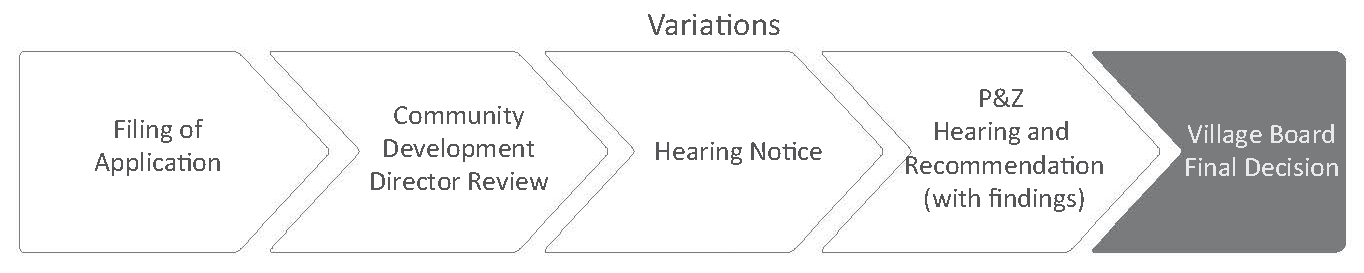
11.5.6. - Hearing and Recommendation—Planning and Zoning Commission
A.
Within sixty (60) days of receipt of a complete application, the planning and zoning commission must hold a public hearing on the requested variation. Within sixty (60) days of the close of the public hearing, the planning and zoning commission must act to:
1.
Recommend approval of the variation request;
2.
Recommend approval of the variation request with conditions or modifications; or
3.
Recommend denial of the variation request.
B.
The planning and zoning commission's recommendation must be accompanied by specific findings of fact regarding whether practical difficulties or particular hardships would result if a variation is not granted.
C.
A simple majority vote of a quorum of the planning and zoning commission is required to recommend approval or denial of a variation request.
11.5.7. - Final Action—Village Board
A.
Within ninety (90) days of receipt of the planning and zoning commission's recommendation, the village board may act to approve the variation request, approve the variation request with conditions and/or modifications or deny the requested variation. The village board may also may remand the variation request to the planning and zoning commission's for further consideration.
B.
If the variation request is remanded, the village board must specify the reasons and scope of the remand, and further proceedings before the planning and zoning commission's must be limited to those identified items. The planning and zoning commission's must conduct further proceedings as may be appropriate and return a recommendation on the variation to the village board within sixty (60) days of the date that the matter is remanded to them. Within sixty (60) days of receipt of the planning and zoning commission's findings and recommendation, the village board must take final action on the variation request.
C.
The village board may act on requested variations by a simple majority vote except that when the planning and zoning commission has recommended denial of the variation, approval by the village board requires a two-thirds majority vote of a quorum.
11.5.8. - Transferability
Approved variations run with the land and are not affected by changes of tenancy or ownership
11.5.9. - Amendments
A request for changes in the specific nature of the approved variation or changes to any conditions attached to an approved variation must be processed as a new variation application, including all requirements for fees, notices and public hearings.
11.5.10. - Lapse of Approval
A.
An approved variation will lapse and have no further effect twelve (12) months after it is approved by the village board, unless:
1.
A building permit has been issued (if required); or
2.
The use or structure has been lawfully established.
B.
The village board is authorized to extend the expiration period for good cause by up to twelve (12) additional months. Requests for extensions must be submitted to the community development director before the variation expires. No hearings, notices or fees are required for extensions.
C.
A variation also lapses upon revocation of a building permit or a certificate of occupancy for violations of conditions of approval or upon expiration of a building permit to carry out the work authorized by the variation.
11.5.11. - Successive Applications
If a variation request is denied, no substantially similar application may be accepted for the same property for twelve (12) months from the date of denial by the planning and zoning commission, except on the grounds of substantial new evidence or proof of changed conditions found to be valid by the community development director.
(Ord. No. 4036, § 2(Exh. A), 6-11-18)
11.6.1. - Intent
These administrative adjustments procedures are intended to provide a streamlined approval procedure for very minor forms of zoning relief. While typical variations require final decision-making by the planning and zoning commission, the community development director is authorized to approve a select, limited number of administrative adjustments without a public hearing, as identified in this section.
11.6.2. - Authorized Administrative Adjustments
A.
The community development director is authorized to grant the following administrative adjustments:
1.
A reduction of the minimum required lot area by up to ten (10) percent;
2.
A reduction of the minimum required lot width by up to ten (10) percent;
3.
A reduction of minimum required (interior) side setbacks by up to ten (10) percent or one (1) foot, whichever is less;
4.
A reduction of minimum required rear setbacks by up to ten (10) percent of two (2) feet, whichever is less;
5.
A reduction of minimum required motor vehicle off-street parking or loading requirements by up to ten (10) percent or one space, whichever is greater; and
6.
A reduction of minimum bicycle parking space requirements by up to twenty-five (25) percent or two (2) spaces, whichever is greater.
7.
Adjustments to MX district building types defined in Article 4.
B.
The administrative adjustment provisions may not be used to vary, modify or otherwise override a condition of approval or requirement imposed by an authorized village decision-making body or the state or federal government.
11.6.3. - Authority to File
Administrative adjustment applications may be filed by the subject property owner or by the property owner's authorized agent.
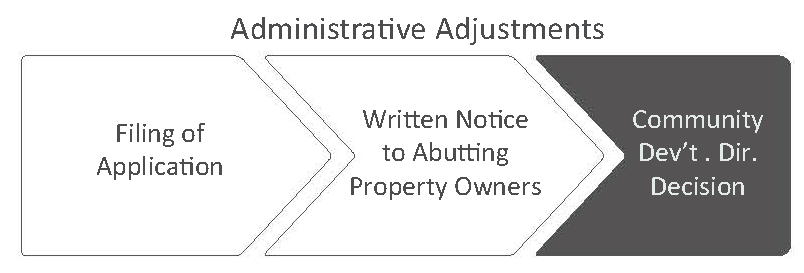
11.6.4. - Application Filing
Complete applications for administrative adjustments must be filed with the community development director.
11.6.5. - Notice of Filing/Intent to Approve
Within seven (7) business days of receipt of a complete application for an administrative adjustment, written notice of application filing must be delivered to all taxpayers of record abutting the subject parcel, excluding street rights-of-way. The notice must describe the nature of the requested administrative adjustment. It must also indicate the date on which the community development director will take action on the application and that the application will available for review and comment until that date. Any interested party may submit written comments concerning the application to the community development director.
11.6.6. - Action by Community Development Director
A.
The community development director must review each application for an administrative adjustment and act to approve the application, approve the application with conditions or deny the application. Alternatively, the community development director is authorized to refer the application to the planning and zoning commission for consideration as a variation.
B.
The community development director may not take final action to approve or deny an administrative adjustment application until at least seven (7) days after the date that notices are deposited in the mail or the date of personal delivery of the required notices.
C.
If a property owner who has received notice of the administrative adjustment application provides a written objection to the administrative adjustment before the date of allowed action indicated on the notice, the community development director must refer the application to the planning and zoning commission for consideration as a variation. No additional fees are required other than fees to cover the cost of required notice of the planning and zoning commission's public hearing.
D.
The community development director's decision to approve or deny an administrative adjustment must be based on the approval criteria and standards of 11.6.7 and accompanied by written findings of fact.
E.
The applicant may appeal a decision to deny an administrative adjustment to the planning and zoning commission. In the case of an appeal, the planning and zoning commission must consider the request as a variation. No additional fees are required other than fees to cover the cost of required notice of the planning and zoning commission's public hearing.
F.
At least once per calendar year, the community development director must provide to the planning and zoning commission a listing of all administrative adjustment decisions.
11.6.7. - Review and Approval Criteria
Administrative adjustments may be approved only when the community development director determines that any specific standards associated with the authorized administrative adjustment and the following general approval criteria have been met:
A.
The requested administrative adjustment is consistent with all relevant purpose and intent statements of this zoning ordinance;
B.
The requested administrative adjustment will not have a substantial or undue adverse effect upon adjacent property, the character of the area or the public health, safety and general welfare; and
C.
Any adverse impacts resulting from the administrative adjustment will be mitigated to the maximum extent feasible.
11.6.8. - Conditions of Approval
In granting an administrative adjustment, the community development director is authorized to impose conditions upon the subject property that are necessary to reduce or minimize any potentially adverse impacts on other property in the surrounding area, and to carry out the stated purpose and intent of this zoning ordinance.
11.6.9. - Transferability
Approved administrative adjustments run with the land and are not affected by changes of tenancy or ownership.
11.6.10. - Amendments
A request for changes in the specific nature of the approved administrative adjustment or changes to any conditions attached to an approved administrative adjustment must be processed as a new administrative adjustment application, including the requirements for fees and notices.
11.6.11. - Lapse of Approval
A.
An approved administrative adjustment will lapse and have no further effect twelve (12) months after it is approved by the community development director, unless:
1.
A building permit has been issued (if required); or
2.
The use or structure has been lawfully established.
B.
An administrative adjustment also lapses upon revocation of a building permit or a certificate of occupancy for violations of conditions of approval or upon expiration of a building permit to carry out the work authorized by the administrative adjustment.
11.6.12. - Appeals
The applicant or any interested party may appeal the decision of the community development director in accordance with Sec. 11.7.
(Ord. No. 4036, § 2(Exh. A), 6-11-18)
11.7.1. - Authority
The planning and zoning commission is authorized to hear and decide appeals where it is alleged there has been an error in any order, requirement, decision or determination made by the community development director or any other administrative official in the administration or interpretation of this zoning ordinance.
11.7.2. - Right to Appeal
Appeals of administrative decisions may be filed by any person aggrieved by the community development director's or other administrative official's decision or action. The planning and zoning commission is authorized to make determinations about whether individuals filing appeals are "aggrieved" by the decision or action.
11.7.3. - Application Filing
A.
Complete applications for appeals of administrative decisions must be filed with the community development director.
B.
Appeals of administrative decisions must be filed within forty-five (45) days of the date of the decision being appealed.
11.7.4. - Effect of Filing
The filing of a complete notice of appeal stays all proceedings in furtherance of the action appealed, unless the community development director certifies to the planning and zoning commission, after the appeal is filed, that, because of facts stated in the certification, a stay would cause immediate peril to life or property, in which case the proceedings will not be stayed unless by a restraining order, which may be granted by the planning and zoning commission or by a court of record based on due cause shown.
11.7.5. - Record of Decision
Upon receipt of a complete application of appeal, the community development director or other administrative official whose decision is being appealed must transmit to the planning and zoning commission all papers constituting the record upon which the action appealed is taken.
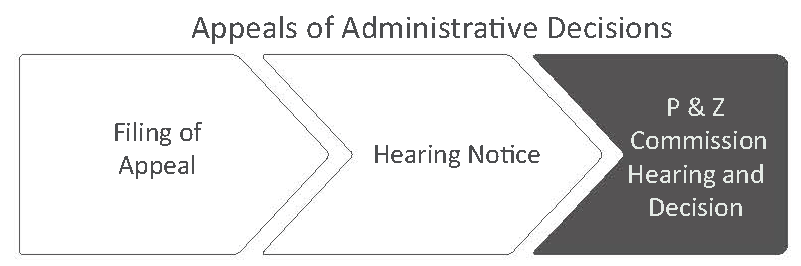
11.7.6. - Notice of Hearing
Notice of the planning and zoning commission's required public hearing must be published in the newspaper in accordance with 11.1.4-A. Additional notice may also be provided in accordance with 11.1.4-B
11.7.7. - Hearing and Final Decision
A.
The planning and zoning commission must hold a public hearing on the appeal within sixty (60) days of the date that the appeal is filed.
B.
Within forty-five (45) days of the close of the public hearing, the planning and zoning commission must take action on the appeal. The planning and zoning commission's decision must be in writing and be supported by written findings of fact.
C.
In exercising the appeal power, the planning and zoning commission has all the powers of the administrative official from whom the appeal is taken. The planning and zoning commission may affirm or may reverse, wholly or in part, or modify the decision being appealed. Action by the planning and zoning commission requires a simple majority vote of a quorum of the planning and zoning commission.
D.
In acting on the appeal, the planning and zoning commission must grant to the official's decision a presumption of correctness, placing the burden of persuasion of error on the appellant.
E.
All decisions of the planning and zoning commission are final administrative determinations and are subject to judicial review only, in accordance with the Illinois Administrative Review Law, 735 ILCS 5/3-101 et seq.
11.7.8. - Decision-Making Criterion
An appeal may be sustained only if the planning and zoning commission finds that the community development director or other administrative official erred.
(Ord. No. 4036, § 2(Exh. A), 6-11-18)

