
Villa Park City Zoning Code
ARTICLE 7
- PARKING
7.1.1. - Purpose
A.
The parking regulations of this article are intended to help ensure that off-street parking facilities are provided to meet the typical day-to-day needs of shoppers, employees, visitors and residents while also avoiding the negative impacts that can result from requiring excessive quantities of offstreet parking.
B.
The provisions of this article are also intended to help protect the public health, safety and general welfare by:
1.
Promoting economically viable and beneficial use of land; and
2.
Providing flexible methods of responding to the transportation and access demands of various land uses in different areas of the village.
7.1.2. - Applicability
A.
General
Off-street parking must be provided and maintained in accordance with the provisions of this article. Unless otherwise expressly stated, the regulations apply to all zoning districts and uses.
B.
New Uses and Development
The parking regulations of this article apply to all new buildings constructed and all new uses established in all zoning districts.
C.
Change of Use
If a new use of a building or structure requires more off-street parking than the use that most recently occupied the building or structure, additional off-street parking is required in an amount equal to the difference between the parking required for the new use and the parking that would have been required for the previous use if current parking requirements had been applicable, provided that the total number of required spaces for the change of use need not exceed the number that would be required for establishment of a new use.
D.
Enlargements and Expansions
1.
The parking regulations of this article apply whenever an existing building or use is enlarged or expanded to include additional dwelling units, floor area, seating capacity or other units of measurement used for establishing off-street parking requirements.
2.
In the case of enlargements or expansions that trigger requirements for additional parking, additional spaces are required only to serve the enlarged or expanded area, not the entire building or use. There is no requirement to address parking space deficits associated with existing, lawfully established buildings or uses.
E.
Maintenance
Off-street parking spaces required by this zoning ordinance must be maintained for the life of the principal use.
F.
Damage or Destruction
When a use that has been damaged or destroyed by fire, collapse, explosion, or other cause is re-established, off-street parking or loading facilities must also be re-established or continued in operation in an amount equal to the number maintained at the time of such damage or destruction. It is not necessary, however, to restore or maintain parking or loading facilities in excess of those required by this zoning ordinance.
Sec. 7.2. - MINIMUM PARKING RATIOS
Off-street motor vehicle parking spaces must be provided in accordance with the minimum ratios established in Table 7-1. See Section 7.4 for an explanation of exemptions and allowed reductions of minimum motor vehicle parking requirements. See Section 7.5 for additional information about bicycle parking requirements.
Table 7-1: Minimum Parking Ratios
(Ord. No. 4036, § 2(Exh. A), 6-11-18; Ord. No. 4452, § 5, 12-9-24)
SEC. 7.3. - CALCULATION OF REQUIRED PARKING
In determining the number of parking spaces required, the following calculation rules apply:
7.3.1. - Multiple Uses
Lots containing more than one (1) use or tenant must provide parking in an amount equal to the total aggregate number of spaces required for each use or tenant on the lot except when a shared parking arrangement is approved in accordance with section 7.4.2.
7.3.2. - Calculations
In calculating the number of parking spaces required for uses subject to a minimum parking ratio of "x" spaces per one thousand (1,000) square feet, first divide the floor area of the subject use by one thousand (1,000) and then multiply the result by "x." If, for example, a minimum parking ratio of 3.33 spaces per one thousand (1,000) square feet is applied to a use occupying five hundred (500) square feet of floor area, the minimum parking requirement for that use would be calculated as follows: (500 sq. ft. ÷ 1,000) x 3.33 = 0.5 x 3.33 = 1.665, which is rounded up to two (2) spaces (See section 14.1.1).
7.3.3. - Occupancy- or Capacity-based Standards
For the purpose of computing parking requirements based on employees, students, members, residents or occupants, calculations must be based on the average number of persons working on any single shift, the average enrollment or membership or the building code-rated capacity, whichever is applicable.
7.3.4. - Bench Seating
For the purpose of calculating parking requirements based on seating, each twenty-two (22) linear inches of bench or pew length is equivalent to one seat.
7.3.5. - Outdoor Customer Seating/Dining Areas
Any outdoor customer seating/dining area exceeding ten (10) percent of a bar, restaurant or other use's indoor floor area must be counted as floor area for purposes of determining off-street parking requirements.
7.3.6. - Unlisted Uses
Upon receiving a development application for a use not specifically listed in an off-street parking schedule, the community development director is authorized to apply the off-street parking ratio specified for the listed use that is deemed most similar to the proposed use or establish a minimum off-street parking requirement for the proposed use in accordance with section 7.3.7.
7.3.7. - Establishment of Other Parking Ratios
The community development director is authorized to establish required minimum parking ratios for unlisted uses and in those instances where authority to establish a requirement is expressly provided. Such ratios must be established on the basis of (1) a similar use/parking determination (as described in section 7.3.6), (2) on parking data provided by the applicant or (3) other information available to the community development director. Parking data and studies must include estimates of parking demand based on reliable data collected from comparable local uses or on external data from credible research organizations, such as the Urban Land Institute (ULI) and the Institute of Transportation Engineers (ITE). Comparability will be determined by density, scale, bulk, area, type of activity and location. Parking studies must document the source of all data used to develop recommended requirements.
(Ord. No. 4036, § 2(Exh. A), 6-11-18)
7.4.1. - On-street Parking
Nonresidential uses may count on-street parking spaces on public street rights-of-way abutting the subject property towards satisfying off-street motor vehicle parking requirements. One (1) on-street parking space credit may be taken for each twenty (20) linear feet of abutting right-of-way where on-street parking is allowed. Only space on the same side of the street as the subject use may be counted, except that the opposite side of the street may be counted if the property on that side of the street does not have the potential for future development. In calculating credit for on-street parking, all fractional spaces are rounded down.
7.4.2. - Shared Parking
A.
General
Shared parking refers to the practice of two (2) or more users who have need for parking at different times voluntarily agreeing to make use of the same motor vehicle parking spaces. Shared parking is encouraged as a means of conserving scarce land resources, reducing stormwater runoff, reducing the heat island effect caused by large paved areas and improving community appearance.
B.
Approval
The community development director is authorized to approve shared parking arrangements among property owners who propose shared parking.
C.
Eligibility
Shared parking may be approved for nonresidential uses that have different periods of parking demand. Required residential parking and accessible parking spaces (for people with disabilities) may not be shared, provided that this provision is not intended to prohibit shared driveways serving such uses.
D.
Calculation
The number of parking spaces required under a shared parking arrangement must be determined in accordance with the following:
1.
Multiply the minimum parking required for each individual use, as set forth in Table 7-1 by the percentage identified in Table 7-2 for each of the 6 designated time periods.
2.
Add the resulting sums for each of the 6 columns in Table 7-2.
3.
Select the time period with the highest total parking requirement and use that total as the shared parking requirement.
Table 7-2: Shared Parking Factors
E.
Other Uses
If one or more of the land uses proposing to make use of a shared parking arrangement do not conform to the land use classifications in Table 7-2, as determined by community development director, then the applicant must submit sufficient data to indicate the principal operating hours of the uses. Based upon this information, the community development director is authorized to determine the appropriate shared parking requirement, if any, for such uses.
F.
Location
Shared parking may be located on-site or off-site. Off-site parking is subject to the regulations of 7.6.2.
G.
Agreement
Before final approval of a shared parking arrangement, a shared parking agreement must be provided guaranteeing the long-term availability of the shared parking, commensurate with the uses served. Shared parking privileges will continue in effect only as long as the agreement, binding on all parties, remains in force. If a shared parking agreement lapses or is no longer valid, then parking must be provided as otherwise required by this article.
7.4.3. - Long-term Bicycle Parking
Each four (4) long-term bicycle parking spaces provided in accordance with Sec. 7.5 is credited as one motor vehicle space, provided that this long-term bicycle parking space credit may not be used to reduce a use's minimum off-street motor vehicle parking requirement by more than one (1) space or ten (10) percent, whichever results in a greater reduction.
7.4.4. - Alternative Compliance
The required parking ratios of this article are not intended to prevent development and redevelopment or to make development and redevelopment economically impractical. In order to allow for flexibility in addressing the actual expected parking demand of specific uses, alternative compliance parking ratios may be approved through the special use approval procedures of Sec. 11.4 only if:
A.
The applicant submits a parking study demonstrating that the motor vehicle parking ratios of Table 7-1 do not accurately reflect the actual day-to-day parking demand that can reasonably be anticipated for the proposed use based on field surveys of observed parking demand for similar use within the city or on external data from credible research organizations, such as the Urban Land Institute (ULI) or the Institute of Transportation Engineers (ITE);
B.
The planning and zoning commission determines that the other allowed parking reduction alternatives of Sec. 7.4 are infeasible or do not apply; and
C.
The planning and zoning commission determines that the reduced parking ratios proposed are not likely to cause material adverse impacts on traffic circulation and safety or on the general welfare of property owners and residents in the surrounding area.
(Ord. No. 4036, § 2(Exh. A), 6-11-18)
7.5.1. - Purposes
A.
Short-term Bicycle Parking
Short-term bicycle parking is generally intended to serve the needs of cyclists who park their bicycles for short time periods, including customers, clients, students and other short-term visitors.
B.
Long-term Bicycle Parking
Long-term bicycle parking is generally intended to serve the needs of cyclists who park their bicycles for long time periods, primarily employees and residents.
7.5.2. - Spaces Required
A.
Short-term Bicycle Parking
Short-term bicycle parking spaces must be provided in accordance with the minimum ratios established in Table 7-3.
Table 7-3: Bicycle Parking Ratios
B.
Long-term Bicycle Parking
Long-term bicycle parking and storage is not required, but as a means of encouraging the provision of long-term bicycle parking spaces for employees and bicycle commuters, motor vehicle parking credit is offered in accordance with 7.4.3. @@@
7.5.3. - Location
1.
Short-Term Bicycle Parking
Required short-term bicycle parking must be located in highly visible areas that do not interfere with pedestrian movements. At least fifty (50) percent of required short-term bicycle parking spaces must be located within one hundred (100) feet of a customer entrance, with the remainder located no more than three hundred (300) feet from any entrance. Short-term bicycle parking must be located on the subject lot, unless a license agreement has been approved by the village to allow private bicycle parking facilities to be located in the right-of-way. Public bicycle parking spaces may be credited toward meeting short-term bicycle parking requirements if such bicycle parking spaces comply with the location requirements of this paragraph.
2.
Long-Term Bicycle Parking
Required long-term bicycle parking provided to receive parking credit in accordance with 7.4.3 must be provided in the building or in a weather-protected area. Long-term bicycle parking spaces must be protected from access by unauthorized persons.
7.5.4. - Design
All required short-term and long-term bicycle parking spaces must:
A.
Consist of bike racks or lockers that are anchored so that they cannot be easily removed;
B.
Be of solid construction, resistant to rust, corrosion, hammers, and saws;
C.
Allow both the bicycle frame and the wheels to be locked with the bicycle in an upright position using a standard U-lock;
D.
Be designed so as not to cause damage to the bicycle;
E.
Facilitate easy locking without interference from or to adjacent bicycles; and
F.
Have minimum dimensions of two (2) feet in width by six (6) feet in length, with a minimum overhead vertical clearance of seven (7) feet.
7.5.5. - Administrative Adjustments
The community development director is authorized to approve an administrative adjustment (see section 11.6) reducing the number of bicycle spaces required under this section or modifying the bicycle parking design and location requirements of this section.
(Ord. No. 4036, § 2(Exh. A), 6-11-18)
7.6.1. - Location
A.
All required off-street parking spaces must be located on the same lot as the use to be served by such parking, except as otherwise expressly stated in this article.
B.
Parking is prohibited in front and street side yards, except that his provision is not intended to prohibit parking on permitted residential driveways.
7.6.2. - Off-Site Parking
A.
When Allowed
All or a portion of required off-street parking for nonresidential uses may be provided off-site in accordance with the regulations of this section. Required accessible parking spaces and required parking for residential uses may not be located off site.
B.
Location
Off-site parking areas must be located within a 650-foot radius of the use served by such parking, measured between the nearest public entrance door of the use to be served and the outer perimeter of the furthest parking space within the off-site parking lot. Off-site parking lots are allowed only in zoning districts that permit non-accessory parking or in districts that allow the principal use to be served by the off-site parking spaces, unless otherwise approved as a special use.
C.
Design
Off-site parking areas must comply with all applicable parking area design regulations of section 7.9.
D.
Control of Off-Site Parking Area
The property to be occupied by the off-site parking facilities must be under the same ownership as the lot containing the use to be served by the parking. The off-site parking area may be under separate ownership only if an agreement is provided guaranteeing the long-term availability of the parking, commensurate with the use served by the parking. Off-site parking privileges will continue in effect only as long as the agreement, binding on all parties, remains in force. If an offsite parking agreement lapses or is no longer valid, then parking must be provided as otherwise required by this article.
7.6.3. - Use
A.
Required off-street parking facilities may be used only for the temporary parking of licensed passenger motor vehicles by residents, tenants, patrons, employees, or guests of the principal use. Off-street parking spaces required by this zoning ordinance must be maintained for the life of the principal use.
B.
Off-street parking spaces may not be leased to uses not on-site, including but not limited to schools and commuter parking, unless approved by a special use or shared parking agreement.
C.
No vehicle repair or service of any kind is permitted in an off-street parking space except in a completely enclosed garage.
(Ord. No. 4036, § 2(Exh. A), 6-11-18)
7.7.1. - Applicability
Except as otherwise expressly stated, the regulations of this section apply to residential uses in all R districts.
7.7.2. - Parking in Street Yards
Only private passenger motor vehicles may be parked in street yards in R districts, provided that parking in rear yards of corner lots is allowed in accordance with the rear yard parking provisions of this section. No more than four (4) vehicles may be parked or stored in street yards, except for occasional guests.
7.7.3. - Parking in Rear Yards
The following vehicles may be parked in rear yards in R districts:
A.
Private passenger motor vehicles;
B.
Recreational vehicles;
C.
Boats, whether mounted on a boat trailer or unmounted;
D.
Boat trailers; and
E.
Pickup trucks and vans.
7.7.4. - Parking in Side Yards
The following vehicles may be parked in side yards in R districts if they do not exceed twenty-seven (27) feet in length:
A.
Private passenger motor vehicles
B.
Recreational vehicles other than slide-in, truck-mounted campers;
C.
Boats when mounted on a boat trailer and only from May 1 to October 31;
D.
Boat trailers; and
E.
Pickup trucks and vans.
7.7.5. - Recreational Vehicle (RV) Parking
A.
In R districts, no more than two (2) recreational vehicles may be parked outside of a completely enclosed garage. When RVs are mounted on trailers, the trailer and all mounted RVs will be counted as a single recreational vehicle. Trailers that are not mounted with one or more recreational vehicles are counted as a separate RV.
B.
Recreational vehicles parked or stored in R districts may not be occupied or used for living, sleeping or housekeeping purposes.
C.
Notwithstanding the other parking regulations of this section, recreational vehicles may be parked anywhere on the premises for active loading or unloading purposes for up to forty-eight (48) hours during any one continuous period.
7.7.6. - Inoperable Vehicles and Repairs
A.
Inoperable or unlicensed motor vehicles may not be parked or stored in an R district unless located within a completely enclosed garage.
B.
All vehicle repairs must be conducted within an completely enclosed garage.
7.7.7. - Trucks and Large Vehicles
A.
Except for vehicles expressly allowed to be parked or stored in R districts pursuant to the R district parking regulations of this section, it is unlawful for any motor vehicle having a gross vehicle weight of more than eight thousand (8,000) pounds to be parked or stored in any R zoning district, including on any public or private street or alley.
B.
Except for vehicles expressly allowed to be parked or stored in R districts pursuant to the R district parking regulations of this section, the parking or storage of any second division motor vehicle, as defined in the Illinois Motor Vehicle Code, displaying a license plate containing other than a Class B designation constitutes prima facie evidence of a violation of truck and large vehicle parking restrictions of this section.
C.
Notwithstanding the other parking regulations of this section, trucks and other service vehicles may be parked in R district temporarily while making deliveries or actively rendering service to a property owner.
(Ord. No. 4036, § 2(Exh. A), 6-11-18)
7.8.1. - Applicability
A.
Except as otherwise expressly stated, the regulations of this section apply to residential uses in all RS and RD districts per dwelling unit.
B.
Parked vehicles for single-unit, two-unit, and townhouse dwellings are permitted to park on private driveways and parking pads provided that the parked vehicles do not encroach into the right-of-way.
(Ord. No. 4452, § 6, 12-9-24)
7.8.2. - Number
A.
No more than one (1) driveway is allowed per street frontage.
B.
Driveways shall be located at least sixty (60) feet from a signalized intersection, and thirty (30) feet from all other intersections.
C.
Lots with a street frontage of at least one hundred (100) linear feet of frontage may incorporate one (1) additional approach along that frontage. On properties for which more than one (1) approach is permitted, the distance between the approaches shall be a minimum of fifty (50) feet measured at the inside edge.
D.
Lots occupied by duplex or attached dwelling units may have up to one (1) driveway per dwelling unit.
(Ord. No. 4452, § 6, 12-9-24)
7.8.3. - Location
A.
Driveways and parking pads are allowed in easements, unless otherwise restricted.
(Ord. No. 4452, § 6, 12-9-24)
7.8.4. - Dimensions
A.
Driveways must be at least nine (9) feet in width measured at the property line.
B.
Driveways shall be a maximum of twenty-four (24) feet measured at the property line.
C.
Parking pads shall not exceed nine (9) feet in width by twenty (20) feet in depth.
(Ord. No. 4452, § 6, 12-9-24)
7.8.5. - Visibility at Driveways
7.8.6. - Driveway Turnarounds
Driveway turnarounds are prohibited in street yards except when the lot has frontage on a major street (as designated by the village) and the lot cannot accommodate a turnaround area outside of the street yard because of the applicable regulations of this section and the configuration of the subject property. Street yard driveway turnarounds may not exceed fourteen (14) feet in length or the width of the existing driveway, excluding flares.
(Ord. No. 4452, § 6, 12-9-24)
7.8.7. - Driveway and Parking Pad Design
A.
A driveway apron the width of the garage, carport, or parking pad serviced by the driveway is permitted to extend up to twenty (20) feet in depth from the garage doors or rear edge of the carport or parking pad before tapering back to the required driveway width, see Figure 7-1 Garage Apron Width.
Figure 7-1 Garage Apron Width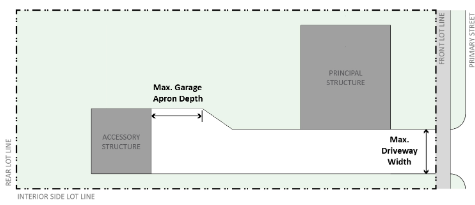
B.
Adequate provisions must be made for the disposal of stormwater so that water will not flow into adjacent property. To keep water runoff on site and prevent runoff towards adjacent properties, new or replacement driveways must meet existing grades along the property line and then slope ⅛-inch to ¼-inch per foot away from the property line and toward the center of the driveway. Any curbs along driveway must be constructed so as to not dam water on adjacent properties.
C.
Maximum lot coverage shall comply with Table 2-3: Lot and Building Regulations (R districts).
D.
Residential driveways and parking areas must comply with the surfacing requirements of Section 7.9.4.
E.
All new off-street parking facilities, including driveways, must meet the requirements of this section.
F.
Attached garages may not be converted into a living area unless the required off-street parking spaces are being provided for elsewhere on the lot.
G.
Driveways may not be designed or constructed in any manner that will interfere with planned or existing parkway or right-of-way improvements or in a way that will create traffic hazards.
(Ord. No. 4307, §§ 2—4, 11-14-22; Ord. No. 4452, § 6, 12-9-24)
7.9.1. - General
Parking areas must be designed and constructed to allow unobstructed movement into and out of required parking spaces without interfering with fixed objects or vehicles except in the case of allowed tandem and valet parking.
A.
Tandem Parking
Tandem parking spaces may be used to satisfy residential parking requirements if the tandem spaces are assigned to the same dwelling unit.
B.
Valet Parking
Valet parking may be used to satisfy minimum off-street parking requirements for nonresidential uses if an attendant is present during all hours of operation. Valet parking lots may be laid out in such a way that one or more vehicles must be moved to obtain access to other parked vehicles.
7.9.2. - Parking Stall Sizes and Parking Lot Geometrics
Off-street parking areas are subject to the dimensional requirements of Table 7-4 (see also Figure 7-2). The Director of Community and Economic Development or their designee is authorized to establish dimensions for parking configurations not shown.
Table 7-4: Parking Area Dimensions
Note: Dimensions are measured from the centerline of the stripe.
Figure 7-2. Parking Area Dimensions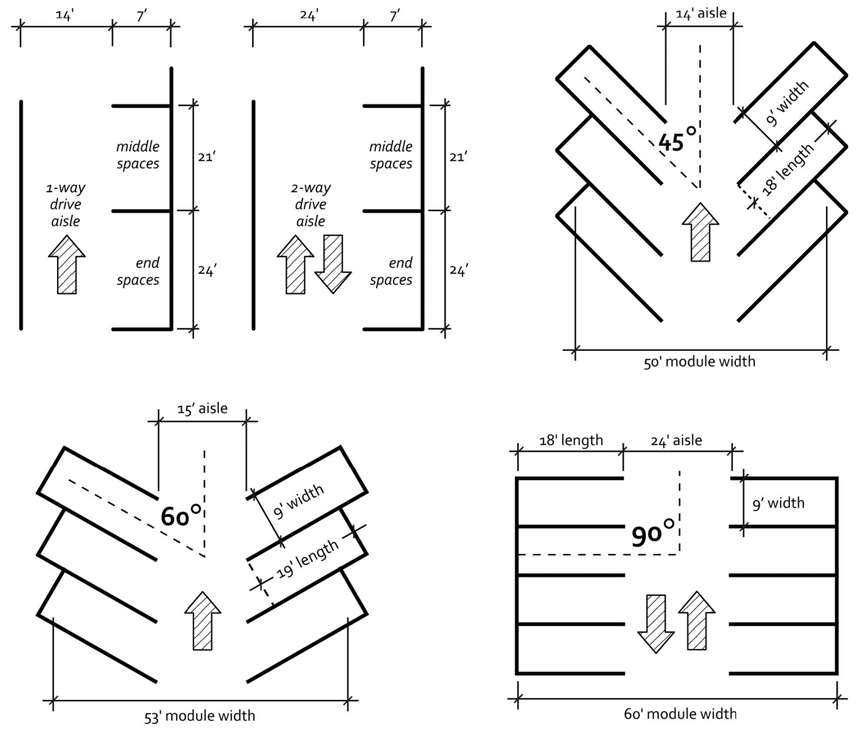
(Ord. No. 4452, §§ 7, 8, 12-9-24)
7.9.3. - Striping
In parking lots containing eight (8) or more parking spaces, striping consisting of parallel lines, four (4) inches in width must be provided for each parking stall. Striping must be yellow or white.
7.9.4. - Surfacing
All open off-street parking areas and driveways must be improved with all-weather, hard surface pavement consisting of the following minimum specifications:
A.
A three-inch bituminous concrete (Hot Mix Asphalt—HMA) surface course on a six-inch compacted crushed stone aggregate base. For replacement driveways, the base material must be inspected for adequate compaction and subsurface drainage; or
B.
A five-inch Portland cement concrete (P.C.C.) surface on a four-inch thick compacted aggregate base. For replacement driveways, the base material must be inspected for adequate compaction.
C.
Concrete ribbon strips are permitted only if constructed of concrete in accordance with all applicable village regulations.
D.
Brick paver or block driveways and parking areas are permitted if construction is done in accordance with the manufacturer's specifications.
E.
The placement of granular fill or other non all-weather parking surface is prohibited. This provision is not intended to prohibit the continued use and maintenance of any existing non all-weather surface. Any non-conforming surface may not be expanded, per 13.5.2.
7.9.5. - Wheel Stops
In all parking lots containing eight (8) or more parking spaces, wheel stops or bumper guards must be installed when necessary to prohibit vehicle overhang onto adjacent pedestrian ways or landscape areas.
7.9.6. - Access
A.
Each required off-street parking space must open directly upon an aisle or driveway with a width and design that provides safe and efficient means of vehicular access to the parking space.
B.
All off-street parking must be designed with appropriate means of vehicular access to a street or alley in a manner that will least interfere with motorized and non-motorized traffic.
C.
Driveways across public property and curb cuts may not exceed twenty-four (24) feet in width, as measured at the lot line.
7.9.7. - Landscaping and Screening
See Sec. 9.1.
7.9.8. - Lighting
Parking areas must be illuminated to provide for safe vehicular and pedestrian movements. All lighting must be arranged to prevent glare on abutting properties and public rights-of-way (see also section 9.4).
7.9.9. - Drainage
All open off-street parking areas must be provided with adequate drainage and stormwater management improvements, in accordance with plan submitted to and approved by the community development director.
(Ord. No. 4036, § 2(Exh. A), 6-11-18; Ord. No. 4307, § 5, 11-14-22)
Sec. 7.10. - ACCESSIBLE PARKING
7.10.1. The number, location, and design of accessible parking spaces must be provided in accordance with the Illinois Accessibility Code.
(Ord. No. 4036, § 2(Exh. A), 6-11-18; Ord. No. 4343, §§ 2, 3, 5-22-23)
7.11.1. - Purpose
The regulations of this section are intended to help ensure that
A.
There is adequate on-site maneuvering and circulation area for vehicles and pedestrians;
B.
Vehicles awaiting service do not impede traffic on abutting streets; and
C.
Impacts on surrounding uses are minimized.
7.11.2. - Applicability
The regulations of this section apply to new developments, the addition of drive-through facilities to existing developments and the relocation of existing drive-through facilities.
7.11.3. - Stacking Spaces Required
In addition to the parking required for each use, establishments with drive-through facilities must provide stacking spaces for each drive-through station as indicated in Table 7-6, unless otherwise expressly approved through the special use permit procedures of section 11.4.
Table 7-6: Stacking Spaces Required
7.11.4. - Stacking Lane Dimensions, Design and Layout
A.
Stacking lanes must be designed so that they do not interfere with parking movements or safe pedestrian circulation.
B.
Each stacking space must be at least eight (8) feet in width and eighteen (18) feet in length.
C.
All stacking lanes must be clearly identified through such means as striping, landscaping, pavement design, curbing and/or signs.
7.11.5. - Setbacks
Stacking lanes must be set back at least fifteen (15) feet from the lot line of any R-zoned lot.
7.11.6. - Noise
Sound attenuation walls, landscaping or other mitigation measures may be required to ensure that drive-through facilities will not have adverse noise-related impacts on nearby residential uses.
7.11.7. - Site Plans
Site plans must show the location of drive-through windows and associated facilities (for example: communications systems and access aisles), as well as adjacent residential uses.
(Ord. No. 4036, § 2(Exh. A), 6-11-18)
7.12.1. - Required
A.
Off-street vehicle loading and unloading areas must be provided for any new proposed public/civic, commercial or industrial use or expansion of such a use that would result in a building with a floor area of 20,000 square feet or more.
B.
Off-street vehicle loading and unloading areas must be provided for any building containing 50 or more dwelling units.
7.12.2. - Plans Required
Off-street loading plans must be submitted with site plans, conditional use permits and building permits involving any use required or proposing to provide off-street loading facilities. Plans must accurately designate the proposed off-street loading spaces, dimensions and clearance and access to the loading spaces. Plans for the design of loading areas are subject to approval by the village.
7.12.3. - Location and Design
The following location and design regulations apply to all off-street loading facilities regardless of whether they are required to be provided by this zoning ordinance.
A.
Off-street loading facilities must be located on the same lot as the use served.
B.
All loading areas adjacent to residential zoning districts must be screened from view of the residential zoning district.
C.
Loading spaces may not be located in a required front or side setback.
D.
Loading areas and access drives must be paved and maintained with concrete, asphalt, or similar material of sufficient thickness and consistency to support anticipated traffic volumes and weights.
E.
Each off-street loading space must be designed to provide a safe means of vehicular access to a street or alley in a manner that will least interfere with traffic movement, as approved by the community development director.
(Ord. No. 4036, § 2(Exh. A), 6-11-18)

