
Villa Park City Zoning Code
ARTICLE 2
- RESIDENTIAL DISTRICTS
2.1.1. - The Districts.
The residential zoning districts are listed in Table 2-1. Whenever this zoning ordinance refers to "residential" zoning districts or "R" districts, it is referring to these districts.
Table 2-1: Residential Zoning Districts
2.1.2. - Purposes
A.
General
Residential zoning districts are primarily intended to create, maintain and promote a variety of housing opportunities for individual households and to maintain and promote the desired physical character of existing and developing neighborhoods. While the districts primarily accommodate residential uses, some nonresidential uses are also allowed. The various R district are primarily differentiated on the basis of allowed building types and lot and building regulations.
B.
RS-10
The RS-10 district is primarily intended to accommodate detached houses on lots with an area of at least 10,000 square feet.
C.
RS-7.5
The RS-7.5 district is primarily intended to accommodate detached houses on lots with an area of at least 7,500 square feet.
D.
RD-7.5
The RD-7.5 district is primarily intended to accommodate duplexes and detached houses on lots with an area of at least 7,500 square feet.
E.
RM-9
The RM-9 district is primarily intended to accommodate multi-unit buildings on lots at least 9,000 square feet in area.
(Ord. No. 4036, § 2(Exh. A), 6-11-18)
SEC. 2.2. - ALLOWED BUILDING TYPES
Building types are permitted in R districts in accordance with Table 2-2.
Table 2-2: Allowed Building Types (R districts)
(Ord. No. 4036, § 2(Exh. A), 6-11-18)
SEC. 2.3. - LOT AND BUILDING REGULATIONS
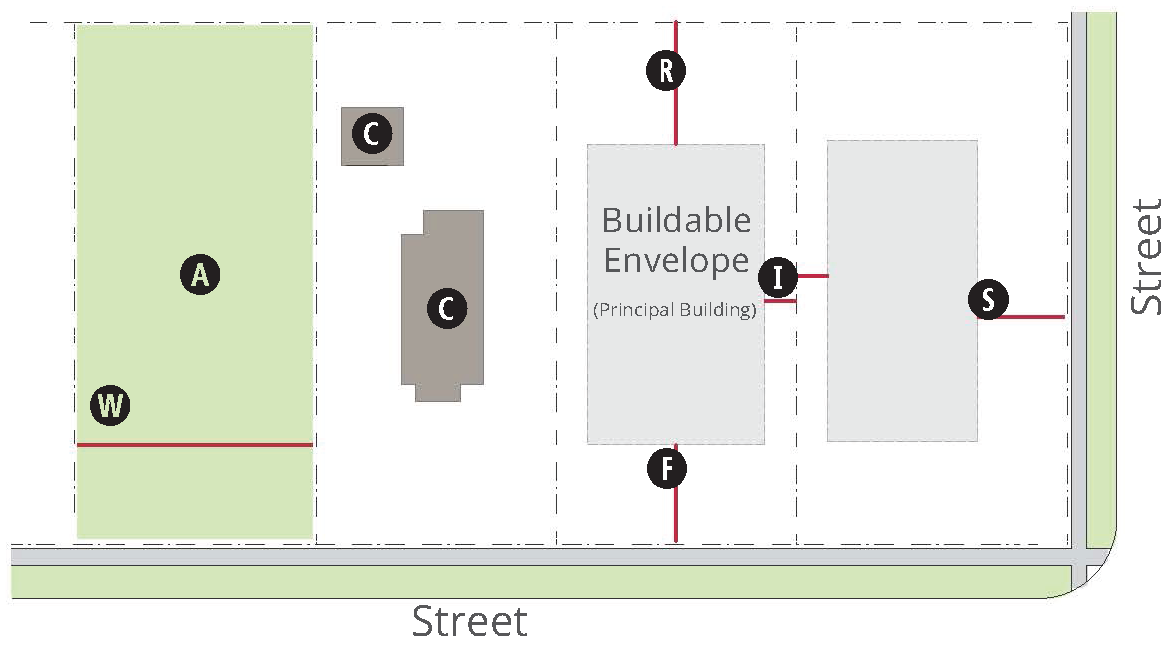
Lots and buildings in R districts are subject to the regulations of Table 2-3.
Table 2-3: Lot and Building Regulations (R districts)
| Lot Regulation | RS-10 | RS-7.5 | RD-7.5 | RM-9 | |
 | Minimum Lot Area (square feet) | 10,000 | 7,500 | 7,500 | 9,000 |
| Minimum Lot Area per Dwelling Unit (square feet) | 10,000 | 7,500 | 3,750 | 1,800 | |
 | Minimum Lot Width (feet) | 65 | 50 | 60 | 50 |
 | Maximum Lot Coverage (impervious Site Coverage) (%) | 50 | 60 | 60 | 50 |
| Building Regulations | RS-10 | RS-7.5 | RD-7.5 | RM-9 | |
| Minimum Building Setbacks | |||||
 | Front Street (feet) | 30[1] | 30[1] | 25[1] | 35[1] |
 | Side Street (feet) | 20 | 15 | 15 | 15 |
 | Interior Side (feet) | 6 | 6 | 6 | 9 |
 | Rear (feet/% of lot depth, whichever is greater) | 40/20 | 40/20[2] | 40/20 | 40/20 |
| Maximum Building Height (feet) | 28 | 28 | 28 | 35 | |
[1] Contextual setback regulations apply to infill development. See section 14.1.9.B
[2] On lots more one hundred sixty (160) feet deep, the sum of front and rear setbacks need not exceed fifty (50) percent of lot depth.
(Ord. No. 4036, § 2(Exh. A), 6-11-18; Ord. No. 4262, § 2, 12-13-21)
SEC. 2.4. - ALLOWED USES
Principal uses are allowed in the R districts in accordance with the use regulations of Section 6.1.
Figure 2-1. R District Lot and Building Regulations
(Ord. No. 4036, § 2(Exh. A), 6-11-18)
2.5.1. - Anti-Monotony Regulations
A.
Purpose
The anti-monotony regulations of this section are intended to promote architectural and visual diversity and to ensure that new detached houses with similar front elevations are not constructed on abutting lots.
B.
Applicability
The anti-monotony regulations of this section apply to all new detached houses in RS-10 and RS-7.5 districts.
C.
Evaluation Criteria
At least three (3) of the following features on proposed new detached houses must be different than those present on detached houses on abutting lots that front on the same street:
1.
Roof type (hip, gable, mansard, etc.);
2.
Plan orientation (right-hand model vs. left-hand model, etc.);
3.
Site orientation (different elevation facing the street);
4.
Front porch (actual porch vs. stoop or steps with landing);
5.
Architectural style (e.g., contemporary, colonial, prairie, neo-colonial, neo-deco, neo-federalist); or
6.
Garage layout (attached vs. detached or front loading vs. side loading)
2.5.2. - Attached Garage Design
A.
Purpose
These attached garage design regulations are intended to ensure that the main entrance for pedestrians is the prominent entrance. And to provide for a more pleasant pedestrian environment by preventing garages and vehicle areas from dominating the views of the neighborhood from the sidewalk and to enhance public safety by preventing garages from blocking views of the street from inside the residence.
B.
Applicability
The attached garage regulations of this section apply to all new detached houses in RS-10, RS-7.5 and RD-7.5 districts and to all new duplexes in the RD-7.5 district. The regulations also apply to the addition of new garages or expansions of existing garages.
C.
Length of Street-Facing Garage Wall
1.
General
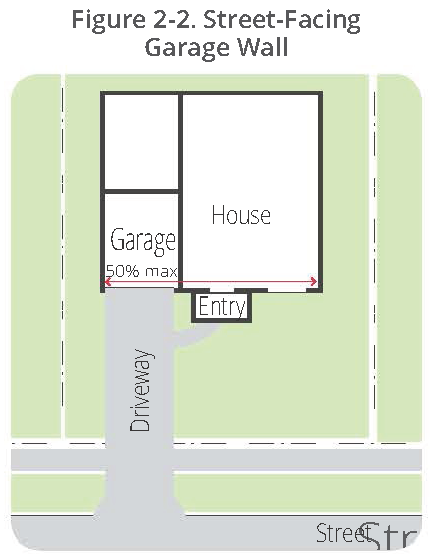
The length of the garage wall facing the street may not exceed 50% of the length of the street-facing building facade containing the primary pedestrian building entrance. See Figure 2-2.
2.
Exception
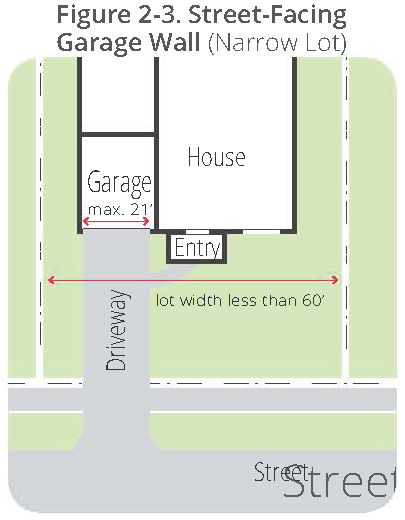
For lots that are less than 60 feet in width, the garage wall facing the street may not exceed 21 feet in length. See Figure 2-3.
D.
Street Setback
1.
General
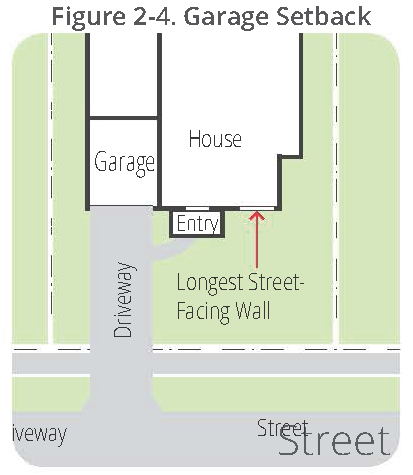
A garage wall that faces a street must be set back from the street lot line in accordance with the minimum building setbacks of section 2.3 and may be no closer to the street lot line than the longest exterior wall of the house facing the same street. See Figure 2-4. On lots with more than one street lot line, this regulation applies only to the street-facing facade on which the main pedestrian entrance is located.
2.
Exceptions
a.
A street-facing garage wall may be up to six (6) feet in front of the longest street-facing wall of the house if: (1) there is a porch at the main entrance with a minimum depth of five (5) feet and a minimum width of ten (10) feet and (2) the street-facing garage wall complies with the minimum building setbacks of section 2.3.
b.
For a side-loaded garage, the street-facing garage wall may extend more than six (6) feet in front of the longest street-facing wall of the house if (1) the street-facing garage wall and the garage wall opposite the garage entrance contain window and door openings on at least fifteen (15) percent of the subject walls.
(Ord. No. 4036, § 2(Exh. A), 6-11-18)
2.6.1. - Parking
See article 7
2.6.2. - Accessory Uses and Structures
See section 6.10
2.6.3. - Fences and Walls
See section 6.10
2.6.4. - Home Occupations
See section 6.10.6
2.6.5. - Permitted Obstructions and Encroachments
See section 14.1.9.C, Table 14-1: Permitted Setback Obstructions/Encroachments
(Ord. No. 4036, § 2(Exh. A), 6-11-18; Ord. No. 4262, § 3, 12-13-21; Ord. No. 4304, § 2, 10-24-22)

