
Villa Park City Zoning Code
ARTICLE 8
- SIGNS
8.1.1. - Purpose
The sign regulations of this article are intended to balance the following differing, and at times, competing goals:
A.
To support the desired character of the village, as expressed in adopted plans, policies and regulations;
B.
To promote an attractive visual environment;
C.
To encourage the effective use of signs as a means of communication for businesses, organizations and individuals;
D.
To provide a means of way-finding for visitors and residents;
E.
To provide for reasonable business identification and communication;
F.
To prohibit signs of such excessive size and number that they obscure one another to the detriment of the economic and social well-being of the village and its residents, property owners and visitors;
G.
To protect the safety and welfare of the public by minimizing hazards for motorized and nonmotorized traffic;
H.
To minimize the possible adverse effects of signs on nearby public and private property; and
I.
To provide broadly for the expression of individual opinions through the use of signs on private property.
8.1.2. - Scope; Permit Required
A.
All signs are subject to the regulations of this article and all other applicable provisions of this zoning ordinance.
B.
All signs shall require a permit other than Nameplates, Commemorative Wall Plaques and Inscriptions as provided in Sec. 8.3.1.
C.
Sandwich signs as provided in Sec. 8.3.2.
D.
Certain temporary signs as listed in 8.3.6.A, 8.3.6.B, 8.3.6.C and 8.3.6.E(4).
E.
Sign exceptions as listed in Sec. 8.3.7.
8.1.3. - Content Neutrality
Any sign allowed under this article may contain, in lieu of any other message or copy, any lawful noncommercial message that does not direct attention to a business operated for profit, or to a product, commodity or service for sale or lease, or to any other commercial interest or activity, as long as the sign complies with all size, height, location and other applicable requirements of this article.
(Ord. No. 4105, § 1, 9-9-19)
Sec. 8.2. - PROHIBITED SIGNS AND SIGN CHARACTERISTICS
The following signs and sign characteristics are prohibited except as otherwise expressly stated:
8.2.1. Signs for which a required permit has not been issued;
8.2.2. Signs located in such a manner as to constitute a nuisance as provided in the village code;
8.2.3. Search lights, strobe lights, rotating beacon lights, flashing lights that are visible from public right-of-way, except as otherwise expressly allowed by this article or required by law;
8.2.4. Permanent signs located in or obstructing a required parking or loading space, or that otherwise obstruct vehicular or pedestrian access or circulation, or that pose any other hazard to motorized or nonmotorized travel;
8.2.5. Signs located in or that project into the right-of-way of a public street unless otherwise expressly stated in this article or a right-of-way permit or license agreement has been approved by the village;
8.2.6. Signs that obstruct any fire escape, required exit, window or door opening used as a means of egress;
8.2.7. Signs that interfere with an opening required for ventilation, except that signs may cover transom windows when not in violation of applicable building and fire safety codes;
8.2.8. Signs affixed directly to a tree, utility pole or traffic control device;
8.2.9. Signs that obstruct, impair, obscure, interfere with the view of, or that may be confused with, any authorized traffic control sign, signal, or device;
8.2.10. Sign displays with a brightness of such intensity or brilliance that they impair the vision or endanger the safety and welfare of any pedestrian, cyclist, or person operating a motor vehicle;
8.2.11. Signs that violate the intersection visibility triangle regulations of Sec. 9.3:
8.2.12. Pole signs;
8.2.13. Off-premise advertising signs;
8.2.14. Signs attached to or painted on an inoperable or unlicensed vehicle (motorized or non-motorized) located in view of the right-of-way; and
8.2.15. Signs attached to or painted on a licensed motor vehicle if the sign: (1) directs attention to a business, service, commodity, or activity offered or sold on the premises and (2) if the vehicle is parked closer to the street than the nearest building wall (does not apply to vehicles parked for the purpose of immediate loading and unloading).
Sec. 8.3. - SIGN EXCEPTIONS
The following signs are not counted as signs for purposes of determining the number of signs or total area of signs on a lot and do not require a sign permit unless the sign is illuminated or the regulations of this section otherwise state that a permit is required.
8.3.1. - Nameplates, Commemorative Wall Plaques and Inscriptions
Nameplates, commemorative wall plaques and commemorative wall inscriptions are allowed in all zoning districts. Nameplates may not exceed two (2) square feet in area. Commemorative wall plaques and commemorative wall inscriptions may not be illuminated and may not exceed four (4) square feet in area.
8.3.2. - Sandwich Board Signs
A.
Eligible Area
Sandwich board signs are permitted only in commercial zoning districts located in the Villa Avenue Business District, Ardmore Avenue Business District and the train station area, as shown on the maps adopted as part of Ordinance No. 3673, which are on file in the office of the community development director.
B.
Number
A maximum of one sandwich board sign is allowed per business.
C.
Size
Sandwich board signs may not exceed six (6) square feet in area or more than four (4) feet in height.
D.
Removal
Sandwich board signs must be removed when:
1.
The business is not open;
2.
The National Weather Service issues a high-wind warning, a tornado or severe thunderstorm watch or warning; or
3.
There is an accumulating snowfall event.
E.
Construction
Sandwich board signs must be professionally constructed of wood, metal or durable plastic, and maintained in good condition.
F.
Location
Sandwich board signs must be:
1.
Located in front of the business and allow at least four (4) feet of sidewalk clearance to allow safe passage.
2.
Set back at least two (2) feet from back of curb abutting on-street parking spaces.
3.
Located on the ground and not be attached to any structure or person.
8.3.3. - Special Event/Recognitions Signs
Special event/recognition signs are subject to village board approval. Village board-approved special event/recognition signs are not subject to the sign regulations of this article unless otherwise expressly stated at the time of approval.
8.3.4. - Driveway Signs
A.
One driveway sign may be installed at each vehicle entrance and exit to any lot occupied by an allowed nonresidential use or multi-unit (residential) building. Such signs must be located within ten (10) feet of the intersection of the driveway and the street right-of-way. Driveway signs may be illuminated but may not exceed four (4) square feet in area or three (3) feet in height.
B.
Off-street parking areas with a capacity of more than four (4) vehicles, multi-tenant developments and uses on lots exceeding eighty thousand (80,000) square feet in area may display internal site driveway signs. Such signs must be located within 10 feet of an internal site driveway, drive aisle or parking space and may not exceed eight (8) square feet in area or six (6) feet in height.
8.3.5. - Drive-through Signs
Drive-through signs are permitted in conjunction with allowed drive-through uses, in accordance with the following regulations:
A.
Location
Drive-through signs must be located within ten (10) feet of a drive-through lane.
B.
Number and Dimensions
One primary drive-through sign not to exceed 36 square feet in area or eight (8) feet in height is allowed per order station up to a maximum of two (2) primary drive-through signs per lot. One secondary drive-through sign not to exceed sixteen (16) square feet in area or six (6) feet in height is allowed per order station, up to a maximum of two (2) secondary drive-through signs.
Figure 8-1. Drive-through Signs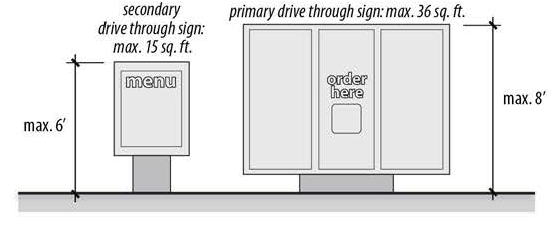
C.
Residential Separation
Drive-through signs must be set back at least twenty-five (25) feet from residential zoning districts.
D.
Visibility
Drive-through signs must be oriented to be visible by motorists in allowed drive-through lanes.
8.3.6. - Temporary Signs
A.
Real Estate Signs
One real estate sign is allowed per street frontage in all zoning districts, subject to the maximum sign area regulations of Table 8-1:
Table 8-1: Maximum Area of Real Estate Signs
B.
Construction Signs
One construction sign is allowed per street frontage in all zoning districts. Construction signs are subject to the maximum sign area regulations that apply to real estate signs.
C.
Campaign Signs
Campaign signs are allowed in all zoning districts, subject to the following regulations.
1.
Campaign signs are allowed only on private property (not in the public right-of-way) and require the consent of the subject property owner.
2.
There is no set limit on the number of campaign signs allowed on a lot, provided that the total allowed sign area of campaign signs may not exceed sixteen (16) square feet per lot in residential districts or thirty-two (32) square feet per lot in nonresidential zoning districts.
3.
Individual campaign signs may not exceed four (4) square feet in area in residential districts or nine (9) square feet in area in nonresidential districts.
4.
Campaign signs located on nonresidentially zoned properties must be removed within seven (7) days after the voting event. There is no limit on the duration of display of campaign signs located on R-zoned lots.
5.
Campaign signs may not be illuminated in any manner.
D.
Grand Opening Signs
Grand opening signs are allowed in any nonresidential district, subject to the following regulations.
1.
Grand opening signs are allowed for no more than thirty (30) consecutive days during the grand opening period, which is six-month period immediately following the opening of a new business, not previously located on the premises or the reopening of an established business that has been closed for at least sixty (60) consecutive days for renovation or change of business or ownership.
2.
A grand opening permit must be obtained before the grand opening.
3.
No more than three (3) of the following types of grand opening signs are allowed:
a.
One cold air inflatable device no more than twenty (20) feet in height measured from grade level. The device must comply with zoning district setback requirements. Any commercial message area attached to the device may not exceed thirty-two (32) square feet in area.
b.
One non-flashing portable sign no more than thirty-two (32) square feet in area. The sign must comply with zoning district setback requirements.
c.
One banner sign affixed flush to the building, no more than ten (10) feet in length or four (4) feet in height.
d.
Banners or streamers projecting out from the building, subject to zoning district setback requirements.
e.
Searchlights or beacons provided that such light may only be operated between dusk and 10:00 p.m. or closing, whichever is earlier.
4.
All grand opening signs must be removed by the permittee within twenty-four (24) hours after the expiration of the grand opening permit.
E.
Promotional Signs
The following types of promotional signs are allowed as sign exceptions on lots occupied by allowed nonresidential uses, subject to the following regulations.
1.
Promotional Banner Signs
One promotional banner sign affixed flush with the building wall and secured at all four (4) corners, not exceeding ten (10) feet in length or four (4) feet in height, is allowed per zoning lot. Promotional banners may be displayed no more than four (4) times in any calendar year, for not more than fifteen (15) consecutive days. For multi-tenant buildings consisting of three (3) or more tenants, two (2) promotional banner signs are allowed.
2.
Promotional Pole Banners
Promotional pole banners are allowed when secured to permanently mounted standards such as light poles. Promotional pole banners may not exceed eight (8) feet high by 2.5 feet in width and must maintain a minimum vertical clearance of nine (9) feet. No more than two (2) promotional pole banners are allowed per pole. Ornamental banners with no commercial message are allowed without a permit when meeting the requirements as stated above.
3.
Promotional Placard Signs
Promotional placard signs are allowed, subject to a maximum area of six (6) square feet and a maximum height of four (4) feet. Promotional placard signs must be located adjacent to the principal structure and must be placed inside the principal structure before the close of the business day. A permit is not required for promotional placard that comply with the regulations in this section.
4.
Promotional Window Signs
Promotional window signs are allowed as sign exceptions for allowed nonresidential uses for a maximum period of sixty (60) days in any calendar year, provided they do not cover more than seventy-five (75) percent of the area of the window to which they are affixed.
8.3.7. - Other Sign Exceptions
The following additional signs are also allowed as sign exceptions:
A.
Signs of notice, warning, directive, or instructional nature erected by or on behalf of a government or agency;
B.
Flags, emblems or insignia of any nation or political subdivision;
C.
Signs located completely within enclosed buildings, provided that such signs are oriented to be primarily visible from inside the subject building; and
D.
Labels and notices on equipment or structures, provided the label or notice does not exceed fifteen (15) square inches in area.
(Ord. No. 4036, § 2(Exh. A), 6-11-18)
8.4.1. - Location
Unless otherwise expressly stated in this article, signs must be located on the same zoning lot as the business, profession or activity to which the sign directs attention or to a commodity, service or entertainment sold or offered on such zoning lot.
8.4.2. - Sign Construction
All signs that are applied with paint or similar substance on the face of a wall are prohibited. Any sign made of plywood or similar material must contain a trim border along the entire perimeter of the sign. Painted signs on plywood or similar material must utilize stenciling or similar methods to achieve a neat and uniform appearance.
8.4.3. - Placement
New signs must be placed in a manner as to create a minimum of interference with the visibility of existing signs.
(Ord. No. 4036, § 2(Exh. A), 6-11-18)
8.5.1. - Applicability
The regulations of this section apply to signs in R districts.
8.5.2. - Signs Allowed
The following signs are permitted in R districts on lots occupied by allowed nonresidential uses or allowed multi-unit (residential) buildings:
1.
Wall Signs
Allowed nonresidential uses and allowed multi-unit (residential) buildings in R districts are allowed a maximum of one (1) wall sign per public building entrance leading to a lobby or other common area. Such signs may not exceed thirty-two (32) square feet in area.
2.
Monument Signs
Allowed nonresidential uses and allowed multi-unit (residential) buildings in R districts are allowed a maximum of one monument sign per street frontage. Allowed monument signs are subject to a maximum height limit of six (6) feet and may not exceed thirty-two (32) square feet in area.
3.
Electronic Message Display Panels
Electronic message display panels are prohibited in R districts, provided that on a lot occupied by an allowed public, civic or institutional use, the village board is authorized to approve a special use for one of the allowed signs to include a electronic message display panel. If approved, the electronic message display panel is subject to the regulations of Sec. 8.7 as well as any additional regulations imposed by the village board.
(Ord. No. 4036, § 2(Exh. A), 6-11-18)
8.6.1. - Applicability
The regulations of this section apply to signs in all nonresidential zoning districts.
8.6.2. - Freestanding Signs
Freestanding signs are allowed in all nonresidential zoning districts, subject to the following regulations.
A.
Number
A maximum of one freestanding sign is allowed per lot, provided that lots with more than three hundred fifty (350) feet of lot frontage are allowed a maximum of two (2) freestanding signs. One (1) additional freestanding sign is allowed for vehicle sales establishments (auto dealers) if they sell both new and used vehicles or if they sell more than one (1) make of vehicle.
B.
Area
1.
The maximum area of allowed freestanding signs is based on the subject lot's street frontage, as indicated in Table 8-2.
Table 8-2: Maximum Area of Freestanding Signs
2.
For fueling stations, an additional fifteen (15) square feet of sign area is allowed for those fueling stations listing fuel prices directly on the freestanding sign, but not to exceed two hundred (200) square feet for any single sign. Also, for fueling station canopies, one sign is allowed on each canopy face with the sign area for each canopy sign not to exceed ten (10) percent of the area of each canopy face.
C.
Height
Freestanding signs on nonresidentially zoned lots may not exceed twenty-five (25) feet in height.
D.
Setbacks
Freestanding signs on nonresidentially zoned lots must be set back at least ten (10) feet from all street rights-of-way. This required setback applies to all components of the sign, including the sign structure and sign face.
E.
Landscaping
Landscaping must be installed and maintained around the base of all freestanding signs. The landscape area must extend a minimum of three (3) feet from the outer edge of the sign base on all sides. Where the area around the base of a sign will not accommodate landscaping, the community development director is authorized to allow installation of all or a portion of the required landscaping at an alternate location on the site.
F.
Location
Freestanding signs may not be located in yards abutting R-zoned lots.
8.6.3. - Wall Signs
Wall signs are allowed in all nonresidential zoning districts, subject to the following regulations.
A.
Sign Area
1.
Interior Lots
The maximum area of all wall signs on a building occupying an interior lot may not exceed 1.5 square feet per linear foot of the building's street-facing building frontage, except that if the street-facing building wall is located more than two hundred (200) feet from the street right-of-way, up to two two (2) square feet of wall sign area is allowed per linear foot of street-facing building frontage.
2.
Corner Lots
The maximum area of all wall signs on a building occupying a corner lot may not exceed the wall sign area allowed for interior lots, plus an additional 0.75 square feet of sign area per linear foot of side street-facing building frontage.
B.
Location
Wall signs may be located on any exterior wall of a building except that wall signs are prohibited on building walls facing an abutting R-zoned lot.
C.
Sign Type
Box signs are prohibited as wall signs.
8.6.4. - Projecting Signs
Projecting signs are allowed in all nonresidential zoning districts, subject to the following regulations.
A.
Maximum Sign Area
1.
Number
A maximum of one projecting sign is allowed per building or tenant space.
2.
Sign Area
The area of all projecting signs on a building is counted against the building's maximum allowed wall sign area. The area of any individual projecting sign may not exceed fifty (50) square feet.
B.
Height
1.
Projecting signs must be mounted to provide a minimum vertical clearance of at least nine (9) feet when mounted above sidewalks or pedestrian ways or at least fifteen (15) feet when mounted above driveways or vehicular circulation areas.
2.
The maximum height of a projecting sign may not exceed twenty (20) feet above the mean grade of the centerline of the abutting street.
C.
Location
Projecting signs may be located on any exterior wall of a building except that projecting signs are prohibited on building walls facing an abutting R-zoned lot.
D.
Sign Type
Box signs are prohibited as projecting signs.
8.6.5. - Roof Signs
Roof signs are prohibited in all zoning districts.
8.6.6. - Window Signs
The area of all permanent window signs is counted against the building's maximum allowed wall sign area. Permanent window signs may not cover more than twenty-five (25) percent of the window area.
8.6.7. - Awning and Canopy Signs
A.
Non-illuminated awnings or canopies are allowed and are not counted as wall signs, unless the sign copy area on the awning or canopy exceeds 6 square feet in area. Copy area in excess of 6 square feet in area is counted against the building's maximum allowed wall sign area.
B.
Awnings and canopies must be mounted to provide a minimum vertical clearance of at least nine (9) feet when mounted above sidewalks or pedestrian ways or at least fifteen (15) feet when mounted above driveways or vehicular circulation areas.
C.
Awnings and canopies may not be located above the building's ground floor.
(Ord. No. 4036, § 2(Exh. A), 6-11-18)
8.7.1. - Where Allowed
Electronic message display panels are allowed in any of the commercial and industrial zoning districts with the exception of the Ardmore Avenue Business District, Villa Avenue Business District, St. Charles Road and the train station area as shown on the maps adopted as part of Ordinance No. 3673, which are on file in the office of the community development director. Electronic message display panels are subject to the regulations of this section.
8.7.2. - Maximum Number and Sign Area
No more than one of the allowed signs on a lot may contain an electronic message display panel. The sign area of the electronic message display panel is counted in calculating the overall area of the subject sign. An electronic message display panel may not exceed fifty (50) percent of the allowed sign area of the subject sign.
8.7.3. - Message Hold Time
An electronic message display may not change more frequently than every three (3) seconds. Background colors or displays are allowed to change only when the message changes.
8.7.4. - Graphics and Animation
Graphics are allowed only as static displays. The use of animation, dissolve, fade, scrolling, traveling, flashing, or blinking characters on electronic message display panel signs is prohibited. Animation, live feeds, video or any off-site advertising is prohibited on electronic message display panels.
8.7.5. - Brightness
All electronic message display panels must be equipped with automatic dimming devices, sun screens or otherwise be designed to operate in a manner that is appropriate for ambient light levels and include no external illumination. The brightness of the electronic message display panel may not exceed five thousand (5,000) nits in the daytime or more than one thousand seven hundred fifty (1,750) nits in the nighttime (after sunset).
8.7.6. - Operating Hours
All electronic message display panels within 100 feet of any R zoning district must be turned off between the hours of 11:00 p.m. and 7:00 a.m. unless the business is open and operating during such hours, in which case the sign may be operated only during the hours of business operation.
(Ord. No. 4036, § 2(Exh. A), 6-11-18)
Sec. 8.8. - ADMINISTRATION
8.8.1. Any person proposing to erect any sign requiring a sign permit must submit a sign permit application to the community development director. Applications for a sign permit must be accompanied by detailed plans, including scaled drawings of the proposed sign, a detailed site plan and other information deemed necessary by the community development director to determine compliance with applicable regulations.
8.8.2. Sign permit fees must be paid before the issuance of a sign permit.
8.8.3. If the work associated with a sign permit has not been completed within six (6) months of the date of the issuance of the permit, such permit will lapse and become null and void.
(Ord. No. 4036, § 2(Exh. A), 6-11-18)
8.9.1. - Applicability
A master sign plan is required for all shopping centers and other multi-tenant developments. No sign permit may be issued for a new multi-tenant development until a master sign plan has been reviewed and approved. A master sign plan is not required for existing multi-tenant developments except when the development is being rehabilitated or expanded and the value of such rehabilitation or expansion exceeds three (3) times the equalized assessed valuation of the development for the most recent tax year.
8.9.2. - Contents of Master Sign Plans
Master sign plans must indicate the number, location, materials, colors and dimensions of all freestanding, wall and projecting signs in the multi-tenant development. The master sign plan must also include other information necessary to determine whether the proposed signs comply with the sign regulations of this article.
8.9.3. - Design
Master sign plans must describe and illustrate a consistent pattern of signage in the multi-tenant development. All signs within the development must have at least three (3) of the following design elements in common:
A.
Common colors on the background or text;
B.
Common lettering style;
C.
Common size (e.g., a height or wall location common to each sign);
D.
Common materials.
8.9.4. - Sign Structure Color
All sign cabinets, trim caps, returns and all sign supports such as poles and braces must be of a common color.
8.9.5. - Plan Approval and Amendments
The community development director is authorized to approve master sign plans and amendments to master sign plans.
(Ord. No. 4036, § 2(Exh. A), 6-11-18)
8.10.1. - Description
A nonconforming sign is a sign that was lawfully established but that no longer complies with applicable zoning ordinance regulations because of the adoption or amendment of regulations after the sign was established.
8.10.2. - General Regulations
Nonconforming signs may continue subject to the following provisions:
1.
Nonconforming signs must be maintained in good repair and safe condition. No permits may be issued for enlargements, structural upgrades or other modifications that would prolong the life of nonconforming signs.
2.
If a sign is nonconforming by reason of restrictions on its brightness or illumination or its use of electronic display panel, strobe or beacon lights, the sign must be immediately removed or made to conform.
3.
A window sign that is nonconforming by reason of restrictions on its sign area must be immediately removed or made to conform.
4.
If a nonconforming sign is damaged or partially destroyed to the extent of more than 50% of its replacement cost at the time of damage, the sign must be removed or made to conform to all applicable regulations within 90 days of the date of the date of damage or destruction..
(Ord. No. 4036, § 2(Exh. A), 6-11-18)
Sec. 8.11. - ABANDONED SIGNS
Any sign that is located on property that becomes vacant and unoccupied for a period of six (6) months or more, or pertains to a time, event, or purpose that has passed or that no longer applies, is conclusively deemed to have been abandoned. Abandoned signs are prohibited, and the sign face must be removed or replaced with clear or blank panels.
(Ord. No. 4036, § 2(Exh. A), 6-11-18)
8.12.1. - Definitions
A.
Sign: Any writing (including letters, words or numerals), pictorial representation (including illustrations or decorations), emblem (including devices, symbols or trademarks), flag, banner, streamer, pennant, string of lights, or display calculated to attract the attention of the public or any other figure of similar character that:
1.
Is a structure or any part thereof, or a portable display, or is attached to, painted on, or in any other manner represented on a building or other structure or on the ground; and
2.
Is used to announce, direct attention to, or advertise; and
3.
Is located outside of a building, or if inside a building, is designed primarily to be visible from outside the building.
B.
Sign area: See sign measurement rules in Sec. 8.12
C.
Sign, off-premise advertising: A sign that directs attention to a business, product or activity available or conducted, at a location other than the zoning lot upon which such sign is located or that directs attention to a noncommercial message or idea not directly related to an activity conducted on such zoning lot.
D.
Sign, awning: A sign located on a structure, made of cloth, metal, or other material attached to a building, such structure being erected so as to permit its being raised or retracted to a position against the building when not in use.
E.
Sign, billboard: Same as "off-premise advertising sign."
F.
Sign, box (or cabinet): A sign that is printed on a plastic, acrylic or similar surface that is mounted on a cabinet or box-type frame that houses the light source and electrical equipment.
G.
Sign, business: A sign that directs attention to a business or profession conducted upon, or to a commodity, service or entertainment sold or offered upon, the zoning lot upon which such sign is located.
H.
Sign, campaign: A temporary sign announcing or supporting political candidates or issues in connection with any national, state, or local voting event.
I.
Sign, canopy: A sign located on a structure, other than an awning, made of cloth, metal or other material with frames attached to a building, and supported by a frame or other device placed upon or affixed to the ground or sidewalk.
J.
Sign, construction: A temporary sign erected on the premises on which construction is taking place, during the period of such construction.
K.
Sign, flashing: A sign that emits a sudden or transient outburst of bright light; a flood of light briefly appearing and disappearing; as a flash; or one that repeats an unchanging light pattern of words, numerals or designs of constant brightness. For purposes of this ordinance, an electronic message display panel is not considered a flashing sign as long as it complies with the regulations of Sec. 8.7I.
L.
Sign, freestanding (or ground): A sign that is completely or principally self-supported, independent of any building, and anchored in or upon the ground.
M.
Sign, ground: Same as "sign, freestanding."
N.
Sign, illuminated: A sign lighted by or exposed to artificial lighting either by lights on or in the sign or directed toward the sign.
O.
Sign, monument: Signs mounted on or supported by a decorative masonry, metal or natural stone base or alternative material approved by the community development director. Monument signs have a base that is flush with the ground or no more than 12 inches above the ground and a width (at the base) that is at least seventy-five (75) percent of the width of the sign face.
P.
Sign, nameplate: A small wall sign.
Q.
Sign, pole: a freestanding sign over four (4) feet in height that is not a monument sign.
R.
Sign, portable: A sign that is not permanent, affixed to a building, structure, or the ground.
S.
Sign, projecting: A sign that is attached to or supported by a building wall by more than twelve (12) inches, with the sign faces perpendicular to such wall.
T.
Sign, public hearing notice: A sign posed by the village that is intended to provide notice of a public hearing or meeting concerning a proposed rezoning, planned development or subdivision for the property on which the sign is posted.
U.
Sign, real estate: A temporary sign displayed on property that is being actively marketed for sale or lease.
V.
Sign, roof: A sign erected, constructed, or maintained in whole or in part upon the roof of a building or structure.
W.
Sign, temporary: A sign constructed of cloth, canvas, fabric, plywood, or other light material and designed or intended to be displayed for a short period of time.
X.
Sign, wall: A sign attached directly to the front wall, side wall or corner (exterior side) wall of a building with the sign face being effectively parallel to the wall and projecting not more than twelve (12) inches from such wall.
Y.
Sign, window: A sign that is visible from the exterior of a building or structure and that is permanently painted on a window or located within twelve (12) inches of a window.
8.12.2. - Measurements
A.
Sign Area
1.
Signs Enclosed in Frames or Cabinets
The area of a sign enclosed in a frame or cabinet is determined based on the outer dimensions of the frame or cabinet surrounding the sign face.
2.
Channel (individual) Letter Signs
a.
The area of a sign comprised of individual letters or elements attached to a building wall is determined by calculating the area of the smallest geometric figure (e.g. square, rectangle, circle, polygon, etc.) that can be drawn around the letters and/or elements.
b.
Signs consisting of individual letters and/or elements will be measured as one sign when the distance between the letters and/or elements is less than the largest dimension of the largest sign letter.
3.
Multi-Sided Signs
Unless otherwise expressly stated, when the sign faces of a multi-sided sign are parallel or within thirty (30) degrees of parallel, only one side is counted for the purpose of determining the area and number of signs. If the sign faces are not parallel or within thirty (30) degrees of parallel, all sign faces are counted.
4.
Non-planar Signs
Spherical, free-form, sculptural or other non-planar sign area is measured as fifty (50) percent of the sum of the areas using only the four (4) vertical sides of the smallest four-sided polyhedron that will encompass the sign structure. Signs with greater than four (4) polyhedron faces are prohibited.
B.
Sign Height
The height of a sign is measured as the vertical distance from curb level to the highest point of the sign.
C.
Nits (Brightness)
For the purpose of verifying compliance with maximum brightness level limits expressed in "nits," brightness levels must be measured with the electronic message display panel set to run full white copy with a luminance meter positioned at a location perpendicular to the sign face center. When taking the luminance reading, the sign face must be the only subject visible in the viewfinder.
D.
Window Area
The area of a window includes only the glass or glazed elements of the window. Frames, mullions and similar features are not counted as part of the window area.
Figure 8-2. Area of Sign in Frame or Cabinet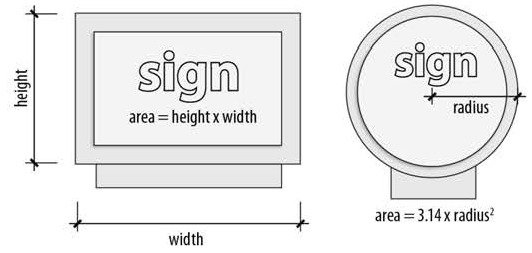
Figure 8-3. Area of Individual Letter Signs
Figure 8-4. Multi-sided Sign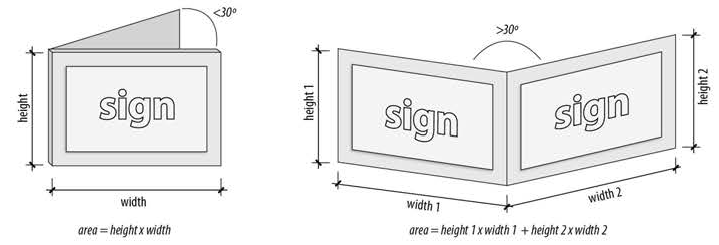
Figure 8-5. Non-planar Signs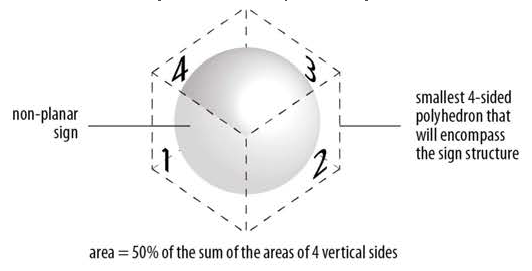
(Ord. No. 4036, § 2(Exh. A), 6-11-18)

