
Villa Park City Zoning Code
ARTICLE 9
- SITE DESIGN AND PERFORMANCE STANDARDS
9.1.1. - Purpose
The landscaping and screening regulations of this section are intended to:
A.
Create and maintain an aesthetically appealing community character that minimizes the negative impacts of vehicular traffic, parking lots, etc., and that incorporates human-scale into the visual perception of the village;
B.
Beautify the public way and mitigate the adverse effects on public streets and adjacent properties of noise, blowing dust and debris, water runoff and glare from motor vehicle headlights and parking area lighting;
C.
Mitigate the impacts of high-intensity uses locating near lower intensity uses; and
D.
Reduce topsoil erosion and stormwater runoff.
9.1.2. - Applicability
A.
The landscaping and screening regulations of this section apply to all new nonresidential (including mixed-use) developments and all multi-family developments (three (3) or more units per lot).
B.
Detached houses and duplexes are exempt from the landscaping and screening regulations of this section.
C.
Existing developments are exempt from the landscaping and screening regulations of this section, provided that a landscape plan showing the required landscape improvements for all areas of the site to be disturbed by proposed construction are required whenever one or more of the following occurs:
1.
When any new principal building is constructed on the site.
2.
When any addition to a principal building is constructed that increases its gross floor area by twenty-five (25) percent or more.
3.
When an existing parking lot or drive-in facility is reconstructed, such that the reconstructed area exceeds twenty-five (25) percent of the initial paved surface area, including access driveways. Resurfacing, sealing or restriping of an existing parking lot or drive-in that does not entail reconstruction of existing asphalt or concrete is not subject to this requirement. If meeting the landscape requirements reduces the number of parking spaces that can be accommodated. The community development director is authorized to reduce the subject use's off-street parking requirements in order to accommodate the required landscaping.
4.
When remodeling, redevelopment or reconstruction is proposed on nonresidential property that would expand existing gross floor area of the lot's structure by less than twenty-five (25) percent, only the portion of the site where the expansion is located is subject to the landscaping and screening regulations of this section.
9.1.3. - General Landscape Standards
A.
General Guide
Required landscaping and screening must be selected, measured, installed, and maintained in accordance with the American Standards for Nursery Stock, ANZI Z60.1, published by the American Nursery and Landscape Association (www.anla.org).
B.
Tree Mix
If more than eight (8) trees are required, no more than forty (40) percent may be of a single species. If more than twenty-five (25) trees are required, no more than twenty-five (25) percent may be of a single species. This requirement applies to trees being planted, but not to existing trees.
C.
Existing Vegetation
1.
Existing vegetation may be used to satisfy the landscaping and screening requirements of this ordinance if protected and maintained during site development and construction phases of work and if such trees or plants are not otherwise prohibited.
2.
Preserved trees will be credited toward satisfying the tree planting requirements of this ordinance if they meet applicable size requirements. Trees up to six (6) inches in diameter at breast height will be credited on a 1:1 basis. In order to encourage the preservation of existing mature trees, existing trees larger than 6 inches in diameter at breast height, up to 12 inches in diameter at breast height will be credited at a ratio of 2:1. Trees that are more than 12 inches in diameter at breast height will be credited at a ratio of 3:1.
D.
Plant Selection
Plants must be healthy, free of insects and diseases and physical damage (e.g., bark bruises, cracked branches). The use of native or naturalized species (to northeastern Illinois) is encouraged. The community development director is authorized to prepare and make available to the public a list of prohibited and preferred trees and plants. Additionally, plant selection should be based on all of the following factors:
1.
Climate hardiness of plant material;
2.
Disease and pest resistance and stress tolerance;
3.
Year-round screening ability, particularly in those areas where plants will be used to provide visual screening for residential uses.
E.
Minimum Plant Size
Unless otherwise expressly stated, plants must comply with the following minimum size requirements at the time of installation:
1.
Canopy trees in a parkway: 1.5-inch caliper.
2.
Canopy trees not in a parkway: 2.5-inch caliper.
3.
Evergreen trees: Eight (8) feet in height.
4.
Ornamental trees, single trunk: Two-inch caliper.
5.
Ornamental trees, multi-trunk: Six (6) feet in height.
6.
Large shrubs: Twenty-four (24) inches in height.
7.
Small shrubs: Eighteen (18) inches in height.
F.
Sod, Topsoil, and Seeding
Parkway landscaping must be installed in topsoil with a minimum depth of 4 inches and include sod or ground cover plants. All seeded area must be Class 1A seeding mixture.
G.
Energy Conservation
1.
Deciduous trees that are sun-tolerant should be placed on the south and west sides of buildings to provide shade.
2.
Evergreens and other shade-tolerant plants should be concentrated on the north side of buildings to dissipate the effect of winter winds.
H.
Installation
1.
When necessary, trees must be staked to ensure they will be straight.
2.
The species identifying labels must remain on the tree until species verification is completed by the village. Other tags wires, plastic ties and wire baskets must be removed from trees.
3.
Wrapping of trees must be done immediately after they are planted.
I.
Mulching
All trees and shrubs must be mulched with a minimum of a three (3) inches of shredded bark, wood chips, or other organic mulch. All perennial, annual, or groundcover beds must be mulched with a minimum of a two (2) inches of shredded bark, wood chips, or other organic mulch.
J.
Nonliving Landscaping Materials
Nonliving landscaping materials (e.g., sand, stone, rock or bark) may be substituted for living cover over up to thirty (30) percent of the landscaped area. Artificial plants and artificial turf may not be used to satisfy landscaping and screening requirements.
K.
Fire Hydrant Clearance
A minimum four-foot clear area around all fire hydrants is required and there must be unobstructed access to the large "steamer" port side of any fire hydrant.
L.
Fire Department Connections
All fire department connections must remain free from obstruction.
M.
Fire Alarm Warning Device
No obstructions to the sight lines of any exterior fire alarm warning device (bells, strobes, etc.) are permitted.
N.
Rejection of Materials
The community development director is authorized to reject plant material that does not comply with the specification, and all rejected plant material shall be immediately removed from the site by the contractor. The village will not assume any responsibility for such rejected material.
9.1.4. - Landscape Plan
A.
Landscape Plan Required
A landscape plan must be submitted and approved for all projects requiring site plan review. No permit for work, including site plan approval, may be issued until a landscape plan has been approved by the community development director.
B.
Content of Landscape Plan
Unless waived by the community development director, all landscape plans must be sealed by a state-registered landscape architect and include the following information:
1.
Title block including the name and street address of the project;
2.
North arrow, scale, date of plan and any subsequent revisions, name and address of owner and site plan designer;
3.
Property lines;
4.
Zoning and use of all abutting properties;
5.
Dimensions of landscaped areas;
6.
The location and dimensions of all existing and proposed buildings, structures, parking lots and driveways, roadways and rights-of-way, loading areas, sidewalks, bicycle paths, ground signs, refuse disposal areas, fences, free-standing electrical equipment, light fixtures, other surface utility structures, and other free-standing structural features as determined by the community development department, tot lots and other recreational facilities, setbacks and easements;
7.
Proposed locations of stormwater inlets, valve vaults, hose bibs, manholes, hydrants, fire department Siamese connections, and other structural features as determined necessary by the community development director;
8.
Existing and proposed contours at one-foot contour intervals;
9.
The location, extent and general elevations of all detention and retention areas and drainageways;
10.
The location, quantity, size, root ball condition (e.g., B/B or potted) and both scientific and common names of all proposed plant materials, the on-center spacing for hedges;
11.
Specification of the type, boundaries, size and spacing of all proposed ground cover, turf and method of installation including grass seed mixes;
12.
Typical planting details for trees, shrubs, ground covers, etc;
13.
The designation, location, type and size of all existing trees with a diameter at breast height of four (4) inches or more, including all trees to be preserved or removed;
14.
Details of all proposed fences and walls;.
15.
Elevations, cross-sections and other construction details required by the community development department; and
16.
Existing and proposed stormwater management ponds and areas.
9.1.5. - Landscape and Screening Requirements
A.
General
All areas of the site that are not paved must be landscaped with trees, shrubs, flowers, ground cover and/or grass to control water runoff, restrict blowing trash and litter, and deter improper or unsafe site access.
B.
Parkway Trees
Parkway trees must be provided in accordance with chapter 21, article III of the village code.
C.
Perimeter Landscaping
Perimeter landscape buffers must be provided in accordance with the following requirements:
1.
Abutting RS or RD Zoning
When nonresidential or multi-family residential development occurs on property abutting any RS or RD district, a landscape buffer with a minimum width of ten (10) feet must be provided within the required setback. Landscaping must be provided within the required buffer as follows:
a.
A solid screen at least six (6) feet in height must be provided along the entire length of the abutting property line. Such screen must consist of a solid wood fence, berm, trees, evergreens, shrubbery, or other live plant materials that provide complete (one hundred (100) percent) visual screening. The placement of the solid screen materials shall be reviewed and determined by the Director of Community Development if this Code section conflicts with any other regulations.
b.
Shade trees must be provided at the rate of at least one tree per fifty (50) feet of frontage along the abutting property line.
c.
Ornamental trees must be provided at the rate of at least one tree per twenty-five (25) feet of frontage along the abutting property line.
d.
Shrubs must be provided at the rate of at least one shrub per twenty (20) feet of frontage along the abutting property line.
2.
Abutting Nonresidential or RM Zoning
When nonresidential or multi-family residential development occurs on property abutting any nonresidential or RM district, landscaping must be provided as follows:
a.
Shade trees must be provided at the rate of at least one tree per fifty (50) feet of frontage along the abutting property line.
b.
Other landscaping materials, including berms, ornamental trees, evergreens, shrubbery, hedges, or other live plant materials must be provided along at least thirty (30) percent of the abutting property line.
3.
Foundation Landscaping
No foundation landscaping is required for buildings built on a lot line; buildings in MX-1, MX-2, and MX-3 districts, or for areas where there is no public access. Otherwise, foundation landscaping is required as follows:
a.
Foundation landscaping must be provided in the form of a continuous five-foot (minimum) landscape area around the full perimeter of the building, excluding pedestrian and vehicle access points. The foundation landscape area may not be reduced by more than fifty (50) percent to accommodate pedestrian and vehicle access points.
b.
Foundation landscape areas must be one hundred (100) percent planted along the front, fifty (50) percent planted along each side and twenty-five (25) percent planted in the rear.
c.
Plantings must include a combination of trees, shrubs, perennials and ground covers that enhance the building's architecture, soften its mass and break up blank walls. Turf grass may not be counted as part of the required foundation planted area. Remaining areas not planted must be vegetated with sod or seed and blanket.
D.
Parking Lot Perimeter Landscaping
The perimeter of all parking lots containing six (6) or more vehicle parking spaces must comply with the parking lot perimeter landscaping regulations of this section.
1.
Street Yards
All open off-street parking areas must be separated from a public right-of-way with a minimum seven-foot wide buffer area, planted as follows:
a.
When a parking lot is located in or abutting a street yard in an RS or RD district, continuous landscaping must be provided across one hundred (100) percent of the parking lot frontage to a minimum height of three (3) feet. Such landscaping must consist of hedges, or other live plant material. At least fifty (50) percent of plantings must be evergreens.
b.
When a parking lot is located in or abutting a street yard in a RM or nonresidential district, continuous landscaping must be provided across sixty (60) percent of the parking lot frontage to a minimum height of three (3) feet. Such landscaping must consist of berms, shade or ornamental trees, evergreens, shrubbery, hedges or other live plant material. At least fifty (50) percent of plantings must be evergreens.
2.
Rear and Side Yards
a.
When a parking lot is located in an interior yard abutting an RS or RD district, a minimum ten-foot landscape buffer must be provided within the required setback. Landscaping must be provided within the buffer as follows:
i.
A solid screen at least six (6) feet in height must be provided along the entire length of the abutting property line. Such screen must consist of a solid wood fence, berms, trees, evergreens, shrubbery, or other live plant materials, necessary to provide complete (one hundred (100) percent) visual screening.
ii.
Shade trees must be provided at the rate of at least one tree per fifty (50) feet of frontage along the abutting property line.
iii.
Ornamental trees must be provided at the rate of at least one tree per twenty-five (25) feet of frontage along the abutting property line.
iv.
Shrubs must be provided at the rate of at least one shrub per twenty (20) feet of frontage along the abutting property line.
b.
Where a parking lot is located in a yard adjacent to an RM or nonresidential district, a minimum five-foot landscape buffer must be provided within the required setback. Landscaping must be provided across at least fifty (50) percent of that portion of the parking lot abutting the property line to a minimum height of three (3) feet. Such landscaping must consist of a combination of berms, shade and ornamental trees, evergreens, shrubbery, hedges, or other live plant materials.
E.
Interior Parking Lot Landscaping
All parking lots containing twenty (20) or more spaces must comply with the interior parking lot landscaping regulations of this section
1.
Parking lots must contain at least one landscape island for every twenty (20) parking spaces.
2.
Landscape islands must be located at the end of every row of parking and include a plantable area with dimensions of at least nine (9) feet by eighteen (18) feet for single rows and at least nine (9) feet by thirty-six (36) feet for double rows.
3.
In addition to landscape islands at the end of parking rows, at east one additional in-row landscape island must be provided for every twenty (20) parking spaces within a parking row.
4.
Landscape islands must contain at least one deciduous shade tree for single-row islands and two (2) deciduous shade trees for double islands.
5.
In addition to required shade trees, all islands must be fully sodded, seeded (with erosion blanket) or planted with low shrubs, perennials or ground cover and maintained at a maximum height of thirty (30) inches.
F.
Loading Areas
All outside loading or storage areas visible from any abutting property or public right-of-way must be permanently screened. Screening must be provided by a minimum six-foot tall solid, commercial-grade wood fence or wall, or a combination berm and dense evergreen tree planting at least eight (8) feet in height at the time of planting.
G.
Alternative Parking Lot Landscaping
As an alternative to traditional parking lot design, lots that use low-impact design (green infrastructure) techniques to slow water runoff, increase infiltration and improve water quality are permitted and encouraged. These parking lots must be properly designed, graded and planted utilizing "best management practices" outlined in the DuPage County Stormwater and Floodplain Ordinance. Vegetation must be established using a combination of seeding and plugs.
H.
Refuse Enclosures and Other Accessory Uses/Structures
1.
Refuse Disposal and Recycling Areas
a.
No refuse or recycling containers may be located between any principal structure and its street lot line. All refuse disposal, recycling and grease storage containers must be screened on three (3) sides by a masonry or concrete wall constructed with materials that are similar to the principal building to a height of at least six (6) feet and with a solid, single or double access gate on one side only and situated so that, to the greatest extent possible, it does not face an abutting property or public right-of-way. The enclosure must be used solely for the confinement of refuse, recycling and grease containers and may not be used for the outside storage of any other materials or equipment. No material is permitted to accumulate so that it is visible above the height of the enclosure.
b.
The community development director is authorized to permit refuse or recycling containers screening to be constructed of a minimum six-foot tall solid wood fence combined with landscape screening that will grow to a height of at least four (4) feet in cases where the director determines that the screening required by paragraph "a" would be impossible or impractical due to site-specific constraints.
2.
Utility Equipment and Ground-Level Mechanical Equipment
All equipment visible from any abutting lot or public right-of-way must be permanently screened by dense deciduous or evergreen plantings that are at least the height of the equipment being screened. Plant material must be carefully arranged to provide maintenance and meter access while maintaining the required opacity.
3.
Rooftop Mechanical Equipment
Except for antennas mounted on roofs pursuant to the provisions of this ordinance, all mechanical equipment located on the roof must be completely (one hundred (100) percent) screened by a parapet wall or other screening structure constructed of the same materials as, or materials architecturally and aesthetically compatible with, the principal building facade to at least the height of such equipment.
I.
Outdoor Storage Screening Requirements
Where outdoor storage is permitted, the following regulations apply:
1.
Outside storage may not exceed six (6) feet in height.
2.
Outdoor storage must be screened by a solid, commercial-grade fence or wall with a height of at least six (6) feet. The outdoor storage area must be located so that, to the greatest extent possible, it is not visible from abutting property or public right-of-way.
3.
Outdoor storage is not permitted in street yards and must be at least ten (10) feet from the nearest property line, except abutting a residential district in which case it must be at least thirty (30) feet from the nearest property line.
9.1.6. - Completion Guarantee
All required landscaping and screening materials shown on the approved landscape plan must be installed before the issuance of an occupancy permit. In periods of weather conditions adverse to planting the landscaping materials, a temporary occupancy permit may be issued prior to installation of landscaping and screening if a cash security of at least fifty (50) percent of the value of the landscaping is provided to the village, which must be returned upon completion and final inspection and approval of the required landscaping and screening improvements.
9.1.7. - Maintenance
A.
Responsibility
The owner of the premises, and any lessee, are jointly and severally responsible for maintaining, repairing and replacing all landscape materials and other improvements shown on the approved landscape plan over the entire life of the development. Any plant materials such as shrubs, trees and ground covers that die, are in decline, or supporting less than fifty (50) percent healthy leaf growth must be replaced in compliance with the approved landscape plan. The same maintenance requirements apply to those properties without an approved landscape plan on file.
B.
Watering Plant Material
A permanent means to water plant material, such as hose bibs or an underground irrigation system, must be provided.
C.
Screening
All screening, including fences, walls and landscaping must be protected from damage by motor vehicles, pedestrians, snow, or salt that could reduce the effectiveness of the screening.
9.1.8. - Plant List:
The community development director is authorized to establish a permitted, preferred and prohibited plant list.
(Ord. No. 4036, § 2(Exh. A), 6-11-18)
9.2.1. - General
A.
Applicability
The fence regulations of this section apply to all fences unless otherwise expressly stated.
B.
Exemptions
Mesh fences enclosing school sites, park and recreation uses, or utility and public service uses are exempt from the fence regulations of this section. Mesh fences in M zoning districts are exempt from section 9.2.2, Allowed Fence Heights and Locations, but shall not exceed eight (8) feet in height.
C.
Permits Required
A fence permit is required from the Community Development Department before the construction or erection of any fence or required screening.
D.
Installation
The finished side of all fences (i.e., the side of the fence without posts or visual structural support elements) must face outward, toward the abutting lot or right-of-way.
E.
Fences in Easements
Fences may be constructed in utility easements and easements granted to the Village if the property owner acknowledges in a form approved by the Village Attorney that the Village and its agents have the right to remove the fence at any time in order to repair, maintain or inspect the easement. The Village is authorized to remove fences in easements without notifying the property owner, but the village must attempt to provide advance notice to the property owner if practical. The property owner is solely responsible for all expenses for repair, replacement, or damage to the fence within the easement as a result of either the fence removal or the repair, maintenance or inspection of improvements. The village has no liability whatsoever in connection with fences placed in easements. No fence permit may be issued if construction of the proposed fence will create an obstruction to the natural flow of water within any drainage easement.
F.
Barbed Wire
No fence may contain any barbed wire or be designed, constructed, or installed to cause injury to any person, except in M zoning districts or as approved through the special use process in all other districts. Barbed wire may be installed in M zoning districts, provided that the lowest portion is at least eight (8) feet above grade. The barbed wire regulations of this paragraph do not apply to village-owned property.
9.2.2. - Allowed Fence Heights and Locations
Maximum allowed fence heights depend on the type of fence and its location, as indicated in Table 9-1.
Table 9-1: Allowed Fence Heights and Locations
[1] Fence posts and ornamental post caps may extend above the maximum fence height by up to 6 inches.
[2] Fences up to 6 feet in height area allowed in yards abutting IL Route 83, between E Park Boulevard and E Madison Street.
(Ord. No. 4036, § 2(Exh. A), 6-11-18; Ord. No. 4308, § 2, 11-14-22; Ord. No. 4343, §§ 4—6, 5-22-23)
9.3.1. - Intersections
On corner lots in all zoning districts, except C-1, C-2, MX-1, MX-2, MX-3, MX-T, MX-R1, and MX-R2, nothing may be erected, placed, planted, or allowed to grow between a height of three (3) feet and ten (10) feet above grade within the required intersection visibility triangle, which is formed by two (2) lines that begin at the point of intersection of the subject lot's street lots lines and extend for a distance of twenty (20) feet along each street lot line and a third connecting line that forms the triangle (see Figure 9-5). In the C-1, C-2, MX-1, MX-2, and MX-3, MX-T, MX-R1, and MX-R2 districts, the determination of whether a visibility triangle is required shall be reviewed by the Village Engineer and determined by the Director of Community Development.
Figure 9-5. Intersection Visibility Triangle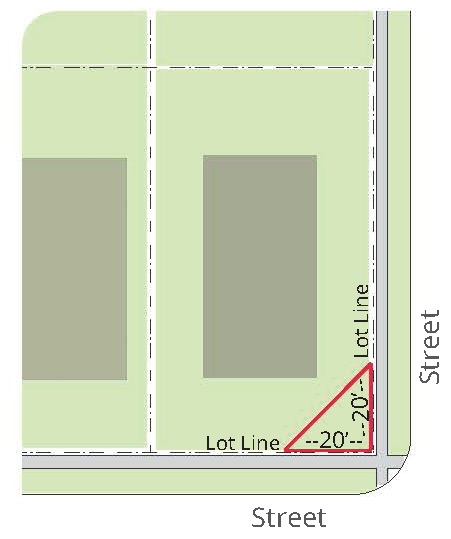
9.3.2. - Driveways
Solid fences and other visual obstructions exceeding three (3) feet in height are prohibited within driveway visibility triangles. Driveway visibility triangles are required along both sides of driveways. The triangles are formed as follows:
A.
One side of the triangle extends from the intersection of the property line and the driveway edge for a distance of ten (10) feet along the lot line away from the driveway.
B.
The second side of the triangle extends from the intersection of the property line and the driveway edge for a distance of ten (10) feet inward from the lot line along the driveway edge.
C.
The third side of the triangle connects the other two (2) sides (see Figure 9-6).
Figure 9-6. Driveway Visibility Triangle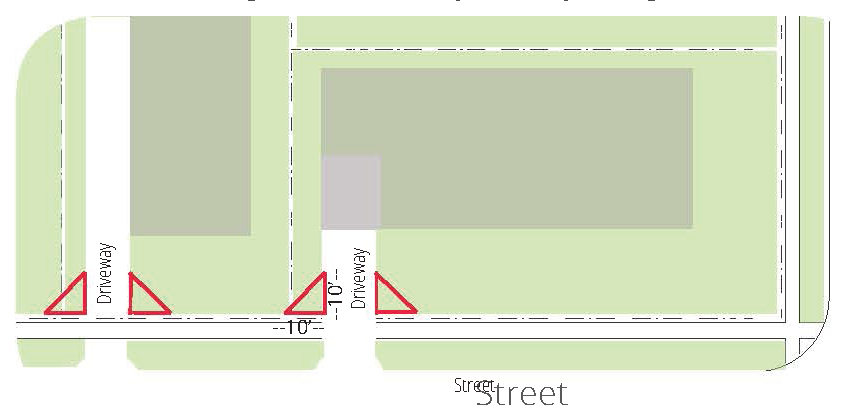
(Ord. No. 4036, § 2(Exh. A), 6-11-18; Ord. No. 4308, § 3, 11-14-22; Ord. No. 4343, §§ 7—9, 5-22-23)
9.4.1. - Applicability
Except as otherwise expressly stated, the outdoor lighting regulations of this section apply to all new installations and all replacements of existing outdoor lighting in the village.
9.4.2. - Exceptions
A.
Because of their unique requirement for nighttime visibility and their limited hours of operation, municipal facilities, ball diamonds, playing fields, tennis courts, and other outdoor recreational facilities are exempt from the outdoor lighting regulations of this section. Lighting for outdoor recreational facilities must be shielded to minimize light and glare from spilling onto adjacent residential properties.
B.
Traditional holiday lighting is exempt from outdoor lighting regulations of this section, provided the lighting is reasonable, limited to a power rating of no more than 75 watts and does not constitute a public safety hazard or nuisance.
C.
Transportation facilities are exempt from the outdoor lighting regulations of this section.
D.
When site characteristics are unique and the outdoor lighting regulations of this section cannot be met, the community development director is authorized to approve alternative lighting designs if the illumination levels and/or uniformity ratios are within 20% of the values set forth in this section.
E.
A higher intensity of illumination in a safety or security problem area as defined by the chief of police may be authorized by the community development director.
F.
Lighting installed and maintained within a public right-of-way, lighting used in conjunction with public safety operations, or hazard or warning lights required by a governmental agency are exempt from the outdoor lighting regulations of this section.
G.
Sign illumination is exempt from the outdoor lighting regulations of this section.
9.4.3. - General Regulations
A.
The style of the light and light standard must be consistent with the architectural style of the principal building.
B.
Security lighting must be placed at building entranceways and building access areas.
C.
All building lighting for security or aesthetics must include glare controls and be shielded.
D.
Floodlighting is discouraged, and if used, must be shielded to prevent glare for drivers or pedestrians, light trespass beyond the property line, and light above a 90 degree horizontal plane.
E.
Wallpack type fixtures are prohibited.
F.
All parking area lighting must include glare controls and be shielded.
G.
Light poles must be located where they do not create hazards for pedestrians or vehicles.
H.
The illuminated face of all fixtures must be parallel to the ground. Tilted fixtures are prohibited.
I.
The maximum height of a luminaire may not exceed twenty-five (25) feet, as measured from the ground directly below the centerline of the luminaire to the top of the pole or luminaire, whichever is higher.
9.4.4. - Glare
No exterior lighting may be maintained on a lot so as to shine into, or upon, any other lot or any rightof-way with an intensity great enough to reduce a viewer's ability to see, or to cause momentary blindness or to create a nuisance on adjacent property. Sources of light (the bulb) must be directed, shaded, shielded, or otherwise located to minimize perceived glare on adjacent properties and streets.
Table 9-2: Maximum Illumination
9.4.5. - Prohibited
The following are expressly prohibited:
A.
Exterior lighting used in a manner that could interfere with the safe movement of motor vehicles on public streets and alleys.
B.
Any light that could be confused with, or construed as, a traffic control device, unless authorized by state, federal, city or county government.
C.
High-pressure sodium lamps are prohibited.
D.
Blinking, flashing, moving, revolving, fluttering, flickering, oscillating, scintillating, changing light intensity, brightness and changing color lights shall be prohibited, except for temporary holiday displays, lighting for public safety or traffic control, or lighting required by the FAA or other governmental agency for air traffic control and warning purposes.
9.4.6. - Parking Lot Standards
Not withstanding the other outdoor lighting regulations of this section, all uses required by this zoning ordinance to provide six (6) or more parking spaces or one or more loading spaces, must provide lighting facilities to illuminate all parking spaces, aisles and loading spaces in accordance with the following requirements:
A.
Parking lot lighting must be provided to a minimum intensity of 2.0 footcandles during all times that the parking lot is open for general use.
B.
The horizontal illumination at the property line adjacent to or across from detached or attached single-family residential zoned properties may not exceed 0.2 footcandles.
9.4.7. - Measuring Light Levels
Footcandle horizontal measurements must be taken at a height of 3.5 feet above ground. Light level measurement must be made at the property line of the property upon which the light to be measured is being generated. If measurement on private property is not possible or impractical, light level measurements may be made at the boundary of the public street right-of-way that adjoins the property of the complainant or at any other location on the property of the complainant. Measurements must be made after dark with the light sources in question on, then with the same light sources off. The difference between the two (2) readings must then be compared to the maximum permitted illumination. This procedure eliminates the effects of moonlight and other ambient light. Light levels are specified, calculated and measured in footcandles (fc). All fc values are maintained footcandles unless specified otherwise.
9.4.8. - Exterior Lighting Plans
A lighting plan must be prepared any time exterior lighting is proposed, or modified, that is associated with a multi-family residential use or with any commercial, office, industrial or other nonresidential use. The lighting plan must be submitted with the site plan or independently if a site plan is not required. All lighting plans are subject to approval by the community development director. The lighting plan must include:
A.
A site plan indicating location of light fixtures by style on the site.
B.
Identification of all proposed light fixtures, including those used for site lighting, canopy lighting and exterior building lighting.
C.
Cut sheet of each proposed light style. All styles (ground, sign, wall, pole, recessed can, bollard) of lights proposed on the building and site must be identified. Catalog cut sheets for the proposed light poles, fixtures and any exterior control equipment.
D.
The type of refractor, louver, or side shield to cut off direct light to adjacent properties. On all nonresidential and multifamily uses, the shield must cover the top and sides to completely block passage of light and must extend downward vertically below the lowest point of the illumination source.
E.
Lamp type. Incandescent, quartz-halogen, fluorescent, low-pressure sodium, mercury vapor, metal halide, or approved equal.
F.
Lamp wattage.
G.
Pole height.
H.
Photometric plan prepared by a professional lighting consultant. The photometric plan must show a grid of individual illumination values and accurately indicate the level of illumination at all property lines and five (5) feet beyond the property line, based on all proposed light fixtures.
I.
A summary table containing average footcandles, minimum footcandles, maximum footcandles, uniformity ratio (average/minimum), footcandles at the property line, pole height, and light loss factor (LLF).
J.
The lighting plan must also contain a certification by the property owner and the preparer of the plan that the exterior lighting depicted on the plan complies with the outdoor lighting regulations of this section.
K.
Once the plan is approved, the exterior lighting of the property must conform to the plan. If the outdoor lighting as installed does not comply with this section, the owner must make those revisions necessary to bring the lighting plan into conformance.
L.
Identification of all proposed control equipment, conduit and wiring, including material, size and location.
M.
Construction details of the pole, pole foundation, electrical trench with warning tape and pole wiring.
(Ord. No. 4036, § 2(Exh. A), 6-11-18)
9.5.1. - Applicability
All buildings, structures and uses are subject to the performance standards of this section.
9.5.2. - Noise
A.
Any use established in an M district must be operated to comply with the noise standards of this section.
B.
Existing uses may not be altered or modified in a way that would conflict with, or be in greater conflict with, the noise standards of this section.
C.
All sounds of an intermittent nature must be controlled so as not to become a nuisance to adjacent use.
D.
Sound levels must be measured with a sound-level meter and associated octave band filter, manufactured in compliance with standards prescribed by the American National Standards Institute (ANSI).
E.
At no point on the boundary of an R, O, C or MX district may the sound intensity level of any individual operation or plant (other than the operation of motor vehicles or other transportation facilities) exceed the decibel levels in the designated octave bands shown in Table 9-3.
Table 9-3: Maximum Permitted Sound Levels
9.5.3. - Smoke and Emissions
A.
Any use established must be operated to comply with smoke and emission standards of this section.
B.
Existing uses may not be altered or modified in a way that would conflict with, or be in greater conflict with, the smoke and emission standards of this section.
C.
In addition to smoke and emission standards of this section, the emission of smoke or particulate matter in such manner or quantity as to endanger or to be detrimental to the public health, safety, comfort or welfare is hereby declared to be a public nuisance and unlawful.
D.
For the purpose of grading the density of smoke, the Ringelmann Chart published and used by the United States Bureau of Mines must be employed. The emission of smoke or particulate matter of a density greater than No. 1 on the Ringelmann Chart is prohibited at all times except as otherwise expressly stated.
E.
The emission, from all sources within any lot area, of particulate matter containing more than ten (10) percent by weight of particles having a particle diameter larger than forty-four (44) microns is prohibited.
F.
Dust and other types of air pollution, borne by the wind from such sources as storage areas, yards, roads and the like within lot boundaries must be kept to a minimum by appropriate landscaping, paving, oiling, fencing or acceptable means. Emission of particulate matter from such sources in excess of the weight limitations specified in this section is prohibited.
G.
The emission of more than ten (10) smoke units per hour per stack is prohibited, including smoke of a density in excess of Ringelmann No. 1. However, during a single one-hour period in each 24-hour day, each stack may emit up to twenty (20) smoke units when blowing soot or cleaning fires. Only during fire-cleaning periods, however, is smoke of Ringelmann No. 3 permitted, and then for not more than four (4) minutes.
H.
The rate of emission of particulate matter from all sources within the boundaries of any lot may not exceed a net figure of one pound per acre of lot area during any one hour, after deducting from the gross hourly emission per acre the correction factors set forth in Table 9-4, Table 9-5 and Table 9-6. Determination of the total net rate of emission of particulate matter within the boundaries of any lot must be made as follows:
1.
Determine the maximum emission in pounds per hour from each source of emission and divide this figure by the number of acres of lot area-thereby obtaining the gross hourly rate of emission in pounds per acre.
2.
From each gross hourly rate of emission, deduct the appropriate correction factor for height, velocity and temperature, as forth in Table 9-4, Table 9-5 and Table 9-6, thereby obtaining the net rate of emission in pounds per acre per hour from each source of emission.
3.
Add together the individual net rates of emission, to obtain the total net rate of emission from all sources of emission within the boundaries of the lot. Such total may not exceed one pound per acre of lot area during any one (1) hour.
Table 9-4: Height of Emissions
Table 9-5: Velocity of Emissions
Table 9-6: Temperature of Emissions
9.5.4. - Vibrations
No operation or activity may cause at any time ground transmitted vibrations in excess of the limits established in this section and may not in any event create earth-shaking vibrations beyond the property line of a magnitude such as to be a nuisance or hazard to any person or other property. Vibration (the periodic displacement, measured in inches, of earth) must be measured at any point along a R, O, C or MX district boundary line with a three-component measuring instrument and must be expressed as displacement in inches, and may not exceed the maximumvibration limits established in Table 9-7.
Table 9-7: Maximum Vibration
9.5.5. - Glare and Heat
All operations or illumination producing intense glare or heat must be performed within a completely enclosed building and in a manner that does not create a public nuisance or hazard at any location beyond lot lines of the subject property.
9.5.6. - Stormwater
Adequate provisions must be made for the disposal of stormwater consistent with Section 18-104 Changing Lot Elevation and Grades; Obstructing Drainage, and Appendix D of the Village of Villa Park Municipal Ordinance.
(Ord. No. 4036, § 2(Exh. A), 6-11-18)

