
Villa Park City Zoning Code
ARTICLE 4
- MX DISTRICTS2
Editor's note— Ord. No. 4326, § 2(Exh. A), adopted Jan. 23, 2023, repealed the former Art. 4, §§ 4.1—4.8, and enacted a new Art. 4 as set out herein. The former Art. 4 pertained to similar subject matter and derived from Ord. No. 4036, § 2(Exh. A), adopted June 11, 2018.
4.1.1. - The Districts
The mixed-use zoning districts are listed in Table 4-1. Whenever this zoning ordinance refers to "mixed-use" zoning districts or "MX" districts, it is referring to these districts.
Table 4-1: Mixed-Use Zoning Districts
4.1.2. - Purposes
A.
General
Mixed-use zoning districts are primarily intended to create, maintain and promote a variety of vertically and horizontally mixed-use places, and to maintain and promote the desired physical character of existing and developing mixed-use places. The various MX districts are differentiated on the basis of allowed building types and a mix of allowable uses in each building.
1.
To guide the development of a mix of uses to further the future of the train station area, commercial corridors, and main street nodes in the village.
2.
To support the desired character of the village, as expressed in adopted plans, policies and regulations.
3.
To promote multiple modes of transportation, including biking, walking, and transit use, with compact development of an appropriate scale.
4.
To provide a mix of housing types within and within walking distance of mixed-use nodes and corridors.
5.
To achieve development that is appropriate in scale and intensity for the neighborhoods and sites proximate to the train station area, commercial corridors, and main street nodes in the village.
B.
MX-1
The MX-1 district is intended to accommodate low-scale mixed-use buildings in the train station area. The building form establishes an essentially continuous street wall of storefront facades along the sidewalk of primary streets, and focuses pedestrian-friendly retail and service uses on the ground story along primary streets with residential and/or office uses elsewhere. Parking is intended to be internal to the building or located in the rear of the lot, screened from the primary street with the building.
C.
MX-2
The MX-2 district is intended to accommodate lower-scaled mixed-use buildings in the neighborhood mixed-use nodes. The building form establishes an essentially continuous street wall of storefront facades along the sidewalk of primary streets, and focuses pedestrian-friendly retail, office and service uses on the ground story along primary streets with residential and/or office uses elsewhere. Parking is intended to be internal to the building or located in the rear of the lot, screened from the primary street with the building.
D.
MX-3
The MX-3 district is intended to accommodate low- to mid-scaled mixed-use buildings along commercial corridors. The building form defines a street wall of storefront facades along the sidewalk of the primary corridor, while allowing for limited interior side yard parking between the buildings to account for no on-street parking along the corridor. Uses focus a wider variety of commercial uses on the ground story along primary streets with residential and/or office uses elsewhere. Parking may also be internal to the building or located in the rear of the lot.
E.
MX-T
The MX-T district is intended to accommodate low- to mid-scaled office and/or residential buildings transitioning between mixed-use shopping nodes and residential uses. The building form defines compact buildings with entrances, windows, and interior uses facing the primary corridor. Parking is intended to be internal to the building; located in the rear of the lot, screened from the primary street with the building; or located in the side yard, limited in width and orientation.
F.
MX-R1 and MX-R2
The MX-R districts are primarily residential within a mix of building types. MX-R1 is mid-scale and intended for use in the station areas. MX-R2 is lower in scale and intended as a transition to existing single-family neighborhoods. The allowable building types, including apartment buildings and townhouses, define compact buildings with entrances, windows, and interior uses facing the primary corridor and small landscape yards in front. Parking is intended to be internal to the building or located in the rear of the lot, screened from the primary street with the building.
4.1.3. - Uses
Principal uses are allowed in the MX districts in accordance with the use regulations of section 6.1. Individual building types may be subject to additional use regulations.
(Ord. No. 4326, § 2(Exh. A), 1-23-23)
4.2.1. - Primary Streets
A.
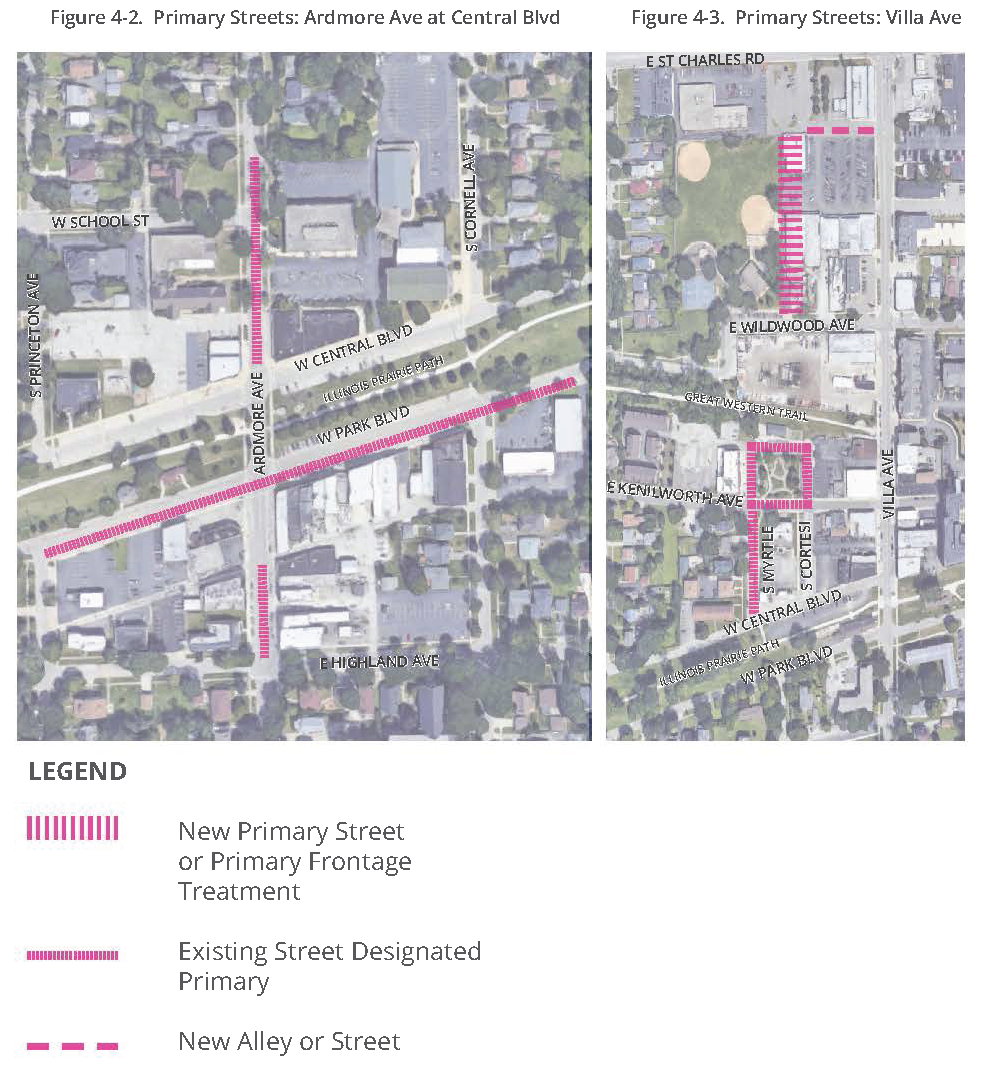
The designation of primary streets determines the front lot line and prioritizes those street frontages for the location of building streetwalls and storefronts. Parking and driveway locations are also limited along primary street frontages.
B.
For the purposes of the MX districts, Villa Avenue, St Charles Avenue, and Ardmore Avenue, are considered primary streets, unless otherwise designated on the maps in Figure 4-2 and Figure 4-3.
C.
When two (2) primary streets abut a parcel, the Community Development Director is authorized to determine which street will be the primary street.
D.
Lot frontages that abut civic spaces or public open spaces must be treated as primary frontages.
E.
At all intersections of primary and non-primary streets, primary frontage facade treatments must extend along the non-primary street for a distance of at least thirty (30) feet.
4.2.2. - Street Extensions
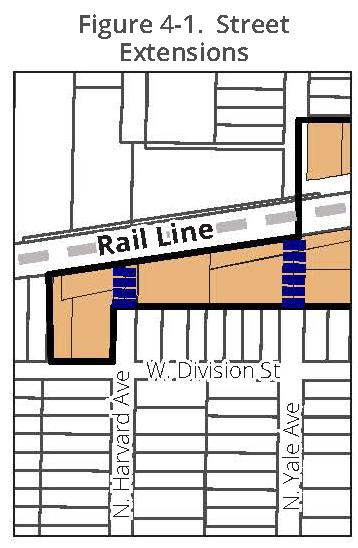
The parcels located at the northern ends of North Harvard Avenue and North Yale Avenue, south of the tracks and north of West Division Street, will require street extensions for maximum applicability of the requirements of these regulations. Refer to Figure 4-1 for these locations.
A.
Street frontages are required for all building types. To maximize street frontage in these locations, extension of the existing streets is required per Figure 4-1.
B.
Hammerhead turnarounds can be accommodated at the ends of each street by utilizing parking lot entrances.
C.
On-street parking can be accommodated along the street, in either a parallel or head-in configuration.
D.
Streets must match the existing configurations, including curb, sidewalk, and parkway locations.
(Ord. No. 4326, § 2(Exh. A), 1-23-23)
4.3.1. - General
Many of the MX district regulations are based on building types. All principal buildings must comply with one of the building types allowed in the subject zoning district.
4.3.2. - Descriptions
1.
Storefront Building
a.
A storefront building is a mixed-use building located at the front and corner property lines allowing easy access to passing pedestrians. Parking may be provided in the rear of the lot, internally in the building, or, in some cases, one (1) double-loaded aisle of parking is permitted in the interior side yard at the front property line.
b.
Ground floor uses are limited to those with some level of pedestrian activity, such as retail, service, and office uses, with additional commercial, office, and/or residential uses in the upper stories. Storefronts with large amounts of transparency and regularly spaced entrances off the street are utilized on the ground floor front facade.
2.
General Building
A general building is limited in terms of uses by the district within which it is located, generally housing office and/or residential uses. Similar to Storefront buildings, general buildings are intended to be built close to the front and corner property lines allowing easy access to passing pedestrians and transit riders. Parking may be provided in the rear of the lot, internally in the building, or, in some cases, one (1) double-loaded aisle of parking is permitted in the interior or the side yard at the front property line.
3.
Row Building
a.
A row building is a building comprised of multiple vertical units, each with its own entrance to the street. This building type may be organized as townhouses or rowhouses, and may also be live-work units with a publicly accessed ground story.
b.
Parking is required to be located in the rear yard and may be incorporated either into a detached garage or in an attached garaged accessed from the rear of the building. However, when the garage is located within the building, a minimum level of occupied space is required on the front facade to ensure that the street facade is active.
4.
Civic Building
A civic building is a more flexible building type intended only for civic and institutional types of uses. These buildings are distinctive within the community fabric created by the other building types. In contrast to most of the other building types, a minimum setback line is required instead of a build to zone. Parking is limited to the rear in most cases.
4.3.3. - Where Allowed
Building types are permitted in the MX districts in accordance with Table 4-2.
Table 4-2: Allowed Building Types (MX districts)
4.3.4. - General Regulations
All building types must comply with general regulations of this section.
A.
Multiple Principal Buildings on One Lot
Multiple principal buildings are permitted on all lots in MX districts; however, each building must comply with the applicable building type regulations.
B.
Corner Lots
The intersections of two build-to zones at a street corner must be occupied by building.
C.
Refuse, Recycling, Utility, and Loading Location
Refuse, recycling, and loading areas are allowed only in rear yards. Utility appurtenances (such as transformers and air conditioner units) may be located only in rear yards or (interior) side yards, and must be completely screened from view from the street.
D.
Open Areas on Lot
1.
All front yards, build-to zones, side yards, corner side yards, and rear yards not covered by buildings, parking, or driveway shall contain either landscape, patio space, or sidewalk space.
2.
Parking areas and driveway locations are permitted in specific locations by building type. Parking is prohibited in street yards, unless otherwise expressly stated.
3.
Parking and driveways are prohibited in build-to zones and setbacks except that when driveway access is permitted from streets, driveways may cross perpendicularly through the build to zone or setback. Two-way driveways may not exceed twenty-four (24) feet in width. One-way driveways may not exceed fourteen (14) feet in width.
(Ord. No. 4326, § 2(Exh. A), 1-23-23)
Sec. 4.4. - Building Type Regulations
Regulations applicable to each building type allowed in MX districts are presented on the following pages:
4.4.2. - Storefront Building
| Permitted Districts | |||||
|---|---|---|---|---|---|
| MX-1 | MX-2 | MX-3 | References and Additional Requirements | ||
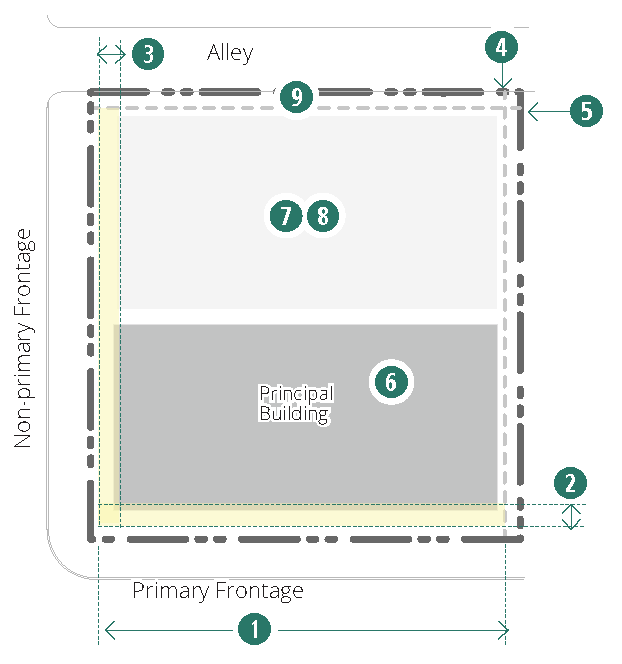
| A. Building Siting (Refer to Figure 4-4) | |||||
 | Minimum Primary Frontage Build-to Zone Coverage | 95% | 95% | 50% | Refer to 4.5.1 |
 | Front Build-to Zone | 0' to 5' | 0' to 5' | 6' to 10' | Minimum 13 ft. streetscape area is required along street frontages; refer to 4.5.2 |
 | Corner Build-to Zone | 0' to 5' | 0' to 10' | 0' to 10' | |
 | Minimum Side Yard Setback | 0'; 5' if adjacent to other building type | |||
 | Minimum Rear Yard Setback | 5'; 40' if abutting RS or RD district | 5'; 15' if abutting RS or RD district | 5'; 40' if abutting RS or RD district | See 9.1.5 for required landscape screening |
 | Maximum Impervious Cover Additional Semi-Pervious Cover |
75%
25% |
75%
25% |
75%
25% | |
 | Surface Parking or Accessory Parking Structure | Rear yard only | Rear yard only | Rear and limited side yard only | Limited side yard means one double-loaded aisle of parking perpendicular to the street |
 | Permitted Driveway Access Locations | Alley;. If no alley exists, 1 driveway permitted off each non-primary street; if no alley and non-primary street abut the parcel, 1 driveway permitted off a primary street with an administrative adjustment (see Sec. 11.6) | Shared driveways and parking is encouraged | ||
 | Permitted Garage Entrance Location | Rear facade;. Side facade garage access requires an administrative adjustment | Rear, side, or corner side facade | ||
| B. Height (Refer to Figure 4-5) | |||||
 | Overall: Minimum Height Maximum Height |
2 stories
8 stories |
1 stories
4 stories |
1 stories
4 stories | Up to 2 additional stories permitted with special use approval (see Sec. 11.4); see 4.5.3 for measuring |
Figure 4-4. Storefront Building: Siting
| Permitted Districts | |||||
|---|---|---|---|---|---|
| MX-1 | MX-2 | MX-3 | References and Additional Requirements | ||
 | Ground Story: Minimum Height Maximum Height |
14'
24' |
14'
18' |
14'
24' | Measured floor to floor; more than 18' in height counts as 2 stories; see 4.5.4 for measuring |
 | Upper Stories: Minimum Height Maximum Height |
9'
14' |
8.5'
12' |
9'
14' | |
| C. Uses (Refer to Figure 4-5) | |||||
 | Primary Frontage Ground Story | All permitted non-residential uses. | Refer to Article 6 | ||
 | Non-Primary Frontage, Upper Stories, Basement | Any permitted use. | Refer to Article 6 | ||
 | Parking within Building | Permitted fully in any basement and in rear of upper floors | |||
 | Required Occupied Building Space | Minimum 20' deep on all full height floors from any primary street facade; not required in basement | Refer to Sec. 14.2 for definition of occupied building space | ||
| D. Facade and Roof Requirements (Refer to Figure 4-6) | |||||
 | Primary Frontage Minimum Ground Story Transparency | 75% | 70% | 65% | Measured between 2' and 9' above adjacent walk grade; see 4.5.5 |
 | Minimum Transparency Street, Courtyard, Open Space Facade | 20% | 15% | 15% | Measured per story of all stories; see 4.5.5 |
 | Blank Wall Limitations | Required per floor on all street facades | Refer to 4.5.5 | ||
 | Entrance Location and Number | Principal entrance required on primary frontage facade; entrances required a minimum of one per every 60' of building facade | Refer to 4.7.7 for principal entryway | ||
 | Entryway Configuration and Elevation | Recessed between 3' and 8', maximum 8' wide; entrances shall be within 1.5' vertically of adjacent walk elevation. | Refer to 4.7.8 for storefront design | ||
 | Ground Story Vertical Facade Divisions | One 2" deep expression line per every 30' of facade width | |||
 | Horizontal Facade Divisions | Within 3' of the top of the ground story and the bottom of the any 5th floor | |||
 | Permitted Roof Types | Parapet, pitched, flat; tower permitted | Refer to Section 4.6 for roof types | ||
Figure 4-5. Storefront Building: Height and Use Requirements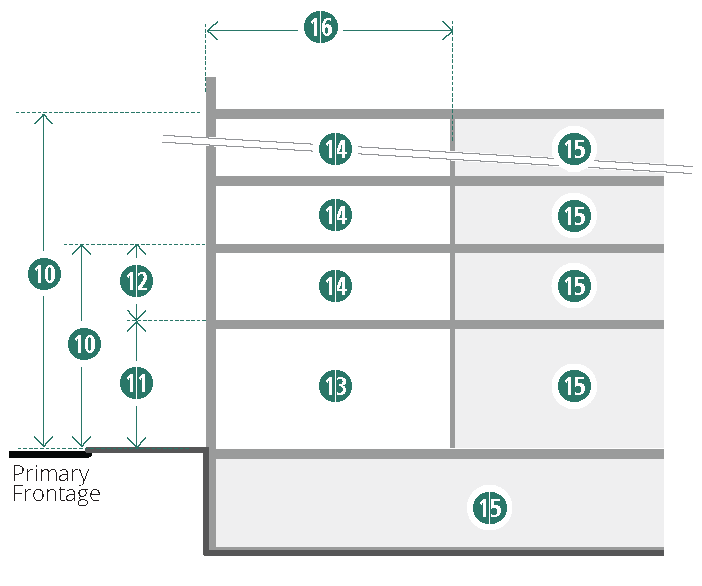
Figure 4-6. Storefront Building: Facade Design Requirements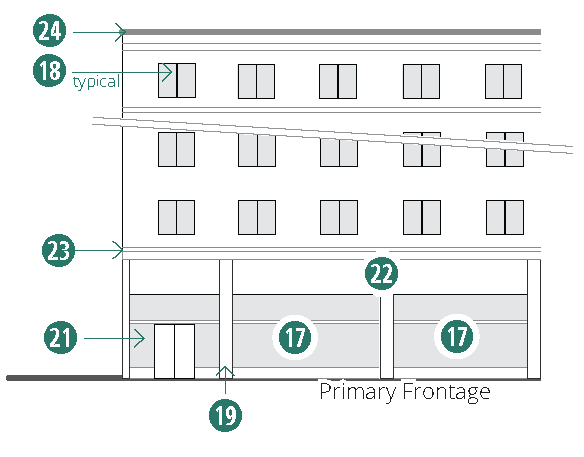
4.4.3. - General Building
| Permitted Districts | |||||
|---|---|---|---|---|---|
| MX-T | MX-R1 | MX-R2 | References and Additional Requirements | ||
| A. Building Siting (Refer to Figure 4-7) | |||||
| Minimum Primary Frontage Build-to Zone Coverage | 75% | 75% | 60% | Refer to 4.5.1 |
| Front Build-to Zone | 5' to 10' | 5' to 10' | 10' to 20' | Minimum 13 ft. streetscape area is required along street frontages; refer to 4.5.2 |
| Corner Build-to Zone | 0' to 10' | 0' to 10' | 5' to 15' | |
| Minimum Side Yard Setback | 5' | 10' | 15' | |
| Minimum Rear Yard Setback | 5'; 40' if abutting RS or RD district | See 9.1.5 for required landscape screening | ||
| Maximum Building Width | None | None | 120' | |
| Maximum Impervious Cover Additional Semi-Pervious Cover |
70%
25% |
70%
20% |
65%
20% | |
| Surface Parking or Accessory Parking Structure | Rear and limited side yard only | Rear yard only | Rear yard only | Limited side yard means one double-loaded aisle of parking perpendicular to the street |
| Permitted Driveway Access Locations | Alley. If no alley exists, 1 driveway permitted off each non-primary street; if no alley and non-primary street abut the parcel, 1 driveway permitted off a primary street with an administrative adjustment (see Sec. 11.6) | Shared driveways and parking is encouraged | ||
| Permitted Garage Entrance Location | Rear facade. Side facade garage access requires an administrative adjustment | Rear, side, or corner side facade | ||
| B. Height (Refer to Figure 4-8) | |||||
| Overall: Minimum Height Maximum Height | 2 stories 5 stories | 2 stories 6 stories | 2 stories 4 stories | Up to 2 additional stories permitted with special use approval (see Sec. 11.4); see 4.5.3 for measuring |
| Stepped Back Upper Stories | Stories above the third shall be stepped back a minimum of 12 feet from the front facade | |||
| All Stories: Minimum Height Maximum Height |
9'
14' |
8.5'
12' |
9'
14' | Measured floor to floor; see 4.5.4 for measuring |
Figure 4-7. General Building: Siting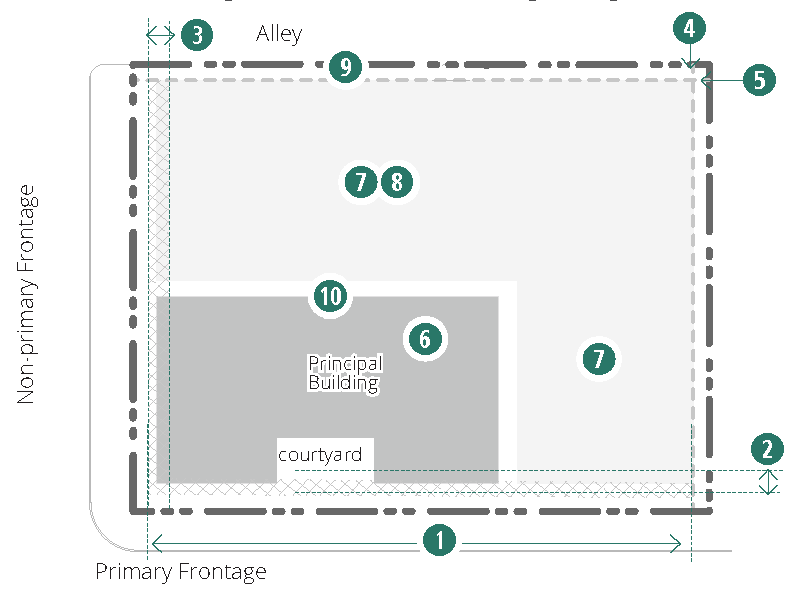
| Permitted Districts | References and Additional Requirements | ||||
|---|---|---|---|---|---|
| MX-T | MX-R1 | MX-R2 | |||
| C. Uses (Refer to Figure 4-8) | |||||
| Ground Story & Basement | All permitted uses except that ground floor residential shall require a Special Use. Residential Accessory Uses will be permitted on the ground floor by right if all residential is above. | All Uses permitted in the district. | Refer to Article 6 | |
| Upper Stories | Any permitted use except commercial service, eating and drinking establishments, and retail sales | Refer to Article 6 | ||
| Parking within Building | Permitted fully in any basement and in rear of ground and upper stories | |||
| Required Occupied Building Space | Minimum 20' deep on all full height floors from any primary street facade; not required in basement | Refer to Sec. 14.2 for definition of occupied building space | ||
| D. Facade and Roof Requirements (Refer to Figure 4-9) | |||||
| Minimum Transparency Street, Courtyard, Open Space Facade | 15% | 15% | 15% | Measured per story of all stories; see 4.5.5 |
| Blank Wall Limitations | Required per floor on all street facades | Refer to 4.5.5 | ||
| Entrance Location and Number | Principal entrance required on primary frontage facade; entrances required a minimum of one per every 90' of building facade | Refer to 4.7.7 for principal entryway | ||
| Entryway Configuration and Elevation | Entry doors shall be off a stoop, minimum 6' wide and 3' deep; entrances shall be within 30" of adjacent street sidewalk average elevation OR between 30" and 5' with visible basement (transparency required) | Refer to 4.7.8 for storefront design | ||
| Ground Story Vertical Facade Divisions | One 2" deep expression line per every 60' of facade width | |||
| Horizontal Facade Divisions | Within 3' of the top of the ground story, any visible basement, and the bottom of the any 5th floor | |||
| Permitted Roof Types | Parapet, pitched, flat; tower permitted | Parapet, pitched, flat; tower permitted | Parapet, pitched; tower permitted | Refer to Sec. 4.6 for roof types |
Figure 4-8. General Building: Height and Use Requirements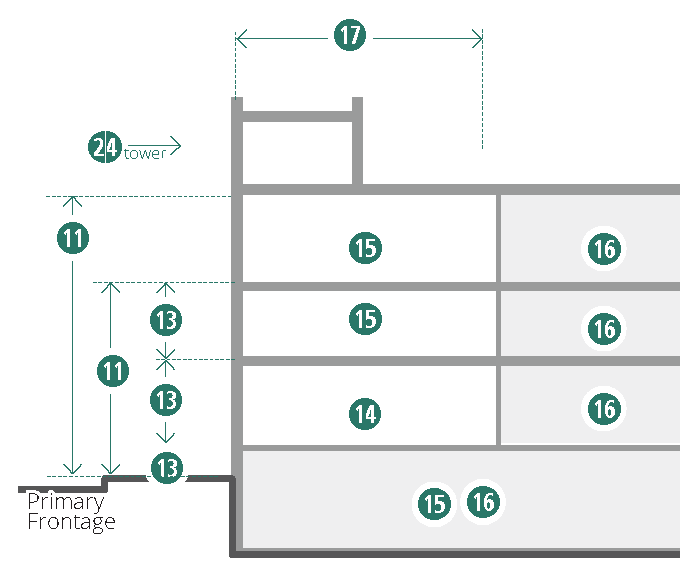
Figure 4-9. General Building: Facade Design Requirements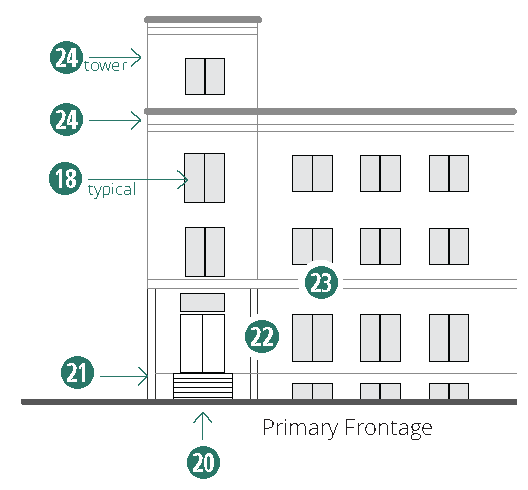
4.4.4. - Row Building
| Permitted Districts | |||||
|---|---|---|---|---|---|
| MX-T | MX-R1 | MX-R2 | References and Additional Requirements | ||
| A. Building Siting (Refer to Figure 4-10) | |||||
| Minimum Primary Frontage Build-to Zone Coverage | 75% | 65% | 65% | Refer to 4.5.1 |
| Front Build-to Zone | 5' to 10' | 5' to 15' | 10' to 20' | Minimum 13 ft. streetscape area is required along street frontages; refer to 4.5.2 |
| Corner Build-to Zone | 0' to 10' | 5' to 10' | 5' to 15' | |
| Units outside Build-to Zone | Each unit shall have a facade located within the primary build-to zone, except 1 of every 3 units may front a courtyard, existing open space/park, or non-primary street with its principal entrance. | |||
| Minimum Side Yard Setback | 0' per unit; 10' between buildings | 0' per unit; 15' between buildings | ||
| Minimum Rear Yard Setback | 5'; 25' if no alley exists | 5'; 20' if no alley exists | 5'; 35' if no alley exists | See 9.1.5 for required landscape screening |
| Maximum Building Width | None | 8 units per building and 180' | 6 units per building and 140' | |
| Maximum Impervious Cover Additional Semi-Pervious Cover |
65%
25% |
65%
20% |
60%
20% | |
| Surface Parking or Accessory Garage | Rear yard only | Rear yard only | Rear yard only | |
| Permitted Driveway Access Locations | Alley; if no alley exists, 1 driveway permitted per building off each non-primary street; if no alley and non-primary street abut the parcel, 1 driveway permitted off a primary street with an administrative adjustment (see Sec. 11.6) | Shared driveways and parking is encouraged | ||
| Permitted Attached Garage Entrance Location | Rear facade only; side facade garage access requires an administrative adjustment | |||
Figure 4-10. Row Building: Siting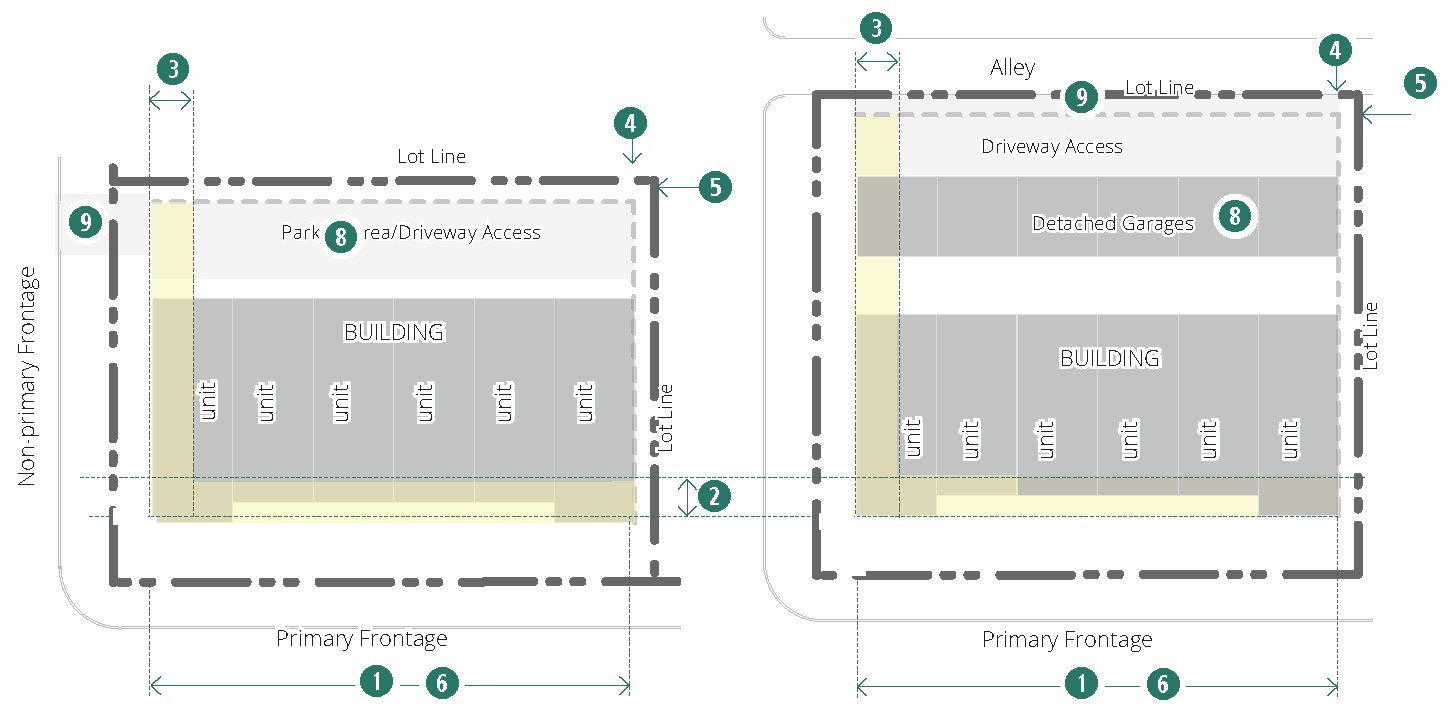
| Permitted Districts | |||||
|---|---|---|---|---|---|
| MX-T | MX-R1 | MX-R2 | References and Additional Requirements | ||
| B. Height (Refer to Figure 4-11) | |||||
| Overall: Minimum Height Maximum Height |
2 stories
3.5 stories |
2 stories
3.5 stories |
2 stories
3 stories | See 4.5.3 for measuring |
| All Stories: Minimum Height Maximum Height |
8.5'
12' |
9'
14' |
9'
14' | Measured floor to floor; see 4.5.4 for measuring |
| C. Uses (Refer to Figure 4-11) | |||||
| Primary Frontage Ground Story | All permitted uses except eating and drinking establishments | All permitted uses | In MX-T, commercial service and retail sales are permitted when located in live-work units at street corners; refer to Article 6 | |
| Non-Primary Frontage, Upper Stories, Basement | Any permitted use except commercial service, eating and drinking establishments, and retail sales | All permitted uses | Refer to Article 6 | |
| Parking within Building | Permitted fully in any basement and in rear of ground and upper stories | |||
| Required Occupied Building Space | Minimum 20' deep on all full height floors from any primary street facade; not required in basement | Refer to Sec. 14.2 for definition of occupied building space | ||
| D. Facade and Roof Requirements (Refer to Figure 4-12) | |||||
| Minimum Transparency Street, Courtyard, Open Space Facade | 15% | 15% | 12% | Measured per story of all stories; see 4.5.5 |
| Blank Wall Limitations | Required per floor on all street facades | Refer to 4.5.5 | ||
| Entrance Location and Number | One entrance required per unit on the primary frontage facade, courtyard, or open space per (4) above; minimum of one principal entrance required per 30' of primary street facade | Refer to 4.7.7 for principal entryway | ||
| Entryway Configuration | Entry doors shall be off a stoop, minimum 4' wide and 3' deep, OR a porch, minimum 8' wide and 5' deep No more than 2 entry doors may be located off each stoop or porch | Refer to 4.7.8 for storefront design | ||
| Entryway Elevation | 80% of entrances and the ground story shall be within 30" of adjacent street sidewalk average elevation OR between 30" and 5' with a visible basement (transparency required) | |||
| Permitted Roof Types | Parapet, pitched, flat; tower permitted | Parapet, pitched, flat; tower permitted | Parapet, pitched; tower permitted | Refer to Sec. 4.6 for roof types |
Figure 4-11. Row Building: Height and Use Requirements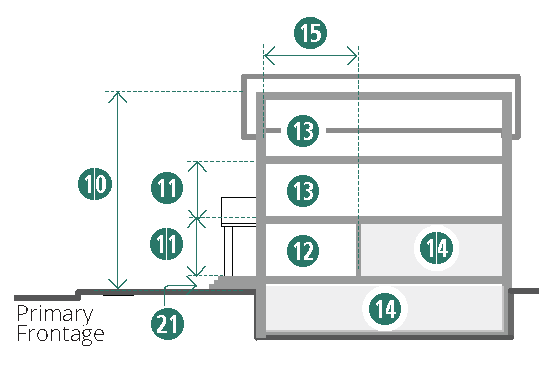
Figure 4-12. Row Building: Facade Design Requirements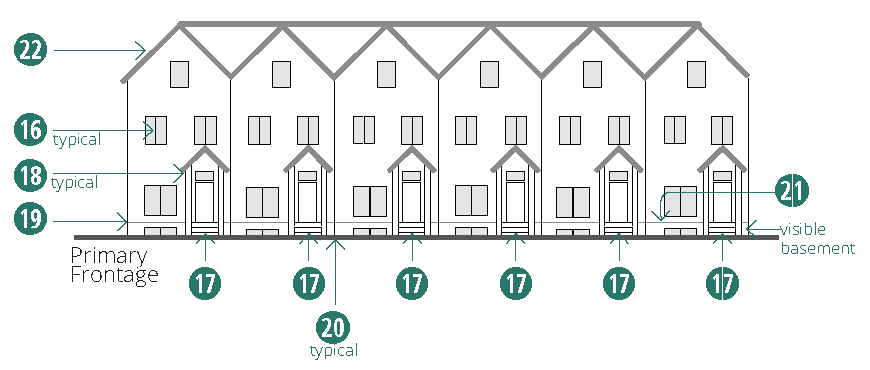
4.4.5. - Civic Building
| Permitted Districts | References and Additional Requirements | |||
|---|---|---|---|---|
| MX-1 MX-2 MX-3 | MX-T MX-R1 | |||
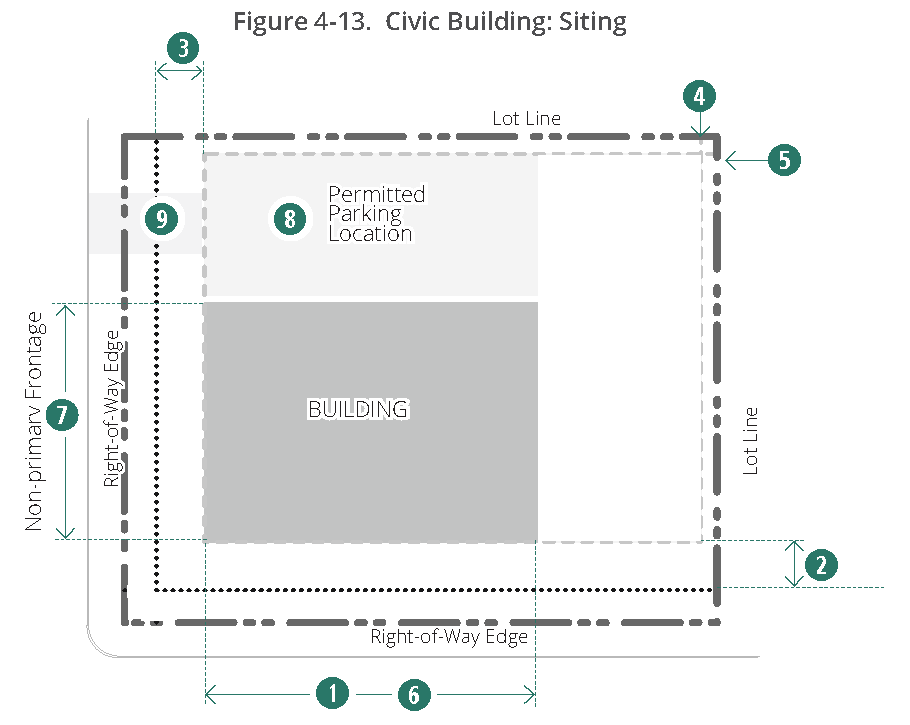
| A. Building Siting (Refer to Figure 4-13) | ||||
| Minimum Primary Frontage Build-to Zone Coverage | None | None | |
| Front Setback | 5' | 10' | Minimum 13 ft. streetscape area is required along street frontages |
| Corner Setback | 5' | 5' | |
| Minimum Side Yard Setback | 5' | 5' | |
| Minimum Rear Yard Setback | 5'; 30' if abutting RS or RD district | See 9.1.5 for required landscape screening | |
| Minimum Lot Width | 50' | ||
| Maximum Impervious Cover Additional Semi-Pervious Cover |
70%
20% |
70%
10% | |
| Surface Parking or Accessory Parking Structure | Rear yard and limited side yard only | Limited side yard means one double-loaded aisle of parking perpendicular to the street | |
| Permitted Driveway Access Locations | Alley; if no alley exists, 1 driveway permitted off each non-primary street; if no alley and non-primary street abut the parcel, 1 driveway permitted off a primary street with an administrative adjustment (see Sec. 11.6) | Shared driveways and parking is encouraged | |
| Permitted Garage Entrance Location | Rear facade; side facade garage access requires an administrative adjustment | ||
| Permitted Districts | References and Additional Requirements | |||
|---|---|---|---|---|
| MX-1 MX-1 MX-3 | MX-T MX-R1 | |||
| B. Height (Refer to Figure 4-14) | ||||
| Overall: Minimum Height Maximum Height |
2 story
8 stories in MX-1; 4 stories in MX-2 and MX-3 |
1 story
6 stories | Up to 2 additional stories permitted with special use approval (see Sec. 11.4); see 4.5.3 for measuring |
| Ground Story: Minimum Height Maximum Height |
9'
20' |
9'
16' | Measured floor to floor; more than 18' in height counts as 2 stories; see 4.5.4 for measuring |
| All Stories: Minimum Height Maximum Height |
9'
14' |
9'
14' | |
| C. Uses (Refer to Figure 4-14) | ||||
| All Frontages and Stories | Only public, civic and institutional uses permitted in district | Refer to Article 5 | |
| Parking within Building | Permitted fully in any basement and in rear of ground and upper stories | ||
| Required Occupied Building Space | Minimum 20' deep on all full height floors from any primary street facade; not required in basement | ||
| D. Facade and Roof Requirements (Refer to Figure 4-15) | ||||
| Minimum Transparency Street, Courtyard, Open Space Facade | 12% | 12% | Measured per story of all stories; see 4.5.5 |
| Blank Wall Limitations | none | Refer to 4.5.5 | |
| Entrance Location and Number | Principal entrance required on primary frontage facade; entrances required a minimum of one per every 150' of building facade | Refer to 4.7.7 for principal entryway | |
| Entryway Configuration and Elevation | Entry doors shall be off a stoop, minimum 6' wide and 3' deep; entrances shall be within 30" of adjacent street sidewalk average elevation OR between 30" and 5' with visible basement (transparency required) | Refer to 4.7.8 for storefront design | |
| Permitted Roof Types | Parapet, pitched, flat; tower permitted | Parapet, pitched, flat; tower permitted | Other roof types permitted by administrative adjustment; refer to Sec. 4.6 for roof types |
Figure 4-14. Civic Building: Height and Use Requirements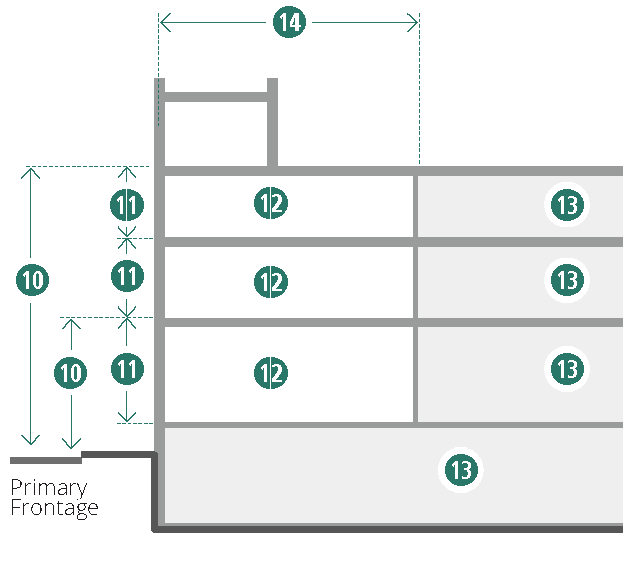
Figure 4-15. Civic Building: Facade Design Requirements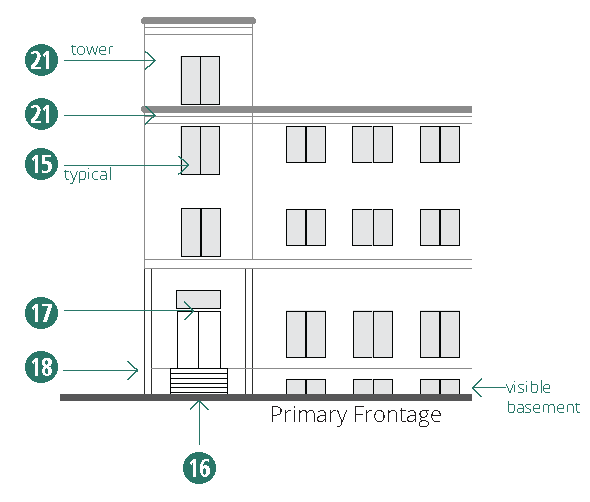
(Ord. No. 4326, § 2(Exh. A), 1-23-23)
Sec. 4.5. - Building Types—Measurements
The following explains and further defines the standards outlined on the tables on the previous pages.
4.5.1. - Minimum primary frontage lot line coverage.
The minimum percentage of building facade along the primary frontage of a lot is designated on each building type table.
A.
Measurement
The width of the principal structures (as measured within the build-to zone along the frontage edge) is divided by the length of the frontage parallel to the property line following the street. Refer to Figure 4-16.
B.
Courtyards
Where noted by building type, courtyards, located along the facade in the build-to zone count towards the minimum coverage.
C.
Civic Space Type
Open spaces per civic space type requirements are exempt from minimum primary frontage lot line coverage.
Figure 4-16. Minimum Primary Frontage Lot Line Coverage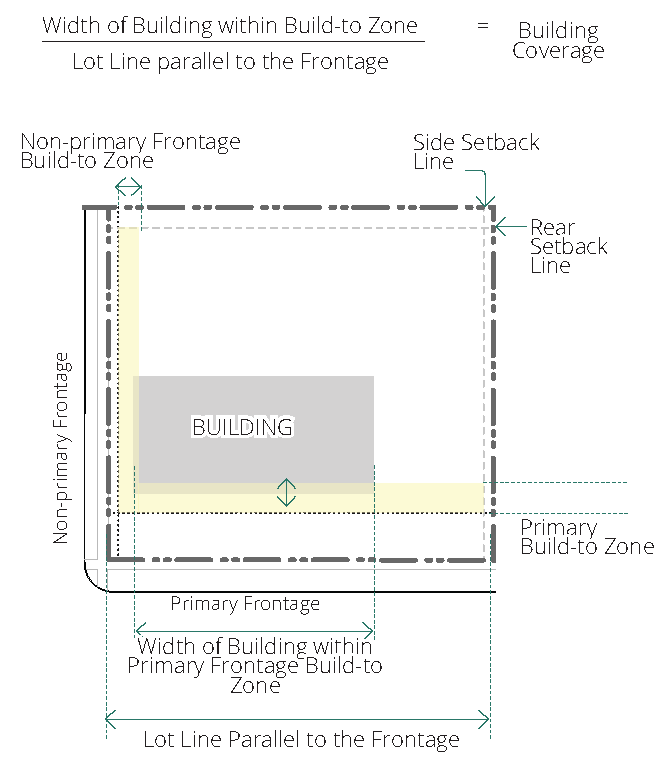
4.5.2. - Build-to Zone
The build-to zone is designated separately for each frontage on each building type table. Refer to Figure 4-17.
A.
Measurement
The build-to zone for all frontages is measured from the property line parallel to the frontage, unless otherwise noted.
B.
Minimum Streetscape Area
When a minimum streetscape area is required, the build-to zone is measured from the edge of the required streetscape onto the site. Minimum streetscape area is measured from back of curb to property line and is intended to accommodate clear sidewalk area and either a landscape/street tree area (parkway) or a furnishings zone at storefront locations. Furnishings zone includes the sidewalk extended to the curb with tree wells or planters for street trees.
C.
Encroachments
Awnings, balconies, and building mounted signage may extend up to three (3) feet beyond the build-to zone into any yard area, but may not extend into the street right-of-way.
Figure 4-17. Build-to Zones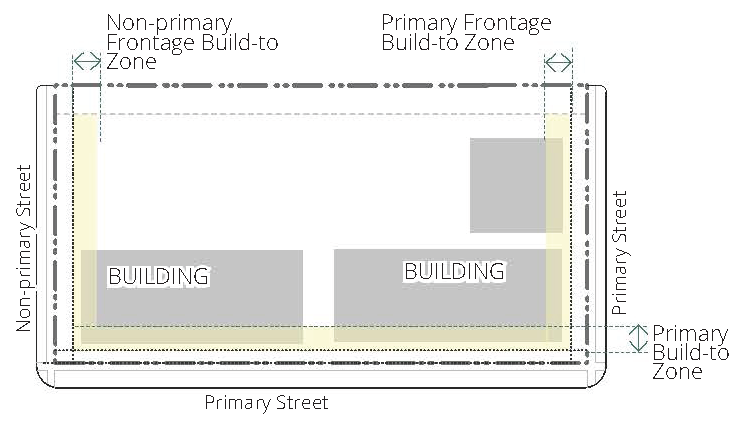
4.5.3. - Heights in Stories
Refer to Figure 4-18.
A.
Minimum Overall Height
Minimum heights require a minimum number of stories on the primary frontage facades of the building. The building must meet the minimum required height for the first thirty (30) feet of occupied building space measured from the primary frontage facade into the building.
B.
Maximum Overall Height
Maximum heights are specified both in number of stories and overall dimension. This requirement applies to the entire building.
1.
Towers. Where noted, towers may exceed the overall maximum height per subsection 4.6.5.
2.
Cap Type. Where noted, certain cap types may allow additional height.
C.
Two Half Stories
A building incorporating both a half story within the roof and a visible basement shall count the height of the two (2) half stories as one (1) full story.
Figure 4-18. Measuring Stories with Floor-to-Floor Height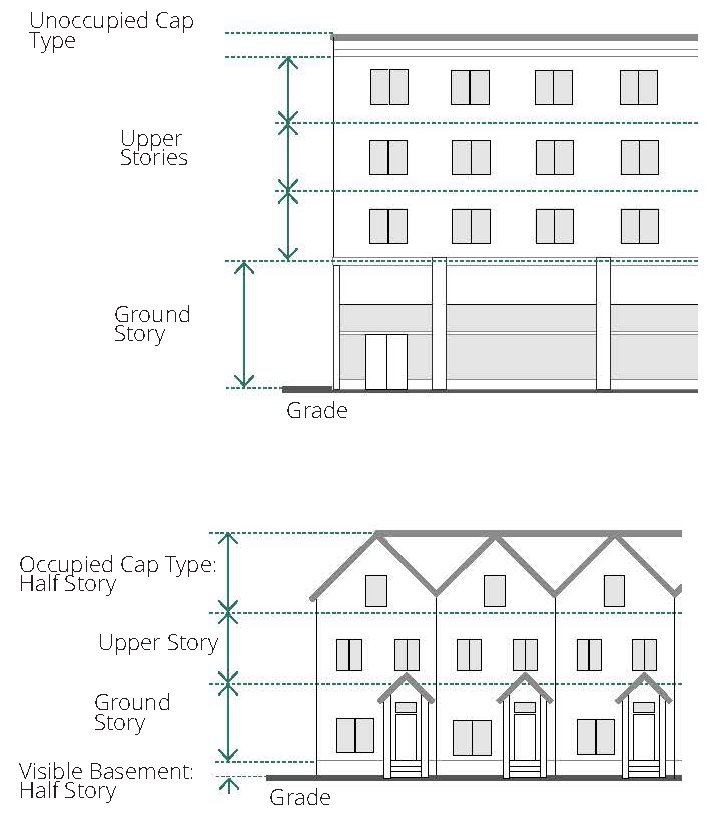
4.5.4. - Minimum and Maximum Height Per Story
Each story is measured with a range of permitted floor-to-floor heights. Refer to Figure 4-18.
A.
Measurement
Floor height is measured in feet between the floor of a story to the floor of the story above it. Minimum and maximum floor-to-floor heights are required to be met on floors along facades, a minimum of eighty (80) percent of each story.
B.
Single Story Buildings and Top Floor Measurement
For single story buildings and the uppermost story of a multiple story building, floor-to-floor height shall be one (1) foot less than noted per building type and measured from the floor of the story to the ceiling.
C.
Mezzanines
Mezzanines may be included within the floor-to-floor height of any story, included in the calculation of stories. Mezzanines occupying more than thirty (30) percent of the floor area below and extending above the story's allowable floor-to-floor height shall count as an additional story, including articulation of the story.
D.
Taller Spaces
Spaces exceeding the allowable floor-to-floor heights of the building are not permitted on primary frontage facades. These spaces are unlimited on interior lots and non-primary frontage facades, but shall be counted as the number of stories that would fit within their height.
4.5.5. - Minimum Required Transparency
Per the requirements of each building type, a minimum amount of transparency is required on all stories of all facades.
A.
Measurement
Minimum facade transparency is measured from floor-to-floor of each story separately. Refer to Figure 4-19. Transparency includes windows and any glass in doors that is highly transparent with low reflectance. The measurement may include the frame, mullions, and muntins, but shall not include trim or casing.
B.
Blank Wall Segments
No more than a fifteen-foot wide section, measured horizontally, and no more than thirty (30) percent of any story shall be without transparency.
1.
Exception. When a facade of any story is located within three (3) feet of a parallel building facade, no minimum transparency is required for that story.
C.
Minimum Ground Story Transparency
When required by the building type, ground story transparency shall be measured between two (2) feet and either eight (8) or ten (10) feet, as noted, from the average grade at the base of the facade. Minimum ground story transparency supersedes the overall minimum transparency required for the building type.
D.
Tall Stories
Stories that are eighteen (18) feet or taller in height shall be counted as two (2) stories for the purpose of calculating minimum facade transparency, with each horizontal half of the story calculated separately.
E.
Half Stories
All half stories located within roof structure and visible basements are required to meet the minimum transparency.
Figure 4-19. Measuring Minimum Facade Transparency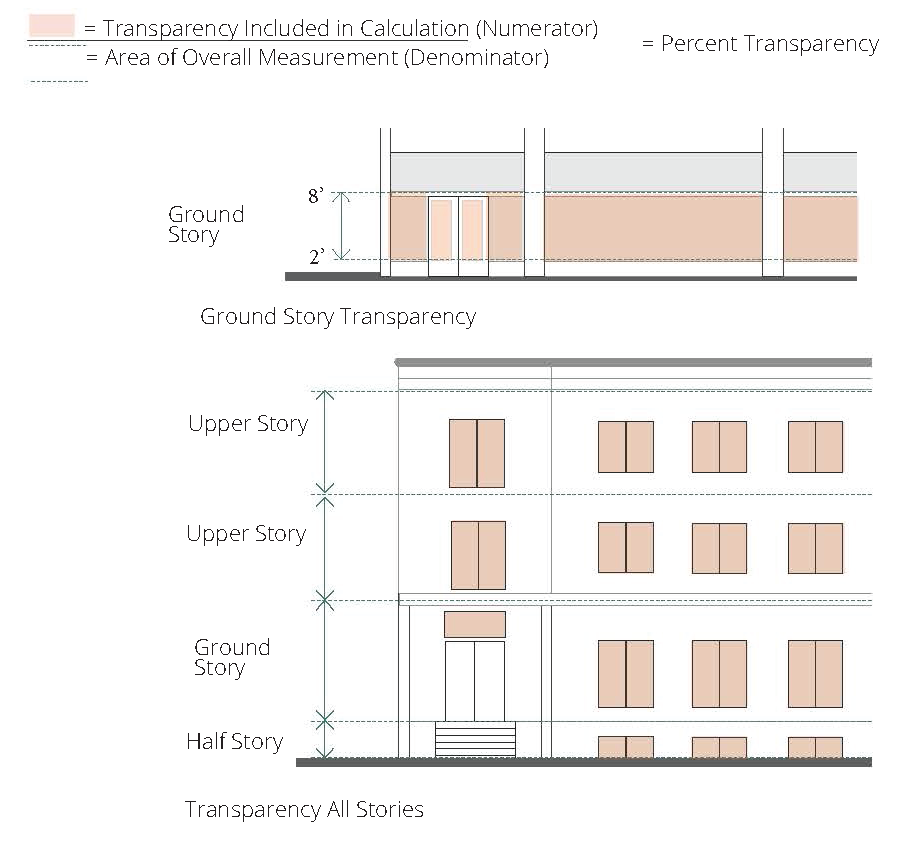
(Ord. No. 4326, § 2(Exh. A), 1-23-23)
Sec. 4.6. - Roof Types
Roof type standards apply to all building types. Refer to each building type table for permitted roof types.
4.6.1. - General
The following provisions apply to all roof types.
A.
One (1) Type Required. All buildings shall meet the requirements of at least one (1) of the roof types permitted for the building type.
B.
Measuring Height. Refer to 4.5.4 for information on measuring building height.
C.
Other Roof Types. Other building caps not listed as a specific type may be requested with the following requirements:
1.
The roof type shall not create additional occupiable space beyond that permitted by the building type.
2.
The shape of the roof type shall be significantly different from those defined in this section 4.6, Roof Types, i.e. a dome, spire, vault.
3.
The building shall warrant a separate status within the community from the fabric of surrounding buildings, with a correspondence between the form of the roof type and the meaning of the building use.
4.6.2. - Parapet Roof
A parapet is a low wall projecting above a building's roof along the perimeter of the building. It can be utilized with a flat or low pitched roof and also serves to limit the view of roof-top mechanical systems from the street (refer to Figure 4-20).
A.
Height is measured from the top of the upper story to the top of the parapet.
B.
Minimum height is two (2) feet with a maximum height of six (6) feet.
C.
The parapet shall be high enough to screen the roof and any roof appurtenances from view of the street(s).
a.
Horizontal Expression Lines. An expression line shall define the parapet from the upper stories of the building and shall also define the top of the cap.
b.
Occupied Space. Occupied space shall not be incorporated behind this roof type.
Figure 4-20. Parapet Roof Type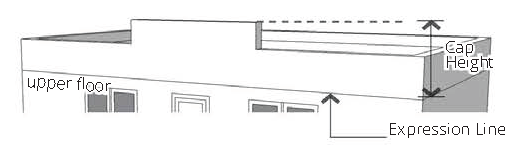
4.6.3. - Pitched Roof
Pitched roofs are sloped. Slope is measured as the vertical rise divided by the horizontal run (refer to Figure 4-21).
A.
The roof may not be sloped less than a 4:12 (rise:run) or more than 16:12, except that slopes of less than 4:12 are permitted on second story or higher roofs. Refer to Figure 4-21.
B.
Configurations.
1.
Hipped, gabled, and combination of hips and gables with or without dormers are permitted.
2.
Butterfly roofs (inverted gable roof) are permitted with a maximum height of eight (8) feet, inclusive of overhang.
3.
Gambrel and mansard roofs are not permitted.
C.
Parallel Ridge Line. A gabled end or perpendicular ridge line shall occur at least every one hundred (100) feet of roof when the ridge line runs parallel to the front lot line. (Refer to Figure 4-22).
D.
Roof Height. Roofs without occupied space and/or dormers shall have a maximum height on street-facing facades equal to the maximum floor height permitted for the building type.
E.
Occupied Space. Occupied space may be incorporated behind this roof type.
Figure 4-21. Pitched Roof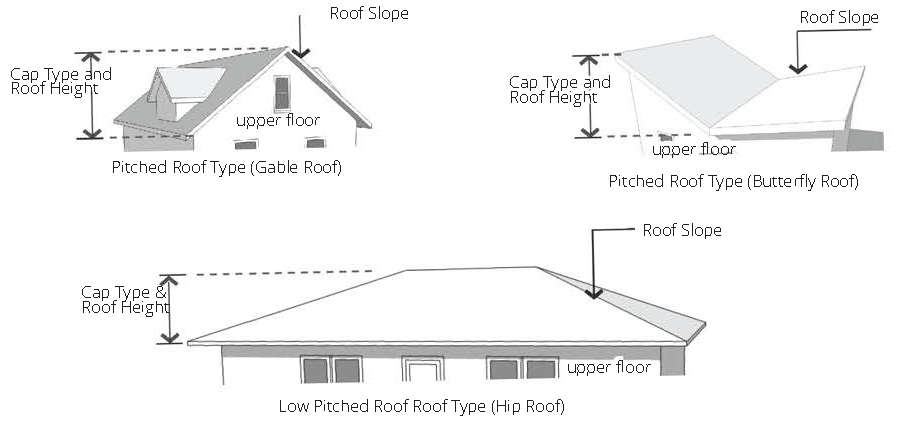
Figure 4-22. Parallel Ridge Line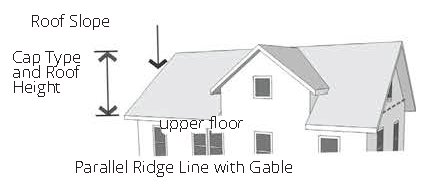
4.6.4. - Flat Roof
This flat roof is flat with overhanging eaves (refer to Figure 4-23).
A.
Configuration. Roofs with no visible slope are acceptable. Eaves are recommended on all street facing facades.
B.
Eave Depth. Eave depth is measured from the building facade to the outside edge of the eave. Eaves shall have a depth of at least fourteen (14) inches.
C.
Eave Thickness. Eave thickness is measured at the outside edge of the eave, from the bottom of the eave to the top of the eave. Eaves shall be a minimum of eight (8) inches thick.
D.
Interrupting Vertical Walls. Vertical walls may interrupt the eave and extend above the top of the eave with no discernible cap.
1.
No more than one-half (½) of the front facade can consist of an interrupting vertical wall.
2.
Vertical walls shall extend no more than four (4) feet above the top of the eave.
E.
Occupied Space. Occupied space shall not be incorporated behind this roof type.
Figure 4-23. Flat Roof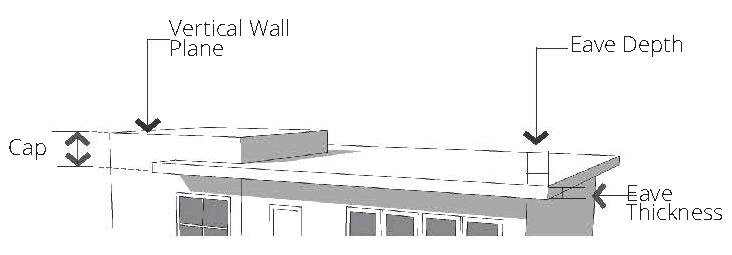
4.6.5. - Towers
A tower is a rectilinear or cylindrical, vertical element, that shall be used with other roof types (refer to Figure 4-24)
A.
Quantity. All building types, with the exception of the civic building, are limited to one (1) tower per building.
B.
Tower Height. Maximum height, measured from the top of the parapet or eave to the top of the tower, is the equivalent of the height of one (1) upper floor of the building to which the tower is applied.
C.
Tower Width. Maximum width along all facades is one-third (⅓) the width of the front facade or thirty (30) feet, whichever is less.
D.
Horizontal Expression Lines. An expression line shall define the tower from the upper stories.
E.
Occupied Space. Towers may be occupied by the same uses allowed in upper stories of the building type to which it is applied.
F.
Application. May be combined with all other roof types.
G.
Tower Cap. The tower may be capped by the parapet, pitched, low pitched, or flat-roof roof types, or the spire may cap the tower.
Figure 4-24. Tower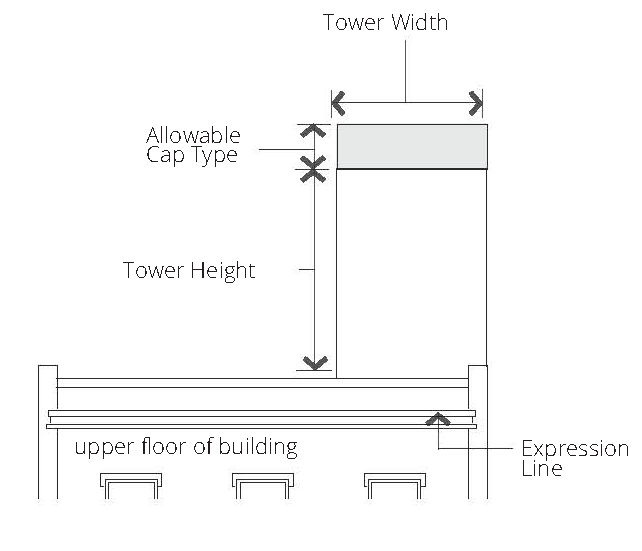
(Ord. No. 4326, § 2(Exh. A), 1-23-23)
Sec. 4.7. - General Design Requirements
The following outlines the district design requirements that affect a building's appearance and district cohesiveness. They improve the physical quality of buildings, enhance the pedestrian experience, and protect the character of the neighborhood.
4.7.1. - Materials and Color
A.
Primary Facade Materials. Eighty (80) percent of each facade shall be constructed of primary materials. For facades over one hundred (100) square feet, more than one (1) material shall be used to meet the eighty (80) percent requirement.
Permitted primary building materials include high quality, durable, natural materials, such as stone, brick; wood lap siding; fiber cement board lapped, shingled, or panel siding; glass. Other high quality synthetic materials may be approved during the site plan process with an approved sample and examples of successful, high quality local installations. Refer to Figure 4-25.
Figure 4-25. Primary Materials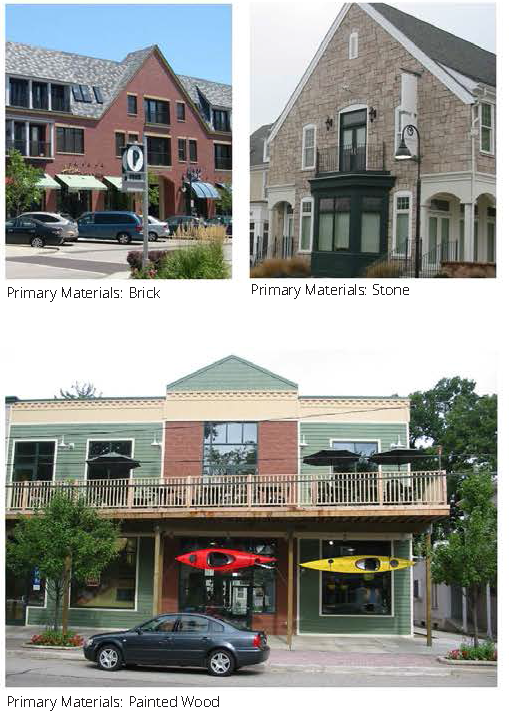
B.
Secondary Facade Materials. Secondary materials are limited to details and accents and include gypsum reinforced fiber concrete for trim and cornice elements; metal for beams, lintels, trim, and ornamentation, and exterior architectural metal panels and cladding. Exterior Insulation and Finishing Systems (EIFS) is permitted for trim only or on upper floor facades only.
C.
Roof Materials. Acceptable roof materials include three hundred (300) pound or better, dimensional asphalt composite shingles, wood shingles and shakes, metal tiles or standing seam, slate, and ceramic tile. "Engineered" wood or slate may be approved during the site plan process with an approved sample and examples of successful, high quality local installations. Refer to Figure 4-26.
Figure 4-26. Roof Materials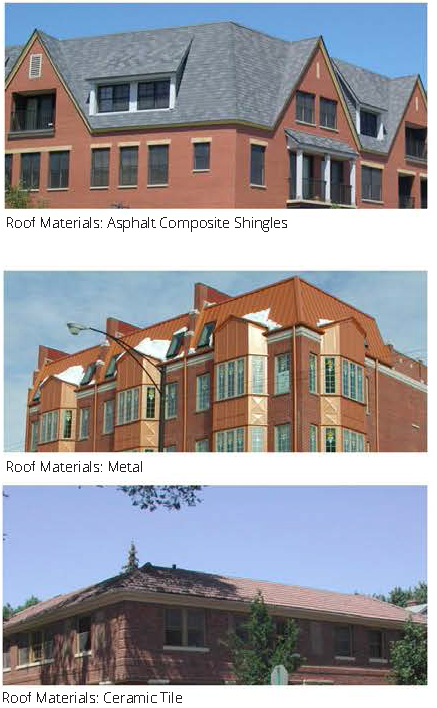
D.
Color. Main building colors shall utilize any historic palettes from any major paint manufacturer. Other colors may be utilized for details and accents, not to exceed a total area larger than ten (10) percent of the facade surface area.
E.
Appropriate Grade of Materials. Commercial quality doors, windows, and hardware shall be used on all building types with the exception of the row building. Refer to Figure 4-2.
Figure 4-27. Doors and Windows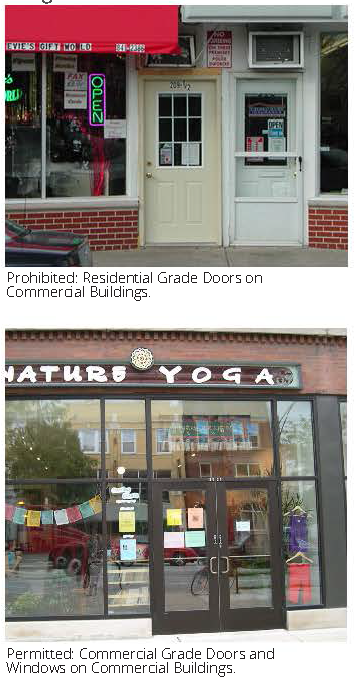
4.7.2. - Windows, Awnings, and Shutters
A.
Windows. All upper story windows on all historic, residential, and mixed use buildings shall be recessed, double hung. Percent of transparency is required per building type. Horizontal or vertical strip windows, tinted or reflective glass, and glass block (refer to Figure 4-28) are prohibited within MX districts.
B.
Security Grills. Grills shall be fully retractable and completely within the interior of the building and inconspicuous to the extent possible. Exterior bars are prohibited on any window. Refer to Figure 4-29.
C.
Awnings. All awnings shall be canvas or metal. Plastic awnings and canopy awnings that extend from the front facade into the right-of-way are prohibited. Awning types and colors for each building face shall be coordinated. Refer to Figure 4-31.
D.
Shutters. If installed, shutters, whether functional or not, shall be sized for the windows. If closed, the shutters shall not be too small for complete coverage of the window. Shutters shall be wood.
"Engineered" wood may be approved during the site plan process with an approved sample and examples of successful, high quality local installations.
Figure 4-28. Windows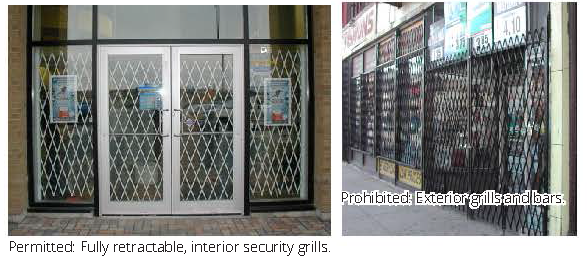
Figure 4-29. Security Grills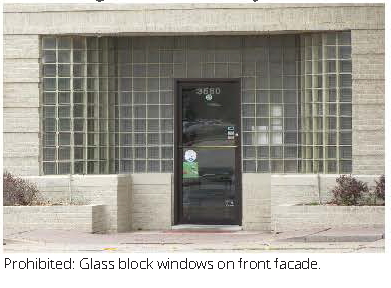
Figure 4-30. Balconies Integrate to Facade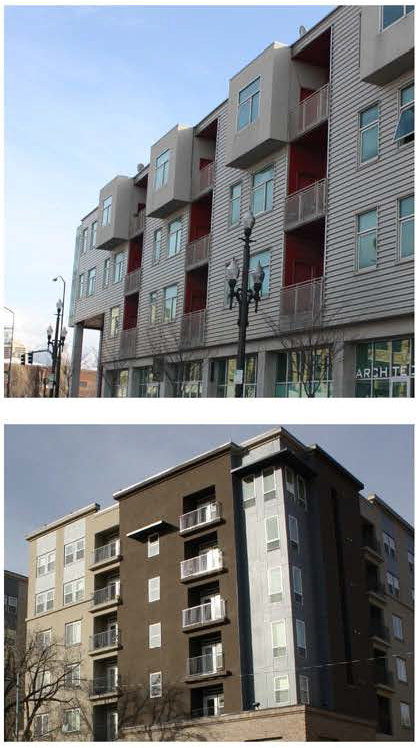
Figure 4-31. Awnings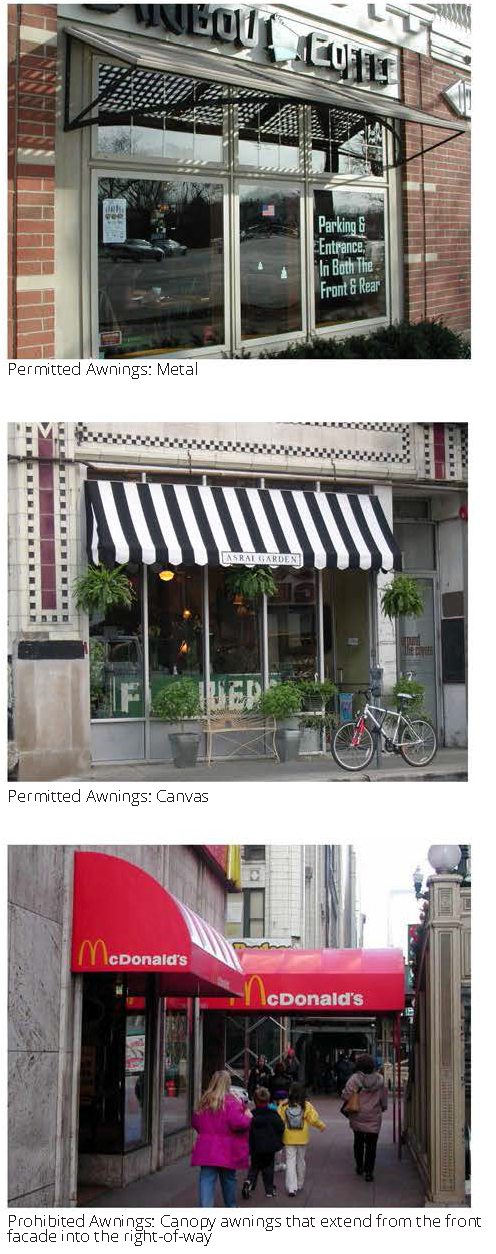
4.7.3. - Balconies
The following applies in all locations where balconies are incorporated into the facade design facing any street or parking lot. Refer to Figure 4-30.
A.
Size. Balconies shall be a minimum of six (6) feet deep and five (5) feet wide.
B.
Connection to Building. Balconies shall be integral to the facade at the street line. Balconies on stepped back stories shall be independently secured and unconnected to other balconies.
C.
Facade Coverage. A maximum of forty (40) percent of the front and corner side facades, as calculated separately, may be covered with balconies, including street-facing railing and balcony structure.
4.7.4. - Treatments at Terminal Vistas
Refer to Figure 4-32. When a street terminates at a parcel, the parcel shall be occupied by one (1) of the following:
A.
If the parcel is open space, any Civic Space Type with the exception of the pocket park shall be utilized and a vertical element shall terminate the view. Acceptable vertical elements include a stand or grid of trees, a sculpture, or a fountain.
B.
If the parcel is not utilized as a Civic Space Type, the front or corner side of a building, whether fronting a primary street or not, shall terminate the view. The building shall incorporate one (1) of the following treatments to terminate the view: a tower, a bay, or a courtyard. Refer to Figure 4-33 for one (1) illustration of this requirement.
Figure 4-32. Terminal Vista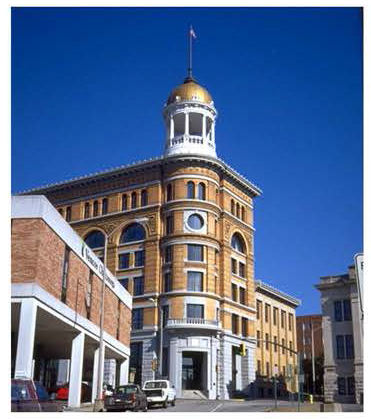
4.7.5. - Building Variety
Building design shall vary between vertical facade divisions, where required per the building types, and from adjacent buildings by the type of dominant material or color, scale, or orientation of that material and at least two (2) of the following. Refer to Figure 4-32 for one (1) illustration of this requirement.
A.
The proportion of recesses and projections.
B.
The location of the entrance and window placement, unless storefronts are utilized.
C.
Roof type, plane, or material, unless otherwise stated in the building type requirements.
Figure 4-33. Building Variety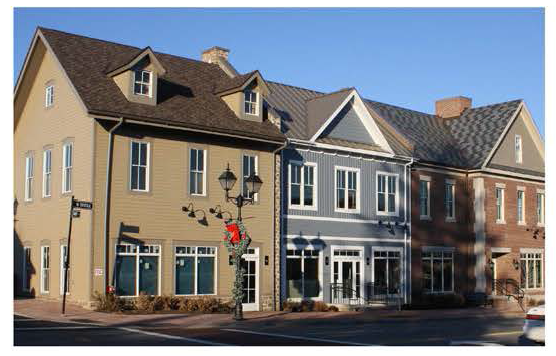
4.7.6. - Building Lighting
A.
Exterior lighting should serve only to illuminate entries, signage, adjacent pedestrian areas and displays, or to highlight significant architectural features above the first floor.
B.
Traditional light fixtures and/or appropriately scaled contemporary light fixtures should be used. Fixture color should be muted, and should coordinate with the overall facade and signage color scheme.
C.
Security lighting should be concealed to the extent practical.
4.7.7. - Principal Entryway
Principal entrances to buildings or units shall be clearly delineated through one (1) or more of the following (refer to Figure 4-34):
A.
Cap or Canopy. The entryway shall be covered by a cap or canopy differentiating it from the overall building cap.
B.
Sidelights and Transom. Sidelights and/or transom windows shall be included around the entryway.
C.
Extended Articulation. The entryway shall be included in a separate bay of the building extended up at least two (2) stories.
D.
Other Design Options. The Community Development Director may approve different design options that add emphasis and draw attention to the entryway through a minor exception during design review.
Figure 4-34. Examples of Defined Principal Entryway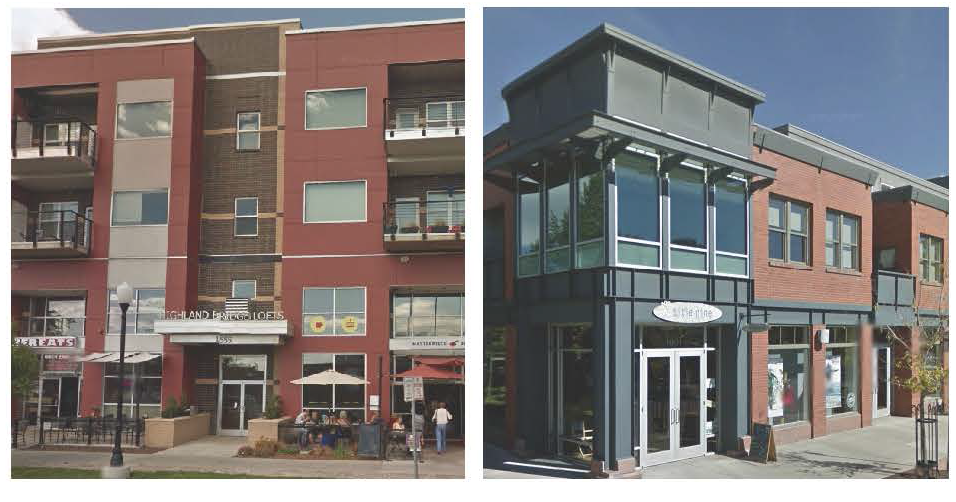
4.7.8. - Storefront Design
Refer to Figure 4-35. A storefront is the ground story facade of a building that includes a large window area for display and entranceway into the building, usually associated with retail sales, eating and drinking establishments, and commercial service uses.
A.
Amount of Glass. Storefront glass quantity is required by building type.
B.
Clear Windows. Windows shall be unobstructed during the daytime and evening hours. Either displays or occupied space shall be located inside the building, viewable from outside the window.
C.
Transom Windows. Transom windows above doors and above storefront windows are encouraged.
D.
Bulkhead. A bulkhead, minimum height of twelve (12) inches and maximum height of thirty (30) inches is required. The bulkhead may be constructed of wood, metal, concrete, or masonry. Concrete masonry units may not be exposed.
E.
Sign Band. A wall sign band or location, minimum eighteen (18) inches in height, is required to be designed into the facade.
Figure 4-35. Storefront Design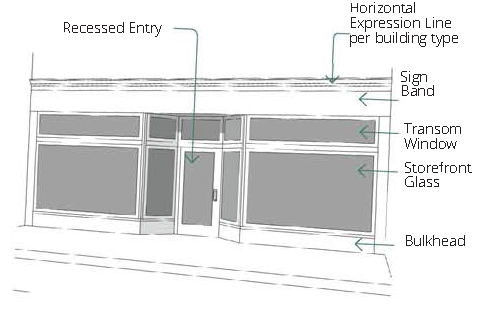
4.7.9. - Arcade Design
Refer to Figure 4-36. An arcade is a covered pedestrian walkway within the recess of a ground story.
A.
An open-air public walkway is permitted from the face of the building recessed into the building a minimum of eight (8) and a maximum of fifteen (15) feet.
B.
Build-to Zone. When the arcade is utilized, the outside face of the arcade shall be considered the front facade, located within the required build-to zone.
C.
Column Spacing. Columns shall be spaced between ten (10) feet and twelve (12) feet on center.
D.
Column Width. Columns shall be a minimum of one (1) foot eight (8) inches and a maximum two (2) feet four (4) inches in width.
E.
Arcade Opening. Opening shall not be flush with interior arcade ceiling and may be arched or straight.
F.
Horizontal Facade Division. Horizontally define the ground story facade from the upper stories.
G.
Visible Basement. A visible basement is not permitted.
Figure 4-36. Arcade Design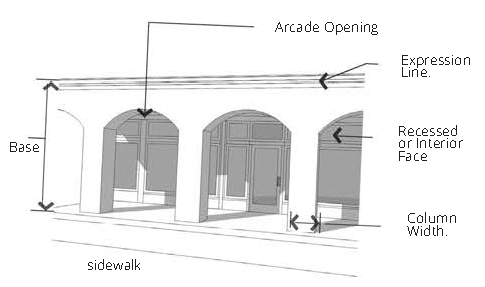
4.7.10. - Fuel Stations and Car Washes
Fueling stations and car washes require a special use permit (refer to section 11.4, Special Uses) and shall meet the following. Refer to Figure 4-37 for one (1) illustration of a compliant fuel station.
A.
Location of Pumps. Any fueling pumps shall be located in the rear or interior side yard.
B.
Convenience Store/Building. A building on the premises of a fueling station shall be located in the build-to zone and shall occupy any corner. The building shall fulfill all requirements of the building type with the exception of the minimum primary build-to zone coverage and the minimum height requirement.
C.
Car Wash Facility. Any car wash facility shall be located in the rear of the lot. Vehicle entrance doors may be located on the rear facade, non-primary street facade, or an interior facade not visible from the primary street. Vehicular entrances are prohibited on the primary street facade, unless otherwise approved through a minor design exception.
D.
Additional Drive Entrance. One (1) driveway entrance, in addition to the driveways permitted by building type, is permitted on the lot, maximum width twenty-four (24) feet. With a minor design exception, the driveway may be located on the primary street.
Figure 4-37. Example of Fuel Station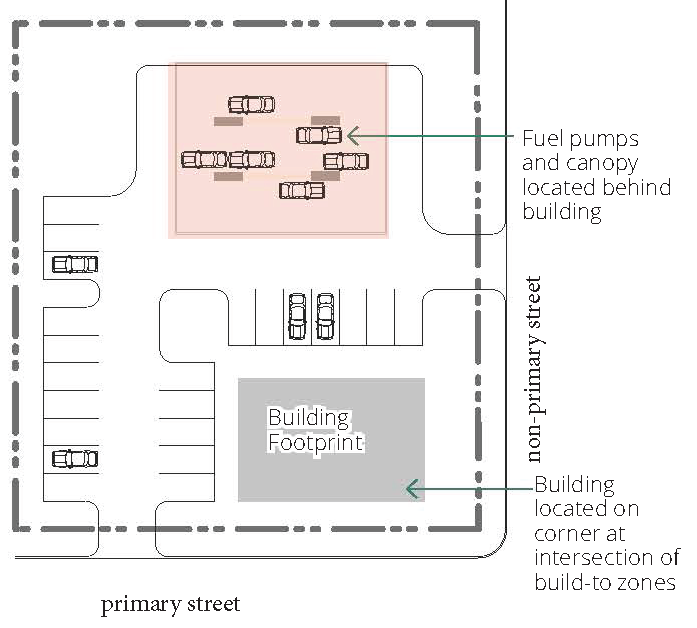
4.7.11. - Drive-Through Structures
Refer to Figure 4-38 for one (1) illustration of the following requirements.
A.
Structure/Canopy. Drive-through structures or canopies shall be located on the rear facade of the building or in the rear of the lot behind the building, where permitted by use. The structure shall not be visible from any Primary Street.
B.
Stacking Lanes. Stacking lanes shall be located perpendicular to the Primary Street or behind the building.
C.
The canopy and structure shall be constructed of the same materials utilized on the building.
Figure 4-38. Drive-Through Facility Layout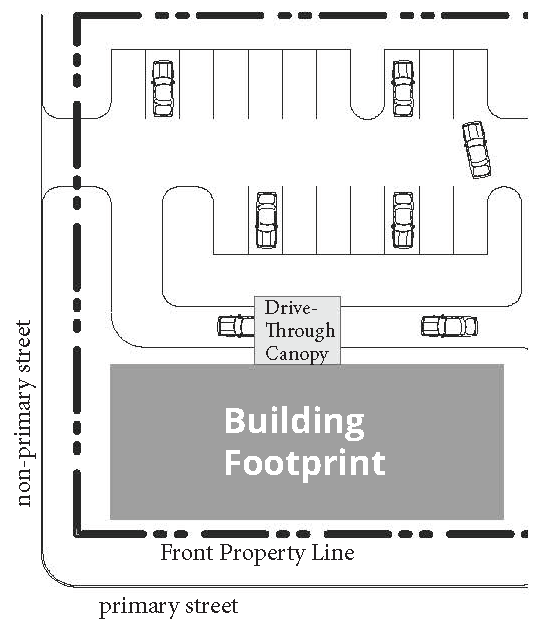
(Ord. No. 4326, § 2(Exh. A), 1-23-23)
Sec. 4.8. - Streetscape Guidelines
The following guidelines apply to all streets adjacent to MX districts with the intent of creating pedestrian oriented, multimodal streets.
4.8.1. - Typical Street Elements
All street rights-of-way should include the following vehicular and pedestrian realm considerations. Each street type detailed in this article outlines which facilities are applicable. Refer to Figure 4-39.
A.
Vehicular Realm. The vehicular realm is comprised of the travel lanes, bicycle lanes, and parking lanes.
1.
Refer to public works requirements for all lane widths.
2.
Refer to this section for additional information on on-street parking and bicycle facilities.
B.
Pedestrian Realm. The pedestrian realm is comprised of pedestrian facilities, such as sidewalk. A buffer area that serves to buffer pedestrians or bicyclists from the movements of higher speed vehicles in the vehicular realm shall consist of one (1) of the following:
1.
Landscape Zone. A landscape area between the back of curb to the sidewalk in which street trees, stormwater swales, lighting, and signage may be located. Typically used adjacent to residential ground floor uses.
2.
Furnishings Zone. A hardscape area that extends from the sidewalk to the back of curb, in which street trees, street furniture, lighting, and signage may be located. Typically used adjacent to commercial or office ground floor uses.
Figure 4-39. Typical Right-of-Way Elements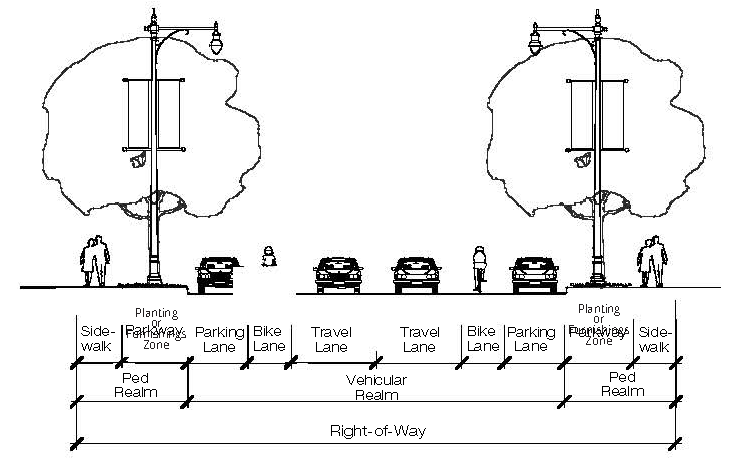
C.
Bicycle Facilities. Bicycle facilities should be included on any streets based on the village's bicycle plan. The following types of bicycle accommodations are appropriate in the vehicular realm. Refer to Figure 4-40.
1.
Dedicated Bicycle Lane. Dedicated bicycle lanes are striped lanes on the outside of the outermost travel lanes that are designated for only bicycle use. This lane occurs on both sides of the street and shall be four (4) to five (5) feet wide.
2.
Designated Shared Lane. A designated shared lane is a lane that is shared between vehicles and bicycles. This lane is typically wider than a standard vehicular lane, minimum thirteen (13) feet, in order to accommodate both types of users, and includes a painted bicycle marker combined with a double arrow (known as a "sharrow"). This improvement occurs in both directions.
3.
Shared Lane. A shared lane refers to a street that does not have bicycle lanes or a designated shared lane, but the speed and configuration of the street is such that bicycles could comfortably share lanes with traffic.
D.
On-Street Parking. On-street parking should be included on both sides of all streets. Parallel, back-in diagonal, or head-in diagonal are the most appropriate types.
E.
Parkway Trees. Street trees are required along all street frontages. Street trees shall be located in either a landscape zone (within a planting bed or lawn) or a furnishings zone (in trees wells with grate as required).
1.
For each tree preserved or planted, a minimum amount of permeable surface area is recommended, unless otherwise stated in this article.
2.
Preserved trees should have a permeable surface area equal to the critical root zone. The critical root zone is equal to half of the radius of the tree's mature canopy, measured from the trunk out to the dripline.
3.
Planted trees have a suggested minimum permeable area and soil volume based upon tree size; refer to Table 4-3 for details.
4.
Permeable area for one (1) tree cannot count toward that of another tree.
5.
When the critical root zone of an existing tree or the suggested permeable surface area requirement of a newly planted tree extends below any pavement, structural soil is required underneath the pavement.
Figure 4-40. On-Street Bicycle Facilities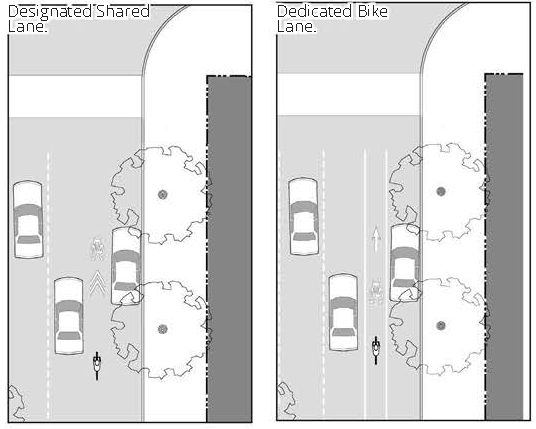
Table 4-3: Minimum Recommended Soil Volumes and
Permeable Area per Planted Tree
4.8.2. - Street Configurations
The following street configurations are provided to assist in the redesign or repaving of Ardmore Avenue to better serve the MX-1 district.
A.
Ardmore Avenue, ninety-seven (97) feet right-of-way. The following alternatives are suggested for Ardmore Avenue north of the Metra Tracks with a ninety-seven (97) feet wide right-of-way.
1.
Alternative 1. (Refer to Figure 4-41). This alternative provides new on-street parking with sixty (60) degree-angled parking on the east side and parallel parking on the west side. Two (2) travel lanes are provided and a left turn lane is permitted at intersections. Parkways with trees buffer pedestrians on the sidewalks.
2.
Alternative 2. (Refer to Figure 4-42). This alternative provides new on-street parallel parking on both sides of the street with two (2) travel lanes. Parkways with trees buffer pedestrians on sidewalks.
3.
Alternative 3. (Refer to Figure 4-43). This alternative provides new on-street parallel parking on both sides of the street with two (2) travel lanes. Parkway with a furnishings zone buffers pedestrians on the west side of the street. On the east side, a large parkway of permeable pavers over a parkway tree structural soil system improves stormwater infiltration and tree health.
B.
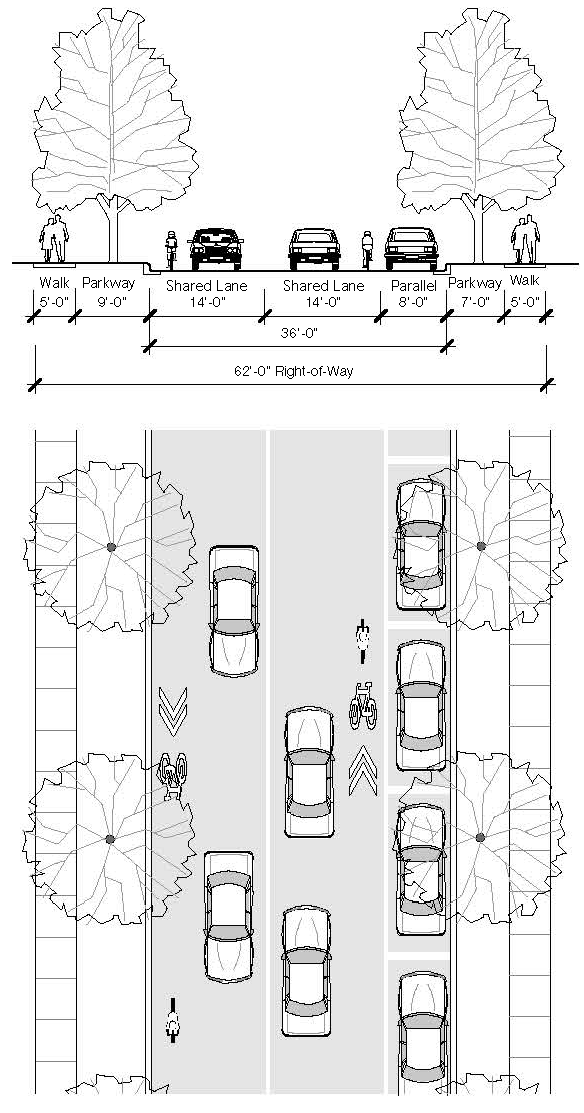
Ardmore Avenue, sixty-two (62) feet right-of-way. The following alternatives are suggested for Ardmore Avenue south of the Metra Tracks with a sixty-two (62) feet wide right-of-way.
1.
Alternative 1. (Refer to Figure 4-44). This alternative provides new on-street parallel parking on both sides of the street with two (2) travel lanes for traffic. Parkways with parkway trees buffer pedestrians on sidewalks.
2.
Alternative 2. (Refer to Figure 4-45). This alternative provides one (1) side of new on-street parallel parking. Two (2) shared travel lanes are wide enough for cars and bicycles.
Figure 4-41. Ardmore avenue 97' ROW - Alternative 1
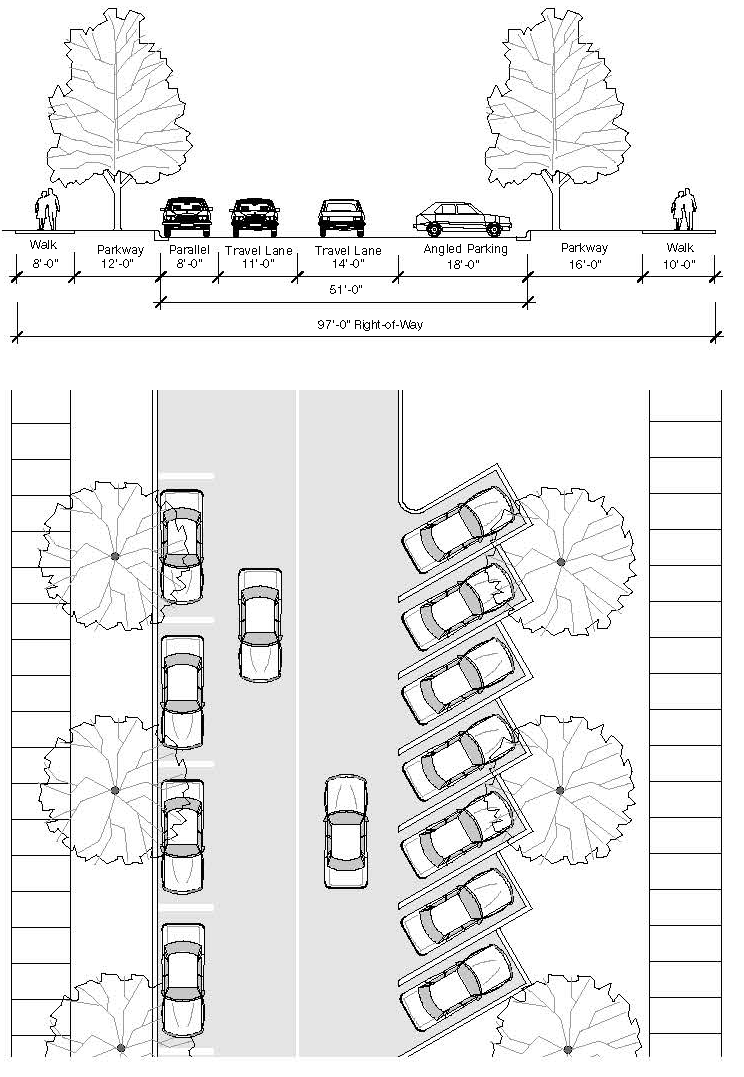
Figure 4-42. Ardmore Avenue 97' ROW - Alternative 2
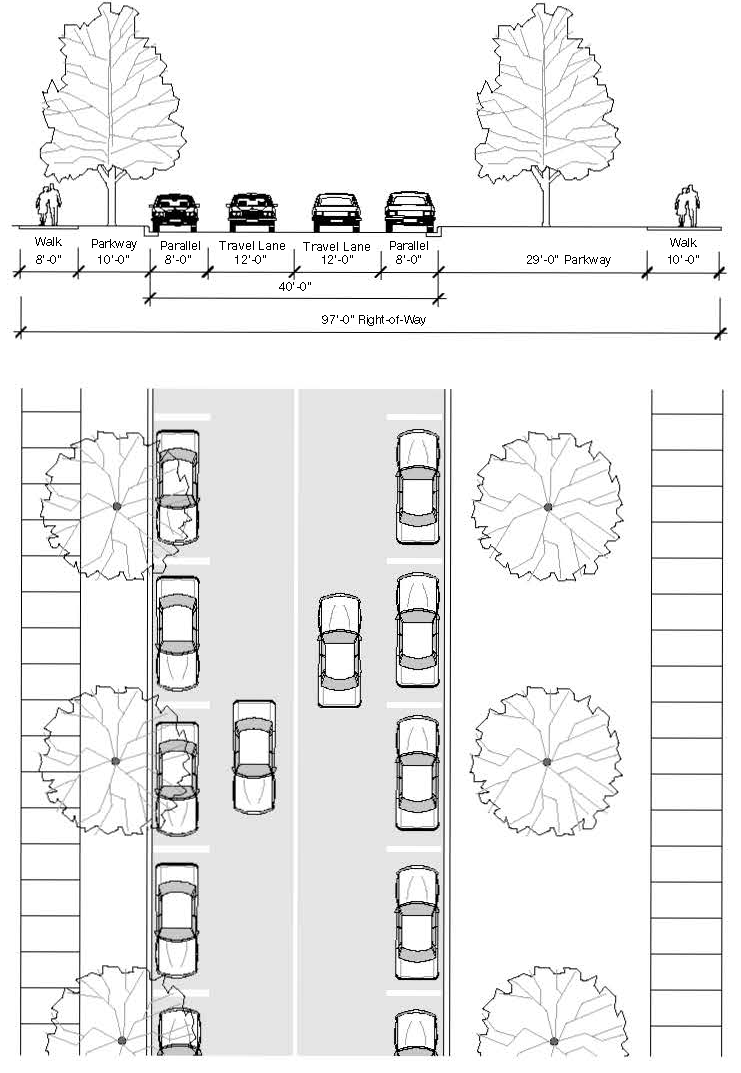
Figure 4-43. Ardmore Avenue 97' ROW - Alternative 3
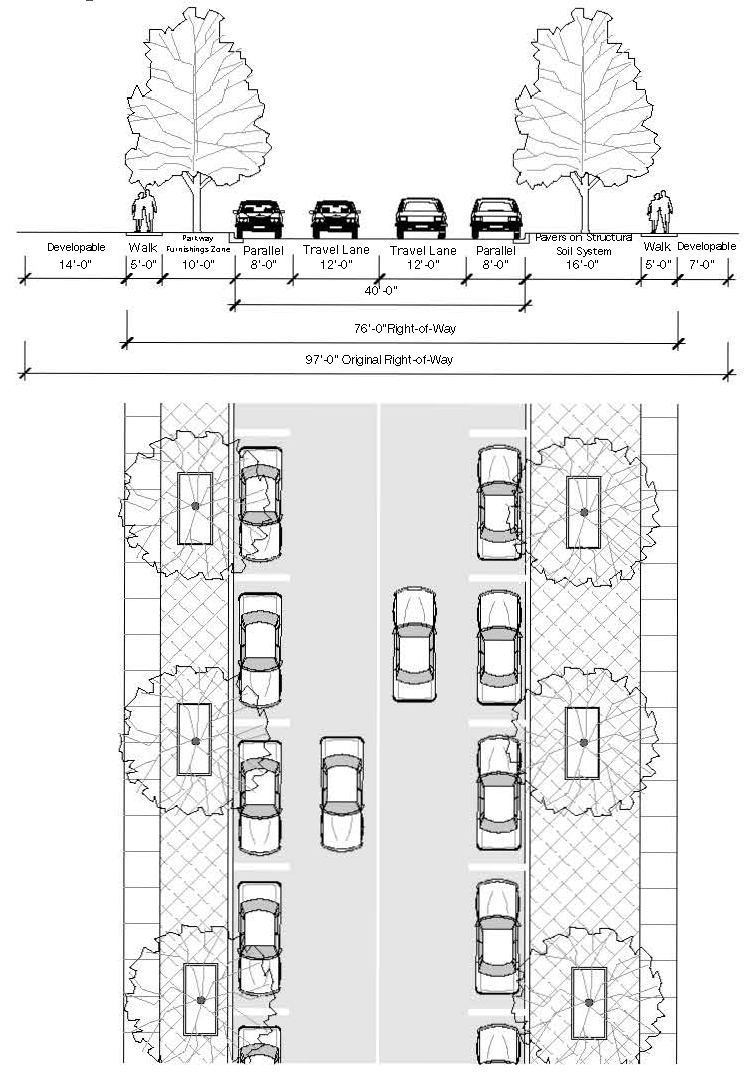
Figure 4-44. Ardmore Avenue 62' ROW - Alternative 1
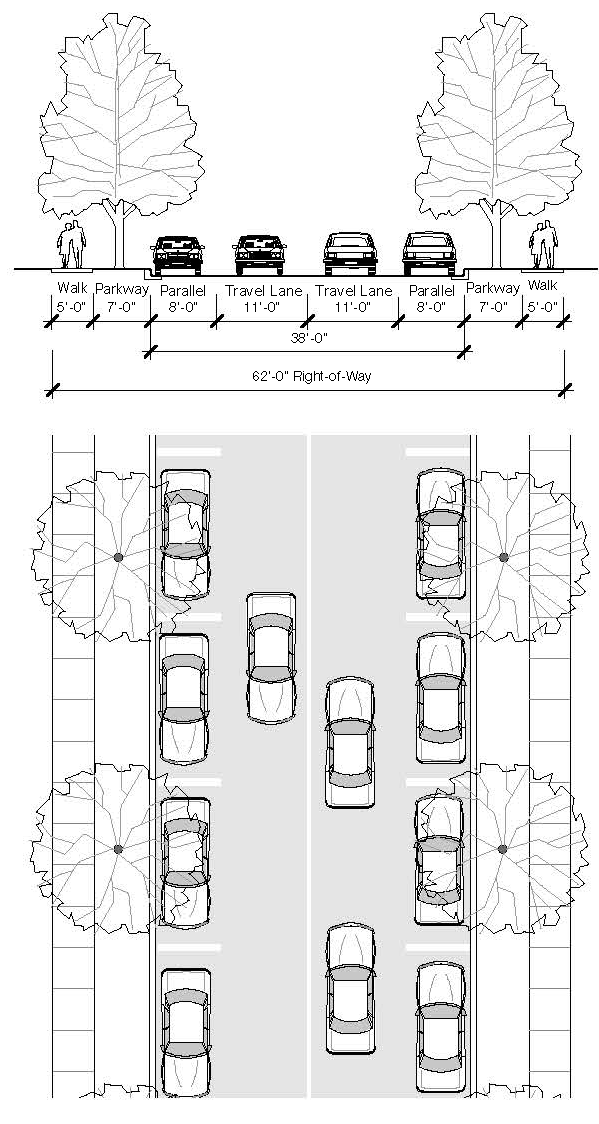
Figure 4-45. Ardmore Avenue 62' ROW - Alternative 2
(Ord. No. 4326, § 2(Exh. A), 1-23-23)

