
Washington City Zoning Code
ARTICLE XI
MULTIFAMILY DEVELOPMENT
Sec. 40-287.- Applicability.
The standards established in sections 40-288 through 40-298 shall apply to new construction and conversions of all multifamily development in allowable zoning districts, except the B1H Zoning District. Multifamily development in the B1H Zoning District shall be subject to the standards established in sections 40-299 through 40-302.
(Code 1993, § 27-108; Ord. No. 21-3, § 1(Att.), 6-14-2021)
Sec. 40-288. - Procedures; required review, contents.
(a)
Required review. The developer shall submit a development plan to the Department of Planning and Development for review and approval prior to the issuance of any construction or building permits in accordance with the following:
(1)
Site plan approval. For one (1) structure containing three (3) or more attached dwelling units and/or two (2) or more dwelling structures located on a common lot.
(2)
Preliminary and final subdivision plat approval. Preliminary and final subdivision plat approval shall be required in accordance with chapter 34, pertaining to subdivisions.
(b)
Contents. The contents shall be as necessary to determine and ensure compliance with the standards, conditions, and restrictions of the zoning and subdivision chapters and related laws. Specific site design elements, submission requirements, and procedures shall be in accordance with article XVIII of this chapter, pertaining to site plan review.
(Code 1993, § 27-109)
Sec. 40-289. - Density.
The minimum lot area required per dwelling unit is as follows:
(a)
One (1) bedroom unit: two thousand three hundred (2,300) square feet (net) per unit.
(b)
Two (2) bedroom unit or greater: two thousand nine hundred (2,900) square feet (net) per unit.
For purposes of this section, the area within any public street right-of-way shall not be used to determine the net area.
(Code 1993, § 27-110)
Sec. 40-290. - Open space and recreation area requirements.
(a)
Thirty (30) percent of the lot area shall be reserved as open space.
(b)
Public and/or private streets, driveways, off-street parking areas, and principal and accessory structures shall not be used in calculating or meeting the open space requirements.
(c)
Recreation areas shall be provided at a ratio of five hundred (500) square feet per dwelling unit.
(1)
Recreation areas shall be designed for recreation purposes such as playgrounds, tennis courts, volleyball courts, dog parks, greenways, basketball courts, swimming pools, or similar uses.
(2)
Recreation areas shall be maintained by the owner and kept in good condition.
(d)
Recreation areas may be counted as open space provided impervious surfaces constitute no more than fifty (50) percent of such recreation areas.
(e)
Detached accessory structures shall not cover more than ten (10) percent of any individually designated, open space or common area.
(f)
Recreation area requirements in multifamily developments shall not apply to developments that:
(1)
Contain less than two (2) net acres; and
(2)
Are located within a one-half (½) mile radius of a public recreation area.
(g)
Any person developing and/or subdividing property subject to this ordinance, upon approval of the Director of Planning and Development, may make a payment in lieu of any required dedication of open space and/or recreation in accordance with section 40-292.
(Code 1993, § 27-111; Ord. No. 21-3, § 1(Att.), 6-14-2021)
Editor's note— Ord. No. 21-3, § 1(Att.), adopted June 14, 2021, amended the title of § 40-290 to read as herein set out. The former § 40-290 title pertained to Open space.
Sec. 40-291. - Development standards.
(a)
Lot dimensions. Development standards for lot dimensions in multifamily developments are as follows:
(1)
Net area: fifteen thousand (15,000) square feet.
(2)
Primary width: seventy-five (75) feet at the minimum building line, for the first dwelling.
(3)
A secondary width of fifteen (15) feet shall be provided for each additional dwelling unit.
(b)
Setbacks for principal structures. Development standards for setbacks for principal structures in multifamily developments are as follows:
(1)
Front yard/public street right-of-way: twenty-five (25) feet.
(2)
Private street easement: ten (10) feet.
(3)
Group development property line: twenty (20) feet.
(4)
Single structure property line: Development standards for property lines in multifamily developments are as follows:
a.
Side: ten (10) feet.
b.
Rear: twenty (20) feet.
(c)
Setbacks for accessory structures. Development standards for setbacks for accessory structures in multifamily developments are as follows:
(1)
Public street right-of-way: twenty-five (25) feet.
(2)
Private street easement: ten (10) feet.
(3)
Property line: In accordance with article VII of this chapter, pertaining to bufferyard landscaping requirements.
(4)
No accessory structure to any multifamily structure or dwelling unit shall be located in any front yard.
(5)
Specific accessory structures such as satellite dish antennas and swimming pools shall comply with the applicable provisions of article VI of this chapter, pertaining to dimensional standards, modifications, and special standards.
(d)
Setbacks for recreation areas. Development standards for setbacks for recreation areas in multifamily developments are as follows:
(1)
Active. No portion of an active recreation area shall be located within the setback or less than twenty (20) feet from any dwelling unit.
(2)
Passive. May be located within the setback in accordance with the bufferyard regulations, as shown in section 40-293.
(e)
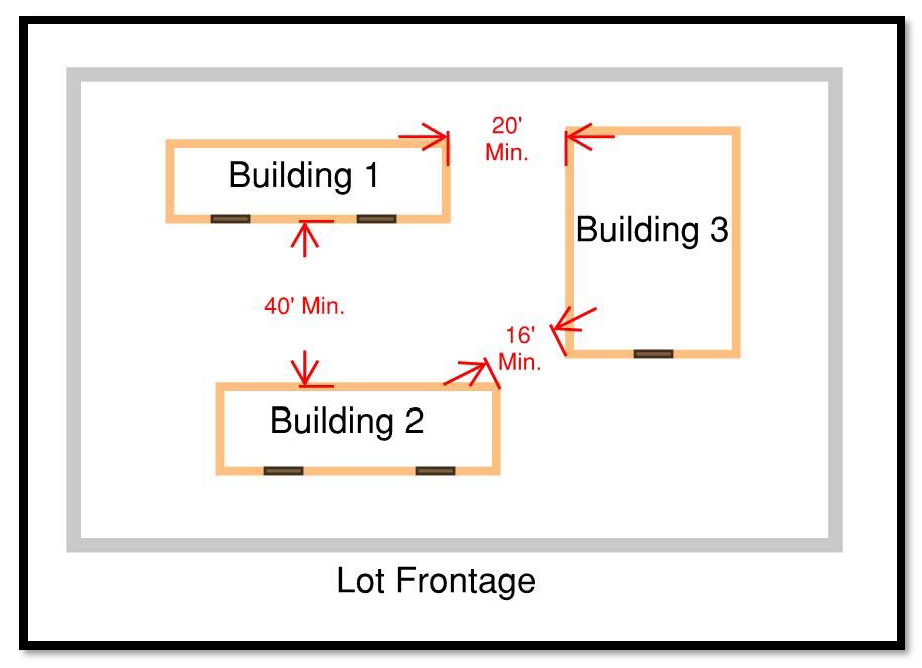
Building separation within group developments containing two (2) or more principal structures on one (1) lot of record.
(1)
No portion of a principal structure front or rear building wall elevation shall be located less than forty (40) feet from an adjacent principal structure front or rear building wall elevation as measured at ninety (90) degrees, except as provided herein.
(2)
No portion of a principal structure side building wall elevation shall be located less than twenty (20) feet from an adjacent principal structure as measured at ninety (90) degrees, except as provided herein.
(3)
Single-family and two-family attached group developments shall be exempt from subsections (e)(1) and (2) of this section, provided such structures meet all other requirements of this section.
(4)
No portion of any principal structure shall be located less than sixteen (16) feet from any other principal structure as measured to the closest point.
(5)
No two (2) units or structures shall be considered attached unless such units or structures share a minimum five-foot common party wall.
(6)
Architectural extensions including, but not limited to, bay windows, chimneys, open porches and decks, roof overhangs, and balconies shall not be considered in calculating building separation provided such encroachments are not more than three (3) feet.
(f)
Building height. No structure shall exceed thirty-five (35) feet in height above the property grade unless the required setbacks and building separations are increased one (1) foot for each one (1) foot or fraction thereof of building height in excess of thirty-five (35) feet.
(g)
Building length. No continuous unit or series of attached units shall exceed a combined length of two hundred sixty (260) feet.
(Code 1993, § 27-112; Ord. No. 21-3, § 1(Att.), 6-14-2021)
Sec. 40-292. - Fee-in-lieu.
(a)
Payment in lieu of dedication shall be the product of the post-development appraised value of the land to be developed (per gross acre) multiplied by the number of acres to be dedicated. The following formula shall be used to determine the fees:
Post Development Appraised Value of Development (per gross acre) * Required Open Space and/or Recreation Area (acres) = Payment in Lieu Fee
(b)
The post development appraised value of the development shall be established after applicable plan approval by an appraiser who is a member of the Appraisal Institute (MAI) or a North Carolina General Certified Appraiser.
(c)
The payment shall be made to the City of Washington and shall be submitted prior to the approval of the final plat.
(d)
All funds received for payment in lieu of dedication shall be deposited in a special fund or line item to be used only for the acquisition, development, management, and/or redevelopment of public open space by the city.
(Ord. No. 21-3, § 1(Att.), 6-14-2021)
Editor's note— Ord. No. 21-3, § 1(Att.), adopted June 14, 2021, amended § 40-292 in its entirety to read as herein set out. Former § 40-292 pertained to Recreation area requirement (private), and derived from the Code of 1993, § 27-113.
Sec. 40-293. - Bufferyard requirements.
Bufferyard requirements shall be in accordance with article VII of this chapter, pertaining to bufferyard landscaping requirements.
(Code 1993, § 27-114; Ord. No. 21-3, § 1(Att.), 6-14-2021)
Sec. 40-294. - Parking requirements.
(a)
Parking requirements in multifamily developments by the number of spaces are as follows:
(1)
One (1) bedroom unit: one and one-half (1½) spaces per unit.
(2)
Two (2) or more bedroom units: two (2) spaces per unit.
(b)
All off-street parking areas designed for three (3) or more spaces shall be in accordance with article XVII of this chapter, pertaining to parking.
(Code 1993, § 27-115; Ord. No. 21-3, § 1(Att.), 6-14-2021)
Sec. 40-295. - Garbage/trash container pad locations.
(a)
No common garbage/trash container pad shall be located closer than twenty (20) feet to any dwelling structure.
(b)
Each common garbage/trash container pad required to service the development shall be located within two hundred (200) feet of the dwelling units such container is intended to serve.
(c)
Each container pad shall be enclosed on three (3) sides by a complete visual screen and have a latching gate on the fourth side.
(Code 1993, § 27-115.5; Ord. No. 21-3, § 1(Att.), 6-14-2021)
Sec. 40-296. - Private streets.
Private streets may be allowed, pursuant to the standards of chapter 34, pertaining to subdivisions.
(Code 1993, § 27-116)
Sec. 40-297. - Compliance with subdivision standards.
All development regulated in accordance with this section shall be subject to the requirements, conditions, and restrictions of chapter 34, pertaining to subdivisions, whether or not the subject tract is actually divided for the purpose of transferring title.
(Code 1993, § 27-117)
Sec. 40-298. - Applicability.
The standards established in sections 40-299 through 40-302 shall apply only in the B1H Zoning District.
(Code 1993, § 27-118)
Sec. 40-299. - Development standards in B1H Zoning District.
The following development standards apply in the B1H Zoning District.
(a)
Minimum lot area. Minimum lot area: one thousand (1,000) square feet per unit.
(b)
Minimum lot width. Minimum lot width: N/A.
(c)
Minimum setbacks. Minimum front, side, and rear yard setbacks: zero (o).
(d)
Minimum parking. Minimum parking: one-half (1/2) space per bedroom.
(e)
Parking location requirements. All required parking and parking for which bonuses are obtained must be within eight hundred (800) feet of the building they are to serve. Leased parking shall be in accordance with the applicable provisions of article XVII of this chapter, pertaining to parking.
(f)
Off-street parking. All off-street parking areas designed for three (3) or more spaces shall be in accordance with article XVII of this chapter, pertaining to parking.
(g)
Street frontage use requirements. All ground floor street frontage shall be developed for nonresidential uses, as permitted in the applicable zone. When new construction occurs for residential purposes, located in a flood zone, and off street parking is placed at ground level, the nonresidential provision does not apply.
(h)
Preservation design. For development within the City of Washington Historic District, all applicable historic district standards shall be met and appropriate review shall be made by the Historic Preservation Commission, in accordance with article XV of this chapter, pertaining to special districts.
(i)
Signage. All signs shall be erected in accordance with article XVI of this chapter, pertaining to signs, but in no event shall be mounted over existing windows, doors, or other significant architectural features.
(Code 1993, § 27-119; Ord. No. 06-06, § 1, 3-13-2006; Ord. No. 21-3, § 1(Att.), 6-14-2021)
Sec. 40-300. - Residential density bonus provisions in B1H Zoning District.
A project shall be eligible for a residential density bonus, by way of a lot area per unit reduction, if space is provided within the project for the uses, improvements, or facilities set forth in this section:
(a)
Off-street parking, nonresidential. The minimum ratio shall be one (1) space per one thousand (1,000) square feet of gross nonresidential area.
(b)
Cultural/entertainment facilities. Such facilities shall be open to the public on a regular basis, and shall be limited to:
(1)
Visual arts space. Facilities that provide space for the viewing of performing arts, including, but not limited to, exhibition halls, galleries, concert halls, or theaters. Such space shall occupy not less than fifteen (15) percent of the total floor area of the portion of the building used for residential purposes.
(2)
Motion picture theaters. Facilities that provide indoor space for the showing of motion pictures.
(c)
Pedestrian circulation improvements. Improvements to which the public is ensured access to a regular basis, or an area that is dedicated to and accepted by the city for public access purposes. Such improvements shall be directly accessible to existing pedestrian circulation areas, and limited to:
(1)
Businesses allowing pedestrian access through at least two (2) entrances opening to different streets, sidewalks, open spaces, and/or parking lots.
(2)
Arcades. A continuous but not necessarily enclosed space which extends along the facade of a building and has at least two (2) entrances opening directly to a street, open space, or sidewalk or which runs through a building and connects a street, open space, or sidewalk to another street, open space, or parking lot.
(3)
Plaza. A continuous area which is open to the sky for its entire width and length, which fronts on a street, sidewalk, widening, or parking lot, and which is directly accessible to the public at all times for passive recreational purposes. The ground level of the plaza shall be constructed mainly of hard-surfaced materials, and shall be landscaped and lighted. An existing open space for which no such improvements are planned shall not qualify.
(d)
Child or adult day care facility.
(e)
Historic structure/rehabilitation. This bonus is applicable to those projects qualifying for the Historic Rehabilitation Tax Credit, as approved by the North Carolina Division of Archives and History and the United States Department of Interior.
(Code 1993, § 27-120)
Sec. 40-301. - Schedules of residential bonuses for B1H Zoning District.
For each amenity provided above, the project will be eligible to reduce the required lot area by the number of square feet indicated in this section. The maximum lot reduction allowed shall be two hundred fifty (250) square feet per unit.
(Code 1993, § 27-121)
Sec. 40-302. - Conversion of single-family dwelling units in the Residential Historic District.
No existing single-family dwelling unit located in the Residential Historic District (RHD) shall be altered so as to accommodate a two-family or multifamily dwelling unit. Notwithstanding any other provision of this article, any single-family dwelling unit previously converted to another use, including, but not limited to, a use as a two-family or multifamily dwelling unit, shall be treated as a nonconforming situation or use for the purposes of this article. All new construction of two-family or multifamily units in the Residential Historic District (RHD) shall meet the standards set forth in this article.
(Code 1993, § 27-122; Ord. No. 97-11, 7-14-1997; Ord. No. 00-4, 4-10-2000; Ord. No. 00-19, 11-13-2000)

