
Washington City Zoning Code
ARTICLE VI
DIMENSIONAL STANDARDS, MODIFICATIONS, AND SPECIAL STANDARDS
Sec. 40-139.- Applicability.
Unless otherwise provided in these regulations, the minimum standards and requirements established in this article shall apply to all uses. See also article V of this chapter, pertaining to standards and criteria for special uses.
(Code 1993, § 27-50)
Sec. 40-140. - Schedule of dimensional standards by zoning district.
The following is a schedule of dimensional standards by zoning districts:
(a)
The schedule of dimensional standards for residential districts is as follows:
(b)
The schedule of dimensional standards for institutional and commercial districts is as follows:
(c)
Schedule of dimensional standards for industrial districts.
(1)
The following table specifies dimensional standards for lots and buildings in the industrial district:
(2)
The following table specifies dimensional standards for road setbacks in the industrial district:
(Code 1993, § 27-51; Ord. No. 04-1, § 5, 1-12-2004; Ord. No. 21-3, § 1(Att.), 6-14-2021)
Sec. 40-141. - Measuring setbacks.
(a)
Corner lot side yard street setbacks represent the minimum distance required between the nearest exterior finished walls of the primary structure and/or any supporting member/boundary (edge) of any attached accessory structure, to the closest adjacent street right-of-way line. Where an accessory structure is attached to the primary structure, the building footprint is extended, therefore the boundary of the entire building footprint shall be considered when measuring setbacks.
(b)
Front, side, and rear setbacks represent the minimum distance required between the nearest exterior finished walls of the primary structure and/or any supporting member/boundary (edge) of any attached accessory structure, to the closest adjacent front, side, or rear property lines. Where an accessory structure is attached to the primary structure, the building footprint is extended, therefore the boundary of the entire building footprint shall be considered when measuring setbacks.
(Code 1993, § 27-52; Ord. No. 21-3, § 1(Att.), 6-14-2021)
Sec. 40-142. - Lot design requirements.
(a)
Conformance to dimensional requirements. Unless otherwise provided, no principal and/or accessory building, structure, or use shall be erected, expanded, enlarged, increased, or initiated on any lot that does not abut a public street, or as set out in chapter 34, pertaining to subdivisions, or within any Planned Unit Development (PUD) District where such minimum lot frontage distance shall not be less than the minimum driveway standards applicable to the particular use in accordance with the Manual of Standard Designs and Details and article VII of this chapter, pertaining to bufferyards and landscaping requirements. The minimum distance shall be measured along the right-of-way line of the street.
(b)
Unimproved and/or unaccepted street exemption. A permit may be issued for improvement, construction, or use on a lot that abuts a dedicated street for the minimum distance which is an unimproved and/or unaccepted street, provided such street meets the applicable dimensional requirements of chapter 34, pertaining to subdivisions.
(c)
Single-family exemption. A single-family dwelling may be constructed on a lot that does not abut a public street, provided such lot is at least two (2) acres in size and is provided with direct access to a public street by an easement created for the exclusive use of such dwelling. Any easement created pursuant to this exemption shall be at least forty (40) feet in width and shall not exceed three hundred (300) feet in length. Otherwise, streets must meet the requirements of subsection (b) of this section.
(d)
Planned unit development and multifamily development exemption. A permit for construction or use within any Planned Unit Development or multifamily development may be allowed on a lot that does not abut a public street, provided such development is platted pursuant to chapter 34, pertaining to subdivisions; and where the original development tract or lot met the minimum lot frontage requirement and the resulting lots are provided direct access to a public street across common property or an approved private street perpetually maintained for such purposes.
(e)
Office, commercial, and industrial exemption. A permit for construction or use within any office, commercial, and industrial development may be allowed on a lot that does not abut a public street, provided such development is platted pursuant to chapter 34, pertaining to subdivisions; and where the original development tract or lot met the minimum lot frontage requirement and the resulting lots are provided direct access to a public street across common property or a recorded access easement perpetually maintained for such purposes.
(f)
Location. All portions of each building erected in accordance with this section shall be located within five hundred (500) feet of an approved public or private street.
(g)
Required lot frontage. Lot frontage shall not be less than eighty (80) percent of the required minimum lot width.
(h)
Lot width reduction. The minimum width for lots which abut the bulb of a cul-de-sac may be reduced, provided however, no lot shall have a width of less than forty (40) feet, except for planned unit developments which may be fifty (50) feet. To qualify under this section, the subject lot shall have at least eighty (80) percent of its frontage abut the bulb of a cul-de-sac.
(Code 1993, § 27-53; Ord. No. 21-3, § 1(Att.), 6-14-2021)
Editor's note— Ord. No. 21-3, § 1(Att.), adopted June 14, 2021, amended the title of § 40-142 to read as herein set out. The former § 40-142 title pertained to Lot frontage requirements.
Sec. 40-143. - Airport zoning; height restrictions.
All uses, including those listed under section 40-144, shall be limited to the height and locational standards and requirements established under article IX of this chapter, pertaining to airport zoning.
(Code 1993, § 27-54)
Sec. 40-144. - Height exemptions.
(a)
The height limits of these regulations shall not apply to a church spire, belfry, cupola, or dome; an ornamental tower not intended for human occupancy; a conveyor; or a parapet wall not extended for more than three (3) feet above the roof line of the building. Where more restrictive, airport height limits shall take precedent over the requirements of this section.
(b)
The height of the following freestanding structures may exceed the height limits of the district, provided that the public street, side, and rear setbacks are increased one (1) foot for every one (1) foot or fraction thereof in height above the district maximum. Where more restrictive, airport height limits shall take precedence over the requirements of this section.
(1)
Monuments.
(2)
Water towers.
(3)
Observation towers.
(4)
Chimneys or smokestacks.
(5)
Flagpoles.
(6)
Masts or aerials.
(7)
Stadiums.
(8)
Communication towers.
(Code 1993, § 27-55; Ord. No. 21-3, § 1(Att.), 6-14-2021)
Sec. 40-145. - Visibility at intersections.
Visibility at intersections shall be reserved in accordance with the sight distance standards and requirements of the city and as provided by notation or description upon any map recorded, pursuant to chapter 34, pertaining to subdivisions. Within such sight distance area, nothing shall be erected, placed, planted, grown, or constructed to exceed a height of twenty-four (24) inches above the centerline grade of the adjacent street intersection.
(Code 1993, § 27-56)
Sec. 40-146. - Residential accessory structure and building standards.
The following standards for residential accessory structures and buildings are listed as follows:
(a)
Residential, detached accessory.
(1)
Location. Residential-detached accessory structures and buildings may be located only in the rear yard, not in any side or front yard, except as provided under subsection (1).a. of this section.
a.
Detached garages and carports may be located in a side yard, but do not qualify for the setback reduction designated in subsection (2).b.
(2)
Setbacks. Standards for setbacks, rear and side yards:
a.
Not less than the principal building setback for the district, except as provided under subsection (2)b. of this section.
b.
Structures or buildings less than fifteen (15) feet in height shall be set back not less than five (5) feet, pursuant to article VII of this chapter, pertaining to bufferyards and landscaping requirements. This reduction is not applicable to corner and reverse frontage lots. Minimum corner lot side yard setbacks for the district, as listed in section 40-140, shall apply for all corner lots. Minimum front yard setbacks shall apply for all double frontage lots except as provided in (2)c.
c.
The rear yard setback of single-family and two-family attached (duplex) double frontage lots shall be not less than fifteen (15) feet provided that:
(i)
The reverse rear frontage public street is a minor or major thoroughfare street as shown on the adopted thoroughfare plan;
(ii)
No driveway access is existing or permitted by regulation, at the time of building permit application, for the subject lot at any point on the reverse rear frontage; and
(iii)
The front orientation of adjacent dwellings, located on all sides of the subject lot, which share common side and/or rear yard boundaries with the subject lot, shall be to a street frontage other than the reverse rear frontage street of the subject lot.
For purposes of this section, the term "reverse rear frontage" shall be construed as the street frontage opposite to the front orientation of the subject dwelling.
(3)
Setback from the principal building. Residential-detached accessory structures and buildings must be a minimum distance of eight (8) feet from the principal structure.
(4)
Height. Residential-detached accessory structures and buildings shall not exceed the height of the existing principal building or district maximum height whichever is less.
(5)
Building footprint. The total building footprint area of all accessory buildings on a lot shall be no greater than eighty (80) percent of the gross floor area of the principal building.
(b)
Residential; attached accessory. The location, setback, and height shall be in accordance with the district standards established for the principal building unless otherwise provided.
(c)
List of accessory structures or buildings. Residential accessory structures and buildings may include but are not limited to the following:
(1)
Emergency shelter.
(2)
Garage, carport, boathouse.
(3)
Gazebo.
(4)
Greenhouse.
(5)
Playhouse.
(6)
Pumphouse.
(7)
Storage shed.
(8)
Toolshed.
(9)
Swimming pool, hot tub, sauna, cabana, outdoor shower.
(10)
Workshop.
(11)
Dog pen.
(12)
Satellite dish.
(d)
Special requirements. Special requirements for certain accessory structures or buildings.
(1)
Swimming pools. Pools permanently or semi-permanently constructed below grade and which exceed forty (40) square feet in water surface area shall be protected by a four-foot or higher fence containing a latching gate to keep children and animals from having unsupervised access.
a.
Above-ground swimming pools shall have a gate, ladder, or step that is secured, locked, or removed to prevent access. Any opening when the gate, ladder, or step is secured, locked, or removed shall not be greater than four (4) inches in diameter.
(2)
Satellite dishes. Satellite dishes that are equal to or greater than 39.37 inches in diameter are subject to the following requirements. Satellite dishes under 39.7 inches and customer-end antennas shall be exempt from the following requirements per Rule 47 C.F.R. Section 1.4000.
a.
Satellite dishes may be located in rear yards or on the rear portion of the roof of a principal building.
b.
Satellite dishes may be located in a side yard if a variance is granted by the Board of Adjustment. In no case may a satellite dish be located in a front yard. No satellite dish can be constructed that would cause a sight obstruction.
c.
All satellite dishes that are proposed to be located in the Historic District must be approved by the Historic Preservation Commission before installation.
d.
A satellite television antenna shall not exceed twelve (12) feet in diameter and a ground-mount satellite television antenna shall not exceed twenty (20) feet in height, including any platform or structure upon which said antenna is mounted or affixed.
e.
There shall be no more than one (1) dish per dwelling unit in the case of a single-family-, condominium-, or townhouse-type development. There shall be no more than one (1) dish per building in the case of multifamily (rental) type housing.
(3)
Stables and/or kennels. Stables and/or kennels:
a.
Shall be erected no closer than one hundred (100) feet to any existing dwelling or residential district.
b.
Shall meet the minimum dimensional standards and setbacks within the applicable district, except as provided under subsection (3)a. of this section.
(e)
Mobile homes, campers, office trailers, etc. Mobile homes, campers, office trailers, and other manufactured homes are not allowed to be placed or installed as an accessory building.
(Code 1993, § 27-57; Ord. No. 98-22, 12-14-1998; Ord. No. 00-13, 9-11-2000; Ord. No. 21-3, § 1(Att.), 6-14-2021)
Sec. 40-147. - Commercial, industrial, and office accessory structure and building standards.
The location, setback, and height of any commercial, industrial, or office accessory structure or building shall be in accordance with the district minimum established for the principal use and the bufferyard regulations.
(Code 1993, § 27-58)
Sec. 40-148. - Projections into required setbacks and bufferyards.
(a)
The following structures are permitted in required lot setbacks, provided that compliance is maintained with the street visibility standards of the city:
(1)
Landscaping features, including, but not limited to, ornamental pools, planting boxes, sculpture, arbors, trellises, and birdbaths.
(2)
Pet shelters; at-grade patios; play equipment; outdoor furniture; ornamental entry columns and gates; flagpoles; lampposts; address posts; mailboxes; outdoor fireplaces; public utility lines, poles, pumps, and boxes; wells; fences or retaining walls subject to the requirements of subsection (b) of this section, or similar structures.
(3)
Handicap ramps, except for porches and landings.
(4)
Steps not connected to any above-grade structure, such as step connecting two (2) elevations of open space.
(5)
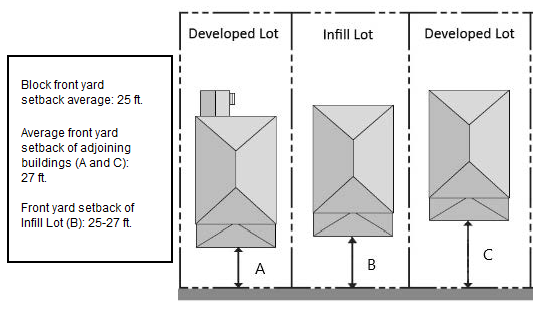
Infill setbacks (applicable only for existing lots of record at time of ordinance adoption). On residential blocks where fifty (50) percent or more of the existing lots on one (1) side of the street have a front yard setback variation of eight (8) feet or less, buildings hereafter erected, moved, or structurally altered on that block shall provide a front yard setback as follows:
a.
The front yard setback minimum shall be the average of the residential block lots with the eight (8) foot or less variation in front setback yard depth.
b.
The front yard setback shall not exceed the average of two (2) adjoining buildings, one (1) on either side of the lot if the adjoining buildings are within two hundred (200) feet of the subject lot.
c.
Subsection (b)(1) shall not require a front yard setback greater in depth than the minimum front yard setback required in the applicable district.
d.
Subsection (b)(1) shall not apply to proposed buildings less than twenty (20) feet from any street line.
(Example: Infill Lot is single-family detached home proposed for a lot in the RMF district. The minimum front yard setback for the RMF district is thirty (30) feet. More than fifty (50) percent of the front yard setbacks on the block have a variation of eight (8) feet or less between one another, with an average front yard setback of twenty-five (25) feet between all of them. Infill lot is also located within two hundred (200) feet from the adjoining buildings (A and C). The average front yard setback of buildings A and C is twenty-seven (27) feet. Infill lot shall provide a front yard setback no less than twenty-five (25) feet and no greater than twenty-seven (27) feet.
(b)
The following attached structures will be permitted to project into the specified bufferyard for the following distance:
(1)
Cornices, overhanging eaves and gutters, windowsills, bay windows, or similar architectural features, chimneys and fireplaces, fire escapes, fire balconies, fire towers, open unenclosed stoops (as defined in article II), open unenclosed decks, and open unenclosed steps may project no more than two and one-half (2 ½) feet into any required bufferyard, but in no case closer than three (3) feet to any property line or in compliance with state building codes.
(2)
Open covered porches, excluding screened or glassed, may project no more than five (5) feet into a front or rear yard; provided such porch does not exceed thirty-five (35) square feet in surface area.
(3)
Open unenclosed carports which are attached to and part of the principal structure and which are unenclosed on all exterior sides, except for necessary supports, may project into side or rear yards but shall be no closer than fifteen (15) feet to a side or rear yard adjoining a street right-of-way and no closer than five (5) feet to a side or rear property line.
(4)
Gas pump island canopies can project into any bufferyard in accordance with the bufferyard regulations, however, no gas pump island canopy shall be located closer than ten (10) feet to a street right-of-way line.
(5)
Canopies and awnings can project into any bufferyard in accordance with the bufferyard regulations or the following requirements, whichever is greater:
a.
B1H district: not closer than five (5) feet to any street right-of-way.
b.
All other nonresidential districts: not closer than ten (10) feet to any street right-of-way.
c.
All residential districts: five (5) feet into any bufferyard.
(Code 1993, § 27-59; Ord. No. 98-21, 11-9-1998; Ord. No. 05-5, § 1, 2-14-2005; Ord. No. 21-3, § 1(Att.), 6-14-2021)
Editor's note— Ord. No. 21-3, § 1(Att.), adopted June 14, 2021, amended the title of § 40-148 to read as herein set out. The former § 40-148 title pertained to Projections into required yards.
Sec. 40-149. - Special standards for certain permitted uses.
(a)
The uses listed herein require special standards to be met. Standards may be found in sections (b) through (u) below.
(1)
Temporary uses.
(2)
Home occupations.
(3)
Schools, public and private.
(4)
Municipal government building, uses.
(5)
Family care home.
(6)
Bona fide farms.
(7)
Condominium-type (unit ownership) and townhouse-type development.
(8)
Marinas.
(9)
Boardinghouses and roominghouses.
(10)
Agricultural production (livestock), animal feeder/breeder, animal services (livestock), animal services (other). Hog and poultry production is specifically prohibited.
(11)
Minor automobile repair services.
(12)
Churches.
(13)
Noncommercial parks and recreational facilities in the airport zoning classification.
(14)
Manufactured home sales.
(15)
Public school maintenance facilities in residential zoning districts.
(16)
Mixed uses development in an industrial district.
(17)
Automotive parking lots at grade level in the Residential Historic District (RHD).
(18)
Light industrial uses in the B2 General Business District.
(19)
Forest regulations.
(20)
Private event center (indoor).
(b)
Temporary uses.
(1)
Purpose. It is the purpose of this section to recognize that there is a need for special allowances to be granted to certain temporary uses so that they may be permitted within the community. Because of the special problems related to temporary uses it is also necessary to provide specific, separate, and distinct guidelines and standards for them. It is the express intent of these provisions to minimize any potential adverse impact of such temporary uses by eliminating, to the greatest possible extent, any major problems, threats, or dangers to the public health, safety, or welfare as may exist with any or all of these temporary uses.
(2)
Permitted temporary uses. Temporary uses shall be limited to a use of land, buildings, or structures not intended to be of a permanent duration. Such uses shall be limited to the following:
a.
Circuses and/or carnivals.
b.
Evangelistic and religious events.
c.
Outdoor bazaars, cookouts and/or similar activities by churches or other nonprofit institutions or organizations.
d.
Open lot sales area for farm produce made or grown by the farm producer or immediate family.
e.
Open lot sales area for Christmas trees or special fund raising sales for nonprofit organizations.
f.
Contractors' offices and/or construction sheds including mobile offices for displaces or contractors during construction on the site.
g.
Temporary on-site real estate offices.
h.
Temporary special sales or flea markets in commercial or industrial districts, occasional sidewalk or parking lot sales.
i.
Yard sales conducted outdoors by a resident in their respective yard area.
j.
Other temporary recreational or entertainment-related events or activities such as fairs or concerts. Itinerant merchants, as defined in sections 16-140, shall not be considered a temporary use pursuant to this section. Itinerant merchants shall be subject to the regulations and permit requirements of chapter 16, article V, rather than the requirements of this article.
(3)
Permit required. Any person desiring to conduct a permitted temporary use, as defined in subsection (2) of this section, must first obtain a permit from the Department of Planning and Development. Such a permit will establish the requirements for the particular uses set out in subsection (3)d. of this section.
a.
Purpose. The purpose of this permit is to ensure that a temporary use meets the requirements set out herein and to coordinate traffic, parking, and other inspections necessary to the safe and healthful operation of the event.
b.
Application. Application for a temporary use permit shall be made to the Director of Planning and Development, on a form furnished by the Department of Planning and Development, at least five (5) working days prior to the start of the event.
c.
Requirements for permit issuance. A temporary use permit shall not be issued until evidence is shown that the following requirements have been or will be complied with:
1.
The temporary use is permitted under subsection (2) of this section.
2.
Ample parking is provided for the temporary event, in addition to required parking for any permanent use located at the event site.
3.
Written and notarized authorization is given from the property owner or his agent for the event to take place.
4.
Any event held outside of a building and within five hundred (500) feet of any residence shall cease operation by 10:00 p.m.
5.
Noise shall be controlled so no adjoining property owner or occupant is unduly disturbed by the event.
d.
Additional conditions or requirements. The following additional conditions or requirements shall apply for each permitted temporary use:
(c)
Home occupations.
(1)
Home occupations, as defined in article II of this chapter, may be permitted only under the following conditions:
a.
Home occupations shall only be permitted in single-family dwelling units.
b.
Home occupations shall constitute an accessory use to the principal use.
c.
Home occupations shall not occupy more than one-third (⅓) of the total area of the principal use dwelling, and in no event occupy more than five hundred (500) square feet of floor area.
d.
Home occupations shall not employ more than one (1) person other than those persons legally residing within the principal use dwelling.
e.
Home occupations shall not be visible from any public right-of-way or adjacent property line.
f.
Home occupations shall not involve any outside storage of related materials, parts, or supplies.
g.
Home occupations shall have signage in accordance with article XVI of this chapter, pertaining to signs.
h.
Home occupations shall not create any hazard or nuisance to the occupants residing or working within the principal use dwelling or to area residents or properties.
i.
Home occupations shall not involve any external structural alterations which are not customary in residential buildings.
j.
The on-site sale of articles produced elsewhere than within the dwelling shall not be permitted.
k.
Home occupations shall not be permitted within accessory structures or buildings.
(2)
Permit required. Any person desiring to conduct a permitted home occupation, as defined in sections 40-25, must first obtain a permit from the Department of Planning and Development. Such a permit will establish the requirements for the particular uses set out in subsection (b)(1) of this section.
a.
Purpose. The purpose of this permit is to ensure that a home occupation meets the requirements set out herein.
b.
Application. Application for a home occupation permit shall be made to the Director of Planning and Development, on a form furnished by the Department of Planning and Development.
c.
Requirements for permit issuance. A home occupation permit shall not be issued until evidence is shown that the following requirements have been or will be complied with.
1.
The home occupation meets the requirements of subsection (b)(1) of this section.
2.
Ample parking is provided for the home occupation, in addition to required parking for any permanent use located at the site.
3.
Noise shall be controlled so no adjoining property owner or occupant is unduly disturbed by the home occupation.
(3)
Incidental use. The following permitted limited in-home services and/or business activities shall not constitute a home occupation and shall be construed as an incidental accessory residential use within any dwelling, for purposes of regulation under this chapter, provided that: (i) not more than one (1) person is engaged in the conduct of the listed activity, (ii) the person that is engaged in the conduct of the activity shall be a permanent resident within the subject dwelling, (iii) not more than two (2) customer/clients shall be allowed on the premises at any one (1) time, (iv) no on-site signage shall be displayed in connection with the limited in-home service and/or business activity, and (v) the activity is compliant with subsection 40-149(b)(1):
a.
Music or dance instructor, provided all associated amplified and/or non-amplified sound is not plainly audible, within any adjacent area dwelling unit or beyond the adjacent property line;
b.
Educational tutoring;
c.
Accountant, tax and/or financial advisor, stockbroker;
d.
Attorney at law;
e.
Counseling, including psychologist, marriage and similar professional counselor;
f.
Doctor, physical therapist or other similar health care professional;
g.
Consultant, including public relations, advertising, computer science, engineering, architect and other similar professional consultant;
h.
Clothes alteration seamstress; excluding garment manufacturing, shoe repair and sales of clothing items;
i.
Catalogue ordering sales consultant business wherein retail products are ordered by the end customer from a catalogue and/or by reference to limited samples displayed at off-site locations remote to the business address;
j.
Artist, photographer/videographer, graphic designer, writer;
k.
Real estate broker/realtor;
l.
Real estate/personal property appraiser;
m.
General contractor including building, painting, electrical, plumbing, mechanical, landscape, and cleaning/janitorial service, excluding any on-site: (i) physical display and/or storage of products, and materials, (ii) manufacture or assembly, (iii) storage of construction or service delivery equipment including trucks, trailers, excavators, tractors, and mowers of a type and number uncommon to typical domestic residential use, provided however a personal transportation vehicle customarily associated with residential use, shall be permitted; and
n.
The incidental use of any dwelling by the occupant(s) for the purpose of receiving or transmitting messages or mail, record or bookkeeping, filing, address listing for applicable privilege license or tax identification, and other similar activities, which do not involve the on-site sale, delivery, distribution, reception, storage or manufacture of goods, products or services.
(d)
Schools, public and private. Public and private schools:
(1)
Shall be subject to the bufferyard regulations, however, no principal or accessory building shall be located within fifty (50) feet of any adjoining property or public street right-of-way line.
(2)
The minimum lot size shall be three (3) acres.
(3)
The bufferyard and lot size requirements shall not apply to schools in the B1H zone.
(4)
In the B1H zone, the student drop-off area shall be provided, with a stacking arrangement for cars before the drop-off space. Traffic shall not be completely blocked in either direction by cars stacked for dropoff.
(e)
Municipal government building uses. Municipal government building or use, including police and fire stations, libraries, and public parks or athletic fields: When municipal buildings, parks, or other recreational areas to be used for athletic events or night programs are located in a residential zone or adjoining a lot containing a permitted residential use, a public hearing shall be properly advertised and conducted before the City Council for the purposes of hearing and considering any comments by the public as to the location under consideration.
(f)
Family care home. No family care home shall be permitted within a one-half (½) mile, two thousand six hundred forty (2,640) feet, the radius of an existing family care home as measured from the nearest lot line of the proposed family care home to the nearest lot line of an existing family care home.
(g)
Bona fide farms.
(1)
Buildings and structures shall meet the minimum standards for the applicable district. Bona fide farm buildings and structures located in a residential district shall meet applicable single-family dwelling standards.
(2)
Agricultural cultivation shall be exempt from any required setbacks, provided no structures are required or utilized within the setbacks listed under subsection (g)(1) of this section.
(3)
Bufferyard vegetation standards shall not apply to any bona fide farm.
(h)
Condominium-type (unit ownership) and townhouse-type development.
(1)
Attached residential and nonresidential units constructed for individual owner occupancy shall be subject to the following:
a.
Interior units of each structure may be constructed on common property lines (zero (0) lot line setbacks) provided the overall structure meets the front, side, and rear setbacks for the applicable use and district. If there is an offset of the wall from the interior common lot line, such offset shall be set back not less than five (5) feet.
b.
No two (2) units shall be considered attached unless such units share a common five-foot party wall.
c.
Common party walls shall be constructed in accordance with the state building code, G.S. Chapter 47C (G.S. 47C-1-101 et seq.) (North Carolina Condominium Act), and other applicable requirements.
d.
The overall density of the development shall be no greater than that permitted by applicable district requirements.
e.
The maximum lot coverage for the district shall apply to the development.
f.
Buildings, units, or lots separated by a public street right-of-way shall be considered individually for compliance under subsection (h)(1)d. and e. of this section.
g.
In the case of staggered or extended common property line walls, a five-foot maintenance and access easement with a maximum two-foot eave encroachment easement within the maintenance easement shall be established on either end of the building and shall ensure ready access to both ends of the building wall for normal maintenance. The designated common area which provides such access shall meet the requirements of this section.
h.
The minimum lot width of each townhouse lot shall be no less than sixteen (16) feet, provided that when the lot is combined with other contiguous lots within the development the combined lot widths are equal to or exceed the minimum lot width of the applicable district for the particular use.
i.
All development regulated in accordance with this section shall be subject to the requirements, conditions, and restrictions of the subdivision regulations.
(i)
Marinas. All marinas, as defined in article II, located within the jurisdiction of this chapter, whether they are permitted uses, special uses, or otherwise, shall be subject to the following restrictions:
(1)
Marinas shall be limited to one (1) per lot, regardless of the number of dwellings or commercial units located on such lot, and must comply in all respects with the standard and intent of the Coastal Area Management Act.
(2)
Marinas shall not interfere with the access to any adjacent property and shall have a minimum setback of fifteen (15) feet from property lines. The minimum setback may be waived by the Board of Adjustment if the affected property owner consents in writing to the waiver.
(3)
Marinas shall provide pumpout facilities. This requirement may be waived by the Director of Planning and Development if a marina will not accommodate boats with heads or wastewater storage tanks.
(4)
All marinas shall provide off-street parking as follows:
a.
If associated with residential or preexisting development, one-half (½) space per slip/mooring, plus the spaces required by the associated development, as listed in article XVII of this chapter.
b.
If associated with or developed as a business, according to the spaces required for marinas in article XVII of this chapter, in addition to any spaces required for the adjoining business.
(5)
The following words, terms, and phrases, when used in this section, shall have the meanings ascribed to them in this subsection, except where the context clearly indicates a different meaning:
Basin means a facility for the harboring of boats, the construction of which involves the extraction of natural materials.
Dock means a wharf, pier, or platform containing spaces or slips designed for the docking of boats and accommodating boarding access to floating boats from one (1) or both sides of the boat.
Permanent mooring means a fixture in the river bottom such as mooring poles or buoys to which boats tie for locational stability.
Wet boat storage means facilities for holding unoccupied vessels in the water, including permanent moorings.
(j)
Boardinghouses and rooming houses. As defined in article II of this chapter, boardinghouses, and rooming houses must meet all of the following conditions:
(1)
The total number of unrelated occupants, in addition to the resident family, to which space is let shall not exceed four (4) persons.
(2)
The minimum lot size shall be nine thousand (9,000) square feet.
(3)
No boardinghouse or rooming house shall be located within a four hundred-foot radius of another boardinghouse or rooming house.
(4)
One (1) parking space must be provided for each tenant, in addition to required spaces for the resident family.
(5)
No more than two (2) required parking spaces may be located in the front yard; additional parking is to be located in the rear yard and shall be no closer than five (5) feet to the property line. The five-foot buffer is to be used as a planting area for evergreen plant material to be located on three-foot centers to reach a height of at least four (4) feet in three (3) years.
(6)
The driveway and the parking area are to be constructed with hard surface all-weather material such as asphalt, concrete, brick, CABC, or any other approved material. Grass and bare earth material are not acceptable.
(7)
The total amount of land devoted to structures and parking shall not exceed sixty (60) percent of the total lot area.
(8)
The use shall be considered an accessory use within an owner-occupied, single-family dwelling.
(9)
In the event a single-family dwelling has been converted to a rooming house or boardinghouse without prior approval from the city, the following procedures shall be followed:
a.
The city will notify the owner of the violation.
b.
Upon notification by the city, the owner will have six (6) months to be in compliance with the requirements or discontinue the use of the building.
c.
If the owner disagrees with the ruling, they may appeal the decision to the Board of Adjustment.
(k)
Agricultural production (livestock), animal feeder/breeder, animal services (livestock), animal services (other). Hog and poultry production is specifically prohibited.
(l)
Minor automobile repair services.
(1)
All wrecked or damaged motor vehicles and parts shall be screened by an opaque fence of uniform construction, a minimum of six (6) feet in height, and with a bufferyard of greater intensity, as required by the bufferyard regulations, as not to be visible from adjoining property lines and street rights-of-way.
(2)
Non-wrecked or visually damaged vehicles on the premises for repair shall be stored at the rear of the principal structure.
(3)
No vehicle shall be stored on the premises for more than fifteen (15) days.
(4)
There shall be no exterior storage of items other than vehicles. No vehicles shall be stored within ten (10) feet of any street right-of-way.
(5)
There shall be no sale of vehicles.
(6)
Rental of utility trailers, cars, and trucks shall be permitted as accessory uses provided that all units in excess of four (4) shall be screened from adjoining street rights-of-way and property lines by an opaque fence of uniform construction, a minimum of six (6) feet in height, and with a bufferyard of greater intensity as required by the bufferyard regulations.
(7)
Outdoor displays of products such as tires, oil, wiper blades, or other similar products shall be permitted provided they are within ten (10) feet of the principal structure and outside required bufferyards. Signage displayed in conjunction with such display shall be in accordance with the sign regulations.
(8)
All services, except fuel sales and services related to fuel sales, such as window washing and oil checks, shall be performed within a completely enclosed building.
(m)
Churches.
(1)
Minimum lot requirement shall be sixty thousand (60,000) square feet.
(2)
Not less than fifty (50) percent of available parking must be provided on-site.
(n)
Noncommercial parks and recreational facilities in the airport zoning classification.
(1)
Minimum lot size shall be forty (40) acres.
(2)
Minimum frontage adjacent to a dedicated and accepted street shall be five hundred (500) linear feet.
(3)
Berms may be constructed parallel to street rights-of-way.
(4)
Restroom facilities shall be installed and connected to municipal water and sewer lines.
(o)
Manufactured home sales.
(1)
A site plan shall be submitted showing office buildings, accessory buildings, parking, general and service driveways, bufferyards, including landscaping, and the location and orientation of the mobile home display area.
(2)
Setbacks for homes on display shall meet building setback requirements for the zone in which the lot is located.
(3)
All display homes located adjacent to public streets shall be skirted.
(4)
Bufferyard E shall be installed where the side and rear lot lines are adjacent to classifications I and II land uses or residentially zoned vacant land. Bufferyard D shall be installed where the side and rear lot lines are adjacent to classifications III, IV, or V land uses or nonresidential zoned vacant land. Along public streets, bufferyard A shall be installed, except no bufferyard width shall be less than six (6) feet.
a.
Bufferyard width may not be reduced by using the fencing option.
b.
If the fencing option is used to reduce bufferyard vegetation, the fence shall face the adjoining property and the vegetation shall be installed along the outer perimeter of the fence. Acceptable fence materials include cedar, masonry, or pressure-treated lumber resistant to rot.
c.
Preference shall be given to trees or shrubs which grow to at least eight (8) feet tall.
(5)
All mobile home sales businesses not in compliance with these standards shall become nonconforming in all districts as of the date of adoption of the ordinance from which this article is derived and shall be brought into compliance or removed within five (5) years after February 13, 2006.
(p)
Public school maintenance facilities in residential zoning districts.
(1)
Minimum lot size: twenty thousand (20,000) square feet.
(2)
External front, side, and rear yard setback: fifty (50) feet.
(3)
Operation of the facility is Monday through Friday, 7:00 a.m. through 5:00 p.m., or when emergency situations arise, i.e., hurricanes, tornadoes, or other natural disasters.
(4)
No outside storage of materials shall be permitted.
(q)
Mixed uses development in an industrial district.
(1)
Conversion of existing buildings is allowed provided the property is located in a local, state, or national Register of Historic Places or within two hundred (200) feet of a local historic district.
(2)
All permitted and special uses listed in sections 40-94 are allowed under the zoning district classifications I1 and I2. In addition, multifamily development is allowed provided the development standards for the industrial mixed-use classification can be met, as provided in this section.
(3)
Development standards in the mixed-use classification are subject to the following development standards:
a.
Minimum lot area: one thousand (1,000) square feet per unit or eighteen thousand (18,000) square feet per lot.
b.
Minimum lot width: seventy-five (75) feet.
c.
Minimum side and rear yard setbacks are to be determined by the state building code.
d.
Minimum front yard setback: This distance is to be determined by the average of the existing structures located in the same block where the building is to be located.
e.
Parking: Article XVII of this chapter, pertaining to parking, shall apply. Parking for residential uses for this mixed-use classification shall be one (1) off-street parking space for each bedroom.
f.
Landscaping along street frontage is required. A combination of fencing, shrubs, and trees shall be installed on the land. One (1) tree shall be installed per unit. Shrubs may be substituted for the tree at a ratio of four (4) shrubs for each tree. Ground cover (plant material) may be substituted for grass.
g.
The site plan shall be approved by the Planning Board prior to the building permit being issued. The site plan shall be prepared by a registered architect or engineer and drawn to scale. The site plan shall consist of the front, side, and rear elevations of the building including landscaping and off-street parking.
(r)
Automotive parking lots at grade level in the Residential Historic District (RHD).
(1)
Vacant lots in the Residential Historic District cannot be used in connection or associated with commercial or industrial permitted or special uses.
(2)
When parking lots are developed in conjunction with a permitted or special use in the Residential Historic District (RHD), screening material in the form of a berm, fencing, and landscaping shall be constructed in accordance with article VII of this chapter, pertaining to bufferyard landscaping requirements.
(3)
A front yard setback of ten (10) feet shall be created along the front of the parking lot and shall be maintained as an open space planted with trees, shrubs, and ground cover.
(4)
Driveways to the parking lot entrances and exits shall be constructed of concrete material along with curbing and guttering. The new curb section shall be constructed adjacent to the right-of-way line of the property.
(s)
Light industrial uses in the B2 General Business District.
(1)
Conversion of existing buildings in the B2 General Business District is allowed for light industrial uses, provided that the primary structure has existed for ten (10) years prior to the operation of the new use.
(2)
All permitted and special uses listed in section 40-94, allowed under the zoning District I2 (Light Industrial District), are allowed as permitted and special uses for these converted existing buildings in the B2 General Business District.
(3)
Developmental standards for light industrial uses in the B2 General Business District are as follows:
a.
Minimum lot area: five (5) acres.
b.
Minimum lot width: two hundred (200) feet.
c.
Minimum front yard setback: fifty (50) feet.
d.
Minimum side yard setback: twenty (20) feet.
e.
Minimum corner lot setback: twenty-five (25) feet.
f.
Minimum rear yard setback: twenty (20) feet.
g.
Minimum square footage of an existing building: thirty thousand (30,000) square feet.
h.
Maximum height: fifty (50) feet.
i.
All outside storage material shall be located at the rear of the principal building in an enclosed structure.
j.
Bufferyards and landscaping requirements shall be met in accordance with article VII of this chapter.
k.
Parking requirements shall be met in accordance with article XVII of this chapter.
(t)
Forest regulations.
(1)
A city shall not adopt or enforce any ordinance, rule, regulation, or resolution that regulates either:
a.
Forestry activity on forestland that is taxed on the basis of its present-use value as forestland under article 12 of chapter 105 of the General Statutes (G.S. ch. 105, art. 12).
b.
Forestry activity that is conducted in accordance with a forest management plan that is prepared or approved by a forester registered in accordance with Chapter 89B of the General Statutes (G.S. ch. 89B).
(2)
This section shall not be construed to limit, expand, or otherwise alter the authority of a city to:
a.
Regulate activity associated with development. A city may deny a building permit or refuse to approve a site or subdivision plan for either a period of up to:
1.
Three (3) years after the completion of a timber harvest, if the harvest results in the removal of all or substantially all of the trees that were protected under city regulations governing development from the tract of land for which the permit or approval is sought.
2.
Five (5) years after the completion of a timber harvest, if the harvest results in the removal of all or substantially all of the trees that were protected under city regulations governing development from the tract of land for which the permit or approval is sought and the harvest was a willful violation of the city regulations.
b.
Regulate trees pursuant to any local act of the General Assembly.
c.
Adopt ordinances that are necessary to comply with any Federal or State law, regulation, or rule.
d.
Exercise its planning or zoning authority under this article.
e.
Regulate and protect streets under chapter 32, pertaining to streets and sidewalks.
(u)
Private event center (indoor).
(1)
No such establishment shall be located within one hundred (100) feet from the nearest property line of a church, elementary or secondary school, public park, playground, library, or residentially zoned property.
(2)
No such establishment shall be located within three hundred (300) feet from the nearest property line of another private event center or private event space.
(3)
The hours of operation shall be limited to 7:00 a.m. to 11:00 p.m.
(4)
Sound generated by the use shall be in compliance with chapter 20, article V—sound and noise control, of this Code.
(5)
All on-site lighting must be directed away from all adjacent properties.
(6)
Bufferyards/landscaping shall be in compliance with article VII of this chapter. Private event center (indoor) shall be a classification III—medium impact commercial recreation use.
(7)
Under no circumstances should a private event center (indoor) be used as a private club or music venue.
(Code 1993, § 27-61; Ord. No. 98-3, 2-9-1998; Ord. No. 99-1, 1-11-1999; Ord. No. 99-2, 6-14-1999; Ord. No. 99-13, 10-11-1999; Ord. No. 00-3, 2-14-2000; Ord. No. 00-14, 9-11-2000; Ord. No. 01-4, 5-14-2001; Ord. No. 01-14, 10-8-2001; Ord. No. 02-23, 11-11-2002; Ord. No. 06-02, § 14, 2-13-2006; Ord. No. 21-3, § 1(Att.), 6-14-2021; Ord. No. 24-1, §§ 8, 9, 5-13-2024)
Sec. 40-150. - Sidewalk requirements.
Construction of sidewalks shall be required in all commercial development, except when abutting a freeway, and along major thoroughfares, minor thoroughfares, and boulevards in conjunction with the construction of any new non-residential developments, mixed-use developments, and multifamily residential developments in accordance with the provisions of this section. The sidewalk requirements in this section are in addition to sidewalk requirements set forth under section 34-154.
(a)
Sidewalks shall be provided along both sides of major thoroughfares, minor thoroughfares, and boulevards as designated in the adopted Comprehensive Transportation Plan, and any subsequent amendments. The developer shall provide the sidewalk on the side of the street where the development is located in conjunction with the new development on existing lots.
(b)
Sidewalk shall be provided on all roads within and abutting commercial development, except when abutting a freeway.
(c)
Construction of sidewalks required by this section shall be accomplished along the entire length of all property of the development abutting any public street.
(d)
Sidewalks shall be constructed in accordance with the Manual of Standard Designs and Details. The specific design and location of all sidewalks shall be reviewed by the Director of Public Works. The Director of Public Works may expand the required width of sidewalks from the Manual of Standard Design and Details in certain locations of the city and in limited cases, reduce the required width of sidewalks to avoid obstructions while remaining in compliance with dimensional standards of the Americans with Disabilities Act.
(e)
All required sidewalks shall be installed prior to any occupancy, including temporary occupancy, of new development.
(f)
Additional requirements.
(1)
If special conditions make sidewalk construction unnecessary or undesirable and such conditions have been verified by the Director of Public Works, the requirement to construct sidewalks on any street in conjunction with the construction of any new building on existing lots may be deferred. Such deferment shall be granted upon written application to and approval of the Director of Public Works based on circumstances the Director determines are currently undesirable for sidewalk installation.
(2)
General standards the Director may use while considering deferment of sidewalk installation shall include, but not be limited to, pending changes to rights-of-way alignments, pending changes to roadway drainage facilities, unsafe contours or unprotected drainage facilities adjacent to the sidewalk route, or pending utility work or other construction scheduled in the area beyond the developer's control that could damage the sidewalk if installed. Special conditions which make the sidewalk construction unnecessary or undesirable shall not include the personal circumstances of the developer or the lack of sidewalks on adjacent or nearby properties.
(3)
If approved for a circumstance where the sidewalk construction is being delayed, the cost of the installation and construction of the deferred sidewalk, as determined by the Public Works Director, shall be paid by the developer to the city and the city will construct and install the sidewalk when the circumstances for deferment no longer exist. If approved for a circumstance where the sidewalk construction will not occur, no payment for sidewalk construction will be required by the developer. Appeals of decisions made by the Director of Public Works may be made by the developer to the Board of Adjustment.
(Ord. No. 21-3, § 1(Att.), 6-14-2021)

