
Washington City Zoning Code
ARTICLE XVI
SIGNS
Sec. 40-403.- Definitions.
The following words, terms and phrases, when used in this article, shall have the meanings ascribed to them in this section, except where the context clearly indicates a different meaning:
Banner means a suspended sign made of a flexible material such as canvas, sailcloth, plastic, or waterproof paper.

Building facade means the face of a building oriented in the same direction, or within a forty-five-degree angle of the same direction, including roof and wall.
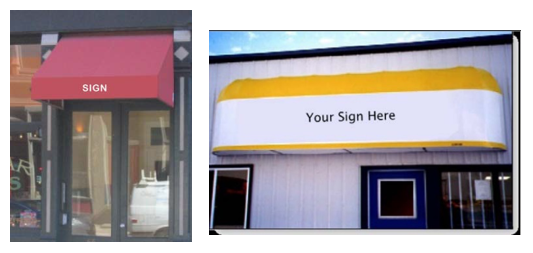
Canopy or awning sign means a sign that is applied to a canopy or awning.
Changeable copy means a non-digital sign or portion thereof with characters, letters, or illustrations that can be changed or rearranged manually without altering the face or surface of the sign.

Flags means devices made of flexible material which are mounted on a pole and become limp when the wind is not blowing which represent or symbolize an organization, group, cause, event, activity, or unit of government.
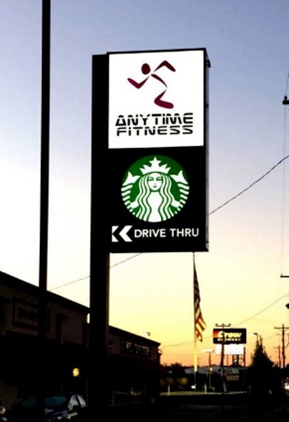
Freestanding sign means a sign that is attached to, erected on, or supported by some structure (such as a pole, mast, frame, or other structure) that is not itself an integral part of or attached to a building or other structure whose principal function is something other than the support of a sign. A sign that stands without supporting elements, such as, a sandwich sign, is considered a freestanding sign, but is also considered a portable sign, as defined in this section.
Heritage sign means an exterior historical sign painted before 1975 located in the B1H Zoning District called the Central Business Historic District within the City of Washington. Heritage signs are also known as ghost signs typically used in the past for product advertising.
Internally illuminated sign means a sign where the source of the illumination is inside the sign and light emanates through the message of the sign, rather than being reflected off the surface of the sign from an external source. Without limiting the generality of the foregoing, signs that consist of or contain tubes that are filled with neon or some other gas that glows when an electric current passes through it and are intended to form or constitute all or part of the message of the sign, rather than merely providing illumination to other parts of the sign that contain the message, shall also be considered internally illuminated signs.
Nonconforming sign means any sign which was lawfully erected in compliance with applicable code provisions and maintained prior to the effective date of the ordinance from which this article is adopted, and which fails to conform to all applicable standards and restrictions of this article.
Off-premises signs means a sign that draws attention to or communicates information about a business, service, commodity, accommodation, attraction, or other activity that is conducted, sold, or offered at a location other than the premises on which the sign is located. Such signs are not permitted, except those specifically exempt in accordance with section 40-406.
On-premises signs means a sign that draws attention to or communicates information about a business, service, commodity, accommodation, attraction, or other activity that is conducted, sold, or offered at or on the premises on which the sign is located.
Outdoor advertising sign means an outdoor sign displaying a non-commercial message or identifying, advertising, and/or directing the public to a business, merchandise, service, entertainment or product which is unrelated to the place, use of, products sold on, or sale or lease of, the property on which such sign is located. These signs are also known as off-premise or billboards.
Portable sign means a sign that is designed to be moved from place to place and which is not permanently installed or permanently anchored to either the ground or a wall.
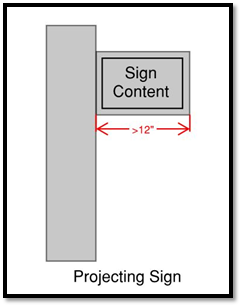
Projecting signs means a sign that is attached to and projects more than twelve (12) inches from a building facade or wall.
Sign means any device that is sufficiently visible to persons not located on the lot where such device is located to accomplish the objective of directing attention to a business, commodity, service, entertainment or other activity sold or offered exclusively on the premises where the sign is located, or of communicating information to them.
A shopping center directory sign means any sign identifying the name of a shopping center and depicting the various tenants within.

Subdivision directory means any sign supported wholly or in part by some structure other than the building or buildings housing the business to which the sign pertains, or any sign which projects more than five (5) feet from the side of the building to which it is attached.
Temporary sign means a sign that is used in connection with a circumstance, situation, or event that is designed, intended, or expected to take place or to be completed within a reasonably short or definite period after the erection of such sign, or is intended to remain on the location where it is erected or placed for a period of not more than thirty (30) days. If a sign display area is permanent but the message displayed is subject to periodic changes, that sign shall not be regarded as temporary. Banners are not allowed as temporary signs, except as permitted in sections 40-415(b) and (f).
Wall sign means any sign attached to, painted on, or erected against any wall of a building or structure so that the exposed face of the sign is on a place parallel to the plane of said wall and which does not extend more than twelve (12) inches from the wall. Wall signs also include any sign erected against, installed on or painted on a penthouse above the roof of a building as long as the wall of the penthouse is on a plane parallel to the wall of the building. Wall signs also include a sign attached to, painted on, or erected against a false wall or false roof that does not vary more than thirty (30) degrees from the plane of the adjoining wall elevation.
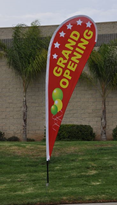
Wind blade sign means a form of temporary sign composed of durable lightweight fabric with a sturdy frame enclosing only a portion of the material's edge so that it can remain upright and still be flexible in the breeze. Such signs are legible even without the blowing of the wind.
Window sign means a window sign is a sign attached directly onto the outside of the window of a building.
(Code 1993, § 27-164; Ord. No. 02-21, 11-11-2002; Ord. No. 21-3, § 1(Att.), 6-14-2021; Ord. No. 21-7, § 1, 11-8-2021)
Sec. 40-404. - Purpose.
The purpose of this article shall be to allow certain signs of a residential and commercial nature in areas designated for such uses in a manner which will best provide and ensure:
(a)
The health, safety, and general welfare of the public.
(b)
The adequate supply of light and air to adjacent properties.
(c)
Adequate and proportionate advertisement displays which promote and protect the economic vitality of the community.
(d)
That signage displayed adjacent to and visible from a public right-of-way will not distract or confuse the motoring public, thereby causing a public hazard.
(e)
That the aesthetic quality of the city is maintained for the benefit of all the citizens of the city, county, and the state as a whole.
(Code 1993, § 27-163)
Sec. 40-405. - Permit required.
(a)
Except as otherwise provided in sections 40-406 and 40-407, no sign may be erected, moved, enlarged, or substantially altered, except in accordance with the provisions of this section. Mere repainting or changing the message on a changeable copy sign shall not, in and of itself, be considered a substantial alteration, unless a change of use or occupancy occurs. If a change of use or occupancy occurs, or if a sign is replaced, then a sign permit shall be required.
(b)
Sign permit approval is a separate process from building permit approval. Although detailed sign plans may be included in site plans for a building permit, a separate sign permit must be obtained before any sign can be constructed.
(c)
Signs may be erected, moved, enlarged, or substantially altered only in accordance with a sign permit issued by the city. Violations of this provision shall be handled in accordance with article XXI of this chapter, pertaining to administration, enforcement, penalties.
(Code 1993, § 27-165; Ord. No. 21-3, § 1(Att.), 6-14-2021)
Sec. 40-406. - Signs excluded from regulation.
The following signs are exempt from regulation under this article, except for those restrictions stated in this section:
(a)
Signs not exceeding four (4) square feet in area that are customarily associated with residential use and that are not of a commercial nature, such as signs giving property identification names or numbers or names of occupants, signs on mailboxes or newspaper tubes, and signs posted on private property relating to private parking or warning the public against trespassing, danger from animals, or other dangers.
(b)
Signs erected by or on behalf of or pursuant to the authorization of a governmental body, including legal notices, identification, and informational signs, and traffic, directional, or regulatory signs.
(c)
Official signs erected by public utilities.
(d)
Flags, pennants, or insignia of any governmental or nonprofit organization when not displayed in connection with a commercial promotion or as an advertising device.
(e)
Integral decorative or architectural features of buildings or works of art, so long as such features or works do not contain letters, trademarks, moving parts, or lights.
(f)
Signs directing and guiding traffic, such as entrance and exit signs, and do not contain a commercial message or logo, on private property that does not exceed four (4) square feet each
(g)
Signs painted on or otherwise permanently attached to currently licensed motor vehicles and trailers that are not primarily used as signs.
(h)
A sign proclaiming noncommercial messages that do not exceed one (1) per lot per abutting street and sixteen (16) square feet in area.
(i)
Signs located on the interior of buildings, courts, lobbies, stadiums, or other structures that are not intended to be seen from the exterior of said building or structure.
(j)
Memorial and historical plaques or markers.
(k)
Sign painted to or attached to vending machines or similar devices which indicate the contents of the machine, the price, or operating instructions.
(l)
Government flags.
(1)
A county, city, consolidated city-county, or unified government shall not prohibit an official governmental flag from being flown or displayed if the official governmental flag is flown or displayed:
a.
In accordance with the patriotic customs set forth in 4 U.S.C. § 5-10, as amended; and
b.
Upon private or public property with the consent of either the owner of the property or of any person having lawful control of the property.
(2)
Notwithstanding subsection (a) of this section, for the purpose of protecting the public health, safety, and welfare, reasonable restrictions on flag size, number of flags, location, and height of flagpoles are not prohibited, provided such restrictions shall not discriminate against any official governmental flag in any manner.
(3)
For purposes of this section, the term "official governmental flag" shall mean any of the following:
a.
The flag of the United States of America.
b.
The flag of nations recognized by the United States of America.
c.
The flag of the state.
d.
The flag of any state or territory of the United States.
e.
The flag of a political subdivision of any state or territory of the United States.
(m)
Heritage signs. All exterior, historical painted wall signs in the B1H Zoning District are exempt from the requirements of this article, provided that the signs are restored to their original condition and appearance. No enhancements as to illumination or animation shall be added to the sign. A painted wall sign is considered historic if it predates 1975. Property owners wishing to restore a historical painted wall sign must verify with the designated City Historic Preservation Staff Planner the original state of the painted wall sign through photographic documentation or discernable outline. Any person wishing to renovate a sign located within the B1H Zoning District will be required to obtain a Certificate of Appropriateness from the City Historical Preservation Commission before proceeding with any work.
(Code 1993, § 27-166; Ord. No. 21-3, § 1(Att.), 6-14-2021; Ord. No. 21-7, § 2, 11-8-2021)
Sec. 40-407. - Temporary signs, permit exemptions and additional regulations.
(a)
The following temporary on-premise signs are permitted without a sign permit. However, such signs shall conform to the requirements set forth below as well as all other applicable requirements of this article, except those contained in section 40-410, pertaining to total allowable sign surface area, and section 40-413, pertaining to the number of freestanding and wall signs:
(1)
Signs containing the message that the real estate on which the sign is located (including buildings) is for sale, lease, or rent, together with information identifying the owner or agent. Such signs may not exceed four (4) square feet in area and shall be removed immediately after the sale, lease, or rental. For lots of less than five (5) acres, a single sign-on each street frontage may be erected. For lots of five (5) acres or more in the area and having a street frontage of more than four hundred (400) feet, a single sign not exceeding thirty-two (32) square feet in the area may be erected on each street frontage.
(2)
Construction site/opening soon identification signs. Not more than one (1) such sign may be erected per site, and it may not exceed thirty-two (32) square feet in area. Such signs shall not be erected prior to the issuance of a building permit and shall be removed within ten (10) days after the issuance of the final certificate of occupancy. One (1) "opening soon" sign may be permitted per building site provided such sign does not exceed thirty-two (32) square feet in area and is erected for a period not to exceed sixty (60) days.
(3)
Signs attached temporarily to the interior of a building window or glass door. Such sign, individually or collectively, may not cover more than seventy-five (75) percent of the surface area of the transparent portion of the window or door to which they are attached. In the B1H and RHD districts, signs placed in windows, from the interior, shall occupy no more than twenty (20) percent of the area of the displaying window. Such signs shall be removed within thirty (30) days after placement.
(4)
Displays, including lighting, erected in connection with the observance of holidays. Such signs shall be removed within ten (10) days following the holidays.
(5)
Signs advertising upcoming theatrical events or concerts are permitted and may be displayed no more than thirty (30) days before the event and will be removed within five (5) days after the event. These signs will not exceed six (6) square feet in size.
(b)
Other temporary signs, not listed in subsection (a) of this section, shall be regarded and treated in all respects as permanent signs.
(Code 1993, § 27-167; Ord. No. 11-4, § 2, 3-14-2011; Ord. No. 21-3, § 1(Att.), 6-14-2021)
Sec. 40-408. - Determining the number of signs.
(a)
For the purpose of determining the number of signs, a sign shall be considered to be a single display surface or display device containing elements organized, related, and composed to form a unit.
(b)
Without limiting the generality of subsection (a) of this section, a multi-sided sign shall be regarded as one (1) sign.
(Code 1993, § 27-168; Ord. No. 21-3, § 1(Att.), 6-14-2021)
Sec. 40-409. - Computation of sign area.
(a)
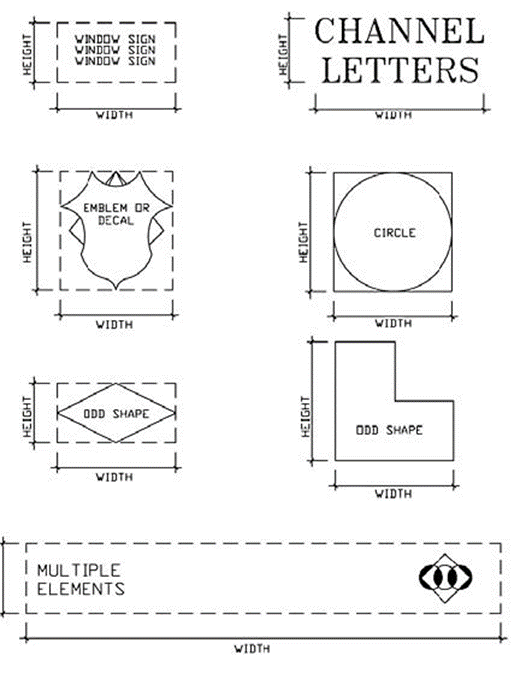
The sign area shall be computed by including the entire unit within a single, continuous, rectilinear perimeter forming ninety (90) degree angles, enclosing the extreme limits of the writing, representation, emblem or other display, together with any material or color forming an integral part of the background of the display or used to differentiate the sign from the backdrop or structure against which it is placed, but not including any supporting framework or bracing that is clearly incidental to the display itself.
(b)
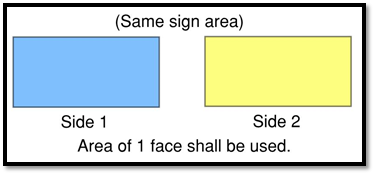
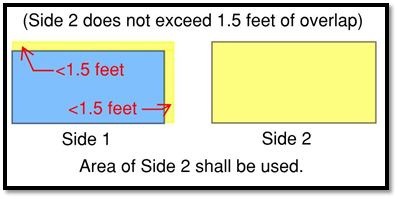
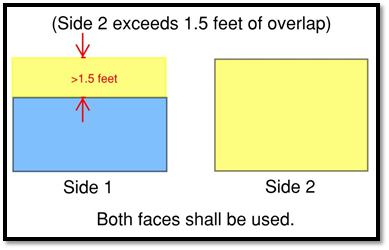
Where a sign has two (2) or more faces, the area of the sign shall be calculated as follows:
(1)
If two (2) faces have the same sign area, then the area of one (1) of the faces shall be used in the calculation of sign area.
(2)
If two (2) faces placed back-to-back contain no more than one and one-half (1½) feet of overlap between one another, the larger of the two (2) faces shall be used in the calculation of sign area.
(3)
If two (2) faces placed back-to-back contain more than one and one-half (1½) feet of overlap between one another, both faces shall be used in the calculation of sign area.
(Code 1993, § 27-169; Ord. No. 21-3, § 1(Att.), 6-14-2021)
Sec. 40-410. - Total allowable sign surface area.
(a)
Unless otherwise provided in this article, the total surface area devoted to all signs on any lot shall not exceed the limitations set forth in this section, and all signs except temporary signs shall be included in this calculation.
(b)
If a lot has frontage on more than one (1) street, then the total surface area permitted on that lot shall be the sum of the sign surface area allotments related to each street on which the lot has frontage. However, the total sign surface area that is oriented toward a particular street may not exceed the portion of the lot's total sign surface area allocation that is derived from frontage on that street.
(c)
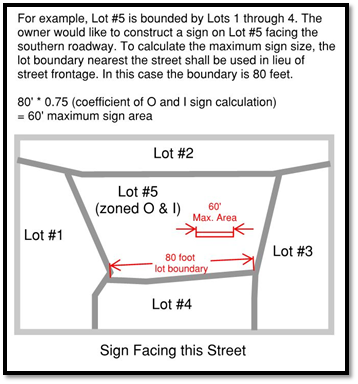
Whenever a lot is situated such that it has no street frontage on any lot boundary and an applicant desires to install on such a lot a sign that is oriented toward a street, then the total sign surface area permitted on that lot shall be the sign surface area that would be allowed if the lot boundary closest to the street toward which such sign is to be oriented fronted on such street. The applicant shall be restricted to using only one (1) street and the closest lot boundary to this street for determining the total permitted sign surface area. However, the applicant shall be given the opportunity to determine the one (1) street used in the calculation.
(d)
The total sign area delineated in this section may be allocated among the various types of permissible signs at the discretion of the sign permit applicant. However, the maximum sign area allocated to any one (1) particular type of sign is outlined in sections 40-411 and 40-412. Therefore, the total sign area determined by this section may not be attained in some cases because of the sign area cap for individual freestanding or wall signs. For example, use in the B1H District with one hundred (100) feet of lot frontage, five hundred (500) square feet of the building facade, and a front display window area of fifty (50) square feet would be allowed a total sign area of thirty-five (35) square feet. A maximum wall sign of twenty-five (25) square feet (five hundred (500) feet building facade surface area times five (5) percent equals twenty-five (25) square feet) and a maximum window sign of ten (10) square feet (fifty (50) feet display window area times twenty (20) percent equals ten (10) square feet) would be allowed. Consequently, the limited amount of building facade area, in this case, would prevent the total sign surface area from being attained. The amount of total permissible sign area not utilized for freestanding and wall signs could, however, be applied to other types of allowable signs.
(Code 1993, § 27-170; Ord. No. 01-01, 1-8-2001; Ord. No. 21-3, § 1(Att.), 6-14-2021)
Sec. 40-411. - Freestanding sign surface area.
(a)
For purposes of this section, a side of a freestanding sign is any plane or flat surface included in the calculation of the total sign surface area, as provided in section 40-409. For example, wall signs typically have one (1) side. Freestanding signs typically have two (2) sides (back-to-back), although four-sided and other multi-sided signs are also common.
(b)
Subject to subsection (c) of this section, a single side of a freestanding sign may not exceed one-half (1/2) of a square foot in surface area for every linear foot of street frontage along the street toward which such sign is primarily oriented. However, in no case may a single side of a freestanding sign exceed two hundred (200) square feet.
(c)
Freestanding, on-premises signs are permitted in the B1H District, provided the single side of the sign shall not exceed twenty (20) square feet in area.
(d)
With respect to freestanding signs that have no discernible sides, such as, spheres or other shapes not composed of flat planes, no such freestanding sign may exceed the maximum surface area allowed under subsection (b) of this section for a single side of a freestanding sign.
(Code 1993, § 27-171; Ord. No. 02-21, 11-11-2002)
Sec. 40-412. - Wall sign surface area.
(a)
The sign surface area on any sign located on a wall of a structure may not exceed thirty (30) percent of the total surface area of the wall on which the sign is located.
(b)
The sign surface area of any sign located on a wall of a structure on any lot within the B1H Zoning District may not exceed five (5) percent of the total surface area of the wall on which the sign is located. The sign surface of any wall sign mounted on a residential building, including those put to commercial use, shall be small, less than one (1) square foot, identification panels at the primary entrance.
(c)
Wall surface area is calculated by multiplying the vertical distance of the building wall (measured at the average finished grade) times the horizontal distance of the building wall.
(Code 1993, § 27-172)
Sec. 40-413. - Number of freestanding and wall signs.
(a)
Except as authorized by this section, no lot may have more than one (1) freestanding sign.
(b)
If a lot is located on a lot that has frontage on two (2) or more public streets, then the lot may have not more than one (1) freestanding sign along each side of the lot bordered by such streets.
(c)
No more than one (1) wall sign per establishment per street frontage is allowed.
(d)
No more than one (1) canopy or awning sign per establishment per street frontage is allowed.
(Code 1993, § 27-173; Ord. No. 02-21, 11-11-2002; Ord. No. 21-3, § 1(Att.), 6-14-2021)
Sec. 40-414. - Location and height requirements.
(a)
No portion of any freestanding sign shall extend closer than two (2) feet to a street right-of-way line or property line.
(b)
No sign may extend above any parapet or be placed upon any roof surface, except that for purposes of this section, roof structures constructed at an angle of seventy-five (75) degrees or more from horizontal shall be regarded as wall space. This subsection shall not apply to displays, including lighting, erected in connection with the observation of holidays on the roofs of structures.
(c)
No wall sign attached flat to a building may project more than twelve (12) inches from the building wall. Projecting signs (as defined in section 40-403) may, however, exceed the twelve-inch requirement, as long as there is only one (1) projecting sign per separate business establishment, no part of the projecting sign can project more than five (5) feet from the building wall, and the projecting sign does not exceed six (6) square feet in area, and the bottom edge of the projecting sign is located at least eight (8) feet above the sidewalk. In the B1H and RHD zoning districts, projecting signs may be located only underneath an awning, may be no larger than three (3) square feet in area, and must have a clearance of eight (8) feet from the sidewalk. Projecting signs count as one (1) wall sign.
(d)
No sign or supporting structure may be located on or over the traveled portion of any public right-of-way unless the sign is attached to a structural element of a building and an encroachment permit has been obtained from the city.
(e)
No part of a freestanding sign, as measured from ground level, may exceed a height as set out in the following table:
(Code 1993, § 27-174; Ord. No. 02-21, 11-11-2002; Ord. No. 21-3, § 1(Att.), 6-14-2021)
Sec. 40-415. - Special provisions for certain signs.
(a)
Subdivision entrance, subdivision directory, and multifamily development entrance signs. At any entrance to a subdivision or multifamily development, there may be not more than one (1) sign identifying such subdivision or development. A single side of any such sign may not exceed thirty-two (32) square feet. In cases where such signs are mounted on decorative functional or nonfunctional walls, the wall area shall not be utilized to calculate total sign surface area. No subdivision directory sign shall be located on any major or minor thoroughfare as shown on the city thoroughfare plan. Such signage shall be allowed in addition to the maximum sign allowance for the lot on which such signage is located.
(b)
Grand opening/going out of business signs. No such sign shall be displayed for more than ten (10) days. No maximum sign surface area requirement shall be established for such signs. Such signs shall be exempt from the provisions of section 40-417. Banners shall be allowed as part of grand opening or going out of business signage.
(c)
Directory signs for non-residential development. Such signs may be allowed provided they do not exceed twenty (20) square feet in a display area, six (6) feet in height, and are located no closer than ten (10) feet from the property line. There shall be no more than two (2) directory signs on any lot. Such signs shall contain no commercial advertisement. Such signage shall be allowed in addition to the maximum sign allowance for the lot on which such signage is located.
(d)
Restaurant menu reader boards. Restaurant menu reader boards shall not exceed twenty (20) square feet in area or six (6) feet in height. Such displays shall be set back not less than twenty (20) feet from any property line. One (1) menu reader board shall be allowed per each drive-through lane, and such display shall contain no commercial advertisement that can be viewed from any adjacent street right-of-way or property line. Such signage shall not be included in the calculation of or count toward the total allowable sign surface area.
(e)
Home occupation signs. Signs displayed in connection with an approved home occupation shall not exceed two (2) square feet in total sign surface area.
(f)
Temporary nonprofit and governmental organization signs. Temporary sign(s), including banners, erected in conjunction with a special event sponsored and conducted by a nonprofit or governmental organization shall be allowed subject to all of the following conditions:
(1)
It is the intention of this subsection that no such sign shall be displayed in conjunction with a commercial promotion or as an advertising device for a commercial establishment, product, or service.
(2)
Not more than one (1) on-premises and six (6) off-premises signs shall be allowed in conjunction with any event. No sign shall be erected on any lot without the consent of the property owner.
(3)
No such sign shall exceed thirty-two (32) square feet of sign surface area.
(4)
There shall be no more than one (1) special event sign allowed on any lot.
(5)
The maximum frequency of any special event display shall not exceed two (2) occurrences within any twelve-month period, and the maximum duration of such display shall not exceed thirty (30) days. Each sign shall be removed within three (3) days following the event. For purposes of this subsection, the duration of each separate event display shall be measured in continuous days.
(6)
Each display shall contain the name and current phone number of the event sponsor printed on the non-communication side/surface of the sign.
(7)
Such signs shall be located completely on private property. No portion of the sign or its support structure shall be located on or across any public street right-of-way or private street easement. (Exception: A suspended banner shall be allowed above West Main Street at the intersection of Van Norden Street. Any variation from the allowable square footage at this location shall be approved by the Planning and Development Department.)
(8)
Such sign shall not be located within any sight distance triangle as defined in this Code or as provided by notation or description upon any map recorded pursuant to the subdivision regulations.
(9)
No such sign shall be suspended from or attached to any public utility pole, apparatus, structure or support/guy wire, any public or private traffic control or directional sign, structure or device, or any tree or shrub located on public or private property.
(10)
No such sign shall be erected or maintained which obstructs any traffic control sign or device or warning sign located on public or private property.
(g)
Portable, on-premises signs. Portable, on-premises signs are allowed in the B1H District and may be placed in front of each business entrance so as not to obstruct any sidewalk area or public right-of-way. A single side of a portable, on-premises sign shall not exceed eight (8) square feet in area, and shall be removed at the close of the working day.
(h)
Static light-emitting diode (LED) fuel price signs. Gas stations shall be permitted one (1) freestanding sign which may include a maximum of three (3) fuel rate/price signs. The dimensions of each of the fuel rate/price signs shall not exceed eight (8) square feet each. Such a sign shall state the fuel price completely when displayed and can use either changeable copy or LED methods to display the fuel price. The static LED sign is for fuel pricing purposes only. Such fuel signs shall not display messages and shall display numerals only.
(i)
Electronically illuminated signs. Signs that contain a fixed, non-flashing message screen are permitted provided that screen changes occur no more than once every hour. In addition, no more than fifty (50) percent of the maximum allowable sign area of any free-standing or wall sign may be designated as an electronic illuminated sign/screen, up to a maximum sign area of fifty (50) square feet. The brightness of said signs/screens shall not be at an intensity that would impair the vision, day or night, of oncoming traffic. All such signs shall be reviewed and approved by the zoning administrator prior to installation consistent with the requirements of this article.
(j)
Canopy or awning signs, as defined in section 40-403, must not exceed six (6) square feet in area and must be located a minimum of eight (8) feet above the ground. Sign content for canopy or awning signs must be printed directly onto the canopy or awning. No other sign materials shall be permitted.
(Code 1993, § 27-175; Ord. No. 00-11, 8-14-2000; Ord. No. 02-21, 11-11-2002; Ord. No. 08-6, § 1, 6-9-2008; Ord. No. 08-04, § 1, 4-14-2008; Ord. No. 14-3, § 1, 5-12-2014; Ord. No. 21-3, § 1(Att.), 6-14-2021)
Sec. 40-416. - Sign illumination.
(a)
Unless otherwise prohibited by this chapter, signs may be illuminated if such illumination is in accordance with this section.
(b)
No sign within one hundred fifty (150) feet of a residential zone may be illuminated between the hours of 12:00 a.m. and 6:00 a.m., unless the impact of such lighting beyond the boundaries of the lot where it is located is entirely inconsequential.
(c)
Lighting directed toward a sign shall be shielded so that it illuminates only the face of the sign and does not shine directly into a public right-of-way or residential premises.
(d)
Subject to subsection (f) of this section, illuminated tubings or strings of lights that outline property lines, sales areas, roof lines, doors, windows, or similar areas are prohibited.
(e)
Subject to subsection (f) of this section, no sign may contain or be illuminated by flashing or intermittent lights or lights of changing degrees of intensity, except signs indicating the time, date, or weather conditions.
(f)
Subsections (d) and (e) of this section does not apply to temporary signs erected in connection with the observance of holidays and contain no commercial message.
(g)
Internally illuminated signs shall not be permitted in any residential zone. Signs illuminated by floodlight may be allowed in residential zones provided the light falls within the boundaries of the sign face.
(Code 1993, § 27-176; Ord. No. 99-18, 12-13-1999; Ord. No. 21-3, § 1(Att.), 6-14-2021)
Sec. 40-417. - Miscellaneous restrictions and prohibitions.
(a)
No temporary nor permanent sign shall be attached to a tree or to a city utility pole. No temporary nor permanent sign shall be placed on any public street right-of-way, except that political signs may be posted in the right-of-way in accordance with section 32-10 and signs attached to a structural element of a building may be erected in the right-of-way in accordance with section 40-414(d) above.
(b)
No sign may be located so that it substantially interferes with the view necessary for motorists to proceed safely through intersections or to enter onto or exit from public streets or private roads.
(c)
Signs that revolve or are animated or that utilize movement or apparent movement like wind blades, to attract the attention of the public are prohibited. Banners (except as allowed in sections 40-415(b) and (f)), streamers, animated display boards, pennants, and propellers are prohibited, but signs that move only occasionally because of wind are allowed if their movement is not a primary design feature of the sign and is not intended to attract attention to the sign. The restrictions of this subsection shall not apply to signs specified in section 40-406(d) or to signs indicating the time, date, and weather conditions.
(d)
No sign may be erected so that by its location, color, size, shape, nature, or message it would tend to obstruct the view of or be confused with official traffic signs or other signs erected by units of government.
(e)
Freestanding signs shall be securely fastened to the ground or to some other substantial supportive structure so that there is virtually no danger that either the sign or the supportive structure may be moved by the wind or other forces of nature and cause injuries to persons or property, in conformity with the state building code.
(f)
The sign area of a sign permanently painted, affixed, or placed in a building window that is visible from a street right-of-way shall be restricted to no more than forty (40) percent of the total window area. In the B1H and RHD districts, signs painted on storefront windows shall take up no more than ten (10) percent of the window, and signs placed in windows, from the interior, shall occupy no more than twenty (20) percent of the area of the displaying window. The sign area of such signs shall not be included in the total sign surface area established in accordance with the provisions of section 40-410.
(g)
Off-premises signs are not permitted, except for those signs specifically exempt from regulation in accordance with section 40-406.
(h)
All temporary or portable signs, as defined in section 40-403, except for those specifically exempted in sections 40-406 and 40-407 or those specifically allowed in section 40-415(g), are not permitted.
(i)
Any sign made up of or containing strobe lights, zip lights, flashing lights or rotating beacons, flags, streamers, banners, pennants, or strings of lights, or permanently installed or situated merchandise, except for those specifically exempted in sections 40-406 and 40-407, are not permitted.
(j)
Off-premises, outdoor advertising signs, commonly known as billboards, are not permitted.
(k)
No sign shall contain statements, words, or pictures which describe or display specified anatomical areas or specified sexual activities, or which contain words or phrases which are classified as vulgar or vulgar slang in the current edition of The New College Edition of the American Heritage Dictionary of the English Language or are otherwise commonly known to be obscene. The phrase "god damn" is also specifically prohibited for use in signs.
(l)
Inflatable signs, inflatable characters or animals, and inflatable tube men (also known as air dancers) are prohibited.
(Code 1993, § 27-177; Ord. No. 02-21, 11-11-2002; Ord. No. 21-3, § 1(Att.), 6-14-2021)
Sec. 40-418. - Nonconforming signs.
(a)
Signs in existence on the effective date of the ordinance from which this article is derived which do not conform to the provisions of this article, but which were constructed, erected, affixed, or maintained in compliance with all previous regulations, shall be regarded as nonconforming signs. Although it is not the intent of this section to encourage the continued use of nonconforming signs, nonconforming signs, except those specifically listed in section 40-422, shall be allowed to continue and a decision as to the continued existence and use or removal of such signs shall be controlled as set forth hereinafter. In the event an off-premises outdoor advertising sign, as more specifically provided for in section 40-422(b), has not been voluntarily removed in compliance therewith or the Director of Planning and Development has not initiated removal of such sign under section 40-422(b), or other applicable law, the use or removal of such sign shall also be controlled as set forth hereinafter. Nothing contained herein shall be construed to waive or in any way nullify the obligation to remove such signs in accordance with section 40-422(b), or waive or in any way nullify the authority of the Director of Planning and Development to initiate removal of such signs under section 40-421, 40-422(b) or other applicable law.
(1)
No nonconforming sign shall be changed to another nonconforming sign. The term "changing" includes replacing a sign panel within an existing frame with another panel of identical size or shape.
(2)
No nonconforming sign shall have any changes made in the words or symbols used or the message displayed on the sign unless the sign is specifically designed for periodic change of message.
(3)
No nonconforming sign shall be structurally altered so as to change the shape, size, type, or design.
(4)
No nonconforming sign shall be reestablished after the activity, business, or use to which it relates has been discontinued or changed to another use. Such signs shall be removed in accordance with section 40-421.
(5)
No nonconforming sign shall be reestablished and all remains of the sign must be removed in accordance with section 40-421 if the sign is damaged or destroyed, such that the estimated expense of repairs exceeds fifty (50) percent of the estimated total value of the sign at the time of damage or destruction. If damaged by less than fifty (50) percent of the estimated total value, but repairs are not made within three (3) months of the time such damage occurs, the nonconforming sign shall not be allowed to continue and must be removed in accordance with section 40-421.
(6)
No nonconforming sign shall be relocated.
(7)
Normal maintenance and repair of a nonconforming sign is permitted providing the shape, size, type, or design of the sign is not altered.
(8)
No nonconforming sign shall be changed or altered to allow any illumination of such nonconforming sign.
(b)
Signs located on premises which come into the extraterritorial planning and zoning jurisdiction of the city after the effective date of this article, which signs do not comply with the provisions of this article, shall be subject to the requirements listed in subsection (a) of this section.
(c)
Any nonconforming sign which is structurally altered, relocated, or replaced shall immediately be brought into compliance with all the provisions of this article, and be subject to section 40-421, pertaining to sign removal and discontinued signs.
(Code 1993, § 27-178; Ord. No. 06-24, §§ 1, 2, 12-11-2006)
Sec. 40-419. - Shopping center signs.
(a)
Shopping center developments, regardless of the zoning district in which located, shall conform to the sign regulations contained in this section.
(b)
Wall signs for individual businesses in shopping center developments shall be calculated as provided in subsection (c) of this section. The intent of these provisions is to allow each separate business establishment to have a reasonable means of identification. Because shopping centers include many individual businesses, the cumulative total wall sign area permitted by subsections (c) and (d) of this section may exceed the total sign area authorized in section 40-410.
(c)
One (1) wall sign per separate business establishment per street frontage is permitted. Allowable wall sign area is determined as follows:
(1)
The sign surface area on any sign located on a wall of a structure may not exceed thirty (30) percent of the total surface area of the wall on which the sign is located or one-half (1/2) of a square foot of sign area for each linear foot of building frontage, whichever is less. In no case may any wall sign exceed two hundred (200) square feet in area.
(2)
For shopping centers located in the B1H District, the sign surface area on any sign located on a wall of a structure may not exceed five (5) percent of the total surface area of the wall on which the sign is located.
(d)
One (1) freestanding shopping center directory sign or sign for individual on-premises use per street frontage in shopping centers shall be permitted in accordance with section 40-411(b).
(Code 1993, § 27-179; Ord. No. 21-3, § 1(Att.), 6-14-2021)
Sec. 40-420. - Sign maintenance.
Should any sign become in danger of falling or is deemed otherwise unsafe in the opinion of the Director of Planning and Development, the owner thereof, or the person or firm maintaining the same, shall upon written notice from the Director of Planning and Development, immediately in the case of imminent danger and in any case within ten (10) days, secure said sign in a manner to be approved by the Director of Planning and Development in conformity with the provision of the state building code, or remove such sign. If such sign is not removed by the owner, the Director of Planning and Development or his designated agent may initiate legal procedures to obtain the necessary court orders to remove such signs at the expense of the owner or lessee thereof.
(Code 1993, § 27-181)
Sec. 40-421. - Sign removal and discontinued signs.
(a)
The Director of Planning and Development shall order the removal of any sign maintained in violation of the provisions of this article for which removal procedures are herein prescribed accordingly: The Director of Planning and Development shall give ninety (90) days' written notice to the owner or lessee to remove the sign or to bring it into compliance with this article. If the owner or lessee fails to remove the sign within ninety (90) days after the ninety-day written notice has been given, the Director of Planning and Development or his duly authorized representative may institute removal proceedings according to the procedures specified in G.S. 160A-175.
(b)
Any temporary or portable sign erected in violation of the provisions of section 40-407 may be removed immediately, at the direction of the Department of Planning and Development. Any sign so removed shall be retained at a designated municipal facility until recovered by the sign owner following payment to the city of a fee per sign, as established from time to time by ordinance. Any sign not recovered within ten (10) days shall be destroyed.
(c)
Upon the discontinuance of a business or occupancy of an establishment for a consecutive period of one hundred eighty (180) days, the Department of Planning and Development shall require the removal of the on-premises sign advertising or identifying the establishment. The Department of Planning and Development shall give thirty (30) days' notice to the property owner to remove the sign. Failure to remove the sign within the thirty (30) day period shall constitute a violation of this chapter and shall be remedied in accordance with article XXI of this chapter, pertaining to administration, enforcement, penalties.
(Code 1993, § 27-182; Ord. No. 03-08, 3-10-2003)
Sec. 40-422. - Amortization of certain signs.
(a)
The following signs shall become nonconforming in all districts, unless otherwise specified, as of the date of adoption of the ordinance from which this article is derived and shall be removed within six (6) months after the date of adoption:
(1)
All temporary or portable signs, as defined in section 40-403, except for those specifically exempted in sections 40-406 and 40-407. Portable signs shall not be permanently anchored to make them conform unless the lot or business on which they are located does not have a freestanding sign, in which case one (1) portable sign per street frontage lot may be permanently anchored and thus serve as the allowed freestanding sign for that lot or business provided that the sign meets all of the applicable requirements of article XVI.
(2)
Any sign made up of or containing strobe lights, ziplights, flashing lights or rotating beacons, flags, streamers, banners, pennants, or strings of lights, or permanently installed or situated merchandise, except for those specifically exempted in section 40-406 and section 40-407.
(Code 1993, § 27-183; Ord. No. 21-3, § 1(Att.), 6-14-2021)

