
Washington City Zoning Code
ARTICLE VII
BUFFERYARD AND LANDSCAPING REQUIREMENTS
Sec. 40-167.- Bufferyards.
(a)
Purpose. Bufferyards are a combination of land and physical barriers such as fencing, plant material, and earthen berms which separate various land uses and street rights-of-way. Their purpose is to create a better quality of living for the community by encouraging the preservation of existing vegetation and stabilizing the environment's ecological balance; to establish proper separation between land uses; to provide flexibility in developing appropriate separation between land uses; and to help reduce the negative impact of glare, noise, trash mitigation, odors, overcrowding, traffic, lack of privacy, and visual blight when incompatible land uses adjoin one another.
(b)
Exceptions. The provisions contained in the bufferyard requirements shall not apply to those uses located within the B1H Zoning District.
(c)
Steps for determination. To determine the bufferyard required by this article, the following steps should be taken:
(1)
Identify the classification of the proposed land use and any adjacent land use listed in section 40-169, pertaining to the bufferyard use classification list.
(2)
Use section 40-170, pertaining to the bufferyard chart, to determine the appropriate letter designation for each abutting yard.
(3)
Match the letter designation obtained from section 40-170, pertaining to the bufferyard chart, with the letter designation of section 40-171, pertaining to bufferyard illustrations, to determine the required bufferyard.
(Code 1993, § 27-62; Ord. No. 21-3, § 1(Att.), 6-14-2021)
Editor's note— Ord. No. 21-3, § 1(Att.), adopted June 14, 2021, amended the title of § 40-167 to read as herein set out. The former § 40-167 title pertained to General.
Sec. 40-168. - Site plan required, approval, timing of permits.
(a)
Prior to issuance of a building permit, an applicant must propose and receive approval for a bufferyard plan in accordance with this article. The applicant must submit a site plan drawn to scale in accordance with the requirements of article XVIII of this chapter, pertaining to site plan review. Bufferyard vegetation improvements may be phased to coincide with the construction of buildings, provided such phasing is set forth on the approved bufferyard plan.
(b)
Building permits and temporary certificates of occupancy may be issued only after a detailed site plan, including a detailed bufferyard plan, has been approved by the Department of Planning and Development. Recommendations on the proposed bufferyard may be obtained from the Department of Planning and Development.
(c)
In order for a final certificate of occupancy to be issued, all vegetation, fencing, and berms required by this article shall be in place and written certification from the installer stating that the vegetation has been installed, in accordance with the proposed bufferyard plan, must be submitted to the Department of Planning and Development and inspected and approved by staff. Written certification shall serve as a request for inspection.
(Code 1993, § 27-63; Ord. No. 21-3, § 1(Att.), 6-14-2021)
Sec. 40-169. - Use classification list.
Below are the classifications of land uses which will be utilized in conjunction with section 40-170, pertaining to the bufferyard chart, to determine the required bufferyards.
(a)
Classification I. Single-family dwellings, individual mobile homes, two-family attached dwellings, family care homes, golf courses, nature areas, wildlife sanctuaries, and their accessory uses, including recreation.
(b)
Classification II. Classification II land uses are as follows:
(1)
Multifamily dwellings, dormitories, mobile home parks, fraternities and sororities, roominghouses/boardinghouses and their accessory uses, including recreation.
(2)
Limited impact recreational uses, including, but not limited to: playgrounds, jogging trails, bicycling areas, boat-launch ramps, picnic areas, swimming pools, and tennis courts.
(c)
Classification III. Classification III land uses are as follows:
(1)
Institutional uses, including, but not limited to: day or youth camps, cemeteries, churches, day care centers, group care homes, libraries, museums, nursing homes, public or private schools, schools or homes for the physically or mentally handicapped, retirement homes, social or fraternal organizations, and hospitals.
(2)
Governmental buildings or uses, including, but not limited to: offices, fire stations, police stations, garages, public utilities, and public service uses. Specifically excluded are sanitary landfills, wastewater treatment facilities, extraction activities, and animal shelters.
(3)
Commercial and service uses, including, but not limited to: retail sales operations, hotels, laundries/dry cleaners, grocery stores not open between the hours of 11:00 p.m. and 6:00 a.m., alcoholic beverage stores, restaurants (conventional, not fast food), service or business stores (catering, bakery, duplicating, photography, shoe repair, tailoring, travel agency, etc.), taxi companies, shopping centers, funeral homes, and principal use parking lots.
(4)
Offices, including drive thru facilities.
(5)
Utility uses, including, but not limited to: telephone facilities, cable television companies, radio and television facilities, and telecommunication towers.
(6)
Medium impact commercial recreation uses, including, but not limited to: amusement parks, fairgrounds, miniature golf, golf driving ranges not operated in conjunction with a golf course, sports arenas, stables, indoor recreation areas such as skating rinks, tennis, swimming, handball, and racquetball, athletic clubs, exercise and dance studios, and indoor theaters.
(7)
Plant nurseries or greenhouses that are not a part of a farm.
(d)
Classification IV. Classification IV land uses are as follows:
(1)
High impact recreational uses, including, but not limited to: outdoor theaters, shooting ranges (skeet, rifle, archery), go-cart racing, billiard parlors, and nightclubs.
(2)
Road service uses, including, but not limited to: gasoline sales, convenience stores, fast food restaurants, major and minor repair facilities, boat rental/sales or service, vehicle rental/sales or service, automobile wash, retail sales involving outside storage (vehicles, storage units, etc.), bus and truck terminals, and mobile home sales.
(3)
Veterinary offices, kennels, animal boarding, outside facilities, and animal shelters.
(4)
Agricultural support uses including, but not limited to: farm equipment rental/sales and service and farm supply (feed, grain, and fertilizer).
(5)
Grocery stores open between the hours of 11:00 p.m. and 6:00 a.m.
(6)
Light industrial uses, including, but not limited to: sewing operations, wood products, laboratories, warehouses, wholesaling businesses and storage, publishing plants and printing plants, miniwarehouses, contractor's office with equipment storage yards, furniture refinishing, fuel oil, ice, coal, wood sales, lumberyards, building materials sales and storage, trade shops (including cabinet, metal, carpentry, planing, plumbing, upholstery, refinishing, and paneling), tire recapping plants, and wastewater treatment plants.
(e)
Classification V. Classification V land uses are as follows:
(1)
Heavy industrial uses, including, but not limited to: concrete or asphalt mixing plants, bulk material or machinery storage (unenclosed), fuel generation plants, grain elevators, farm product processing (dairies, poultry, or meat), meat packaging plants or slaughterhouses, resource recovery activities, airports, heliports, and fertilizer manufacturing.
(2)
Mining activities.
(3)
Automobile graveyards, junkyards.
(Code 1993, § 27-64; Ord. No. 99-6, 6-14-1999)
Sec. 40-170. - Chart for permitted land use classifications.
The bufferyard chart for land use is as follows:
Notes:
1.
Building setbacks shall be in accordance with applicable regulations for the zoning district and use.
2.
Unless otherwise provided, setbacks shall be determined in the following manner:
a.
Structures thirty-five (35) feet in height and under, in accordance with prescribed bufferyards.
b.
Structures over thirty-five (35) feet in height, in accordance with prescribed bufferyards or by using the following formula, whichever is greater: D=6 + 2(S) + L/10 where D is the minimum setback distance, S is the number of stories and L is the length of the wall. Where the length of the wall is set back eight (8) feet or more, the length (L) of each segment or plane is measured separately in determining the required yard depth. (See definition of the term "story" in section 40-25.)
c.
Setbacks for parking, storage, dumpsters, etc., shall be in accordance with prescribed bufferyards.
3.
Bufferyards for adjacent streets may only be encroached upon for driveway accesses and signage.
4.
The vegetation requirements of this section shall not apply to public alleys and private service easements which provide secondary access; however, structures must observe the bufferyard setback.
(Code 1993, § 27-65; Ord. No. 21-3, § 1(Att.), 6-14-2021)
Sec. 40-171. - Illustration of specifications.
Bufferyard illustrations indicate the specifications of each bufferyard. Bufferyard requirements are stated in terms of the width of the bufferyard and the number of plant units required per each one hundred (100) linear feet of bufferyard.
(a)
Bufferyard A. The following table lists specifications and requirements for Bufferyard A:
(b)
Bufferyard B. The following table lists specifications and requirements for Bufferyard B:
(c)
Bufferyard C. The following table lists specifications and requirements for Bufferyard C:
(d)
Bufferyard D. The following table lists specifications and requirements for Bufferyard D:
(e)
Bufferyard E. The following table lists specifications and requirements for Bufferyard E:
(f)
Bufferyard F. The following table lists specifications and requirements for Bufferyard F:
(g)
Fences. Fences must create a complete visual screen for at least six (6) feet in height. Acceptable materials are cedar, masonry, redwood, chainlink with slats, and pressure treated lumber resistant to rot. Fence installation should be consistent with acceptable building practices.
(h)
Berms.
(1)
Minimum height: five (5) feet.
(2)
Maximum slope: two (2) feet horizontal for each one (1) foot vertical; 2:1.
(3)
Minimum crown: width, two (2) feet.
(Code 1993, § 27-66; Ord. No. 21-3, § 1(Att.), 6-14-2021)
Sec. 40-172. - Standards.
(a)
Existing fencing. When there is an existing fence which creates a complete visual screen for at least five (5) feet in height on an adjoining property owner's yard, and that fence extends along a minimum of fifty (50) percent of the abutting yard in question, as determined by the Director of Planning and Development, then the developer may elect to use one (1) of the applicable alternative bufferyards.
(1)
Bufferyard D: minimum width, ten (10) feet; required plant materials per one hundred (100) feet, two (2) large trees (minimum 70 percent evergreen); three (3) small trees, and twenty-five (25) evergreen shrubs; fence, not required.
(2)
Bufferyard E: minimum width, fifteen (15) feet; required plant materials per one hundred (100) feet, three (3) large trees (minimum 70 percent evergreen); four (4) small trees; and twenty-five (25) evergreen shrubs; fence, not required.
(3)
Bufferyard F shall be in accordance with the bufferyard prescribed by this section.
(b)
Exemption. For all uses except public schools, bufferyards are not required along those areas where there are five hundred (500) feet or more separating adjoining property lines and street right-of-way lines from areas where any improvements are taking place and where land is being used for purposes including, but not limited to, storage, mining activities, and stormwater detention areas. In the case of public schools, bufferyards are not required along those areas where there are two hundred fifty (250) feet or more separating adjoining property lines and street right-of-way lines from areas where any improvements are taking place and where land is being used for purposes including, but not limited to, storage, stormwater detention areas, and recreation facilities.
(c)
Minimum plant size. Unless otherwise indicated elsewhere in this section, all plant materials shall meet the following minimum size standards at the time of planting:
(d)
Spacing in bufferyards C, D, E, and F. Bufferyards C, D, E, and F are intended to create a complete visual screening yearround. Therefore, proposed and existing vegetation should be spaced to accomplish this purpose. No more than two (2) continuous feet of horizontal plane, as measured and viewed perpendicular from the property line, may be void of vegetation at least six (6) feet in height within ten (10) years of planting.
(e)
Existing material. Any existing plant material which otherwise satisfies the requirements of this section may be counted toward satisfying all such requirements. For bufferyards B, C, D, E, and F, one (1) existing large or small tree may be substituted for two shrubs as required by this article.
(f)
Seeding and mulching of plants. All bufferyard areas that are not landscaped shall be seeded with lawn or prairie grass unless the ground cover is already established. Mulching shall be implemented as required by planting material type utilized in the bufferyard areas.
(g)
Encroachment. Among other things, bufferyards may not be encroached upon by vehicular areas (except common access driveways and parking lots), buildings, service walkways, exterior storage, dumpsters, or mechanical equipment unless otherwise provided. Encroachment by stormwater detention ponds may occur subject to the approval of the city. Any plant materials placed within stormwater storage areas shall be of a variety that will survive periodic flooding. Exterior lighting may project three (3) feet into required bufferyards.
(h)
Recreational use of bufferyards. A bufferyard may be used for passive recreation; it may contain greenway, pedestrian, bicycle, or equestrian trails, provided no plant material is eliminated, the total width of the bufferyard is maintained, and all other regulations of this chapter are met. In no event, however, shall the following uses be permitted in bufferyards: playgrounds, ballfields, stables, swimming pools, tennis courts, or any other type of active recreational use.
(i)
Easement. No vegetative screening or barriers required by this section shall be placed on property subject to utility or drainage easements without the written consent of the city and the easement holder.
(j)
Solar access. If the development on the adjoining use is existing, and is designed for solar access, small trees shall be substituted for large trees where large trees would destroy solar access.
(k)
Overlapping bufferyards. Whenever two (2) or more bufferyard requirements are applicable to the same use or combination of uses, then the more stringent of the bufferyard requirements shall apply.
(l)
Drainage ditch. When a drainage ditch separates property lines, all vegetation and fencing required by this article shall be provided. However, in no case shall the required vegetation and fencing be located within five (5) feet of the outer edge of the drainage ditch. Placement of vegetation and fencing within easements shall be in accordance with subsection (i) of this section.
(m)
Future thoroughfare. Required landscaping materials, fencing, and berms shall not encroach within future thoroughfare right-of-way.
(n)
Shopping centers, condominium/townhouse, multifamily group, and Planned Unit Developments. Bufferyards are required only along exterior property lines of the project, however, bufferyards are required along all property lines of outparcels that have direct access onto a public, dedicated street.
(o)
Solid wall. A building wall of solid construction (e.g., wood, masonry, etc.), that is without windows, access, protrusions, mechanical equipment, etc., may be used to satisfy the fencing requirements of this article along those areas where the building exists. There shall be no breaks or separations between fencing and building walls along property lines where a combination of fencing and building walls are used to satisfy the requirements of this section.
(p)
Vegetation location. Required vegetation shall be installed within the minimum bufferyard area, except as provided herein. Where a drainage ditch or other natural feature prevents the installation of required vegetation within the minimum bufferyard area, such materials shall be installed within an area of equal width to the required bufferyard area. This area of equal width shall be located adjacent to and extend from the drainage ditch or other natural features. Building setbacks, parking areas, driveways, and all site improvements may encroach into the area of equal width.
(Code 1993, § 27-67; Ord. No. 21-3, § 1(Att.), 6-14-2021)
Editor's note— Ord. No. 21-3, § 1(Att.), adopted June 14, 2021, amended the title of § 40-172 to read as herein set out. The former § 40-172 title pertained to Standards for bufferyards.
Sec. 40-173. - Maintenance of landscaped areas.
(a)
The property owner shall be responsible for maintaining all vegetation required by this article in a healthy condition. Any dead, unhealthy, or missing vegetation shall be replaced upon written notice of noncompliance by the Department of Planning and Development to ensure compliance with all bufferyard requirements. Replacement must occur upon notification by the Department of Planning and Development of any dead, unhealthy, or missing vegetation and shall be planted in accordance with the provisions of this article. Replacement shall occur at the earliest suitable planting season.
(b)
To ensure that landscape materials do not constitute a driving hazard, a sight distance as determined by the city and/or the North Carolina Department of Transportation shall be observed at all street intersections of driveways with streets. Within this sight triangle, no landscape material, fencing, or berms exceeding thirty (30) inches above the adjacent street intersection shall be permitted. In the case of private driveways, the sight distance shall be measured along an imaginary line five (5) feet outside and parallel to the outer edges of said driveway and along the intersecting street right-of-way. The required sight distance for private driveways shall be twenty-five (25) feet.
(c)
If at the time of the request for a certificate of occupancy, the required vegetation is not in place due to the unavailability of plant material, then the developer/owner may obtain a temporary certificate of occupancy from the Department of Planning and Development. Such temporary certificate of occupancy shall be limited to thirty (30) days and may be renewed not more than three (3) times.
(d)
To ensure that fencing will be maintained in a safe and aesthetic manner, the following maintenance requirements must be observed for all fencing required by this article:
(1)
No fence shall have more than twenty (20) percent of its surface area covered with disfigured, cracked, or missing materials, or peeling paint for a period of more than thirty (30) consecutive days.
(2)
No fence shall be allowed to remain with bent or broken supports, or be allowed to stand more than fifteen (15) degrees away from the perpendicular for a period of more than thirty (30) consecutive days.
(Code 1993, § 27-68; Ord. No. 21-3, § 1(Att.), 6-14-2021)
Editor's note— Ord. No. 21-3, § 1(Att.), adopted June 14, 2021, amended the title of § 40-173 to read as herein set out. The former § 40-173 title pertained to Maintenance of bufferyard areas.
Sec. 40-174. - Acceptable vegetation.
The following list of vegetation shall be used to satisfy the requirements of this article:
Small Trees: 20 Feet and Below
Evergreen
Deciduous
Large Trees: 20 Feet and Above
Evergreen
Large Trees: 20 Feet and Above
Deciduous
Evergreen Shrubs: 4 to 6 Feet
*Various Varieties
Evergreen Shrubs: 6 to 12 Feet
*Various Varieties
(Code 1993, § 27-69; Ord. No. 21-3, § 1(Att.), 6-14-2021)
Sec. 40-175. - Nonconforming bufferyards.
(a)
The provisions contained in this section shall not apply to existing structures that do not conform with the bufferyard required by this article. Structures that do not comply with the bufferyard required by this article shall be subject to the nonconforming provisions contained in subsection (c) of this section.
(b)
Subject to subsection (a) of this section, property that does not comply with the bufferyard requirements contained in this article shall meet the provisions of this section.
(c)
When there is noncompliance with the bufferyard required by this section, and when an applicant files the necessary forms for a building permit, certificate of occupancy, or business license, one (1) of the following two (2) situations shall apply:
(1)
Bufferyard regulations are not applicable. This provision applies when:
a.
There is a change of land use where the new land use is of the same or lower classification, as found in section 40-169, as the previous land use; or
b.
Expansions are proposed which singularly or collectively are twenty (20) percent or less of the existing floor area, existing improved parking areas, or other impervious areas of the existing use at the time the ordinance becomes applicable.
(2)
A portion of the prescribed bufferyard will be required in accordance with subsection (d) of this section when:
a.
There is a change of land use where the land use is of a higher classification as found in section 40-169, as the previous land use; or
b.
Proposed expansions are singularly or collectively more than twenty (20) percent of the existing floor area, existing improved parking areas, or other existing impervious areas. The provisions of this section shall in no way be deemed to require the removal of existing structures, buildings, improved parking areas, mechanical equipment, and lighting; provided, however, all other encroachments including, but not limited to, concrete islands and the like shall be removed. Such areas shall be planted in accordance with the applicable provisions of the bufferyard regulations.
(d)
When a portion of the prescribed bufferyard is required based on subsection (c)(2) of this section, the following shall suffice for compliance with this section.
(1)
For purposes of this subsection when there is less than eight (8) feet of bufferyard width available, small trees may be substituted for large trees.
(2)
Where seventy-five (75) percent or more of the required bufferyard width is available, all physical barriers and plant material shall be installed.
(3)
Where less than seventy-five (75) percent of the required bufferyard width is available, all physical barriers and a percentage of plant material equal to that of the land areas available shall be installed.
(4)
Where less than one (1) foot of bufferyard width is available, ground cover may be substituted for the required vegetation.
(Code 1993, § 27-70; Ord. No. 21-3, § 1(Att.), 6-14-2021)
Sec. 40-176. - Parking area landscaping.
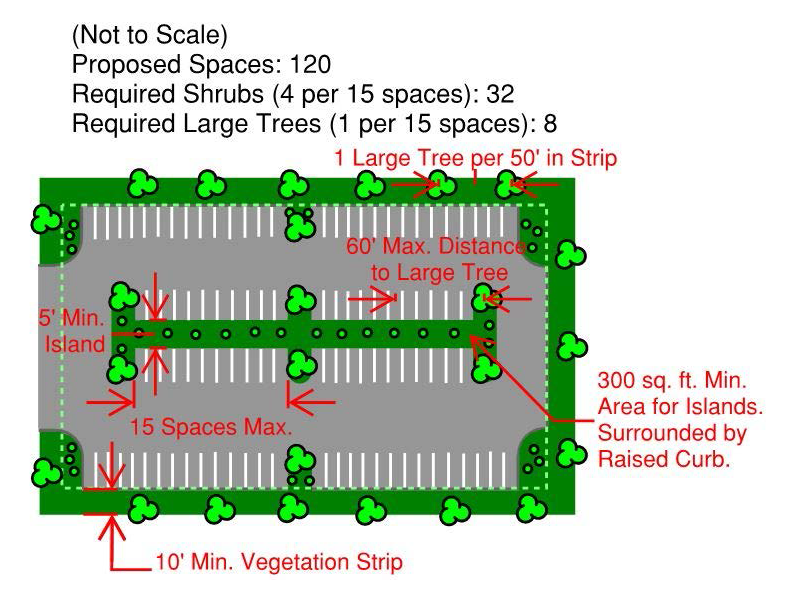
Parking improvements required per section 40-448(b) of this chapter shall provide vegetation as such:
(1)
Parking areas with fifteen (15) or more parking spaces shall provide internal vegetation in the form of islands or peninsulas and shall be designed as such:
a.
Four (4) shrubs shall be provided within the islands and/or peninsulas per fifteen (15) parking spaces.
b.
One (1) large tree shall be provided within the islands and/or peninsulas per fifteen (15) parking spaces.
c.
Each island shall contain a minimum of three hundred (300) square feet of soil or other permeable surface, shall not be less than five (5) feet in width and shall be surrounded by a six (6) inch raised curb or stop bar.
d.
Parking aisles shall contain no more than fifteen (15) consecutive parking spaces without the introduction of an additional interior planted area, in order to avoid long, uninterrupted parking aisles. This requirement is not applicable if a single parking aisle abuts a required bufferyard or an interior landscaped area separates the aisle from a primary traffic lane.
e.
The ends of parking aisles shall be clearly separated and defined by interior planted areas when they abut and are perpendicular to a primary traffic lane. The use of interior planted areas at the end of parking aisles are not required when the aisles abut and are perpendicular to required bufferyards.
f.
No parking space shall be more than sixty (60) feet from a large tree.
(2)
Required bufferyards, pursuant to article VII of this chapter, pertaining to bufferyard landscaping requirements, shall not be counted for meeting the requirements for parking area plantings.
(3)
Required plantings shall be calculated by dividing the number of parking spaces by fifteen (15) and rounding to the nearest whole number.
(4)
A vegetative strip of at least ten (10) feet in width shall be maintained at the perimeter of parking areas. A minimum of one (1) large tree per fifty (50) feet should line the parking areas.
(5)
All vegetation shall be selected and maintained in accordance with article VII of this chapter.
(Ord. No. 21-3, § 1(Att.), 6-14-2021)

