
Washington City Zoning Code
ARTICLE XVII
PARKING
Sec. 40-438.- Purpose.
(a)
In order to ensure proper and uniform development of public and private loading areas in the city and its extraterritorial area, to relieve traffic congestion in the streets, and to minimize any detrimental effects of off-street parking areas on adjacent properties, the procedures and standards set forth in this article shall apply.
(b)
The requirements contained in these regulations shall be considered as the minimum standards.
(c)
The owner, developer, or operator of any existing or proposed use, along with the Director of Planning and Development shall evaluate anticipated needs to determine if they are greater than the minimum requirements herein specified.
(Code 1993, § 27-184)
Sec. 40-439. - Off-street parking and loading required.
No permit for new construction, expansion, development, occupancy, or related activity shall be issued for any use, unless such use is in accordance with the provisions of this article.
(Code 1993, § 27-185)
Sec. 40-440. - Exemptions.
The provisions of this article shall not apply to nonresidential land uses within the B1H District.
(Code 1993, § 27-186)
Sec. 40-441. - Parking plan required.
(a)
A parking plan which conforms to the provisions of this article shall be submitted to the Department of Planning and Development for site plan review in accordance with the specific submission standards of article XVIII.
(b)
Parking plan approval shall be required prior to the approval of any site plan, building permit, use permit, privilege license, change of use permit, zoning compliance permit, temporary use permit, or occupancy permit.
(c)
The Director of Planning and Development shall have final approval authority concerning the site design and construction standards of all off-street parking lots.
(Code 1993, § 27-187)
Sec. 40-442. - Parking lot landscaping.
Off-street parking lots and drives shall comply with the provisions of article VII of this chapter, pertaining to landscaping requirements.
(Ord. No. 21-3, § 1(Att.), 6-14-2021)
Editor's note— Ord. No. 21-3, § 1(Att.), adopted June 14, 2021, amended § 40-442 in its entirety to read as herein set out. Former § 40-442 pertained to Compliance with bufferyards, and derived from the Code of 1993, § 27-188.
Sec. 40-443. - Combination of required parking spaces.
(a)
The required parking space for any number of separate use may be combined in one (1) lot, but the required space assigned to one (1) use may not be assigned to another use, except that one-half (1/2) of the parking spaces required for churches, theaters, stadiums, assembly halls, or any other use whose peak attendance will be at night or on Sundays, may be combined with a use which will be closed or which will guarantee significantly less parking demands at night and on Sundays than during normal business hours with prior approval by the Director of Planning and Development.
(b)
A use which is deficient in required parking spaces shall not designate existing parking to any other use.
(c)
When more than one (1) use is included within any one (1) lot or building, the minimum number of required spaces shall be the sum total of all the required spaces for the individual uses.
(Code 1993, § 27-189)
Sec. 40-444. - Nonconforming parking; expansion of floor area; other units of measurement.
When a building or use deficient in off-street parking spaces as defined by these regulations is increased in floor area, number of dwelling units, seating capacity, number of participants or employees, addition of secondary principal or accessory use, or any other unit of measurement used to calculate required parking, one (1) of the following shall apply:
(a)
Where such increase is fifty (50) percent or less of the original measurement, additional parking spaces shall be provided to meet the requirements of this article as if the increase were a new and separate use.
(b)
Where such increase is more than fifty (50) percent of the original measurement, additional parking spaces shall be provided to make all combined existing and proposed uses conform to the requirements of this article.
(Code 1993, § 27-190)
Sec. 40-445. - Surface material.
(a)
All parking spaces and lots associated with multifamily residences or businesses, except as provided herein, shall be constructed with a hard surfaced all weather material such as asphalt, concrete, brick, CABC or any other approved materials. Grass and bare earth areas shall not be acceptable. The parking area shall be maintained in a safe, sanitary, and neat condition. All spaces shall be marked clearly to be recognizable to the general public.
(b)
Parking areas serving individual single-family and two-family dwellings, churches, and seasonal, recreational, or temporary activities shall be exempt from the surface material requirement of this section.
(Code 1993, § 27-191; Ord. No. 21-3, § 1(Att.), 6-14-2021)
Sec. 40-446. - Cross-district parking.
Pursuant to section 40-447(a), any parking area and/or driveway utilized in conjunction with any use, whether required or otherwise, which is located wholly or partly within a zoning district which is different than the zoning district in which the principal use is located, may be permitted in accordance with the following:
(a)
Parking and driveways for residential uses, and nonresidential uses permitted in residential zoning districts, shall be permitted in residential zoning districts which allow the specific use and in all nonresidential zoning districts.
(b)
Parking and driveways for nonresidential uses shall be permitted in all nonresidential zoning districts and prohibited in all residential zoning districts, except as provided in subsection (a) of this section.
(Code 1993, § 27-192; Ord. No. 21-3, § 1(Att.), 6-14-2021)
Sec. 40-447. - Parking area location criteria.
(a)
All uses, except as provided in subsections (b) and (c) of this section, shall provide off-street parking on the same parcel of land as the use it is intended to serve. For purposes of this section, the term "common areas within townhouses, condominiums, or planned unit projects" shall be construed as meaning the same parcel of land. Parking permitted within the right-of-way of a public street shall not be considered to fulfill or partially fulfill the minimum parking requirements.
(b)
Remote parking may be allowed for any use which cannot provide parking on the same parcel of land as the principal use, provided such use complies with all of the following requirements:
(1)
The use does not comply with the current on-site parking requirement.
(2)
No new construction, expansion, or enlargement of the existing or proposed use is requested which would intensify or create an on-site nonconforming parking situation.
(3)
The existing on-site parking facility cannot be improved to conform with current requirements.
(4)
The remote parking facility shall comply with subsection (d) of this section.
(c)
Churches may be exempt from subsection (b)(2) of this section, provided that:
(1)
Fifty (50) percent of the required parking spaces shall be located on the same parcel of land as the principal use; and
(2)
Any remote parking facility shall comply with subsection (d) of this section.
(d)
Remote parking facilities shall conform to the following standards:
(1)
No portion of the remote parking facility shall be located more than (400) feet from the associated principal use site.
(2)
Use of a remote parking facility not under the same ownership shall require a parking encumbrance agreement approved by the Director of Planning and Development, with a copy of the agreement filed with the Department of Planning and Development and with the office of the Beaufort County Register of Deeds.
(3)
The remote parking facility shall not be utilized or occupied by any other use or for any other purpose other than as parking for the associated principal use.
(4)
The remote parking facility shall be located within a district which permits the associated principal use or within a district which allows principal use parking lots.
(5)
Where the associated principal use is listed as being subject to special use permit approval of the Board of Adjustment, the proposed remote parking facility for the principal use shall be considered an expansion of the principal use and the expansion shall be subject to such approval.
(6)
If the parcel which contains the remote parking facility is disposed of or committed to some other use that displaces the parking required by this article, then the certificate of occupancy for the principal use shall be revoked.
(7)
The remote parking facility shall not be located across a major or minor thoroughfare from the associated principal use.
(Code 1993, § 27-193; Ord. No. 21-3, § 1(Att.), 6-14-2021)
Sec. 40-448. - Improvement standards.
(a)
All off-street parking areas designed for two (2) or less spaces shall meet the following requirements:
(1)
Shall be surfaced in accordance with section 40-445.
(2)
Shall have adequate ingress and egress. All uses, excluding single-family detached and two-family attached (duplex), shall be subject to section 40-448(b).
(3)
All entrances and exits shall conform to the driveway regulations of the city or the North Carolina Department of Transportation, whichever is more restrictive.
(4)
Shall be in accordance with article VII of this chapter, pertaining to bufferyard landscaping requirements, and article XV of this chapter, pertaining to special districts.
(5)
In the absence of a garage or carport, the driveway shall be considered as providing off-street parking for single-family and two-family dwellings. The area to which the driveway approach provides access shall be sufficiently large to store any vehicles using the driveway completely off the right-of-way, on private property. Parking of vehicles shall not be permitted on sidewalks.
(6)
All off-street parking areas shall be separated from walkways, sidewalks, bikeways, streets or any dedicated right-of-way. To prevent vehicles from driving across these areas, except at an approved driveway approach, and to prevent parking or maneuvering vehicles from overhanging upon such areas, there shall be a six (6) inch raised curb or stop bar constructed between such areas and the parking area.
(7)
Garages and carports shall qualify as parking for residential uses for the purposes of this subsection.
(b)
All off-street parking areas designed for three (3) or more spaces shall meet the following requirements. These requirements shall not apply to single-family or two-family dwellings.
(1)
General design standards.
a.
Parking areas shall be surfaced in accordance with section 40-445.
b.
Parking areas shall conform to the minimum standards found in the City of Washington Manual of Standard Designs and Details, Series 55, Parking.
c.
Parking areas shall be in accordance with article VII of this chapter, pertaining to bufferyard landscaping requirements, and article XV, pertaining to special districts.
d.
Sight distance requirements as established by the Director of Public Works and/or NCDOT shall be observed.
e.
All entrances and exits shall conform to the driveway regulations of the city or the North Carolina Department of Transportation, whichever is more restrictive.
f.
All parking areas will be adequately drained in accordance with the storm drainage regulations set forth by the city.
g.
Parking areas shall be designed with careful regard to orderly arrangement and topography, and shall, to the greatest extent possible, be integrated naturally into their physical setting.
h.
All off-street parking areas shall be separated from walkways, sidewalks, bikeways, streets, or any dedicated right-of-way. To prevent vehicles from driving across these areas, except at an approved driveway approach, and to prevent parking or maneuvering vehicles from overhanging upon such areas, there shall be a six-inch raised curb or stop bar constructed between such areas and the parking area.
i.
Parking areas shall provide internal vegetation in accordance with section 40-176 of this chapter.
(2)
Parking space standards.
a.
Each off-street parking space for each use shall be within one hundred fifty (150) feet of the use it is intended to serve, except as provided by the remote parking facility standards, listed under section 40-447(d).
b.
No parking space shall be closer than fifteen (15) feet to a multifamily dwelling structure.
c.
All uses shall provide off-street parking on the same parcel of land as the use it is intended to serve, except as provided by the remote parking facility standards, listed under section 40-447(d). Parking may be allowed within parallel parking bays located on private streets.
d.
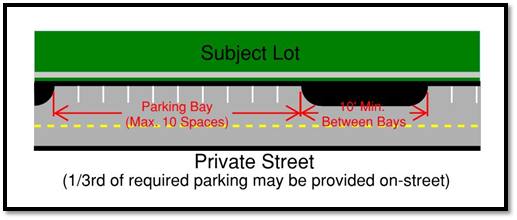
One-third (⅓) of the required spaces may be in parallel parking bays within the easements of private streets, except on the turnaround portion of a cul-de-sac; provided that:
i.
Any bay shall contain no more than ten (10) spaces; and
ii.
Each bay shall be separated from any other bay by a distance of at least ten (10) feet;
iii.
No more than one-fourth (¼) of the total frontage on any private street shall be devoted to parking bays;
iv.
Parking bays directly adjoining private streets will be permitted on one (1) side of the street at a time only. Such parking areas may be alternated from one (1) side of the street to the other.
e.
Parking areas so designed to serve ten (10) or more vehicles may designate a maximum of twenty-five (25) percent of the spaces for use by compact cars only. These spaces shall conform to the minimum standards found in the City of Washington Manual of Standard Design and Details. These spaces shall be identified in a manner that will prohibit its occupancy by any larger vehicle.
(3)
Internal circulation standards.
a.
All parking areas shall be arranged such that ingress and egress is by forward motion of the vehicle only.
b.
Primary traffic lanes are to be clearly defined and shall not provide direct access from individual parking spaces or parking aisles.
c.
No access shall be provided from a secondary traffic lane into a primary traffic lane at any point closer to the street right-of-way than twenty (20) feet in addition to the required bufferyard.
d.
Appropriate directional painting and/or traffic control signage shall be used to encourage reasonable vehicular flow. Stop signs shall be required at all points where traffic lanes exit a parking lot greater than twenty-five thousand (25,000) square feet in the area into a public street unless controlled by other devices. All internal and external traffic signs, markings, and devices shall be clearly displayed and conform to North Carolina Department of Transportation standards.
e.
Primary traffic lanes shall be required as follows:
i.
One (1) lane for each lot containing one hundred (100) to one hundred ninety-nine (199) parking spaces.
ii.
A minimum of two (2) primary lanes for lots containing in excess of two hundred (200) parking spaces.
iii.
Where the parking lot abuts two (2) or more streets, a minimum of one (1) primary lane shall exit the parking lot into each street.
(4)
Additional standards.
a.
No parking space shall be utilized for dead storage, repair work, or other similar activity.
b.
When the front footage of any building exceeds two hundred fifty (250) feet, a fire lane shall be provided along this frontage. The fire lane shall not be considered as part of the traffic lane, shall be a minimum of ten (10) feet in width, and shall be clearly marked.
c.
All off-street parking areas for buildings that are subject to the North Carolina State Building Code, Volume I, General Construction, shall comply with all of the requirements set forth therein including those for parking spaces for the physically handicapped.
d.
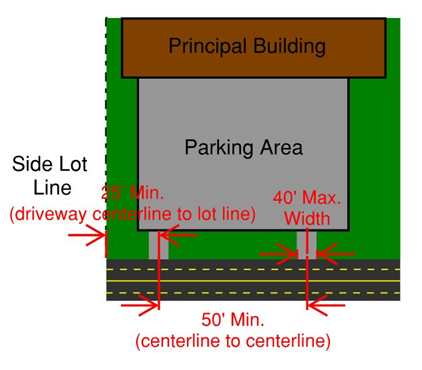
Driveways. No centerline of any entrance driveway leading from a major thoroughfare shall be closer than twenty-five (25) feet to a side lot line. Driveway centerlines on any one (1) lot must be separated by at least fifty (50) feet. The width of any driveway leading from a public street shall not exceed forty (40) feet at its intersection with the curb or street line. The Board of Adjustment may not grant a variance from the width provision.
(c)
Off-street loading areas shall be provided as follows:
(1)
Every commercial, office, and industrial use, except those located in the B1H District, shall provide space for off-street loading and unloading of delivery, shipment, or transport vehicles.
(2)
Space designated for compliance with off-street parking requirements shall not be used to comply with these requirements and vice-versa.
(3)
Off-street loading areas shall be, at minimum, twelve (12) feet by thirty (30) feet with a vertical clearance of sixteen (16) feet above the finished grade of the space.
(4)
All off-street loading areas shall be arranged and marked to provide for orderly and safe unloading and loading, and shall not hinder the free movement of vehicles and pedestrians. All loading and unloading maneuvers shall take place on private property. All loading areas shall be designed to prevent backing maneuvers from or into the street unless otherwise approved by the Director of Public Works.
(5)
Design standards, minimum number of loading spaces required are as follows:
a.
Retail operations and restaurants, including restaurant and dining facilities within hotels and office buildings: one (1) space for each five thousand (5,000) square feet of floor space or major fraction, fifty-one (51) percent or greater, thereof, not to exceed two (2) spaces.
b.
Office buildings and hotels: one (1) space per one hundred thousand (100,000) square feet of space or major fraction thereof, not to exceed two (2) spaces.
c.
Industrial and wholesale operations: one (1) space for each ten thousand (10,000) square feet of floor space or major fraction thereof, not to exceed four (4) spaces.
(Code 1993, § 27-194; Ord. No. 21-3, § 1(Att.), 6-14-2021)
Sec. 40-449. - Schedule of required parking spaces.
Off-street parking spaces shall be provided for all land uses in the following proportions:
(Code 1993, § 27-196; Ord. No. 98-8, 5-11-1998; Ord. No 14-7, § 6, 10-6-2014; Ord. No. 17-5, § 6, 12-11-2017; Ord. No. 21-3, § 1(Att.), 6-14-2021; Ord. No. 24-1, § 11, 5-13-2024)
Sec. 40-450. - Unlisted uses.
(a)
Where a particular use or class of use is not listed under section 40-449, the Department of Planning and Development shall determine the minimum number of spaces to be required in each individual case. In reaching such determination, the Department of Planning and Development shall be guided by the requirements for similar uses, the number and type of vehicles and/or persons likely to be attracted to the proposed use and studies of the parking requirements in other jurisdictions.
(b)
Appeal from such decisions shall be made to the Board of Adjustment.
(Code 1993, § 27-196)

