
Waukegan City Zoning Code
SECTION 10
- OFF-STREET PARKING AND LOADING
10.01 - General Provisions
A.
Purpose. The purpose of this Section is to promote the health, safety, and general welfare of the public by providing for safe and efficient traffic circulation, ensuring an appropriate quantity of vehicular and bicycle parking to support a variety of land uses, minimizing impervious surface coverage associated with parking and loading, and providing for adequate site access and loading facilities.
B.
Applicability. The requirements of this Section apply to the following:
1.
New construction of a principal structure or establishment of a principal use.
2.
The construction of new parking facilities, loading facilities, drive-through facilities, and/or driveways.
3.
The reconfiguration, reduction, expansion, or reconstruction of existing parking facilities, loading facilities, drive-through facilities, and/or driveways.
C.
General Requirements. The following requirements apply to all parking and loading areas.
1.
Site Plan Review Approval. Site plan review approval is required prior to the expansion, reduction, reconfiguration, or reconstruction of an existing parking lot. Existing parking lots that fully meet the landscaping requirements of Section 11.07 (Parking Lot Landscaping) do not require a site plan review in accordance with Section 4.09 (Site Plan Review).
2.
Permit. Construction of new off-street parking lots and loading areas required by this Section must be completed prior to the issuance of an occupancy certificate for the uses served by the parking and loading facilities.
3.
Change in Use. When an existing use is changed to a new use, the minimum required number of parking and loading spaces may be increased or decreased in accordance with the new use parking requirements and with an approved permit or site plan review.
4.
Encroachment. Parking facilities are allowed to encroach into the front yard, corner side yard, interior side and/or rear yard of a zoning lot, but must be at least five feet from any lot line, provided no parking lot perimeter landscape, see Section 11.07.A (Parking Lot Perimeter Landscape), or buffer yard, see Section 11.08 (Buffer Yards) is required.
5.
Maintenance Responsibility. The owner of the zoning lot is responsible for maintaining all parking and loading facilities in good repair. The condition of parking and loading facilities will be assessed by the Building Commissioner. For parking and loading facilities adjacent to residential districts, no cleaning or maintenance of such facilities may be performed between the hours of 10:00 p.m. and 7:00 a.m., except for the removal of snow.
6.
Waukegan Compendium of Specifications for Development. All parking and loading areas must be constructed and maintained according to the requirements of the Compendium of Specifications for Development.
10.02 - Off-Street Parking Spaces
A.
General Requirements. Off-street parking spaces for motor vehicles must be provided in accordance with the following standards.
1.
Availability of Spaces. All parking spaces on a zoning lot must be made available to the users of the principal use. Spaces may not be utilized for motor vehicle repair, service, or for long-term storage or display of vehicles, materials, or goods with the exception of approved marina/motor vehicle dealership, motor vehicle sales, and motor vehicle rental uses.
2.
Accessible Parking.
a.
State Requirements. Accessible parking spaces must be designed, marked, and display appropriate signage as required by the Illinois Accessibility Code, Americans with Disabilities Act, and all additional applicable laws.
b.
Applicability. Accessible parking must be provided in all parking facilities that provide parking for residents, employees and/or visitors except for single-unit, two-unit, three-unit, and four-unit dwellings, as required by the Americans with Disabilities Act.
c.
Minimum Parking Requirements. The number of accessible parking spaces are counted toward the total number of off-street parking spaces required.
3.
Off-Premises Parking Facilities. Parking facilities for uses other than single-unit, two-unit, three-unit, four-unit, and townhouse dwellings may be provided on a separate zoning lot with prior written approval by the Zoning Administrator on the following conditions:
a.
Residential Uses. Any off-premises parking facility serving a multi-dwelling unit must be located no farther than 300 feet, measured along a publicly accessible pedestrian route, from the nearest principal entrance of the building served by the off-premises parking facility.
b.
Non-residential Uses. Any off-premises parking facility serving a non-residential use must be located no farther than 500 feet, measured along a publicly accessible pedestrian route, from the nearest principal entrance of the building served by the off-premises parking facility.
c.
Off-Premises Parking Facility Agreement. Off-premises parking facilities that are not owned or controlled by the owner of the property being served may only be used if the owner or operator of the property being served enters into a written lease agreement for use of the off-premises parking facility. The lease agreement must guarantee that the off-street parking facilities will be available for as long as the uses requiring the off-premises parking remains in operation. The agreement must be in a format satisfactory to the City Attorney and must be recorded in the Recording Division of the Lake County Clerk's Office, as applicable.
4.
Tandem Parking. Tandem parking may be granted for residential uses only through an application for site plan review, see Section 4.09 (Site Plan Review). Both parking spaces must be designated for use by occupants of the same dwelling unit. Motor vehicle repair and/or service facilities may utilize tandem parking in their parking lots, pursuant to an application for site plan review.
5.
Shared Parking Facilities. Off-street parking facilities for different buildings, structures or uses, or for mixed uses, may be provided collectively in any zoning district in which separate parking facilities for each are permitted.
6.
Commercial Vehicles in Residential Districts. The following vehicles may not be parked in a residential zoning district unless the vehicle is parked in an enclosed garage, or is in use for deliveries, repairs, construction, maintenance, loading, or unloading: limousines, buses, tow trucks, semi-truck trailers, box trucks, construction vehicles, landscaping vehicles and trailers, agricultural vehicles, and other similar commercial vehicles. Parking of commercial vehicles on public streets or in private driveways visible from the public right-of-way is prohibited.
B.
Computation. Off-street parking spaces are determined using the following standards.
1.
Units of Measurement.
a.
Gross Floor Area. Unless otherwise stated, parking standards for non-residential uses must be calculated based on gross floor area (GFA) in square feet (sf) of all principal structures on a zoning lot.
b.
Occupancy- or Capacity-Based Requirements. Parking spaces required per employee, student, or occupant must be calculated based on either (i) the maximum number of employees on the largest shift, or (ii) maximum fire-rated permitted occupancy of the building, whichever measurement is applicable.
c.
ADA Spaces. ADA Access Aisles must be counted as one additional parking space.
d.
Semi-truck Spaces. Semi-truck spaces must be counted as two parking spaces.
2.
Fractions of Parking Spaces. When computation of parking spaces results in a fraction, any fraction of less than one-half may be disregarded, and the required number of spaces rounded down to the next whole number, and any fraction of one-half or more must be rounded up to the next greater whole number of required spaces.
3.
Multiple Uses Served by a Single Parking Facility. When multiple uses are served by a single parking facility, the total number of parking spaces required must be the sum of the parking requirements for each individual use, unless each use operates at set hours that do not overlap.
4.
Use of Off-Street Loading Area. Area allocated to any off-street loading spaces may not be used to satisfy parking space requirements.
C.
Parking Standards. Table 10.03-1 Off-Street Parking Standards establishes the minimum and maximum vehicular parking requirements for the listed uses. Table 10.03-1 also establishes the minimum short-term and long-term bicycle parking requirements for the listed uses.
1.
B4 District. In the B4 District, the minimum vehicle parking requirements of Table 10.03-1 do not apply to residential and non-residential uses.
2.
Lakefront Districts. In the L1, L2, and L3 Districts, the minimum vehicular parking requirements of Table 10.03-1 do not apply to residential uses. In the L1, L2, and L3 Districts, residential uses must only provide a minimum of 0.5 parking spaces per dwelling unit.
3.
Uses Subject to Development Applications. In all zoning districts, approved development applications including conditional uses, planned unit developments, and site plans, may be subject to minimum and maximum parking requirements established through the approval process, see Section 4.08 (Conditional Uses).
4.
Use Not Specified. Any use not specified in Table 10.03-1 Off-Street Parking Standards must adhere to the minimum parking requirements provided for the most similar use as determined by the Zoning Administrator.
5.
Excess Parking Waiver; Fee. The applicant for a proposed use may be permitted to install and maintain parking spaces in excess of the maximum permitted off-street parking in instances where the Zoning Administrator determines that providing only the maximum allowed amount of parking on-site is not sufficient to serve the proposed use and provides a waiver from the maximum permitted parking requirement. Applicants requesting a waiver from the maximum permitted off-street parking requirements will be required to pay a one-time per space fee in an amount set forth in the fee and fine schedule. All waiver fees must be placed into a fund to be used by the City for the acquisition, construction, and maintenance of short-term bicycle parking located in the public right-of-way, or on City owned property. The use granted the waiver from the maximum number of vehicle parking spaces must be credited permanently by ordinance or resolution identifying the number of spaces for which payment was received by the City. Requests for parking in excess of maximum permitted parking for single-unit, two-unit, three-unit, four-unit, and townhouse dwellings are not subject to the excess parking adjustment fee but must follow the standards of Section 4.04 (Variances) and Section 4.05 (Minor Adjustments).
10.03 - Bicycle Parking
A.
Applicability. Minimum bicycle parking requirements apply to the use categories in Table 10.03-1 Off-Street Parking Standards, provided that those use categories meet the development thresholds listed in Section 10.01.B (Applicability).
B.
Minimum Requirement. Where bicycle parking is required, a minimum of two spaces must be provided.
C.
Bicycle Parking Design. Bicycle parking spaces must be designed in accordance with the following requirements:
1.
Dimensions. Each bicycle parking space must have a minimum width of two feet, minimum length of six feet, and minimum vertical clearance of seven feet, see Figure 10.03-1 Bicycle Parking Design.
2.
Safe Access. Bicycle parking spaces must be protected from motor vehicle traffic and located to permit safe access to and from the use served. A sidewalk, shared path, or other means of access, with a minimum width of five feet, must be provided adjacent to bicycle parking facilities to ensure adequate maneuvering space.
3.
Racks and Structures. Secure racks and supporting structures must be provided for each bicycle parking space and must be designed to accommodate both chain and U-shaped locks. Bicycle parking spaces must permit the bicycle frame and one wheel to be locked to the rack and supporting structure. A locked bicycle must be supported in a stable position without damage to the wheels, frame, or components. Racks with artistic designs are encouraged.
4.
Visibility and Maintenance. Areas used for bicycle parking must be designed and maintained to be well-lit and reasonably free from standing water, mud, and dust.
5.
Signage. If bicycle parking spaces for non-residential uses are not visible from the street, signs must be posted to indicate the location of such parking.
Figure 10.03-1 Bicycle Parking Design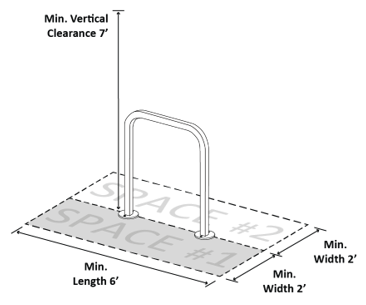
D.
Short-Term Bicycle Parking. The following standards apply to required short-term bicycle parking spaces, as established in Table 10.03-1 Off-Street Parking Standards.
1.
Location. Short-term bicycle parking must be located in a highly visible, publicly accessible location within 50 feet of the principal entrance to a building containing the use it serves. For buildings or uses requiring more than eight short-term bicycle parking spaces, all parking spaces must be covered for weather protection. Parking spaces in excess of these eight spaces may be located more than 50 feet from the principal building entrance.
2.
Spaces Within the Right-of-Way. With the permission of the City Engineer, the property owner may install the required short-term bicycle parking spaces within the public right-of-way. Spaces within the right-of-way must maintain a path of egress that complies with the standards of accessible design of the Americans with Disabilities Act and the Public Right-of-Way Accessibility Guidelines.
3.
Credit for Existing Public Parking Facilities. With the permission of the Zoning Administrator, the property owner may receive credit for existing public bicycle parking spaces located in the right-of-way, or on City property, within 600 feet of the front-door of the use to comply with the required short-term bicycle parking.
4.
Waiver; Fee-In-Lieu. A fee-in-lieu of providing short-term bicycle parking spaces may be permitted with written approval of the Zoning Administrator in instances where the Zoning Administrator determines that providing short-term bicycle parking on-site is not practical. Applicants requesting a waiver from the short-term bicycle parking requirement will be required to pay a one-time per space fee in an amount set forth in the fee and fine schedule. All fees-in-lieu must be placed into a fund to be used by the City for the acquisition, construction, and maintenance of short-term bicycle parking or other bicycle infrastructure located in the public right-of-way, or on City owned property. The use granted the reduction in the number of required short-term bicycle parking spaces must be credited permanently by ordinance or resolution identifying the number of spaces for which payment was received by the City.
E.
Long-Term Bicycle Parking. The following standards apply to required long-term bicycle parking spaces, as established in Table 10.03-1 Off-Street Parking Standards.
1.
Location. Long-term bicycle parking must be located within an enclosed, limited-access area designed to protect bicycles from inclement weather, unauthorized use, and theft, and must comply with the following requirements:
a.
Long-term bicycle parking must be provided within the building containing the use that it is intended to serve, or within a structure that has a principal entrance 200 feet or less from the principal entrance to the building.
b.
Long-term bicycle parking serving multiple uses or buildings may be combined into a single area, enclosure, or facility.
c.
Where long-term bicycle parking is located adjacent to vehicular parking or loading facilities, a physical barrier must be provided to prevent damage to bicycles by motor vehicles.
2.
Facilities. Long-term bicycle parking spaces may be provided within the following types of facilities:
a.
Enclosed spaces within a building, such as bicycle rooms or garages.
b.
Bicycle sheds.
c.
Bicycle lockers.
d.
Other enclosed or covered spaces as approved by the Zoning Administrator.
(Ord. No. 25-O-03, § 2(Exh. A), 1-6-25)
10.04 - Parking Design Standards
A.
Dimensions. All off-street parking aisles and spaces must be designed in compliance with the requirements established in Table 10.04-1 Off-Street Parking Dimensions and Figure 10.04-1 Parking Lot Layout.
1.
Vertical Clearance. Each parking space must have a minimum vertical clearance of seven feet.
2.
Compact Spaces. Up to ten percent of the total required off-street parking facilities may be met with compact parking spaces. Compact spaces must be clearly marked, grouped in contiguous areas, and may not be mixed with spaces designed for full-size cars or with Electric Vehicle Charging Stations.
3.
Electric Vehicle Charging Station. EV parking and EV charging infrastructure must adhere to the requirements established in Section 10.10 (Parking and Charging Infrastructure for Electric Vehicles).
4.
Semi-Truck Trailers. The dimensions for a semi- truck trailer parking space are 12 feet in width, 60 feet in length, and 14 feet in vertical clearance.
Figure 10.04-1. Parking Lot Layout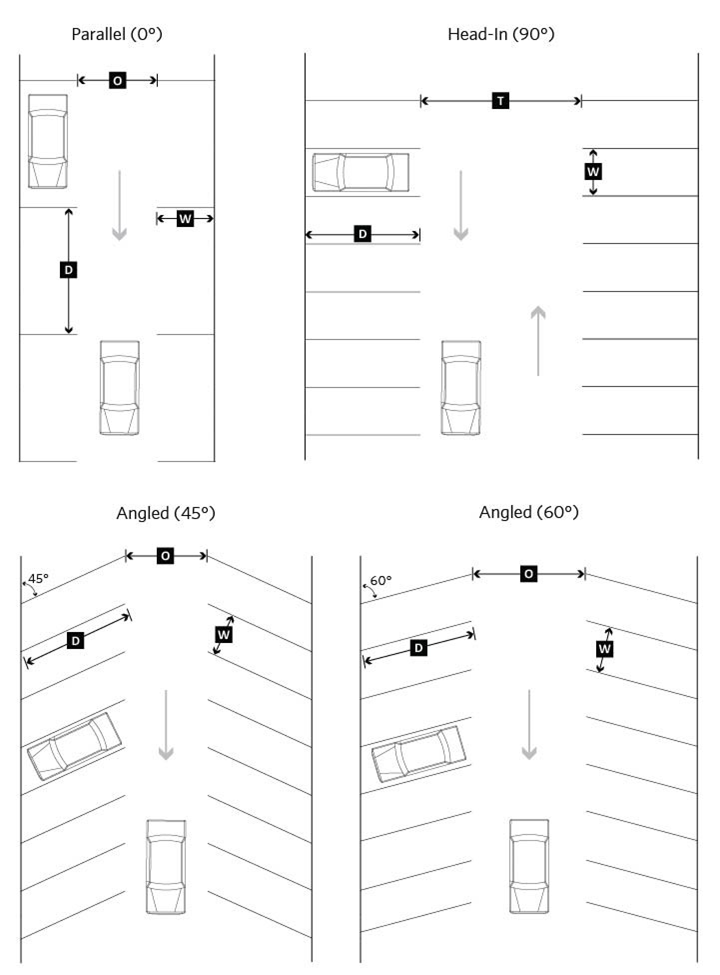
B.
Materials. All off-street parking lots, loading areas, drive-through facilities, and driveways must be constructed using a hard surface, all-weather, dustless material such as asphalt, concrete, or other material approved by the City Engineer.
1.
Pervious Paving Materials. The use of pervious paving materials for parking facilities is allowed. In all districts, the use of pervious paving materials is subject to the prior approval of the Development Review Board.
a.
Maintenance Plan. A maintenance plan for the pervious paving must be approved by the City Engineer before a building permit can be issued.
b.
Impervious Coverage. Pervious paving materials are counted towards impervious coverage. Parking lot landscape requirements in accordance with Section 11.07 (Parking Lot Landscaping) and lot coverage requirements in accordance with Section 8 (Zoning District Regulations) still apply.
2.
Recycled Materials. Recycled materials are encouraged and may be used for parking facilities subject to the prior written approval of the City Engineer.
C.
Access.
1.
Parking Lots. Parking lots must be designed with adequate means of vehicular access from a driveway, street, or alley in a manner that minimizes interference with traffic movement on surrounding streets. Parking facilities must be designed to allow drivers to proceed forward into traffic from an access point, rather than backing out. Existing parking facilities and those that serve single-unit, two-unit, three-unit, four-unit, and townhouse dwellings are exempt from this requirement.
2.
Parking Spaces. Each parking space within a parking lot must open directly onto an aisle or driveway of sufficient width to provide adequate means of vehicular access to the parking space. Vehicles may only be parked within striped parking spaces.
3.
Cross-Access Drives. Mixed-use and non-residential uses adjacent to other mixed-use and non-residential uses are encouraged to provide a vehicular cross-access drive to allow circulation between sites. Property owners who establish cross-access drives will be required to record an easement allowing cross-access in a form acceptable to the City's Corporation Counsel.
4.
Pedestrian Cross-Access. Where sidewalks are not present, mixed-use and non-residential uses are required to provide pedestrian cross-access to allow circulation between adjacent sites, see Figure 10.04-2 Off-Street Parking Access.
Figure 10.04-2 Off-Street Parking Access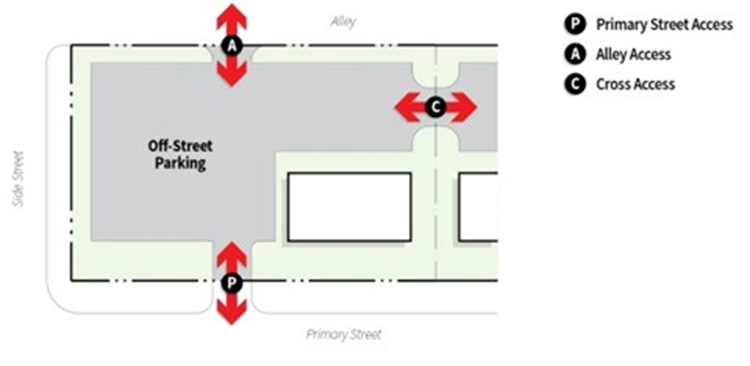
D.
Striping. Off-street parking lots must include clear delineations of parking spaces with paint or another permanent, durable material that is clearly visible.
E.
Wheel Stops, Bumper Stops, and Curbing. Wheel stops, bumper stops, and/or curbing must be permanently and securely installed along the perimeter of parking lots to prevent vehicles from encroaching on sidewalks, landscape areas, fencing, walls, or buildings. The Zoning Administrator may waive this requirement after determining that appropriate stormwater infrastructure is present.
F.
Drainage. Off-street parking lots must be graded for proper drainage so that water is not designed to flow into adjacent properties, as approved by the City Engineer. On-site retention and filtration of stormwater must be provided where practical.
G.
Landscape Requirements. Parking facilities must meet the applicable landscape requirements of Section 11 (Landscape Standards).
H.
Outdoor Lighting Requirements. Parking facilities must meet the applicable outdoor lighting requirements of Section 11.10 (Outdoor Lighting).
I.
Sign Requirements. Parking facilities must meet the applicable sign requirements of Section 12 (Signs).
J.
Snow Storage. Snow storage areas must be provided on or adjacent to all off-street parking facilities. Snow removal equipment, salt, and de-icing agents stored in off-street parking facilities must be properly enclosed and protected from weather. Snow storage in off-street parking facilities for residential uses may not reduce the available parking below required minimums.
1.
Obstructions. Snow must be stored in a manner that does not restrict access or circulation for pedestrians or vehicles.
2.
Storage in Landscape Areas. Landscape areas may not be used for snow storage unless designed for that purpose with non-compacted soils and plantings selected for salt-tolerance and durability.
3.
Storage in Stormwater Management Facilities. Snow may not be stored on top of storm drain catch basins or within stormwater management facilities.
4.
Off-Site Snow Storage. If snow storage cannot be accommodated on-site, the applicant must arrange for off-site snow storage with approval from the Zoning Administrator.
(Ord. No. 25-O-03, § 2(Exh. A), 1-6-25)
10.05 - Pedestrian Circulation Systems
A.
Applicability. Off-street parking areas require pedestrian circulation systems to ensure the safety of pedestrians, bicyclists, and motorists in accordance with the applicability standards of Section 10.01.B (Applicability). Refer to Figure 10.05-1 On-Site Pedestrian Circulation.
B.
Required Connections. The pedestrian circulation system must connect all buildings on the site to one another and provide walkway connections to vehicle parking facilities, bicycle parking facilities, adjacent public rights-of-way, and to adjacent properties along a shared street frontage. The Zoning Administrator may waive this requirement after determining that such connection would not be feasible or if it would create a safety hazard.
Figure 10.05-1 On-Site Pedestrian Circulation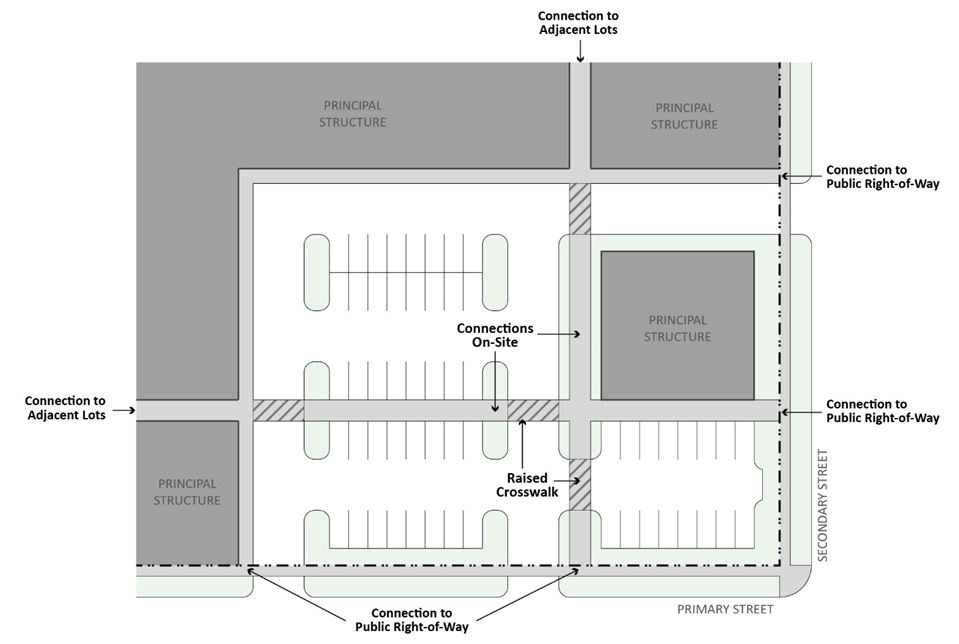
C.
Design Standards for On-Site Pedestrian Circulation Systems. On-site pedestrian circulation systems must be designed in accordance with the following requirements:
1.
Width. The pedestrian circulation system must be paved with a minimum width of five feet.
2.
Clear Markings. Where the pedestrian circulation system crosses driveways, drive aisles, or loading areas, it must be clearly marked by a change in grade, a change in materials, special pavers, stamped asphalt or concrete. Painted striping does not meet this requirement.
3.
Raised Surface. Where the pedestrian circulation system is parallel to an adjacent driveway or drive aisle, it must be raised at least four inches above the surface of the vehicle travel lane and separated by a raised curb. The pedestrian circulation system may also include landscaping, decorative bollards, or other architectural features.
4.
Frontage Sidewalk. A sidewalk with a minimum width of five feet is required along the full length of any building frontage containing a primary entrance that is directly adjacent to a parking row, driveway, or drive aisle. For parking lots with more than 150 parking spaces, a minimum width of ten feet is required. Refer to Figure 10.05-2 Frontage Sidewalk.
5.
Integrated Design. The design of pedestrian circulation systems must be integrated with parking lot landscaping in accordance with Section 11.07 (Parking Lot Landscaping), where appropriate.
6.
Materials. All pedestrian circulation systems must be constructed using a hard surface, all-weather, dustless material in accordance with Section 10.04.B (Materials).
Figure 10.05-2 Frontage Sidewalk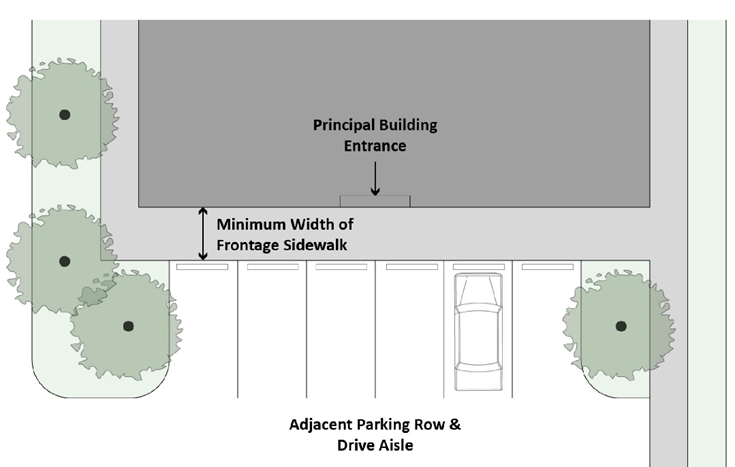
10.06 - Driveways
A.
Driveways providing access to a lot from a right-of-way, alley, or other vehicular access point must comply with the following requirements:
1.
Location. Driveways are permitted to encroach into the required corner side yard, interior side yard and/or rear yard, but must be at least one foot from the interior side lot line, except when the driveway provides shared access for two adjacent properties through a recorded easement, or the principal structure is less than ten feet from the interior side lot line. Driveways must be essentially perpendicular to the right-of-way being accessed. Driveways are permitted to encroach into the front yard if access is from the street and driveway extends to a parking pad past the front line of the house or garage. Parking pads may not be located directly in front of the house.
2.
Quantity. One driveway per principal structure is allowed, provided that the minimum frontage requirements established in Section 8 (Zoning District Regulations) are met. Driveways must be located at least 60 feet from a signalized intersection, and 30 feet from all other intersections, measured from edge of pavement. Lots with at least 150 linear feet of frontage per block face may incorporate one additional driveway along that frontage, with approval from the Development Review Board. On properties for which more than one driveway is permitted, the distance between the driveway entrances must be a minimum of 50 feet.
3.
Driveway Width. Minimum driveway width is nine feet wide. Driveways must be constructed in compliance with Table 10.06-1 Maximum Driveway Width. Driveway width must be measured at the lot line.
4.
Lot Coverage. Driveways are subject to lot coverage requirements in accordance with Section 9.03.A.5 (Lot Coverage) except for interior side yards when extending to a parking pad or garage in the rear yard.
5.
Separation. Driveways and parking areas must be separated from any patio or other hard surface area not designated for parking by a landscaped buffer with a minimum width of four feet.
6.
Visibility. No building, structure, sign, or landscape element that is more than 50 percent opaque may obstruct the area between two and a half feet and eight feet in height within the sight triangle area on each side of any driveway. Beginning at the intersection of the driveway with the lot line, the sight triangle is formed by measuring ten feet along the lot line in the opposite direction of the driveway and ten feet along the driveway in the opposite direction of the lot line, then connecting the endpoints of the lines across the subject lot (refer to Figure 10.06-1 Visibility at Driveways).
Figure 10.06-1 Visibility at Driveways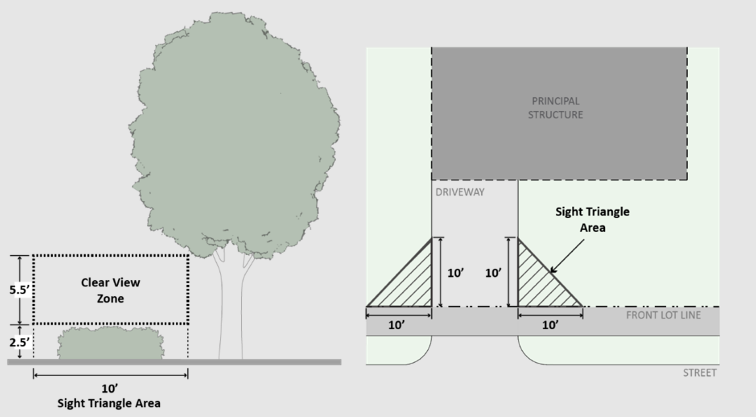
7.
Turning Radii.
a.
Multiple-Unit Dwellings and Commercial Uses. Entrances to multiple-unit dwellings and commercial uses must have minimum turning radii that meet Waukegan Fire Department approval standards.
b.
Industrial Uses. Entrances to industrial uses must have minimum turning radii that meet Waukegan Fire Department approval standards.
8.
Intersection of Sidewalk and Driveway.
a.
Sidewalk. In locations where a sidewalk is crossed by a driveway, the sidewalk must be constructed of a permanent, concrete surface with a minimum width of five feet.
b.
Driveway Aprons. Driveway aprons may not exceed the width of a driveway by more than three feet on each side of the driveway. Driveway aprons must be constructed of asphalt or concrete material as approved by the City Engineer.
9.
Residential Driveways. The following standards apply to driveways for single-unit, two-unit, three-unit, four-unit, and townhouse dwellings only.
a.
Driveway Parking. Vehicles are permitted to park on driveways provided that the vehicles do not encroach into rights-of-way, recorded easements, or adjacent properties.
b.
Alley Orientation. Where an alley exists adjacent to the side or rear lot line, all motor vehicle access to a garage must occur through the alley in accordance with Section 9.03.C.19 (Garage).
c.
Driveway Parking Pad. A parking pad the width of the garage served by the driveway is permitted to extend up to 20 feet in depth from the garage doors before tapering back to the required driveway width. A parking pad accessed from an alley may extend up to 20 feet in depth from the adjacent lot line. Alley-accessed parking pads may only extend up to 20 feet in width, see Figure 10.06-3 Driveway Parking Pad Width.
Figure 10.06-3 Driveway Parking Pad Width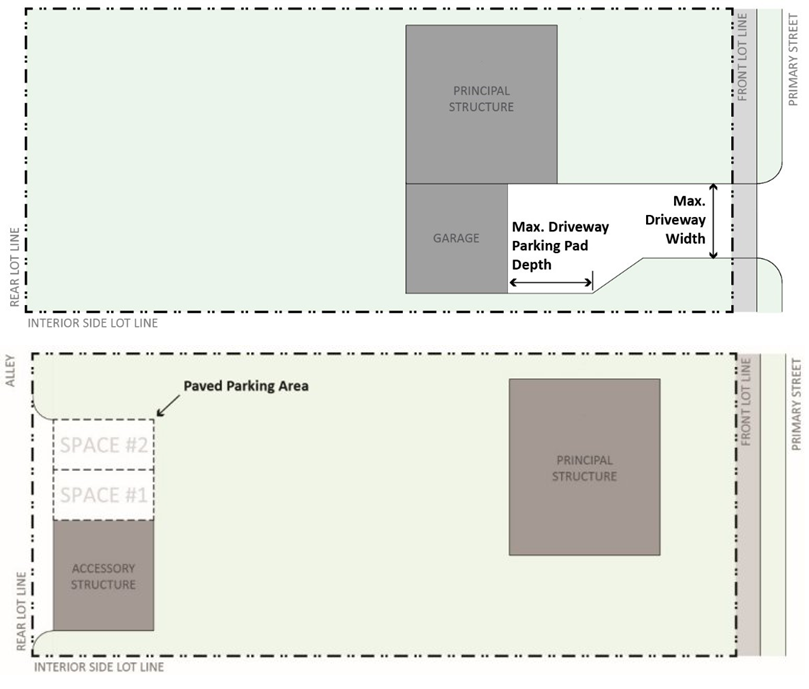
(Ord. No. 25-O-03, § 2(Exh. A), 1-6-25)
10.07 - Vehicle Stacking Requirements
A.
Space Requirements. Every use having a drive-through facility must provide stacking spaces for organized movement of traffic through the premises. The following requirements apply to all stacking spaces and drive-through facilities in accordance with Table 10.07-1 Table of Required Stacking Spaces.
B.
Stacked spaces are required in addition to the Table 10.03-1 Off-Street Parking Standards and are not counted toward the maximum parking requirement.
C.
Dimensions. All stacking spaces must have a minimum width of nine feet, as measured from the edge of the drive-through lane to the outermost edge of the last point of service, such as a drive-through window. Stacking spaces must have a minimum length of 20 feet.
D.
Location. Stacking spaces must be located behind the vehicle parked at the last point of service, such as a drive-through window, and placed in a line within the drive-through lane. Stacking spaces must be located so that they do not obstruct access to the site or to parking and loading spaces. Refer to Figure 10.07-1 Stacking Spaces.
E.
Visibility. Pick-up windows must be located so that stacking spaces are not oriented along the street-facing property line with the most visibility.
F.
Wayfinding. Each drive through lane exit and entrance must be designated by pavement markings indicating direction of traffic.
Figure 10.07-1 Stacking Spaces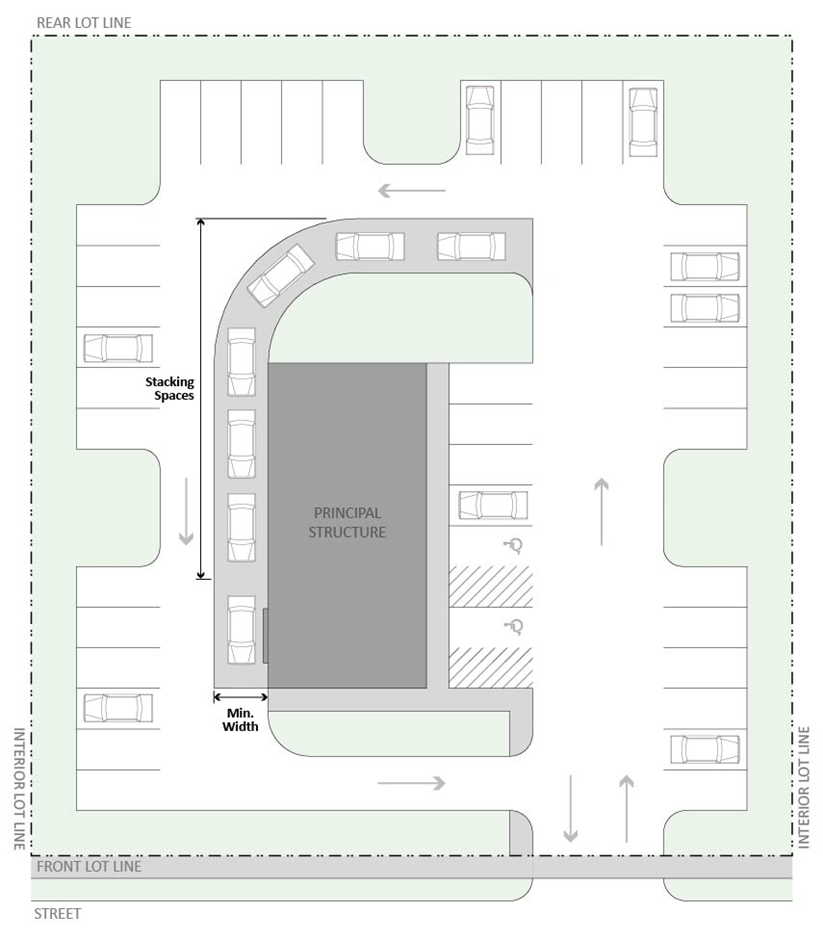
10.08 - Recreational Vehicle Parking
A.
Use. Recreational vehicles may not be used as active dwelling units, including sleeping, bathing, or food preparation, while located within City boundaries. Recreational vehicles may not be connected to sewer, water, or other utilities for any period of time, except for temporary service connections for basic maintenance.
B.
Principal and Accessory Structures. Recreational vehicles are not permitted to be parked or stored on a lot without a principal structure. Recreational vehicles may not be used as accessory structures but may be kept within an enclosed accessory structure provided that the accessory structure satisfies the requirements of Section 9.03 (Accessory Uses and Structures).
C.
Operability. Recreational vehicles parked or stored on private property must always remain operable. Recreational vehicles may not be permanently affixed to the ground in a manner that would prevent timely removal.
D.
Proprietorship. Recreational vehicles may only be owned, leased, or rented by the occupant of the lot on which the recreational vehicles are parked or stored.
E.
Location. Recreational vehicle parking or storage is allowed in the interior side yard and/or rear yard behind the front line of the primary structure. Recreational vehicles in the interior side yard must be parked at least one foot from the interior side lot line but are not allowed where the driveway provides shared access for two adjacent properties. Recreational vehicles in the rear yard must be parked at least three feet from the rear lot line. Recreational vehicles may not park on any public street in the City between the hours of 10:00 p.m. and 7:00 a.m. Recreational vehicles may not park on, or block, any sidewalk in the City at any time.
F.
Loading and Unloading. A recreational vehicle may only be parked in a driveway located in any yard for a period of no more than 24 hours for the purposes of maintenance, loading and unloading. An applicant may extend this 24-hour period by means of a written request filed with the Zoning Administrator no less than seven business days prior to the event. The Zoning Administrator must decide whether to grant or deny the applicant's request no less than five business days after receipt of the applicant's written request.
G.
Parking Surface and Dimensions. Recreational vehicles must be parked on a hard surface, all-weather, dustless material in accordance with Section 10.04.B (Materials) that is equal or greater in length and width to the recreational vehicles being parked.
H.
Screening. Recreational vehicles must be screened by a solid, opaque fence in accordance with fence regulations, or with landscape screening with at least 75 percent opacity to a height of at least six feet.
10.09 - Off-Street Loading Facility Requirements
A.
Applicability. A minimum number of off-street loading spaces may be required as part of a site plan review, conditional use permit, or planned unit development. The maximum number of loading spaces required for any zoning lot is four spaces, but this standard does not apply to warehousing, storage, or distribution facility uses.
B.
Dimensions. Loading spaces must have a minimum width of ten feet, minimum length of 25 feet, and minimum vertical clearance of 14 feet.
C.
Location. All loading spaces must be located on the same zoning lot as the use served, unless an alternate location has been approved by the Zoning Administrator through the site plan review process in accordance with Section 4.09 (Site Plan Review).
1.
Side or Rear Yard. Loading facilities may only be located in the interior side and/or rear yard of the lot. A designated loading area may be located within a drive aisle with prior written approval from the Zoning Administrator.
2.
Residential Districts. A loading space may not be closer than 50 feet from the lot line of a residential district, unless the space is screened in accordance with Section 11.09.C (Off-Street Loading Area Screening Requirements).
3.
Intersections. Loading spaces may be located less than 50 feet from a signalized intersection, and 30 feet from all other intersections, measured from edge of pavement.
D.
Access. Each required off-street loading space must have appropriate means of vehicular access from a driveway, street, or alley in a manner that minimizes interference with traffic movement. A loading space may not project into or block a street, sidewalk, alley, access drive, or parking area. Loading facilities must be designed to allow the driver to proceed forward into traffic from an access point, rather than backing out.
E.
Central Loading. Central Loading facilities may be substituted for loading berths on the individual zoning lots, provided the following conditions are met:
1.
Each zoning lot served will have direct access to the central loading area without crossing streets or alleys at-grade.
2.
No zoning lot served will be 500 feet removed from the central loading area.
3.
The tunnel or ramp connecting the central loading area with the zoning lot served will be a minimum of seven feet in width and have a minimum clearance of seven feet.
10.10 - Parking and Charging Infrastructure for Electric Vehicles
A.
Applicability. The requirements of this section apply to the use categories in Table 10.03-1 Off-Street Parking Standards, provided that those use categories meet the development thresholds listed in Section 10.01.B (Applicability).
B.
Number of Spaces Required. The minimum parking requirements for EV-capable, EV-ready, and EV-installed spaces are included in the total number of allotted parking spaces established in Table 10.03-1 Off-Street Parking Standards.
1.
Residential Uses. New construction of single-unit and two-unit dwellings must have at least one EV-ready parking space per dwelling unit. All other residential uses must provide EV charging infrastructure in accordance with Table 10.10-1 EV Minimum Parking Standards.
2.
Non-Residential Uses. EV charging infrastructure must be provided in accordance with Table 10.10-1 EV Minimum Parking Standards.
3.
Calculation. The quantities shown in Table 10.10-1 EV Minimum Parking Standards are cumulative. EV-installed spaces can substitute for EV-ready and EV-capable spaces as a portion of the total requirement.
C.
Location. EV-capable, EV-ready, and EV-installed spaces must be located in the same parking lot as the principal use and are encouraged to be located in desirable and convenient parking locations within the parking lot.
D.
Design Standards. In addition to the requirements set forth in Section 10.04 (Parking Design Standards), EV-capable, EV-ready, and EV-installed parking spaces must comply with the following design requirements.
1.
Charging equipment must be mounted on the wall or on a structure at the end of the electric vehicle parking space provided. No charging device may be placed within the dimensions of a parking space, on the sides, or entrance to a parking space.
2.
Outlets and connector devices must be a minimum of 36 inches and a maximum of 48 inches from the pavement surface where the charging device is mounted. Devices may not impede on pedestrian travel or snow removal activities.
3.
All charging equipment must incorporate a cord management system or method to minimize the potential for cable entanglement, user injury, or connector damage. Cords must be retractable or have a device to safely hang the cord without touching the pavement surface.
4.
Wayfinding signs, if installed, must be placed to effectively guide the motorist to the designated parking space. Signage must comply with existing regulations set forth in Section 12.06 (Regulations for Accessory Signs).
E.
Accessibility. For non-residential uses, a minimum of one EV-installed space must be located adjacent to an Americans with Disabilities Act designated space to provide access to the charging station. The EV-installed space must have all relevant parts located within accessible reach.

