
Waukegan City Zoning Code
SECTION 9
- USES
9.01 - General Provisions
A.
Purpose. The purpose of this Section is to protect and promote the health, safety, comfort, convenience, and general welfare of the public by providing clear standards for the allowed usages of the land within the City.
B.
General Standards. The following standards apply generally to the uses allowed by this Ordinance.
1.
Federal, State, and Local Requirements. All uses must comply with relevant federal, state, and local standards including licensing, registration, health, and safety requirements.
2.
Number of Principal Uses. A zoning lot may contain more than one principal use.
3.
Principal, Accessory, and Temporary Uses. Each use may function as a principal, accessory, or temporary use on a zoning lot, unless otherwise specified.
4.
Uses Within Enclosed Buildings or Structures. Each use must be primarily located within an enclosed building or structure, unless specifically permitted by this Ordinance. A use that typically includes an outdoor component is exempt from this requirement. Examples include, but are not limited to, community gardens, outdoor entertainment, outdoor recreation, outdoor storage areas, or parks. All buildings and structures must comply with the applicable requirements of this Section and Section 8 (Zoning District Regulations).
5.
Exempt Public Uses. The following public uses are allowed to be erected, constructed, altered, or maintained in any zoning district with City approval.
a.
Traffic signals, fire hydrants, and other similar public safety devices.
b.
Utility poles, wires, mains, drains, pipes, conduits, cables, wireless telecommunication small cells, and other similar public service improvements.
C.
Interpretation. Some of the uses and structures included in this Section are defined as broad categories that contain a group of similar uses. See Section 13 (Definitions) for definitions of the uses and structures included in this Section. Applicants may request an interpretation of the uses and structures allowed by Ordinance from the Zoning Administrator in accordance with Section 4.10 (Ordinance Interpretation).
1.
Unlisted Similar Use or Structure. If a use or structure is not listed in this Section but is similar in nature and impact to a use or structure allowed within a zoning district, the Zoning Administrator may interpret the unlisted use or structure to be an allowed use.
a.
The unlisted use or structure is subject to any use standards that apply to the similar allowed use or structure.
b.
The Zoning Administrator may interpret an unlisted use as requiring the approval of a conditional use permit if the similar allowed use requires the approval of a conditional use permit.
2.
Unlisted Dissimilar Use or Structure. If a use or structure is not listed in this Section and the Zoning Administrator does not deem the use or structure to be similar in nature and impact to a use or structure allowed within a zoning district, then the use is not allowed and may only be approved through an amendment of this Ordinance. See Section 4.07 (Amendments).
9.02 - Principal Uses and Structures
A.
Use Table. Table 9.02-1 Principal Uses and Structures establishes the uses allowed in each zoning district. Each use is given one of the following designations for each zoning district.
1.
Permitted Use ("P"). "P" indicates that a use is allowed by-right within the designated zoning district provided that it meets all applicable use standards set forth in Section 9.02.B (Use Standards for Principal Uses and Structures).
2.
Conditional Use ("C"). "C" indicates that the use requires the approval of a conditional use permit, refer to Section 4.08 (Conditional Uses), in order to be allowed within the designated zoning district and must meet all applicable use standards set forth in Section 9.02.B (Use Standards for Principal Uses and Structures).
3.
No Designation. The absence of a letter (a blank space) or the absence of the use from the table indicates that the use is not allowed within the designated zoning district.
B.
Use Standards for Principal Uses and Structures. The following standards apply to principal uses and structures as designated in the Use Standards column of Table 9.02-1 Principal Uses and Structures.
1.
Airport. Airports and surroundings boundary areas are subject to the rules and regulations of the State of Illinois Department of Aeronautics as well as the following regulations:
a.
The height of structures in areas surrounding the boundaries of airports must comply with the restrictions set forth in the established approach plan that has been approved by the State of Illinois Department of Transportation Division of Aeronautics.
b.
The height of structures in areas within the approved approach plan must also comply with the requirements set forth by local, state, and federal authorities.
c.
Structures exceeding the maximum permitted heights will be considered obstructions to air navigation unless found not to be objectionable after special aeronautical study. Such structures may be specifically authorized by a variance granted pursuant to Development Review Board or Planning and Zoning Commission procedures.
2.
Animal Boarding, Hospital, or Shelter.
a.
Location. Animal boarding facilities, hospitals, and shelters that are not entirely enclosed are not allowed directly adjacent to any residential use.
b.
Outdoor Boarding. Two outdoor dog runs per establishment are allowed. Outdoor animal boarding facilities may only be located in the interior side and/or rear yard and must be enclosed with a privacy fence with a minimum height of six feet. See Section 9.03.C.17 (Fence or Wall) for additional fence standards.
c.
Drainage. Drainage from outdoor dog runs or kennels may not drain onto adjacent properties, into the public right-of-way, or into stormwater catchments.
d.
Safety. All animal boarding facilities, hospitals, and shelters must be designed to ensure the safety, health, and well-being of the animals on-site, including protection from predators, the elements, and inclement weather.
3.
Bed and Breakfast.
a.
Residential Character. The location and operation of the facility may not alter the residential character of the neighborhood, and the facility must incorporate a residential design that is compatible with the surrounding residences in accordance with Section 8.09 (Design Requirements for Residential Zoning Districts).
b.
Minimize Adverse Impacts. The facility must minimize traffic congestion, pedestrian hazards, noise, and other adverse impacts on surrounding properties.
c.
Facilities. Bed and breakfasts must offer at least one meal to guests per day. Individual guest units may not contain cooking facilities. Any meals offered by the facility must be provided in a common location within the residence.
(1)
No more than six guest rooms may be rented during any given time.
(2)
The facility must also be the primary residence of the owner.
(3)
No more than two non-residents may be employed on the premises.
d.
Duration of Stay. Guests are permitted a maximum of seven consecutive days to reside at the facility.
4.
Cannabis Business Establishments (Non-Retail) - Cannabis Craft Grower, Cannabis Cultivation Center, Cannabis Dispensary, Cannabis Infuser, Cannabis Processor, or Cannabis Transporter.
a.
Minimum Spacing. A cannabis craft grower, cannabis dispensary, cannabis cultivation center, cannabis infuser, cannabis processor, or cannabis transporter may not be located within 1,000 feet of a lot zoned or used for residential purposes, or any residential care facility, licensed childcare facility, library, school, college, university, or public park. If a lot zoned or used for residential purposes is separated from a none-retail cannabis business establishment by a major state roadway, the minimum spacing may be reduced to 250 feet.
b.
On-Site Consumption. Cannabis products may not be consumed on-site.
c.
Security. The site design of the non-retail cannabis business establishment must incorporate adequate security measures, such as security personnel, controlled access, vault storage, exterior lighting, surveillance cameras, and/or fencing that meet or exceed the State of Illinois requirements for such facilities.
d.
Exterior Appearance and Display. The exterior appearance of the building must be compatible with commercial or industrial structures already constructed or under construction within the immediate neighborhood. Signage may not contain cannabis imagery such as cannabis leaves, plants, smoke, paraphernalia, imagery orientated towards youth, or language referencing cannabis.
e.
Colocation. Any cannabis craft grower, cannabis dispensary, cannabis cultivation center, cannabis infuser, cannabis processor, or cannabis transporter may, operate on the same zoning lot and within the same building as one or more other cannabis business establishment provided that each cannabis business establishment must be properly licensed by the state of Illinois and have obtained a conditional use permit.
5.
Car Wash.
a.
Stacking Spaces. Stacking spaces associated with a car wash must comply with the requirements of Section 10.07 (Vehicle Stacking Requirements).
b.
Screening. The street frontage adjacent to any outdoor car wash area must be screened in accordance with the requirements of Section 11.07.A (Parking Lot Perimeter Landscape).
c.
Overhead Doors. All wash bays must be secured with overhead doors when the establishment is closed.
d.
Drainage. Drainage from a car wash may not drain onto adjacent properties, into the right-of-way, or into stormwater catchments.
e.
Traffic Study. The City may require a traffic study to ensure that a proposed development does not adversely affect safe and efficient traffic circulation for motorists, bicyclists, or pedestrians.
6.
Cemetery. R Districts. In R Districts, Cemeteries may only be owned and operated by a place of worship.
7.
Contractor Yard.
a.
Location. No Contractor Yard may be located within 500 feet of any residential district measured from property line to property line.
b.
Operations. All operations with the contractor yard must be located onsite. The site must be the primary business location of the business and the business must be registered with the Secretary of State to that address. The City business license will list that address on the business license.
c.
Storage and screening. All materials and equipment must be stored or located behind the front yard and corner yard setback line. Any materials stored or located within view of the public right-of-way must be screened in accordance with the requirements of Section 11.07.A (Parking Lot Perimeter Landscape).
d.
Design Standards. Windows and doors seen from the public right-of-way must remain unobstructed.
8.
Day Care Center.
a.
Minimize Adverse Impacts. The design of the facility must minimize traffic congestion, pedestrian hazards, noise, and other adverse impacts on surrounding properties.
b.
Traffic Study. The City may require a traffic study to ensure that the proposed development does not adversely affect safe and efficient traffic circulation for motorists, bicyclists, or pedestrians.
9.
Day Care Home.
a.
Residential Character. The location and operation of the facility may not alter the residential character of the neighborhood, and the facility must incorporate a residential design that is compatible with the surrounding residences in accordance with Section 8.09 (Design Requirements for Residential Zoning Districts). A day care home may have no more than eight children present at any time, including any children who reside in the home.
b.
Residency of Operator. The day care home must be the primary residence of the operator.
c.
Employees. Additional non-resident employees are allowed to work in a day care home.
d.
Minimize Adverse Impacts. The design of the facility must minimize traffic congestion, pedestrian hazards, noise, and other adverse impacts on surrounding properties.
e.
Development Review Board. Day Care Home uses may be subject to review and conditions set by the Development Review Board per Section 2.03 (Development Review Board), dependent on regulation found in City's Code of Ordinances.
10.
Drive-Through Facility.
a.
Accessory Use. Drive-Through Facilities are only allowed as an accessory component to restaurants, financial institutions, and retail goods establishments.
b.
Access. Driveways must comply with the requirements of Section 10.06 (Driveways).
c.
Stacking Spaces. Stacking spaces must comply with the requirements of Section 10.07 (Vehicle Stacking Requirements).
d.
Minimum Street Frontage Requirement. Drive-through facilities are exempt from the minimum street frontage requirements established in Section 8 (Zoning District Regulations).
e.
Minimize Adverse Impacts. The location of entrances and exits must minimize traffic congestion, pedestrian hazards, and adverse impacts on surrounding properties.
f.
Drive aisles must be designed to minimize crossings with pedestrian walkways. Where pedestrian crossings are necessary, they must have clear visibility, be at-level with the pedestrian walkway, and be identified by special paving, striping, and/or signage
g.
Screening. Any drive-through establishment within 100 feet of any residential zoning district must provide landscape, wall, or fence screening six feet in height along queue areas to shield adjacent properties from headlight and menu display glare.
h.
Noise. Any drive-through establishment must control the noise level of any speaker so that it does not exceed 65 decibels at any property line.
i.
Traffic Study. The City may require a traffic study to ensure that a proposed development does not adversely affect safe and efficient traffic circulation for motorists, bicyclists, or pedestrians.
11.
Dwelling: Community Residence (Large) or Community Residence (Small).
a.
Occupancy. A community residence (large) provides living accommodations for nine or more unrelated residents while a community residence (small) provides living accommodates for eight or fewer unrelated residents.
b.
Minimum Spacing. A community residence may not be located within 1,000 feet of another community residence, measured from the property line, and more than one community residence may not be located on a single block.
c.
Residential Character. The location and operation of the facility may not alter the residential character of the neighborhood, and the facility must incorporate a residential design that is compatible with the surrounding neighborhood, in accordance with place-based guidelines set forth in the 2020 Waukegan Comprehensive Plan.
d.
B1 District Location. In the B1 District, a community residence may only be located above the ground floor.
12.
Dwelling: Live/Work.
a.
Sales. On-site retail transactions associated with a live/work dwelling are permitted.
b.
Residency of Operator. The live/work dwelling must be the primary residence of the operator.
c.
Employees. One additional employee who does not reside in the dwelling unit is allowed to work in a live/work dwelling.
d.
Signage. All signs must follow home-based business sign regulations
e.
Space Limitation. No more than 50 percent of the total square footage of the premises may be used for residential uses.
f.
Structural Limitations. No exterior alterations of any kind can be made to the dwelling unit that would change its residential character as a dwelling unit, with the exception of conforming signs.
g.
Dwellings Above the Ground Floor. A dwelling of a live/work use may be located above the ground floor in the B1 and B2 District.
13.
Dwelling: Residential Care Facility. B1 District Location. In the B1 District, a residential care facility must be located above the ground floor.
14.
Dwelling: Single-Room Occupancy Units.
a.
Dimensions. A Single-Room Occupancy Unit must contain at least 120 square feet of floor space, including at least four-square feet of closet space with an unobstructed height of at least five feet, for use by the occupant.
(1)
If the closet space is less than four square feet, the habitable floor space in the unit must be increased by the amount of the deficiency.
(2)
Such floor space minimums must increase by 100 square feet for each additional person allowed to reside in a single-room occupancy unit.
b.
Access. The occupant must be able to access the unit without passing through any other unit. Each unit must have immediate access to two or more approved means of exit from the building, appropriately marked and leading to safe and open space at ground level.
c.
Amenities. Single-room occupancy units must have access to a communal cooking facility and shared or private sanitary facilities.
15.
Elementary, Middle, High, or Vocational School.
a.
Minimize Adverse Impacts. The location of facilities, entrances, exits, service areas, parking areas, and loading docks must minimize traffic congestion, pedestrian hazards, and adverse impacts on surrounding properties.
b.
Pedestrian Access. Drive aisles must be designed to minimize crossings with pedestrian walkways. Where pedestrian crossings are necessary, they must have clear visibility, be at-level with the pedestrian walkway, and be identified by special paving, striping, and/or signage.
16.
Gas Station.
a.
Minimum Street Frontage Requirement. Gas stations are exempt from the minimum street frontage requirements established in Section 8 (Zoning District Regulations).
b.
Stacking Spaces. Stacking spaces must comply with the requirements of Section 10.07 (Vehicle Stacking Requirements).
c.
Canopy Height. The height of a gas station canopy may not exceed 30 feet.
d.
Traffic Study. The City may require a traffic study to ensure that a proposed development does not adversely affect safe and efficient traffic circulation for motorists, bicyclists, or pedestrians.
e.
Light Pollution. Lighting must be designed with luminaires recessed under the canopy to minimize light pollution. The illuminance of the canopy may not exceed 20 foot-candles as measured at any location on the lot. See Section 11.10 (Outdoor Lighting).
f.
Landscaping. Street frontage not occupied by building or driveways must be improved in accordance with the requirements of Section 11.07.A (Parking Lot Perimeter Landscape).
g.
Underground storage tanks must meet or exceed state and federal environmental regulations.
17.
Government Facility. Access. Government facilities are exempt from the maximum driveway widths established in Section 10.06 (Driveways).
18.
Homeless Shelter. The following specific conditions apply to all Homeless Shelters when considering an application for a conditional use permit:
a.
Parking and Loading. If services of the facility include transport via private bus, van, or other multi-passenger vehicles, loading for such vehicle must comply with the requirements of Section 10.09 Off-Street Loading Facility Requirements.
b.
Accessibility. Location of Homeless Shelters should be based on convenience and proximity to public transportation, designated bicycle and pedestrian infrastructure, or proximity to other relevant services.
c.
Security. Facilities must be designed and operated with functional security cameras in all public or shared spaces and hallways and building and site perimeters.
d.
Staff. A paid professional staff member must be on-site at all times that clients or guests are on the premises.
19.
Indoor Entertainment (Large), Indoor Entertainment (Small), or Indoor Recreation.
a.
Minimize Adverse Impacts. The location of entrances and exits, service areas, and parking and loading docks must minimize traffic congestion, pedestrian hazards, and adverse impacts on surrounding properties.
b.
Traffic Study. The City may require a traffic study to ensure that a proposed development does not adversely affect safe and efficient traffic circulation for motorists, bicyclists, or pedestrians.
20.
Marina, Motor Vehicle Dealership or Marina, Commercial/Recreational.
a.
Minimize Adverse Impacts. Any cleaning, painting, servicing, testing, or repair of boats or other products may not produce adverse impacts to surrounding properties through additional emissions, noise pollution, smoke, dust, or other particulate material that causes odor, fire, pollution into surrounding water systems, or glare.
b.
Storage. All storage, except of motor vehicles or water-borne craft in operable condition, must be within completely enclosed buildings or effectively screened by a solid wall or fence in accordance with the requirements of Section 11.07.A (Parking Lot Perimeter Landscape).
21.
Motor Vehicle Repair and/or Service.
a.
Location. All parking or storage of vehicles in connection with motor vehicle repair and/or service facilities must be set back a minimum of 10 feet from any property line adjacent to a public street in accordance with Section 11.08 (Buffer Yards).
b.
Hours of Operation. Motor vehicle repair and/or service facilities which are located within 50 feet of any residential district are permitted to operate only between the hours of 6:00 a.m. and 8:00 p.m.
c.
Outdoor Storage. Disabled or inoperable vehicles and those awaiting pick-up may be stored outdoors only under the following conditions:
(1)
Location. Outdoor storage of vehicles is prohibited in the front yard and corner side yard setbacks.
(2)
Screening. All storage areas must be screened from view of the public right-of-way by building and/or landscape screening in accordance with the requirements of Section 11.07.A (Parking Lot Perimeter Landscape).
(3)
Storage Duration. Motor vehicle repair and/or service facilities may not store the same vehicles outdoors for more than 30 days.
(4)
Any vehicle stored outdoors must appear in operable condition.
d.
Location for Repairs. All repairs must occur inside an enclosed building.
e.
Screening. Street frontage not occupied by buildings or driveways must be improved with landscape screening in accordance with the requirements of Section 11.07.A (Parking Lot Perimeter Landscape).
22.
Motor Vehicle Rental or Motor Vehicle Sales.
a.
Screening. The street frontage adjacent to any motor vehicle rental or motor vehicle sales use must be improved with landscape screening in accordance with the requirements of Section 11.07.A (Parking Lot Perimeter Landscape).
b.
Light Pollution. The illuminance of any outdoor motor vehicle sales and display area may not exceed 10 foot-candles as measured at any location on the lot.
23.
Outdoor Entertainment or Outdoor Recreation.
a.
Minimize Adverse Impacts. The location of entrances and exits, service areas, and parking and loading docks must minimize traffic congestion, pedestrian hazards, and adverse impacts on surrounding properties.
b.
Noise will be managed so as not to create a public nuisance for surrounding properties in compliance with the requirements of Section 9.05.A (Noise).
c.
Traffic Study. The City may require a traffic study to ensure that a proposed development does not adversely affect safe and efficient traffic circulation for motorists, bicyclists, or pedestrians.
24.
Outdoor Storage Area.
a.
Location. Outdoor storage areas may only be located in the interior side yard or rear yard and must be located on a hard surface such as asphalt or concrete unless an alternative surface type is approved by the City Engineer.
b.
Height. Materials in an outdoor storage area may not exceed eight feet in height if they are located 20 feet or less from a lot line. Materials in an outdoor storage area may not exceed 18 feet in height if they are located more than 20 feet from a lot line.
c.
Uses. Outdoor storage areas are allowed as a principal use in association with the following principal uses: garden center, gas station, light manufacturing, machinery and equipment sales and rental, and warehousing and distribution facility. Outdoor storage areas may be allowed as a principal use in association with other types of principal uses with prior written approval by the Zoning Administrator.
d.
Screening. The requirements of Section 11.09 (Screening Requirements) apply to outdoor storage areas.
e.
Traffic Study. The City may require a traffic study to ensure that a proposed development does not adversely affect safe and efficient traffic circulation for motorists, bicyclists, or pedestrians.
25.
Pawn Shop or Title or Payday Loan Establishment.
a.
Minimum Spacing.
(1)
A currency exchange, pawn shop, or title or payday loan establishment may not be located within 2,500 feet of another currency exchange, pawn shop, or title or payday loan establishment.
(2)
A currency exchange, pawn shop, or title or payday loan establishment may not be located within 250 feet of any residential district, school, day care center, park, or place of worship.
b.
Location of Transactions. All transactions must occur entirely inside the facility at a service counter. No transactions may be permitted through an exterior walk-up window or drive-through facility.
c.
Hours of Operation. Currency exchanges, pawn shops, or title or payday loan establishments may only operate between the hours of 8:00 a.m. and 8:00 p.m.
26.
Stable. Setbacks. Any structure used for the stabling of horses must be setback a minimum of 50 feet from any property line.
27.
Utility. Screening. The street frontage adjacent to the utility must be treated with landscape screening in accordance with the requirements of Section 11.07.A (Parking Lot Perimeter Landscape).
28.
Utility-Scale Solar Energy System.
a.
General Solar Energy System Regulations. The following regulations apply to both principal use and accessory use solar energy systems.
(1)
Wind Resistance. All supporting structures must be rated to withstand wind speeds of 110 miles per hour or greater.
(2)
Electrical Wiring. All electrical wiring must be located underground or inside the building on which the solar energy system is mounted.
(3)
Lighting. Solar energy systems may not be artificially illuminated.
(4)
Signs. No signs are permitted on solar energy systems or supporting structures, except for the manufacturer's safety information and warning signs in accordance with Section 12.08.B.2 (Warning Signs).
(5)
Utility Interconnection. On-grid solar energy systems may not be installed until documentation has been provided by an electrical utility provider agreeing to interconnect with the utility provider's transmission system. Off-grid solar energy systems are not permitted.
(6)
Emergency Disconnection.
(a)
For principal use solar energy systems, an emergency disconnection switch must be provided in an easily accessible outdoor location.
(b)
For accessory use solar energy systems, an emergency disconnection switch must be located near the electric meter.
(7)
Solar Access Easements. Property owners may seek solar access easements from their neighbors and have those easements legally recorded with the applicable county.
(8)
Approved Solar Components. Electric solar energy system components must have an Underwriters Laboratory (UL) listing or approved equivalent, and solar hot water systems must have a Solar Rating and Certification Corporation (SRCC) rating.
(9)
Compliance with Building Codes. All solar energy systems must meet approval of local building code officials, consistent with the City of Waukegan's current adopted codes. All solar thermal systems must comply with HVAC-related requirements of the current edition of the International Energy Conservation Code as adopted by the State of Illinois.
(10)
Compliance with National Electrical Code. All photovoltaic systems must comply with the current edition of the National Electrical Code.
(11)
Compliance with State Plumbing Code. Solar thermal systems must comply with applicable State of Illinois Plumbing Code requirements.
b.
Impervious Coverage. Maximum impervious coverage requirements do not apply to utility-scale solar energy systems, so long as the soil under the collectors is not compacted and is maintained with vegetation.
29.
Small Wind Energy Systems.
a.
General Wind Energy System Regulations. The following regulations apply to both principal use and accessory use wind energy systems.
(1)
Tower Design. All wind energy system towers must be free-standing monopoles or latticed with no guyed wires. Tilt-down towers are permitted. All wind energy systems must be painted a non-reflective white, off-white, or gray.
(2)
Electrical Wiring. All electrical wiring must be located underground or inside the building on which the wind energy system is mounted.
(3)
Lighting. Wind energy systems may not be artificially illuminated, unless required by the Federal Aviation Administration.
(4)
Sound. All wind energy systems must comply with Section 9.05.A (Noise). Noise standards may be temporarily exceeded during severe weather such as tornados and thunderstorms.
(5)
Signs. No signs are permitted on wind energy systems or supporting structures, except for the manufacturer's safety information and warning signs in accordance with Section 12.05.A.10 (Warning Signs).
(6)
Utility Interconnection. On-grid wind energy systems may not be installed until documentation has been provided by an electrical utility provider agreeing to interconnect with the utility provider's transmission system. Off-grid systems are not permitted.
(7)
Emergency Disconnection.
(a)
For principal use wind energy systems, an emergency disconnection switch must be provided in an easily accessible outdoor location.
(b)
For accessory use wind energy systems, an emergency disconnection switch must be located near the electric meter.
(8)
Clearance. All wind energy systems must have a minimum of 15 feet of clearance between the turbine blades and the ground. Greater clearance may be necessary for tilt-down towers.
(9)
Climbing Apparatus. Any external climbing apparatus associated with a wind energy system must be inaccessible to the public.
(10)
Creation of Easements. Wind access easements across contiguous or nearby lots, tracts, or land may be created to establish a window of exposure to the wind to protect an existing or intended wind turbine's ability to harness the wind from obstruction of buildings and trees. The property owner is responsible creating, obtaining, and recording such easements. Such easements must indemnify the City from future disputes between property owners.
(a)
Such easements may be purchased, reserved, granted, or otherwise obtained.
(b)
Adverse possession cannot create such an easement.
(c)
An easement infringed upon is a compensable property right through private remedy.
(d)
Recording of Easements. Wind access easements must be recorded with the Recording Division of the Lake County Clerk's Office and filed with the Building and Engineering Departments.
(e)
Construction in Easement Areas. Any person seeking a building permit to construct or modify any structure or building to increase the consumption of airspace over that lot must certify in writing that no wind access easement will be impacted by the construction.
(f)
Denial of Permit. No building permit will be granted if the City's Building Commissioner determines that the proposed construction would intrude upon the easement.
(11)
Turbine Certification. All small wind energy systems must be approved by a small wind turbine certification program recognized by the American Wind Energy Association.
b.
Small Wind Energy System (Ground-Mounted)
(1)
General Wind Energy System Regulations. All ground-mounted small wind energy systems must comply with the general wind energy system regulations in Section 9.02.B.29.a (General Wind Energy System Regulations). Refer to Figure 9.02-3 Small Wind Energy System (Ground-Mounted).
(2)
Location. Ground-mounted small wind energy systems are allowed only in the interior side and rear yards.
(3)
Setbacks. All ground-mounted small wind energy systems must be setback a minimum of 15 feet or the distance equal to the tower height, whichever is greater, from any lot lines, above ground utility lines, and other utility-scale wind turbines.
(4)
Quantity. There is no limit on the quantity of turbines that may be installed for a ground-mounted wind energy system.
(5)
Height.
(a)
The maximum system height for a ground-mounted small wind energy system is the maximum building height of the zoning district in which the turbine is located.
(b)
The maximum system height for a ground-mounted small wind energy system of 90 feet may be granted in the B1, B2, B3, B4, H/C, R/LI, and I Zoning Districts through the conditional use permit process. (See Section 4.08 Conditional Uses)
(6)
Shadow Flicker and Sound Impacts. All applications for a conditional use permit under this Subsection must include a shadow flicker study, showing the calculated locations of shadow flicker caused by a wind energy system and the expected duration (measured in total hours per year) of the flicker on adjacent residences, or any residentially zoned properties. Any significant shadow flicker on a residence or residentially zoned property, defined as more than 30 hours per year, must be addressed through conditions related to siting or mitigation measures.
Figure 9.02-2 Small Wind Energy System (Ground-Mounted)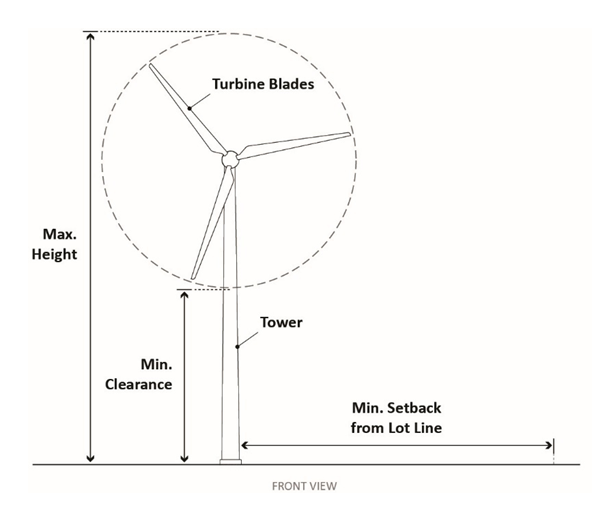
30.
Wireless Telecommunication Facility and/or Tower.
a.
General Requirements.
(1)
Lighting. Wireless telecommunication facilities and towers may not include artificial lighting, unless required by the Federal Communications Commission, the Federal Aviation Administration, or the City.
(2)
Signs.
(a)
All towers and antennae must have the name of the provider and an emergency telephone number (both business and non-business hours) either lettered directly on the equipment or on a plate attached to the equipment. This sign may not exceed two square feet in size.
(b)
Wireless telecommunication facilities and towers may not display signs except for the information required under Section 9.02.B.29.a.5, or for government regulation, such as Federal Communications Commission registration information.
(3)
Screening. Wireless telecommunication facilities and towers must include landscape screening in accordance with the requirements of Section 11.08.B (Buffer Yard Requirements), except for required fencing, which must be a minimum of six feet and maximum of ten feet in height.
(4)
Storage. Vehicle and outdoor storage on site of any tower is prohibited.
(5)
Removal.
(a)
If the installation is maintained or operated in such a fashion to be in violation of this section and the owner has failed to eliminate the violation within 30 days of the mailing of written notice of violation to its last known address, the City may remove such antenna or tower at the owner's expense and may use the posted bond to the extent necessary with the owner responsible for any costs exceeding the available bond.
(b)
Any installation that is not operated for a continuous period of six months will be considered abandoned, provided that if there are two or more users of a single tower, the tower will not be considered abandoned until all users cease using the tower. The owner of such installation must remove same within 30 days of the mailing of written notice of abandonment to its last known address. If the owner fails to remove the installation within the 30-day period, then the City may remove such installation at the owner's expense and may use the posted bond to the extent necessary with the owner responsible for any costs exceeding the available bond.
(6)
Deviations. An application that demonstrates that any provision or combination of provisions of Section 9.02.B.29 (Small Wind Energy Systems) individually or collectively renders it not reasonably possible to install a functioning installation and all other possibilities have been exhausted, the City Council may waive, reduce, or substitute from the requirements of this section to permit a functioning installation which will still be consistent with Section 9.02.B.29 (Small Wind Energy Systems).
b.
Wireless Telecommunication Facility.
(1)
Height. The maximum height of a wireless telecommunication facility is 12 feet.
(2)
Size. The maximum footprint of the facility is the footprint of the building be larger than 12 feet by 15 feet.
(3)
Roof Design. The facility must have a conventional peaked roof. A flat roof is prohibited.
(4)
Use. Wireless telecommunication facilities may house equipment and supplies for the operation of wireless telecommunication towers. Such facilities must be unstaffed and must be used for equipment that is used as part of the operation of the facility.
c.
Wireless Telecommunication Tower.
(1)
Location.
(a)
City of Waukegan Property. All towers or antennae should be located on property or structures owned or controlled by the City if available and structurally feasible. If no property owned or controlled by the City is available or structurally feasible to serve the needs of the wireless provider, property or structures owned or controlled by the County of Lake, Waukegan Park District, Waukegan School District, or any township located within the corporate limits of the City of Waukegan will be the next preference.
(b)
Installation is not allowed in a wetland or floodplain unless no damage would occur to the wetland or flood plain and the proposed tower is structurally sound.
(2)
Height. The maximum height of a wireless telecommunication tower is 150 feet, unless a taller height is required to function satisfactorily; in such case, the applicant must present a report indicating the need for a height greater than 150 feet as an additional material required for a variance application. See Section 4.04 (Variances).
(3)
Setbacks. Towers, antennae, and accessory facilities must satisfy the minimum zoning district setback requirements. Towers greater than 100 feet in height may not be located closer than 0.25 miles from any existing tower that is greater than 100 feet in height.
(4)
Design.
(a)
Wireless telecommunication towers must be designed to accommodate at least three telecommunication providers and their accompanying wireless telecommunication facilities.
(b)
New telecommunications towers must allow for the co-location of city-owned repeaters, boosters and/or transmitters for emergency communications systems.
(a)
The provider will coordinate the installation of, and pay for, any associated labor charges for the installation of any city-owned repeaters, boosters, antennae and/or transmitters.
(b)
The provider will provide and maintain any necessary normal electric power, per city specification for any city-owned repeaters, boosters, antennae and/or transmitters.
(c)
An ample protective enclosure, per city specification, must be provided for any city-owned repeaters, boosters, and/or transmitters.
(d)
Within 24-hour notification, the provider will make available access to the tower or antennae for the purpose of inspecting, aligning, adjusting and/or repairing any city-owned repeaters, boosters, antennae and/or transmitters.
(c)
Wireless telecommunication towers must be galvanized and painted a neutral color, unless otherwise required by the Federal Communications Commission, the Federal Aviation Administration, or the City.
(Ord. No. 25-O-03, § 2(Exh. A), 1-6-25)
9.03 - Accessory Uses and Structures
Accessory uses and structures are subject to the requirements of this Section.
A.
General Provisions for Accessory Structures.
1.
Construction Phasing. No accessory structure may be constructed prior to the construction of the principal building to which it is accessory.
2.
Location. Accessory structures may be located in the rear yard of a zoning lot, unless otherwise established by this Ordinance. Accessory structures, except fences and walls, are not allowed in any easement whether publicly or privately held.
3.
Setback. Accessory structures, except fences and walls, must be located a minimum of five feet from any interior lot line or rear lot line unless otherwise established by this Ordinance.
4.
Height. No accessory structure may exceed the height of the principal structure, unless otherwise established by this ordinance or by this Ordinance.
5.
Lot Coverage. No accessory structure may occupy more than 40 percent of any yard. No accessory structure, when combined with impervious ground cover, may occupy more than 40 percent of any yard, unless otherwise established by this Ordinance. The total area of accessory structures on a lot may not occupy more than 40 percent of all yards combined and may not be larger in area or any dimension than the principal structure.
B.
Accessory Uses and Structures Table. Table 9.03-1 Accessory Uses and Structures includes accessory uses and structures that may be located in each zoning district within the City.
1.
Allowed ("A"). "A" indicates that the accessory use or structure does not require a building permit and is allowed by-right within the designated zoning district provided that it meets all applicable standards set forth in Section 9.03.C (Use Standards for Accessory Use and Structures).
2.
Allowed with Building Permit ("BP"). "BP" indicates that the accessory use or structure requires the approval of a building permit in accordance with Chapter 6 (Buildings and Building Regulations) of the City's Code of Ordinances and must meet the use standards set forth in Section 9.03.C (Use Standards for Accessory Uses and Structures) in order to be allowed within the designated zoning district.
3.
No Designation. The absence of a letter (a blank space) indicates that the use or structure is not allowed within the designated zoning district.
C.
Use Standards for Accessory Uses and Structures. The following standards apply to accessory uses and structures in the Use Standards column of Table 9.03-1 Accessory Uses and Structures.
1.
Accessory Dwelling Unit. Accessory dwelling units are subject to site plan review and must meet the following standards.
a.
Location. Accessory dwelling units are permitted as a detached accessory structure on zoning lots that contain a single-unit dwelling in the R1, R2, R3, R4, R5, L1, L2, and L3 Districts. An accessory dwelling unit is allowed in the rear yard only.
b.
Number. One accessory dwelling unit is permitted per zoning lot.
c.
Size. The maximum size of an accessory dwelling unit is 900 square feet. Accessory dwelling units, as well as all accessory structures and paved surfaces, are included in impervious ground cover calculation. Impervious surfaces may not occupy more than 40 percent of the yard in aggregate.
d.
Design. An accessory dwelling unit must be designed to be clearly secondary to the principal dwelling unit on the site. The exterior materials of the accessory structure in which the dwelling unit is in must be compatible with the primary dwelling unit, including siding and trim materials, window design, roof shape, roof pitch, and roof material. Accessory dwelling units may not have axels or wheels. Accessory dwelling units may not be larger than the principal structure.
e.
Parking. An accessory dwelling unit counts as an additional dwelling unit when calculating residential parking requirements.
f.
Residency of Owner. The owner of any Accessory Dwelling Unit must maintain primary residency on the same zoning lot as the unit. The owner of the rental license for any rented accessory dwelling unit must be held by the owner of the zoning lot.
2.
Awning or Canopy
a.
Encroachment. Awnings and canopies may encroach up to four feet into any yard.
b.
Ground Clearance. Awnings and canopies must have a minimum ground clearance of eight feet.
c.
Signs. For regulations pertaining to awning signs see Section 12.05.A (Awning Signs).
3.
Balcony.
a.
Encroachment. Balconies may encroach up to four feet into any yard.
b.
Ground Clearance. In residential districts, balconies must have a minimum ground clearance of two feet. In non-residential districts, balconies must have a minimum ground clearance of eight feet.
4.
Ball Court.
a.
Location. Ball courts are allowed in the rear yard, except that one fixed basketball standard and backboard are allowed in the front yard, corner side yard, interior side yard, or rear yard in the R1, R2, R3, R4, R5, L1, and L3 Districts without a building permit. Fixed basketball standards and backboards must be located in a driveway and must be located at least six feet from any sidewalk and three feet from any lot line. Ball courts in the CR District are exempt from these requirements.
b.
Lot coverage. Ball courts are considered impervious ground covered and combined with accessory structures, may not occupy more than 40 percent of any yard.
5.
Bay Window. Encroachment. Bay windows may encroach up to four feet into any yard.
6.
Cabana, Gazebo, or Pergola.
a.
Location. Cabanas and gazebos are allowed in the rear yard only. Pergolas are allowed in any yard.
b.
Number. A zoning lot may have two of either a cabana, gazebo, or pergola.
c.
Size. A cabana, gazebo, or pergola may be a maximum of 350 square feet.
d.
Design. Each side of a cabana, gazebo, or pergola must be at least 25 percent open.
7.
Car Corral. Materials. A car corral may not consist of collapsible materials such as tarp, canvas or vinyl typically used as a pop-up tent or canopy.
8.
Carport.
a.
Location. Carports are permitted in rear or interior side yard.
b.
Setbacks. Carports must be a minimum of three feet from the rear and side lot lines. The eaves and gutter of the carport may extend up to 18 inches from the carport towards the rear and side lot line.
c.
Alley Orientation. Where a zoning lot is located with a side or rear lot line adjacent to a dedicated alley, all motor vehicle access to a carport must occur through the alley.
d.
Quantity. One carport is permitted per zoning lot.
e.
Size. Carports may not be larger than 400 square feet.
9.
Chimney. Encroachment. Chimneys may encroach up to three feet into any yard.
10.
Community Library Kiosk.
a.
Location. Community library kiosks may be located in the front or corner side yards.
b.
Size. The enclosed area used for storing books and materials may be no larger than two feet on any side.
c.
Design. Community library kiosks must be constructed on a single post and securely attached.
d.
Maintenance. All community library kiosks must be maintained in a state of structural integrity and good repair (e.g. free from peeling paint and rotting wood).
11.
Compost Bin.
a.
Location. Compost bins are allowed in the rear yard only.
b.
Enclosure. Compost must be contained in a fully enclosed receptacle with a tightly fitted lid.
c.
Maintenance. Compost bins must be maintained in a sanitary condition so as not to become a nuisance. Compost may not contain sewage, meat, bones, or grease.
12.
Deck. Location. Uncovered decks are allowed in the interior side yard or rear yard. Covered decks are allowed only in the rear yard.
13.
Dog Run.
a.
Location. Dog runs may be located in the rear yard only.
b.
Coverage. Dog runs must be uncovered in the R1, R2, R3, R4, and R5 Districts.
c.
Size. Dog runs may not exceed 48 square feet in the R1, R2, R3, R4, and R5 Districts. Any dog run exceeding 48 square feet must meet the standards set forth in Section 9.03.C.17 (Fence or Wall).
14.
Eave, Gutter, Sill, or Cornice. Encroachment. Eaves, gutters, sills, and cornices may encroach up to four feet into any yard.
15.
Electric Vehicle Charging Station.
a.
Location. Electric vehicle charging stations may be located within any garage, parking garage, or parking lot, or attached to a non-street-fronting façade adjacent to a residential driveway.
b.
Standards. Electric vehicle charging stations must meet the standards set forth in Section 10.10 (Parking and Charging Infrastructure for Electric Vehicles).
16.
Electrical Generator.
a.
Location. Electrical generators may be located in the interior side and rear yard only.
b.
Screening. Electrical generators must be screened with dense plants or sound attenuating fencing. The height of the screening must be 1.5 feet higher than the top of the generator.
c.
Environmental performance standards. The maximum noise generated after screening is installed may not exceed 75 decibels measured from the property line of the zoning lot on which the generator is installed.
17.
Fence or Wall.
a.
Height. Table 9.03-2 Maximum Fence Height provides maximum height requirements for fences or walls by zoning district. Maximum fence heights shown are for both open fence and solid fence designs, unless otherwise noted. The maximum height of a fence or wall is measured from the ground at the base of the fence or wall.
b.
Location. All fences must be located on or within the zoning lot for which a fence permit has been issued. No fence or fence post may encroach on property outside the zoning lot for which a fence permit has been issued.
c.
Construction, Design, and Appearance. In all zoning districts, both sides of a fence or wall must be similar in construction, design, and appearance. The finished side of a fence or wall must face outward from the zoning lot so that all posts are located on the property owner's side of the fence or wall.
(1)
Prohibited Materials. Fences may not be constructed of barbed wire, electrically charged wire, or razor wire, in the R1, R2, R3, R4, R5, L1, L2, and L3 Districts. Fences constructed of barbed wire, electrically charged wire, or razor wire may be allowed in all other districts subject to site plan review, see Section 4.09 (Site Plan Review), and may not exceed seven feet in height.
(2)
Design. Fences in residential districts located within front or corner side yard setbacks must be ornamental in appearance and construction consisting of 50 percent transparency. Ornamental fences include wrought iron, picket, and split rail. Fences elsewhere on residential zoning lots may be any style, including stockade, basket weave, or ornamental. In-ground pools must be fully fenced with self-locking gates in all zoning districts.
(3)
Lakefront Fences. All fences in the L1, L2, and L3 Districts must be ornamental with 50 percent transparency, regardless of location on a zoning lot. Ornamental fences include wrought iron, picket, and split rail.
d.
Access. Every fence with frontage on a public right-of-way, except for corner lots, must include a gate or opening that provides access to the public right-of-way.
e.
Electric Pet Fence. Electric pet fences are allowed in the R1, R2, R3, R4, R5, L1, L2, and L3 Districts for single-unit, two-unit, three-unit, four-unit. and townhouse dwellings. Electric pet fences must be installed underground and located three feet inside of all lot lines. At least one sign indicating the presence of an electric pet fence signs must be installed adjacent to a public right-of-way in accordance with Section 12.05.N (Yard Signs).
18.
Flagpole.
a.
Location. Flagpoles must be located at least five feet from the lot line.
b.
Number. A maximum of three flag poles are allowed per zoning lot.
c.
Height. The maximum height of a flagpole is 30 feet in residential districts and 40 feet in non-residential districts.
19.
Garage.
a.
Single-Unit, Two-Unit, Three-Unit, Four-Unit, and Townhouse Dwellings. Refer to Figure 9.03-1 Garage Location for Single-Unit, Two-Unit, Three-Unit, Four-Unit, and Townhouse Dwellings.
(1)
Attached Garage Location. Attached garages may be attached to the corner side, interior side, or rear elevation of the principal structure. Attached garages with a front-facing garage must be set back a minimum of five feet from the front elevation of the principal structure.
(2)
Detached Garage.
(a)
Location. Detached garages are only allowed in the rear yard.
(b)
Setbacks. Detached garages must be a minimum of 3 feet from the rear and side lot lines. The eaves and gutter of the garage may extend up to 18 inches from the garage towards the rear and side lot line.
(c)
Detached garages must be located a minimum of 6 feet from the principal structure.
(3)
Number. One attached or one detached garage is allowed per dwelling unit.
b.
Multiple-Unit Dwellings. The exterior materials of a garage accessory to a multiple-unit dwelling must be compatible with the principal building. A garage accessory to a multiple-unit dwelling must have a varied roofline, in terms of height, shape, or material.
c.
Alley Orientation. Where a zoning lot is located with a side or rear lot line adjacent to a dedicated alley, all motor vehicle access to a garage must occur through the alley.
Figure 9.03-1 Garage Location for Single-Unit, Two-Unit, Three-Unit, Four-Unit, and
Townhouse Dwellings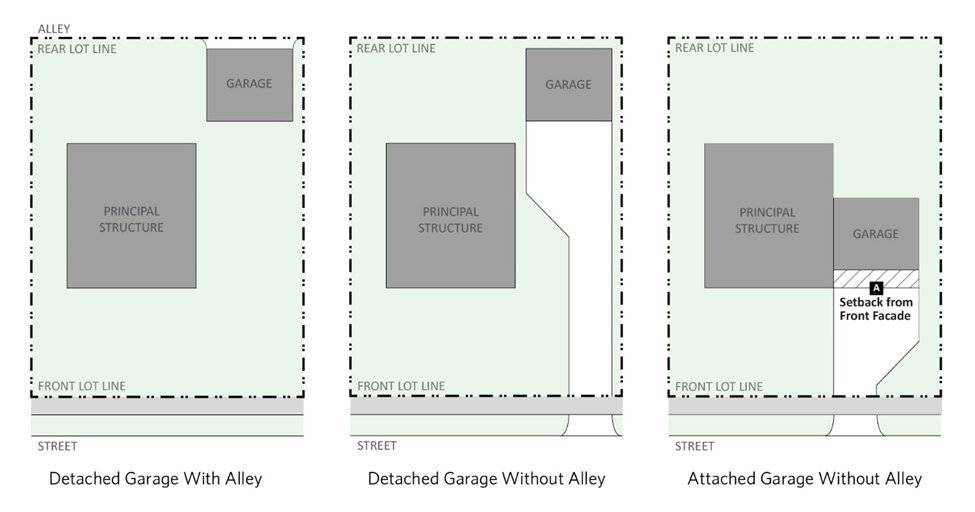
20.
Greenhouse.
a.
Location. Greenhouses are allowed only in rear yards in the CR, R1, R2, R3, R4, R5, B3, L1, and L3 Districts.
b.
Size. Greenhouses are limited to a maximum size of 200 square feet.
21.
Home-Based Business.
a.
Location. A home-based business is permitted within any dwelling unit in the City as part of a principal and/or accessory building in accordance with the following standards. Home-based business standards do not apply to day care homes which are regulated in accordance with the requirements of Section 9.02.B.9 (Day Care Home).
b.
Business License. All home-based businesses are subject to applicable businesses licensing and inspection requirements.
c.
Residential Character. The location and operation of a home-based business may not alter the residential character of the dwelling or neighborhood.
d.
Structural Limitations. No alterations to the dwelling unit are permitted for the sole purpose of the home-based business that would change its residential character.
e.
Uses. Examples of allowed home-based businesses include, but are not limited to, artist, consultant, counselor, craftsperson, home kitchen operator, designer, tutor, writer, and instructor of music, craft, or fine art. Home-based businesses may not engage in on-site retail or wholesale sales, or manufacturing or industrial processes.
f.
Residency of Operator. The operator of the home-based business must reside in the dwelling unit in which the home-based business is located.
g.
Employees. No more than one additional employee who does not reside in the dwelling unit is allowed to work in a home-based business.
h.
Visitors. A maximum of one visitor (such as a client, customer, or pupil) associated with the home-based business may be present at any given time.
i.
Hours of Operation. Home-based businesses with outside visitors may operate from 7:00 a.m. to 9:00 p.m. on a daily basis.
j.
Outdoor storage. No outdoor storage is allowed in connection with any home-based business.
k.
Parking. Any parking needs associated with the home-based business must be accommodated on the same zoning lot within an existing driveway or garage.
l.
Deliveries. Deliveries and shipments are not allowed to or from the premises, with the exception of carriers that typically provide service to residential neighborhoods, such as the U.S. Postal Service and/or express shipping services (e.g. UPS, FedEx, DHL, Amazon).
m.
Signs. Home-based businesses are permitted one nameplate sign, no larger than one square foot.
22.
Hoophouse.
a.
Use Limitation. Hoophouses are only allowed in conjunction with agricultural uses, community gardens, gardens, and garden centers.
b.
Size. Hoophouses are limited to a maximum size of 200 square feet.
23.
Mechanical Equipment.
a.
Location. Ground-mounted mechanical equipment may project four feet into any side or rear yard. Roof-mounted mechanical equipment must be located a minimum of six feet from the edge of the supporting walls of any roof. Window-mounted air conditioning units may project two feet into any yard.
b.
Screening. Roof-mounted mechanical equipment screening must equal the height of the tallest mechanical equipment installed on the roof of the building. In the absence of screening attached to the unit, the parapet of the façade must be extended such that the unit is not visible from the curb of the sidewalk across the street from the structure on which the unit is located. The requirements of Section 11.09 (Screening Requirements) apply to ground-mounted mechanical equipment.
c.
Mechanical equipment standards do not apply to electrical generators which are regulated in accordance with the requirements of Section 9.03.C.16 (Electrical Generator).
24.
Outdoor Dining.
a.
Location. Outdoor dining may only be located on private property, unless otherwise allowed by the City. Outdoor dining may not be located in any yard that is adjacent to a residential use or zoning district, except when such residential use is part of a mixed-use development. Outdoor dining areas must be separated from the right-of-way and parking areas with masonry walls, planters, bollards, fencing, or similar elements.
b.
Sidewalk Clearance. Outdoor dining areas must be located and oriented to provide a minimum of four feet of sidewalk clearance available for pedestrians at all times in accordance with the Americans with Disabilities Act Accessibility Guidelines.
c.
Parking Lot Clearance. Outdoor dining may not interfere with the drive aisles and required parking spaces of a parking lot. Outdoor dining structures may not occupy more than 40 percent of available parking spaces nor any provided ADA parking stalls.
d.
Site Plan Review. Permits for outdoor dining areas and structures are subject to site plan review in accordance with Section 4.09 (Site Plan Review).
25.
Outdoor Fireplace or Fire Pit.
a.
Location. Outdoor fireplaces and fire pits are allowed in the rear yard only.
b.
Setback. Outdoor fireplaces and fire pits must be located a minimum of 15 feet from any building.
c.
Size. The maximum diameter of outdoor fireplaces and fire pits is four feet.
26.
Outdoor Sales and Display Area.
a.
Items Offered. The items permitted to be offered in outdoor sales and display areas include, but are not limited to, building or garden supplies for retail sale, nursery plants, equipment for household use, and other household items that are typically used or stored outdoors. Permanent outdoor sales and display areas for motor vehicle sales are subject to the requirements for Section 9.02.B.22 (Motor Vehicle Rental or Motor Vehicle Sales).
b.
Size. Outdoor sales and display areas may not exceed 15 percent of the gross lot area in commercial zoning districts and 25 percent in industrial zoning districts.
c.
Improved Surface. Outdoor sales and display areas must be paved.
d.
Access. Outdoor sales and display areas may not obstruct driveways, parking areas, sidewalks, and landscaped yards.
e.
Fencing. If an outdoor sales and display area is secured with a fence, it must be constructed of treated wood, simulated wood, or decorative metal.
27.
Patio and Open Terrace.
a.
Location. Open patios and terraces are allowed in any yard. Permanently roofed patios are allowed only in the rear yard.
b.
Height. Patios and open terraces may not be higher than three feet above the average level of the adjoining ground.
28.
Porch.
a.
Location. Porches are allowed in the rear yard only. Porches must be located at least five feet from a lot line and may project a maximum of eight feet from a structure.
29.
Recreation Equipment.
a.
Location. Recreation equipment is allowed in the rear yard and interior side yard only.
b.
Size. The maximum size of a children's playhouse in residential zoning districts is 144 square feet.
c.
There is no maximum size of a children's playhouse in business districts for day care centers.
30.
Refuse, Recycling, and Grease Containers.
a.
Applicability. Refuse, recycling, and grease container regulations apply only to those uses that collect refuse, recyclable materials, and grease in commercial containers. These regulations do not apply to collection containers provided to residences by the City's designated waste hauling franchisee.
b.
Refuse Area Location. Refuse areas must be located in the interior side yard or rear yard. An alternative location may be permitted with written approval by the Zoning Administrator
c.
Screening. The requirements of Section 11.09 (Screening Requirements) apply to refuse, recycling, and grease containers.
31.
Shed.
a.
Location. Sheds are allowed only in rear yards.
b.
Number. One shed is allowed per zoning lot.
c.
Area. In the R1, R2, R3, R4, and R5 Districts, the maximum area of a shed is 144 square feet.
d.
Motor Vehicle Storage. The storage of motor vehicles, including, but not limited to, cars, trucks, and vans, in sheds is prohibited.
32.
Small Wind Energy System (Building-Mounted).
a.
General Wind Energy System Regulations. All building-mounted small wind energy systems must comply with the general wind energy system regulations in Section 9.02.B.29 (General Wind Energy System Regulations).
b.
Quantity.
(1)
In the R1, R2, R3, R4, R5, L1, L2, and L3 Districts, one building-mounted small wind energy system is permitted per zoning lot.
(2)
In the B1, B2, B3, B4, H/C, E, R/LI, and I Districts, there is no maximum number of building-mounted small wind energy systems per zoning lot.
c.
Location. Building-mounted wind energy turbines may be attached to any roof surface on a principal or accessory structure.
d.
Height.
(1)
The maximum height of a building-mounted small wind energy system is 15 feet.
(2)
Building-mounted small wind energy systems may extend no more than 10 feet above the highest peak of a pitched roof.
Figure 9.03-2 Small Wind Energy System (Building-Mounted)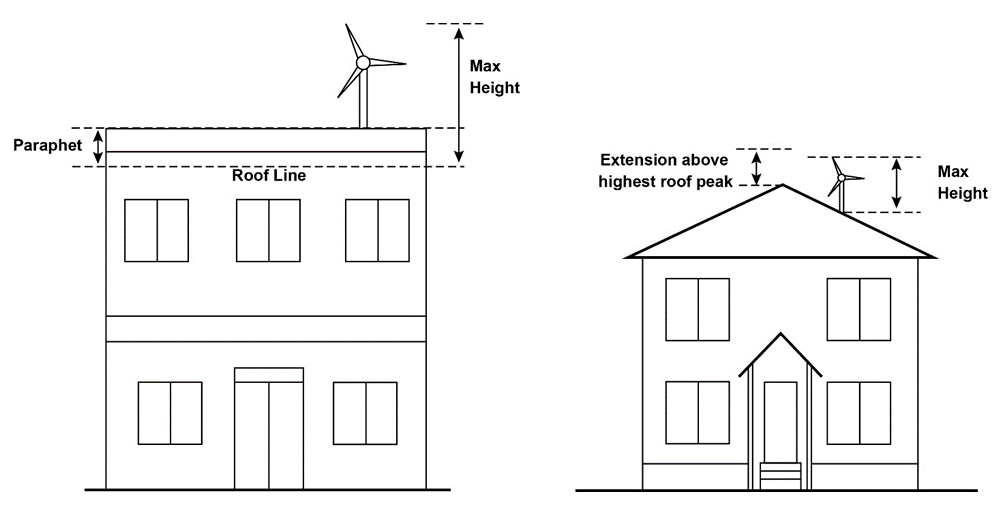
33.
Solar Energy Systems (Private, Non-Utility).
a.
General Requirements.
(1)
On-site Use. Energy produced through the private solar energy system must be utilized on-site but may be delivered to a power grid to offset the cost of energy on-site.
(2)
Utility Provider Notification. Written evidence must be provided at the time a building permit is applied for that the utility company has been notified of the customer's intent to install a private solar energy system.
(3)
Glare. Solar collection systems may not adversely impact adjacent properties, or otherwise be a nuisance. Solar collection devices must be designed and located to avoid glare or reflection onto adjacent properties, businesses, residences, and adjacent roadways and will not interfere with traffic or create a safety hazard. All private solar energy systems using a reflector to enhance solar production must minimize glare from the reflector that is likely to impact adjacent or nearby properties. This provision may not be read to apply to PV systems, or other solar energy systems which absorb sunlight and do not reflect it.
(4)
Tree Removal. Tree removal will be minimal and comply with the regulations of Section 11.02 (Tree Preservation).
(5)
Arrangement. Where feasible, solar collector units must be consolidated into array groupings located toward the center of the roof, rather than situated in a disjointed manner.
(6)
Conditional Use. Except as provided in this Section, the conditional use permit process outlined in Section 4.08 (Conditional Uses) of this Ordinance must be the method used for requesting approval for a private solar energy system that exceeds applicable district height limitations. In reviewing the request for additional height, such factors as height of the system in relationship to existing and potential structures, manmade or natural, and their impact on the system's efficacy will be considered. In addition, the requirements of paragraphs 1 through 6 of this section will be considered.
(7)
Placement on Landmarked Properties. If a private solar energy system is to be placed on a landmarked structure or other lot that falls under the purview of the Waukegan Historic Preservation Ordinance, a Certificate of Appropriateness under Section 11 of that Ordinance will be required. The Historic Preservation Commission may not deny a private solar energy system's placement solely because of the property's landmarked status, however, other factors required under Section 11.4 of that Ordinance will be considered. Coordination with the Illinois State Historic Preservation Office may be required.
b.
Ground-Mounted Private Solar Energy Systems.
(1)
General Private Solar Energy System Regulations. All ground-mounted solar energy systems must comply with the general private solar energy system regulations detailed in Section 9.02.B.29.a (General Solar Energy System Regulations).
(2)
Location.
(a)
Ground-mounted private solar energy systems are allowed in the rear yard of any zoning district.
(b)
Ground-mounted private solar energy systems are allowed in the interior side yard in B1, B2, B3, B4, B5, H/C, E, R/LI, and I Districts.
(3)
Setback. All parts of a ground-mounted solar energy system must be located a minimum of three feet, or the height of the system, whichever is less, from any interior lot line or rear lot line.
(4)
Height. The maximum height of ground-mounted solar energy systems is 15 feet when positioned at maximum tilt.
(5)
Quantity. The aggregate area of panels in a ground-mounted private solar energy system may not exceed 20 percent of the rear yard area in the CR, R1, and R2 Districts.
(6)
Coverage. Ground-mounted private solar energy systems on non-residential lots may not exceed half the area of the principal structure on the lot.
(7)
Visibility. Active ground-mounted private solar energy systems must be screened from the view of public rights-of-way; provided, that screening should not be required to an extent that it affects the operation of the system. Any power transmission lines connecting a ground-mounted private solar energy system to any other structure on the zoning lot must be buried underground.
(8)
Not an Impervious Surface. Ground-mounted private solar energy systems are exempt from percentage of required yard occupied calculations (for impervious surfaces) contained in Section 9.03.A.5 (Lot Coverage) only if the soil under the collector is not compacted and is maintained in vegetation.
(9)
Abandonment. If a ground-mounted solar energy system is inoperable or abandoned for a period of six consecutive months, the property owner may be notified by the City that the system must either be repaired and made operable, or removed, no later than 90 days after delivery of the notice. The property owner must comply with any such order or seek other relief within the time allowed.
(10)
Placement on Environmental Hazard Sites. If a ground-mounted private solar energy system is to be placed on a property designated by the US Environmental Protection Agency as a Superfund Site, such systems may be exempted, by conditional use permit, from ordinary mounting requirements under this Section, and may instead propose alternative means to conform with EPA regulations and state and federal law.
Figure 9.03-5 Solar Energy System (Ground-Mounted)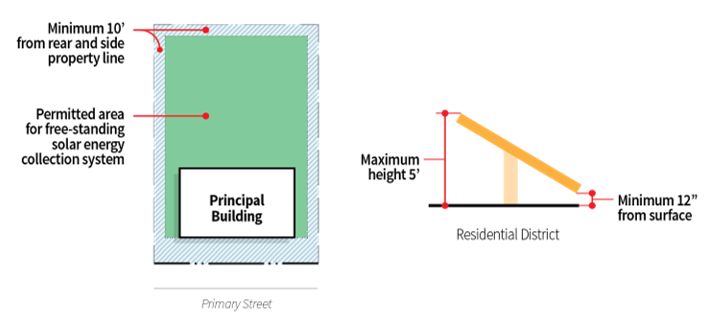
c.
Building-Mounted Private Solar Energy Systems.
(1)
General Solar Private Energy System Regulations. All building-mounted private solar energy systems must comply with the general private solar energy system regulations in 9.02.B.32.a (General Requirements). Refer to Figure 9.03-6 Solar Energy System (Building-Mounted).
(2)
General Requirements.
(a)
Location. Building-mounted private solar energy systems may be installed on principal or accessory structures in any district.
(b)
Orientation. Panels must be oriented to maximize solar access.
(c)
Roof Access. Roof access to solar collection devices must be provided for fire-fighting purposes.
(3)
Residential Uses.
(a)
Placement. Solar collection panels are allowed on the roof of any principal or accessory structure of the property and must be mounted flush with the slope of the roof. Solar collection devices are not allowed on any part of the vertical portion of a mansard roof.
(b)
Height. Height is measured from the surface on which the private solar collection device is mounted, to the highest edge of the system. See Figure 9.03-6 Solar Energy System (Building-Mounted).
i.
Sloping Roof. Private solar energy systems must be mounted flush with the roof, may not have a highest finished pitch steeper than the roof pitch on which the system is mounted, and the surface of the collector may not extend any further than 12 inches from the roof surface at any point. No portion of the solar collectors can extend beyond the ridgeline of the roof at any point. The total height of the building including the solar collection devices must comply with the height regulations of the zoning district.
ii.
Flat Roof. The maximum height of solar collection devices mounted on a flat roof is five feet, or the height of the building parapet, whichever is less. Solar collection devices may not be visible at-grade from adjacent properties or exceed the height regulations of the zoning district.
(c)
Projection. The collector surface and mounting devices for roof-mounted solar energy systems may not extend beyond the roof edge or the exterior perimeter of the principal structure.
(d)
Roof Coverage.
i.
Sloping Roof. A building-mounted private solar energy system may cover 75 percent of a pitched roof.
ii.
Flat Roof. There is no coverage limit for building-mounted private solar energy systems on flat roofs.
(e)
Roof Vents. Building-mounted private solar energy systems may not be located within six inches of a roof vent.
(4)
Non-residential Uses.
(a)
Placement. Solar access is optimized on the front and corner façades. Systems are simultaneously used to shade the structure's windows. See Figure 9.03-5 Solar Energy System (Ground-Mounted). Solar collection panels are allowed on the following areas of a structure:
i.
Any roof face.
ii.
Side and rear building façades.
iii.
Front or corner building façades, if the following conditions are met:
(b)
Height. Height is measured from the surface on which the solar collection device is mounted, to the highest edge of the system. Solar collection devices may not cause the structure to exceed the maximum permitted height of the structure within the zoning district. See Figure 9.03-6 Solar Energy System (Building-Mounted).
i.
Sloping Roof. The maximum height of a solar collection devices mounted on a sloping roof is 15 inches above the ridge of the roof.
ii.
Flat Roof. The maximum height of solar collection devices mounted on a flat roof is 15 feet when oriented at maximum tilt, or the height of the building parapet, whichever is less. Solar collection devices must be consolidated into array groupings located toward the center of the roof.
(c)
Projection. The collector surface and mounting devices for roof- mounted solar energy systems may not extend beyond the exterior perimeter of the building on which the system is mounted or built, except if the collector and mounting system has been explicitly engineered to safely extend beyond the roof edge or building façade as follows:
i.
The collector surface and mounting devices may project up to four feet from a building façade or roof edge provided the systems are simultaneously used to shade the structure's windows. See Figure 9.03-7 Solar Energy System (Façade).
ii.
The collector surface and mounting devices may project into a side or rear setback. However, under no circumstances may any part of the system be closer than five feet, or the height of the unit, whichever is greater, to the side or rear property line.
Figure 9.03-6 Solar Energy System (Building-Mounted)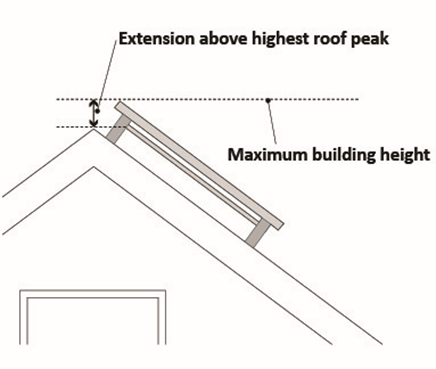
Figure 9.03-7 Solar Energy System (Façade)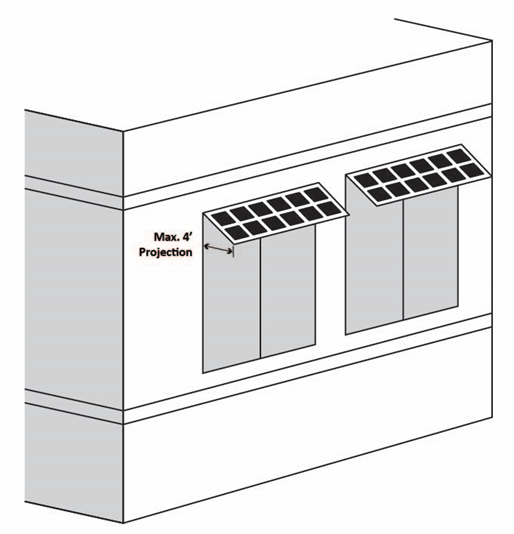
34.
Stairs or Stoop.
a.
Encroachment. Stairs and stoops may encroach up to five feet into any yard.
b.
Height. Stairs and stoops that encroach into any yard may not exceed four feet in height above grade.
35.
Swimming Pool or Hot Tub. The following standards apply to swimming pools and hot tubs, with a depth equal to or greater than two feet.
a.
Location. Swimming pools and hot tubs are allowed in the rear yard.
b.
Height. Aboveground swimming pools and hot tubs may not exceed six feet in height.
c.
Distance from Other Structures. A swimming pool or hot tub must be a minimum of three feet from any other structure or building on a zoning lot, with the exception of a permanent deck or patio. A swimming pool must be at least five feet from any buried utility lines or cables and 10 feet from any aerial utility lines or cables, as verified by the Zoning Administrator.
d.
Minimum Lot Coverage. Swimming pools and hot tubs are counted towards the 40 percent lot coverage limit for accessory structures.
e.
Fence required. Yards with swimming pools or hot tubs must have a fence at least four feet in height surrounding the pool or hot tub.
36.
Treehouse.
a.
Location. Treehouses are allowed in the rear yard.
b.
Number. A maximum of one treehouse is allowed per zoning lot.
c.
Size. The maximum size of a treehouse is 100 square feet.
d.
Tree Incorporation. Treehouses must incorporate a planted tree as a critical structural element.
37.
Wireless Telecommunication Antenna.
a.
General Requirements. Wireless telecommunication antennas must meet the general requirements for wireless telecommunication facilities and/or towers in Section 9.02.B.30.a (General Requirements).
b.
Height. A wireless telecommunication antenna may not increase the height of any building, structure, or wireless telecommunication tower on which it is mounted by more than ten percent.
c.
Stealth Design. All wireless telecommunication antennas must utilize stealth design to blend into the structure on which it is mounted, such as a rooftop, tower, spire, or other similar feature, including those co-located on a wireless telecommunication tower. A wireless telecommunication antenna must be enclosed, camouflaged, screened, or obscured so that it is not readily apparent to a casual observer.
(Ord. No. 25-O-03, § 2(Exh. A), 1-6-25)
9.04 - Temporary Uses and Structures
Temporary uses are established for a fixed period of time with the intent to discontinue such use upon the expiration of such time and does not involve the construction or alteration of any permanent structure. Temporary structures may be constructed in furtherance of a temporary use and are not intended to be permanent fixtures on property. Temporary uses and structures are subject to the requirements of this section. Some temporary uses may require a special event permit in addition to a temporary use permit.
A.
Temporary Uses and Structures Table. Table 9.04-1 Temporary Uses and Structures establishes the allowed temporary uses and structures for each zoning district. Table 9.04-1 Temporary Uses and Structures is not an exhaustive list of temporary uses and structures that may be located within the City. Each use or structure is given one of the following designations for each zoning district.
1.
Allowed ("A"). "A" indicates that the temporary use or structure does not require a temporary use permit and is allowed by-right within the designated zoning district provided that it meets all applicable use standards set forth in Section 9.04.B (Use Standards for Temporary Uses and Structures).
2.
Allowed with Temporary Use Permit Approval ("T"). "T" indicates that the temporary use or structure requires the approval of a temporary use permit in accordance with Section 4.03 (Permit Approval) and must meet any applicable use standards set forth in Section 9.04.B (Use Standards for Temporary Uses and Structures) in order to be allowed within the designated zoning district.
3.
No Designation. The absence of a letter (a blank space) indicates that the use is not allowed within the designated zoning district.
B.
Use Standards for Temporary Uses and Structures. The following standards apply to temporary uses and structures designated as permitted ("A") or permitted with a Certificate of Zoning Compliance/Temporary Use Permit ("T") in the zoning districts noted in the "Use Standards" column of Table 9.04-1 Temporary Uses and Structures. Temporary uses may be located outdoors or within an enclosed building or structure.
1.
Construction Trailer. Duration. Construction trailers permitted on zoning lots for which building permits have been issued and may only be maintained on the premises during the period when construction work, including demolition and site grading, is being actively conducted. Construction trailers may not contain accommodations for sleeping or cooking.
2.
Farmers Market.
a.
Schedule. The schedule and duration of a farmers market will be determined as part of a temporary use permit. A temporary use permit for a farmers market can be issued on an annual basis, which allows for a schedule of days per week and number of weeks per year.
b.
Management Plan. A management plan must be submitted addressing the following:
(1)
The on-site presence of a manager to direct the operation of vendors.
(2)
An established set of operating rules, days and hours of operation, vendor set-up and take-down times, a maintenance plan, and provisions for waste removal.
(3)
A site plan indicating vendor stalls, visitor facilities, seating areas, restrooms, parking, and all entrances and exits to the site.
3.
Garage or Yard Sale.
a.
Eligibility. Only residential properties may hold garage or yard sales.
b.
Merchandise. Merchandise for sale may only be household goods sold at resale. Offering retail overstock goods in large quantities is not permitted at garage or yard sales.
c.
Frequency. Garage and yard sales may be held for three consecutive days up to three times per year. City-wide garage and yard sales do not count toward this total.
d.
Hours of Operation. Garage and yard sales may operate from 7:00 a.m. to 7:00 p.m.
e.
Signs. Garage and yard sale signs must be in accordance with Section 12.06.N (Yard Signs).
4.
Residential Model Unit. Duration. Residential model units are permitted only during the period of active selling and/or leasing of space in a new residential development. Residential model units may not be used for sleeping, bathing, or cooking purposes.
5.
Temporary Outdoor Entertainment.
a.
Duration. Temporary outdoor entertainment is limited to a period of seven consecutive days. The Zoning Administrator may grant additional time or successive permits through the temporary use permit process.
b.
Frequency. A maximum of two temporary outdoor entertainment permits may be issued per year for any zoning lot.
c.
Other Local Regulations. Temporary outdoor entertainment must comply with the requirements of the City's Code of Ordinances (see Chapter 15, Article V. Special Events and Parades) and other local regulations.
d.
Zoning Permit Approval. Approval of a temporary use permit is based on the adequacy of the lot area, provision of parking, traffic access, and public safety, as well as the absence of undue adverse impacts on adjacent properties. A permit application for a temporary use permit must include the following:
(1)
Site Plan. As part of an application for a temporary use permit, the operator of the event must submit a site plan to the City prior to the event that illustrates the location of major site components and ingress and egress routes for emergency vehicles.
(2)
Proof of State Inspection. The operator of the event must provide proof that all amusement devices have been inspected and approved by the State of Illinois Department of Labor.
e.
Bulk and Setback Requirements. Temporary outdoor entertainment is exempt from the bulk and setback requirements of Section 8 (Zoning District Regulations).
f.
Live Musicians. Approved temporary outdoor entertainment and outdoor dining uses, in accordance with Section 9.03.C.24 (Outdoor Dining), may allow live musicians to perform for guests in the outdoor dining area.
6.
Temporary Outdoor Sale.
a.
Duration. Temporary outdoor sales for antiques markets, art fairs, craft fairs, and holiday sales are limited to a period of up to three days. Temporary outdoor sales for pumpkin sales lots and Christmas tree lots are limited to a period of up to 30 days.
b.
Frequency. A maximum of three temporary use permits for temporary outdoor sales may be issued per year for any zoning lot.
c.
Zoning Permit Approval. Approval of a zoning permit is based on the adequacy of the lot area, provision of parking, traffic access, and public safety, as well as the absence of adverse impacts on adjacent properties. The zoning permit application must include a site plan submitted to the City prior to the event that illustrates the location of major site components and ingress and egress routes for emergency vehicles.
d.
Bulk and Setback Requirements. Temporary outdoor sales for pumpkin sales lots and Christmas tree lots are exempt from the bulk and setback requirements of Section 8 (Zoning District Regulations).
e.
Sidewalk Clearance. A minimum of four feet of sidewalk clearance must remain available for pedestrians in accordance with the Americans with Disabilities Act Accessibility Guidelines.
f.
Refuse. Temporary outdoor sales must provide and service metal refuse containers in the number and locations required by the Zoning Administrator.
g.
Storage. Merchandise must be stored inside the building during non-business hours where practical.
7.
Temporary Storage Container.
a.
Number. One temporary storage container or dumpster is permitted per zoning lot at any one time.
b.
Duration. Temporary storage containers may be located on a lot for a period of no more than 30 consecutive days unless used in conjunction with an approved building permit.
c.
Extension. Temporary storage containers used not in conjunction with a building permit are permitted to be located on a lot of an additional 30 consecutive day period with written approval from the Building Commissioner, if requested a minimum of 10 days before the expiration of the permit.
d.
Frequency. A maximum of two instances of temporary storage container installation are allowed per year. An extension to a permit will not count as a second instance.
e.
Improved Surface. The temporary storage container must be located on an improved hard surface. Containers may not be permanently attached to the ground, have permanent utility service, or be stacked on top of one another.
f.
Sight Obstruction. Temporary storage containers must be located at least ten feet from the any street-adjacent property line to prevent sight obstructions.
8.
Tents. Duration. Temporary tents are limited to a period of up to ten days. When a temporary tent is associated with any permitted use, accessory use, temporary use, or conditional use permit, the tent must be removed no more than two days after the period during which the associated use is allowed. Tents may not be used as dwelling units.
(Ord. No. 25-O-03, § 2(Exh. A), 1-6-25)
9.05 - Environmental Performance Standards
All uses in all zoning districts must comply with the performance standards established in this Section, unless any federal, state, county, or local regulations establish a more restrictive standard, in which case the more restrictive standard applies.
A.
Noise. No activity or use may be conducted in a manner that generates a level of sound, as measured on another property, greater than that allowed by federal, state, county, and local regulations. These limits do not apply to construction noises, noises emanating from safety signals or warning devices, noises not directly under the control of the owner or occupant of the property, and transient noises from moving sources, such as motor vehicles, railroads, and aircraft.
1.
Small wind energy systems. Measured at the property line, maximum noise in any residential zoning district is 55 dBA, and the maximum noise in commercial and industrial zoning districts is 60 dBA; except during short-term events such as utility outage or a severe windstorm. Measurement of such levels can account for ambient sound conditions. To limit the level of low frequency sound, the average C-weighted sound level during system operation will not exceed the A-weighted ambient sound level by more than 20 dBA.
2.
Industrial Zoning Districts.
a.
Noise measurement. Noise levels are measured with a sound-level meter and associated octave-band analyzer manufactured according to standards prescribed by the American National Standards Institute. Impulsive type noises are subject to the performance standards hereinafter prescribed provided that such noises will be capable of being accurately measured with such equipment. Noises capable of being so measured, for the purpose of this Ordinance, those noises which cause fluctuations of the needle of the sound level meter with a variance of no more than plus or minus two (± 2) decibels. Noises incapable of being so measured, such as those of an irregular intermittent nature, must be controlled so as not to become a nuisance to adjacent uses.
b.
Noise Level Standards. The maximum noise measured at the zoning district boundary of residential and business zoning districts may not exceed levels included in Table 9.05-1 Industrial Noise Limits:
B.
Odor. No activity or use may be conducted in a manner that generates odors of such intensity and character as to be harmful to the health, welfare, or comfort of the public. Any such use must be stopped or modified to remove the odor.
C.
Dust, Smoke, and Air Pollution. Dust and air pollution carried by the wind from sources such as storage areas, yards, parking areas, equipment, and the like, within zoning lot boundaries, must be kept to a minimum by appropriate landscaping, screening, paving, wetting, or other acceptable means. In industrial districts, the following regulations apply.
a.
In addition to the performance standards specified hereinafter, the emission of smoke or particulate matter in such manner or quantity as to be detrimental to or endanger the public health, safety, comfort, or welfare is hereby declared to be a public nuisance and will henceforth be unlawful.
b.
Particulate matter emissions caused by the wind from open storage areas, yards, roads, etc. within zoning lot lines must be kept to a minimum by appropriate landscaping, paving, oiling, wetting, or other means.
c.
For determining the density or equivalent opacity of smoke, the Ringelmann Chart as adopted and published by the United States Bureau of Mines in Circular No. 8333 will be employed.
d.
No industrial operation can cause or allow to be emitted into the open air from any process or control equipment or to pass any convenient measuring point in a breeching or stack, dust in the gases to exceed 0.85 pounds per 1,000 pounds of gases adjusted to 12 percent CO 2 content for the products of combustion.
e.
The emission, from all sources within any zoning lot, of particulate matter containing more than ten percent by weight of particles having a particulate diameter larger than 44 microns is prohibited.
f.
Permitted Smoke Emission. Within 1,000 feet of a residence or business zoning district boundary line, the continuous emission of smoke from any vent, stack, chimney, or combustion process will have a density or equivalent opacity no greater than Ringelmann No. 1.
D.
Glare and Heat. No activity or use may be conducted in a manner that generates glare or heat that may be detected at any point off the zoning lot on which the use is located. Light sources must be shielded so as not to cause a nuisance across lot lines.
E.
Vibration. No activity or use may be conducted in a manner that generates earthborn vibration that can be detected at any point off the zoning lot on which the use is located.
F.
Fire and Explosion Hazards. Materials that present potential fire and explosion hazards must be transported, stored, used, and disposed of only in conformance with all applicable federal, state, county, and local regulations. In industrial zoning districts, the following regulations apply.
1.
The storage, utilization, or manufacture of materials or products ranging from incombustible to moderate burning, as determined for liquids by a closed cup flash point of not less than 187°F, is permitted subject to compliance with all other performance standards for Industrial Zoning Districts.
2.
The storage, utilization, or manufacture of materials or products ranging from free or active burning to intense burning, as determined for liquids by a closed cup flash point of less than 187°F but not less than 105°F, is permitted subject to compliance with all other performance standards for the Industrial Districts, and provided the following conditions are met:
3.
Said materials or products must be stored, utilized, or produced within completely enclosed buildings or structures having exterior walls of fire-resistive construction in accordance with other ordinances in the City's Code of Ordinances of Waukegan.
4.
The utilization in manufacturing processes of materials, which produce flammable or explosive vapors or gases, as determined for liquids by a closed cup flash point of less than 105°F, will be permitted in the Industrial Districts provided:
a.
The final manufactured product does not itself have a closed cup flash point of less than 187°F.
b.
The use and storage of such materials must be in conformity with standards prescribed by the National Fire Protection Association and with the requirements of other ordinances in the City's Code of Ordinances of Waukegan.
c.
The storage of said materials are prohibited above ground.
5.
Any use that involves the storage, utilization, or manufacture of fire and explosion hazards may be required to provide the City with an Emergency Management Plan and necessary training and equipment for enacting said plan in the event of an emergency.
G.
Electromagnetic Interference. Electromagnetic interference from the operation of any use that is not in compliance with the rules and regulations of the Federal Communications Commission may not adversely affect the operation of any equipment located off the zoning lot on which such interference originates.
H.
Hazardous, Radioactive, and Toxic Materials. No activity or use may produce hazardous, radioactive, or toxic material without prior notice to the City. Notice must be given to the Zoning Administrator at least 30 days before the operation commences. The transport, handling, storage, discharge, clean up, and disposal of all hazardous, radioactive, or toxic materials, including waste, must comply with applicable federal, state, county, and local regulations. In industrial zoning districts, the following regulations apply.
1.
Released toxic materials may not exceed ten percent of the maximum permissible airborne concentration allowed an industrial worker when measured at any point beyond the zoning lot line, either at ground level or habitable elevation, whichever is more restrictive.
2.
When the maximum permissible airborne concentrations of toxic materials allowed an industrial worker are not contained in the most recent list of Threshold Limit Values published by the American Conference of Governmental Industrial Hygienists. The applicant must prove that proposed levels will be safe for the general population.

