
Waukegan City Zoning Code
SECTION 13
- DEFINITIONS
13.01 - Purpose
The purpose of this Section is to define the terms used throughout this Ordinance.
13.02 - Definition of Terms
Abandoned Sign: A sign advertising a business, institution, lessor, owner, product, or activity that is no longer current, operating, available, or located on the premises where the sign is displayed.
Accessibility Ramp: An inclined structure that allows increased access to a building or structure.
Accessory Building or Use: A building or use, which is conducted or located on the same zoning lot as the principal building or use served, except as may be specifically provided elsewhere in this Ordinance. An accessory building or use is clearly incidental to, subordinate in purpose to, and serves the principal use. An accessory building or use must be either in the same ownership as the principal use or clearly operated and maintained solely for the comfort, convenience, necessity, or benefit of the occupants, employees, customers, or visitors of or to the principal use.
Accessory Dwelling Unit (Detached): A small, self-contained residential dwelling unit that is detached from and secondary to a larger residential dwelling unit located on the same lot.
Accessory Sign: Permanent signs, that are not classified as primary, exempt, or prohibited signs, including on-site directional signs for vehicles and pedestrians, parking restrictions, warnings, and other similar signs.
Adjacent: Means contiguous to or abutting.
Adult Entertainment Establishment: A building or use that matches any commercial establishment definition as defined by Section 14-301 of the City's Code of Ordinances.
Agricultural Use: The use of land for farming, including, but not limited to animal husbandry, dairying, pasturage, horticulture, floriculture, viticulture, apiculture, aquaculture, hydroponics, tree farms, and sod farms, where these uses are the principal use of the land. Agricultural Use does not include "Garden Center" or "Resource Extraction."
Airport: An area of land or water which is used or intended for use for the landing and taking off of aircraft, and any appurtenant areas which are used or intended for use for airport buildings or other airport facilities or rights-of-way, including all necessary taxiways, aircraft storage and tie-down areas, hangars, and other necessary buildings and open space.
Alley: A right-of-way primarily designed to serve as a secondary access to the side or rear of those properties whose principal frontage is on a street.
Ambient Sound: The all-encompassing sound at a given location, usually a composite of sounds from many sources regardless of their spatial origin.
Anemometer Tower: A temporary wind speed indicator constructed for the purpose of analyzing the potential for utilizing a wind energy system at a given site. This includes the tower, base plate, anchors, cables and hardware, wind direction vanes, booms to hold equipment, data logger, instrument wiring, and any telemetry devices that are used to monitor or transmit wind characteristics over a period of time for either instantaneous wind information or to characterize the wind resource at a given location.
Animal Boarding, Hospital, or Shelter: An establishment where pet animals are temporarily boarded, treated for illness or injury, and/or temporarily cared for while permanent homes are found for them.
Apartment Hotel: A hotel in which permanent guests occupy at least 90 percent of the hotel accommodations.
Applicant: An owner, occupant, or a representative of an owner or occupant of a lot, parcel, or tract of land for which an application has been filed for an annexation, subdivision, permit, variance, appeal, amendment, conditional use permit, planned unit development, site plan review or any other form of relief outlined in this Ordinance.
Arbor: A freestanding structure that serves to support climbing plants, often used to define an access point to a garden.
Architectural Materials: The building materials used in or customarily used in the construction of the exterior of a building, or the particular materials used in the construction of the exterior of any building which displays a cornerstone.
Areas of Significant Impact or Critical Concern: The areas of environmental sensitivity and sites which because of their location possess potential for access and mobility issues, over-crowding, and adverse environmental and/or safety effects.
Arterial Road: A major, high-capacity public right-of-way with the highest degree of traffic continuity and serving as a major trafficway for high volumes of traffic around or through the City.
Assisted Living Facility: A residential facility that provides daily assistance and long-term residence for three or more disabled and/or elderly individuals but does not provide regular in-patient medical or nursing care. Such facilities provide a combination of housing, supportive services, personalized assistance, and health care designed to respond to the individuals who need help with common daily activities, such as dressing, grooming, and bathing. Assisted Living Facility does not include "Community Residence."
Awning: A structure, usually made of canvas or other durable and flexible material, extended before a window, door, etc. as a protection from sun or rain.
Awning Sign: A sign that is displayed on an awning. See Figure 13.02-1 Awning Sign.
Figure 13.02-1 Awning Sign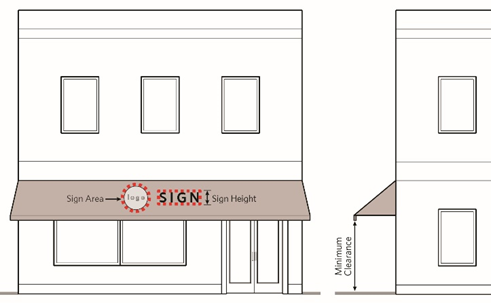
Backlighted Letter: An illuminated reverse channel letter (open or translucent back) configured so light from the letter is directed against the surface behind the letter producing a halo lighting effect around the letter. See Figure 13.02-2 Backlighted Letter.
Figure 13.02-2 Backlighted Letter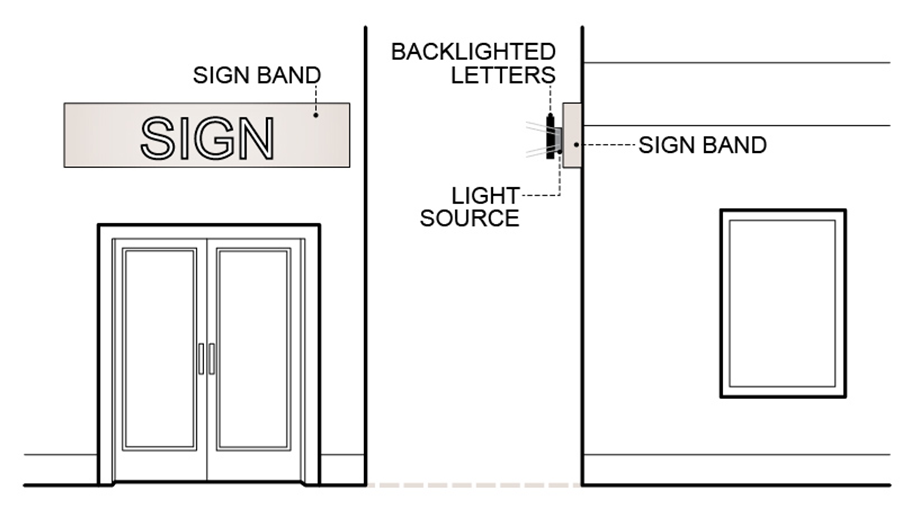
Balcony: A platform that projects from the exterior wall of a building, which is exposed to the open air, has direct access to the interior of a building, and is not supported by columns extending to the ground.
Ball Court: A paved area used to play sports and/or games.
Banner: A sign made of fabric or any non-rigid material with no enclosing framework. See Figure 13.02-3 Banner.
Figure 13.02-3 Banner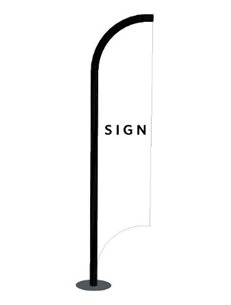
Banquet Hall: An establishment used regularly for serving food and/or beverages to groups that, before the day of the event, have reserved the facility for banquets or meetings. The general public is not admitted, and there is no admission charge at the door. Live entertainment may be featured as an accessory to the banquet or meeting use. A banquet facility is not a restaurant, bar, or nightclub.
Bar/Tavern: An establishment licensed by the City for the purpose of selling alcohol for consumption on the premises where sold, and restaurants with a liquor-serving facility that is separate from the dining area and is regularly operated during hours not corresponding to food service hours.
Basement: A portion of a building below the first or ground floor level with less than half its clear floor-to-ceiling height below the average grade of the adjoining ground.
Bay Window: A window built to project outward from an exterior wall, often with a flat front and angled sides.
Bed and Breakfast: A home-based business in an owner-occupied single-unit residential building that provides temporary accommodation rented to a person or persons on a daily or weekly basis for a period of time.
Blade Sign: A double-faced sign that projects perpendicular to the building façade and is suspended by or attached to a single decorative (non-industrial) bracket. Blade signs are primarily oriented towards pedestrians.
Block: A tract of land bounded by streets, or by a combination of streets and public parks, cemeteries, railroad rights-of-way, shorelines of waterways, municipal boundary lines, township lines or county lines.
Blue Roof: A roof that is designed to store and discharge rainfall.
Bluff: All property on the lake side of the table land beginning at a point where the slope of the land first exceeds ten percent and continuing to the toe of the slope.
Body Art Establishment: An establishment that provides physical body adornment, alteration or modification that may include, but is not limited to, tattooing, piercing, branding, braiding, implantation, or scarification.
Bond: Any form of security, including a cash deposit, surety or performance bond, collateral, property or instrument of credit in an amount and form satisfactory to the City Council whenever a bond is required by this Ordinance.
Buffer: Any land maintained in either a natural or landscaped state and used to screen and/or mitigate the impacts of development on surrounding areas, properties, or rights-of-way.
Buildable Area: An area of the lot remaining after the minimum open space and/or yard requirements of this Ordinance have been complied with.
Building Commissioner: An officer and assistants designated by the City Council as the office responsible for the issuance of building permits, sign permits, plan review, and construction inspections for residential, commercial, and industrial properties within the City.
Building Height: The vertical distance from grade to the highest point of the roof. The following projections are not included when determining building height: chimneys, towers, spires, parapet walls, staircase enclosures, elevator enclosures, tanks, cooling towers, green roofs, blue roofs, mechanical equipment, and similar projections.
Building-Mounted Small Wind Energy System: A relatively small wind generating facility, mounted on a building, which generates power for on-site use.
Building-Mounted Solar Energy System: A solar energy system that is attached to a building on a parcel as the principal method of structural support.
Building Permit: An official permit issued by the Building Commissioner to allow for construction, erection, demolition, or alteration of a building or other land modification activity.
Building Setback Line: A line within a lot or other parcel of land, between which said line and the adjacent boundary of the lot line or street upon which the lot is adjacent to, the erection of a principal building or structure is prohibited.
Building: A structure built, used, designed, or intended for the support, shelter, protection or enclosure of persons, animals, or property of any kind, and which is permanently affixed to the land. When a building is divided into separate parts by unpierced fire or party walls extending continuously from the ground through all stories to and above the roof, each part is considered a separate building.
Bulk: The size and setbacks of buildings or structures and the location of same with respect to one another. Bulk includes height and area of buildings; location of exterior walls in relation to lot lines, streets, or other buildings; gross floor area of buildings in relation to lot area (floor area ratio); all open spaces allocated to buildings; and amount of lot area required for each dwelling unit.
Business: An occupation, employment, or enterprise that occupies time, attention, labor and materials, or wherein merchandise is exhibited or sold, or where services are offered.
Cabana: A portable or semi-permanent structure often used as a changing room for a swimming pool or other recreational use.
Cabinet or Box Sign: A lettered panel lit by florescent lighting behind. See Figure 13.02-4 Cabinet or Box Sign.
Figure 13.02-4 Cabinet or Box Sign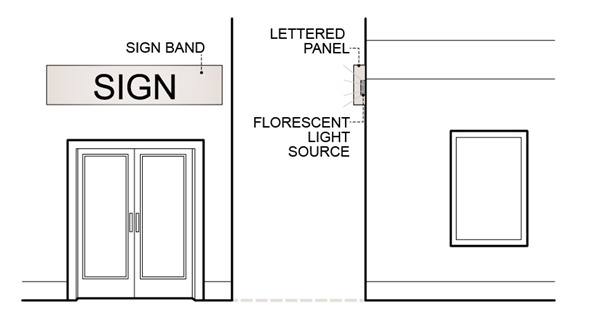
Cannabis Business: Cannabis Business includes "Cannabis Craft Grower," "Cannabis Cultivation Center," "Cannabis Dispensary," "Cannabis Infuser," "Cannabis Processor," or "Cannabis Transporter."
Cannabis Craft Grower: An establishment licensed, certified, or accredited by the appropriate local and state agencies that cultivates, dries, cures, packages, and/or performs activities to produce cannabis products to provide to "Cannabis Dispensaries" or "Cannabis Processors."
Cannabis Cultivation Center: An establishment licensed, certified, or accredited by the appropriate local and state agencies that cultivates, processes, transports, and/or performs activities to produce cannabis products to provide to other "Cannabis Businesses."
Cannabis Dispensary: A retail establishment licensed, certified, or accredited by the appropriate local and state agencies that provides cannabis products, paraphernalia, and/or related supplies directly to the consumer for purchase and removal from the premises by the purchaser.
Cannabis Infuser: An establishment licensed, certified, or accredited by the appropriate local and state agencies that incorporates cannabis into products to provide to other "Cannabis Businesses."
Cannabis Processor: An establishment licensed, certified, or accredited by the appropriate local and state agencies that produces cannabis concentrate or incorporates cannabis into products to provide to other "Cannabis Businesses."
Cannabis Transporter: An establishment licensed, certified, or accredited by the appropriate local and state agencies that transports cannabis to provide to other "Cannabis Businesses" or licensed "College or University" under the Cannabis Vocational Training Program.
Canopy: A roof-like structure projecting from a wall which may be supported in whole or in part by vertical supports from the ground and erected primarily to provide shelter from the weather.
Car Corral: A free-standing and semi-portable metallic or fiberglass structure which is securely anchored to the pavement and used as a shelter for the storage of automobiles. It consists of a roof over a framework of poles with open sides.
Car Wash: An establishment containing facilities for washing more than one automobile at any one time, using production line methods with a chain conveyor, blower, steam cleaning device, or other mechanical devices or providing space, water, equipment, or soap for the complete or partial hand-washing of such automobiles, whether by operator or by customer.
Carport: A covered parking area that is integrated as part of a structure's overall design, usually formed by the extension of the structure's roof.
Casino: A facility at which lawful gambling is authorized pursuant to a permit or license issued by the Illinois Gaming Board, which may include a gaming floor, sports betting areas, bars, lounge areas, theaters, and parking lots and structures.
Cellar: A portion of a building having more than half its clear floor-to-ceiling height below the average grade of the adjoining ground.
Cemetery: Land used for the burial of the deceased, which may include offices, structures for performing religious ceremonies related to the entombment of the deceased, and related accessory structures for the storage of maintenance equipment.
Changeable Copy Sign: A sign on which the message, letters, characters, illustrations, or other symbols can be changed, replaced, or rearranged on the surface of the sign. See Figure 13.02-5 Changeable Copy Sign.
Figure 13.02-5 Changeable Copy Sign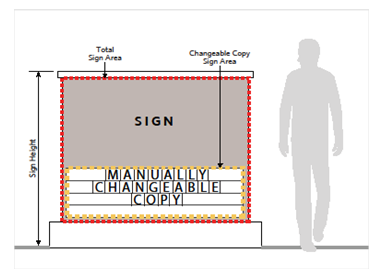
Channel Letter Sign: A fabricated or formed three-dimensional letter that may accommodate a light source. See Figure 13.02-6 Channel Letter Sign.
Figure 13.02-6 Channel Letter Sign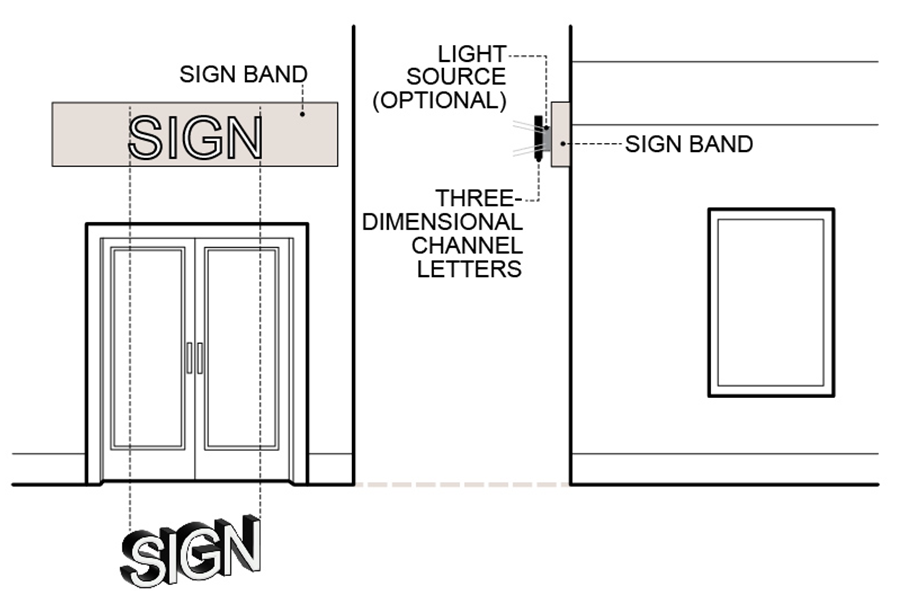
Chimney: A vertical structure used to remove smoke and combustion gases from a building that is often of masonry construction.
City: The City of Waukegan, Illinois.
City's Code of Ordinances: The Code of Ordinances, City of Waukegan, Illinois.
Clinic, Medical or Dental: An organization of specializing physicians or dentists or both, who have their offices in a common building. A clinic does not include inpatient care. Clinics are classified as Professional Offices.
Club, Lodge, or Hall: A meeting, recreational, or social facility established for the use of the members and guests of a non-profit or private organization.
Cluster Development: A residential development approved only as a planned unit development in which the established district yards and frontage requirements are waived in order to permit the varied design of residential living environments and increases in the minimum bulk requirements as they apply to individual lots provided the yards at the exterior perimeter of the development are not reduced below the minimums required for the district, the density is not increased above the maximum allowed in the district, and all other applicable requirements are met. Any resulting attached dwellings are protected from fire hazard as provided by applicable codes.
Cluster of Trees: A minimum of three trees which stand together within five feet of each other. Cluster of trees do not refer to the vertical branches which break from the trunk of the tree at ground level. See Figure 13.02-7 Cluster of Trees.
Figure 13.02-7 Cluster of Trees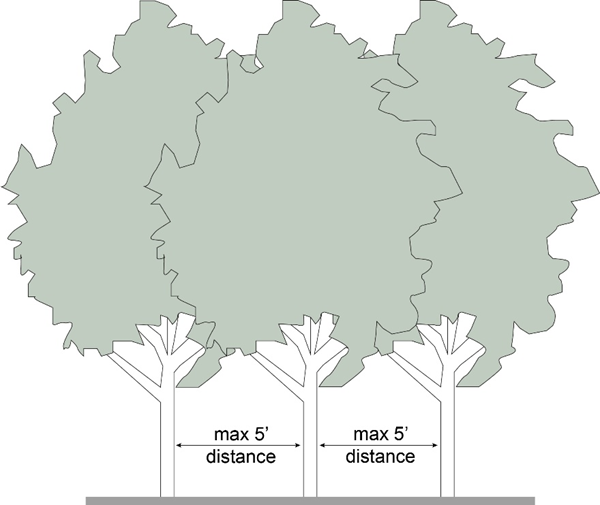
Collector Street: A street of limited continuity which carries traffic from local streets to the system of arterial roads and highways, including the principal entrance streets of a residential development and the principal circulating streets within such a development.
College or University: A facility for post-secondary higher learning that grants associate's or bachelor's degrees. The institution may also have research facilities and/or professional schools that grant master and doctoral degrees. College or University includes ancillary non-residential uses such as cafeterias, restaurants, retail sales, indoor or outdoor recreational facilities, and similar uses.
Common Open Space: A portion of a development, including subdivisions and planned unit developments, set aside in perpetuity as open space for use and enjoyment by owners or occupants of the development. Common Open Spaces may include wetlands, floodplains or flood-hazard areas, ravine corridors, bluffs, prime agricultural lands, habitats of endangered wildlife, as identified on applicable federal or state lists, scenic views, historical or cultural features, archaeological sites, or other elements to be protected from development, as well as easements for public utilities.
Community Library Kiosk: A small, freestanding structure used for exchanging books and reference materials within a community.
Community Residence: A group residence consisting of a group home or specialized residential care home serving people with disabilities, as defined in the Fair Housing Act, 42 USC 3602, that is licensed, certified, or accredited by the appropriate state or federal agencies. Such residence serves as a single housekeeping unit for the housing of unrelated people with functional disabilities who share responsibilities, meals, social activities, and other aspects of residential living. A Community Residence (Large) provides living accommodations for nine or more residents while a Community Residence (Small) provides living accommodations for eight or fewer residents. Paid professional support staff provided by a sponsoring agency do not count against the eight-person threshold and must be either living with the residents on a 24-hour basis, or present whenever residents with disabilities are present at the dwelling. Community Residence does not include "Assisted Living Facility," "Independent Living Facility," "Nursing Home," or "Residential Care Facility" and does not include transitional treatment facility, or a residence that serves as an alternative to incarceration for a criminal offense.
Compendium of Specifications for Development: The City of Waukegan Engineering Department's Compendium of Specifications for Development.
Compost Bin: A container used to store and break down organic matter to produce material that facilitates fertilizing and conditioning soil.
Comprehensive Plan: The City of Waukegan, Illinois Comprehensive Plan adopted March 16, 2020, and amended on March 6, 2023. The Comprehensive Plan is intended to guide the City's long-range planning efforts. It is the City's official guide to land use and development, which details the vision and policy agenda for critical issues, including land use, redevelopment, housing, economic development, transportation, infrastructure, parks and recreation, and natural resources.
Conditional Use Permit: A form of zoning relief that allows owners to establish a conditional use within the particular zoning district.
Conditional Use: A use, either public or private, which, because of its unique characteristics, cannot be properly classified as a permitted use in a particular district or districts. After due consideration, in each case, of the impact of such use upon neighboring land and of the public need for the particular use at the particular location, such conditional use may or may not be granted, with or without imposed conditions, subject to the terms of this Ordinance.
Conservation Area: An area within which all existing vegetation is preserved for the purpose of retaining the natural character of the area and providing screening from adjacent uses or a public or private street.
Conservation Easement: A legally binding agreement between a landowner and a land trust or government agency that permanently limits uses of the land in order to protect the value of its natural, geological, botanical, or environmental condition.
Construction Trailer: A movable or portable unit to be towed on its own chassis and which is used on construction sites or for institutional uses and is not designed for permanent or residential use.
Contractor Yard: A yard and/or building used by a general contractor (engaged in any building trade or craft), landscaping contractor, or building contractor where vehicles, equipment and materials are stored. A contractor may perform maintenance, shop, or assembly work in a contractor yard. The contractor yard must also contain the operational offices of the business and may not be used primarily as storage for businesses with operations located elsewhere.
Convention and Exhibition Halls: A facility designed to hold conventions and exhibitions, where individuals and groups gather to promote and share common interests.
Corner Lot: A lot situated at the intersection of two streets, the interior angle of such intersection not exceeding 135 degrees. See Figure 13.02-16 Lot Diagram.
Corner Side Yard: A side yard which adjoins a public street. See Figure 13.02-31 Yard Diagram.
Cornerstone: A permanent sign showing the name of the building, address, date of construction, name of the architect, and/or name of the owner.
Cornice: A projecting horizontal architectural feature, often located on the wall of a building or structure below the roofline.
Critical Root Zone: An area on the ground extending out from the trunk of a tree in all directions with a distance of one foot for every one inch of tree diameter at breast height. See Figure 13.02-8 Critical Root Zone.
Figure 13.02-8 Critical Root Zone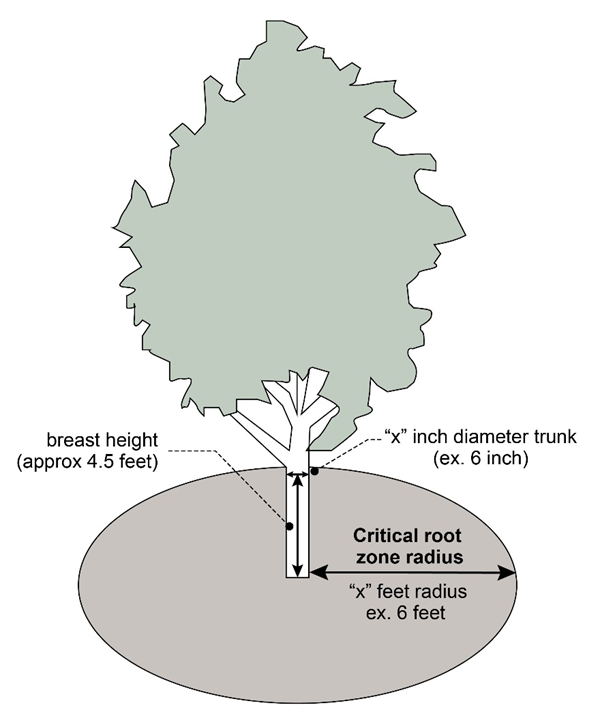
Cubic Feet: The amount of material in excavation and/or fill measured by the method of "average and areas."
Cul-De-Sac: A local street with only one outlet and having an appropriate terminal for the safe and convenient reversal of traffic movement.
Cultural Facility: A use that provides cultural services including, but not limited to, museums, cultural centers, historical societies, and libraries.
Cutting: The felling or removal of a tree, or any procedure that results in the death or substantial destruction of a tree. Cutting does not include normal pruning or trimming of trees consistent with this Ordinance.
Day Care Center: A facility licensed by the State of Illinois that provides day care for more than eight children or any number of adults.
Day Care Home: A dwelling unit licensed by the State of Illinois in which day care is provided for a maximum of eight children, excluding all natural, adopted and foster children of the residents of the dwelling unit.
Deck: A roofless outdoor platform often constructed of wood or composite wood that is elevated from the ground and connects to the exterior wall of a building.
Detached: A condition of being surrounded by open space on the same lot. Detached applies to buildings and structures that are located on but not connected to other buildings or structures on the same zoning lot.
Deteriorated: When applied to a sign, sign face, or outdoor advertising sign, deteriorated means a change in the condition of the sign such that structural members are weakened; fastenings are weakened or loosened; anchors are weakened or loosened; components of the sign such as letters, glass tubing, trim, access plane or other parts have become weakened, loosened, displaced or damaged; paint or other protective covering is worn away, flaked, peeling or loosened in whole or in part; and/or the sign face is flaked, peeling, worn away or damaged. A deteriorated sign or sign component need not be an unsafe sign or component and need not pose an immediate safety hazard.
Developer: The owner of land proposed to be subdivided or redeveloped or a representative of the owner with consent from the legal owner of the premises.
Development: Any human-made change to improved or unimproved real estate, including, but not limited to construction of, or substantial improvements to, buildings or other structures, paving, excavating, changing existing grade, or storage of materials.
Development Activity: Any work to newly construct or substantially improve buildings, structures, or site elements that requires the issuance of a building permit. Routine repair and maintenance are not included in development activity.
Development Sign: A monument sign placed at the entrance to a residential, commercial, or industrial subdivision, displaying the name of the subdivision.
Diameter at Breast Height (DBH): The diameter of a tree measured at 54 inches above the ground.
Directional Sign: A sign designating the location or direction of any place or area. See Figure 13.02-9 Directional Sign.
Figure 13.02-9 Directional Sign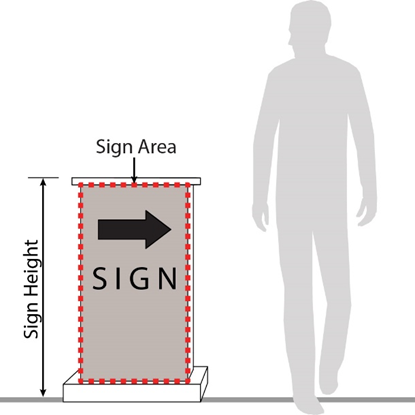
Directory Sign: Any permanent, enclosed changeable copy sign used to identify the occupants of a building or group of buildings and their location within the same. See Figure 13.02-10 Directory Sign.
Figure 13.02-10 Directory Sign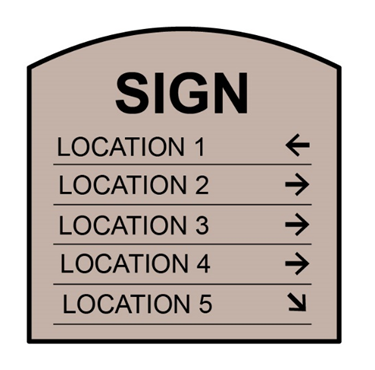
Disability: Having a physical or mental impairment which substantially limits one or more of a person's major life activities, or having a record of having such an impairment, or being regarded as having such an impairment.
Discontinued: The condition of having become vacant and remaining unoccupied. A building, structure or portion thereof, is considered discontinued if all or substantially all of which is designed or intended for a use which is not permitted in the district in which it is located which is or hereafter becomes vacant as to the nonconforming use and remains unoccupied or is not used for the nonconforming use and remains unoccupied or is not used for the nonconforming use for a continuous period of six months. A discontinued building may not be occupied or used except by a use which conforms to the use regulations of the district in which it is located. The discontinuance of the active and continuous operation of a nonconforming use, or part thereof, for such period of six months, is hereby construed and considered to be an abandonment of such nonconforming use, regardless of any reservation of an intent not to abandon same or of an intent to resume active operations.
Dog Run: An enclosed area located within a yard that provides space for a dog to exercise.
Dormitory: A building or portion thereof which contains living quarters for students, staff, or any members of any college, university, boarding school, theological school, hospital, religious order, or similar use.
Drive-Through Facility: A facility used to provide products or services through a window, attendant, or automated machine to customers, clients, and visitors in motor vehicles. Drive-Through Facility may be established in combination with other uses, such as a "Financial Institution" or "Restaurant." Drive-Through Facility is not considered to be established in combination with a "Car Wash," "Gas Station," or "Motor Vehicle Repair and/or Service."
Dwelling: A building or portion thereof designed or used exclusively for residential occupancy, including single-unit dwellings, two-unit dwellings, three-unit, four-unit, townhouse, multi-unit dwellings, unit above the ground floor, live/work, and community residences for persons with disabilities, but not including hotels or motels.
Easement: The grant of a legal right by a property owner to another person to use any designated part of the owner's property, for a specified purpose.
Eave: The projecting lower edge of a roof that overhangs the wall of a building.
Efficiency Unit: A dwelling unit consisting of one principal room exclusive of bathroom, kitchen, hallway, closets, or dining alcove directly off the principal room, provided such dining alcove does not exceed 125 square feet in area.
Electric Vehicle Charging Station: A location used to supply energy to electric vehicles.
Electrical Generator: A device that generates electrical power, which may use natural gas.
Electrical Sign: Any sign containing electrical wiring or any sign which is attached to or intended to be attached to an electrical power source including batteries or solar cells or any sign which is lighted by an electrical light source attached to the sign for purpose of providing light upon the sign surface.
Electronic Display Screen: A sign, or portion of a sign, that displays an electronic image or video, which may or may not include text. This definition includes television screens, plasma screens, digital screens, flat screens, LED screens, video board, and other similar displays.
Electronic Message Center: A sign, or portion of a sign, that uses changing lights to form a sign message or messages in text form wherein the sequence of messages and the rate of change is electronically programmed and can be modified by electronic processes. Electronic message centers do not include signs that are animated, or that can display videos. See Figure 13.02-11 Electronic Message Center.
Figure 13.02-11 Electronic Message Center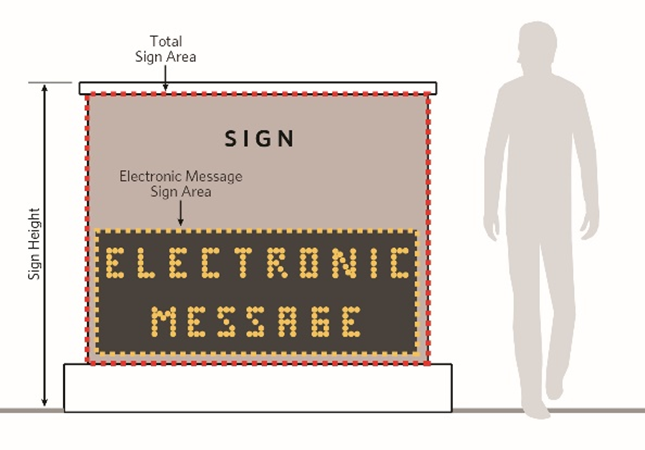
Elementary, Middle, or High School: A public or private educational facility offering instruction to preschool, elementary school, middle school, junior high school, and/or high school students with a full range of curricular programs.
Erect: As applied to signs and as used in this Ordinance, erect means the act of construction, placing, displaying, erecting, relocating or painting in place a sign, and does not include the printing fabrication or painting of signs in a sign shop or in a location other than where the sign is to be displayed or any permitted aspect of sign maintenance when applied to an existing sign. Repainting an existing sign constitutes a new sign which requires a permit.
EV-Capable Parking Spaces: Parking spaces with electric vehicle charging infrastructure that has the electric panel capacity, space, and the conduit to accommodate future wiring and installation of a Level 2 EV charger (40 Amp, 208 / 240V dedicated branch circuit or greater service).
EV-Installed Parking Spaces: Parking spaces with electric vehicle charging infrastructure that has the electric panel capacity, conduit, necessary wiring for Level 2 charging (40 Amp, 208 / 240V dedicated branch circuit or greater service), and a Level 2 or greater EV charger (the connecting and protective equipment to safely supply electricity to the vehicle).
EV-Ready Parking Spaces: Parking spaces with electric vehicle charging infrastructure that has the electric panel capacity, conduit, and necessary wiring for Level 2 charging (40 Amp, 208 / 240V dedicated branch circuit or greater service) that is connected to a junction box or other receptacle.
Excavation: Any act by which organic matter, earth, sand, gravel, rock, or any other similar material is cut into, dug, quarried, uncovered, removed, displaced, relocated, or bulldozed and includes the conditions resulting therefrom.
Existing Grade: The vertical location of existing ground surface prior to excavation or filling.
Extended Stay Hotel: A hotel, motel or inn containing ten or more sleeping rooms used for temporary occupancy of transient persons and containing cooking facilities in more than fifteen percent of the individual rooms.
Eye Catcher: A temporary sign or device which flutters or moves in the wind, which revolves, moves or changes shape, or which reflects light in a startling or unusual way, or which emits light, changes color, or turns on and off in such a way as to attract or capture the attention of a passerby. See Figure 13.02-12 Eye Catcher.
Figure 13.02-12 Eye Catcher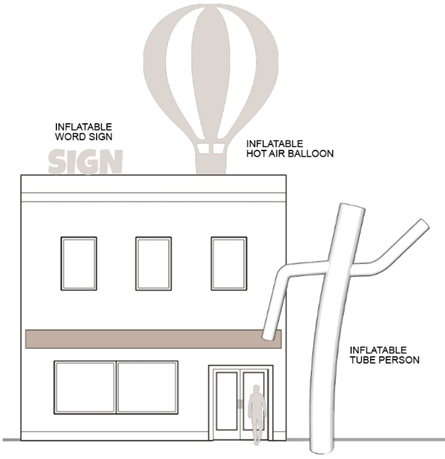
Façade: The exterior face of a building, including, but not limited to, the walls, windows, windowsills, doorways, and design elements. In the case of a two-story building, only the first level is used in calculating the façade area. For purposes of calculating wall signage, if the façade is not a straight line, the façade is the lineal distance measured from corner to corner at grade level. See Figure 13.02-13 Façade Measurement.
Figure 13.02-13 Façade Measurement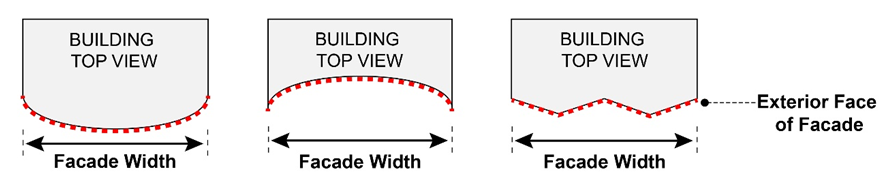
Farmers Market: An outdoor market located in a designated area for the sale of agricultural products, such as fruits, vegetables, juices, flowers, plants, herbs, spices, dairy goods, and meats, by the vendors who typically produce such items. Farmers Market typically offer for sale items such as baked goods, arts and crafts, and other value-added goods.
Fence: A structure which is a barrier and is used as a boundary or a means of protection or confinement, which is made of manufactured material, such as but not limited to wire mesh, chain link, wood or stone material.
Fill: Any act by which earth, sand, gravel, rock, or any other material is deposited, placed, replaced, pushed, dumped, pulled, transported, or moved by man to a new location, and includes the conditions resulting therefrom.
Final Grade: The vertical location of the ground or pavement surface after the grading is completed in accordance with the site development plan.
Final Plat: The map or plan of record of a subdivision, and any accompanying material.
Financial Institution: A bank, credit union, or savings and loan office. Financial Institution does not include "Currency Exchange" or "Title or payday Loan Establishment."
Firm: Any partnership, corporation, group or association whether constituted on a for-profit or not-for-profit basis.
Flag: A lightweight fabric, or other material with patterns and colors, which is meant to move in the wind.
Flag Lot: A lot where the vast majority of the lot can only be accessed from the right-of-way by means of a narrow strip of land between adjacent lots. See Figure 13.02-2 Lot Types.
Flagpole: A ground-mounted or building-mounted structure used to display a flag.
Foundation Plantings: Any combination of ornamental trees, evergreens, shrubs, ground cover and flowers which are provided along the base of the front façade and corner side yard façade of the residence except where sidewalks, driveways or other hardscape that is adjacent to the residence. Foundation plantings may be used to complement the residence's appearance, blending it into the surroundings; not to camouflage the residence.
Freestanding Tower-Mounted Wind Energy System: A wind energy generating facility that is free standing and the principal use of the structure.
Frequency: The number of oscillations per second in a sound wave and is an index of the pitch of the resulting sound.
Front Lot Line: The boundary of a lot which is along an existing or dedicated public street, or, where no public street exists, is along a public right-of-way. In the case of land-locked or partially land-locked land, the front lot line is the lot line that faces the access to the lot. In the case of a corner lot, the narrower of the two frontages is considered the front lot line.
Front Yard: A yard extending along the full length of the front lot line between the side lot lines with a depth extending to the front edge of the principal structure. See Figure 13.02-31 Yard Diagram.
Frontage: The portion of a lot line adjacent to any street right-of-way other than an alley measured between two points, such as side lot lines for single zoning lot, or between intersecting street and another intersecting street for multiple zoning lots. Boundaries may also include dead-end streets, ravines or bluffs, or a municipal boundary. The street right-of-way may be a limited access or controlled access roadway but may not be a utility right-of-way, drainage way, park, railroad, or alley.
Funeral Home/Crematory: An establishment where services are conducted for the deceased, including facilities to prepare the deceased for display, burial, and/or cremation.
Garage: A building, either attached or detached, which is used or designed for the parking and storage of motor vehicles, and the storage of various equipment.
Garage or Yard Sale: The sale of a variety of used household items, which is typically held in the garage, driveway, and/or front yard of a residential dwelling unit.
Garden Center: An establishment that sells plants and trees grown or stored on site and products associated with the cultivation and care of plants and trees.
Gas Station: An establishment where motor vehicle fuel, including electric charging and non-petroleum fuel, is stored and dispensed from fixed equipment into motor vehicles. Gas Station may also include accessory activities such as restaurants, car washes, and convenience retail stores. Gas Station does not include "Motor Vehicle Repair and/or Service."
Gazebo: A freestanding open-sided structure, often hexagonal or octagonal in shape, that provides shade and shelter in outdoor areas.
Golf Course: A tract of land designed with at least nine holes for playing a game of golf and improved with tees, greens, fairways, and hazards. A golf course may include a clubhouse, driving range, restrooms, and related accessory structures for the storage of maintenance equipment.
Government Facility: A building or structure owned, operated, and/or occupied by a governmental agency to provide services to the public. Government Facility includes public safety facilities, public works facilities, post offices, and administrative offices, but does not include "Park," "Elementary, Middle, or High School."
Grade: The average level of the finished surface of the ground adjacent to the exterior wall of a building or structure.
Grading Plan: A topographic drawing establishing the proposed land elevation versus existing topography necessary for the achievement of the subdivision.
Grading: Altering the shape of the ground surface to a predetermined condition, which may include stripping, cutting, filling, stockpiling, and shaping or any combination of these practices.
Green Roof: A roof that is partially or completely covered with vegetation, a growing medium, and a waterproof membrane, that absorbs rainwater and reduces the heat absorbed by a building or structure.
Greenhouse: A building for the cultivation and protection of plants, which is typically constructed of transparent glass, metal, and/or plastic.
Gross Floor Area: The sum of the gross horizontal areas of the several floors of the building, or portion thereof, devoted to such use, including accessory storage areas located within selling or working space such as counters, racks, or closets, and any floor area devoted to retailing activities, to the production or processing of goods, or to business or professional offices. However, "floor area" for the purposes of measurement for off-street parking spaces does not include: floor area devoted primarily to storage purposes (except as otherwise noted herein); floor area devoted to off-street parking or loading facilities, including aisles, ramps and maneuvering space; or mechanical or storage floor area other than area devoted to retailing activities, to the production or processing of goods, or to business or professional offices.
Gross Lot Area: The area of a horizontal plane bounded by the front, side and rear lot lines, but not including any area occupied by the waters of a duly recorded lake or river.
Ground Floor: The level of a building which has its floor no more than three feet above grade.
Ground Sign: A sign permanently attached to or supported by the ground or a foundation in the ground or other paved or improved surface located at grade. Types of ground signs include, but are not limited to, pole signs and monument signs. See Figure 13.02-14 Ground Sign.
Figure 13.02-14 Ground Sign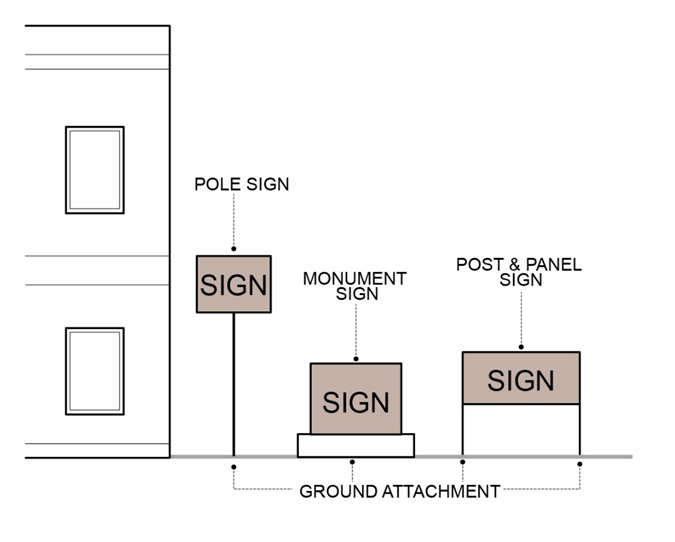
Ground-Mounted Solar Energy System: A free-standing solar energy system that is not attached to and is separate from any building on the same parcel of land on which the solar energy system is located.
Gutter: A structure used to convey stormwater that is located at the eave of a roof.
Guyed Tower: A tower that is primarily supported and/or secured by rope, cord or cable.
Habitable Room: A room or enclosed floor space used or intended to be used for living, sleeping, cooking or eating purposes, excluding bathrooms, water closets, laundries, pantries, foyers, or communicating corridors, closet storage spaces, stairways, and elevator shafts.
Half Street: A street bordering one or more property lines of a tract of land wherein the subdivider has allocated by part of the ultimate right-of-way width.
Heavy Manufacturing: A use engaged in manufacturing, assembly, fabrication, packaging, storage, handling, or other industrial processing of products from unprocessed or raw materials, which may include the use of highly flammable material, or toxic material. Heavy Manufacturing uses may be engaged in processes that are likely to have a substantial impact on the environment or on adjacent properties. Typical Heavy Manufacturing uses include, but are not limited to, chemical processing, grain milling, metal casting, metal smelting, motor vehicle assembly, motor vehicle wrecking, petroleum refining, rendering, tire assembly, and asphalt, brick, concrete, or tile manufacturing. Heavy Manufacturing does not include Cannabis Cultivation Center or Cannabis Processor.
Helipad: A designated area or structure used for the pickup or discharge of passengers and cargo that is conveyed to or from the designated area or structure by a helicopter.
Heritage Tree: Any tree having an 18 inch or larger diameter at breast height (DBH).
Hoophouse: A structure used to extend the growing season of agricultural crops that is generally made of plastic and semicircular in shape.
Home-Based Business: An occupation carried on in a dwelling unit by a resident, which is accessory to the residential use of the dwelling unit.
Homeless Shelter: A facility that provides temporary overnight shelter for unhoused populations. Homeless shelters do not include transitional housing.
Hospital: An institution that provides healthcare and medical services for the sick and injured, which may include, but are not limited to, in-patient facilities, out-patient facilities, training facilities, offices, and laboratories.
Hot Tub: An in-ground or aboveground basin of water that includes an air-injection system and/or water heating system that is intended for soaking.
Hotel/Motel: An establishment that provides sleeping accommodations and lodging services on a short-term basis for a fee and amenities which may include, but are not limited to, restaurants, meeting rooms, health clubs, and swimming pools.
Incompatible Use: A use or service, which is unsuitable for direct association with certain other uses because it is contradictory, incongruous, or discordant.
Indoor Entertainment: An enclosed building where spectator uses are conducted by a private entity that typically charges patrons a fee to enter. Indoor Entertainment (Large) accommodates a capacity of 250 or more people while indoor entertainment (small) accommodates a capacity of less than 250 people. Typical Indoor Entertainment uses include, but are not limited to, indoor theaters, indoor music venues, and indoor sports arenas. Indoor Entertainment uses may include refreshment stands that provide products for consumption on the premises. Indoor Entertainment does not include Adult Entertainment Establishment or Indoor Recreation.
Indoor Recreation: An enclosed building where recreational activities are conducted by a private entity that typically charges patrons a fee to enter. Typical "Indoor Recreation" uses may include, but are not limited to, health clubs, bowling alleys, pool halls, children's play facilities, sporting or training facilities, arcades, indoor miniature golf courses, indoor swimming pools, indoor tennis courts, and indoor skating facilities. Indoor Recreation uses may include refreshment stands that provide products for consumption on the premises. Indoor Recreation does not include Indoor Entertainment, Park, or Elementary, Middle, or High School. There is no capacity designation for Indoor Recreation.
Industrial District: An area in which enterprises and activities which involve the manufacturing, processing or fabrication of any commodity are located.
Interior Lot: A lot other than a corner, or reversed lot. See Figure 13.02-16 Lot Diagram.
Interior Side Yard: A side yard which is located immediately adjacent to another zoning lot or to an alley or path separating such side yard from another zoning lot. See Figure 13.02-31 Yard Diagram.
Kennel: Any premises or portion thereof on which four or more dogs, cats, or other household domestic animals over four months of age are kept, or on which more than two such animals are maintained, boarded, bred, or cared for, in return for remuneration, or are kept for the purpose of sale.
Laboratory: A place devoted to experimental study such as testing and analyzing that does not include the manufacturing of products.
Landscape Yard: A yard that is designed to improve views from the exterior of a project to its interior. Landscape yards can be used to provide development identity at entry roads where permitted, storm water detention, noise screening, pedestrian and bicycle circulation and visual barriers. These purposes can be accomplished through the use of water elements, berms, plantings, trees, walks, bicycle paths, graphics, and entry structures.
Lattice Work Tower: Any tower composed of an open framework made of strips of metal, wood or similar material overlapped or overlaid in a regular, usually crisscross pattern.
Laundromat: An establishment that provides washing, drying, and/or ironing machines for use by customers on the premises.
Legal Nonconforming: Any existing lot, building, or use that does not conform to all standards of this Ordinance or its subsequent amendments but was legally established or constructed prior to the effective date of this Ordinance.
Light Manufacturing: A use engaged in manufacturing, assembly, fabrication, packaging, storage, handling, or other industrial processing of products primarily from prepared materials or finished products, which does not include the use of highly flammable material, or toxic material. Light Manufacturing uses may be engaged in processes that have a minimal impact on the environment and adjacent properties. Typical Light Manufacturing uses include, but are not limited to contractors, equipment suppliers, commercial kitchens (such as caterers and delivery-only kitchens) and commercial printing. Light Manufacturing does not include Cannabis Cultivation or Processing Center.
Limited Access Expressway, Freeway or Highway: A trafficway for through-traffic, in respect to which owners or occupants of adjacent property or lands, and other persons, have no legal rights of access to or from the same, except at such points and in such manner as may be determined by the public authority having jurisdiction over such trafficway.
Linear Feet: The measurement of distance per foot in a straight line.
Local Street: A street of limited continuity used primarily for access to adjacent properties and local needs of a neighborhood or development.
Local-Estate Street: A local street whose primary purpose is to conduct traffic to and from dwelling units and to other streets within the hierarchy of roadway. It is associated with large-lot or low- density zoning and low traffic volumes. It is a two-lane, two-way roadway with shoulders and ditch drainage.
Lot Depth: The mean horizontal distance between the front lot line and the rear lot line of a lot, measured within the lot boundaries. See Figure 13.02-15 Lot Width and Depth Calculation.
Figure 13.02-15 Lot Width and Depth Calculation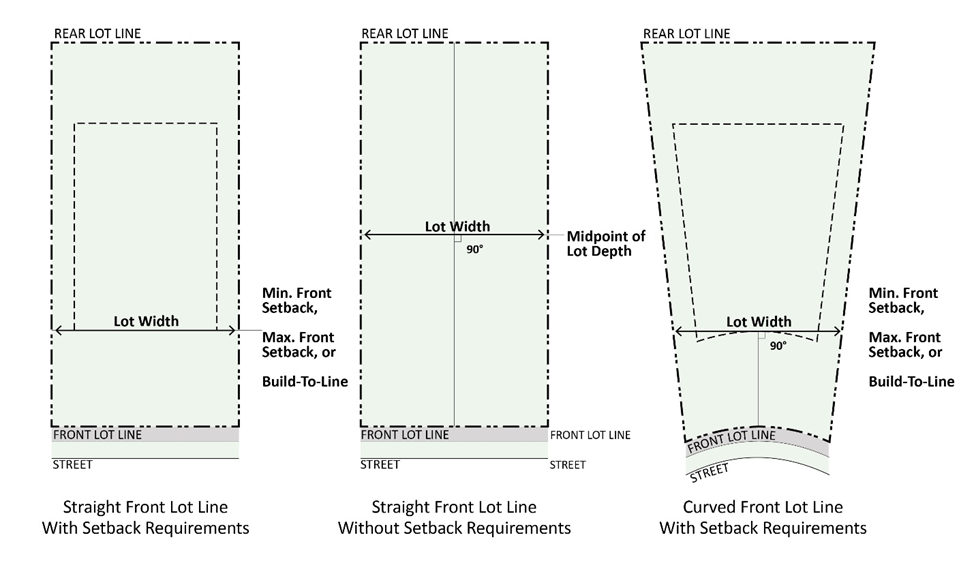
Lot of Record: A lot which is part of a subdivision, the plat of which has been recorded in the Recording Division of the Lake County Clerk's Office, or a parcel of land, the deed to which was recorded in the Recoding Division of the Lake County Clerk's Office prior to the adoption of this Ordinance.
Lot Width: The horizontal distance between the side lot lines of a lot, measured at the narrowest width within the first 30 feet of lot depth immediately in back of the front yard setback line. See Figure 13.02.19.
Lot: A parcel or tract of land intended to be separately owned, developed, or otherwise used. See Figure 13.02-16 Lot Diagram.
Figure 13.02-16 Lot Diagram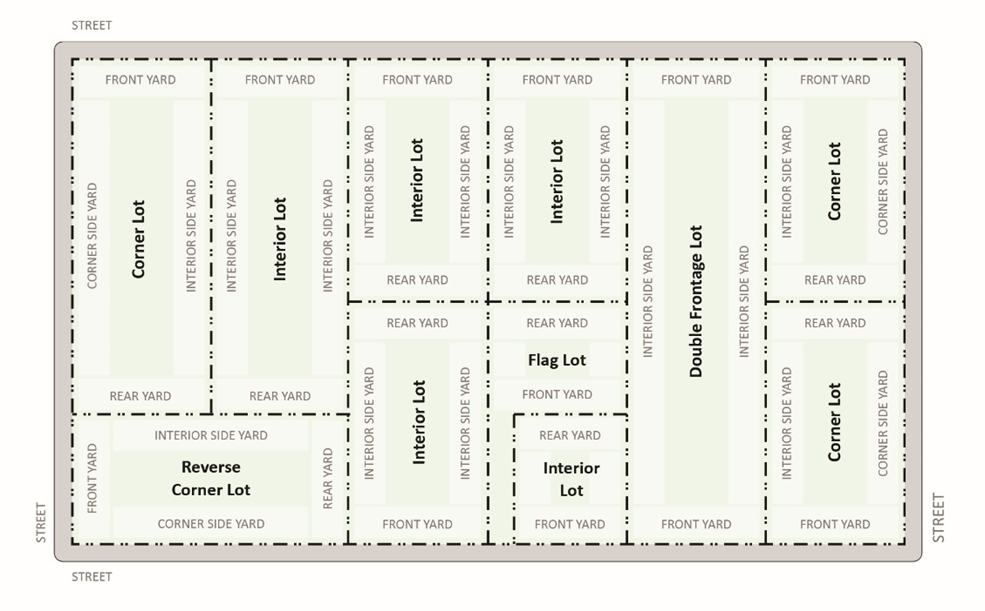
Machinery and Equipment Sales and Rental: Establishments primarily engaged in the sale or rental of tools, trucks, tractors, construction equipment, and similar industrial equipment. Machinery and Equipment Sales and Rental includes the incidental storage, maintenance, and servicing of such equipment.
Maintain: The act of restoring, preserving, refurbishing, cleaning, renewing, painting, repainting, or keeping the sign, billboard, or outdoor advertising sign within the public view.
Major Subdivision: A major subdivision involves any of the following (i) the division of a single lot into four or more lots; (ii) any division or consolidation that involves the construction of new rights-of-way, access to a state or county highway, the extension of utilities, the dedication of land for public rights-of-way, parks, or other public purposes, requires any other improvements, or requires exceptions or variances from this Ordinance; (iii) the consolidation of, or change in the boundary between, four or more adjoining lots; or (iv) any division or consolidation that involves conservation and cluster development.
Marginal Access Street: A local street which parallels and is adjacent to, an arterial road or highway, and which provides access to adjacent properties and protection from through traffic.
Marina, Commercial/Recreational: means a facility for the docking of watercraft that is made available for use to non-owners of the lot for remuneration including, but not limited to rental fees and user fees, and which may provide accessory services including boat service, repair, storage, and sales.
Marina, Motor Vehicle Dealership: Anestablishment leasing mooring space or slips to the public and providing incidental services, including storage, fueling and minor repairs, but not engaged in production, processing, or manufacturing.
Marquee Sign: A sign with two or three sign faces that is mounted to a marquee. See Figure 13.02-17 Marquee Sign.
Figure 13.02-17 Marquee Sign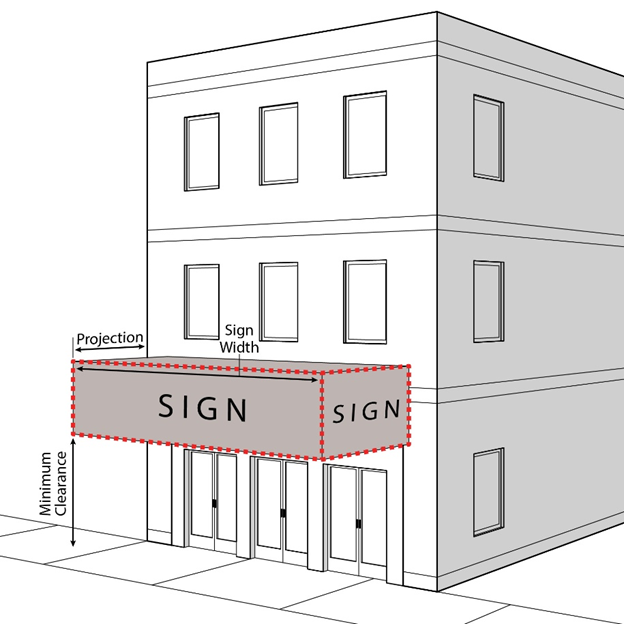
Marquee: Any fixed hood or canopy, constructed of metal or other incombustible material and extending over the public right-of-way and providing a roof over the entrance of a theater, hotel, motel, restaurant, auditorium, or similar use.
Measured Sign: All permanent signs for which this Ordinance establishes restrictions upon the area of the sign or upon the total area of the signage to be displayed upon a lot. Measured signs include all signs used to advertise a business or product where the sign is located away from the premises on which the business is conducted or the product sold (off-premises sign), all business identification and on-premises advertising signs.
Mechanical Equipment: Ground-mounted and roof-mounted equipment such as heating, ventilating, and air-conditioning (HVAC) units.
Mezzanine: An intermediate story between the floor and ceiling of a main story and extending over only part of the main floor.
Microbrewery or Distillery: A facility for the production and packaging of malt beverages of alcoholic content with a capacity of less than 30,000 barrels per year, or a facility for the production and packaging of spirits and liquors with a capacity of less than 50,000 gallons per year. Microbreweries or Microdistilleries may include a tasting room, which allows customers to consume products manufactured on site, as well as a retail space for purchase of products manufactured on site and related items. Breweries that exceed a capacity of 30,000 barrels per year, distilleries that exceed a capacity of 50,000 gallons a year, or facilities that only manufacture for distribution are considered either Light Manufacturing or Heavy Manufacturing depending on capacity.
Minor Subdivision: A minor subdivision involves (i) the division of a single lot into three or fewer lots which front on an existing right-of-way that is not a state or county highway, (ii) is served by existing utilities, (iii) does not require the dedication of land for public rights-of-way, parks, or other public purposes, (iv) does not require any other public improvements, and (v) does not require any exceptions or variances from this Ordinance. Minor subdivision also includes the consolidation of, or change in the boundary between, three or fewer adjoining lots.
Monopole Tower: A self-supporting pipe structure made of a continuous taper. Step-taper monopoles are prohibited.
Monument Sign: A sign that is permanently attached to or supported by the ground and where the base of said sign is no higher than two feet above grade. Characteristics of the monument sign are a supporting base composed of brick, architecturally treated wood or other similar materials complimented by landscaping. See Figure 13.02-18 Monument Sign.
Figure 13.02-18 Monument Sign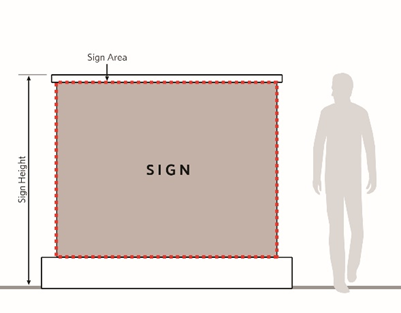
Motor Freight Terminal: A building or area in which freight shipped by motor truck or railroad is received, assembled, sorted, and/or rerouted for local, intra-state, or interstate shipment by motor truck.
Motor Vehicle: A passenger vehicle, truck, truck-trailer, trailer, or semi-truck trailer propelled or drawn by mechanical power.
Motor Vehicle Rental: An establishment that rents motor vehicles, including moving trucks, and includes incidental facilities for parking and servicing such vehicles.
Motor Vehicle Repair and/or Service: An establishment that provides services to adjust, align, repair, repaint, and/or replace motor vehicle parts and systems, including body work. "Motor Vehicle Repair and/or Service" includes facilities that sell motor vehicle parts and supplies in an incidental manner to the establishment's repair facilities. "Motor Vehicle Repair and/or Service" does not include "Gas Station," "Motor Vehicle Rental," or "Motor Vehicle Sales."
Motor Vehicle Sales: An establishment that sells or leases new or used motor vehicles, including incidental facilities for parking and servicing such vehicles.
Multi-Modal Facility: A single facility that combines multiple modes of public transportation including bus, rail, bicycles, rental cars, taxis, and other transportation services.
Multi-Purpose Entertainment Establishment: An establishment that operates as a multi-purpose facility which may include (a) broadcast and multi-media uses as well as (b) periodic events, which events (i) may be private or open to the general public; (ii) may be free or ticketed, (iii) may include live or recorded entertainment; (iv) may include the provision of food for on-site consumption; and (v) may or may not include the service of alcoholic beverages pursuant to a properly issued local liquor license.
Name Plate: A sign containing the name, street address, and/or occupation or profession of the occupant of a building.
Natural Drainage: The path by which water traverses a piece of property in its natural state, agricultural state or, if modified previously by man, that is now present on the site.
New Development: Any development of a previously unimproved or undeveloped real estate, including but not limited to a subdivision, conditional use permit, planned unit development, as well as the demolition and reconstruction of buildings and structures, and new construction of buildings, parking lots, and structures.
No Disturbance Area: An area, identified on a plat of subdivision or approved development plan around one or more trees within which all construction, grading, installation of utilities and all other land-altering activity is prohibited.
Non-Boarding: A term used in this Ordinance to indicate that no habitable rooms are permitted in the building.
Non-Commercial Messaging Sign: A non-commercial sign placed on a privately-owned zoning lot by the owner or occupant of the zoning lot. Non-commercial message signs do not include advertising signs, business signs, construction signs, identification signs for home occupations, real estate signs, or any other sign promoting a business, commodity, transaction, service, or entertainment.
Nonconforming Building or Structure: Any building or structure that was legally constructed prior to the effective date of this Ordinance, which does not comply with all of the regulations of this Ordinance or of any amendment hereto (i) governing bulk for the zoning district in which such building or structure is located; or (ii) is designed or intended for a nonconforming use. A building located on a nonconforming lot is not classified as a nonconforming building solely because of insufficient lot area or width.
Nonconforming Lot: Any lot or parcel that was legally platted or established prior to the effective date of this Ordinance that does not comply with the lot area or width requirements of this ordinance.
Nonconforming Use: Any use of land, buildings, or structures, that was legally established prior to the effective date of this Ordinance, which does not comply with all of the regulations of this Ordinance or its subsequent amendments governing use of the zoning district in which such use is located.
Non-Residential Subdivision: Any subdivision whose intended use is other than residential such as business, commercial or industrial.
Noxious Matter: Any matter, which is capable of causing injury or illness to living organisms or is capable of causing detrimental effects to the health or the psychological, social, or economic wellbeing of humans.
Occupancy Certificate: A certificate issued by the Building Commissioner which permits the use of a building in accordance with the approved plans and specifications, and which certifies compliance with the provisions of law for the use and occupancy of the building in its several parts together with any special stipulations or conditions of the building permit.
Octave Band: A means of dividing the range of sound frequencies into octaves to classify sound according to pitch.
Odorous Matter: Any matter or material that yields an odor which is offensive in any way.
Off-Premises Sign: means a sign or sign structure other than a billboard intended to advertise a business, good or goods, or service not located, sold, or offered on the property on which the sign is located.
On-Premises Identification Sign: A sign which directs attention solely to the primary use on the premises upon which the sign is located.
Opaque Fence: An opaque fence or planting screen for the purposes of this Ordinance is any solid fence or wall or any fence or wall with voids constituting less than 20 percent of the surface area of the fence or wall or any dense screen of evergreens, deciduous plant materials or a mixture of both types with or without berming.
Open Space: Any pervious surface area on a lot that is not within the buildable area or parking area and may not be improved with buildings or structures.
Operator: The person who is legally responsible for the operation of a use on a premises, whether or not that person owns the premises.
Ornamental Fence: Any fence designed to complement the principal or accessory structure or to enhance the character of the site, including, without limitation, wrought iron, picket, and split rail fences. An ornamental fence must have voids constituting 50 percent or more of the surface area of the fence. An ornamental fence does not include stockade, chain link, or similar fences.
Outdoor Dining: An open-air or partially enclosed seating area that is typically connected to an indoor seating area for a "Restaurant" or "Bar/Tavern".
Outdoor Entertainment: An open air or partially enclosed structure in which spectator uses are conducted by a private entity that typically charges patrons a fee to enter. Typical "Outdoor Entertainment" uses include, but are not limited to, outdoor theaters, outdoor music venues, outdoor sports arenas, and amusement parks. "Outdoor Entertainment" uses may include refreshment stands that provide products for consumption on the premises. "Outdoor Entertainment" does not include "Outdoor Recreation."
Outdoor Fireplace or Fire Pit: An outdoor area to burn materials that is equipped with a hearth and chimney, or that is open in design, and is generally constructed of steel, concrete, brick, or other noncombustible material.
Outdoor Recreation: An open air or partially enclosed structure in which recreational activities are conducted by a private entity that typically charges patrons a fee to enter. Typical "Outdoor Recreation" uses may include, but are not limited to, outdoor miniature golf courses, outdoor swimming pools, outdoor tennis courts, and outdoor skating facilities. "Outdoor Recreation" uses may include refreshment stands that provide products for consumption on the premises. "Outdoor Recreation" does not include "Outdoor Entertainment," "Park," "Elementary, Middle, or High School."
Outdoor Sales and Display Area: An area for the sales and display of products and services outside of a building or structure that is accessory to a principal use.
Outdoor Storage Area: An area for the storage of materials, equipment, machinery, or recreational vehicles used in the conduct of a business.
Outlot: A parcel of land within a subdivision and which has been included on a preliminary or final plat but not designated as a buildable lot due to insufficient size, insufficient frontage, peculiar siting, or topographical problems. Outlots may be used for other purposes such as storm detention or common open space.
Owner of Sign: The person who owns or is otherwise responsible for the erection, maintenance, and operation of the sign and not the owner of the property upon which the sign is located unless the owner of the sign and the property are the same person.
Owner: Any person having legal title to, or sufficient interest in, the land sought to be subdivided or developed under this Ordinance.
Owning Land or Having an Enforceable Real Estate Interest in the Land: A person having a freehold interest in land, or a possessory interest entitled to exclusive possession, or a contractual interest which may become a freehold interest or an exclusive possessory interest, and which is specifically enforceable; including the following classification of interest: ownership in fee simple, ownership by life estate; ownership by adverse possession purchase on contract, and possession of enforceable option.
Painted Wall Sign: Any wall sign that is applied directly to the wall or other surface of any existing building or other structure without any support or surface preparation other than paint, primer, or similar products or materials. See Figure 13.02-19 Painted Wall Sign.
Figure 13.02-19 Painted Wall Sign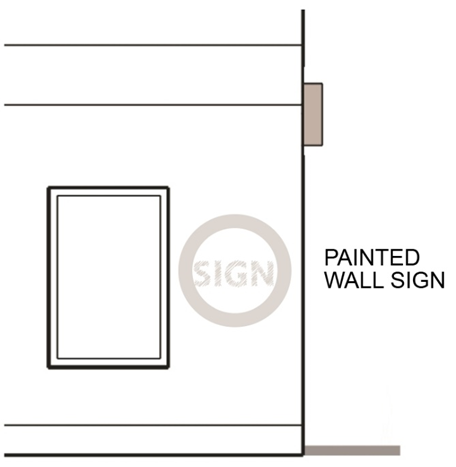
Park: A non-commercial, not-for-profit facility designed to serve the recreation needs of the residents of the community. Parks include, but are not limited to, publicly accessible ballfields, football fields, soccer fields, basketball courts, tennis courts, dog parks, skateboard parks, playgrounds, beaches, and park district field houses, which may have indoor recreation facilities.
Parking Facility: A parking lot or parking garage providing off-street parking of motor vehicles.
Parking Garage: A structure with two or more levels that is used to park motor vehicles.
Parking Lot: Any lot (other than accessory) open to the sky which is used to park motor vehicles.
Parking Space: An enclosed or unenclosed surfaced area permanently reserved for the temporary storage of one motor vehicle and appropriately connected with a street or alley by a surfaced driveway affording adequate ingress and egress.
Particulate Matter: Any dust, smoke, or any other form of airborne pollution in the form of minute separate particles.
Patio and Open Terrace: A roofless hard surfaced area typically constructed of masonry, brick, or concrete that is attached to the ground adjacent to the wall of a building.
Pawn Shop: An establishment licensed, certified, or accredited by the appropriate local and state agencies that lends money in exchange for personal property that is used as collateral. "Pawn Shops" may purchase personal property outright or on the condition of selling it back to a customer with interest. "Pawn Shops" may include cash for gold establishments, which have the primary business of purchasing precious metals, jewelry, watches, and other similar items. "Pawn Shop" does not include "Retail Goods Establishments" such as antique stores and consignment stores.
Pennant: Any lightweight plastic, fabric, or other material, whether or not containing a message of any kind, suspended from a rope, wire, or string, usually in series, designed to move in the wind. This is considered an eye-catcher and hence is prohibited.
Pergola: A freestanding structure with columns or posts topped with beams and open rafters, which may or may not be connected to the wall of a building.
Permanent Guest: A person who occupies or has the right to occupy a hotel or motel or apartment hotel accommodation as their domicile and place of permanent residence.
Permitted Use: A use, which may be lawfully established in a particular district or districts provided it conforms to all requirements, regulations, and standards of such district.
Person: A person, partnership, corporation, limited liability company, firm, association, or other body or individual.
Personal Services Establishment: An establishment primarily engaged in the provision of services of a personal nature. "Personal Service Establishment" includes facilities that sell products and goods in an incidental manner to the establishment's provision of services. "Personal Service Establishment" uses may include, but are not limited to, dry cleaners, barbershops, beauty salons, animal day care establishments, animal grooming establishments, express shipping services (e.g. UPS, FedEx, DHL), electronics repair, shoe repair shops, and tailor shops. "Personal Service Establishment" also includes commercial educational facilities, such as driving schools, dance schools, and tutoring facilities. "Personal Services Establishment" may include "Corner Store." "Personal Services Establishment" does not include "Adult Entertainment Establishment," "Animal Boarding, Hospital, or Shelter" or "Tattoo Parlor."
Place of Worship: An institution maintained by a religious body where people assemble for religious purposes, ceremonies, and other similar events. A "Place of Worship (Large)" accommodates a capacity of 250 or more people while a "Place of Worship (Small)" accommodates a capacity of less than 250 people. "Place of Worship" may include housing for members of religious orders, "Day Care Centers," "Preschools," or "Elementary, Middle, or High Schools."
Planned Unit Development: A distinct category of development intended to allow flexibility in the application of the standards of this Ordinance. "Planned Unit Developments" are intended for significant development proposals that provide amenities to the community which are not required from conventional development applications.
Pole Sign: A sign that is mounted on a freestanding pole. See Figure 13.02-20 Pole Sign.
Figure 13.02-20 Pole Sign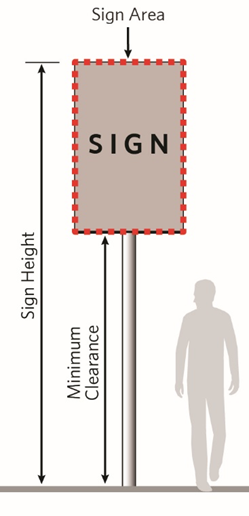
Porch: An unenclosed roofed platform projecting from the exterior wall of a building.
Portable Sign: A permanent, pedestrian-scale sign which is designed to be moved from one location to another for the purpose of advertising events or locations including signs that have either a fixed message or changeable copy message board. See Figure 13.02-21 Portable Sign.
Figure 13.02-21 Portable Sign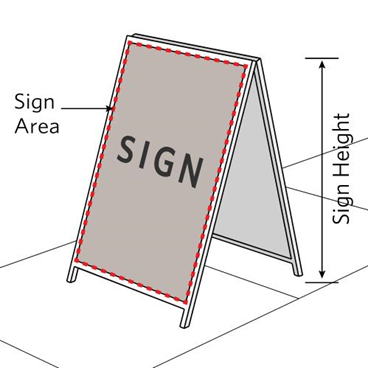
Primary Arterial Road: An arterial road intended to move through-traffic to and from major attractors or generators and/or as a route for traffic between communities.
Principal Use: The primary use of a lot or building as distinguished from an accessory use. Principal uses may be designated as a permitted use or a conditional use.
Private Garage: A detached accessory building or portion of a main building housing the automobiles of the occupants or guests of the premises.
Private Street: Streets that are built and maintained by persons other than the City of Waukegan which may or may not restrict access to public traffic.
Professional Office: An establishment that engages in the application, processing, or manipulation of business information or professional expertise, or that offer health-related outpatient treatment by licensed health professionals. A "Professional Office" may not manufacture, assemble, warehouse, or repair goods and products for the retail or wholesale market, or engage in the repair of products or the provision of retail services. "Professional Office" may include, but is not limited to, medical offices, dental offices, law firms, insurance agencies, accounting firms, real estate agencies, investment firms, and non-profit organizations. "Professional Office" does not include "Government Facility."
Projecting Sign: Any sign which is attached to a building or other structure and projects into or overhangs the public right-of-way or other public land except that a wall sign, the face of which is parallel to the wall upon which it is located, and which projects not more than one foot into the public right-of-way or other public land, is not considered a projecting sign for the purposes of this Ordinance. See Figure 13.02-22 Projecting Sign.
Figure 13.02-22 Projecting Sign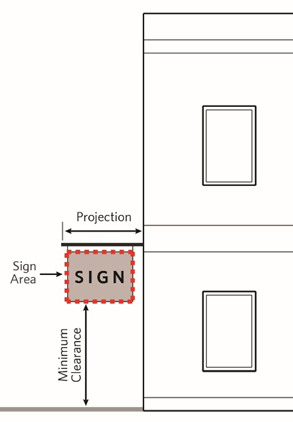
Property Lines: The lines bounding a zoning lot, as defined herein.
Protected Area: Any area in which tree protection measures are required pursuant to this Ordinance, including without limitation any bluff, conservation area, ravine, heritage tree, No Disturbance Area, Streetscape Preservation Area, or Tree Preservation Area.
Public Garage: A building or portion thereof, other than a private garage, designed or used for equipping, servicing, repairing, hiring, selling, storing, or parking motor vehicles. The term repairing does not include an automotive body repair shop or the rebuilding, dismantling, or storage of wrecked or junked vehicles, unless expressly authorized.
Public Right-of-Way: Any sidewalk, crosswalk, street, alley, highway, or other public thoroughfare.
Rain Barrel: A container for storing rainwater installed above-grade that generally has a capacity of less than 500 gallons.
Rainwater Cistern: A container for storing rainwater that may be installed either above or below grade.
Ravine: All property beginning at a point where the slope of the land first exceeds ten percent and continuing to the toe of slope.
Real Estate Sign: A temporary sign adhering to content-neutral standards that indicates that the premises upon which it is located is available for sale or lease. A real estate sign may be either a ground sign or a wall sign.
Rear Lot Line: The boundary of a lot which is most distant from, and is, or is most nearly, parallel to, the front lot line. See Figure 13.02-16 Lot Diagram.
Rear Yard: A yard extending along the full length of the rear lot line between the side lot lines with a depth extending to the rear edge of the principal structure. See Figure 13.02-31 Yard Diagram.
Recreation Equipment: Structures typically used for children's active recreation, which may include, but not be limited to swing sets, jungle gyms, and children's playhouses.
Recreational Cannabis: Cannabis that is grown and sold recreationally to adults over the age of 21, pursuant to applicable State specific laws and regulations.
Refuse, Recycling, or Grease Container: A receptacle for the disposal of litter, recyclables, or grease.
Removal: The removal of earth, trees, vegetation, or other physical aspect of a site.
Research/Development Facility: A facility in which ideas and technologies are investigated, tested, and refined in industries that may include, but is not limited to, electronics, computer hardware and software, communications, information technology, biotechnology, pharmaceuticals, and green technology. "Research/Development Facility" may include the incidental manufacture and/or sale of products developed at the facility.
Residential District: Zoning districts depicted on the Zoning Map in which residential uses are the predominate land use.
Residential Care Facility: A group care facility licensed for 24-hour medical or non-medical care of people in need of supervision or assistance essential for daily living, or for the protection of the individual. A "Residential Care Facility" includes "Assisted Living Facility," "Independent Living Facility," "Nursing Home," hospice, and continuum of care facilities. A "Residential Care Facility" does not include "Community Residence," "Transitional Housing," "Homeless Shelter," or "Senior-Restricted Residence."
Residential Model Unit: A building or structure displayed as an example of the dwelling units available for sale or for rent in a residential development. A Residential Model Unit may include sales or rental offices but may not be used as a habitable dwelling unit until all sales and marketing efforts in the residential development have been completed.
Restaurant: An establishment that prepares and sells food and beverages for consumption on the premises and/or for carry-out. "Restaurant" does not include refreshment stands incidental to "Indoor Entertainment," "Indoor Recreation," "Outdoor Entertainment," or "Outdoor Recreation" uses.
Retail Goods Establishment: An establishment that provides physical goods, products, or merchandise directly to the consumer for purchase and removal from the premises by the purchaser. "Retail Goods Establishment" may include, but is not limited to, grocery stores, clothing stores, jewelry stores, appliance stores, electronics stores, furniture stores, office supply stores, bookstores, and sporting goods stores. "Retail Goods Establishment" may include "Corner Store" or "Retail Goods Establishment." "Retail Goods Establishment" does not include "Adult Entertainment Establishment," "Cannabis Dispensary" or "Pawn Shop."
Reverse Channel Letter: A fabricated dimensional letter with opaque face and side walls. See Figure 13.02-23 Reverse Channel Letter.
Figure 13.02-23 Reverse Channel Letter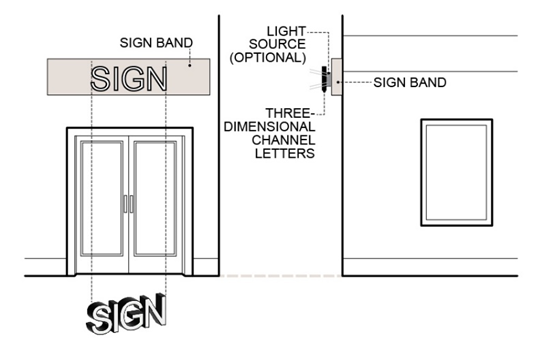
Reversed Corner Lot: A corner lot, the street side lot line of which is substantially a continuation of the front lot line of the first lot to its rear. See Figure 13.02-16 Lot Diagram.
Right-of-Way: A strip of land occupied, designed to be occupied, or designated to be occupied, by a street, highway, alley, sidewalk, crosswalk, thoroughfare, railroad, electric transmission line, oil or gas pipeline, water main, sanitary or storm sewer main, or for another special use. The usage of the term "right-of-way" for land platting purposes in the City of Waukegan means that every right-of-way hereafter established and shown on a final plat is to be separate and distinct from the lots or parcels adjoining such right-of-way, and not included within the dimensions or areas of such lots or parcels. Rights-of-way intended for streets, alleys, crosswalks, water mains, sanitary sewers, storm drains, or any other use involving maintenance by a public agency, must be dedicated to public use by the maker of the plat on which such right-of-way is established. See Figure 13.02-24 Right-of-Way Cross-Section.
Figure 13.02-24 Right-of-Way Cross-Section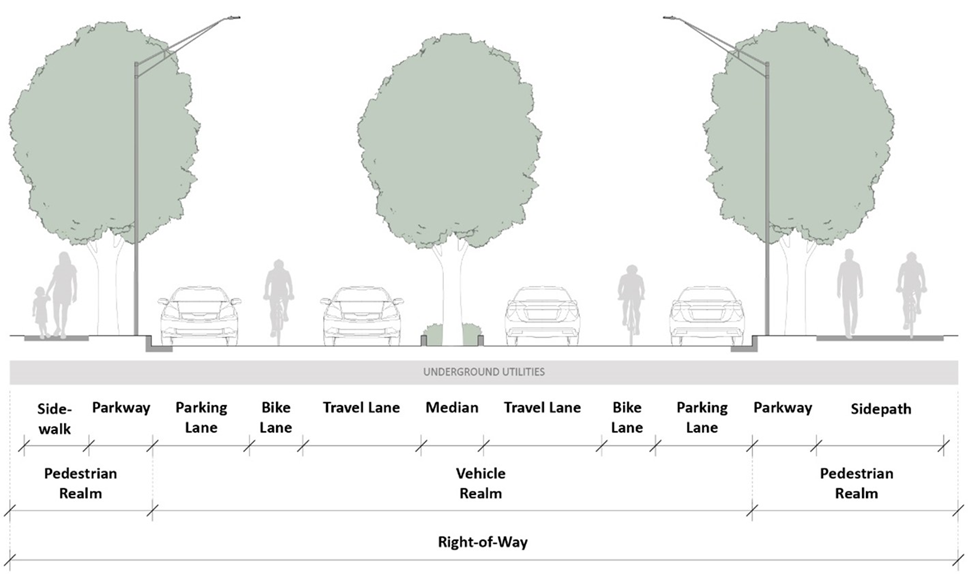
Ringelmann Chart: That which is described in the U.S. Bureau of Mines Information Circular 8333, and on which are illustrated graduated shades of gray for use in estimating the light-obscuring capacity of smoke density.
Ringelmann Number: The number of the area on the Ringelmann Chart that coincides most nearly matches the visual density of emission of the light-obscuring capacity of the smoke.
Roadside Stand: A structure for the display and sale of agricultural products, with no space for customers within the structure itself.
Roadway: A portion of a road or street which is improved, designed, or ordinarily intended for vehicular use. Divided roads and roads with frontage or service roads have more than one roadway.
Roof Sign: Any sign erected or constructed on or over the roof of any building or other structure or which extends above the cornice line of the building upon which it is located and supported in whole or in part by such building or structure. Roof signs are prohibited in the City of Waukegan. See Figure 13.02-25 Roof Sign.
Figure 13.02-25 Roof Sign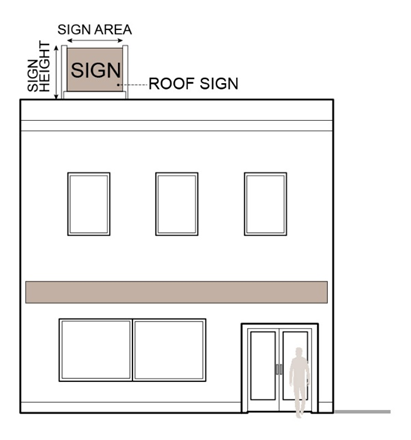
Rotor Diameter: The diameter of the circle swept by the rotor. For measurement purposes this means the distance from the outer-most tip of the longest blade to the center of the turbine rotor multiplied by two.
Rotor: The rotating part of a wind turbine, including the blades and blade assembly or the rotating portion of the generator.
Secondary Arterial Road: An arterial road designed to service moderate traffic attractors or generators and to carry traffic from collector streets to primary arterial roads.
Security Fence: A security fence means any fence or wall, open or opaque, to a height of at least five feet or as otherwise required by this Ordinance, which is constructed with voids or spaces no wider than four inches and furnished with secure gates.
Self-Storage (Indoor): A facility used for the storage of personal property where individuals rent storage spaces of various sizes that are accessed from interior hallways of the building on an individual basis.
Senior-Restricted Residence: A property containing single, complete dwelling units, with kitchen and bathroom facilities in each unit, within a multi-unit dwelling. A Senior Restricted Residence is intended for, and solely occupied by persons of age 62 years or older; or intended and operated for occupancy by persons of at least 55 years of age, where at least 80 percent of the occupied units are occupied by at least one person of age 55 or older. A Senior-Restricted Residence must prohibit residents younger than 21 years of age, and visits by minors under age 21 for more than 30 days in any 120-day period. A Senior-Restricted Residence may provide communal eating, recreational, personal care, or other uses for residents and guests.
Service Road: A public street, generally paralleling and contiguous to a main traveled way, primarily designed to promote safety by eliminating promiscuous ingress and egress to the right-of-way and providing safe and orderly points of access at fairly uniformly spaced intervals.
Setback: The minimum distance maintained between a lot line and the nearest supporting member of any structure on the lot.
Shadow Flicker: The moving shadow cast on the ground and stationary objects, created by the sun shining through the moving blades of a wind energy system.
Shared Use Path: A multi-use path designed primarily for use by bicyclists and pedestrians, including pedestrians with disabilities, for transportation and recreation purposes. Shared use paths are physically separated from motor vehicle traffic by an open space or barrier and are either within the highway right-of-way or within an independent right-of-way.
Side Lot Line: Any boundary of a lot which is not a front lot line or a rear lot line. See Figure 13.02-16 Lot Diagram.
Side Yard: A yard extending along a side lot line from the front yard to the rear yard with a depth extending to the side edge of the principal structure. See Figure 13.02-31 Yard Diagram.
Sidewalk: A portion of a street or crosswalk way paved, or otherwise surfaced, intended for pedestrian use only.
Sight Triangle Area: A triangular area, described by the edge of pavement lines of two intersecting streets and a line connecting said edge of pavement lines, in which the height of structures and landscaping regulation is limited to a maximum of 2.5 feet above grade in order to promote visibility at street intersections. Any leg of such triangle must be a minimum of 30 feet in length.
Sign Band: The horizontal wall area that is located above the ground floor storefront opening and below the second-floor line and is located a minimum of eight feet and a maximum of 15 feet above grade.
Sign Components: The sign face, the supporting structure, and the structural trim of a sign. See Figure 13.02-26 Sign Components.
Figure 13.02-26 Sign Components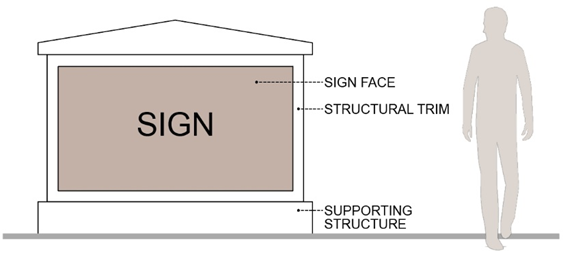
Sign Face: The surface of the sign upon which the message, logotype, symbol, or other device is located including surrounding moldings, trim, decorative trim, or any portion of the sign which is painted with a distinctive color scheme or in colors which contrast in hue or value with the painted or natural colors of the supporting structure or structural trim, if any. Two-sided signs where each side is identical have one sign face. Two-sided signs where the sides are not identical have two sign faces.
Sign: A message, image, display, or object used to advertise, direct attention to, or promote the interests of a person, business, organization, location, product, service, or activity. "Signs" do not include works of art.
Signage: The collection, aggregation or sum total of signs located on a lot, pertaining to a particular use or class of uses, subject to a particular regulation or standard, or however else aggregated.
Sill: A projecting horizontal architectural feature, often located below a window or door.
Single-Room Occupancy Unit: A traditional form of affordable residential housing consisting of a single room, often between 70 and 350 square feet in size, which may have cooking and sanitary facilities in each unit or have shared cooking and sanitary facilities. Single-Room Occupancy Units are generally a form of affordable private housing for lower income individuals, homeless, seniors, and persons with disabilities. Generally, Single-Room Occupancy Units are offered on a weekly or monthly rental basis.
Site Development: The altering terrain and/or vegetation and constructing improvements.
Site: A lot or parcel of land, or a contiguous combination thereof, where grading work is performed as a single unified operation.
Snipe Sign: A sign affixed, hung, placed, applied, or posted to any tree, utility pole, hydrant, bench, fence, stake, trash receptacle, sidewalk, curb, parkway, street, median, or similar location, located on either public or private property, without the consent of the property owner.
Solar Collector Surface: Any part of a solar energy system that absorbs solar energy for use in the system's transformation process. The collector surface is considered the front of a solar energy system, and does not include frames, supports, or mounting hardware.
Solar Energy System: An energy system that consists of one or more solar collection devices, solar energy related "balance of system" equipment, and other associated infrastructure with the primary intention of generating electricity, storing electricity, or otherwise converting solar energy to a different form of energy. Solar energy systems may generate energy in excess of the energy requirements of a property if it is to be sold back to a public utility in accordance with the law. Such a system can either be "building mounted" or "freestanding." Solar energy systems include, but are not limited to, photovoltaic (PV) power systems and solar thermal systems.
Solar Energy: The radiant energy received from the sun, which can be collected in the form of heat or light by a Solar Energy System.
Solid Waste: Any garbage, refuse, sludge, and any other discarded material, including solid, liquid, semisolid, or contained gaseous material resulting from industrial, commercial, institutional, mining, and agricultural operations, and from community activities.
Sound Level: The A-weighted sound pressure level in decibels (dB) (or the C-weighted level if specified) as measured using a sound level meter which meets the requirements of a Type 2 or better precision instrument according to the American National Standards Institute (ANSI) S1.4. The "average" sound level is time-averaged over a suitable period using an integrating sound level meter, which that meets the requirements of ANSI S12.43.
Stable: The land and structures where horses are bred, raised, boarded, or kept for hire or sale, including training, riding lessons, and for therapy.
Stairs: A structure made up of a series of steps used to move from one level of a building or structure to another.
Stealth Design: A technique that reduces the visual impact of a structure by enclosing, camouflaging, screening, or obscuring the structure in relation to the architectural features of a larger building or structure.
Stoop: A structure made up of stairs and a landing used to access a building or structure.
Story: That part of a building between any floor and the floor next above, and if there is no floor above, then the ceiling above.
Street Block: The lots facing a street between two rights-of-way, and with the same address numbering scheme. For example, 1501, 1502 and 1503 Jackson would be considered within the same street block.
Street Tree: A tree located in the public right-of-way and maintained by the City of Waukegan or its contracted designee.
Street: Any road (other than a private road), highway, parkway, avenue, alley, or other way intended for public use which connects a way to another such way or to a building or structure. A street refers to the entire public right-of-way (including public sidewalks).
Streetscape Preservation Area: The portion of a property located in the front and corner side yards, as those defined by the Ordinance.
Stripping: Any activity which removes the vegetative surface cover including tree removal, clearing and storage or removal of topsoil.
Structural Alteration: Any change, other than incidental repairs, which would prolong the life of the supporting members of a building, such as the addition, removal, or alteration of bearing walls, columns, beams, girders, or foundations.
Structural Trim: Any battens, capping, nailing strips, latticing, platforms, railings, and light fixtures attached to or used in conjunction with a sign.
Structure: Anything, which is constructed or erected which requires permanent location on the ground or attachment to something having permanent location on the ground.
Subdivider: Any person, corporation, or duly authorized agent who undertakes the subdivision of land as defined herein.
Subdivision Design Standards: The basic land-planning standards established as guides for the preparation of preliminary and final plats as set forth in Section 7 (Subdivision Development Standards).
Subdivision: A described tract of land, which is to be, or has been, divided into two or more lots or parcels of any size. The term "subdivision" includes re-subdivision, planned unit development, cluster development, or other similar unified development and, where it is appropriate to the context, relates to the process of subdividing or to the land subdivided. For the purpose of this Ordinance, however, the division of land into parcels or tracts no smaller than five acres in area and not involving any new streets or easements of access does not constitute a "subdivision" if no new streets are created. This Ordinance applies to all subdivisions, including those subdivisions accepted prior to the adoption of this Ordinance.
Substantial Conformance: The proposed project is consistent and in conformance with a previously approved permit or application.
Supporting Structure: The load bearing members including uprights, cross bars, diagonal braces, guys, light fixture supports and similar components. The exposed back of any sign face is considered part of the structure.
Subject Property: One or more parcels of real property for which an application for relief under this Ordinance is submitted to the City.
Surveyor: A licensed professional responsible for the division of land into legally recordable divisions.
Swimming Pool: An in-ground or above-ground basin of water constructed for swimming or wading.
Swinging Sign: A sign that is attached to an installed arm, mast, or span that is able to swing or hang. See Figure 13.02-27 Swinging Sign.
Figure 13.02-27 Swinging Sign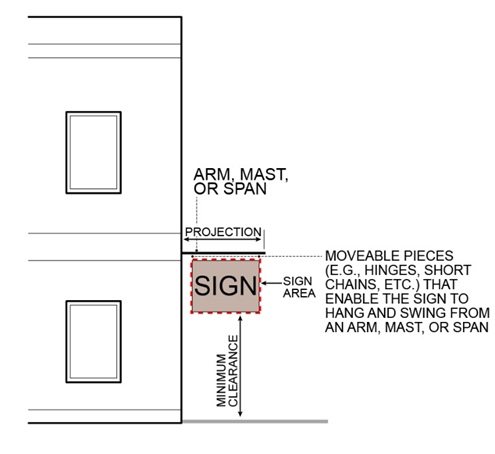
System Height: The vertical distance measured from the finished grade of the parcel to the outermost tip of the rotor when the tip is at its highest point, or such other higher point, depending on the structure's design, if such point is higher than the rotor.
Temporary Sign: Any sign irrespective of the type of sign or the materials used for its construction which is restricted by the terms of this Ordinance as to the length of time that it may be erected, maintained, used, or displayed by permit.
Temporary Outdoor Entertainment: A live event that is intended to be in place for a limited period of time within an outdoor space. "Temporary Outdoor Entertainment" may include, but is not limited to, animal shows, carnivals, circuses, fireworks shows, live music, outdoor theater, and worship services.
Temporary Outdoor Sale: The temporary outdoor sale and display of merchandise for temporary uses, such as antiques markets, art fairs, craft fairs, holiday sales, pumpkin sales lots, or Christmas tree lots.
Temporary Storage Container: A temporary, moveable structure that may be used for the storage of possessions or products before being transported to a storage facility, or for collecting waste and other material associated with the construction and renovation of a structure. "Temporary Storage Container" may include steel shipping containers commonly used for intermodal shipping.
Temporary Use: A use established for a fixed period of time with the intent to discontinue such use upon the expiration of such time and does not involve the construction or alteration of any permanent structure.
Tent: A temporary structure or enclosure constructed of pliable material and supported by one or more poles.
Thoroughfare: A street with a high degree of continuity, including collector streets, arterial roads, and limited-access highways.
Three-Component Measuring System: A complement of instruments or seismograph, which can record, simultaneously, vibration vectors in three mutually perpendicular directions.
Threshold Limit Value (TLV): The maximum allowable concentration permitted an industrial worker for eight hours exposure per day, five days a week, as adopted by the American Conference of Governmental Industrial Hygienists.
Through Lot: A lot which has a pair of opposite street lines along two substantially parallel streets, and which is not a corner lot. On a through frontage lot, both street lines are considered front lot lines. Through Lots are commonly referred to as Double-Frontage Lots See Figure 13.02-16 Lot Diagram.
Title or Payday Loan Establishment: An establishment that provides loans to individuals in exchange for personal checks or titles to motor vehicles. Title or Payday Loan Establishments are defined in the Illinois Payday Loan Reform Act, 85 ILCS 122/1-1, et seq., and any such business which is regulated under that Act. "Title or Payday Loan Establishment" does not include "Currency Exchange" or "Financial Institution."
Toe of Slope: The point in the ravine or bluff where the slope is less than 22 degrees or where the slope reverses directions. On compound slopes where there may be more than one possible toe location, the controlling point is whichever toe location provides the greater area for a ravine or bluff.
Topping: The indiscriminate cutting of tree branches to stubs or lateral branches that are not large enough to assume the terminal role. The act of topping is prohibited due to its effects on trees, which eventually lead to the decay and death of the tree.
Tower: A structure that is designed and constructed primarily for the purpose of supporting one or more antennae. The term includes radio and television transmission towers, microwave towers, common-carrier towers, cellular telephone towers, and the like. The height of such a tower is the distance measured from ground level to the highest point on the tower, even if said highest point is an antenna or lightning rod.
Tower-Mounted Wind Turbine: A wind turbine mounted on a structure that is designed and constructed primarily for the purpose of elevating and supporting a wind generator, including freestanding lattice towers, monopole towers, or guyed towers.
Toxic Material: A substance (liquid, solid, gas) which by reason of inherent deleterious property when emitted in any amount, is injurious to plants, animals, or human beings.
Transfer: The sale of residential property that is sold on contract or through a recorded title transfer.
Transitional Yard: A yard which must be provided on a zoning lot in a Business District which adjoins a zoning lot in a Residence District, or that yard which must be provided on a zoning lot in an Industrial District which adjoins a zoning lot either in a Residence or Business District.
Tree Preservation Areas: An area identified on a plat of subdivision, or on a site plan attached to the ordinance granting a conditional use permit, within which trees are to be preserved. This differs from a Conservation Easement in that removal of undergrowth is permitted.
Tree Well: An area that surrounds the tree at the drip line, where the trunk of the tree is either above or below the average grade outside the drip line. See Figure 13.02-28 Tree Well.
Figure 13.02-28 Tree Well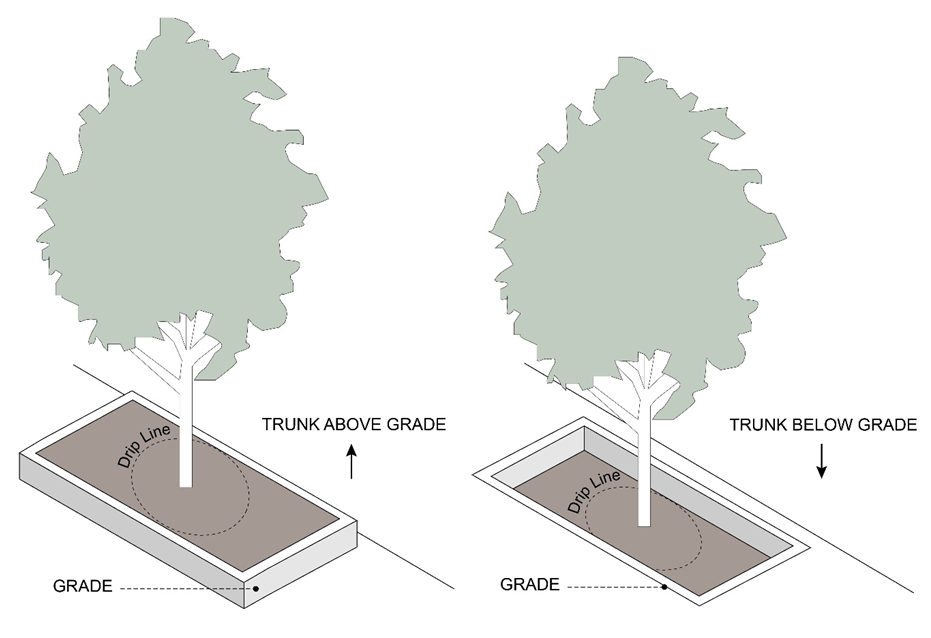
Unified Development Ordinance (UDO): The City of Waukegan Unified Development Ordinance, this Ordinance.
Use: The purpose for which land or premises, or building or structure thereon is designed, arranged, or intended, or for which it is occupied, maintained, or leased.
Utility: The use of land for infrastructure facilities including transmission and services for gas, electricity, water treatment and storage, sewage treatment and storage, telephone, cable television, data, cellular, and fiber-optic cable. Utility does not include facilities that produce, generate, or store energy.
Utility-Scale Solar Energy System: An energy collection system that converts sunlight into electricity for off-site use by utility customers. "Utility-Scale Solar Energy Systems" consist of photovoltaic panels, mounting devices, and associated control electronics to provide electricity to the power grid.
Utility-Scale Wind Energy System: An energy collection system that converts wind energy into electricity for off-site use by utility customers. "Utility-Scale Wind Energy Systems" consist of a turbine, a monopole tower, and associated control electronics to provide electricity to the power grid.
Vacant: The land on which there are no structures or only structures of the land itself.
Variance: A relaxation of the terms of this Ordinance where such variance will not be contrary to the public interest and where a liberal enforcement of this Ordinance would result in unnecessary and undue hardship, subject to the standards of this Ordinance.
Vertical-Axis Wind Turbine: A wind turbine in which the rotor is mounted vertically.
Vibration Frequency: The number of oscillations per second of a vibration.
Vibration: The periodic displacement, measured in inches, of earth.
Vocational School: A facility that offers instruction in industrial, clerical, commercial, managerial, building trades, or automotive skills. "Vocational School" does not include "Elementary, Middle, or High School" or "College or University."
Wall: A vertical structure, typically constructed of concrete, stone, brick, masonry, or other similar material, that creates a physical barrier for light and air.
Wall Sign: Any sign which is attached to and supported by the wall of a building or other structure provided the sign face is parallel to the wall to which the sign is attached. See Figure 13.02-29 Wall Sign.
Figure 13.02-29 Wall Sign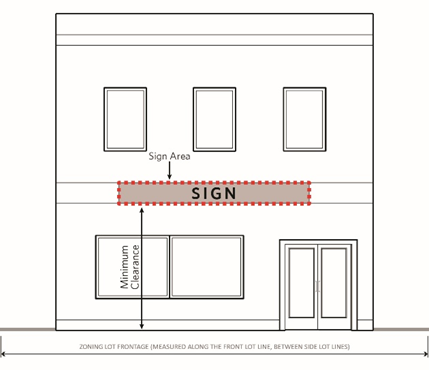
Warehousing and Distribution Facility: An establishment that stores and transports products or equipment, including, but not limited to warehouses and fulfillment centers. Warehousing and Distribution Facility does not include motor vehicle storage, RV storage, boat storage, or commercial vehicle storage.
Wind Energy System: A rotary device that extracts energy from the wind. This device includes any base, blade, foundation, generator, nacelle, rotor, tower, transformer, vane, wire, inverter, batteries, or other components used in the system.
Window Sign: Any permanent sign or similar device displayed inside the window or a doorway of a building or upon the interior wall of a building opposite a window in such a way as to be clearly visible from the outside. See Figure 13.02-30 Window Sign.
Figure 13.02-30 Window Sign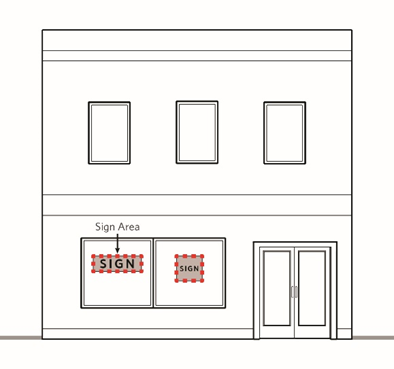
Wireless Telecommunication Antenna: A structure that is six cubic feet in volume or larger that is used to transmit and/or receive communication, data, or other similar signals in order to facilitate the use of wireless devices. "Wireless Telecommunications Antenna" does not include "Satellite Dish" or "Wireless Telecommunication Small Cell."
Wireless Telecommunication Facility: A structure used to protect the equipment that processes communication, data, or other similar signals to facilitate the use of wireless devices.
Wireless Telecommunication Small Cell: A structure that is smaller than six cubic feet in volume that is used to transmit and/or receive communication, data, or other similar signals in order to facilitate the use of wireless devices. "Wireless Telecommunications Small Cell" does not include "Antenna," "Satellite Dish, or "Wireless Telecommunication Antenna."
Wireless Telecommunication Tower: A structure designed and constructed to support one or more "Wireless Telecommunications Antennas" and all devices attached to it. "Wireless Telecommunication Towers" are typically freestanding and may be of either lattice or monopole construction.
Yard: An open space on the same zoning lot with a building or structure, unoccupied and unobstructed from its lowest level to the sky. A "yard" extends along a lot line and to a depth or width specified in the yard requirements for the zoning district in which such zoning lot is located. See Figure 13.02-31 Yard Diagram.
Figure 13.02-31 Yard Diagram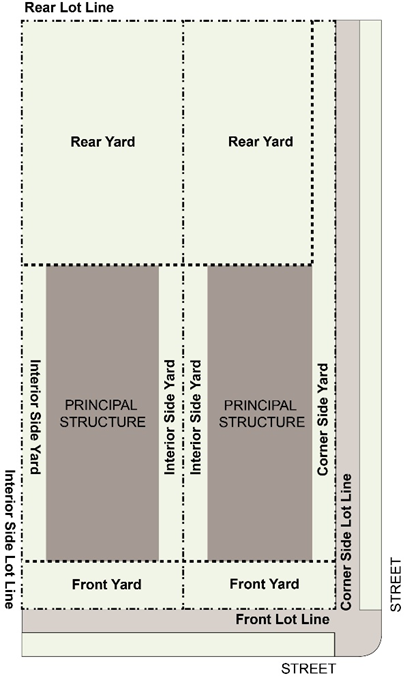
Zoning Administrator: The officer of the City and their designees who are responsible for enforcing and administering all components of this Ordinance.
Zoning Permit: The written approval of the Zoning Administrator certifying that the applicant's plans and drawings comply with all applicable provisions of this Ordinance. The "zoning permit" may consist of a standardized independent form bearing the signature of the Zoning Administrator or it may be represented as a part of a building permit application.
Zoning Lot: A single tract of land located within a single block which (at the time of filing for a building permit) is designated by its owner or developer as a tract to be used, developed, or built upon as a unit under single ownership or control. A "zoning lot or lots" may or may not coincide with a lot of record.
Zoning Map: The City of Waukegan Zoning Map established pursuant to Section 8.04 (Zoning Map) and adopted by Ordinance No. 25-O-02 which depicts the various zoning districts of the City and their boundaries.
(Ord. No. 25-O-03, § 2(Exh. A), 1-6-25)

