Waukegan City Zoning Code
SECTION 8
- ZONING DISTRICT REGULATIONS
8.01 - Purpose
The purpose of this Section is to establish various zoning districts and corresponding development standards for properties within the City.
8.02 - Applicability
The provisions of this Section apply to all new developments, including construction and significant exterior renovation of existing structures that require a building permit. Refer to Section 6 (Nonconformities) for information on the continuation of nonconforming structures.
8.03 - Development Standards of General Applicability
The following sections provide development requirements that must be met in addition to the development requirements for each zoning district established in this Section.
A.
Site Plan Review. See Section 4.09 (Site Plan Review) for applicable site plan review requirements.
B.
Uses. See Section 9 (Uses) for principal, accessory, and temporary use requirements as well as standards for accessory and temporary structure requirements.
C.
Parking and Loading. See Section 10 (Off-Street Parking and Loading) for off-street parking, loading, and access requirements.
D.
Landscaping and Buffering. See Section 11 (Landscape Standards) for landscaping, buffering, and screening requirements.
E.
Signs. See Section 12 (Signs) for sign requirements.
F.
Building Regulations. Refer to Chapter 6 (Buildings and Building Regulations) of the City's Code of Ordinances for additional development requirements outside the purview of this Ordinance.
8.04 - Zoning Map
A.
Establishment of Zoning Map. The location and boundaries of the districts established in this Section are hereby established on the map designated as the City of Waukegan Zoning Map and referred to herein as the "Zoning Map." The Zoning Map is adopted by reference and incorporated as part of this Ordinance.
B.
Map for Reference. The Zoning Map is maintained for reference and public inspection on the City's website and in the offices of both the City Clerk and the Zoning Administrator.
C.
Zoning Map Amendments. All map amendments, see Section 4.07 (Amendments), that involve a change to the designation of a lot within a zoning district must be documented on the Zoning Map.
D.
Interpretation of Boundary Lines. The boundaries of all zoning districts shown on the Zoning Map are determined in accordance with the following:
1.
Right-of-Way Lines. Where zoning district boundary lines coincide with streets, alleys, railroads, easements, or similar rights-of-way, the centerline of the right-of-way is considered the boundary line of the district.
2.
Lot Lines. Where zoning district boundary lines coincide with a lot line, the lot line is considered the boundary line of the district.
3.
Lot of single ownership. Where a zoning district boundary line divides a lot in single ownership, the Zoning Administrator will determine which zoning district designation will apply to the entire site by written interpretation.
8.05 - Use of Land and Buildings
A.
Number of Buildings on a Lot. No more than one principal building may be located on a lot used for a single-unit or multi-unit residential dwelling, except as part of a planned unit development in accordance with Section 5 (Planned Unit Developments). For non-residential uses, more than one principal building may be located on a zoning lot provided that each building complies with the applicable requirements of this Section as though it were an individual principal building on a zoning lot or if it was approved as a planned unit development in accordance with Section 5 (Planned Unit Developments).
B.
Applicability of Regulations.
1.
Applicability of Use Regulations. A building, structure, or lot may only be used for a use that is allowed as either a permitted or approved conditional use in the zoning district in which such building, structure, or land is located. Buildings, structures, or lots may also be used for an approved accessory use or a temporary use in accordance with the requirements of Section 9.03 (Accessory Uses and Structures) and Section 9.04 (Temporary Uses and Structures).
2.
Applicability of Lot and Setback Regulations. Lot dimensions and setbacks may not be reduced below the minimum requirements or extended beyond the maximum requirements of this Ordinance without a variance or planned unit development approval. Lots or setbacks created after the effective date of this Ordinance must meet the requirements for the zoning district in which the structure is located. All setbacks allocated to a structure must be located on the same zoning lot as such building.
3.
Consolidation of Contiguous Lots Operated as a Single Zoning Lot. Multiple contiguous lots under the same ownership and used as a single zoning lot must consolidate the lots into a single parcel upon zoning review and staff recommendation in accordance with Section 3.03 (Subdivision Application) and Section 7 (Subdivision Development Standards).
4.
Applicability of Bulk and Height Requirements. All structures erected after the effective date of this Ordinance must meet the bulk and height requirements for the zoning district in which the structure is located. No existing structure may be enlarged, altered, reconstructed, or relocated in such a manner that conflicts with the requirements of the zoning district in which the structure is located.
a.
Airport Height Restrictions. Areas surrounding the boundaries of the Waukegan National Airport are required to comply with the height restrictions as prescribed in state and federal regulations for runway protection zones and airspace clearance.
b.
Airport Height Restriction Variances. Structures that exceed the height requirements in the approach plan of the require an aeronautical study and may receive a variance if they are found to not be an obstruction to air navigation. (See Section 4.04 Variances)
C.
Air Rights. Development involving the use of air rights from properties in the same zoning district and fronting a common right-of-way is allowed in all non-residential zoning districts (B1, B2, B3, B4, H/C, E, R/LI, I). Air rights development requires a conditional use permit and may only be initiated by the property owner. See Section 2.06 (Application Procedure) and Section 4.08 (Conditional Uses).
D.
Obstruction of Visibility Prohibited. No building, structure, or sign may be erected or placed, or vegetation allowed to grow in a manner that will create a visibility obstruction for motorists, bicyclists, or pedestrians along or over public rights-of-way. No building, structure, sign, or vegetation may obstruct the area between 2.5 feet and 8 feet in height within the sight triangle area. The sight triangle area is measured along 30 feet of curb line or edge of pavement where no curbs are present, from the point where two or more streets intersect, or where a street intersects railroad tracks. (See Figure 8.05-1 Visibility Obstruction)
E.
Solid Waste. No building, structure, or lot may be used in a manner that creates a solid waste nuisance on its premises as defined in Section 11-36 of the City's Code of Ordinances. No solid waste may be produced or be a byproduct of production if the solid waste cannot be disposed of via general waste collection to a licensed Subtitle D Landfill. No solid waste of any kind may be stored on any property for longer than a regular waste disposal cycle or 30 days, whichever is less.
Figure 8.05-1 Visibility Obstruction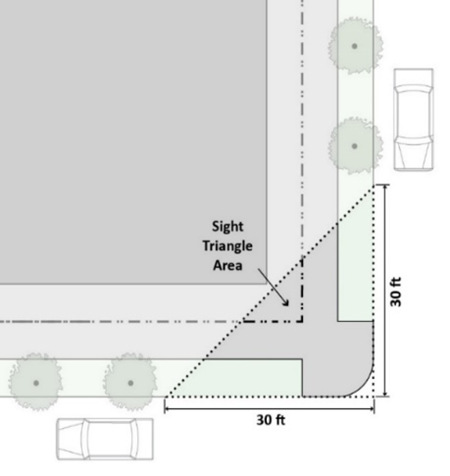
8.06 - Establishment of Zoning Districts and Purpose Statements
In order to carry out the purpose and intent of this Ordinance, the City is hereby divided into the following zoning districts:
A.
CR Conservation/Recreation District. The CR Conservation/Recreation District is established to encourage development of land for recreational open space, accommodate agricultural uses and limited non-agricultural uses that are compatible with agricultural development, preserve natural resources, and reduce the potential financial burden to areas subject to periodic flooding or with high water tables.
B.
Residential Districts.
1.
R1 Single-Unit Dwelling District. The R1 District is established to accommodate low-density residential development. The R1 District allows single-unit dwellings, other residential uses, and limited non-residential uses that are compatible with surrounding residential neighborhoods.
2.
R2 Single-Unit Dwelling District. The R2 District is established to accommodate moderate density residential development. The R2 District allows single-unit dwellings, other residential uses, and limited non-residential uses that are compatible with surrounding residential neighborhoods.
3.
R3 General Residential District. The R3 District is established to accommodate single-unit, two-unit, three-unit, and four-unit dwellings, townhouse dwellings, and other residential uses and limited non-residential uses that are compatible with surrounding residential neighborhoods.
4.
R4 General Residential District. The R4 District is established to accommodate high density residential development. The R4 District allows single-unit, two-unit, three-unit, and four-unit dwellings, townhouse dwellings, multiple-unit dwellings, and other residential uses and limited non-residential uses that are compatible with surrounding residential neighborhoods.
5.
R5 Multiple-Unit Residential District. The R5 District is established to accommodate multiple-unit dwelling development. The R5 District allows multiple-unit dwellings, other residential uses, and limited non-residential uses that are compatible with surrounding residential neighborhoods.
C.
Business Districts.
1.
B1 Neighborhood Convenience District. The B1 District is established to accommodate pedestrian development that serves surrounding neighborhoods. The B1 District allows a narrowly defined set of commercial, institutional, and limited residential uses primarily along local roads.
2.
B2 Community Shopping District. The B2 District is established to accommodate pedestrian and auto-oriented development that serves surrounding neighborhoods and communities. The B2 District allows a range of commercial, institutional, and limited residential uses primarily along major and minor arterial roads.
3.
B3 General Commercial District. The B3 District is established to accommodate auto-oriented commercial development that serves the City and surrounding communities. The B3 District allows a wide range of commercial, institutional, and limited residential uses primarily along major arterial roads.
4.
B4 Downtown District. The B4 District is established to accommodate dense, pedestrian-oriented development that serves the City and surrounding communities. The B4 District allows a wide range of commercial, residential, and institutional uses within Downtown Waukegan.
5.
H/C Health/Civic District. The H/C District is established to accommodate office buildings, business headquarters, civic and cultural structures, and educational, hospital and medical services, and institutional uses in a mutually compatible environment.
6.
E Entertainment District. The E District is established to accommodate large-scale entertainment and retail developments that serve the City and surrounding communities. The E District allows a range of entertainment, cultural, and retail uses, and multi-unit dwellings in a mutually compatible environment.
D.
Industrial Districts
1.
R/LI Research/Light Industrial District. The R/LI District is established to accommodate research, light industrial, business, corporate, and professional office uses that can be developed in a unified manner. The R/LI District allows development of large tracts of land that are accessible to the regional interstate highway systems.
2.
I Light Industrial District. The I District is established to accommodate low intensity manufacturing development with minimal impacts on neighboring properties. The I District allows a narrowly defined set of light manufacturing, office, and research uses.
E.
Lakefront Districts
1.
L1 South Lakefront District. The L1 District is established to accommodate open space and moderate density residential and pedestrian development that serves surrounding neighborhoods. The L1 District allows one-unit, two-unit, three-unit, and four-unit dwellings, townhouse dwellings, and low-rise multiple-unit dwellings, and limited commercial uses that are compatible with surrounding residential neighborhoods.
2.
L2 Marina District. The L2 District is established to accommodate marina, recreational, and mixed use commercial and residential development that serves the City and surrounding communities. The L2 District allows multi-unit dwellings, mixed-use developments, and a wide range of commercial and recreational uses.
3.
L3 North Harbor District. The L3 District is established to accommodate marina, recreational, and mixed use commercial and residential development that serves surrounding neighborhoods. The L3 District allows townhouse dwellings, multi-unit dwellings, mixed-use developments, and a wide range of commercial and recreational uses.
(Ord. No. 25-O-03, § 2(Exh. A), 1-6-25)
8.07 - Summary Table of Zoning Requirements
Table 8.07-1. Summary Table of Zoning District Requirements: Conservation, Residential, and Lakefront Districts and Table 8.07-2 Summary Table of Zoning District Requirements: Business and Industrial Districts provide a summary of the bulk and setback requirements for each zoning district established in this Section.
(Ord. No. 25-O-03, § 2(Exh. A), 1-6-25)
8.08 - Conservation/Recreation District Bulk and Setback Requirements
Table 8.08-1 CR District Requirements and Figure 8.08-1 CR District Requirements establish bulk and setback regulations for the CR District. See Section 9.03 (Accessory Uses and Structures) for provisions related to accessory structures.
Figure 8.08-1 CR District Requirements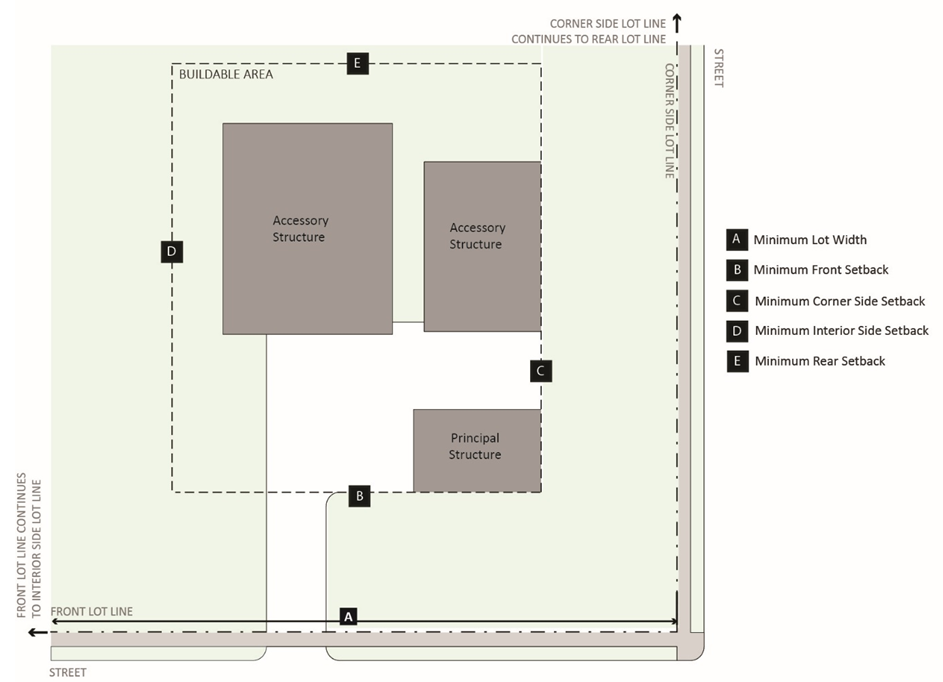
8.09 - Residential Zoning District Design Requirements
A.
Applicability. The design requirements in this section apply to all new construction and additions to single-unit dwellings, two-unit dwellings, three-unit dwellings, four-unit dwellings, townhouse dwelling units, and multiple-unit dwellings within the City's residential zoning districts.
B.
Design Requirements for Single-Unit Dwellings, Two-Unit Dwellings, Three-Unit Dwellings, and Four-Unit Dwellings. Refer to Figure 8.09-1 Single-Unit Dwelling, Two-Unit Dwelling, Three-Unit Dwelling, and Four-Unit Dwelling Design Requirements and Figure 8.09-2 Anti-Monotony Façade Separation.
1.
Building Orientation for All Lots. The entrance to single-unit and two-unit dwellings must be oriented toward the front lot line. The entrance to three-unit and four-unit dwellings must include a minimum of two entrances, at least one of which is oriented toward the front lot line with primary access via the front lot line.
2.
Building Orientation for Corner Lots. The entrance to single-unit, two-unit, three-unit, and four-unit dwellings located on corner lots must have a relationship with both intersecting streets in a manner that maintains the existing street wall on both streets to the greatest extent possible.
3.
Façade Articulation. To avoid the appearance of blank walls, façades facing the front yard and corner side yard must include façade articulation, such as entrances, bay windows, porches, or other architectural features.
4.
Façade Transparency. At least one window is required on façades facing the front yard, corner side yard, interior side yard, and rear yard. Minimum transparency of 25 percent is required on façades facing the front yard and corner side yard. Minimum transparency of ten percent is required on façades facing the rear yard.
5.
Additions. Additions to single-unit, two-unit, three-unit, and four-unit dwellings must maintain the architectural style, scale, and building mass of the existing structure. The building addition's materials, colors, trim, and other architectural details must complement the existing structure. All additions must meet the requirements of Section 8.09.B (Design Requirements of Single-Unit Dwellings, Two-Unit Dwellings, Three-Unit Dwellings, and Four-Unit Dwellings).
6.
Roofs. Sloped roofs must include eaves of at least six inches in width.
7.
Anti-Monotony. New construction of single-unit, two-unit, three-unit, and four-unit dwellings involving four or more lots must have distinctive façade designs. Dwelling units with similar façade designs must be separated by two or more lots on both sides of the street. Dwelling units are considered distinct if they are different according to at least four of the following features.
a.
Number of stories.
b.
Architectural style, such as craftsman, prairie, or ranch.
c.
Shape and dimensions of the front façade.
d.
Color palettes and materials for walls, trim, and roofs.
e.
Placement, size, and style of doors and windows.
f.
Roofline, roof pitch, and the number and location of dormers.
g.
Location and proportion of front porches.
h.
Location and proportion of garages and garage doors, if included on the front façade.
Figure 8.09-1 Single-Unit Dwelling, Two-Unit Dwelling, Three-Unit Dwelling, and Four-Unit
Dwelling Design Requirements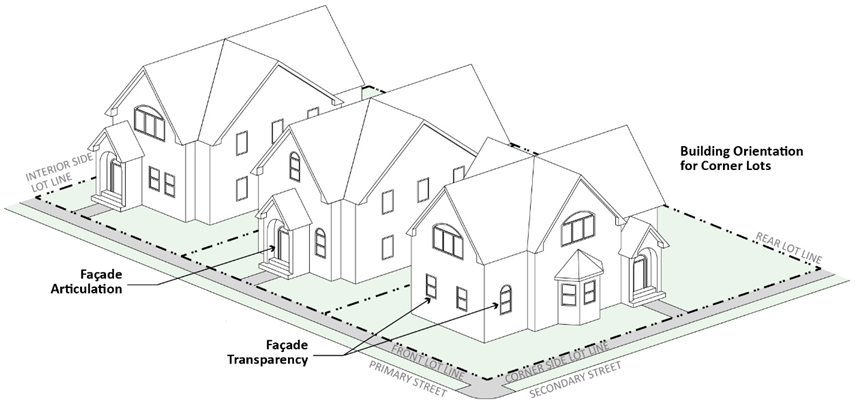
Figure 8.09-2 Anti-Monotony Façade Separation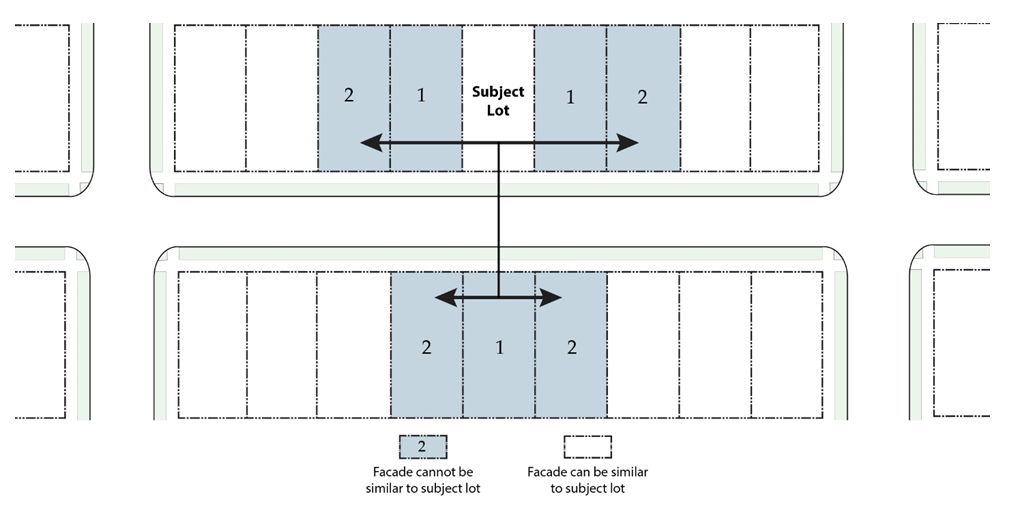
C.
Design Requirements for Multiple-Unit Dwellings and Townhouse Dwelling Units. Refer to Figure 8.09-3 Multiple-Unit Dwelling and Townhouse Dwelling Unit Design Requirements and Figure 8.09-4 Building Separation Distance.
1.
Façade Articulation. To avoid the appearance of blank walls, façades facing the front yard and corner side yard must include façade articulation, such as entrances, bay windows, porches, or other architectural features.
2.
Façade Transparency. Minimum transparency is required on façades facing the front yard, corner side yard, and interior side yard. Minimum transparency of 25 percent is required on façades facing the front yard and corner side yard. Minimum transparency of ten percent is required on façades facing the rear yard.
3.
Unified Design. The façades of multiple-unit and townhouse dwelling units must utilize common architectural forms, elements, materials, and colors that wrap around all façades of the building to provide a unified architectural design when the development is viewed from all directions.
4.
Building Separation. In developments with more than one building, there must be a minimum separation of 40 feet between two front façades, two rear façades, a front and rear façade, a front and side façade, or a rear and side façade. There must be a minimum separation of ten feet between two side façades. Walkways, driveways, and parking areas may be located within the minimum building separation areas.
5.
Doors, Windows, and Balconies. Doors and windows must have frames with raised elements, such as jambs, entablatures, thresholds, and casings, to create articulation. Windows must be set back into or projected out from the façade to provide façade depth and shadow. Bay windows and balconies are encouraged to provide dimensional elements on a façade.
6.
Roofs. Sloped roofs must include eaves of at least six inches in width. Roof forms must be articulated so that varied planes and massing within the overall roof are provided. Large monotonous roofs and simple pitched roofs without breaks in the expanse of the roof are prohibited. For flat roofs, the use of cornices and/or parapets is required to break up the roofline.
Figure 8.09-3 Multiple-Unit Dwelling and Townhouse Dwelling Unit Design Requirements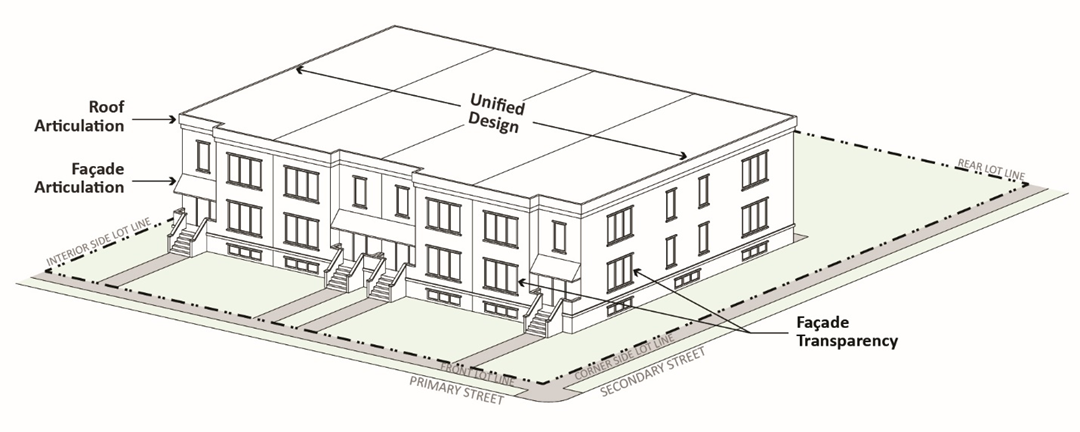
Figure 8.09-4 Building Separation Distance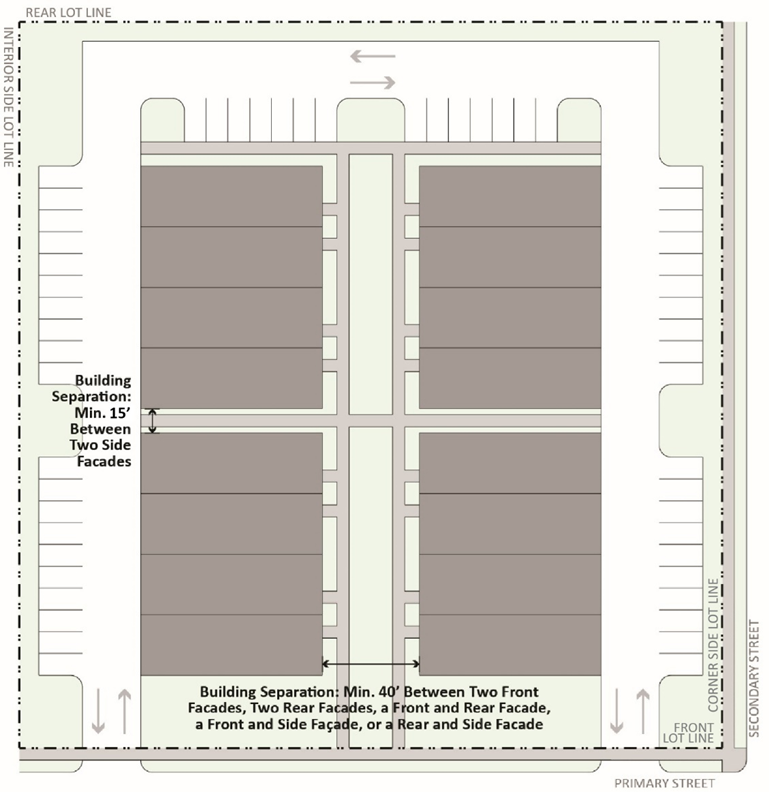
D.
Front Setback Averaging in the R2 and R3 Districts. In situations where a block contains lots with buildings that have a difference in front setbacks of 15 feet or more, then a new building or an addition to an existing building may be built to the average front setback of adjacent lots instead of the minimum front setback requirement. These setback averaging provisions may not be used to reduce the front setback to less than 20 feet. Refer to Figure 8.09-5 Setback Averaging.
1.
Lots to Be Included. The average front setback must include the four lots closest to the subject lot that are on the same side of the block as the subject lot.
2.
Lots Not to Be Included. Lots with frontage on a different street than the subject lot, or that are separated from the subject lot by a street or alley, may not be used in computing the front setback average.
3.
Vacant Lots. Vacant lots used for averaging will be deemed to have a front yard setback equal to the minimum requirement of the subject zoning district.
Figure 8.09-5 Setback Averaging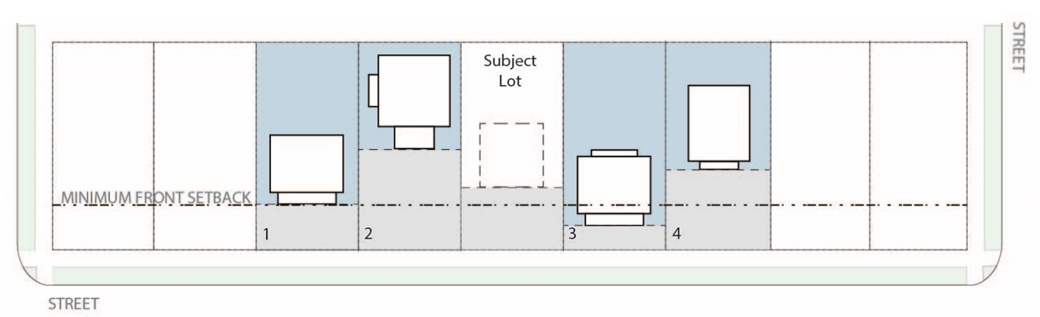
8.10 - Residential Zoning District Bulk and Setback Requirements
Table 8.10-1 Residential Zoning District Requirements and Figure 8.10-1 Residential Zoning District Requirements establish bulk and setback regulations for the R1, R2, R3, R4, and R5 Districts. See Section 9.03 (Accessory Uses and Structures) for provisions related to accessory structures.
Figure 8.10-1 Residential Zoning District Requirements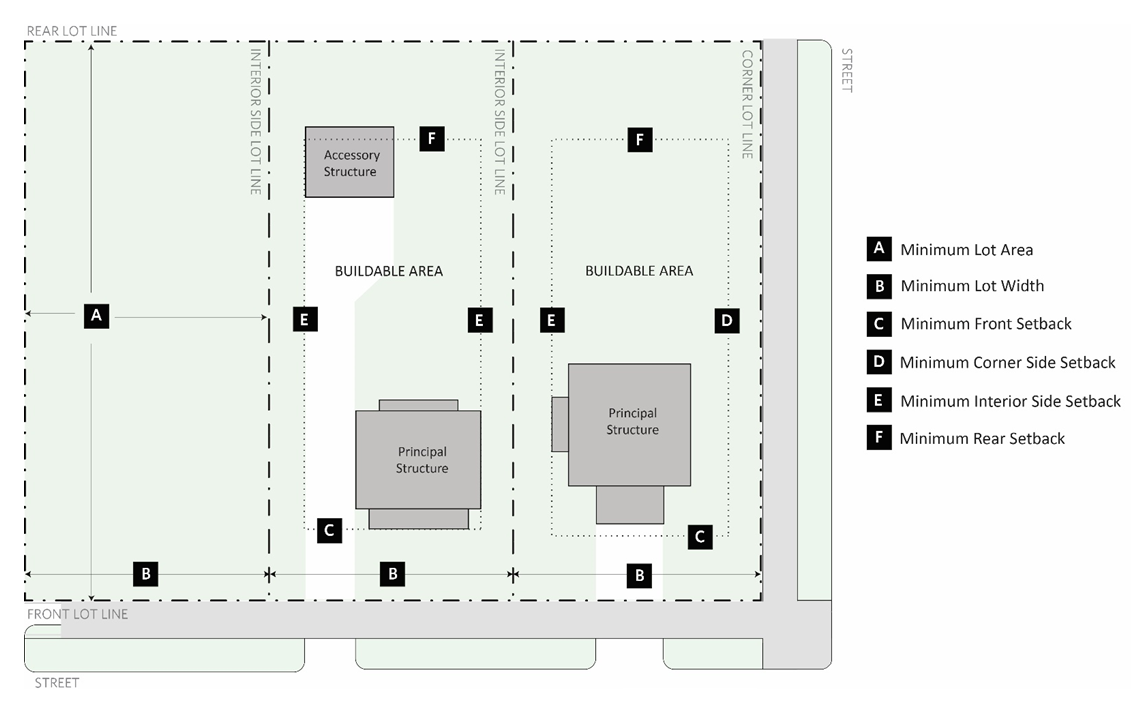
8.11 - Lakefront Zoning District Design Requirements
A.
Applicability. The design requirements in this section apply to all new construction and additions to residential dwellings, and all new construction and significant exterior renovation of existing structures for all other uses within the City's Lakefront Zoning Districts.
B.
Design requirements for Single-Unit Dwellings, Two-Unit Dwellings, Three-Unit Dwellings, and Four-Unit Dwellings must comply Section 8.09.B (Design Requirements for Single-Unit Dwellings, Two-Unit Dwellings, Three-Unit Dwellings, and Four-Unit Dwellings). Refer to Figure 8.09-1 Single-Unit Dwelling, Two-Unit Dwelling, Three-Unit Dwelling, and Four-Unit Dwelling Design Requirements and Figure 8.09-2 Anti-Monotony Façade Separation.
C.
Design requirements for Multiple-Unit Dwellings and Townhouse Dwelling Units must comply with Section 8.09.C (Design Requirements for Multiple-Unit Dwellings and Townhouse Dwelling Units). Refer to Figure 8.09-3 Multiple-Unit Dwelling and Townhouse Dwelling Unit Design Requirements.
D.
Design requirements for non-residential structures must comply with Section 8.13 (Design Requirements for Business Zoning Districts). Refer to Figure 8.13-2 Business District Design Requirements, and Figure 8.14-1 Business District Requirements.
8.12 - Lakefront Zoning Districts
Table 8.12-1 Lakefront Zoning District Requirements establish bulk and setback regulations for the L1, L2, and L3 Districts. See Section 9.03 (Accessory Uses and Structures) for provisions related to accessory structures.
8.13 - Design Requirements for Business Zoning Districts
A.
Applicability. The design requirements in this section apply to all new construction and significant exterior renovation of existing commercial, mixed-use, and multiple-unit structures within the City's B1, B2, B3, and B4 Districts. For additional design requirements specific to each business zoning district, see Section 8.14 (Business Zoning Districts: B1, B2, and B4) and Section 8.15 (Business Zoning Districts: B3, H/C, and E). For design requirements specific to dwellings above ground floor-commercial within the City's business zoning districts see Section 8.09 (Residential Zoning District Design Requirements).
B.
Design Requirements.
1.
Façade Design.
a.
Defined Base, Middle, and Top. Buildings with three or more stories must be designed with a distinct base (ground story), middle, and top. The base of the building must be defined from the upper stories by a horizontal expression line, which is a decorative, three-dimensional linear element protruding or indented at least two inches from a building façade. The top of the building must be crowned with a similar expression line six inches or greater in width. Neither the base nor the top of a building may constitute less than one story or more than one third of the building's façade.
b.
Façade Articulation. For buildings with more than 50 feet of building width or depth, vertical architectural or structural elements must be incorporated along all street-facing façades at regular intervals to divide large, flat wall planes. Examples of such elements include texture change, material change, color change, or wall articulation change, such as an offset, pilaster, column, reveal, or vertical expression line, of no less than six inches.
2.
Building Façade Materials.
a.
Allowed Materials. Durable and natural materials are allowed on any building façade, such as stone, brick, stucco, concrete, burnished concrete masonry units, fiber cement siding, and non-reflective glass, unless otherwise limited by Section 8.13.B.2.b (Limited Materials).
b.
Limited Materials. The following materials may only be utilized for trim or architectural details and may not exceed 20 percent of the total area of any building façade: utility brick, vinyl or metal siding, metal wall panels, exposed aggregate (rough finish) concrete wall panels, non-burnished concrete masonry units, exterior insulation and finishing systems, fiberglass, plastic, untreated wood, and mirrored glass.
c.
Alteration. Except for murals and public art, the painting of brick, limestone, or other natural stone is prohibited so that such materials retain their natural colors.
3.
Building Details. Pedestrian-scale elements are encouraged on any building façade fronting a public right-of-way, such as decorative lighting not more than nine feet from the ground, planters, and awnings.
4.
Roof Design. Sustainable and environmentally friendly roof designs are encouraged, including, but not limited to green roof, white roof, and blue roof designs.
5.
Parking Garage Design. Parking garages in all zoning districts must meet the requirements for façade design in accordance with Section 8.13 (Design Requirements for Business Zoning Districts).
6.
Ground Floor Uses. In the B4 District, an allowed commercial, civic, or institutional use must occupy the first 30 feet of building depth only on the ground floor of a parking garage along a minimum of 50 percent of the street-facing façade, in accordance with Figure 8.13-1 Parking Garage Setback.
Figure 8.13-1 Parking Garage Setback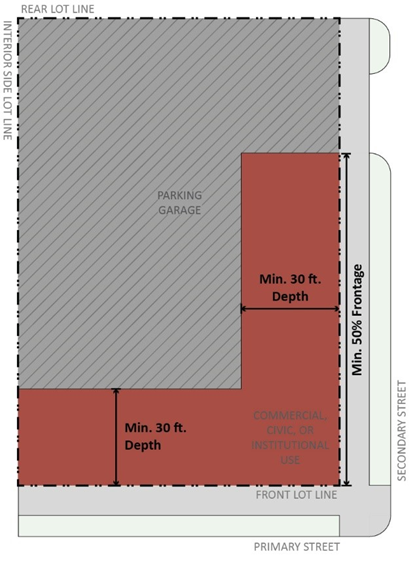
C.
Explanation of Table Requirements. The following information explains the design requirements established in Figure 8.13-2 Business District Requirements and Table 8.14-1 Business District Requirements.
1.
Minimum Street Frontage. The minimum proportion of a principal building required to be located adjacent to a right-of-way expressed as a percentage of the total length of the lot line adjacent to the right-of-way.
2.
Parking Location. The yards in which an off-street parking lot is allowed.
3.
Minimum Transparency. The amount of highly transparent, non-reflective glass required as a percentage of the total area of the street-facing ground story façades between two and eight feet above grade. Tinting of glass in excess of 20 percent is prohibited. Buildings larger than 30,000 square feet are exempt from these standards. Spandrel glass or covered windows may be substituted for transparent windows with approval from the Zoning Administrator or referral to the Development Review Board.
4.
Principal Entrance Location. The façade on which the principal building entrance must be located.
Figure 8.13-2 Business District Design Requirements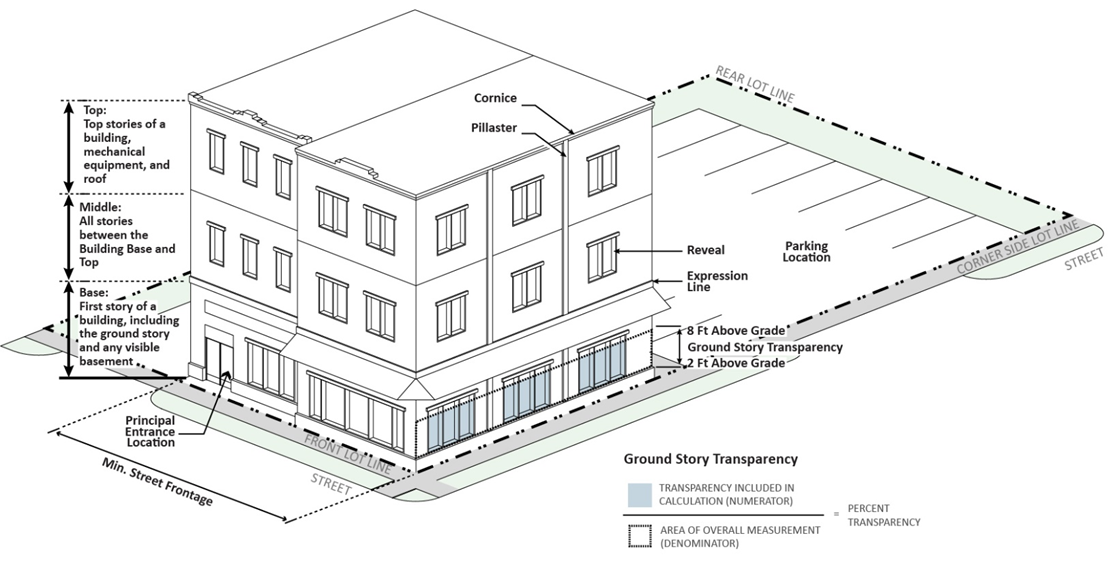
8.14 - Business Zoning Districts: B1, B2, and B4
Table 8.14-1 Business District Requirements and Figure 8.14-1 Business District Requirements establish bulk and setback regulations for the Business Districts. See Section 9.03 (Accessory Uses and Structures) for provisions related to accessory structures.
Figure 8.14-1 B1, B3, and B4 Business District Requirements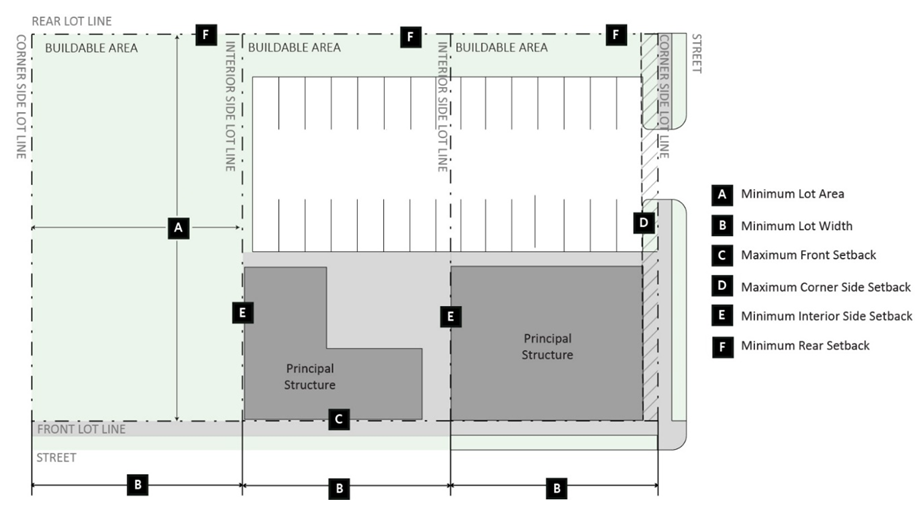
(Ord. No. 25-O-03, § 2(Exh. A), 1-6-25)
8.15 - Business Zoning Districts: B3, H/C, and E
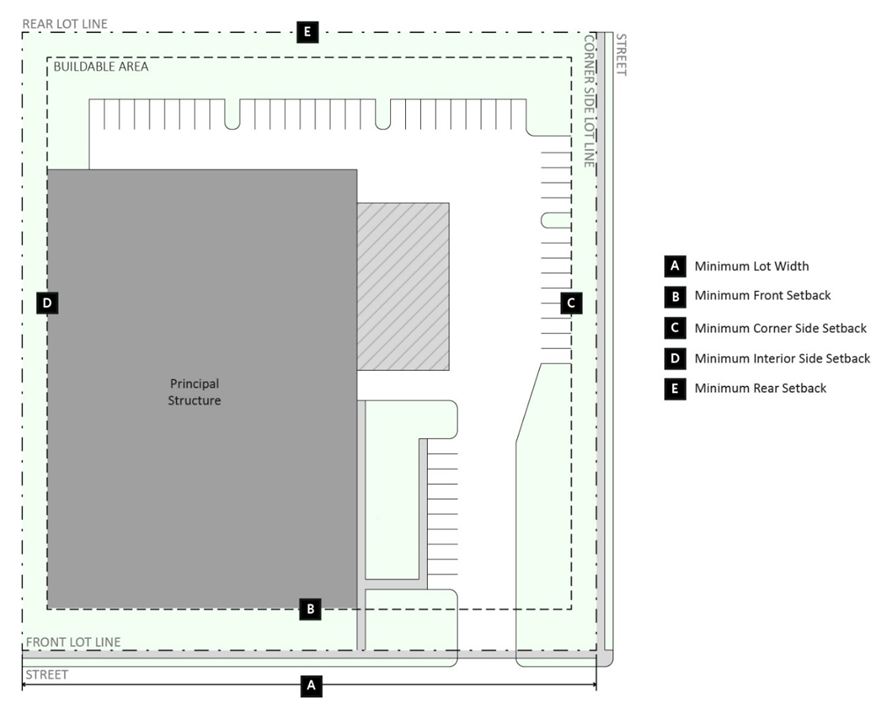
Table 8.15-1 B3, H/C, and E District Requirements and Figure 8.15-1 B3, H/C, and E District Requirements establish bulk and setback regulations for the B3, H/C, and E Districts. See Section 9.03 (Accessory Uses and Structures) for provisions related to accessory structures.
Figure 8.15-1 B3, H/C, and E District Requirements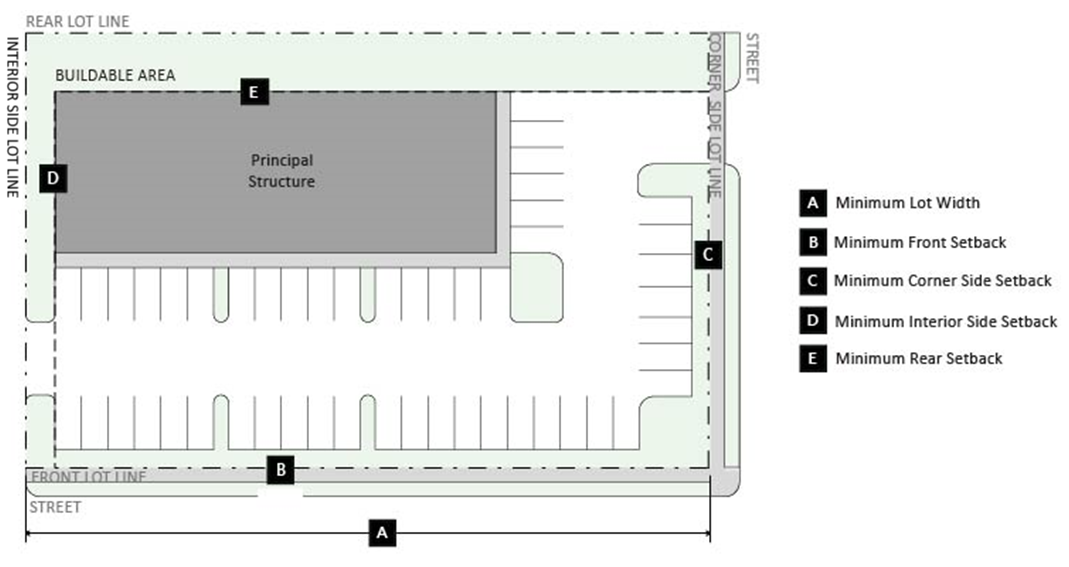
8.16 - Design Requirements for Industrial Zoning Districts
A.
Applicability. The design requirements in this section apply to all new construction and significant exterior renovation of existing structures within the City's R/LI, and I Districts. Refer to Figure 8.16-1 Industrial District Design Requirements.
B.
Design Requirements.
1.
Façade Articulation. For buildings with more than 100 feet of building width or depth, vertical architectural or structural elements must be incorporated along all street-facing façades at regular intervals no less than one third of the building's width or depth to vertically divide large, flat wall planes. Examples of such elements include texture change, material change, color change, or wall articulation change, such as an offset, pilaster, column, reveal, or vertical expression line, of no less than six inches.
2.
Building Façade Materials.
a.
Allowed Materials. Durable and natural materials are allowed on any building façade, such as stone, brick, stucco, concrete, burnished concrete masonry units, fiber cement siding, and non-reflective glass, unless otherwise limited by Section 8.16.B.2.b (Limited Materials).
b.
Limited Materials. The following materials may only be utilized for trim or architectural details and may not exceed 25 percent of the total area of any building façade: utility brick, vinyl or metal siding, metal wall panels, exposed aggregate concrete wall panels (rough finish), non-burnished concrete masonry units, exterior insulation and finishing systems, fiberglass, plastic, untreated wood, and mirrored glass. Except for murals and public art, the painting of brick, limestone, or other natural stone is prohibited so such materials retain their natural colors.
3.
Roof Design. Sustainable and environmentally friendly roof designs are encouraged, including, but not limited to green roof, white roof, and blue roof designs
4.
Parking Location. Parking areas may be located in the front, corner side, interior side, or rear yards. Parking areas located in the front or corner side yard may not be the dominant visual element of the site when viewed from a right-of-way. Parking areas of 50 parking spaces or more must be located in interior side and rear yards. See Section 10 (Off-Street Parking and Loading).
5.
Principal Entrance Location. Principal entrances must be located on the front or corner side façade.
Figure 8.16-1 Industrial District Design Requirements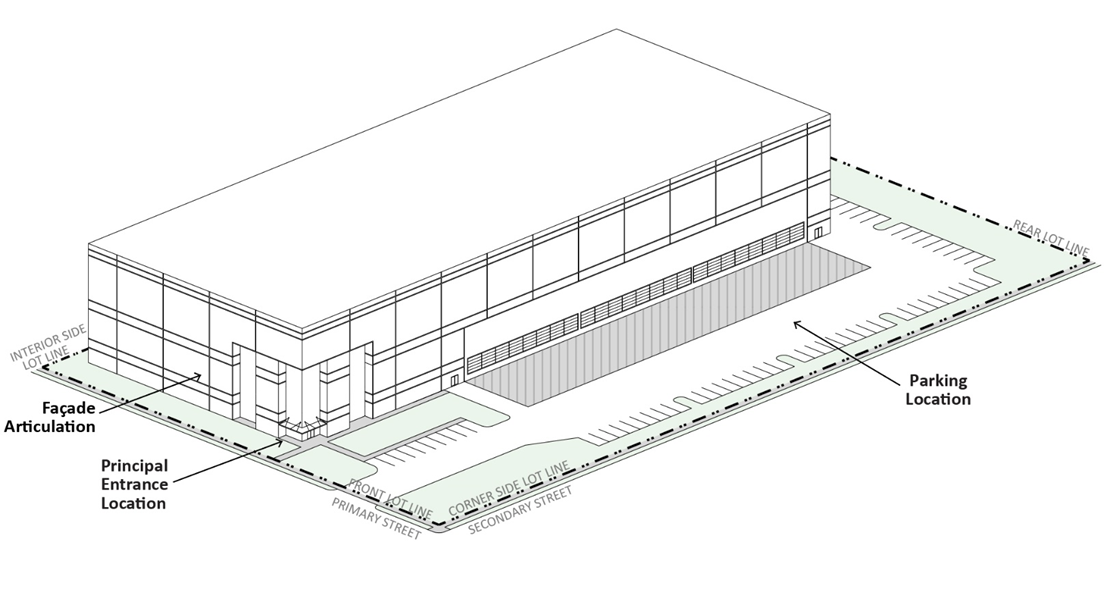
8.17 - Industrial Zoning Districts: R/LI and I
Table 8.17-1 Industrial District Requirements and Figure 8.17-1 Industrial District Requirements establish bulk and setback regulations for the R/LI and I Districts. See Section 9.03 (Accessory Uses and Structures) for provisions related to accessory structures.
Figure 8.17-1 Industrial District Requirements