
Waukegan City Zoning Code
SECTION 2
- ADMINISTRATIVE BODIES AND APPLICATION PROCEDURES
2.01 - Purpose
The purpose of this Section is to establish the jurisdiction, specific administrative duties, and responsibilities of the Zoning Administrator, Development Review Board, Planning and Zoning Commission, and City Council as they relate to this Ordinance, and establish the application, notice, and public hearing procedures for applications for relief under this Ordinance. The procedure and substantive standards applied by these bodies are described in Section 4 (Zoning Relief Approval Procedures).
2.02 - Zoning Administrator
A.
Appointment. The Zoning Administrator is a department head of the City vested with the authority to administer and enforce this Ordinance as set forth in this Section.
B.
Jurisdiction. The Zoning Administrator has the following specific duties and responsibilities pursuant to this Ordinance.
1.
Provide public information and education relative to this Ordinance.
2.
Review and determine for each zoning district all applications for approval of all non-listed uses, as established in Section 4.10 (Ordinance Interpretation).
3.
Maintain permanent and current records of this Ordinance, including, but not limited to, all maps, amendments, conditional uses, variances, appeals, and applications therefore.
4.
Forward to the Planning and Zoning Commission all applications for conditional uses, map and text amendments to this Ordinance, appeals, and variances that are initially filed with the office of the Zoning Administrator.
5.
Enforce all orders of the Planning and Zoning Commission.
6.
Issue all zoning permit approvals and zoning letters and make and maintain records thereof.
7.
Conduct inspections of buildings, structures, and uses of land to determine compliance with the terms of this Ordinance.
8.
Issue violation notices requiring compliance and advise violators of right of appeal.
9.
Require that all construction or work of any type be stopped when such work is not in compliance with this Ordinance; and revoke any permit that was unlawfully issued.
2.03 - Development Review Board
A.
Establishment and Composition. The Development Review Board is established pursuant to Division 3 of Article V of Chapter 2 of the City's Code of Ordinances and will have the membership set forth therein and in this Section 2.03 (Development Review Board).
B.
Jurisdiction. The Development Review Board has the following specific duties and responsibilities pursuant to this Ordinance.
1.
Make recommendations to the Planning and Zoning Commission for any application for a conditional use permit requiring a site plan review, refer to Section 4.08 (Conditional Uses).
2.
Review and make final decisions on applications for site plan review, refer to Section 4.09 (Site Plan Review).
3.
Review and make final decisions on applications for minor adjustments, pursuant to Section 4.05 (Minor Adjustments).
4.
Review and make final decisions on sign variances and appeals from decisions on sign permit applications.
5.
Review and make final decisions on minor subdivision applications, pursuant to Section 3.03 (Subdivision Applications).
6.
Review and make recommendations to the Planning and Zoning Commission on appeals from Zoning Administrator decisions, business licenses, and objections.
7.
Review all applications for zoning permits, building permits, and occupancy certificates involving nonconforming lots, structures, buildings, and uses where such lots, structures, buildings, and uses are not in compliance with the City's standards and cannot as a practical matter be brought into compliance with the City's standards and make all required determinations and issue all necessary certificates and permits required for the maintenance, repair, use, enlargement, amortization, or demolition of such uses and structures except that where the owner chooses to apply for the establishment of a nonconforming use as a conditional use, Section 2.03.B.1 will apply.
8.
Act as a Tree Advisory Board, Code Enforcement Board, or any other such board in the absence of a designated body, as an advisory body to the Mayor and City Council and have the duties and responsibilities designated in the City's Code of Ordinances.
(Ord. No. 25-O-03, § 2(Exh. A), 1-6-25)
2.04 - Planning and Zoning Commission
A.
Establishment and Composition. The Planning and Zoning Commission is created pursuant to Article II of Chapter 16 of the City's Code of Ordinances and will have the membership set forth therein and in this Section 2.04.
B.
Jurisdiction. The Planning and Zoning Commission has the following specific duties and responsibilities pursuant to this Ordinance.
1.
To hear and decide appeals from any order, requirement, decision, or determination made by the Zoning Administrator under this Ordinance pursuant to Section 4.06 (Appeals).
2.
To hear and make final determinations on applications for variances from the terms of this Ordinance, in the manner prescribed by the subject to the standards established herein pursuant to Section 4.04 (Variances).
3.
To hold public hearings on requests for amendments pursuant to Section 4.07 (Amendments), conditional uses pursuant to Section 4.08 (Conditional Uses), variances pursuant to Section 4.04 (Variances), and planned unit developments pursuant to Section 5 (Planned Unit Developments), prepare findings and recommendations, and submit same to the City Council.
4.
To conduct an annual review of the Ordinance and issue a report to the City Council.
5.
To hear and decide all matters referred to it or upon which it is required to opine or act under this Ordinance.
6.
To reverse, reduce, modify, or affirm, wholly, or in part, any decision brought for review and appeal.
7.
To periodically conduct a complete review of the Ordinance and the Comprehensive Plan, holding a series of public meetings thereon, and make recommendations to the City Council in the manner described in Section 2.08 (Public Hearing).
8.
To pursue other responsibilities as designated by this Ordinance or by City Council.
C.
Meetings. All meetings of the Planning and Zoning Commission required or otherwise authorized under this Ordinance will be conducted in accordance with the requirements of the Illinois Open Meetings Act (5 ILCS 120/1 et seq.). Special meetings may be called by the Chair. The Commission shall keep records of its hearings, voting, examinations, and other official actions as outlined in Section 2.08.D (Records).
D.
Rules of Procedure. The Planning and Zoning Commission will enact rules of procedure covering the procedures to be used by the commission in the discharge of its duties and responsibilities. The Commission's rules of procedure must be ratified by the City Council.
2.05 - City Council
A.
Establishment and Composition. The City Council of the City of Waukegan, hereinafter referred to as the "City Council" or "Council", as established and will be composed in accordance with Article II of Chapter 2 of the City's Code of Ordinances and the Illinois Municipal Code.
B.
Jurisdiction. The City Council has the following specific duties and responsibilities pursuant to this Ordinance.
1.
Approve or deny all proposed amendments, planned developments, and conditional uses, upon receipt of recommendations from the Planning and Zoning Commission.
2.
Approve or deny those variances referred to it by the Planning and Zoning Commission.
3.
Approve or deny those variances and site plan reviews normally under the jurisdiction of the Planning and Zoning Commission or Development Review Board when the applicant is concurrently requesting other relief over which the City Council has jurisdiction in accordance with the following provisions:
a.
All public hearings on applications for variances and site plan review conducted by the City Council must be noticed in the manner described in Section 2.07 (Notice).
b.
All public hearings on applications for variances and site plan review conducted by the City Council must be conducted in the manner described in Section 2.08 (Public Hearing).
c.
At the public hearing conducted by the City Council, the subsidiary body to which the variance or site plan review would normally be referred to will be given the opportunity to provide ask questions of applicants, witnesses, and others providing testimony, and provide comments or recommendations to the City Council.
d.
Any applications for which the City Council has reserved to itself the responsibility of reviewing and conducting the public hearing will not require a separate recommendation or decision from any subsidiary body. Such reservation by the City Council will not be considered a failure to act by any subsidiary body.
4.
Act upon the periodic report from the Planning and Zoning Commission concerning the status of the Ordinance and the Comprehensive Plan.
2.06 - Application Procedure
A.
Authorization. Any owner of property in the City, or owner of property proposed for annexation to the City in the case of annexation applications, or any individual designated by the owner of property in the City, is authorized to file an application for annexation, subdivision, floodplain development permit, site plan review, conditional use permit, variance, minor adjustment, occupancy certificate, certificate of zoning compliance, zoning map amendment, appeal, ordinance interpretation, sign permit, or temporary use permit.
B.
Pre-Application Consultation. Prior to filing an application, the applicant may be required to schedule and attend a pre-application consultation with appropriate City staff, including the Zoning Administrator and any other appropriate City representatives, which may include the Building Commissioner, Fire Marshal, City Engineer, and Planners, to discuss the proposed project. At the pre-application consultation, the Zoning Administrator will provide the applicant with guidance on the application procedure. The Zoning Administrator may direct the applicant to correct any existing violations of any City Code or other code, law, or regulation on the subject property prior to filing an application. Additional such meetings may be required prior to filing an application.
C.
Filing. All applications must be filed in-person at a scheduled submittal meeting with the Zoning Administrator on forms provided by the City. Applications must be filed in such number as requested by the City, with plans at a scale that is sufficient to allow a clear understanding of the proposal, and with all of the elements required by the application form. Mailed, delivered, or dropped off applications will not be accepted.
D.
Fees. Every application must be accompanied by the required filing fee set forth in the fee and fine schedule. Fees may be modified from time to time and will be reflected on the fee and fine schedule. The City is not required to process any application for relief under this Ordinance until the application fee has been paid in full and any required cost recovery deposit has been provided. Applications initiated by the City staff, Planning and Zoning Commission, or the City Council are exempt from fees.
E.
Acceptance of a Completed Application. The Zoning Administrator determines whether an application is complete and accurate during a mandatory submittal meeting with the applicant. After determining that an application is complete and accurate, the application is scheduled for consideration by the appropriate board, commission, or official. If the Zoning Administrator determines that an application is deficient, processing of the application will cease until the deficiencies are rectified by the applicant. An application is not considered filed until the Zoning Administrator determines the application is complete and accurate.
F.
Failure to Act. The failure to issue a decision or make a recommendation on any application within the applicable period specified in this Ordinance, whether by the Zoning Administrator, Development Review Board, Planning and Zoning Commission, or City Council is deemed denial of or a recommendation to deny the application.
G.
Withdrawal of Application. An applicant has the right to withdraw an application at any time prior to the final decision on the application by the City Council, Planning and Zoning Commission, or Zoning Administrator. The return of application fees for withdrawn applications are subject to the recoverable costs, cost recovery deposit payment, and cost recovery escrow standards established in Section 1.06A.3 (Cost Recovery). However, application fees are non-refundable after mailed notices have been prepared by the City. Unexpended cost recovery deposits will be returned to the applicant.
H.
Successive Application. No application that has been denied in whole or in part, may be resubmitted for a period of one year from the date of said order of denial, except if substantial new information has become known since the denial. A successive application filed within one year of the date of denial must include detailed information that justifies its consideration. The Zoning Administrator determines whether a successive application is appropriate for submittal.
I.
Period of Validity. In any case where an application for relief has been approved, but any occupancy certificate or building permit has not been applied for within one year from the date of granting thereof, then, without further action by the original approving body, the use or authorization is null and void.
J.
Public Examination of Application. Applications for relief under this Ordinance are considered public records and subject to review and disclosure pursuant to the Illinois Freedom of Information Act (5 ILCS 140/1 et seq.). Any person may examine any application and any of the supporting materials, subject to the requirements and exemptions set forth in the Illinois Freedom of Information Act. Upon reasonable request, any person may receive electronic copies of the application and related documents. Applicants seeking to exempt proprietary and confidential information included in their applications, the disclosure of which would cause competitive harm, should clearly mark all such material as "proprietary and confidential" prior to submitting them to the City.
2.07 - Notice
The administrative body conducting a hearing or making a decision will not hear or review an application unless the applicant complies with the notice requirements of this Section. Figure 2.07-1 Types of Required Notice indicates the types of notice required prior to public hearings or decisions on each of the applications.
A.
Published Notice.
1.
Applicability. Notices of public hearings for applications under this Ordinance will be published in the manner set forth in this Subsection (A). Notices of public meetings for applications under this Ordinance that do not require a public hearing shall be published as required by the Illinois Open Meetings Act (5 ILCS 120/1 et seq.)
2.
Timing. Published notice must be provided in one or more newspapers of general circulation within the City no later than 15 days or earlier than 30 days before the public hearing on the application for relief.
3.
Content. All notices of public hearings pursuant to this section must include the date, time, location, and purpose of the hearing, the name of the body holding the hearing, the name of the applicant, the address and property identification number of the subject property, and the nature of the relief sought.
4.
Proof of Notice. A certificate or affidavit of publication of the published notice will be maintained by City staff in the application file.
B.
Mailed or Hand Delivered Notices.
1.
Applicability; Notice to Neighboring Properties.
a.
Site Plan Reviews and Appeals. City staff will provide mailed notice to all owners of property located within 250 feet of any lot line of the subject property. The width of any public right-of-way will not be counted when measuring the 250-foot distance. The requirements of this Section do not prohibit the City from providing supplemental notice to owners of properties located more than 250 feet from the property line of the subject property as the Zoning Administrator may deem appropriate. See Figure 2.07-2 Notice to Neighboring Properties: 250 Feet. The identities and addresses of owners of property entitled to receive notice will be determined based on current real estate tax records maintained by Lake County available through the County's website. Provision of notice to the taxpayer of record will be deemed sufficient notice for the purpose of mailed notices. The Zoning Administrator will retain documentation stating that notice was provided to each property that states the names, addresses, and property identification numbers of all notice recipients.
b.
Map Amendments, Annexations, Preliminary and Final Plats of Subdivision, Variances, Planned Developments, and Conditional Uses. City staff will provide notice by certified mail to all owners (as determined from current real estate tax records) within 250 feet of any lot line of the subject property. The area occupied by any public right-of-way is not included as part of this requirement. The requirements of this Section do not prevent the City from providing additional notice to properties located more than 250 feet from the property line of the subject property as the Zoning Administrator may deem appropriate. See Figure 2.07-2 Notice to Neighboring Properties: 250 feet. The Zoning Administrator will retain documentation stating that notice was provided to each property that states the names, addresses, and property identification numbers of all notice recipients.
c.
Minor Adjustments. Mailed or delivered notice must be provided by the City to the owners of all properties located adjacent to and across the street from the subject property. The Zoning Administrator must prepare an affidavit stating that notice was provided to each property that states the names, addresses, and property identification numbers of all notice recipients. The Zoning Administrator will retain documentation stating that notice was provided to each property that states the names, addresses, and property identification numbers of all notice recipients.
2.
Time Frame. All notices of public hearings pursuant to this section must be either mailed or hand delivered no later than 15 days or earlier than 30 days before the public hearing on the application for relief.
3.
Contents. All notices of public hearings pursuant to this section must include the date, time, location, and purpose of the hearing, the name of the body holding the hearing, the name of the applicant, the address and property identification number of the subject property, and the nature of the relief sought.
4.
Proof of Notice. Affidavits of mailing or delivery, along with certified mail receipts will be maintained by City staff in the application file.
Figure 2.07-2 Notice to Neighboring Properties: 250 Feet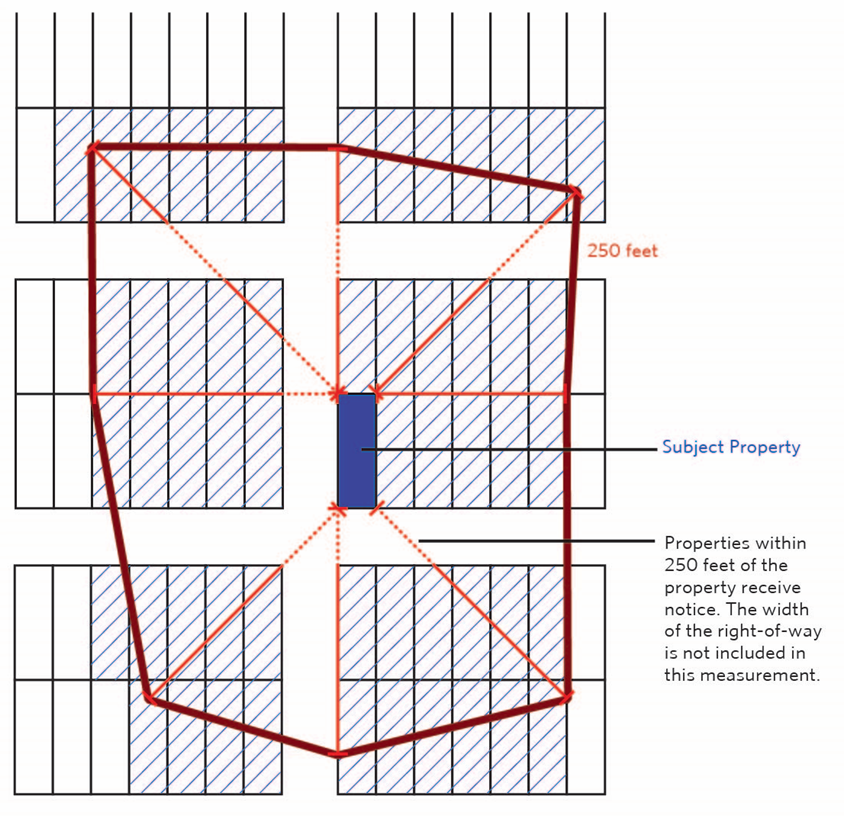
C.
Posted Sign Notice.
1.
Applicability. For applications requiring notice to be posted on the subject property, the City will provide the applicant with a sign to post notice of a public hearing on the subject property.
2.
Timing. The notice sign must be posted no earlier than 30 days and no later than 15 days before the public hearing and must remain in place until the conclusion of the public hearing.
3.
Location. Applicants must post the notice sign on a location on the subject property that is visible from the right-of-way and allows the notice sign to be legible to persons on the right-of-way. Corner and through lots will be required to post a sign notice on each frontage of the subject property.
4.
Proof of Notice. Applicant must provide the City with photographic evidence that the notice sign has been posted on the property and an affidavit that the sign was maintained in that location throughout the entire required notice period.
5.
Contents. All posted notices of public hearings pursuant to this section must include the date, time, location, and purpose of the hearing, the name of the body holding the hearing, the name of the applicant, the address and property identification number of the subject property, and the nature of the relief sought.
6.
Requirement Modifications. The Zoning Administrator may modify the posted sign notice requirements when these requirements are found to be inappropriate or ineffective in providing the intended notice due to the location, configuration, or conditions on the subject property. Modifications to the posted sign notice may include content, quantity, and location.
2.08 - Public Hearing
A.
Call for Public Hearings. All public hearings are held at the call of the Chair or designated officer of the body designated by this Ordinance to conduct the hearing and are open to the public. The public hearing is held in accordance with procedures of the hearing body and in accordance with the requirements of the Illinois Municipal Code (65 ILCS 5/1 et seq.). The applicant or their representative must attend the hearing. Notice of the public hearing will be provided as required by Section 2.07 (Notice) of this Ordinance.
B.
Testimony. Any person who attends a public hearing may appear and present testimony and evidence regarding an application. All testimony must be given under oath or by affirmation. The Chair of the hearing body, or in their absence, the acting Chair, may administer oaths and compel the attendance of witnesses.
1.
The hearing body may take judicial notice of facts to the same extent and in the same manner as courts of record and may consider any relevant facts within the personal knowledge of any member of the body which are stated into the records by such member.
2.
The applicant or appellant, as the case may be, must bear the burden of presenting the evidence and testimony to establish conclusively that the requested relief will conform to all applicable laws and regulations other than that for which relief is sought.
3.
All exhibits containing plans and specifications for the proposed use, structure, building, site element, or property condition must remain part of the permanent records of the hearing body.
C.
Voting. The hearing body must keep minutes of its proceedings that show the vote of each member of the hearing body upon each application, or whether the member was absent, or failed to vote. The necessary vote to approve or recommend approval must be as set forth in this Ordinance or in the City's Code of Ordinances.
D.
Records. The hearing body will keep records of its hearings, and evaluation standards will be included in the minutes of each application specifying the reasons for the hearing body's decision. The hearing body will keep minutes of its proceedings showing the vote of each member upon every question, or if absent or failing to vote, indicating that fact. Every rule, regulation, amendment, or repeal thereof, and every order, requirement, decision, or determination of the hearing body pursuant to this Ordinance will immediately be filed in the office of the City Clerk and be a public record. Transcripts of hearings will only be prepared and provided at the request of, and at the sole cost and expense of, an applicant.
E.
Rules of Procedure. A hearing body's rules of procedure may not conflict with this Ordinance or with state statutes.

