
Waukegan City Zoning Code
SECTION 6
- NONCONFORMITIES
6.01 - Purpose
The purpose of this Section is to regulate uses, structures, lots, and site elements that were constructed and maintained in compliance with previously adopted development regulations, but do not conform to the standards and requirements of this Ordinance. The intent of this Section is to specify the circumstances under which legal nonconforming uses, structures, lots, and site elements may be maintained, altered, or expanded, as well as circumstances under which such nonconformities must be gradually eliminated.
6.02 - Applicability
A.
Authority to Continue.
1.
Any use, structure, lot, or site element that was established legally or is substantially underway prior to the effective date of this Ordinance, or its subsequent amendments, may continue as long as it remains otherwise lawful.
2.
Any use, structure, lot, or site element that was established legally prior to the effective date of this Ordinance, or its subsequent amendments, and has been rendered nonconforming due to the regulations of this Ordinance, or its subsequent amendments, is a legal nonconforming use, structure, lot, or site element and may be maintained subject to the provisions of this Section as long as it remains otherwise lawful.
3.
Any use, structure, lot, or site element that was established illegally prior to the effective date of this Ordinance, or its subsequent amendments, will remain illegal if it is not brought into conformance with the requirements of this Ordinance.
B.
Nonconforming Status. The legal nonconforming status of a nonconforming use, structure, lot, or site element runs with the property and is not affected by changes in property ownership, tenancy, or management.
C.
Burden of Establishing Legal Status. The burden of establishing the legal status of a nonconforming use, structure, lot, or site element under the provisions of this Ordinance is the responsibility of the owner or operator of such use, structure, lot, or site element.
6.03 - Nonconforming Uses
A.
Applicability. A legal nonconforming use is the use of land that conformed to applicable development regulations when the use was established, but no longer conforms after the effective date of this Ordinance or its subsequent amendments.
B.
Expansion within an existing structure. A legal nonconforming use may be extended throughout the building or structure in which the use is presently located, so long as no changes or structural alterations are made to the existing building or structure.
C.
Expansion of use. A legal nonconforming use may not be expanded, enlarged, or increased in intensity to include any land area or separate structure not previously occupied by such legal nonconforming use, except as permitted in Section 6.04.C (Structural Alterations).
D.
Relocation. A legal nonconforming use may not be relocated on the same lot or any other lot unless the relocation of such use meets the requirements of the zoning district in which the use is relocated.
E.
Change of Use. A legal nonconforming use must not be changed to any other use unless the new use is allowed as a permitted or conditional use within the zoning district in which the use is located. See Table 9.02-1 (Principal Uses and Structures).
F.
Discontinuation or Abandonment. If a legal nonconforming use is discontinued, or the structure that it occupies becomes vacant or remains unoccupied for a period of six consecutive months, such use is deemed abandoned and may not be reestablished regardless of the intent to continue the use, except that the six-month consecutive period may be extended by the Development Review Board pursuant to Section 2.03 (Development Review Board). Any period of discontinuance or abandonment caused by a government action or an act of nature is not included in the six-month period but requires verification of the Zoning Administrator. Any subsequent use or occupancy of such land or structure must meet the requirements of the zoning district in which the use is located.
G.
Uses Accessory to Discontinued or Abandoned Nonconforming Use. A nonconforming use of land, which is accessory to the nonconforming use of building or structure, shall be discontinued on the same date of the nonconforming use of the building or structure is discontinued.
H.
Remediation of Nonconformity Required. Before a new Occupancy Certificate can be issued for a site including a nonconforming use, structure, or lot, all structures and site elements on the premises must be brought into compliance with City's Code of Ordinances, including the removal and abatement of any solid waste or other nuisance conditions, and a No Further Remediation Letter for the site must be provided to the Zoning Administrator and Building Commissioner.
(Ord. No. 25-O-03, § 2(Exh. A), 1-6-25)
6.04 - Nonconforming Structures
A.
Applicability. A legal nonconforming structure is a principal or accessory structure that at one time conformed to applicable development regulations when constructed, but no longer conforms after the effective date of this Ordinance or its subsequent amendments.
B.
Ordinary Maintenance and Repair. Ordinary maintenance and repair may be performed on any legal nonconforming structure provided that such activities will not create any new nonconformity or increase the extent of any existing nonconformity.
C.
Structural Alterations, Enlargements, and Additions. Structural alterations, enlargements, and additions may not be performed on any legal nonconforming structure, except in the following situations:
1.
When the alteration, enlargement, or addition is required by law or is necessary to restore the structure to a safe condition upon the order of the Building Commissioner, Fire Marshal or a court of competent jurisdiction.
2.
When the alteration, enlargement, or addition is for the purpose of creating a conforming structure.
3.
When the alteration, enlargement, or addition will not create any new nonconformity or increase the extent of any existing nonconformity.
4.
When the alteration, enlargement, or addition extends the existing perimeter walls of a structure in a residential district with nonconforming setbacks provided that the resulting structure will not create any new nonconformity or increase the extent of any existing nonconformity. Refer to Figure 6.04-1 Extension of Nonconforming Perimeter Walls.
5.
When the alteration, enlargement, or addition includes a sustainable accessory structure, such as a rainwater cistern, small wind energy system, or solar energy collection system in a manner approved by the Building Commissioner or Zoning Administrator.
6.
When the alteration, enlargement, or addition provides exterior lighting compliant with the requirements of this Ordinance.
Figure 6.04-1 Extension of Nonconforming Perimeter Walls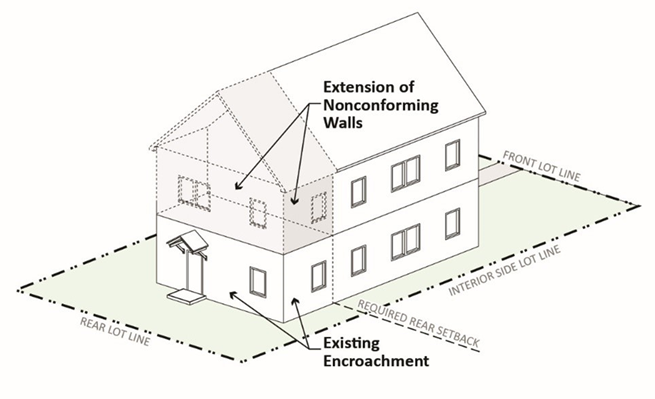
D.
Relocation. A legal nonconforming structure may not be relocated on the same lot or any other lot unless the relocation of such structure meets the requirements of the zoning district to which the structure is relocated.
E.
Damage or Destruction.
1.
If a legal nonconforming structure is damaged or destroyed to the extent of 50 percent or more of its replacement value, then the structure may not be repaired or reconstructed unless the repaired or reconstructed structure meets the requirements of the zoning district in which the structure is located.
2.
If a legal nonconforming structure is damaged or destroyed to the extent of less than 50 percent of its replacement value, the structure may be repaired or reconstructed provided that:
a.
The repairs will not create any new nonconformity or increase the extent of any existing nonconformity.
b.
A building permit is obtained for such repairs no later than six months after the date of damage or destruction, and the repairs are completed within one year of issuance of the building permit or other extension period granted by the Building Commissioner.
3.
The replacement value of the legal nonconforming structure may be established by one of the following methods:
a.
The sale of the structure within the previous year.
b.
An appraisal of the structure within the last two years.
c.
The amount for which the structure was insured prior to the date of damage or destruction.
d.
An alternative method determined acceptable by the Building Commissioner.
4.
If a building permit has not been obtained within six months after the date of damage or destruction, or construction started no later than one year after that date, the owner may apply for a conditional use permit to repair or reconstruct the nonconforming structure subject to Section 4.08 (Conditional Uses).
6.05 - Nonconforming Lots of Record
A.
Applicability. A legal nonconforming lot of record is a lot of record that conformed to applicable development regulations when it was platted or established, but no longer conforms after the effective date of this ordinance or its subsequent amendments.
B.
Contiguous Nonconforming Lots of Record. If two or more contiguous lots of record are owned by a single party, or by related parties, and one or more of the lots does not meet the requirements for lot area or lot width as established by this Ordinance, then the lots of record may only be developed as a single zoning lot. A building permit will not be issued for the development of contiguous nonconforming lots of record in violation of this Section.
C.
Individual Nonconforming Lots of Record in Residential Districts. A legal nonconforming lot of record may only be developed if the principal structure meets all of the bulk and setback requirements of the zoning district in which it is located and that the owner of that lot of record, or a related party, does not own any lots of record that are contiguous to the subject lot of record.
6.06 - Nonconforming Site Elements
A.
Applicability. A legal nonconforming site element is a physical condition on the property that conformed to applicable development regulations when it was constructed or installed, but no longer conforms after the effective date of this Ordinance or its subsequent amendments. For the purposes of this section, legal nonconforming site elements include impervious site coverage, off-street parking and loading, landscaping, lighting, signs, or other similar conditions on a property that are not a building or structure.
B.
Ordinary Maintenance and Repair. Ordinary maintenance and repair may be performed on any legal nonconforming site element provided that such activities will not create any new nonconformity or increase the extent of any existing nonconformity.
C.
Sign Face Alteration or Replacement. If the sign face of a nonconforming sign is altered or replaced, the sign must be removed, relocated, or brought into compliance under Section 12 (Signs).
D.
Relocation. A legal nonconforming site element may not be relocated on the same lot or any other lot unless the relocation of such site element meets the requirements of the zoning district in which the site element is relocated.
E.
Damage or Destruction.
1.
If a legal nonconforming site element is damaged or destroyed to the extent of 50 percent or more of its replacement value, then the site element may not be repaired or reconstructed unless it meets the requirements of the zoning district in which the site element is located.
2.
If a legal nonconforming site element is damaged or destroyed to the extent of less than 50 percent of its replacement value, the site element may be repaired or reconstructed provided that:
a.
The repairs will not create any new nonconformity or increase the extent of any existing nonconformity.
b.
A building permit is obtained for such repairs no later than six months after the date of damage or destruction, and such repairs are completed within one year of issuance of the building permit or other extension period granted by the Building Commissioner.
3.
The replacement value of the legal nonconforming site element may be established by one of the following methods:
a.
Two estimates of the cost of replacement of the site element by independent contractors.
b.
The amount for which the site element was insured prior to the date of damage or destruction.
c.
An alternative method determined acceptable by the Building Commissioner.
F.
Discontinuation or Abandonment of Nonconforming Signs. A legal nonconforming sign may not remain in use if the property on which the sign is located is vacant and unoccupied for a period of six months or more.
G.
Discontinued or Abandoned Nonconforming Sign Removal. Discontinued or abandoned nonconforming signs established under Section 6.06.E. must be removed by the owner. Removal must include the sign face, supporting structure, and structural trim.

