
Wauwatosa City Zoning Code
CHAPTER 24
10 ACCESSORY AND TEMPORARY USES
24.10.010 Accessory Uses Generally
- Allowed. Accessory uses and structures are permitted in connection with lawfully established principal uses unless otherwise expressly stated.
- Applicable Regulations. Unless otherwise expressly stated, accessory uses and structures are subject to the same regulations and standards as apply to principal uses and structures on the subject parcel.
- Incidental and Subordinate Nature. The zoning administrator is authorized to determine when a use, building or structure meets the definition of an accessory use or accessory structure. In order to classify a use or structure as "accessory," the zoning administrator must determine that the use or structure:
- is subordinate to the principal building or principal use in terms of area and/or function;
- contributes to the comfort, convenience or necessity of occupants of the principal building or principal use served; and
- is customarily found in association with the subject principal use or principal building.
- Time of Construction and Establishment.
- Accessory buildings must be constructed in conjunction with or after the principal building. They may not be constructed or installed before the principal building.
- Accessory uses may be established only after the principal use of the property is established.
- Location. Accessory uses and structures must be located on the same parcel as the principal use to which they are accessory, except as otherwise expressly stated.
24.10.020 Home Occupations
- General. Home occupations are allowed as accessory uses to principal uses in the household living category.
- Purpose. The regulations of this section are primarily intended to ensure that home occupations in R zoning districts will not adversely affect the character and livability of the surrounding residential neighborhood. The regulations are also intended to ensure that the home occupation remains subordinate to the residential use and that the residential viability of the dwelling is maintained. The regulations recognize that many types of work can be done in a home with little or no effect on the surrounding neighborhood.
- Applicability. Home occupations must comply with all of the standards of this section.
- Exemptions. Uses listed in the use table of Section 24.07.030 (e.g., home-based day cares and bed & breakfasts) are not regulated as home occupations and are exempt from the regulations of this section.
- Standards. A dwelling unit may be used for one or more home occupations subject to compliance with all of the following minimum standards:
- The home occupation must be accessory and secondary to the use of a dwelling unit for residential purposes, and the home occupation may not change the residential character of the residential building or adversely affect the character of the surrounding neighborhood. Home occupations may not, for example, produce light, noise, vibration, odor, parking demand, traffic or any exterior activity that is inconsistent with the character of a residential neighborhood in Wauwatosa.
- There may be no external structural alterations or construction that would change the residential character of the property upon which the home occupation is located. Examples of such prohibited alterations include construction of parking lots, paving of required setbacks and the addition of commercial-like exterior lighting.
- No separate entrance to the building may be added to the residential building for the home occupation unless the entrance is not visible from any public street.
- The home occupation and all related activities, including storage (other than the lawful parking or storage of vehicles), must be conducted entirely within a completely enclosed building, either the principal residential building or an allowed accessory building (e.g., detached garage).
- Residential accessory uses conducted within garages may not take up space that provides space for meeting minimum off-street parking requirements.
- No window display or other public display of any material or merchandise is allowed.
- The owner of the home occupation must reside in the dwelling unit in which the home occupation is located.
- In addition to the resident property owner, up to 2 nonresident persons, including employees, associates and customers may be present on the property at any time. This 3-person maximum limit per property applies regardless of the number of home occupations being conducted on the property.
- Truck deliveries or pick-ups of supplies or products, associated with the home occupation, are allowed at the site of the home occupation only between 8:00 a.m. and 7:00 p.m. Vehicles used for delivery and pick-up may not include semi-tractor trailers.
- The following uses are expressly prohibited as home occupations:
- any type of repair or assembly of vehicles or equipment with internal combustion engines (such as autos, motorcycles, scooters, snowmobiles, outboard marine engines, lawn mowers, chain saws and other small engines) or of large appliances (such as washing machines, dryers and refrigerators) or any other work related to automobiles and their parts;
- dispatch centers or other businesses where employees come to the site and are dispatched to other locations;
- rental businesses;
- tow truck services;
- material or equipment storage businesses;
- restaurants;
- funeral or interment services; and
- animal boarding businesses.
24.10.030 Accessory Solar Energy Systems
- General.
- Accessory solar energy systems are allowed in all zoning districts. See also Section 66.0401 of the Wisconsin Statutes.
- Accessory solar energy systems must comply with all applicable building ordinance and electrical code requirements.
- Owners of accessory solar energy systems are solely responsible for negotiating with other property owners for any desired solar easements to protect access to sunlight. Any such easements must be recorded with the register of deeds.
- Building-Mounted Solar Energy Systems.
- Building-mounted solar energy systems may be mounted on principal and accessory structures.
- All applicable setback regulations apply to building-mounted solar energy systems. Systems mounted on principal structures may encroach into interior side and rear setbacks in accordance with Section 24.18.030F.
- Only building-integrated and/or flush-mounted solar energy system may be installed on street-facing building elevations.
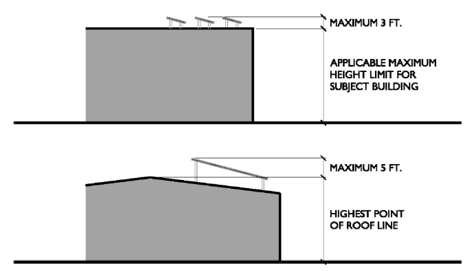
- In residential zoning districts, solar energy systems may not extend more than 3 feet above the applicable maximum building height limit for the subject building type or more than 5 feet above the highest point of the roof line, whichever is less. In nonresidential zoning districts, solar energy systems may not extend more than 8 feet above the applicable maximum building height limit.
- Ground-Mounted Solar Energy Systems.
- In R zoning districts, ground-mounted solar energy systems may not be located in a (front or corner side) street yard.
- Ground-mounted solar energy systems are subject to applicable accessory building setback regulations.
- Ground-mounted solar energy systems are subject to applicable accessory building height regulations.
24.10.040 Electric Vehicle Charging Stations
- General.
- Private (restricted-access) EV charging stations are permitted as accessory uses in all zoning districts.
- Public EV charging stations are permitted as accessory uses to allowed nonresidential uses in all zoning districts.
- Parking.
- Electric vehicle charging stations may be counted toward satisfying minimum residential off-street parking space requirements.
- Public electric vehicle charging stations must be reserved for parking and charging electric vehicles only. Electric vehicles may be parked in any space designated for public parking, subject to the restrictions that apply to any other vehicle.
- Multi-unit Residential. Multi-unit developments may qualify for a reduction in the total number of required parking spaces where EV capable spaces are provided. The Zoning Administrator may approve a reduction in required parking proportional to the number of EV capable spaces provided, not to exceed ten percent of the total parking requirement. To qualify for a reduction, the development must meet the following criteria:
- The parking area includes forty or more spaces, and
- At least five percent of the total provided spaces are EV capable, up to a maximum of six EV capable spaces.
- Equipment. Vehicle charging equipment must be designed and located so as to not impede pedestrian, bicycle or wheelchair movement or create safety hazards on sidewalks.
- Usage Fees. Property owners are not restricted from collecting a service fee for the use of an electric vehicle charging station.
- Posted Information.
- Information must be posted identifying voltage and amperage levels and any type of use, fees, or safety information related to the electric vehicle charging station.
- Public electric vehicle charging stations must be posted with signage indicating that the space is reserved for electric vehicle charging purposes only. For purposes of this provision, "charging" means that an electric vehicle is parked at an electric vehicle charging station and is connected to the battery charging station equipment.
- Maintenance. Electric vehicle charging stations must be maintained in all respects, including the functioning of the equipment. A phone number or other current contact information must be provided on the equipment for reporting when it is not functioning or other problems are encountered.
HISTORY
Repealed & Reenacted by Ord. O-25-25 on 11/18/2025
Repealed & Reenacted by Ord. O-25-25 on 11/18/2025
24.10.050 Small Wind Energy Systems
- Rooftop-mounted Systems.
- Where Allowed. Rooftop-mounted small wind energy systems are allowed as an accessory use in all zoning districts subject to compliance with the following regulations. See also Section 66.0401 of the Wisconsin Statutes.
- Regulations. All rooftop-mounted small wind energy systems are subject to the following regulations:
- In residential districts, a maximum of one rooftop mounted small wind energy system is allowed per lot.
- Rooftop mounted small wind energy system may not exceed 15 feet in height above the highest point of the structure to which it is attached. Roof-mounted small wind energy systems must comply with applicable FAA regulations, including any necessary approvals for installations close to airports.
- Small wind energy systems may not exceed a noise level of 60 dBA, as measured at the owner's property line. The level, however, may be exceeded during short-term events, such as utility outages and severe wind storms.
- No rooftop-mounted small wind energy system may be installed until evidence has been given that the utility company has been informed of the customer's intent to install an interconnected customer-owned energy generator. Off-grid systems are exempt from this requirement.
- Building permit applications for rooftop-mounted small wind energy systems must be accompanied by standard drawings of the wind turbine structure, including the tower and base. An engineering analysis of the system showing compliance with the building ordinance and certified by a Wisconsin-licensed design professional must be submitted. This analysis is frequently supplied by the manufacturer. A valid first generation seal is required.
- Ground-mounted Systems.
- Where Allowed. Ground-mounted small wind energy systems are allowed as an accessory use in all zoning districts subject to compliance with the following regulations. See also Section 66.0401 of the Wisconsin Statutes.
- Regulations. All ground-mounted small wind energy systems are subject to the following regulations:
- No more than one ground-mounted small wind energy system is permitted per lot.
- All ground-mounted small wind energy systems must be set back from all property lines a distance equivalent to at least 110% of the total system height.
- The blade tip of any rotor must, at its lowest point, have ground clearance of at least 15 feet.
- All climbing apparatus must be located at least 15 feet above the ground, and the tower must be designed to prevent climbing within the first 15 feet from the top of foundation.
- Building permit applications for ground-mounted small wind energy systems must be accompanied by standard drawings of the wind turbine structure, including the tower, base and footings. An engineering analysis of the system showing compliance with the building ordinance and certified by Wisconsin-licensed design professional must be submitted. This analysis is frequently supplied by the manufacturer. A valid first generation seal is required.
- Tower structure lighting is prohibited unless required by the Federal Aviation Administration or appropriate authority.
- Ground-mounted small wind energy systems must comply with applicable FAA regulations, including any necessary approvals for installations close to airports.
- Ground-mounted small wind energy systems may not exceed a noise level of 60 dba, as measured at the owner's property line. The level, however, may be exceeded during short-term events, such as utility outages and severe wind storms.
- No ground-mounted small wind energy system may be installed until evidence has been given that the utility company has been informed of the customer's intent to install an interconnected customer-owned generator. Off-grid systems are exempt from this requirement.
24.10.060 Satellite Dish Antennas
- Satellite dish antennas up to one meter (39.4 inches) in diameter are permitted as accessory uses in all districts. They are subject to accessory building/structure setback standards.
- Satellite dish antennas over one meter in diameter, up to 3 meters (118.2 inches) in diameter, are permitted as accessory uses in all nonresidential districts, subject to accessory building/structure setback standards.
- Satellite dish antennas may be erected on the roof or attached to a principal building, provided the maximum height of the installation does not exceed the maximum allowable height of the subject district or more than 15 feet above the top of the building on which it is to be located, whichever is less.
- Federal Law. The wireless communication facility regulations of this section must be applied with the constraints of the Telecommunications Act of 1996 and Section 6409 of the Middle Class Tax Relief and Job Creation Act of 2012.
24.10.075 Accessory Dwelling Units (ADUs)
- Purpose.
- The accessory dwelling unit regulations of this section are intended to help promote the benefits of accessory dwelling units, while also preserving neighborhood character and promoting predictability and certainty for established neighborhoods.
- Accessory dwelling units ("ADU") help advance the city's housing and land use goals and policies by:
- Accommodating additional housing units while preserving the character of existing neighborhoods;
- Allowing efficient use of the city's existing housing stock and infrastructure;
- Providing housing options and choices that respond to varying income levels, changing household sizes and lifestyle needs;
- Providing a means for residents to remain in their homes and neighborhoods, and obtain extra income, security, companionship and assistance; and
- Promoting a broader range of accessible and more affordable housing.
- Zoning District Regulations. Accessory dwelling units are subject to all applicable regulations of the zoning district in which they are located, unless otherwise expressly stated in this section.
- Where Allowed. Accessory dwelling units are allowed only on lots occupied by a detached house, semi-detached house, attached house, or a two-unit house.
- Number. No more than one accessory dwelling unit is allowed per lot.
- Methods of Creation. An accessory dwelling unit may be created through any of the following methods:
- Converting existing area within the interior of a principal dwelling unit (e.g., attic or basement) to an ADU;
- Adding floor area to an existing dwelling unit to accommodate an ADU;
- Constructing a detached accessory dwelling unit on a parcel with an existing principal dwelling unit;
- Converting space within a detached accessory building; or
- Constructing a new principal dwelling unit with an internal or detached accessory dwelling unit.

- Location of Entrances. Only one entrance to a principal dwelling unit containing an accessory dwelling unit may be located on a façade that faces a street, unless the principal dwelling unit contained an additional street-facing entrance before the accessory dwelling unit was created. Detached ADUs are exempt from this regulation. General Regulations for All ADUs. All accessory dwelling units must comply with the regulations of this subsection.
- Size. The floor area of an ADU may not exceed the gross floor area of the principal dwelling unit on the subject lot (excluding any attached garage), or 1,000 square feet, whichever is less. For purposes of this provision, the following are excluded from the definition of "gross floor area":
- Garage areas;
- Basement areas where the ceiling height measured from the floor is less than seven feet; and
- Any other areas of the building where the floor-to-ceiling height is either less than five feet or not accessible by a stairway.
- Parking. No additional parking is required for an accessory dwelling unit. Existing required parking for the principal dwelling unit must be maintained or replaced on-site.
- Building Permit Approval. Before the issuance of a building permit for the construction of any new accessory dwelling unit, plans must be reviewed and approved by the chief building official to determine compliance with all applicable building and life safety codes.
- Regulations for New Detached ADUs and Building Additions. The regulations of this subsection apply to all detached buildings and building additions proposed to be occupied by ADUs. These provisions apply only to detached buildings and building additions constructed after June 19, 2019.
- Exterior Finish Materials. The exterior finish material must be compatible with the exterior finish material of the principal dwelling unit.
- Roof Pitch. The roof pitch must be the same as the predominant roof pitch of the principal dwelling unit.
- Trim. Trim on edges of elements on the building addition to the principal dwelling unit or the accessory structure occupied by the ADU must be compatible in type, size and location as the trim used on the principal dwelling.
- Entrances. Entrances to ADUs occupying detached accessory structures may not face the nearest rear property line unless there is an alley abutting that property line. Entrances may face the nearest side property line, provided there is a minimum setback of five feet from the side property line.
- Setbacks. A detached accessory dwelling unit shall not be located in front of the principal dwelling.
- Building Separation. A minimum five-foot separation distance shall be maintained between the detached ADU and the principal dwelling. This five-foot separation shall be free of structures except that it may include walkways, patios, decks and similar structures that do not exceed thirty inches in height above finished grade.
- Height. Detached accessory dwelling units shall not exceed sixteen feet in height unless constructed above a garage, in which case the height shall not exceed twenty-four feet in height. In all cases, the height of the detached accessory dwelling unit shall not exceed the height of the principal dwelling. The Zoning Administrator may approve a single-story detached accessory dwelling unit with a maximum height of twenty feet, provided the roof pitch matches that of the principal dwelling.
- Building Coverage. Maximum building coverage limits for the lot do not apply to detached accessory dwelling units.
HISTORY
Adopted by Ord. O-19-11 pt. II on 6/18/2019
Amended by Ord. O-22-24 pt. I on 9/20/2022
Repealed & Replaced by Ord. O-25-25 on 11/18/2025
Adopted by Ord. O-19-11 pt. II on 6/18/2019
Amended by Ord. O-22-24 pt. I on 9/20/2022
Repealed & Replaced by Ord. O-25-25 on 11/18/2025
24.10.080 Temporary Uses
- Description and Purpose.
- A temporary use is the use of property conducted from an area or structure (e.g., parking lots, lawns, trucks, tents, or other temporary structures) that does not require a building permit and that may or may not comply with the use or lot and building standards of the zoning district in which the use is located.
- The temporary use regulations of this section are intended to permit such occasional, temporary uses and activities when consistent with the overall purposes of this zoning ordinance and when the operation of the temporary use will not be detrimental to the public health, safety or general welfare.
- Temporary uses include temporary buildings and uses for construction purposes for a period of not more than one year.
- Authority to Approve.
- Except as expressly stated in Section 24.10.080C, all temporary uses are subject to all city permits and requirements.
- The zoning administrator is authorized to approve temporary uses that comply with the provisions of this section and to impose conditions on the operation of temporary uses that will help to ensure that they do not create unreasonable adverse impacts on surrounding uses and that they operate safely, consistent with the general purposes of this zoning ordinance.
- The zoning administrator is also authorized to require that individual temporary use requests be processed as conditional uses.
- Exemptions. The following are permitted as temporary uses without complying with the permit requirements of this section:
- temporary uses and structures needed as the result of a natural disaster or other health and safety emergencies during the period of the emergency;
- temporary events or activities occurring within, or upon the grounds of, a private residence or upon the common areas of a multi-unit residential development;
- garage sales conducted in R districts or on parcels occupied by residential dwelling units; and
- temporary uses conducted on public property, provided such uses have been approved by the common council or other duly authorized city official.
- Authorized Uses. Unless otherwise expressly required to be approved by the board of public works, the following may be approved by the zoning administrator as temporary uses when the zoning administrator determines that the operation of such use will be generally compatible with surrounding uses and will not be detrimental to public safety:
- Christmas tree and similar holiday sales lots;
- outdoor carnivals;
- outdoor concerts, festivals and similar events;
- temporary sales offices;
- temporary portable storage containers, subject to Section 24.10.090;
- auctions; and
- similar uses and activities.
- Conditions of Approval. In approving a temporary use, the zoning administrator is authorized to impose conditions on the operation of temporary uses that will help to ensure that they do not create unreasonable adverse impacts on surrounding uses and that they operate safely, consistent with the general purposes of this zoning ordinance. Such conditions may include the following:
- requirements for vehicle access and parking;
- restrictions on hours of operation;
- limitations on signs, outdoor lighting and amplified sound;
- requirements for financial guarantees for cleanup and/or removal of structures or equipment; and
- other conditions necessary to carry out the general purposes of this zoning ordinance.
- Time Limit.
- The applicant must submit a written explanation of the length of time needed for a proposed temporary use.
- The zoning administrator must establish the allowed time limit for each temporary use at the time of approval and enforce the time limit after approval.
- Procedure. Upon receipt of a complete application for a temporary use, the zoning administrator must review the proposed use for its likely effects on surrounding properties and its compliance with the provisions of this section.
24.10.090 Temporary Portable Storage Containers
Temporary portable storage containers are an allowed temporary use. The following regulations apply to lots occupied by a dwelling unit.
- Temporary portable storage containers are permitted for a period not to exceed a total of 60 days within any consecutive 6-month period. However, in cases where a dwelling has been damaged by natural disaster or casualty, the zoning administrator is authorized to allow a temporary portable storage container for a longer period.
- Temporary portable storage containers may not exceed 8.5 feet in height or more than 260 square feet in floor area.
- Temporary portable storage containers may not be located in the public right-of-way or obstruct intersection or visibility.
- Temporary portable storage containers may not be located in a front or street side setback unless located on a driveway or other paved surface.
- Rail cars, semi-trailers and similar structures may not be used for temporary (or permanent) storage on parcels occupied by a dwelling unit.
- Signs on temporary portable storage containers must comply with all applicable city sign regulations.
24.10.100 Mobile Food Establishments
Mobile food establishments are regulated as provided in Section 8.32.160 of this Code.
HISTORY
Adopted by Ord. O-16-25 pt. I on 6/7/2016
Adopted by Ord. O-16-25 pt. I on 6/7/2016
24.10.110 Retail Kiosks, Vending Machines And Donation Boxes
Retail sales kiosks, vending machines and donation drop boxes are allowed only if located entirely within an enclosed building or within the exterior perimeter footprint of an allowed building.

