
Wauwatosa City Zoning Code
CHAPTER 24
11 PARKING AND LOADING
24.11.010 General
- Purpose.
- The regulations of this chapter are intended to ensure that residential developments provide adequate of off-street motor vehicle parking in proportion to their typical demand, while establishing design and access standards for required and provided parking, loading, bicycle, and other transportation access facilities. These regulations are intended to reduce the negative impacts associated with spillover parking into adjacent areas and avoid the negative environmental and visual impacts that can result from excessively large parking lots and other vehicular use areas.
- The provisions of this chapter are also intended to help protect the public health, safety and general welfare by:
- helping avoid and mitigate traffic congestion;
- encouraging multi-modal transportation options and enhanced pedestrian and cyclist safety;
- providing methods to reduce the amount of impervious surfaces associated with parking areas and to help ensure that sufficient and effective stormwater management measures are incorporated into the parking lot design in order to reduce the environmental impacts of impervious surfaces and stormwater runoff;
- providing flexible methods of responding to the transportation and access demands of various land uses in different areas of the city. Applicability.
- Applicability
- General. Unless otherwise expressly stated, the regulations of this chapter apply to all districts and uses.
- New Uses and Development. Unless otherwise expressly stated, the regulations of this chapter apply to all new buildings constructed and all new uses established in all zoning districts.
- Enlargements and Expansions.
- Unless otherwise expressly stated, the regulations of this chapter apply whenever an existing building or use is enlarged or expanded to include additional dwelling units, floor area, or other units of measurement used for establishing off-street parking and loading requirements.
- In the case of enlargements or expansions of residential uses triggering requirements for additional parking or loading, additional spaces are required only to serve the enlarged or expanded area, not the entire building or use. In other words, there is no requirement to address lawfully existing parking and loading space deficits.
- When an enlargement or/and expansion of a residential use requires a conditional use approval, exceptions to the minimum parking ratios may also be considered. In considering the request, review and decision-making bodies must weigh projected parking and access needs in relation to projected mode split (i.e., auto, transit, pedestrian, bicycle), availability of on-street and nearby parking and other relevant factors that may justify the issuance of the conditional use permit. Review and decision-making bodies may consider, among other factors, the positive impacts that reduced parking ratios may have on economic development, building reuse and neighborhood preservation goals.
- Change of Use.
- When a nonresidential use is converted to a residential use, the new residential use must provide the minimum off-street parking spaces required by Section 24.11.020.
- The land owner may request a reduction in or waiver of minimum required parking ratios through the conditional use process. In considering the request, review and decision-making bodies must weigh projected parking and access needs in relation to projected mode split (i.e., auto, transit, pedestrian, bicycle), on-street and nearby availability of parking and other relevant factors that may justify the issuance of the conditional use permit. Review and decision-making bodies may consider, among other factors, the positive impacts that reduced parking ratios may have on housing, economic development, building reuse, and neighborhood preservation goals.
- Exceptions. The board of public works is authorized to grant exceptions to the parking and loading regulations of this chapter.
Adopted by Ord. O-19-05 pt. VI on 4/2/2019
Repealed & Replaced by Ord. O-25-25 Part XXIII on 11/18/2025
24.11.020 Minimum Parking Ratios
- Except as otherwise expressly stated, off-street motor vehicle parking spaces must be provided in accordance with the following table.
- Nonresidential Uses. There are no minimum off-street motor vehicle parking requirements for nonresidential uses. Any parking that is provided must comply with all other applicable standards of this chapter.
- Residential Uses. Minimum parking ratios for residential uses are as follows:
USE CATEGORY
Minimum Motor Vehicle Off-Street Parking Ratio
Use Subcategory
-Specific Use TypeRESIDENTIAL
Household Living
-Detached House
1.0 space per dwelling unit
-Semi-detached House
1.0 space per dwelling unit
-Two-unit Building
1.0 space per dwelling unit
- Three-Unit/Four-Unit House
1.0 space per dwelling unit
- Cottage Court
1.0 space per dwelling unit
-Attached House
1.0 space per dwelling unit
-Multi-unit Building
1.0 space per dwelling unit
-Elderly (One or More Bedroom)
0.5 space per dwelling unit
-Mixed-use Building, Vertical and Horizontal [1]
Same as Multi-unit Building, parking is only required for the residential portion
Live-Work Unit
1.0 space per dwelling unit, parking is only required for the residential portion
Group Living
As determined by zoning administrator (See Section 24.11.030G)
[1] A 25% reduction in the minimum off-street parking requirements for residential uses in Section 24.11.020A may apply to mixed-use developments located in the C1, C2, MID-TRN, CO, and MID-MIX districts.
- Parking Exemptions near Connect BRT Stations. The minimum off-street parking requirements for residential uses as detailed in Section 24.11.020B shall not apply to new development located within ¼ mile of a Connect BRT station in the /MAY overlay district, or the CO, C2, SP-MED, or SP-RP districts.
Repealed & Reenacted by Ord. O-25-25 on 11/18/2025
24.11.030 Calculations
The following rules apply when calculating the required number of off-street parking and loading spaces required for residential uses under this zoning ordinance.
- Multiple Uses. Unless otherwise expressly stated, lots occupied by more than one residential use must provide parking and loading in an amount equal to the total of the requirements for all uses that occupy the lot.
- Mixed-Uses. Unless otherwise expressly stated, mixed-use developments must provide parking for the residential portion of the site.
- Fractions. When measurements of the number of required spaces result in a fractional number, any fraction of less than ½ is rounded down to the next lower whole number, and any fraction of ½ or more is rounded up to the next higher whole number.
- Unlisted Uses. Upon receiving a development application for a use not specifically listed in an off-street parking schedule, the zoning administrator is authorized to apply the off-street parking ratio specified for the listed use that is deemed most similar to the proposed use or establish a minimum off-street parking ratio for the proposed use in accordance with Section 24.11.030D.
- Establishment of Other Parking Ratios. The zoning administrator is authorized to establish required minimum off-street parking ratios for unlisted uses and in those instances where authority to establish a requirement is expressly granted. Such ratios may be established on the basis of a similar use/parking determination (as described in Section 24.11.030C), on parking data provided by the applicant or information otherwise available to the zoning administrator. Parking data and studies provided by applicants must include estimates of parking demand based on reliable data collected from comparable uses or on external data from credible research organizations. Comparability will be determined by density, scale, bulk, area, and location.
Repealed & Replaced by Ord. O-25-25 Part XXV on 11/18/2025
24.11.040 Parking For Persons With Disabilities
The provisions contained in Sections 101.12, 346.503 and 346.56 of the Wisconsin Statutes and any related Wisconsin Administrative Code sections are adopted by reference and are applicable to all parking facilities.
24.11.050 Shared Parking
- Description. Shared parking represents an arrangement in which 2 or more uses with different peak parking periods (hours of operation) use the same off-street parking spaces.
- Authorization and Criteria.
- The zoning administrator is authorized to approve shared parking arrangements for:
- Nonresidential uses with different hours of operation; and
- Mixed-use developments where residential and nonresidential uses have offset peak parking demands.
- In order to approve shared parking, the zoning administrator must find, based on competent evidence provided by the applicant, that there is no substantial conflict in the principal operating hours or peak parking demand of the uses for which the sharing of parking is proposed.
- A request for approval of a shared parking arrangement must be accompanied by such information determined by the zoning administrator to be necessary to evaluate the peak parking demand characteristics or difference in hours and/or days of operation, including, but not limited to, a description of the uses and their operational characteristics.
- Residential uses may have shared parking with approval by the Zoning Administrator. In considering the request, the Zoning Administrator shall weigh projected parking and access needs in relation to projected mode split (i.e., auto, transit, pedestrian, bicycle), on-street and nearby availability of parking and other relevant factors that may justify the approval. The Zoning Administrator may consider, among other factors, the positive impacts that reduced parking ratios may have on housing goals, economic development, building reuse, and neighborhood preservation.
- The zoning administrator is authorized to approve shared parking arrangements for:
- Shared Parking Agreement.
- An agreement providing for the shared use of parking areas, executed by the parties involved, must be filed with the zoning administrator in a form approved by the city attorney and recorded with the register of deeds.
- Shared parking agreements are binding upon applicants, their successors and assigns. Amendments to parking agreements require zoning administrator approval, based on whether the proposed amendment complies with all applicable zoning ordinance provisions.
- Shared parking privileges remain in effect only as long as the agreement, binding on all parties, remains in force. If a shared parking agreement lapses or is no longer valid, then parking must be provided as otherwise required by this chapter.
Repealed & Replaced by Ord. O-25-25 Part XXVI on 11/18/2025
24.11.060 Location Of Off-Street Parking
- General. Except as expressly allowed by the off-site parking regulations of Section 24.11.060D, required or provided off-street parking spaces must be located on the same lot as the building or use they are required to serve.
- Residential Districts. The following regulations apply in all residential zoning districts:
- No motor vehicles may be parked on property occupied by residential uses unless they are within a garage, upon a paved parking slab, or upon a paved driveway leading directly from the street to the garage or paved parking slab. A three-foot buffer is required between any parking space and the sidewalk.
- Parking of Commercial Vehicles in Residential Districts.
- It is the declared purpose of this section in exercising the general police powers of the city and pursuant to the authority of the city to regulate land use, to preserve and maintain the esthetic attractiveness of residential neighborhoods, and toward this end it is the considered determination of the governing body of the City of Wauwatosa that vehicles that have the appearance of being used for commercial purposes, as determined by the characteristics listed in subsection 2, if parked on residential properties outside of a garage may detract from the residential character of the neighborhood. The purpose of this section is not to restrict the use or parking of all trucks, but rather to regulate parking of commercial trucks or vehicles outside of a garage within a residential zoning district.
- To provide guidelines in determining whether a specific vehicle is a commercial vehicle for purposes of this section, the following characteristics must be considered. No single characteristic shall be determinative, and the determination shall be made by the Zoning Administrator or designee based upon the totality of the circumstances:
- If the vehicle carries a commercial or truck registration;
- If the vehicle has a commercial sign affixed, attached or painted thereof, the commercial character of the sign will be given considerable weight;
- If the vehicle is ordinarily used for commercial purposes and if such use is discernible from the exterior of the vehicle including but not limited to permanently installed equipment such as ladder racks, toolboxes, lifts, rack, or similar appurtenances; or
- If the gross weight of the vehicle exceeds 10,000 pounds.
- One commercial vehicle meeting any of the characteristics in subsection 2 may be parked outside of a garage within a residential zoning district provided that:
- The vehicle is not a semi-tractor, box truck, or similar heavy commercial vehicle;
- No more than one such commercial vehicle shall be permitted per residential lot; and
- The vehicle must be parked upon a paved parking slab, or upon a paved driveway leading directly from the street to the garage or paved parking slab. A three-foot buffer is required between any parking space and the sidewalk.
- This section is not intended to prohibit the temporary parking of commercial vehicles while they are being used to perform a service or make deliveries at the location where parked.
- This section is not intended to prohibit the parking of vehicles entirely within a garage within a residential district.
- Off-Site Parking.
- General. All or a portion of provided off-street parking for nonresidential uses may be provided off-site, in accordance with the provisions of this section. Required accessible parking spaces for persons with disabilities may not be located off site. Required parking for residential uses must be located on the same lot as the residential use to be served by the parking.
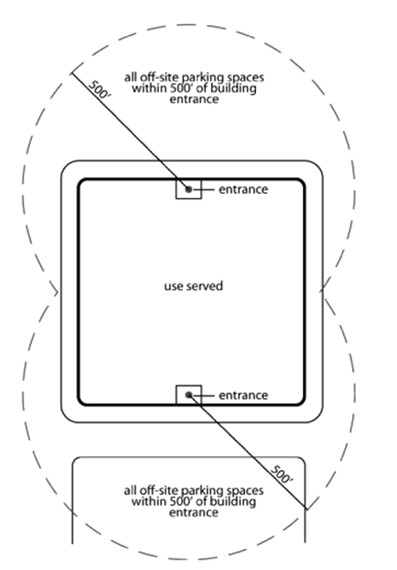
- Location. Off-site parking areas must be located within a 500-foot radius of the use served by such parking, measured between the entrance of the use to be served and any portion of a parking space within the off-site parking lot. The off-site parking must be located in a zoning district that allows non-accessory parking or that allows the principal use that will be served by the parking. The 500-foot radius restriction does not apply to the MRMC campus. See Section 24.060.060B, footnote 2 for definition of MRMC campus.
- Control of Off-Site Parking Area.
- The property to be occupied by the off-site parking facilities must be under the same ownership as the lot containing the use to be served by the parking. The off-site parking area may be under separate ownership only if a legal agreement is provided to the zoning administrator guaranteeing the long-term availability of the parking. The agreement must be in a form approved by the city attorney and recorded with the register of deeds.
- Off-site parking agreements are binding upon applicants, their successors and assigns. Amendments to off-site parking agreements require zoning administrator approval, based on whether the proposed amendment complies with all applicable zoning ordinance provisions.
- Off-site parking privileges remain in effect only as long as the agreement, binding on all parties, remains in force. If an off-site parking agreement lapses or is no longer valid, then parking must be provided as otherwise required by this chapter.
Adopted by Ord. O-18-11 pt. III on 5/1/2018
Repealed & Reenacted by Ord. O-25-25 on 11/18/2025
Amended by Ord. O-26-002 on 3/24/2026
24.11.070 Use Of Off-Street Parking Areas
- Off-street parking areas may be used solely for the temporary parking of licensed motor vehicles in operating condition unless otherwise approved by the board of public works.
- Off-street parking spaces may not be used for the display of goods for sale or lease or for storage of building materials unless otherwise approved by the board of public works.
- Off-street parking spaces are intended to serve residents, tenants, patrons, employees, or guests of the principal use. Off-street parking spaces required by this zoning ordinance must be maintained for the life of the principal use.
- No motor vehicle repair work is permitted in a parking space other than emergency roadside repair, such as changing a flat tire.
24.11.080 Bicycle Parking
- General. This section establishes regulations governing bicycle parking facilities.
- Short-term Bicycle Parking.
- Purpose. Short-term bicycle parking is generally intended to serve the needs of cyclists who park their bicycles for short time periods, including customers, clients, students and other short-term visitors.
- Spaces Required. Short-term bicycle parking spaces are required in accordance with the following minimum ratios:
- Design and Location.
- General. Required bicycle parking spaces must:
- consist of bike racks or lockers that are anchored so that they cannot be easily removed;
- be of solid construction, resistant to rust, corrosion, hammers and saws;
- allow both the bicycle frame and the wheels to be locked with the bicycle in an upright position using a standard U-lock;
- be designed so as not to cause damage to the bicycle;
- facilitate easy locking without interference from or to adjacent bicycles; and
- be in highly visible, active, well-illuminated areas that do not interfere with pedestrian movements.
- Location. At least 50% of required bicycle parking spaces must be located within 50 feet of a customer entrance, and the remainder must be located within 100 feet of any entrance. If required bicycle parking spaces are not visible from the abutting street or the main customer entrance, signs must be posted indicating their location.
- Size. All required bicycle parking spaces must have minimum dimensions of 2 feet in width by 6 feet in length, with a minimum overhead vertical clearance of 7 feet.
- General. Required bicycle parking spaces must:
Short-term Bicycle Parking Spaces Req'd
Multi-unit Residential
1 space per 20 dwelling units; 1 space min.
Commercial, Public and Civic
1 per 10 motor vehicle spaces; 1 space min.
Industrial
1 per 20 motor vehicle spaces; 1 space min.
- Long-term Bicycle Parking.
- Purpose. Long-term bicycle parking is generally intended to serve the needs of cyclists who park their bicycles for long time periods, including overnight and all-day parking, generally serving the needs of employees and residents.
- Long-term Spaces Required. Long-term bicycle parking spaces are required in accordance with the following ratios:
- The board of public works is authorized to approve a reduction in vehicle parking requirements for projects that provide additional long-term bicycle parking spaces.
- Standards for long-term bicycle parking spaces. Long-term bicycle parking spaces must meet the following criteria:
- All required long-term bicycle parking spaces shall be located indoors, or in a location otherwise protected from weather and access by unauthorized persons, except at educational facilities or as otherwise approved by the Board of Public Works or Common Council;
- Indoor bicycle parking spaces must be located on the ground floor or in a location otherwise served by an elevator or ramp capable of transporting the bicycle(s) being stored;
- Long-term bicycle parking must provide bike racks or lockers anchored so that they cannot be easily removed or damaged, must allow both the bicycle frame and the wheels to be locked with the bicycle in an upright position, be designed so as not to cause damage to the bicycle, and facilitate easy locking without interference from or access to adjacent bicycles.
Long-term bicycle parking spaces required
Multi-Unit Residential
1 space per 4 dwelling units; 2 space min.
Commercial, Public and Civic
1 space per 6,000 sq. ft. gross floor area; 2 space min.
Industrial
1 space per 24,000 sq. ft. gross floor area; 2 space min.
Adopted by Ord. O-22-25 pt. I on 9/20/2022
Repealed & Reenacted by Ord. O-25-25 on 11/18/2025
24.11.090 Motorcycle And Scooter Parking
When 20 motor vehicle parking spaces are required, motorcycle, moped or scooter parking may be substituted for up to 5 automobile parking spaces or 10% of required motor vehicle parking, whichever is less (unless otherwise approved by the board of public works). For every 4 motorcycle parking spaces provided, the automobile parking requirement is reduced by one space. Each motorcycle space must have minimum dimensions of 4 feet by 8 feet. This provision applies to existing and proposed parking lots.
24.11.100 Drive-Through Facilities And Vehicle Stacking Spaces
- Applicability.
- The regulations of this section apply to all uses that include drive-through facilities and to all portions of a development that comprise the drive-through facility.
- The regulations apply to new developments, the addition of drive-through facilities to existing developments and the relocation of existing drive-through facilities. All drive-in and drive-through facilities require conditional use approval.
- Parts of a Drive-through Facility. A drive-through facility is composed of two parts:
- The stacking lanes (the space occupied by vehicles queuing for the service to be provided); and
- The service area, where the service occurs. In uses with service windows, the service area starts at the service window. In uses where the service occurs indoors, the service area is the area within the building where the service occurs. For other facilities, such as gas pumps, air compressors and vacuum cleaning stations, the service area is the area where the vehicles are parked during the service or operation.
- Setbacks and Landscaping. Service areas and stacking lanes on parcels abutting R zoning districts must be set back at least 15 feet and landscaped in accordance with the landscape screening requirements of Section 24.12.040.
- Stacking Lanes. These regulations help ensure that there is adequate on-site maneuvering and circulation areas, that stacking vehicles do not impede safe movement of traffic and that stacking lanes will not have nuisance impacts on nearby residential uses.
- All drive-through facilities must provide at least 4 stacking spaces for vehicles at the pick-up or teller window and at least 4 spaces from the order box. Each stacking space must be at least 20 feet in length.
- A stacking lane is not required for accessory facilities where vehicles do not routinely queue up while waiting for the service. Examples are window washing, air compressor and vacuum cleaning stations.
- Stacking lanes must be designed and laid out in accordance with all applicable ordinance requirements and engineering standards and specifications.
- All stacking lanes must be clearly identified, through such means as striping, landscaping, pavement design and signs. Such identification must comply with all applicable ordinance requirements and engineering standards and specifications.
- Noise. Speakers associated with drive-through facilities must be located and designed to minimize noise levels on nearby uses. Sound attenuation walls, landscaping or other mitigation measures may be required to ensure that the facility will not have adverse noise-related impacts on nearby residential uses.
- Site Plans. Site plans must show the location of drive-through windows and associated facilities (for example: communications systems and access aisles), as well as adjacent residential uses.
24.11.110 Design
Parking areas must be designed and constructed in accordance with Chapter 8.44 (Parking Lots and Vehicle Storage Lots) and with applicable city engineering and board of public works standards.
24.11.120 Vehicle Loading And Unloading
- Plans Required. Off-street loading plans must be submitted with site plans, conditional use permits and building permits involving any use required or proposing to provide off-street loading facilities. Plans must accurately designate the proposed off-street loading spaces, dimensions and clearance and access to the loading spaces. Plans for the design of loading areas are subject to approval by the city.
- Location and Design. The following location and design regulations apply to all provided off-street loading facilities regardless of whether they are required to be provided by this zoning ordinance.
- Off-street loading facilities must be located on the same lot as the use served.
- All loading areas adjacent to a parcel within a residential zoning district shall be screened from view in accordance with the screening standards of Section 24.12.040.
- Loading spaces may not be located in a required front or side setback.
- Loading areas and access drives must be paved and maintained with concrete, asphalt, or similar material of sufficient thickness and consistency to support anticipated traffic volumes and weights.
- Each off-street loading space must be designed to provide a safe means of vehicular access to a street or alley in a manner which will least interfere with traffic movement and are subject to approval by the city.
Repealed & Replaced by Ord. O-25-25 Part XXIX on 11/18/2025

