
Wauwatosa City Zoning Code
CHAPTER 24
16 PROCEDURES
24.16.010 Common Provisions
- Summary of Review and Decision-making Authority. The following table provides a summary of review and decision-making authority.[1]Committee review may be required before common council action (see also Section 2.24.030 of the city code of ordinances).
ZA
DRB
HPC
BZA
PC
CC[1]
Zoning Text and Map Amendments, Comprehensive Plan Amendment
—
—
—
—
R
<DM>
Conditional Use Permits
—
—
—
—
R
<DM>
Planned Unit Developments
Preliminary Development Plan
—
—
—
—
R
<DM>
Final Development Plan
DM
R
—
—
—
—
Variances
—
—
—
<DM>
—
—
Historic (Site/Structure) Designation
—
—
<R>
—
R
<DM>
Historic Overlay Zoning Map Amendment
—
—
<R>
—
R
<DM>
Certificates of Appropriateness
—
—
<DM>
—
—
—
Appeals of Administrative Decisions
—
—
—
<DM>
—
—
Temporary Use
DM
—
See also Section 24.10.080
CC = common council
PC = plan commission
BZA = board of zoning appeals
HPC = historic preservation commission
ZA = zoning administrator
R = review and recommendation
DM = decision-making body (final decision)
< > = public hearing required - Applicability. The common provisions of this section apply to all of the procedures in this chapter unless otherwise expressly stated.
- Applications and Fees.
- Eligible Applicants. Many of the procedures of this chapter allow applications to be filed by "eligible applicants." An eligible applicant is any person, firm, or corporation (including their authorized agent) having a freehold interest, a possessory interest entitled to exclusive possession, a contractual interest that may become a freehold possessory interest or any exclusive possessory interest that is specifically enforceable on the subject property.
- Form of Application.
- Applications required under this zoning ordinance must be submitted in a form and in such numbers as required by the zoning administrator.
- The zoning administrator must develop checklists of application submittal requirements and make those checklists available to the public.
- Application Filing Fees. Applications must be accompanied by the fee amount indicated in the consolidated fee schedule that has been approved by the common council. Upon withdrawal of any application pursuant to the provisions of subsection 24.16.010 F.4., below, the applicant shall not be entitled to a refund or return of the required filing fees except upon action of the Common Council.
- Application Completeness, Accuracy and Sufficiency.
- An application will be considered complete and ready for processing only if it is submitted in the required number and form, includes all required information and is accompanied by the required filing fee.
- The zoning administrator must make a determination of application completeness within seven business days of application deadline.
- If an application is determined to be incomplete, the zoning administrator must provide written notice to the applicant along with an explanation of the application's deficiencies. No further processing of the application will occur until the deficiencies are corrected. If the deficiencies are not corrected by the applicant within 60 days, the application will be considered withdrawn.
- No further processing of incomplete applications will occur and incomplete applications will be pulled from the processing cycle. When the deficiencies are corrected, the application will be placed in the next processing cycle.
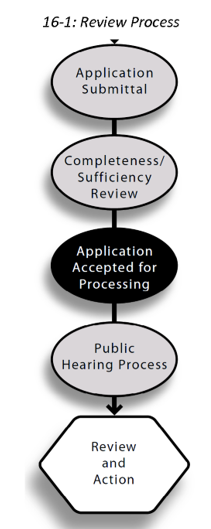
- Applications deemed complete will be considered to be in the processing cycle and will be reviewed by staff and other review and decision-making bodies in accordance with applicable review and approval procedures of this zoning ordinance.
- The zoning administrator may require that applications or plans be revised before being placed on an agenda for possible action if the zoning administrator determines that:
- The application or plan contains one or more significant inaccuracies or omissions that hinder timely or competent evaluation of the plan's/application's compliance with zoning ordinance requirements or other regulations;
- The application contains multiple minor inaccuracies or omissions that hinder timely or competent evaluation of the plan's/application's compliance with zoning ordinance requirements or other regulations; or
- The decision-making body does not have legal authority to approve the application or plan as submitted.
- Application Processing Cycles. The zoning administrator, after consulting with review and decision-making bodies, is authorized to promulgate reasonable cycles and timelines for processing applications. Processing cycles may establish:
- deadlines for receipt of complete applications;
- dates of regular meetings and public hearing;
- the scheduling of staff reviews and reports; and
- time-frames for review and decision-making.
- Hearings.
- Interested parties and citizens must be given an opportunity to appear and be heard at required hearings, subject to reasonable rules of procedure.
- A hearing for which proper notice was given may be continued to a later date without providing additional notice as long as the continuance is set for specified date and time and that date and time is announced at the time of the continuance.
- If a hearing is continued or postponed for an indefinite period of time from the date of the originally scheduled hearing, new public notice must be given before the rescheduled hearing. If the applicant requests a postponement, the applicant must pay any costs of renotification.
- Public Hearing Notices.
- Published Notice. Whenever the provisions of this zoning ordinance require that published notice be provided, the notice must be published in the city's official newspaper in accordance with Chapter 985 of the Wisconsin Statutes. The applicant must post signage in a format provided by the city in a prominent location on the development site for the duration of the approval process.
- Mailed Notice.
- Unless otherwise expressly stated, whenever the provisions of this zoning ordinance require that notices be mailed, the notices must be sent via United States Postal Service mail.
- Addresses must be taken from the latest property information available in the office of the city assessor.
- Courtesy Notices. In addition to the forms of notice required to be provided by the provisions of this zoning ordinance, the city may elect to provide additional forms of courtesy notification by, for example, mailing notice to neighborhood organizations, posting notices in city hall or other city buildings or providing notice via the Internet.
- Content of Notices. All required public hearing notices must:
- Indicate the date, time and place of the hearing or date of action that is the subject of the notice;
- Describe any property involved in the application by address or by a commonly understood description of the location;
- Describe the general nature, scope and purpose of the application or proposal; and
- Indicate where additional information on the matter can be obtained.
- Action by Review Bodies and Decision-Making Bodies.
- Review and decision-making bodies may take any action that is consistent with:
- the regulations of this zoning ordinance;
- any rules or by-laws that apply to the review or decision-making body; and
- the notice that was given.
- Review and decision-making bodies are authorized to defer action or continue a public hearing in order to receive additional information or further deliberate.
- Review and decision-making bodies are authorized to defer action, continue the hearing or deny an application whenever the applicant fails to appear for a scheduled and advertised hearing or whenever the applicant fails at more than one meeting to provide the documentation necessary to demonstrate compliance with the notice requirements of this zoning ordinance.
- An applicant may withdraw an application at any time prior to the scheduled time of a meeting at which a final vote by the appropriate decision-making body is to occur, by written or electronic communication indicating such withdrawal to the City Clerk. Such item shall be immediately removed from any upcoming agenda and no further action shall be taken upon the application by such decision-making body. Following such withdrawal, further consideration of said item must follow the process described within this code for a new application.
- An applicant may postpone review of an application at any time prior to the scheduled time of a meeting by written or electronic communication to the city clerk. Such item shall be immediately removed from any upcoming agenda and no further action shall be taken until requested by the applicant. Applications with no activity for six months will be considered withdrawn and further consideration of said item must follow the process described within this code for a new application.
- Review and decision-making bodies may take any action that is consistent with:
- Conditions of Approval. When decision-making bodies approve applications with conditions, the conditions must relate to a situation created or aggravated by the proposed use or development and must be roughly proportional to the impacts of the use or development.
- Decision-Making Criteria; Burden of Proof or Persuasion. Applications must address relevant review and decision-making criteria. In all cases, the burden is on the applicant to show that an application complies with all applicable review or approval criteria.
(Ord. O-13-17, § XIII, 11-19-2013)
Amended by Ord. O-18-26 pts. I—IV on 12/4/2018
Amended by Ord. O-22-9 pts. I, II on 2/15/2022
Amended by Ord. O-22-28 pt. I on 9/20/2022
Amended by Ord. O-22-27 pt. I on 9/20/2022
Amended by Ord. O-22-26 pt. I on 9/20/2022
Amended by Ord. O-23-18 pts. IV, V on 8/1/2023
Amended by Ord. O-24-35 on 11/19/2024
Amended by Ord. O-25-25 on 11/18/2025
24.16.020 Zoning Ordinance Text Amendments
- Authority to Initiate. Amendments to the text of this zoning ordinance may be initiated by the common council or the plan commission, or following the filing of an application with the zoning administrator.
- Public Hearing and Notice of Hearing. Upon receiving a completed application for a Zoning Ordinance Text Amendment, planning staff shall schedule a public hearing before the common council and prepare appropriate notice and publications. Class 2 notice of the common council's required public hearing on a zoning ordinance text amendment must be published in accordance with chapter 985 of the Wisconsin Statutes.
- Plan Commission Recommendation. Following the required public hearing before the common council, proposed zoning ordinance text amendments must be referred to the plan commission. Following their review of the proposed text amendment, the plan commission must act by simple majority vote of those members present and voting to recommend that the proposed text amendment be approved, approved with modifications, or denied. The plan commission's recommendation must be transmitted to the common council.
- Common Council Consideration and Decision.
- Upon receipt of recommendations from the plan commission, the common council may act to approve, approve with modifications or deny the proposed text amendment. If the plan commission's recommendation has not been forwarded to the common council within 60 days of referral of the proposed text amendment to the plan commission, the common council may take action without receipt of the recommendation.
- Final action on a zoning ordinance text amendment by the common council requires a simple majority vote of those members present and voting.
- Review Criteria and Standards. Zoning ordinance text amendments are legislative decisions of the common council based on their consideration of the public, health, safety and general welfare.
Amended by Ord. O-24-35 on 11/19/2024
24.16.030 Zoning Map Amendments (Rezonings)
- Authority to Initiate. Amendments to the official zoning map may be initiated by the common council, the plan commission or by petition of an eligible applicant or an eligible applicant's authorized agent (See Section 24.16.010C.1).
- Application Filing. Zoning map amendment applications must be filed with the zoning administrator.
- Public Hearing and Notice of Hearing.
- Upon receipt of a completed application for a Zoning Map Amendment, planning staff shall schedule a public hearing before the common council and prepare appropriate notices and publications.
- Class 2 notice of the common council's required public hearing on a zoning map amendment must be published in accordance with chapter 985 of the Wisconsin Statutes.
- Notice must be mailed to all of the following at least 7 days before the common council's required public hearing:
- the subject property owner;
- all owners and occupants (when data available) of property within 300 feet of the subject property; and
- the clerk of any municipality with corporate limits that abut the subject property.
- The applicant must post signage in a format provided by the city in a prominent location on the development site for the duration of the approval process.
- Plan Commission Recommendation. Following the required public hearing before the common council, proposed zoning map amendments must be referred to the plan commission. Following review of the proposed zoning map amendment, the plan commission must act by simple majority vote to recommend that the proposed zoning map amendment be approved, approved with modifications, or denied. The plan commission's recommendation must be transmitted to the common council.
- Common Council Hearing and Decision.
- Upon receipt of recommendations from the plan commission, the common council may act to approve, approve with modifications (e.g., reducing the land area involved in the rezoning or recommending another less intensive zoning classification) or deny the proposed zoning map amendment. If plan commission recommendation has not been forwarded to the common council within 60 days of referral of the proposed zoning map amendment to the plan commission, the common council may act without receipt of the recommendation.
- Final action on a zoning map amendment by the common council requires a simple majority vote.
- Review Criteria and Standards. Zoning map amendments are legislative decisions of the common council based on their consideration of the public health, safety and general welfare.
- Successive Applications. Upon disapproval of a zoning map amendment by the common council, no zoning map amendment petition requesting the same or more intensive zoning on the same or similar property may be filed for or accepted for processing by the city for 6 months from the date of final action by the common council.
(Ord. O-13-17, § XIV, 11-19-2013; Ord. O-14-20, pt. IX, 8-5-2014)
Amended by Ord. O-22-7 pts. I, II on 2/1/2022
Amended by Ord. O-22-29 pt. I on 9/20/2022
Amended by Ord. O-24-35 on 11/19/2024
Amended by Ord. O-25-25 on 11/18/2025
24.16.040 Conditional Use Permits
- Purpose. The conditional use permit approval procedures of this section are intended to provide a transparent, public review process for land uses that, due to their widely varying design and operational characteristics, require case-by-case review in order to determine whether they will be compatible with surrounding uses and development patterns.
- Authority to Initiate. Conditional use permit applications may be filed by eligible applicants or an eligible applicant's authorized agent (See Section 24.16.010C.1).
- Application Filing. Condition[al] use permit applications must be filed with the zoning administrator. Upon receipt of the application and a completeness determination, the zoning administrator shall schedule the public hearing before the common council and coordinate the required notices.
- Notice of Hearing. The common council must hold a hearing on all conditional use permits.
- Notice of the common council's required hearing must be mailed to all owners and occupants (when data available) of property within 200 feet of the subject property at least 7 days before the hearing.
- Class 2 notice of the common council's required public hearing on a conditional use permit must be published in accordance with chapter 62.23 (dm) of the Wisconsin Statutes.
- The applicant must post signage in a format provided by the city in a prominent location on the development site for the duration of the approval process.
- Plan Commission Recommendation. Following the close of the public hearing before the common council, proposed conditional use permits must be referred to the plan commission. The plan commission must act by simple majority vote to recommend that the conditional use permit be approved, approved with modifications, or denied. The plan commission's recommendation must be transmitted to the common council.
- Common Council Decision.
- Following receipt of recommendations from the plan commission, the common council may act to approve, approve with conditions or deny the conditional use permit. If the plan commission's recommendation has not been forwarded to the common council within 60 days of referral of the proposed condition[al] use to the plan commission, the common council may act without receipt of the recommendation.
- Final action on a conditional use permit by the common council requires a simple majority vote.
- General Review Criteria and Standards. The common council may authorize the zoning administrator to issue a conditional use permit if the common council finds that the following conditions exist and so indicates in the minutes of its proceedings:
- that the establishment, maintenance or operation of the conditional use will not be detrimental to or endanger the public health, safety or general welfare;
- that the uses, values and enjoyment of surrounding properties for purposes already permitted in the district will not be substantially impaired or diminished by the establishment, maintenance or operation of the conditional use;
- that establishment of the conditional use will not impede the normal and orderly development and improvement of surrounding properties for uses permitted in the district;
- that adequate utilities, access roads, drainage and other necessary improvements have been or are being provided;
- that adequate measures have been or will be taken to provide ingress and egress that will minimize on- and off-site traffic congestion; and
- that the conditional use complies with all applicable regulations of the subject zoning district.
- Successive Applications. Upon disapproval of a conditional use permit by the common council, no similar conditional use permit application for the same or similar property may be filed or accepted for processing by the city for 12 months from the date of final action by the common council.
- Lapse of Approval. A Conditional Use will lapse and have no further effect 18 months after it is approved by the Common Council, unless:
- a building permit has been issued (if required) or development is commenced;
- the use or structure has been lawfully established; or
- unless a different lapse of approval period or point of expiration has been expressly established by the Common Council.
- Amendments. No modification or alteration of any conditional use permit approved pursuant to this section will be permitted unless approved by the Common Council.
- Any application for an alteration, extension or other modification will be filed and processed as an original application under this section.
- Alterations and modifications shall be subject to the same standards and criteria as original applications and shall be in conformance with all the provisions of this section.
- Minor Deviations. Minor deviations to conditional uses including maintenance, repair, or renovation of existing buildings, structures or improvements and alterations, extensions, or other modifications of such uses that do not increase, intensify, expand, substantially change the character of the conditional use, or adversely affect adjacent property or property owners may be authorized by the zoning administrator and do not require approval by the common council.
(Ord. O-14-20, pt. X, 8-5-2014)
Amended by Ord. O-16-13 pt. XXI on 5/3/2016
Amended by Ord. O-18-26 pt. V on 12/4/2018
Amended by Ord. O-22-30 pt. I on 9/20/2022
Amended by Ord. O-23-18 pts. VI, VII on 8/1/2023
Amended by Ord. O-24-35 on 11/19/2024
Amended by Ord. O-25-25 on 11/18/2025
24.16.050 Planned Unit Developments
- Planned Unit Development (/PUD) overlay zoning districts are established through the approval of a zoning map amendment in accordance with the zoning map amendment procedures of Section 24.16.030. New PUD zoning map amendments shall be processed concurrently with a preliminary development plan application. Final development plan approval is required after approval of the PUD zoning map amendment and/or preliminary development plan. This section describes the required review and approval procedures for PUD preliminary and final development plans. Modifications to plans in existing /PUD overlay zoning districts follow established PUD plan amendment procedures.
- Development Plan Approval Required. Approval of PUD preliminary and final development plans must occur before any building permit is issued and before any development takes place in a /PUD overlay district. Permits may be issued for a development phase if a preliminary development plan has been approved for the entire PUD and a final development plan has been approved for the subject phase.
- Preliminary Development Plans. At the option of the applicant, the preliminary development plan may serve also as the preliminary subdivision plat if such intention is declared before the plan commission's hearing and if the plans include all information required for preliminary plats and preliminary development plans.
- Preapplication Meetings. Before submitting a PUD application, the applicant must schedule a meeting with the zoning administrator to discuss the proposed plan and the required process. The zoning administrator is responsible for coordinating the involvement of other relevant city departments in the preapplication meeting. The applicant must also hold a neighborhood meeting, with invitations mailed to all property owners within 200 feet of the subject property, alderpersons of the district, and the zoning administrator.
- Application Contents. An application for a preliminary development plan must contain all items of information specified in the pre-application meeting including proof of holding a neighborhood meeting prior to application submission.
- Application Filing. Complete applications for preliminary development plan approval must be filed with the zoning administrator at the same time that the /PUD zoning map amendment application is filed. Preliminary development plan applications may be filed only by the common council, the plan commission or by petition of an eligible applicant or an eligible applicant's authorized agent (See Section 24.16.010C.1). Upon receipt of the completed application, planning staff shall schedule a public hearing before the common council and prepare appropriate notice and publications.
- Notice of Hearing. The common council must hold a public hearing on the proposed preliminary development plan and/or /PUD zoning map amendment.
- Class 2 notice of the common council's required public hearing on a zoning map amendment must be published in accordance with chapter 985 of the Wisconsin Statutes.
- Notice must be mailed to all of the following at least 7 days before the common council's required public hearing:
- the subject property owner;
- all owners and occupants (when data available) of property within 300 feet of the subject property; and
- the clerk of any municipality with corporate limits that abut the subject property.
- The applicant must post signage in a format provided by the city in a prominent location on the development site for the duration of the approval process.
- Following the required public hearing before the common council, PUD preliminary development plans must be referred to the plan commission with the /PUD zoning map amendment, if such map amendment is required. Following review of the proposed zoning map amendment and/or preliminary development plan, the plan commission must act by simple majority vote to recommend that the proposed zoning map amendment and/or preliminary development plan be approved, approved with modifications, or denied. The plan commission's recommendation must be transmitted to the common council.
- Common Council Hearing and Decision.
- Upon receipt of recommendations from the plan commission, the common council act to approve, approve with modifications (e.g., reducing the land area involved in the rezoning or recommending another less intensive zoning classification) or deny the proposed preliminary development plan and/or /PUD zoning map amendment, as required. If plan commission recommendation has not been forwarded to the common council within 60 days of referral of the proposed preliminary development plan and/or /PUD zoning map amendment to the plan commission, the common council may act without receipt of the recommendation.
- Final action on a /PUD zoning map amendment by the common council requires a simple majority vote.
- Review Criteria. Zoning map amendments are legislative decisions of the common council based on their consideration of the public, health, safety and general welfare.
- Lapse of Approval.
- If the subject landowner fails to file an application for PUD final development plan approval within two years of the date of PUD preliminary development plan approval, the landowner may request an extension for a period of up to one year. If the landowner does not request such an extension, or if the landowner does not file an application for a PUD final development plan within the 1-year extension period, approval of the PUD preliminary development plan will lapse and be of no further effect.
- For projects to be developed in phases, phase limits must be shown on the preliminary development plan. The common council may impose conditions upon the phasing plan as deemed necessary to ensure orderly development, including requirements for financial guarantees ensuring construction of all required improvements.
- Final Development Plans.
- Application Filing. Final development plan applications must be filed with the zoning administrator before the lapse of a preliminary development plan.
- Design Review Board's Recommendation. PUD final development plans must be referred to the design review board. The design review board must review the final development plan and vote to recommend that the final development plan be approved, approved with modifications, or denied. The design review board's recommendation must be transmitted to the zoning administrator.
- Zoning Administrator Decision. Following receipt of recommendations from the design review board, the zoning administrator may act to approve, approve with conditions or deny the final development plan. If the design review board has received all the required items of information in the final development plan, but has not forwarded a recommendation to the zoning administrator within 60 days of referral of the final development plan to the design review board, the zoning administrator may act without receipt of the recommendation.
- Review Criteria. In reviewing PUD final development plans, the zoning administrator must confirm the submitted final development conforms with the approved preliminary development plan, any conditions imposed on that plan or any applicable regulations of this zoning ordinance. If the zoning administrator determines that the PUD final development plan does not conform with the approved preliminary development plan, any conditions imposed on that plan or any applicable regulations of this zoning ordinance, the PUD final development plan shall be referred to plan commission for approval, approval with conditions, or denial.
- Lapse of Approval.
- In the event the landowner fails to commence development shown on the final development plan within two years after final approval has been granted, then such final approval will lapse and be of no further effect unless the time period is extended by the common council upon written application by the landowner.
- Requests for extensions must be submitted to the zoning administrator.
- In the event of lapse of approval, approved PUD plans have no further effect and the regulations of the underlying zoning govern.
- Amendments.
- Amendment Determination. The zoning administrator is authorized to determine whether a proposed PUD amendment constitutes a minor or major amendment.
- Major Amendments. Major amendments may be approved only through the procedure required for approval of the PUD in Section 24.16.050C. A major amendment is one that constitutes a material change to the approved final development plan that is likely to create more significant adverse impacts on surrounding property owners or the community as a whole, such as:
- increases in the number of dwelling units or floor area over 10%;
- reductions in the amount of land area set aside as open space, recreation area or natural resource conservation area; or
- failure to provide public amenities or public benefit features approved as part of the PUD.
- Minor Amendments. The zoning administrator is authorized to approve, approve with conditions, or deny minor PUD amendments through the approval of an amended final development plan, in accordance with the procedures of Section 24.16.050D. A minor amendment is a change that constitutes a minor modification to the approved Final Development Plan, will not result in adverse impacts to surrounding property owners or the broader community, and maintains the spirit and intent of the original Final Development Plan, such as:
- Increases or decreases in floor area of 10% or less;
- Increases in the number of residential dwelling units of 10% or less;
- Modifications to approved signage that do not increase allowable sign square footage as approved per the Final PUD;
- Land use changes where the new land use is permitted under the base zone and/or obtains all required permits under the base zone (i.e. Conditional Use permit, etc.).
Amendments that do not meet the above criteria shall be considered Major Amendments and are subject to the review criteria in Section 24.16.050E.2. The Zoning Administrator may refer minor amendments to the plan commission for approval, approval with conditions, or denial.
Adopted by Ord. O-16-37 §§ I—IV on 11/1/2016
Amended by Ord. O-19-05 pts. VII—IX on 4/2/2019
Amended by Ord. O-22-7 pt. III on 2/1/2022
Amended by Ord. O-22-31 pts. I, II on 9/20/2022
Amended by Ord. O-24-35 on 11/19/2024
Amended by Ord. O-25-25 on 11/18/2025
24.16.060 Variances
- Intent. Zoning variances are intended as a way to provide relief from practical difficulties or unnecessary hardships resulting from strict application of zoning ordinance requirements.
- Applicability; Authorized Variances. The board of zoning appeals is authorized to grant variances to the provisions of this zoning ordinance in accordance with the variance procedures of this section, except that these variance procedures may not be used to:
- permit a principal use in a zoning district that is not otherwise allowed in that zoning district (i.e., "use variances" are prohibited);
- waive, modify or amend any definition or use classification;
- waive, modify or otherwise vary any of the review and approval procedures;
- waive, vary, modify or otherwise override a condition of approval or requirement imposed by an authorized decision-making body or the state or federal government;
- waive, vary or modify applicable "minimum lot area per unit" (density) standards (Note: this provision is not intended to prohibit variances of minimum lot area requirements for individual lots);
- waive, vary or modify provisions over which jurisdiction for exceptions or other modifications is assigned to another decision-making body; or
- waive, vary or modify provisions for which variances are expressly prohibited.
- Authority to File. Variance applications may be filed by eligible applicants or an eligible applicant's authorized agent (See Section 24.16.010C.1).
- Application Filing. Variances applications must be filed with the zoning administrator.
- Transmittal to Board of Zoning Appeals. The zoning administrator must transmit the variance application to the board of zoning appeals before their hearing on the matter.
- Notice of Hearing.
- Class 1 notice of the board of zoning appeals' required hearing on a variance application must be published in accordance with chapter 985 of the Wisconsin Statutes.
- Notice must be mailed to all of the following at least 7 days before the board of zoning appeals' required hearing:
- the subject property owner; and
- all owners of property within 100 feet of the subject property.
- Notice of the filing of a variance application must be forwarded to the common council president and the alderperson of the district in which the subject property is located.
- In the case of variances to the floodplain or wetland regulations of this zoning ordinance, notice must be provided to the Wisconsin Department of Natural Resources at least 10 days before the board of zoning appeals' hearing.
- Hearing and Final Decision.
- The board of zoning appeals must hold a hearing to consider the variance request.
- Following the close of the hearing, the board of zoning appeals must make its findings of fact and act to approve the requested variance, approve the variance with modifications and/or conditions, or deny the variance request based on the review criteria and standards of Section 24.16.060H.
- Approval of a variance requires a simple majority vote of board of zoning appeals' members present and voting.
- General Review Criteria and Standards. No variance may be approved unless the board of zoning appeals finds that all of the following conditions exist:
- Exceptional circumstances exist pertaining to the subject lot;
- That the requested variance is necessary for the preservation and enjoyment of the property rights possessed by other properties in the district and vicinity;
- That the variance will not create special detriment to adjacent property and will not materially impair or be contrary to the purpose and spirit of this ordinance or to the public interests; and
- That the difficulty or hardship was not created by the property owner.
- Addition[al] Review Criteria and Standards in Floodplains. In addition to the general criteria and standards of Section 24.16.060H, the board of zoning appeals must find that all of the following criteria are met when the variance involves floodplain zoning regulations:
- the variance will not cause any increase in the regional flood elevations or profiles, permit a lower degree of flood protection in the floodplain than the flood elevation, allow any floor, basement or crawlway below the regional flood elevation, allow actions without the required amendments or have the effect of allowing or expanding a use or building that is prohibited in the floodplain zoning district;
- the lot for which the variance is requested is less than 21,780 square feet in area and contiguous to existing structures constructed below the regional flood elevation; and
- the variance will not increase costs for rescue and relief efforts.
- Transferability. Approved variances run with the land and are not affected by changes of tenancy, ownership, or management.
- Amendments. A request for changes in conditions of approval of variance must be processed as a variance application, including the requirements for fees and notices.
- Lapse of Approval. An approved variance will lapse and have no further effect one year after it is approved by the board of zoning appeals, unless:
- a building permit has been issued (if required);
- the use or structure has been lawfully established; or
- unless a different lapse of approval period or point of expiration has been expressly established by the board of zoning appeals.
- Successive Applications. Once a variance request has been denied by the board of zoning appeals, no rehearing on the same or substantially similar variance application may [be] held except upon a simple majority vote of board members present and voting and a finding that substantial new evidence is submitted that could not reasonably have been presented at the previous hearing.
- Review by Court of Record. Any person aggrieved by the decision of the board of zoning appeals may present to the court of record a petition duly verified setting forth that such decision is illegal and specifying the grounds of the illegality. The petition must be presented to the court within 30 days after the filing of the decision in the office of the board of zoning appeals.
24.16.070 Building Permits
No permit for the use of land or buildings may be issued under Chapter 15 unless Building & Safety Manager has certified, after examination of the site and proposed building plans, that it complies with all provisions of this zoning ordinance.
Repealed & Reenacted by Ord. O-25-25 on 11/18/2025
24.16.080 Designation Of Historic Sites And Structures
- Applicability. The historic site and structure designation procedures of this section must be used to designate historic sites and historic structures. The procedures must also be followed to rescind historic designations.
- Authority to Initiate. Historic site or structure designations may be initiated by the common council, the historic preservation commission or by petition of an eligible applicant or an eligible applicant's authorized agent (See Section 24.16.010C.1).
- Interim Control. No building permit may be issued for alteration, construction, demolition or removal of a structure, site, or property proposed to be designated as a historic site or structure from the date of the meeting of the historic preservation commission at which a nomination form is first presented until the final disposition of the nomination by the historic preservation commission or the common council unless such alteration, removal or demolition is authorized by formal resolution of the common council as necessary for public health, welfare or safety. These interim controls may not be in effect for more than 180 days.
- Application Filing. Historic site or structure nomination forms must be filed with the zoning administrator.
- Notice of Hearing.
- Class 1 notice of the historic preservation commission's required hearing must be published in accordance with chapter 985 of the Wisconsin Statutes.
- Notice must be mailed to all of the following at least 10 days before the historic preservation commission's required public hearing:
- the subject property owner; and
- all owners of property within 200 feet of the subject property.
- Notice must be forwarded to the common council president and the alderperson of the district in which the subject property is located.
- Notice must also be provided to the following: department of public works, development department, fire and police departments, health department, building department and plan commission. Each department may respond to the historic preservation commission within 30 days of notification with its comments on the proposed designation.
- Historic Preservation Commission Hearing and Recommendation.
- Upon receipt of a complete application/nomination form, the historic preservation commission must hold a hearing on the proposed historic designation. In addition to allowing comments from all notified persons, the historic preservation commission may hear expert witnesses. They also have the power to subpoena witnesses and records as deemed necessary. The commission may also conduct an independent investigation into the proposed designation.
- No more than 10 days after the close of the hearing, the historic preservation commission must act by simple majority vote to recommend that the proposed historic site or structure designation be approved, approved with modifications or denied. The historic preservation commission's recommendation must be transmitted to the common council.
- Common Council Hearing and Decision.
- Upon receipt of recommendations from the historic preservation commission, the common council may act to approve, approve with modifications or deny the proposed historic designation.
- Final action on a historic designation by the common council requires a simple majority vote. Designation Criteria. Historic site or structure designations may be applied to site, structures or improvements of particular historic, architectural, archeological or cultural significance to the city such as those that:
- Designation Criteria. Historic site or structure designations may be applied to site, structures or improvements of particular historic, architectural, archeological or cultural significance to the city such as those that:
- exemplify or reflect the broad cultural, political, economic or social history of the nation, state or community;
- are identified with historic personages or with important events in national, state or local history;
- embody the distinguishing characteristics of an architectural type or specimen inherently valuable for a study of a period, style, method of construction, or of indigenous materials or craftsmanship;
- are representative of the notable work of a master building [builder], designer or architect who influenced the person's age; or
- have yielded, or may be likely to yield, information important to prehistory or history.
- Notice of Action. After the designation has been approved by the common council, notification must be sent to the subject property owner. Notification must also be given to the city clerk, building department, plan commission and the city assessor.
- Recordation. Upon approval of a historic designation of a site or a structure, such designation must be recorded with the register of deeds.
(Ord. O-14-20, pt. XIII, 8-5-2014)
Amended by Ord. O-22-7 pts. IV, V on 2/1/2022
Amended by Ord. O-25-25 on 11/18/2025
24.16.090 Historic Overlay Districts
- Applicability. The historic (/HIS) overlay zoning district and the procedures of this section are used to designate historic districts. Historic overlay zoning districts may be established only in accordance with the procedures of this section. See Section 24.05.050 for information on the /HIS overlay district.
- Authority to Initiate. Amendments to the official zoning map to establish /HIS overlay zoning may be initiated by the common council, the plan commission, the historic preservation commission or by petition of an eligible applicant or an eligible applicant's authorized agent (See Section 24.16.010C.1).
- Interim Control. No building permit may be issued for alteration, construction, demolition or removal of a structure, site, or property proposed to be included in an /HIS overlay district from the date of the meeting of the historic preservation commission at which a nomination form is first presented until the final disposition of the nomination by the historic preservation commission or the common council unless such alteration, removal or demolition is authorized by formal resolution of the common council as necessary for public health, welfare or safety. These interim controls may not be in effect for more than 180 days.
- Application Filing. Historic overlay zoning map amendment applications must be filed with the zoning administrator.
- Notice of Hearing.
- Class 1 notice of the historic preservation commission's required hearing must be published in accordance with chapter 985 of the Wisconsin Statutes.
- Class 2 notice of the common council's required public hearing on a zoning map amendment must be published in accordance with chapter 985 of the Wisconsin Statutes.
- Notice must be mailed to all of the following at least 7 days before the historic preservation commission's and common council's required public hearings:
- the subject property owner;
- all owners of property within 200 feet of the subject property; and
- the clerk of any municipality with corporate limits that abut the subject property.
- Historic Preservation Commission Hearing and Recommendation. Upon receipt of a complete application/nomination form, the historic preservation commission must hold a hearing on the proposed historic overlay zoning designation. Following the close of the hearing, the historic preservation commission must act by simple majority vote to withhold a recommendation or to recommend that the proposed overlay zoning amendment be approved, approved with modifications or denied. The historic preservation commission's recommendation must be transmitted to the plan commission and common council.
- Plan Commission Recommendation. Proposed historic overlay zoning map amendments must be referred to the plan commission. Following review of the proposed historic overlay zoning map amendment, the plan commission must act by simple majority vote to recommend that the proposed zoning map amendment be approved, approved with modifications, or denied. The plan commission's recommendation must be transmitted to the common council within 30 days of the date of their review.
- Common Council Hearing and Decision.
- Upon receipt of recommendations from the historic preservation commission and plan commission, the common council must hold a hearing on the proposed historic overlay zoning map amendment. Following the close of the hearing, the common council may act to approve, approve with modifications (e.g., reducing the land area involved in the rezoning or recommending another less intensive zoning classification) or deny the proposed zoning map amendment.
- Final action on an historic overlay zoning map amendment by the common council requires a simple majority vote.
- Designation Criteria. Historic site or structure designations may be applied to site, structures or improvements of particular historic, architectural, archeological or cultural significance to the city such as those that:
- exemplify or reflect the broad cultural, political, economic or social history of the nation, state or community;
- are identified with historic personages or with important events in national, state or local history;
- embody the distinguishing characteristics of an architectural type or specimen inherently valuable for a study of a period, style, method of construction, or of indigenous materials or craftsmanship;
- are representative of the notable work of a master building [builder], designer or architect who influenced the person's age; or
- have yielded, or may be likely to yield, information important to prehistory or history.
- Recordation. Upon approval of a historic designation of a site or a structure, such designation must be recorded with the register of deeds.
- Recordation. A historic overlay zoning map amendment that has been approved by the common council must be recorded with the register of deeds.
Amended by Ord. O-22-7 pts. VI, VII on 2/1/2022
Amended by Ord. O-25-25 on 11/18/2025
24.16.100 Certificates Of Appropriateness
- Applicability.
- No permit shall be issued to reconstruct, alter or demolish all or any part of the exterior of designated historic structures or to construct any exterior improvement upon designated historic sites, and no such work shall occur, unless a certificate of appropriateness has been granted by the historic preservation commission in accordance with the provisions of this section.
- Agencies of the city and all public utility and transportation companies undertaking projects affecting historic structures, historic sites or historic districts are required to obtain a certificate of appropriateness before initiating any changes in the character of street paving, sidewalks, utility installations, lighting, walls, fences, structures and buildings on property, easements or streets owned or subject to city franchise agreements.
- Exemptions.
- No certificate of appropriateness is required for interior work or exterior work that does not require the issuance of a building permit.
- Ordinary maintenance and repairs may be undertaken without a certificate of appropriateness, provided that:
- the work is limited to repairs of existing features of an historic structure or site or the replacement of elements of a structure with pieces identical in appearance;
- the work does not change the exterior appearance of the structure or site; and
- does not require the issuance of a building permit.
- Application Filing. Applications for certificates of appropriateness must be filed with the zoning administrator.
- Historic Preservation Commission Hearing and Decision.
- The historic preservation commission must hold a hearing on certificate of appropriateness applications. Following the close of the hearing, the historic preservation commission may act to approve, approve with conditions or deny the certificate of appropriateness. The historic preservation commission must make its decision within 45 days of the date that a complete application is filed with the zoning administrator.
- In acting on certificates of appropriateness, the historic preservation commission must consider the review criteria of Section 24.16.100E and all applicable historic preservation requirements of this zoning ordinance. If the historic preservation commission determines that the application for a certificate of appropriateness and the proposed changes are consistent with the character and features of the property or district and comply with all applicable historic preservation requirements of this zoning ordinance, it must issue the certificate of appropriateness.
- If the historic preservation commission fails to issue a certificate of appropriateness due to the failure of the proposal to conform to applicable regulations and guidelines, the applicant may appeal such decision to the common council, with the same requirements for notice and hearing as required for the historic preservation commission in this section. In addition, if the historic preservation commission fails to issue a certificate of appropriateness, it must suggest ways in which the applicant would be able to obtain a certificate of appropriateness in accordance with applicable standards and guidelines.
- Final action on a certificate of appropriateness application requires a simple majority vote of those commission members present and voting.
- Upon issuance of a certificate of appropriateness, building permits for the subject work may be issued (if required).
- Review Criteria. In acting on applications for a certificate of appropriateness, the historic preservation commission must consider all of the following criteria, as applicable:
- Whether, in the case of a designated historic structure or historic site, the proposed work would detrimentally change, destroy or adversely affect any exterior architectural feature of the improvement upon which the work is to be done;
- Whether, in the case of the construction of a new improvement upon an historic site, or within an historic district, the exterior of the improvement would adversely affect or not harmonize with the external appearance of other neighboring improvements on the site;
- Whether, in the case of any property located in an historic district, the proposed construction, reconstruction, exterior alteration or demolition does not conform to the purpose and intent of this zoning ordinance and to the objectives and design criteria of the historic preservation plan for the historic district, as adopted by the common council;
- Whether the building or structure is of such architectural or historical significance that its demolition would be detrimental to the public interest and contrary to the general welfare of the people of the city and state;
- Whether the building or structure is of such old and unusual or uncommon design, texture and/or material that it could not be reproduced without great difficulty and/or expense;
- Whether retention of the building or structure would promote the general welfare of the people of the city or the state by encouraging the study of American history, architecture and design, or by developing an understanding of American culture and heritage;
- Whether the building or structure is in such a deteriorated condition that it is not structurally or economically feasible to preserve or restore or use it; provided, that any hardship or difficulty claimed by the owner which is self-created or which is the result of any failure to maintain the property in good repair cannot qualify as a basis for the issuance of a certificate of appropriateness; and
- Whether any new structure proposed to be constructed, or change in use proposed to be made, is compatible with the buildings and character of the area in which the subject property is located.
- General Standards for Designated Historic Properties. In addition, in determining whether to issue certificates of appropriateness, the historic preservation commission must consider and may give decisive weight to any or all of the following standards:
- A property must be used for its historic purpose or be placed in a new use that requires minimal change to the defining characteristics of the building and its site and environment.
- The historic character of a property must be retained and preserved. The removal of historic materials or alteration of features and spaces that characterize a property must be avoided.
- Each property must be recognized as a physical record of its time, place and use. Changes that create a false sense of historical development, such as adding conjectural features or architectural elements from other buildings, are not allowed.
- Most properties change over time; those changes that have acquired historic significance in their own right must be retained and preserved.
- Distinctive features, finishes and construction techniques or examples of craftsmanship that characterize a property must be preserved.
- Deteriorated historic features must be repaired rather than replaced. Where the severity of deterioration requires replacement of a distinctive feature, the new feature must match the old in design, color, texture and other visual qualities and, where possible, materials. Replacement of missing features must be substantiated by documentary, physical or pictorial evidence.
- Chemical or physical treatments, such as sandblasting, that cause damage to historic materials may not be used. The surface cleaning of structures, if appropriate, must be undertaken using the gentlest means possible.
- Significant archeological resources affected by a project must be protected and preserved. If such resources must be disturbed, mitigation measures must be undertaken.
- New additions, exterior alterations or related new construction may not destroy historic materials that characterize the property. The new work must be differentiated from the old and must be compatible with the massing, size, scale and architectural features to protect the historic integrity of the property and its environment.
- New additions and adjacent or related new construction must be undertaken in such a manner that if removed in the future, the essential form and integrity of the historic property and its environment would not be impaired.
- Other Permits and Approvals. The issuance of a certificate of appropriateness does not relieve the applicant from obtaining other permits and approvals required by the city. A building permit or other municipal permit may not be issued and if issued will be deemed invalid if it is obtained without the presentation of the certificate of appropriateness required for the proposed work. Insofar as they are applicable to an historic structure, historic site or improvement in an historic district designated under this section, any provision of the plumbing code, electrical code or building or housing [code] of the city shall apply, unless waived by the appropriate state or city officials. The historic preservation commission may support or propose such waivers before the appropriate state or city appeals body.
- Lapse of Approval. An approved certificate of appropriateness will lapse and have no further effect one year after it is issued by the historic preservation commission, unless:
- a building permit to perform the work has been issued (if required); or
- the work has been commenced and is being diligently pursued.
- Violations. In addition to other penalties and remedies authorized in Section 24.17.020, the city, upon determining that work is being conducted without a required certificate of appropriateness or in violation of a certificate of appropriateness, issue a stop work order, and all work must cease on the designated property. No additional work may be undertaken as long as such stop work order remains in effect.
Adopted by Ord. O-19-05 pt. X on 4/2/2019
24.16.110 Appeals Of Administrative Decisions
- Applicability; Authorized Variances. The board of zoning appeals is authorized to hear and decide appeals when it is alleged there has been an error in any order, requirement, decision or determination made by the design review board, the zoning administrator or any other administrative official in the administration, interpretation or enforcement of this zoning ordinance.
- Right to Appeal. Appeals of administrative decisions may be filed by any person aggrieved by the administrative official's decision or action, including officials, departments, boards or agencies affected by decisions.
- Application Filing. Appeals of administrative decisions must be filed with the zoning administrator within 10 days of the date of the written decision or order.
- Effect of Filing. The filing of a complete notice of appeal stays all proceedings in furtherance of the action appealed, unless the zoning administrator certifies to the board of zoning appeals, after the appeal is filed, that, because of facts stated in the certification, a stay would cause immediate peril to life or property, in which case the proceedings will not be stayed unless by a restraining order, which may be granted by the board of zoning appeals or by a court of record based on due cause shown.
- Transmittal to Board of Zoning Appeals. Upon receipt of a complete notice of appeal, the zoning administrator or other administrative official whose decision is being appealed must transmit to the board of zoning appeals all papers constituting the record upon which the action appealed is taken.
- Notice of Hearing.
- Class 1 notice of the board of zoning appeals' required hearing on an appeal of an administrative decision must be published in accordance with chapter 985 of the Wisconsin Statutes.
- Notice must be mailed to the subject property owner at least 7 days before the board of zoning appeals' required hearing.
- Notice of the filing of an appeal must be forwarded to the common council president and the alderperson of the district in which the subject property is located.
- Hearing and Final Decision.
- The board of zoning appeals must hold a hearing to consider the appeal.
- Following the close of the hearing, the board of zoning appeals must take action on the appeal. The board's decision must be supported by written findings of fact.
- In exercising the appeal power, the board of zoning appeals has all the powers of the administrative official from whom the appeal is taken. The board of zoning appeals may affirm or may, upon the concurring vote of a simple majority of board members present and voting, reverse, wholly or in part, or modify the decision being appealed.
- In acting on the appeal the board of zoning appeals must grant to the administrative official's decision a presumption of correctness, placing the burden of persuasion of error on the appellant.
- General Review Criteria and Standards. An administrative decision may be reversed only if the board of zoning appeals finds that the zoning administrator or other administrative official erred.
- Successive Applications. Once an appeal has been denied by the board of zoning appeals, no rehearing on the same or substantially similar appeal may held except upon a simple majority vote of board members present and voting and a finding that substantial new evidence is submitted that could not reasonably have been presented at the previous hearing.
- Review by Court of Record. Any person aggrieved by the decision of the board of zoning appeals may present to the court of record a petition duly verified setting forth that such decision is illegal and specifying the grounds of the illegality. The petition must be presented to the court within 30 days after the filing of the decision in the office of the board of zoning appeals.
(Ord. O-14-20, pt. XI, 8-5-2014)
24.16.120 Comprehensive Plan Amendment
- Applicability. The procedures of State Statutes 66.1001 must be used for a comprehensive plan amendment.
- Authority to Initiate. Amendments may be initiated by the common council, the plan commission or by petition of an eligible applicant or an eligible applicant's authorized agent (See Section 24.16.010C.1).
- Application Filing. Comprehensive plan amendment applications must be filed with the zoning administrator.
Adopted by Ord. O-25-25 on 11/18/2025

