
Wauwatosa City Zoning Code
CHAPTER 24
06 SPECIAL PURPOSE DISTRICTS
24.06.010 General
- Special Purpose Districts. Like overlay zoning districts, special purpose zoning districts are tools for dealing with special situations or accomplishing special planning and zoning goals. Unlike overlay districts, special purpose districts are base zoning classifications; they do not "over-lay" other base zoning districts.
- The Districts. The city's special purpose zoning districts are listed below. When this zoning ordinance refers to "special purpose" zoning districts or "SP" districts, it is referring to these districts.
Zoning District
Map Symbol
Formerly Known As
Conservation
SP-CON
Conservancy
Parks and Open Space
SP-POS
Parks and Open Space
Cemetery
Public Facilities
SP-PUB
Municipal Center and Public Works
Institutions
SP-INS
Institutions
Medical Center
SP-MED
Medical Center and Institutions
Research Park
SP-RP
Research Park Planned Development
Parking Support
SP-PKG
Off-Street Parking
24.06.020 SP-CON, Conservation District
- Purpose. The SP-CON district is primarily intended to accommodate natural resource conservation, open space and passive, public recreation uses.
- Uses. Principal uses are allowed in SP-CON districts in accordance with the use table of Section 24.07.030. Any property owned by Milwaukee County in the SP-CON district is considered to be zoned as "Parks" for purposes of Wisconsin Statutes Section 59.17(2)(b)(3).
- Lot and Building Standards. The lot and building standards of the following table apply to all principal and accessory uses allowed in the SP-CON district, except as otherwise expressly stated in this zoning ordinance. General exceptions to these standards and rules for measuring compliance can be found in Section 24.18.030. In approving a conditional use, the common council may impose greater restrictions and additional limitations, such as lot area, lot width and lot coverage.
Lot and Building Standards
SP-CON
Minimum Setbacks (feet)
Front
100
Side, Street
100
Side, Interior
100
Rear
100
Maximum Height (feet)
Principal Buildings
35
Accessory Buildings
20
Adopted by Ord. O-16-16 pt. I on 5/3/2016
24.06.030 SP-POS, Parks And Open Space District
- Purpose. The SP-POS district is primarily intended to accommodate public parks, open spaces and recreation uses and public entertainment and spectator sport venues.
- Uses. Principal uses are allowed in SP-POS districts in accordance with the use table of Section 24.07.030.
- Lot and Building Standards. The lot and building standards of the following table apply to all principal and accessory uses allowed in the SP-POS district, except as otherwise expressly stated in this zoning ordinance. General exceptions to these standards and rules for measuring compliance can be found in Section 24.18.030. In approving a conditional use, the common council may impose greater restrictions and additional limitations, such as lot area, lot width and lot coverage.
Lot and Building Standards
SP-POS
Minimum Setbacks (feet)
Front
100
Side, Street
100
Side, Interior
100
Rear
100
Maximum Height (feet)
Principal Buildings
No max.
Accessory Buildings
20
24.06.040 SP-PUB, Public Facilities District
- Purpose. The SP-PUB district is primarily intended to accommodate municipal facilities and other public works and services uses.
- Uses. Principal uses are allowed in SP-PUB districts in accordance with the use table of Section 24.07.030.
- Lot and Building Standards. The lot and building standards of the following table apply to all principal and accessory uses allowed in the SP-PUB district, except as otherwise expressly stated in this zoning ordinance. General exceptions to these standards and rules for measuring compliance can be found in Section 24.18.030.
Lot and Building Standards SP-PUB Minimum Lot Area (square feet) 10,000 Lot and Building Standards
[SP-PUB]
Minimum Lot Width (feet)
100
Minimum Setbacks (feet)
Front
25
Side, Street
25
Side, Interior
25
Rear
25
Maximum Height (feet)
Principal Buildings
50
Accessory Buildings
35
Maximum Building Coverage (% of lot area)
80
(Ord. O-14-20, pt. III, 8-5-2014)
24.06.050 SP-INS, Institutions District
- Uses. Principal uses are allowed in SP-INS districts in accordance with the use table of Section 24.07.030.
- Lot and Building Standards. The lot and building standards of the following table apply to all principal and accessory uses allowed in the SP-INS district, except as otherwise expressly stated in this zoning ordinance. General exceptions to these standards and rules for measuring compliance can be found in Section 24.18.030.[1] Plus one foot for each foot of building height above 35 feet.
Lot and Building Standards
SP-INS
Minimum Lot Area (square feet)
9,000
Minimum Lot Width (feet)
80
Minimum Setbacks (feet)
Front
25
Side, Street
15
Side, Interior
10[1]
Rear
24[1]
Maximum Height (feet)
Principal Buildings
No Max.
Accessory Buildings
20
Maximum Building Coverage (% of lot area)
Interior Lot
45
Corner Lot
50
Repealed & Replaced by Ord. O-25-25 on 11/18/2025
24.06.060 SP-MED, Medical Center District
- Uses. Principal uses are allowed in SP-MED districts in accordance with the use table of Section 24.07.030.
- Lot and Building Standards. The lot and building standards of the following table apply to all principal and accessory uses allowed in the SP-MED district, except as otherwise expressly stated in this zoning ordinance. General exceptions to these standards and rules for measuring compliance can be found in Section 24.18.030.[1] Plus one foot for each foot of building height above 35 feet.
Lot and Building Standards
SP-MED
Minimum Lot Area (square feet)
10,000
Minimum Lot Width (feet)
100
Minimum Setbacks (feet)
Front
25
Side, Street
25
Side, Interior
25[1][2]
Rear
25[1][2]
Maximum Height (feet)
Principal Buildings
No Max.
Accessory Buildings
50
Maximum Building Coverage (% of lot area)
Interior Lot
35[3]
Corner Lot
40[3]
[2] As to that portion of the current SP-MED district located south of Watertown Plank Road, east of Interstate Highway 45, north of Wisconsin Avenue and west of the eastern boundary of the current SP-MED district (the "MRMC Campus"), the interior side setback and the rear setback shall be zero; provided, however, that where the MRMC Campus abuts a residential district, the interior side setback and rear setback shall be 25 feet plus one foot for each foot of building height above 35 feet.
[3] As to the MRMC Campus, the Maximum Building Coverage (% of lot area) for interior and corner lots shall be 65. - Educational Facility Housing.
- Educational facility housing within the SP-MED district shall be restricted to east of 92nd Street and south of Watertown Plank Road.
- Educational facility housing shall have a maximum front setback of 25 feet and a minimum building height of four stories or 50 feet.
Adopted by Ord. O-18-11 pt. I on 5/1/2018
Amended by Ord. O-25-25 on 11/18/2025
24.06.070 SP-RP, Research Park District
- Purpose. The SP-RP district is primarily intended to accommodate a broad range of office, professional, research related uses, and certain specialized manufacturing operations of a non-nuisance type in an office park setting along with multi-unit housing, retail, and service uses in order to implement the Research Park Master Plan. Development within the SP-RP district is subject to all applicable codes, covenants, and restrictions.
- Uses. Principal uses are allowed in the SP-RP district in accordance with the use table of Section 24.07.030.
- Lot and Building Standards. The lot and building standards of the following table apply to all principal and accessory uses allowed in the SP-RP district, except as otherwise expressly stated in this zoning ordinance. General exceptions to these standards and rules for measuring compliance can be found in Section 24.18.030.
Lot and Building Standards | SP-RP |
Minimum Lot Area (square feet) – only applies to parcel with navigable waterway | [1] |
Minimum Lot Width (feet) – only applies to parcel with navigable waterway | [1] |
Minimum Setbacks (feet) | |
From property line on Mayfair Road, Watertown Plank Road and Wisconsin Avenue | 10 |
From property line at highway 45 | 50 |
From shared property line within the park | 3 |
From property line of internal streets | 10 |
From navigable waterway ordinary high water mark | [1] |
Maximum Height (feet) | |
Principal Buildings | No
max. |
Principal Buildings – within 300’ of the Wisconsin Avenue property line | 100 |
Accessory Buildings | 50 |
Accessory Buildings – within 300’ of the Wisconsin Avenue property line | 30 |
Maximum Building Coverage (% of lot area) | No
max. |
[1] Must follow regulations established in Chapter NR 115 Wisconsin Statutes.
Amended by Ord. O-16-32 §§ II—V on 9/20/2016
Amended by Ord. O-25-25 Part XI on 11/18/2025
Amended by Ord. O-26-16 on 7/28/2026
24.06.080 SP-PKG, Parking Support District
- Purpose. The SP-PKG district is primarily intended to accommodate off-street parking areas bordering the C (commercial) district while protecting nearby residential areas from adverse impacts associated with spillover parking into residential neighborhoods.
- Uses. At-grade and below-grade, accessory and non-accessory parking of private vehicles and commercial vehicles with a maximum rated capacity of 3/4 ton are the only uses permitted in the SP-PKG district.
- Regulations.
- No part of any parking lot, except fencing and landscaping, may be located within 7 feet of any lot line adjoining an R-zoned lot, nor may any motor vehicle be parked or located less than 7 feet from any street line nor less than 10 feet from any residential dwelling. See Section 8.44 for additional requirements.
- Parking lots may not be used for vehicle repair work or servicing of any kind, or for the sale, display, demonstration, or advertising of merchandise or service of any kind or for the storage of motor vehicles, mechanical equipment or materials. Signs containing a commercial message are prohibited.
- Buildings above grade are not permitted in the SP-PKG district.
- Landscaping, screening, lighting and fencing must be designated on the approved site plan with respect to size, type and specifications and must be replaced with identical stock or materials which are acceptable substitutes upon approval of the board of public works when damage or deterioration should occur.
Adopted by Ord. O-21-17 pt. II on 8/3/2021
Repealed & Replaced by Ord. O-25-25 Part XIII on 11/18/2025
24.06.085 MID, Midtown Districts
- Districts. The MID districts are listed below. When this zoning ordinance refers to "MID" districts it is referring to these districts. After August 28, 2019, the MID zoning classification may be applied only to property with street frontage on North Avenue between Wauwatosa Avenue and Menomonee River Parkway.
TABLE 24-1 MID DISTRICTS Zoning District Map Symbol Midtown Residential MID-RES Midtown Transitional MID-TRN Midtown Mixed-Use MID-MIX - Purpose. The MID, Midtown district regulations are intended to help implement the recommendations of the Midtown North Avenue Plan.
- MID-RES. The MID-RES (Midtown Residential) district regulations are established to help implement the "limited multi-family" subarea recommendations of the Midtown North Avenue Plan.
- MID-TRN. The MID-TRN (Midtown Transitional) district regulations are established to help implement the "transitional" subarea recommendations of the Midtown North Avenue Plan.
- MID-MIX. The MID-MIX (Midtown Mixed-Use) district regulations are established to help implement the "mixed-use" sub-area recommendations of the Midtown North Avenue Plan.
- Uses. Uses are allowed in MID districts in accordance with the use table of Sec. 24.07.030.
- Building Types. Uses are allowed in the MID districts in accordance with Table 24-2. The regulations governing allowed building types are presented in Sec. 24.06.085-F. through Sec. 24.06.085-L.
- Other Regulations. Uses and development in MID districts are subject to all other applicable regulations and standards of this zoning ordinance, including the following:
- Accessory Uses and Structures. See Chapter 24.10.
- Temporary Uses. See Sec. 24.10.080.
- Parking and Loading. See Chapter 24.11.
- Landscaping and Screening. See Chapter 24.12.
- Nonconformities. See Chapter 24.15.
- Additional Regulations. Additional MID district-specific regulations are presented in Sec. 24.06.085-M through Sec. 24.06.085-U.
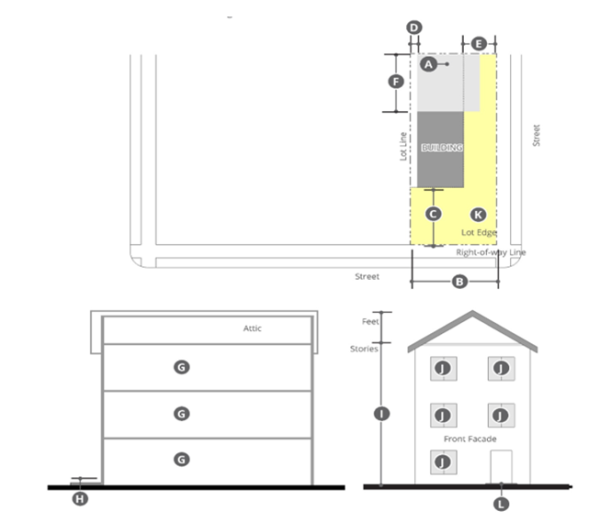
- Detached, Two-Unit, and Three-/Four-Unit House; Cottage Court Regulations. Detached houses, two-unit houses, three-/four-unit houses, and cottage courts are subject to the regulations of Table 24-3. See also Figure 24-1, which is keyed to the letter symbols in the first column of the table.
Figure 24-1. Detached, Two-Unit, and Three-Unit/Four-Unit Houses
TABLE 24-3 DETACHED, TWO-UNIT, THREE-UNIT /FOUR-UNIT HOUSES; COTTAGE COURTS
MID-RES
MID-TRN
MID-MIX
Supplemental
1. Lot
A
Minimum Lot Area (square feet)
6,000
B
Minimum Lot Width (feet)
Interior Lot
Corner Lot50
602. Principal Building Siting
C
Minimum Front Setback (feet)
25
D
Minimum Interior Side Setback (one side/both sides, feet)
3/9
E
Minimum Street Side Setback (% of lot width)
20[1]
F
Minimum Rear Setback (% of lot depth)
20[2]
3. Accessory Building Siting
Minimum Rear and Interior Side Setback (feet)
1.5
Minimum Alley Setback (feet)
5
4. Uses
G
Allowed Uses in All Stories
Residential uses allowed by Sec. 24.07.030
5. Building Coverage
Maximum Building Coverage of Principal & Accessory Buildings Combined (% of lot area)
Interior Lot
Corner Lot37
42Maximum Building Coverage of Accessory Buildings (% of lot area)
12[3]
6. Building Height
Sec. 24.06.085-M
H
First Story Floor Elevation (min/max above sidewalk, ft.)
0 to 4
I
Maximum Principal Building Height (feet)
35
I
Maximum Accessory Building Height (feet)
16[4]
7. Building Facade
J
Minimum Front Facade Transparency (%)
15
Sec. 24.06.085-O
J
Minimum Street-Side Facade Transparency (%)
5
8. Lot Edges
KEdge Type Required
Landscape
Sec. 24.06.085-P
L
Edge Element Required
Porch or Stoop
Sec. 24.06.085-Q
Table 24-3 Notes
[1] Not required to exceed 15 feet.
[2] Minimum 15 feet; not required to exceed 25 feet.
[3] Not to exceed 720 square feet.
[4] Accessory building heights of up to 20 feet may be approved by the zoning administrator if the administrator determines that the additional height is necessary to accommodate a roof pitch consistent with the architectural style of the principal building and that the additional height will not be used to create habitable floor area. - Semi-Detached and Attached House Regulations. Semi-Detached Houses and Attached houses are subject to the regulations of Table 24-4. See also Figure 24-2, which is keyed to the letter symbols in the first column of the table.
TABLE 24-4 SEMI-DETACHED AND ATTACHED HOUSES
MID-RES
MID-TRN
MID-MIX
Supplemental
1. Lot
A
Minimum Lot Area (square feet)
Semi-Detached Houses
Attached Houses3,000
2,000
B
Minimum Lot Width (feet)
Semi-Detached Houses
Attached Houses30
20
2. Principal Building Siting
C
Minimum Front Setback (feet)
25
D
Minimum Interior (non-street) Side Setback (feet)
0[1]
E
Minimum Street Side Setback (% of lot width)
20
F
Minimum Rear Setback (% of lot depth)
20[2]
3. Accessory Building Siting
Minimum Rear and Interior Side Setback (feet)
1.5
Minimum Alley Setback (feet)
5
4. Uses
G
Allowed Uses in All Stories
Residential uses allowed by Sec. 24.07.030
5. Building Coverage
Maximum Building Coverage of Principal & Accessory Buildings Combined (% of lot area)
Interior Lot
Corner Lot50
60
Maximum Building Coverage of Accessory Buildings (% of lot area)
12[3]
6. Building Width
Maximum Number of Attached Units
8
7. Building Height
Sec. 24.06.085-M
H
First Story Floor Elevation (min/max above sidewalk, ft.
0 to 4
I
Maximum Principal Building Height (feet)
35
I
Maximum Accessory Building Height (feet)
16[4]
8. Building Facade
J
Minimum Front Facade Transparency (%)
15
Sec. 24.06.085-O
J
Minimum Street-Side Facade Transparency (%)
5
9. Lot Edges
K
Edge Type Required
Landscape
Sec. 24.06.085-P
L
Edge Element Required
Porch or Stoop
Sec. 24.06.085-Q
Table 24-4 Notes
[1] End units subject to minimum 4.5-foot interior side setback.
[2] Minimum 15 feet; not required to exceed 25 feet.
[3] Not to exceed 720 square feet.
[4] Accessory building heights of up to 20 feet may be approved by the zoning administrator if the administrator determines that the additional height is necessary to accommodate a roof pitch consistent with the architectural style of the principal building and that the additional height will not be used to create habitable floor area.
Figure 24-2. Semi-detached and Attached Houses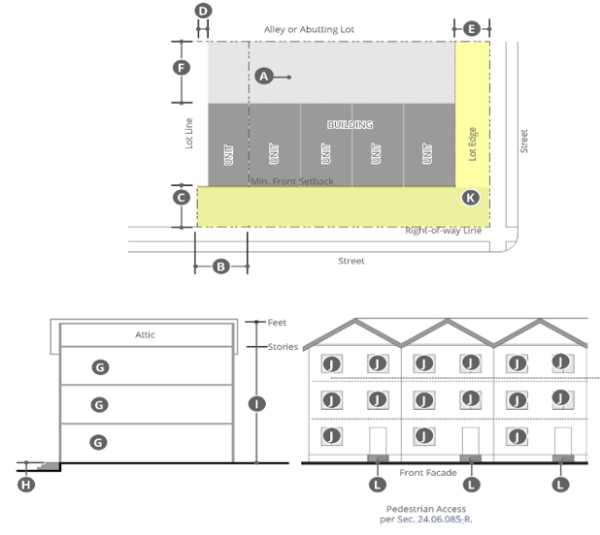
- Commercial House and Live-Work Regulations. Commercial houses are former detached houses that have been converted for occupancy by nonresidential principal uses, such as offices or retail shops. Commercial houses and live-work units are subject to the regulations of Table 24-5. See also Figure 24-3, which is keyed to the letter symbols in the first column of the table.
TABLE 24-5 COMMERCIAL HOUSES AND LIVE-WORK UNITS
MID-TRN
MID-MIX
Supplemental
1. Lot
A
Minimum Lot Area (square feet)
6,000
B
Minimum Lot Width (feet)
Interior Lot
Corner Lot50
602. Principal Building Siting
C
Minimum Front Setback (feet)
25
D
Minimum Interior Side Setback (one side/both sides, feet)
3/9
E
Minimum Street Side Setback (% of lot width)
20[1]
F
Minimum Rear Setback (% of lot depth)
20[2]
3. Accessory Building Siting
Minimum Rear and Interior Side Setback (feet)
1.5
Minimum Alley Setback (feet)
5
4. Uses
G
Allowed Uses in Ground Story
Commercial uses allowed by Sec. 24.07.030
G
Allowed Uses in Other Stories
Any use allowed by Sec. 24.07.030
5. Building Coverage
Maximum Building Coverage of Principal & Accessory Buildings Combined (% of lot area)
Interior Lot
Corner Lot50
60Maximum Building Coverage of Accessory Buildings (% of lot area)
12[3]
6. Building Height
Sec. 24.06.085-M
H
First Story Floor Elevation (min/max above sidewalk, ft.)
0 to 4
I
Maximum Principal Building Height (feet)
35
I
Maximum Accessory Building Height (feet)
16[4]
7. Building Facades
J
Minimum Front Facade Transparency (%)
15
Sec. 24.06.085-O
J
Minimum Street-Side Facade Transparency (%)
5
8. Lot Edges
K
Edge Type Required
Sec. 24.06.085-P
L
Edge Element Required
Sec. 24.06.085-Q
Table 24-5 Notes
[1] Not required to exceed 15 feet.
[2] Minimum 15 feet; not required to exceed 25 feet.
[3] Not to exceed 720 square feet.
[4] Accessory building heights of up to 20 feet may be approved by the zoning administrator if the administrator determines that the additional height is necessary to accommodate a roof pitch consistent with the architectural style of the principal building and that the additional height will not be used to create habitable floor area.
Figure 24-3. Commercial House and Live-Work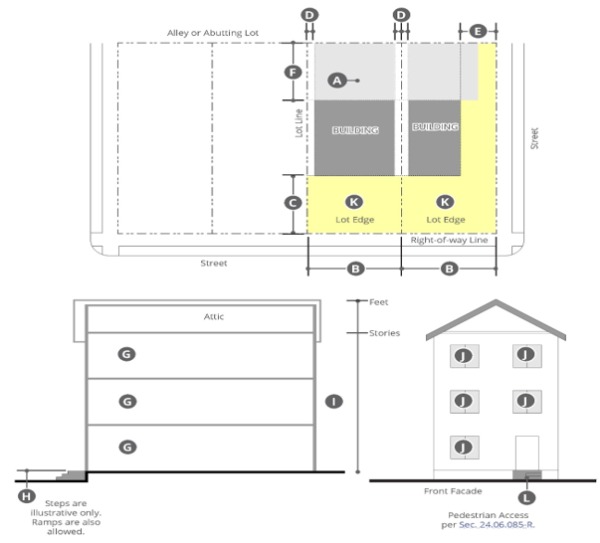 Multi-Unit Residential Building Regulations. Multi-unit residential buildings (as defined in Sec. 24.08.020.A.5) are subject to the regulations of Table 24-6. See also Figure 24-4, which is keyed to the letter symbols in the first column of the table.
 TABLE 24-6 MULTI-UNIT RESIDENTIAL BUILDINGS
MID-RES
MID-TRN
MID-MIXSupplemental
1. Lot
A
Minimum Lot Area (square feet)
6,000
6,000
B
Minimum Lot Width (feet)
Interior Lot
Corner Lot50
60
50
60
2. Principal Building Siting
C
Minimum Front Setback (feet)
25
10
C
Maximum Front Setback (feet)
30
30
Minimum Building Coverage at/between Min. and Max. Front Setback (%)
75
75
D
Minimum Interior Side Setback (one side/both sides, feet)
3/9
3/9
E
Minimum Street Side Setback (% of lot width)
20[1]
20[1]
F
Minimum Rear Setback (% of lot depth)
20[2]
20[2]
3. Accessory Building Siting
Minimum Rear and Interior Side Setback (feet)
1.5
1.5
Minimum Alley Setback (feet)
5
5
4. Uses
G
Allowed Uses in All Stories
Residential uses allowed by Sec. 24.07.030
5. Building Coverage
Maximum Building Coverage of Principal & Accessory Buildings Combined (% of lot area)
Interior Lot
Corner Lot50
60
50
60
Maximum Building Coverage of Accessory Buildings (% of lot area)
12[3]
12[3]
6. Building Width
Maximum Building Width (feet)
85
No Max.
7. Building Height
Sec. 24.06.085-M
H
First Story Floor Elevation (min/max above sidewalk, ft.)
0 to 4
0 to 4
I
Maximum Principal Building Height (feet)
45
45
I
Maximum Accessory Building Height (feet)
16[4]
16[4]
8. Building Façade
J
Minimum Front Facade Transparency
20
20
Sec. 24.06.085-O
J
Minimum Street-Side Facade Transparency
5
5
9. Lot Edges
K
Edge Type Required
Landscape
Sec. 24.06.085-P
L
Edge Element Required
Porch or Stoop
Sec. 24.06.085-Q
Table 24-6 Notes
[1] Not required to exceed 15 feet.
[2] Minimum 15 feet; not required to exceed 25 feet.
[3] Not to exceed 720 square feet.
[4] Accessory building heights of up to 20 feet may be approved by the zoning administrator if the administrator determines that the additional height is necessary to accommodate a roof pitch consistent with the architectural style of the principal building and that the additional height will not be used to create habitable floor area.
Figure 24-4. Multi-Unit Residential Building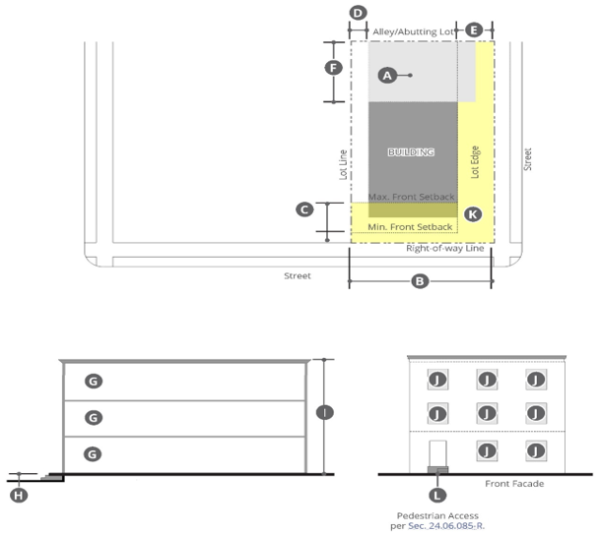
- Commercial Building Regulations. Commercial buildings are subject to the regulations of Table 24-7. See also Figure 24-5, which is keyed to the letter symbols in the first column of the table. Commercial buildings are buildings occupied by nonresidential uses in all stories of the building.
TABLE 24-7 COMMERCIAL BUILDINGS
MID-TRN
MID-MIX
Supplemental
1. Lot
A
Minimum Lot Area (square feet)
6,000
6,000
B
Minimum Lot Width (feet)
50
50
2. Principal Building Siting
C
Minimum Front Setback (feet)
10
5
D
Maximum Front Setback (feet)
25
10
Minimum Building Coverage at/between Min. and Max. Front Setback (%)
60
70
E
Minimum Interior (non-street) Side Setback (feet)
3[1]
3[1]
F
Minimum Street Side Setback (% of lot width)
10[2]
10[2]
G
Minimum Rear Setback (% of lot depth)
20[3]
20[3]
3. Accessory Building Siting
Minimum Rear and Interior Side Setback (feet)
3
3
Minimum Alley Setback (feet)
5
5
4. Uses
H
All Stories
Any use allowed by 24.07.030
5. Building Coverage
Maximum Building Coverage (% of lot area)
75
75
6. Building Height
Sec. 24.06.085-M
I
First Story Floor Elevation (min/max above sidewalk, ft.)
0 to 3
0 to 3
J
Maximum Principal Building Height (stories/feet)
3/42
3/42
Sec. 24.06.085-N
J
Maximum Accessory Building Height (feet)
20
20
7. Building Façade
K
Minimum Front Facade Transparency
Sec. 24.06.085-O
L
Ground Story
Upper Stories (above first)50
1560
20Minimum Street-Side Facade Transparency
All Stories15
15
8. Lot Edges
M
Edge Type Required
Hardscape
Sec. 24.06.085-P
Edge Element Required
None
Table 24-7 Notes
[1] No side setback is required abutting a lot occupied by a nonresidential building with no side setback along the shared lot line.
[2] Not required to exceed 15 feet.
[3] Minimum 15 feet; not required to exceed 25 feet.
Figure 24-5. Commercial Building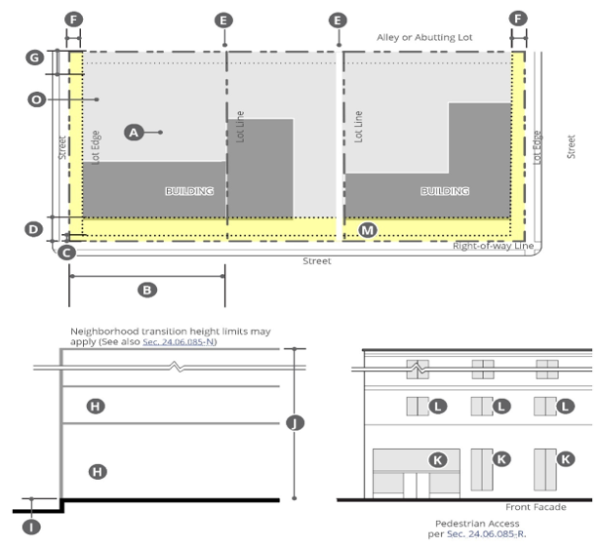
- Vertical Mixed-use Building Regulations. Vertical mixed-use buildings (as defined in Sec. 24.08.020.A.6) are subject to the regulations of Table 24-8. See also Figure 24-6, which is keyed to the letter symbols in the first column of the table. Figure 24-6. Veritical Mixed-Use Building
TABLE 24-8 VERTICAL MIXED-USE BUILDINGS
MID-TRN
MID-MIX
Supplemental
1. Lot
A
Minimum Lot Area (square feet)
6,000
6,000
B
Minimum Lot Width (feet)
50
50
2. Principal Building Siting
C
Minimum Front Setback (feet)
10
5
D
Maximum Front Setback (feet)
25
10
Minimum Building Coverage at/between Min. and Max. Front Setback (%)
60
80
E
Minimum Interior (non-street) Side Setback (feet)
3[1]
3[1]
F
Minimum Street Side Setback (% of lot width)
10[2]
10[2]
G
Minimum Rear Setback (% of lot depth)
20[3]
20[3]
3. Accessory Building Siting
Minimum Rear and Interior Side Setback (feet)
3
3
Minimum Alley Setback (feet)
5
5
4. Uses
H
Allowed Uses in Ground Story
Commercial uses allowed by Sec. 24.07.030 [4]
I
Allowed Uses in Other Stories
Any use allowed by Sec. 24.07.030
5. Building Coverage
Maximum Building Coverage (% of lot area)
75
75
6. Building Height
Sec. 24.06.085-M
J
First Story Floor Elevation (min/max above sidewalk, ft.)
0 to 1.5
0 to 1.5
K
Minimum Ground Story Height (floor-to-floor/feet)
14
14
L
Minimum Principal Building Height (stories)
2
2
L
Maximum Principal Building Height (feet)
45
45
Sec. 24.06.085-N
L
Maximum Accessory Building Height (feet)
20
20
7. Building Facade
M
Minimum Front Facade Transparency
Sec. 24.06.085-O
N
Ground Story
Upper Stories (above first)55
2070
25Minimum Street-Side Facade Transparency
All Stories15
15
8. Lot Edges
O
Edge Type Required
Hardscape
Sec. 24.06.085-P
Edge Element Required
None
Table 24-8 Notes
[1] No side setback is required abutting a lot occupied by a nonresidential building with no side setback along the shared lot line.
[2] Not required to exceed 15 feet.
[3] Minimum 15 feet; not required to exceed 25 feet.[4] Residential dwelling units may be located in the ground-story but not within 20 feet of a North Avenue-facing building facade.
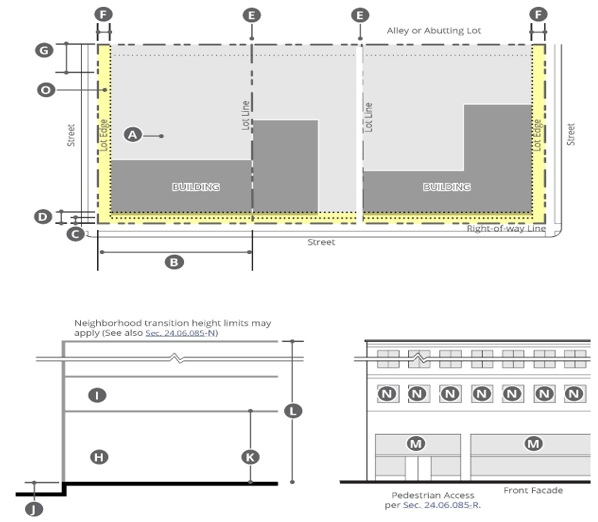
- Public and Civic Building Regulations. Public and civic buildings, which are buildings occupied solely by allowed public or civic uses, are subject to the regulations of Table 24-9.
TABLE 24-9 PUBLIC AND CIVIC BUILDINGS MID- RES MID- TRN MID- MIX Supplemental Lot Minimum Lot Area (square feet) 6,000 6,000 6,000 Minimum Lot Width (feet) 50 50 0 1. Principal Building Siting Minimum Front Setback (feet) 25 10 5 Minimum Interior (non-street) Side Setback (feet) 3[1] 3[1] 3[1] Minimum Street Side Setback (% of lot width) 20 10[2] 10[2] Minimum Rear Setback (% of lot depth) 20[3] 20[3] 20[3] 2. Accessory Building Siting Minimum Rear and Interior Side Setback (feet) 3 3 3 Minimum Alley Setback (feet) 5 5 5 3. Uses Allowed Uses in All Stories Any use allowed by Sec. 24.07.030 4. Building Coverage Maximum Building Coverage (% of lot area) 60 75 75 5. Building Height Sec. 24.06.085-M First Story Floor Elevation (min/max above sidewalk, ft.) 0 to 4 0 to 4 0 to 4 Maximum Principal Building Height (stories/feet) 3/35 3/42 3/42 Sec. 24.06.085-N Maximum Accessory Building Height (feet) 16 20 20 Table 24-9 Notes
[1] No side setback is required abutting a lot occupied by a nonresidential building with no side setback along the shared lot line.
[2] Not required to exceed 15 feet.
[3] Minimum 15 feet; not required to exceed 25 feet. - Building Height.
- Maximum overall building height limits apply to the entire building.
- Minimum story (floor-to-floor) heights must be met along all street facing facades and for at least 75% of the story area.
- The following requirements apply to vertical mixed-use building types:
- The second story area must be covered and enclosed and equal at least 75% of the first story's floor area;
- The second story facade must extend the entire width of any first story building facade except for second story areas used for unenclosed or uncovered outdoor dining area, uncovered decks, uncovered balconies, unenclosed stairs and uncovered atriums; and
- The entire indoor area of the second story must be conditioned space (HVAC) and available for human occupancy.
- Neighborhood Transition Height Limit.
- MID-MIX and MID-TRN-zoned lots that abut R-zoned lots or that are separated from R-zoned lots solely by alleys are subject to the neighborhood transition height limits of this subsection.
- Principal buildings may not exceed 3 stories or 35 feet in height within 30 feet of the lot line of the abutting or alley-separated R-zoned lot.
- Transparency. Transparency regulations govern the minimum percentage of a street-facing building façade that must be covered by windows or glazed, transparent elements. In determining compliance with transparency requirements on a building facade, the transparency of each building story must be calculated separately.
- Lot Edges.
- Description. The term "lot edge" refers to the area of a lot located immediately beyond the back of the sidewalk between:
- The back of the sidewalk and a principal building; and
- The back of the sidewalk and an allowed parking lot.
- Purpose. The design of lot edges helps define the transition between public and private property and contributes to the overall character of the area, particularly for pedestrians.
- General Lot Edge Regulations. Different lot edge types and elements are required in accordance with the regulations that apply to the different building types allowed in MID districts. The following general regulations apply to all lot edge types:
- Mechanical equipment and other building service may not be located in the lot edge along the front of the lot.
- Lot edges may not be used for vehicles, except for driveway or alley crossing, incidental service, maintenance or emergency actions.
- Landscape material used to satisfy lot edge tree planting and landscape requirements must comply with the standards of Sec. 24.12.050.
- Landscape Edge. Landscape edges are subject to the following regulations:
- Landscaping, such as trees, shrubs, groundcover plants, sod, or annual or perennial vegetation, must be provided in at least 70% of the lot edge area. The area of any stoops or porches is not counted in determining the total lot edge area.
- The landscape edge may not be used for vehicles, except for incidental service, maintenance or emergency actions.
- The landscape edge may not be covered, except by features allowed to encroach into required building setbacks (see Sec. 24.18.030-F).
- Landscape edges with a depth of 7 feet or more must be planted with at least one deciduous tree per 50 linear feet of street frontage, except where this condition is satisfied through preservation of existing on-site or adjacent street trees.
- Hardscape Edge. Hardscape edges are subject to the following regulations:
- Hardscape areas improved for pedestrian amenity or aesthetic appeal must be provided in at least 50% of the lot edge area. The area of any stoops or porches is not counted in determining the total lot edge area.
- Hardscape edges greater than 10 feet in depth must be planted with at least one deciduous tree per 50 linear feet of street frontage, except where this condition is satisfied through preservation of existing on-site or adjacent street trees.
- Hardscape edges must provide at least one bench or similar seating area per 50 linear feet.
- Hardscape edges may not be covered, except by features allowed to encroach into required building setbacks (see Sec. 24.18.030-F).
- Parking Edge.
- Lot edges that are immediately adjacent to an allowed parking lot are subject to following regulations:
- Perimeter landscaping must be provided in accordance with Sec. 24.12.020.
- At least one point of pedestrian access in the form of paths, walkways, ramps, or stairs must be provided to connect the public sidewalk to the parking lot.
- Lot edges that are immediately adjacent to an allowed parking lot are subject to following regulations:
- Description. The term "lot edge" refers to the area of a lot located immediately beyond the back of the sidewalk between:
- Edge Elements. Edge elements in the form of porches and stoops are required for detached house, two-unit houses, semi-detached house, attached house, and commercial house building types. When required, such elements are subject to compliance with the regulations of this subsection.
- Porches. Required porches must be located along the front facade and comply with the following:
- A porch must be at least 4 feet in depth, not including any steps leading to the porch.
- A porch must have a width of at least 20% of the building facade from which it projects.
- A porch must have a roof, but it may not be otherwise enclosed except by screens.
- Porches required under these MID district provisions may extend into a required front setback if such extension is at least 2 feet from all lot lines.
- A porch may not encroach onto the sidewalk or into the right-of-way.
- Stoops. Required stoops must be located along the front facade and comply with the following:
- A stoop may not exceed 6 feet in depth, not including any steps leading to the stoop.
- A stoop may have a cover but may not be enclosed.
- Stoops required under these MID district provisions may extend into a required front setback if such extension is at least 2 feet from all lot lines.
- A stoop may not encroach onto the sidewalk or into the right-of-way.
- Porches. Required porches must be located along the front facade and comply with the following:
- Pedestrian Access.
- Buildings Abutting Lot Edges. All buildings that abut a lot edge (see Sec. 24.06.085-P) are subject to the following regulations:
- All building types and individual ground-story commercial establishments must provide a pedestrian entrance along the lot edge that provides both ingress and egress, operable to residents or customers. This requirement expressly applies to individual dwelling units within an attached house building.
- Additional entrances off another street, an open space, or internal parking area are also permitted.
- If a building abuts a lot edge along more than one public street, the required pedestrian entrance must face North Avenue.
- All required entrances must provide safe and convenient pedestrian pathways from the adjacent public sidewalk. Pathways that exclusively serve individual residential units must have a minimum width of 3 feet. All other pathways must have a minimum width of 5 feet.
- Buildings Not Abutting Lot Edges. All buildings that do not abut a lot edge are subject to the following regulations:
- Buildings and individual ground-story commercial establishments must provide safe and convenient pedestrian pathway from their required pedestrian entrance to a public sidewalk. This requirement expressly applies to individual dwelling units with an attached house building.
- Pathways that exclusively serve individual residential units must have a minimum width of 3 feet. All other pathways must have a minimum width of 5 feet.
- The total combined length of the pedestrian pathway from the entrance to the sidewalk may not exceed 150% of the straight line distance from the entrance to the closest public sidewalk.
- Buildings Abutting Lot Edges. All buildings that abut a lot edge (see Sec. 24.06.085-P) are subject to the following regulations:
- Building Design.
- Applicability. The building design regulations of this section apply to all allowed building types except detached houses and two-unit houses, unless otherwise expressly stated.
- Purposes. The building design regulations of this section are intended to improve the physical and aesthetic quality of buildings, activate the pedestrian environment and maintain and protect the character of MID districts.
- Exterior Wall Finish Materials. The following exterior wall finish materials must be used on at least 80% of all street-facing building facades, not including building foundations, non-glass window components, and doors:
- Brick, including full-depth and half-depth masonry brick, but not simulated brick veneers; or
- Stone, including unpainted natural stone, unpainted cast stone having the appearance of natural stone, and unpainted terracotta.
- Vertical Delineation of Building Stories. The first one or 2 stories of every vertical mixed-use and commercial building must be delineated from the stories above through the use of cornice lines, horizontal shadow lines, fenestration and other forms of architectural detailing.
- Building Articulation and Massing. In order to avoid large expanses of flat (one-dimensional) exterior walls along sidewalks, building facades over 50 feet in length along a street, including abutting attached house dwelling units, must incorporate wall projections or recesses a minimum of 12 inches in depth. The combined length of such recesses and projections must constitute at least 20% of the total façade length along the public street.
- Rooflines. Building roof lines along street-facing facades must change at least once every 200 feet of facade length. This change must occur for a minimum length of 20 feet and be accomplished through at least one of the following:
- A change of roof parapet wall height and material;
- A change in roof cornice design;
- A change in the number of stories;
- A change in roof shape.
- Facade Length. Street-facing building facades may not exceed 300 feet in length along any single street.
- Parking.
- Parking Location.
- Access to off-street parking spaces serving attached houses must come from alleys or shared driveways located in street side or rear yard. Access to off-street parking spaces serving all other building types must come from alleys or driveways.
- Off-street parking may not be located between a public street and a principal building's front facade. On lots with more than one street frontage, the front of the lot is deemed to be North Avenue.
- Off-street parking spaces located within the ground-story of any building may not be located within 20 feet of a North Avenue-facing building facade that abuts a lot edge. This provision does not apply to the street-side facade of detached houses, two-unit houses, semi-detached houses or attached houses.
- Parking Location.
- PUD Overlays. After August 28, 2019, no new /PUD overlay districts may be established on property classified in a MID district. Existing /PUD overlay district regulations that apply to property classified in a MID district may be amended as long as such amendment does not expand the /PUD overlay district boundary in existence on August 28, 2019.
TABLE 24-2 ALLOWED BUILDING TYPES | |||
Building Types | MID Districts | ||
RES | TRN | MIX | |
P = permitted -
= prohibited | |||
Detached house | P | P | - |
Semi-detached house | P | P | - |
Two-unit house | P | P | - |
Three-unit house / Four-unit house | P | P | P |
Cottage Courts | P | P | - |
Live-Work | - | P | P |
Attached house | P | P | P |
Commercial house | - | P | - |
Multi-unit Residential Building, 5-12 units | P | P | P |
Multi-unit Residential Building, 13+ units | - | P | P |
Commercial building | - | P | P |
Vertical mixed-use building | - | P | P |
Public or civic building | P | P | P |
Adopted by Ord. O-19-17 pt. I on 8/6/2019
Amended by Ord. O-25-25 on 11/18/2025
24.06.090 Residential Planned Development District (Obsolete)
No applications may be accepted for rezoning to the Residential Planned Development district. Land classified in the Residential Planned Development district on the effective date specified in Section 24.01.020 may be used and developed in accordance with the Residential Planned Development district regulations in effect immediately preceding the effective date specified in Section 24.01.020 or in accordance with an approved PUD plan.
24.06.100 Business Planned Development District (Obsolete)
No applications may be accepted for rezoning to Business Planned Development district. Land classified in the Business Planned Development district on the effective date specified in Section 24.01.020 may be used and developed in accordance with the Business Planned Development district regulations in effect immediately preceding the effective date specified in Section 24.01.020 or in accordance with an approved PUD plan.
24.06.110 Generally Applicable Regulations
Uses and development in all SP districts are subject to all other applicable regulations and standards of this zoning ordinance, including the following (note that special parking rules apply to the SP-MED district under Sec. 24.11.060E):
- Nonconformities. See Chapter 24.15.
- Accessory Uses and Structures. See Chapter 24.10.
- Parking and Loading. See Chapter 24.11.
- Landscaping and Screening. See Chapter 24.12.
- Temporary Uses. See Section 24.10.080.
Adopted by Ord. O-18-11 pt. II on 5/1/2018

