
Wauwatosa City Zoning Code
CHAPTER 24
09 SUPPLEMENTARY USE REGULATIONS
24.09.010 Adult Family Home
- Adult family homes that are licensed, operated or permitted under the authority of the State of Wisconsin are permitted as of right in R districts if they are located at least 1,500 feet from all existing adult family homes.
- Adult family homes that are licensed, operated or permitted under the authority of the State of Wisconsin and that are located closer than 1,500 feet to existing adult family homes may be approved as a conditional use in accordance with Section 24.16.040.
24.09.020 Residential Uses
- Attached and Semi-Detached Houses.
- Applicability. Attached and semi-detached houses are subject to all applicable regulations of this zoning ordinance except as modified or supplemented by the attached and semi-detached house building regulations of this section.
- Side Setbacks. No side setback is required for common or abutting walls. Otherwise, the minimum side setback requirements of the subject zoning district apply.
- Parking and Access.
- Access to parking spaces and garages must be from the alley for all parcels abutting an alley.
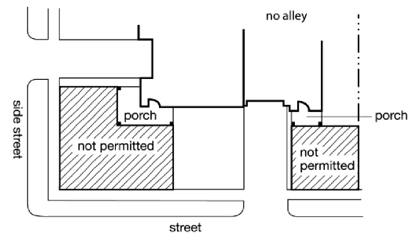
- For parcels without alley access, driveways, parking and other vehicular use areas may not be located between the porch or main building entrance and the street.
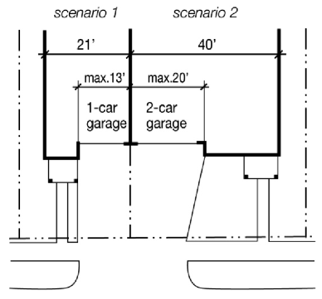
- When parking is provided in a garage that faces a street, the following standards must be met:
- The garage width may not exceed 50% of the street-facing façade of each attached dwelling unit or 13 linear feet, whichever is greater (see diagram).
- An attached and semi-detached house structure may have no more than 2 individual garage doors or carport entrances in succession on a street-facing façade.
- Garages and carports must be set back at least 20 feet from all property lines that abut a street. Garages and carports must be recessed as least 4 feet from street-facing façade of the building.
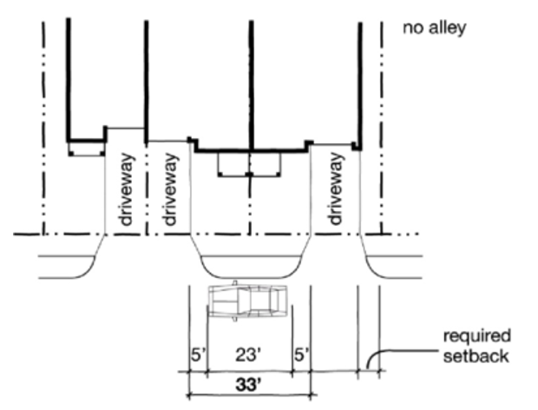
- When garages or carports are paired (abutting), driveways must be combined and centered on the property line between dwelling units providing access to the garages or carports. There must be a minimum of 33 feet distance between single or paired driveways, measured along the front property line, unless otherwise approved by the zoning administrator (see diagram).
- The width of all driveway approaches must meet city engineering standards.
- Two-Unit House.
- All Districts. The primary entrances shall be oriented toward the street frontage.
- R Districts. Two-unit dwellings shall include a shared front porch or prominent shared entry feature oriented toward the street, designed to reflect the appearance of a detached house.
- Three-Unit/Four-Unit House. The primary entrances shall be oriented toward the street frontages.
- Cottage Court.
- Number of Cottage Courts. A maximum of one cottage court shall be allowed per development site.
- Standards for Cottage Court Units on Individual Lots. If the cottage court buildings are located on individual lots, the minimum size of a cottage court lot shall be 1,500 square feet.
- Size of Dwelling Units.
- A cottage court building utilized as a dwelling shall have a maximum floor area of 1,800 square feet.
- A cottage court building utilized as a common amenity space shall have a maximum floor area of 4,000 square feet.
- Number of Dwelling Units.
- A maximum of one dwelling unit shall be allowed per building in a cottage court.
- A cottage court development site shall have a minimum of four and a maximum of 16 buildings per site.
- One of the allowed cottage court buildings may be utilized for common amenity space.
- Building Orientation and Design.
- Buildings shall be oriented with their main entrance facing the shared common court open space, except for corner buildings.
- Corner buildings shall be oriented with their main entrance facing either the shared common court open space or the public right of way.
- Buildings shall have a front porch meeting the following standards:
- Width. Eight feet minimum
- Depth. Six feet minimum
- Height. Eight feet minimum
- Permanent Foundation Required. Individual cottage home court buildings shall be affixed to the ground with a permanent foundation.
- Common Court Open Space.
- Buildings in a cottage court shall be arranged around a common court.
- The common court shall be open to and visible from the public right of way.
- The common court shall have a minimum area of 2,500 square feet.
- The common court shall have a minimum width of 30 feet as measured from the interior of the pedestrian walkway.
- Required building setbacks do not count as common court open space.
- A maximum of 30 percent of a common court open space may be used for stormwater management if designed as a rain garden or bioswale.
- Pedestrian Access.
- A pedestrian walkway with a minimum width of five feet shall connect all buildings to the public right of way, common court open space, and parking areas.
- The pedestrian walkway shall be setback a minimum of six feet from building entrances.
- Vehicle Access and Parking.
- Parking and driveways shall be located to the rear of the buildings in a dwelling-cottage/tiny home court.
- Parking shall be accessed by an alley if an alley exists.
- If no alley exists, parking shall be accessed by a single driveway.
- The driveway shall be located either:
- From the secondary street for a corner development site, or
- To the interior side of the buildings on the development site.
- Universal Design. A minimum of 5% of units, and no fewer than 2 units per cottage court shall be designed with accessible no-step entries.

- Live-Work Unit.
- Live-work units are not considered home occupations. Home occupations are regulated separately under Section 24.10.020.
- The work area shall occupy a maximum of 50 percent of the total unit.
- The work area shall be limited to the first or main floor only.
- A minimum of one person shall reside and be employed in the live work unit.
- A maximum of five people who are not residents of the live work unit may be employed in the work area at any one time.
- Allowed nonresidential uses in a live-work unit shall include:
- Artisan Manufacturing,
- General Commercial,
- Office, Administrative, Professional.
- Personal Services, and
- Private Meeting/Recreation/Event Facility.
HISTORY
Adopted by Ord. O-19-05 pt. IV on 4/2/2019
Repealed & Replaced by Ord. O-25-25 on 11/18/2025
Adopted by Ord. O-19-05 pt. IV on 4/2/2019
Repealed & Replaced by Ord. O-25-25 on 11/18/2025
24.09.030 Bed And Breakfast
Bed and breakfasts may be approved in accordance with conditional use procedures of Section 24.16.040.
- bed and breakfasts must be located at least 1,500 feet from all existing bed and breakfast uses; and
- the maximum number of guest rooms must be established by the common council as part of the conditional use approval process.
HISTORY
Adopted by Ord. O-19-05 pt. V on 4/2/2019
Adopted by Ord. O-19-05 pt. V on 4/2/2019
24.09.040 Community Living Arrangements
- Facilities Permitted as of Right. Community living arrangement that are licensed, operated or permitted under the authority of the State of Wisconsin are permitted as of right in R districts, provided that they comply with all of the following requirements:
- the community living arrangement is limited to a maximum capacity of 8 or fewer persons;
- the community living arrangement must be located at least 1,500 feet from all existing community living arrangements;
- the applicant must provide written documentation of the capacity of the community living arrangement; and
- the total capacity of all community living arrangements in R districts within the aldermanic district in which they are located may not exceed 25 persons or 1% of the population of the district based on the latest census information, whichever is greater.
- Facilities Subject to Conditional Use Approval. Community living arrangement that are licensed, operated or permitted under the authority of the State of Wisconsin, but that do not comply with all of the requirements of Section 24.09.040A may be approved as a conditional use in accordance with Section 24.16.040.
- Criteria for Determining Over-Concentration. When applying the general conditional use review criteria and standards of Section 24.16.040G to a conditional use permit application for community living arrangements, the common council must find that the proposed conditional use will not create an over-concentration of community living arrangement facilities that could create an institutional setting or seriously strain the existing social structure or resources of the community. The following considerations are relevant to this over-concentration determination and finding:
- distance separating the proposed community living arrangement from other such facilities;
- capacity of the community living arrangement in relation to the total capacity of all the community living arrangements in the community;
- impact on the community of other community living arrangements;
- success or failure of integration into communities of other community living arrangements operated by the individual or group seeking the conditional use permit;
- ability of the community to meet the special needs, if any, of the proposed facility.
- Facilities for Persons with Disabilities.
- When considering a conditional use permit application for a community living arrangement serving persons with disabilities and when the facility is proposed to be located more than 1,500 feet from another community living arrangement serving persons with disabilities, it must be presumed by the common council that the conditional use permit review criteria and standards of Section 24.16.040G and Section 24.09.040B.1 have been met unless the record establishes the contrary by evidence that is clear, satisfactory and convincing.
- When considering a conditional use permit application for a community living arrangement serving persons with disabilities and when the facility is proposed to be located within 1,500 feet of another community living arrangement serving persons with disabilities, the common council must presume that the proposed conditional use will create an over-concentration of community living arrangements and institutional setting that is contrary to the purpose for which community residential programs were established and seriously strains the existing social structure and resources of the community. No conditional use permit may be approved in such case unless the applicant demonstrates by evidence that is clear, satisfactory and convincing that such an over-concentration will not result.
- State Inspection and Review. As a condition of any conditional use permit application for a community living arrangement, the zoning administrator must request an inspection [of] the proposed facility and a review of the proposed program pursuant to Section 46.03(22)(b) of the Wisconsin Statutes. No community living arrangement use may commence until the inspection and review has been completed by the state.
- Identification of Client Group. Every conditional use application for a community living arrangement must identify the client group being served by the facility. Any change in the client group being served by the facility is considered a major amendment to the approved conditional use permit and requires approval of a new conditional use permit in accordance with the procedures of this section.
- Community Advisory Committee. No conditional use application may be considered by the plan commission or common council unless the owner or operator of the facility first establishes and maintains a community advisory committee and reviews the operation of the proposed facility with the community advisory committee. These requirements may be considered to have been met upon a showing by the applicant that a good faith effort has been made by the owner or operator to establish the community advisory committee.
- Criteria for Determining Over-Concentration. When applying the general conditional use review criteria and standards of Section 24.16.040G to a conditional use permit application for community living arrangements, the common council must find that the proposed conditional use will not create an over-concentration of community living arrangement facilities that could create an institutional setting or seriously strain the existing social structure or resources of the community. The following considerations are relevant to this over-concentration determination and finding:
(Ord. O-13-17, § XI, 11-19-2013)
HISTORY
Amended by Ord. O-16-13 pt. III on 5/3/2016
Amended by Ord. O-16-13 pt. III on 5/3/2016
24.09.050 Convenient Cash Businesses
- Purpose.
- The purpose of this section is to provide for the regulation of convenient cash businesses and other similar establishments.
- It is recognized that convenient cash businesses have the potential to be harmful to the public welfare, both in regards to the community harmony and with respect to potential effects on the quality, aesthetics and functional aspects of the community. The purpose of regulating convenient cash services is to ensure compatibility with surrounding uses and properties and to avoid an unchecked proliferation of convenient cash services that may result in the displacement of other necessary commercial and financial services.
- Such businesses tailor their services to make them attractive to persons experiencing unfavorable economic circumstances, often aggravating those circumstances. Additionally, it has been found that through their business practices, convenient cash businesses are susceptible to attracting criminals seeking to commit robberies. Finally, when clustered in an area or strung out along an arterial street, such concentration creates an unwarranted negative impression regarding the economic vitality of a commercial district and the community at large. Based on their proliferation, their susceptibility to crime and the negative effects of their proliferation, the common council finds that the health, safety and welfare of the residents of the City of Wauwatosa should be protected by legislation limiting the geographic proliferation of convenient cash businesses.
- It is therefore the intent of this zoning ordinance to regulate the locations and hours of operation of convenient cash businesses in the City of Wauwatosa.
- Location and Operation of Convenient Cash Businesses.
- Convenient cash businesses may not be located within 2,500 feet of any other convenient cash business.
- Convenient cash businesses may not be located within 250 feet of a residential district, as measured by the shortest line between the parcel to be occupied by the proposed convenient cash facility and the property line of the nearest R-zoned property.
- Convenient cash businesses may not operate between the hours of 9:00 p.m. and 9:00 a.m.
- Businesses must keep a glass entrance and exit doors with all windows clear of any signs or advertisements.
- The building or portion thereof that is dedicated to the convenient cash use must have a minimum size of 1,500 square feet of building floor area.
- All convenient cash businesses must purchase and provide to the City of Wauwatosa, based upon specifications provided by the city, one outdoor surveillance camera and wireless subscription module (total cost not to exceed $5,000) to be positioned in close proximity to the business at a location determined by the city. The city will be the owner of this equipment and be responsible for its repair and maintenance.
- The applicant must provide a security plan that addresses the following:
- limits on amount of cash immediately available for withdrawal;
- lighting plan for the business showing both exterior and interior lighting;
- plans for maintaining visibility into the interior of the check cashing facility;
- plans for security of the check cashing area of the facility;
- a program for graffiti and litter abatement;
- hours of operation; and
- use of security guards and cameras.
- The convenient cash business should work with the city and the police department to allow specific access by the police department to interior security cameras in the event of an emergency.
- Conditional use permit application fees for businesses regulated pursuant to this section must be increased above normal fees in an amount sufficient to fund notices to all property owners within 250 feet of the parcel on which the proposed convenient cash business is to be located.
24.09.060 Foster Home Or Treatment Foster Home
- Foster homes and treatment foster homes that are not owned by a corporation, child welfare agency, religious assembly, association or public agency are permitted as of right in R districts, provided that they comply with all of the following requirements:
- the foster home or treatment foster home must be licensed, operated or permitted under the authority of the Wisconsin Department of Health and Family Services; and
- the foster home or treatment foster home must be the primary domicile of the foster parent or treatment foster parent.
- Foster homes and treatment foster homes that are owned by a corporation, child welfare agency, religious assembly, association or public agency are permitted as of right in R districts, provided that they comply with all of the following requirements:
- the foster home or treatment foster home must be licensed, operated or permitted under the authority of the Wisconsin Department of Health and Family Services;
- the proposed foster home or treatment foster home must be located at least 1,500 feet from an existing foster home or treatment foster home; and
- the total capacity of all foster homes and treatment foster homes within the aldermanic district in which they are located may not exceed 1% of the total population of the district.
- Foster homes and foster treatment homes that are licensed, operated or permitted under the authority of the State of Wisconsin, but that do not comply with all of the requirements of Section 24.09.060A or Section 24.09.060B, as applicable, may be approved as a conditional use in accordance with Section 24.16.040.
24.09.070 (RESERVED)
24.09.070 RESERVED
HISTORY
Repealed & Replaced by Ord. O-25-25 on 11/18/2025
Repealed & Replaced by Ord. O-25-25 on 11/18/2025
24.09.080 Community Garden
Community gardens are subject to the following regulations.
- A community garden area may be divided into separate garden plots for cultivation by one or more individuals or may be farmed collectively by members of the group.
- Community garden group members may or may not reside on the subject property.
- Community gardens are subject to all front and street side setback regulations of the zoning district in which they are located.
- Any structure used in conjunction with a community garden must comply with the following requirements:
- Be located at least 10 feet from any property line.
- If the total area of structures used in conjunction with a community garden does not exceed 80 square feet, the structures are not considered accessory buildings. Otherwise, all structures used for community gardens are accessory buildings and must comply with the applicable accessory use and structure regulations of Chapter 24.10.
- The following are not considered structures for the purposes of this section: benches, bike racks, cold-frames, hoop houses, raised/accessible planting beds, compost or waste bins, picnic tables, garden art, rain barrels or other rainwater harvesting systems and children's play areas.
- The site must be designed and maintained so that water and fertilizer will not drain onto adjacent property.
- Sales and donation activities may occur only in locations where retail sales or agricultural product sales are an allowed use, provided that on-site sale and donation of crops grown on the community garden site may be authorized as a temporary use in accordance with Section 24.10.080.
- The operator of a community garden must maintain the property in productive use during the growing season.
- At the end of each growing season annual vegetation must be cut down to a height of not more than 6 inches above ground level.
24.09.090 Large-Format Retail Developments
- Purpose. The large-format retail development regulations of this section apply design standards and additional conditions to large commercial developments in order to ensure that such developments are properly located and compatible with the surrounding area and community character and that such developments do not negatively affect the city and property owners. These large developments should present high-quality materials and design, promote pedestrian-friendly environments, encourage [and] incorporate effective stormwater management practices to minimize impervious area and prevent water quality and flooding impacts and ensure that the development is beneficial to the community.
- Applicability. The large-format retail development regulations of this section apply to individual freestanding buildings and group developments with a cumulative gross floor area of 50,000 square feet or more of retail sales area, including all structures and outdoor sales areas within the development and regardless of diverse lotting, use or tenancy.
- Development Agreement. Any development agreement approved by the common council pursuant to these regulations must conform as closely as possible to these standards, but the common council is granted the flexibility to consider the unique requirements of the individual development.
- Conditional Use and PUD Approvals. Conditional use approval or planned unit development (PUD) approval does not exempt large-format retail developments from the applicable large-format retail development regulations of this section.
- Community Impact Statement. The purpose of conditional use review is to provide for detailed analysis of certain land uses which, because of their scale or intensity of use, have the potential for significant impact on the health, safety or general welfare of residents, including negative effects on the environment, abutting property values, the character of the surrounding neighborhood, demand for services and infrastructure and traffic safety.
- At the time of submission of an application for conditional use for a property subject to the large-format retail development regulations of this section, or as otherwise required by law, the applicant must submit to the city a community impact statement, prepared to appropriate professional standards, which must evaluate the potential impact of the development upon the factors below. The scope and detail of the community impact statement is subject to the discretion of the development director:
- Traffic and parking conditions on site and within the surrounding area;
- Municipal utilities and services including water supply, sewage, disposal, stormwater management systems and flooding potential, police, fire protection, emergency services, schools and other city services;
- The physical and ecological characteristics of the site and the surrounding land, including wetlands, floodplain vegetation, wildlife habitat and other environmental conditions;
- The character of the community, including scenic, historic and archaeological conditions;
- The economic impact of the project on local businesses and residents, including number and types of jobs created, amount of local labor to be used, the amount, type and location of potential spin-off development, impact of changing land use patterns and potential for development pressure on surrounding neighborhoods.
- At the time of submission of an application for conditional use for a property subject to the large-format retail development regulations of this section, or as otherwise required by law, the applicant must submit to the city a community impact statement, prepared to appropriate professional standards, which must evaluate the potential impact of the development upon the factors below. The scope and detail of the community impact statement is subject to the discretion of the development director:
- The costs of all studies and investigations reasonably necessary to prepare a community impact statements required under this section must be borne by the applicant. If it becomes necessary for the city to hire outside professionals to review the impact statement, the cost of hiring the consultant(s) must be borne by the applicant.
- Aesthetic and Visual Guidelines. Unless otherwise specifically provided in a development agreement approved by the common council, large-format retail developments must comply with the following provisions, subject to review by the design review board:
- Smaller Retail Stores. The presence of smaller retail stores gives a center a "friendlier" appearance by creating variety, breaking up large expanses and expanding the range of the site's activities. Windows and window displays of such stores should be used to contribute to the visual interest of exterior facades. When principal buildings contain additional, separately owned stores that occupy less than 50,000 square feet of gross floor area, with separate customer entrances:
- The street level facade of such stores must be transparent between the height of three feet and eight feet above the walkway grade for no less than 60% of the horizontal length of the building facade of such additional stores;
- Windows must be recessed and should include visually prominent sills, shutters, or other such forms of framing.
- Facades and Exterior Walls Including Sides and Backs.
- The building must be designed in a way that will reduce the massive scale and uniform and impersonal appearance and will provide visual interest consistent with the community's identity, character and scale. Buildings must have at least two functional stories unless approved by the plan commission. Long building walls of at least 100 feet must be broken up with projections or recessions of sufficient depth along all sides and in sufficient number, to reduce the unbroken massing into lengths of approximately 50 feet or less along all sides of the building. Projections from the facade can be used as an alternate approach.
- Along any public street frontage, the building design should include vision windows, arcades, awnings or other acceptable features along at least 60% of the building length. Arcades and other weather protection features must be of sufficient depth and height to provide a light-filled and open space along the building frontage. Architectural treatment, similar to that provided to the front facade must be provided to the sides and rear of the building to mitigate any negative view from any location off-site and any public area (e.g., parking lots, walkways, etc.) on-site. Where the facade faces adjacent residential uses, screening and buffering consisting of a mix of evergreen and deciduous trees or a fence must be installed providing at least the equivalent level of screening of an earthen berm that is at least 6 feet in height, containing at a minimum, a double row of evergreen or deciduous trees planted at intervals of 15 feet on center. The spacing and selection of trees may be modified if the landscaped area is designed for stormwater treatment, provided sufficient fencing or other visual screening is provided to achieve the equivalent level of screening. Additional landscaping or fencing may be required by the plan commission or design review board to effectively buffer adjacent land use as deemed appropriate.
- Detail Features. The building must include architectural features that contribute to visual interest at the pedestrian scale and reduce the massive aesthetic effect by breaking up the building wall, front, side, or rear, with color, texture changes, wall offsets, reveals, or projecting ribs. The use of planter boxes and green wall features providing stormwater management and water quality benefits is encouraged as a means of meeting this standard.
- Roofs. The roof design must provide variations in rooflines and add interest to and reduce the massive scale of, large buildings. Roof features must complement the architectural and visual character of adjoining neighborhoods. Roofs must include two or more roof planes. Parapet walls must be architecturally treated to avoid a plain, monotonous look.
- Materials and Color. The buildings must have exterior building materials and colors that are aesthetically pleasing and compatible with materials and colors that are used in adjoining neighborhoods. This includes the use of high-quality materials and colors that are low-reflective, subtle, neutral, or earth tone. Examples of acceptable high-quality materials include: brick, wood, sandstone and other native stone. Certain types of colors must be avoided such as fluorescent or metallic although brighter colors in limited quantities as building trims and as accents may be considered at the discretion of the plan commission or design review board. Construction materials such as tilt-up concrete, smooth-faced concrete block, prefabricated steel panels and other similar materials must be avoided unless the exterior surface is covered with an acceptable architectural treatment.
- Entryways.
- The building design must provide design elements which clearly indicate to customers where the entrances are located and which add aesthetically pleasing character to buildings by providing highly visible customer entrances. Large retail buildings are encouraged to feature multiple entrances. Multiple entrances reduce walking distances from cars and facilitate pedestrian and bicycle access from public sidewalks. Multiple entrances also mitigate the effect of unbroken walls and neglected areas that often characterize building facades that face bordering land uses.
- If a building faces multiple public or private rights-of-way, it must feature at least one customer entrance on those sides. Where the principal building faces more than two abutting public or private rights-of-way, this requirement may be interpreted to apply only to the two sides of the building facing the primary street and one secondary street. Where additional stores will be located in the principal building, each store must have at least one exterior customer entrance, which must conform to the above requirements. The number of entrances must be addressed at the preliminary development plan stage.
- Screening of Mechanical Equipment. Mechanical equipment must be screened to mitigate noise and views in all directions. If roof-mounted, the screen must be designed to conform architecturally to the design of the building either with varying roof planes or with parapet walls.
- Smaller Retail Stores. The presence of smaller retail stores gives a center a "friendlier" appearance by creating variety, breaking up large expanses and expanding the range of the site's activities. Windows and window displays of such stores should be used to contribute to the visual interest of exterior facades. When principal buildings contain additional, separately owned stores that occupy less than 50,000 square feet of gross floor area, with separate customer entrances:
- Site Design and Relationship to Surrounding Community. Unless otherwise specifically provided in a development agreement approved by the common council, all large-format retail developments must comply with the following:
- Traffic Impacts. The applicant must have a traffic impact study prepared according to the standard traffic methodology. In addition to the general standards of the methodology, the traffic impact study must include weekend traffic generation and impact analysis. The traffic impact study must also study intersections within an area designated by the city engineer to take into account the regional traffic draw of a large-scale retail establishment.
- Vehicular Access. The use must provide safety and protection to adjacent uses by having motor vehicles access only from an arterial, major or business district road as designated in the master plan.
- Stormwater Management. Every application must be accompanied by a stormwater impact statement in order for the permit application to be considered. The city engineer must prescribe the form(s) and information that must be submitted to determine compliance with Title 18 of the city code of ordinances and other applicable stormwater rules. Applicants are encouraged to pursue low-impact stormwater management practices such as bioretention and pervious pavement if they are determined to be appropriate for the site by the city engineer.
- Landscaping. Each parking area must be surrounded by a ten-foot-wide landscaped area around its edge. Shade and ornamental trees are also required in the parking areas, with the amount and placement to be determined through consultation with the city forester. Species should be suitable for their location including resistance to salt damage and appropriateness for climate. Landscaping must be in compliance with Chapter 24.12 and receive approval from the design review board.
- Buffers. The use must provide visual and noise buffers to nearby residential uses. This can be accomplished by providing a substantial building setback from a residential use or residentially zoned property that is adjacent to the site. A landscape buffer of substantial width should be provided adjacent to the site property line where it adjoins residential uses or zones. The landscape buffer should include deciduous and evergreen trees at regular intervals to provide noise, light and visual screening. No other uses, such as, but not limited to, parking or storage, are permitted within the landscape buffer area.
- Pedestrian Flows. The project must provide pedestrian accessibility, safety and convenience to reduce traffic impacts and enable the development to project a pedestrian-friendly, inviting image. Continuous internal pedestrian walkways, no less than 6 feet in width must be provided from the public sidewalk or right-of-way to the principal customer entrance of all principal buildings on the site. Sidewalks must also connect the store to transit stops on- or off-site and to nearby residential neighborhoods. If possible, walkways must connect focal points of pedestrian activity such as, but not limited to, transit stops, street crossings, building and store entry points and must feature adjoining landscaped areas that include trees, shrubs, benches, flower beds, ground covers, or other such materials for no less than 50% of their length. Sidewalks must be provided along the full length of any building along any facade featuring a customer entrance and along any facade abutting public parking areas. Such sidewalks must be located at least 6 feet from the facade of the building to provide planting beds for foundation landscaping, except where features such as arcades or entryways are part of the facade. Internal pedestrian walkways must provide weather protection features such as awnings or arcades within 30 feet of all customer entrances, constructed parallel to the facade of the building. This is not intended to extend into the driving aisles or parking areas. All internal pedestrian walkways must be distinguished from driving surfaces through the use of durable, low maintenance surface materials such as pavers, bricks, or scored concrete to enhance pedestrian safety and comfort, as well as the attractiveness of the walkways.
- Central Features and Community Spaces. The project is to provide attractive and inviting pedestrian scale features, spaces and amenities. Entrances and parking lot locations must be functional and inviting with walkways conveniently tied to logical destinations. Bus stops should be considered internal parts of the configuration whether they are located on-site or along the street. Customer drop-off/pick-up points that may be provided should also be integrated into the design and should not conflict with traffic lanes or pedestrian paths. Special design features such as towers, arcades, porticos, light fixtures, planter walls, seating areas and other architectural features that define circulation paths and outdoor spaces must anchor pedestrian ways. Examples are outdoor plazas, patios, courtyards and window shopping areas. Each development should have at least two of these areas.
- Outdoor Lighting. The applicant must provide an outdoor lighting report which provides information on how outdoor lighting will be accomplished to minimize impacts on adjacent properties or roadways. Outdoor lighting should provide clear visibility and a feeling of security. This can be accomplished by aiming the lights down and placing hoods on them. The light element should not protrude below the lower edge of the hood. To minimize any indirect overflow of light on adjacent residential properties, the height of any proposed parking lot light standard should be as short as possible and should stair step down to a lower height when close to residential uses or residentially used properties.
- Outdoor Sales and Storage. Areas for outdoor sales of products may be permitted if they are extensions of the sales floor into which patrons are allowed free access. Such areas must be incorporated into the overall design of the building and the landscaping and must be permanently defined and screened with walls and/or fences. Materials, colors and design of screening walls and/or fences must conform to those used as predominant materials and colors on the building. If such areas are to be covered, then the covering must be similar in materials and colors to those that are predominantly used on the building facade. Outdoor sales areas are considered part of the gross floor area of the retail establishment. Outdoor storage of products in an area where customers are not permitted is prohibited. This prohibition includes outdoor storage sheds and containers.
- Delivery and Loading Spaces.
- Delivery and loading operations must be designed and located to mitigate visual and noise impacts to streets and adjoining residential neighborhoods. If there is a residential use or residentially zoned area adjacent to the site, such operations are not permitted between 9:00 p.m. and 6:00 a.m. (Chapter 7.46 of the city code of ordinances). For good cause shown, the plan commission may permit deliveries at additional times provided the applicant submits evidence that such deliveries will not negatively impact nearby residential uses. Delivery and loading areas must be substantially set back from a residential use or residentially zoned property that is adjacent to that site. A landscape buffer of substantial width should be provided adjacent to the delivery and loading area where it adjoins residential uses or zones. The landscape buffer should include evergreen shrubs and/or trees plus deciduous trees at regular intervals to provide noise, light and visual screening. If the delivery and loading spaces are located within an enclosed building or underground, no such setback and buffer area is required.
- Delivery trucks may not be parked on the premises during nondelivery hours with motor and/or refrigerators/generators running, unless the truck noise is mitigated so that it does not significantly affect nearby residential properties.
- The delivery and loading areas must be screened or enclosed so that they are not visible from public streets, public sidewalks, internal pedestrian walkways or adjacent properties. The screen must be of masonry construction and at least 10 feet high or of a design approved by the design review board to screen the noise and activity of the loading dock.
- Accessory Uses. All accessory uses must be compatible with the proposed development and be an allowed use under AA business district zoning. The parking lot may not provide space for overnight camping, storage of vehicles, or additional activities with the exception of those uses approved under other sections of the ordinance codified in this chapter. The applicant must demonstrate that any accessory uses will not have negative impacts on adjacent residential uses, residentially zoned properties, or adjacent properties. Any accessory uses must be oriented to face away from any residential use or residentially zoned property that is adjacent to the site.
- Temporary or Seasonal Uses. Nonenclosed areas for the storage and sale of seasonal inventory must be permanently defined and screened with walls and/or fences. Materials, colors and designs of screening walls and/or fences and the cover must conform to those used as predominant materials and colors of the building. No such sales/displays are allowed in required off-street parking areas unless reviewed and approved by the board of public works.
- Trash Collection Area and Time Limitations. Loading areas and outdoor storage areas exert visual and noise impacts on surrounding neighborhoods. These areas should be gated and screened, recessed or enclosed so that they are not visible from adjoining properties and/or public streets. While screens and recesses can effectively mitigate these impacts, the selection of inappropriate screening materials can exacerbate the problem. Appropriate locations for loading and outdoor storage areas include areas between buildings, where more than one building is located on a site and such buildings are not more than 40 feet apart, or on those sides of buildings that do not have customer entrances. No area for outdoor storage, trash collection or compaction, loading, or other such uses may be located within 20 feet of any public street, public sidewalk or pedestrian right-of-way. Loading docks, truck parking, outdoor storage, utility meters, HVAC equipment, trash dumpsters, trash compaction and other service functions must be incorporated into the overall design of the building and the landscaping so that the visual and acoustic impacts of these functions are fully contained and out of view from adjacent properties and public streets and no attention is attracted to the functions by the use of screening materials that are substantially different from or inferior to the principal materials of the building and landscape. In locations where applicable, refuse collection is subject to the time limitations in Section 7.46.060 of the city code of ordinances.
- Parking Lots and Structures. Parking areas must provide safe, convenient and efficient access for vehicles and pedestrians. They must be distributed around large buildings in order to shorten the distance to other buildings and public sidewalks and to reduce the overall scale of the paved surface. Ideally, no more than 30% of the total parking provided should be located on any side facing a street unless approved by the city plan commission. If buildings are located closer to streets, the scale of the complex is reduced, pedestrian traffic is encouraged and architectural details take on added importance. No more than 60% of the off-street parking area for the entire property may be located between the front facade within the front yard of the principal building(s) and the primary abutting street unless the principal building(s) and/or parking lots are screened from view by outlot development and additional tree plantings and/or berms. Landscaping must be used to define parking areas, primary vehicular drives and pedestrian areas in an aesthetically and environmentally pleasing manner. Parking structure facades should achieve the same high-quality design and appearance as the buildings they serve. The parking structure's utilitarian appearance should be minimized by utilizing effective design treatments such as colonnades, arcades, awnings, street furniture and other public amenities. Compatible materials, coordinated landscaping and screening, appropriate building color, sensitive lighting and signage should all be considered for garage facades.
- Maintenance and Reuse of Properties.
- Unless otherwise specifically provided in a development agreement approved by the common council, all large-format retail developments are subject to the following provisions:
- The owner must maintain the property in compliance with all provisions of the city code of ordinances or a plan approved as part of a development agreement approved by the common council. If the property is not found to be in compliance with the code or the approved plan, the city may take action to correct the situation, after providing the owner or operator with notice of the defective condition and an opportunity to cure the alleged defective condition. Costs of any such corrective action by the city will be assessed as a special charge against the property, to be added to the property tax bill pursuant to Section 66.0627 of the Wisconsin Statutes.
- If the facility is vacated, the owner or operator, within twelve months, must submit, to the plan commission, a plan contemplating the removal or reuse of the facility. The time limit may be extended by the plan commission. If the owner or operator is unable to provide a plan which is acceptable to the plan commission, the city may utilize the Land Conservation Fund described in Section 20.14, Charter Ordinances, or other funds which may be made available for such purpose, to take whatever action is permitted by law to assure appropriate redevelopment or reuse of the facility.
- Prior to issuance of a building permit for any large-format retail development, the building owner must contribute to the Land Conservation Fund described in Section 20.14, Charter Ordinances, City of Wauwatosa. The amount of contribution will be calculated based upon the number of square feet of retail space being created and must be as set forth in the consolidated fee schedule.
- Unless otherwise specifically provided in a development agreement approved by the common council, all large-format retail developments are subject to the following provisions:
(Ord. O-14-20, pt. XIII, 8-5-2014)
24.09.100 Sexually Oriented Businesses
The following uses of land are specifically prohibited except as provided under this chapter: sex bookstores, coin-operated motion picture devices showing sex movies and cabarets or any places featuring nude or semi-nude dancers, strippers or similar type entertainment.
- Purpose and Intent. It is declared to be the purpose and intent of these sexually oriented business regulations to protect the public health, safety, welfare and morals of the community, to promote the stability of property values and impose restrictions upon those activities which pander to gross sexuality in a manner that would detract from the neighborhood, adversely affect the property values, increase crime and violence and be repugnant to the morals of the community. In recognition of the protections afforded to the citizens under the First and Fourteenth Amendments, it is not the intent of these regulations to inhibit freedom of speech or the press, but rather to deter those of low morals from imposing their lack of morals upon the rest of the community; and further recognizing that those parts of a community, which become centers of loose moral conduct, frequently become places of rowdiness, criminality and indecent behavior. It is further the belief that just as advertising is designed to stimulate one's appetite for desiring goods or a service, an overabundance of and preoccupation with sexual displays or material arouses the appetites of those so preoccupied and encourages violations of the criminal statutes involving sexual offenses and is contrary to the health, safety and welfare of the community.
- Book Sales. No person, firm or corporation shall establish any bookstore or book department of a store in which a substantial or significant portion of its stock in trade is in books, magazines and other periodicals which are distinguished or characterized by their emphasis on matter depicting, describing or relating to "specified sexual activities" or "specified anatomical areas," except as provided in Section 24.09.100G.
- Sexual Device Stores. No person, firm or corporation shall operate any sexual devices store for the display or sale of sex stimulating devices, aids to sexual gratification, or devices to perform the functions of male or female genitals, or other similar articles or devices, except as provided in Section 24.09.100G.
- Mini-motion Displays. No person, firm or corporation shall offer for viewing through coin-operated motion picture devices any movie or other form of display which has significant displays of specified sexual activities, or specified anatomical areas, except as provided in Section 24.09.100G.
- Motion Picture Theaters. No person, firm or corporation shall operate a movie theater distinguished or characterized by an emphasis on presenting material depicting, describing or relating to specified sexual activities or specified anatomical areas for observation by patrons therein, except as provided in Section 24.09.100G.
- Cabarets. No person, firm or corporation shall feature or permit topless dancers, bottomless dancers, exotic dancers, strippers or persons engaged in specified sexual activities or similar entertainers, except as otherwise provided in Section 24.09.100G.
- Exceptions. Such use or uses as prohibited by the regulations of this section may be waived; provided that such building is not located within 500 feet of any residential dwelling, rooming unit, school, hospital, church or place of worship, or stores that may be frequented by children under the age of 18. This prohibition may be waived if the person applying for the waiver files with the common council a petition of the proposed regulated use signed by 51% of the persons owning, residing, or doing business within a radius of 500 feet of the location of the proposed use. The petitioner shall attempt to contact all eligible locations within this radius and must maintain a list of all addresses at which no contact was made. A minimum of 100 responses is required. In the event that the 500 feet radius is not sufficiently populated to provide 100 residences and/or business places eligible to respond, the radius will be increased in increments of 100 feet until there is an area large enough to contain 100 eligible residences and/or business places. In addition to these conditions, such use is subject to the conditional use procedures of Section 24.16.040.
24.09.110 Wireless Communication Facilities
- Freestanding Towers.
- Fencing must secure each site with accessory ground structures not to exceed dimensions of 12 feet by 20 feet with a maximum height of 10 feet.
- Ground structures must have a stone aggregate or masonry exterior and must be in keeping with the appearance of other ground structures on each site with respect to size and exterior materials.
- Landscaping must be incorporated at each location.
- No more than 6 freestanding towers may be located on any site.
- Towers and antennas may not exceed 120 feet in height.
- All obsolete or unused facilities must be removed within 90 days of cessation of operations at the site.
- Co-located Antennas. New antennas and repair and replacement of existing antennas that are attached or affixed to existing structures along with related electrical cabinets are allowed as of right in C and M districts and on city-owned property and school district-owned property, provided that the antenna does not project higher than 15 feet above the height of the structure to which it is attached. Antennas that project more than 15 feet above the existing structure height require conditional use approval.
- State and Federal Laws. The wireless communication facility regulations of this section must be applied with the constraints of WI Statute 66.0404 Mobile Sighting Regulations and the Federal Telecommunications Act of 1996 and Section 6409 of the Middle Class Tax Relief and Job Creation Act of 2012.
(Ord. O-13-17, § XII, 11-19-2013)
24.09.120 Cigarette, Cigar, Tobacco, Vape, Or E-Cigarette Stores
- Purpose: The purpose of this section is to regulate the location and operation of Cigarette, Cigar Tobacco, Vape, or E-cigarette Store within the City of Wauwatosa to minimize potential public health risks, particularly to minors, and to maintain the safety and welfare of the community. This ordinance is designed to ensure that Cigarette, Cigar Tobacco, Vape, or E-cigarette stores are not located in close proximity to sensitive uses such as daycares, schools, and parks, which are frequented by children and young individuals.
- Conditional Use Permit: Cigarette, Cigar, Tobacco, Vape, or E-cigarette stores require approval of a Conditional Use Permit where permitted in accordance Table 24.07.030.
- Prohibited Location: No Cigarette, Cigar, Tobacco, Vape, or E-cigarette Store shall be located within 1,000 feet of any of the following:
- Daycare centers
- Public or private schools, grades K-12
- Public parks
- Concentration: No Cigarette, Cigar Tobacco, Vape, or E-cigarette Store shall be located within 1 mile of another Cigarette, Cigar Tobacco, Vape, or E-cigarette Store.
- Measurement: Distance for Sections 24.09.120.C and 24.09.120.D shall be measured in a straight line from the property boundary of the Cigarette, Cigar Tobacco, Vape, or E-cigarette Store to the property boundary of the daycare, school, or park.
- Signage Plan: As part of the Conditional Use Permit application process, a sign plan must be submitted for review and approval. The plan shall include:
- The proposed design, size, and location of all signage on the premises.
- Content of the proposed signage, which must comply with City sign regulations and must not include any content that promotes vaping to minors.
- Signage must clearly display age restrictions and any health warnings required by law.
- No signage is allowed within 3 feet of ground level.
- Any other information as required from the Zoning Administrator.
HISTORY
Adopted by Ord. O-25-18 on 7/22/2025
Adopted by Ord. O-25-18 on 7/22/2025

