
Wauwatosa City Zoning Code
CHAPTER 24
18 TERMINOLOGY AND MEASUREMENTS
24.18.010 Rules Of Language
See Section 24.01.100.
24.18.020 Definitions
"Accessory Building." A building that is subordinate in area, extent or purpose to the principal use and building on the subject lot and that is customarily used in conjunction with a permitted accessory use.
"Accessory Dwelling Unit." A separate dwelling unit within a detached house, semi-detached house or attached house or a separate dwelling unit that occupies an accessory building that shares a lot with a detached house, semi-attached house, attached house, or two-unit house. As the name implies, accessory dwelling units are an accessory use to the principal use of the property (i.e., the principal dwelling unit). (See also the Accessory Dwelling Unit regulations of Sec. 24.10.075)
"Accessory Use." A use that is subordinate in area, extent or purpose to the principal use of the subject lot and that is customarily found in conjunction with a permitted principal use.
"Alley." A public right-of-way that affords a secondary means of access to abutting property.
"Apiary." The use of land for keeping bees. A bee farm.
“Artisan Manufacturing.” A fully indoor small-scale business that produces goods or specialty foods, primarily for direct sales to consumers, such as artisan leather, glass, wood, paper, ceramic, textile and yarn products, specialty foods and baked goods. This land use includes the design, processing, fabrication, assembly, treatment and packaging of products; as well as the incidental storage, sales and distribution of such products. This land use does not include uses producing noise, odor, vibration, or similar impacts perceivable by the natural senses outside of the structure or portion of the structure where the use is located.
“Attached House.” A residential building containing three or more dwelling units, each located on its own lot with a common or abutting wall along shared lot lines. Each dwelling unit has its own external entrance.
"Awning." A roof-like cover that projects from the wall of a building.
"Basement." A portion of a building having no more than 50% of its floor-to-ceiling height above grade.
"Biomass Energy." Energy produced from the biological breakdown of organic matter.
"Block." A tract of land bounded by streets or by a combination of one or more streets and public parks, cemeteries, railroad rights-of-way, bulkhead lines, or shore lines of waterways or corporate boundary lines.
"Buildable Lot Area." The portion of a lot remaining after required setbacks have been provided.
"Building." Anything constructed or erected for shelter or enclosure of persons, animals, chattels, or movable property of any kind that requires, more or less, permanent location on the land or that is attached to something having a permanent location on the land.
"Building, Completely Enclosed." A building separated on all sides from the adjacent open space or from other structures by a permanent roof and by exterior walls having only windows and normal entrance or exit doors, or by party walls.
"Building, Detached." A building surrounded by open space on the same lot.
"Building Height." See Section 24.18.040.
"Building, Principal." A building in which the principal use of the subject lot is conducted.
"Building, Residential." A building arranged, designed, used, or intended to be used solely for the residential occupancy by one or more households.
"Business." An occupation, other than home occupations, employment, or enterprise that occupies time, attention, labor and materials, or wherein merchandise is exhibited or sold, or where services are offered.
"Certificate of Appropriateness." The certificate issued by the historic preservation commission approving alteration, rehabilitation, construction, reconstruction or demolition of an historic structure, historic site or any improvement in an historic district.
"Cigarette." As set forth in Section 139.30(1) of the Wisconsin Statutes.
"Cold Frame." An unheated structure no more than 4 feet in height used for protecting seedlings and plants from the cold.
"Commercial Message." Any sign, wording, logo, or other representation that directly or indirectly, names, advertises, or calls attention to a business, product, service or other commercial activity.
"Commercial Vehicle." A motor vehicle ordinarily used or designed for the delivery of goods, wares, merchandise or of materials of any kind, or for the transportation of tools or supplies in the conduct of an occupation or of a business.
"Community Advisory Committee." A committee consisting of representatives from a proposed community living arrangement facility, residents of the neighborhood in which the facility is proposed to be located and the development director or his or her designee.
"Convenient Cash Business." A business licensed pursuant to Wis. Stats. Secs. 218.05 or 138.09, engaged in the "payday loan business," "title loan business," "currency exchange business" (also known as "check cashing"), or any other substantially similar business. Convenient cash businesses do not include financial institutions as defined below. For purposes of this definition, the following terms have means ascribed:
- "Business" includes an individual or individuals, firm, partnership, association, corporation, limited liability company or any other business entity.
- "Currency exchange business" means, in accordance with Section 218.05, Wis. Stats., any business except banks incorporated under the laws of this state and national banks organized pursuant to the laws of the United States and any credit union operating under Ch. 186, Wis. Stats. pursuant to a certificate of authority from the Wisconsin commissioner of credit unions, engaged in the business of and providing facilities for cashing checks, drafts, money orders and all other evidences of money acceptable to such community currency exchange for a fee, service charge or other consideration. This term does not include any person engaged in the business of transporting for hire, bullion, currency, securities, negotiable or nonnegotiable documents, jewels or other property of great monetary value nor any person engaged in the business of selling tangible personal property at retail nor any person licensed to practice a profession or licensed to engage in any business in this state, who in the course of such business or profession and, as an incident thereto, cashes checks, drafts, money orders or other evidences of money.
- "Financial institutions" mean any business authorized to do business under state or federal laws relating to financial institutions, including, without limitation, banks and trust companies, savings banks, building and loan associations, savings and loan associations and credit unions. This term does not include a currency exchange, payday loan business or a title loan business.
- "Payday loan business" means a business that provides unsecured loans with an initial term of ninety-one days or less in which the amount borrowed does not exceed two thousand dollars and is usually for a period from the time of the loan until the borrowers next payday for which the lender charges either fees or interest for the loan.
- "Title loan business" includes any business providing loans to individuals in exchange for receiving title to the borrower's motor vehicle as collateral.
“Cottage Court.” A residential development of small-scale, detached dwelling units located on a single lot or individual lots and arranged around a shared court visible from the street.
"Curb Level." The level of the established curb in front of a building or structure, measured at the center of building.
“Detached House.” A principal residential building containing one dwelling unit located on a single lot with private yards on all sides.
"Distributed Energy." Systems that produce and distribute energy at a small area scale, such as a neighborhood or campus.
"Dwelling." A residential building, or portion thereof designed or used exclusively as a residence or sleeping place, but not including hotels, motels, rooming houses, nursing homes, tourist homes, tents or mobile homes.
"Dwelling Unit." A group of rooms constituting all or part of a dwelling, that are arranged, designed, used, or intended for use exclusively as living quarters for one household.
“Educational Facility Housing.” A residential building or group of buildings owned or managed by a college, university, or other institution of higher education, or by a private entity under agreement with the institution.
"Elderly." Any person, persons, or family head 62 years of age or over. In the instance of elderly or retirement housing, the head of household or sole occupant must be elderly.
"Farm Products." Fruits, vegetables, mushrooms, herbs, grains, legumes, nuts, shell eggs, honey or other bee products, flowers, nursery stock, livestock food products (including meat, milk, yogurt, cheese and other dairy products) and seafood.
"Farm Product, Value-added." A product processed by a producer from a farm product, such as baked goods, jams and jellies, canned vegetables, dried fruit, syrups, salsas, salad dressings, flours, coffee, smoked or canned meats or fish, sausages, or prepared foods.
"Fence, Solid." A fence, including solid entrance and exit gates, that effectively conceals from viewers in or on adjoining properties and streets, materials stored and operations conducted behind it. See also Section 15.28 Fences.
"Floor Area, Gross." The sum of the gross horizontal areas of all floors measured in square feet, not including the basement floor, measured from the exterior faces of the exterior walls or from the centerline of walls separating two buildings. The floor area of a building includes elevator shafts and stairwells at each floor, floor space used for mechanical equipment, (except equipment, open or enclosed, located on a roof or in a basement), penthouses, attic space having headroom of seven feet ten inches or more, interior balconies and mezzanines, enclosed porches, and floor area devoted to accessory uses.
"Floor Area Ratio." The numerical value obtained through dividing the gross floor area of a building by the lot area on which the building is located.
"Garage, Attached." A garage beneath a building or a garage adjoining a building and connected by a roof.
“General Commercial.” A place of business providing the sale and display of goods or sale of services directly to the consumer, with goods, including prepared foods and catering service, available for immediate purchase and removal from the premises by the purchaser.
"Geothermal Energy System." A sealed, watertight loop of pipe buried outside of a building foundation, intended to re-circulate fluids through a heat exchanger. This includes vertical closed loop, horizontal closed loop and water body closed loop systems.
"Greenhouse." A temporary or permanent structure that is primarily used for the cultivation of plants.
“Group Living.” Residential occupancy of a dwelling by other than a "household," typically providing communal kitchen/dining facilities. Examples of group living uses include but are not limited to fraternities, sororities, convents, monasteries and nursing homes. 1. Adult Family Home. See Section 50.01(1), Wisconsin Statutes. 2. Community Living Arrangement. See Section 46.03(22), Wisconsin Statutes. 3. Foster Home/Treatment Foster Home. See Sections 48.02(6) and 48.02(17q), Wisconsin Statutes.
"Habitable Floor Area." As defined in Wisconsin Administrative Code.
"Historic District." An area designated by the common council on recommendation of the historic preservation commission, that contains 2 or more historic improvements or sites, as well as those abutting improvement parcels that the historic preservation commission and common council determine should be included in the district to assure that their appearance and development is harmonious with such historic structures or historic sites.
"Historic Property, Designated." Any property that has been designated as an historic site or any property within an historic district.
"Historic Site." Any parcel of land of historic significance due to a substantial value in tracing the history or prehistory of man, or upon which an historic event has occurred, and that has been designated as an historic site under this section, or an improvement parcel, or part thereof, on which is situated an historic structure and any abutting improvement parcel, or part thereof, used as and constituting part of the premises on which the historic structure is situated.
"Historic Structure." Any improvement that has a special historic interest or value as part of the development, heritage or cultural characteristics of the city, state or nation and that has been designated as an historic structure pursuant to the provisions of this zoning ordinance.
"Home Occupation." See Section 24.10.020.
"Hoop House." A temporary or permanent structure typically made of flexible pipe or other material covered with translucent plastic, constructed in a "half-round" or "hoop" shape, for the purposes of protecting and cultivating plants. A hoop house is considered more temporary than a greenhouse.
"Household." Any number of individuals related by blood, marriage or adoption living together on the premises as a single housekeeping unit, including domestic servants, for whom, subject to the provisions of this title, separate living quarters may be provided. A household may provide meals, and/or lodging for not to exceed 3 additional persons not related to household members.
"Improvement Parcel." The unit of property that includes a physical betterment constituting an improvement and the site upon which it is located, that is treated as a single entity for the purpose of levying real estate taxes. The term "improvement parcel" also includes any unimproved area of land that is treated as a single entity for real estate tax purposes.
"Invasive (plant) Species." Plant species regulated under the Wisconsin Invasive Species Rule (Chapter NR 40).
"Large-Format Retail Development." Retail sales uses consisting of individual freestanding buildings or groups of buildings with a cumulative gross floor area of 50,000 square feet or more, including all structures and outdoor sales areas within the development and regardless of diverse lotting, use or tenancy.
“Live-Work Unit.” An attached residential building type with a small commercial enterprise on the ground floor and a residential unit above or behind with a common tenant in both spaces.
"Lot." A parcel of land under a single tax key number having frontage on a public street or permanent deeded access to a street when zoned /PUD overlay or /SP-MED District, or part of a regional shopping mall, occupied or intended to be occupied by a principal structure together with accessory buildings and uses, sufficient in size to meet the lot width, lot frontage, lot area, yard, parking area, and other open space provisions of this ordinance.
"Lot Area." See Section 24.18.030A.
"Lot, Corner." A lot situated at the junction of and abutting on 2 or more intersecting streets, or a lot at the point of deflection in alignment of a single street, the interior angle of which does not exceed 135 degrees.
"Lot Depth." The mean horizontal distance between the front lot line and the rear lot line of a lot measured within the lot boundaries.
"Lot, Interior." A lot situated on a single street that is bounded by adjacent lots along each of its other lines.
"Lot Lines." The peripheral boundaries of a lot.
"Lot Line, Front." See Section 24.18.030E.1.d.
"Lot Line, Rear." The lot line that is most distant from and is or is approximately parallel to the front line. If the rear lot line is less than 20 feet in length, or if a point is formed at the rear, the rear lot line shall be deemed to be a line 20 feet in length within the lot, parallel to and at the maximum distance from the front lot line.
"Lot Line, Side." Any lot line that is not a front or rear lot line.
"Lot, Nonconforming." See Section 24.15.020.
"Lot, Through." A lot that has a pair of opposite lot lines along two substantially parallel streets, and that is not a corner lot. See also Section 24.18.030E.1.c.
"Lot Width." See Section 24.18.030C.
"Mall, Regional." A shopping center with more than 250,000 square feet of gross floor area.
"Marquee." A permanent roof-like structure projecting from the wall of a building and/or over an entrance.
“Meeting/Recreation/Event Facility.” A building for the: hosting of parties, meetings, banquets, and conferences, other events; viewing, partaking in, and/or experiencing an amusement, including but not limited to movie theaters, arenas, athletic facilities, and performing arts venues; and programming, production, presentation, exhibition of any of the arts and cultural disciplines, including auditoriums, galleries, museums, and libraries. This use excludes explicit establishments.
“Mixed-use Building, Vertical.” A building in which commercial uses occupy the ground floor and dwelling units occupy at one or more upper floors.
“Mixed-use Building, Horizontal.” A development in which commercial and residential uses are located in separate buildings on the same site or within a cohesive development plan. Uses may be arranged side-by-side, in adjacent structures, or across a unified site design.
"Mobile Retail Food Establishment." Retail food establishment that reports to and operates from a commissary and is readily moveable, is a motorized wheeled vehicle, or a towed wheeled vehicle designed and equipped to serve food.
"Mobile Food Vending, Retail." Sales of commissary prepared or prepackaged food from a mobile retail food establishment or pushcart.
“Multi-unit Residential Building.” A residential building containing 5 or more dwelling units that share common walls and/or common floors/ceilings.
"Party Wall." A wall containing no opening that extends from the elevation of building footings to the elevation of the outer surface of the roof or above, and that separates contiguous buildings but is in joint use for each building.
“Personal Services.” An establishment primarily engaged in providing individual services generally related to personal needs or cosmetic services, such as hair and nail salons, barber shops, clothing alterations, shoe repair, tattoo shops, weight loss centers, makeup services, gyms, dance studios, music and/or art studios, and laundry services.
"Photovoltaic Cell." A semiconductor device that converts solar energy into electricity.
"Producer." A person or entity that grows or raises farm products on land that the person or entity farms and owns, rents or leases or a person or entity that creates (by cooking, canning, baking, preserving, roasting, etc.) value-added farm products.
"Pushcart." A non-self-propelled vehicle limited to serving commissary prepared or prepackaged food and non-potentially hazardous food unless the equipment is commercially designed and approved to handle food preparation and service.
"Renewable Energy." Energy from resources that are quickly replenished, such as sunlight, wind, water, biomass, geothermal resources.
“Semi-Detached House.” A residential building containing two dwelling units, each located on its own lot with a common or abutting wall along shared lot lines. Each dwelling unit has its own external entrance.
"Setback." See Section 24.18.030E.
"Shade Tree." A tree planted primarily for its ability to provide ample shade beneath its high crown of foliage and broad overhead canopy.
"Single Ownership." A parcel of land, improved or unimproved, that is owned by a person and his or her spouse and/or children, by a corporation and any of its directors, officers, employees or agents or such persons, spouse and/or children, by a number of corporations as one director who is on the board of directors of all corporations or an officer or director whose spouse and/or children are officers or directors in the other corporations or by a partnership and any of its partners, employees, agents or the spouse and/or children of such persons.
"Solar Energy System." A system intended to convert solar energy into thermal, mechanical or electrical energy.
"Solar Energy System, Building-Integrated." A solar energy system that is an integral part of a principal or accessory building, rather than a separate mechanical device, replacing or substituting for an architectural or structural part of the building. Building-integrated systems include, but are not limited to, photovoltaic or hot water systems that are contained within roofing materials, windows, skylights, shading devices and similar architectural components.
"Solar Energy System, Structure-Mounted." A solar energy system that is mounted on the façade or roof of either a principal or accessory structure.
"Solar Energy System, Flush-Mounted." A solar energy system that is mounted flush with a finished building surface, at no more than 6 inches in height above that surface.
"Solar Energy System, Ground-Mounted." A solar energy system mounted on the ground and not attached to any other structure other than structural supports.
"Solar Panel." A group of photovoltaic cells assembled on a panel.
"Specified Sexual Activities." Includes any and all of the following:
- Human genitals in a state of sexual stimulation or arousal;
- Acts of human masturbation, sexual intercourse or sodomy;
- Fondling or other erotic touching of human genitals, pubic region, buttock or female breast.
"Specified Anatomical Areas." Includes any and all of the following:
- Less than completely and opaquely covered:
- Human genitals pubic region,
- Buttock, and
- Female breast below a point immediately above the top of the areola; and
- Human male genitals in a discernibly turgid state, even if completely and opaquely covered.
"Story." That portion of a building included between the surface of any floor and the surface of the floor next above it or, if there is no floor above it, the space between the floor and the ceiling or roof next above it. Basements and floor space with a floor-to-ceiling height of less than 7 feet are not counted as stories.
"Story, ground." The first full story of a building as measured from the front lot line.
"Story, Half." A story that is situated in a sloping roof, the floor area of which does not exceed two-thirds of the floor area of the story immediately below it, and that does not contain an independent dwelling unit.
"Street Wall." A wall, or part of a wall of a building or supports of a porch or other structure nearest to and most nearly parallel with the shortest lot line along a street, extending more than 4.5 feet above finished grade.
"Structural Alterations." Any change, other than incidental repairs, in the supporting members of a building or structure, such as bearing walls or partitions, columns, beams, or guiders, or any substantial change in the roof or exterior walls excepting such alterations as may be required for the safety of the building.
"Structure." Anything erected, the use of which requires more or less permanent location on the ground or attached to something having a permanent location on the ground such as buildings, towers, masts, poles, booms, signs, decorations, carports, machinery, pergolas, arbors, sheds, playhouses, outdoor fireplaces, and equipment.
“Three-/ Four-unit House.” A residential building containing three or four dwelling units, all located on the same single lot (also referred to as a “triplex” or a “quadplex”). The dwelling units are attached and may be arranged vertically (on separate floors), horizontally (side-by-side), or a combination of both.
"Tobacco Products." As set forth in Section 139.75(12) of the Wisconsin Statutes.
"Trellis." A vertical frame of lattice work used as a screen or as a support for climbing plants. The trellis, exclusive of the planting materials, may not exceed a maximum opacity of 50%. The length of a trellis may not exceed the maximum trellis height, that is 8 feet and no trellis units may be joined to create a continuous barrier. A trellis is not an arbor.
“Two-unit House.” A residential building containing two dwelling units, both of which are located on the same single lot (also referred to as a "duplex" or "two-flat"). The dwelling units within a two-unit building are attached and may be located on separate floors or side-by-side
"Usable Open Space." That portion of a lot with a minimum dimension of 10 feet that is not devoted to buildings, structures, parking areas or driveways.
"Use." The purpose or activity for which the land or building thereon is designed, arranged or intended, or for which it is occupied or maintained.
"Use, Nonconforming." See Section 24.15.030.
"Use, Principal." The main use of land or building as distinguished from a subordinate or accessory use.
"Utility-Scale Energy Production." An energy production facility that produces electric energy for widespread distribution through the electric power grid.
"Water Collection Cistern." A barrel or similar container that collects and stores rainwater or other water that would otherwise be lost as runoff or diverted into a storm drain.
"Zoning Administrator." The development director or the development director's designee.
Adopted by Ord. O-19-11 pt. III on 6/18/2019
Amended by Ord. O-19-17 pt. III on 8/6/2019
Amended by Ord. O-21-17 pt. XII on 8/3/2021
Amended by Ord. O-22-32 pt. I on 9/20/2022
Amended by Ord. O-23-18 pt. VIII on 8/1/2023
Amended by Ord. O-25-25 on 11/18/2025
24.18.030 Measurements And Exceptions
- Lot Area. Lot area includes the total land area contained within the property lines of a lot.
- Lot Area Per Unit. Lot area per unit refers to the amount of lot area required for each dwelling unit on the subject parcel. For example, if a minimum parcel-area-per-unit standard of 1,000 square feet is applied to an 8,750 square foot parcel, a maximum of 8 dwelling units would be allowed on that parcel.
- Lot Width. Lot width is measured between side property lines at the front lot line. For irregularly shaped lots, lot width is measured by averaging the lot's width at the front and rear lot lines.
- Building Coverage. Building coverage is the area of a lot covered by principal and accessory buildings, as measured along the building line. Only building areas beneath a roof are counted for purposes of measuring building coverage. A porch with a roof, for example, is counted, but an uncovered deck structure is not considered building coverage.
- Setbacks.
- Front and Street Side Setbacks.
- Measurement. Front and street side setbacks are measured from the existing right-of-way line to the closest point of the building or structure.
- Permitted Obstructions/Encroachments. Front and street side setbacks must be unobstructed and unoccupied from the ground to the sky except as expressly allowed in Section 24.18.030F.
- Double Frontage (Through) Lots. On double-frontage lots, front setback requirements apply to both (opposing) street frontages.
- Determining the Front of a Lot. For lots in residential zoning districts, the front is the side of the lot that is along a street. In the case of a corner lot, the narrowest side fronting on the street shall be considered to be the front of the lot. In the case of a corner lot with equal sides, the side facing the street having the greatest frontage shall be considered to be the front of the lot. For lots in nonresidential zoning districts, the front is the side of the lot along the major street as determined by the zoning administrator.
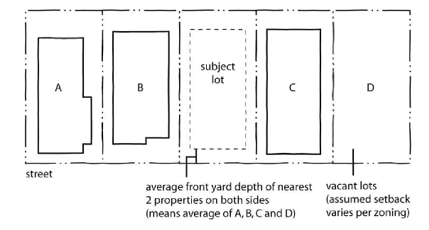
- Exceptions for Established Setbacks. When existing buildings are closer to the front property line than the required front setback, additions to existing buildings may be constructed to the existing front setback provided they do not encroach any closer to the front property line. When existing buildings on one or more abutting lots are closer to the street (front or street side) property line than the otherwise required setback, construction of new buildings on the subject lot may comply with the average street yard depth that exists on the nearest 2 lots on either side of the subject lot instead of complying with the zoning district's minimum street setback requirement.
- If one or more of the lots required to be included in the averaging calculation is vacant, that vacant lot will be deemed to have a street yard depth equal to the minimum street setback requirement of the subject zoning district.
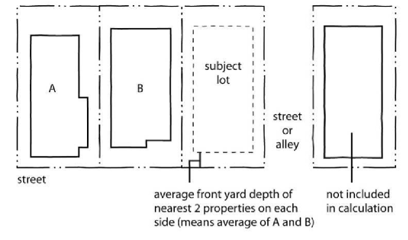
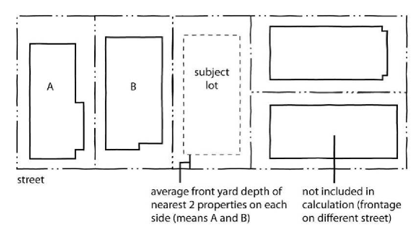
- Lots with frontage on a different street than the subject lot or that are separated from the subject lot by a street or alley may not be used in computing the average.
- When the subject lot is a corner lot, the average street yard depth will be computed on the basis of the nearest 2 lots with frontage on the same street as the subject lot.
- When the subject lot abuts a corner lot with frontage on the same street, the average front yard depth will be computed on the basis of the abutting corner lot and the nearest 2 lots with frontage on the same street as the subject lot.
- If one or more of the lots required to be included in the averaging calculation is vacant, that vacant lot will be deemed to have a street yard depth equal to the minimum street setback requirement of the subject zoning district.
- Rear Setbacks.
- Measurement. Rear setbacks are measured from the rear property line to the closest point of the building.
- Permitted Obstructions/Encroachments. Rear setbacks must be unobstructed and unoccupied from the ground to the sky except as expressly allowed in Section 24.18.030F.
- Through Lots. On through lots both (opposing) street lines are considered front property lines and front setback requirements apply.
- Side Setbacks.
- Measurement. Side setbacks are measured from the interior (non-street) side property line to the closest point of the building.
- Permitted Obstructions/Encroachments. Side setbacks must be unobstructed and unoccupied from the ground to the sky except as expressly allowed in Section 24.18.030F.
- Front and Street Side Setbacks.
- Features Allowed to Encroach in Required Setbacks.
- Residential Zoning Districts. Required setbacks in residential zoning districts must be unobstructed and unoccupied from the ground to the sky except that features are allowed to encroach into required setbacks to the extent indicated in the following table:
Obstruction/Feature
Residential District Setback
Front
Rear
Interior Side
Street Side
Arches
P
P
Awnings
P[12]
P
P[8]
P[8]
Balconies
P
Belt courses
P[9]
P[9]
P[9]
P[9]
Cornices
P
P
P
P
Exiting stairs and landing, minimum required by building code
P
P
P
P
Fences
-
P[2]
P[2]
P[2]
Fire escapes, open
-
-
-
-
Flag poles
P
P
P
P
Garages, detached and carports
-
P[1]
P[13]
-
Geothermal heat pumps and geothermal heat exchange systems (max. 4 feet height)
-
P
P
-
Laundry drying equipment
-
P
-
-
Nameplates
P
P
P
P
Parking spaces (required, open)
-
P
-
-
Ornamental features, attached (includes chimney)
P[5]
P[5]
P[5]
P[5]
Ornamental features, detached
P[9]
P[9]
P[9]
P[9]
Ornamental light standards
P
P
P
P
Outdoor fireplaces
-
P[1]
-
-
Patio, at grade
P
P
P
P
Pergolas/arbors
-
P[1]
-
-
Playhouses & play structures
-
P[1]
-
-
Planter boxes, landscape or stormwater
P[4]
P[4]
P[4]
P[4]
Porch (Entrance)
P [16]
-
-
-
Roof overhangs
P[5]
P[5]
P[5]
P[5]
Signs
P[10]
-
-
P[10]
Sills
P
P
P
P
Solar or wind energy systems, building-mounted (see also sec. 24.10.030)
-
P
P
-
Solar or wind energy systems, ground-mounted (see also sec. 24.10.030)
-
P
P
-
Swimming pools and tennis courts
-
P
-
-
Tool sheds, detached or attached
-
P[1]
-
-
Trellises
P[14]
P[14]
P[14]
P[14]
[15]
Water collection cisterns
P[4]
P
P
P[4]
Wheelchair lifts & ramps
P
P
P
P
Wing walls
P[9]
P[9]
P[9]
P[9]
P = Permitted setback obstruction - = Prohibited setback obstruction [1] Must comply with accessory structure setbacks. [2] See Chapter 15.28 of the city code of ordinances. [3] Not more than 4.5 feet above grade if located more than 2.5 feet into a required setback. [4] 5 feet maximum—not more than 4.5 feet above grade. [5] 2 feet maximum into minimum required setback. [6] 4 feet maximum into minimum required setback. [7] 1 foot maximum into minimum required setback. [8] 3 feet maximum into minimum required setback. [9] Not more than 4.5 feet above grade. [10] See Chapter 15.14 of the city code of ordinances. [11] Not closer than 10 feet to any side or rear lot line. [12] 6 feet maximum into minimum required setback. [13] Minimum side setback required for side of principal structure on which the proposed garage/carport would be constructed. [14] Trellis units must be separated by a distance that equals their width. [15] On side yards abutting a street, a trellis may be placed in street side yard, provided that it is at least 18 inches from the street side property line and complies with intersection visibility regulations of Section 24.14.020. [16] Must be open on at least three sides, with exception to railing, and may contain an elevated deck at level with the front door. May project 6 feet maximum into required front yard setback. If the wall of the door entrance does not meet the required front yard setback, the porch may extend off of the entrance wall a maximum of 6 feet, but shall be setback no closer than 15 feet to the front property line. - Nonresidential and Special Purpose Districts. Required setbacks in nonresidential and special purpose zoning districts must be unobstructed and unoccupied from the ground to the sky except that features are allowed to encroach into required setbacks to the extent indicated in the following table:
Obstruction/Feature
Nonresidential District Setback
Front
Rear
Interior Side
Street Side
Arches
-
P
-
-
Awnings
-
P
-
-
Balconies
P
P[6]
P
P
Belt courses
P[7]
P[7]
P[7]
P[7]
Cornices
P[5]
P[5]
P[5]
P[5]
Tool sheds, detached or attached
-
P[1]
-
-
Fences
P[2]
P[2]
P[2]
P[2]
Fire escapes, open
P[8]
P[8]
P[8]
P[8]
Flag poles
P
P
P
P
Fountains
P
P
P
P
Garages, detached and carports
-
P[1]
-
-
Geothermal heat pumps and geothermal heat exchange systems (max. 4 feet height)
-
P
P
-
Laundry drying equipment
-
P
-
-
Nameplates
P
P
P
P
Open accessory off-street parking spaces required
P
P
P
P
Ornamental features attached (includes chimney)
P[5]
P[5]
P[5]
P[5]
Ornamental features detached
P[9]
P[9]
P[9]
P[9]
Ornamental light standards
P
P
P
P
Playhouses & play structures
P
P[1]
P
P
Planter boxes, landscape or stormwater
P[4]
P[4]
P[4]
P[4]
Roof overhangs
P[5]
P[5]
P[5]
P[5]
Signs
P[10]
P[10]
P[10]
P[10]
Sills
P[5]
P[5]
P[5]
P[5]
Solar or wind energy systems, building-mounted (see also sec. 24.10.030)
-
P
P
-
Solar or wind energy systems, ground-mounted (see also sec. 24.10.030)
-
P
P
-
Stoops and patio
P
P
P
P
Swimming pools
-
P[11]
-
-
Tennis courts
-
P
-
-
Trees and plants
P
P
P
P
Trellises
P
P
P
P
Water collection cisterns
P[4]
P
P
P[4]
Wheelchair lifts & ramps
P
P
P
P
Wing walls
P[4]
P[4]
P[4]
P[4]
P = Permitted setback obstruction - = Prohibited setback obstruction [1] Must comply with accessory structure setbacks. [2] See Chapter 15.28 of the city code of ordinances. [3] Not more than 4.5 feet above grade if located more than 2.5 feet into a required setback. [4] 5 feet maximum—not more than 4.5 feet above grade. [5] 2 feet maximum into minimum required setback. [6] 4 feet maximum into minimum required setback. [7] 1 foot maximum into minimum required setback. [8] 3 feet maximum into minimum required setback. [9] Not more than 4.5 feet above grade. [10] See Chapter 15.14 of the city code of ordinances. [11] Not closer than 10 feet to any side or rear lot line. [12] 6 feet maximum into minimum required setback
- Residential Zoning Districts. Required setbacks in residential zoning districts must be unobstructed and unoccupied from the ground to the sky except that features are allowed to encroach into required setbacks to the extent indicated in the following table:
- Transparency Measurement. Ground story transparency must be measured between 2 feet and 8 feet above the sidewalk level at the base of the facade. Other facade transparency requirements are measured from the front door threshold elevation to the ceiling of the top story of the building. Transparency requirements must be satisfied by the use of windows or glass in doors with a transmittance factor of at least 50% and a reflectance factor of no more than 0.25. The measurement may include the frame, mullions, and muntins, but not trim or casings.
Adopted by Ord. O-19-05 pt. XI on 4/2/2019
Amended by Ord. O-19-17 pt. III on 8/6/2019
Amended by Ord. O-21-18 pt. V on 8/3/2021
Amended by Ord. O-21-17 pts. XIV, XV on 8/3/2021
Amended by Ord. O-25-25 on 11/18/2025
24.18.040 Building Height
- Measurement. Building height is measured as vertical distance from the established grade at the middle of the front of the building to the highest point of the roof. When a building is located on a natural terrace or slope the heights may be measured from the average ground level at the building wall.
- Exceptions.
- General. The following features are not counted in the measurement of building height and may exceed otherwise stated maximum height limits:
- Chimneys,
- Parapet walls,
- Skylights,
- Steeples,
- Flag poles,
- Cooling towers,
- Elevator bulkheads,
- Monuments,
- Water towers,
- Ornamental towers and spires, and
- Mechanical appurtenances or penthouses to house mechanical appurtenances.
- Solar Energy Systems. Building-mounted solar energy systems may extend up to 3 feet above the applicable maximum zoning district height limit, provided they do not extend more than 5 feet above the roof line.
- Rainwater Harvesting Systems (Roof-mounted). Reserved.
- General. The following features are not counted in the measurement of building height and may exceed otherwise stated maximum height limits:
- Exceptions.

