
Wauwatosa City Zoning Code
CHAPTER 24
12 LANDSCAPING AND SCREENING
24.12.010 General
- Purpose. The landscaping and screening regulations of this chapter establish minimum requirements for landscaping and screening. The regulations are intended to advance the general purposes of this ordinance and specifically to:
- Enhance quality of life for residents and visitors;
- Protect property values;
- Enhance the quality and appearance [of] new development and redevelopment projects;
- Mitigate possible adverse impacts of higher intensity land uses abutting lower intensity land uses;
- Promote the preservation, expansion, protection and proper maintenance of landscaping, including the wise use of water resources;
- Improve air quality;
- Protect water quality and reduce the negative impacts of stormwater runoff by reducing impervious surface area and providing vegetated areas that filter and retain greater amounts of stormwater on site;
- Moderate heat by providing shade;
- Reduce the impacts of noise and glare; and
- Promote sustainable landscape practices including the use of non-invasive native and regionally adaptable plants.
- Applicability. The landscaping and screening regulations of this chapter apply as set forth in the individual sections of these regulations. In general, the regulations apply to new development that requires permitting or review by the city and significant expansion of existing uses and developments.
- Exemptions. The following are exempt from the landscaping and screening regulations of this chapter:
- Parking areas within or under a building,
- Detached houses,
- Semi-detached houses,
- Two-unit (residential) buildings, and
- Attached houses.
- Exceptions. The board of public works is authorized to grant exceptions to the landscaping and screening regulations of this chapter.
Adopted by Ord. O-23-18 pt. II on 8/1/2023
24.12.020 Perimeter Vehicular Use Area Landscaping
- Applicability. Perimeter vehicular use area landscaping must be provided in accordance with the standards of this section when parking stalls are located within 100 feet of the right-of-way and when the stalls are part of any of the following:
- Any new construction of a parking lot must comply with the current requirements of this ordinance.
- Parking areas that are rehabilitated, reconstructed, or renovated are required to comply with current requirements of this ordinance. This includes any construction activity that alters the base course material and/or addition of curb that is not currently in place. Maintenance shall not be subject to this requirement and includes re-striping, patching, and resurfacing of an existing lot.
- When an existing vehicular use area is expanded by more than 1,750 square feet of additional paved area, in which case the requirements of this ordinance apply only to the expanded area if the original portion is only undergoing re-striping, patching, resurfacing or other construction activity that does not alter the base course in any way.
- When an existing approved parking lot is expanded by 50 percent or more, based on square footage, or 50 percent or more is renovated, reconfigured, or base material altered, the entire parking area shall be brought into compliance with the requirements of this ordinance. All expanded areas or renovated areas are considered cumulative.
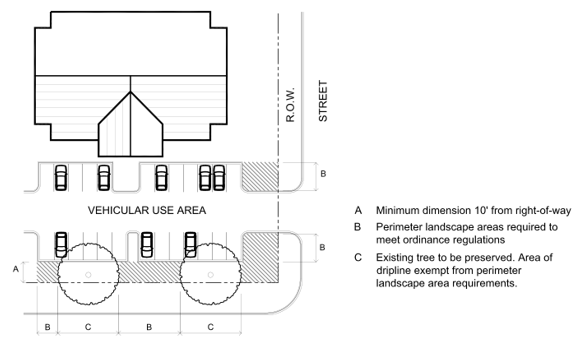
- Standards.
- A landscape strip with a minimum depth of 10 feet must be provided between the vehicular use area and the public right-of-way. This perimeter vehicular use area must include at least 2 deciduous trees and 8 shrubs per 50 feet of vehicular use area frontage. Protection of existing trees within the perimeter landscape area should be prioritized. When existing trees are preserved, the area within the dripline of the tree is exempt from the required frontage area. Existing shrubs can contribute to the shrub requirement at a one to one ratio.
- The zoning administrator is authorized to approve reductions in height for vehicular use area perimeter landscaping to protect sight distance at (driveways and street) intersections.
- The integration of stormwater infrastructure and features used for landscaping and stormwater management is strongly encouraged. When landscape areas are expressly designed for stormwater management, the planting and dimensional requirements of subsection B.1, above, may be modified by the landscape architect as necessary to ensure the area functions effectively for stormwater treatment purposes while also providing landscaping that is equivalent to the amount of landscaping required by subsection B.1, above.
- Materials, Design and Maintenance. Perimeter vehicular use area landscaping is subject to the regulations of Section 24.12.050.
(Ord. O-14-20, pt. VII, 8-5-2014)
Amended by Ord. O-19-31 pt. I on 12/3/2019
Amended by Ord. O-21-17 pt. IX on 8/3/2021
Amended by Ord. O-25-25 on 11/18/2025
24.12.030 Interior Vehicular Use Area Landscaping
- Applicability. The interior vehicular use area landscaping standards of this section apply to all of the following:
- Any new construction of a parking lot must comply with the current requirements of this ordinance.
- Parking areas that are rehabilitated, reconstructed, reconfigured or renovated are required to comply with current requirements of this ordinance. This includes any construction activity that alters the base course material and/or addition of curb that is not currently in place. Maintenance shall not be subject to this requirement and includes re-striping, patching, and resurfacing of an existing lot.
- When an existing vehicular use area is expanded by more than 1,750 square feet of additional paved area, in which case the requirements of this ordinance apply only to the expanded area if the original portion is only undergoing re-striping, patching, resurfacing or other construction activity that does not alter the base course in any way.
- When an existing approved parking lot is expanded by 50 percent or more, based on square footage, or 50 percent or more is renovated, reconfigured, or base material altered, the entire parking area shall be brought into compliance with the requirements of this ordinance. All expanded areas or renovated areas are considered cumulative.
- Standards.
- Vehicular Use Areas. Vehicular use areas include parking spaces, drive aisles, driveways and drive-through lanes. Vehicular use areas that are covered by canopies or similar structures must be included when calculating minimum interior vehicular use area landscaping requirements, but installation of landscaping is not required beneath canopies or other structures that block sunlight or rainfall. Parking and circulation areas located within a parking structure are not counted as vehicular use areas for purposes of these interior vehicular use area landscaping requirements.
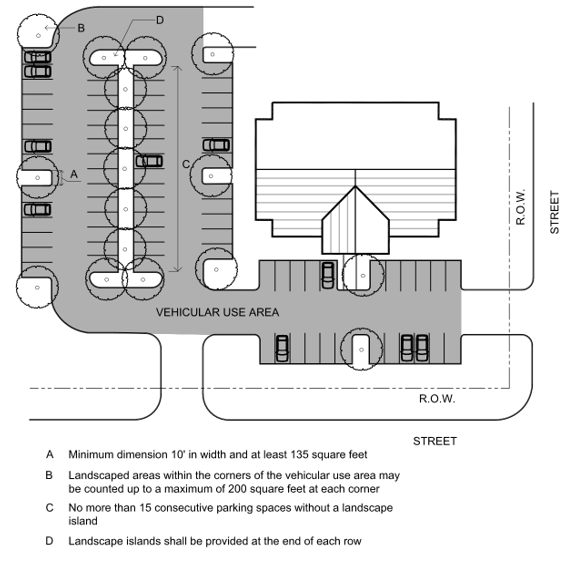
- Minimum Interior Landscape Area. At least 10% of the interior of vehicular use areas must be landscaped.
- Landscape Islands and Medians. Interior vehicular use area landscaping must be provided in the form of landscape islands or medians.
- Landscape islands and medians must have an area of at least 135 square feet and be at least 10 feet in width. Only pervious area within landscape islands may be counted toward meeting minimum area and width requirements. Combining landscape islands to form larger interior landscape areas is encouraged.
- Landscape islands shall be provided at the end of each parking row and within the row of parking spaces so that there are no more than 15 consecutive parking spaces without a landscape island. The landscape architect can make an exemption for number of consecutive parking spaces if all other interior parking use area landscaping requirements are achieved.
- Landscape areas located outside the perimeter of the vehicular use area may not be counted toward satisfying interior vehicular use area landscaping requirements. Landscaped areas within the corners of the vehicular use area may be counted up to a maximum of 200 square feet for each corner, if at least one shade tree is located within the area.
- Shade trees must be provided in interior landscape islands at a minimum rate of one tree per 180 square feet of required interior landscape area.
- The integration of stormwater infrastructure and features used for landscaping and stormwater management is strongly encouraged. When required landscape areas are expressly designed for stormwater management, the planting and dimensional requirements of Sections 24.12.030 B.3.a and 24.12.030 B.3.c may be modified by the landscape architect as necessary to ensure that the areas functions effectively for stormwater treatment purposes while also providing landscaping that is equivalent to the amount required by subsections B.3.a and B.3.c., above.
- Vehicular Use Areas. Vehicular use areas include parking spaces, drive aisles, driveways and drive-through lanes. Vehicular use areas that are covered by canopies or similar structures must be included when calculating minimum interior vehicular use area landscaping requirements, but installation of landscaping is not required beneath canopies or other structures that block sunlight or rainfall. Parking and circulation areas located within a parking structure are not counted as vehicular use areas for purposes of these interior vehicular use area landscaping requirements.
- Materials, Design and Maintenance. Interior vehicular use area landscaping is subject to the regulations of Section 24.12.050.
Adopted by Ord. O-19-31 pts. II—IV on 12/3/2019
Amended by Ord. O-21-17 pt. X on 8/3/2021
24.12.040 Screening
- Features to Be Screened. The following features must be screened from view of public rights-of-way, public open spaces and from lots used or zoned for residential purposes.
- Ground-mounted Mechanical Equipment. All ground-mounted mechanical equipment over 30 inches in height, other than air conditioning units, solar panels, wind-energy or similar renewable energy devices, is subject to principal building setbacks and must be screened from view of all R- zoned properties by a solid fence, solid wall, dense hedge, within a neutral-colored cabinet, or combination of such features. The hedge, fence, or wall must be tall enough to screen the equipment. See Section 15.04.040 C.2.a. for air conditioning unit requirements.
- Roof-mounted Mechanical Equipment. Roof-mounted mechanical equipment (e.g., air conditioning, heating, cooling, ventilation, exhaust and similar equipment, but not solar panels, wind energy or similar renewable energy devices) over 30 inches in height must be screened from ground-level view of all R- and C-zoned properties in one of the following ways:
- A parapet along façades facing the that is as tall as the tallest part of the equipment;
- A solid screen around the equipment that is as tall as the tallest part of the equipment, with the screen an integral part of the building's architectural design; or
- An equipment setback from roof edges facing that is at least 3 feet in depth for each one foot of equipment height.
- An alternative solution may be approved by the Design Review Board
- Refuse/Recycling Containers. Refuse/recycling containers must be screened from view of streets and all abutting lots with a solid wall or decorative (metal or wood) opaque fence at least 6 feet in height on all sides, with a secured or lockable gate extending to ground level. Refuse/recycling containers may not be located in front or street side setbacks. The location of containers, type of surfacing to be used and the location of storm drains to which the area will drain must be indicated on the site plan. The container area must be graded or curbing must be provided to ensure that all drainage is directed to an approved sanitary sewer connection or to another infiltration area designed to ensure that no untreated runoff from the container area will enter a public storm sewer. These location and screening requirements do not apply to containers used by single-family and two-family residence or those used on a temporary basis.
- Materials, Supplies and Equipment. All stored materials, supplies, merchandise, vehicles, equipment, or other similar materials not on display for direct sale, rental or lease to the ultimate consumer or user must be screened by a fence, wall, dense hedge, or combination of such features. Storage areas must be graded or curbing must be provided to ensure that no untreated runoff will enter a public storm sewer.
- Manufacturing and SP-PUB Districts. When any manufacturing or SP-PUB district abuts a residential zoning district, a solid fence or wall at least 6 feet in height must be installed along all property lines that abut the residential zoning district. The screening fence or wall may not extend in front of the building line on the M- or SP-PUB-zoned lot or in front of the building line of any dwellings on abutting residential lots. The fence or wall must be installed at time of any new construction or any building or parking area expansion on the M- or SP-PUB-zoned lot. New fences or walls are not required when equivalent screening exists on the abutting residential property.
- Standards.
- All plant material used for screening must be at least 4 feet in height at time of planting.
- Screens may be broken only as necessary to accommodate gates, approved access drives and walkways or to enable the screening area to be used for stormwater treatment.
- Materials, Design and Maintenance. Required landscaping and screening elements are subject to the regulations of Section 24.12.050.
Adopted by Ord. O-21-17 pt. XI on 8/3/2021
Amended by Ord. O-25-25 Part XXXI on 11/18/2025
24.12.050 Landscape Material And Design
- Landscaping with Required Landscape Areas. Required landscaped areas must be covered with biodegradable mulch, ornamental grasses, forbs, native plants or other perennial herbaceous or shrub planting combinations. Landscape-grade stone or aggregate material may also be used within landscape areas. In areas subject to erosion, erosion-reducing blankets or reinforced mulch must be used.
- Existing Trees and Vegetation. Existing non-invasive trees and shrubs count toward satisfying the landscaping and screening regulations of this chapter if they are located within the subject area and they comply with the plant height and size requirements of this section.
- Installation.
- Landscaping must be installed and maintained in accordance with the requirements of this section and the approved landscape plan.
- Required landscaping must be installed in complete and healthy condition before a certificate of occupancy may be issued or city-approved financial guarantees (e.g., escrow) are provided to the city.
- Plant Selection.
- Trees and plants selected for required landscape areas must be well-suited to the microclimate and on-site soil conditions.
- Trees and plant material must comply with the specifications found in American Standards for Nursery Stock (ANSI).
- Woody plants must be rated to survive in USDA Hardiness Zones 1, 2, 3, 4, or 5.
- Invasive species may not be used to meet landscape requirements.
- If more than 30 trees will be used, a mixture of 3 or more tree species must be used.
- If more than 50 shrubs will be used, a mixture of 3 or more shrub species must be used.
- Trees.
- Deciduous. Deciduous trees used to satisfy the requirements of this chapter must have a minimum caliper size of 2.0 inches (measured 6 inches above the root ball) and a minimum clear stem of 5 feet.
- Evergreen. Evergreen trees used to satisfy the requirements of this chapter must have a minimum height of 5 feet at time of planting. There is no minimum caliper size for evergreen trees at time of planting.
- Shrubs.
- Deciduous/Broadleaf. Deciduous/broadleaf shrubs used to satisfy the requirements of this chapter must have a minimum height of 15 inches or be a minimum 2-gallon size. The minimum height in required perimeter vehicular use area landscape strips is 24 inches.
- Evergreen. Evergreen shrubs used to satisfy the requirements of this chapter must have a minimum width of 2 feet or be a minimum 7-gallon size.
- Perennial Plants and Ornamental Grasses. Perennial plants and ornamental grasses, which may be substituted for shrubs except within required perimeter vehicular use area landscape strips or visual screening application, must be a minimum 4.5-inch container size.
- Groundcover Plants. Groundcover plants are deciduous or evergreen plants that grow low and spread horizontally, not including turf. Groundcover plants used to satisfy the requirements of this chapter must be at least 2.5-inch container size.
- Mulch. All required trees and plants must be located within a (biodegradable) mulched area and be separated from turf by a minimum distance of 3 feet from the stem or trunk. Mulch that may leach dye or colorants into surface waters is prohibited.
- Fences and Walls. Chain-link or other open wire fences may not be used to satisfy any of the requirements of this chapter. Fences and walls are subject to Chapter 15.28 of the city code of ordinances.
- Curbs and Vehicle Barriers. Landscaped areas in or abutting vehicular use areas must be protected by concrete curbing, anchored wheel stops, or other durable barriers approved by the city engineer. Wood timbers that are not part of a structural retaining wall may not be used to meet this requirement. Alternative barrier designs that provide improved infiltration or storage of stormwater are encouraged. Curbs protecting landscape islands within vehicular use areas may be designed to allow stormwater runoff to pass through them. Curbs may be perforated or have gaps or breaks.
- Bioretention. When landscape areas are designed and used as bioretention areas, specific plant materials, ponding depths, soils and design treatments must be consistent with Wisconsin Department of Natural Resources Conservation Practice Standard 1004 (Bioretention for Infiltration) or an equivalent design approved by the city.
- Intersection Visibility. Plantings and landscape material, other than trees, located within the intersection visibility area established by Section 24.14.020 may not exceed a height of 30 inches. Trees within the required intersection visibility area must have all branches trimmed to provide clear vision for a vertical height of at least 8 feet above the highest adjacent roadway or driveway surface. Evergreen trees are not permitted within required intersection visibility areas.
- Fire Hydrants and Utilities. Landscaping must be placed to allow full visibility of and access to fire hydrants and access to utility systems.
- Water Conservation. To promote resource-efficient landscaping for the conservation of water and other natural resources, the following principles and practices are strong[ly] recommended:
- Practical turf areas;
- Use of water-conserving plant material;
- Grouping of plants with similar water requirements;
- Installation of pervious paving to encourage groundwater recharge and re-use and to discourage run-off;
- Rainwater harvesting techniques;
- Use of mulches;
- Use of soil amendments based on soil analysis; and
- Use of reclaimed water.
- Maintenance. It is the responsibility of the property owner to maintain required landscaping in accordance with the city's property maintenance code and with an approved maintenance plan. The maintenance plan must include, at a minimum, methods for providing the following:
- Necessary irrigation,
- Integrated pest management,
- Fertilization,
- Tree care and pruning,
- Replacement of lost vegetation, and
- Weed management.
- Seed Mixes/Native Plantings.
- No mow and alternative turf seed mixes. Seed mixes used to establish lawn areas must be clearly identified on the plans. Species, establishment requirements and three-year maintenance plan must be provided at time of review and approval.
- Native perennial and prairie seed mixes. Seed mixes used to establish native planting areas must be clearly identified on the plans. Species, establishment requirements and three-year maintenance plan must be provided at time of review and approval.
Adopted by Ord. O-19-31 pts. V, VI on 12/3/2019
24.12.060 Landscape Plan
A landscape plan must be submitted at the time of site plan, conditional use permit or building permit review, whichever occurs first. A Wisconsin registered landscape architect must certify in writing that the plan is complete, accurate and in compliance with the landscaping and screening regulations of this chapter. The requirement that such plans and specifications be certified by a Wisconsin registered landscape architect may be waived for minor alterations and improvements that, in the sole determination of the development department, do not require the services of such a professional.
The landscape plan must have a minimum scale of 1" = 50' and include at least the following information:
- Location of trees and vegetation proposed for use within required landscape areas in sufficient detail for a determination that the plan conforms to the landscaping regulations of this zoning ordinance.
- All existing vegetation which is equal to or exceeds the following sizes must be inventoried and shown on the plan: deciduous trees 3 inch caliper or greater, evergreen trees 7 feet high (HTT) or greater, and shrubs 36 inches high (HTT) or greater.
- The vehicular use areas clearly identified and dimensioned for the purpose of determining compliance with the landscape requirements for each vehicular use area and a tabulation in chart form of each vehicular use area including the square footage of each vehicular use area, the square footage of each interior landscape area and the number of trees and plants proposed to be provided within interior and perimeter areas.
- A plant list of proposed landscape materials showing quantities, caliper sizes, root type (bare root, balled and burlapped, container size), height of material, botanical and common names, type and amount of mulch, ground cover and grasses.
- Specifications for treatment of compacted soil within required landscape areas.
- Specifications for planting media in required landscape areas.
- The location of walls, fences, walks, lighting and other hard landscaping materials. All underground and above ground utilities that impact landscape features must be shown on the landscape plan.
- Irrigation plan or location of water outlets.
- Planting and staking details to ensure proper installation and establishment of proposed plant materials.
- Identification of a landscape maintenance program including a statement that all diseased, damaged, or dead material will be replaced by the end of the following planting season, in perpetuity.
- Identification of snow storage areas including a statement that snow will not be pushed onto interior landscape islands unless designed for and identified on the landscape plan for snow storage.
- Other information or data determined necessary by the zoning administrator, such as construction details and/or cross-sections sufficient to resolve specific site conditions. These conditions include, but are not limited to retaining walls, screen walls, fences, or features to maintain natural drainage patterns.
- Detailed cross-sections of all proposed screening techniques including berms, architectural walls, ornamental fences, planting buffers, lighting standards, water features, etc.
Adopted by Ord. O-19-31 pt. VII on 12/3/2019
24.12.070 Performance Guarantee
- At the time of final execution of a certified survey map, subdivision plat or site plan approval with the City, or at the time of execution of an approved zoning permit, development agreement or any permit requiring a landscape plan, the owner is required to make a fiscal arrangement, either by bond, escrowed funds, certificate of deposit or letter of credit, with the City to ensure that the owner will be in full compliance with landscape installation and maintenance requirements.
- The developer shall submit a cost estimate for the landscaping based on actual bids or qualified or licensed landscape architect, forester, master gardener and/or landscape professional estimate. The cost estimate must include plant material and cost of installation.
- Additionally, a maintenance portion of the surety is required to ensure that the landscape installation is maintained during its critical establishment (one-year) period following installation. The amount of the surety shall include 100% of the cost estimate for such maintenance. The establishment period is one year for trees, shrubs and perennials that are larger than one quart. The establishment period is three years for landscapes grown from seed, including prairie, wildflower and no mow turf mixes.
- After the critical one-year establishment period following initial installation, the property owner shall be responsible for the perpetual care and maintenance of the required landscape area.
- Any owner required to file such surety shall grant a temporary access easement and license to the City or its agent to enter upon the land for the purposes of installing or maintaining the required landscaping for the length specified for maintenance compliance, in the event that such landscaping is not in place by the date specified in the agreement.
- Should the City be required to provide for full compliance, the applicant shall forfeit that portion of the surety required to reimburse it for the cost of bring the property into compliance. The balance of such surety shall be released when landscape improvement verification and compliance is received.
- A qualified or licensed landscape architect and/or landscape professional shall perform the final inspection of the site to ensure adherence to the landscape plan and required installation techniques per this chapter. The qualified or licensed landscape architect and/or landscape professional will be required to sign a letter of compliance before the fiscal security will be released. The City of Wauwatosa must also concur with the letter of compliance before the fiscal security will be released.
- Return of Fiscal Security. When it is determined that the landscaping has been installed and maintained for one year in accordance with an approved landscape plan, the City of Wauwatosa shall return the surety to the applicant. The Development Department shall authorize the refunding of the deposits.
Editor's note(s)—Ord. No. O-19-31, pt. VIII, adopted December 3, 2019, repealed § 24.12.070 and enacted a new § 24.12.070. Former § 24.12.070 pertained to alternative compliance.
Adopted by Ord. O-19-31 pt. IX on 12/3/2019
Amended by Ord. O-21-17 pt. XII on 8/3/2021

