
Waynesville City Zoning Code
ARTICLE 405
XIII-A MLOD-1 MILITARY LIGHTING OVERLAY DISTRICT
405.667: DISTRICT REGULATIONS
- Statement of Purpose. The purpose of this Section is to establish regulations for outdoor lighting impacting military operations within five (5) miles of the perimeter of Fort Leonard Wood. Specific purposes of these lighting districts are as follows:
- To reduce glare and potential distractions to night time training exercises occurring within this area.
- To balance the needs of the military, the City of Waynesville and property owners regarding responsible development including outdoor lighting within this area.
- Designation Criteria. To be designated as a military lighting overlay district, an area must be within five (5) miles of the perimeter of Fort Leonard Wood; provided, however, that if a Joint Land Use Study determines that lighting regulations are required in a smaller area than those required in a designated district, the City may initiate a rezoning to remove properties from a military lighting overlay district. If a Joint Land Use Study determines that different regulations are required or recommended, the City may modify the district regulations accordingly.
- Zoning Process and Classification.
- This Section establishes a military lighting overlay district, specifies the general purposes of the military lighting overlay district and the scope of the standards within that district.
- The military lighting overlay district is established as an overlay to the regular base zoning districts.
- The Planning and Zoning Committee shall coordinate with other appropriate departments or agencies in order to evaluate land use, traffic and other development related issues in determining the necessity of establishing a military lighting overlay district. All parties in interest and citizens shall have an opportunity to be heard.
- The zoning designation for the military lighting overlay district shall consist of a base zone symbol and the military lighting overlay district symbol "MLOD" as a suffix. Military lighting overlay districts shall be numbered sequentially to distinguish among different districts, i.e., "MLOD-1", "MLOD-2", etc.
- District Standards.
- As used in this Article, the following terms shall be defined as follows:
BUSINESS - A person, partnership, corporation, or organization engaged in commerce, manufacturing, or a service: profit and non-profit seeking enterprise or concern. The definition is intended to be broadly construed and shall include, but not limited to, charitable organizations.
CANDELA - The unit of measure indicating the luminous intensity (candlepower) of a light source in a specific direction.
DIGITAL SIGN - Catho-ray tube (CRT), flat panel liquid-crystal display (LCD), plasma, aerial imaging, projector or other electronic devices that are at the end-point of a digital signage system.
DIRECT LIGHT - Light emitted directly from the lamp, off of the reflector diffuser, or through the refractor or diffuser lens of a luminaire.
EXEMPTED NONCONFORMING LUMINAIRES - Any existing luminaires which were lawfully in place according to all applicable City Ordinances at the time, but which do not now comply with all applicable regulations as of the effective date of District designation.
FOOT-CANDLE (fc) - A unit of light measurement equal to one (1) lumen per square foot.
FULL CUTOFF - Describes a luminaire light distribution where one hundred (100) candela per one thousand (1,000) lamp lumens (ten percent) may emit at all vertical angles beginning at eighty (80) degrees up from nadir to less than ninety (90) degrees, and zero (0) candela per one thousand (1,000) lamp lumens (zero present) is allowed at ninety (90) degrees (horizontal plane) and all angles above. This applies to all horizontal angles around the luminaire. A full cutoff luminaire is also fully shielded. (See Exhibit 2.)
EXHIBIT 2 - All public and private outdoor lighting installed after the effective date(s) of an MLOD District designation shall conform to the requirements established by this section.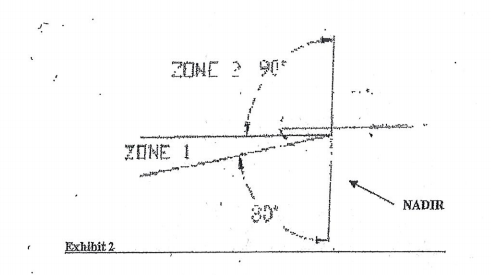 FULLY SHIELDED - A lighting fixture constructed in such a manner that all light emitted by the fixture, either directly from the lamp or a diffusing element, or indirectly by reflection or refraction from any part of the luminaire, is projected below the horizontal plane as determined by photometric test or certified by the manufacturer. A fully shielded fixture is not necessarily full cutoff.
GLARE - A luminance produced by bright sources in the field-of-view superimposed on the image in the eye reducing contrast and hence visibility.
"IESNA" (or "IES") - An acronym for the Illuminating Engineering Society of North America. The IESNA make recommendations for outdoor lighting but does not set outdoor lighting community standards which are set through local regulations.
ILLUMINANCE - The quantity of light arriving at a surface measured in foot-candles.
INTERMITTENT LIGHTING - Luminaires that do not remain on for more than five (5) minutes.
LUMEN - A unit of luminous flux. For purposes of this Section, the lumen-output values shall be the initial lumen output ratings of a lamp. The lumen rating associated with a given lamp is generally indicated on its packaging or may be obtained from the manufacturer.
LUMINAIRE - A complete lighting fixture consisting of a lamp or lamps together with the parts designed to distribute the light, to position and protect the lamps to connect the lamps to the power supply.
LUMINOUS FLUX - A quantitative expression of the brilliance of a source of visible light which is electromagnetic energy within the wavelength range of approximately three hundred ninety (390) nanometers (nm) to seven hundred seventy (770) nm. This quantity is measured in terms of the power emitted per unit solid angle from an isotropic radiator, a theoretical point source that radiates equally in all directions in three-dimensional space.
NADIR - The direction pointing vertically down from the lowest light emitting part of the luminaire (see Exhibit 2 for an example).
NIT - A unit of illuminative brightness equal to one (1) candle per square meter, measured perpendicular to the rays of the source.
OUTDOOR LIGHTING - Illumination of an outside area or object by any man-made device that is located outdoors and produces light.
TEMPORARY OUTDOOR LIGHTING - Lighting allowed as specified in an approved temporary permit pursuant to the requirements of Subsection (D)(12)(h) below.
TRESPASS LIGHTING - Light emitted by a luminaire that falls outside the boundaries of the property on which the luminaire is sited.
FULLY SHIELDED - A lighting fixture constructed in such a manner that all light emitted by the fixture, either directly from the lamp or a diffusing element, or indirectly by reflection or refraction from any part of the luminaire, is projected below the horizontal plane as determined by photometric test or certified by the manufacturer. A fully shielded fixture is not necessarily full cutoff.
GLARE - A luminance produced by bright sources in the field-of-view superimposed on the image in the eye reducing contrast and hence visibility.
"IESNA" (or "IES") - An acronym for the Illuminating Engineering Society of North America. The IESNA make recommendations for outdoor lighting but does not set outdoor lighting community standards which are set through local regulations.
ILLUMINANCE - The quantity of light arriving at a surface measured in foot-candles.
INTERMITTENT LIGHTING - Luminaires that do not remain on for more than five (5) minutes.
LUMEN - A unit of luminous flux. For purposes of this Section, the lumen-output values shall be the initial lumen output ratings of a lamp. The lumen rating associated with a given lamp is generally indicated on its packaging or may be obtained from the manufacturer.
LUMINAIRE - A complete lighting fixture consisting of a lamp or lamps together with the parts designed to distribute the light, to position and protect the lamps to connect the lamps to the power supply.
LUMINOUS FLUX - A quantitative expression of the brilliance of a source of visible light which is electromagnetic energy within the wavelength range of approximately three hundred ninety (390) nanometers (nm) to seven hundred seventy (770) nm. This quantity is measured in terms of the power emitted per unit solid angle from an isotropic radiator, a theoretical point source that radiates equally in all directions in three-dimensional space.
NADIR - The direction pointing vertically down from the lowest light emitting part of the luminaire (see Exhibit 2 for an example).
NIT - A unit of illuminative brightness equal to one (1) candle per square meter, measured perpendicular to the rays of the source.
OUTDOOR LIGHTING - Illumination of an outside area or object by any man-made device that is located outdoors and produces light.
TEMPORARY OUTDOOR LIGHTING - Lighting allowed as specified in an approved temporary permit pursuant to the requirements of Subsection (D)(12)(h) below.
TRESPASS LIGHTING - Light emitted by a luminaire that falls outside the boundaries of the property on which the luminaire is sited.
- All public and private outdoor lighting installed after the effective date(s) of an MLOD District designation shall conform to the requirements established by this Section.
- Any luminaire in the new development that is aimed, directed, or focused so as to cause Direct light from the luminaire to be directed toward an adjacent military base, camp or installation is prohibited. Such luminaire must be redirected or its light output controlled to eliminate such conditions.
- Residential Lighting.
- No trespass lighting within residential areas may exceed one and one-half (1 ½) foot-candles at the property line, with the exception of intermittent lighting which can be up to two (2) foot-candles.
- All lighting within residential areas must comply with Commercial lighting Subsections (D)(5)(a)—(e) below.
- Commercial Lighting.
- All lighting fixtures installed on any commercial property and which include or exceed two (2) foot-candles shall be fitted to render them full cutoff (no lighting output emitted above ninety (90) degrees at any lateral angle around the fixture.) See "Acceptable Fixture" designation as shown in Exhibit 3. The manufacturer or firm handling the installation of outdoor lighting must provide documentation to prove full cutoff status of outdoor lighting to the Zoning and Planning Committee during the plan review stage.
EXHIBIT 3 - Acceptable vs. Unacceptable Fixture Examples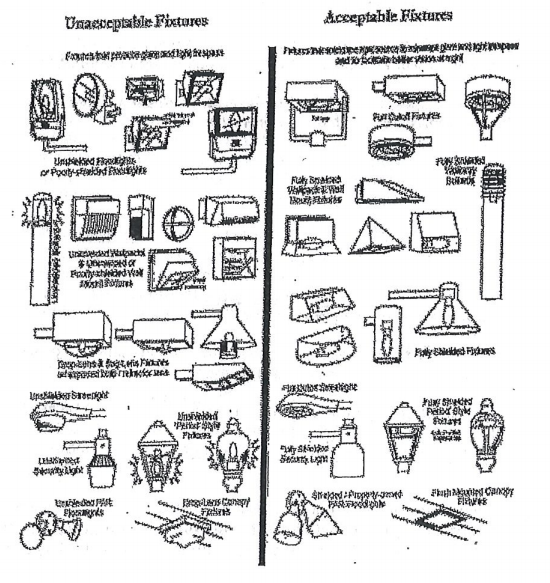
- For lighting horizontal tasks such as roadways, sidewalks, entrances and parking areas, fixtures must meet "full cutoff" criteria (no light output emitted above 90 degrees at any lateral angle around the fixture).
- Intermittent lighting must be of the "motion sensor" type that stays on for a period of time not to exceed five (5) minutes and has a sensitivity setting that allows the luminaire to be activated only when motion is detected on the site.
- All trespass lighting shall not exceed two and one-half (2 ½) foot-candles measured at the property line, except that residential trespass lighting is regulated in Subsection (D)(4)(a) above.
- Floodlight fixtures must be aimed so as to prevent direct radiation of light into the open sky at any angle above the horizontal plane as shown in Exhibit 4 and verified using a tool such as shown in Exhibit 5.
EXHIBIT 4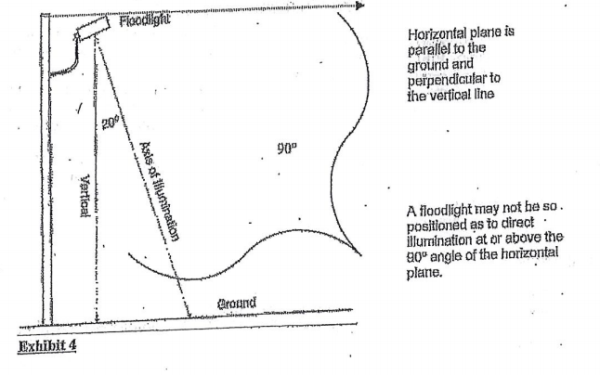
EXHIBIT 5 - This is a tool for aiming lights such as the floodlight represented in Exhibit 4. This tool would verify the angle of 20º by placing the upper edge of the tool against the floodlight lens and adjusting the floodlight so that a level parallel to the bottom edge shows level.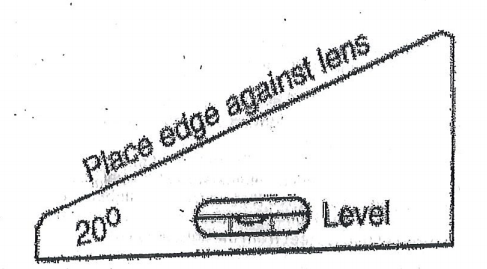
- With the exception of lighting which is required for security and safety such as parking lot illumination, businesses must turn off outdoor lights emitting illumination levels exceeding two (2) foot-candles (fc) after 11:00 P.M.
- Lighting installed to illuminate construction sites in order to secure or protect equipment at night shall meet the requirements of Subsection (D)(4)(a) above.
- All lighting fixtures installed on any commercial property and which include or exceed two (2) foot-candles shall be fitted to render them full cutoff (no lighting output emitted above ninety (90) degrees at any lateral angle around the fixture.) See "Acceptable Fixture" designation as shown in Exhibit 3. The manufacturer or firm handling the installation of outdoor lighting must provide documentation to prove full cutoff status of outdoor lighting to the Zoning and Planning Committee during the plan review stage.
- Parking Lot and Parking Structure Lighting.
- Total pole and fixture height shall comply with of this Chapter.
- All lighting luminaires in surface parking lots and on the top decks of parking Structures shall be fitted to render them full cutoff.
- Reflectivity. In order to allow for a variety of surface material options:
- Surface parking lots shall be designed, coated or constructed so that Illumination levels are no more than what is reflected from asphalt at an average of twenty (20) foot-candles.
- Top decks of parking structures shall be designed, coated or constructed so that illumination levels are no more than what is reflected from asphalt at an average of fifteen (15) foot-candles.
- One (1) hour after closing, businesses must turn off at least fifty percent (50%) of lighting luminaires in surface parking lots and on top decks of parking structures; however, those luminaires turned off may be set to function utilizing a motion detector system or dimmer.
- Outdoor Sign Lighting.
- All signs located within locations in the district of City of Waynesville shall be positioned in such a manner and contain "dark sky" approved shielding devices as to significantly reduce spillover light affecting the military installation and operations.
- On-premise signs may remain illuminated during regular business hours, but may not be illuminated later than one-half (½) hour after the business is no longer open to the public, nor prior to the daily opening of the business to the public.
- On-premise signs utilizing neon tube lighting shall be exempt from the requirements of Subsection (d)(7)(b) above.
- Single-tenant on-premise signs shall be illuminated at a level no greater than seven (7) foot-candles measured at five (5) feet from the light source. Multi-tenant on-premise signs shall be illuminated at a level no greater than twelve (12) foot-candles measured at five (5) feet from the light sources.
- Exterior means of illumination utilized for on-premise signs shall be positioned in a "top down" manner as depicted in Exhibit 4. Bottom-mounted fixtures shall not be used for on-premise signs.
- Conventional non-digital off-premise signs shall employ an illumination system utilizing no more than two (2) luminaires to illuminate each sign message area (face). Each luminaire shall employ a refractor and hood that focuses the light on to the sign face and each luminaire may not exceed four hundred (400) watts.
- Other than the requirements contained in Subsection (D)(1) and Subsection (D)(8), the installation, operation, alteration, repair or improvement of an illumination device used for an off-premise sign are not subject to the other provisions.
- Nothing in this Section shall be interpreted to authorize signs in areas of the City prohibiting signs.
- Street Lighting.
- This Subsection regulates the illumination levels for street lights that are installed on any street and must follow the American National Standard Practice for Roadway Lighting under the IESNA.
- Street light illumination must follow the guidelines in paragraph D of this Subsection unless a licensed professional engineer, trained and experienced in the science of illumination engineering, deems other illumination levels based on IESNA standards more appropriate for existing conditions and staff concurs with this assessment.
- New ornamental street lights must be classified as either IES "Full Cutoff" or IES "Cutoff" as determined by a valid photometric report. This report must be generated for the specified model by a qualified testing lab (testing to IES standards) and must include a full vertical evaluation through one hundred eighty (180) degrees; otherwise that fixture will be unacceptable.
- LEED Standards. It is encouraged that, where possible, LEED (The Leadership in Energy and Environmental Design) certified lighting standards be substituted for the requirements of Subsections (D)(5) through (8) above, so long as the minimum standards of this Section are met. If a project utilizes LEED certified lighting standards, the remainder of a project's design does not have to meet LEED standards.
- Tower and Structure Lighting. See FCC or FAA regulations.
- Other Prohibited Lighting. Unless authorized by the City Council by specific ordinance for a special event.
- Exemptions. The following outdoor lighting instances are exempt from the lighting requirements of this Section:
- All legal outdoor lighting in place prior to the effective date of an MLOD district designation.
- Outdoor lighting for which light is produced directly by the combustion of fossil fuels.
- Outdoor lighting used during law enforcement, fire, and medical activities and for meteorological data gathering purposes.
- Outdoor lighting employed during emergency or night-time repairs of roads and utilities.
- Lighting required by law to be installed on motor vehicles.
- Lighting required for the safe operation of aircraft.
- Decorative holiday lighting from November 15 through the next January 15.
- Temporary Exemptions. Any individual may submit a written request to the City Administrator or District Representative for temporary lighting and obtain a temporary electrical permit. The permit may grant temporary lighting for a period not to exceed thirty (30) days, with at least thirty (30) days passing before another temporary electrical permit may be issued. The request for temporary lighting must contain the following information in addition to information required to obtain a temporary electrical permit.
- Proposed use and location of the outdoor light requested.
- Type of lamp(s) to be used, including manufacturer's part number and initial lumens.
- Type of light fixture used, including manufacturer's model number and specification (cut) sheets indicating photometric distribution data stated in iso foot-candle diagrams.
- Starting and ending dates for temporary lighting use.
- Contact information including name of requester, affiliation (if applicable), address and telephone number.
- And such other information the Director may require.
- Administration. The City Administrator shall administer this Section.
- Variances and Special Exceptions.
- The City Administrator may grant a variance to the requirements of this Section. Where a literal enforcement of the provisions will result in unnecessary hardship. A variance request must be submitted to the City in writing that sets out the basis for the request.
- A special exception to the requirements of this Section may be granted by the City Council where a plan's lighting design does not meet strict design standards but alternative methods may be used which meet the intent of the Code.
- As used in this Article, the following terms shall be defined as follows:
BUSINESS - A person, partnership, corporation, or organization engaged in commerce, manufacturing, or a service: profit and non-profit seeking enterprise or concern. The definition is intended to be broadly construed and shall include, but not limited to, charitable organizations.
CANDELA - The unit of measure indicating the luminous intensity (candlepower) of a light source in a specific direction.
DIGITAL SIGN - Catho-ray tube (CRT), flat panel liquid-crystal display (LCD), plasma, aerial imaging, projector or other electronic devices that are at the end-point of a digital signage system.
DIRECT LIGHT - Light emitted directly from the lamp, off of the reflector diffuser, or through the refractor or diffuser lens of a luminaire.
EXEMPTED NONCONFORMING LUMINAIRES - Any existing luminaires which were lawfully in place according to all applicable City Ordinances at the time, but which do not now comply with all applicable regulations as of the effective date of District designation.
FOOT-CANDLE (fc) - A unit of light measurement equal to one (1) lumen per square foot.
FULL CUTOFF - Describes a luminaire light distribution where one hundred (100) candela per one thousand (1,000) lamp lumens (ten percent) may emit at all vertical angles beginning at eighty (80) degrees up from nadir to less than ninety (90) degrees, and zero (0) candela per one thousand (1,000) lamp lumens (zero present) is allowed at ninety (90) degrees (horizontal plane) and all angles above. This applies to all horizontal angles around the luminaire. A full cutoff luminaire is also fully shielded. (See Exhibit 2.)
HISTORY
Adopted by Ord. 2128 on 2/19/2015
Adopted by Ord. 2128 on 2/19/2015

