
Weber County Unincorporated
City Zoning Code
City Zoning Code
CHAPTER 104
29 Destination And Recreation Resort Zone DRR-1
Sec 104-29-1 Purpose And Intent
The purpose of this chapter is to provide flexible development standards to resorts that are dedicated to preserving open space and creating extraordinary recreational resort experiences while promoting the goals and objectives of the general plan. It is intended to benefit the residents of the county and the resorts through its ability to preserve an area's rural character, by utilizing a mechanism that allows landowners to voluntarily transfer development rights to areas that are more suitable for growth. Resorts within an approved destination and recreation resort zone shall, by and large, enhance and diversify quality public recreational opportunities, contribute to the surrounding community's well-being and overall, instill a sense of stewardship for the land.
(Ord. of 1956, § 44-1; Ord. No. 2016-4, Exh. B2, 5-24-2016)
Amended by Ord. 2026-09 on 5/26/2026
Sec 104-29-2 Development Standards
- General design and layout. A destination and recreation resort shall have a general design that concentrates a mixture of recreational, commercial, and residential uses within and immediately adjacent to a village core which is surrounded by substantially natural open spaces. Areas outside of the village core may include recreational and resort supporting uses and facilities, and intermittently dispersed clusters of employee, single-family, and multifamily dwellings.
- Minimum area. The minimum area requirement for a destination and recreation resort shall be 1,000 contiguous acres. The resort area may be made up of multiple property owners making application under one contiguous and cohesive plan including lands under contract or agreement with a local, state or federal agency. Lands under such contract or agreement shall not count towards the minimum area requirement.
- Initial allowed density. A lot or parcel rezoned to the DRR-1 zone from a zone that allow(s)(ed) dwelling units shall have an initial density that is equal to the lot or parcel’s base density, as defined in Title 101, Chapter 2, that was allowed in the prior zone.
- Transferable development rights. To increase residential development rights on a lot or parcel in the DRR-1 zone, the following apply:
- Transferred density.
- Qualifications. Residential development rights are permitted to be transferred to any lot or parcel in the DRR-1 zone, also known as the receiving property, that, at a minimum, can demonstrate that the transfer will:
- Result in a resort that meets the purpose and intent of this chapter and the general plan.
- Result in an overall 80 percent reduction in anticipated future traffic congestion at key intersections leading to the sending area(s).
- Result in the long-term preservation and maintenance of desirable open spaces in both the sending area(s) as well as in the areas surrounding the receiving area(s).
- No right exists until transfer is complete. No residential development rights in excess of the base density exists on a receiving property until after the landowner has successfully completed the transfer of an equal number of residential development rights from another lot or parcel that has the available number of residential development rights being pursued.
- Rights available for transfer. A residential development right is deemed available for transfer from a sending lot or parcel if the sending lot or parcel's base density calculation, together with adjustments for any previous residential development right reduction or addition, demonstrates that the residential development right could be developed on the lot or parcel in a manner that complies with the provisions of this Land Use Code. A residential development right reduction or addition is any of the following:
- Use of the residential development right for construction of a residential unit onsite.
- Transfer of a residential development right to another lot or parcel.
- Receipt of a residential development right from another lot or parcel.
- Restriction of the construction, development, or subdivision of or on the lot or parcel for residential purposes as provided in county laws not otherwise in this Land Use Code; state or federal laws, regulations, or restrictions; conservation or preservation easements or agreements; or any other County-enforceable development restriction or prohibition that clearly and specifically makes the residential development right unbuildable on the lot or parcel.
- Completing a transfer. The reallocation shall be completed by recording a Notice of Transfer document to each affected lot or parcel.
- Each Notice of Transfer document shall run with the land.
- Each Notice of Transfer document shall document the applicable lot or parcel's estimated initial density; the number of dwelling units already developed on the lot or parcel; the number of residential development rights subtracted from, or added to, the initial density by any other means; and the number of residential development rights remaining for the lot or parcel.
- Qualifications. Residential development rights are permitted to be transferred to any lot or parcel in the DRR-1 zone, also known as the receiving property, that, at a minimum, can demonstrate that the transfer will:
- County review of transfer. A landowner may submit a request for approval of a transfer of residential development rights at any time. Planning Division Staff shall review each request for compliance with applicable regulations. If the transfer complies with this ordinance, Planning Division Staff shall prepare a Notice of Transfer document for each affected lot or parcel in a form as approved by the County Attorney’s Office.
- A transfer is not complete until a notice of transfer has been signed by each affected landowner of record for each affected lot or parcel, the reviewing staff, and the Planning Division Director, and then recorded to each affected lot or parcel in the Office of the County Recorder.
- Approval of a subdivision’s preliminary plat or a design review that is based on the receipt of transferred residential development rights is conditioned, by reference herein, on the applicable transfers being completed. Approval is void if the transfer is not completed.
- No final plat application shall be approved or recorded and no building permit shall be submitted or approved until after the transfer(s) are complete.
- Transferred density.
- Density transfers.
- Transfer allowances and limitations. A residential development right may be transferred to a lot or parcel in a DRR-1 Zone from any lot or parcel in the following zones: A-1, A-2, A-3, RE-15, RE-20, F-1, F-3, F-5, F-10, F-40.
- Transfer ratio. The transfer ratio is as specified in the following table. This means for every one residential development right transferred from a sending lot or parcel, the number of residential development rights specified in the table are allowed to be constructed on a receiving lot or parcel within the DRR-1 Zone.
QUALIFIER TRANSFER RATIO The sending lot or Parcel is within 300 feet of the Weber River or any branch of the Ogden River and the transfer will result in or be accompanied by the dedication of the land or a conservation easement in favor of the County or another governmental entity selected by the County for the land within 300 feet of the river, and which will permit in perpetuity a public multi-use pathway along the river. 3 The sending lot or Parcel is in an area which the County anticipates will support long-term agricultural operations. 3 The sending lot or Parcel is in an area that contains characteristics, natural resources, or other features of value for open space conservation. 2 The sending lot or Parcel is on a historical site and the transfer will result in or be accompanied by the recordation of a historical preservation easement and historical preservation plan proposed by the developer and approved by Weber County in consultation the Utah State Historic Preservation Office. 2 The transfer will result in the dedication, donation, or other permanent preservation of a site determined to be desirable to a local park district or other county-approved entity for the perpetual location and operation of a public cultural or recreational facility. 1.5 The sending lot or parcel is on a bench or other viewshed corridor, the limitation of development of which provides a public benefit, as determined by the County. 1.5
- Buffer area. A buffer area, approved by the Land Use Authority, shall be provided at the perimeter of the resort boundary where commercial and/or multifamily buildings and associated parking are proposed to lie within close proximity to lands that are not a part of the resort, except where at the location of the use the developer (as defined in the applicable zoning development agreement) owns at least 200 feet of property extending from the resort boundary or where the developer has received approval from the owner of any property within 200 feet of the resort boundary. The following minimum standards shall apply:
- DRR-1 Zone abutting zones that allow residential uses with area requirements of one unit per three acres or larger: A minimum width of 200 feet with an additional ten feet of buffer for every one foot that a resort building exceeds the height of 35 feet.
- DRR-1 Zone abutting zones that allow residential uses with area requirements of less than one unit per three acres: A minimum width of 100 feet with an additional ten feet of buffer for every one foot that a resort building exceeds the height of 35 feet.
- DRR-1 Zone abutting commercial zones or zones that allow multifamily dwellings: No buffer required.
- No buffer area is required at or around a resort's interior lot or parcel boundaries or where a resort shares a common boundary with a local, state or federal agency that has entered into a contract or agreement for the use of adjacent local, state or federal lands.
- Site development standards.
(1) Minimum lot area a. Single-family residential/main building None b. Two, three, four and multi-family, commercial and mixed use structure None c. Public utility substation As provided in Section 108-10-2: Site development standards for public utility substation or structure d. Other As otherwise required by this Land Use Code. (2) Minimum lot width a. Single-family residential/main building None b. Two, three, four and multi-family, commercial and mixed use structure None c. Public utility substation As provided in Section 108-10-2: Site development standards for public utility substation or structure d. Other As otherwise required by this Land Use Code. (3) Setbacks. Setbacks shall apply for the following specific uses: a. Front setbacks 1. Single, two, three and four-family dwelling None (0 feet) 2. Accessory building related to the above None (0 feet) 3. Multifamily, commercial and mixed use structure None (0 feet) 4. Accessory building related to the above None (0 feet) 5. Public utility substation As provided in Section 108-10-2: Site development standards for public utility substation or structure 6. Other As otherwise required by this Land Use Code. b. Side setbacks 1. Single, two, three and four-family dwelling 5 feet 2. Accessory building 8 feet, except 3 feet when located at least 10 feet from the rear of the dwelling 3. Multifamily, commercial and mixed use structure None (0 feet); except where a destination and recreation resort parcel sides on an existing parcel in a commercial zone, lying outside of the destination and recreation resort zone. In this situation, the destination and recreation resort multifamily, commercial and/or mixed use structure(s) shall meet the minimum required setback of the zone in which the adjacent parcel is located.
4. Accessory building None (0 feet); exception is the same as above 5. Public utility substation As provided in Section 108-10-2: Site development standards for public utility substation or structure 6. Other As otherwise required by this Land Use Code. c. Rear setbacks 1. Single, two, three and four-family dwelling 10 feet 2. Accessory building 3 feet, except 8 feet when on a corner lot and within 20 feet of a street right-of-way.
3. Multifamily, commercial and mixed use structure None (0 feet); except where a destination and recreation resort parcel rears on an existing parcel in a commercial zone lying outside of the destination and recreation resort zone. In this situation, the destination and recreation resort multifamily, commercial and/or mixed use structure(s) shall meet the minimum required setback of the zone in which the adjacent parcel is located. 4. Accessory building None (0 feet); exception is the same as above 5. Public utility substation As provided in Section 108-10-2: Site development standards for public utility substation or structure 6. Other As otherwise required by this Land Use Code. (4) Maximum building height a. Single, two, three and four-family dwelling 35 feet b. Multifamily, commercial and mixed use structure 75 feet, except 55 feet if within a radius of 2.5 miles of the intersection of State Route 39 and State Route 167. c. Public utility substation 35 feet, unless otherwise provided in Section 108-7-5: Exceptions to height limitations d. Other As otherwise required by this Land Use Code. - Open space. A minimum of 60 percent of the net developable acreage, owned by the resort and located within the destination and recreation resort zone, shall be designated as open space. A portion of that open space shall consist of conservation open space in an amount equal to or greater than 30 percent of the resort's net developable acreage. The area designated as conservation open space shall be encumbered by an irrevocable conservation easement meeting the general and applicable requirements described in Section 104-29-6 of this chapter and shall be granted prior to beginning any construction within an overall subdivision phase. The minimum number of acres encumbered by each easement shall be equal to or greater than the number of acres involved in each subdivision phase until the total number, of required conservation open space acres, is met. Areas dedicated (platted and recorded) as open space within residential and nonresidential subdivisions may count towards the minimum open space requirement.
- Alternative development standards. After recommendation from the Planning Commission, the County Commission may approve alternative development standards than those found in this section provided the alternative standards are part of a legislatively approved development agreement with a master plan and assist with the implementation of the agreement or master plan.
(Ord. of 1956, § 44-2; Ord. No. 2016-4, Exh. B2, 5-24-2016; Ord. No. 2017-2, Exh. A1, 1-24-2017; Ord. No. 2017-11, Exh. A, 5-9-2017; Ord. No. 2018-6, Exh. A, 5-8-2018)
Amended by Ord. 2021-6 on 3/23/2021
Amended by Ord. 2026-09 on 5/26/2026
Sec 104-29-3 (Reserved)
(Ord. of 1956, § 44-3)
Repealed by Ord. 2026-09 on 5/26/2026
Sec 104-29-4 (Reserved)
(Ord. of 1956, § 44-4)
Repealed by Ord. 2026-09 on 5/26/2026
Sec 104-29-5 (Reserved)
(Ord. of 1956, § 44-5)
Repealed by Ord. 2026-09 on 5/26/2026
Sec 104-29-6 Transferable Development Right Easement
A when this chapter requires a conservation easement on a sending area lot or parcel, or portion thereof, the following shall apply. The conservation easement shall meet the requirements set forth in Utah Code § Title 57, Chapter 18.
- Title/form.
- The easement shall be entitled as an "Irrevocable Conservation Easement."
- The easement shall be in a form considered appropriate and acceptable to the offices of the Weber County Attorney and Recorder.
- Grantor/grantee. The easement shall name Weber County and a local park district or one other qualified conservation organization, which is authorized to hold interest in real property, as the grantees. The qualified conservation organization, named as grantee, shall meet the requirements described in Utah Code § 57-18-3 and shall require the approval of the county.
- Recital. The easement shall recite and explain all matters of fact, including a parcel/boundary description, which are necessary to make the transaction intelligible.
- Nature of easement. The easement shall explain its perpetual, irrevocable, inheritable and assignable nature.
- Purpose.
- The easement shall explain its purpose in terms of how it is intended to protect, preserve, enable the creation or continuation of an anticipated use and prevent certain conditions or uses upon the land that may diminish its open space qualities.
- It shall be acknowledged, within this section, that the above "statements of purpose" are intended to be a substantive provision of the easement and that any ambiguity or uncertainty regarding the application of the terms of the easement will be resolved so as to further its purpose.
- Permitted uses and activities.
- The easement shall list the property rights that have been retained by the grantor, including the right to allow or restrict public access, and shall acknowledge that these rights are consistent with the applicable zoning for the area in which the parcel is located.
- In the event that a residential development right has been retained on the sending lot or parcel, a statement shall be made, within this section, which explains the remaining number and type of development rights associated with the parcel. An exhibit shall also be referenced, within this section, which restricts and graphically demonstrates the general location of any future development.
- Prohibited uses and activities. The easement shall list the property rights that have been voluntarily relinquished by the grantor and acknowledge that any exclusion does not constitute an approved use or imply that uses may be inconsistent with the applicable zoning for the area in which the parcel is located.
- Monitoring and enforcement.
- The easement shall state that the grantee will have the right to enforce the terms of the easement by entering the property, provided that an advance notice of 24 hours is provided to the grantor, for the purpose of inspecting the property for suspected/reported violations. Additionally, it shall state that the grantee shall have the right to enter the property at least once a year, at a mutually agreed time for the purpose of inspection and compliance monitoring regardless of whether grantee has reason to believe that a violation of the easement exists. In order to establish a monitoring baseline, an exhibit shall also be referenced, within this section, which inventories, graphically demonstrates and photo documents relevant features and the existing condition of the parcel.
- For the purposes of correcting any violation, condition or circumstance that is not consistent with the terms of the easement, it shall be stated that the grantee or assigns may, at their discretion, use any available legal or equitable remedy to secure and restore compliance with the standards set forth in the easement. Legal and/or equitable remedies may include but not be limited to injunctive relief, entering the property to perform restorative activities and/or recorded lien.
- Termination and extinguishment. The easement shall state under which conditions and/or circumstances that the easement could be terminated. These conditions may include but not be limited to grantee consent, court action or eminent domain.
- Subordination. Prior to granting the easement the grantor shall submit a title report and certify, within this section, that the sending lot or parcel has clear title and is not encumbered by a mortgage, deed of trust or other instrument securing the property and its unrestricted value as collateral. If the sending lot or parcel has been encumbered by a mortgage, deed of trust or other instrument that has secured the property and its unrestricted value as collateral, the grantor shall declare all encumbrances, within this section, and reference an exhibit, provided by any and all beneficiaries, that acknowledges and agrees to their subordinate position as it relates to the easement and the enforcement of its terms. The agreement/exhibit shall also clearly state that the beneficiary, by exercising any right granted to them under a mortgage, deed of trust or other instrument, cannot and will not modify, extinguish or affect the grantee's right to enforce the terms of the easement.
- Costs and liabilities. The easement shall state that the grantor will continue to be responsible for and bear all costs and liabilities of any kind related to ownership, operation, upkeep and maintenance of the sending lot or parcel.
- Conveyance or transfer of property. The easement shall state that any document intended to transfer or convey the subject property (or any interest in the subject property) will specifically refer to the easement and disclose its perpetual nature and the fact that it runs with the land. It shall also state that any failure to comply with this requirement shall not adversely affect the grantee's right to enforce the terms of the easement in any way.
- General provisions. This section shall describe provisions for but not limited to easement amendments, controlling law and interpretation.
(Ord. of 1956, § 44-6)
Amended by Ord. 2026-09 on 5/26/2026
Sec 104-29-7 Seasonal Workforce Housing
- Seasonal workforce housing. A seasonal workforce housing plan shall be incorporated into the overall resort in order to provide a socially, economically and environmentally responsible development. To balance neighborhoods and promote a sense of community between visitors and working residents, the resort shall locate a majority of seasonal workforce housing units within the resort or on property that is contiguous to the resort (and properly zoned for seasonal workforce housing) and offer a total number of units at a rate that meets or exceeds the following requirements based on the land use categories and calculations below:
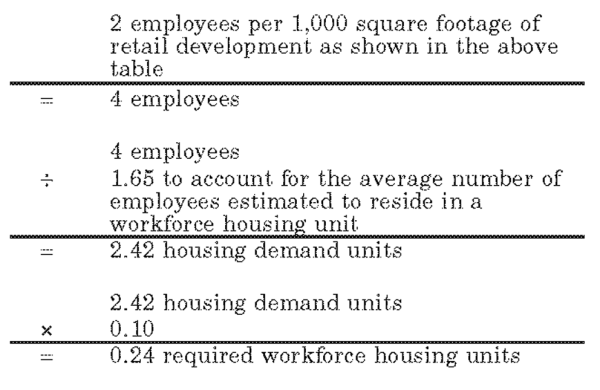
- A specific development site that proposes a land use that requires the resort developer to project the full-time equivalent employee (FTEE) generation, shall divide the FTEE by 1.65 to account for the average number of seasonal employees estimated to reside in a seasonal workforce housing unit. This number equals the seasonal employee housing demand. The seasonal employee housing demand shall then be multiplied by ten percent to calculate the required number of seasonal workforce housing units. Fractional housing units shall be rounded up to the nearest whole unit.
- A specific development site that has an assigned employee generation value shall use that value to establish a FTEEs generated. The number of FTEEs shall then be divided by 1.65 to account for the average number of seasonal employees estimated to reside in a seasonal workforce housing unit. This number equals the seasonal employee housing demand. The seasonal employee housing demand shall then be multiplied by ten percent to calculate the required number of seasonal workforce housing unit(s). Fractional housing units shall be rounded up to the nearest whole unit.
Seasonal Workforce Housing
for the Destination and Recreation Resort Zone by Land UseDevelopment/Land Use Category Employee Generation Value (FTEE) Resort operations To be projected by resort Hotel, condo-tel & timeshare, etc. To be projected by resort Restaurant and drinking establishment 3.5 per 1,000 sf finished floor space Retail 2 per 1,000 sf finished floor space Commercial amusement and indoor/outdoor recreation 3 per 1,000 sf finished floor space
- Housing type. Workforce housing may consist of structures such as; single-, two-, three- and four-family dwellings, multifamily dwellings and rental units. Rental units may be apartments, dormitories, boardinghouses and/or residence halls.
- Housing affordability. An annual report shall be generated and presented to the county planning staff that outlines a previous year's employment level, workforce housing need, housing type/availability and occupancy. The report shall also outline the methods guaranteeing perpetual affordability and the rental and/or mortgage payments as they relate to housing types. Housing payments, including utilities, shall not exceed 30 percent of the area moderate household income as defined in the county's moderate income housing plan.
- Density and affordable workforce housing. Any density created by the development of required workforce housing shall not count against the development's approved density.
(Ord. of 1956, § 44-7; Ord. No. 2016-4, Exh. B2, 5-24-2016)
Amended by Ord. 2026-09 on 5/26/2026
Sec 104-29-8 Land Uses
Use | Permitted (P)
Conditional (C) | |
| Residential Uses | ||
| Single-family dwelling; including not more than two lockout sleeping rooms per dwelling | P | |
| Two-family dwelling (aka Duplex) | P | |
| Three-family dwelling | P | |
| Four-family dwelling | P | |
| Multi-family dwelling | P | |
| Recreation lodge | P | |
| Condominium dwelling unit and/or condominium rental apartment (condo-tel); including not more than two lockout sleeping rooms per unit or apartment. | P | |
| Private residence club | P | |
| Townhome | P | |
| Residential facility for persons with a disability meeting the requirements of section 108-7-13 | P | |
| Timeshare/fractional ownership unit | P | |
| Hotel | P | |
| Bed and breakfast dwelling/B&B inn/B&B hotel | P | |
| Accessory dwelling unit | P | |
| Workforce housing/dormitory/residence hall | P | |
| Hostel | P | |
| Campground (public or private tent/RV); meeting the requirements of the Forest Campground Ordinance of Weber County | P | |
| Short-term rental, pursuant to Title 108, Chapter 11. | P | |
| Commercial Uses | ||
| Bank/financial institution | P | |
| Bakery | P | |
| Drinking establishment | P | |
| Grocer/neighborhood market | P | |
| Delicatessen | P | |
| Boutique (gift, flower, antique, clothing, jewelry) | P | |
| Fueling station/gas station | P | |
| Conference/education center | P | |
| Wellness center (i.e., spa, fitness, etc.) | P | |
| Art gallery and studios | P | |
| Book store | P | |
| Beauty/barber shop | P | |
| Short-term vendor | P | |
| Package liquor Store | P | |
| Private club | P | |
| Restaurant; excluding drive-thru window | P | |
| Sporting goods/clothing store; including rental | P | |
| Other Uses | ||
| Arts theater and performance facility/auditorium/amphitheater | P | |
| Agriculture | P | |
| Childcare facilities | P | |
| Church/place of worship | P | |
| Clinic/medical facility | P | |
| Community center | P | |
| Developed recreation facility (i.e., swimming, golf course, ice skating, skate park, playground, tubing hill, tennis, etc.) | P | |
| Dude ranch; including horse rental | P | |
| Equestrian center | P | |
| Gun club/skeet/sporting clay | C | |
Heliport, subject to the following standards: (1) A helipad must be located at least 200 feet from any property not within the resort or otherwise owned by the resort operation. (2) The helipad landing surface must be dust-proof and free from obstructions. (3) Prior to issuance of a conditional use permit for a heliport, written approval from the Federal Aviation Administration (FAA) is required, if necessary. | C | |
| Home occupation | P | |
| Horses for private use, provided that not more than two are kept for each one acre of land exclusively devoted to the keeping of horses | P | |
| Trails (nordic, hiking, biking, equestrian) | P | |
| Laundromat | P | |
| Museums | P | |
| Nordic center | P | |
| Office; professional and resort administrative | P | |
| Office supply/shipping service | P | |
| Parking areas and structures | P | |
| Parks and playgrounds | P | |
| Pharmacy | P | |
| Public building | P | |
| Public utility substation and structure | C | |
| Real estate office | P | |
| Recreation centers | P | |
| Recreation vehicle storage | P | |
| School; public or private school having a similar curriculum as a public school | P | |
| Ski area and associated facilities; including lifts | P | |
| Ski lodge and associated services | P | |
| Small wind energy system; meeting the requirements of section 108-7-24 | C | |
| Solar energy installation; meeting the requirements of section 108-7-27 | P | |
| Telecommunications tower | C | |
| Yurt | P | |
| Welcome/information center | P | |
| Wastewater treatment facility; meeting the requirements of the state division of water quality | C | |
| Water pumping plants and reservoirs | C | |
| Accessory dwelling unit. Unless restricted for employee housing, one detached accessory dwelling unit shall count as one dwelling unit. | P | |
| Greenhouse, nursery, or farm | P | |
| Transit facility | P | |
| Corral, stable, or building for keeping of animals or fowl | P | |
| Household pets | P | |
| Private stable | P | |
| Educational facility | P | |
| Liquor, wine, and beer manufacturing, bottling, blending, distilling, packaging, sales, and related activities | P | |
| Temporary building or use incidental to construction work. Such building shall be removed upon completion or abandonment of construction work | P | |
| Grazing and pasturing animals | P | |
| Detached lockouts | P | |
| Accessory building incidental to the use of a main building; main building designed or used to accommodate the main use to which the premises are devoted; and accessory uses customarily incidental to a main use | P | |
(Ord. No. 2012-1, § 4, 1-3-2012; Ord. No. 2015-7, Exh. A, 5-5-2015; Ord. No. 2016-4, Exh. B2, 5-24-2016)
Amended by Ord. 2020-27 on 12/22/2020
Amended by Ord. 2021-6 on 3/23/2021
Amended by Ord. 2023-01 on 1/10/2023
Amended by Ord. 2026-09 on 5/26/2026
Sec 104-29-9 Second Kitchen
A second kitchen covenant shall not be required when constructing less than three kitchens in a dwelling or condominium unit, provided such unit is not configured in a manner that enables more than one dwelling unit.
(Ord. No. 2016-4, Exh. B2, 5-24-2016)
Amended by Ord. 2026-09 on 5/26/2026
Sec 104-29-10 Miscellaneous Improvements
"Miscellaneous improvements" means:
- Improvements with a height less than six feet such as walkways, steps, patios, decks, exterior railings, and similar exterior dwelling improvements;
- Exterior landscaping décor such as a planter, landscape curbing, or any other similar exterior landscaping décor or improvements;
- Hot tubs, barbeques, grills, firepits, firebowls, patio heaters, benches, picnic tables, and hammocks. In addition, without reference to height, overhangs, eves, decks, stairs, access ramps, and retaining walls that are connected or attached to the structure shall constitute "miscellaneous improvements." Miscellaneous improvements are permitted outside of the building envelope. Notwithstanding the foregoing, miscellaneous improvements on lots subject to hillside review (pursuant to chapter 14) or other supplementary review, are subject to hillside review or other supplementary reviews.
(Ord. No. 2016-4, Exh. B2, 5-24-2016)

