
Weslaco City Zoning Code
Sec. 150-12
Additional use, height, and area regulations and exceptions.
(a)
Use regulations.
(1)
Accessory buildings and accessory use. No accessory building or accessory use shall be constructed upon a lot until the construction of the main use building has commenced. No accessory building shall be used unless the main use building on the lot is also being used. R-3 rural district areas shall be excluded from this requirement.
a.
In a residence or an apartment district any accessory building and use shall be smaller in both size and scale than the man use building, detached from the main building, without separate bath or kitchen facilities, not used for commercial purposes and not rented or leased. Separate bath facilities shall be allowed in cabanas and other private poolside structures; however, that such structure shall never be used as a residence.
b.
In commercial districts, an accessory building and use shall be smaller in both size and scale than the main building, the use of which is incidental to and used only in conjunction with the main building.
c.
Guest house and maids quarters requirements shall be as follows:
1.
Must be on the same utilities as primary residence.
2.
May have separate kitchen facilities.
3.
Restricted to R-1 and R-3 districts only.
4.
Maids quarters must have access through interior corridors or attached to main use building.
d.
Portable building/ portable classrooms shall be permitted in any public, semipublic or private schools. Portable building/ portable classrooms shall be permitted at any daycare or childcare center that within a commercially zoned area. Portable building/ classrooms must comply within standard setbacks for the zoned area.
(2)
Railroad rights-of-way. On all existing rights-of-way of railroad companies, regardless of the zoning district in which such rights-of-way are located, railroad trackage and accessories to railroad movement may be constructed or maintained.
(3)
Conditional use regulations.
a.
Purpose; defined. To provide for the compatible and orderly development of the city, certain uses are hereby declared to be conditional. The term "conditional use," when used in this section, means a use that may be suitable only in certain locations in the zoning district at any particular time or, likewise, may be inappropriate in a zoning district due to conditions then existing. In general, uses declared to be conditional under the terms of this chapter are recreational uses operated as a commercial enterprise and requiring the payment of money or a thing of value by the customer to the owner or operator as a condition for partaking in the recreational activity therein offered.
b.
Uses declared to be conditional. In extension and not in limitation of the definition of a conditional use in subsection (a)(3) a. of this section, the following uses are hereby declared to be conditional:
1.
Billiard or pool halls.
2.
Dance halls/event centers.
3.
Skating rinks.
4.
Bowling alleys.
5.
Amusement parks.
6.
Permanent circus (longer than two weeks).
7.
A day care center in a residential district, subject to the satisfaction of the following mandatory minimum conditions designed to protect the single-family residential character of the neighborhood by remaining low impact and preserving the quality of life within the neighborhood:
i.
Six-foot high screened opaque buffer fence is required along outdoor play area.
ii.
A maximum of 12 children will be permitted.
iii.
Must be secondary use to the home and the applicant must reside there.
iv.
No outside storage areas permitted.
v.
Business must take place in primary structure for home.
vi.
No exterior alterations indicating that a different use other than residential are permitted, the location must maintain the look of a residential area.
vii.
Must meet state requirements
viii.
Parking requirement shall be one space for every four children.
ix.
Only one daycare is permitted on dead-end streets and cul-de-sacs.
x.
The spacing between daycares must be 600 feet.
xi.
If applicant is not the property owner, an authorization letter must be provided by owner.
xii.
The conditional use permit shall be renewable upon one-year terms:
(i)
Yearly facility inspection must be conducted by planning, fire marshal, health and building departments prior to one-year renewal.
(ii)
Applicant must pay an administrative fee to the city for permit renew in accordance with Article VI, Master Fee Schedule.
(iii)
Property owners within a 200-foot radius will be notified by letter.
(iv)
Renewal shall be presented for consideration to the planning and zoning commission.
(v)
Renewal shall be presented for consideration to the city commission, only if the renewal has been denied by the planning and zoning commission.
xiii.
No garages, carports or accessory buildings can be used for occupation.
xiv.
If conditional use permit is revoked, applicant cannot request a permit within one year.
xv.
State comptroller registration must be provided and a copy submitted to the city.
xvi.
Property must be at least 50 feet wide.
xvii.
Property must be in compliance with latest adopted building permit at the time of application.
xviii.
A sign may be posted with a maximum size of 1.5 feet × 1.5 feet and must be non-illuminated.
xix.
All outdoor decorations along walls, fences or lawns shall be prohibited.
xx.
Exterior walls of the building and fencing must be painted in conformance with the surrounding color schemes of the existing neighborhood.
8.
Mental, drug or alcohol group therapy centers.
9.
All businesses holding mixed beverage alcohol permits.
10.
Assisted living facility (personal care homes and other similar type facilities) businesses in R-2, B-1, B-2, B-3, or I zoning districts.
11.
Hospice facilities in R-2, B-1, B-2, B-3, or I zoning districts.
12.
Bed and breakfast businesses shall be a permitted use in all zoning districts except in the I industrial district where they are prohibited, subject to the satisfaction of the following mandatory minimum conditions designed to protect the single-family residential character of the neighborhood:
i.
The owner of the real property on which the bed and breakfast inn is located must reside in the dwelling that is classified as a bed and breakfast homestay and bed and breakfast inn;
ii.
One off-street parking space must be provided for each guest room and the off-street parking must not be visible, as a result of sufficient landscaping, a stone or masonry wall, solid wooden fence, or some combination thereof, at street level, from the public right-of-way or any adjacent residential property;
iii.
Compliance with all applicable fire, building and health codes;
iv.
Signage shall be provided consistent with the requirement of Chapter 114.
v.
No cooking facilities of any kind shall be permitted in any guest room;
vi.
The only meal to be provided to guest shall be breakfast, and it shall only be served to guest taking lodging in the facility.
vii.
Guests may stay no longer than two weeks continuously in bed and breakfast classified as homestay or inn;
viii.
The conditional use permit shall be renewable upon one-year terms:
(i)
Yearly facility inspection must be conducted by planning, fire marshal, health and building departments prior to one-year renewal.
(ii)
A police report of the location must be provided to the commission as part of the renewal application.
(iii)
Applicant will pay an administrative fee to the city for permit renew in accordance with Article VI, Master Fee Schedule.
(iv)
Property owners within a 200-foot radius will be notified by letter.
(v)
Renewal shall be presented for consideration to the planning and zoning commission.
(vi)
Renewal shall be presented for consideration to the city commission, only if the renewal has been denied by the planning and zoning commission.
ix.
Such other conditions as the planning and zoning commission may recommend or the city commission may impose if it is determined to be necessary or desirable for the protection of nearby properties and in the public interest;
x.
The property owner must provide proof of registration with the Texas Comptroller for the collection of hotel/motel taxes;
xi.
All property owners must obtain approval for a conditional use permit prior to the listing of the property on any host site;
xii.
All property owners must provide proof of liability insurance which specifically covers bed and breakfast;
xiii.
All bed and breakfast host must have at least one guest officially sign in, providing a real name, address, contact information, car registration, or a copy of a driver's license, which must be provided to the city upon request;
xiv.
The official guest sign in record, hosting dates and financial documents must be maintained for a minimum of four years and must be made available to the city upon request for auditing to ensure tax compliance.
xv.
The occupancy maximum shall be conspicuously posted within the bed and breakfast; and
xvi.
The name and telephone number of the local responsible party shall be conspicuously posted within the bed and breakfast and provided to planning department staff. The responsible party shall answer calls 24 hours a day seven days a week for the duration of rental period to address problems associated with the bed and breakfast.
13.
The operation of a private or public school in an "R-1" district.
14.
Any other use of a recreational nature as described in section 150-12(a)(3)a.
15.
Businesses that require any of the following on-premises licenses/permits from the Texas Alcoholic Beverage Commission:
i.
Wine and beer retailers permit.
ii.
Beer retail dealers on premise license.
iii.
Retail dealers on-premise late hours license.
iv.
Brewpub license.
v.
Wine and beer retailers permit for excursion boats.
vi.
Wine and beer retailers permit for railway dining car.
vii.
Mixed beverage permit.
viii.
Mixed beverage late hours permit.
ix.
Mini bar permit.
x.
Caterer's bar permit.
xi.
Food and beverage certificate.
xii.
Beverage cartage permits.
xiii.
Mixed beverage restaurant permit with food beverage certificate.
16.
Businesses that require any of the following off-premise licenses/permits from the Texas Alcoholic Beverage Commission: [The change of ownership shall be exempt from the conditional use requirement, case shall be handled administratively by the office of the city secretary. Unless license was revoked in accordance with section 150-12(h)(3)]
i.
Wine and beer retailer's off-premises permit.
ii.
Beer retail dealer's off-premises.
iii.
Package store permit.
iv.
Wine only package store permit.
v.
Local distributors permit.
vi.
Local cartage permit.
vii.
Local cartage transfer permit.
viii.
Package store tasting permit.
c.
Permit required. Notwithstanding any other provision of this chapter, no conditional use may be established or operated in any zoning district where such use is otherwise permitted or authorized under the terms hereof unless a use permit is first granted by the city in accordance with the requirements of this section. A use permit may only be issued by the city commission after receipt of recommendation from the planning and zoning commission of said city. The use permit may have a specified time limitation attached and may impose conditions other than those which are specifically set forth in this chapter.
d.
Approval procedure; responsibility. The planning director or duly appointed representative will have the responsibility for processing all applications for use permits required for conditional uses and for forwarding such applications to the planning and zoning commission.
1.
After receiving an application for a use permit, the planning director or duly appointed representative shall place the request on the agenda of the next planning and zoning commission meeting at least 14 days from the date of the advertisement is published.
2.
The planning director or duly appointed representative shall conduct a technical review of the application and shall forward a recommendation to the planning and zoning commission. The planning and zoning commission shall make a formal recommendation to the city commission. The city commission shall approve or disapprove the application, after public hearing and after receiving the report of the planning and zoning commission according to the procedure set out in section 150-20(c) and (d).
3.
A conditional use permit shall be granted only when the proposed use is otherwise permitted in the zoning district in which it is proposed to be located.
4.
In granting a use permit, the city commission may impose such requirements and conditions with respect to location, construction, maintenance, and operation for the particular use that they deem necessary for the protection of adjacent property and in the public interest, in addition to those expressly stipulated in this chapter.
e.
Application filing procedure and fees. Application shall be made by the property owner, lessee, or certified agent thereof, to the planning commission on a form prescribed for this purpose by the city. Such application may be accompanied by drawings as set forth in subsection (a)(3)f. of this section. The granting of a use permit does not exempt the applicant from complying with requirements of Article III of Chapter 26 or other ordinances. The fee for a use permit shall be $300.00, payable at the time application is made. No part of this fee shall be refundable. The application shall contain the following information:
1.
The name of the proposed use.
2.
The location of the proposed use.
3.
The purpose of the proposed use.
4.
The owners and operators of the proposed use.
5.
Whether or not alcoholic beverages will be consumed on the premises.
6.
The hours of operation of the proposed use.
7.
An application for a conditional use permit for the same location can only be submitted once during a 12-month period. The city commission may waive this requirement if circumstances warrant it.
f.
Preliminary site plans preferred.
1.
Purpose. The purpose of the site plan is to ensure a feasible compliance with this chapter and to assist in the orderly and harmonious development of the city, to protect the general welfare, and to help prevent the impairment by the erection of structures, additions or alterations without proper attention to site planning.
2.
Contents. The site plan shall contain:
i.
The location of all structures on the subject property.
ii.
Landscaping and/or fencing of yards and setback areas and the use of landscaping and/or walls or fences for screening purposes.
iii.
Design of ingress and egress to minimize interference with traffic flow on abutting streets.
iv.
Off-street parking and loading facilities.
v.
Height of all structures.
vi.
Proposed uses.
g.
Prerequisites for approval.
1.
No structure or property in any district shall be used for a use listed as a conditional use without first having a use permit for such use from the city commission.
2.
The city commission, after receipt of report and recommendations from the planning and zoning commission may permit a conditional use subject to appropriate conditions and safeguards when, after public notice and hearing, it finds and determines that:
i.
The proposed use meets all the minimum standards established in this chapter and in applicable health and safety ordinances of the city for this type of use;
ii.
The proposed use is in harmony with the purpose and intent of this chapter and of the plan for the physical development of the district, as embodied in the comprehensive plan of the city; and
iii.
The proposed use will not be detrimental to the health, welfare and safety of the surrounding neighborhood or its occupants, nor be substantially and permanently injurious to neighboring property. The city commission, in making this determination, may take into account the place or manner in which the applicant is likely to conduct the business and the number of similar establishments in the area, if any. Any undue concentration of conditional uses in any area of the city shall be avoided.
3.
The city commission may impose additional reasonable restrictions or conditions to carry out the spirit and intent of this chapter and to mitigate adverse effects of the proposed use. The requirements may include, but are not limited to, increased open space, loading and parking requirements, suitable landscaping, and additional improvements such as curbing and sidewalks.
h.
Development and/or automatic cancellation.
1.
Following the issuance of the conditional use, the building official shall ensure that, if the development is undertaken, it is completed in compliance with said permit. However, if a use permit has not been used within twelve months after the date granted, the permit is automatically cancelled. An applicant may be granted a six-month extension from the planning and code enforcement director as long as request is submitted in writing two weeks prior to expiration.
2.
The conditional use permit is granted solely to the agent authorized by the property owner to use establishment/property. Should ownership or the authorized agent change the conditional use is considered void.
3.
An alcoholic beverage establishment meeting or exceeding one or more of the criteria set forth below will not be eligible for a city liquor permit renewal and will be subject to a permit revocation at any time during the permit period if violations established below are met or exceeded. (All violations refer to those that take place within the property of the establishment.
i.
Five unreported fights or disturbances;
ii.
Two separate incidents which result in a homicide or homicides;;
iii.
Any one offense of prostitution, lewd conduct, gambling, drug or narcotics possession or sales, or assault permitted or committed on the premise, by act or omission, by the owner, agent or employee of the premise.
iv.
Fifteen arrests of intoxicated persons on premises;
v.
Any two sales of alcoholic beverages to a minor by the owner, agent or employee of the premises; or
vi.
Two violations in the hours of operation.
Any establishment denied the renewal of a city liquor permit due to meeting or exceeding the above criteria will require a new conditional use permit to open or re-open any bar at the same location regardless of duration of closure of previous establishment (no non-conforming use).
i.
Preexisting conditional uses to be considered nonconforming. Any existing conditional use in operation prior to the effective date of the ordinance from which this subsection is derived is hereby declared to be a nonconforming use and subject to the provisions of section 150-13. However, any nonconforming conditional use which holds a license or permit from the state alcoholic beverage commission authorizing the on-premises consumption of alcoholic beverages shall become subject to the provisions hereof upon the transfer of such license or permit to any person, and the new licensee or permittee shall not be entitled to use the premises for any use for which a use permit is required until he has applied for a use permit and a use permit has been granted by the city commission.
(b)
Height regulations.
(1)
Public, semipublic or private service buildings, hospitals, institutions or schools, where permitted in a district, may be erected to a height not exceeding 60 feet, and churches and temples may be erected to a height not exceeding 75 feet if the building is set back from each yard line at least one foot for each two feet additional height above the height limit otherwise provided in the district in which the building is located.
(2)
Chimneys, cooling towers, elevator bulk heads, fire towers, grain elevators, flour mills, monuments, stacks, or scenery lofts, tanks, water towers, ornamental towers and spired church steeples, or necessary mechanical appurtenances may be erected to a height in accordance with existing or hereafter adopted ordinances of the city, provided that in the absence of any such ordinance, there shall be no height limitation on these structures.
(c)
Area and density regulations.
(1)
In a district in which commercial or industrial buildings are built with one or more stories for residential purposes above the commercial or industrial uses, no side yards will be required for the residential portions of the building, provided that the part of the building intended for residential use is not more than two rooms deep from front to rear.
(2)
No yard or other open space provided about any building, for the purposes of complying with the provisions of these regulations, shall again be used as a yard or an open space for another building. Every part of a required yard shall be open to the sky and unobstructed by buildings except for accessory buildings in the rear yard and except the ordinary projections of skylights, sills, belt courses, cornices, and other ornamental features which may project into such yards a distance of not more than two feet.
3.
Any building or accessory use constructed on any lot shall be located ten feet from any other building or accessory use on such lot or attached in R-1, R-3, R-4 and M-1 Districts.
(4)
Front yard requirements shall be as follows:
a.
Where 40 percent or more of the frontage on one side of a street between two intersecting streets is developed with buildings that have not observed a front yard as described in subsection (c)(5)a of this section, then:
1.
Where a building is to be erected on a parcel of land that is within 100 feet of existing buildings on both sides, the minimum front yard shall be a line drawn between the two closest front corners of the adjacent buildings on the two sides; or
2.
Where a building is to be erected on a parcel of land that is within 100 feet of an existing building on one side only, such building may be erected as close to the street as the existing adjacent building. In determining such front yard depth, buildings located entirely on the rear one-half of a lot shall not be counted.
b.
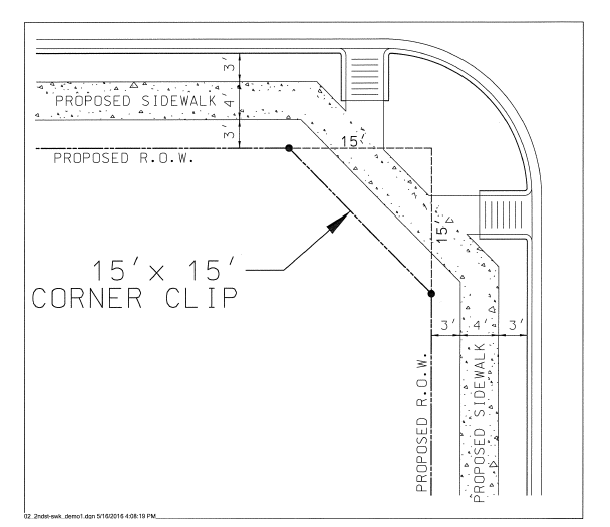
On any corner lot on which a front or side yard is required, no wall, fence, sign, or other structure, or any plant growth shall be permitted or maintained higher than three feet above the curb level within 15 feet of the intersection of the property lines. All opaque fencing extended to the front yard shall upon any corner lot construct a 15-foot by 15-foot corner clip fence.
c.
Front yard solid face fences extending past the forward most portion of the main use building to the front and side lot of property lines shall be restricted to a height of not more than 36 inches above the grade of the yard within 15 feet of the front property line.
d.
Attached accessory buildings or accessory uses in an R-1, R-2, R-3 or M-1 zone shall be from the front property line the same distance required for the main building, for front yard purposes. Detached accessory buildings or accessory uses shall be located in the area defined as the rear yard.
5.
Side yard requirements shall be as follows:
(a)
The minimum width of a side yard of a corner lot in the R-1, R-2, and R-4 districts shall be not less than ten feet, provided that if the corridor is identified on the Hidalgo County Thoroughfare Map and the street side line of a corner lot is in the same block frontage with a lot whose street line is a front of such lot, the side yard shall extend to the average alignment of the buildings along the same side of the street, unless such buildings are more than 25 feet back from the street line, in which case the side yard need not be more than 25 feet.
b.
A side yard of not less than 25 feet on the side of the lot adjoining on an R-1 or R-2 district shall be provided for all schools, libraries, churches, community houses, clubs, and other public or semipublic buildings hereafter erected or structurally altered.
c.
Where 40 percent or more of the side yard on one side of a street between two intersecting streets is developed with buildings that have not observed a side yard, then:
1.
Where a building is to be erected on a parcel of land that is within 100 feet of existing buildings on both sides, the minimum side yard shall be taken at an average of the adjacent buildings on the two sides; or
2.
Where a building is to be erected on a parcel of land that is within 100 feet of an existing building on one side only, such building may be erected as close to the side yard as the existing adjacent building.
d.
Where a lot in a B-1, B-2, B-3, or I district is not used for residential purposes and abuts upon an R-1 or R-2 district, a side yard shall be provided of not less than ten feet. Furthermore, in such abutting zones, it shall be required that the commercial zone developer must provide and permanently and adequately maintain a permanent screening fence of masonry and/or solid wood of redwood and/or cedar, no less than eight feet in height, and that the building must set back no less than ten feet from such abutting property line, such screen shall set back within the property line. Furthermore, if the residential building converts to a commercial or industrial building, a permanent screening fence of masonry and/or solid wood of redwood and/or cedar, no less than eight feet in height, shall be required.
e.
Garages detached or attached to the main use building entering on the side street of a corner lot, shall maintain a side yard of 20 feet in front of the garage.
(6)
Rear yard requirements shall be as follows:
a.
In R-1, R-2, R-4 and M-1 districts, no main use, accessory use or accessory building shall be constructed, placed or located within five feet of the rear property line on any lot.
b.
Any accessory building or accessory use constructed on any lot in an R-1, R-2, R-4 and M-1 district shall be located ten feet from the main use building on such lot or attached and may not be more than one story in height.
c.
Any building constructed on any lot in a B-1, B-2, B-3, or I district shall be located at least ten feet away from all other buildings on such lot.
d.
If an alley abuts the rear property line on any lot in an R-1 or R-2 district, no part of such alley may be used in determining the rear yard setback described in subsection (c)(7)a of this section.
e.
Where 40 percent or more of the rear yard on one side of a street between two intersecting streets is developed with buildings that have not observed a rear yard, then:
1.
Where a building is to be erected on a parcel of land that is within 100 feet of existing buildings on both sides, the minimum rear yard shall be taken at an average of the adjacent buildings on the two sides; or
2.
Where a building is to be erected on a parcel of land that is within 100 feet of an existing building on one rear only, such building may be erected as close to the rear yard as the existing adjacent building.
f.
Where a lot in a B-1, B-2, B-3 or I district is not used for residential purposes and abuts upon an R-1 or R-2 district, a rear yard shall be provided of not less than ten feet. Furthermore, in such abutting zones, it shall be required that the commercial zone developer must provide and permanently and adequately maintain a permanent screening fence of masonry and/or solid wood of redwood and/or cedar, no less than eight feet in height, and the building must set back no less than ten feet from such abutting property line, such screen shall set back within the property line. Where a lot in a B-1,B-2, B-3 or I district is used for residential purposes and abuts upon an R-1 or R-2 district, the rear yard requirements from the R-1 or R-2 district shall apply. Furthermore, if the residential building coverts to a commercial or industrial building, a permanent screening fence of masonary and/ or solid woof of redwood and/or cedar no less than eight feet in height shall be required.
(Ord. No. 2018-02, § II, 2-6-2018; Ord. No. 2021-52, § II, 1-4-2022)

