
Wheat Ridge City Zoning Code
ARTICLE V
- DESIGN STANDARDS
Sec. 26-501.- Off-street parking and loading.
In all zoning districts, off-street parking facilities for the parking or storage of self-propelled motor vehicles and/or licensed trailers for the use of occupants, employees and patrons of the buildings, structures or premises hereafter erected, altered, used or extended after the effective date of this chapter shall be provided and maintained as herein prescribed, unless otherwise specifically provided.
A.
Purpose. The purpose of these parking and loading regulations is to:
1.
Allow flexibility in addressing vehicle parking, loading, and access issues;
2.
Present a menu of strategies to solve parking issues for varying site constraints and conditions throughout the city;
3.
Ensure that off-street parking, loading, and access demands associated with development are met without adversely affecting other nearby land uses and surrounding neighborhoods;
4.
Lessen congestion upon the public streets in the city;
5.
Accommodate and encourage multi-modal transportation usage; and
6.
Reduce the visual impact of parking and loading areas from sidewalks, streets, and adjacent residential properties.
B.
Applicability. This section shall apply only to new development, major change of uses (e.g., single detached dwelling to office; office to restaurant) or substantial extension of expansion of uses for which a building permit or site use approval is required, established subsequent to the adoption of this provision, provided, however, in residential districts on and after August 31, 2009, it shall be unlawful to park motor vehicles in areas meeting the definition of landscaping as defined in section 26-502, or on uncontrolled weeds, or on compacted dirt surfaces, unless such surfaces constitute a residential driveway or hard surfaced auxiliary storage area and said driveways or storage areas existed prior to August 31, 2009.
1.
Applicability to existing uses.
a.
No existing use or structure shall be deemed nonconforming solely because of the lack of off-street parking (including bicycle parking or EV parking) or loading requirements prescribed in this section.
b.
Off-street parking and loading facilities existing on the effective date of this section: September 28, 2009, shall be maintained as long as the use or structure exists, unless an equivalent number of spaces are provided conforming to the requirements of this section.
c.
In connection with an existing use, this section shall not require the maintenance of more parking or loading spaces than is required for a new building or use under this section.
d.
For the purposes of this section, "maintained" shall mean that no off-street parking and loading facility shall be reduced in capacity, design, or function to less than the minimum standards prescribed in this section.
2.
Expansions and increases in intensity. Unless otherwise expressly stated in this section, the off-street parking and loading standards of this section apply when an existing structure or use is expanded or enlarged, through the addition of dwelling units, floor area, seating capacity, employees, or other units of measurement used for establishing off-street parking and loading requirements. Additional off-street parking and loading spaces shall be required only to serve the enlarged or expanded area, not the entire building or use. Table 1 below sets forth an example for applying this standard:
3.
Major change of use. Unless otherwise expressly stated in this section, off-street parking (including bicycle parking) and loading facilities shall be provided for any change of use or manner of operation that would, based on the off-street parking schedule or the off-street loading schedule, result in a requirement for more parking or loading spaces than the former use. Additional parking or loading spaces shall be required only in proportion to the extent of the change, not for the entire building or use and only for seventy-five (75) percent of the additional parking required by the change in use. Table 2 below sets forth an example for applying this standard:
4.
Planned developments. In planned developments, the amount of off-street parking shall be determined on a case-by-case basis as part of the city's consideration of the planned development application. However, the decision-making body may use the off-street parking and loading requirements of this section as the starting point for determination of the applicable minimum standards. All planned development applications shall include a parking plan according to this section.
5.
Applicability of parking lot design standards to existing uses. Parking lot design standards shall apply to existing uses as follows:
6.
Additions affecting existing parking. Nothing in this section shall prevent extension of, or addition to, a building, structure or use into an existing parking area provided the same amount of parking spaces taken by the extension or addition is provided by an enlargement of the existing parking area, or if additional parking is found elsewhere in accordance with these regulations herein, and provided the total number of spaces required for all uses on the lot are met.
7.
Parking plan required. All plans for the construction of any parking facility, excluding those for single- and two-unit dwellings, must be approved by the community development director or their designee, either through the site plan or specific development plan review process or as part of a building or site work permit application for the site. No such land shall be used for parking until approved by the director and a permit is issued. The plan must contain the following minimum information:
a.
Number, location, and size of parking stalls including accessible, EVCS, and bicycle parking.
b.
Widths of aisles and islands.
c.
Location of landscaped areas including required buffers/screening and parking lot islands as required by section 26-502 E.
d.
Type of surfacing.
e.
Scale and north arrow.
f.
Location of streets, curb cuts and property boundaries.
g.
Traffic directional arrows, signage and markings.
h.
Loading areas.
i.
Drainage provisions.
j.
Location and direction of proposed lighting.
k.
Location, height, and type of walls or fences to be constructed.
C.
Shared parking.
1.
Purpose. The purpose of these shared parking regulations is to provide the option for users near one another that have different peak parking demands or different operating hours to share off-street parking facilities to:
a.
Encourage the efficient use of land and resources;
b.
Reduce development costs while not adversely affecting traffic patterns and creating minimal spillover parking;
c.
Allow more complimentary forms of development; and
d.
Help reduce the amount of land devoted to parking while providing a sufficient number of spaces.
2.
Shared parking standards.
a.
Calculation. The number of shared parking spaces for two (2) or more distinguishable land uses shall be determined by using the following procedure:
i.
Step 1: Calculate the number of parking spaces required for each individual land use as set forth in table 6 (schedule of off-street parking).
ii.
Step 2: Multiply the required number of parking spaces from step 1 by the percentages in each of the six (6) time periods in Table 4 below.
iii.
Step 3: For each time period, add the number of spaces required for all applicable land uses to obtain a total for each of the six (6) time periods.
iv.
Step 4: Select the time period with the highest total parking requirement and use that the total as the shared parking allowance.
b.
Shared parking procedure.
i.
Mixed occupancy on single parcel or building. In the case of mixed uses on a single parcel or within a single building, the community development director may approve a shared use of parking in accordance with Table 4 above, (Shared Parking Matrix).
ii.
Off lot shared parking.
a)
Shared parking agreement. In the case of off lot shared parking where the off lot site is owned by others, a written agreement between the city, the owner who shall provide the additional parking, and the owner of the property seeking the parking shall be entered into. Said agreement shall be recorded as a deed restriction and shall specify the number and location of the parking spaces. Approval of said agreement by the city shall consider the impact of the parking on adjacent or nearby residential properties. Said agreement may be terminated only if adequate onsite or offsite parking space is provided through other means as approved by the director of community development. The agreement shall be recorded with the Jefferson County Clerk and Recorder's Office and shall be enforced until all three (3) parties sign a release.
b)
Location of off lot shared parking. Off-lot parking may be used provided said parking area is within three hundred (300) feet of the nearest point on the structure or use for which the parking is intended to serve and the off-lot parking is a permitted use as listed in the Table of Uses for the zone district in which the off-lot parking will be located.
c)
Off lot shared parking pedestrian access. All parking spaces for any off lot shared parking shall have direct pedestrian access to the main entry of the building or use they are intended to serve as determined by the community development director. Shared parking that is located across an arterial street as defined in the Comprehensive Plan shall be accessible to pedestrians using an existing traffic signal which includes a pedestrian crossing phase to cross the arterial street. The total walking distance from the main entry of the building to the shared parking, by way of the traffic signal crossing of the street, shall not exceed three hundred (300) feet.
d)
Miscellaneous shared parking provisions. The total requirements for off-street parking facilities may be utilized as the sum of the requirements for each of the various uses computed separately.
i)
Off-street parking facilities for one (1) use shall not be construed as providing required parking for any other use except as provided for under planned developments, or under a shared parking arrangement as approved by the community development director in accordance with this subsection.
ii)
In no instance may required accessible parking spaces be provided off lot as part of a shared parking agreement, unless no parking can be provided on site.
iii)
In no instance may on-street parking be utilized as part of a shared parking agreement.
iv)
EV parking may be provided off site as part of a shared parking agreement.
D.
Parking reductions.
1.
Parking reductions by right. The community development director may grant a parking reduction not to exceed twenty-five (25) percent of the required number of vehicular parking spaces as set forth below without a variance process. Only one (1) of the following options may be applied to any one (1) development, unless otherwise noted in the table:
2.
Parking reduction criteria. Parking reductions may only be granted by the community development director upon finding that the proposed reduction:
a.
Will create minimal spillover parking onto adjacent property or public rights-of-way;
b.
Will not adversely affect traffic circulation patterns on or off site; and
c.
Will promote quality urban design equally or better than a plan that strictly complies with the standards in this section.
The community development director may require a traffic generation study prepared by a professional engineer in order to determine that the criteria in above have been met.
3.
Parking reductions—Variance procedures. The community development director may grant a parking reduction of up to fifty (50) percent of the required number of vehicular parking spaces in accordance with the variance procedures in subsection 26-115 C of this Code. Parking reductions exceeding fifty (50) percent shall be taken to the board of adjustment in accordance with the procedures set forth in subsection 26-115 C.3 of this Code.
E.
Standards.
1.
General provisions.
a.
Planned development (PRD, PCD, PID, PHD). In planned developments, except for unified shopping centers over one hundred thousand (100,000) square feet of floor area provided for below, parking shall be considered with regard to the standards set forth in this section for the various use requirements. Where it is desired to share the parking spaces between two (2) or more uses, the regulations set forth in subsection 26-501 C (Shared parking) shall be used to determine the appropriate shared parking arrangements.
b.
Mixed occupancy and collective parking. In the case of mixed uses on a single parcel or within a single building, or of collective parking for several buildings or uses on two (2) or more parcels, except for shopping centers over one hundred thousand (100,000) square feet, the total requirements for off-street parking facilities shall be the sum of the requirements for each of the various uses computed separately. Off-street parking facilities for one (1) use shall not be construed as providing required parking for any other use except as provided for under planned developments. Unified shopping centers with over one hundred thousand (100,000) square feet of total combined floor area, which may be either in a single structure or several structures within a single unified development, and which may include various kinds of uses, shall be required to provide a minimum parking ratio of four (4) spaces per one thousand (1,000) square feet of total combined gross leasable floor area unless a shared parking arrangement may be made in accordance with subsection 26-501 C (shared parking).
c.
Location of parking areas.
i.
Off-street parking facilities for any use shall be provided and located on the same lot as the use or uses they are intended to serve except as provided for herein.
ii.
If sufficient parking spaces cannot be accommodated on the lot for any use, off-lot parking may be used in accordance with subsection 26-501 C (shared parking).
iii.
Additional requirements for location of parking requirements may exist in the adopted Architectural and Site Design Manual.
d.
Parking of recreational vehicles, travel trailers, and pickup-mounted campers.
i.
In all zone districts, the use of recreational vehicles, travel trailers, and pickup-mounted campers for living quarters is prohibited except in approved RV parks.
ii.
Parking of such vehicles in an approved RV park shall be limited to a maximum of thirty (30) days within the same RV park.
iii.
Additional restrictions for the parking of such vehicles are set forth in subsection F. herein.
2.
Summary table.
Notes:
(1) Wherever the word "person," "student," or "employee" is used as a unit of measure, the requirement shall be based upon the maximum designed use or occupant capacity.
(2) For operations which contain more than one (1) use category (e.g. motel/restaurant), the director of community development shall require parking computed by using the "mixed occupancy" provisions in this subsection E.2; however, the director may allow for up to fifty (50) percent reductions in parking for secondary uses where it is clearly shown that maximum parking demand peaks will not coincide.
3.
Uses not specified. In the case of a use not specifically mentioned, the requirements for off-street parking facilities for a similar use shall be determined by the director of community development based upon comparison to similar uses. His decision may be appealed to the board of adjustment.
4.
Bicycle parking.
a.
Applicability. Bicycle parking as set forth in table 7 in subsection E.4.b below shall be required for all nonresidential multi-unit dwelling dwelling, and single-unit attached uses.
b.
Standards.
i.
Bicycle parking design standards.
a)
The required bicycle rack is the "inverted U" type, or other type approved by the community development director. Each inverted U bicycle rack shall count as two (2) bicycle parking spaces.
b)
Bicycle parking facilities shall include provisions for storage and locking of bicycles in secure racks, or equivalent installation, in which the user may lock both the bicycle frame and wheels to the rack.
c)
Parking for bicycles shall be provided on site, and bicycle parking areas shall be well-lighted and located as near to the building or facility entrance as possible but not more than fifty (50) feet away, and shall not interfere with pedestrian traffic.
d)
If possible, bicycle parking areas should utilize already existing weather protected areas such as building overhangs.
e)
Bicycle facilities required by this section shall be maintained for the duration of the use requiring such facilities, and shall not be used for other purposes.
ii.
Long-term bicycle parking.
a)
Intended to provide users of a site a secure and weather-protected place to park and store bicycles and to charge electric bicycles.
b)
Shall take the form of an enclosed bicycle storage room within the primary building, enclosed bicycle lockers, a separate bicycle storage shed, an enclosure within a parking garage, or in another form within one hundred (100) feet of the primary entrance as deemed appropriate by the community development director.
c)
All types of long-term bicycle parking shall be easily accessible to all building occupants, secure, lighted, and weather resistant.
iii.
Number of required bicycle parking spaces. Bicycle parking spaces shall be provided at a rate specified below in table 7. No development shall provide fewer than two (2) bicycle parking spaces, unless otherwise noted in table 7.
iv.
Vehicular parking space reductions for bicycle parking spaces. Table 5 in section 26-501 D provides options to reduce the number of required motor vehicle parking spaces if additional bicycle-related facilities are provided beyond the minimum requirements.
5.
Surfacing. For all uses other than single detached dwellings in agricultural zone districts, areas subject to wheeled traffic for access, parking, sales or storage, shall be properly graded for drainage. These areas shall be surfaced with concrete, asphalt or brick pavers. For single- or two-unit dwellings, the first twenty-five (25) feet of driveway area from the existing edge of pavement into the site shall be surfaced with concrete, asphalt, brick pavers or similar materials. The auxiliary storage of motorized or non-motorized vehicles cannot occur within six (6) feet of the front property line. The storage area must be hard surfaced and must be built so that the materials used as to the parking surface stays contained within the parking pad (with the use of concrete curbs, railroad ties, etc).
6.
Parking area landscaping. Parking area landscaping shall be provided as set forth below. Landscaping in off street parking areas shall be counted towards the minimum total landscaped area required by section 26-502.
a.
Landscape buffering for parking and loading areas. Landscape buffering shall comply with screening and buffering requirements of section 26-502 E.
b.
Landscaped islands in parking areas. Landscaped islands are required as set forth in section 26-502 E.
7.
Parking area lighting.
a.
All lighting shall be in accordance with section 26-503 of the Code of Laws.
b.
Any lighting used to illuminate any off-street parking area shall not have a negative impact on the surrounding area.
c.
The light source shall be indirect, diffused or shielded type fixtures, installed to reduce glare and the consequent interference with adjacent streets and adjoining residential properties.
d.
Fixtures shall be attached to a building or mounted on poles and shall be in accordance with the requirements of section 26-503.
8.
Off-street loading.
a.
Loading space shall be provided at a rate deemed necessary by the owner. Loading shall not occur from any public street, major interior drive, nor occupy or intrude into any fire lane or required parking spaces. Where possible, loading docks must be located on the site so as not to be viewed from major roads, access ways, or residentially zoned property.
b.
The typical dimensions of an off-street loading space are twelve (12) feet wide by forty (40) feet long, with a minimum vertical clearance of fourteen (14) feet. A minimum maneuvering aisle width of forty (40) feet shall be provided behind the off-street loading space. These dimensions may be altered by the community development director based on the specific needs of the business and anticipated volumes of use.
c.
No loading space shall be located in any front setback area, nor shall it permit any vehicle to extend into any front setback area or across any lot line of a more restrictive district while being loaded or unloaded.
d.
In no instance shall a passenger loading area be considered an off-street loading area for the purposes of this subsection.
9.
Accessible parking. For all uses other than single- and two-unit dwellings, ADA-compliant accessible parking shall be provided at the minimum rate consistent with the following table. The minimum width of an accessible parking space shall be eight and one-half (8½) feet with an adjacent accessible aisle with a minimum width of five (5) feet. Two (2) accessible parking spaces may share a common aisle.
One (1) in every six (6) accessible spaces, but not less than one (1), shall be designated as "van accessible" and shall be a minimum of eight (8) feet in width and shall be served by an access aisle a minimum of eight (8) feet in width. "Van accessible" spaces may also be a minimum of eleven (11) feet in width with a minimum access aisle width of five (5) feet in accordance with ANSI 117.1—Accessible and usable buildings and facilities.
a.
Signage; location; etc. Each accessible space shall be marked with a freestanding sign containing the international symbol of accessibility and shall be a minimum of sixty (60) inches above the floor of the parking space, measured to the bottom of the sign. Signage for van accessible spaces shall contain the designation "van accessible". The International Symbol of Accessibility shall also be painted on the pavement. Said parking space shall be located as near to the entrance of the use as practically possible and shall not involve crossing any area used for vehicular circulation. The total number of accessible spaces provided shall be included in the total number of parking spaces otherwise required by this section.
b.
Electric vehicle charging station (EVCS). Any van accessible parking space that is served by an EVCS and is not designated as reserved for a person with a disability must be counted as at least two (2) standard vehicle parking spaces.
10.
Drive-thru and vehicle stacking requirements. Stacking spaces shall be a minimum of eight and one-half (8½) feet wide and eighteen (18) feet long and shall not double as a circulation driveway, maneuvering area or off-street parking space. Stacking spaces shall be required as set forth in Table 9 below.
11.
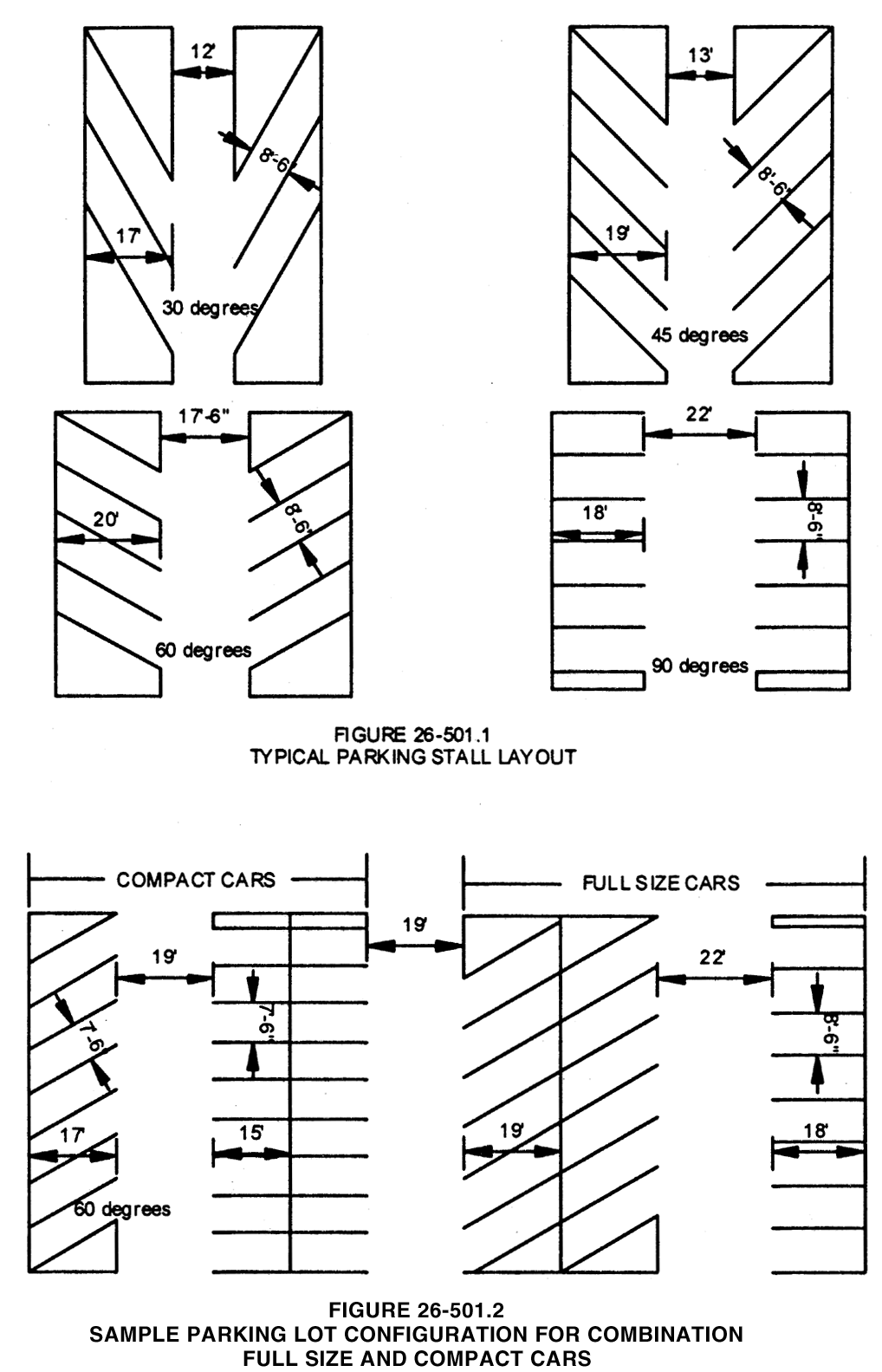
Parking space and aisle dimensions. The following table establishes the minimum parking lot space and aisle dimensions for full-size and compact automobiles.
Minimum Parking Standards
The following diagram illustrates typical parking stall layout for full-sized and
compact cars in accordance with the above standards:
12.
Miscellaneous.
a.
Auxiliary storage of vehicles. The auxiliary storage of motorized or non-motorized vehicles cannot occur within six (6) feet of the front property line. The storage area must be hard surfaced and must be built so that the material used as to the parking surface stays contained within the parking pad (with the use of concrete curbs, railroad ties, etc).
b.
Usable parking spaces. Any parking stall which is unusable due to maneuverability difficulties or does not have clear access into and out of its parking space shall not be considered in the count of the total number of available parking spaces on the property. Double-loaded spaces (parking where one (1) vehicle blocks another) are considered unusable, except when serving single and two-unit dwellings.
c.
Back-out parking. Except for single- and two-unit dwellings, all parking areas shall be designed so that vehicles exiting from the parking area will not be required to back out across any public sidewalk or public right-of-way, unless an exception has been granted by the community development director in consultation with the city engineer.
d.
One-way traffic flow. Parking which is designed for one-way traffic shall be clearly indicated as such by the use of a sign or arrow designating the direction of traffic flow and by the words "one-way."
e.
Marking of parking spaces. Parking spaces shall be marked and maintained on the pavement and any other directional markings/signs shall be installed as required by the city to ensure the approved use of space, direction of traffic flow and general safety in accordance with the approved parking plan.
f.
Parking lot design standards for truck-tractors and/or semi-trailers. Where it is desired to park truck-tractors and/or semi-trailers as regulated by sections 26-618 and 26-619, a parking plan shall be submitted which shows the location, extent and size of the proposed truck-tractor and semi-trailer parking, and which indicates proposed screening, lighting, landscaping, circulation, type of paving, and any other feature which will help the planning commission, city council and staff to evaluate the proposal and potential impacts. The following minimum standards shall be used in designing such parking lots:
Dimensions:
i.
All parking and circulation areas shall be paved to acceptable engineering standards with bituminous concrete or portland concrete.
ii.
Each parking stall shall be supplied with an electrical outlet to permit vehicles to be connected to electricity while parked.
iii.
Unattended truck-tractors shall not be allowed to idle.
iv.
The use of standard automobile parking spaces and/or circulation aisles for truck-tractor and/or semi-trailer parking or circulation is prohibited.
g.
Fractions. When units of measurements determining number of required parking spaces result in the requirement of a fractional space, any fraction shall require one (1) parking space.
h.
Small car parking. In parking lots with thirty (30) spaces or more, twenty (20) percent of the required parking spaces may be designated for small or compact cars; provided, that small car parking area or spaces shall be clearly labeled or otherwise distinguished from full-sized parking areas or spaces.
i.
Bumper, curb and wheel stops. To ensure the proper maintenance of these facilities, parking areas shall be designed so that a parked vehicle does not overhang the public right-of-way, public sidewalk, or adjacent property. A permanent curb, bumper, wheel stop or similar device shall be installed which shall be adequate to protect the right-of-way, sidewalk, or adjacent property from vehicular overhang and to protect any structure from vehicular damage. If such protection is provided by means of a method designed to stop the wheel rather than the bumper of the vehicle, the stopping edge shall be placed no closer than two (2) feet from the edges of the public right-of-way, sidewalk or building. A parked vehicle may overhang a landscape area up to two (2) feet. Such landscaped area must be low maintenance and may be included as a part of the length of the parking stall.
j.
Restrictions on the use of nonresidential parking areas. No parking area shall be used for the sale, storage, repair of, dismantling or servicing of any vehicles, equipment, materials or supplies. This shall not apply to vehicles on sales lots and does not preclude emergency repairs to a motor vehicle. For automotive repair facilities, vehicles stored on the property in excess of seventy-two (72) hours for the purpose of being repaired must be screened from view from adjacent streets and properties by a six-foot-high solid fence.
k.
Use and maintenance of parking area. For all uses, including single- and two-unit dwelling uses, parking of vehicles shall be limited to those areas specifically developed for parking and shall not be permitted within landscaped areas, designated fire lanes, loading zones, or other areas not designed and developed for parking. All parking and drive areas shall be maintained so as to prevent unsafe, muddy, dusty, weedy, or unsightly or blighting conditions. The provisions of these subsections l. and m. shall apply to both existing and future conditions.
l.
Appeal/variances and waivers to standards. Variances and waivers to parking requirements shall be processed as a variance pursuant to section 26-115, unless otherwise specified in this section.
13.
Electric vehicles (EVs) and electric vehicle charging stations (EVCS).
a.
General standards. All parking spaces that are required to be EVCS must meet the EVCS specifications pursuant to current building codes. All terms used within this section not defined in chapter 26 of the Code of Laws shall use the definitions pursuant to current building codes, including EV capable, EV capable light, EV ready, and EVCS installed.
b.
Applicability. The requirements of this subsection shall apply as follows:
i.
For site plan and specific development plan applications approved on and after March 1, 2024, all requirements of this subsection shall apply.
ii.
For site plan and specific development plan applications approved prior to March 1, 2024 but for which no building or site work permits have been obtained by March 1, 2026, all requirements of this subsection shall apply. A site plan or specific development plan amendment may be required to memorialize the required addition of EVCS or other EV facilities.
iii.
For new construction not subject to the development review processes of section 26-106, but which does require a building or site work permit and must provide parking, all applicable requirements of this subsection shall apply if a permit is not applied for prior to March 1, 2024.
c.
Parking requirements. The following table 12 sets forth the number of required EVCS installed spaces, EV ready spaces, and both types of EV capable spaces. These requirements apply to all new developments for which parking is required. This list is not intended to be exhaustive of each use category; the community development director shall determine the appropriate requirements if the use is not identified in the table below.
i.
New developments shall meet all requirements in table 12.
ii.
Additions for any use other than a single-unit dwelling, duplex, or single-attached dwelling (townhome) that increase existing floor area by sixty (60) percent or more shall be required to provide EV capable light spaces at a rate based on the required proportionate increase in spaces from table 1 and the EV capable light percentages in table 12.
iii.
For major changes of use that require additional parking spaces, EV capable light spaces shall be provided at a rate based on the required proportionate increase in table 2 and the EV capable light percentages in table 12.
iv.
For existing multi-unit residential properties undergoing renovations or expansions which disturb a minimum of fifty (50) percent or more of the parking area, all minimum parking requirements of table 12 shall apply.
v.
The community development director may waive the requirements of ii and iii above in whole or in part based upon existing conditions, demonstrated by the applicant, that may make it impossible or impractical to install the necessary conduit. Cost of compliance alone shall not be a basis for the waiver.
d.
Any EV parking space provided shall be counted towards the overall number of required parking spaces.
e.
Sites exceeding minimum requirements. EVCS installed spaces that exceed the minimum requirements of this section are permitted to be used to meet the minimum requirements for all space types. EV ready spaces that exceed the minimum requirements of this section are permitted to be used to meet the minimum requirements of EV capable and EV capable light spaces. EV capable spaces that exceed the minimum requirements of this section are permitted to be used to meet the minimum requirements of EV capable light spaces.
f.
Signage. All EVCS installed spaces shall include signage identifying them as restricted parking for EVs. If time limits or vehicle removal provisions are to be enforced, regulatory signage including parking restrictions shall be installed immediately adjacent to, and visible from, the EVCS.
g.
Accessible spaces. An EVCS shall be considered accessible if it is located adjacent to, and can serve, an accessible parking space as defined and required by this Code and the ADA.
F.
Vehicular access. Vehicular access to any property shall be controlled in such a manner as to protect the traffic-carrying capacity of the street upon which the property abuts, as well as to protect the value of the adjacent property.
1.
Driveway connections to street. For single- or two-unit dwellings, the first twenty-five (25) feet of driveway area from the existing edge of pavement into the site shall be surfaced with concrete, asphalt, brick pavers, or similar materials. For all uses, driveway connections with the public street must be paved between the property line and the existing edge of asphalt of the street.
2.
Spacing of vehicle access.
a.
For all uses other than single- or two-unit dwellings, no vehicle entrances or exits may be closer than twenty-five (25) feet to any property line except when used for joint access for two (2) or more lots.
b.
For all uses other than single- or two-unit dwellings, vehicle entrances or exits on the same lot shall be spaced at not less than one-hundred-foot intervals. The one-hundred-foot spacing shall be measured from the interior edge of both access points.
c.
For all uses, corner lots shall have no vehicular entrances or exits located closer than twenty-five (25) feet from any two (2) intersecting street rights-of-way, except on arterial or major collector streets such distance shall be fifty (50) feet.
d.
The community development director in consultation with the city engineer may approve a modification or waiver to the vehicle access standards and requirements stated in this subsection 2, pursuant to section 21-181 et seq. and based upon consideration of traffic characteristics, both on and off of the site, with the primary purpose of preserving public safety.
3.
Curb cut widths.
a.
Residential zone districts. In all residential districts, curb cuts for property access shall be not less than ten (10) feet and not more than twenty-four (24) feet in width.
b.
Commercial and industrial zone districts. Curb cuts in commercial and industrial districts shall not be more than thirty-five (35) feet in width when serving an individual property and shall not in any instance be less than twenty (20) feet.
c.
Joint curb cuts. A joint curb cut, one (1) which serves more than one (1) property, may not exceed forty-five (45) feet in width.
d
The community development director in consultation with the city engineer may approve a modification or waiver to the vehicle access standards and requirements stated in this subsection 3, pursuant to section 21-181 et seq. and based upon consideration of traffic characteristics, both on and off of the site, with the primary purpose of preserving public safety.
4.
Number of access points.
a.
For all uses, one (1) access point per property ownership will be permitted, unless a site plan or traffic study approved by the city shows that additional access points are required to adequately handle driveway volumes and will not be detrimental to traffic flow on adjacent public streets.
b.
In cases where it is possible to provide one (1) access point which will serve adjacent properties or where adherence to these requirements would leave a parcel of property without vehicular access, curb cut setback or spacing requirements may be reduced or enlarged so as to permit a single vehicular access point if approved by the community development director in consultation with the city engineer.
c.
Low-density residential uses are permitted to have "horseshoe-shaped" driveways provided that the public street accesses are thirty (30) feet apart at the closest point (interior edges).
d.
The community development director in consultation with the city engineer may approve a modification to or waiver to the vehicle access standards and requirements stated in this subsection 4, pursuant to section 21-181 et seq. and based upon consideration of traffic characteristics, both on and off of the site, with the primary purpose of preserving public safety.
G.
Residential parking.
1.
Parking of commercial vehicles. In residential zone districts, the parking of trucks, vans, buses or licensed trailers which are used for commercial purposes, whether the commercial enterprise is conducted from the home or conducted elsewhere, is prohibited except as permitted by this section. An occupant of a dwelling may park, or allow the parking of, no more than one (1) truck or van which is used for commercial purposes upon the premises or confined to the street frontage of the lot in question; provided, however, that such vehicle does not exceed a one-ton chassis. Parking of trailers which are used for commercial purposes is prohibited on any public right-of-way.
2.
Parking of recreational vehicles and trailers.
a.
Maximum number allowed. In residential zone districts, a maximum of two (2) of any the following vehicles may be parked outside upon property owned or rented by the vehicle owner, provided the vehicle owner resides on the property:
i.
Recreational vehicle.
ii.
Trailer upon which are stored personal recreational vehicles.
b.
Exemptions from maximum number allowed. Recreational vehicles or trailers are exempt from this two-vehicle limitation provided the vehicles or trailers are stored in the area between the side property line and the side wall of the structure and the back property line and the back wall of the structure, provided both of the following are met:
i.
The vehicles or trailers are less than six (6) feet in height; and
ii.
The vehicles or trailers are not visible from the public right-of-way as a result of being stored behind a solid fence six (6) feet in height, a structure, or vegetation which completely screens the vehicle from view from the public right-of-way.
In determining if a trailer is exempt or not exempt from the provisions of this subsection B., the height of the trailer will depend upon whether the trailer is loaded or not. A trailer that is exempt in an unloaded condition shall not be considered exempt in a loaded condition if the trailer plus load exceeds six (6) feet in height.
3.
Location of recreational vehicles and trailers.
a.
Restrictions adjacent to streets. Only one (1) such recreational vehicle or trailer may be stored in the area between the street and all walls of the structure facing the street. Such vehicles or trailers must be parked six (6) feet or more inside the front property line. For corner lots, the one (1) vehicle restriction shall apply to both areas between the street and the walls of the structure facing the street. Any vehicle or trailer lying partially between the street and the front walls of the structure shall be considered to be parked or stored in the front yard. Where it is difficult to determine the public right-of-way boundary due to lack of curb, gutter and/or sidewalk, or survey markers, such boundaries shall be presumed to be ten (10) feet from the edge of pavement or back of curb. Where a sidewalk exists, such boundaries shall be presumed to be two (2) feet from the outside edge of sidewalk. For the purposes of this subsection 3.a, permanent or temporary carports, frame covered structures, tents, or other temporary structures shall not be used to store or conceal such recreational vehicles or trailers in excess of the maximum number permitted.
b.
Side and rear setbacks. Recreational vehicles or trailers stored in a side yard need not meet any setback requirements. Recreational vehicles or trailers exceeding six (6) feet in height stored in a back yard must meet the side and rear yard setback requirements for accessory structures for the zone district in which the recreational vehicle or trailer is stored. Recreational vehicles and trailers less than six (6) feet in height stored in a back yard do not need to meet rear and side yard setbacks.
c.
Parking in rights-of-way.
i.
In residential zone districts, detached trailers and recreational vehicles are prohibited from parking in public rights-of-way; however one (1) recreational vehicle or one (1) trailer may be parked within public street rights-of-way for a period up to seventy-two (72) hours, provided they are attached to the towing vehicle. Moving the towing vehicle and/or the trailer to another location in the right-of-way does not extend or restart the seventy-two-hour period.
ii.
In residential zone districts, where it is desired to maintain such a restricted vehicle either within six (6) feet of a public street on private property or within a lawful parking area on a public street abutting the front of the property in excess of seventy-two (72) hours, the property owner may obtain a temporary parking permit from the community development department. Such temporary parking permit shall be for a time period not to exceed fourteen (14) days and no more than one (1) such permit shall be issued each six (6) months for the same vehicle. The issuance of a temporary permit is for the purpose of parking only and not for any other activity. The permit must be placed upon the inside windshield or side window on the driver's side so as to be visible for inspection.
d.
Miscellaneous recreational vehicle and trailer regulations.
i.
Pick up truck-mounted campers. Pickup truck-mounted campers, when mounted upon pickup trucks, are not subject to these parking restrictions except that such camper shall not be used for permanent or temporary living quarters. Nothing in this section will be construed to restrict or limit parking of any vehicle so described upon private property so long as said vehicle is parked in accordance with the limitations of this section and provided that sight distance triangle requirements of section 26-603 are met.
ii.
Surfacing of areas for recreational vehicles and trailers. Areas which are used to store or park allowed recreational vehicles or trailers shall be of an improved surface consisting of concrete, asphalt, brick pavers, gravel at least six (6) inches in depth, or similar materials. If gravel is used, the parking or storage area must be built so that the material used for surfacing stays contained with the storage or parking area with the use of concrete curbs, railroad ties, landscape timbers, or similar materials.
iii.
Parking of recreational vehicles and trailers on multi-unit dwelling property. The storage of recreational vehicles or trailers is permitted upon multi-unit dwelling residential properties where the owner of the vehicle resides upon the premises, and where such vehicle or vehicles do not displace required accessible parking spaces or loading areas.
4.
Variances to residential parking standards. Any vehicle or trailer owner may apply for a variance to the restrictions contained in subsections 2.a, 3.a, and 3.b in accordance with the procedures for requesting [an] administrative variance as provided in subsection 26-115 C.1, whether or not the requested variance is within the fifty (50) percent limitation. Should objections be received from the adjacent property owners, the community development director shall schedule the request for a public hearing before the board of adjustment under Code section 2-61.
H.
Definitions.
1.
Drive through and vehicle stacking space. A stacking space is an area for motor vehicles to line up in while waiting to go through a drive-through facility, or within a designed drop-off or pick-up zone.
2.
Floor area. Floor area shall mean the gross interior floor area of the entire building or portion of building devoted to a specific use or uses, less the following areas:
a.
Mechanical/utility rooms.
b.
Restrooms.
c.
Elevators, stairwells.
d.
Show windows.
e.
Hallways.
f.
Common areas.
g.
Kitchen areas.
For the purpose of estimating parking requirements where detailed calculations for the above-stated exceptions are lacking, it will be assumed that such excepted space covers no more than ten (10) percent of gross floor area.
3.
Gross leasable area. The total interior floor area designed for tenant occupancy and exclusive use and includes both owned and leased area, but excludes common mall areas not designed for specific use such as pedestrian circulation, common physical plant and maintenance areas.
4.
Hard surface. Durable and dustless materials designed to bear the weight load for the storage of motor vehicles, including concrete, asphalt, compacted crushed stone, compacted gravel, recycled asphalt, open and closed pavers, including turf block pavers and other similar materials.
5.
Hospital bassinets. In hospitals, bassinets shall not be counted as beds.
6.
Low- or medium-density residential. For the purposes of this section, low- or medium-density residential shall be considered any property zoned residential. Only planned residential developments with densities greater than twelve (12) dwelling units per acre shall be considered high density residential.
7.
Major change of use. For the purposes of this section, a major change of use shall be considered any use that requires an increased number of required off street parking spaces from the prior use.
8.
Residential driveway. An area providing direct access from a public or private street or access easement and leading directly to a garage or other hard surface motor vehicle parking area and not exceeding the width of the garage door or doors or the width of the motor vehicle parking area by more than two (2) feet on either side.
9.
Seating. In places of public or private assembly in which patrons or spectators occupy benches, pews or other seating facilities, each twenty (20) inches of seating facility shall be counted as one (1) seat for the purpose of determining requirements for off-street parking facilities under this chapter.
10.
Street parking. Street parking shall mean parking spaces which are available within the public streets immediately adjacent to a single- or two-unit residential lot or development, excluding areas designated as no parking zones. For each single- or two-unit dwelling, two (2) street parking spaces shall be provided. In cases where street parking does not add up to two (2) parking spaces per dwelling unit, the difference shall be made up on the lot or development.
11.
Unified shopping center. A principally retailed facility which may also include service and office-type uses in a single main structure, and ownership or common control elements exist so that the entire development functions as a unit.
(Ord. No. 2001-1215, § 1, 2-26-01; Ord. No. 1288, §§ 1, 2, 5-12-03; Ord. No. 1348, § 2, 7-11-05; Ord. No. 1449, §§ 1, 2, 8-24-09; Ord. No. 1455, § 1, 9-28-09; Ord. No. 1683, § 26, 1-27-20; Ord. No. 1684, §§ 8, 9, 2-10-20; Ord. No. 1744, § 25(Exh. 1), 7-11-22; Ord. No. 1767, § 1, 6-26-23; Ord. No. 1788, §§ 1, 2, 2-26-24; Ord. No. 1789, §§ 12—15, 2-26-24; Ord. No. 1801, §§ 13, 14, 8-26-24; Ord. No. 1824, §§ 10—14, 6-23-25)
Sec. 26-502. - Landscaping, buffering, and open space.
A.
Purpose and intent.
1.
The purpose of this section is to establish requirements for the design, installation, and maintenance of landscapes that recognize water conserving principles while enhancing the aesthetic character of the city.
2.
The intent of these landscaping regulations is to:
a.
Improve the visual quality and compatibility within and between developments and buffer differing land uses, scales of development, and parking lots;
b.
Promote the efficient use of water resources;
c.
Reduce heat islands and promote energy efficiency thru increased shading; and
d.
Increase biodiversity and pollinator habitat through a mix of plant types.
B.
Applicability. The requirements of this section shall apply as follows:
1.
This section shall apply to all new site development approved on and after (effective date).
2.
Existing development approved prior to (effective date) is exempt from the requirements of this section but is encouraged to comply, where practicable.
3.
Any amendment to a previously approved landscape plan shall comply with all provisions within this section, where practicable.
4.
Site development in mixed-use zone districts shall comply with subsections C, D, and F; and the open space requirements in chapter 26, article XI. Site development within the MU-LLC zone district shall comply with subsections C, D, and F; and the open space requirements in chapter 26, article XIV.
C.
Definitions. For the purposes of this section, the following words and phrases shall have the meaning respectively ascribed to them below:
Establishment period. The first two (2) years after installation of the plant in the landscape when its roots have integrated with the soil and new growth is present.
Hydrozone. A portion of the landscape area having plants with similar water needs (high, moderate, low, or very low).
Irrigation zone. An area served by a single control valve, sometimes referred to as a "station." Zones are comprised of plant materials and soil types with similar water requirements.
Landscape/landscaping. A combination of living material (such as trees, shrubs, perennials, grasses, groundcovers, vines, annual flowers, turf or seeded areas, and food gardens), non-living material (such as mulch, stone, boulders, pavers, patios, plazas, and courtyards, hard surface sport courts, permeable artificial turf surfaces, and unplanted areas of a xeric landscape), natural features (land and water forms), and structural features (such as benches, fountains, art, and screen walls).
Landscape buffer. A land area with live plantings and/or structural components used to visually separate a use or parking lot from another property or public street.
Landscaping, non-living. The portion of a site containing non-living materials or features as an integral part of the landscape, including but not limited to mulch, stone, boulders, pavers, patios, plazas, and courtyards, hard surface sport courts, permeable artificial turf surfaces, and unplanted areas of a xeric landscape.
Material, living. Includes trees, shrubs, perennials, grasses, groundcovers, vines, annual flowers, turf or seeded areas, and food gardens.
Material, non-living. Includes such materials as organic and inorganic mulches, stones, boulders, pavers, artificial turf, and ornamental objects.
Mulch. Any organic material (such as shredded bark, straw, or compost), or inorganic mineral material (such as rock, gravel, or decomposed granite), applied to the soil surface for the purpose of reducing evaporation, suppressing weeds, moderating soil temperature, and preventing soil erosion.
Native plant. A species that is indigenous to the Colorado Front Range and naturally occurring in one (1) or more plant communities.
Permeable or pervious. Any surface or material that allows the passage of water through the material and into the underlying soil.
Rain sensor or rain shutoff device. A component connected to an irrigation controller that automatically suspends or overrides scheduled irrigation when significant precipitation is detected.
Structural features. Manufactured features including but not limited to fountains, reflecting pools, outdoor artwork, screen walls, fences, and/or benches.
Turf. A surface layer of earth containing mowed grass with its roots, including cool-season turf grass (annual bluegrass, Kentucky bluegrass, perennial ryegrass, red fescue, and tall fescue) and warm-season turf grass (Bermuda grass, blue grama grass, and buffalo grass).
Turf, functional. Functional turf means turf that is located in a recreational use area or other space that is regularly used for civic, community, or recreational purposes, which may include playgrounds, sports fields, picnic grounds, amphitheaters, portions of parks, putting greens, and the playing areas of golf courses.
Turf, non-functional. Non-functional turf is turf that is predominantly ornamental and not functional, such as that located in a street right-of-way, parking lot, median, and transportation corridor. Non-functional turf does not include turf designated as part of a water quality treatment solution required for compliance with federal, state and local agencies.
Water budget. the targeted maximum amount of irrigation water applied to a landscaped area as measured in gallons per square foot per year.
Weeds. Refer to section 24-50 of the Code.
Xeric/waterwise. An environment or habitat containing or utilizing little moisture.
D.
General landscaping standards.
1.
Irrigation.
a.
Landscape areas, plant beds, and raised planters shall be served by a permanent automatic irrigation system.
b.
Irrigation systems shall be zoned according to the water needs of the proposed plant material, with separate zones for trees, shrubs, perennials, and turf, and for sun, shade, and other climatic conditions.
c.
Trees shall have permanent irrigation installed, including within a xeric/waterwise landscape.
d.
For xeric/waterwise renovation of an existing landscape, the requirement for a functioning automatic irrigation system may be waived if water lines are not readily available or feasible to install, at the discretion of the community development director. A xeric/waterwise landscape plan with manual watering schedule may be required.
2.
Living material.
a.
Soil preparation. All areas to receive plant material shall be treated with organic amendments at a rate of four (4) cubic feet per one thousand (1,000) square feet, incorporated to a minimum depth or six (6) inches. A lesser amount may be allowed if a soil test shows that such amendments are not necessary for water retention and deep root development.
b.
Selection. Plant material selection shall conform to the recommended and prohibited plant lists in the Streetscape Design Manual. Any proposed deviation from these lists or the approved landscape plan must be requested in writing, with approval by the community development director required prior to planting.
c.
Biodiversity. Diversity of the genus and species of trees and shrubs is encouraged to prevent monocultures that could result in large-scale losses in the event of disease or blight.
d.
Substitutions. Any proposed deviation from the approved landscape plan must be requested in writing, with approval by the community development director required prior to planting.
e.
Non-functional turf. To reduce the unnecessary use of water, turf shall be prohibited in non-functional areas of the landscape. Prohibited areas include:
i.
Parking lot islands and medians;
ii.
Private street medians; and
iii.
Street right-of-way.
3.
Minimum quality standards. All new plant material shall meet or exceed current quality and species standards of the American Standard for Nursery Stock and the Colorado Nursery Act. A copy shall be maintained on file with the community development department.
4.
Minimum plant sizes. Required landscaping shall meet the following minimum size standards:
Table 1: Minimum New Plant Sizes
5.
Non-living material and features.
a.
Non-living material may be counted toward meeting required landscape area where utilized as an intentional and integrated part of the overall design.
b.
Mulches. Refer to specifications in table 2 below.
Table 2: Mulch Specifications
6.
Amenity zone/right-of-way landscaping.
a.
Street tree selection shall conform to the recommended and prohibited plant lists in the Streetscape Design Manual.
b.
Landscaping located in a sight distance triangle within the amenity zone shall be maintained at a height below the clear zone, pursuant to section 26-603.
c.
Structures or amenities such as walls, fences, and boulders are not permitted in the right-of-way.
7.
Installation of required landscaping.
a.
All required landscaping shall be installed per the approved plan and on the property for which it is required, which may include adjacent rights-of-way.
b.
Installation shall conform with the standard specifications of the Associated Landscape Contractors of Colorado.
8.
Restoration and revegetation of disturbed areas. All portions of the site where vegetative cover is damaged, removed, or destroyed during construction and not covered by new improvements, shall be revegetated with a mix of native, adaptive, and/or drought tolerant grasses and ground covers to prevent erosion.
9.
Completion of landscaping.
a.
The installation of required landscaping and irrigation shall be completed prior to the issuance of a certificate of occupancy. Where occupancy is requested prior to installation of landscaping, a financial guarantee following the requirements of this subsection shall be required. Financial guarantee shall only be accepted for the completion of necessary landscaping in extenuating circumstances such as adverse weather, desired occupancy outside of the planting season or necessary deferment of landscaping installation until construction of a phase of development is completed, or other conditions as determined by the community development director.
b.
The installation of required site fixtures such as lighting, benches, trash receptacles, and bicycle racks shall be completed prior to the issuance of a certificate of occupancy. Where occupancy is requested prior to completion of site fixtures, a financial guarantee following the requirements of this subsection shall be required. Financial guarantee shall only be accepted for the installation of site fixtures in extenuating circumstances as determined by the community development director, and only if the lack of installed features does not result in a life or public safety concern.
c.
Additional financial guarantee may be required by chapter 20 related to site stabilization and native seed establishment.
d.
The financial guarantee shall meet the following requirements:
i.
An irrevocable letter of credit or escrow account shall be required for the completion of landscaping, fixtures, and shall be equal to one hundred and twenty-five (125) percent of the remaining cost of installation and/or stabilization/establishment.
ii.
The amount of the financial guarantee shall be based on an itemized cost estimate for the required installation per the approved landscaping plan. The itemized cost estimate shall be accepted at the discretion of the community development director prior to acceptance of the financial guarantee.
a)
For single detached and duplex sites, the community development director has the discretion to determine the value of escrow based on the prevailing market rate for installation and materials.
b)
For all other sites, the applicant shall provide the itemized cost estimate for review by the community development director.
iii.
Financial guarantees shall not be released or extinguished until all installation is complete and in compliance with the approved landscape plan and the irrigation is installed and functional.
iv.
Should the required landscaping not be properly installed upon the expiration of the financial guarantee, the city reserves the right to use such funds to have the required landscaping, fixtures, and site stabilization placed upon the subject premises.
v.
Any costs incurred by the city in excess of the funds provided by the financial guarantee shall be recovered by the city through normal lien proceedings.
10.
Maintenance.
a.
The party or parties responsible for the property upon which the landscape plan will be implemented, whether as developer, property owner(s), property manager or homeowners' association, and their respective heirs, successors, and assigns are jointly and severally responsible to maintain all plants and landscape areas, including within the adjacent public rights-of-way, in accordance with the approved plans. The city may enforce the approved plan against any or all of such parties:
i.
All areas shall be kept free of disease, pests, weeds, and litter.
ii.
Regular pruning and trimming shall be performed to maintain an attractive appearance and to permit the plants to achieve their intended form and height.
iii.
Any landscaping found to be dead, diseased, damaged, or missing shall be removed and/or replaced within one (1) planting season.
b.
Landscape structures such as retaining walls, seat walls, fire pits, water fountains, benches, etc. shall be repaired or replaced as necessary to maintain a structurally sound condition.
c.
Mulches, crushed stone, cobble, and other loose surface materials shall be contained within defined and edged beds in their designated areas, free of weeds, and to their required depths.
d.
Irrigation systems shall be inspected and maintained in accordance with the approved irrigation plan as required pursuant to section 26-502. Temporary irrigation systems, required for the establishment of native grass and/or wildflower areas, shall be removed upon successful coverage of the primary material.
11.
Inspection, authority, and violations.
a.
Required landscaping shall be subject to inspection by the community development department to ensure continued compliance with the approved plans. Any proposed deviation from the approved landscape plan must be requested in writing, with approval by the community development director required prior to planting.
b.
Enforcement and penalties shall be in accordance with those provisions set forth in article X.
12.
Private covenants. No restrictive covenants, conditions, restrictions, deed clauses or other agreements between the parties that prevent the use of xeric/waterwise landscaping shall be enforceable in any manner which allows plant materials prohibited by this section, which prevents plant materials allowed by this section, or which otherwise prevents or hinders the implementation of an approved landscape plan.
E.
Landscape requirements by use. Nothing contained in this section shall prohibit any landowner from landscaping in excess of minimum requirements stated herein, either on their property or within public right-of-way, if approved by the community development director. Off-site landscaping cannot reduce the on-site requirements.
Table 3. Landscape Requirements by Use
1.
Single detached and duplex residential uses:
a.
Minimum landscape requirements set forth in table 3 pertaining to single detached and duplex residential uses shall apply.
b.
The use of xeric/waterwise plant material and principles are strongly encouraged.
c.
For xeric/waterwise renovations to existing single detached and duplex residential sites, the minimum landscape requirements set forth in table 3 remain in effect.
d.
A fully rocked or mulched front yard must contain a minimum one-third (⅓) living plant coverage, as measured by projected growth after two (2) years.
e.
Native grasses and/or wildflower mixes of a height greater than twelve (12) inches must be confined to the rear yard or planted within a defined bed with a structural or spaded edge in the front yard.
f.
Artificial turf is permitted in rear or side yards not visible from a public street at a maximum of four hundred (400) square feet per dwelling unit.
2.
Multi-unit residential, single-attached residential, and nonresidential uses:
a.
The minimum landscape requirements set forth in table 3 pertaining to multiunit and nonresidential uses shall apply.
b.
Expansions of existing development and structures.
i.
Unless otherwise expressly stated in this subsection, the landscaping requirements of this section apply when an existing structure is expanded or enlarged, through the addition of floor area or other units of measurement used for establishing landscaping requirements.
ii.
If the site is conforming in terms of the existing landscaping square footage provided, then the expansion or new site development shall not cause the percentage of landscaping to be reduced below the required percentages in table 3.
iii.
If the site is currently nonconforming in terms of the existing landscaping square footage provided, additional landscaping shall be required to address the enlarged or expanded area, not the entire building or use, on a percentage basis as determined by square footage added. Table 4 below sets forth an example for applying this standard:
Table 4. Calculating Required Landscaping for Expansions on Non-Conforming Sites
c.
The use of xeric/waterwise plant materials and principles are required and shall be used to guide design and promote water conservation.
d.
Walking paths or sidewalks of at least five (5) feet in width may count toward non-living landscaping if designed as part of a pedestrian network or loop through other living or non-living landscape areas such as a common lawns, plazas, or courtyards, subject to approval by the community development director.
e.
Preservation of existing healthy trees is encouraged, and credit shall be given toward required new plant material. Trees with a caliper of five (5) inches or less may be credited as one (1) tree. Trees with a caliper of five (5) to ten (10) inches may be credited as two (2) trees. Trees with a caliper in excess of ten (10) inches may be credited as three (3) trees.
f.
Non-functional turf. In addition to the limitations set forth in section 26-502 D, non-functional turf shall also be prohibited in the following locations:
i.
Landscape areas with slopes greater than four-to-one (4:1); and
ii.
Landscape strips less than six (6) feet in width.
g.
Artificial turf.
i.
Artificial turf is permitted in limited circumstances, as follows:
a)
Sport and play areas specifically designed for athletic purposes including but not limited to athletic fields of play, playgrounds, gaming areas, and dog runs.
b)
Private fenced side and rear yards of single-attached dwellings, such as townhomes, up to a maximum of four hundred (400) square feet per dwelling unit.
c)
The location shall be approved through a site plan application, civil construction documents, site work permit, or building permit, whichever is applicable, and permeability shall be accounted for in drainage plans. The only use of artificial turf that qualifies as landscape materials (non-living) is for athletic fields of play. Other uses of artificial turf, including playgrounds, gaming areas, and dog runs, shall not qualify as landscaping.
ii.
Artificial turf is prohibited in the following locations:
a)
Required landscape buffer areas.
b)
Areas owned and/or maintained by owners' associations, except where used for athletic fields of play.
c)
On commercial, industrial, and institutional properties, except where used for athletic fields of play.
h.
Screening, buffers, and transitions.
i.
Landscape screening and buffering for parking lots:
a)
Any parking lot, drive aisle, drive-thru lane, or loading area adjacent to a public street shall be screened with one (1) or more of the following:
1)
A minimum five (5) foot wide landscape buffer with regularly spaced trees and/or shrubs to soften the parking edge.
2)
A vertical screening device, thirty (30) to forty-two (42) inches in height (and in compliance with the sight triangle requirements of section 26-603). The screening device may be a continuous masonry wall constructed of stone, brick, or split-face concrete block, a combination pier and decorative iron railing, or any other decorative and durable screening device that is consistent with the materials of the main building. Wood, chain link and vinyl picket fencing shall not be permitted.
3)
When a parking lot's frontage along the street or public space is greater than twenty (20) linear feet, no more than thirty (30) percent of the screening requirement may be fulfilled by a landscape buffer.
b)
Wherever a parking lot abuts a property with a residentially or agriculturally zoned lot with a residential use, a minimum ten (10) foot wide landscape buffer is required between the parking lot and the adjacent property line. This width may be reduced to six (6) feet if an opaque six (6) foot fence or decorative wall is placed at the property line. The landscape buffer shall contain regularly spaced trees and/or shrubs.
c)
Additional parking lot buffering requirements may apply based on use. Refer to supplementary regulations in article VI.
ii.
Landscape screening and buffering between use types.
a)
Where new development abuts a residentially or agriculturally zoned lot that contains a single-unit or duplex residential use, a landscape buffer shall be required following the standards of the parking lot buffering requirements adjacent to residential uses.
b)
The buffer shall count toward the required building setback.
i.
Parking area landscaping.
i.
Parking area landscaping shall be provided including any required parking lot buffers. Landscaping in off street parking areas shall be counted toward the minimum required landscape area.
ii.
Landscape islands. The intent of requiring landscape islands is to provide shade and minimize the aesthetic impact of large, uninterrupted expanses of pavement.
a)
Interior landscape islands shall be provided at a minimum rate of one (1) island per thirty (30) parking spaces. Each landscape island shall occupy the equivalent of one (1) parking space or larger and shall be landscaped with a minimum of one (1) shade tree and four (4) shrubs or acceptable equivalent (see table 1).
b)
At the discretion of the owner, and with approval of the director of community development, based upon the intent and purpose of this section, an acceptable alternative to individual islands would be the equivalent aggregate landscape area developed in larger islands or landscape medians.
c)
Parking lot landscape islands shall be irrigated with an automated drip system and have raised concrete curbs.
d)
No landscaping within the parking lot islands or medians shall impede parking space use or obstruct visibility for vehicles entering, maneuvering in, or exiting the parking lot.
F.
Process.
1.
Landscape plan. A landscape plan shall be submitted with the required development plan or building permit for (1) all single-unit detached or duplex residential development with common area tracts or easements; (2) all multi-unit and single-unit attached residential development; and (3) all nonresidential development. The plan shall include:
a.
Date, north arrow, and scale; name and location of the development; name(s) of owner(s); name, address and telephone number of person or firm preparing the plan; name and telephone number of the contact person for the project.
b.
Location of property lines with dimensions, adjacent streets and rights-of-way, drainage features, building and structures, parking, loading and vehicular circulation areas, driveways, exterior freestanding light fixtures and sight distance triangles.
c.
Location, dimensions, and square footage calculations of all landscape areas including total lot area, total landscape area, and areas of living and non-living materials.
d.
Location of proposed plant materials and trees; schedule of plant material and trees including species types, sizes, quantities, and hydrozone category, with total quantities and characteristics provided by use of a key and legend.
e.
Location of existing trees or other plant material to be preserved; schedule of existing trees or plant material to be preserved including species types, sizes, and quantities.
f.
Location of existing trees or other plant material to be removed; schedule of existing trees or plant material to be removed including species types, sizes, and quantities.
g.
Standard notes as determined by the community development department.
2.
Hydrozone plan. A hydrozone plan is required with the submittal of a landscape plan which shall encourage the grouping of plants by water need. The plan shall include:
a.
Location, square footage, and hydrozone category (high, moderate, low, or very low) for each zone.
b.
Annual water budget table. Calculations shall utilize the following water budget categories and include a table of annual water usage, as noted below. A maximum budget of fifteen (15) gallons per square foot per year is allowed, with twelve (12) gallons per square foot or less encouraged.
Table 5. Water Budget Categories
Table 6. Calculating an Annual Water Budget
Table 7. EXAMPLE: Annual Water Budget Table
3.
Irrigation plan. An irrigation plan showing the location and type of irrigation system shall be submitted with the required civil construction plans as part of site development plan review (or building permit, if determined by the community development director).
4.
Amendments to an approved plan.
a.
Any proposed deviation from the approved landscape plan must be requested in writing, with approval by the community development director required prior to planting.
b.
If minor changes to a site's landscaping are requested due to attrition or changes in site conditions, approval by the community development director may be required. The total area of landscaping may not be reduced below approved or minimum standards.
c.
For property owners wishing to move toward a more xeric/waterwise design, a revised landscape plan may be required if the original design is substantially altered, if the proposed changes result in a significant modification of the irrigation system, or if an irrigation plan or system does not exist, at the discretion of the community development director.
5.
Administrative adjustments and variances.
a.
Administrative adjustments. Administrative adjustments are intended to relieve unnecessary hardship in complying with the strict letter of this article, especially in cases where unique site or building characteristics exist, to be demonstrated by the applicant who shall include an alternative proposal with the application materials. The community development director may grant administrative adjustments to the following standards:
i.
Species type, quantity, and size of plantings.
ii.
Required increase of landscaping on nonconforming sites with a proposed expansion if the addition of landscaping is impossible or impractical due to other code requirements such as required parking areas.
iii.
Adjustments to width of required buffer zones up to twenty (20) percent.
iv.
Irrigation of new xeric/waterwise landscaping on sites with existing development if water lines are not readily available nor feasible to install.
b.
Variances. The minimum required landscape area from table 3 and required buffer areas from section 26-502 E beyond administrative adjustments of twenty (20) percent, may be eligible to be reduced by approval of a variance; see section 26-115.
(Ord. No. 1801, § 1, 8-26-24; Ord. No. 1814, §§ 8, 9, 1-27-25; Ord. No. 1825, §§ 1—3, 6-23-25)
Editor's note— Ord. No. 1801, § 1, adopted Aug. 26, 2024, repealed the former § 26-502, and enacted a new § 26-502 as set out herein. The former § 26-502 pertained to similar subject matter landscaping requirements and derived from Ord. No. 2001-1215, § 1, adopted Feb. 26, 2001; Ord. No. 1288, §§ 1, 2, adopted May 12, 2003; Ord. No. 1330, § 1, adopted Aug. 9, 2004; Ord. No. 1481, § 14, adopted Mar 28, 2011; Ord. No. 1491, § 4, adopted May 23, 2011; Ord. No. 1523, § 7, adopted Oct. 8, 2012; Ord. No. 1683, § 27, adopted Jan. 27, 2020; and Ord. No. 1744, § 25(Exh. 1), adopted July 11, 2022.
Sec. 26-503. - Exterior lighting.
A.
Purpose. The purpose of this section is to regulate the spillover of light and glare from exterior lighting on operators of motor vehicles, pedestrians and land uses in the proximity of the light source. With respect to motor vehicles in particular, safety considerations form the basis of these regulations. In other cases, both the nuisance and hazard aspects of glare, reflected light and incidental spillover light are regulated. This section does not apply to public street lighting or to public outdoor parks and recreation uses.
B.
Permit required. An electrical permit application shall be required and a permit issued prior to installation or substantial modification of any exterior lighting. The permit application shall be accompanied by information required by the uniform electrical code and additional information that may be necessary to determine potential negative effects upon adjacent properties and public streets including, but not limited to, a plot plan showing location and orientation of lighting standards, building elevations showing location and orientation of lighting standards, lighting standard specifications including height, type (i.e., cutoff, non-cutoff, spot, floodlight, etc.), peak candlepower diagram, and any shielding devices to be incorporated so as to minimize incidental light spillover or glare.
C.
Lighting standards. The following restrictions shall apply to outdoor light control, including lighting within or directed upon outdoor signs:
1.
All fixtures shall be fully shielded. For purposes of this section, fully shielded shall mean fixtures constructed so that light rays emitted are projected below, and not above, the horizontal plane of the fixture, such that the source of illumination (bulb or direct lamp) is not visible from adjacent property or rights-of-way. All light fixtures shall be downcast to minimize undesirable effects of illumination such as glare, skyglow and light pollution.
2.
All metal halide and fluorescent fixtures shall be filtered with glass, acrylic or translucent enclosures.
3.
Only high-pressure sodium (HPS), low pressure sodium (LPS) or incandescent fixtures shall be permitted in commercial and multi-unit residential parking areas. The level of illumination shall be consistent with minimum industry standards adopted by the illuminating engineering society.
4.
All exterior lighting shall be designed and situated so that substantially all of the directly emitted light falls within the property boundaries.
5.
Exterior lighting shall also be designed and situated so that no incidental or reflected light interferes with reasonable enjoyment of adjacent land uses, or safe movement of motor vehicles on public streets.
6.
The following exterior lighting is specifically prohibited:
a.
Any light that may be confused with or construed as a traffic control device.
b.
Any animated, flashing or changing intensity lights, except for temporary holiday displays.
7.
Lights one hundred (100) watts and less per fixture, fluorescent lights forty (40) watts and less per fixture, gas-fired fixtures and lights used for holiday decorations are exempt from the requirements of this section.
8.
For commercial developments, mixed-use developments and multi-unit residential developments, exterior freestanding light fixtures shall be mounted no more than eighteen (18) feet high. All other applications shall be limited to a maximum of twelve (12) feet. The height of a mounted lighting fixture shall not exceed the height of the wall it is mounted on.
9.
Lighting plan. All applications for commercial, mixed use and multi-unit residential developments shall submit, as part of the final site development approval, a lighting plan which includes the following:
a.
Site plan showing locations of all lighting fixtures and a numerical grid of lighting levels (photometric report) or as isoilluminance curves (concentric circular lines representing constant illumination levels).
b.
Lamp type and wattage.
c.
Mounting heights of all fixtures.
d.
Cut sheet showing the design and finishes of all fixtures and designation as cutoff fixtures.
10.
Amortization schedule. All nonconforming outdoor light fixtures, including lighted outdoor signs, existing prior to December 1, 2000, shall be brought into conformance with these outdoor lighting provisions on or before December 1, 2005. Any light fixture that is replaced shall comply with the outdoor lighting regulations of this section at the time of such replacement.
(Ord. No. 2001-1215, § 1, 2-26-01; Ord. No. 1744, § 25(Exh. 1), 7-11-22)
Secs. 26-504, 26-505. - Reserved.
Editor's note— Ord. No. 1383, § 8, adopted May 14, 2007, repealed §§ 26-504 and 26-505 in their entirety. Former § 26-504 pertained to residential site design requirements and derived from 2001-1215, § 1, adopted Feb. 26, 2001. Former § 26-505 pertained to industrial performance standards and derived from 2001-1215, § 1, adopted Feb. 26, 2001.
Sec. 26-506. - Mobile home park design standards.
A.
Scope. Any person desiring to enlarge or establish a mobile home park shall meet or exceed these design standards.
B.
Access. All mobile home parks shall have access to a collector street if directly abutting thereon. Parks not abutting a collector street shall show several direct routes to a collector street in order that the traffic is dispersed along several routes.
C.
Vehicle travel lanes. All roads and driveways shall be hard-surfaced and so constructed as to handle all anticipated peak loads, adequately drained and lighted for safety and ease of movement of vehicles. Minimum pavement widths shall be twenty (20) feet for two-way roads with no on-street parking allowed, twelve (12) feet for one-way roads with no on-street parking allowed, and ten (10) feet for all driveways. The mobile home park road system should be so designed as to prevent the use of such roads for through traffic. The entire width of the vehicle travel lanes shall be surfaced with approved materials and designed on a suitable road base as approved by the city engineer. Concrete curb and gutters shall be placed along both sides of all roads. Type of curbs and gutters shall reflect topographic conditions and road design. Walkways may be required on one (1) or both sides of roads providing access to park. Approval of the design for road system, curb and gutter, and walkways will be subject to the city engineer's approval.
D.
Walkways. Public walks shall be provided on the public street side of each mobile home site. All public walks, such as from mobile homes to service buildings and along road and driveways, shall be at least four (4) feet in width. Walks used in common by one (1) to three (3) units, connecting the units to a common area or primary walk, shall be at least thirty (30) inches in width. Walks are required on only one (1) side of drives leading to service areas.
E.
Utilities and other services.
1.
All sanitary sewage utilities and water facilities, including connections provided to individual lots, shall meet the requirements of the applicable water and sanitation district operating within the city limits of Wheat Ridge and within the jurisdiction of the Jefferson County Health Department.
2.
The plumbing connections to each mobile home lot shall be constructed so that all lines are protected from freezing, or from creating any type of nuisance or health hazard.
3.
An adequate amount of culinary water shall be piped to each mobile home lot. The water distribution system shall be acceptable to the water organization servicing such park.
4.
A drainage plan shall be submitted to the city and approved by the city engineer. Drainage facilities shall be constructed so as to protect those that will reside in the mobile home park as well as the property owners adjacent to the park.
5.
All electric, telephone and other lines from supply poles to each mobile home lot shall be underground. When meters are installed, they shall be uniformly located.
6.
Fuel, oil and propane gas storage and distribution systems shall be located and designed in conformance with applicable state and city codes, and shall be reviewed and approved by the fire department. When separate meters are installed, each shall be located in a uniform manner.
7.
Facilities for the storage and disposal of trash and garbage in a sanitary manner shall be provided in each park.
8.
When exterior television antennae installation is necessary, a master antenna shall be installed and extend to individual units by underground lines. Such master antennae shall be so placed as not to be a nuisance to park residents or surrounding areas.
9.
Yard lights, attached to standards approved by the city, shall be provided in sufficient number and intensity to permit the safe movement of vehicles and pedestrians at night, and shall be effectively located to buildings, trees, walks, steps and ramps; however, these yard lights shall not cause offsite glare, and shall meet the requirements of section 26-503.
10.
The erection, construction, reconstruction, repair, relocation and/or alteration of all permanent buildings and structures located within a park shall conform to the requirements of the building and fire code adopted by the city.
F.
Pads, mats or platforms. Each mobile home lot shall be provided with a gravel pad acceptable to the community development department for each location and shall be treated to prevent the growth of weeds, or a concrete pad, mat or platform not less than four (4) inches in thickness, or of equal bearing strength if reinforced concrete is used.
Minimum pad dimensions for single mobile homes shall be twelve (12) feet by fifty (50) feet; minimum pad dimensions for double-wide mobile homes shall be twenty-four (24) feet by fifty (50) feet. Anchor rings shall be provided every fifteen (15) feet in the parking pad, the design of which shall be approved by the building inspector.
G.
Fire extinguishing equipment. Every mobile home park shall be equipped at all times with fire extinguishing equipment in good working order of such type, size and number and so located within the park as to satisfy applicable regulations of the appropriate fire district.
H.
Storage sheds. Each mobile home lot shall be provided with one (1) storage shed constructed of metal or other suitable material, which shall be uniform as to size and location throughout the mobile home park. All sheds shall be kept clean, shall be maintained in good condition, shall be kept painted, shall contain a minimum of ninety (90) cubic feet of storage area, shall be a minimum of six (6) feet in height, and shall meet minimum setback and yard requirements set forth herein.
I.
On-site laundry. An onsite common laundry facility shall be provided if all mobile homes are not furnished with individual washers and dryers.
J.
Service area enclosures. The city council may require fencing or screen planting around areas containing garbage, rubbish or waste disposal or around service or recreational areas as a condition of approval of a mobile home park.
K.
Recreational requirements. In addition to the minimum landscape requirements, a minimum of eight (8) percent of the gross site area shall be reserved for recreational development. These facilities and areas shall be designed with trees, grass, benches, equipment, etc., in relationship to park users. Provision of separate adult and tot lot recreational areas is encouraged.
L.
Mobile home skirt. All mobile homes shall have the space between ground level and the underside of the floor enclosed by an opaque or solid, durable screening material.
M.
Patios. An outdoor patio area of not less than one hundred twenty (120) square feet shall be provided at each mobile home lot, conveniently located to the entrance of the mobile home, and approximately related to open areas on the lot and other facilities for the purpose of providing suitable outdoor living space to supplement the interior space of the mobile home. A permit shall be required for any canopy or awning used as a patio cover and for any screened, glassed-in or otherwise enclosed awning used as a patio cover and for any screened, glassed-in or otherwise enclosed awning or canopy. Any patio cover or enclosure must meet setback and yard requirements as set forth in subsections E. and F., hereof.
N.
Federal standards. All mobile homes which are no older than five (5) years at the time of placement must meet federal standards.
O.
Building permit. It is unlawful for any person to construct, enlarge, alter, improve or convert any mobile home park or to improve any lands for use as a park, or to cause the same to be done, or to set or establish a mobile home within a mobile home park unless such person holds a valid and existing permit issued by the building inspector for the performance of such work. No building permit shall be issued for any mobile home park, or any mobile home, unless plans for development are in full compliance with the approved outline and specific development plans and other related development codes.
P.
Certificate of occupancy. Upon completion of any such mobile home park and prior to the use thereof, and upon the placement of a mobile home upon a lot on site within such mobile home park, the owner or operator of said park, or mobile home, shall obtain a certificate of occupancy.
(Ord. No. 2001-1215, § 1, 2-26-01; Ord. No. 1515, § 8, 7-9-12; Ord. No. 1683, § 28, 1-27-20)
Sec. 26-507. - Stormwater facilities.
A.
Purpose. The purpose of these regulations is to ensure that stormwater facilities are integrated into site development and are designed to enhance the development through the use of innovative or low impact design approaches and through the use of materials and landscaping that complement the surroundings.
B.
Applicability. The standards and requirements of this section shall apply to:
1.
Site development in all zone districts;
2.
Substantial modification of existing stormwater facilities or expansion of such facilities by more than fifteen (15) percent.
C.
Design.
1.
All stormwater facilities shall be designed and maintained in accordance with the city's current site drainage requirements.
2.
Below the five (5) year stormwater surface elevation, plant material shall be limited to wetland plantings, grasses, or other groundcovers that enhance water quality and are appropriate based on periodic flooding and facility maintenance needs. Trees and shrubs may be planted above the five (5) year stormwater surface elevation.
3.
For concrete structures or basins that are visible from a public street or public space, rocks, landscaping, and/or decorative concrete surface treatments shall be utilized to soften their appearance.
4.
The side slopes of stormwater facilities should be gradual, and generally limited to four-to-one (4:1) or less.
5.
The top edge of slopes and embankments should be landscaped with groupings of trees and shrubs. This shall not be construed to mean trees spaced on center. Plantings should be located to allow maintenance access as needed.
(Ord. No. 1618, § 1, 4-10-17)
Sec. 26-508. - Site grading and retaining walls.
A.
Purpose. The purpose of these regulations is to ensure that grading designs respect existing topography and are sensitive to existing landforms and the surrounding properties.
B.
Applicability. The standards and requirements of this section shall apply to:
1.
Site development in all zone districts.
2.
Substantial modification of existing retaining walls or site grading or expansion of such walls by more than fifteen (15) percent.
C.
Design.
1.
Walls and elevation changes that are adjacent to public spaces shall be designed to provide a pedestrian scaled environment through the use of terracing, landscaping, and/or material variation.
2.
All retaining walls shall be built per the requirements of any applicable codes, including but not limited to the technical codes adopted by the city and contained in chapter 5 of this Code.
3.
Landscaping shall be provided in combination with retaining walls to soften the appearance of walls.
4.
All terraced planting areas between walls shall be of sufficient width to support vegetation and root systems.
5.
Site grading shall not adversely impact adjacent property and/or rights-of-way. Grading shall anticipate future development and shall integrate with adjacent property and/or right-of-way.
6.
Slopes steeper than three-to-one (3:1) are not permitted. Grades of four-to-one (4:1) or less are encouraged.
7.
Transition grades should be rolling and natural rather than one (1) continuous straight line.
8.
Turf grass should not be used on slopes steeper than four-to-one (4:1).
(Ord. No. 1618, § 2, 4-10-17)

