
Wheat Ridge City Zoning Code
ARTICLE VI
SUPPLEMENTARY REGULATIONS
Sec. 26-601.- Scope and application.
This article applies generally to all site development throughout the various zone districts within the city. This article is in addition to any regulation, standard or requirement specifically set forth in any other section of this chapter or any other section of the Wheat Ridge Code of Laws.
(Ord. No. 2001-1215, § 1, 2-26-01)
Sec. 26-602. - Maintenance of structures and sites.
All structures, and all elements and features of any site (including, without limitation, buildings, fences, walls, parking areas, driveways, sidewalks, signs, landscaping, utility lines and irrigation systems) for which the owner thereof or his or her predecessor-in-interest obtained approval from the city for the construction or establishment, shall be maintained in good repair and in substantially the form, condition and nature which was represented at the time they were constructed. It is the intention of this section that such structures, elements and features of sites, having once been approved for construction or development, shall not be allowed to deteriorate to a condition which is in any respect inferior to the condition or state upon which the original approval for construction or development was based. Maintenance procedures and requirements applicable to the Streetscape and Architectural Design Overlay Districts are found in the Maintenance Standards section of the Streetscape and Architectural Design Manual. For purposes of this section, either or both the owner or tenant of the structure or real property shall be considered the responsible party. The city, after notice to the property owner, may enter upon the property and correct the condition in the event the owner or tenant fails to do so. The cost of such correction may be assessed against the property and collected by the city in any manner permitted by law.
(Ord. No. 2001-1215, § 1, 2-26-01)
Sec. 26-603. - Fences, walls, and obstructions to view.
Divisional fences and divisional walls are permitted in any zone district with the issuance of a fence permit approved by the community development department in accordance with the requirements of this section.
A.
Permitted fence, etc., heights. Generally, no divisional fence, wall or hedge above the height of forty-eight (48) inches shall be permitted within a minimum required front yard, or above the height of six (6) feet in instances not otherwise specified. Decorative, open-type fences which are at least eighty (80) percent open, such as wrought iron fence, may be permitted up to six (6) feet in height above the elevation of the street within minimum front yards. Woven-wire and chainlink fences are prohibited above forty-eight (48) inches in front yards.
B.
Sight distance triangle requirement. Where property abuts the intersection of two (2) streets; the intersection of an alley and a street; or the intersection of a driveway and a street, unobstructed view shall be provided and maintained at all times within the sight distance triangle and clear zone as described in this subsection.
1.
Sight distance triangle. The sight distance triangle is the horizontal area at the intersection of two (2) streets; a street and an alley; or a street and a driveway. Two (2) sides of the triangle are measured from the corner intersection along the curb and gutter flow line, or if no curb exists, from the edge of pavement, for a distance specified below:
a.
Streets, collector or arterial: Fifty-five (55) feet.
b.
Streets, local or private: Twenty-five (25) feet.
c.
Alleys: Fifteen (15) feet.
d.
Driveways: Fifteen (15) feet.
The third side of the triangle is a line across the corner joining the other two (2) sides. Where an intersection has rounded corners, the sides will be extended in a straight line to a point of intersection, as shown in Figure 26-603.1.
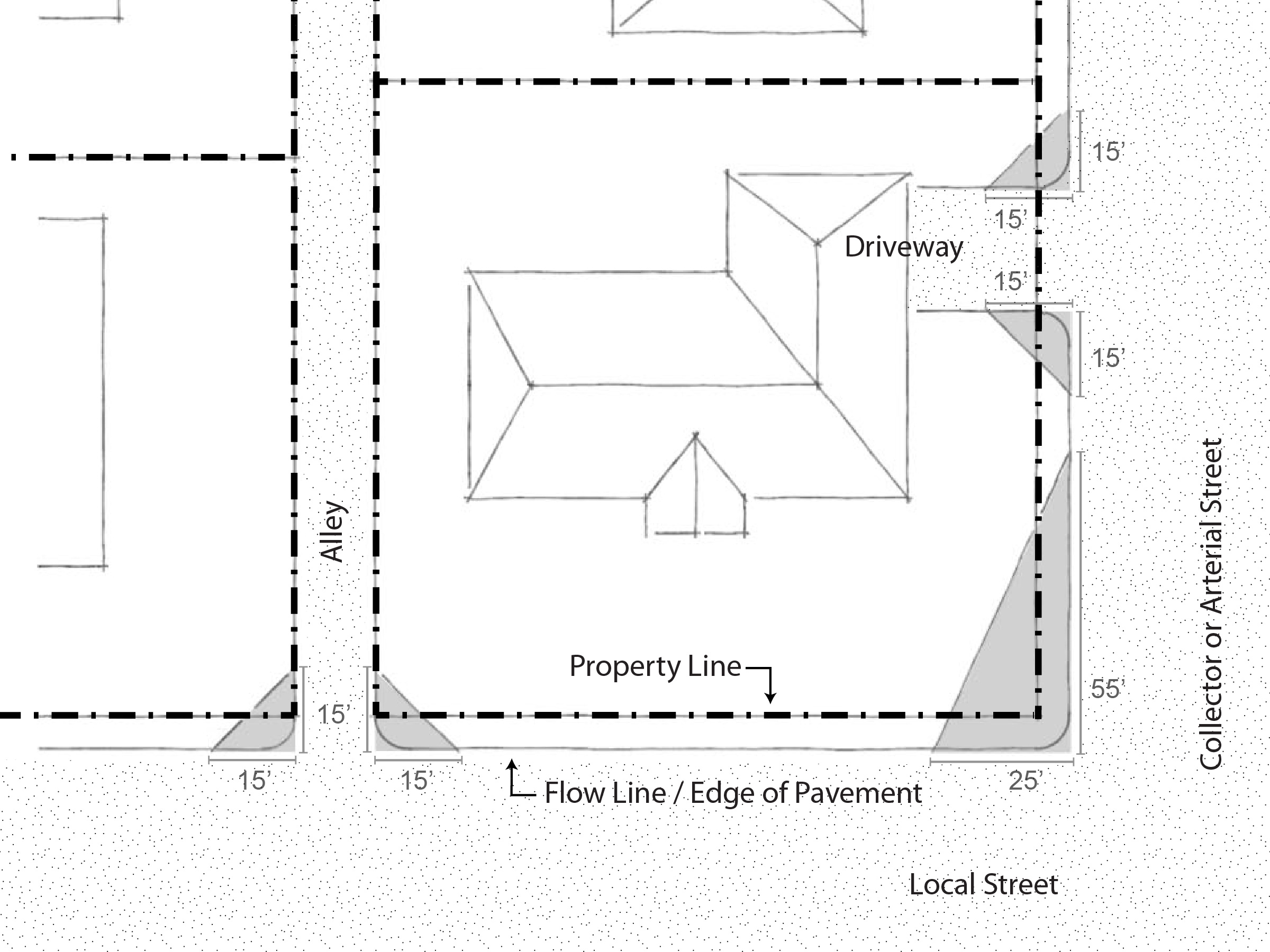
Figure 26-603.1 - Sight Distance Triangle
2.
Vertical clear zone. The vertical clear zone is the area above a sight distance triangle in which obstructions shall be minimized to provide a clear view.
a.
Height. The clear zone is measured vertically from the curb and gutter flow line, or if no curb exists, from the edge of pavement. If the intersection includes a collector or arterial street, the clear zone is the area between a height of thirty-six (36) and ninety-six (96) inches. For all other intersections, the clear zone is between forty-two (42) and ninety-six (96) inches. See Figure 26-603.2.
b.
Obstructions prohibited. The clear zone shall be free of obstructions, including but not limited to fences, walls, landscaping, signs, structures, tree canopies or parked vehicles.
c.
Exceptions. Certain obstructions may be approved by the community development director in consultation with the city engineer to be located within the clear zone. These may include:
i.
Approved decorative open type fences that are at least eighty (80) percent open;
ii.
Approved landscaping, such as street trees;
iii.
Approved signs, such as pole signs with a diameter of less than twelve (12) inches;
iv.
Public utility poles;
v.
Obstructions in the driveway sight triangle for single- and two-unit dwellings on local streets.
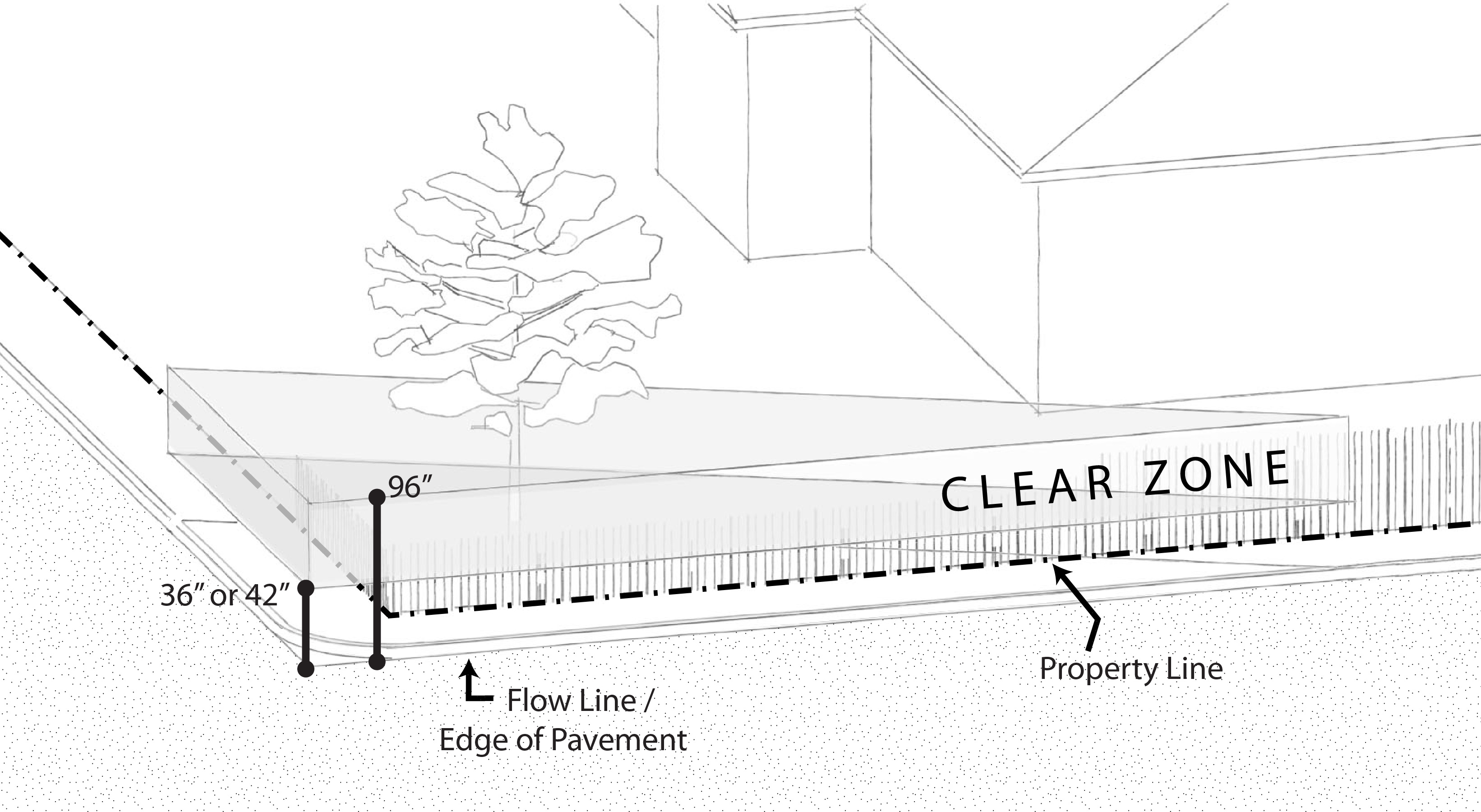
Figure 26-603.2 - Clear Zone
3.
Signalized intersections. At signalized intersections, where both streets are either collectors and/or arterials, the required sight distances shall be governed by the standards set forth in the most current edition of the policy on geometric design of highways and streets, published by the American Association of State Highway and Transportation Officials (AASHTO).
4.
Authority of the director of public works. For other signalized intersections involving local streets, the director of public works (or his/her designee) is authorized to permit modifications to the sight triangle requirements for special circumstances in accordance with the standards set forth in the most current edition of the policy on geometric design of highways and streets, published by the American Association of State Highway and Transportation Officials (AASHTO).
For corner lots bounded by public streets or private drives with vertical curves and where the application of the standard sight triangle regulations does not provide adequate sight clearance to protect the public safety, the director of public works (or his/her designee) shall determine the necessary vertical height clearance and the sight triangle dimensions in order to ensure a safe sight distance.
C.
Columns, poles and posts. Support columns, poles or posts shall be permitted to be constructed up to one (1) foot higher than the permitted fence heights; however, the columns, poles or posts cannot be constructed in such a manner as to constitute a traffic hazard due to obstruction of view. No such column, pole or post which extends above the maximum fence height shall be permitted to be constructed greater than two (2) feet by two (2) feet and no less than ten (10) feet on center. Column caps may be no larger than two and one-half (2½) feet by two and one-half (2½) feet.
D.
Fences and divisional walls permitted.
1.
Masonry walls.
2.
Ornamental iron.
3.
Woven wire and chainlink.
4.
Wood.
5.
Hedges.
6.
Barbed wire:
a.
Barbed wire shall be permitted only in the Agricultural One (A-1) zone district, or within any zone district if located within floodplain areas, or in residential zones for the keeping of large animals where allowed, provided any barbed wire is located at least three (3) feet inside of another permitted fence and that the other fence is at least forty-two (42) inches high; or
b.
Barbed wire shall be permitted in commercial, industrial and public facilities (PF) zone districts where placed on top of a six-foot-high fence or higher where permitted. Barbed wire placed on top of a fence shall not be counted toward the height of a fence. The barbed wire placed on top of a fence shall not be greater than two (2) feet in height and shall point inwards towards the property. In the public facilities zone district, where barbed wire fencing is used next to existing residential development, consideration shall be given to minimize the impact through buffering.
E.
Fence types prohibited.
1.
Any fence, if in the opinion of the chief building inspector, public works director, or chief of police, that would constitute a hazard to the health or safety of any person; and
2.
Any fence which does not comply with the provisions hereof, unless a variance has been approved.
F.
Planned developments. Fences and divisional walls within a planned development may vary from these standards; provided that the fences are in conformance with the provisions set forth for fencing and walls as approved in the outline development plan and as detailed on an approved specific development plan.
G.
Recreational fences:
1.
Open fences (over eighty (80) percent open) may be constructed to a height not to exceed ten (10) feet for the uses listed below. Such fences shall conform to all setback requirements for structures in this district:
Recreational uses:
a.
Tennis courts.
b.
Volleyball courts.
c.
Swimming pools.
d.
Golf driving ranges.
e.
Goals and backstops.
f.
Other similar uses.
2.
For all swimming pools, hot tubs, spas, and similar aquatic facilities (including in- and above-ground), required fences and barriers shall conform to the requirements of the International Residential or Building Code, as applicable.
H.
Maintenance. All fences shall be maintained in a structurally sound and safe condition, and shall not be allowed to deteriorate so as to become unsightly nuisances to neighboring property or to the general public.
I.
Height measurement.
1.
Divisional fences, walls, hedges, and other divisional structures which are parallel or are adjacent to public streets shall be measured as provided by section 26-603B. (sight distance triangle requirements).
2.
All other provisional fences, walls, hedges, and other divisional structures or obstructions shall be measured from finished grade, five (5) feet inside of the property to which it belongs.
J.
Notwithstanding this section, an electrically charged fence, if approved as a special use pursuant to section 26-114, may be constructed to a maximum height of nine (9) feet.
(Ord. No. 2001-1215, § 1, 2-26-01; Ord. No. 1248, § 1, 5-13-02; Ord. No. 1288, §§ 1, 2, 5-12-03; Ord. No. 1376, § 1, 10-23-06; Ord. No. 1515, § 9, 7-9-12; Ord. No. 1518, §§ 1, 2, 8-27-12; Ord. No. 1648, § 6, 6-25-18; Ord. No. 1683, § 29, 1-27-20; Ord. No. 1744, § 25(Exh. 1), 7-11-22)
Sec. 26-604. - Storage of flammable liquids or gases.
No aboveground storage of flammable liquids or gases in excess of two thousand (2,000) gallons shall be permitted in any district other than the industrial-employment district unless approved as a special use and in conformance with the Uniform Fire Code and other applicable laws.
(Ord. No. 2001-1215, § 1, 2-26-01; Ord. No. 1523, § 8, 10-8-12)
Sec. 26-605. - Large animals.
Private stables for the keeping of large animals such as horses, cows, llamas, sheep, goats and similar animals shall meet the following requirements. This section shall not apply to conforming lots in the A-1 or A-2 districts:
A.
Minimum open lot area shall be nine thousand (9,000) square feet for the first horse equivalent unit and an additional six thousand (6,000) square feet for each additional horse equivalent unit. For the purposes of this section, "open lot area" means a portion of lot excluding area covered by a main structure and attached carports or patios, and excluding detached garages. There shall be no more than four (4) horse equivalent units per acre except that offspring of animals on the property may be kept until weaned. One (1) horse equivalent equals one (1) horse, one (1) cow, two (2) llamas, two (2) burros, four (4) alpacas, four (4) sheep, four (4) goats, six (6) dwarf goats or two (2) ponies.
B.
Manure or liquid waste shall not be allowed to accumulate so as to cause a nuisance as regulated by Wheat Ridge Code of Laws, chapter 15.
C.
The pen, corral or fenced area allotted to the animals shall meet the following requirements:
1.
The fence or other enclosure must be constructed and maintained in such a manner so as to adequately and humanely contain the animals. Owners of animals using fences belonging to adjacent properties to be used for the containment of animals must have permission of the owner of the fence in question in writing.
2.
The pen, corral or fenced area for the regular keeping of such animals shall not be permitted within thirty (30) feet of the front lot line, except for lots over one (1) acre or, if under one (1) acre if the lot has no main structure.
3.
No part of an enclosure for the keeping of such animals shall be permitted within thirty (30) feet of a residence or other main structure on an adjacent parcel.
4.
The fence or other enclosure must enclose a minimum of eight hundred (800) square feet for the first animal and an additional one hundred (100) square feet for each additional animal of any species.
D.
Structures such as barns or sheds or those portions of such structures where animals are housed shall be no closer than fifteen (15) feet to a side or rear lot line and shall be no closer than thirty (30) feet to a residence or other main structures on an adjacent parcel and shall not be located within the required front yard setback.
E.
After a complaint is received concerning the keeping of a large animal on residential lots and substandard sized agricultural lots with corrals less than one thousand (1,000) square feet in size, the owner shall follow an approved manure management program as prescribed by the chief of police.
F.
Upon receipt of any complaint involving large animals as defined herein, standard nuisance abatement procedures will be followed. Additionally, code enforcement personnel will make the complaint known via the community services team supervisor to the chief of police who shall authorize consultation with an approved veterinarian or animal control resource at any time. The chief of police will investigate all citizen complaints regarding large animals or their equivalents. The chief of police will develop written procedures for how citizen complaints will be investigated, monitored, and disposed of.
G.
Any keeping of animals made nonconforming by the passage of Ordinance No. 1165, Series of 1999, or of Ordinance 1552, Series 2014, shall constitute a legal nonconforming keeping of animals. The legal, nonconforming keeping of such animals may be continued so long as such keeping of animals remains otherwise lawful; except where such keeping of animals is discontinued for a period of sixty (60) consecutive days or more, then said keeping of animals must conform to the provisions hereof or must cease. Upon sale of a property, the minimum requirements of section 26-605 shall be met or the keeping of animals must cease. For the purposes of this subsection G., periodic removal for the purposes of pasturing shall not constitute discontinuance of use.
H.
Nonconforming A-1 and A-2 properties (i.e., A-1 and A-2 lots less than one (1) acre in size) shall follow the provisions of subsections A. through G., of this section.
(Ord. No. 2001-1215, § 1, 2-26-01; Ord. No. 1552, § 1, 7-14-14; Ord. No. 1569, § 8, 3-23-15)
Sec. 26-606. - Small animals and poultry.
The private keeping of small animals, such as dwarf goats, rabbits and chinchillas, or poultry, such as chickens, ducks, geese, pheasants or pigeons, shall be subject to the following requirements. This section shall not apply to conforming lots in the A-1 or A-2 districts.
A.
Except when in compliance with section 26-605 (large animals), dwarf goats shall be limited to a maximum of three (3) per residential dwelling unit, plus their unweaned offspring and provided no un-neutered male dwarf goats shall be allowed. For each dwarf goat, a minimum of one hundred thirty (130) square feet of permeable lot area shall be provided in the side or rear yard.
B.
Poultry houses and pigeon coops, or the portions of these and other structures used to house or provide shelter for small animals, shall not exceed four hundred (400) square feet of ground floor area nor twelve (12) feet in height.
C.
Hutches for small animals shall not exceed one hundred (100) square feet of ground floor area with a maximum of two (2) floors or levels.
D.
Maximum ground floor areas for small animals or poultry set forth above may be increased by fifty (50) percent for each acre in addition to the minimum lot size for the zone district.
E.
All houses, coops, hutches or portions of these and other structures housing or providing shelter for small animals shall be located other than in a front yard, shall be set back at least fifteen (15) feet from side and rear property lines, and shall be no closer than thirty (30) feet from a residence or other main structure on an adjacent property.
F.
The accumulation of animal waste to the extent that such becomes a nuisance to surrounding properties is prohibited, as regulated by chapter 15 of this Code of Laws.
G.
The legal, nonconforming keeping of such animals may be continued so long as such keeping of animals remains otherwise lawful; except where such keeping of animals is discontinued for a period of sixty (60) consecutive days or more, then said keeping of animals must conform to the provisions hereof or must cease.
(Ord. No. 2001-1215, § 1, 2-26-01; Ord. No. 1552, § 2, 7-14-14)
Sec. 26-607. - Keeping of bees.
The private keeping of bees is permitted in all zone districts, subject to the following requirements:
A.
Beehive structures shall be located other than in a front yard and shall be set back from rear and side property lines a minimum of fifteen (15) feet.
B.
Beehive structures shall be enclosed within a fenced area or fenced yard.
(Ord. No. 2001-1215, § 1, 2-26-01)
Sec. 26-608. - Bed and breakfast rooms.
Bed and breakfast rooms are allowed as a special use as a subordinate use of a single detached dwelling subject to the following requirements:
A.
The dwelling must be occupied by the owner.
B.
Up to a maximum of four (4) sleeping quarters for transient occupancy may be provided for rent based upon the following requirements:
1.
Twelve thousand five hundred (12,500) square feet of lot area is required for the first bed and breakfast room.
2.
An additional one thousand (1,000) square feet of lot area is required for each additional room, up to a maximum of four (4) bed and breakfast rooms in total.
3.
Off-street parking, in addition to the spaces required for the single detached dwelling, shall be provided at the rate of one (1) space for each bed and breakfast room. The location, surfacing, buffering and access requirements for such parking shall be established by the planning commission and city council as the required site plan is reviewed by those approving bodies.
C.
All building, fire, health and other applicable codes of laws shall be met prior to issuance of a certificate of occupancy for the use, even though the special use may have been approved.
D.
One nonilluminated freestanding or wall sign, not in excess of four (4) square feet per face, is permitted. Freestanding signs shall be set back at least ten (10) feet from property lines, and fifteen feet (15) from driveways, and shall be no higher than four (4) feet.
E.
The special use permit, if granted, shall be granted to the owner or proposed owner of the property at the time of application and shall not be transferable to a future owner.
(Ord. No. 2001-1215, § 1, 2-26-01; Ord. No. 1709, § 8, 2-22-21; Ord. No. 1744, § 25(Exh. 1), 7-11-22; Ord. No. 1823, § 4, 5-12-25)
Sec. 26-609. - Access to public streets.
A.
Access to public streets required. No building permit or certificate of occupancy shall be issued or approved for any structures not adjacent to a full width dedicated street, as required by article IV hereof, or, alternatively, on easements or private roadways of record having a minimum width of twenty-four (24) feet, or upon a combination of full width dedicated streets or private roadways or easements, within the restrictions imposed by this section.
B.
Use of private drives, roadways, and easements of record. To the extent the development is proposed to rely upon access to the public roadway system through the use of private drives, roadways, and/or recorded easements of record, approval for the same may be granted or withheld by the city in its sole discretion, based upon one (1) or more the following considerations:
1.
The nature and extent of provisions for long-term maintenance of such private roadways or easements, through a special district, homeowners association, or other means.
2.
The design and grade of the proposed roadway or easement, and the extent to which the same meets or varies from the requirements for full width dedicated streets under article IV hereof.
3.
Whether the proposed roadway or easement is a logical design and meets requirements for fire access.
4.
The merits of alternate designs for the proposed access.
5.
The number of residential units and/or amount of commercial property/units proposed to be served by the roadway or easement.
6.
The length of block or area served.
7.
The impact of the design and use of the roadway or easement upon the immediately adjacent publicly dedicated street network.
8.
Whether bicycle and pedestrian facilities are provided on the site consistent with the requirements of the zoning code, including the Architectural and Site and Design Manual and Streetscape Design Manual.
C.
Review procedure. The city shall review any proposal for use of private drives, roadways, and/or easements under this section and shall approve, approve with conditions, or deny such use pursuant to the review procedure applicable to the subject development, including without limitation site development plan, specific development plan, planned building group, and/or subdivision plat.
(Ord. No. 2001-1215, § 1, 2-26-01; Ord. No. 1288, §§ 1, 2, 5-12-03; Ord. No. 1683, § 30, 1-27-20; Ord. No. 1703, § 1, 1-11-21)
Sec. 26-610. - Building lots.
Every building or structure hereafter erected within the city shall be located on a lot, as defined herein, and in no instance shall there be more than one (1) main building on one (1) lot except as permitted within a planned development district, within a mixed use district, or as permitted as a planned building group (PBG).
(Ord. No. 2001-1215, § 1, 2-26-01; Ord. No. 1471, § 9, 9-13-10)
Sec. 26-611. - Building setbacks.
A.
Generally. Building setback shall be measured at right angles from the closest property line to the outermost wall of a building. In residential zone districts only, encroachments into required setback areas shall not be permitted except as follows, provided however, that no encroachment into a side or rear yard is allowed in the NC, RC, C-1, C-2, or I zone districts when adjacent to a residentially zoned property:
1.
Porches, patios, decks and balconies. Porches, patios, decks and balconies which are open on at least two (2) sides may encroach into a front setback up to eight (8) feet or into a side or rear yard a maximum of one-third the distance to the closest property line.
2.
Architectural features. Cornices, eaves, beltcourses, sills, canopies or other similar architectural features, including bay windows, may extend or project into a required front, side or rear yard not more than thirty (30) inches.
3.
Chimneys. Chimneys may project into a required front, side or rear yard not more than two (2) feet, provided the width of such yard is not reduced to less than three (3) feet.
4.
Fire escapes, open stairways. A fire escape or open stairway may extend into any front, side or rear yard, provided the width of such yard is not reduced to less than three (3) feet.
5.
Nonconforming setbacks. Where there are existing setback encroachments that lawfully existed in accordance with section 26-120 (Nonconforming lots, uses and structures), additions and new buildings may be allowed setback encroachments in accordance with section 26-120 and section 26-625, (Accessory buildings).
B.
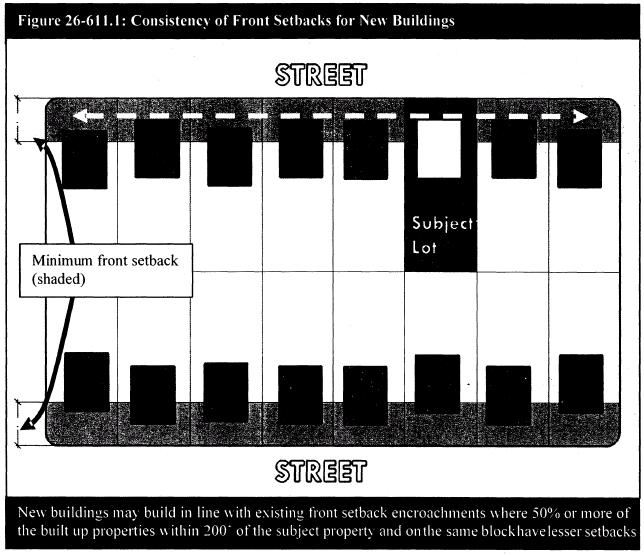
Allowed setback encroachments for principal buildings. The following setback reduction shall apply to front yards and to side or rear yards which abut a public street. If fifty (50) percent or more of the main buildings within a built-up area in any district have less than the required setback, each new main building may have a setback consistent with the average building setbacks in the immediate area. For the purpose of computing such average, a setback less than fifteen (15) feet shall be deemed to be fifteen (15) feet.
For the purpose of front yard setbacks, an immediate area shall be deemed "built-up" if fifty (50) percent or more of the lots within the same block and within two hundred (200) feet on each side lot line within the same block of any particular lot have been improved with buildings (see figure 26-611.1). For the purpose of side or rear yard setbacks which abut a public street, an immediate area shall be deemed "built-up" if fifty (50) percent or more of the lots on the same side of the street and within three hundred (300 feet) of the subject parcel have been improved with buildings. However, in no instance shall a structure encroach into a required sight distance triangle.
(Ord. No. 2001-1215, § 1, 2-26-01; Ord. No. 1313, § 9, 10-27-03; Ord. No. 1448, § 4, 8-24-09; Ord. No. 1575, § 9, 7-13-15)
Note— See editor's note to § 26-120.
Sec. 26-612. - Residential group homes.
The following supplemental requirements apply to residential group homes by category, as defined at section 26-123:
A.
All group homes:
1.
Shall maintain all required state and county licenses for occupation.
2.
Shall maintain compliance with all applicable fire, building and safety codes.
3.
Separation requirements. No group home within any residential zone district shall be located on an adjacent lot or parcel or within the following distances to group homes:
a.
For group homes with up to and including eight (8) residents: Seven hundred fifty feet (750) feet;
b.
For group homes with nine (9) to fourteen (14) residents: One thousand five hundred (1,500) feet
The purpose for this requirement is to ensure that a residential setting is maintained for the persons resident in the home.
4.
Parking, screening and buffering. For all group homes with nine (9) or more residents, a special or conditional use permit is required. Such permit shall require, in addition to any other conditions, that the facility shall comply with the parking standards of the Code. All commercial components, such as parking lots and playgrounds shall be screened and buffered from neighboring residences and uses to the extent practical. The city may also request a trip generation study.
5.
In all residential zone districts, meetings or gatherings on-site at a residential group home that are consistent with a normal residential family setting shall be allowed, however shall only be for residents, family of residents, and necessary persons required for the support, care and supervision of the resident persons. This does not permit conducting ministerial activities of any private or public organization or agency or permit types of treatment activities or the rendering of services in a manner substantially inconsistent with the activities otherwise permitted in the particular zoning district. See C.R.S. § 30-28-115(2)(c).
6.
The owner or operator of a group home shall semi-annually (by March 31 and September 30 of each year), and otherwise upon request by the city, provide a certificate to the city, in a form provided by the city, documenting compliance with this chapter.
B.
Group homes for disabled persons; reasonable accommodation procedure.
1.
Policy. It is the city's policy to provide a reasonable accommodation in accordance with federal and state fair housing laws (42 USC § 3600 et seq. and CRS § 29-34-301) for persons with disabilities seeking fair access to housing in the application of this chapter. The purpose of this section is to establish the procedure by which a person may request a reasonable accommodation and how the request is to be processed.
2.
Reasonable accommodation. Any person seeking to operate a residential group home that will substantially serve persons with disabilities may apply for a reasonable accommodation to obtain relief from a regulation policy, or condition of this chapter that poses a barrier to equal access to housing.
3.
Procedure.
a.
Application required. An application for a reasonable accommodation shall be filed with and processed by the city manager or designee. The application shall include the following information and be subject to the determinant factors required by this section.
b.
Submittal requirements. The application shall be made in writing, and shall include the following information:
i.
The specific provision, regulation, policy or conditions in this chapter from which the reasonable accommodation is being requested.
ii.
The specific exception or modification sought from the application of the subject provision, policy, or condition of this chapter that the applicant seeks;
iii.
Documentation that the specific exception or modification requested by the applicant is necessary to provide one (1) or more individuals with a disability an equal opportunity to use and enjoy the residence;
iv.
Any other information that the city manager or designee reasonably determines is necessary to evaluate the request for a reasonable accommodation;
v.
Any other information that the city manager or designee reasonably concludes is necessary to determine whether the findings required by subsection 7. can be made, so long as any request for information regarding the disability of the individuals benefited complies with fair housing law protections and the privacy rights of the individuals affected.
4.
Fees. No application fee is required to request a reasonable accommodation.
5.
City manager action. Within sixty (60) days of receipt of a completed application, the city manager or designee shall issue a written determination to approve, conditionally approve, or deny a request for the requested reasonable accommodation.
6.
Standards for granting a reasonable accommodation. The following factors may be considered in determining whether to grant a reasonable accommodation:
a.
Whether a less drastic exception or modification to the applicable provision, regulation, policy, or condition that achieves the same end as the requested reasonable accommodation is available;
b.
Special needs created by the disability at issue;
c.
Potential benefit that can be accomplished by the requested modification;
d.
Potential impact on properties within the vicinity;
e.
Physical attributes of the subject property and structures;
f.
Alternative accommodations that may provide an equivalent level of benefit;
g.
Whether the requested accommodation is needed to enable the home to be located sufficiently proximate to services and facilities as convenience stores, commercial services, public transportation, and public recreation facilities;
h.
Whether the requested accommodation would impose an undue financial or administrative burden on the city;
i.
Whether the requested accommodation would require a fundamental alteration in the nature of a program of the city.
7.
Findings. The written decision to approve, conditionally approve, or deny a request for a reasonable accommodation shall be based on the following findings, all of which are required for approval. In making these findings, the city manager or designee may approve alternative reasonable accommodations which provide the applicant with an equivalent level of benefit.
a.
The requested accommodation is requested by or on the behalf of one (1) or more individuals with a disability protected under federal and Colorado fair housing laws;
b.
The requested accommodation is necessary to provide one (1) or more individuals with a disability an equal opportunity to use and enjoy a dwelling;
c.
The requested accommodation will not impose an undue financial or administrative burden on the city, as "undue financial or administrative burden" is defined in federal fair housing laws (42 USC § 3600 et seq.) and interpretive case law;
d.
The requested accommodation will not, under the specific facts of the application, result in a direct threat to the health or safety of other individuals or substantial physical damage to the property of others;
e.
Whether the existing supply of facilities of a similar nature and operation in the community is sufficient to provide individuals with a disability an equal opportunity to live in a residential setting;
f.
The requested accommodation will not result in a fundamental alteration in the nature of the requirements of this chapter.
(Ord. No. 2001-1215, § 1, 2-26-01; Ord. No. 1684, § 11, 2-10-20)
Sec. 26-613. - Home occupations.
A.
Home occupation. Home occupations are permitted as accessory uses to any conforming (as to use) residential dwelling; provided, however, that the following requirements are met:
1.
Such use shall be conducted entirely within a dwelling or accessory structure except for sales of plants, produce, or other agricultural products grown, raised, or produced on the premises and carried on only by the inhabitants living there, with the exception that should the operator be substantially, physically handicapped a nonresident may be employed to assist the operator in his work to the extent he requires it to make up for his physical handicap.
2.
Not more than one (1) employee may live off-premises.
3.
Such use shall be clearly incidental and secondary to the use of the dwelling for dwelling purposes and shall not change the character thereof.
4.
The total area used for said purposes shall not exceed twenty-five (25) percent of the gross floor area of the user's dwelling unit.
5.
Each home occupation is permitted to have one (1) non-illuminated sign up to two (2) square feet in size. The sign may be freestanding or wall-mounted. See article VII, chapter 26.
6.
No home occupation shall create negative impacts for the residential neighborhood and it shall not change the residential character thereof.
7.
The use shall not generate traffic, noise, vibration, glare, fumes, odors or electrical interference beyond what normally occurs in any residential zone district.
8.
There shall be only incidental storage of stocks, supplies or products related to the occupation conducted on the premises. Merchandise stored or merchandized on the premises, which is either for retail sale or for delivery of presold items, shall be limited to a maximum area of one hundred (100) square feet.
9.
There shall be no exterior storage on the premises of materials, products or equipment used as part of the home occupation, nor shall there be any visible evidence from any property line of the operation of a home occupation except for the sale of plants and produce grown on the premises.
10.
Parking related to the home occupation shall be confined to the street frontage of the lot in question, the driveway and the garage/carport. In instances where the home is used as an office for business conducted off-premises, such as by way of example, a home improvement contractor, lawn care service, etc., storage of materials, tools, equipment, trailers, trucks or vans used in the business, except as specified below, shall not be permitted upon the premises from which the home occupation operates. In addition, parking of the motor vehicle of an employee who works off of the premises shall be confined to the frontage of the lot in question, the driveway, and the garage or carport. The home occupant may park no more than one (1) motor vehicle used in the business upon the premises or confined to the street frontage of the lot in question; provided that any such vehicle does not exceed a one-ton chassis. All tools, equipment and materials shall be totally enclosed within this vehicle or within enclosures attached to the vehicle.
11.
Home occupations are limited to the following business or commercial activities:
a.
Craft work, such as the making of pottery, jewelry or dolls, flower arranging, smithing and woodworking.
b.
Garment work, such as tailoring, dressmaking, millinery work, ironing and garment repair.
c.
Office uses, such as office uses for door-to-door, home party and telephone solicitation sales, investment counseling, typing, notary public, travel services, surveyors, physicians, dentists, lawyers, accountants, architects, engineers and other similar services.
d.
Repair services for electronics, small appliances, and mechanical devices, bicycles and upholstery.
e.
Tutoring, music lessons, dance lessons, gymnastics lessons, swim lessons and tennis lessons.
f.
Artistic endeavors, such as art studios, portrait studios, photography studios, writing and lithography.
g.
Garage sales, not to exceed four (4) three-day periods, which need not be consecutive, per calendar year.
h.
Hair care services carried on by only one (1) inhabitant of the dwelling. No other employee shall be permitted.
i.
Small and large day care homes, however large day care homes shall not be located adjacent to one another, and a parking and traffic flow management plan may be required at the sole discretion of the community development director prior to approval of a business license.
j.
Sales directly related but merely ancillary to the primary home occupation, such as:
(1)
Sale of hair care products by a beautician or barber.
(2)
Sale of accompaniment items, such as neckties, bows, ribbons or belts for a tailor or dressmaker.
(3)
Sale of component parts or accessories used in repair services for electronics, small appliances, bicycles, etc.
(4)
Supplies related to a class, course of instruction, or lessons conducted on the site.
(5)
Sale of artistic or craft works which were created on the site, such as pottery, jewelry, dolls, portraits, paintings, sculptures, etc.
(6)
Sale of agricultural products grown, raised or produced on the premises. Agricultural products include raw vegetables, fruits, herbs, flowers, plants, nuts, honey and eggs. Value-added agricultural products, which are made from raw agricultural products grown, raised, or produced on site, such as jams, jellies, oils, vinegars, and cheeses, may also be sold. The sale of agricultural products and value-added agricultural products may be conducted outdoors as a produce stand use.
k.
Delivery of pre-sold items which were sold either over the telephone, by door-to-door solicitation or at home parties, such as beauty products, kitchen ware, home products, etc.
l.
Massage therapist, restricted to one (1) practitioner, possessing a currently valid massage therapist license issued by the State of Colorado pursuant to C.R.S. § 12-235-101 et. seq. and subject to the restrictions of chapter 11, article X of the Code of Laws.
m.
Other similar uses as approved by the director of community development or board of adjustment and when in conformance with the standards and requirements set forth herein.
12.
In no event shall any home occupation include or allow any of the following business or commercial activities:
a.
Body or mechanical repair or modification of motor vehicles (for hire).
b.
Animal hospital, kennel or animal grooming.
c.
Residential health care facility.
d.
Taxidermy of large animals and large fish and/or curing of hides and skins.
e.
Parking of vehicles for a fee or any other thing considered of value.
(Ord. No. 2001-1215, § 1, 2-26-01; Ord. No. 1370, § 1, 8-28-06; Ord. No. 1491, § 5, 5-23-11; Ord. No. 1641, § 13, 4-23-18; Ord. No. 1696, § 8, 8-24-20; Ord. No. 1768, § 5, 6-28-23)
Sec. 26-614. - Trash storage area screening.
A.
Trash storage for all existing and new multi-unit dwellings, institutional buildings, all business and industrial buildings or uses and agriculturally-zoned properties shall be accommodated within the structure, or if located outside:
1.
Shall be located or screened so as not to be visible from any public streets, and;
2.
Shall be screened when located within one hundred (100) feet of any single- or two-unit residential structure.
If screened by a fence or wall, a fence permit and site plan shall be required, and such screening shall be by a decorative wall or fence six (6) feet in height. Dumpsters and the required screening shall not be located within five (5) feet of combustible walls, openings, or combustible roof eave lines. The required screening shall be protected from damage by normal removal and replacement of the dumpster by a trash truck. Maintenance will be required if the screening is damaged and/or dilapidated, or in need of repair, and the area around the screening shall be kept free of junk and trash.
B.
One- and two-unit residential structures in residentially zoned areas are permitted to have one (1) trash dumpster no larger than two (2) cubic yards in size and are subject to the following conditions:
1.
Trash dumpsters may not be stored wholly or partially within any portion of the front setback of the lot and,
2.
Any trash dumpster shall be screened from view so not to be visible from the public right-of-way or adjacent properties.
If a trash dumpster is screened by a fence or wall, a fence permit and site plan shall be required. Such screening shall be by a decorative wall or fence six (6) feet in height. Dumpsters and the required screening shall not be located within five (5) feet of combustible walls, openings, or combustible roof eave lines. The required screening shall be protected from damage by normal removal and replacement of the dumpster by a trash truck. Maintenance will be required if the screening is damaged and/or dilapidated or otherwise in need of repair. The area around the dumpster and screening shall be kept free of junk and trash.
C.
Residential structures on agriculturally-zoned property shall be permitted to have one (1) trash dumpster. The dumpsters on such lots may be larger than one and one-half (1.5) cubic yards in size and shall meet the requirements set forth in subsection 26-614.A.
D.
In no instance shall trash screening for any commercial, industrial, multi-unit dwelling, agricultural, or other residential property be permitted to become a sight, traffic, or safety obstruction for driveways or street corners. No such screening shall displace required parking spaces, or landscaping, unless reviewed and approved by the director of community development as an administrative variance after considering all reasonable alternatives. An administrative variance, to the prior sentence only, shall follow the procedures set forth in section 26-115, but shall not be limited to the fifty (50) percent provisions thereof.
E.
Temporary construction dumpsters and temporary storage containers may be allowed in all zone districts at active construction projects only, and must be located on private property. If impractical to locate on private property, a right-of-way permit may be obtained from the public works department pursuant to Article III of Chapter 21 of the Wheat Ridge Code of Laws. Temporary construction dumpsters and temporary storage containers shall not be located so as to create sight, traffic, or safety obstructions. Temporary construction dumpsters and temporary storage containers must be removed within fourteen (14) days of construction completion.
F.
Screening is not required for dumpsters that are used by the community exclusively for the purpose of recycling. Dumpsters used for this purpose must be clearly labeled as recycling dumpsters.
(Ord. No. 2001-1215, § 1, 2-26-01; Ord. No. 1284, § 1, 4-28-03; Ord. No. 1454, § 1, 9-28-09; Ord. No. 1483, § 1, 4-11-11; Ord. No. 1744, § 25(Exh. 1), 7-11-22)
Sec. 26-615. - Commercial mobile radio service (CMRS) facilities.
A.
Purpose and intent. The purpose and intent of this section 26-615 is to accommodate the communication needs of residents and businesses while protecting the public health, safety, and general welfare of the community. These regulations are necessary in order to:
1.
Facilitate the provision of wireless telecommunication services to the residents and businesses of the city.
2.
Minimize adverse impacts of facilities through careful design, siting and screening standards.
3.
Encourage and maximize colocation and the use of existing and approved towers, buildings, and other structures to accommodate new wireless telecommunication antennas in order to reduce the number of towers needed to serve the community.
4.
Provide specific regulations related to the review processes for CMRS facilities.
5.
Align the review and approval process for CMRS facilities with the FCC and any other agency of the federal government with the authority to regulate CMRS facilities.
B.
Applicability. The standards contained in this section shall apply to all applications for any CMRS facility. The applicant shall demonstrate in writing that its proposed CMRS facility meets all applicable standards and provisions of the Code. Pre-existing CMRS facilities shall not be required to meet the requirements of this section, other than the requirements of subsection E. Changes and additions to pre-existing CMRS facilities must meet the applicable requirements of this section.
C.
Review and approval process. Proposed CMRS facilities shall be reviewed pursuant to the following procedures depending upon the facility type and/or proposed change:
1.
Review procedure.
a.
Building- or structure-mounted facilities in all zone districts shall be reviewed by the community development department through a building permit application for compliance with the requirements for such facilities.
b.
Roof-mounted facilities in all zone districts shall be reviewed by the community development department through a building permit application for compliance with the requirements for such facilities.
c.
New freestanding or alternative tower CMRS facilities must receive a special use permit, pursuant to sections 26-114, 26-204 and 26-1111.
d.
New freestanding or alternative tower CMRS facilities in all planned development zone districts (including planned residential districts) unless specifically listed or shown as such in the outline development plan, also require amendment of the outline development plan pursuant to article III. At the sole discretion of the community development director, new freestanding or alternative tower CMRS facilities may be reviewed as a special use pursuant to sections 26-114, 26-204 and 26-309.
e.
Applications for colocation on any existing facility shall be reviewed by the community development department through a building permit application for compliance with the requirements for such facilities.
f.
Small cell CMRS facilities and networks in public rights-of-way and easements shall be reviewed by the community development department and shall require a building permit. Additionally, such facilities shall be reviewed by the public works department and shall require a permit under section 21-101, et seq.
g.
Small cell CMRS facilities and networks on private property shall be reviewed by the community development department through a building permit applicable for compliance with the requirements for such facilities.
2.
Approval process.
a.
The city shall review and act upon the application within the following time periods:
(1)
Within thirty (30) days the city will give written notice of incompleteness if so determined, specifying the Code section(s) that requires such missing information. This determination pauses the remaining deadlines until a complete application is filed.
(2)
Within sixty (60) days the city will act on applications that are not a substantial change.
(3)
Within ninety (90) days the city will act on applications for small cell facilities or colocation applications that are not a substantial increase in the size of a tower.
(4)
Within one hundred fifty (150) days the city will act on applications for new CMRS facilities, colocation applications that are a substantial increase in the size of the tower or substantial increase of an existing CMRS facility.
b.
The final action of the city on any CMRS application shall be in writing and shall advise the applicant of the reasons for approval, approval with conditions, or denial.
D.
Standards for all CMRS facilities. The following are standards for all CMRS facilities.
1.
Colocation. The shared use of existing freestanding or roof-mounted CMRS facilities shall be preferred to the construction of new facilities in order to minimize adverse visual impacts associated with the proliferation of towers.
a.
No CMRS application to construct a new freestanding or roof-mounted CMRS facility shall be approved unless the applicant demonstrates to the reasonable satisfaction of the city that no existing CMRS facility within a reasonable distance, regardless of municipal boundaries, can accommodate the applicant's needs. Evidence submitted to demonstrate that no existing facility can accommodate the applicant's proposed CMRS facility shall consist of one (1) or more of the following:
(1)
No existing CMRS facilities are located within the geographic area required to meet the applicant's coverage demands.
(2)
Existing CMRS facilities or structures are not of sufficient height to meet the applicant's coverage demands and cannot be extended to such height.
(3)
Existing CMRS facilities or structures do not have sufficient structural strength to support applicant's proposed antenna and related equipment.
(4)
Existing CMRS facilities or structures do not have adequate space on which proposed equipment can be placed so it can function effectively and reasonably.
(5)
The applicant's proposed antenna would cause electromagnetic interference with the antennas on the existing CMRS facility, or the antennas on the existing facility would cause interference with the applicant's proposed antenna.
(6)
The applicant demonstrates that there are other compelling limiting factors, including but not limited to economic factors, that render CMRS facilities or structures unsuitable.
b.
No CMRS facility owner or operator shall unreasonably exclude a telecommunication competitor from using the same facility or location. Upon request by the city, the owner or operator shall provide evidence and a written statement to explain why colocation is not possible at a particular facility or site.
c.
If a telecommunication competitor attempts to colocate a CMRS facility on an existing or approved CMRS facility or location, and the parties cannot reach an agreement, the city may require a third-party technical study to be completed at the applicant's expense to determine the feasibility of colocation.
d.
Applications for new freestanding CMRS facilities shall provide evidence that the facility can accommodate colocation of additional carriers.
2.
Federal requirements. All CMRS facilities shall meet the current standards and regulations of the FAA, the FCC, and any other agency of the federal government with the authority to regulate CMRS facilities. Failure to meet such revised standards and regulations shall constitute grounds for revocation of city approvals and removal of the facility at the owner's expense.
3.
Safety standards. All CMRS facilities shall conform to the requirements of the International Building Code, and National Electrical Code, as applicable.
4.
Abandonment. CMRS facilities which are abandoned by nonuse, disconnection of power service, equipment removal or loss of lease for greater than six (6) months shall be removed by the CMRS facility owner. Should the owner fail to remove the facilities, the city may do so at its option, and the costs thereof shall be a charge against the owner and recovered by certification of the same to the county treasurer for collection as taxes in the manner provided by Code section 2-93, or by any other means available under article X of chapter 26.
5.
Third party review.
a.
CMRS providers use various methodologies and analysis tools, including geographically based computer software, to determine the specific technical parameters of CMRS facilities, such as expected coverage area, antenna configuration and topographic constraints that affect signal paths. In certain instances there may be a need for expert review by a third party of the technical data submitted by the CMRS provider. The city may require such a technical review to be paid for by the applicant for a CMRS facility. The selection of the third party expert may be by mutual agreement between the applicant and the city or at the discretion of the city, with a provision for the applicant and interested parties to comment on the proposed expert and review its qualifications. The expert review is intended to be a site-specific review of technical aspects of the CMRS facilities and not a subjective review of the site selection. The expert review of the technical submission shall address the following:
(1)
The accuracy and completeness of the submission;
(2)
The applicability of analysis techniques and methodologies;
(3)
The validity of conclusions reached;
(4)
Any specific technical issues designated by the city.
b.
Based on the results of the third party review, the city may require changes to the application for the CMRS facility that comply with the recommendation of the expert.
6.
All CMRS facilities are accessory uses to the structure upon which they are placed or to the primary use of the property on which they are constructed. With the exception of small cell facilities, no CMRS facility shall be located on a vacant lot devoid of any primary or main building.
7.
Siting of CMRS facilities in residential areas. The city encourages the siting of CMRS facilities in nonresidential areas.
a.
The city prohibits freestanding CMRS facilities in the following zone districts:
(1)
Residential-One (R-1);
(2)
Residential-One A (R-1A);
(3)
Residential-One B (R-1B);
(4)
Residential-One C (R-1C);
(5)
Residential-Two (R-2);
(6)
Residential-Two A (R-2A);
(7)
Residential-Three (R-3);
(8)
Residential-Three A (R-3A);
(9)
Agricultural-One (A-1);
(10)
Agricultural-Two (A-2);
(11)
Mixed Use-Neighborhood (MU-N); and
(12)
Mixed Use-Lutheran Legacy Campus (MU-LLC).
b.
The city prohibits all CMRS facilities on properties where the principal use is a single- or two-unit dwelling.
c.
Alternative tower CMRS facilities may be located on a property containing a non-residential use, regardless of underlying zoning.
d.
Building, structure or roof-mounted CMRS facilities may be located on a property containing a nonresidential or multi-unit dwelling use, regardless of underlying zoning.
e.
Small cell facilities are permitted in all zone districts.
E.
Standards for freestanding and alternative tower CMRS facilities. Freestanding and alternative tower CMRS facilities are subject to the following requirements and shall be evaluated as a special use.
1.
Freestanding CMRS facilities shall be visually screened from adjacent residential development and public rights-of-way.
2.
Freestanding and alternative tower CMRS facilities shall be permitted only as an accessory use, and are subject to accessory use setback development standards in the applicable zone district.
3.
Freestanding and alternative tower CMRS facilities shall not exceed the permitted height for the principal use on the subject property.
4.
Freestanding CMRS facilities shall not be permitted between the principal structure and the street.
F.
Standards for building or structure-mounted CMRS facilities. Building or structure-mounted CMRS facilities are subject to the following requirements and shall be evaluated as part of the community development department's review process.
1.
Such facilities shall be architecturally compatible with and textured and colored to match the building or structure to which they are attached.
2.
The antenna shall be mounted as flush to the wall as technically possible. The maximum protrusion of such facilities from the building or structure face to which they are attached shall be two (2) feet.
3.
Panel antennae shall not extend above the building wall or parapet to which they are mounted.
4.
Whip antennae shall extend no more than ten (10) feet above the highest point of the building or structure to which they are attached.
G.
Standards for roof-mounted CMRS facilities. Roof-mounted CMRS facilities are subject to the following requirements and shall be evaluated as part of community development department's review process.
1.
All roof-mounted CMRS facilities and accessory equipment shall be set back from the roof or parapet edge so that visibility from the street or adjacent residential properties is minimized to the greatest extent possible.
2.
If roof-mounted equipment is visible from the street or adjacent residential properties, CMRS facilities and accessory equipment shall be screened by materials that are architecturally compatible with and colored to match the building or structure to which they are attached.
3.
No roof-mounted facility, including antenna or accessory equipment, shall exceed twelve (12) feet in height, as measured from the roof deck.
4.
Roof-mounted accessory equipment shall not be permitted on a sloped roof, unless it can be demonstrated that it is not visible from the street or adjacent residential areas.
H.
Standards for small cell facilities and networks.
1.
Applicable requirements on private property. Small cell facilities and small cell networks on private property shall comply in all respects with the requirements of the preceding subsections E., F., or G.
2.
Applicable requirements in public rights-of-way. Small cell facilities and small cell networks in public rights-of-way shall comply in all respects with the following requirements:
a.
Location. Small cell facilities are permitted in city rights-of-way, upon facilities in these rights-of-way and on public easements owned by the city under the following priority:
(1)
First, on a city-owned utility pole, which shall be removed and replaced with a pole designed to contain all antennae and equipment within the pole to conceal any ground-based support equipment and ownership of which pole is conveyed to the city.
(2)
Second, a city-owned utility pole with attachment of the small call facilities in a configuration approved by the city.
(3)
Third, on a third-party owned utility pole, (with the consent of the owner thereof), with attachment of the small cell facilities in a configuration approved by the city.
(4)
Fourth, on a traffic signal pole or mast arm in a configuration approved by the city, or in the case of a CDOT facility, by CDOT.
(5)
Fifth, on a freestanding or ground-mounted facility which meets the definition of and requirements for an alternative tower structure in a location and configuration approved by the city.
The proposed location and pole type shall be justified in the permit application.
b.
Height. All small cell facilities shall not exceed three (3) feet above the light pole, traffic signal or other facility or structure to which they are attached, or the maximum height in the relevant zone district, whichever is less. When new utility poles are proposed as an alternative tower, their height shall be similar to existing utility/light poles in the vicinity, as determined by the community development director.
c.
Spacing and placement. No small cell facility shall be located within one thousand (1,000) feet of any other such facility. Small cell facilities shall be located on common property lines, as extended into the right-of-way, to the extent feasible.
d.
Design. Small cell facilities shall be designed to blend with and be camouflaged in relation to the structure upon which they are located (e.g.: painted to match the structure or same material and color as adjacent or city-standard utility poles). The final design and color shall be subject to approval by the city.
e.
Permitting. Small cell facilities and networks shall make application for a permit for work in the right-of-way under Code section 21-11, et seq., and for location and maintenance of such facility shall make application for a permit for use of the public right-of-way under Code section 21-101, et seq. In addition, all small cells and networks in the right-of-way must make application for a building permit. Prior to such application, the applicant shall first confirm with the community development department that the location is eligible. Small cell facilities and networks shall make application for location on private property through the building permit process. The city may accept applications for a small cell network, provided each small cell facility shall be separately reviewed.
f.
Indemnification. The operator of a small cell facility which is permitted to locate within a city-owned right-of-way or easement or on a city-owned utility pole, traffic signal or other structure owned by the city shall, as a condition of permit approval, indemnify the city from and against all liability and claims arising as a result of that location or attachment, including repair and replacement of damaged poles and equipment, in a form approved by the city attorney.
g.
Bonding. All permits for location of small cell facilities on real property not owned by the small cell permittee shall include as a condition of approval a bond, in form approved by the city attorney, to guarantee payment for any damages to the real property and removal of the facility upon its abandonment.
h.
Permit expiration. A permit for a small cell facility shall expire nine (9) months after approval unless construction of the permitted structure has been initiated.
I.
Standards for ground-mounted accessory equipment. Ground-mounted accessory equipment that is associated with a freestanding, roof-mounted or building-mounted CMRS facility are subject to the following requirements and shall be evaluated with the associated CMRS facility application.
1.
Ground-mounted accessory equipment shall be subject to the accessory structure setback requirements in the underlying zone district.
2.
Ground-mounted accessory equipment or buildings containing accessory equipment shall not exceed twelve (12) feet in height.
3.
Ground-mounted accessory equipment not fully enclosed in a building shall be fully screened from adjacent residential properties and public rights-of-way.
4.
Buildings containing ground-mounted accessory equipment shall be architecturally compatible with the existing structures on the property and character of the neighborhood.
J.
Definitions.
Alternative tower CMRS facility. An existing or proposed structure that is compatible with the natural setting and surrounding structures and that camouflages or conceals the presence of the antennae and can be used to house or mount CMRS antenna. Examples include manmade trees, clock towers, bell steeples, light poles, silos, existing utility poles, existing utility transmission towers and other similar alternative designed structures.
Building or structure-mounted commercial mobile radio service facility. A CMRS facility in which antenna are mounted to an existing structure (e.g., water tower, light pole, steeple, etc.) or building face.
CDOT. Colorado Department of Transportation.
Commercial mobile radio service (CMRS) accessory building or cabinet. An unmanned building or cabinet used to house equipment associated with a CMRS facility.
Commercial mobile radio service (CMRS) site. An unmanned facility consisting of equipment for the reception, switching and transmission of wireless telecommunications, including, but not limited to, personal communications service (PCS), enhanced specialized mobile radio (ESMR), paging, cellular telephone and similar technologies.
Freestanding commercial mobile radio service (CMRS) facility. A CMRS facility that consists of a stand-alone support facility (monopole and/or lattice structure), antenna, associated equipment, accessory buildings and equipment cabinets.
Roof-mounted commercial mobile radio service (CMRS) facility. A CMRS facility in which antenna are mounted on an existing building roof.
Small cell CMRS facility: A wireless service facility that meets both of the following qualifications:
1.
Each antenna is located inside an enclosure of no more than three (3) cubic feet in volume or, in the case of an antenna that has exposed elements, the antenna and all of its exposed elements could fit within an imaginary enclosure of no more than three (3) cubic feet; and
2.
Primary equipment enclosures are not larger than seventeen (17) cubic feet in volume. The following associated equipment may be located outside of the primary equipment enclosure and, if so located, is not included in the calculation of equipment volume: Electric meter, concealment, telecommunications demarcation box, ground-based enclosures, back-up power systems, grounding equipment, power transfer switch, and cut-off switch.
Small cell CMRS network. A collection of interrelated small cell facilities designed to deliver wireless service.
Substantially change. A modification which substantially changes the physical dimensions of an eligible support structure if it meets any of the following criteria, including a single change or a series of changes over time whether made by a single owner or operator or different owners/operators over time, when viewed against the initial approval for the support structure. The following are considered substantial changes:
1.
For towers other than towers in the public rights-of-way, it increases the height of the tower by more than ten (10) percent or by the height of one (1) additional antenna array with separation from the nearest existing antenna not to exceed twenty (20) feet, whichever is greater; for other eligible support structures, it increases the height of the structure by more than ten (10) percent or more than ten (10) feet, whichever is greater;
2.
For towers other than towers in the public rights-of-way, it involves adding an appurtenance to the body of the tower that would protrude from the edge of the tower more than twenty (20) feet, or more than the width of the tower structure at the level of the appurtenance, whichever is greater; for other eligible support structures, it involves adding an appurtenance to the body of the structure that would protrude from the edge of the structure by more than six (6) feet;
3.
For any eligible support structure, it involves installation of more than the standard number of new equipment cabinets for the technology involved, or more than four (4) cabinets; or, for towers in the public rights-of-way and base stations, it involves installation of any new equipment cabinets on the ground if there are no pre-existing ground cabinets associated with the structure, or else involves installation of ground cabinets that are more than ten (10) percent larger in height or overall volume than any other ground cabinets associated with the structure;
4.
It entails any excavation or deployment outside the current site;
5.
It would defeat the concealment elements of the eligible support structure; or
6.
It does not comply with conditions associated with the original siting approval for the construction or modification of the eligible support structure or base station equipment, provided however that this limitation does not apply to any modification that is non-compliant only in a manner that would not exceed the thresholds identified in paragraphs 1. through 5. of this definition.
Tower. Any freestanding structure designed and constructed primarily for the purpose of supporting one (1) or more Federal Communications Commission-licensed or authorized antennae, including self-supporting lattice towers, guy towers and monopole towers, radio and television transmission towers, microwave towers, common carrier towers, cellular telephone towers and other similar structures. The term also includes any antenna or antenna array attached to the tower structure.
(Ord. No. 2001-1215, § 1, 2-26-01; Ord. No. 1288, §§ 1, 2, 5-12-03; Ord. No. 1515, § 10, 7-9-12; Ord. No. 1612, §§ 1, 2, 11-14-16; Ord. No. 1621, §§ 1, 2, 6-12-17; Ord. No. 1631, §§ 1, 2, 12-11-17; Ord. No. 1736, §§ 1, 2, 5-23-22; Ord. No. 1744, § 25(Exh. 1), 7-11-22; Ord. No. 1814, § 10, 1-27-25)
Sec. 26-616. - Satellite-receiving earth stations.
A.
Term defined. A "satellite earth station" means an antenna of any size, shape or description designed for the purpose of receiving microwave transmissions directly or indirectly from satellites.
B.
Permit required; application and fee. No person shall erect a satellite earth station in the city without first obtaining a permit, and no installation or erection shall commence before such permit is issued.
C.
Application for permit and plans.
1.
Any person who desires to install or erect a satellite earth station shall apply to the department of community development for a permit. An occupant, renter or co-owner shall have the written permission of all owner(s) of the lot, premises or parcel of land within the city on which such satellite earth station is proposed to be installed or erected.
2.
The applicant shall submit a written application upon forms provided by the department of community development and shall also submit:
a.
A plot plan of the property or parcel of land showing the exact location of the proposed satellite earth station and all other buildings on the subject property;
b.
A description of the kind of satellite earth station proposed;
c.
Plans showing specifications and elevations of the proposed satellite earth station with sufficient details to show the method of assembly and construction.
3.
The written application shall indicate the names of the owner(s) of the subject property, the occupant of the subject property, the occupant of the subject premises and the contractor or other person proposed to construct or erect the proposed satellite earth station.
4.
The director of community development may issue the permit, provided the applicant has met all requirements of this chapter.
D.
Permit fee. Prior to issuance of a permit for a satellite earth station, the applicant shall pay the fee specified by the Uniform Building Code for building permits, based on valuation of the project.
E.
Inspection and installation. The director of community development may inspect and reinspect erected or installed satellite earth stations, and should, in his opinion, any structural or electrical deficiencies become apparent or develop with regard to the satellite earth station such as to cause said station to be or to become out of compliance with any city-adopted codes or ordinances or regulations, he shall require compliance with the provisions of applicable codes.
F.
Location of satellite earth stations.
1.
Residential zone districts: A satellite earth station may be located in a residential zone, provided that it is:
a.
Neutral in color, non-reflective and bears no advertising emblem or information other than the name of the manufacturer in letters not to exceed two (2) inches in height; and
b.
Limited to one (1) per lot, except multi-unit dwelling developments may have one (1) per main building where there are multiple main buildings on a lot; and
c.
Not in excess of twelve (12) feet in diameter; nor fifteen (15) feet in height; and
d.
Not roof-mounted; and
e.
Located only in the rear or side yard with the base a minimum of ten (10) feet from any property line, except that where a side yard abuts a public street, such antenna shall not be permitted in that yard; and
f.
Screened so that the full visual impact of satellite receiving antenna shall be reduced. If the subject parcel adjoins a residential zone, all antennas shall be effectively screened by a fence, wall or dense screening hedge to a maximum height of six (6) feet. Said fence, wall or hedge shall be located on or near the lot line bounding the residential zone and shall otherwise comply with the applicable zoning requirements governing its location.
2.
Commercial or industrial zone districts: A satellite earth station may be located in any business, commercial or industrial zone, provided that it is:
a.
Neutral in color, non-reflective and bears no advertising emblem or information other than the name of the manufacturer in letters not to exceed two (2) inches in height; and
b.
Limited to one (1) per lot or per main building; and
c.
Not in excess of twelve (12) feet in diameter or twenty (20) feet in height (unless roof-mounted); and
d.
Not in excess of the maximum height of the zone district in which the satellite earth station is located if roof-mounted. A study of roof capabilities to handle the additional load shall be submitted with permit and plans; and
e.
Not constructed any closer to the ground, if not located directly on the ground, then seven (7) feet above ground level; and
f.
Not located between a building and a front lot line, if ground-mounted. If the subject parcel adjoins a residential zone, all antennas shall be placed a minimum of ten (10) feet from any lot line and effectively screened by a fence, wall or dense screening hedge to a maximum height of six (6) feet. Said fence, wall or hedge shall be located on or near the lot line bounding the residential zone and shall otherwise comply with the applicable zoning requirements governing its location.
G.
Satellite earth station construction; support structures.
1.
Only galvanized metal support construction or equivalent shall be permitted.
2.
The structure, installation and electrical wiring must be in conformance with the National Electrical Code and any other applicable city building, zoning and fire codes.
3.
Only a concrete base or caissons, depending on soil conditions, extending not less than three (3) feet below the surface, shall be employed in line with grade.
4.
The structure, including the foundation, shall be designed to withstand wind force of up to ninety (90) miles per hour.
5.
Any driving motor shall be limited to 125-volt maximum design voltage and all other rotating parts shall be contained in protective guards.
6.
The satellite earth station shall be bonded to a grounding rod in accordance with the requirements provided in the National Electrical Code.
H.
Board of adjustment authority. Authority is expressly granted to the board of adjustment to hear requests for variances, and to grant variances from the provisions of this section.
I.
Exemption of cable television franchisee. It is the expressed intent of the city council that the provisions of this section shall not apply to AT&T Broadband or any successor, additional franchisee or permittee under chapter 23 of the Code of Laws of the City of Wheat Ridge.
J.
Statement of purpose. The city council of the City of Wheat Ridge is cognizant of the provisions of the rule adopted by the Federal Communications Commission as section 25.104 of the commission's rules and regulations. As its response thereto, the city council does hereby declare that the purpose of adopting this section is to protect the aesthetic integrity of the City of Wheat Ridge and the neighborhoods thereof. In adopting said section, the city council has attempted to adopt regulations which provide for such aesthetic protection while placing the least possible restrictions or limitations upon the legitimate ability of residents to avail themselves of the current and future technology represented by satellite signal-receiving earth stations. The city council has knowingly and intentionally provided for restrictions on such aspects of satellite signal-receiving earth stations as color and location and roof mounting because those aspects of regulation relate directly to aesthetic considerations which are important to all residents of the city, not just those who choose to avail themselves of the technology of satellite signal-receiving earth stations, and those aspects of regulations which are deemed not to interfere unreasonably with the right of a homeowner or business owner to avail himself of, and to receive, said technology. In addition, the right of an aggrieved property owner to seek a variance from the provisions of this section provides adequate protection, without unreasonable or excessive cost, of the rights of both the user of the technology and the remaining property owners within the city.
(Ord. No. 2001-1215, § 1, 2-26-01; Ord. No. 1288, §§ 1, 2, 5-12-03; Ord. No. 1744, § 25(Exh. 1), 7-11-22)
Sec. 26-617. - Private communications towers, antennas and devices.
A.
May include other similar communication devices not exceeding thirty-five (35) feet in height whether ground or structurally mounted.
B.
Setbacks from property lines must be equal to the height of the tower, unless roof or building mounted.
(Ord. No. 2001-1215, § 1, 2-26-01)
Sec. 26-618. - Parking of truck-tractors and semi-trailers.
A.
It shall be unlawful for any person to park or store, or allow the parking or storing of, truck-tractors or semi-trailers upon any property located and situated within the City of Wheat Ridge, or upon any dedicated public street or road, or private street or road, or public right-of-way or easement or park within the City of Wheat Ridge except as permitted by subsection B of this section.
B.
The following exceptions apply:
1.
Any truck-tractor or semi-trailer in immediate and active use, or in the process of actively being loaded or unloaded.
2.
Any truck-tractor or semi-tractor parked in or upon property on which a special use permit is granted authorizing the parking of commercial truck-tractors and/or semi-trailers pursuant to section 26-619, or any major vehicle parked at the truck stop located at the northeast corner of West 44th Avenue and I-70 eastbound on-ramp.
3.
Any truck-tractor and/or semi-trailer parked or stored upon property wherein the use or storage of said vehicle is related to the transportation needs of the business conducted on said property.
4.
No provisions of this subsection shall apply upon state highways within the city.
C.
Enforcement. Notwithstanding any other provision of this chapter or the Code of Laws of the City of Wheat Ridge, any truck-tractor or semi-trailer, as defined herein, which is parked or stored in violation of the provisions of this section shall be subject to being towed and stored, at the owner's sole expense, by a towing contractor selected by the chief of police of the city. The towing of illegally parked vehicles is necessary to ensure traffic and pedestrian safety by removing the view impediment created by said illegally parked vehicles and to protect the aesthetic integrity of the various zoned districts and neighborhoods within the city. In addition to the right to tow said illegally parked truck-tractors and/or semi-trailers, authority is granted to impose administrative charges upon the owner or operator of said illegally parked vehicle, or the owner of property allowing or permitting such illegal parking, subject to the following requirements:
1.
To defray the cost of enforcement, a charge of fifty dollars ($50.00) shall be imposed for the first offense, one hundred dollars ($100.00) for the second offense, two hundred dollars ($200.00) for the third offense, and three hundred dollars ($300.00) for the fourth or subsequent offenses.
2.
Any person subjected to said administrative charges who objects thereto shall be entitled to either:
a.
Have the right to request a hearing before the chief of police, which hearing shall be held no less than seventy-two (72) hours after the making of said request; or
b.
Have a summons and complaint issued to him directing his appearance in the Wheat Ridge Municipal Court. If found guilty in the Wheat Ridge Municipal Court or if a guilty plea is entered thereto, the court shall impose fines as specified herein.
c.
No vehicle shall be released from storage after towing unless and until all towing and storage charges have been paid, and all administrative charges specified in this section have been paid, or evidence is presented from the chief of police or the municipal court that the rights granted hereby have been invoked. In the event any towing is found to be improper, all costs for towing and storage shall be reimbursed by the city to the owner.
(Ord. No. 2001-1215, § 1, 2-26-01)
Sec. 26-619. - Parking not of more than three commercial truck-tractors and/or semi-trailers.
A.
In order to evaluate the proposal, the applicant shall submit a site plan which adequately illustrates location and size of all parking spaces and drive aisles and direction of traffic flow, and which shows the proposed parking relative to existing structures on and adjacent to the site, to adjacent streets, and which shows point of ingress/egress to the site.
B.
In addition, the applicant shall submit a report which address the following:
1.
Traffic impact to adjacent and surrounding street systems.
2.
Noise generated on the subject site and proposed methods of mitigating its offsite effects.
3.
Air pollution caused by the new development and the relationship with ambient air pollution in the surrounding area. Proposed methods of controlling or reducing air pollution that are part of the development concept shall be described.
4.
Compatibility with adjacent land uses, and proposed methods of assuring compatibility, such as screening, landscaping, setback of orientation.
C.
Any property upon which a special use permit is granted pursuant to these requirements shall be conspicuously posted to indicate the authorization for the parking of commercial truck-tractors and/or semi-trailers thereon and shall meet the standards of section 26-501 (off-street parking).
D.
It shall be a violation for any commercial truck-tractor and/or semi-trailer to be parked or stored upon property not so posted.
E.
Any commercial truck-tractor and/or semi-trailer parked in violation of the provisions hereof shall be subject to the provisions of section 13-2 of this Code of Laws.
F.
The intent of this provision is to limit those areas in which truck-tractors and/or semi-trailers used in commercial ventures may be parked, and is not intended to apply to any noncommercial use of such vehicles.
(Ord. No. 2001-1215, § 1, 2-26-01)
Sec. 26-620. - Acceleration/deceleration lanes.
In all districts, any use providing access to an expressway, arterial street, collector street or I-70 frontage road may be required to construct and dedicate acceleration and/or deceleration lanes along those streets upon which access is obtained. In addition, "accel/decel" lanes may be required for any street within an area which is covered by an adopted master plan in the Comprehensive Plan. This requirement shall be determined at the time of subdivision site plan approval (for planned developments), rezoning or building permit review. If existing right-of-way is inadequate to accommodate an accel/decel lane, the city shall have the right to require a dedication therefore.
The basis for requiring acceleration and deceleration lanes shall be as follows:
A.
Access to a site is obtained from the particular street which is being evaluated for an accel/decel lane.
B.
For Colorado State Highways and state-regulated interstate frontage roads, the Colorado Division of Highways Access Code shall apply except where City of Wheat Ridge requirements are more restrictive, in which case, Wheat Ridge regulations shall apply.
C.
For all other applicable streets, accel/decel lanes may be required upon a finding that:
1.
There is an increase in vehicular trips to and from a particular site in excess of either twenty (20) percent or one hundred (100) trips per day, whichever is higher; or
2.
There is an increase in vehicular traffic to and from a particular site in excess of fifteen (15) trips in any one (1) hour; unless a traffic impact study indicates that the level of service is at or above level of service "E" on the fronting street, as defined in the Institute of Traffic Engineers' definition of "level of services"; or
3.
An accel/decel lane is in existence (or is reserved) upon adjacent property and pedestrian or vehicular traffic would be imperiled, or minimum recognized engineering design and/or safety standards would not be met, if the accel/decel lane was not extended.
(Ord. No. 2001-1215, § 1, 2-26-01)
Sec. 26-621. - Reserved.
Editor's note— Ord. No. 1824, § 15, adopted June 23, 2025, repealed § 26-621, which pertained to residential parking and derived from Ord. No. 2001-1215, § 1, adopted Feb. 26, 2001; Ord. No. 1265, § 2, adopted Sept. 23, 2002; Ord. No. 1271, § 2, adopted Dec. 10, 2002; Ord. No. 1288, §§ 1, 2, adopted May 12, 2003; Ord. No. 1318, § 1, adopted March 22, 2004; and Ord. No. 1744, § 25(Exh. 1), adopted July 11, 2022.
Sec. 26-622. - Parking for the principal purpose of sale.
A.
For purposes of this section, "vehicle" shall include motor vehicles, motor homes, travel trailers and mobile homes.
B.
No person shall park any vehicle for the principal purpose of selling such vehicle on a public roadway, on public property or any other property not zoned residential.
C.
Vehicles considered to be parked for the principal purpose of sale on any private driveway or private property may be reported by the owner or manager of such property to the community development department for issuance of an appropriate citation.
D.
Any police officer or any employee of the city designated to give notices of violations of this section as part of their official duties are hereby empowered to issue an appropriate citation or summons and complaint under this Code. Such persons shall be empowered with a right of reasonable access to and entry upon property within the city for the purposes of monitoring compliance with this section and for the purposes of issuing citations or otherwise enforcing this section.
E.
The municipal court shall have the jurisdiction to hear and decide all such complaints filed under this section, and, upon conviction, may impose punishment as provided at sections 1-5 and 1-6 of this Code. In any prosecution under this section, proof that the vehicle described in the complaint was parked with a "for sale" sign in a conspicuous place on or in the vehicle shall constitute prima facie evidence that the owner of the vehicle was the person who parked or knowingly permitted to be parked such vehicle for the principal purpose of selling such vehicle, and that such person parked or knowingly permitted the vehicle to be parked at such place and for the time in which such violation occurred.
F.
The provisions of this section shall not apply to those persons who have been licensed by the City of Wheat Ridge to sell vehicles. This section shall apply as provided in subsection A., above and to all existing property within city limits.
G.
Vehicles may be parked on property zoned residential for the principal purpose of sale only in compliance with all of the following conditions:
1.
The vehicle must be parked upon the driveway or upon the street immediately adjacent to the residential property relied upon;
2.
Only one (1) vehicle at any one (1) time may be parked for the principal purpose of sale, provided that in the event of death in the family, divorce, terminal illness or confinement in a correctional, mental or nursing facility the director of community development may give written authorization that up to three (3) vehicles may be sold at one (1) time; and
3.
In the event the owner of the vehicle is not the owner of the residential zoned property relied upon for compliance with this section such vehicle owner must obtain the permission of such property owner in writing.
(Ord. No. 2001-1215, § 1, 2-26-01; Ord. No. 1288, §§ 1, 2, 5-12-03)
Sec. 26-623. - Excavation and deposit control.
A.
Generally. For operations whereby a building permit is not required pursuant to the uniform codes adopted by the city and contained in chapter 5 of this Code, no deposit, grading, and/or extractive operation disturbing an area of one (1) acre or more shall be permitted in any district except in the manner prescribed herein. Where disturbed areas are less than one (1) acre and such operation is a part of a larger common plan of development larger than one (1) acre in size, no deposit, grading, and/or extraction operation shall be permitted in any district except in the manner prescribed herein. It is the intent and purpose of this section to establish reasonable uniform limitations, safeguards and controls in the City of Wheat Ridge for the conservation and wise utilization of property through deposit, grading, and/or extraction of soil, sand, gravel, rock, minerals, concrete or asphalt pavement, and other similar resources materials. However, a primary intent and purpose is to protect surrounding properties from adverse impacts, including, but not limited to, drainage problems, soil erosion, traffic problems, changes in ground elevation relative to adjacent properties, etc., which may be created by such operations. All fees shall be in accordance with those fees established by the Uniform Building Code. All operations shall comply with all provisions in chapter 20 of this Code (stormwater quality and control), and any fill operation which is proposed for a parcel located within a 100-year floodplain shall additionally comply with the Floodplain Zoning Ordinance, article VIII of this chapter.
B.
Grading permits. Dumping, landfill, grading, and/or extraction operations which disturb an area of one (1) acre or more in size may be allowed by a permit issued by the city engineer after reviewing an application and supporting information submitted to the engineering division. Such deposit or extraction of earth, sand, gravel, rock, minerals, concrete or asphalt pavement, or other similar materials, and/or storage thereof, are subject to the following conditions. A grading permit may be issued for a period of time not to exceed one (1) year and may be renewed upon written request:
1.
Application. An application for grading permit shall be submitted to the engineering division and shall be accompanied by the appropriate fee and by engineered plans and drawings which illustrate the following minimum information:
a.
Certified survey of the site showing existing easements and right-of-way with a corresponding metes and bounds legal description for the boundary on the current city datum.
b.
Name and address of property owner(s) and lessee(s), both within the site and adjacent to the site's perimeter.
c.
A grading and erosion control plan showing the location and extent of areas to be filled and/or excavated, existing and proposed contour lines using elevations consistent with the current city datum drawn at a scale acceptable to the city engineer, and any erosion control items required per the stormwater management plan.
d.
A stormwater management plan defining both construction and post-construction best management practices (BMPs).
e.
Drainage report and plan in conformance with the city's site drainage requirements.
f.
Location of existing and proposed points of ingress/egress.
g.
Location of residences, structures, and utilities lying inside the site in question and within a fifty-foot perimeter adjacent to the site.
h.
Name, location, and surfacing of all roadways both within and adjacent to the site to be used for haulage.
i.
Schedule of operations, including completion date.
j.
Copies of any permits issued by the State of Colorado required for the operation.
k.
Copies of all materials required to be submitted to the State of Colorado or the U.S. government, where such agencies are involved in permit reviews and/or approvals as a referral, permitting or funding agency.
2.
Performance standards.
a.
Roads. Subject to operators maintaining all haulage roads used in connection with this operation, under their control or ownership, as much as possible in a dust-free condition. Such haulage roads shall not be established along existing residential streets except as may be provided by a special permit. This shall not preclude collector or major streets from being used for this purpose.
b.
Erosion control. Erosion control provisions utilized during operations shall adhere to the BMPs identified in the stormwater management plan.
c.
Drainage. Debris and/or contaminants shall not be accumulated or discharged beyond the property line by any means of transportation including that of natural drainage. The operation shall be conducted so that the excavated area will not permit water of a stagnated nature to collect or remain.
d.
Site stabilization. All grading permits shall contain provisions to stabilize the site as near or closely as is practicable to its prior natural state or condition or in such state or condition as the city engineer may approve. Methods of site stabilization shall adhere to all BMPs per the approved stormwater management.
3.
Bond. To insure rehabilitation of the site as prescribed in subsection d., above, there shall be required at the time the original permit is issued a performance bond naming the city council of the City of Wheat Ridge as obligee in an amount and type to be determined by the city engineer, based on and with consideration for the magnitude of the excavation activities and rehabilitation requirements. In no instance shall the amount of the bond be less than twenty thousand dollars ($20,000.00).
4.
Insurance. Every operator, before commencing operations, shall be insured to the extent of two hundred fifty thousand dollars ($250,000.00) per person, one million dollars ($1,000,000.00) per occurrence against liability arising from production, activities or operations incidental thereto conducted or carried on under or by virtue of any law, resolution or condition imposed by these regulations, and such insurance shall be kept in full force and effect during the period of such operations, including site rehabilitation. A certificate indicating protection by such insurance shall be filed with the application for special permit.
5.
Equipment All equipment used shall be maintained and operated utilizing standard items, such as mufflers, filters, etc., as much as possible to eliminate noise, vibration, dust, etc., which are injurious or substantially annoying to persons living in the vicinity.
6.
Hours of operation. All activities shall operate from 7:00 a.m. to 5:00 p.m. Operations shall not be permitted on Saturdays, Sundays or holidays, unless otherwise approved by the city engineer.
(Ord. No. 2001-1215, § 1, 2-26-01; Ord. No. 1288, §§ 1, 2, 5-12-03; Ord. No. 1369, § 1, 8-28-06; Ord. No. 1503, § 11, 10-10-11; Ord. No. 1683, § 31, 1-27-20)
Sec. 26-624. - Greenhouses and landscape nurseries.
A.
As permitted in various zone districts (see section 26-204):
1.
Bulk storage or piles of materials must be screened from view of adjacent properties by a view-obscuring fence six (6) feet in height;
2.
In Agricultural Use Districts (A-1 and A-2), bulk storage or piles of such materials shall not be permitted within a front yard setback and shall be no closer than twenty-five (25) feet to side or rear lot line;
3.
In restricted commercial, commercial and industrial-employment use districts, bulk storage or piles of such materials shall not be permitted within a front yard setback and shall be no closer than twenty-five (25) feet to a side or rear lot line which abuts residentially or agriculturally zoned property.
B.
"Bulk storage or piles of materials" includes, but is not limited to: manure, peat, top soil, rock, sand, and firewood.
(Ord. No. 2001-1215, § 1, 2-26-01; Ord. No. 1523, § 9, 10-8-12)
Sec. 26-625. - Accessory buildings and structures.
A.
Purpose and scope. The purpose of this section is to allow accessory buildings that are incidental and subordinate to the principal use and structure on a property and to set forth standards that help to minimize adverse impacts of these buildings on adjacent property. The purpose of this section is also to allow flexibility to construct accessory buildings on challenging properties relative to size and existing physical improvements while minimizing adverse impacts on surrounding properties. The terms building and structure are used interchangeably in this section and all regulations herein apply to buildings and structures, irrespective of the term used.
B.
Applicability. All accessory buildings shall be subject to the provisions set forth in this section, and those in sections 26-205 to 26-220 (zone district regulations). In the event of a conflict between the accessory building standards in this section and any other requirements of this Code, this section shall control.
C.
Accessory building standards for residential and agricultural zone districts
1.
General standards.
a.
Location.
i.
No accessory building shall be located on a vacant lot devoid of any primary or main building.
ii.
No accessory building shall be located within any platted or recorded easement or over any utility, except as otherwise expressly agreed to in writing by the city or utility provider, as applicable.
b.
Size and height. The size and height of accessory buildings shall be as set forth in the residential and agricultural zone district regulations, as applicable, in sections 26-205 to 26-214.
c.
Miscellaneous provisions.
i.
Metal accessory building restriction. Metal accessory buildings over one hundred twenty (120) square feet are not permitted in any residential zoning district. Frame-built residential accessory structures over one hundred twenty (120) square feet in size may be allowed to have metal siding as long as the material has a textured wood grain appearance similar to horizontal clapboard. Vertically placed vinyl-clad siding is not allowed.
ii.
Buildings housing animals. Any building that houses animals, except a residence, shall be setback a minimum of fifteen (15) feet from property lines and at least thirty (30) feet from a residential structure on an adjacent property, except as otherwise specified in any zone district.
iii.
Gates and guard houses. Gates and guard houses are only allowed as part of an approved planned development.
2.
Major and minor accessory buildings. Major and minor accessory buildings shall be as defined in sections 26-205 to 26-214 based on size and height.
3.
Allowable setback encroachments for accessory buildings. Accessory buildings may encroach into required setbacks as set forth below:
a.
Front yards and side and rear yards abutting public streets. Where an existing principal building that lawfully existed at the time of the adoption or amendment of this section encroaches into a required front yard setback or a required side or rear yard setback abutting a public street, an accessory building may encroach into the required setback as follows, provided that there shall be no encroachment into the minimum sight distance triangle as set forth in subsection 26-603.B:
i.
Detached garages and carports. Detached garages and carports may build in line with the nonconforming principal building, as long as the detached garage is located behind the front or street-facing façade of the principal building, except as follows:
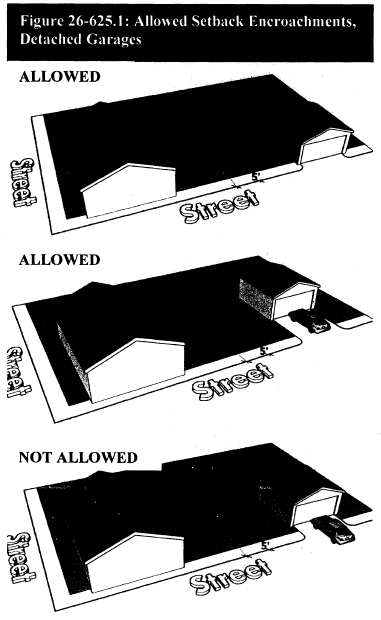
a)
Where the garage door or main vehicular access is located parallel to the street, the setback cannot be between five (5) feet and eighteen (18) feet. The purpose of this regulation is to allow setback encroachments where there will not be the possibility of vehicles parked in the driveway in conflict with public rights-of-way. (See figure 26-625.1)
b)
Where the garage door or main vehicular access is located perpendicular to the street, the detached garage or carport may be built in line with the principal building. The purpose of this regulation is to allow setback encroachments where there will not be the possibility of vehicles parked in the driveway in conflict with public rights-of-way.
c)
Where the garage door or main vehicular access is located parallel to and accessed off of an arterial street, the detached garage may not encroach into the required setback.
d)
The community development director may require modified setbacks in these instances where there may be potentially hazardous conditions.
ii.
All other accessory buildings. Accessory buildings that do not have any vehicular access may build in line with the nonconforming principal structure in front yards and side and rear yards abutting public streets, as long as the accessory building is located behind the front or street-facing façade of the principal structure.
D.
Accessory building standards for commercial and industrial zone districts.
1.
General standards.
a.
Location.
i.
No accessory building shall be located on a vacant lot devoid of any primary or main building.
ii.
No accessory building shall be located within any platted or recorded easement or over any utility, except as otherwise expressly agreed to in writing by the city or utility provider, as applicable.
iii.
Accessory buildings shall only be located in the side or rear yard. Accessory buildings may not be located in side yards that abut a public right-of-way.
b.
Maximum number.
i.
In commercial zone districts, a maximum of one (1) accessory building shall be allowed.
ii.
In industrial zone districts, a maximum of two (2) accessory buildings shall be allowed.
c.
Size. The total floor area of all accessory structures on a single property may not exceed fifty (50) percent of the floor area of the primary structure located on that property. In no case may a single accessory structure exceed five hundred (500) square feet in floor area.
d.
Setbacks.
i.
The required side yard setback shall be a minimum of five (5) feet.
ii.
The required rear yard setback shall be a minimum of ten (10) feet.
e.
Height. The maximum height of any accessory structure shall be twelve (12) feet.
f.
Materials. The accessory structure shall have exterior materials that are architecturally compatible with the primary structure, with the following exceptions:
i.
An accessory structure that is one hundred twenty (120) square feet or less. Such accessory structures may not be constructed of metal, but are allowed to have metal siding as long as the material has a textured wood grain appearance similar to horizontal clapboard. Vertically placed vinyl-clad siding is not allowed.
ii.
On industrial zoned properties only, one (1) or both of the allowable accessory structures may be industrial shipping containers or storage units that do not have exterior materials compatible with the primary structure. Such containers must be screened from view of adjacent properties and streets by an opaque wall or fence that is at least as tall as the container and that does not exceed eight (8) feet in height.
E.
Accessory buildings in planned development districts.
1.
Accessory buildings shall only be allowed in a planned development district if accessory structures are expressly permitted in the approved outline development plan. All standards for accessory buildings in a planned development district shall be established in the approved outline development plan.
F.
Accessory recreational equipment. Recreational equipment is permitted in addition to minor and major accessory structures on residential properties subject to the following:
1.
All in-ground pools, above-ground pools, and hot tubs shall be subject to the accessory building setback requirements of the underlying zone district; however, setbacks shall not apply to those pools which are otherwise exempted from building permit by chapter 5. The size of the pool or hot tub shall dictate whether it is subject to the major or minor setback requirements. Any pool or hot tub exceeding the minor accessory structure size shall be subject to the major accessory structure setback. The size of the pool or hot tub is limited by the ability of the lot to comply with the overall coverage requirements for the underlying zone district provided in article II.
2.
Any recreational equipment or structure which is one hundred twenty (120) square feet in size or less is exempt from zoning development standards.
3.
Any recreational equipment or structure which is essentially temporary is exempt from zoning development standards.
4.
Any recreational equipment or structure which is more than one hundred twenty (120) square feet and is essentially permanent shall be subject to the following standards:
a.
Maximum size: the total floor area of all recreational equipment or structures may not exceed four hundred (400) square feet or the underlying lot coverage, whichever is more restrictive.
b.
Maximum height: Twelve (12) feet
c.
Minimum side and rear setbacks: Five (5) feet
d.
Minimum front setback: subject to the front setback for the underlying zone district.
5.
For the purpose of this subsection F., permanence shall be determined at the sole discretion of the community development director in consideration of the size, portability, deconstructability, and presence of utilities. As examples only, recreational equipment that is essentially temporary may include portable goals, portable playsets, portable playhouses, portable nets, portable skate park equipment, yard games, bounce houses, and portable movie screens. Recreational equipment that is essentially permanent may include playsets, tree houses, in-ground trampolines, and skate park equipment.
6.
All nonconforming recreational equipment or structures existing prior to the effective date of Ord. No. 1721, shall be brought into conformance with these provisions on or before April 1, 2022.
(Ord. No. 1448, § 5, 8-24-09; Ord. No. 1468, § 2, 8-9-10; Ord. No. 1721, § 3, 9-27-21; Ord. No. 1744, § 19, 7-11-22)
Sec. 26-626. - Residential uses in commercial zones; conditions.
A.
The amount of total floor area devoted to commercial use must exceed that devoted to residential use.
B.
Residential use shall not be located on the ground floor, and if so, restricted to the rear half of the building.
C.
Residential use density shall not exceed one (1) dwelling unit per five thousand (5,000) square feet of lot area.
D.
Parking shall be supplied at the rate of one (1) space per dwelling unit, except that minimum parking is not required for multi-unit dwellings.
E.
Where the applicant intends to convert an existing residential structure, either partially or wholly, to a commercial use, commercial development standards shall be applied for parking, landscaping and residential buffering. Any changes to building floor area shall fully comply with all commercial development standards.
F.
No new residences as a primary or principal use shall be allowed.
(Ord. No. 2001-1215, § 1, 2-26-01; Ord. No. 1744, § 20, 7-11-22; Ord. No. 1824, § 16, 6-23-25)
Sec. 26-627. - Temporary holiday tree produce and bedding plant sales lots; conditions.
A.
Temporary sales lots shall be permitted for no more than ninety (90) days.
B.
If located upon a parcel which is occupied by a primary use, the temporary sales area shall not occupy required parking spaces or fire lanes, and shall not be located within the required sight distance triangle of the intersection of two (2) streets.
C.
If located upon an undeveloped parcel, adequate off-street parking area for the use must be provided.
D.
Temporary fences, signs, structures and other temporary improvements shall meet all zoning and building code requirements.
E.
No such temporary sales lot shall occupy a parcel without first having received a business license, sales tax license, and building permit(s) as may be required by the City of Wheat Ridge.
(Ord. No. 2001-1215, § 1, 2-26-01)
Sec. 26-628. - Motor vehicle, farm implement, recreational vehicle, mobile or modular home, motorcycle, boat trailer and equipment sales, rental and storage lots.
A.
As applied where outdoor display or inventory storage is proposed.
B.
Sales, rental and service of a truck-tractor or semi-trailer is prohibited.
C.
All parking and vehicle display areas shall be paved.
D.
There shall be a minimum of one thousand five hundred (1,500) feet separation between any of the sales, rental or storage lots for the uses listed. New or expanded sales, rental or storage lots which do not meet the one thousand five hundred (1,500) feet separation requirement of this subsection D. may be permitted upon approval of a special use permit following the procedures of section 26-114. This procedure may be applied to permitted and special uses.
E.
There shall be a minimum ten-foot landscape buffer adjacent to any public street, with such buffer to be completely within the property boundaries, although the owner may additionally landscape that area between the front property line and the street improvements if approved by the community development director. There shall be no waivers of this landscape buffer requirement.
F.
Whenever a parking lot or display lot adjoins property zoned for residential use, a landscape buffer of ten (10) feet from said lot boundary shall be required. Within the ten-foot landscape buffer, a six-foot view obscuring fence or decorative wall shall be constructed. There shall be no waivers of this landscape and fence buffer requirement.
G.
Refer to section 26-502 for parking lot landscape island requirements.
(Ord. No. 2001-1215, § 1, 2-26-01; Ord. No. 1249, § 1, 3-25-02; Ord. No. 1683, § 32, 1-27-20; Ord. No. 1801, § 12, 8-26-24)
Sec. 26-629. - Building contractor's service shop; requirements.
A.
All outside storage areas shall be screened from view from adjacent properties and streets by a six (6) foot opaque wall or fence. Stacking of materials and supplies shall not exceed the height of the fence.
B.
Additionally, for uses which involve custom work and/or fabrication upon the premises, and provided that no excessive noise, vibration, dust, emission of heat, glare, radiation, smoke or fumes are produced to the extent that it is dangerous, hazardous or a nuisance to the reasonable enjoyment of use of adjacent properties.
(Ord. No. 2001-1215, § 1, 2-26-01)
Sec. 26-630. - Itinerant sales; requirements.
A.
Itinerant sales shall not occupy required parking spaces or fire lanes, shall not occupy the sight distance triangle required at the intersection of two (2) streets if on a corner property, shall be set back at least ten (10) feet from all property lines and may not exceed thirty (30) days occupancy of the same property.
B.
Only one (1) itinerant merchant may occupy a premises at any time.
C.
A special use permit is required.
D.
Only sale of items permitted in the zone district shall be allowed.
(Ord. No. 2001-1215, § 1, 2-26-01)
Sec. 26-631. - Outside display or storage; requirements.
A.
Merchandise, material, or stock for sale or rent may be displayed or stored within ten (10) feet of the front of buildings without being screened, except that required parking spaces or fire lanes shall not be used for such outside display or storage.
B.
Merchandise, material or stock may be stored or displayed behind the front of buildings within side or rear yards only where completely screened from adjacent properties and streets by a six-foot high opaque wall or fence in addition to trees to be placed at thirty-foot intervals. Merchandise, material and stock shall not be stacked to a height greater than that of the screening fence.
C.
The above shall not apply to operable automobile or light-duty truck rental and sales lots; planted and potted nursery stock, plant and produce sales, boat and camper sales lots, or mobile home and structure sales lots, except that required parking spaces and fire lanes shall not be used for storage or display.
(Ord. No.2001- 1215, § 1, 2-26-01)
Sec. 26-632. - Workshops; requirements.
No excessive noise, vibration, dust, emission of heat, glare, radiation, smoke or fumes may be produced to the extent that the workshop is dangerous, hazardous or a nuisance to the reasonable enjoyment or use of adjacent properties.
(Ord. No. 2001-1215, § 1, 2-26-01)
Sec. 26-633. - Special requirement for drive-through uses.
Any use or development proposing a motor vehicle "drive-through," as determined by the community development director, shall be required to obtain a special use permit for the "drive-through," unless the development itself is being reviewed as a special use.
(Ord. No. 2001-1215, § 1, 2-26-01; Ord. No. 1288, §§ 1, 2, 5-12-03)
Sec. 26-634. - Bail bonds businesses; distance requirements.
A.
No person shall locate, cause to locate or permit to be located a bail bonds business within one hundred (100) feet of the property line of any lot, tract or parcel of land within the city which is zoned for residential use, or zoned A-1 or A-2 and used for residential purposes.
B.
No person shall locate, cause to locate or permit to be located a bail bonds business within six-hundred (600) feet of the property line of any school or public park.
C.
For the purpose of this section, the distance between a bail bonds business and a residential district, a residential lot, a school or a public park shall be measured in a straight line, without regard to intervening structures, objects or city limits, from the closest exterior wall of the structure in which the bail bonds business is located to the property line of such use.
(Ord. No. 1413, § 4, 6-9-08)
Sec. 26-635. - Farmers' markets.
Farmers' market uses, as defined in section 26-123 and where allowed per section 26-204, shall comply with the following regulations.
A.
Temporary canopies. Temporary canopies may be allowed in order to provide protection from the elements for both the operators and products.
B.
Signage. A farmers' market is permitted to have one (1) temporary sign or banner, which is non-illuminated and no greater than fifty (50) square feet in size. Such sign or banner must be located on the premises and may only be displayed when the market is in operation.
C.
Hours of operation. In residential zone districts, hours of operation for farmers' markets shall be restricted from 7:00 a.m. to sunset.
D.
Submittal to community development department. A submittal with operational information including hours and days of operation, a parking plan, and written approval from the owner of the property where the farmers' market will occur, is required for review and approval by the community development department. Such submittal may be submitted and reviewed through the business license application process, as required per chapter 11, article 2 of the Code of Laws.
(Ord. No. 1491, § 6, 5-23-11)
Sec. 26-636. - Produce stands.
Produce stands, as defined in section 26-123 and where allowed per section 26-204, shall comply with the following regulations.
A.
Location. Produce stands must be located on private property.
B.
Products sold. Agricultural products such as raw vegetables, fruits, herbs, flowers, plants, nuts, honey and eggs are sold. Value-added agricultural products, which are made from raw agricultural products grown, raised, or produced on-site, such as jams, jellies, oils, vinegars, and cheeses, may also be sold at produce stands. Products sold at produce stands must have been primarily grown, raised, or produced on the same property where the stand is located.
C.
Seasonal operations. Produce stands may operate for up to six (6) months of the year. When the produce stand is not in use, it must be removed and stored indoors.
D.
Hours of operation. In residential zone districts, hours of operation shall be restricted from 7:00 a.m. to sunset.
E.
Home occupation requirement. Where a produce stand is located on a property with a residential dwelling unit, it shall qualify as a home occupation and must comply with the regulations in section 26-613.
F.
Signage. Produce stands operating as home occupations shall be allotted one non-illuminated sign up to two (2) square feet in size, as defined in section 26-709. All other produce stands are permitted to have one (1) non-illuminated sign up to six (6) square feet in size with a maximum height of five (5) feet. The sign may not be displayed when the stand is not in operation.
G.
Parking. Temporary off-street parking is required if there is not adequate on-street parking on adjacent streets.
(Ord. No. 1491, § 6, 5-23-11)
Sec. 26-637. - Urban gardens.
Urban gardens, as defined in section 26-123 and where allowed per section 26-204, shall comply with the following regulations.
A.
Signage. each urban garden is permitted one (1) non-illuminated sign up to six (6) square feet in size, with a maximum height of five (5) feet.
B.
Landscape buffer. Where urban gardens directly abut a residentially or agriculturally zoned lot with a residential use, there shall be a minimum five-foot landscaped buffer between the garden or farm area and the property line.
C.
Parking. On-site parking may be required if there is not adequate on-street parking on adjacent streets. A parking plan shall be included in the submittal to the community development department, as required in G. below. Where on-site parking is provided, the areas used for parking and access to parking shall be surfaced with durable and dustless materials including concrete, asphalt, compacted crushed stone, compacted gravel, recycled asphalt, open and closed pavers or similar materials. The parking area shall be built so that materials used in the parking surface stay contained within the parking pad, through the use of curbs, railroad ties, etc.
D.
Permitted structures. Primary and accessory structures are allowed. Accessory structures such as sheds and greenhouses are permitted whether or not the lot contains a primary or main structure. All structures shall comply with the regulations for primary and accessory structures, including maximum size, height, and setbacks, for the property's zone district.
E.
Hours of operation. In residential zone districts, urban gardens are permitted to operate from 7:00 a.m. to sunset and any exterior lighting must be shut off at sundown. Exterior lighting in all zone districts shall comply with the exterior lighting standards in section 26-503.
(Ord. No. 1491, § 6, 5-23-11)
Sec. 26-638. - Occupancy limits.
A.
Except as provided in subsection B. hereof, the maximum occupancy allowed per dwelling unit shall not exceed the maximum permitted by the applicable building codes adopted or amended by the City of Wheat Ridge as set forth in chapter 5 of the Code, or by any applicable state or federal law or regulation, or by affordable housing guidelines applicable to the dwelling unit.
B.
Exceptions. The following shall be subject to different maximum occupancy limits than those established in subsection A. above:
1.
Residential group homes that conform to the requirements of section 26-612 of this Code.
[2.
Reserved.]
C.
A violation of this section shall be proven by a preponderance of the evidence as a civil matter for which imprisonment shall not be imposed. The owner and any other person responsible for the management or control of a dwelling unit shall be liable for allowing occupancy in excess of this section if they knew, or through reasonable diligence should have known, that a violation of this Section was occurring.
(Ord. No. 1520, § 1, 9-10-12; Ord. No. 1744, § 25(Exh. 1), 7-11-22; Ord. No. 1823, § 5, 5-12-25)
Sec. 26-639. - Street naming and numbering.
A.
Designation. The community development director shall designate the proper street names and numbers and addresses for all structures.
B.
Guidelines for street naming.
1.
The city-wide street numbering system is based upon the Denver Metropolitan system.
2.
Streets running east and west are avenues.
3.
Streets running north and south are streets.
4.
Streets running east and west, halfway between established grids, shall take the name of the avenue preceding, with the suffix "place."
5.
Streets running north and south halfway between established grids shall take the name of the street preceding, with the suffix "court."
6.
Streets running east and west and connecting with an east and west avenue shall be a "drive."
7.
Streets running north and south and connecting with a north-south street shall be a "way."
8.
Horseshoe-shaped streets beginning and ending within a major block, or dead end streets, shall be a "circle." It is suggested that the term "circle" should be used sparingly. If at all possible, a "way" or "drive" should be used except in the case of absolute necessity.
9.
Streets should line up on a grid with existing streets and avenues preferably with those existing prominently in the metropolitan area.
10.
Street signs should be readable from each direction of travel.
11.
Temporary signs shall be required during construction period.
12.
Names should be of simple spelling for easy pronunciation.
C.
Guidelines for structure numbering (addressing).
1.
Structures including those on private drives shall be addressed to the street from which primary access is gained.
2.
Numbers shall continue north and south from the base street, Ellsworth, and east and west from the base street, Broadway.
3.
Numbers should be systematically spaced from 0 to 99 on each "major" block so that the 50 will be in the middle of the block.
4.
Odd numbers shall be on the west and north sides of the street. Even numbers shall be on the east and south sides.
5.
All address numbers shall be readable from the street.
6.
Developments with multiple main structures. In cases where a single development that is under common or unified control or ownership has more than one (1) main structure, each such structure shall be assigned a single address based upon orientation of the primary building access and with regard to the normal grid system for address numbering.
7.
Developments with a single building and with multiple units. Except for two-, three-, or four-unit residential structures where a single building is divided into multiple units, either for residential or nonresidential, and either as units occupied by renters/lessors or by ownership, (i.e., a condominium or townhouse), each such building shall have a single address with the various units indicated by different means, such as by unit letter or number. A two-, three- or four-unit dwelling structure may either have individual addresses, or one (1) address for the building with unit designation as defined above.
8.
For circle or horseshoe-shaped streets, numbering shall be in accordance with the numbering on the street or avenue where the horseshoe or circle originates, and numbers should not duplicate those on the major street.
D.
Notice to place number.
1.
It shall be the duty of any owner/occupant of any premises, upon notice from the community development director to cause the official number to be placed on any building so owned or occupied. Such numbering shall be accomplished in the manner required within thirty (30) days after service of such notice. For establishments where fire access is gained from the rear, both rear and front doors shall have the addresses posted.
2.
It is unlawful for any owner/occupant to retain or use or to permit to be retained or used upon any building, any number other than the number designated by the community development director.
E.
Renumbering and renaming.
1.
In all cases where a street has been named or numbered or renamed or renumbered pursuant to any other legal requirement, as the same may be required from time to time by action of the city council, it shall be the duty of the community development director to adjust and rename or renumber such streets.
2.
The community development director may require or approve a request for a change of address, after proper notification of the owner and all affected agencies, on any property under one (1) or more of the following instances:
a.
In response to a street rename or change in number as described above.
b.
If an address is out of proper sequence.
c.
If an odd or even number is on the wrong side of a street.
d.
If the number series presently in use is incorrect or misleading.
e.
If a change in a street intersection or street location makes a present address outmoded or misleading.
f.
Where identical numbers are found on the same street, or on streets which have the same number or name but different suffixes (i.e. street, avenue, place, etc.)
g.
Where the assigned address is not being used.
h.
Where subdivision or building development on one (1) large parcel would make an existing address misleading or out of sequence.
i.
Where the structure is not addressed to the street from which primary access is gained.
j.
Other situations not stated above which may cause problems with mail delivery, emergency service, or other public safety or service reason as determined appropriate by the community development director.
F.
Adjustments. In all cases where there is a mistake or conflict in names or numbers, or where some special arrangement varying from the general terms of this chapter is necessary, the community development director shall direct and make the proper adjustment of the same in harmony with the spirit and intention of this chapter.
(Ord. No. 1547, § 14, 4-28-14; Ord. No. 1744, § 25(Exh. 1), 7-11-22)
Sec. 26-640. - Marijuana.
A.
As used in this section, "marijuana" means all parts of the plant of the genus cannabis, whether growing or not; the seeds thereof; the resin extracted from any part of such plant; and every compound, manufacture, salt, derivative, mixture, or preparation of the plant, its seeds or its resin, including marijuana concentrate but shall not include industrial hemp, the fiber produced from the stalks, oil or cake made from the seeds of the plant, sterilized seed of the plant which is incapable of germination, or the weight of any other ingredient combined with marijuana to prepare topical or oral administrations, food, drink, or other product whether for medicinal or non-medicinal (recreational) purposes.
B.
Cultivation, drying, processing and manufacture of marijuana and marijuana-infused products is permitted as an accessory use to any residential dwelling; provided, however, that the following requirements are met:
1.
Such use shall be conducted only within an enclosed locked space within the dwelling and may not be conducted within any accessory structure.
2.
Such use shall be incidental and secondary to the use of the dwelling for dwelling purposes and shall not change the character thereof.
3.
Such use may only be conducted by a person who resides within the dwelling in which the use is occurring.
4.
The total area used for said purposes shall not exceed twenty-five (25) percent of the gross floor area of the user's dwelling unit.
5.
The use shall not generate traffic, noise, vibration, glare, fumes, odors or electrical interference beyond what normally occurs in any residential zone district.
6.
There shall be no visible evidence from any property line that such use is occurring within the dwelling.
7.
The use of compressed, flammable gas as a solvent in the extraction of THC or other cannabinoids is prohibited.
8.
The installation or modification of any electrical, mechanical, plumbing or any other type of system or fixture related to the use shall comply with all applicable provisions of the city's building regulations as set forth in chapter 5 of this Code.
C.
Except as provided for in articles XII and XIII of chapter 11 of this Code, cultivation, drying, processing, manufacture, testing and storage of marijuana may not occur in any non-residential structure.
(Ord. No. 1551, § 1, 6-23-14; Ord. No. 1598, § 9, 6-27-16)
Editor's note— Ord. No. 1551, § 1, adopted June 23, 2014, enacted provisions intended for use as § 26-639. Inasmuch as there were already provisions so designated, said ordinance has been included herein as § 26-640 at the discretion of the editor.
Sec. 26-641. - Self-storage facilities; distance requirements.
A.
There shall be a minimum one-half (½) mile separation between self-storage facilities, measured radially from the property line of any existing mini-warehouse facility, regardless of the zone district, and without regard to intervening structures, objects or city limits.
B.
There shall be a minimum one-quarter (¼) mile separation between self-storage facilities and any fixed guideway rail stations, including light rail and commuter rail, measured radially from the property line, regardless of the zone district, and without regard to intervening structures, objects or city limits.
(Ord. No. 1607, § 2, 9-12-16)
Sec. 26-642. - Bulk plane.
A.
Bulk plane. In addition to the height and setback standards of article II, building envelopes are regulated by a three-dimensional bulk plane for the purpose of preserving neighborhood compatibility, privacy, and the adequate supply of light and air.
1.
Applicability. The bulk plane restrictions of this section shall apply to all properties zoned R-1, R-1A, R-1B, R-1C, R-2, R-2A, R-3, and R-3A for which a detached single-unit dwelling is the primary use. The entirety of any building envelope shall be contained within the bulk plane, including the dwelling and all accessory structures, unless otherwise exempted by subsection A.4.
2.
Measurement of bulk plane. The bulk plane is a plane that begins fifteen (15) feet above every property line of a lot or parcel, which then slopes at a forty-five (45) degree angle until it intersects the bulk plane from the opposite side of the lot or parcel. See figure 26-642.2. Maximum building heights set forth in article II, chapter 26 shall apply regardless of the height at which the two (2) opposite bulk planes intersect above the lot or parcel.
3.
Measurement of base plane. The base plane (see figure 26-642.1) shall be measured from the existing average grade of a lot or parcel. Average grade shall be calculated as the average of the elevations taken at the midpoints of each property line. See figure 26-642.2.
4.
Exceptions. Encroachments into the bulk plane shall be permitted as follows:
a.
Chimneys.
b.
[Railings.] Open-type railings compliant with adopted City Code.
c.
Architectural features. Cornice, eaves, beltcourses, sills, canopies or other similar architectural features, including bay window, may extend or project into the bulk plane not more than thirty (30) inches.
d.
Mechanical equipment. Vent pipes, solar panels, swamp coolers.
e.
[Dormers.] Dormers measuring no more than eight (8) feet wide; six (6) feet tall, as measured from the lowest point of intersection between the roof and the dormer to the highest point of a flat roof or mean height level between eaves and ridge for a gable, hip, gambrel or other roof; and, occupying no more than fifty (50) percent of the roof.
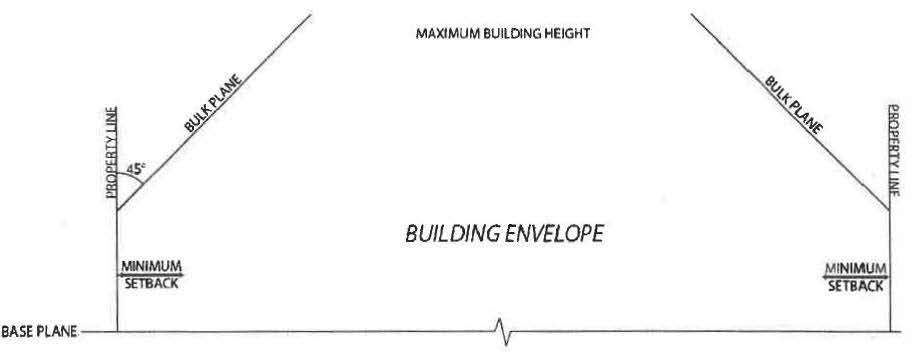
Figure 26-642.1. Section view of bulk plane building envelope, as measured from all
property lines.
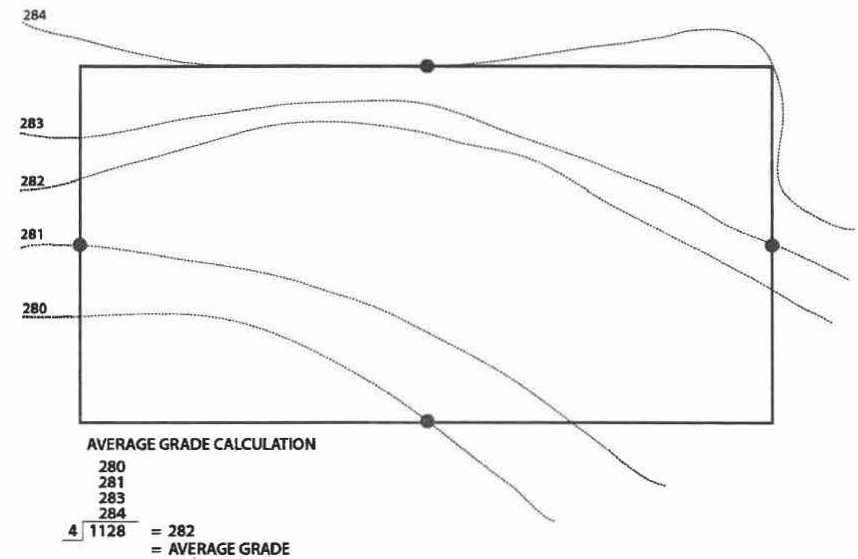
Figure 26-642.2. Average Grade Calculation.
(Ord. No. 1613, §§ 6—8, 11-21-16; Ord. No. 1746, § 9, 8-22-22)
Sec. 26-643. - Freestanding emergency departments.
A.
For purposes of this section, freestanding emergency departments shall mean and include a medical facility that is not physically attached to a hospital facility that has the capability of providing medical care and services to patients with emergency medical conditions in a manner similar to emergency rooms located within hospitals. Features of a freestanding emergency department may include, but are not limited to, expanded hours of operation, drive-lanes or vehicle bays to accommodate ambulance arrivals and departures, board-certified emergency physicians, board-certified emergency nurses, on-site lab and imaging capabilities and similar equipment, services and treatments not commonly available in urgent-care facilities.
B.
Where permitted by the table of uses in sections 26-204 and 26-1111, freestanding emergency departments must be on a site of at least five (5) acres in size and co-located exclusively with other medical uses (such as office, clinic, and laboratory uses) to create a medical campus.
(Ord. No. 1646, § 2, 8-13-18; Ord. No. 1821, § 1, 6-9-25)
Sec. 26-644. - Animal-related facilities.
A.
All kennels and animal daycare facilities shall obtain a kennel license from the city of wheat ridge police department.
B.
Animal daycare facilities in mixed use zone districts are subject to the following regulations:
1.
Animals shall not be kept or boarded overnight, bred, sold, or let for hire.
2.
No outdoor play yards, runs, pens, or training areas are allowed.
C.
Animal daycare facilities in the C-1 and C-2 zone districts are subject to the following regulations:
1.
No more than fifteen (15) animals shall be outside at any given time.
2.
Outdoor play yards shall be setback at least twenty (20) feet from side and rear property lines where they are adjacent to residentially zoned or used property.
3.
Outdoor play yards shall be screened from view so as not to be visible from any public street or adjacent property.
4.
Any outdoor play yard shall only be used from dawn until dusk for supervised exercise and training use, this shall not prohibit the occasional use of outdoor areas for supervised animal relief outside of these hours.
5.
Overnight boarding shall not exceed twenty-five (25) percent of the gross floor area of the structures associated with the animal daycare, overnight boarding shall be enclosed within a soundproof building.
D.
Kennels and animal daycare facilities which are subject to the special use permit process, per sections 26-114 and 26-204, in zone districts where indicated in this chapter are, in addition to the requirements of this section, subject to the conditions of approval attached to the special use permit.
(Ord. No. 1670, § 3, 6-24-19)
Sec. 26-645. - Short-term rentals.
Short-term rentals, as defined in section 26-123, are subject to the following requirements:
A.
Licensing and permitting required. It shall be unlawful for any person, as defined in section 26-123, to offer or provide lodging in the form of a short-term rental within the city without having first obtained a short-term rental business license pursuant to chapter 11, article XIV of the Code. Only owners of the affected real property may obtain short-term rental business licenses.
B.
Permitted locations.
1.
Short-term rentals are permitted as primary or accessory uses in all residential, agricultural, commercial, and mixed-use zone districts, including planned development districts.
2.
Short-term rentals are prohibited in industrial zone districts including planned industrial developments.
C.
Maximum number per short-term rental host: A short-term rental host, as defined in section 26-123 ("short-term rental host"), may operate a short-term rental in up to one (1) dwelling unit not occupied by the host (a "whole-home" rental), and in up to one (1) dwelling unit occupied by the host (a "partial-home" rental) where a portion of the dwelling unit, such as a room or rooms, functions as a short-term rental, so long as the host continuously resides in the dwelling unit or on the same property in either the primary or accessory dwelling unit through the duration of the rental. This maximum shall apply to all types of dwelling units in all zone districts, except for the following:
1.
Apartments and mixed use developments. A short-term rental host, as the owner of an apartment or mixed use development in the mixed use-neighborhood (MU-N), mixed use-commercial (MU-C) series, mixed use-Lutheran Legacy Campus (MU-LLC), and commercial-one (C-1) zone districts, may operate a maximum of four (4) dwelling units as short-term rentals within that development. For apartment and mixed use developments with greater than forty (40) dwelling units in those zone districts, additional short-term rentals are permitted at a rate of five (5) percent of the total number of dwelling units, in addition to the four (4) already permitted by this section. For the purposes of this subsection, an apartment or mixed use development shall mean one (1) or more multiple contiguous properties under one (1) ownership with one (1) or more multi-unit dwellings or mixed use buildings, excluding single attached dwelling uses.
2.
Condominium developments. For condominium developments (those which have a recorded condominium plat allowing for individually-owned dwelling units) in any zone district, each individual dwelling unit owner is eligible, as a short-term rental host, to operate a short-term rental as provided by subsection C. of this section, provided that the maximum number of such rentals allowed by subsection C.1. is not exceeded in the development.
3.
Accessory dwelling units. A short-term rental shall be permitted to operate within an accessory dwelling unit and shall be considered an owner-occupied or partial-home short-term rental.
D.
Requirements.
1.
The property owner of a short-term rental must obtain a short-term rental business license pursuant to chapter 11, article XIV.
2.
A short-term rental must be located within a legal dwelling unit as defined in section 26-123.
3.
The building or portion of building used as a short-term rental shall continuously meet the standards of all applicable international residential and building codes adopted or amended by the City of Wheat Ridge as set forth in chapter 5 of the Code of Laws.
4.
Short-term rentals are prohibited in temporary structures and buildings or structures without a residential certificate of occupancy, including but not limited to: recreational vehicles, sheds, tents, and campers.
5.
Short-term rentals are prohibited in deed-restricted affordable housing, income-restricted housing, age-restricted housing, and rent-stabilized or rent-controlled housing. A short-term rental host shall be required to attest to compliance with this provision as part of the registration process.
6.
If the property does not meet the minimum parking requirements in section 26-501 for the zone district in which it is located, one (1) additional parking space per short-term rental is required to be installed prior to approval of a short-term rental license. A short-term rental host shall be required to attest to compliance with the parking requirements as part of the registration process.
7.
Short-term rentals located in any residential zone district shall be restricted to a minimum two-night stay, per individual reservation.
E.
Maximum number of short-term rentals per city council district.
1.
There shall be a limit on the total number of non-owner-occupied short-term rentals that are licensed in each city council district. The limit per council district shall be established by the community development director on an annual basis on January 1, with a reporting deadline of January 31. The limit shall be calculated as two (2) percent of the total number of units within single-, two-unit, and single attached dwellings in each district.
a.
This restriction shall apply to any single-, two-unit, and single attached dwelling in any zone district.
b.
This restriction shall not apply to owner-occupied short-term rentals.
c.
This restriction shall not apply to short-term rentals within apartment and mixed-use developments in mixed use and commercial zone districts which are subject to the restrictions of subsection (C)(1) hereof.
2.
If the maximum number for any district is reached, any subsequent application shall be placed on a waiting list until such time that the total number of short-term rentals in that district falls under the maximum number allowed.
(Ord. No. 1709, § 9, 2-22-21; Ord. No. 1744, §§ 21, 25(Exh. 1), 7-11-22; Ord. No. 1802, § 5, 8-26-24; Ord. No. 1814, § 11, 1-27-25)
Editor's note— Ord. No. 1709, § 12, adopted February 22, 2021, states that subsection E. of the above section has an effective date of November 1, 2021, which differs from the effective date of the rest of this section, which is May 1, 2021.
Sec. 26-646. - Accessory dwelling units.
Accessory dwelling units, as defined in section 26-123, are subject to the following requirements:
A.
Eligible zone districts: An accessory dwelling unit (ADU) shall be permitted as an accessory use to single detached dwellings in all residential and agricultural zone districts, the mixed use-neighborhood (MU-N) zone district, and portions of the mixed use-Lutheran Legacy Campus (MU-LLC) zone district per the table of permitted uses (table 5) in section 26-1410 B. Planned residential developments and planned mixed use developments that allow single detached dwelling units as a primary use shall also allow ADUs as an accessory use.
B.
Development standards:
1.
Detached accessory dwelling units shall be subject to the accessory building development standards for the zone district in which they are located, set forth in sections 26-205 to 26-214 and this section, including bulk plane requirements for ADUs located in residential zone districts.
2.
Attached accessory dwelling units shall be subject to the principal building development standards for the zone district in which they are located, set forth in sections 26-205 to 26-214 and this section, including bulk plane requirements for ADUs located in residential zone districts.
3.
Size:
a.
The floor area of an accessory dwelling unit shall not exceed fifty (50) percent of the gross floor area of the primary dwelling unit, or one thousand (1,000) square feet, whichever is more restrictive. Regardless of this limit, ADUs shall always be permitted between five hundred (500) and seven hundred fifty (750) square feet in size, so long as the gross floor area of the ADU does not exceed that of the primary dwelling unit.
b.
As an exception, an attached accessory dwelling unit in a basement or second floor may exceed the size limitations, provided the area does not exceed the area of the first floor of the same structure.
c.
The maximum footprint of a detached ADU structure shall be one thousand (1,000) square feet. This footprint shall include the allotted floor area of the ADU, plus any other spaces attached to the ADU, such as a garage, carport, porch, or deck.
4.
Height: A detached accessory dwelling unit in any zone district may not exceed twenty-five (25) feet in height.
C.
Parking: No additional parking spaces shall be required. Parking requirements for short-term rentals may apply if the ADU is being operated as a short-term rental, subject to the standards in subsection 26-645 D.6.
D.
Maximum number: A maximum of one (1) accessory dwelling unit shall be permitted per property.
E.
Occupancy and sale restrictions:
1.
If the ADU is to be operated as a "partial-home" short-term rental as described in section 26-645, then the property owner, as reflected in title records and evidenced by voter registration, vehicle registration or other similar means, must occupy either the primary dwelling unit or the ADU.
2.
The ADU shall not be sold separately from the primary dwelling unit, nor shall the lot on which it is situated be subdivided unless such subdivision can be accomplished in accordance with all provisions of this Code.
F.
Nonconforming properties:
1.
Owners of property currently containing structures which may fall within the definition of ADU under section 26-123, are hereby granted the right to apply to the city for approval of the same until August 15, 2026. Following that date, and in absence of city approval of an ADU under this section, unapproved or unpermitted ADUs shall be subject to enforcement as provided by law. Following that date, and in the absence of city approval of an ADU under this section, unapproved or unpermitted ADUs shall be subject to enforcement as provided by law. Development standards of subsection B. do not apply.
2.
A building permit shall be required for any construction or modification of the ADU to bring the structure into compliance with applicable building codes, to the extent practical, as determined by the community development director, in consultation with the chief building official. A building permit is not required to the extent the ADU is determined to be legally nonconforming pursuant to section 26-120 as documented by proof provided by the owner and to the satisfaction of the community development director.
3.
If a property contains more than one (1) ADU, deemed lawful pursuant to subsections F.1. and F.2. by August 15, 2026, those ADUs shall be allowed to remain until voluntarily demolished or converted to other uses, consistent with the provisions of Code subsection 26-120 C.
4.
Properties containing existing nonconforming accessory structures may be eligible for conversion of those structures to an ADU only to the extent a variance to address nonconforming elements is first obtained pursuant to section 26-115.
G.
Existing development on lot. A single detached dwelling unit must exist as a primary dwelling unit on the lot or parcel or be constructed simultaneously with the ADU. A certificate of occupancy or completion for an ADU will only be issued after or coincident with issuance of the same for the primary dwelling unit.
(Ord. No. 1744, § 22, 7-11-22; Ord. No. 1798, § 1, 8-12-24; Ord. No. 1822, §§ 13—16, 5-12-25)

