
Wixom City Zoning Code
CHAPTER 18
12 - GENERAL PROVISIONS
Sections:
18.12.010 - Uses per lot.
A.
Except as otherwise specifically provided in this title, no lot may contain more than one principal building, structure, or use.
B.
Groups of multiple-family buildings, site condominiums, retail business buildings, multi-tenant offices, leased industrial space, or other groups of buildings contained within a single integrated complex are deemed to be a principal use collectively. To be considered as an integrated complex, the site shall share parking, signs, access, or other similar features, which together form a unified function and appearance.
C.
In cases where there is more than one use, the use comprising the greatest floor area shall generally be considered the principal use, except in cases where a use comprising a secondary amount of floor area is considered to have greater impact in terms of traffic generated, noise levels, disruption of views, and similar impacts.
D.
Wireless communication facilities may be located on a lot that contains another use, except one-family and two-family dwellings.
(Ord. 08-05 § 1 (part), 2008)
18.12.020 - Lot area allocation.
A.
No portion of a lot can be used more than once for determining compliance with the provisions for lot area and yard dimensions for construction or alteration of buildings.
B.
No lot, adjacent lots in common ownership, required yard, parking area, or other required open space shall be created, divided, or reduced in dimensions or area below the minimum requirements of this title. If already less than the minimum requirements of this title, a lot, adjacent lots in common ownership, required yard, parking area, or other open space shall not be divided or reduced in dimensions or area so as to increase its noncompliance with the minimum requirements of this title. Lots or yards created after the effective date of the ordinance codified in this chapter shall comply with the requirements of this title.
(Ord. 08-05 § 1 (part), 2008)
18.12.030 - Lots adjoining alleys.
In calculating the area of a lot that adjoins an alley for the purpose of applying lot area and setback requirements of this title, one-half the width of such alley abutting the lot shall be considered as part of such lot.
(Ord. 08-05 § 1 (part), 2008)
18.12.040 - Voting place.
The provisions of this title shall not be so construed as to interfere with the temporary use of any property as a voting place in connection with a municipal, school, or other public election.
(Ord. 08-05 § 1 (part), 2008)
18.12.050 - Height limit.
The building height restrictions of all zoning districts shall not apply to the following:
A.
Parapet walls and cornices not exceeding four feet in height.
B.
Chimneys, cooling towers, elevator bulkheads, fire towers, gas tanks, grain elevators, silos, stacks, stage towers and scenery lofts, water tanks, public monuments, church spires, belfries, cupolas, domes, ornamental towers, and penthouses or roof structures housing necessary mechanical appurtenances.
(Ord. 08-05 § 1 (part), 2008)
18.12.060 - Projections into required yards.
Certain architectural features may project the following distance into the required yard setbacks as follows:
Table 12.06
Permitted Projections Into Required Yards
A.
Central air conditioning, heating and water filtration equipment installed outside of one-family or two-family dwellings and their attached structures shall be located to the rear of the principal building, not less than three feet in from the extreme sides of the principal structure and in no cases less than fifteen feet from adjoining one-family and two-family dwellings.
1.
The building official may allow an alternate location and may reduce distance spacing in those instances where such alternate location does not adversely impact an abutting dwelling.
2.
Screening of the equipment with appropriate landscaping or other solid material to reasonably conceal the equipment from view is required.
B.
Open patios shall not be considered a portion of the structure.
(Ord. 08-05 § 1 (part), 2008)
18.12.070 - Frontage on a public street.
A.
No lot shall be used for any purpose permitted by this title unless such lot abuts a public street, unless otherwise provided for in this title or in Ordinance 80, codified in Title 16 of the Wixom Municipal Code.
B.
Front yard requirements along rights-of-way shall be measured from the public road right-of-way line, private road access easement line or the curb of any access road, drive, or internal driveway where no right-of-way or easement exists.
C.
Corner lots and through lots in all zoning districts must provide the required front yard setback on each side of the lot which abuts a public street, private road, or access drive. All references to front yard requirements include the exterior side yard of corner lots unless otherwise noted, except as approved.
D.
On curvilinear streets, the minimum front yard setback is measured along a curve parallel to the front lot line.
(Ord. 08-05 § 1 (part), 2008)
18.12.080 - Corner clearance.
A.
No fence, wall, structure, or planting shall be erected, established, or maintained on any lot that will obstruct the view of drivers in vehicles approaching the intersection adjacent to a corner lot or a driveway on any lot.
B.
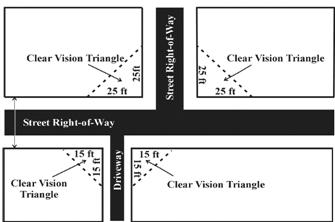
Fences, walls, structures, or plantings located in the clear vision triangle, as depicted below, shall not be permitted to exceed a height of twenty-four inches above the lowest point of the intersecting street(s). The unobstructed triangular area is described as follows:
1.
The area formed at the corner intersection of two street right-of-way or easement lines, the two sides of the clear vision triangle being twenty-five feet in length measured along abutting public right-of-way lines, and third side being a line connecting these two sides; or
2.
The area formed at the corner intersection of a street right-of-way, easement, or alley and a driveway, the two sides of the triangular area being fifteen feet in length measured along the right-of-way line and edge of the driveway, and the third side being a line connecting these two sides.
(Ord. 08-05 § 1 (part), 2008)
18.12.090 - Building grades.
All new buildings and structures constructed on vacant lots adjacent to and in between existing buildings shall be constructed at the elevation of the average grade unless otherwise approved by the planning commission or building official. New grades shall not be established that would permit an increase in the runoff of surface water onto adjacent properties.
(Ord. 08-05 § 1 (part), 2008)
18.12.100 - Essential services.
A.
Essential services, as defined in Chapter 18.24, Definitions, shall be permitted as authorized under any franchise in effect within the city, subject to regulation as provided in any law of the state of Michigan or in any ordinance of the city.
B.
It is the intent of this section to ensure conformity of all structures and uses to the requirements of this title wherever such conformity shall be practicable and not in conflict with the specific requirements of such franchise, legislation or other city ordinance. In the absence of such conflict, the zoning ordinance shall prevail.
C.
Wireless communication facilities shall be subject to the requirements of Section 18.12.110.
(Ord. 08-05 § 1 (part), 2008)
18.12.110 - Wireless communication facilities and services.
A.
Purpose and Intent. The regulations of this section are intended to conform to federal laws and administrative rules governing facilities needed to operate wireless communication systems and to set forth procedures and standards for review and approval for the location of such facilities within the city of Wixom.
1.
It is the city's intent to reasonably regulate the location and design of such facilities to retain the integrity of neighborhoods and the character, property values and aesthetic quality of the city.
2.
Given the increase in the number of wireless communication facilities requested as a result of the new technology and the Federal Telecommunications Act of 1996, it is the policy of the city that all users should colocate attached wireless communication facilities and wireless communication towers, where practicable. Collocation is proposed in order to assure the most economic use of land and to prevent the proliferation of duplicative services.
3.
In recognition of the city's concern that technological advances may render certain wireless communication facilities obsolete or unnecessary in the future, requirements are set forth for the removal of unused or unnecessary facilities in a timely manner and provide security for removal.
4.
These regulations do not apply to accessory antennas addressed in Section 18.13.090.
B.
Zoning Districts and Approval Process for Wireless Communication Facilities. Wireless communication facilities may be located within the city as follows:
Table 12.11
Wireless Communication Facilities
C.
Application Requirements—Collocation. The following information shall be provided with the application, in addition to other administrative site plan submittal requirements, as required in Chapter 18.17, Site Plan Review Requirements and Procedures, for an attached wireless communication facility colocated on an existing structure:
1.
The name, address and phone number of the person to contact for engineering, maintenance and other notice purposes. This information shall be continuously updated during all times the facility is on the premises;
2.
The owner and/or operator of the existing tower or structure;
3.
Legal description of the parent tract and leased parcel (if applicable);
4.
Elevation drawings and construction details of all existing and proposed wireless communication facilities including accessory structures and equipment shelters;
5.
The reason or purpose for the wireless communication facility with specific reference to the provider's coverage, capacity and/or quality needs, goals and objectives;
6.
Identification of the entities providing the backhaul network for the tower(s) described in the application and other cellular sites owned or operated by the applicant in the city and within one mile of the city;
7.
The structural capacity and whether it can accommodate the facility, as proposed or modified;
8.
Limits and type of fencing, the method of screening and illumination;
9.
A description of compliance with this section and all applicable federal, state or local laws;
10.
A description of performance guarantee to be posted upon issuance of a building permit to ensure removal of the facility if it is abandoned or is no longer needed. This amount shall be a minimum of five thousand dollars or as determined upon resolution by the city council.
D.
Application Requirements for New Wireless Communication Tower. The following information shall be provided with the application to construct any new wireless communication tower, in addition to the submittal requirements in subsection C of this section and the items required in Chapter 18.18, Special Land Use Review Requirements and Procedures:
1.
A description of the guarantee to be posted at the time of receiving a building permit for the facility to ensure removal of the facility when it is abandoned or is no longer needed. The applicant shall demonstrate that funds will be available to the city for removal of any structure used for wireless communication in an amount which reasonably reflects the cost of removal of the facility and restoration of the property or structure upon which the facility is located or placed. Adequate funds shall also be provided to cover the city's administrative costs in the event that the applicant or its successor does not remove the wireless communication facility in a timely manner.
The guarantee shall meet the requirements of Section 18.21.100. An agreement establishing a promise of the applicant and owner of the property, or their successors, to remove the facility in a timely manner as required under this section of the ordinance shall be submitted with the application and upon approval recorded at the office of the Oakland County Register of Deeds in a form approved by the city attorney. The written agreement would include the ability of the city to assess the costs as a lien against the property if not paid. The applicant, owner or successor shall be responsible for payment of any costs or attorney fees incurred by the city in securing removal.
2.
Inventory all existing towers, antennas, or sites approved for towers that are either within the jurisdiction of the city or within one mile of the border thereof, including specific information about the location, height, and design of each tower.
3.
In recognition of the city's policy to promote collocation, a written agreement between the applicant and the city, transferable to all assessors and assigns, that the operator shall make space available on the facility for collocation. Any tower one hundred fifty feet or more in height must be made available for a minimum of four carriers.
4.
A description of the suitability of the use of existing towers, other structures or alternative technology not requiring the use of towers or structures to provide services through the use of the proposed new tower.
5.
Prior to issuing a building permit, a signed certification by a professional engineer licensed by the state of Michigan shall be provided to the city that describes the manner in which the proposed structure will fall in the event of damage, accident or injury (i.e., "fall zone"), and that the setback area provided shall accommodate the structure should it fall or break and provide a reasonable buffer in the event the structure fails.
E.
Design Standards Applicable to All Facilities. All wireless communication facilities shall be constructed and maintained in accordance with the following standards:
1.
Facilities shall be located and designed to be harmonious with the surrounding areas.
2.
Fencing shall be provided for protection of the tower and associated equipment and security from children and other persons who may otherwise access the facilities. All fencing shall be black vinyl-coated chain link fencing or a brick wall.
3.
Landscaping shall be provided to screen the structure base, accessory buildings and enclosure from adjacent uses and public rights-of-way. The city may permit an eight-foot tall brick screening wall in locations where landscaping may not survive.
4.
All accessory buildings shall be constructed of brick, provided the planning commission may waive this requirement for a building that is located in the M-1 or M-2 industrial district and is not visible from a public right-of-way or nonindustrial zoning district. This provision shall not apply to equipment cabinets that are not visible from the property line.
5.
Any nonconforming situations on the site, such as, but not limited to, outdoor storage, signs, inadequate landscaping, unpaved parking, lack of a sidewalk, improper lighting or similar conditions, shall be brought into conformance prior to the erection of the wireless communication facility. Collocation may be permitted on existing buildings or structures that are not in conformance with the current zoning standards; however, additional landscaping shall be provided to reduce the impact of the nonconformity and the wireless facility.
6.
Accessory buildings shall be a maximum of fourteen feet high and shall be set back in accordance with the requirements for principal buildings in that zoning district.
7.
All attached wireless communication facilities proposed on the roof of a building shall be designed, constructed and maintained to be architecturally compatible with the principal building. The equipment enclosure may be located within the principal building or may be an accessory building. If proposed as an accessory building, it shall conform with all district requirements for principal buildings, including yard setbacks.
8.
The plans shall contain a notation that the plans comply with all the requirements of the Federal Aviation Administration, Federal Communication Commission, and Michigan Aeronautics Commission. Any aviation hazard lighting shall be detailed on the plans.
9.
If an antenna is installed on a structure other than a tower, the antenna and supporting electrical and mechanical equipment must be of a neutral color that is identical to, or closely compatible with, the color of the supporting structure so as to make the antenna and related equipment as visually unobtrusive as possible.
F.
Design Standards Applicable to New Towers. In addition to the design standards in subsection E of this section, all wireless communication towers shall be constructed and maintained in accordance with the following standards:
1.
Feasible Collocation. A permit for the construction and use of a new wireless communication facility shall not be granted until the applicant demonstrates a feasible collocation is not available for the coverage area and capacity needs.
2.
Collocation Agreement. All new and modified wireless communication facilities shall be designed and constructed to accommodate collocation, with a written agreement between the applicant and the city, in a format approved by the city attorney.
3.
Height. The applicant shall demonstrate that the requested height of the new or modified tower and antenna shall be the minimum height necessary for reasonable communication by the applicant, including additional height to accommodate future collocation where appropriate. The height of the tower shall not exceed a maximum of one hundred fifty feet. Taller towers shall require approval from the zoning board of appeals in accordance with subsection H of this section.
4.
Tower Setbacks. The wireless communication tower shall be setback from all property lines a distance determined by a professional engineer in accordance with subsection (D)(5) of this section.
5.
Accessory Structure Setback. Accessory structures must satisfy the minimum zoning district building setback requirements.
6.
Access. There shall be unobstructed access to the tower for operation, maintenance, repair and inspection purposes which may be provided through or over an easement. This access shall have a width and location determined by such factors as: the location of adjacent thoroughfares and traffic and circulation within the site; utilities needed to service the tower and any attendant facilities; the location of buildings and parking facilities; proximity to residential districts and minimizing disturbance to the natural landscape; and the type of equipment which will need to access the site.
7.
Soils Report. The tower shall be constructed in accordance with all applicable building codes and shall include the submission of a soils report from a geotechnical engineer licensed in the state of Michigan. This soils report shall include soil borings and statements confirming the suitability of the foundation design relative to soil conditions for the proposed use.
8.
Color. Towers shall be constructed of galvanized steel or painted a neutral color to reduce visual obtrusiveness.
9.
Lighting. Towers shall not be artificially lighted, unless required by the Federal Aviation Administration or other applicable authority. If lighting is required, the lighting alternatives and design chosen must cause the least disturbance to the surrounding views.
10.
Signs. No signs shall be allowed on an antenna or tower.
G.
Collocation.
1.
Statement of Policy.
a.
It is the policy of the city of Wixom to minimize the overall number of newly established locations for wireless communication facilities and towers within the city by encouraging the use of existing structures.
b.
If a provider fails or refuses to permit collocation on a facility owned or controlled by it, where collocation is feasible, the result will be that a new and unnecessary additional structure will be required, in contradiction with city policy. Collocation shall be required unless an applicant demonstrates that collocation is not feasible.
2.
Antennas on Existing Towers. An antenna which is attached to an existing tower may be approved by the building official and, to minimize adverse visual impacts associated with the proliferation and clustering of towers, collocation of antennas by more than one carrier on existing towers shall take precedence over the construction of new towers, provided such collation is accomplished in a manner consistent with the following:
a.
A tower which is modified or reconstructed to accommodate the collocation of an additional antenna shall be of the same tower type as the existing tower, unless the building official allows reconstruction as a monopole.
b.
An existing tower may be modified or rebuilt to a taller height, not to exceed thirty feet over the tower's existing height, to accommodate the collocation of additional carriers if the provisions of this chapter for fall zone and foundation stability are met.
2.
Antennas Mounted on Structures or Rooftops. Wireless communication antennas placed on the roofs of buildings may be approved by the building official, if the principal use is a conforming use and the building is a conforming structure. The antenna shall not exceed the height of its supporting structure by more than twelve feet. This does not apply to residential buildings.
3.
Antennas Mounted on Utility Structures. Wireless communication antennas attached to utility structures such as water towers or electrical transmission line towers may be approved by the building official. The equipment cabinet or structure used in association with antennas shall be located in accordance with the city building code and this title regarding accessory structures in the zoning district in which it is located.
H.
Variances. The zoning board of appeals may consider a variance from the standards of this section, based upon a finding that one or more of the following factors exist, as appropriate for the type of variance requested:
1.
Location. The applicant must demonstrate that a location cannot reasonably meet coverage or capacity needs if constructed in accordance with the standards of this section.
2.
No Collocation. The applicant must demonstrate that a feasible collocation is not available for the coverage area and capacity needs because existing structures cannot support the facility, that collocation would result in unreasonable interference, or that reasonable financial terms are not available for collocation.
3.
Tower Setback. The applicant has provided engineering information that documents that the tower is self-collapsing and that the setback area provided shall accommodate the structure should it fall or break and provide a reasonable buffer in the event the structure fails.
4.
Height. The height requested is necessary to compensate for signal interference due to topography, tall buildings, masses of trees, or other obstructions, or would reduce the number of towers to the benefit of the city.
5.
Mitigation. The applicant has proposed means to mitigate any negative impacts through provision for future collocation, if found to be appropriate by the city, and special design of the facility and site.
6.
Design. The wireless communication and accessory facilities shall be designed to be compatible with the existing character of the proposed site, neighborhood and general area such as a steeple, bell tower, or similar form.
(Ord. 08-05 § 1 (part), 2008)
18.12.120 - Grading, excavation, filling, soil removal, creation of ponds and clearing of trees.
A.
The grading, excavation, filling, soil removal, creation of ponds, or clearing of trees within an area of less than one hundred square feet, shall be permitted activities on any lot provided such activity is incidental to the uses on the lot and in accordance with applicable city, county, and state regulations.
B.
Grading, excavation, filling, soil removal, creation of ponds, or tree clearing within an area over one hundred square feet may be permitted after review and approval of an administrative site plan in accordance with Chapter 18.17, Site Plan Review Requirements and Procedures and with applicable city, county, and state regulations.
C.
Excavation and site preparation for building foundations is excepted from the excavating provisions of this section provided that such work is considered incidental to building construction and all necessary permits have been obtained.
D.
Excavation required for swimming pools is excepted from excavating provisions of this section provided that all necessary permits are obtained and the pool is completely constructed within six months of the excavation.
E.
Any clearing of trees on lots of over one hundred square feet prior to site plan approval in accordance with Chapter 18.17, Site Plan Review Requirements and Procedures shall be prohibited unless a tree removal permit from the building department has been issued.
F.
The use of land for dumping or disposal of refuse, ash, garbage, rubbish, waste material or industrial byproducts or the storage, collection or accumulation of used construction materials shall not be permitted in any district.
(Ord. 08-05 § 1 (part), 2008)
18.12.130 - Performance standards.
No use otherwise allowed shall be permitted within any district which does not conform to the following standards of use, occupancy and operation, which standards are established as the minimum requirements to be maintained within the area:
A.
Smoke. It is unlawful for any person, firm or corporation to permit the emission of any smoke from any source whatever to a density greater than that density described as No. 2 on the Ringlemann Chart, provided that the following exceptions shall be permitted:
1.
Smoke, the shade or appearance of which is equal to but not darker than No. 3 on the Ringlemann Chart for a period or periods aggregating four minutes in any thirty minutes.
2.
Smoke, the shade or appearance of which is equal to but not darker than No. 3 on the Ringlemann Chart for a period or periods aggregating three minutes in any fifteen minutes, when building a new fire or when breakdown of equipment occurs such as to make it evident that the emission was not reasonably preventable.
Method of Measurement. For the purposes of grading the density of smoke, the Ringlemann Chart as now published and used by the United States Bureau of Mines which is made a part of this title shall be the standard. However, the umbrascope readings of smoke densities may be used when correlated with the Ringlemann Chart.
B.
Dust, Dirt and Fly Ash. No person, firm or corporation shall operate or cause to be operated, maintain or cause to be maintained, any process for any purpose, or furnace or combustion device for the burning of coal or other natural or synthetic fuels, without maintaining and operating while using said process or furnace or combustion device, recognized and approved equipment, means, method, device or contrivance to reduce the quantity of gas-borne or airborne solids or fumes emitted into the open air, which is operated in conjunction with said process, furnace or combustion device so that the quantity of gas-borne or airborne solids shall not exceed 0.20 grains per cubic foot of the carrying medium at a temperature of five hundred degrees Fahrenheit.
Method of Measurement. For the purpose of determining the adequacy of such devices, these conditions are to be conformed to when the percentage of excess air in the stack does not exceed fifty percent at full load. The foregoing requirement shall be measured by the A.S.M.E. Test Code of dust-separating apparatus. All other forms of dust, dirt and fly ash shall be completely eliminated insofar as escape or emission into the open air is concerned. The building official may require such additional data as is deemed necessary to show that adequate and approved provisions for the prevention and elimination of dust, dirt and fly ash have been made.
C.
Glare and Radioactive Materials. Glare from any process (such as or similar to arc welding or acetylene torch cutting) which emits harmful ultraviolet rays shall be performed in such a manner as not to be seen from any point beyond the property line, and as not to create a public nuisance or hazard along lot lines. Radioactive materials and wastes, including electromagnetic radiation such as X-ray machine operation, shall not be emitted to exceed quantities established as safe by the U.S. Bureau of Standards, when measured at the property line.
D.
Fire and Explosive Hazards.
1.
In the M-2 general industrial district, the storage, utilization or manufacture of materials or products ranging from incombustible to moderate burning, as determined by the fire chief, is permitted subject to compliance with all other performance standards above-mentioned.
2.
The storage, utilization or manufacture of materials, goods or products ranging from free-to-active burning to intense burning, as determined by the fire chief, is permitted subject to compliance with all other yard requirements and performance standards previously mentioned, and provided that the following conditions are met:
a.
The materials or products shall be stored, utilized or produced within completely enclosed buildings or structures having noncombustible exterior walls, which meet the requirements of the building code of the city.
b.
All such buildings or structures shall be set back at least forty feet from lot lines, or in lieu thereof, all such buildings or structures shall be protected throughout by an automatic sprinkler system complying with installation standards prescribed by the National Fire Association.
c.
The storage and handling of flammable liquids, liquefied petroleum gases and explosives shall comply with the rules and regulations as established by Act 207 of the Public Acts of 1941, as amended.
E.
Noise.
1.
The emission of measurable noises from the premises shall not exceed sixty decibels as measured at the boundary property lines. This provision shall apply in all districts except as specified in this section for the M-1 and M-2 industrial districts. A sound level meter shall be used to measure the level of the sound or noise. Sounds of very short duration, which cannot be measured accurately with the sound level meter, shall be measured by an impact noise analyzer.
2.
M-1 District. In the M-1, light industrial district, the measurable noise emanating from the premises used for activities permitted shall not exceed seventy decibels during the normal work periods of between the hours of six a.m. and ten p.m. and shall not exceed sixty-five decibels during the sleeping hours of between the hours of ten p.m. and six a.m. as measured at the property lines. Noises shall be muffled so as not to become objectionable due to intermittence, beat frequency or high frequency.
3.
M-2 District. In the M-2, general industrial district, the measurable noise emanating from the premises used for activities permitted shall not exceed seventy-five decibels during the normal work period or between the hours of six a.m. and ten p.m. and shall not exceed seventy decibels during the sleeping hours of between the hours of ten p.m. and six a.m., as measured at the property lines. Noises shall be muffled so as not to become objectionable due to intermittence, beat frequency or high frequency.
F.
Vibration. Machines or operations which cause vibration shall be permitted in industrial districts, but no operation shall cause a displacement exceeding 0.003 of one inch as measured at the property line.
G.
Odors. Creation of offensive odors is prohibited.
H.
Wastes. All discharges to the city's publicly owned treatment works (sanitary sewer system) shall conform to appropriate regulations in the city wastewater disposal standards and regulations for the city's sewage disposal system as included in Ordinance No. 135, codified in Chapter 13.08 of Wixom Municipal Code.
(Ord. 08-05 § 1 (part), 2008)
18.12.140 - Off-road vehicles and motorcycles.
The off-road use of motorcycles and other types of off-road vehicles shall be prohibited except on an approved racetrack or course for motorcycles and off-road vehicles in the M-1 district. This provision shall not apply to the lawful use of licensed vehicles on streets, roads, driveways or parking lots.
(Ord. 08-05 § 1 (part), 2008)
18.12.150 - Street names and house numbers.
A.
Street Names. All streets shall be known and designated by the names applied thereto on the map of the city known as the street address guide, filed with the building department. The naming of any street or the changing of the name of any street shall be done by administrative approval of the building official.
B.
Street Numbers. All premises shall bear a distinctive street number on the front or near the front entrance of such premises in accordance with and as designated upon the street address guide on file in the building department.
C.
Numbering Buildings. The owners and occupants of all buildings in the city shall cause the correct numbers to be placed thereon in accordance with such street address guide. Such numbers shall be not less than three inches high, shall be facing the street and adjacent to the principal entrance, and in such position as to be plainly visible from the street.
(Ord. 08-05 § 1 (part), 2008)
18.12.160 - Reserved.
Editor's note— Ord. No. 2021-02, § 2, adopted April 27, 2021, repealed § 18.12.160, which pertained to medical marihuana activities and derived from Ord. No. 2014-01, § 3, adopted Jan. 28, 2014.
18.12.170 - Special events.
The building official may grant special event permits for temporary uses having a duration of no more than seven days, under the following conditions:
A.
The granting of the special event permit shall in no way constitute a change in the uses permitted in the district nor on the property where the temporary use will be permitted.
B.
An application must be submitted meeting the sketch plan requirements of Section 18.17.060. The application shall include a written description of the special event, and a written explanation as to the time, duration, nature of the development requested, and arrangements for removing the use at the termination of the special events permit.
C.
For special events that utilize all or a portion of a parking lot for other than vehicle parking, the application shall be reviewed by applicable city departments and city consultants to ensure appropriateness and safety. This review period will be a maximum of ten days from the date a complete application is submitted, as determined by the building official.
D.
With the special events covered under subsection 18.12.170.C. above, the building official may approve multiple events happening over a one-year period where the same conditions exist. A multiple-event approval does not eliminate the need for a separate permit for each event.
E.
With respect to special event requests that will not utilize all or a portion of a parking lot, the building official may, in his/her discretion, forward the application for review by any city departments, city consultants or the planning commission for input.
(Ord. No. 2020-02, § 1, 7-14-2020)
18.12.180 - Temporary uses.
The planning commission may grant temporary use fees that do not require the erection of any capital improvement of a structural nature under the following conditions:
A.
The granting of the temporary use shall in no way constitute a change in the uses permitted in the district nor on the property wherein the temporary use is permitted.
B.
An application must be submitted meeting the sketch plan requirements of Section 18.17.060. The application shall include a written description of the temporary use, and a written explanation as to the time, duration, nature of development requested, and arrangements for removing the use at the termination of the temporary use permit. Temporary uses may be approved for a period of up to twelve months, with the granting of one twelve-month extension being permissible by the planning commission.
C.
The temporary use application shall be reviewed by applicable city departments and city consultants to ensure appropriateness and safety.
D.
All setbacks, land coverage, off-street parking, lighting and other ordinance requirements shall be met. The planning commission may also impose reasonable conditions on a temporary use that might be required to protect the public health, safety, peace, morals, comfort, convenience and general welfare of the inhabitants of the city.
E.
In classifying uses as not requiring capital improvements, the planning commission shall determine that they are either demountable structures related to the permitted use of land; recreation developments such as, but not limited to, golf driving ranges and outdoor archery courts or structures which do not require foundations, heating systems or sanitary connections. No temporary use shall install any permanent structures, and shall be limited to demountable structures.
F.
The temporary use shall be in harmony with the general character of the district and meet the intent of the City of Wixom Master Plan.
G.
The planning commission may, after notice to the permit holder and holding a public hearing, revoke said temporary use permit upon showing that either the conditions of approval have not been met, that the use is having a negative impact on the surrounding properties, or that the use is contrary to original representations by the applicant.
H.
No temporary use permit shall be granted without first giving notice to owners of adjacent property of the time and place of a public hearing to be held as further provided for in this chapter.
(Ord. No. 2020-02, § 2, 7-14-2020)

