
Wixom City Zoning Code
CHAPTER 18
15 - OFF-STREET PARKING, LOADING, ACCESS AND CIRCULATION REQUIREMENTS
Sections:
18.15.010 - Off-street parking requirements.
There shall be provided in all districts at the time of erection or enlargement of any principal building or structure, automobile off-street parking spaces with adequate access to all spaces.
A.
Schedule of Parking Requirements. The minimum number of off-street parking spaces by type of use shall be determined in accordance with Table 15.01.
Table 15.01
Schedule of Parking Requirements
B.
Floor Area, Usable. For the purpose of computing the number of parking spaces required, the definition of "floor area, usable" in Chapter 18.24, Definitions shall govern.
C.
Fractional Spaces. When units or measurements determining the number of required parking spaces result in the requirement of a fractional space, any fraction up to and including one-half shall be disregarded and fractions over one-half shall require one parking space.
D.
Uses Not Listed. For those uses not specifically mentioned, the requirements for off-street parking facilities shall be in accordance with a use that the building official considers is similar in type.
E.
Maximum Allowed Parking. In order to minimize excessive areas of pavement which reduces aesthetic standards and contribute to high rates of stormwater runoff, exceeding the minimum parking space requirements by more than twenty percent shall only be allowed with approval by the planning commission. In granting such additional space, the planning commission shall determine that such parking will be required, based on documented evidence, to accommodate the use on a typical day.
F.
Collective or Shared Parking. Two or more buildings or uses may collectively provide the required off-street parking in which case the required number of parking spaces shall not be less than the sum of the requirements for the several individual uses computed separately, except as provided for below. Where the two uses are on separately owned lots, a legal agreement for shared parking shall be filed and recorded with the Oakland County Register of Deeds and a copy provided to the city.
G.
Reduction of Parking Requirements. The planning commission may reduce the parking requirements based upon a finding that there will be a lower demand for parking due to one or more of the following:
1.
Shared parking by multiple uses where there will be a high proportion of multipurpose visits or uses have peak parking demands during differing times of the day or days of the week. Pedestrian connections shall be maintained between the uses. Where uses are on separate lots, the lots shall be adjacent to each other. Pedestrian and vehicular connections shall be maintained between the lots and shared parking agreements shall be filed and recorded with the Oakland County Register of Deeds and a copy provided to the city.
2.
Expectation of walk-in trade due to sidewalk connections to adjacent residential neighborhoods or employment centers. The site design shall incorporate pedestrian connections to the site and on-site pedestrian circulation shall provide safe and convenient access to the building entrance.
3.
Availability of other forms of travel such as transit. The planning commission may require that the site design incorporate transit stops, pedestrian connections to nearby transit stops or bicycle parking facilities.
H.
Land Banked Parking. Where the conditions of subsection G of this section are not met, but an applicant demonstrates that the parking requirements for a proposed use would be excessive, the planning commission may defer some of the parking, provided the following:
1.
The site plan designates portions of the site for future construction of the required parking spaces.
2.
Areas reserved for future parking shall be maintained in a landscaped appearance and not used for building area, storage, or other accessory use.
3.
The deferred parking shall be required to meet ordinance requirements if constructed and may not occupy required greenbelts.
4.
Construction of the deferred parking area to add parking spaces may be initiated by the owner or required by the building official, based on parking needs or observation, and shall require administrative approval of an amended site plan.
I.
Existing Parking. Off-street parking existing at the effective date of the ordinance codified in this title, in connection with the operation of an existing building or use, shall not be reduced to an amount less than that required in this chapter for a similar new building or new use.
J.
Location. Off-street parking for other than residential use shall be either on the same lot or within three hundred feet of the building it is intended to serve, measured from the nearest point of the building to the nearest point of the off-street parking lot. Ownership shall be shown on all lots or parcels intended for use as parking by the applicant.
K.
Residential Parking. Required residential off-street parking spaces shall consist of a parking strip, parking bay, driveway, garage or combination thereof and shall be located on the premises they are intended to serve, and are subject to the provisions of Chapter 18.13, Accessory Buildings and Uses. In R-1, R-2, R-3 and R-4 districts, parking is subject to the following:
1.
Parking is not permitted in a front yard except on an improved driveway with a concrete, asphalt, gravel or stone surface.
2.
Driveways shall not utilize more than thirty-five percent of the front yard. All existing dwellings shall be exempt from this requirement.
3.
Required off-street parking for one-family dwellings may be provided in a stacking configuration in a driveway or garage or combination thereof.
4.
Lawn and yard areas, other than designated parking areas, shall not be utilized for off-street parking.
L.
Storage in Parking Lots Prohibited. The open storage of merchandise, materials, trucks, trailers, construction trailers, recreational vehicles and equipment is prohibited in areas of the property which are designed to accommodate the off-street parking requirements of the site.
M.
Sales in Parking Lots Prohibited. The placement of materials, merchandise, motor vehicles, trucks, trailers, recreational vehicles or equipment in off-street parking areas of a property for the purpose of sale, rental or repair is prohibited, except as may be provided in this title.
N.
Barrier Free-Accessible Parking. Off-street parking facilities required for physically handicapped-accessible buildings shall be based on Table 15.01.B.
Table 15.01.B
Barrier Free-Accessible Parking Requirements
(Ord. 08-05 § 1 (part), 2008)
18.15.020 - Off-street parking facility design.
A.
Applicability. Whenever the off-street parking requirements in this chapter require the building of an off-street parking facility, such off-street parking lots shall be laid out, constructed and maintained in accordance with the following standards and regulations.
B.
Access.
1.
Adequate ingress and egress to the parking lot by means of clearly limited and defined drives shall be provided for all vehicles per the requirements of Section 18.15.050.
2.
Ingress and egress to a parking lot lying in an area zoned for other than one-family residential use shall not be across land zoned for one-family residential use.
3.
Each entrance to and exit from any off-street parking lot located in an area zoned for other than one-family residential use shall be at least twenty-five feet from adjacent property located in any one-family residential district.
C.
Maneuvering Lanes. All spaces shall be provided adequate access by means of maneuvering lanes. Backing directly onto a street is prohibited. All maneuvering lane widths shall permit one-way traffic movement, except that the ninety degree pattern may permit two way movement.
D.
Minimum Dimensional Requirements. Plans for the layout of off-street parking facilities shall be in accordance with the following minimum requirements of Table 15.02 except as modified by the Michigan Department of Labor and Economic Growth, Barrier Free Design Section of the Bureau of Construction Codes (parking space width requirement of not less than twelve feet).
Table 15.02
Minimum Dimensional Requirements
1 Will be required to be increased in those instances where fire or safety apparatus is required to utilize maneuvering lane.
E.
Parking Abutting Sidewalk. Where a parking space abuts a sidewalk, the minimum sidewalk width shall be seven feet. Where parking spaces overhang a seven-foot wide sidewalk or a curbed landscape area, two feet may be deducted from the required length of the parking space.
F.
Stacking Spaces. Required stacking spaces shall be a minimum nine feet wide and twenty feet in length.
G.
Pavement. All driveways and parking lots, with the exception of those serving detached one-family homes, shall be hard-surfaced with concrete or asphalt and shall have concrete curbing on all sides. Bumper blocks shall not be used in parking lots except where the planning commission determines they are necessary. The planning commission may approve alternative paving materials, such as permeable/grass pavers, for overflow, seasonal or low usage parking.
H.
Drainage. All parking lots shall be graded or drained to dispose of stormwater runoff. The planning commission may permit openings in the curbing for drainage purposes. No surface water from a commercial or industrial parking lot shall be permitted to drain directly onto adjoining property unless a drainage easement has been obtained. Discharge of drainage into a public right-of-way or municipal storm sewer shall require written approval of the county drain commission, the appropriate road agency and the city. Parking lot pavement, curbing and drainage shall be in accordance with city specifications.
I.
Snow Storage. Areas for snow storage must be provided and illustrated as such on the site plan.
J.
Illumination. All illumination of parking lots or display areas shall be designed, installed and/or shielded to prevent spillover onto adjacent properties, and shall be arranged to prohibit adverse effect on motorist visibility on adjacent public streets. Parking lot lighting shall comply with the requirements of Section 18.14.040.
K.
Screening Wall. Where an off-street parking or loading area is adjacent to a residential use or zoning district, a continuous and obscuring wall shall be provided in accordance with the requirements of Section 18.13.050.
L.
Landscaping. The parking area shall provide screening, greenbelts, buffers and parking lot landscaping in accordance with Section 18.14.020.
M.
Waiver of Parking Lot Setbacks with Shared Access. Side or rear parking lot setbacks may be reduced or waived by the planning commission where a shared access driveway, connected parking lots, frontage road, or rear service drive is provided. Parking lots shall provide for cross circulation between adjacent sites where the planning commission determines that it will be beneficial for traffic circulation between sites in accordance with the requirements of Section 18.15.050.
N.
Construction and Maintenance.
1.
Plans. Plans and specifications for parking areas shall be submitted and approved following the site plan review requirements of Chapter 18.17, Site Plan Review Requirements and Procedures.
2.
Installation. Required parking lots shall be installed and completed before issuance of an occupancy permit. The building official may grant a single extension for an additional six months in the event of adverse weather conditions or unusual delays beyond the control of the property owner.
3.
Maintenance. Pavement shall be maintained in good condition. The visibility of pavement markings delineating parking spaces and directional control shall be maintained.
(Ord. 08-05 § 1 (part), 2008)
18.15.030 - Off-street loading requirements.
On-premise space for standing, loading and unloading vehicles shall be provided for each use involving the receipt or distribution of goods. Where loading and unloading is not proposed, the applicant shall include a notation stating such on the site plan. The planning commission may permit central loading areas to be shared by multiple uses, such as in a retail shopping center or office park.
A.
Traffic Flow. The size of the loading area shall be sufficient to prevent undue interference with adjacent required parking spaces, maneuvering aisles, or traffic flow on public streets.
B.
Alleys. Where an alley exists at the rear of the building, the required loading area may be computed from the centerline of the alley.
C.
Location. Loading/unloading areas and docks shall not be provided in the front yard. Where possible, loading areas shall be integrated into the design of the building to minimize visibility.
D.
Screening. Loading docks and loading areas facing a residential district or a public street shall be adequately screened by a wall and/or landscaping.
E.
Not Included with Parking. Required loading areas shall not be included in calculations for off-street parking space requirements.
F.
Size. The size of all required loading/unloading spaces shall be at least ten feet by fifty feet or five hundred square feet in area, with a clearance of at least fourteen feet in height. The planning commission may modify this requirement for uses that will involve smaller delivery trucks such as offices.
G.
Pavement. Loading dock approaches shall be constructed of asphalt or concrete with a base sufficient to accommodate expected vehicle weight.
H.
Number. The minimum number of loading spaces shall be provided in accordance with Table 15.03:
Table 15.03
Off-Street Loading Requirements
I.
Exceptions. For office uses that will not require large truck deliveries, loading may take place in undesignated places in parking lots provided such loading is of a short-term nature.
(Ord. 08-05 § 1 (part), 2008)
18.15.040 - Truck maneuvering, access and circulation standards.
A.
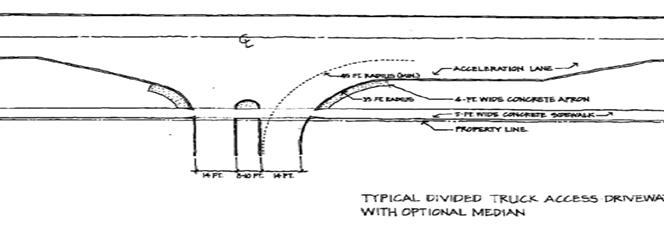
Truck Access. All site plans submitted under Chapter 18.17, Site Plan Review Requirements and Procedures must indicate the type and volume of truck traffic anticipated at the site, include dimensions of all truck access and circulation lanes, and indicate all truck loading/unloading areas. Driveways and streets of commercial and industrial facilities anticipated to receive truck traffic must be designed to adequately accommodate that traffic (see Figure 15.04). The minimum driveway curve radius shall be thirty-five feet.
Figure 15.04 Typical Driveway Standards for Truck Access
B.
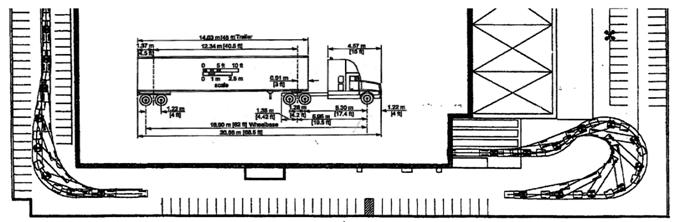
Truck Circulation Plan. Site plans must include a diagram with the dimensions of trucks anticipated at the site and show all existing and proposed truck circulation patterns, including the direction and flow of truck traffic on the site (see Figure 15.04.B.) and dimensions of all truck service drives, berths and dock approaches.
Figure 15.04.B Truck Circulation
C.
Turning Radius. Trucking, warehouse, and industrial facilities and other uses with loading docks shall be designed to include larger turning radii and added maneuvering space to accommodate trucks with a WB-62 design standard or another standard specified by the city engineer.
(Ord. 08-05 § 1 (part), 2008)
18.15.050 - Driveway access management.
A.
Driveway Location in General.
1.
All driveways serving multiple-family, commercial, office, institutional or industrial uses, hereafter referred to as "commercial driveways," shall comply with the requirements of this section.
2.
Driveways for nonresidential uses shall be located so as to minimize interference with the free movement of traffic, to provide adequate sight distance, and to provide the most favorable driveway grade.
3.
Driveways, including the radii but not including right turn lanes, passing lanes and tapers, shall be located entirely within the right-of-way frontage, unless otherwise approved by the road commission for Oakland County or the city and upon written certification from the adjacent property owner agreeing to such encroachment.
B.
Driveway Spacing Standards.
1.
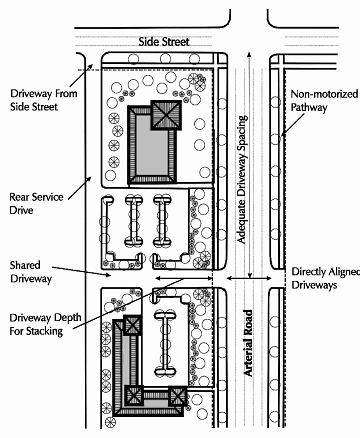
Minimum spacing requirements between a proposed commercial driveway and an intersection either adjacent or on the opposite side of the street may be set on a case-by-case basis but in no instance shall be less than the distances listed in Table 15.05. The following measurements are from the near edge of the proposed driveway, measured at the throat perpendicular to the street, to the near lane edge of the intersecting street or pavement edge for uncurbed sections.
Table 15.05
Minimum Commercial Driveway Spacing From Street Intersections1, 2
Footnotes:
1 Major thoroughfares include: 12 Mile Road, Beck Road, Charms Road, Grand River Avenue, Loon Lake Road, Maple Road, Pontiac Trail, Potter Road, West Road, Wixom Road and any other County Primary Roads, State trunklines or streets with a right-of-way of at least eighty-six feet.
2 For sites with insufficient street frontage to meet the above criterion, the planning commission may require construction of the driveway along a side street, a shared driveway with an adjacent property, construction of a driveway along the property line farthest from the intersection or require a service road.
2.
Minimum spacing between two commercial driveways shall be determined based upon posted speed limits along the parcel frontage. The minimum spacing indicated in Table 15.05.B. are measured from centerline to centerline.
Table 15.05.B
Minimum Commercial Driveway Spacing From Another Driveway
3.
To reduce left-turn conflicts, new commercial driveways shall be aligned with those across the street where possible. If alignment is not possible, driveways shall be offset a minimum of two hundred fifty feet along arterial streets and one hundred fifty feet along collector and local streets from those on the opposite side of the street. These standards may be reduced by the planning commission where there is insufficient frontage and shared access with an adjacent site is not feasible. Longer offsets may be required depending on the expected inbound left-turn volumes of the driveways.
4.
In the case of expansion, alteration or redesign of an existing development where it can be demonstrated that preexisting conditions prohibit adherence to the minimum commercial driveway spacing standards, the planning commission may modify the driveway spacing requirements. Such modifications shall be of the minimum amount necessary, but in no case shall spacing of a full-access driveway be less than sixty feet, measured centerline to centerline.
C.
Number of Commercial Driveways.
1.
The number of commercial driveways serving a property shall be the minimum number necessary to provide reasonable access and access for emergency vehicles, while preserving traffic operations and safety along the public street.
2.
Access shall be provided for each separately owned parcel. This access may be an individual driveway, shared driveway or via a service drive. Additional driveways may be permitted for property only as follows:
a.
One additional driveway may be allowed for properties with a continuous frontage of over three hundred feet, and one additional driveway for each additional three hundred feet of frontage, if the planning commission determines there are no other reasonable access opportunities.
b.
The planning commission determines additional access is justified without compromising traffic operations along the public street.
D.
Commercial Driveway Design.
1.
All commercial driveways shall be designed according to the standards of the city, the road commission for Oakland County or Michigan Department of Transportation, as appropriate.
2.
For high traffic generators, or for commercial driveways along streets experiencing or expected to experience congestion, the planning commission may require two egress lanes.
3.
Where a boulevard entrance is desired by the applicant or planning commission, a fully curbed island shall separate the ingress and egress lanes. The radii forming the edges on this island shall be designed to accommodate the largest vehicle that will use the driveway. The minimum area of the island shall be one hundred eighty square feet. The planning commission may require landscaping on the section outside the public right-of-way. Such landscaping shall be tolerant of street conditions.
E.
Shared Driveways, Frontage Roads and Service Drives.
1.
Where noted above, or where the planning commission determines that reducing the number of access points may have a beneficial impact on traffic operations and safety while preserving the property owner's right to reasonable access, a shared commercial driveway, frontage road or rear service drive connecting two or more properties or uses may be required. In particular, service drives may be required near existing traffic signals or near locations having potential for future signalization; along major arterial streets with high traffic volumes; and along segments with a relatively high number of accidents or limited sight distance.
2.
Shared commercial driveways and service roads shall be within an access easement recorded with the Oakland County Register of Deeds. A draft of the access easement shall be provided to the city for review prior to filing.
The number of accesses along a service road shall be according to the standards of this section. The planning commission may allow temporary access where the service road is not completed if a performance bond or other financial guarantee is provided which assures elimination of the temporary access upon completion of the service road. Building permits shall not be issued until such financial guarantee has been submitted to the city.
3.
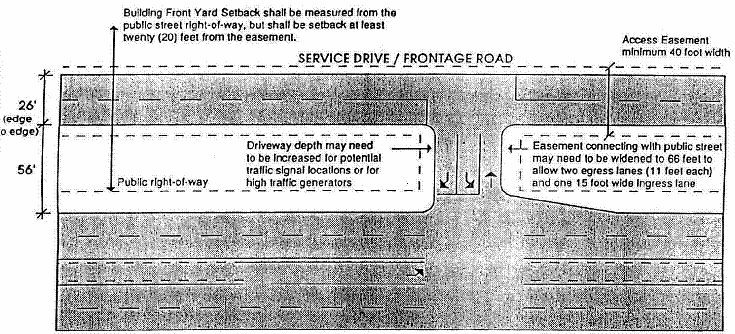
Service Road Design Standards (see Figure 15.05).
a.
Location. Service roads shall generally be parallel or perpendicular to the front property line and may be located either in front of, adjacent to, or behind principal buildings. In considering the most appropriate alignment for a service road, the planning commission shall consider the setbacks of existing buildings and anticipated traffic flow for the site.
b.
Access Easement. The service road shall be within an access easement permitting traffic circulation between properties. This easement shall be sixty-six feet wide, except an access easement parallel to a public street right-of-way may be forty feet wide, if approved by the planning commission. The required width shall remain free and clear of obstructions, unless otherwise approved by the planning commission.
c.
Construction and Materials. Service roads shall have a base, pavement and curb with gutter in accordance with Oakland County road commission standards for public streets, except the width of the service road shall have a minimum pavement width of twenty-six feet.
d.
Parking. The service road is intended to be used exclusively for circulation, not as a parking maneuvering aisle. The planning commission may require the posting of "no parking" signs along the service road. In reviewing the site plan, the planning commission may permit temporary parking in the easement area where a continuous service road is not yet available, provided that the layout allows removal of the parking in the future to allow extension of the service road.
Figure 15.05 Service Drives
e.
Access to Service Road. The planning commission shall approve the location of all accesses to the service road, based on the driveway spacing standards of this section, provided the planning commission may allow additional driveways if approved by the road commission for Oakland County or the Michigan Department of Transportation, and consistent with the purpose of this chapter.
f.
Temporary Access. The planning commission may approve temporary accesses where a continuous service road is not yet available and a performance bond or escrow is created to assure elimination of temporary access when the service road is continued. Building permits shall not be issued until monies have been deposited with the city.
g.
Elevation. The site plan shall indicate the proposed elevation of the service road at the property line and the city shall maintain a record of all service road elevations so that their grades can be coordinated.
h.
Landscaping. The area between a service road and the public street right-of-way shall be planted as a landscaped greenbelt as specified in Section 18.14.020.
i.
Maintenance. Each property owner shall be responsible for maintenance of the easement and service drive.
(Ord. 08-05 § 1 (part), 2008)

