
Wixom City Zoning Code
CHAPTER 18
07 - VILLAGE CENTER AREA DISTRICT1
Editor's note—Ord. No. 2023-01, § 1, adopted April 11, 2023, repealed the former Ch. 18.07, §§ 18.07.010—18.07.090, and enacted a new Ch. 18.07 as set out herein. The former Ch. 18.07 pertained to similar subject matter and derived from Ord. 08-05 § 1 (part), adopted in 2008.
18.07.010 - Intent.
The intent of the Village Center Area (VCA) district is to: become a center of activity incorporating institutional uses and civic spaces with mixed-use development in a pedestrian oriented area; to minimize traffic congestion, infrastructure costs and environmental degradation by promoting a compact community; and to follow smart growth principles. The design and amenities in the VCA are of high importance as they establish a distinct look. Provisions for the VCA district support traditional neighborhood design principles, which are historically based on urban development from the early colonial times to the 1940s. Such principles include, but are not limited to:
A.
Developing residential neighborhoods, which are interconnected to all development by roadways and pedestrian ways, with an emphasis on making the entire area a more walkable community.
B.
The use of high-quality architecture and building materials.
C.
Providing housing types and uses that are mixed and developed in close proximity to one another.
D.
Focusing the densest mixed use buildings within the VCA.
E.
Incorporating civic buildings and civic squares, which provide places of assembly for social activities, in prominent locations that act as landmarks, symbols and focal points for community identity.
F.
Providing recreation and open space with neighborhood greens, landscaped streets, boulevards and parkways woven into roadway and block patterns for the purpose of providing adequate space for social activity, parks and visual enjoyment.
G.
Locating dwellings, shops and workplaces in close proximity to each other, the scale of which accommodates and promotes pedestrian travel within the community.
H.
Providing landscaped areas, which is incorporated into buildings and their urban context.
I.
Preserving open space and natural areas.
J.
Implementing the vision, goals, and objectives of the master plan and all other applicable plans.
(Ord. No. 2023-01, § 1, 4-11-2023)
18.07.020 - Subareas.
A.
Subareas. The master plan identified the focus development area of the VCA as the area within the city that places greater emphasis on regulating urban form and character of development as well as use and intensity of use. However, there is recognition that within the VCA there are distinct areas based on contextual differences, which include, but are not limited to:
1.
Existing land use and building patterns;
2.
Established traffic patterns;
3.
Built street patterns;
4.
Surrounding and adjacent land uses;
5.
Natural features and open space; and
6.
Non-motorized connections.
To fulfill the goals of the city master plan and the overall intent of the VCA, the VCA is further divided into three subareas.
B.
Core Subarea. The core subarea of the VCA is recognized as the center and the densest portion of the VCA. The intent of the core subarea:
1.
Ensure that development is of human scale, primarily pedestrian-oriented, and designed to create attractive streetscapes and nonmotorized spaces.
2.
Promote denser mixed-use infill development and redevelopment.
3.
Promote a compact growth pattern to efficiently use the remaining developable land, and to enable the cost-effective extension of utilities, services, streets, and transit service.
4.
Promote mixed-use development in both a horizontal and vertical form.
5.
Promote commercial and office development of a scale that serves the surrounding area.
6.
Improve mobility options and reduce the need for excessive on-site parking by encouraging alternative means of transportation.
C.
Transition Subarea. The transition subarea of the VCA is recognized as the area of transition between higher-intensity development in the Core subarea and the adjacent neighborhoods including those in the low intensity subarea. The intent of the transition subarea:
1.
Provide transitional features such as architectural elements, site features, or alterations to building massing that are used to provide a transition between higher intensity uses and low- or moderate-density residential areas. These features assist in mitigating potential conflicts between those uses.
2.
Provide a continuum of use intensity, where moderate intensity uses are sited between high-intensity uses and low-intensity uses.
3.
Provide a wide spectrum of appropriate uses.
4.
Promote appropriate density of infill development and redevelopment.
5.
Improve mobility options and reduce the need for excessive on-site parking by encouraging alternative means of transportation.
D.
Low Intensity Subarea. The low intensity subarea is recognized as the area of lowest intensity within the VCA with a focus on single-family residential uses. The intent of the low intensity subarea:
1.
Ensure enhanced design and considerate layout to ensure that future development lessens the adverse impacts on the adjoining zones and provides for a smooth transition.
2.
Maintain and enhance the existing and surrounding built environment.
3.
Provide new development which is contextually sensitive to the surrounding area.
4.
Ensure new development preserves and enhances the natural environment.
E.
Subarea Map.
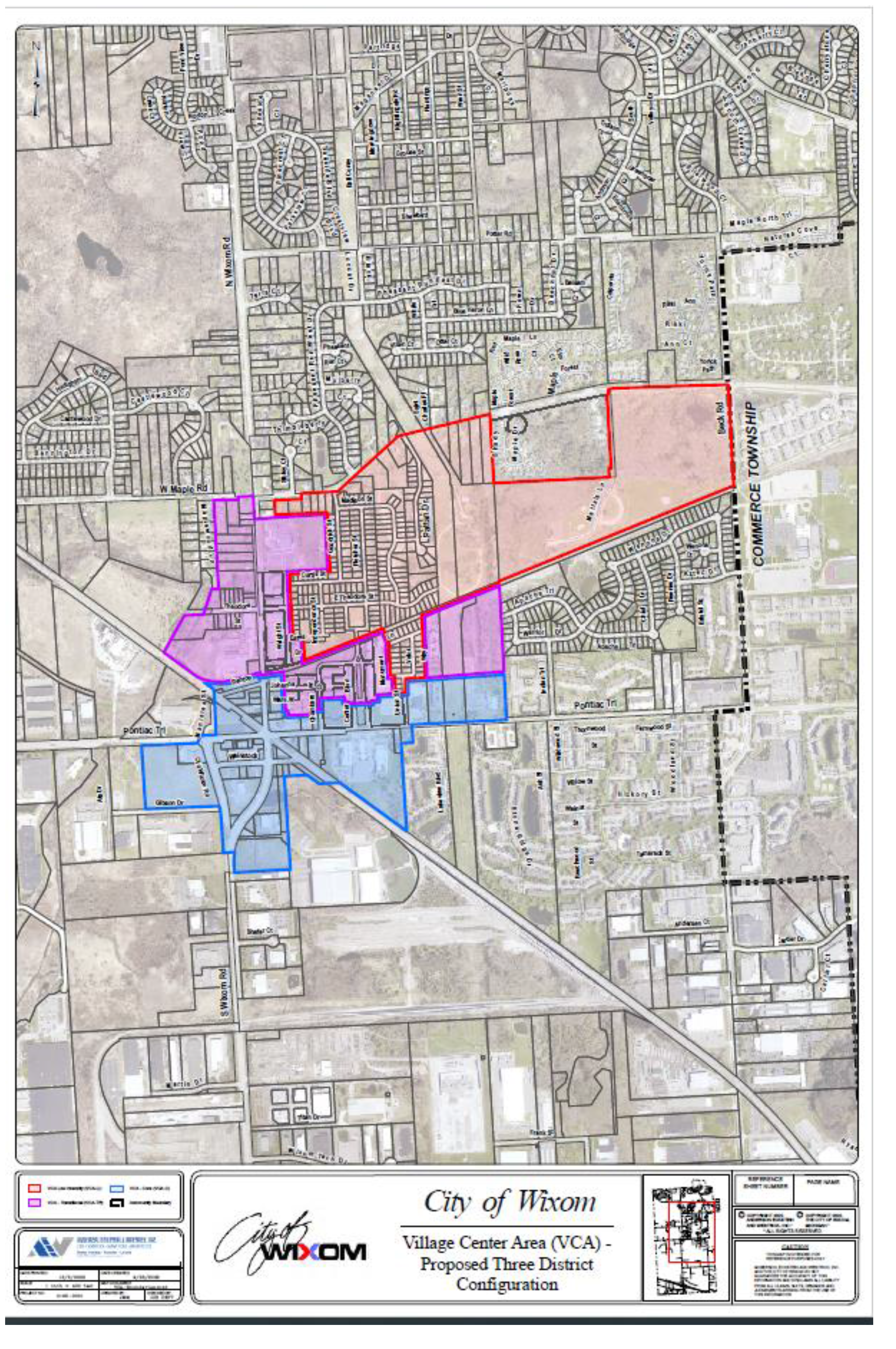
(Ord. No. 2023-01, § 1, 4-11-2023)
18.07.030 - Schedule of uses.
A.
Use and development of land and buildings shall only be for the following specified uses, unless otherwise provided. Land and/or buildings in the district indicated at the top of Table 7.01 may be used for the purposes denoted by the following abbreviations:
P: Permitted Use: Land and buildings in this district may be used for the purposes listed by right.
SLU: Special Land Use: Land and/or buildings in this district may be used for this purpose by obtaining Special Land Use approval when all applicable standards cited in Chapter 18.18, Special Land Use Review Requirements and Procedures and specific standards of Section 18.07.050 are met.
NP: Not Permitted: The use is not permitted in the district.
"Requirement." provides reference to additional requirements or conditions applicable to that specific use.
Table 7.01 Schedule of Uses
(Ord. No. 2023-01, § 1, 4-11-2023)
18.07.040 - Requirements applicable to all uses.
All uses permitted by right or by special land use approval shall meet the following requirements:
A.
Dealing Directly with Consumers. All permitted retail or service establishments shall deal directly with consumers. All goods produced on the premises shall be sold at retail on the premises where produced.
B.
Conducted within Enclosed Buildings. All business, servicing or processing, except for off-street parking, loading and approved open air uses, shall be conducted within completely enclosed buildings.
C.
Civic Uses. Sites developed with civic uses such as schools, places of assembly or worship, libraries, government offices, and parks require specific architectural treatment and design that is unique from other uses. The planning commission may permit modifications to the dimensional and building height requirements as part of the site plan review. In considering the modifications, the planning commission shall determine that the design of the building, location of the building and parking, and the relationship of the site design to the streetscape and adjacent buildings are in keeping with the intended character of the Wixom Village Center Area.
(Ord. No. 2023-01, § 1, 4-11-2023)
18.07.050 - Standards applicable to specific uses.
Uses allowed in the VCA district shall be subject to the following specific requirements applicable to that use:
A.
Drive-Through. Drive-through business shall be subject to the following:
1.
The drive-through facility shall be located on and attached to the rear elevation of the building to minimize visibility from a public or private roadway.
2.
Clear identification and delineation between the drive-through facility and the parking lot shall be provided.
3.
Each drive-through facility shall provide a bypass lane to allow other vehicles to pass those waiting to be served.
4.
There shall be a minimum of five stacking spaces.
5.
Drive-throughs for food uses are not permitted.
B.
Open-Air Business. Open-air business uses shall be subject to the following:
1.
The outdoor display and sales shall be accessory to a principal permitted retail use with a building on the site.
2.
All outdoor display and sales areas shall be paved with a permanent, durable and dustless surface and shall be graded and drained to dispose of stormwater without negatively impacting adjacent property.
3.
Any approved outdoor sales or display within a parking lot shall meet the required parking lot setback; provided that the planning commission may require additional landscaping, screening or ornamental fencing.
4.
Any stockpiles of soils, fertilizer or similar loosely packaged materials shall be sufficiently covered or contained to prevent dust or blowing of materials.
C.
Restaurants. Restaurants shall be designed to minimize any impact from noise and odors on nearby residential uses. This may include limiting hours of operation, noise insulation, enclosed storage of waste receptacles and ventilation filters. Outdoor restaurants and cafes shall also be subject to the requirements of subsection D of this section.
D.
Outdoor Restaurants and Cafes. Outdoor restaurants and cafes shall be subject to the following requirements, in addition to subsection C of this section:
1.
A site drawing showing a detailed plan of the outdoor restaurant or cafe shall be administratively approved by the city. The city will review the site plan in order to ensure the following traffic and pedestrian safety measures:
a.
Any sidewalk or open space used for the outdoor restaurant or cafe shall be immediately adjacent to the applicant restaurant. However, the cafe may be separated from the restaurant by the main pedestrian walkway along the public sidewalk.
b.
The use of a sidewalk or open space for the outdoor restaurant or cafe shall allow a minimum pedestrian walkway of five feet.
c.
Any tables, chairs, umbrellas or other equipment shall not extend into or over the five-foot wide pedestrian walkway, and there shall be no barriers to pedestrian visibility. The number, size and location of tables, chairs and equipment shall be administratively approved by the city.
d.
If alcohol is to be served in conjunction with the proposed outdoor restaurant or cafe, barriers designating the service area, as required by the Michigan Liquor Control Commission, shall be utilized. If no alcohol is to be served, a barrier approved by the city shall be utilized between the service area and the pedestrian right-of-way.
2.
The outdoor restaurant or cafe must be part of a licensed full-service restaurant and it must meet all of the requirements of, and secure all of the necessary permits from, the Oakland County Health Department and the Michigan Liquor Control Commission, as applicable.
3.
Liability insurance and property damage coverage, naming the City of Wixom as an insured party, in an amount approved by the city, must be provided before an outdoor restaurant or cafe may be set up.
4.
Final approval by the appropriate city department is required for any seating placed within the public right-of-way.
E.
Funeral Homes. Funeral homes and mortuary establishments shall be subject to the following:
1.
Adequate off-street assembly area shall be provided for vehicles to be used in funeral processions. The assembly area shall be provided in addition to any required off-street parking area.
2.
A caretaker's residence may be permitted within the building of mortuary establishments.
3.
Crematoriums are not permitted.
F.
Day Care Centers. Day care centers for children shall be subject to the following:
1.
The facility shall have received a state license to operate prior to seeking a special use permit. A copy of the license must be filed with the building department as a condition of special land use approval.
2.
The facility shall provide no less than four hundred square feet of outdoor play area per child shall be provided on the site.
3.
The outdoor play area shall not be located in the front yard.
4.
Screening and fencing of the outdoor play area shall be provided as required by the planning commission.
5.
Parking shall be provided to allow for direct drop-off and pick-up of children without requiring children to cross streets.
G.
Adult Day Care Homes. Day care homes for adults shall be subject to the following conditions:
1.
No more than six persons, other than full-time occupants of the dwelling, may be cared for in any one dwelling.
2.
Certification shall be provided from the Michigan Association of Day Care Providers to ensure safety and quality of care.
3.
Day care facilities shall not provide nursing or medical care.
H.
Social Clubs. Social clubs shall be subject to the following:
1.
The facility shall be located no nearer than five hundred feet to any residence, public or private school, day care facility or place of worship;
2.
The outdoor use of loudspeakers, sound amplifying systems or paging systems shall be prohibited;
3.
Appropriate licenses are required if alcoholic beverages are served.
(Ord. No. 2023-01, § 1, 4-11-2023)
18.07.060 - Village Center Area core subarea.
A.
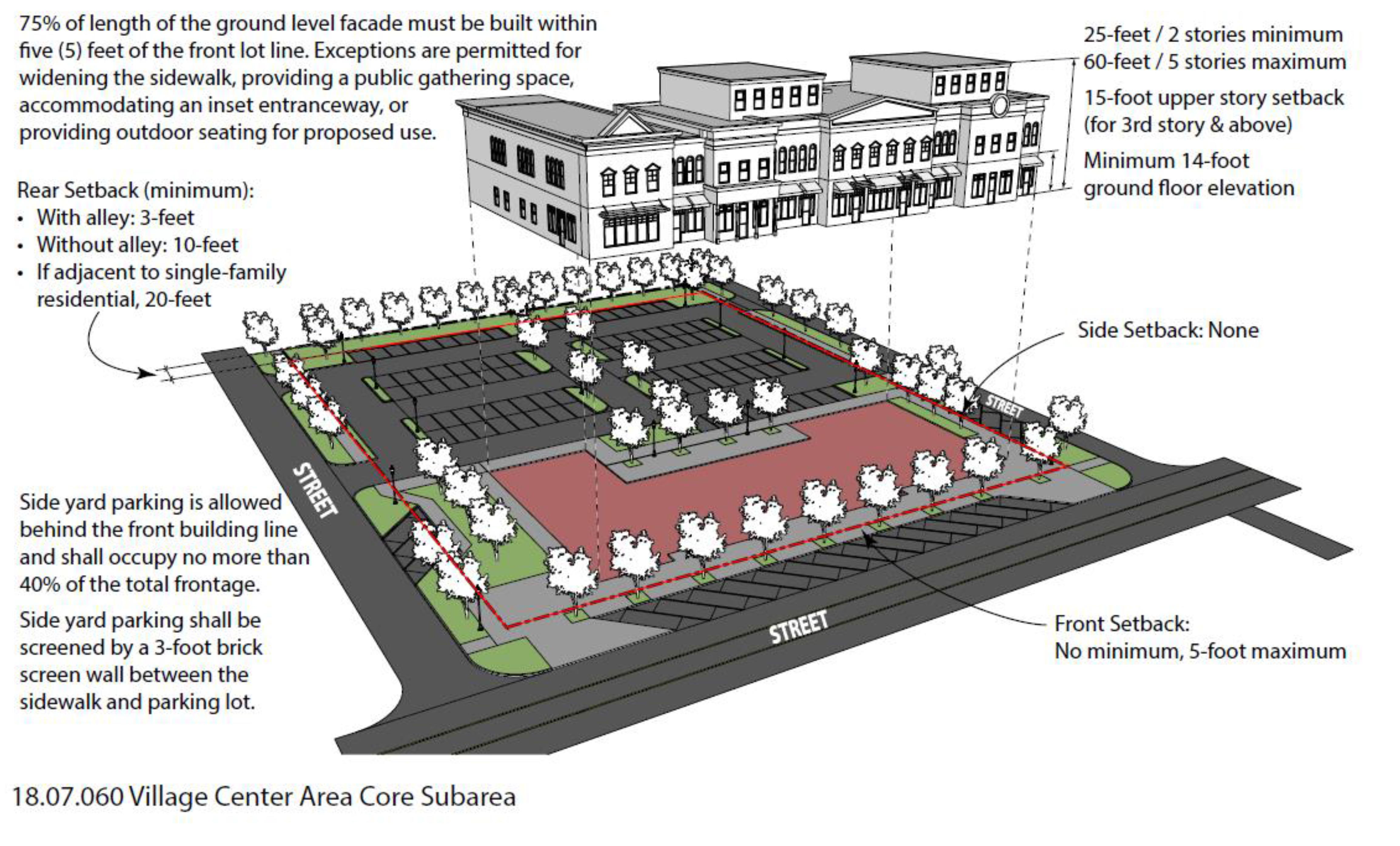
Intent and Applicability. The VCA core subarea, designated on the subarea map in Section 18.70.20 E, is intended for development of the greatest intensity in the VCA, specifically to create a mixed-use, walkable, "Main Street." All property within the designated the VCA core are required to meet any additional regulations.
B.
Bulk Standards.
C.
VCA Core Subarea Specific Requirements. The VCA core subarea requires specific ground floor storefront uses in order to preserve the walkable, active downtown interface with the public realm.
1.
Ground Floor Uses. Only Active Ground Floor Uses are permitted within the first thirty feet of building depth:
a.
Retail sales.
b.
Service uses.
c.
Restaurant.
d.
Bar/lounge.
e.
Office. A commercial or office business may occupy any number of the total floors. In those instances where a residential use is proposed to occupy the same floor as an office or commercial business, the planning commission shall review and approve the mixed-use floor based on findings related to the compatibility of the residential use and the office or commercial business. These findings may include, but are not limited to:
i.
Compatible hours of operation;
ii.
Noise or odors of the operation or occupancy that would be detrimental to the office or commercial business operation, or vice versa;
iii.
Excessive foot traffic.
2.
Dwelling Units.
a.
No dwelling units shall occupy any portion of a commercial or office building at ground level or below ground level. A commercial or office business may occupy any number of the total floors.
b.
Each dwelling unit shall have a minimum floor area of not less than six hundred square feet.
c.
Off-street parking dimensions and arrangement shall be provided in accordance with Section 18.15.010 and shall be located in areas within one thousand feet of the dwelling unit for which parking is provided.
3.
Flex space housing/live work dwelling units shall:
a.
Have first floor retail and a second-floor residential unit
b.
Be a minimum of two and one-half stories in height, with a four-story maximum
c.
Be a mixture of unit sizes, varying from nine hundred square feet to over one thousand two hundred square feet per unit
d.
Have a minimum footprint of six hundred square feet
e.
Have parking on the street or in a surface lot
f.
Garages are permitted for flex space housing/live work units, with rear entry only; and
g.
Have a private exterior space only on the upper stories which face the rear of property, where feasible.
4.
Front Yard Setback Exception. All mixed use and nonresidential buildings shall have seventy-five percent of the length of the ground level street-facing building facade built within five feet of the front lot line. This standard applies to both frontages on a corner lot. Exceptions are permitted to allow a greater amount of the building to be setback when the front yard area, or forecourt, is used for one or more purposes listed below:
a.
Widening the sidewalk along the frontage of the building.
b.
Providing a public gathering area or plaza that offers seating, landscape enhancements, public information and displays, fountains, or other pedestrian amenities.
c.
Accommodating an inset entranceway to the building.
d.
Providing outdoor seating for the proposed use.
e.
The building is used for public or quasi-public/institutional purposes with a plaza or open space area provided in the front yard.
f.
Driveway or pedestrian access to parking at the rear of the building.
g.
Side yard parking along no more than forty percent of the frontage subject to the requirements of parking subsection B of this article.
h.
Where older residential structures have been converted to a nonresidential or mixed use and are to be retained.
(Ord. No. 2023-01, § 1, 4-11-2023)
18.07.070 - Village Center Area transition subarea.
A.
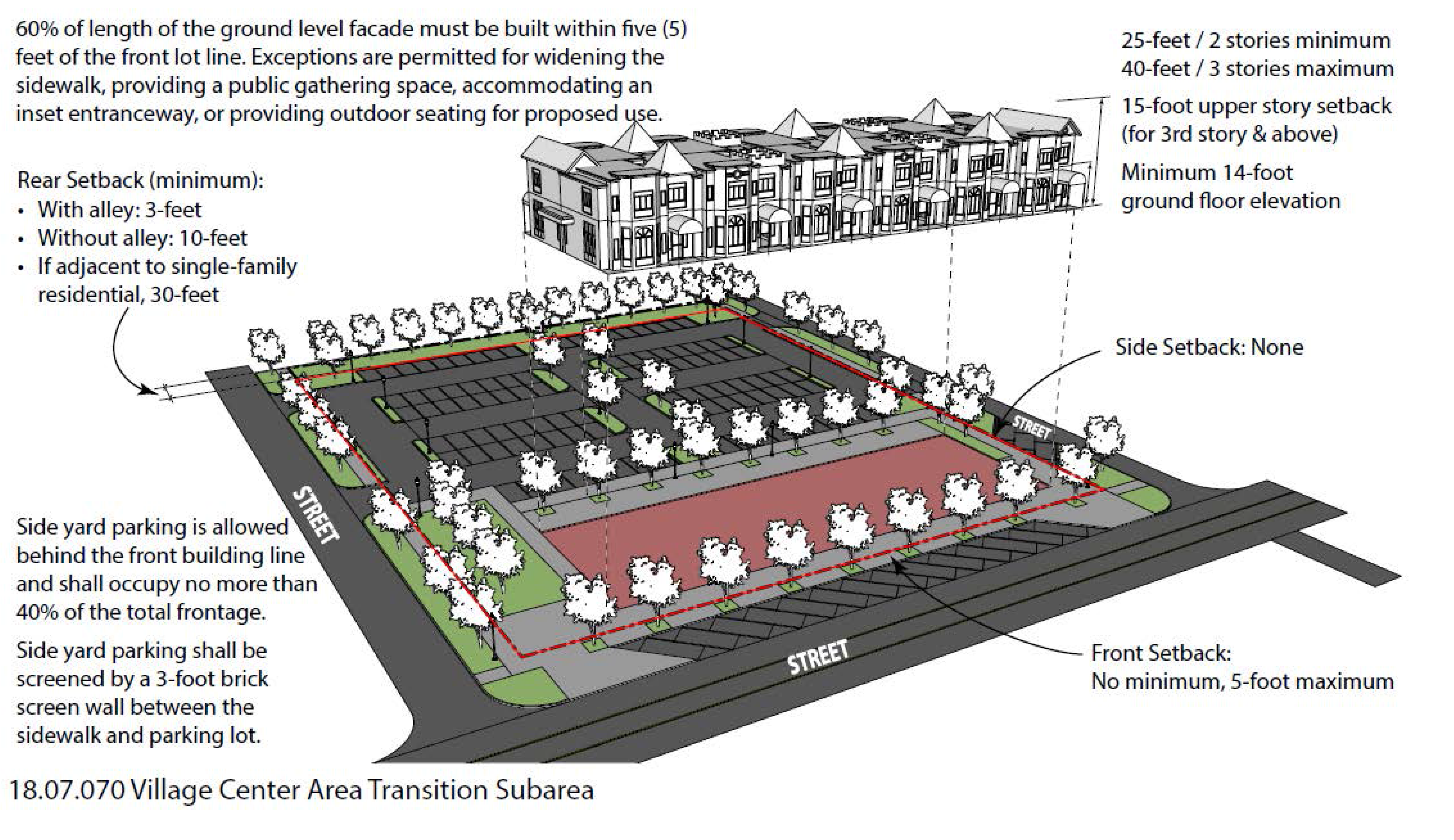
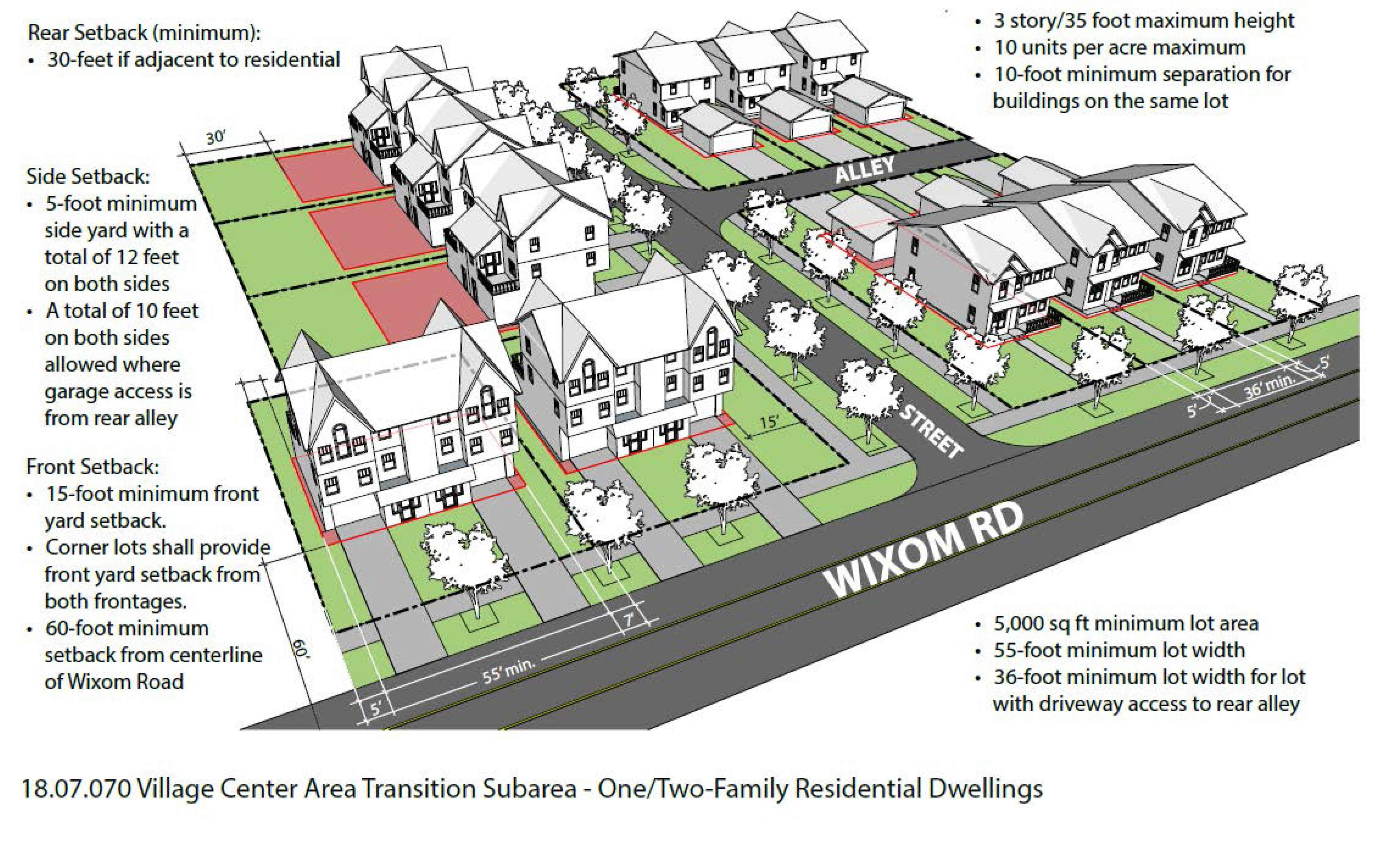
Intent and Applicability. The VCA transition subarea, designated on subarea map in Section 18.70.20 E, is intended to serve as the area of transition between the denser urban core and the less intense lower density subarea. All property within the designated VCA subarea is required to meet the additional regulations:
B.
Bulk standards for Mixed Use and Non-Residential Uses.
C.
Bulk Standards for Residential Uses.
D.
VCA Transition Subarea Specific Requirements.
1.
Dwelling Units.
a.
No dwelling units shall occupy any portion of a commercial or office building at ground level or below ground level. A commercial or office business may occupy any number of the total floors.
b.
Each dwelling unit shall have a minimum floor area of not less than seven hundred and eighty square feet.
c.
Off-street parking dimensions and arrangement shall be provided in accordance with Section 18.15.010 and shall be located in areas within one thousand feet of the dwelling unit for which parking is provided.
2.
Flex space housing/live work dwelling units shall:
a.
Have first floor retail and a second-floor residential unit
b.
Be a minimum of two and one-half stories in height, with a four-story maximum
c.
Be a mixture of unit sizes, varying from nine hundred square feet to over one thousand two hundred square feet per unit
d.
Have a minimum foot print of six hundred square feet
e.
Have parking on the street or in a surface lot
f.
Garages are permitted for flex space housing/live work units, with rear entry only; and
g.
Have a private exterior space only on the upper stories which face the rear of property, where feasible.
3.
Front Yard Setback Exception. All mixed use and nonresidential buildings shall have sixty percent of the length of the ground level street-facing building facade built within five feet of the front lot line. This standard applies to both frontages on a corner lot. Exceptions are permitted to allow a greater amount of the building to be setback when the front yard area, or forecourt, is used for one or more purposes listed below:
a.
Widening the sidewalk along the frontage of the building.
b.
Providing a public gathering area or plaza that offers seating, landscape enhancements, public information and displays, fountains, or other pedestrian amenities.
c.
Accommodating an inset entranceway to the building.
d.
Providing outdoor seating for the proposed use.
e.
The building is used for public or quasi-public/institutional purposes with a plaza or open space area provided in the front yard.
f.
To provide driveway or pedestrian access to parking at the rear of the building.
g.
Side yard parking is permitted along no more than forty percent of the frontage subject to the requirements of parking subsection B.
h.
Retaining older residential structures that have been converted to a nonresidential or mixed use..
(Ord. No. 2023-01, § 1, 4-11-2023)
18.07.080 - Village Center Core low intensity subarea.
A.
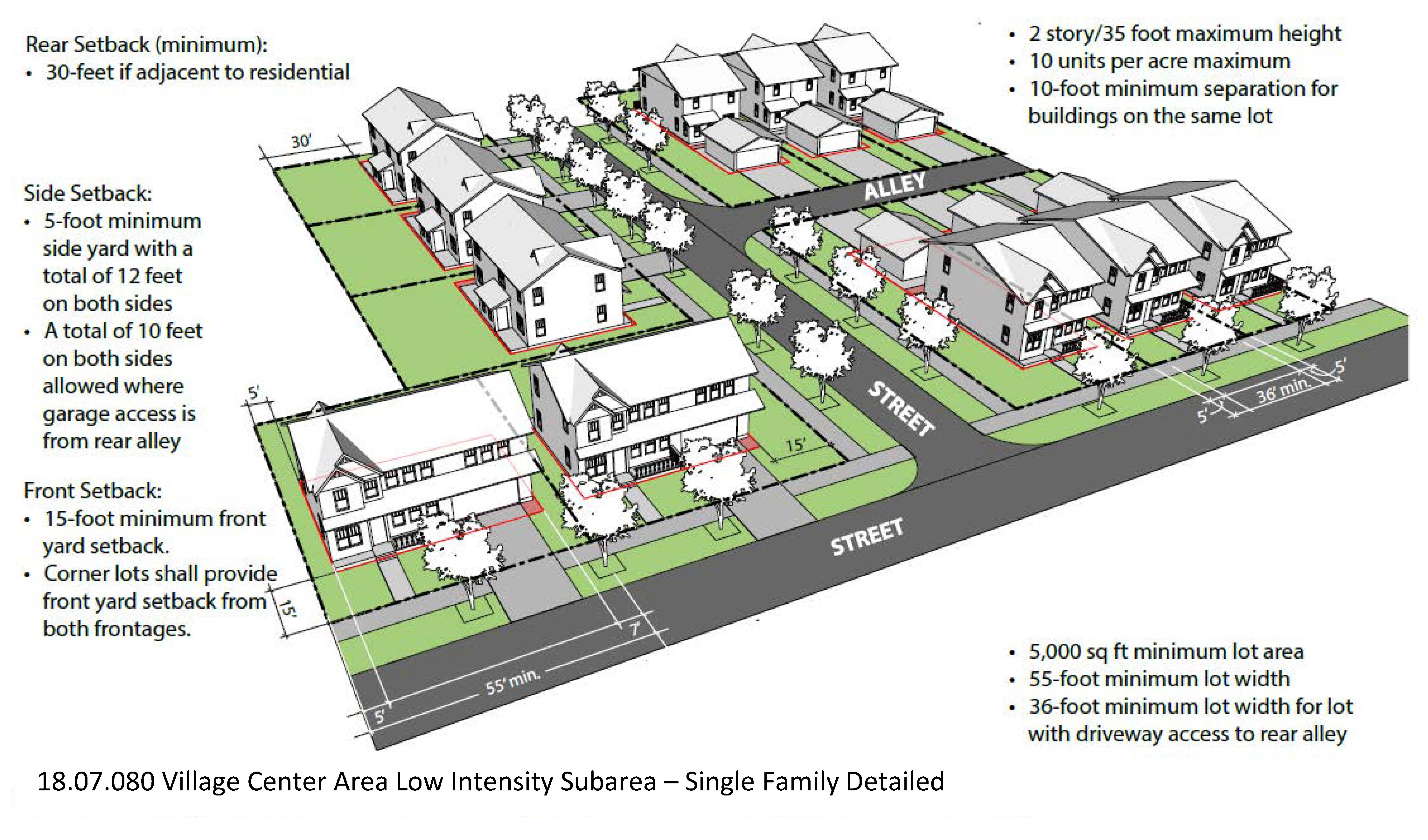
Intent and Applicability. The VCA low intensity subarea, designated on subarea map in Section 18.70.20 E, is intended to serve as the lowest intensity with a focus on single-family residential uses. All property within the designated VCA subarea are required to meet the additional regulations:
B.
Bulk Standards.
1.
Decks and open, unenclosed and uncovered porches, including those constructed on the ground and/or constructed of brick, concrete or pavers, are permitted to extend into the minimum required rear yard setback providing the following standards are met:
a.
No more than twenty-five percent of the area of the rear yard, shall be covered by a deck, patio, swimming pool, or hot tub.
b.
A covered deck or porch shall be considered an extension of the building and shall be subject to the standards applicable to the main structure.
c.
Decks or porches sheltered partially and temporarily with a wind-sail canopy, retractable awning, or a wood, metal, or lattice pergola shall not be considered covered.
d.
Covered and enclosed structures intended for use during three or four seasons of the year (e.g., sunroom, screened porches, enclosed gazebos) are also subject to the requirements of Section 18.03.030 C.
2.
No more than fifteen percent of the block may consist of one and one-half story bungalow type residential unit. A bungalow-type residential unit is defined as a one and one-half story home with a low-pitched gabled or hipped roof, a covered porch with square columns, sheltered by wide overhanging eaves extending the full length of the home. Bungalow-type residential units typically have dormers and double hung windows.
C.
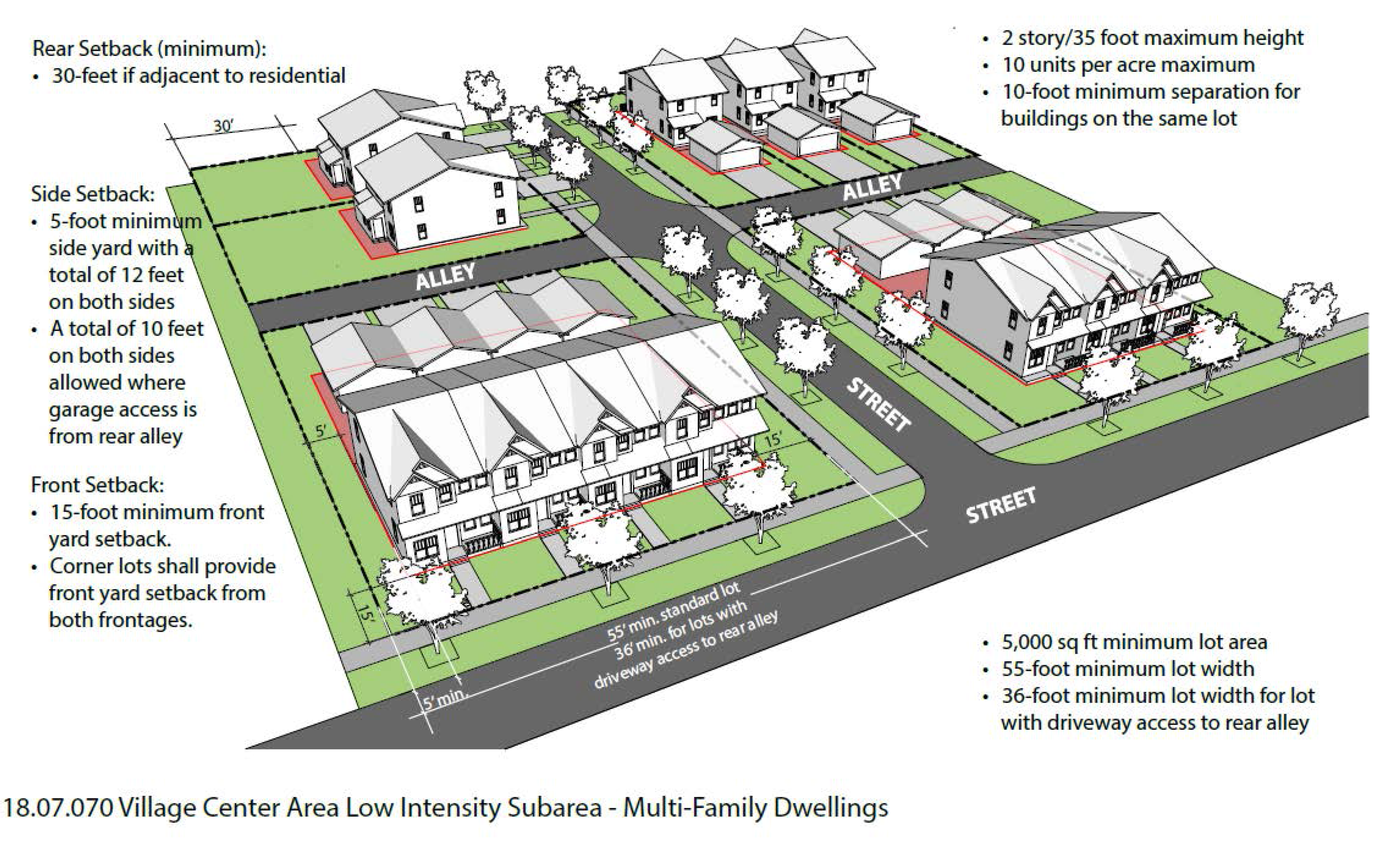
VCA Low Intensity Subarea Specific Requirements.
1.
One-Family Attached Dwellings or Townhouse Dwelling.
a.
When reviewing one-family attached dwelling or townhouse dwelling the planning commission shall consider the following reviews standards:
i.
The proposed development shall be designed and constructed in a manner harmonious with the character of adjacent property and the surrounding area. The proposed development will be harmonious and not create a significant detrimental impact.
ii.
The proposed development includes the appropriate transitional features such as architectural elements, site features, or alterations to building massing that are used to provide a transition between higher intensity uses and lower-density residential areas. These features assist in mitigating potential conflicts between those uses. Transitional features are intended to be used in combination with landscape buffers or large setbacks.
iii.
The proposed development provides similarly sized and patterned architectural features such as windows, doors, arcades, pilasters, cornices, wall offsets, building materials, and other building articulations included on the lower-intensity use shall be incorporated.
iv.
The proposed development is compatible with the master plan and in accordance with the goals and objectives of the master plan and any associated subarea plans.
v.
The proposed development will not adversely impact essential public facilities and services, such as: streets, pedestrian or bicycle facilities, police and fire protection, stormwater and drainage systems, refuse disposal, water and sewage facilities, and schools.
vi.
The proposed development shall not unreasonably impact the quality of natural features and the environment.
vii.
Each dwelling unit shall have a minimum floor area of not less than nine hundred sixty square feet.
(Ord. No. 2023-01, § 1, 4-11-2023)
18.07.090 - Parking.
A.
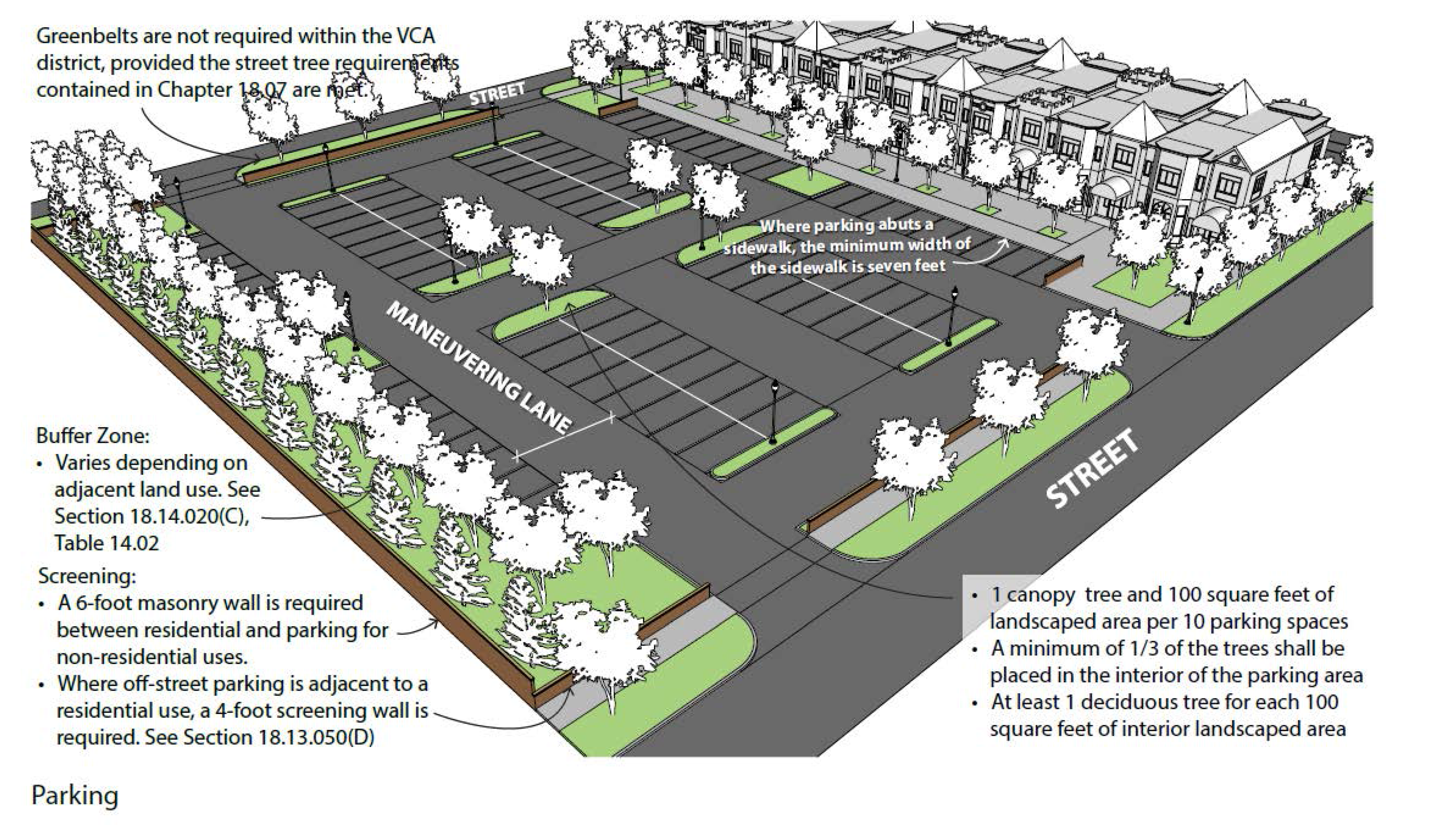
Parking. Parking lots shall meet the following requirements:
1.
Location.
a.
Parking is permitted only in side and rear yards. When parking is located in a side yard (behind the front building line) and has frontage on a public right-of-way, no more than forty percent of the total frontage shall be occupied by parking.
b.
Parking in the side yard shall be screened by a three-foot tall brick screen wall between the sidewalk and the parking lot. The planning commission may permit a hedge row or ornamental wrought iron fence instead of a brick wall.
2.
Parking Decks. Where a parking deck is provided or parking is located on the ground level below a building, at least sixty percent of the frontage shall be occupied by usable building space to a depth of at least twenty feet.
3.
Design. Parking lot design shall conform to the requirements of Chapter 18.15, Off-Street Parking, Loading, Access and Circulation Requirements.
4.
Surface Parking Lot Screening.
a.
Where parking is visible from a street, it shall be screened by a three-foot tall brick screen wall located between the parking lot and the sidewalk. The screen wall shall be detailed with limestone caps.
b.
The planning commission may permit a hedge row or ornamental wrought iron, or similar ornamental fence instead of a brick wall.
c.
Where a parking lot for a nonresidential use is adjacent to a residential use, a six-foot tall brick screen wall shall be provided between the parking lot, including drives, and the residential use instead of the greenbelt required by Section 18.14.020.
d.
Where the commercial parking lot is separated from the residential use by an alley, then the screen wall may be reduced to three feet in height; provided however, the planning commission may also require a six-foot tall brick wall on the residential side of the alley.
e.
Parking lot landscaping shall be provided as required by Section 18.14.020, except the area of landscape islands and number of parking lot trees may be reduced to one-half the normal requirement for parking that is located in the rear yard.
5.
Parking Relief. Because the regulations of this section are intended to encourage pedestrian/transit friendly design and compact mixed-use development that requires less reliance on automobiles, the amount of parking required by Chapter 18.15 may be reduced by thirty percent with planning commission's approval. In the event that a deviation is granted, the following shall apply:
a.
An applicant may request a parking deviation as part of a development application or as a separate and distinct action with no other concurrent request.
b.
The applicant shall provide a parking study with adequate detail and information to assist the planning commission in determining the appropriateness of the request.
c.
A parking deviation may be included in an action on a concurrent request or be made separately by resolution.
d.
The planning commission may attach conditions to the approval of a deviation from the off-street parking requirements that bind such approval to the specific use in question.
e.
The planning commission may require the applicant to set aside area for reserve parking (land banking) that can be constructed as needed. Where an area is set aside for reserve parking, it shall be capable of easy development, not devoted to a use other than open space, and shall be designed to accommodate attendant facilities such as maneuvering lanes and drainage.
(Ord. No. 2023-01, § 1, 4-11-2023)
18.07.100 - Commercial architectural requirements.
Nonresidential buildings and mixed-use buildings (with residential in upper floors) shall meet the following architectural design requirements:
A.
Building Types Permitted. Nonresidential and mixed-use buildings shall be designed with traditional styles of architecture. Buildings shall front onto the sidewalk with windows, doors, and architectural detailing customary of traditional storefronts, and contain varying materials and appearances.
B.
Front Facade Requirements. Walls that face a public street shall include windows and architectural features customarily found on the front of a building, such as awnings, cornice work, edge detailing or decorative finish materials.
C.
Ground Floor Articulation and Fenestration.
1.
Glass areas on storefronts shall be clear or lightly tinted. Mirrored glass is prohibited.
2.
Blank walls shall not face a public street.
3.
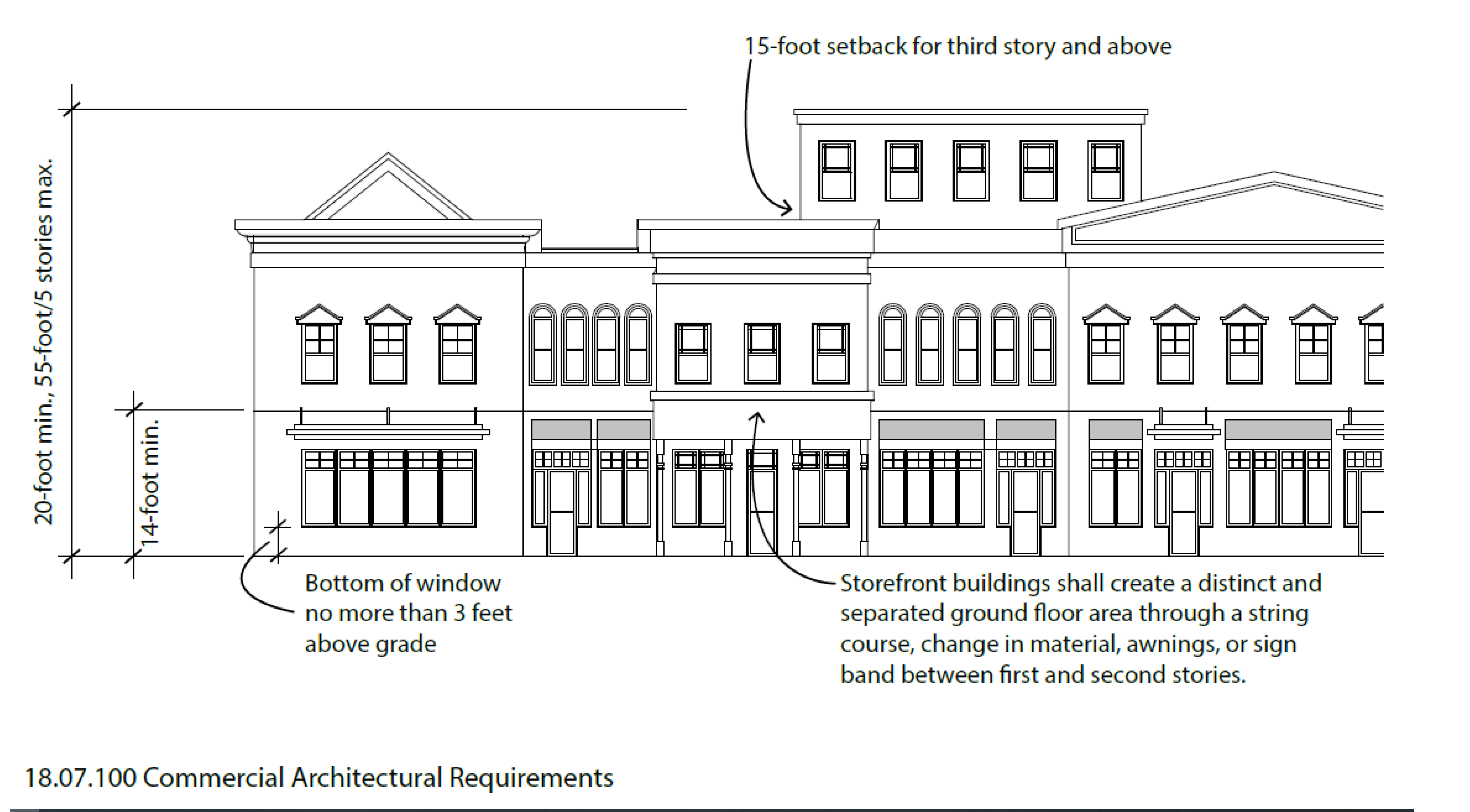
Storefront buildings shall be designed to create a distinct and separated ground floor area through the use of a horizontal expression line, such as a string course, change in material or textures, awnings or canopies, or sign band between the first and second stories.
4.
Ground floor windows may not be made opaque by window treatments (except operable sunscreen devices). For the VCA core subarea, a minimum of eighty percent of the window surface shall allow a view into the building interior for a depth of at least twelve feet. For the VCA transition subarea, a minimum of fifty percent of the window surface shall allow a view into the building interior for a depth of at least twelve feet. Ground floor transparency is measured between two and ten feet above the first-floor elevation. Window displays showcasing goods that are oriented to the front facade may contribute to the fifty percent transparency requirement.
5.
The bottom of the window must be no more than three feet above the adjacent exterior grade.
6.
Required window areas shall be either windows that allow views into retail space, working areas or lobbies, pedestrian entrances, or display windows set into the wall.
7.
For multiple tenant buildings, the minimum transparency requirement must be met by each suite or tenant.
8.
Visibility through the required transparency must portray the principal use of the operation and shall not portray secondary or "back of house" operation areas including, but not limited to, laundry, cleaning supply, stock, or storage areas.
D.
Horizontal Articulation. Buildings shall be designed to reduce apparent mass by dividing facades into a series of smaller vertical components or bays. Components shall be distinguished from one another through a combination of the following:
1.
Variations in overall massing. Changes in parapet projection height shall only occur with a corresponding change in plane.
2.
Vertical bays defined by pronounced changes in plane to create recesses and projections, a minimum of three feet from build to line of the facade;
3.
Distinct changes in exterior finish material corresponding to a change in the building plane - a minimum of three feet from build-to line of the facade - or a distinct organizing architectural feature with a projection a minimum of eight inches.
E.
Entrances.
1.
Each ground floor façade serving as an entrance to a business shall be treated as a storefront incorporating features such as recessed or accentuated doorways, display windows, and transoms.
2.
All buildings shall have a main entrance that is located on at least one street front.
3.
The entrance to the sidewalk shall be usable and all retail and service uses shall maintain a customer entrance to the sidewalk.
4.
Entrances for upper story offices or residential units shall be to the sidewalk.
5.
Main entrances shall have design details that enhance the appearance and prominence of the entrance so that it is recognizable from the street and parking area
6.
For buildings longer than one hundred feet, there shall be a minimum of one usable entrance every full fifty feet of frontage along the front public sidewalk and shall provide architectural variation to visually break the building up.
7.
For office service uses, entrance must be on the first floor of the building.
F.
Corner Buildings.
1.
Buildings situated at a corner shall possess a level of architectural design that incorporates accents and details that accentuate its prominent location.
2.
This can be accomplished through height projections incorporated into a design feature such as additional height, a building peak, tower, or similar accent with the highest point located at the intersecting corner.
3.
Alternatively, a pedestrian plaza may be provided at the corner of the intersecting streets. A main entrance must be on a street-facing wall and either at the corner or within twenty-five feet of the corner.
G.
Building Materials. The following exterior finish materials are required on the front facade and any facade facing a street or parking area. These requirements do not include areas devoted to windows and doors.
1.
All walls exposed to public view from the street or parking area shall be constructed of not less than sixty percent brick or stone. Panel brick and tilt-up brick textured paneling shall not be permitted.
2.
The remaining facade may include wood or fiber cement siding. Exterior finish insulation systems (EFIS) may be used for architectural detailing above the first floor.
3.
Buildings that have upper stories shall be designed to create a distinct and separated ground floor area through the use of accent such as a cornice, change in material or textures, or an awning or canopy between the first and second stories.
H.
Upper Story.
1.
Windows above the first story shall be no less than thirty percent of the total façade area of each story and shall not exceed a maximum of fifty percent of the total facade area for each story.
2.
Upper story windows shall be vertical in proportion.
I.
Roof Design.
1.
Unless otherwise approved by the planning commission, buildings should have flat roof appearance from the street with a decorative cornice that is designed proportionate to the size of the building and length of the wall.
2.
The planning commission may permit a pitched roof, but mansard roofs shall not be permitted on single story buildings. Pitched and mansard roofs shall not be permitted with eaves below a height of twenty feet. All roof edges shall be accentuated in a manner proportionate to the size of the building and length of the wall.
3.
Flat roofs shall be enclosed by parapets.
4.
All rooftop-mounted equipment shall be screened from view on all sides with parapet walls designed as an extension of the building façade (same material) or with approved screening material
5.
Parapets and other screening treatment shall use high quality building materials and shall blend with the design of the building in terms of color, materials, scale and height.
J.
Awnings. Storefronts may be supplemented by awnings, which give shade and shelter or add color and visual interest to the entry or display window of the storefront, provided that the following conditions are met:
1.
Awnings may project over the public sidewalk with a minimum eight-foot clearance provided from the sidewalk, but must be a minimum of five feet from the street curb.
2.
Awnings shall be positioned immediately above the ground floor window area of the facade and have a straight shed that projects from the building at a straight angle with open sides.
3.
Awnings shall be constructed of a durable material such as canvas or other similar material approved by the building official that will not fade or tear easily. Plasticized, vinyl, rigid, cubed or curved awnings or mansard style canopies are prohibited.
4.
Awnings shall not be internally illuminated and any signs may only be illuminated by fixtures located above the awning and directed downward.
5.
Awnings must be installed in accordance with building code requirements.
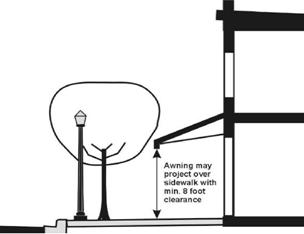
Awning example
K.
Screening.
1.
Rooftop Screening.
a.
Rooftop equipment shall be screened with architectural materials matching or harmonious with the building.
b.
Screens provided to obscure mechanical equipment shall be an opaque barrier at least as high as the equipment being screened.
c.
Rooftop equipment shall be located on the side or rear of a pitched-roof building, screened from public view.
d.
Rooftop equipment shall be situated so that they do not cause excessive nuisance or offense to occupants of nearby buildings.
2.
At-Grade Equipment.
a.
At-grade equipment shall be screened to at least the height of the equipment with architectural and/or landscape materials matching or harmonious with the building or landscape materials provided elsewhere on site.
b.
Landscape materials shall be evergreen species so as to provide a screen year-round.
c.
Walls provided to screen mechanical equipment shall be an opaque fence or wall, with a gate at least as high as the equipment being screened.
d.
At-grade equipment shall be located in a side or rear yard, screened from public view.
e.
At-grade equipment shall be situated so that they do not cause excessive nuisance or offense to occupants of nearby buildings
L.
Converted Dwellings. Where buildings that were originally constructed for one-family residential purposes have been converted to nonresidential uses, the building design requirements of this subsection may be modified by the planning commission where consistent with the historic character of the building. Such modifications may include allowing the use of siding in lieu of masonry materials and residential fenestration (windows) in lieu of the requirement for storefront windows on the first floor. The building shall be brought into compliance with the building code.
(Ord. No. 2023-01, § 1, 4-11-2023)
18.07.110 - Residential architectural requirements.
A.
Intent. Careful consideration of design elements such as compatibility of architectural styles, layout and relationship to the street contribute to the success of the VCA.
B.
Architectural/Building Design Standards.
1.
Townhouses, one/two-family residential dwellings, and three- and four-attached single family dwellings shall meet the following architectural design requirements:
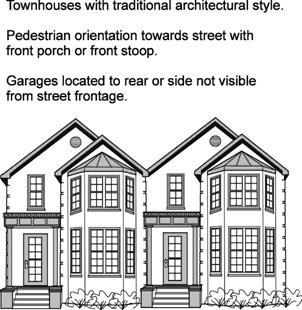
Townhouse
a.
Building Design. Residential buildings shall utilize high-quality traditional architecture, such as, but not limited to: Arts and Crafts, Colonial, Gothic Revival, Italianate, Tudor, Victorian and other traditional styles characteristic of the Midwestern United States.
b.
Building Elevations. As part of a condominium or mixed use building site plan application, typical elevations shall be approved by the Planning Commission as part of the development's design guidelines or pattern book.
c.
Residential blocks shall be designed and offer a minimum of six different residential facades/elevations.
d.
For detached condominium, similar architecture, facades, and color schemes shall not be placed adjacent to the unit, directly across the street nor either side of the unit across the street.
C.
Front Facade.
1.
All residential units shall provide a pedestrian door facing the front lot line.
2.
All dwellings shall include a front porch with steps, stoop, or terrace.
3.
The porch shall have a minimum depth of six feet and a minimum area of seventy-two square feet, unless otherwise approved by the planning commission.
4.
Porches may encroach toward the front and side yard setbacks a maximum of eight feet. A stoop or porch (plus steps) shall not extend any nearer than three feet to the sidewalk in front of the lot.
5.
Porches and stoops shall be elevated at least twenty-four inches above grade.
6.
Ramps for accessibility are permitted to encroach into the front yard setback.
D.
Windows and Doors. The front facade of all residential units shall be at least fifteen percent windows and doors.
E.
Corner Lot.
1.
Shall maintain two front yards.
2.
Wrap around porches are permitted.
3.
Corner entrances on corner houses are permitted.
F.
Building Material.
1.
All buildings shall utilize high-quality building materials that are in keeping with traditional architectural styles. Permitted wall materials include, brick, stone, wood, and composite fiber cement siding.
2.
Vinyl siding may only be used as a secondary material (less than thirty percent per facade) or accent material.
G.
Accessory Buildings.
1.
Detached Garages.
a.
Detached garages shall be located in the rear yard and may be accessed by a rear alley or in one-family dwellings by a driveway that runs from the front yard to the rear along the side of the dwelling.
b.
Detached garages and other accessory buildings located in the rear yard shall be set back a minimum of three feet from the rear and side lot lines and ten feet from the main building.
2.
Accessory buildings and structures.
a.
Shall be subject to the regulations of Section 18.13.010; except accessory buildings may be up to two stories, and twenty feet in height.
b.
If an accessory apartment is proposed within an accessory building, a permit shall be required from the city for the installation of a bathroom or kitchen.
H.
Attached Garages. Attached garages are permitted on the front side of the building if set back a minimum of five feet from the front plane of the building or porch. Attached garages are permitted on the rear or side of the building if the garage is accessed from a rear alley.
I.
Utilities. All utility units shall be placed in the rear yard. If a rear yard location is not feasible, the unit shall be placed in the side yard, behind the front plane of the house, and screened from view.
(Ord. No. 2023-01, § 1, 4-11-2023)
18.07.120 - Modifications to architectural requirements.
A.
The planning commission may approve deviations to the architectural requirements of Sections 18.07.100 and 18.07.110 in order to allow for creativity and flexibility in development and design.
B.
Each deviation shall require a finding that the design standard sought to be deviated from would, if no deviation was permitted, prohibit an enhancement that would be in the public interest. A front elevation drawing of the proposed building shall be provided superimposed on a color drawing or photograph of the entire block and adjacent blocks in both directions showing the relation of the proposed building design to other buildings along the street, which shall be utilized to evaluate the proposed building design based upon all of the following criteria:
1.
Innovations in architectural design may be permitted, provided the building design shall be in keeping with the desired character of the Village Center Area, as articulated in the City of Wixom master plan and the City of Wixom VCA design guidelines.
2.
The building shall be oriented towards the front sidewalk and maintain or enhance the continuity of the pedestrian-oriented environment. A modification shall not result in an increased dominance of vehicular parking or garage doors along the front of the building.
3.
The roof design shall not be out of character with other buildings along the block and shall be within the minimum and maximum height requirements of the district.
4.
The exterior finish materials shall be of equal or better quality and durability as those permitted herein, with the intent to allow for new technologies in building material while maintaining the desired character of the Village Center Area.
5.
Ground floor windows shall be provided along the front sidewalk to maintain the pedestrian orientation of the streetscape, and upper story windows shall not be incompatible with the rhythm and proportions of windows on other buildings along the block.
(Ord. No. 2023-01, § 1, 4-11-2023)
18.07.130 - Streetscape design requirements.
A.
Street Design Standards. All streets shall be constructed to meet the requirements of the City of Wixom, including the city engineering design standards and the VCA design guidelines, except as provided for in this section.
1.
Streets shall meet city requirements for roadway width, except bump-outs may be permitted at intersections, crosswalks and at intermediate points along long blocks to enhance pedestrian safety.
2.
Street Width.
a.
New residential streets shall have a fifty-foot right-of-way (ROW).
b.
New residential streets shall have a minimum width of twenty-seven feet, measured back of curb to back of curb.
c.
The width of new streets serving retail, commercial services and office uses shall be determined by the city based upon traffic volumes, number of lanes and demand for on-street parking.
3.
Block Size.
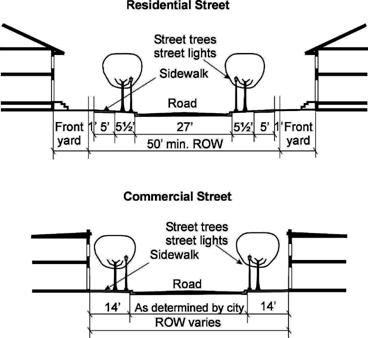
Street cross section
a.
No block length shall exceed nine hundred linear feet without an alley, common access easement or pedestrian pathway providing through access to another street, alley, or common access easement.
b.
The maximum perimeter of any block shall be two thousand six hundred forty-five feet. Larger blocks may be allowed by the planning commission where there is recreational land or natural features that make road crossings impractical and where the police and fire departments determine that street connectivity will still provide for adequate emergency response.
4.
Street Connections.
a.
The VCA shall be developed as an integrated area with an interconnected street network.
b.
Street connections shall be provided to all adjacent parcels.
c.
The use of cul-de-sacs and dead-end streets shall be prohibited.
d.
In locations where it is not possible to provide a through street, the planning commission may allow a looped drive with a common green in the center. The circular drive around the green shall be at least twenty feet wide, measured face to face of curb. The green shall be no less than forty feet at its narrowest dimension.
5.
Curbs.
a.
Straight concrete curbs and gutters shall be provided. Mountable curbs may be permitted only in single-family detached residential areas, and only upon approval by the planning commission.
B.
Traffic Calming.
1.
Bump outs shall be included on new road construction at intersections and in the middle of blocks.
2.
The use of traffic calming devices such as raised intersections, lateral shifts, and traffic circles are encouraged as alternatives to conventional traffic control measures.
3.
Whenever a conflict exists between design priority for pedestrian usage and vehicular level of service, the conflict shall be resolved in favor of the pedestrian; provided the design results in the safest possible design for both vehicles and pedestrians.
C.
Sidewalks and Crosswalks.
1.
Non-Residential Commercial Areas.
a.
Sidewalks along the frontage of nonresidential buildings shall be a minimum of fifteen feet wide concrete or brick pavers and provided consistently on both sides of the street. Five feet of this shall be for landscaping (including street trees), signage, and lighting.
b.
The planning commission may allow the sidewalk width to be reduced to not less than eight feet for frontages that will not be occupied by uses having sidewalk cafes.
c.
Crosswalks in commercial/retail areas are encouraged to use a change in surface materials. Brick paving or stamped concrete are favored.
2.
Sidewalks along the frontage of residential buildings shall be located in the right-of-way (unless there are specific restraints), and shall be a minimum of five-foot wide concrete. Sidewalks shall be provided on both sides of the street. The sidewalks shall be clearly marked with reflective crosswalks.
3.
Sidewalks along the frontage of residential buildings shall be located in the R.O.W. (unless specific restraints) a minimum of five-foot wide concrete and provided on both sides of the street. The sidewalks shall be clearly marked with reflective crosswalks.
4.
Sidewalks shall be seven feet wide where abutting a parking space or a road curb.
5.
Curb cuts and ramps, meeting ADA standards, shall be installed where sidewalks cross streets or driveways.
D.
Street Trees.
1.
One canopy tree shall be provided for every forty feet of frontage, planted within planters, tree grates within the sidewalk, or within a five-foot wide green planting strip located between the curb and sidewalk.
2.
Street trees shall be planted on both sides of the street when constructed.
3.
Street trees shall be a minimum of eleven feet at time of planting.
4.
Street trees shall be pruned to seven feet above grade.
5.
All street trees must be irrigated.
E.
Street Lights/Lighting. Pedestrian level street lighting of a decorative nature shall be installed along all sidewalks and parking areas and shall be designed to promote the traditional neighborhood character of the area.
1.
Light fixtures shall meet the specification in the City of Wixom VCA design guidelines and use metal halide or LED. LED lighting shall not cast a halo and must be shielded to prevent light trespass onto neighboring developments.
2.
All lighting, except municipal street lighting, shall meet the requirements for shielding, placement, and aiming to minimize light trespass and glare such that:
a.
The glare measurements from a zero-setback property line that is adjacent to a public street, private road, or an outlot not reserved for future development shall be no more than 1.0 foot-candles measured in a vertical plane located at the property line.
b.
Light trespass from a non-residential use abutting, or across the alley from, a residential district shall not exceed 0.5 foot-candle at the residential property line measured on a horizontal plane.
c.
LED light temperature shall be "warm white" or filtered to minimize blue light emission. No LED lamps shall have a color corrected temperature (CCT) that exceeds three thousand Kelvin.
3.
Pedestrian level lighting fixtures shall not exceed fifteen feet in height and shall be placed along the sidewalks and parking areas a minimum of sixty feet on center. Eighteen-foot tall double arm light fixtures shall be installed at all street corners/intersections.
4.
Street lighting for vehicular traffic, in addition to, or in combination with, pedestrian level lighting may be required. In the event that vehicular traffic street lighting is required, such lighting shall be installed in accordance with the city engineering standards.
5.
Building wall and freestanding exterior lighting shall be directed downward in order to reduce the glare onto adjacent properties and streets. Wall packs are not permitted.
F.
Alleys. Alleys shall be permitted in all areas of the Village Center Area and shall be required where necessary to provide access to parking lots, loading areas and garages on the rear of dwelling units.
1.
Alleys serving as access to residential garages shall have a minimum pavement width of eighteen feet and be located within a twenty-five-foot wide easement.
2.
Alleys accessing commercial parking lots and loading areas shall have a minimum width of twenty-four feet.
3.
Alleys shall be clearly marked to meet the requirements of the City of Wixom Fire Department for access.
G.
Street Furniture.
1.
Benches and trash receptacles shall be provided in park and plaza areas and along sidewalks where the planning commission determines that pedestrian activity will benefit from these facilities.
2.
Bicycle Facilities. Developments shall be designed to accommodate bicycle travel, including the provision of bike paths and bike racks at destination points such as shopping and recreational facilities.
H.
Waste Receptacles.
1.
Screening of waste receptacles must meet the following requirements:
2.
Commercial Area and Multiple Family Dwellings. Waste areas shall be screened to a minimum height of six feet or one foot above the height of the container in question.
3.
Screening materials shall be masonry or brick and match the façade.
(Ord. No. 2023-01, § 1, 4-11-2023)
18.07.140 - Deviation.
A.
The planning commission may grant dimensional and signage deviations from the ordinance requirements if the following are found:
1.
The deviation meets the intent of Section 18.07.010, Intent, and 18.07.020, Subareas.
2.
The deviation will not adversely impact public health, safety, and welfare
3.
The deviation maintains compatibility with adjacent uses
4.
The deviation is compatible with the master plan and in accordance with the goals and objectives of the master plan and any associated subarea and corridor plans.
5.
The deviation will not adversely impact essential public facilities and services, such as: streets, pedestrian or bicycle facilities, police and fire protection, drainage systems, refuse disposal, water and sewage facilities, and schools.
6.
The deviation will be in compliance with all other zoning chapter standards.
7.
The deviation will not adversely impact any on-site or off-site natural features.
(Ord. No. 2023-01, § 1, 4-11-2023)

