
Wixom City Zoning Code
CHAPTER 18
13 - ACCESSORY BUILDINGS AND USES
Sections:
18.13.010 - Accessory buildings, structures and uses.
Accessory buildings, except as otherwise permitted in this title, shall be subject to the following regulations.
A.
Relation to Principal Building.
1.
Accessory buildings, structures, and uses are permitted only in connection with, incidental to and on the same lot with, a principal building that is occupied by a use permitted in the particular zoning district.
2.
No accessory building, structure, or use shall be occupied or utilized unless the principal structure to which it is accessory is occupied or utilized.
3.
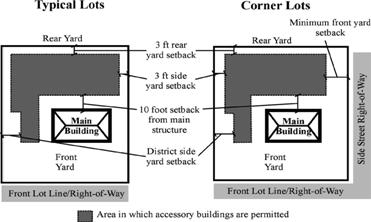
Detached accessory buildings shall be set back a minimum of ten feet from the principal building.
B.
Locations for Detached Accessory Buildings.
1.
Detached accessory buildings and structures shall only be located in the yards listed in Table 13.01.
Table 13.01
Accessory Building Locations and Setbacks
2.
Accessory buildings shall not be located within a dedicated easement or right-of-way.
C.
Rear Yard Lot Coverage Limit. A total of the combined buildings accessory to a residential building shall not exceed the ground floor area of the principal building. The total area of all structures on the lot shall not exceed the lot coverage limits of the district.
D.
Height Limitations. The maximum height of detached accessory buildings shall be one story but not to exceed fourteen feet.
E.
Use. Accessory buildings shall not be occupied for dwelling purposes unless otherwise provided in this chapter. Accessory buildings shall not be used for a home occupation.
F.
Appearance. The design and building materials of any accessory building shall generally be consistent with the character of the principal building on the property (e.g., material, color), as determined by the planning commission or building official.
G.
Attached Garages. Garages that are structurally attached to a principal building by connection of walls or a roof shall be subject to, and must conform to, all regulations of this title applicable to the principal building, including setbacks and lot coverage, and not the regulations of this section. Attached garages shall not exceed the height of the living portion of the dwelling.
(Ord. 08-05 § 1 (part), 2008)
18.13.020 - Lots having water frontage.
A.
Those residential lots or parcels having water frontage and abutting a public thoroughfare shall maintain the yard on the water side as an open unobscured yard, excepting that a covered and/or uncovered boat well shall be permitted.
B.
Accessory structures shall be permitted after review and approval of plans by the zoning board of appeals.
C.
Accessory structures shall be permitted in the yard between the abutting street right-of-way and the principal building, provided the accessory building meets the front yard setback as required for the district in which it is located.
(Ord. 08-05 § 1 (part), 2008)
18.13.030 - Porches and decks.
A.
Front Yard.
1.
Uncovered Porches. An open, unenclosed and uncovered porch or terrace may project into a required front yard setback for a distance not exceeding ten feet.
2.
Covered Porches. Porches or terraces sheltered partially or wholly by a permanent or temporary canopy, awning, metal, lattice, pergola or any other material shall be considered covered. Covered porches and decks may project into a required front yard setback for a distance not exceeding eight feet.
3.
Enclosed Porches. Porches that are covered and enclosed by walls or windows are subject to the front yard setback applicable to the main structure, as set out in the applicable zoning district.
B.
Side Yard. A deck or porch must not be closer to a side lot line than the minimum required side yard setbacks that apply to the main structure on the property, as set out in the applicable zoning district.
C.
Rear Yard. Decks and open, unenclosed and uncovered porches, including those constructed on the ground and/or constructed of brick, concrete or pavers, are permitted to extend into the minimum required rear yard setback providing the following standards are met:
1.
In no case shall any deck or porch be less than twenty feet from the rear lot line.
2.
No more than fifteen percent of the area of the required rear yard, as determined by applying the standards set out in the applicable zoning district, shall be covered by a first-story deck, a ground-level deck, or a deck located above a walk-out basement.
3.
No portion of the deck or porch located in the required rear yard shall contain covered structures such as gazebos, screened or covered porches.
a.
Decks or porches sheltered partially or wholly by a permanent or temporary canopy, awning, metal, lattice, pergola or any other material shall be considered covered.
b.
If covered structures are installed on a deck or porch they shall be subject to the standards applicable to the main structure and in the applicable zoning district.
4.
Covered and enclosed structures intended for use during three or four seasons of the year (e.g., sunroom, screened porches, enclosed gazebos) are also subject to the requirements of Section 18.03.030(C).
D.
Second-Story Decks.
1.
Second-story decks, including any walkway connecting the second-story deck to a first-story deck, a ground-level deck, or a deck located above a walk-out basement, may extend into the rear yard setback, provided it does not extend more than fourteen feet from the rear of the dwelling.
2.
The area of a second-story deck shall not count toward the permitted lot coverage for accessory buildings and structures.
3.
If covered or enclosed, a second-story deck is subject to the minimum setbacks that apply to the main structure on the property, as set out the applicable zoning district.
E.
Privacy Fences and Screens. Any privacy fence or privacy screen attached to a deck or porch shall be permitted in the rear yard, provided that it does not exceed six feet in height, measured from the floor of the deck or porch.
(Ord. 08-05 § 1 (part), 2008)
18.13.040 - Pools and hot tubs.
A.
Location. Swimming pools, spas, hot tubs and similar devices shall not be located in any front yard or easement.
B.
Pool Setback. Swimming pools shall be set back as follows:
Table 13.04
Pool Setback Requirements
C.
Hot Tub Setbacks. Spas, hot tubs and similar facilities shall be set back at least ten feet from the rear lot line and meet the side yard setback of the district.
D.
Security Fencing. Swimming pools, spas, hot tubs and similar devices that contain twenty-four inches or more of water in depth at any point shall provide a permanent security fencing and closable gate that meets the requirements of the city building code.
(Ord. 08-05 § 1 (part), 2008)
18.13.050 - Fences and walls.
A.
All Districts.
1.
Unless specifically authorized elsewhere in this title, fences and walls located within the side yard or rear yard in any district shall not exceed a height of six feet.
2.
Fences and walls shall not be erected within any public right-of-way.
3.
Fences or walls shall not be erected or maintained in such a way as to obstruct the vision of motorists exiting driveways.
4.
Fences may be located along a property line.
5.
Fences that enclose historically designated property shall not exceed four feet in height and must be of material and construction consistent with the historical character of the property.
6.
All exposed horizontal and vertical structural members of a fence shall be located on the inside of the property they are intended to fence.
7.
Electronic fences buried beneath the ground for the control of pets are permitted in all districts.
8.
Fences on lots of record shall not contain barbed wire, electric current or charge of electricity unless otherwise provided in this section.
9.
Fences shall be constructed of quality, durable material such as wood, vinyl, aluminum, wrought iron, or chain link.
B.
Front Yard Fences in Residential Districts.
1.
Unless specifically authorized elsewhere in this title, fences or walls located within the front yard or exterior side yard shall:
a.
Not exceed three and one-half feet in height;
b.
Be in excess of forty-nine percent solid or impervious; and
c.
Be of a decorative nature as determined by the building official.
2.
Parcels having a lot area in excess of two acres and a frontage of at least two hundred feet are excluded from the regulations of subsection B of this section.
C.
Nonresidential Districts.
1.
Fences and walls shall not be permitted in the front yard in a nonresidential district, except where specifically provided for below.
2.
A chain link fence in the front yard of an industrial district may be permitted if enclosing a retention or detention pond approved by the planning commission. Any chain link fence used to enclose a retention or detention pond must be black vinyl coated.
3.
Fences in the industrial district shall not exceed eight feet in height.
4.
Barbed wire in not more than three strands mounted in a wye at the top of the fence shall be permitted in the industrial districts, provided such wye is located to project over the property being fenced.
5.
Landscaping to obscure the visual impact of the fencing in the situations as noted above is required unless waived by the planning commission.
D.
Screen Walls.
1.
Requirements. For those use districts and uses listed below, in addition to the buffer zone required by Section 18.14.020(C), there shall be provided and maintained on those sides abutting or adjacent to a residential district, a screen wall constructed of brick or other suitable quality masonry material approved by the planning commission.
Table 13.05
Wall Requirements
2.
Waivers and Modifications. The planning commission may waive or modify the wall requirement between nonresidential and residential districts under the following conditions:
a.
The requirement for a screen wall may be waived where the developed portion of the nonresidential site, including all buildings, pavement, storage and structures will be set back more than two hundred feet from the residential district.
b.
The requirement for a screen wall may be waived where the residential district is considered to be an area in transition that will become nonresidential in the future, based upon the city of Wixom master plan.
c.
Where conditions are such that a more effective and harmonious development with abutting or neighboring land uses would result, the planning commission may allow or require an earth berm and evergreen plantings to serve as the complete and continuous screen wall. The starting size of evergreen trees shall be a minimum of eight feet in height and irrigation shall be provided.
d.
The planning commission may approve a reduction in wall requirements if material being stored is less than six feet in height.
3.
Location. Walls shall be placed on the property line. In cases where underground utilities interfere with placement of the wall on the property line, the wall may instead be placed on the utility easement line located nearest the property line. In those instances where the wall may interfere with the maintenance of water or sewer utilities, the property owner is responsible for the cost of the removal and replacement of the wall, as determined by the city.
4.
Materials.
a.
All walls shall be constructed of brick or other quality masonry material that matches the primary masonry of the principal building on the site approved by the planning commission or building official.
b.
Construction materials must be durable, weather-resistant, and rustproof.
c.
Standard concrete block walls and poured or precast concrete walls are not permitted.
d.
Required walls shall be similarly finished on all sides.
5.
Maintenance. All walls shall be maintained by the property owner or tenant at all times equal in condition to the completed structure at the time of initial installation. The city may require that a suitable maintenance guarantee be provided for the continued maintenance of walls required under this title.
(Ord. 08-05 § 1 (part), 2008)
18.13.060 - Entranceways.
In all zoning districts, entranceway structures, including but not limited to walls, columns and gates marking entrances to one-family subdivisions, multiple-family housing projects, business centers and industrial and office parks may be permitted and may be located in a required yard, except as provided in Section 18.12.080.
(Ord. 08-05 § 1 (part), 2008)
18.13.070 - Solar panels.
Freestanding or rooftop solar panels shall be considered an accessory structure in all zoning districts and shall be subject to the requirements for such, together with all other applicable building codes and ordinances. Solar panels must be placed and oriented such that glare does not project onto roadways and nearby properties. For nonresidential uses, solar panels may be permitted in the front yard. Car ports with solar generators may be permitted in the front yard only if occupying no more than twenty-five percent of the front parking area and covered by solar panels in which the maximum allowable height between the solar panel at peak tilt and the ground may be twenty-five feet.
(Ord. 08-05 § 1 (part), 2008)
(Ord. No. 2025-03, § 1, 2-25-2025)
18.13.080 - Wind generators.
Wind generators may be permitted in side yards, rear yards, or rooftops when the following conditions are met:
A.
The highest point of any portion of the generator shall not exceed thirty-five feet above the average grade of the lot or twenty feet from the deck of a roof.
B.
The generator device shall be placed no closer to any side or rear lot line than the total distance between the grade of the lot at the base of the tower and the highest point of any portion of the generator. If rooftop mounted, the generator device must be setback at least thirty feet from all roof edges and at least thirty feet from each other wind turbine.
C.
The maximum diameter formed by a circle encompassing the outermost portions of the blades or other wind activated surfaces shall not exceed thirty percent of the distance between the ground and the highest point of any portion of the wind generator. The generator shall be so located that no portion of the structure would penetrate the vertical plane of any adjacent property line if it were to topple over in its normally assembled configuration.
D.
The construction of the tower, blades, base structure, accessory building and wiring shall meet all applicable city building code and ordinances.
(Ord. 08-05 § 1 (part), 2008)
(Ord. No. 2025-03, § 1, 2-25-2025)
18.13.090 - Antennas.
Television and radio antennas, including satellite dish antennas and transmission or reception antennas, may be permitted as an accessory use in any district subject to the following conditions. Conventional television antennae and satellite dishes less than 3.3 feet (one meter) in diameter for a residential use and 6.6 feet (two meters) in diameter for a nonresidential use shall be exempt from the regulations of this section, provided the equipment is not located in the front yard or on the portion of the building facing the front lot line. Wireless communication facilities, such as cellular phone towers, wireless internet antenna and commercial broadcasting antenna, shall be subject to the requirements of Section 18.12.110. Satellite dishes shall be located on the building roof or ground.
A.
Building-Mounted.
1.
The receiving portion of a building-mounted reception antenna shall not exceed a dimension of seven square feet of wind resistance surface in any residential district.
2.
The receiving portion of a building-mounted reception antenna shall not exceed a dimension of fifty square feet of wind resistance surface in any nonresidential district.
3.
Reception antenna shall not exceed a height of more than three feet above the highest point of the roof on which it is mounted in any residential district.
4.
In any nonresidential zoning district, the total height of the reception antenna and the building that it is mounted on shall not exceed the maximum height requirements for the district in which it is located.
5.
Roof-mounted reception antenna shall be placed on a section of the roof in the rear yard.
6.
Reception antenna shall be designed to withstand a wind force of eighty-five miles per hour without the use of supporting guy wires.
7.
Reception antenna shall not be linked, physically or electronically, to a receiver which is not located on the same zoning lot as is the television reception antenna.
B.
Ground-Mounted.
1.
The receiving portion of a ground-mounted antenna shall not exceed a dimension of fifty square feet of wind resistance surface.
2.
The reception antenna shall be constructed to the rear of the principal building and is not permitted in any front or side yard.
3.
The reception antenna, including its concrete base slab or other substructure, shall be set back a minimum of ten feet from any property line or easement in any residential district and a minimum of five feet from any property line or easement in any nonresidential district.
4.
Reception antenna shall be constructed with appropriate landscaping to reasonably conceal the antenna from view.
5.
Reception antenna shall be located on the same lot as the receiver or an adjacent contiguous lot that is owned or managed by the same person and/or company.
6.
A reception antenna shall not exceed a height of fourteen feet.
7.
Wiring between a reception antenna and receiver shall be placed at least four inches beneath the surface of the ground within rigid conduit.
8.
Reception antenna shall be designed to withstand a wind force of seventy-five miles per hour without the use of supporting guy wires.
C.
General.
1.
No advertising or identification display shall be placed on any portion of an antenna or tower, including a satellite dish antenna, except for the name of the manufacturer and serial number.
2.
No more than three antennas shall be located on the same lot as a principal building. Antennae are permitted only in connection with, incidental to, and on the same lot as a principal building, structure, or use.
3.
The color of the antennae shall be of tones similar to the surroundings.
D.
Temporary Permits for Mobile Units. Mobile reception antenna units may be granted temporary permits for periods not to exceed seventy-two hours by the building official. The unit shall be located in accordance with location requirements for a permanent installation or as nearly thereto as possible. In those instances where a front yard installation may be required, the temporary installation shall not be permitted to exceed a twenty-four-hour period. Locations for temporary installation shall be established prior to issuance of a permit for such installation.
(Ord. 08-05 § 1 (part), 2008)
18.13.100 - Backyard play structures and skateboard ramps.
Play structures such as swing sets, tree houses, jungle gyms and skateboard ramps, on residential lots shall be permitted as accessory structures and shall be subject to the requirements for such, together with all other applicable building codes and ordinances.
(Ord. 08-05 § 1 (part), 2008)
18.13.110 - Storage of recreational equipment.
A.
A resident may store recreational equipment they own on their individual lot in garages or other accessory structures or within the confines of the non-required side or any rear yard and shall further comply with the accessory building requirements for distances from principal structures, setbacks from lot lines and easements.
B.
All recreational equipment parked or stored shall not be connected to sanitary facilities and shall not be occupied.
C.
On waterfront lots, boats may be stored on the waterfront side of a lot from October 1st through May 1st of any year.
(Ord. 08-05 § 1 (part), 2008)
18.13.120 - Sale and maintenance of vehicles.
A.
Sale of Vehicles.
1.
A resident of a dwelling unit may have not more than one motorized vehicle for sale on the site of such dwelling unit at any time.
2.
In no instance shall vacant lots or parcels be utilized for the sale of vehicles.
3.
In no instance shall a vehicle for sale be displayed in a front yard other than on the driveway portion of the yard. In those cases where a driveway of a residence is not more than twelve feet in width, the vehicle for sale may be parked within an area adjacent to the driveway not to exceed fifteen feet in width as measured from the side edge of the driveway.
B.
Maintenance of Vehicles. A resident may repair vehicles of the resident on the property of the resident's dwelling unit; however, in no instance shall a resident repair the vehicles of other than a resident of the dwelling unit on said property.
(Ord. 08-05 § 1 (part), 2008)
18.13.130 - Commercial vehicles.
A.
No commercial vehicle weighing in excess of ten thousand pounds gross vehicle weight or meeting the definition of a commercial vehicle shall be parked on any residentially zoned property or residential street in the city for any purpose or length of time other than the following:
1.
For expeditious loading and delivery or pick-up and unloading of materials, goods, or merchandise; or
2.
For the purpose of carrying on a principal use permitted on the property on which the vehicle is parked, as otherwise provided in this title.
B.
The owner of residentially zoned property shall not permit a commercial vehicle to remain on such property in violation of the provisions of this title.
C.
In any proceeding for violation of this title where a motor vehicle displays commercial license registration plates, such registration shall constitute a prima facie presumption that it is a commercial vehicle at the time of any alleged violation.
D.
In any proceeding for violation of the weight limitation provision of this chapter, the weight indicated on the vehicle's registration shall constitute a prima facie presumption of the weight of the vehicle at the time of any alleged violation.
(Ord. 08-05 § 1 (part), 2008)
18.13.140 - Common use waterfront lots.
A.
Where a parcel of land contiguous to a natural body of water is proposed for residential development, a commonly owned area bordering on the body of water may be dedicated for recreational purposes.
1.
The common area shall be dedicated for the use of owners and occupants of dwellings contained in the development.
2.
Deed restrictions and bylaws shall restrict the use of the common waterfront area to the owners and occupants of dwellings within the development. The deed restrictions and bylaws shall be approved by the planning commission with the development.
B.
Common use waterfront lots shall not be used for public marinas, public beaches or commercial recreational use operated for profit.
C.
The design, operation and use of the common waterfront lot shall not impair the natural appearance of the land, overcrowd the lake surface or produce unreasonable noise or annoyance to surrounding properties.
D.
A common waterfront lot shall contain a minimum of three hundred linear feet of water frontage and one hundred fifty feet in depth.
1.
For the purpose of computing the length of water frontage, the measurement shall be along the water's edge at the normal high water mark of the lake as determined by the Michigan Department of Natural Resources or other applicable state agency or department; or if the department has not made such a finding, the normal high water mark location shall be determined at the discretion of the city.
2.
Moreover, the measurement shall be made only along a natural shoreline, and shall not include any man-made channel, lagoon, canal or the like.
E.
The maximum number of boats that can be docked, moored, stored or launched from an individual residential lot or a common waterfront lot shall be determined by zoning district and shall not exceed the following:
Table 13.14
Boat Limits
Nonmotorized watercraft less than eighteen feet in length such as canoes and kayaks shall not be counted towards the above maximum number of boats.
F.
All boats that are moored, stored or launched from an individual residential lot shall be the property of the occupant of the dwelling on the same lot. Mooring, storage or launching of boats by persons who do not reside on the same lot shall be prohibited.
G.
In those instances where lakefront lots or parcels are created, the water frontage lot width, measured at the water's edge at the normal high water mark of the lake, shall not be less than the front yard lot width requirement of the zoning district in which the lot is located.
H.
In no instance shall a waterfront parcel, lot, or tract of land in a residential zone be utilized as a principal use of property for the launching, docking or storage of boats or other watercraft.
(Ord. 08-05 § 1 (part), 2008)

