
Wixom City Zoning Code
CHAPTER 18
16 - SIGNS2
Editor's note—Ord. No. 2022-02, § 1, adopted July 26, 2022, repealed the former Ch. 18.16, §§ 18.16.010—18.16.200, and enacted a new Ch. 18.12 as set out herein. The former Ch. 18.12 pertained to similar subject matter and derived from Ord. of 6-24-2014.
18.16.010 - Purpose and intent.
Signs may be erected or maintained in the City of Wixom only as permitted by this chapter and subject to other restrictions contained in this code. The sign regulations in this chapter are intended to balance the public and private interests and to promote a safe, well-maintained, vibrant, and attractive community while accommodating the need for signs to inform, direct, identify, advertise, advocate, promote, endorse, and otherwise communicate information. The sign regulations of this chapter are intended to ensure that signs are located, designed, sized, constructed, installed, and maintained in a way that protects and promotes safety, health, aesthetics, and the public welfare while allowing adequate communication.
The following municipal interests are considered by the city to be compelling government interests. Each interest is intended to be achieved in a manner that represents the least restrictive means of accomplishing the stated interest, and in all events intended to promote an important government interest that would not be effectively achieved absent the regulation. Regulating the size and location of signage in the most narrowly tailored manner represents the least restrictive means of addressing the targeted government interests of avoiding nuisance-like conditions while maintaining and improving pedestrian and vehicular safety and efficiency; character and quality of life; economic development and property values; and property identification for emergency response and wayfinding purposes.
A.
Pedestrian and Vehicular Safety. Maintaining pedestrian and vehicular safety are predominant and compelling government interests throughout the city, with particular emphasis on the safety of pedestrians. The sidewalk network provides facilities for pedestrians in the city even in automobile-oriented commercial areas. The city recognizes that pedestrian traffic in the commercial areas leads to retail sales, and it serves a variety of business, entertainment, government, and residential uses in the districts. In addition, the city also accommodates automobile-oriented businesses and other land uses that generate motor vehicle trips.
Since most signage is intended and designed to attract the attention of operators of motor vehicles, thereby creating distractions from vigilance for traffic and pedestrian safety, this chapter is intended to regulate signs to reduce such distractions and, in turn, reduce the risk for crashes, property damage, injuries, and fatalities, particularly considering the rate of speed at which the vehicles are traveling in these districts.
1.
The city encourages signage that shall inform pedestrians regarding their desired locations without conflicting with other structures and improvements in these districts, while concurrently allowing effective signage for motorists. These interests are legitimately supported by limiting the maximum size of signage, providing setbacks where relevant, and specifying minimum-sized characters for efficient perception by motorists and pedestrians, while minimizing distractions that could put pedestrians at risk.
2.
In some circumstances, adjusting the size, setback, and other regulations applicable to signage may be important to avoid confusion and promote clarity where vehicular speeds vary on busy thoroughfares.
3.
In multi-tenant buildings and centers, it is compelling and important to provide distinct treatment with a gradation of regulation for individual identification depending on base sign size, amount of road frontage, and the like, all intending to provide clarity to alleviate confusion and thus additional traffic maneuvers, provide a minimum size of characters to allow identification, and maintain maximum-sized overall signage to prevent line-of-sight issues.
4.
Maximum size and minimum setback of signage is compelling and important to maintain clear views for both traffic and pedestrian purposes.
B.
Character and Quality of Life. Achieving and maintaining attractive, orderly, and desirable places to conduct business, celebrate civic events, entertain people, and provide for housing opportunities is directly related to the stability of property values needed to provide and finance quality public services and facilities within the city. This chapter intends to allow signs that are of sufficient, but not excessive, size to perform their intended function as necessary to provide and maintain the city's character and support neighborhood stability. Signs that promote potential vehicular and pedestrian conflict, hinder sight distance, and distract from the pedestrian experience shall be prohibited in efforts to preserve the character and unique experience within the city. Also, the intent of this chapter is that signs shall reflect the character of unique districts as may be established by the city's Master Plan, other adopted plans, or the zoning chapter.
C.
Economic Development and Property Values. It is found and determined that there is a clear relationship between the promotion of a set of specifications and restrictions for signage and the promotion of economic development, recognizing that unregulated and haphazard determinations concerning the size, location, and other characteristics of signs has a realistic tendency to result in an appearance that reduces economic development, and, in the long-term, property values. In addition, the establishment of the restrictions in this chapter has a direct relationship to creating stability and predictability, allowing each private interest to secure reasonable exposure of signage, and thus promote business success. The application of the restrictions in this chapter allows businesses to reasonably command attention to the content and substance of their messages while concurrently allowing the promotion of other visuals, including types of business, landscaping, and architecture, all promoting economic development and property value enhancement.
D.
Avoidance of Nuisance-Like Conditions. Due to the concentration of people and activities, there is a potential for, and it is a compelling interest to avoid, blight, physical clutter, and visual clutter in the city, recognizing that such conditions tend to create nuisance-like conditions contrary to the public welfare. The result of these conditions leads to diminished property values, reduced attractiveness of the community, and reduced quality of life within the districts. Minimum regulations that substantially relate to signage are compelling and important and are necessary for the maintenance and well-being of positive conditions, good character, and quality of life in the city. Ultimately, these regulations are compelling and important for the protection of all police power values.
1.
An excessive number of signs in one location creates visual blight and clutter, as well as confusion of the public. Thus, limiting the number of signs on properties, and establishing setbacks from property lines is a compelling interest that can be directed with minimum regulation.
2.
Signs that are too large and not properly spaced can lead to confusion, undermine the purposes of the signs, and ultimately lead to physical and visual clutter. Establishing maximum sizes and locations can be the subject of clear and effective regulations that address this compelling and important interest.
3.
Requiring minimum construction and maintenance specifications for signs can minimize the creation of blight and clutter due to the deterioration of signs that are not durable or otherwise well-constructed, and such regulations would be consistent with construction codes for other structures. These requirements can be enforced with efficient and low discretion application and review.
4.
The sign chapter is designed to prevent blight and protect aesthetic qualities by preventing visual clutter and protecting views. There is a compelling governmental interest that signs avoid glare, light trespass, safety, and skyglow. A framework that enables the selection of proper fixture types and location, use of supportive lighting technology, and control of light levels in a reasonable fashion is consistent with regulations that are narrowly tailored to achieve the city's interests.
E.
Property Identification for Emergency Response and Wayfinding Purposes. Locating a business or residence by emergency police, fire, and other emergency responders can be a matter of life and death, and thus it is a compelling interest to ensure that proper, understandable, unambiguous, and coordinated signage be permitted and required, and specifications for such purposes can be accomplished in a simple and narrow manner. Wayfinding for vehicular and pedestrian purposes is also a compelling interest to avoid confusion in public rights-of-way, and unnecessary intrusions on private property, and sign specifications for such wayfinding can be coordinated with property identification for emergency purposes.
F.
Protection of the Right to Receive and Convey Messages. The important governmental interests contained herein are not intended to target the content of messages to be displayed on signs, but instead seek to achieve non-speech objectives. In no respect do the regulations of signage prohibit a property owner or occupant from an effective means of conveying a desired message. Nothing in this chapter is intended to prohibit the right to convey and receive messages, particularly noncommercial messages such as religious, political, economic, social, philosophical, or other types of speech protected by the First Amendment of the United States Constitution.
G.
Ease of Administration. To have standards and administrative review procedures that are simple for property owners, tenants, and sign installers to understand and follow.
(Ord. No. 2022-02, § 1, 7-26-2022)
18.16.020 - Definitions.
The following words and phrases shall have the meanings set forth in this chapter when they are used in this chapter:
A.
Sign Definitions, Sign Types. The following definitions apply to types of signs based on the characteristics of the sign without respect to the content of the message:
"Air-activated signs" means a sign that is inflated by air or uses air flow to induce movement. Inflatable objects used for signs are often made of flexible fabric and are equipped with a motor to blow air into the object. Air-activated signs are typically temporary and are restrained, attached, or held in place by a cord, rope, cable, or similar method, but can be permanent.
"Animated sign" means a sign that has any visible moving part either constantly or at intervals; flashing, scintillating, intermittent, or oscillating lights; visible mechanical movement of any description; or other apparent visible movement achieved by any means that move, change, flash, oscillate or visibly alters in appearance to depict action, create an image of a living creature or person, or create a special effect or scene.
"Awning sign" means a permanent sign painted, or screen printed on the exterior surface of an awning.

Awning Sign
"Banner sign" means a temporary sign on paper, cloth, fabric or other flexible or combustible material of any kind that is attached flat against a permanent sign face or strung between two poles or structures.

Banner Sign
"Bench sign" means a sign applied to or affixed to the seat or back of a bench.
"Billboard sign" means a large sign erected, maintained, and used for the purpose of displaying messages that can be seen from a long distance or read from a vehicle traveling at high speeds. A billboard sign generally differs from a freestanding size based on its size.
"Box sign" means a sign with text or symbols printed on a glass, plastic, acrylic, or other materials that are mounted on a cabinet or box that houses the lighting source and equipment.
"Canopy sign" means a permanent projecting sign affixed to the side or bottom surface(s) of an attached canopy.
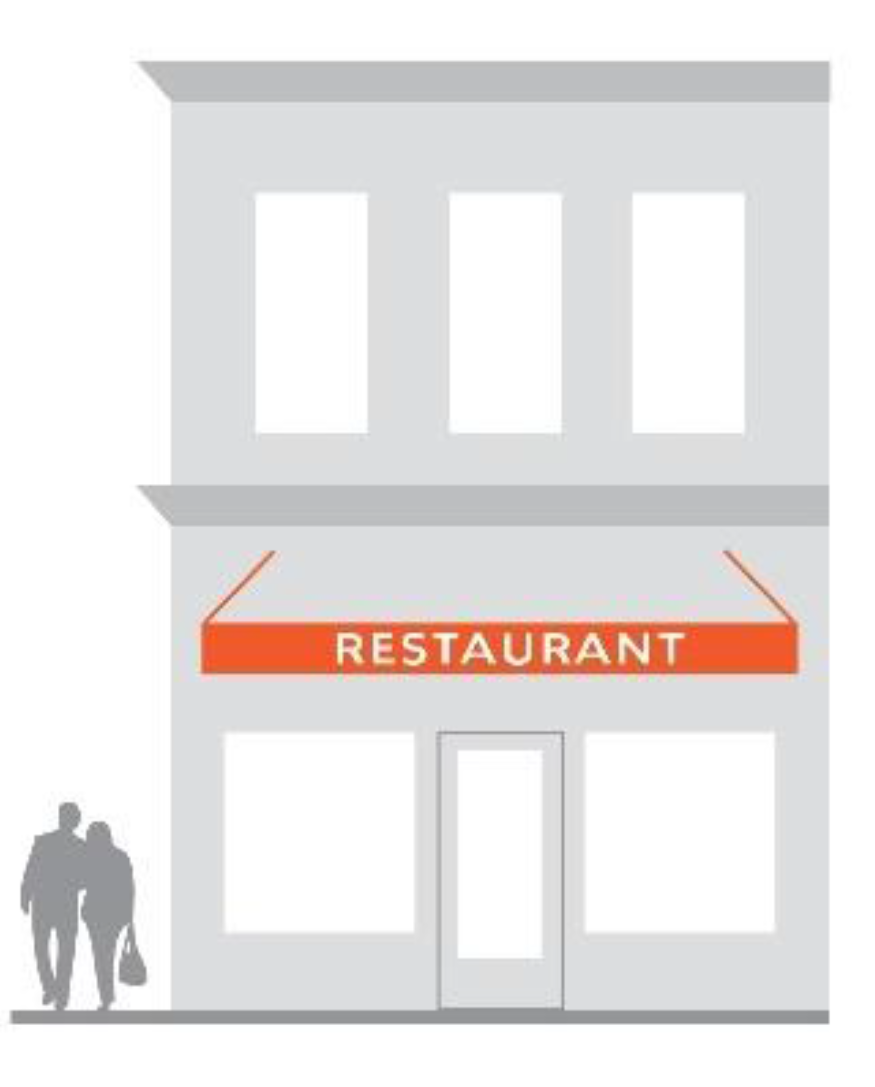
Canopy Sign
"Changeable message sign" means a permanent sign or portion thereof on which the copy or symbols change either manually through placement of copy and symbols on a panel mounted in or on a track system.
"Display board" means an accessory sign displayed near a public building entrance either on the building or on a freestanding podium. Display boards are intended to be viewed at close proximity. Examples include displaying menus, special sales, and descriptions of goods or services provided within the building.
"Electronic message center (EMC) sign" means an electrically activated changeable-copy sign whose variable message and/or graphic presentation capability can be electronically programmed. EMCs typically use light emitting diodes (LEDs) as lighting sources.
"Entranceway signs" means a sign placed at a major entrance to a development consisting of multiple users, parcels, lots, or a combination of each. Entranceway signs are often integrated into freestanding walls, columns, boulders, or other distinguishing features unique to the development.

Entranceway Sign
"Festoons" means a string of ribbons, pennants, spinners, streamers, tinsel, small flags, pinwheels, or lights typically strung overhead and/or in loops.
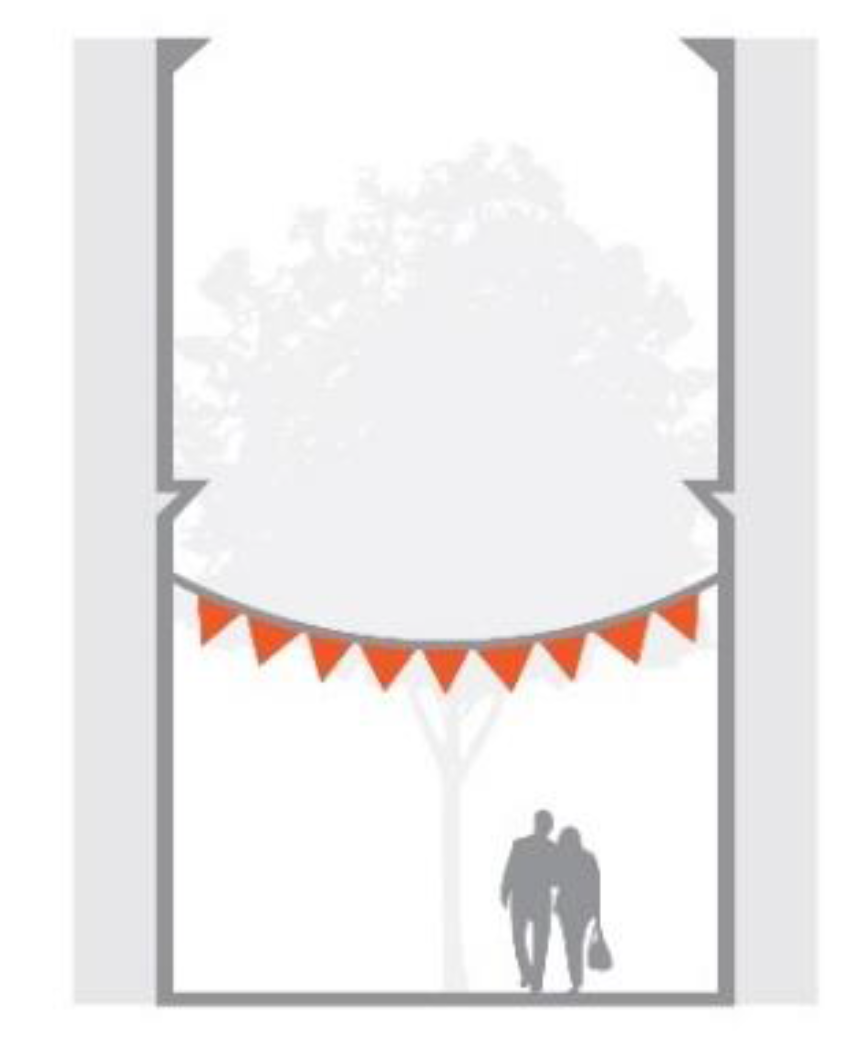
Festoons
"Flag" means a sign on paper, cloth, fabric or other flexible or combustible material of any kind that is attached to a permanent conforming pole. Flags are typically supported on one side of the sign. Flags are not considered air-activated signs for the purposes of this chapter.
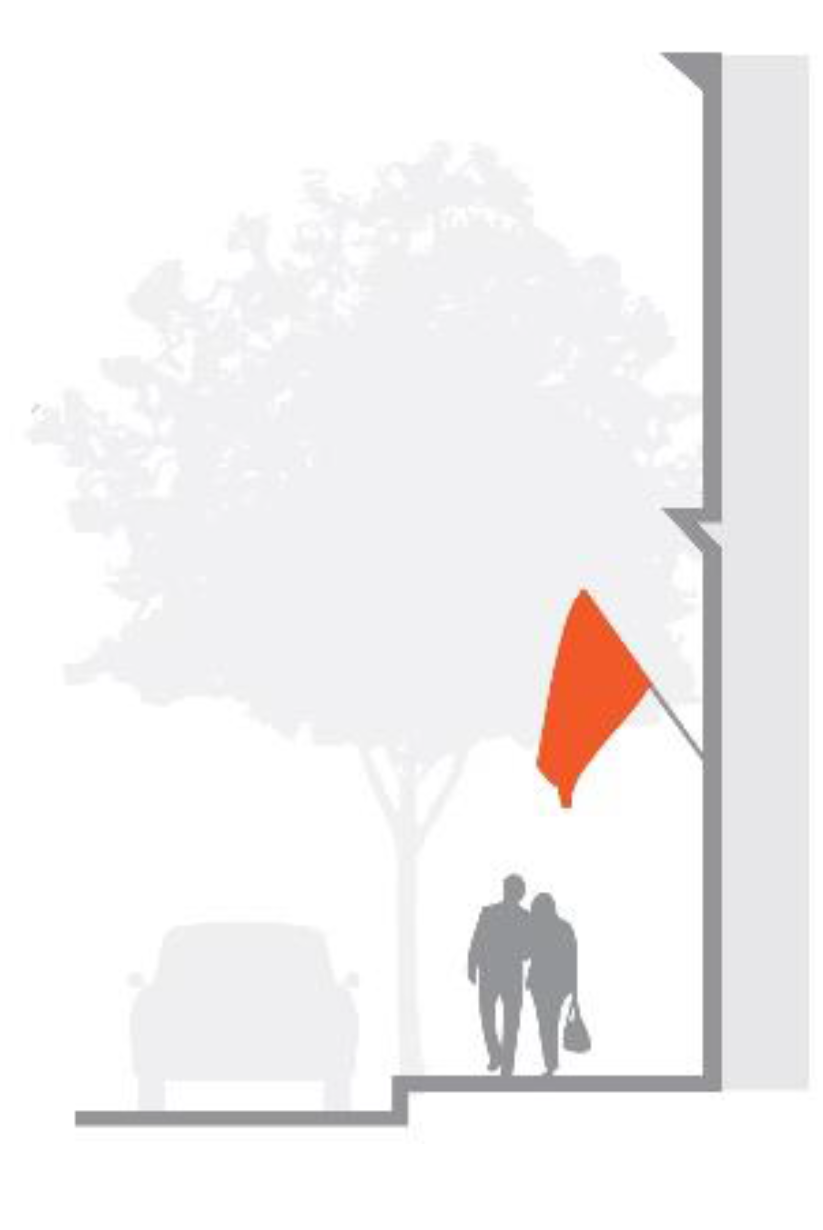
Flag
"Freestanding sign: means a sign supported by one or more uprights, poles, pylons, monuments, or braces placed in the ground and not attached to any building or other structure. Freestanding signs include monument signs, but do not include billboards.

Freestanding Sign
"Incidental sign" means a small sign, usually two square feet or less, designed and located to be viewed by persons on a property and are generally not visible or legible from the right-of-way or adjacent properties. Examples of incidental signs include, but are not limited to, credit card signs, signs indicating hours of business, no smoking signs, signs used to designate bathrooms, handicapped signs, traffic control signs that conform to the requirements of the Michigan Manual of Uniform Traffic Control Devices, and other signs providing information to be read at close proximity.
"Interior sign" means a sign placed within a building, but not including a window sign as defined by this chapter, that is not visible from any public street, sidewalk, alley, park, or public property.
"Marquee sign" means a type of projecting sign typically mounted to the building façade. Marquee signs often include a changeable copy component in addition to the display of a permanent message but are not required to have changeable copy.
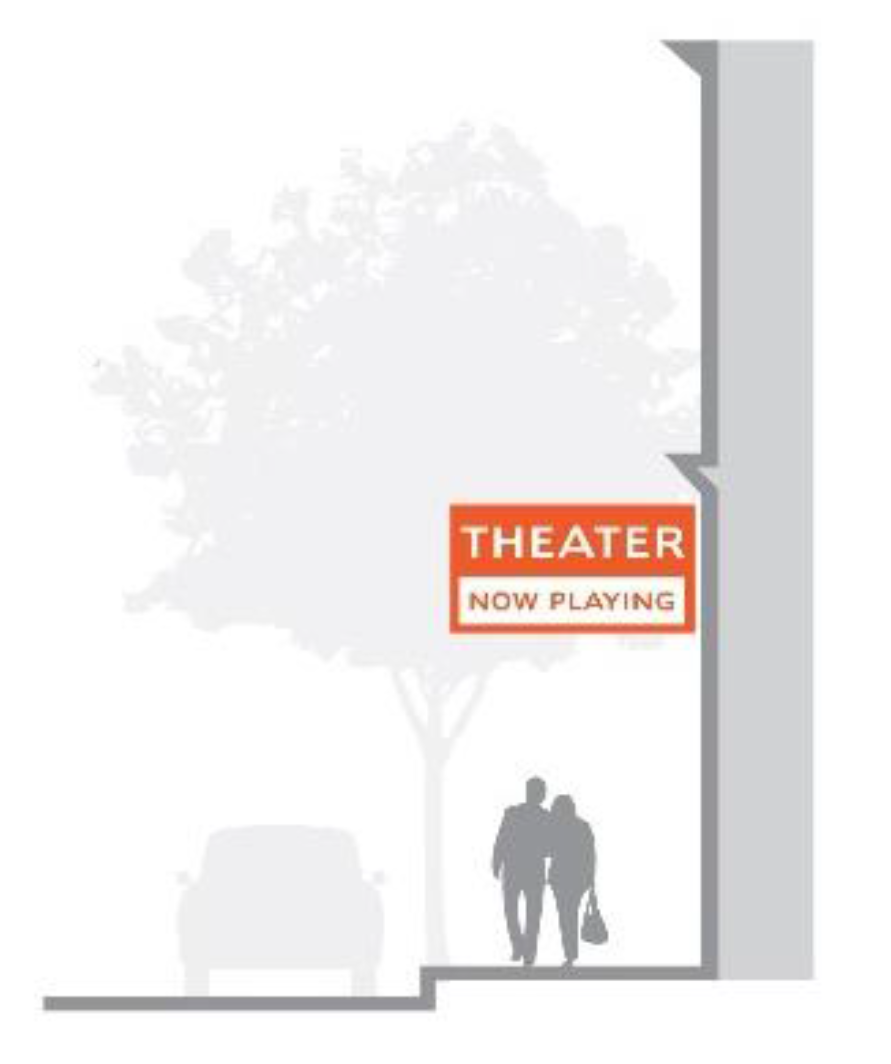
Marquee Sign
"Monument sign" means a base-mounted, freestanding sign placed on the ground and not attached to any building or other structure. A monument sign includes a solid supporting base of at least twenty-four inches in height and a width equal to or greater than the width of the sign face. Monument signs are constructed of a decorative and durable material (e.g., masonry), and shall have no separations between the sign face and the base.

Monument Sign
"Nonconforming sign" means a sign that was lawfully permitted at the time it was erected but is not permitted under current law.
"Permanent sign" means a sign constructed of durable materials intended to withstand prolonged exposure to exterior elements. Permanent signs are affixed to the ground or a structure by means of footings beneath the ground surface, bolts or screws into a structure, or other method intended to ensure the sign is displayed for an extended period of time with minimal maintenance or replacement of parts.
"Portable sign" means a temporary sign designed to be easily movable. Portable signs are typically held in place during the period of display by sandbags, blocks, or other easily movable anchor.
"Projecting sign" means a sign attached to a building or other structure and extending beyond the attachment surface by more than two feet. A "projecting sign" is differentiated from a "wall sign" based on the distance the sign projects from the surface of the building. "Awning signs," "canopy signs," "blade signs" and "marquee signs" are types of projecting signs.
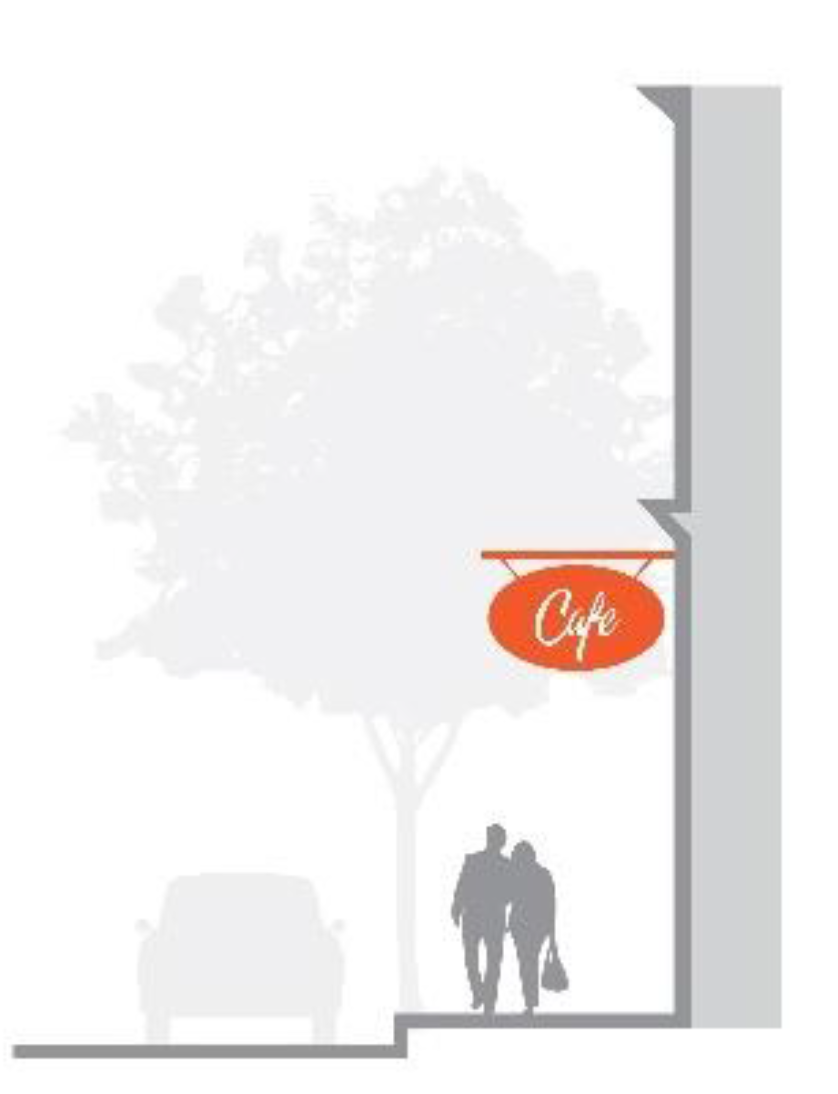
Projecting Sign
"Raceway channel sign" is a wall sign that uses a raceway to mount channel letters, numbers, or symbols. A raceway is a thin, rectangular metal structure that's usually painted to match the building's façade or sign band. The raceway channel is mounted between the wall and the text of the sign.
"Roof sign" means a sign that is erected, constructed, and maintained upon, against, or above the roof or parapet of a building or any portion thereof. A sign mounted upon a mansard fascia that does not project above the highest point of the roof or parapet is considered a "wall sign."
"Sandwich board sign" means a temporary sign that is not permanently anchored or secured to either a building, structure, or the ground. Often referred to as "sidewalk signs," sandwich board signs include, but are not limited to, "A" frame, "T" shaped, or inverted "T" shaped stands.
"Temporary sign" means a display sign, banner or other device constructed of cloth, canvas, fabric, plastic, or other light temporary materials, with or without a structural frame, or any other sign intended for a limited period of display that is not permanently anchored to the ground or a building.
"Transported sign" means a sign attached to or pulled by a vehicle that may be displayed or affixed to a movable object such as, but not limited to, a car, truck, trailer, or similar transportation device. A "portable sign" does not constitute a "vehicle sign."

Transported Sign
"Vehicle sign" means a sign, painted or otherwise, attached to an operable vehicle that is regularly used and moved, including signs on a truck trailer. A "vehicle sign" does not constitute a "transported sign."

Vehicle Sign
"Wall sign" means a sign attached to, painted on, inscribed, or otherwise set upon the exterior wall or surface of any building, no portion of which projects more than eighteen inches from the wall and which does not project above the roof or parapet line. A "wall sign" shall also include a sign mounted upon a mansard fascia that does not project above the highest point of the roof or parapet. Any other sign upon, against, or above the roof or parapet of a building or any portion thereof is defined as a "roof sign."
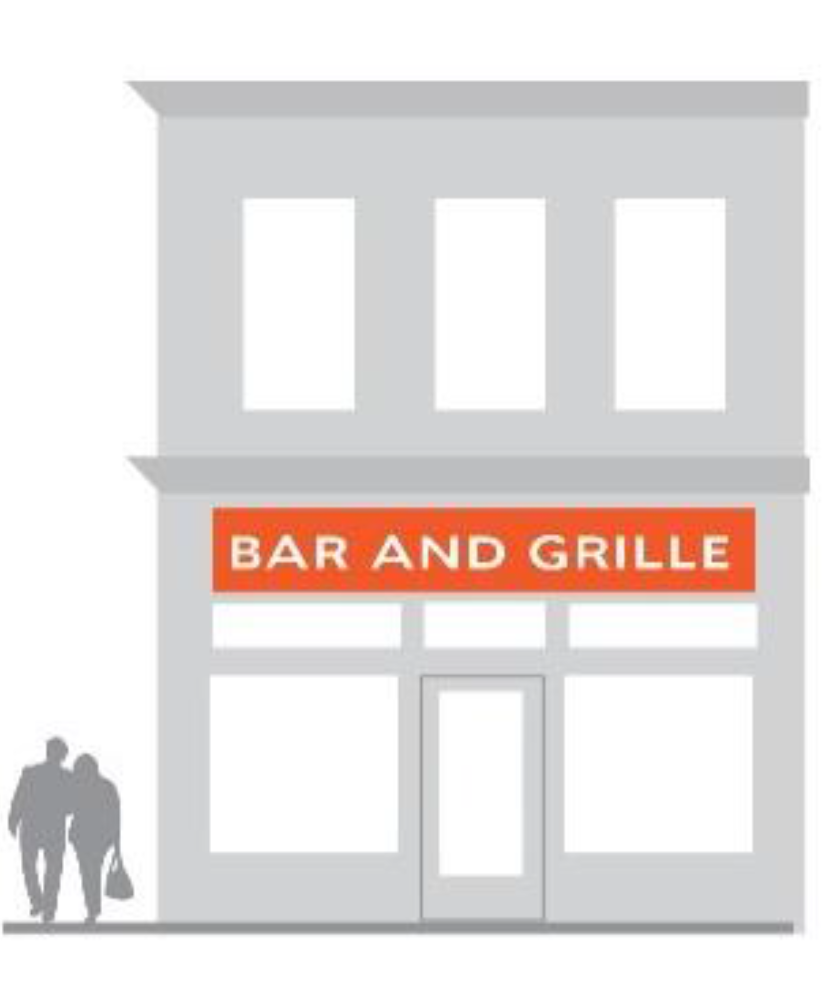
Wall Sign
"Window sign" means a sign that is painted on or attached to a window or glass door that is intended to be viewed from the exterior, including signs located inside a building but visible primarily from the outside of the building.

Window Sign
"Yard sign" means a small temporary sign typically used for non-commercial purposes. Yard signs are characterized by a wire frame, non-durable message surface such as cardboard, plastic, or paper, and are often inserted into a lawn with wire posts. Although variations exist to the materials of the frame and message board, a consistent physical characteristic is its temporary and disposable nature.

Yard Sign
B.
Definitions, General.
"Alteration" means any change in size, shape, height, or type which changes the appearance of a sign or its structure, or a change in position, location, construction, or supporting structure of a sign.
"Building frontage" means the length of the front (entry) portion of a building occupied by a single tenant, often facing a street fronting to the premises on which the tenants are located.
"Glare" means light emitting from a luminaire with intensity enough to reduce a viewer's ability to see, and in extreme cases, causing momentary blindness.
"Grade" means average grade shall be measured fifty feet along the frontage from both sides of the sign. Placing a sign on top of a berm is permitted only if the berm is long enough to meet the average grade requirement and landscaping is provided on the berm.
"Height, maximum" shall be measured from grade to the highest edge of the sign surface or its projecting structure.
"Height, minimum" shall be measured from grade to the lowest edge of the sign surface or its projecting structure.
"Lot, zoning" means a single tract of land, located within a single block, which at the time of filing for a sign permit is designated by its owner or developer as a tract to be used, developed, or built upon as a unit, under single ownership or control.
"Luminaire" means a luminaire is a complete lighting system, which includes a lamp or lamps and a fixture.
"Nit" means a measure of luminance equal to one candela per square meter.
"Owner" means a person, firm, partnership, association, company, or corporation, or any other legal entity, and/or its legal successors, heirs, and assigns.
"Premises" means the contiguous land in the same ownership or control which is not divided by a public street.
"Sign" means any display or object which is primarily used to identify or display information or direct or attract attention by any means which is visible from any public street, sidewalk, alley, park, or public property and is otherwise located or set upon or in a building, structure, or piece of land. The definition does not include goods displayed in a window.
"Sign area" means the entire area within a circle, triangle, rectangle, oval, or other geometric shape enclosing the extreme limits of writing, representation, emblem, or any figure of similar character, together with any frame or other material or element forming an integral part of the display or used to differentiate the sign from the background against which it is placed, including a backboard, but excluding the necessary supports or uprights on which such sign is placed.
(Ord. No. 2022-02, § 1, 7-26-2022; Ord. No. 2024-03, § 1, 9-10-2024)
18.16.030 - Sign design standards in all zoning districts.
A.
Construction Standards.
1.
General Requirements. All signs shall be designed and constructed in a safe and stable manner in accordance with the city's adopted building code and electrical code. All electrical wiring associated with a freestanding sign shall be installed underground.
2.
Building Code Compliance. All permanent signs shall be designed to comply with minimum wind pressure and other requirements contained in the adopted Building Code.
3.
Framework. All signs shall be designed so that the supporting framework, other than the supporting poles on a freestanding sign, is contained within or behind the face of the sign or within the building to which it is attached to be totally screened from view.
B.
Illumination.
1.
General Requirements. Signs shall be illuminated only by steady, stationary, shielded light sources directed solely at the sign, or internal to it. Temporary signs shall not be illuminated. Permanent signs may be internally or externally illuminated, except where prohibited in this chapter.
2.
Illumination. Glare shall be reduced/minimized in such a manner as to maintain an appropriate level of contrast during the day. An automatic dimmer shall be required to control brightness at night, and to reduce drive distraction and light trespass into residential areas. A photometric plan which identifies the proposed illumination levels (in foot candles) shall be provided. Illumination levels shall not exceed fifteen-foot candles at the property line, measured four feet from the ground. Illumination for EMCs is regulated in subsection C below.
3.
Non-Glare Shielded Lighting. Use of glaring undiffused lights or bulbs is expressly prohibited. The source of illumination shall not be visible, shall be fully shielded, and shall cause no glare hazardous to pedestrians, motorists or adjacent residential uses or districts.
4.
Bare Bulb Illumination. Illumination by bare bulbs or flames is prohibited, except that bare bulbs are permitted on electronic changeable copy signs and theatre marquees.
5.
Traffic Hazards. Sign illumination color and/or brightness that create a traffic hazard are prohibited.
C.
Electronic Message Center (EMC) Signs. EMC signs may be permitted on monument signs in non-residential and appropriately zoned districts subject to the standards of this section and the following regulations:
1.
Frequency of Change. Signs with the ability to change displays shall not change more frequently than one time per ten seconds. Animated signs are expressly prohibited.
2.
Manner of Change. Signs with the ability to change displays must be designed to change the display instantaneously. Flashing, scrolling, fading, dissolving, osculating, spinning, twirling, video display, or other type of motion are expressly prohibited.
3.
Internal Illumination. EMC signs shall not emit more than five thousand nits in full daylight and one hundred nits during night hours, which commence no later than one hour after sunset and extend through no earlier than sunrise. The displays shall transition smoothly at a consistent rate from the permitted daytime brightness to the permitted nighttime brightness levels. All EMC signs shall have functioning ambient light monitors and automatic dimming equipment which shall at all times be set to automatically reduce the brightness level of the sign proportionally to any reduction in the ambient light. To verify compliance with City Code or other applicable law, the interface that programs an EMC sign shall be made available to city staff for inspection upon request. if the interface is not or cannot be made available upon the city's request, the sign shall cease operation until the city has been provided proof of compliance with City Code.
4.
Rendering. A color rendering of the display shall be provided for consideration of the planning commission during site plan review, and the planner and building official during an administrative review.
5.
Area. An electronic changeable copy or electronic graphic display area shall not exceed more than one-third of the sign area of any monument sign permitted under the zoning ordinance for the zoning district. However, as an alternative, an EMC sign no greater than one-third of the permitted sign area may be substituted.
6.
Integration Into Sign. The electronic changeable copy or electronic graphic display areas on monument and billboard signs shall be part of the same sign face as a monument or billboard sign without electronic display technology and shall be integrated into the face of such sign by use of a border or similar design treatment that provides a visual linkage to the remainder of the sign.
7.
Default. All electronic message signs shall default to an unlit black screen if fifty percent or more of the light source fails or if the light source otherwise is not displaying properly.
D.
Sign Measurement. The total sign area is to be expressed in square feet and shall be computed as herein set forth.
1.
All signs, unless otherwise provided for herein, shall be set back a minimum of ten feet from any public or private street right-of-way line or access drive in all districts. This distance shall be measured from the nearest edge of the sign, measured at a vertical line perpendicular to the ground or to the right-of-way.
2.
Side yard setbacks for signs shall be the same as that required for the main structure or building, provided that all nonresidential signs shall be set back at least one hundred feet from any residential district.
3.
Single face sign total area shall be computed as the number of square feet within lines drawn at the outer perimeter forming any single and/or combination of geometric shapes, such as a square, rectangle, triangle, oval, or circle encompassing the extreme limits of an individual letter(s), word(s), logo(s), message(s), representations, emblem or any similar figure, including open space(s), together with any frame or other material forming an integral part of display used to differentiate such sign from the background against which it is placed. Uprights or supports for freestanding signs are excluded from this measurement.
4.
Double-face signs having two faces of equal size arranged and/or positioned back-to-back and parallel, or with the faces at an included angle of not more than thirty degrees in the plain or vertical views the area of the sign, shall be computed as one half of the total area of the two faces. When the faces of such a sign are not of equal area, then the area of the sign shall be computed as the total area of the largest face. When signs have three to four faces of equal size arranged and/or positioned with the faces at an angle of more than thirty degrees in the plain or vertical view, the area of the sign shall be computed as the total area of the largest two faces. The area of three-dimensional signs shall be measured by computing the total area of the largest two faces measured at a two-dimensional view.
5.
When two single-face wall signs are arranged and/or positioned within thirty-six inches of each other, the area of the two signs shall be computed as one single face sign and total area shall include the open space between the two separate faces.
6.
The height of the sign shall be measured from the average grade to the upper-most point of the sign. Average grade shall be measured fifty feet along the frontage from both sides of the sign. Placing a sign on top of a berm is permitted only if the berm is long enough to meet the average grade requirement and landscaping is provided on the berm.
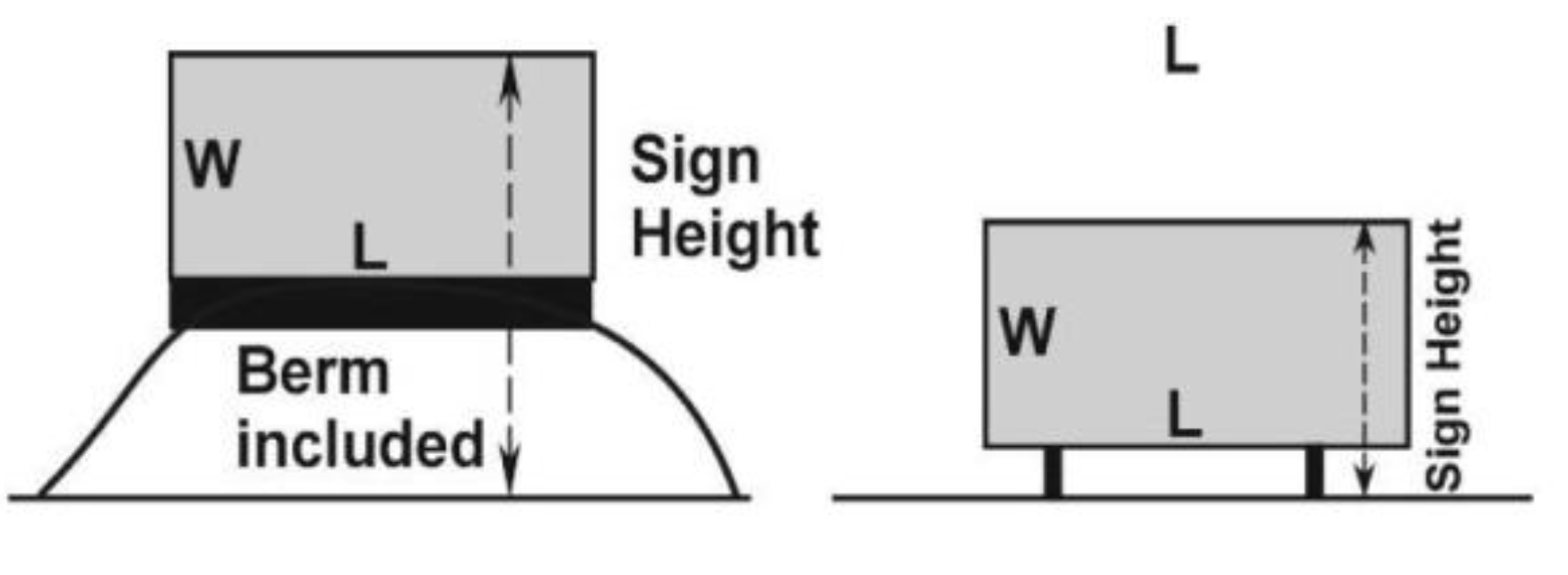
Berm and Sign Height
7.
The area of a cylindrical sign shall be computed by multiplying the circumference of the cylinder by its height.
E.
Sign Location.
1.
Right-of-Way Prohibited. No sign, except those established and maintained by the city, county, state, or federal governments shall be located in, project into, or overhang a public right-of-way or dedicated public easement.
2.
Clear Vision Triangle Area Prohibited. No sign shall be located in the clear vision triangle area, which shall mean the triangular area adjacent to the intersection of any street established by measuring a distance of fifteen feet from the point of intersection of two streets along the right-of-way of each of the intersecting streets and connecting the ends of each measure distance to assure adequate visibility sight lines for vehicular traffic approaching the intersection.
3.
Compliance with Setback Requirements. All permanent signs shall comply with the applicable setback requirements.
4.
Projections. Unless otherwise stated, no sign shall project beyond or overhang the wall or any permanent architectural feature (e.g., awning, canopy, or marquee) by more than eighteen inches and shall not project above or beyond the highest point in the roof or parapet.
5.
Safety. No sign shall be permitted at any location that, in the discretion of the building official, creates any type of safety hazard or visual impediment to pedestrian or vehicular traffic. In making this determination, the building official shall cite any relevant building or electrical codes, provisions of this chapter or other city chapters, and/or findings or studies of the public safety department and/or a traffic engineer.
6.
Liability Insurance. If any sign is suspended over a public street or property or if the vertical distance of such sign above the street is greater than the horizontal distance from the sign to the street property line or parapet wall and so located as to be able to fall or be pushed onto public property, then the owner of such sign shall keep in force a commercial general liability insurance policy in the amount of one million dollars. The commercial general liability insurance policy shall include an endorsement, or policy language, naming the city as an additional insured.
F.
Landscaping. The area surrounding signs shall be landscaped to match the design characteristics of the site. The landscaping shall be maintained such that the sign remains visible to passing motorists.
G.
Setbacks and Distances. The following setback and distance measurements shall be met:
1.
The distance between two signs shall be measured along a straight horizontal line that represents the shortest distance between the two signs.
2.
The distance between a sign and a parking lot or building shall be measured along a straight horizontal line that represents the shortest distance between the outer edge of the parking lot or building.
3.
The distance between a sign and a building or property line shall be measured along a straight horizontal line that represents the shortest distance between the edge of the sign and the building or property line.
(Ord. No. 2022-02, § 1, 7-26-2022)
18.16.040 - Signs exempt from permits.
The following signs shall be permitted in all zoning districts according to the regulations of this chapter and subject to the following provisions. No permit shall be required for signs enumerated below unless otherwise stated. Such exemptions, however, shall not be construed to relieve the owner of the sign from responsibility for its proper location, erection, maintenance, and removal.
A.
Address numbers with a numeral height no greater than six inches for each dwelling unit and eighteen inches for any other use, including multiple-family buildings. The posting of these address signs is necessary for the effective delivery of public safety services, which is a compelling governmental interest.
B.
Any sign on the premises required by law.
C.
Any sign that conforms to the FHWA's Manual on Uniform Traffic Control Devices and is installed for the purpose of directing or instructing traffic.
D.
Nameplates, not to exceed two square feet.
E.
Historical markers and plaques up to twelve square feet.
F.
Memorial signs or tables that do not exceed four square feet, having the name of the building and/or date of erection and cut, cast or engraved into a masonry or metal surface and made an integral part of the building.
G.
Temporary signage in accordance with this chapter.
H.
Official and legal notices signs that are issued by any court, public body, person or officer in the performance of a public duty, or in giving any legal notice, including signs that are required for any public hearing. Such signs shall be removed according to the requirements of the city, court order or state statute.
I.
Signs erected on a city, county, state, or federal building or land owned by the authorized public agency.
J.
Interior signs that are not visible to the outside.
K.
Any lawful sign in a public or private right-of-way installed by an authorized public agency, including, but not limited to, street signs and address signs.
L.
Private traffic control signs that conform to the requirements of the Michigan Manual of Uniform Traffic Control Devices.
M.
Flags not to exceed thirty feet in height. Flags shall not exceed three per zoning lot or be larger than four by six feet.
N.
Window signs, not to exceed twenty-five percent of the total window area of the façade facing a road. Window signs must be placed in a manner to ensure visibility into the building for public safety.
O.
Vehicle signs, where the vehicle on which the sign is displayed does not regularly go unoperated for a period exceeding seven consecutive calendar days.
P.
Warning signs that are publicly-authorized such as no trespassing, warning of electrical currents or animals, that do not exceed two square feet.
Q.
Signs displaying noncommercial messages such as religious, political, economic, social, philosophical, or other types of speech protected by the First Amendment of the United States Constitution. However, said signs shall comply with the number and size regulations in the applicable zoning district.
(Ord. No. 2022-02, § 1, 7-26-2022)
18.16.050 - Prohibited signs in all zoning districts.
The following signs are prohibited in all zoning districts, notwithstanding anything to the contrary in this chapter.
A.
Any sign not expressly permitted.
B.
Obsolete signs.
C.
Animated signs (including revolving signs and rotating signs) and signs that incorporate moving features, except for changeable-copy signs explicitly permitted in this chapter.
D.
Any sign that displays flashing, animation, scrolling, blinking, or intermittent lights, or lights with changing levels of light intensity.
E.
Signs which in any way simulate or could be confused with the lighting of emergency vehicles or traffic signals. There shall be no flashing, oscillating or intermittent, or red, yellow, or green illumination on any sign located in the same line of vision as a traffic control device, or that interferes with vision clearance along any highway, street, or road or at any intersection of two or more streets.
F.
Festoons, except those approved in conjunction with a temporary land use permit.
G.
Air-activated signs and balloon signs, except those approved in conjunction with a temporary land use permit.
H.
Any sign that is deemed structurally or electrically unsafe by the building official.
I.
Signs which hide from view all or any part of any traffic sign, street sign or traffic signal.
J.
Support pole signs, including signs attached to light poles, utility poles, street signpost, and trees. Prohibited support pole signs shall not include support pole signs lawfully installed by an authorized public entity.
K.
Transported signs unless the vehicle with the transported sign is operating lawfully in a public or private road.
L.
Roof signs, except any sign erected or constructed as an integral, or essentially integral, part of the normal roof structure.
M.
Bench signs, not including permanently mounted plaques intended to be read at close proximity.
N.
Projector-image signs.
O.
Pylon or pole signs not otherwise authorized by this chapter.
P.
Rotating search lights or similar devices.
Q.
Temporary electronic message center signs (EMCs).
R.
Private tower signs.
S.
Signs displayed on an unlicensed vehicle or trailer, wagon, or other conveyance. This prohibition shall not apply to temporary "for sale" signs displayed in vehicle windows.
T.
Costume Signs. The basis of prohibiting costume signs is that the movement and proliferation of costume signs would degrade traffic safety through the creation of visual distractions.
U.
Banners, stake signs, flag signs and feather signs, unless authorized by the chapter.
V.
Any sign located in a public or private right-of-way, unless permitted by the road agency or explicitly permitted elsewhere in this chapter.
W.
Neon, LED, or other light types permanently outlining windows or doors.
X.
Billboards.
Y.
Box signs.
Z.
Signs intended to mimic traffic control or emergency services signage. These signs are considered hazards detrimental to pedestrian and vehicular travel and to the public safety and welfare.
(Ord. No. 2022-02, § 1, 7-26-2022)
18.16.060 - Specific sign standards.
The number, display area, and height of signs within the various zoning districts are provided in the sign dimensional standards and regulations table and its accompanying footnotes. Additional standards for specific types of signs are given below.
Footnotes to the Sign Dimensional Standards and Regulations Table
(a) Wall Signs. One wall sign shall be allowed per business, in addition to any other allowed ground signs. Businesses located on a corner lot shall be allowed up to two wall signs, one for each front façade. The maximum wall sign area shall not exceed ten percent of the front facade of the building (any facade which faces a public street), per use or business establishment. However, for a commercial structure containing one use or business establishment the size of the wall sign may be increased up to the maximum square footage as follows if approved by the planning commission:
(1) Window Signs. Window signs are permitted but shall not exceed twenty-five percent of the window area of the façade. Window signs shall be placed so as to maintain clear vision into the building for public safety reasons.
(2) No wall sign shall extend above the roof or parapet of the structure to which it is attached by more than one foot and all electrical conduits and boxes must be hidden.
(3) Logo Sign. A logo sign will be considered part of a wall sign when located within five feet of the primary sign.
(b) Ground Signs. Only one ground sign is permitted per use, including uses which occupy more than one parcel and business centers containing more than one business or use, with additional signs permitted according to the following table. No site shall have more than two ground signs, regardless of the number of street frontages or the amount of frontage. Single uses on a single parcel do not qualify for this consideration:
;em>
(c) Temporary Signs.
1. All temporary signs must comply with the sign size and height standards as specified in the sign dimensional standards and regulations table.
2. Location of temporary signs shall comply with the following:
a. Temporary signs shall not be attached to any utility pole, tree, fence, or be located within any public right-of-way.
b. Temporary signs shall not be located closer than two feet to the edge of the traveled portion of the roadway, and in no case shall they be located within the public right-of-way. The city manager, or his/her designee, may administratively approve signs in the public right-of-way or public easement if the city manager determines that subparagraphs d through g below have been met. The city manager, in his/her sole discretion, may refer any request for signs in the public right-of-way or public easement to the city council for approval.
c. The city manager, or his/her designee, may administratively approve signs for community events or special events, if the city manager determines that subparagraphs d through g below have been met. The city manager, in his/her sole discretion, may refer any request for community events or special events, to the city council for approval.
d. Temporary signs shall not be erected in such a manner than they shall or may reasonably be expected to interfere with, obstruct, confuse, or mislead traffic.
e. Temporary signs cannot be placed or constructed to create a hazard of any kind.
f. Temporary signs may not be posted on private property without first obtaining the permission of the property owner.
g. Signs shall not be located within any clear vision triangle, as described in Section 18.16.030 E.2.
3. Each temporary sign shall be removed within sixty days of placement. Furthermore, no sign may be erected on a single parcel for more than sixty calendar days out of every one hundred twenty calendar days. Although a permit is not required for temporary signs, property and business owners must maintain a log of dates when temporary sign(s) have been in place showing compliance with the above standard. However, signs expressing First Amendment speech shall be exempt from this time limitation.
(d) Ground Signs on Major Thoroughfares. Due to high-speed limits on major thoroughfare roads, ground signs are permitted to have a maximum height of eight feet and area of one hundred square feet on the following roads:
1. Wixom Road from Grand River Ave. to Pontiac Trail.
2. Beck Road from I-96 to Pontiac Trail.
3. Grand River Ave.
;em>(Ord. No. 2022-02, § 1, 7-26-2022)
18.16.070 - Sign regulations for nonresidential properties in the VCA district.
A.
Regardless of other provisions of this chapter, only the following signs and regulations for the signs are applicable to nonresidential properties in the VCA district. Residential properties are subject to all other applicable provisions of this chapter.
B.
Types of Signs. Permitted types of signs are allowed in accordance with the regulations in the following table and other regulations set forth in this section.
C.
Illumination of Signs. In addition to the provisions of Section 18.16.030 B, the following provisions apply to the illumination of signs in the VCA district:
1.
Lighting intensities for illuminated signs shall not exceed ten footcandles, measured at four feet perpendicular to any part of the sign surface.
2.
In keeping with the character of the VCA district external sign lighting is required. Internally lit signs shall only be permitted pursuant to Section 18.16.070 C.6 below. The source of external sign lighting shall not be visible from any adjacent property line.
3.
External (exposed) light sources such as bulbs or neon type tube lighting shall not be allowed on any exterior signs with the exception of window signs as noted below.
4.
There shall be no flashing, blinking, changing of colors, changing of illumination intensity, or any other visual effect associated with lighted signs. Electronic message center signs are prohibited in the VCA District.
5.
Projecting signs may not be backlit or internally illuminated.
6.
Wall signs shall not be internally illuminated with the exception of individual letters, logos, or other message components. When internally illuminated letters, logos, or other message components are used, they shall be mounted directly to the wall of the building and no raceway channel is to be used. Individual internally illuminated letters no larger than eighteen inches high shall be used. Backlit logos or other message components shall be no larger than eighteen inches high. A solid, non-illuminated backer board may be used but will be calculated into the sign area measurement.
7.
A window sign is not to be illuminated, although up to fifty percent of the sign may be constructed of neon. Neon is not to be used for other purposes such as outlining windows or as general accent lighting on the building. The neon must be integral to the sign itself.
8.
Awnings shall not be internally illuminated. Awning signs may only be illuminated by fixtures located above the awning and directed downward.
D.
A-Frame and Sandwich Board Signs. A-Frame and sandwich board signs may be permitted on a sidewalk, provided that such signs are securely anchored and installed in a manner that prevents pedestrian congestion, as follows:
1.
The sign shall not be illuminated in any manner.
2.
The sign is permitted only during operating business hours and must be stored inside when the business is not open.
3.
The sign must be constructed of weatherproof, durable material and kept in good repair.
E.
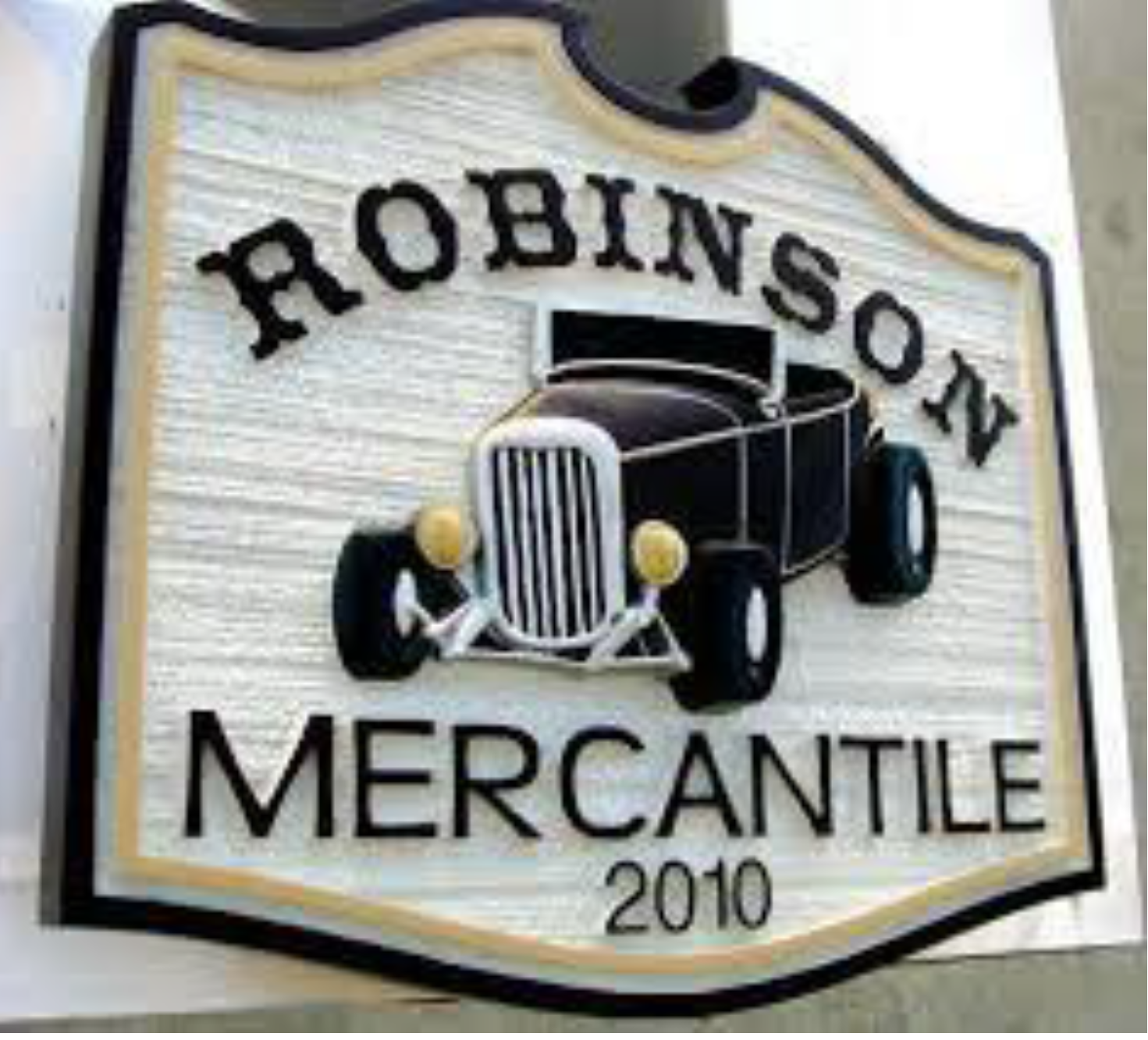
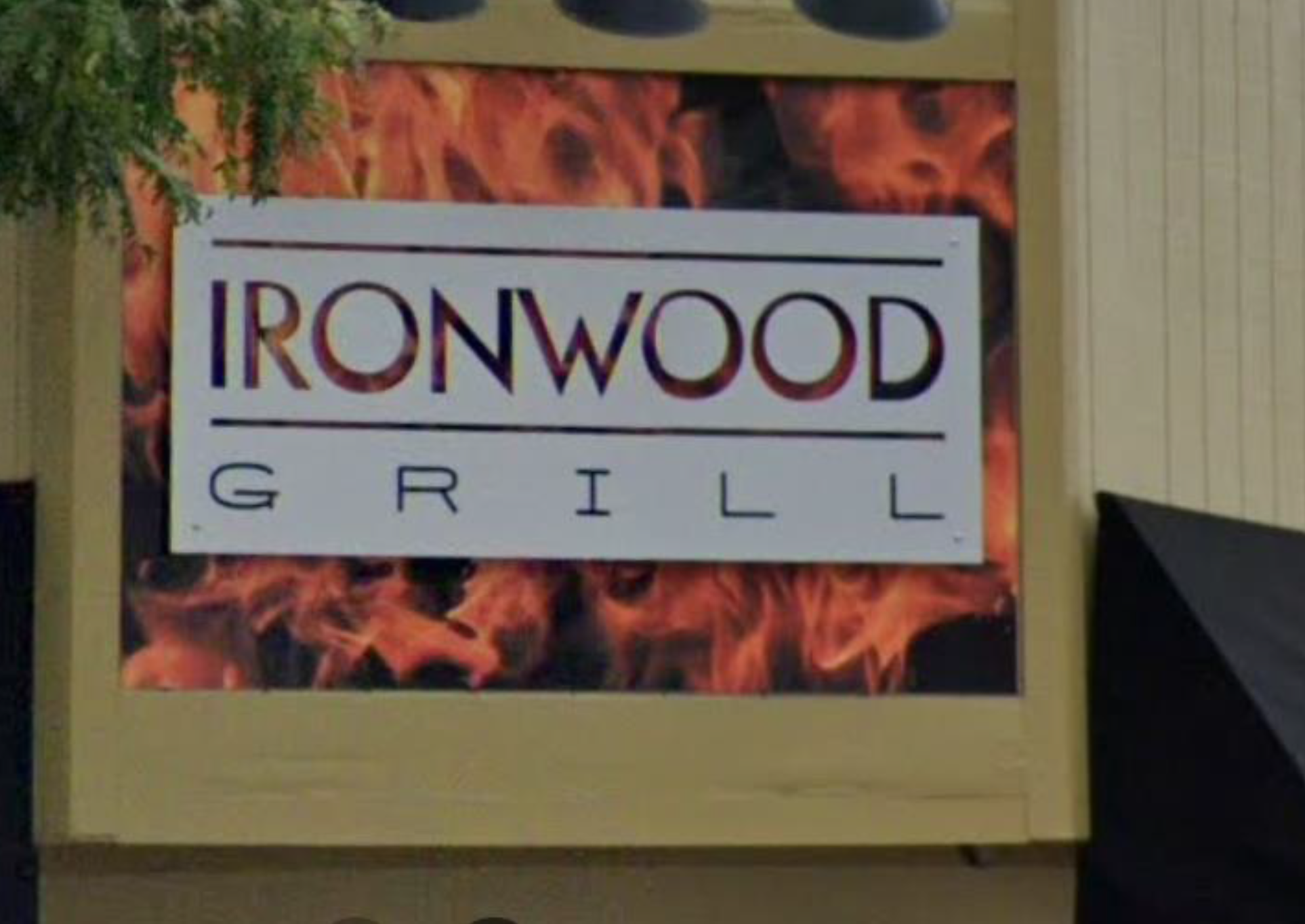
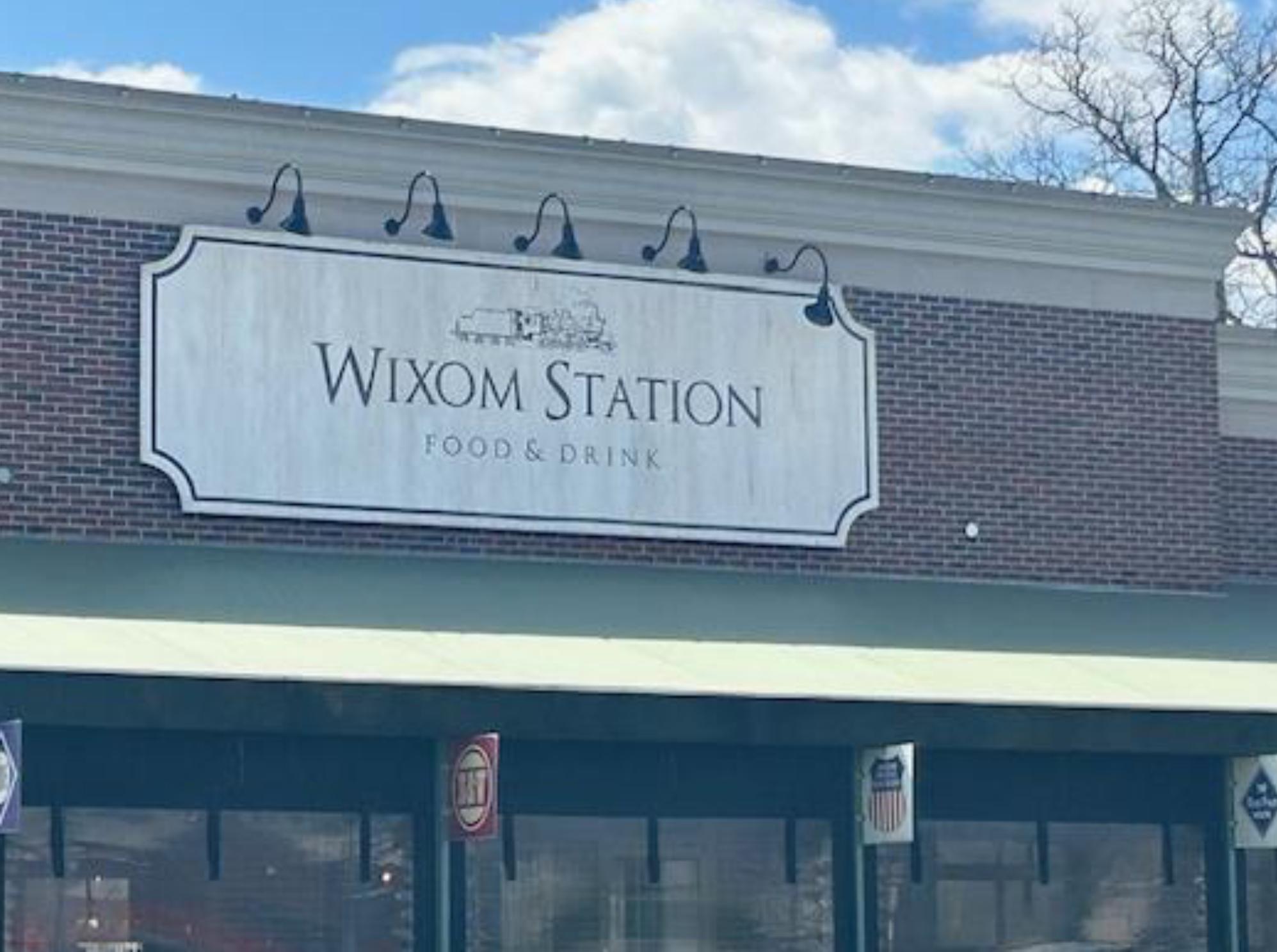
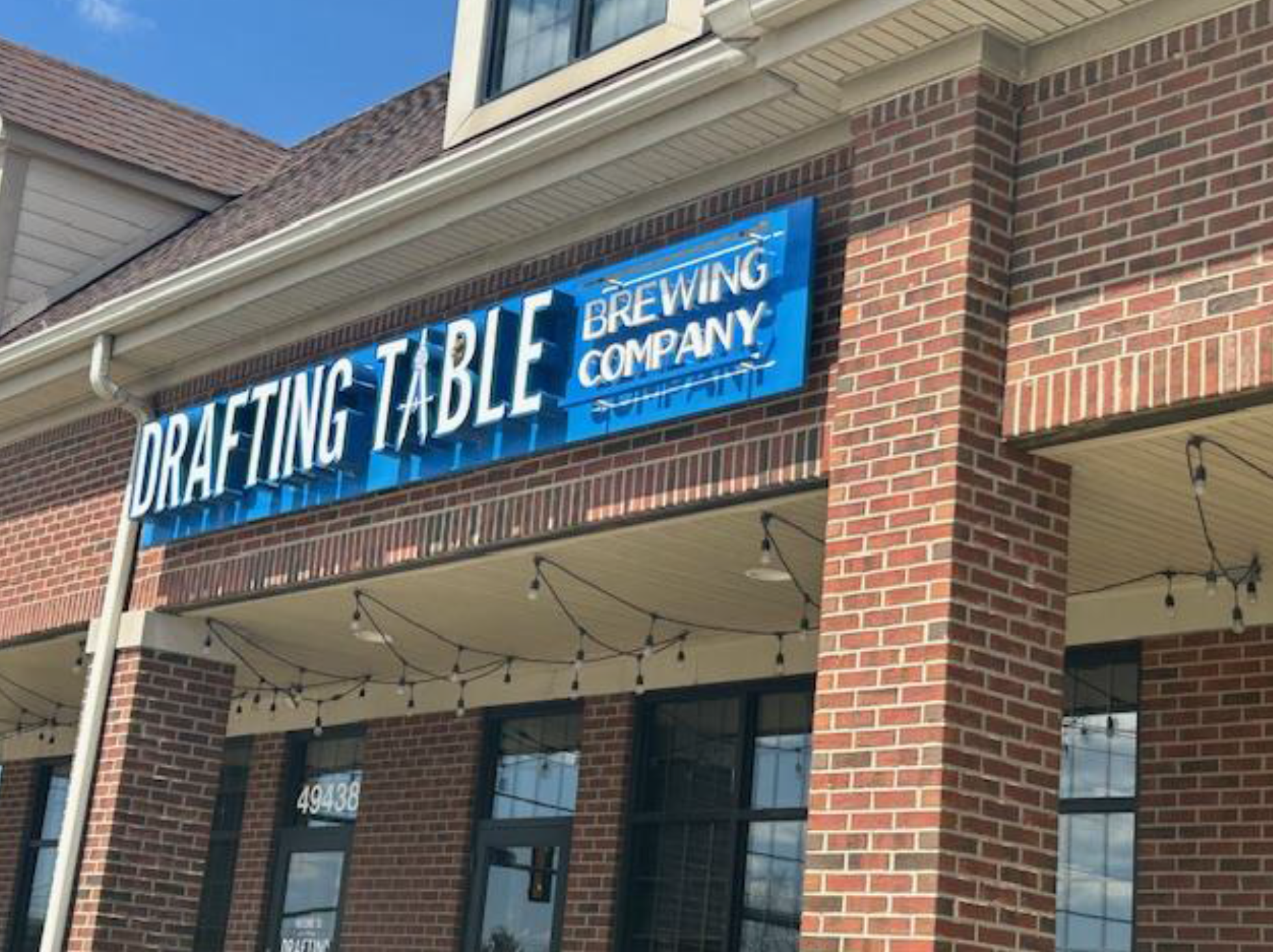
Design and Materials. All signs shall be of a design and character that reinforces the VCA district's intended traditional downtown design. The use of materials such as wood, brass, vintage painting, and symbolic design are highly encouraged. Plastic or PVC may be used only for internally illuminated individual letters, logos or other message components provided their appearance (color, design, shape, etc.) contributes to the VCA district's intended traditional downtown design.
1.
With the exception of illuminated individual letters, logos, or other message components as noted above all signs shall be constructed of two or more the following:
a.
Ceramic Tile - Painted or Sandblasted.
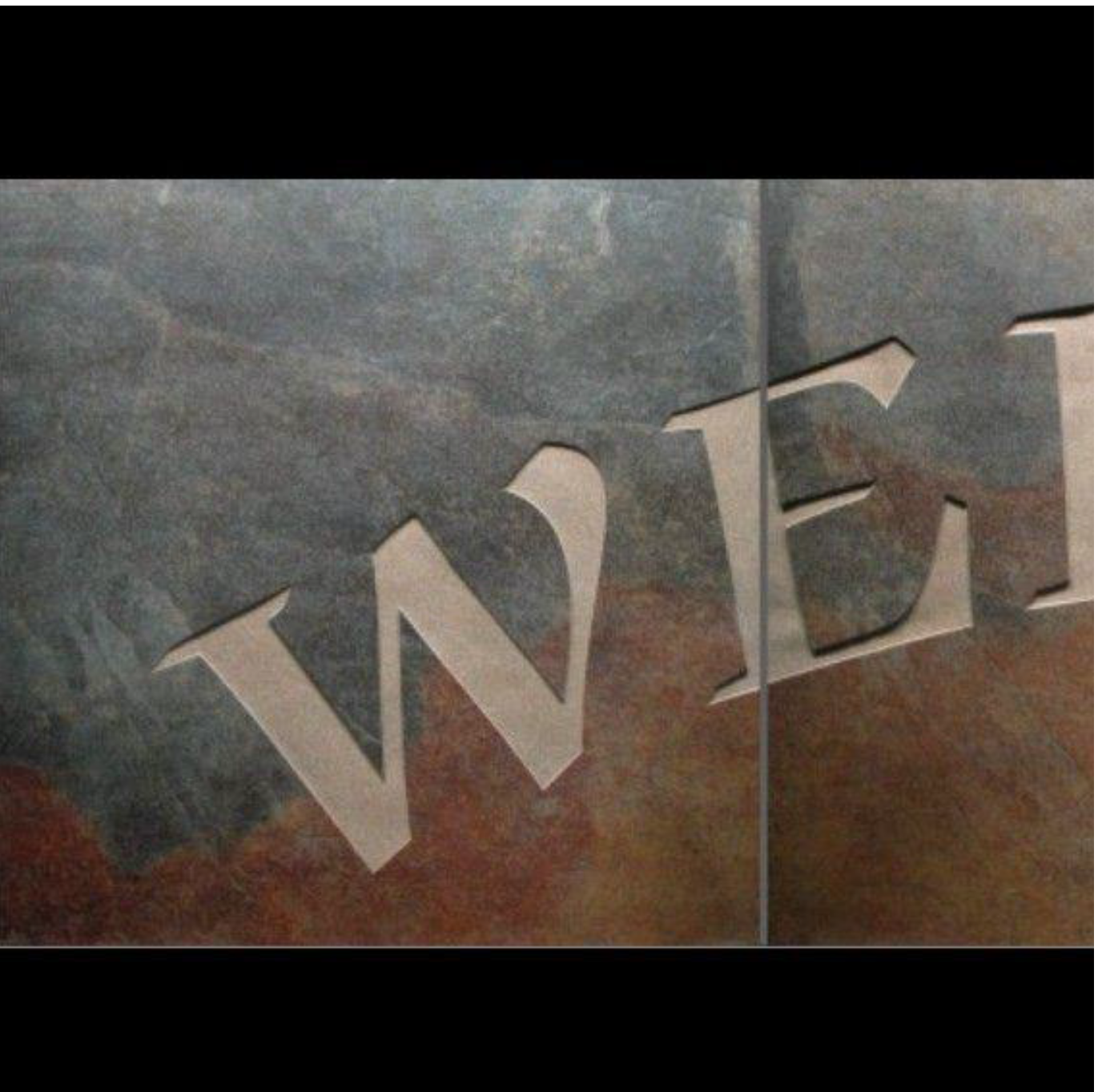
b.
Wood - Carved or Sandblasted.
c.
Metal - Formed, Etched, Cast, or Engraved.
d.
Brick or Stone - with Recessed or Raised Lettering.
e.
Matching or Stylistically Similar Awnings and/or Projecting Signs.

f.
Composite Materials Including Plastic, or PVC When Used in Combination with One of the Above Materials.
2.
Box Signs are Prohibited.

3.
All signs shall have a clearly distinguishable dimensional effect to the sign. Individual letters, symbols, or logos shall be raised or recessed onto a different plane than the sign background. Flat one-dimensional signs shall be prohibited.
4.
Sign colors shall be coordinated with other site elements including awnings and building façade. Neon colors shall be prohibited on all signs.
F.
Window Signs. The sign is to be affixed directly to the window surface or installed so it is immediately adjacent to the window.
G.
Incidental Signs. Incidental signs such as open/close, hours of operation, payment method signs, are permitted provided the aggregate size of the signs is two square feet or less.
H.
Awning/Canopy Signs. Signage shall be permitted on awnings or canopies that are approved as part of a building's design, subject to the following:
1.
Letters, logos, or other message components shall occupy no more than thirty percent of the awning or canopy's face panel area.
2.
Letters, logos, or other message components shall not be located on the end panels of the awning or canopy.
3.
Letters, logos, or other message components installed on the front of an approved canopy or awning may be front lit, provided such lighting does not generate excessive glare. The underside of awnings and canopies shall not be illuminated or backlit.
4.
All awnings are to be constructed of canvas or other similar material approved by the building official and shall comply with the VCA Design Guidelines and Section 18.16.070.
5.
In addition to the above standards, when awning signs are used the awning color and sign font style shall match the character and façade of the building in which they are placed.
I.
Rear Entrances. A sign shall be permitted to identify a rear entrance to a business. The sign must be no larger than twelve square feet in area per side for a public entrance or six square feet in area per side for a service entrance. The rear entry sign may be a wall sign or projecting sign and may be front lit only, with the use of a gooseneck or other approved indirect light fixture.
J.
Nameplates. Nameplates not exceeding two square feet in area denoting only the name and profession of the occupants in a commercial, public, or other institutional building shall be permitted in addition to the wall sign for the building, provided the area of these nameplates shall count towards the total wall sign area of the building.
K.
In no circumstances shall signs on mixed-use buildings be placed above the first-floor elevation. No signage shall be mounted on the façade of the building of any story with residential units.
L.
Planning Commission Waivers. Should a sign permit be denied by the city zoning administrator, the requirements of this section may be modified by the planning commission where the objectives and intent of the VCA district are better served by such modifications, rather than through the strict application of the requirements contained therein. The property owner and/or applicant shall provide information that the modification(s) meet the intent of the VCA District Design Guidelines and the provisions of this section. Further, the planning commission may waive portions of these standards upon a finding that permitted signs would not be practical or feasible because of the shape, character or configuration of the building or site and/or because of the nature of the message being conveyed.
The applicant's denied sign permit and all supporting documentation shall be forwarded to the planning commission to be heard at the commission's next available meeting. The planning commission may request city staff and consultants to review and provide recommendations on the requested waiver(s).
(Ord. No. 2022-02, § 1, 7-26-2022; Ord. No. 2024-03, § 1, 9-10-2024)
18.16.080 - Additional sign standards.
A.
Directional Signs. No more than one directional sign shall be permitted for each approved driveway, with a maximum sign area of four square feet per sign, and a maximum height of four feet. Any directional sign which includes a business name, symbol or logo shall be calculated as part of the allowable ground sign square footage, as specified in the sign dimensional standards and regulations table.
B.
Billboards. The city currently has five existing billboards along I-96 which were erected pursuant to consent judgments. The city has determined that it has no demonstrated need for any additional billboards. The city has also determined that these existing billboards negatively reflect on the aesthetics of the community. The city has therefore concluded that no further billboards shall be permitted to be erected. The existing billboards can be replaced in perpetuity pursuant to the consent judgments. This section is not intended to prohibit the expression of First Amendment views, and any lawful message may be displayed on the existing billboards, be it commercial or noncommercial
C.
Projecting, Awning, and Canopy Signs. Projecting signs, awnings, and canopy signs may be used as an alternative to wall signs listed in the sign dimensional standards and regulations table, provided that they meet the following standards:
1.
Any sign area on a canopy shall be included in calculations of maximum wall sign square footage.
2.
Projecting, awning, or canopy signs, other than those in the VCA District, shall have a minimum ground clearance of ten feet, shall be set back at least six feet from any adjacent public right-of-way, and shall not project over an alley or private access lane. A projecting sign shall not extend for more than two feet from the building to which it is attached.
3.
No awning, canopy or projecting sign shall extend above the roof or parapet of the structure to which it is attached by more than one foot.
4.
Wood posts or supporting arms shall not be used in conjunction with any projecting sign unless it is decorative in nature and part of the character of the sign.
5.
Projecting signs shall not exceed twelve square feet in area or three feet in width. The area of such sign shall be in addition to any permitted sign provided for herein.
6.
Canopy signs shall not be internally illuminated and must be blackened out on the underside.
D.
Entranceway Signs. One permanent sign per vehicular entrance identifying uses such as subdivisions, apartment complexes, condominium communities, senior housing complexes, office and industrial parks and similar uses is permitted, provided that the sign is set back a minimum of fifteen feet from any property line or public right-of-way.
E.
Manual Changeable Message Signs. Manual changeable message signs may be permitted as a portion of, and accessory to, a ground or monument sign in the B-1, B-2, B-3, F-S, I-S, OS-1, IRO, and M-1 districts, in accordance with the following:
1.
The message may be changed manually.
2.
Illumination, if any, shall be concentrated within the face of the sign to prevent glare upon adjoining properties and thoroughfares.
F.
Sandwich Board Signs. Sandwich board or portable A-frame signs are permitted in the B-1, B-2 and B-3, VCA, F-S, and I-S districts at the customer building entrances to businesses subject to the following requirements:
1.
One sign per customer entrance shall be permitted regardless of the number of tenants on the premises.
2.
The sign is permitted only during operating business hours and must be stored inside when the establishment is not open to the general public.
3.
Each sign shall not exceed an overall height of forty-two inches and an overall width of twenty-four inches.
4.
The sign must be located adjacent to the building, no more than ten feet from the customer entrance to the business, be a minimum of two feet from the edge of the curb and be located so that at least a six-foot-wide sidewalk is maintained.
5.
No sign shall be located in such a manner as to interfere with vehicular or pedestrian traffic flow or visibility.
6.
All signs must be constructed or weatherproof, durable material and kept in good repair.
7.
The sign shall not be illuminated in any manner.
8.
Sandwich board signs within the public right-of-way may be moved/removed by the city for municipal purposes (i.e., code enforcement, snow removal, traffic issues, maintenance, safety, etc.).
(Ord. No. 2022-02, § 1, 7-26-2022)
18.16.090 - Construction and maintenance requirements.
A.
Material and Design. All signs shall be designed, constructed, and maintained in conformity with the provisions for materials, loads and stresses of the latest adopted edition of building code and requirements of this article.
B.
Fastenings. All signs must be erected in such a manner and with such materials to remain safe and secure during the period of use and all bolts, cables, and other parts of such signs shall be kept painted and free from corrosion. Any defect due to the fault of the erector shall be repaired by the erector.
C.
Fire Escapes. No signs of any kind shall be attached to or placed upon a building in such a manner as to obstruct any fire escape.
D.
Support Location. No pole, cable, or support of any nature shall be placed on any publicly owned property, street, right-of-way, or proposed street rights-of-way without written authorization from the owner of said right-of-way.
E.
Proximity to Electrical Conductors. No sign shall be erected so that any part including cables and guys will be within ten feet of any electrical conductor, streetlamp, traffic light or other public utility pole standard, or ten feet of a high voltage wire.
F.
Sanitation. Property surrounding any ground or monument sign shall be kept clean, sanitary, and free from obnoxious and offensive and offensive substances, free from weeds, rubbish, and flammable material.
G.
Traffic Interference. No sign shall be erected or maintained which simulates or imitates in size, color, letter, or design any traffic sign or signal or other word, phrase, symbol, or character in such a manner as to interfere with, mislead, or confuse traffic.
H.
Maintenance. All signs shall be maintained in a condition of good repair. Peeling or missing paint, holes, broken, cracked, bent, warped, rotted, discolored, sagging, out-of-plumb, rusted, or missing material or parts shall be repaired within sixty days of written notification by the building official.
I.
Wind pressure. All signs erected, constructed, reconstructed, altered, or moved shall be constructed in such a manner and of such materials so that they shall be able to withstand wind pressure of at least twenty pounds per square foot or seventy-five miles per hour.
J.
Compliance with Building Code. The building code adopted by the city shall regulate the construction and maintenance of signs unless the provisions of this article are more stringent.
(Ord. No. 2022-02, § 1, 7-26-2022)
18.16.100 - Nonconforming signs.
Nonconforming signs are those signs that do not comply with the size, placement, construction or other standards or regulations of this chapter, but were lawfully established prior to its adoption. Signs for which the zoning board of appeals has granted a variance are exempt and shall not be defined as nonconforming. It is the intent of this chapter to bring about, in an expeditious and timely manner, the eventual elimination of signs and their supporting structures that are not in conformity with the provisions of this chapter. The following provisions apply to nonconforming signs, including the replacement of nonconforming signs with less nonconforming signs to encourage a quicker upgrade. A nonconforming sign may be continued and shall be maintained in good condition as described elsewhere in this chapter, however, the following alterations are regulated:
A.
A nonconforming sign shall not be structurally altered so as to prolong the life of the sign or to change the shape, size, type or design of the sign unless the change shall make the sign conforming.
B.
A nonconforming sign shall not be replaced by another nonconforming sign with the exception of pole signs, which can be replaced with a ground or monument sign that is not in compliance with the requirements for ground signs in this chapter, subject to review and approval by the planning commission.
C.
A nonconforming sign shall not be re-established after damage or destruction when the estimated expense of reconstruction exceeds fifty percent of the appraised replacement cost as determined by the building official or if fifty percent or more of the face of the sign is damaged or destroyed.
D.
A nonconforming sign shall not have any changes made in the words or symbols used or the message displayed on the sign unless the sign is designed for periodic change of message.
E.
Signs having a construction design that permits a complete change of the face portion of the sign display area shall not have any faces changed unless the change does not prolong the life of the total sign structure or alter the shape and size of the sign display area.
F.
A nonconforming sign shall not be re-established after the activity, business, or usage to which it relates has been discontinued for a period of ninety days or longer as defined in Section 18.16.110, Dangerous, Unsafe, Abandoned, and Illegally Erected Signs.
(Ord. No. 2022-02, § 1, 7-26-2022)
18.16.110 - Dangerous, unsafe, abandoned, and illegally erected signs.
A.
Dangerous Signs. Any sign constituting an immediate hazard to health or safety shall be deemed a nuisance per se and may be immediately removed by the city without notice and the cost thereof charged against the owner of the property on which it was installed.
B.
Unsafe Signs. Any sign that becomes insecure, in danger of falling, or otherwise unsafe but not considered an immediate danger by the building official to the health or safety of the public shall be removed or repaired within thirty days after written notice from the building official.
C.
Abandoned Signs. Any sign that advertises a business that has been discontinued for at least ninety days or that advertises a product or service that is no longer offered shall be deemed abandoned. Permanent signs applicable to a business temporarily suspended by a change in ownership or management shall not be deemed abandoned unless the structure remains vacant for at least six months. An abandoned sign shall be removed by the owner or lessee of the premises within ten days after written notice from the building official.
D.
Illegally Erected Signs. Any sign erected or displayed illegally in violation of this chapter shall be removed or made to comply with this chapter within ten days after written notice from the city building official.
(Ord. No. 2022-02, § 1, 7-26-2022)
18.16.120 - Permits and application procedures.
A.
Required. Except as expressly provided in Section 18.16.040 relating to signs allowed without a permit, and temporary signs, it shall be unlawful for any person to erect, alter, relocate, or maintain any sign or other structure designed to display a message without first obtaining a permit therefore from the city and payment of a fee provided for in this section.
B.
Application. Applications for permits to erect, construct, maintain, use, display, alter, convert, repair a sign shall be made upon forms provided for by the city, and shall contain or have attached thereto the following information:
1.
Name, address and telephone number of the applicant, property owner(s), and if applicable, the tenant(s) and occupant(s).
2.
Location of building, structure, or lot to which the sign is to be attached or erected.
3.
Position of the sign in relation to nearby buildings, structures, and property lines.
4.
Two drawings of the plans and specifications and method of construction and attachment to the building or in the ground.
5.
Copy of stress sheets and calculations, if deemed necessary by the building official, showing the structure as designed for dead load and wind pressure in accordance with regulations adopted by the city.
6.
Name and address of the person erecting the structure and any applicable licenses.
7.
Any electrical permit required and issued for such sign.
8.
Insurance policy or bond as required by this chapter.
9.
Such other information as the building official, or his or her designee, may require showing full compliance with this and all other applicable laws of the city and the state;
10.
In the discretion of the building official, or his or her designee, when in his or her opinion the public safety requires it, the application containing the material required by this section shall, in addition, bear the certificate or seal of a registered architect or engineer as a condition to the issuance of a permit.
11.
In all applications for entranceway signs, the building official, or his or her designee, shall require that appropriate provisions have been made to ensure continued maintenance of the sign.
C.
Review and Approval. An application will be reviewed and approved or denied within ten business days of submission of a technically compliant application.
D.
Fees. An application, permit, review, and inspection fee shall be paid to the city for each permanent permit and each temporary permit required by this chapter as shall be set by resolution of the city council from time to time.
E.
Ordinary Maintenance. No permit is required for the ordinary servicing or repainting of an existing sign message, the cleaning of a sign, the changing of information on a directory sign, or the changing of advertising on a permitted sign specifically designed for regular change of message without change in structure.
(Ord. No. 2022-02, § 1, 7-26-2022)
18.16.130 - License and insurance.
Every person who engages in the business of erecting, altering or dismantling signs in the city shall first submit proof of appropriate licenses and a liability insurance policy that indemnifies the city and its prior, present and future officials, representatives and employees from all damage suits or actions of every nature brought or claimed against the erector for injuries or damages to persons or property sustained by any person or persons through any act of omission or negligence of said erector, his servants, agents or employees. said policy shall contain a clause whereby it cannot be canceled or changed until after written notice has been filed with the city building department at least thirty days prior to the date of cancellation. The building official shall issue a permit for the sign upon determining that the proposed sign meets the provisions, standards and regulations of this chapter and any other applicable city chapter and after payment of the prescribed fees and deposit.
(Ord. No. 2022-02, § 1, 7-26-2022)
18.16.140 - Administration, enforcement, violations, and penalties.
A.
Generally. The regulations of this chapter shall be administered and enforced by the building official or his or her designee, unless otherwise stated herein.
B.
Violations. It shall be unlawful for any person to erect, construct, maintain, use, display, enlarge, alter, convert, repair, or move, any sign in the city, or cause or permit the same to be done, contrary to or in violation of any of the provisions, standards, and regulations of this chapter. Each act of violation, and on each day upon which any such violation shall occur, shall constitute a separate offense.
C.
Nuisance Per Se. Any sign erected, constructed, maintained, used, displayed, enlarged, altered, converted, repaired, or moved in violation of any of the provisions, standards, and regulations of this chapter, including the failure to remove a sign when directed under the authority of this chapter, is hereby declared to be a nuisance per se, and may be abated by order of any court of competent jurisdiction,
D.
Municipal Civil Infraction. Any person, firm or corporation determined to have violated or been in violation of the provisions, standards or regulations of this chapter shall be responsible for a municipal civil infraction and subject to the penalties and provisions contained in Section 13.04.810, Violations and penalties, of the city's code of ordinances.
E.
Other Relief.
1.
In addition to the remedies otherwise provided for, the city may remove and dispose of an unlawful sign on public property.
2.
In addition to ordering the person determined to be responsible for a municipal civil infraction to pay a civil fine, costs, damages and expenses, the judge or magistrate shall be authorized to issue any judgment, writ or order necessary to enforce or enjoin violation of this chapter.
3.
In addition to any remedies provided for by the code of chapters, any equitable or other remedies available may be sought and granted.
(Ord. No. 2022-02, § 1, 7-26-2022)
18.16.150 - Appeals and variances.
A.
Appeals. An appeal from the ruling of any officer, department, board, or bureau of the city, including the building official, concerning the enforcement of the provisions, standards and regulations of this chapter, with the exception of properties located in the VCA, may be made to the zoning board of appeals by any aggrieved party within thirty days of the ruling. An appeal from the ruling of any officer, department, board, or bureau of the city, the building official, concerning the enforcement of the provisions, standards and regulations of this chapter with respect to any property within the VCA may be made to the planning commission by any aggrieved party within thirty days of the ruling
B.
Variances. The zoning board of appeals or planning commission, as applicable, shall have the authority to grant variances from the requirements of this chapter according to the criteria in Section 18.22.030 E. In deciding whether a practical difficulty exists, the zoning board of appeals or planning commission, as applicable, may also consider the following for sign variance requests:
1.
In determining whether a variance is appropriate, the zoning board of appeals or planning commission, as applicable, will study the sign proposal, consider any extraordinary circumstances, such as those listed below, that would cause practical difficulty in complying with the sign standards. The presence of any of the circumstances listed may be sufficient to justify granting a variance.
2.
In granting or denying a variance, the zoning board of appeals or planning commission, as applicable, will state the grounds and findings upon which it justifies granting or denying the variance based on the following criteria:
a.
Permitted signage could not be easily seen by passing motorists due to the configuration of existing buildings, trees, or other obstructions.
b.
Permitted signage could not be seen by passing motorists in sufficient time to permit safe deceleration and exit. In determining whether such circumstances exist, the width of the road, the number of moving lanes, the volume of traffic, and speed limits, will be considered.
c.
Whether existing signs on nearby parcels would substantially reduce the visibility or identification impact of a conforming sign on the subject parcel.
d.
Whether construction of a conforming sign would require removal or severe alteration to natural features on the parcel, such as, but not limited to: removal of trees, alteration of the natural topography, filling of wetlands, or obstruction of a natural drainage course.
e.
Whether construction of a conforming sign would obstruct the vision of motorists or otherwise endanger the health or safety of passers-by.
f.
Whether a variance from certain sign regulations would be offset by increased building setback, increased landscaping, or other such enhancements, so that the net effect is an improvement in appearance of the parcel and sign, compared to the result that would be otherwise achieved with construction of a conforming sign.
g.
Whether a sign which exceeds the permitted height or area standards of this chapter would be more appropriate in scale because of the large size or frontage of the parcel or building.
(Ord. No. 2022-02, § 1, 7-26-2022)
18.16.160 - Substitution clause.
Notwithstanding any provision, standard, or regulation in this chapter to the contrary, a noncommercial message may be substituted, in whole or in part, for any commercial message on any sign permitted pursuant to this chapter. If a noncommercial message is substituted, the sign must still comply with the provisions, standards, and regulations of this chapter applicable to the original sign prior any substitution. The purpose of this provision is to prevent any inadvertent favoring of commercial speech or messages over noncommercial speech or messages.
(Ord. No. 2022-02, § 1, 7-26-2022)
18.16.170 - Severability clause.
If any provision, standard, or regulation of this chapter, or the application thereof to any person or circumstance, shall be found invalid by a court, such invalidity shall not affect the remaining portion or application, or validity of the remaining provisions, standards, or regulations of this chapter, provided such remaining portions are not determined by the court to be invalid. It is hereby declared to be the legislative intent that this chapter would have been adopted, had such invalid provision not been included.
(Ord. No. 2022-02, § 1, 7-26-2022)

