
Wixom City Zoning Code
CHAPTER 18
14 - GENERAL SITE DEVELOPMENT REQUIREMENTS
Sections:
18.14.010 - Architectural and design requirements.
A.
Purpose. The purpose of this section is to provide a set of exterior building wall material standards, the intent of which is to enhance the visual environment of the city. Furthermore, the review of exterior building wall design and the consistent administration of standards can help to maintain the city's sense of place by encouraging consistent quality and character when structures are built or redeveloped. All development shall utilize quality architecture to ensure that a building protects the investment of adjacent landowners, blends harmoniously into the streetscape, and maintains a positive image for the city's various commercial shopping districts.
B.
Applicability.
1.
This section shall apply to the exterior building walls of all construction, except one-family detached and two-family residential structures and their associated accessory buildings.
2.
Architecture shall be reviewed by the planning commission as a part of site plan review under the requirements of this section. Within the VCA district, the architectural requirements contained in Chapter 18.07, Village Center Area District shall apply instead of this section.
3.
Where additions or remodeling of existing buildings is proposed, the following standards shall apply:
a.
Where a new wall material is proposed for an existing building wall, only that portion of the building being altered shall be subject to the standards of this section. However, in considering the proposed alteration, the planning commission may modify the material requirements of the section so it will be consistent with the architecture of the entire building.
b.
Where an addition is proposed to an existing building, the planning commission may allow the use of existing wall materials for the addition provided that the design of the alteration is consistent with the existing building wall design.
C.
Exterior Building Design.
1.
Buildings shall possess architectural variety, but enhance the overall cohesive community character. All commercial and office buildings should provide architectural features, details, and ornaments such as archways, colonnades, recesses, projections, wall insets, arcades, window display areas, peaked roof lines, decorative cornices or towers.
2.
Building walls and roofs over fifty feet in length shall be broken up with varying building lines, windows, gables, and/or architectural accents such as pilasters, columns, dormers, and awnings.
3.
Window area shall make up at least twenty percent of the exterior wall area facing the principal street(s) from which access is gained. Bars shall not be put over windows and doors that are visible from the street.
4.
In addition, a portion of the on-site landscaping shall abut the walls so that the vegetation combined with the architectural features significantly reduce the visual impact of the building mass as viewed from the street. Additional landscaping requirements of this title must also be satisfied.
5.
Overhead doors shall not face a public street or residential district. The planning commission or building official can modify this requirement upon a determination that there is no reasonable alternative and the visual impact will be moderated through use of building materials, architectural features and landscaping beyond that required in Section 18.14.020.
6.
Additions to existing buildings must complement the current building design with regard to height, proportions, scale, materials, and rhythm of openings.
D.
Building Materials.
1.
Durable building materials which provide an attractive, quality appearance must be utilized.
2.
The predominant building materials should be quality materials that are characteristic of Michigan such as earth-toned brick, decorative tilt-up panels, wood, native stone, and tinted/textured concrete masonry units, glass products or other similar material as determined by the planning commission.
3.
Other materials such as smooth-faced concrete block, undecorated tilt-up concrete EFIS (exterior finish insulation system) panels, or prefabricated steel panels should only be used as accents and not dominate the building exterior of the structure.
4.
Metal roofs may be allowed if deemed by the planning commission to be compatible with the overall architectural design of the building.
5.
All building materials shall be durable, weather-resistant and shall be maintained by the property owner or tenant at all times.
E.
Building and Sign Colors.
1.
Exterior colors shall be of low reflectance, subtle, neutral, or earth tone colors. The use of high intensity colors such as neon, metallic, or fluorescent for the facade or roof of the building are prohibited except as approved by the planning commission or building official for building trim.
2.
The use of trademark colors not meeting this requirement shall require approval by the planning commission.
3.
Mechanical and service features such as gutters, ductwork, service doors, etc., that cannot be screened must be of a color that blends in with the color of the building.
F.
Roof Design.
1.
Roofs shall be designed to reduce the apparent exterior mass of a building, add visual interest, and be appropriate to the architectural style of the building.
2.
Variations in architectural style are highly encouraged. Visible roof lines and roofs that project over the exterior wall of a building enough to cast a shadow on the ground are highly encouraged, with a minimum overhang of twelve inches.
3.
Architectural methods shall be used to conceal flat rooftops and mechanical equipment.
4.
Overhanging eaves, peaked roofs, and multiple roof elements are highly encouraged.
G.
Customer Entrances. Clearly defined, highly visible customer entrances shall be included in the design. Features such as canopies, porticos, arcades, arches, wing walls or integral planters shall be used to identify such entrances.
H.
Community Amenities. Community amenities such as patio/seating areas, water features, artwork or sculpture, clock towers, pedestrian plazas with park benches, or other features located adjacent to the primary entrance to the building(s) are highly encouraged and may be calculated as part of the landscaping requirement.
I.
Signs. Signs shall be in accordance with Chapter 18.16, Signs. All sign bases shall be constructed of materials compatible with the architecture of the building(s) located on the premises.
J.
Natural Features. Buildings shall be sited to protect existing natural areas such as steep natural grades, trees, significant groupings of healthy vegetation (shrubs and trees), and rock outcroppings. To the extent practical, these areas shall be incorporated into the overall site plan.
K.
Building Location and Orientation. New buildings shall have at least one principal building entrance visible from the front lot line.
L.
The planning commission may waive the requirements of this section.
(Ord. 08-05 § 1 (part), 2008)
18.14.020 - Landscaping requirements.
A.
Purpose. The following section is intended to establish minimum standards for the design, installation and maintenance of landscaping, greenbelts and buffer zones. Landscaping, greenbelts, and buffer zones are necessary for the continued protection and enhancement of all land uses, enhance the visual image of the city, preserve natural features, improve property values, and alleviate the impact of noise, traffic, and visual distraction. Buffer zones protect less intense uses from noise, light, traffic, litter and other impacts. These landscaping requirements are applicable for uses described in Section 18.17.020 and not intended for one-family or two-family dwellings on a single lot of record.
B.
Required Greenbelt along Street Frontage.
1.
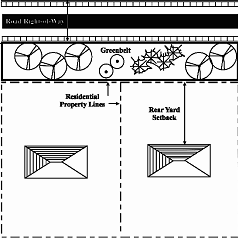
All nonresidential sites shall provide a greenbelt along the front lot line within the minimum required front yard setback along each public or private street right-of-way. The greenbelt shall be landscaped with a minimum of one canopy tree, one ornamental tree, and six shrubs, rounded upward, for every forty linear feet of frontage. The planning commission may approve substitution of evergreen trees for up to fifty percent of the required trees.
2.
All residential subdivisions, condominiums and multifamily developments shall provide a twenty-foot deep greenbelt along all public road frontages that form the exterior boundary of the development. For subdivisions and site condominiums, the greenbelt may be an easement over the lots, provided the required setbacks for individual lots shall be measured from the greenbelt. The greenbelt shall be landscaped with a minimum of one canopy tree, one evergreen tree, one ornamental tree, and six shrubs, rounded upward, for every forty linear feet of frontage.
3.
Greenbelts shall not be required within the VCA district, provided the street tree requirements contained in Chapter 18.07, Village Center Area District are met.
C.
Required Buffer Zones. The following buffer zones shall be required where a proposed use shares a common lot line with an adjacent use. Buffer zones shall apply in addition to the obscuring wall requirements of Section 18.13.050. The buffer zone required and the required landscaping therein shall be as described in Tables 14.02 and 14.02.B.
Table 14.02
Buffer Zone Required
Table 14.02.B
Requirements for Buffer Zones
1.
The planning commission may waive buffer zone requirements between adjacent compatible uses where the district allows a lesser or zero side yard setback or a reduction in parking lot setbacks where shared access and circulation is provided between uses.
D.
Parking Lot Screening.
1.
Parking lots which are visible from a public right-of-way (excluding a public alley) shall have the following landscaping between the parking lot and right-of-way:
a.
A landscaped strip of at least ten feet in width.
b.
One tree for every forty feet or fraction thereof of street frontage to the parking lot.
c.
A hedgerow planted with two-foot tall evergreen shrubs spaced two and one-half feet on center, or a three-foot tall masonry wall or berm.
2.
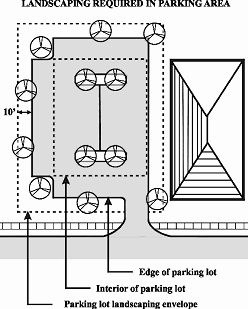
Off-street parking areas containing ten or more parking spaces shall be provided with landscaping at the rate of one canopy tree and one hundred square feet of landscaped area per ten parking spaces.
a.
A minimum of one-third of the trees shall be placed on the interior of the parking area and the remaining may be placed surrounding the parking lot within ten feet, as illustrated.
b.
The landscaped areas shall be located in a manner that breaks up the expanse of paving throughout the parking lot.
c.
There shall be at least one deciduous tree for each one hundred square feet or fraction thereof of interior landscaped area. Each individual landscaped area shall contain at least one tree.
3.
All landscaped areas shall be protected by a raised standard or rolled concrete curb, except where landscape islands are being utilized as part of a stormwater detention or conveyance system.
E.
Required Detention/Retention Pond Landscaping. Detention/retention ponds shall be landscaped to provide a natural setting in open space areas.
1.
Where possible, ponds or basins shall be "free form" following the natural shape of the land to the greatest practical extent. Side slopes shall not exceed one foot vertical for every four feet horizontal.
2.
One deciduous shade or evergreen tree and ten shrubs shall be planted for every fifty linear feet of pond perimeter as measured along the top of the bank elevation. The required trees and shrubs shall be planted in a random pattern or in groupings. The placement of required landscaping is not limited to the top of the pond bank if the plant species is adapted to saturated soil conditions.
3.
Detention and retention ponds shall be landscaped in character with properties and shall be required to provide lawn areas, shrubs and trees to accomplish a suitable appearance compatible with development on the property and on nearby properties. Landscaping shall be required on all areas disturbed by grading to establish detention/retention ponds.
F.
Residential Street Trees.
1.
For all new one- and two-family residential dwelling construction, one street tree for every fifty feet of street frontage shall be provided for each lot or parcel.
2.
Existing trees within street rights-of-way or trees in the front yard that meet size requirements may be utilized as street trees.
3.
The trees shall be provided within the front yard on each lot or site condominium development for one-family residential projects. For detached or attached condominium projects, the trees shall be provided within the front yard area of the units. Where the installation of trees is deferred until after construction of housing units, the city shall require a performance guarantee for tree planting. Landscaping shall be required within cul-de-sacs, road medians and at development entrances.
G.
Plant Material Spacing and Size.
1.
Where plant materials are placed in two or more rows, plantings shall be staggered.
2.
Evergreen trees shall not be less than eight feet in height. When planted informally, they shall be spaced an average of twenty feet on center. When planted in rows, they shall be spaced an average of twelve feet on center.
3.
Narrow evergreen trees shall not be less than five feet in height. When planted informally, they shall be spaced an average of ten feet on center. When planted in rows, they shall be planted an average of five feet on center.
4.
Shrubs shall not be less than thirty inches in height. When planted informally, they shall be spaced an average of six feet on center. When planted in rows, they shall be spaced an average of four feet on center.
5.
Spreading shrubs shall not be less than thirty inches in spread. They shall be planted an average of four feet on center.
6.
Large deciduous trees shall not be less than two and one-half inches in caliper. The landscape plan shall also note the tree's diameter at breast height (DBH), measured at a height of fifty-four inches. When placed informally, they shall be planted an average of thirty feet on center.
7.
Small ornamental trees shall not be less than two inches in caliper. The landscape plan shall also note the tree's DBH, measured at a height of fifty-four inches. When planted informally, they shall be spaced an average of fifteen feet on center.
H.
Plant Material Species.
1.
A mixture of plant materials (evergreen and deciduous trees and shrubs) is suggested in all landscape plans as a protective measure against disease and insect infestation. All landscape nursery stock must be native to the state of Michigan.
2.
Plant materials recommended as part of landscape plans within the city are listed in Table 14.02.C.
Table 14.02.C
Recommended Plant Materials
3.
Plant materials prohibited within the city are listed in Table 14.02.D.
Table 14.02.D
Prohibited Plant Materials
I.
Installation and Maintenance Provisions.
1.
The landscape plan submitted with the site plan shall include a cost estimate for all plant material. At the time of issuing a building permit, a performance guarantee shall be provided for the landscaping shown on the site plan. The city shall retain the performance guarantee for two years to ensure that the landscaping either survives the first growing season or is replaced.
2.
All landscaping shall be maintained in a healthy, neat and orderly state free from refuse and debris. Any dead or diseased plants shall be removed and replaced within six months.
3.
Landscaped areas shall be covered by grass, living ground cover or mulch.
4.
Irrigation shall be provided for all landscaped areas.
5.
Trees required on the site plan must be maintained to remain in compliance with the site plan. Unhealthy vegetation must be replaced. Required landscaping shall not be removed unless approved as a site plan amendment.
6.
Landscaping shall be installed such that, when mature, it does not obscure traffic signs, fire hydrants, lighting, drainage patterns on site or adjacent properties, or obstruct vision for safety of ingress or egress.
7.
Property owners shall be responsible for maintaining the lawn area and any landscaping within the road right-of-way that abuts the lot's frontage in good condition, including any road ditch.
J.
Landscape Planting Plan Review and Field Inspection.
1.
Whenever plantings are required in this title, a plan for planting and landscaping shall be provided showing materials, their locations, spacing, size and number as required by this section and other sections.
2.
In developments providing open space such as multiple housing developments, open space subdivisions and cluster housing developments, a plan for landscaping shall include the development proposals for the open space as well as proposals for planting.
3.
Review fees for landscaping and planting plans shall be charged to the applicant in accordance with fees established from time to time by resolution of the city council.
4.
Upon completion of landscape improvements and planting, the applicant shall notify the city and request a field inspection by the city.
5.
Field inspection fees for review of landscape improvements and planting shall be charged to the applicant in accordance with fees established from time to time by resolution of the city council.
K.
Waiver from Landscaping and Screening Requirements. During site plan review, the planning commission may determine that existing landscaping or screening intended to be preserved is adequate. The planning commission may also determine that dimensional conditions unique to the parcel would prevent development of off-street parking area landscaping, greenbelts or buffer zones. If such a determination is made, the planning commission may waive, in whole or in part, the landscaping provisions of this section. Criteria which shall be used when considering a waiver shall include, but shall not be limited to:
1.
Existing natural vegetation and trees;
2.
Topography;
3.
Existing and proposed building placement;
4.
Building heights;
5.
Adjacent land uses;
6.
Distance between land uses;
7.
Dimensional conditions unique to the parcel;
8.
Traffic sight distances.
L.
There may be instances or situations where the city may determine that trees regulated under Chapter 17.12, Woodlands, have been or will be removed, and the planting of trees under Chapter 18, Landscaping Requirements, is not possible due to site limitations. In such instances, funds in lieu of tree planting shall be paid into the city tree fund by the landowner in an amount established by the city council.
(Ord. 08-05 § 1 (part), 2008)
(Ord. No. 2016-03, § 2, 6-28-2016)
18.14.030 - Sidewalks and nonmotorized pathways.
A.
Sidewalks shall be provided on all major thoroughfares, including state trunklines, arterials and collector roads, unless payment, in lieu of construction as determined by the city engineer, has been provided.
B.
Sidewalks and bike paths shall be constructed in accordance with Chapter 12.04, Sidewalks and Bike Paths, of the Wixom Municipal Code and the Wixom master bike path plan as follows:
1.
Concrete paved sidewalks not less than five feet wide shall be required in all subdivisions, site condominium and cluster housing developments, and planned unit developments within the city.
2.
Concrete paved sidewalks shall be required along all access drives in multiple-family developments.
C.
Crosswalks shall be provided at arterial and collector street crossings and shall be delineated with white pavement markings as specified by the city.
(Ord. 08-05 § 1 (part), 2008)
18.14.040 - Lighting regulations.
A.
Photometric Plan. All site plans submitted must be accompanied by a photometric plan, prepared by a licensed engineer or qualified lighting specialist, and containing the following information:
1.
Lighting plan showing light fixture locations and type designations.
2.
Photometric plan showing horizontal luminance levels in a point-by-point format with contour lines. Canopy lighting will also be included in luminance levels.
3.
Lighting equipment specifications and data sheets.
4.
Any other presentations required to convey the intent of the design.
B.
Lighting Intensity.
1.
Lighting shall not exceed one-half footcandle at a residential lot line.
2.
Light shall not exceed one footcandle at a nonresidential lot line, except along the street frontage.
3.
The maximum light level on the site shall be ten footcandles.
4.
Additional lighting intensity for canopies may be allowed by the planning commission where it is determined necessary for safety reasons, provided it is recessed into the canopy and does not exceed twenty-two footcandles anywhere underneath.
C.
Lighting Uniformity. The uniformity ratio between the average and minimum illumination within the developed portion of the site containing buildings, drives and parking lots shall not exceed four to one. Lighting levels may be reduced to a uniformity ratio of not more than ten to one after midnight, or after established hours of operation.
D.
Light Fixtures.
1.
All fixtures shall be metal halide or LED.
2.
Outdoor lighting in all zoning districts shall be directed toward and confined to the ground areas of lawns or parking lots except as noted elsewhere in this section and shall not cause glare on adjacent properties.
3.
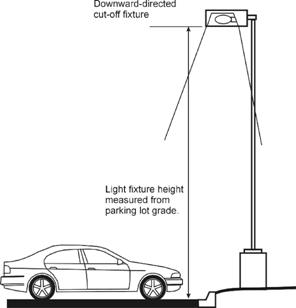
Lighting shall utilize cutoff fixtures that are recessed sufficiently such that the light source is not visible from off site.
4.
Bollard lights are permitted to light driveways and pedestrian areas. Floodlight type fixtures shall not be permitted except for building accent and sign lighting.
E.
Fixture Height.
1.
Light fixtures shall have a maximum height of twenty feet within three hundred feet of a residential district.
2.
Light fixtures shall have a maximum height of thirty feet where more than three hundred feet from a residential district.
F.
Building Lighting.
1.
All lighting in nonresidential districts used for the external illumination of buildings, so as to feature said buildings, shall be placed and shielded so as not to interfere with the vision of persons on adjacent highways or adjacent property. The planning commission may approve decorative light fixtures as an alternative to shielded fixtures when it can be proven that there will be no off-site glare and the proposed fixtures will improve the appearance of the site.
2.
Luminous tube and exposed bulb fluorescent lighting is prohibited as an architectural detail on all buildings, including along the roof line, eaves and around windows. The planning commission may approve internally illuminated architectural bands when it can be shown that the treatment will enhance the appearance of the building or is necessary for security purposes.
G.
Signs. Illumination of signs shall be directed or shielded downward so as not to interfere with the vision of persons on the adjacent highways or adjacent property.
H.
Constant Light. All illumination of signs and any other outdoor feature shall not be of a flashing, moving or intermittent type. Artificial light shall be maintained stationary and constant in intensity and color at all times when in use.
I.
Entrance Lighting. Lighting shall be provided to illuminate commercial driveways for traffic safety.
(Ord. 08-05 § 1 (part), 2008)
18.14.050 - Waste receptacles.
A.
Scope. The regulations of this section shall apply to all uses that have their refuse removal needs serviced by collective refuse containers.
B.
Location.
1.
Waste receptacles, including dumpsters with enclosures, shall be located in the rear yard or nonrequired side yard, unless otherwise approved by the planning commission.
2.
For nonresidential uses adjoining a residential district, the waste receptacle enclosure shall be as far as practical, and in no case be less than twenty feet away from any adjacent residential district.
3.
Waste receptacles shall be easily accessed by refuse vehicles without potential to damage automobiles parked in designated parking spaces or interfering with the normal movement of vehicles on or off the site.
4.
The waste receptacle must be oriented to not directly face a street or driveway, unless approved by the planning commission.
C.
Enclosure Materials and Screening Required.
1.
All waste receptacles, including dumpsters and compactors, must be enclosed on three sides with a six-foot high masonry enclosure with exterior finish matching the primary building materials of the principal building on the site.
2.
All waste receptacles, associated enclosures and receptacle contents must be screened from public view.
3.
Supplemental landscaping to screen the waste receptacle enclosure shall be provided.
4.
The enclosure shall also include a gate, made of wood or other high quality material, as determined by the planning commission, on the fourth side. If the waste receptacle is a dumpster it must have an enclosing lid or cover.
D.
General.
1.
The waste receptacle base shall be at least nine feet by six feet in area, constructed of six inches of reinforced concrete pavement.
2.
The base shall extend six feet beyond the waste receptacle pad or gate to support the front axle of a refuse vehicle.
3.
Posts, bollards or bumpers shall also be provided to protect the enclosure from damage.
4.
The shared use of receptacles shall be allowed by adjoining businesses where sharing will not create a health or safety concern and where it does not result in the accumulation of visibly excessive quantities of waste. Necessary shared use agreements are required.
(Ord. 08-05 § 1 (part), 2008)
18.14.060 - Mechanical equipment.
Any mechanical equipment or utilities and similar equipment associated with a commercial, industrial or other nonresidential use, including water and gas meters; elevator housings; stairways; tanks; heating, ventilation and air conditioning equipment; electrical transformers; television, telephone and cable cabinets; and other similar equipment, shall comply with the following standards:
A.
Roof-Mounted Equipment Screening.
1.
All roof-mounted equipment shall be screened by a solid wall or architectural feature that is constructed of the same material and is compatible in appearance with the principal building.
2.
Roof-mounted equipment shall not exceed a height of ten feet above the surrounding roof surface.
B.
Ground-Mounted Equipment. All ground-mounted equipment shall be screened by a solid wall, fence or landscaping. Landscaping must create a continuous screen with the starting size of the plant material equal to or greater than the height of the equipment at the time of planting.
C.
Building-Mounted Equipment. All building-mounted equipment for multiple-family residential developments and for any nonresidential use shall be screened with landscaping, a solid wall or architectural feature, or integrated into the design of the building.
D.
Residential Buffering. In a nonresidential district, ground-mounted mechanical equipment shall not be located within twenty feet of any residential district. Where adjacent to any residential district, all roof-mounted mechanical units must be set back a minimum of twenty feet from the side of the building facing the residential district and screened using solid architectural materials. Noise from mechanical equipment shall not exceed sixty decibels as measured at the residential property line.
(Ord. 08-05 § 1 (part), 2008)
18.14.070 - Cluster mailboxes.
Where provided, cluster mailboxes containing over eight mailboxes must comply with the following:
A.
Location. The location of the mailboxes shall not cause conflict between pedestrian and vehicular traffic. In addition, the mailboxes shall be integrated into the overall site plan, the site's architecture and other site elements.
B.
Access. Access to cluster mailboxes shall be provided by a parking lane located between the mailboxes and the adjacent street. The parking lane shall be constructed as an extension of the street and be a minimum of seven feet in width for a length of at least twenty-four feet in addition to tapers before and after the mailbox location as specified by the city engineer.
C.
Screening. Landscaping or a decorative enclosure may be required by the planning commission on the backside of the mailbox clusters to help integrate the structure into the overall site layout.
(Ord. 08-05 § 1 (part), 2008)

