
Wixom City Zoning Code
CHAPTER 18
03 - RESIDENTIAL DISTRICTS
Sections:
18.03.010 - Intent.
A.
R-1, R-2, R-3 and R-4 One-Family Residential Districts. The R-1, R-2, R-3 and R-4 one-family residential districts are intended to provide for an environment of one-family detached dwellings in a quiet neighborhood setting along with other residentially related facilities which serve the residents in the district. The districts provide for a range of low to moderate density one-family residential dwellings to meet the housing needs for various residents, and provide a range of housing prices.
B.
RM-1 and RM-2 Multiple-Family Residential Districts. The RM-1 and RM-2 multiple-family residential districts are designed to provide sites for multiple-family dwelling structures, and related uses, which will generally serve as zones of transition between the nonresidential districts and lower-density one-family districts. The multiple-family residential districts are further provided to serve the needs for various age groups, income levels and lifestyles.
C.
These residential districts are intended to achieve the following:
1.
Provide for future residential development that is of a density and character that is compatible with adjoining, existing neighborhoods.
2.
Distinguish between levels of residential density in order to promote a mixture of lot sizes, neighborhood design, housing types and income levels.
3.
Ensure that new residential development possesses the important elements of a quality neighborhood such as sidewalks, street trees, access to parks and recreation, and prominent front entryways to homes.
4.
Link new neighborhoods to existing neighborhoods through connecting street and sidewalk systems that offer a consistent streetscape theme.
5.
Accommodate open space for active and passive recreation in neighborhoods.
6.
Facilitate innovative neighborhood design, open space preservation and high-quality neighborhoods.
7.
Enforce zoning, building code, and property maintenance standards to ensure that the condition of housing units does not deteriorate thereby preserving investment and maintaining the desirability of neighborhoods.
(Ord. 08-05 § 1 (part), 2008)
18.03.020 - Schedule of uses.
Use and development of land and buildings shall only be for the following specified uses, unless otherwise provided for in this title. Land and/or buildings in the districts indicated at the top of Table 3.02 may be used for the purposes denoted by the following abbreviations:
P: Permitted Use: Land and/or buildings in this district may be used for the purposes listed by right.
SLU: Special Land Use: Land and/or buildings in this district may be used for this purpose by obtaining Special Land Use approval when all applicable standards cited in Chapter 18.18, Special Land Use Review Requirements and Procedures and specific standards of Section 18.03.040 are met.
NP: Not Permitted: The use is not permitted in the district.
Requirement: Provides reference to additional requirements or conditions applicable to that specific use.
Table 3.02
Schedule of Uses
(Ord. 08-05 § 1 (part), 2008)
18.03.030 - Residential dwelling units.
All one-family residential dwelling units shall be subject to building permit requirements and review by the building official based upon the following requirements:
A.
Dwelling units shall conform to all applicable city codes and ordinances. Any such local requirements are not intended to abridge applicable state or federal requirements with respect to the construction of the dwelling.
B.
If the dwelling unit is a manufactured home, the manufactured home must either be: (1) new and certified by the manufacturer or appropriate inspection agency as meeting the Mobile Home Construction and Safety Standards of the U.S. Dept. of Housing and Urban Development, as amended, or any similar successor or replacement standards which may be promulgated, or (2) used and certified by the manufacturer and/or appropriate inspection agency as meeting the standards referenced in subsection (B)(1) of this section, and found, on inspection by the building official, to be in excellent condition and safe and fit for residential occupancy.
C.
Dwelling units shall be permanently attached to a perimeter foundation. In instances where the applicant elects to set the dwelling on piers or other acceptable foundations which are not at the perimeter of the dwelling, then a perimeter wall shall also be constructed. The perimeter wall shall be constructed of durable materials and shall also meet all local requirements with respect to materials, construction and necessary foundations below the frost line. The perimeter wall shall also provide an appearance which is compatible with the dwelling and other homes in the area. Any such home shall be anchored by an anchoring system approved by the city.
D.
Dwelling units shall be provided with an exterior building width to depth and depth to width ratio that does not exceed three to one, or is in reasonable conformity with the configuration of dwelling units on adjacent properties or in the surrounding residential neighborhood. All dwelling units shall have minimum width and depth dimensions of twenty feet each.
E.
Dwelling units shall have a roof with a minimum four to twelve pitch and minimum eight-inch eave, and with a gutter drainage system that will collect and concentrate the discharge of storm water or snow away from the sides of the dwelling. The roof shall have wood shake, asphalt or other acceptable shingles, and meet the snow load standards for southern Michigan. The roof pitch requirement may be waived by the building official for specific architectural styles that do not typically have pitched roofs, such as modernistic or international style buildings.
F.
The dwelling unit shall contain storage capability in a basement located under the dwelling, in an attic area, in closet areas, or in a separate structure of standard construction similar to or of better quality than the principal dwelling, which storage area shall be equal to ten percent of the square footage of the dwelling or one hundred square feet, whichever is less.
G.
Dwelling units with habitable basements, whether finished or unfinished, shall provide escape windows that meet the city building code.
H.
Bars shall not be put over windows and doors that are visible from the street.
(Ord. 08-05 § 1 (part), 2008)
18.03.040 - Specific standards applicable to uses.
Uses allowed in the residential districts shall be subject to meeting the following specific requirements applicable to that use:
A.
Raising and Keeping of Horses and Other Livestock. The raising and keeping of horses and other livestock shall be permitted where there is a minimum of three acres for the first animal and one acre for each animal thereafter. The animals shall not be housed within one hundred feet of a property line of a platted subdivision lot or within one hundred feet of a dwelling on any adjoining unplatted parcel.
B.
Roadside Stands for the Sale of Garden Produce Raised on the Premises. The raising of garden produce for sale on the premises may be permitted, provided a zoning permit is obtained from the building official. Permits shall be issued for one year periods subject to yearly renewal, provided structures or buildings are properly maintained. Buildings and structures for which permits are not renewed shall be dismantled as directed by the building official. Building permits shall be issued for any structures or buildings. Buildings, structures, and displays shall not be located in the public road right-of-way.
C.
Churches and Other Places of Worship. Churches, and other similar places of worship and other facilities normally incidental thereto; provided that the uses do not meet the definition of "large-scale churches," shall be subject to the following requirements:
1.
Off-street parking spaces and drives or aisles shall not be located within twenty feet of the front lot line, which shall be landscaped as a greenbelt meeting the requirements of Section 18.14.020. Off-street parking spaces and drives or aisles shall not be located within twenty feet of a side or rear lot line when such lot line abuts a residential district. This minimum setback area shall be landscaped as a buffer zone meeting the requirements of Section 18.14.020.
2.
Principal buildings shall have a setback of at least fifty feet.
3.
All accessory buildings shall have a setback of at least fifty feet from any residential district unless such district is occupied by an existing use other than a dwelling.
4.
Storage of buses, trucks and maintenance equipment shall be entirely within a totally enclosed building.
5.
There shall be no outside loudspeaker or amplified sound outside of a totally enclosed building, except for church bells, call to prayer or other similar purpose.
D.
Colleges, Universities, and other such Institutions of Higher Learning. Colleges, universities and other institutions of higher learning offering courses in general, technical or religious education, public or private, and not operated for profit, shall be permitted provided all buildings are setback a minimum of eighty feet from all lot lines.
E.
Recreational Areas, Recreation Centers and Clubs. Private noncommercial recreational areas, institutional or community recreation centers, and nonprofit swimming pool clubs shall be subject to the following requirements:
1.
The site for a recreational use that is intended to serve areas beyond the immediate residential neighborhood of residents shall have at least one property line abutting a major thoroughfare as designated on the city of Wixom master plan.
2.
Front, side and rear yards shall be at least eighty feet.
3.
Off-street parking shall be provided so as to accommodate not less than one-half of the member families and/or individual members. The planning commission may approve a reduction in the off-street parking requirements in those instances where it is specifically determined that the users will originate from the immediately adjacent areas and will, therefore, be pedestrian or other justification for reduced parking. Prior to the issuance of a building permit or zoning compliance permit, bylaws of the organization shall be provided in order to establish the membership involved for computing the off-street parking requirements. In those cases wherein the proposed use or organization does not have bylaws or formal membership, the off-street parking requirement shall be determined by the planning commission on the basis of usage.
4.
All swimming pools shall be provided with a protective fence four feet in height and entry shall be provided by means of a controlled gate.
F.
Golf Courses. Golf courses, which may or may not be operated for profit, shall be subject to the following requirements:
1.
All principal and accessory buildings shall be set back a minimum of two hundred feet from any property line abutting residentially zoned lands, provided that where topographic conditions are such that buildings would be screened from view, the planning commission may reduce this requirement.
2.
Fairways and driving ranges shall be oriented in such a manner and set back a sufficient distance to prevent golf balls from being hit outside the perimeter of the golf course.
3.
All swimming pools shall be provided with a protective fence four feet in height and entry shall be provided by means of a controlled gate.
G.
Adult Foster Care Facilities. A copy of the state of Michigan license shall be submitted to the city with the special land use application. A copy of the license should be predominately displayed on the premises. The licensee shall immediately notify the city of any change in, or loss of, the license.
H.
Group Day Care Homes. Group day care homes shall be subject to the following requirements:
1.
An on-site drive shall be provided for drop-offs/loading. This drive shall be arranged to allow maneuvers without affecting traffic flow on the public street.
2.
There shall be a fenced, contiguous open space with a minimum area of one thousand five hundred square feet provided on the same premises as the group day care home. The required open space shall not be located within a required front yard.
3.
A copy of the state of Michigan license shall be submitted to the city with the special land use application. A copy of the license should be predominately displayed on the premises. The licensee shall immediately notify the city of any change in, or loss of, the license.
I.
Adult Day Care Homes. Day care homes for elderly adults shall be subject to the following requirements:
1.
Not more than twelve persons, other than the full-time occupants of the dwelling, may be cared for in any one dwelling.
2.
Certification shall be provided from the Michigan Association of Day Care Providers to ensure safety and quality of care.
3.
The facility shall not provide nursing or medical care.
J.
Senior Housing, Nursing Homes and Convalescent Homes. Independent senior housing including senior apartments and condominiums, and dependent senior housing including assisted living, nursing homes and convalescent homes for seniors, shall be subject to the following requirements:
1.
Independent senior housing and senior apartments may be developed in a multiple-family or cluster housing form with full facilities for self-sufficiency in each individual unit. A community center for this overall development may be provided.
2.
Senior assisted living housing shall be developed in a multiple-family housing form with central dining facilities provided as a basic service to each unit. A community center for the overall development shall be provided to support recreational and social activities.
3.
The following minimum requirements shall be provided for the senior housing types permitted in subsections (J)(1) and (J)(2) of this section:
Table 3.04
Senior Housing Requirements
4.
Personal service uses such as a dry cleaning pickup station, beauty shop, barbershop or similar use for the exclusive service to residents of a complex may be allowed in RM-2 and VCA districts within a housing development. In no instance shall such service use be provided with direct access to a street for the use of the public in general, it being the purpose of this provision to allow such use to only be provided as a convenience to occupants of the complex in which such service is located. No signs of any nature shall be visible from outside the building in which the use is located.
K.
Medical Marihuana Home Occupations/Recreational Marihuana.
1.
Intent and Purpose. On November 4, 2008, Michigan voters approved a ballot initiative that legalized medical marihuana, and on December 4, 2008, Michigan's Medical Marihuana Act, MCL 333.26421, et seq. (MMMA) took effect allowing both patients and/or their caregivers to cultivate medical marihuana within an enclosed, locked facility in order for those individuals to be entitled to the MMMA protections.
The Stille-Derossett-Hale Single State Construction Code Act, MCL 125.1501, et seq. allows a local unit of government to legally adopt and enforce the State Building Code at the local level. The purpose of the building code is to enforce public health, safety, and welfare by protecting life and property from all hazards related to the design, erection, repair, removal, demolition, or use and occupancy of buildings, structures or premises. This is in relation to structural strength, adequate egress facilities, sanitary equipment, light and ventilation, and fire safety. Building permits are required when construction or alteration of a structure is in order where a patient or a caregiver has made alterations to a structure to support the cultivation of marihuana.
The city is taking these steps to curtail problems associated with insufficient or improper electrical supplies, problems with ventilation leading to mold, offensive odors, other health hazards and/or other hazards that are associated with the cultivation of marihuana in structures, particularly in residential settings.
The Michigan Zoning Enabling Act, MCL 125.3101, et seq. (MZEA), provides the city with statutory authority to regulate land use within the city through its Zoning Ordinance. The Michigan Supreme Court in the recent case of DeRuiter v Byron Township, 505 Mich 130 (2020), found that a city's zoning ordinance that geographically restricted such caregiver marihuana cultivation to a particular zoning district did not directly conflict with the MMMA, and the township had the authority under the MZEA to require zoning permits and permit fees for the use of buildings and structures within its jurisdiction.
This article is intended to permit those persons in need of marihuana for medicinal purposes allowed under the MMMA to be afforded a reasonable opportunity to be treated, and for those persons who are permitted to furnish medical marihuana, to furnish it within the limitations of the MMMA and MZEA, and the geographical restrictions imposed by the zoning ordinance in order to protect the public health, safety, and welfare.
This article is also intended to recognize the rights of individuals twenty-one years of age and older to use, possess, store, consume, process or cultivate marihuana (referred to collectively as the "use of recreational marihuana") in their residence in accordance with the as provided in the Michigan Regulation and Taxation of Marihuana Act (MRTMA), MCL 333.27952, et seq., as amended.
This article is further intended to protect and preserve the public health, safety, and welfare of the city, the quality of life and stability of property values, including, but not limited to, the value of residential districts.
2.
The acquisition, possession, cultivation, use, delivery or distribution of marihuana to treat or alleviate a debilitating medical condition, and the use of recreational marihuana, is permitted as a home occupation in the R-1, R-2, R-3, and R-4 Districts in compliance with the MMMA and the following:
a.
Medical marihuana for registered qualifying patients or the use of recreational marihuana by an individual twenty-one years or older. Registered qualifying patients, or visiting qualified patients, and individuals twenty-one years or older, may use, possess, cultivate, and store medical marihuana as provided in the MMMA, as amended, and recreational marihuana as provided in the Michigan Regulation and Taxation of Marihuana Act (MRTMA), MCL 333.27952, et seq., as amended, and as further regulated herein.
(1)
A registered qualifying patient (medical marihuana) and individuals twenty-one years of age or older (recreational marihuana):
i.
May use, possess, cultivate and store marihuana in their principle residence within the city for personal use only, and shall comply at all times and in all circumstances with the MMM or the MRTMA, as applicable, and the general rules of the Michigan Community Health or the Michigan Department of Licensing and Regulatory Affairs, as they may be amended from time to time.
ii.
May only cultivate marihuana for him/herself in compliance with the MMMA or the MRTMA, as applicable, on property zoned R-1, R-2, R-3, or R-4, in an enclosed locked facility, inaccessible on all sides and equipped with locks or other security devices that permit access only by the registered qualifying patient and the individual twenty-one years or older residing in the home.
iii.
All necessary building, electrical, plumbing, and mechanical permits shall be obtained for any alterations or any portion of the structure in support of or in association with the cultivation of marihuana.
iv.
The storage of any chemicals, such as herbicides, pesticides, and fertilizers shall be subject to inspection and approval by the City of Wixom Building Department.
v.
The separation of a plant resin from a marihuana plant by butane extraction or any other method that utilizes a substance with a flash point below one hundred degrees Fahrenheit, in any public place, a motor vehicle, inside a residential structure, or the curtilage of a residential structure is prohibited.
vi.
If a room with windows is utilized as a marihuana cultivation location, any lighting methods that exceed usual residential levels between the hours of eleven p.m. and six a.m. shall employ shielding methods, without alteration to the exterior of the residence or dwelling unit, to prevent ambient light spillage that causes or creates a distraction or nuisance to adjacent residential properties.
vii.
If the registered qualifying patient, or individual twenty-one years or older is not the owner of the premises, then written and notarized consent must be obtained from the property owner to ensure the owner's knowledge of the use of the premises as permitted under this section, and the registered qualifying patient and individual twenty-one years or older shall maintain written proof that the use of the property under this section is approved by the property owner. The premises in this subparagraph shall be the principal residence of the registered qualifying patient or individual twenty-one years or older.
viii.
No person other than the registered qualifying patient, or individual twenty-one years or older residing in the home, shall be engaged or involved in the growing, processing or handling of marihuana.
ix.
Use of the registered qualifying patient's residence for medical marihuana or the use of an individual twenty-one years or older' s residence for recreational marihuana shall be clearly incidental or subordinate to its use for residential purposes. Any modifications to the dwelling unit for the purpose of cultivating medical or recreational marihuana shall comply with all applicable building, electrical, mechanical and fire safety code requirements, including all requisite permit applications and related inspections. No part of an accessory building, detached garage, pole barn, or similar building or structure shall be used for the growing process or for distribution of medical or recreational marihuana unless such building or structure has been inspected and approved for the building, electrical, mechanical, and fire safety requirements of such use and fits the definition of an enclosed, locked facility.
x.
No equipment or process shall be used in growing, processing, or handling medical or recreational marihuana which creates noise, vibration, glare, light, fumes, odor, or electrical interference detectable to the normal senses at or beyond the property line of the registered patient's or individual over the age of twenty-one's residential property. In case of electrical interference, no equipment or process shall be used that creates visual or audible interference with any radio, television, or similar receiver off the premises or causes fluctuation of line voltage off the premises.
xi.
The registered qualifying patient, individuals over the age of twenty-one, and the owners, agents, and employees of the property which marihuana for personal or medical use is present are responsible jointly and severally for compliance with this section.
b.
A registered primary caregiver, operating in compliance with the MMMA and applicable rules, may be permitted as a home occupation, only in accordance with the following standards and requirements:
(1)
Medical marihuana home occupations are not permitted in multiple-family developments. Cultivation or other medical use of marihuana as a medical marihuana home occupation is limited to single-family, detached dwellings located in the R-1, R-2, R-3, or R-4 districts.
(2)
A registered primary caregiver operating a medical marihuana home occupation must not be located within one thousand feet of any school, childcare facility, community center, youth center, playground, public or private library, housing facility owned by a public housing authority, and place of worship as measured from the outer most boundaries of the lot or parcel on which the medical marihuana home occupation and restricted facility is located.
(3)
The home occupation shall not be located within five hundred feet of another registered caregiver.
(4)
Not more than one primary caregiver within a single dwelling unit shall be permitted to serve qualifying patients.
(5)
The use of the dwelling unit for the home occupation shall be clearly incidental and subordinate to its use for residential purposes by its occupants, and not more than twenty-five percent of the total square footage of the residence, including the basement and garage area, shall be used for the purposes of the home occupation. The home occupation shall be carried out completely within the confines of such dwelling. No accessory building, attached or detached, shall be used in the home occupation.
(6)
Except for lighting, heating, watering, drying, or other equipment, or fertilizers, herbicides, or other chemicals directly related to the medical use of marihuana, no other materials or equipment not generally associated with normal ownership, use, and maintenance of the dwelling shall be permitted.
(7)
A qualifying patient shall not smoke or consume marihuana at the dwelling of the primary caregiver marihuana.
(8)
If marihuana is grown or located in a room with windows, all interior lighting shall be shielded to prevent ambient light from creating a distraction for adjacent properties.
(9)
If the primary caregiver is not the owner of record of the dwelling in which a registered primary caregiver of medical marihuana is functioning as a home occupation, the primary caregiver must gain written and notarized consent from the owner to use the dwelling for the medical marihuana home occupation. At any time, the city may request proof that the primary caregiver has consent from the property owner to use the dwelling for a medical marihuana home occupation. The premises in this subparagraph shall be the principal residence of the primary caregiver.
(10)
To ensure compliance with all applicable requirements and laws, the portion of the structure, such as a cultivation room, where energy use and heating requirements exceed typical residential limits and chemical storage occurs, it is subject to inspection and approval by the building official, fire marshal, or other authorized city officials.
(11)
The property, dwelling, and all enclosed lot facilities shall be available for inspection upon request by the building official, fire marshal, or other authorized officials.
(12)
The registered primary caregiver is responsible for utilizing an enclosed, locked facility compliant with the MMMA for cultivating, growing, manufacturing, processing and storing marihuana for medical use only. The enclosed, locked facility utilized by the primary registered caregiver shall provide separation by fully enclosed walls, or fences, or for plants that are grown on behalf of each registered qualifying patient, on whose behalf the registered primary caregiver is furnishing marihuana for medical use, so it is accessible only to the primary caregiver and registered patient. The processing and storing of medical marihuana is permitted only by registered primary caregivers and registered qualifying patients.
(13)
The registered primary caregiver may grow up to the maximum of seventy-two plants, but no more than twelve plants for each individual registered qualifying patient as set forth in the MMMA.
(14)
The registered primary caregiver is responsible for providing the security necessary to ensure the growing marihuana and usable product are accessible for use only by the registered primary caregiver for transfer to, only to registered qualifying patients, who are registered to the registered primary caregiver, and must fully comply with the provisions of the MMMA.
(15)
A certificate of occupancy is required and must be obtained from the city before the primary caregiver establishes the home occupation or provides any services to a registered qualifying patient. marihuana.
(16)
The consumption, transfer, or use of marihuana in public, or place open to the public, is prohibited.
3.
It is unlawful to establish or operate a for-profit or non-profit marihuana dispensary, collective, or cooperative within the city, even if such use is intended for the medical use of marihuana.
4.
Medical marihuana provisioning centers, safety compliance facilities, dispensaries, cooperatives, marihuana establishments, and any other operation or facility similar in nature are specific prohibited within the city.
L.
Home Occupations Other Than Medical Marihuana Home Occupations. Any use which is customarily conducted entirely within a dwelling and carried on by the inhabitants thereof, which use is clearly incidental and secondary to the use of the dwelling for dwelling purposes, and does not change the character thereof, is permitted. No article or service may be sold or offered for sale on the premises, except as such is produced by such occupation and shall not require internal or external alterations or construction features, machinery, outdoor storage, or signs not customary in residential areas. Any modifications to the dwelling made for the purpose of a home occupation shall comply with all applicable building, electrical, mechanical, and fire safety code requirements, including all requisite permit applications and related inspections. One non-illuminated name plate, not more than two square feet in area, may be attached to the residence, which shall contain only the name and occupation of the resident of the premises. No persons other than a full-time resident residing on the premises shall be engaged in a home occupation. No home occupation shall be allowed if the traffic to be generated by such home occupation is in excess of that normally associated with single-family residential use. Clinics, doctor offices, dentist offices, hospitals, kennels, millinery shops, beauty parlors, and other similar uses shall not be deemed to be a home occupation.
1.
Home occupations that create the following conditions shall not be permitted:
a.
Changes the outside appearance of the dwelling or is visible from the street.
b.
Generates traffic, parking, sewerage or water use in excess of what is normal in the residential neighborhood.
c.
Creates noise, vibration, glare, fumes, odors or results in electrical interference, or becomes a nuisance.
d.
Results in outside storage or display of anything including signs.
e.
Requires the employment of anyone in the home other than the dwelling occupant.
f.
Requires exterior building alterations to accommodate the occupation.
g.
Occupies more than twenty-five percent of the ground floor area of the dwelling and may not occupy a detached accessory building.
h.
Requires parking for customers that cannot be accommodated on the site and/or not exceeding one parking space at curbside on the street.
i.
Requires the delivery of goods or the visit of customers before six a.m. and after eight p.m.
2.
The following are permitted home occupations, provided they do not violate any of the provisions of the previous paragraph:
a.
Dressmaking, sewing and tailoring.
b.
Painting, sculpturing or writing.
c.
Telephone answering.
d.
Home crafts, such as model making, rug weaving and lapidary work.
e.
Tutoring, limited to a maximum of four students at a time.
f.
Computer application, not including sale of computers.
g.
Salesperson's office or home office of a professional person.
h.
Laundering and ironing, with outdoor drying of clothing prohibited.
i.
Repair of clocks, instruments or other small appliances which do not create a nuisance due to noise, vibration, glare, fumes, odors or results in electrical interference.
j.
Barber shops, beauty shops and similar personal service establishment, limited to one operator.
k.
Other home occupations similar to the above.
3.
Any proposed home occupation that is not specifically permitted by subsection K.2 of this section shall be considered a special land use and be granted or denied upon consideration of those standards contained in subsection K.1 of this section and under the procedures specified in Section 18.18.020.
4.
Home occupation permits shall be limited to the applicant who legally resides in the residence.
M.
Garage Sales. Garage sales or yard sales shall be permitted as an accessory use on a residential lot, provided a permit is obtained from the city and the total time of all garage sales shall not exceed fourteen days within a calendar year.
N.
Bed and Breakfast Inns. Bed and breakfasts shall be subject to the following requirements:
1.
Bed and breakfast operations as a subordinate use to one-family dwelling units are subject to city licensing provisions.
2.
Such dwellings shall meet all applicable codes and ordinances of the city, county and state.
3.
Floor plans drawn to scale of all floors to be utilized for bed and breakfast activities shall be submitted to the city.
4.
Buildings shall be suitable in character for the use proposed and shall not be cause for a change in character of the neighborhood.
5.
The dwelling shall have not more than six sleeping rooms available for guests of the bed and breakfast dwelling.
6.
There shall be no separate cooking facilities provided for the bed and breakfast occupants. Meals, other than those served as a part of the normal operation of the household, shall be served only to occupants of the bed and breakfast facility.
7.
Approved smoke detectors/alarms shall be provided in individual sleeping units and in common hallways.
8.
Emergency egress lighting to assure continued illumination for a duration of not less than one hour in case of emergency or primary power loss.
9.
An approved fire extinguisher in the common hallway accessible to all occupants.
10.
Every sleeping unit shall have at least one operable window approved for emergency egress or rescue, except where the sleeping unit is provided with a door to a corridor having access to two remote exits in opposite directions.
11.
Occupancy shall be of a transient nature for periods not to exceed one week in duration in any one month by any transient occupant. A guest registry indicating name, address, phone number, and vehicle license number, shall be kept indicating dates of arrival and departure of guests and shall be available to the city for inspection upon request.
12.
An unlit sign not exceeding six square feet in area may be provided. Such sign may be provided as a ground sign or a wall sign, except in the VCA district, where the sign must be a wall sign.
13.
Off-street parking shall be provided based upon one space for each rental room and one space for the operator of the facility. It is the city's intent to not encourage yards to be destroyed, landscaping removed, or the integrity of the neighborhood altered to provide parking. In those instances where parking requirements cannot be met, the applicant may request special consideration from the planning commission. In such a case the applicant shall submit an analysis of parking required and parking provided within a three-hundred-foot radius of the subject parcel. After analyzing this data, the planning commission may lower the number of the required parking spaces based on the fact that sufficient off-street parking exists in the neighborhood.
(Ord. 08-05 § 1 (part), 2008)
(Ord. No. 2021-02, § 1, 4-27-2021)
18.03.050 - Height and placement requirements.
Table 3.05 delineates the height, bulk, and setback requirements pertaining to the zoning districts regulated by this chapter. Notes to the schedule of regulations follow.
Table 3.05
Schedule of Residential Regulations
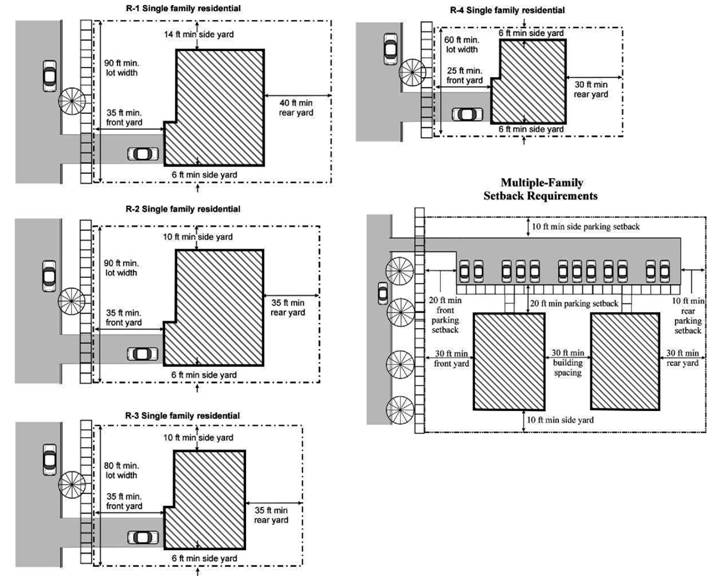
A.
Density. Maximum density shall be based upon the number of units per net buildable acre of the site. The following factors shall be utilized in determining the net buildable area of the site:
1.
Land within the one hundred-year floodplain and regulated wetlands shall be calculated at twenty-five percent toward the total net buildable site acreage (i.e., four acres of wetland equals one net buildable acre).
2.
All submerged land below the ordinary high-water mark of a lake, creek, or stream and public rights-of-way shall be excluded from the net area calculation.
B.
Condominium Developments. One-family detached condominiums in condominium subdivisions shall meet all minimum requirements and standards of the district in which such dwellings are to be constructed, including minimum floor area requirements. Where condominiums are developed without individual site condominium lots, the number of dwelling units per gross acre shall not exceed the following:
1.
R-1: 2.0 dwelling units per gross acre;
2.
R-2: 2.2 dwelling units per gross acre;
3.
R-3: 2.6 dwelling units per gross acre;
4.
R-4: 4.5 dwelling units per gross acre.
C.
Recreational Area. Areas and facilities for recreation purposes shall be provided as follows:
1.
All land area provided for recreation space may be used in computing dwelling unit density and shall be provided and developed in accordance with Table 3.05.B. Land area shall be provided and developed for recreation purposes in all subdivisions, condominiums and multiple dwelling projects as follows:
a.
One-Family Developments. A minimum of one thousand square feet of land area per dwelling unit.
b.
Multiple-Family Developments. A minimum of four hundred square feet of land area per dwelling unit.
Table 03.05.B
Required Recreational Area
2.
The planning commission, in its review of the site plan, may modify recreational improvement requirements in those instances where it can be shown that equally appropriate recreation facilities are to be provided in place of specific improvements designated in Table 3.05.B.
3.
The homeowners association or development owner shall be responsible for the maintenance of the recreational facilities.
D.
Open Space Plan. See Section 18.03.070 regarding flexibility allowances.
E.
Institutional and Recreational Building Setbacks. For all uses permitted other than residential, the setback shall equal the height of the main building or the setback required in this section, whichever is the greater.
F.
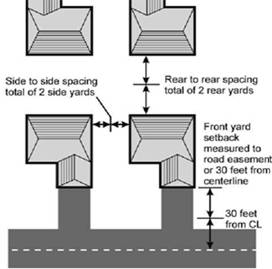
Condominium Setbacks. Where condominiums are developed without individual site condominium lots, the minimum yard setbacks shall be measured as the combined total of the setbacks between adjacent units.
1.
The spacing between sides of units shall be the total of both side yard setbacks combined.
2.
The spacing between two back-to-back units shall be the total of both rear yard setbacks combined.
3.
The front yard setback shall be measured from the road right-of-way or easement. With a private road that does not have a minimum sixty-foot wide easement, the front yard setback shall be measured from the sidewalk along the street. Where sidewalks are not present, the setback shall be measured from a distance of thirty feet from the centerline of the street.
G.
Corner Lot Front Yard Setback. There shall be maintained a required front yard setback on each street side of a corner lot. No accessory building shall project beyond the front yard line on either street. All regulations applicable to a front yard shall apply to both front yards of a corner lot. Both frontages shall be designed as front facades with windows or utilize side entry garages.
H.
Stream Setback. All structures shall be a minimum of twenty feet from each side of Norton Creek and any other stream or established county drain unless a greater setback is required in this chapter.
I.
R-4 Setbacks. Any new principal dwelling built after the effective date of the ordinance codified in this title shall provide a six-foot side yard setback. Existing dwellings with five-foot side yard setbacks shall be permitted to continue, provided any additions shall be setback six feet from the side lot line.
J.
Multiple-Family Building Setbacks. The setback requirements indicated in Table 3.05 shall be measured from the perimeter of the overall site or development. Parking lots shall be set back a minimum of twenty feet from the front lot line and ten feet from the side, and rear lot lines. Setbacks internal to the site shall be as follows:
1.
There shall be at least thirty feet between any two multiple-family or senior housing buildings and at least twenty feet between buildings containing duplexes, townhouses or attached one-family residential units.
2.
A minimum twenty-foot setback from all internal roads, drives and parking areas shall be provided for multiple-family or senior housing buildings; duplexes; townhouses; and attached one-family residential units.
3.
Individual unit driveways shall have a minimum length of twenty feet between the building and a sidewalk for the parking of a vehicle without blocking the sidewalk.
K.
Multiple-Family Storage Areas. All multiple-family dwelling units shall contain utility storage capability for such things as bicycles, sports equipment, barbecues, etc., in a basement located under the dwelling unit, in an attic area, in the living areas, not including clothing closet or in an accessory structure of standard construction similar to or of better quality than the principal dwelling. Such storage area shall be equal to ten percent of the square footage of the dwelling unit or one hundred square feet, whichever is less. An enclosed garage may be utilized to achieve this requirement.
(Ord. 08-05 § 1 (part), 2008)
18.03.060 - Development requirements.
A.
Improvements. All residential developments, including one-family subdivisions, condominiums and multiple-family, shall be provided with improvements for streets and utilities as provided in the city's subdivision regulations contained in Title 16 and in the ordinance establishing engineering design standards for subdivisions and project improvements.
B.
Site Plans. Site plans shall be submitted as provided for in Chapter 18.17, Site Plan Review Requirements and Procedures.
C.
Access. All access to the site shall be in accordance with Section 18.15.050.
D.
Utilities. Assurance shall be given that adequate utility services necessary to the development of the entire property will be provided. Utilities shall be located along the rear of the lot, except where the building official determines that utilities may not be located in the rear yard. Where utilities must be located in the front or side yard, landscape screening shall be provided for utility boxes. Any new utility lines shall be installed underground.
(Ord. 08-05 § 1 (part), 2008)
18.03.070 - Clustered open space development.
A.
Intent. The intent of the clustered open space development is to promote the following objectives:
1.
Provide for moderate density development of residential areas and thereby assist an overall city effort to provide for efficiency of city services, a reduction of transportation needs, and to provide a more desirable living environment by preserving the natural character of open fields, stands of trees, streams, wetlands, hills and similar natural assets.
2.
Encourage a more creative approach in the development of residential areas.
3.
Assure the permanent preservation of natural, social, cultural and/or historic resources.
4.
Encourage a more efficient, aesthetic and desirable use of open area while recognizing a reduction in development costs and allowing the property owner to preserve natural features on the site.
5.
Encourage the provision of open space within reasonable distance to all lot development of the subdivision and to further encourage the development of recreational facilities.
B.
Eligibility Criteria. To be eligible for clustered open space development consideration, the applicant must present a proposal for a residential development that meets all of the following:
1.
A clustered open space development shall result in a recognizable and substantial benefit, both to the residents of the property and to the overall quality of life in the city. The benefits can be provided through site design elements in excess of the requirements of this chapter, such as extensive landscaping, unique site design features, preservation of woodlands and open space, particularly along major thoroughfares or lakes, buffering development from wetlands and provision of buffers from adjacent residential.
2.
The site shall preserve significant natural features such as woodlands, significant views, natural drainage ways, regulated or nonregulated wetlands, or natural corridors that connect quality wildlife habitats which would be in the best interest of the city to preserve and which might be negatively impacted by conventional residential development.
3.
The clustered open space development shall be designed to create a cohesive neighborhood through a network of spaces such as parks and common open space areas for recreation and resident interaction. All open space areas shall be equally available to all residents of the development.
4.
The site shall be under single ownership or control, such that there is a single person or entity having proprietary responsibility for the full completion of the project. The applicant shall provide sufficient documentation of ownership or control in the form of agreements, contracts, covenants, and/or deed restrictions that indicate that the development will be completed in its entirety as proposed.
5.
The clustered open space development shall be consistent with and further the implementation of the city of Wixom master plan.
C.
Density.
1.
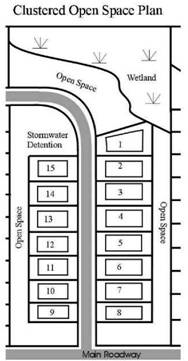
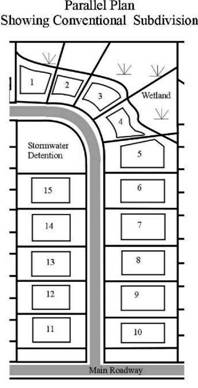
Residential density shall be determined by a parallel plan that illustrates how the site could be developed as a conventional subdivision with the underlying zoning district, meeting all applicable city zoning and subdivision requirements. Lots on the parallel plan shall meet the dimensional requirements required by Section 18.03.050, except in the R-1 district, the parallel plan shall be based upon eighteen thousand square foot lots. The parallel plan shall be submitted with the clustered open space development that contains all information required for a preliminary plat. The city shall review the design and determine the number of lots that could be feasibly constructed with a conventional subdivision. This number shall be the maximum number of dwelling units allowable for the open space cluster development.
2.
The city council shall have the discretion to grant a density bonus of up to twenty-five percent, based upon the recommendation of the planning commission, for projects that meet the following requirements:
a.
The amount of open space and usable recreational land provided is at least fifty percent more than the minimum requirement (i.e., thirty percent of the site must be open space and fifteen percent of the site must be usable recreation area).
b.
The project will create a walkable neighborhood with a continuous pedestrian circulation system that links all areas of the development, links the development to other destinations in the surrounding area and is designed to facilitate a variety of transportation choices by providing alternatives to automobile travel.
c.
The project takes advantage of compact design through clustering of development into a walkable scale neighborhood.
d.
The development will preserve significant open space and natural features.
D.
Dimensional Standards. All lots shall comply with the dimensional standards of the underlying zoning district, provided the lot area and width may be reduced in order to preserve a minimum of twenty percent of the total net site area as common open space (thirty percent with a density bonus) meeting the requirements of subsection F of this section.
1.
All setback and other dimensional standards of Section 18.03.050 for the underlying zoning district shall be complied with. The site plan shall clearly illustrate the building envelopes for the dwellings and potential decks in accordance with Section 18.13.030. The planning commission may allow a reduction in setbacks for yards adjoining open space or to allow for clustering of dwelling units.
2.
The attaching of one-family dwelling units, one to another, may be permitted when the homes are attached by means of a common party side wall.
a.
No other common party wall relationship is permitted and the number of units attached in this manner shall not exceed four.
b.
Each unit shall have individual entrances.
c.
The units shall meet all other setback requirements of the underlying zoning.
d.
The spacing between the sides of groups of buildings shall be equal or greater than the combined total of two side yards required by Section 18.03.050.
3.
The zoning board of appeals shall have no authority to grant variances to a clustered open space development site plan or any conditions placed by the city council. The zoning board of appeals shall have the authority to hear and decide appeal requests by individual lot owners for variances following final approval of the clustered open space development, provided such variance does not contradict the requirements of this section or any conditions placed on the approval of the clustered open space development.
E.
Subdivision Requirements. The layout of the clustered open space development shall comply with the requirements of the subdivision regulations of the city (codified in Title 16). The site shall provide for interconnection of roads and the future integration of circulation between adjacent sites. All landscaping and nonmotorized pathway requirements of Chapter 18.14, General Site Development Requirements shall be met.
F.
Open Space. A minimum of twenty percent of the total site area (thirty percent with a density bonus) shall be preserved as common open space for recreation or conservation and shall be exclusive of residential lots, road rights-of-way, stormwater detention ponds, required greenbelts, minimum building setbacks or other improvements. The open space shall be arranged on the site to meet all of the following requirements, provided the planning commission may modify these standards where it is demonstrated that additional natural features will be preserved elsewhere on the site:
1.
At least one-half of the minimum required open space area, shall be usable upland that shall be improved to provide active or passive recreational use. Open bodies of water such as lakes, rivers, streams and ponds over five acres shall not be included in open space area calculations, but wetlands may be used to satisfy up to one-half of the minimum required open space area.
2.
All wetlands and streams shall be preserved as open space.
3.
Open space shall be located to minimize removal of woodlands.
4.
A twenty-five-foot open space setback shall be provided from all floodplains, wetlands and streams.
5.
Open space will be designed to include recreational trails, picnic areas, parks and greenways. The planning commission may permit recreational buildings within the open space. Golf courses may be permitted, provided the area of the golf course may not be used to satisfy the twenty percent minimum open space requirement.
6.
Access shall be provided to areas dedicated for open space for those lots not bordering on such open space by means of streets or pedestrian access ways.
G.
Open Space Protection. The dedicated open space shall be set aside by the developer through an irrevocable conveyance in a form approved by the city, such as: recorded deed restrictions, covenants that run in perpetuity with the land, or conservation easements. The conveyance shall assure that the open space will be protected from all forms of development and shall never be changed to another use.
1.
Where deed restrictions are utilized for the protection of open space, the restrictions applicable to the open space shall not be amended. Final approval by the city council shall not be granted until the deed restrictions protecting the open space are recorded with the Oakland County Register of Deeds and copies are filed with the city.
2.
A preservation and maintenance plan for the open space shall be submitted with the final preliminary plat or final condominium plan and shall include mechanisms for the long-term funding of open space preservation. The city may require performance guarantees or other funding mechanisms to ensure long-term maintenance of open space. Measures for protection of open space shall be put in place prior to issuance of any building permits.
3.
Signs shall be posted by the developer delineating protected wetlands and conservation areas.
H.
Approval Process.
1.
Tentative Preliminary Plat or Site Plan.
a.
A tentative preliminary plat or site plan shall be submitted for review and recommendation by the planning commission and approval by the city council.
b.
The tentative preliminary plat or site plan shall include all information as required in the city subdivision regulations, codified in Title 16, for a tentative preliminary plat, plus the following additional information:
i.
An aerial photograph of the entire site and all areas within one hundred fifty feet of the site, taken not more than one year prior to the date of the application.
ii.
A second parallel development plan that shows the number of dwelling units that could be developed on the site with a conventional subdivision for the purpose of determining base density.
iii.
Location and definition of function of both developed and undeveloped open spaces. Layout of recreational facilities shall be included on developed open spaces.
iv.
Outline and depiction of major wooded areas and wetlands, and description of the means to be employed to preserve them.
v.
Total site acreage and percent of total project in various uses, including developed and preserved open space.
vi.
Total site density and density of detached and attached dwellings and percent of ground area covered by buildings.
vii.
A table of the required modifications or deviations to the regulations which are otherwise applicable to the site.
c.
The planning commission shall conduct a public hearing on the tentative preliminary plat or site plan. The planning commission shall review the plan and make a recommendation for approval or denial to the city council. Notice of the public hearing shall be in accordance with Section 18.21.110.
d.
If the proposal meets the requirements of this title and the subdivision regulations of the city (codified in Title 16), the planning commission shall recommend approval of the tentative preliminary plat or site plan to the city council along with any conditions upon which approval should be based. If the proposal does not meet the requirements of this title, or the planning commission finds that approval of the proposal would be detrimental to existing development in the general area and should not be approved, the planning commission shall recommend denial to the city council along with the reasons therefore in the minutes of the planning commission. Notice of recommendation of approval or disapproval of the proposal together with copies of all layouts and other relevant information shall be forwarded to the city clerk.
e.
The city council shall review the action of the planning commission together with relevant material submitted by the applicant. The city council may take action to approve or disapprove the tentative preliminary open space plan or may refer such plan back to the planning commission with direction for further review. The city council may also take concurrent action on any tentative preliminary plat or tentative preliminary condominium plan.
2.
Reasonable conditions may be required with approval of a clustered open space development for the purpose of ensuring that public services and facilities affected by a proposed land use or activity will be capable of accommodating increased service and facility loads caused by the land use or activity, protecting the natural environment and conserving natural resources, ensuring compatibility with adjacent uses of land, promoting the use of land in a socially and economically desirable manner, and further the implementation of the city of Wixom master plan.
3.
Final Preliminary Plat or Site Plan.
a.
After approval of a tentative preliminary plat or site plan, the final preliminary plat or site plan shall be submitted for planning commission review and recommendation to the city council. The following shall be submitted for planning commission review and recommendation to the city council:
i.
The final preliminary open space cluster development shall meet all requirements of the plan that was tentatively approved and meet all requirements for a final preliminary plat in the subdivision regulations of the city (codified in Title 16).
ii.
Copies of all necessary county and state approvals shall also be submitted to the city.
iii.
Copies of draft conservation easements, deed restrictions, protective covenants, master deeds, bylaws or other legal mechanisms to protect open space areas shall be submitted with the final preliminary plan.
iv.
Copies of all easement documents in recordable form, as specified by the city.
b.
If the final preliminary plat or site plan is recommended for approval by the planning commission, the plan shall be submitted to the city attorney for the preparation of agreements setting forth the conditions upon which the approval is based, the applicant's acceptance of the conditions and long-term maintenance of the open space. The agreement shall be finalized and approved by the city council prior to city council approval of the final preliminary site plan.
c.
As a condition for the approval of the final preliminary clustered open space plan, the applicant shall deposit a performance guarantee in the amount of the estimated cost of the proposed improvements to the open land guaranteeing the completion of such improvements within a time to be set by the city. Performance guarantees shall be placed in escrow and returned to the applicant upon satisfactory completion of work, as specified in Section 18.21.100.
d.
Detailed construction plans shall be submitted to the city for engineering review and approval prior to commencement of any construction or site grading.
e.
Actual development of the open space shall be carried out concurrently with the construction of other improvements to serve the dwelling units. The city will require landscape improvement for the entire site frontage where such site abuts public streets as an initial site improvement even though such frontage is not part of an early stage of project development. The developer shall also be responsible for landscaping the right-of-way to the road curb along the site frontage. Development of the open space and installation of all the required landscaping must be completed prior to issuance of the final certificate of occupancy for the project.
4.
Final Approvals. Final approvals shall follow procedures for approval of final plats or final condominiums, as applicable. In the case of a subdivision plat, final plats shall be submitted for approval by the city council in accordance with the subdivision regulations of the city (codified in Title 16). In the case of a condominium, final condominium as-built plans and Exhibit B drawings shall be submitted for approval by the city council in accordance with Section 18.17.070, condominium developments. The open space improvements shall be completed prior to final certificates of occupancy being granted for more than fifty percent of the dwelling units.
(Ord. 08-05 § 1 (part), 2008)

