
Wyoming City Zoning Code
ARTICLE 7
- SIGNS2
Editor's note— Ord. No. 20-08, adopted January 5, 2009, amended art. XXIII in its entirety to read as herein set out. Former art. XXIII consisted of §§ 90-791—90-811 and pertained to similar subject matter. See Code Comparative Table for amendatory history.
Sec. 90-700.- Purpose.
The purpose of this article is to regulate signs within the City of Wyoming. The regulations and standards of this article are intended to be content neutral and are considered the minimum necessary to achieve a substantial government interest for public safety, aesthetics, and protection of property values. These objectives are accomplished by establishing regulations concerning the size, placement, construction, illumination, and other aspects of signs in the city so as to:
(1)
Protect the public right to receive messages and information protected by the First Amendment of the U.S. Constitution;
(2)
Recognize that the principal intent of commercial signs is for identification of an establishment on the premises, and not for advertising off-premises activities;
(3)
Recognize that the proliferation of signs unduly distracts motorists and non-motorized travelers, reduces the effectiveness of signs directing and warning the public, causes confusion, reduces desired uniform traffic flow, and creates potential for accidents;
(4)
Prevent signs that are potentially dangerous to the public due to structural deficiencies or disrepair;
(5)
Enable the public to locate goods, services and facilities without excessive difficulty and confusion by restricting the number and placement of signs;
(6)
Preserve and improve the atmosphere of the city by encouraging signs of consistent size and/or nature which are compatible with and complementary to related buildings and uses, and harmonious with their surroundings; and
(7)
Regulate portable commercial signs in recognition of their significant negative impact on traffic safety and aesthetics.
(Ord. No. 20-08, § 1, 1-5-09; Ord. No. 1-11, § 1, 2-7-11)
Sec. 90-701. - Definitions.
The following words, terms and phrases, when used in this article, shall have the meanings ascribed to them in this section, except where the context clearly indicates a different meaning:
Accessory sign: A sign that pertains to the use of the premises on which it is located.
Animated sign: A sign which uses lights, moving parts, or other means to depict action, create an image of a living creature or person, or create a special effect or scene.
Awning: A roof-like structure attached to the side of a building that is intended to provide shelter from the elements over a doorway, window or other parts of a building façade. An awning may or may not be designed to be retractable, generally consists of thin or nonrigid materials and is generally fashioned upon a metal structure that is not an integral part of the building.
Awning sign: A sign which is painted on, printed on, or attached flat against the surface of an awning, including any writing, representation, symbol, logo or any other figure or similar character intended to be part of the display. The presence of any of the above shall cause the entire awning structure to be considered an awning sign.
Back-lit sign: A sign illuminated by an internal light source or lighting behind the sign lettering. An example of a back-lit sign is a ground sign that is illuminated by several fluorescent bulbs located within the sign cabinet.
Banner sign: A sign made of fabric, cloth, paper, or other taut material that is typically not enclosed in a frame. A ground-mounted banner is attached to a pole, frame or fence or any other similar device. A wall-mounted banner is attached to a building. Nongovernmental flags shall be considered banners.
Billboards: See "off-premises advertising sign."
Community special event sign: A temporary sign announcing a specific event of interest to the general public sponsored by a public, quasi-public, civic, religious, or nonprofit organization.
Construction sign: A sign that identifies the owner, lender, contractor, architect, and/or engineer associated with a project under construction.
Directional sign: A sign, typically installed at the driveway opening, to direct traffic flow, regulate traffic operations, and provide information to motorists entering and exiting a site in conformance with the Michigan Manual of Uniform Traffic Control Devices.
Erect: To build, construct, attach, hang, place, suspend or affix.
Flashing sign: A sign that contains an intermittent or sequential flashing light source.
Freestanding sign: A sign attached to the ground by means of a base or pole.
Front-lit signs: A sign illuminated by an external light source. An example of a front-lit sign is a ground sign that is illuminated by a spotlight located in front of and directed toward the sign.
Gasoline price sign: A sign that is used to advertise the price of gasoline. In the event that the brand identification sign is attached to or is a part of the sign advertising price, that portion of the sign used for advertising price shall be considered the gasoline price sign.
Ground sign: A three-dimensional, base-mounted freestanding display sign, that is supported by uprights or braces in or upon the ground surface or mounted on a base, and consisting of two or more sides extending up from the base, and upon which a message, business, group of businesses or center name is affixed.
Illegal sign: A sign which does not meet the requirements of this article and which has not received legal nonconforming status.
Incidental sign: A small sign, emblem, or decal informing the public of goods, facilities, or services available on the premises. Examples of incidental signs include credit card signs, signs indicating the hours of business, no smoking signs, signs used to designate bathrooms, and signs providing information on credit cards and business affiliations.
LED: Light-emitting diode (LED) utilizing technology of diodes arranged in pixels to create narrow spectrum light, sometimes called electroluminescence.
Mansard: A slope roof or roof-like facade.
Manual changeable copy sign: A sign on which the message is changed manually through the manipulation of individual letters.
Marquee: A permanent roof-like structure or canopy, supported by and extending from the face of the building, generally constructed to be an integral part of the building.
Menu board (options board): A freestanding sign oriented to the drive-through lane for a restaurant or other business offering drive-through services that advertises the merchandise or services available, and which has no more than 20 percent of the total area of the sign utilized for business identification. The sign may also incorporate a speaker for ordering items.
Moving sign: A sign in which the sign itself or any portion of the sign moves or revolves. A "rotating sign" is a type of moving sign. Such motion does not refer to the method of changing the message on the sign. Moving signs include any sign which has any visible moving parts, visible revolving parts, visible mechanical movement, or other visible movement achieved by electrical, electronic, or mechanical means, including intermittent electric pulsations or movement caused by normal wind current.
Moving image sign: An electronic changeable message sign that includes the presentation of text, animation, pictorials and graphics that are displayed, or are capable of being displayed, in a progression of frames which give the illusion of motion, including, but not limited to, the illusion of moving text or objects, moving patterns or bands of light, or expanding or contracting shapes. This does not include signs that indicate only time, temperature or date, or a flashing sign as herein defined.
Mural: A design or representation which is painted or drawn on the wall of a structure and which does not advertise a business, product, service, or activity.
Nameplate: An on-premises identification sign giving only the name, address, and/or occupation of an occupant or group of occupants.
Neon sign: A sign consisting of glass tubing, filled with a gas such as neon, which glows when electric current is sent through it.
Nonconforming sign:
(1)
A sign that is prohibited under the terms of this article, but was erected lawfully and was in use on the date of enactment of this article, or amendment thereto; or
(2)
A sign that does not conform to the requirements of this article, but for which a variance has been granted.
Obsolete sign: A sign that advertises a product that is no longer made or that advertises a business that has closed.
Off-premises advertising sign: A sign that contains a message unrelated to a business or profession conducted or to a commodity, service, or activity sold or offered upon the premises where such sign is located. A "billboard" is a type of off-premises advertising sign.
On-premises advertising sign: A sign that contains a message related to a business or profession conducted or to a commodity, service, or activity sold or offered upon the premises where the sign is located.
Parapet: The extension of a false front or wall above a roof line. Signs mounted on the face of a parapet shall be considered wall signs.
Pedestrian sign: A temporary sign, including by way of example, placards, sandwich boards or costumes held or worn by a person, displayed to passing motorists along major streets, and calling attention to a business, product, service, or event.
Pole sign: A type of freestanding sign that is elevated above the ground on poles or braces and not attached to any building or other structure.
Political sign: A sign expressing a political opinion or message or relating to matters to be voted on in a local, state, or national election or referendum.
Primary sign: A sign which has as its principal purpose the advertisement of the use or business conducted on the property.
Projecting sign: A sign other than a flat wall sign that is affixed to a building or structure, any part of which extends perpendicular more than 12 inches beyond the building wall.
Public sign: A sign erected in the public interest by or upon orders from a local, state, or federal public official. Examples of public signs include: legal notices, safety signs, traffic signs, memorial plaques, signs of historical interest, and similar signs.
Real estate sign: An on-premises temporary sign which makes it known that real estate upon which the sign is located is for sale, lease, or rent.
Real estate development sign: A temporary sign that is designed to promote the sale or rental of lots, homes, or building space in a real estate development (such as a subdivision or shopping center) that is under construction on the parcel on which the sign is located. The sign may also identify the designer, contractors and subcontractor, and material suppliers participating in construction on the property on which the sign is located.
Roof line: The top edge of a roof or building parapet, whichever is higher, excluding cupolas, pylons, chimneys, or similar minor projections.
Roof sign: A display sign that is erected, constructed and maintained above the parapet or the roof line of a building.
Secondary sign: A sign on the same property as a primary sign that serves a secondary purpose other than advertising the business or service conducted on the property.
Sign: Any device, structure, fixture, or placard which uses words, numbers, figures, graphic designs, logos or trademarks for the purpose of informing or attracting the attention of persons. Unless otherwise indicated, the definition of "sign" includes interior and exterior signs which are visible from any public street, sidewalk, alley, park, or public property, but not signs which are primarily directed at persons within the premises upon which the sign is located.
Sloping roof sign: A sign mounted on a mansard roof or other roof surface that exceeds 45 degrees in angle relative to horizontal and which is not erected, constructed or maintained above the roof line of a building.
Streamers and pennants: A long narrow line of material, comprised of numerous small flags or strips of material, of various shapes and sizes and used for ornamentation and/or attraction. String lights shall not be considered streamers or pennants.
Surface: The part of the sign upon, against or through which the message is displayed or illustrated.
Temporary sign: A display sign, banner or other advertising device not constructed or intended for long-term use constructed of cloth, canvas, paper, fabric or other light temporary material, with or without a structural frame, intended for a limited period of display.
Trailer sign: A sign of light construction capable of being moved from one location to another usually (but not always) mounted to a chassis with wheels, used for directing attention to a business, commodity, service or entertainment that is conducted, sold or offered on the premises.
Vehicle sign: A sign painted or mounted on the side of a vehicle, including signs on the face of a truck trailer.
Wall sign: A display sign attached parallel to and extending not more than 12 inches from the wall of a building. Painted signs, signs which consist of individual letters, cabinet signs, and signs mounted on the face of a mansard roof or parapet shall be considered wall signs. Permanent signs which are not affixed directly to a window or are positioned next to a window so that they are visible from the outside shall also be considered wall signs.
Window sign: A sign located in or on and affixed to a window, which is intended to be viewed from the outside.
(Ord. No. 20-08, § 1, 1-5-09; Ord. No. 1-11, § 2, 2-7-11)
Sec. 90-702. - Scope of requirements.
It shall be unlawful for any person, firm, or corporation to erect, repair, alter, relocate or maintain on any property within the city any sign, except in conformance with the provisions of this article, subject to issuance of a permit, except as otherwise provided herein.
(Ord. No. 20-08, § 1, 1-5-09)
Sec. 90-703. - Exempt signs.
The following signs are specifically exempt from the permit requirements of this article, provided such signs are outside of the public street right-of-way and are located to ensure adequate sight distance:
(Ord. No. 20-08, § 1, 1-5-09; Ord. No. 1-11, § 3, 2-7-11)
Sec. 90-704. - Prohibited signs.
Unless otherwise permitted elsewhere in this article, the following signs are prohibited in all districts:
TABLE 90-704: PROHIBITED SIGNS
Any sign not expressly permitted.
Balloons exceeding 24 inches in diameter or other inflated advertisements, or any structure held erect or partially erect by stationary or moving air, except those less than 24 inches in diameter specifically permitted in [Table] 90-708-4.
Flags, except that a flag of any nation, government or political subdivision is permitted, not exceeding 60 square feet in area, except as specifically permitted in [Table] 90-708-4.
Flashing or intermittent lighting, except moving image signs, as permitted in this article.
Illegal signs. Any sign unlawfully installed, erected, or maintained.
Moving signs, except moving image signs, as permitted in this article.
Obsolete signs.
Projecting signs.
Roof signs, not including sloping roof signs.
Signs on public property without express permission of the city, including signs mounted to power poles, etc.
Signs that obstruct access. Signs which obstruct free access or egress from any building.
Signs that confuse traffic.
(1)
Any sign that makes use of the words "stop", "look", or "danger", or any other words, phrases, symbols, or characters, in such a manner as to interfere with, mislead, or confuse traffic.
(2)
Signs that are representations of traffic control devices or signals, such as stop signs, railroad crossings, etc.
(3)
Signs that in any way simulate or could be confused with the lighting of emergency vehicles or traffic signals; there shall be no red, yellow, or green illumination on any sign located in the same line of vision as a traffic control system, nor interference with vision clearance along any highway, street, or road or at any intersection of two or more streets.
Street furniture signs. Signs on street furniture, such as benches and trash receptacles.
String lights. String lights used for commercial purposes, other than holiday decorations between Thanksgiving and New Year's day.
Unsafe signs. Any sign or sign structure that:
(1)
Is structurally unsafe;
(2)
Constitutes a hazard to safety or health by reason of inadequate maintenance, dilapidation, or abandonment;
(3)
Is capable of causing electric shock to person who comes in contact with it; or
(4)
Is not kept in good repair, such that it has broken parts, missing letters, missing panels, or nonoperational lights or is sagging, frayed or faded.
Vehicle signs where the primary purpose of the vehicle (including any trailer) is advertisement.
(Ord. No. 20-08, § 1, 1-5-09; Ord. No. 1-11, § 4, 2-7-11)
Sec. 90-705. - General standards for permitted signs.
(1)
General provisions.
(a)
Accessory signs. All signs, except off-premises advertising signs shall advertise business transacted or goods sold or produced on the premises. All signs shall meet the requirements of this article and as required in the building code or in other ordinances of the city.
(b)
Surface of front. No nails, tacks or wires shall be permitted to protrude in or from the front of any sign. This shall not exclude, however, the use of block letters, electrical reflectors or other devices that may extend over the top and in front of the advertising structure.
(2)
Measurement of signs.
(a)
Sign area.
1.
Sign area shall be measured as the square footage of the sign face within a single, continuous perimeter composed of any straight line or geometric figure which encloses the extreme limits of writing, representation, emblem, logo, or any other figure of similar character, together with any frame or other material or color forming an integral part of the display or used to differentiate the sign from the background against which it is placed, excluding only the structure necessary to support the sign. However, for ground-mounted signs, the sign base shall be calculated as part of the sign area and for pole signs, any supports or shrouds whose width exceeds 18 inches, shall be calculated as part of the sign area.
Pole shrouds shall be painted a neutral color and may only have address numbers placed thereon.
2.
The area of a pole sign that has two or more faces shall be measured by including the area of all sign faces, except if two faces are placed back-to-back and are of equal size, and are no more than two feet apart at any point, the area of one face shall be counted as the sign area. If two back-to-back sign faces are of unequal size, the larger of the two shall be counted as the area of the sign.
3.
For buildings containing multiple tenants. When a sign consists of lettering or other sign elements printed, painted or mounted on a wall or a window, the sign area shall be measured by enclosing the edges of the sign elements (i.e. letters, logos) within a parallelogram or rectangle. The sign areas for wall signs and awning signs shall be determined by taking that portion of the wall applicable to each tenant and computing the allowable sign area for that portion of the total wall.
(b)
Sign height.
1.
The permitted height of all signs supported by the ground shall be measured from the level of the ground, finished surface, adjacent to the sign.
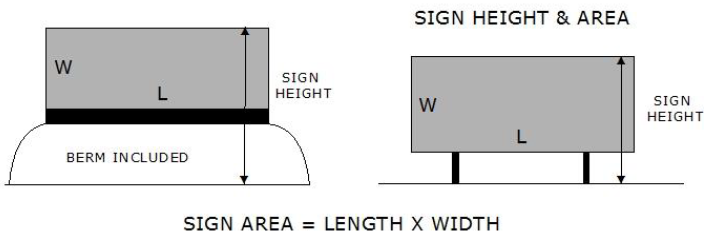
2.
Sign height shall not be measured from an area of the ground that has been built-up or constructed in a manner that would have the effect of allowing a higher sign height than permitted by these regulations (e.g. the height of signs erected on a berm shall be measured from the finished grade adjacent to the berm).
(3)
Clear vision area. No sign shall be located within, project into, or overhang the clear vision area as required in section 90-324; provided a pole sign with a post no larger than one foot in diameter shall be allowed if no part of the sign is lower than ten feet from the adjoining street level.
(4)
Design and construction standards.
(a)
Compliance with codes. Signs shall be constructed in a safe and stable manner in accordance with the city's adopted building code and electrical code. All electrical wiring associated with a freestanding sign shall be installed underground.
(b)
Screening of supports. All wall signs shall be designed so that the supporting framework is contained within or behind the face of the sign or within the building to which it is attached so as to be totally screened from view.
(c)
Clearance from utilities. All signs, including any cables, guy wires, or supports shall have a minimum clearance of four feet from any electric fixture, street light, or other public utility pole.
(d)
Anchoring of temporary signs with cement blocks, tires and other materials not an integral part of the sign design is prohibited.
(5)
Illumination.
(a)
Unless otherwise permitted, a sign shall be illuminated only by steady, stationary, shielded light sources directed solely toward the sign (i.e., front lit signs), or internal to the sign or otherwise from behind the characters (i.e., back lit signs).
(b)
The background of front lit signs may be any color, provided they are not reflective at night. However, such signs may use light reflecting lettering and messaging.
(c)
Use of glaring undiffused lights or bulbs shall be prohibited, except that bare bulbs are permitted for holiday lighting.
(d)
Illumination by bare bulbs, neon, luminous tubing or flames is prohibited. Signs shall have no exposed or flashing bulbs. Except as otherwise permitted in this article, no sign shall contain any visible moving parts or messages. All signs shall be limited to a maximum brightness of 2,000 units during daylight hours. In addition, they shall be reduced to a maximum of 500 units from one-half hour before sunset to one-half hour after sunrise. Brightness shall be measured from the sign's face at maximum illumination.
(e)
Exposed neon or LED lights are permitted, provided the neon or LED is used for lettering and/or images, but not for borders to roofs, walls, or similar architectural features.
(f)
Lights shall be shielded so as not to project directly onto adjoining properties or thoroughfares.
(Ord. No. 20-08, § 1, 1-5-09; Ord. No. 4-10, § 1, 5-17-10; Ord. No. 1-11, § 5, 2-7-11; Ord. No. 14-13, § 1, 9-3-13)
Sec. 90-706. - Signs in planned unit developments.
Signs in planned unit developments shall be subject to a sign plan attached to the site plans approved by via the planned unit development process. Where no sign plan is proposed, signs shall conform to the requirements of this article, based upon the use or uses within the approved planned unit development.
(Ord. No. 20-08, § 1, 1-5-09)
Sec. 90-707. - Specific sign requirements; residential districts.
Signs for residential and nonresidential uses in the residential districts are subject to the following:
(1)
Sign setbacks for all uses: All signs in a residential district shall be set back a minimum of five feet from any property line and shall be located so that clear vision is maintained at all intersections (see section 90-324).
(2)
Adjacent to properties within a residential district:
(a)
Nonilluminated signs: Ten feet from any side or rear property line in an adjacent residential district.
(b)
Illuminated signs: Twenty-five feet from any side or rear property line in an adjacent residential district.
(3)
Real estate development and construction signs: Real estate development signs or construction signs shall not exceed 32 square feet in area or ten feet in height. No more than one real estate development sign or construction sign shall be permitted per use. Real estate development signs and construction signs may not be illuminated.
(4)
Ground-mounted banners: One banner, a maximum of 16 square feet and 12 feet in height, shall be permitted in all residential districts, for each street entrance of a parcel. Ground-mounted banners on single-family residential lots are prohibited. Permits are not required.
(5)
Illumination of signs in residential districts: Signs for home occupations may not be illuminated.
(6)
Specific sign requirements by use: For uses in residential districts, the following signs shall be permitted, subject to the requirements of Table 90-707.
(Ord. No. 20-08, § 1, 1-5-09; Ord. No. 1-11, § 6, 2-7-11; Ord. No. 14-13, § 2, 9-3-13)
Sec. 90-708. - Specific sign requirements; nonresidential districts.
(1)
Permitted sign types.
(a)
Permanent signs. Each lot or use shall be permitted primary and secondary signs as listed in Tables 90-708 and 90-708-2. A sign permit is required for all permanent signs.
(b)
Temporary signs: See Table 90-708-4. A permit shall be required for temporary signs. Temporary signs may not be illuminated.
(c)
Window signs: See Table 90-708-2.
(2)
Specific sign requirements.
(a)
Wall signs.
1.
One wall sign per principal building, occupied by one tenant, shall be permitted per street frontage on each parcel.
2.
Multitenant building or shopping center:
a.
One wall sign shall be permitted for each tenant having an individual means of public access and shall be placed on the tenant's entry wall space.
b.
Tenants occupying a corner space in a multitenant structure shall be permitted to have one sign on each of their wall frontages.
c.
Where several tenants share a common entrance in a multitenant structure, only one wall sign shall be permitted, with the total permitted sign area being allocated among the tenants.
(b)
Awning signs. An awning sign may be provided in lieu of a wall sign. The area of an awning sign shall be considered as part of the permitted area for wall signs as shown in Table 90-708.
(c)
Sloping roof signs. A sloping roof sign may be provided in lieu of an awning or wall sign. The area of a sloping roof sign shall be the same as the permitted area for wall signs as shown in Table 90-708.
(d)
Directional signs. Directional signs are permitted as necessary to direct the public to entrances and exits, parking areas and activity areas, as approved on the required site plan. A freestanding directional sign shall not be located within the clear vision area.
(e)
Marquees. For the purposes of this article, any fascia of a marquee shall be considered a wall, and any sign affixed to a marquee shall be subject to the requirements for wall signs.
(f)
Moving image signs and time and temperature signs.
1.
Except as otherwise permitted in this article, a moving image sign or time and temperature sign shall be permitted only as a secondary sign, subject to the limitation in Table 90-708-2.
2.
Message changes may occur no less than seven seconds apart. The methods of change shall be limited to instantaneous, roll, splice, unveil, venetian, zoom and fade, as interpreted by the chief building official. Messages or images that scroll across the sign shall not be permitted.
3.
Messages may not advertise off-site locations, events or products.
(g)
Off-premises advertising signs. Off-premises advertising signs (billboards) shall only be permitted as outlined in section 90-709.
(3)
Permanent sign requirements. Each use shall be permitted the primary and secondary signs as provided in Tables 90-708 and 90-708-2.
(4)
Temporary sign requirements. Temporary signs shall be permitted in the nonresidential districts per Table 90-708-4:
Footnotes to Table 90-708-4:
(a)
In the case of maintenance or repair (e.g., roofing, windows, or siding), the maximum sign area shall be six square feet.
(b)
The temporary sign shall be set back at least five feet from any public right-of-way line, easement or private street and 25 feet from any residential district property line, and shall be placed to ensure clear sight distances at all intersections.
(c)
On a corner parcel two signs, one facing each street, shall be permitted.
(d)
Community special event signs may include ground signs and/or displays or wall signs, banners, pennants, or similar displays; the number, size and height of the sign(s) shall be subject to chief building official approval.
(e)
The total of all window signs, temporary and permanent, shall not exceed 15 percent of the total wall frontage area.
(f)
Temporary window signs that are faded, yellowed, ripped, non-taut or otherwise damaged shall be removed immediately.
(g)
Trailer sign requirements. A permit shall be obtained and placed on the sign for each week, or part thereof, that the sign is displayed. Permits may be obtained for one week or consecutive multiples thereof, except that no property shall contain temporary signs visible from the street for more than eight weeks per calendar year. After the expiration of the permit, the sign shall be removed from the property or stored in a location that is not visible from the street.
(h)
One ground-mounted banner shall be permitted per parcel for each 100 feet of frontage or portion thereof. Two additional ground-mounted banners shall be allowed by permit for up to a two-week period and up to four times annually. Ground-mounted banners shall be taut and kept in good repair, or shall be removed.
(i)
Wall banners shall comprise a maximum of 15 percent of the wall frontage area for each business served. The total wall frontage area comprised of both window signs and wall banners may not exceed 15 percent. Wall banners are permitted by permit for a maximum of 12 weeks per year. Permits may be obtained for one week, or consecutive weeks thereof. Wall banners shall be taut and kept in good repair, or shall be removed.
(j)
Streamers and pennants are allowed per parcel by permit for up to a two-week period and up to four times annually. Property owner or landlord approval is required for multiple tenant properties. Streamers and pennants shall be taut and kept in good repair or shall be removed.
(k)
A maximum of 50 balloons are allowed per parcel without permit. Additional balloon displays are permitted by permit for up to a two-week period and four times annually.
(l)
One pedestrian sign is permitted for each parcel, or up to two on multiple tenant properties, each with an annual permit. Property owner approval is required. Excessive driver distraction is prohibited and shall not constitute an unreasonable hazard to the public.
(Ord. No. 20-08, § 1, 1-5-09; Ord. No. 4-10, §§ 1, 2, 5-17-10; Ord. No. 7-10, §§ 1—3, 5-17-10; Ord. No. 1-11, §§ 7—10, 2-7-11; Ord. No. 14-13, §§ 3—5, 9-3-13; Ord. No. 15-14, §§ 8, 9, 7-21-14)
Sec. 90-709. - Off-premises advertising signs.
(1)
Off-premises advertising signs shall be located on property abutting a freeway and shall not be placed beyond 300 feet of the freeway right-of-way. A 300-foot setback shall be required from the intersection of any freeway access or egress and the intersecting street.
(2)
A drawing with specifications prepared and sealed by a registered engineer or architect of the state shall be filed with the city prior to the construction and approved for permit by the city's registered building official.
(3)
Off-premises advertising signs may be constructed to a maximum size of 672 square feet per face, provided they are located within 100 feet of a freeway right-of-way. Any off-premises advertising sign placed farther than 100 feet from the freeway right-of-way shall not exceed 300 square feet per face.
(4)
Except as noted in subsection (8)(a), below, no off-premises advertising sign structure shall be constructed closer than 750 feet to another off-premises advertising sign structure in any direction, except that no two off-premises advertising sign structures located on the same side of a freeway may be closer than 1,500 feet. Distances are to be measured along the freeway right-of- way line.
(5)
Off-premises advertising signs shall not exceed the building height restrictions for the zone where erected.
(6)
Off-premises advertising signs located adjacent to a major thoroughfare shall be at least 500 feet from any residential district.
(7)
Tri-vision off-premises advertising signs are allowed, but message changes may occur no less than seven seconds apart.
(8)
Off-premises advertising signs may incorporate an electronic message sign (EMC), subject to the following:
(a)
No permit shall be issued for an off-premise advertising sign structure utilizing digital technology unless, the permit applicant demonstrates that four nonconforming sign structures located within the city boundaries are demolished. The applicant may reduce the number of existing non-conforming signs demolished if they demonstrate that three non-conforming sign structures located within the city's form based code districts are demolished.
(b)
No off-premises LED advertising sign structure utilizing a moving image display shall be constructed closer than 2,500 feet to another off-premises LED advertising sign structure utilizing a moving image display and facing the same direction of travel.
(c)
The entire sign face shall be a moving image display and shall only convey a single product or message at any one time.
(d)
Except for the change from one display to the next, which shall be instantaneous, each individual sign display shall be stationary. No elements of the display may move, flash or scroll, except to change from one display to the next.
(e)
Displays may change no less than seven seconds apart. Each change shall be a fade from one display to the next, with the duration of the transition (fade-out/fade-in) no less than one-half of a second.
(f)
Maximum brightness of an EMC shall not exceed 0.2 foot candles above ambient light.
(g)
All signs regulated under this section shall possess and utilize automatic dimming controls set to automatically adjust to the limits defined in this section.
(h)
Owners of signs regulated under this section shall submit an initial third-party certification for each sign verifying the sign is equipped with a sensor or other device that automatically determines the ambient light and is programmed to automatically adjust according to ambient light conditions, and that the sign is programmed to comply with the 0.2 footcandle measurements.
(i)
Sign owners shall, at the city's request, provide a report from a third party testing agency documenting that the light emitted from the sign meets the minimum illumination standard defined in this section. The certified report shall be submitted within 15 days of the written request from the city. A certified report is valid for a period of 90 days. The third party testing agency shall adhere to the city's accepted procedures for testing which are provided by the building inspections Department.
(j)
In addition to the above requirements, signs allowed under this section shall be configured to default to a static display in the event of mechanical failure.
(Ord. No. 20-08, § 1, 1-5-09; Ord. No. 4-10, §§ 3, 4, 5-17-10)
Sec. 90-710. - Nonconforming signs.
Nonconforming signs are those signs that do not comply with the size, placement, construction or other standards or regulations of this article, but were lawfully established prior to its adoption. The intent of this article is to encourage eventual elimination of nonconforming signs in a timely manner. This objective is considered as much a subject of public health, safety and welfare as the prohibition of new signs in violation of this article. Therefore, the purpose of administering this article is to remove illegal nonconforming signs while avoiding any unreasonable invasion of established private property rights.
(1)
Alteration or reconstruction. A nonconforming sign shall not be altered or reconstructed, unless the alteration or reconstruction is in compliance with this article, except that nonconforming signs shall comply with the following regulations:
(a)
Repairs and maintenance. Normal maintenance shall be permitted, provided that any nonconforming sign that is destroyed by any means to an extent greater than 50 percent of the sign's pre-catastrophe fair market value, exclusive of the foundation, shall not be reconstructed. Normal maintenance shall include painting of chipped or faded signs; replacement of surface panels provided the new panels are no larger than the existing panels; or, repair or replacement of electrical wiring or electrical devices.
(b)
Nonconforming manual copy change, moving image signs and time and temperature signs. The message on a nonconforming manual copy change, moving image or time and temperature sign may be changed, provided that the change does not create any greater nonconformity.
(c)
Substitution. No nonconforming sign shall be replaced with another nonconforming sign.
(d)
Discontinuance. A nonconforming sign shall not be re-established after the activity, business, or use to which it is related has been discontinued for 90 days or longer.
(2)
Continued use of nonconforming sign structure. Any new occupant or owner of the premises shall be required either to remove or bring the sign into compliance with this article.
(Ord. No. 20-08, § 1, 1-5-09)
Sec. 90-711. - Dangerous, unsafe, abandoned and illegally erected signs.
(1)
Unsafe signs. Any sign that becomes insecure, in danger of falling, or otherwise unsafe but not considered an immediate danger by the building official to the health or safety of the public shall be removed or repaired according to the process outlined in subsection (5) below.
(2)
Dangerous signs. Any sign constituting an immediate hazard to health or safety shall be deemed a nuisance and may be immediately removed by the city and the cost thereof charged against the owner of the property on which it was installed.
(3)
Abandoned signs. Any sign that advertises a business that has been discontinued for at least 90 days or that advertises a product or service that is no longer offered shall be deemed abandoned, unless it is determined that business is temporarily suspended due to a change in ownership or management. In any case, however, if the structure remains vacant for at least six months, it shall be considered abandoned for purposes of this section. The owner or lessee of the premises shall take any one of the following alternatives relative to the abandoned sign: removal, replace the sign faces with blanks, or cover the sign faces. Any covering on a sign face shall be maintained, clean, and in good condition or the building official may require replacement of the covering, placement of sign blanks, or sign removal, as noted in subsection (5) below.
(4)
Illegally erected signs. The chief building official shall order the removal of any sign erected illegally in violation of this Article, according to the process outlined in subsection (5) below.
(5)
Process for enforcing violations. For violations of this Article, the building official shall send notice, by certified mail addressed to the property owner and to the owner of the sign if not the property owner, at their last known address. The notice shall describe the violation and require removal or repair.
Should the sign not be removed or repaired within the time specified, the city shall have the authority to remove the sign, and the property owner shall be liable for the cost thereof.
(Ord. No. 20-08, § 1, 1-5-09)
Sec. 90-712. - Administration.
(1)
Sign permits. Except where otherwise noted, permits shall be required for signs. Where required, permits shall be processed according to the following:
(2)
Application. Applications for sign permits shall be made upon forms provided by the city, and shall contain or have attached thereto the following information:
(a)
Name, address and telephone number of the applicant;
(b)
Location of building, structure or lot to or upon which the sign or other advertising structure is to be attached or erected;
(c)
Position of the sign or other advertising structure in relation to nearby buildings or structures;
(d)
Two blueprints or ink drawings or the plans and specifications and the method of construction and attachment to the building or in the ground;
(e)
Copy of stress sheets and calculations showing the structure is designed for dead load and wind pressure in any direction in the amount required by this and all other laws and ordinances of the city; provided that where the building official deems it advisable, he may require the approval of the structural design by a registered professional engineer;
(f)
Name of the person erecting the structure;
(g)
Written consent of the owner as to where the sign is to be erected on vacant land; and
(h)
Such other information as the building official shall deem necessary to show full compliance with this and all other laws and ordinances of the city.
(3)
Fee. Every applicant, before being granted a sign permit, shall pay to the city treasurer a permit fee as shall be established by resolution of the city council from time to time.
(4)
Review of application and issuance of permits.
(a)
Building official review. The building official shall review the sign permit application for any sign proposed on a site or existing building where no other new construction is proposed.
(b)
Issuance of a permit. Following review and approval of a sign application, the chief building official shall have the authority to issue a sign permit.
(c)
Exceptions. A sign shall not be enlarged or relocated except in conformity with the provisions of this article for new signs, nor until a proper permit has been secured. However, a new permit shall not be required for ordinary servicing or repainting of an existing sign message, cleaning of a sign, changing sign panels, or changing of the message on the sign where the sign is designed for such changes (such as manual changeable copy lettering or numbers on a gasoline price sign).
(5)
Inspection and maintenance.
(a)
Inspection of new signs.
1.
All signs for which a permit has been issued shall be inspected by the building official when erected. Approval shall be granted only if the sign has been constructed in compliance with the approved plans and applicable zoning ordinance and building code standards.
2.
In cases where fastenings or anchorages are to be eventually bricked in or otherwise enclosed, the sign erector shall advise the chief building official when such fastenings are to be installed so that inspection may be completed before enclosure.
(b)
Inspection of existing signs. The building official shall have the authority to routinely enter onto property to inspect existing signs. In conducting such inspections, the building official shall determine whether the sign is adequately supported, painted to prevent corrosion, and so secured to the building or other support as to safely bear the weight of the sign and pressure created by the wind.
(c)
Correction of defects. If the building official finds that any sign is unsafe, insecure, improperly constructed, or poorly maintained, the sign erector, owner of the sign, or owner of the land shall make or cause the sign to be made safe and secure by completing any necessary reconstruction or repairs, or entirely remove the sign in accordance with the timetable established by the building official.
(Ord. No. 20-08, § 1, 1-5-09)

