
Wyoming City Zoning Code
ARTICLE 2
- DEFINITIONS
Sec. 90-200.- Construction of language.
(1)
All words and phrases shall be construed and understood according to the common preferred use of the language; but technical words and phrases that may have acquired a peculiar and appropriate meaning in the law shall be construed and understood according to that peculiar and appropriate meaning.
(2)
The definitions contained in this article are for the purposes of this chapter.
(3)
The word "shall" is always mandatory and not discretionary. The word "may" is permissive.
(4)
The terms "ordinance" and "act" shall be understood to include the term "as amended" where the context is appropriate.
(5)
The particular shall control the general. For terms used in this chapter the use of a general term shall not be taken to be the same as the use of any other specific term. For example, a "drugstore," as used in this chapter, shall not be interpreted to be the same as a "retail business" since it is listed as a separate and distinct use.
(6)
Words used in the present tense shall include the future; words used in the singular number shall include the plural; and the plural the singular, unless the context clearly indicates otherwise.
(7)
A "building" or "structure" includes any part thereof.
(8)
The word "person" includes an individual, a corporation, a partnership, an incorporated association, or any other similar entity. A masculine term shall include the feminine version of the term and vice versa.
(9)
Unless the context clearly indicates the contrary, the conjunctions noted below shall be interpreted as follows:
(a)
"And" indicates that all connected items, conditions, provisions, or events shall apply.
(b)
"Or" indicates that the connected items, conditions, provisions or events may apply separately or in combination.
(c)
"Either…or" indicates that the connected items, conditions, provisions or events shall apply separately, not in combination.
(10)
Computing the number of days, the first day is excluded and the last day is included.
(11)
All measurements and calculations shall be to the nearest integer, unless otherwise specified herein; however, fractional measurements that are less restrictive than stated minimums or maximums are not allowed. Calculations that yield a fractional result of exactly one-half (½, or .5) shall be rounded upwards to the next integer.
(12)
The phrase "used for" includes "arranged for," "intended for," "occupied for," and "maintained for."
(13)
Whenever a word or term defined hereinafter in the text of the ordinance, its meaning shall be construed as defined herein. Words or terms not herein defined shall have the meaning customarily assigned to them.
(14)
Unless the context clearly indicates to the contrary, where an illustration accompanies any item in this chapter, the written text shall have precedence over said illustration.
(15)
The terms "abutting" or "adjacent to" include property along the lot lines of the subject site including those of another community, but do not include lands separated by a public street right-of-way.
(Ord. No. 5-11, § 1, 8-1-11)
Editor's note— Sec. 1 of Ord. No. 5-11, adopted Aug. 1, 2011, amended § 90-1 in its entirety to read as herein set out. Former § 90-1 pertained to definitions and derived from the 1983 Code; Ord. No. 21-98, adopted Oct. 5, 1998; Ord. No. 15-99, adopted Nov. 15, 1999; Ord. No. 8-00, adopted May 15, 2000; Ord. No. 10-01, adopted May 21, 2001; Ord. No. 15-01, adopted Aug. 6, 2001; Ord. No. 26-06, adopted Oct. 2, 2006; Ord. No. 09-07, adopted Apr. 2, 2007; Ord. No. 7-09, adopted Dec. 21, 2009; and Ord. No. 3-11, adopted May 2, 2011.
Sec. 90-201. - Definitions "A".
Accessible: A term used to describe a parcel of land that has frontage on, and vehicular access to, an improved public road or an improved private road that has been approved by the city.
Access management: A technique to improve traffic operations along a major roadway and decrease the potential for accidents through the control of driveway locations and design; consideration of the relationship of traffic activity for properties adjacent to, and across from, one another; and the promotion of alternatives to direct access.
Accessory Dwelling Unit (ADU): a house or apartment that shares a building lot with, and is incidental to, a larger primary dwelling unit.
Accessory use, building, or structure: A use, building or structure which is clearly incidental to, customarily found in connection with, subordinate to, and located on the same zoning lot as the principal use to which it is related, and devoted exclusively to the main use of the premises.
Administrative approval: The city departments of building, planning, fire, assessing, public works and engineering who grant site plan approval for those development projects that do not require planning commission authorization.
Administrative review: The city departments of building, planning, fire, assessing, public works and engineering whose responsibility is to review and comment on site plan submittals prior to planning commission review.
Adult business: a business establishment catering to adults only, as defined in Article I, Section 14-2 of the City of Wyoming Code of Ordinances.
Adult care facilities:
(1)
Adult care facilities, state-licensed: A facility for the care of adults, over 18 years of age, as licensed and regulated by the state under Michigan Public Act 218 of 1979, and rules promulgated by the state department of human services, providing foster care to adults. It includes facilities and foster care homes for adults who are aged, mentally ill, developmentally disabled, or physically handicapped who require supervision on an ongoing basis, but do not require continuous nursing care. An adult foster care facility does not include nursing homes, homes for the aged, hospitals, alcohol or substance abuse rehabilitation center, or a residential center for persons released from or assigned to a correctional facility.
(2)
Adult day care facility: A facility other than a private residence, which provides care for more than six adults for less than a 24-hour period.
(3)
Adult foster care family home: A private home with the approved capacity to receive six or fewer adults to be provided with foster care for 24 hours a day for five or more days a week and for two or more consecutive weeks. The adult foster care family home licensee must be a member of the household and an occupant of the residence.
(4)
Adult foster care large group home: A private home with approved capacity to receive at least 13 but not more than 20 adults to be provided supervision, personal care, and protection, in addition to room and board, for compensation, for 24 hours a day, five or more days a week, and for two or more consecutive weeks.
(5)
Adult foster care small group home: A private home with the approved capacity to receive seven to 12 adults who are provided supervision, personal care, and protection in addition to room and board, for 24 hours a day, five or more days a week, and for two or more consecutive weeks for compensation.
(6)
Congregate adult care facility: A private home with the approved capacity to receive more than 20 adults.
Animals:
(1)
Domestic: Any animal customarily kept by humans for companionship, including, but not limited to, dogs, cats, birds, rabbits, hamsters, mice, turtles, and the like.
(2)
Exotic: Any species of animal not considered domestic or livestock, including, but not limited to, snakes, lizards and potbellied pigs.
Athletic training facility. A specialized indoor facility provided for the training needs and related activities of athletes. Unlike a health club, these facilities are primarily for the prearranged use of specific teams and programs, rather than for general public walk-in use. This use includes specialized sports facilities, such as ball courts, hockey rinks, gymnasiums, gymnastics, and pools, and may include weight rooms, classrooms and meeting space. Activities may include training sessions, practices and competitive events.
(Ord. No. 5-11, § 2, 8-1-11; Ord. No. 12-13, § 1, 9-3-13; Ord. No. 12-24, § 1, 11-4-24; Ord. No. 3-25, § 1, 1-21-25)
Sec. 90-202. - Definitions "B"
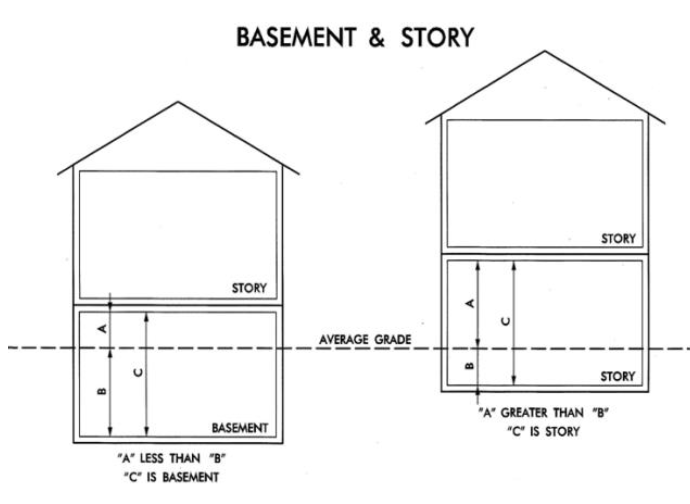
Basement: That portion of a building which is partly or wholly below grade but so located that the vertical distance from the average grade to the floor is greater than the vertical distance from the average grade to the ceiling. A basement shall not be counted as a story. Figure 90-202-1.
Boardinghouse: An owner-occupied dwelling where meals or lodging are provided for compensation to two or more persons for periods of one week or more.
Berm: A manmade mound of earth that is graded and shaped to a specified height and slope and improved with landscaping in such a fashion as to be used for visual and/or audible screening purposes.
Block: The property, abutting one side of a street lying between the two nearest intersecting streets or between an intersecting street and a railroad right-of-way; unsubdivided acreage, river or stream; or between any of the foregoing and any other barrier to the continuity of development.
Building:
(1)
Alterations: Any change, addition or modification in construction or type of occupancy; any change in the structural members of a building, such as walls, partitions, columns, beams, girders; or any change which may be referred to herein as "altered" or "reconstructed."
(2)
Building: A permanent structure having a roof supported by columns, or walls, for the shelter, support or enclosure of persons, animals or possessions, is a building. When any portion thereof is completely separated from every other part thereof by division walls from the ground up, and without openings allowing ingress or egress of persons, each separated portion of the building shall be deemed a separate building.
(3)
Building envelope (also called "buildable area"): The ground area of a lot which is defined by the minimum setback and spacing requirements within which construction of a principal and any attached accessory structures (such as a garage) is permitted by the ordinance. For condominium developments, the building envelope shall be illustrated on a site plan.
(4)
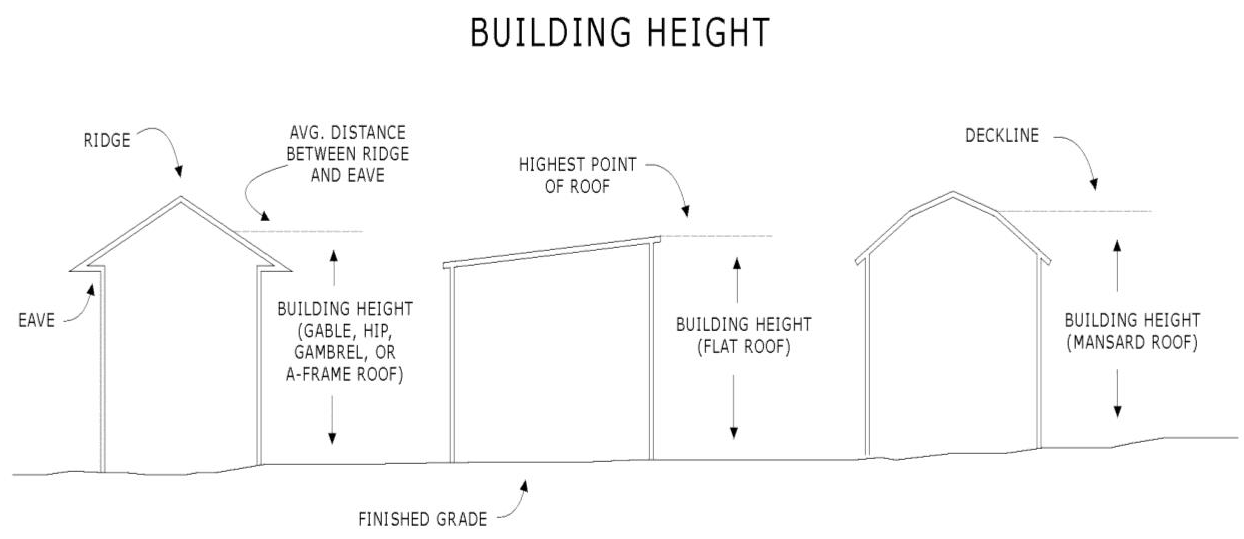
Building height: The vertical distance measured from the established grade to the highest point of the roof for flat roofs; to the deck line for mansard roofs; and to the mean height (between eaves and ridges) for gable, hip, gambrel, and A-frame roofs. Figure 90-202-2.
(5)
Building permit: An authorization issued by the chief building official to move, erect or alter a structure within the city.
Buffer zone: A strip of land often required between certain zoning districts reserved for plant material, berms, walls or fencing singularly or in combination to serve as a visual and/or noise barrier.
Bulk: The term used to indicate the size and setbacks of buildings and structures and their location with respect to one another, including standards for the height and area of buildings; the location of exterior walls in relation to lot lines, streets, and other buildings; gross floor area of buildings in relation to lot area, open space, and the amount of lot area required for each dwelling unit.
(Ord. No. 5-11, § 2, 8-1-11)
Sec. 90-203. - Definitions "C".
Caliper: The diameter of a tree trunk, measured at breast height.
Caretaker living quarters: An independent residential dwelling unit designed for and occupied by no more than two persons, where at least one is employed to look after goods, buildings, or property on the parcel on which the living quarters are located.
Carport: A shelter for vehicles consisting of a roof extended from a wall or a building or a partially open structure consisting of a roof and possibly walls. Carports shall comply with all yard requirements applicable to private garages.
Child care/residential care facilities:
(1)
Child care facility: A facility for the care of children under 18 years of age, as licensed and regulated by the State under Michigan Public Act 116 of 1973 and the associated rules promulgated by the State Department of Human Services.
(2)
Child care centers, nursery schools, and day nurseries: A facility, other than a private residence, receiving pre-school or school age children for group care for periods of less than 24 hours a day, and where the parents or guardians are not immediately available to the child. It includes a facility which provides care for not less than two consecutive weeks, regardless of the number of hours of care per day. The facility is generally described as a child care center, day care center, day nursery, nursery school, parent cooperative preschool, play group, or drop-in center. "Child care center" or "day care center" does not include a Sunday school conducted by a religious organization where children are cared for during short periods of time while persons responsible for such children are attending religious services.
(3)
Family day care home (six or fewer children less than 24 hours per day): A private home in which one but less than six minor children are received for care and supervision for periods of less than 24 hours a day, unattended by a parent or legal guardian, except children related to an adult member of the family by blood, marriage or adoption. It includes a home that gives care to an unrelated child for more than four weeks during a calendar year.
(4)
Group day care home (seven to 12 children less than 24 hours per day): A private home in which more than seven but not more than 12 children are given care and supervision for periods of less than 24 hours a day unattended by a parent or legal guardian, except children related to an adult member of the family by blood, marriage or adoption. It includes a home that gives care to an unrelated child for more than four weeks during a calendar year.
(5)
Foster family group home: A private home in which more than four, but less than seven children, who are not related to an adult member of the household by blood, marriage, or adoption, are provided care for 24 hours a day, for four or more days a week, for two or more consecutive weeks, unattended by a parent or legal guardian.
(6)
Foster family home: A private home in which one but not more than four minor children, who are not related to an adult member of the household by blood, marriage, or adoption, are given care and supervision for 24 hours a day, for four or more days a week, for two or more consecutive weeks, unattended by a parent or legal guardian.
Church: See "Place of Worship".
City officials:
(1)
City council or council: The elected, legislative body of the City of Wyoming.
(2)
Building official or building inspector: Means the Registered Building Official or that person's designee.
(3)
Planning commission or commission: The planning commission of the City of Wyoming, as appointed by the mayor and endorsed by the city council, pursuant to the Municipal Planning Act.
(4)
City planner: The administrator of the planning department for the City of Wyoming.
(5)
Board of zoning appeals or board: The board of zoning appeals of the City of Wyoming. Members are appointed by city council pursuant to the zoning act.
Clinic, medical: An establishment where human patients who are not lodged overnight are admitted for examination and treatment by a group of physicians, dentists or similar professionals. A medical clinic may incorporate customary laboratories and pharmacies incidental to or necessary for its operation or to the service of its patients, but may not include facilities for overnight patient care or major surgery.
Club: A nonprofit organization of persons for charitable, fraternal or social purposes or for the promulgation of agriculture, sports, arts, science, literature, politics or the like, but not operated to espouse beliefs or further activity that is not in conformance with the Constitution of the United States or any laws or ordinances. The facilities owned or used by the organization may be referred to as a "club" in this chapter.
Commercial use: The use of property for retail sales or similar businesses where goods or services are sold or provided directly to the consumer. As used in this chapter, "commercial use" shall not include industrial, manufacturing, or wholesale businesses.
Commercial vehicle: Any vehicle bearing or required to bear commercial license plates and which falls into one or more of the following categories:
(1)
Truck tractor.
(2)
Semi-trailer, which shall include flat beds, stake beds, roll-off containers, tanker bodies, dump bodies and full or partial box-type enclosures.
(3)
Refrigerated and box van vehicles of a type that are commonly used for the delivery of ice cream, milk, bread, fruit or similar vending supply or delivery trucks.
(4)
Tow trucks.
(5)
Commercial hauling trucks.
(6)
Vehicle repair service trucks.
(7)
Snow plowing trucks.
(8)
Any other vehicle with a commercial license plate having a gross vehicle weight in excess of 10,000 pounds or a total length in excess of 22 feet.
(9)
Limousine.
Community center: A government or nonprofit facility used for recreational, social, educational, cultural services and activities. Services may be targeted to certain populations (e.g. youth, seniors) but membership is available to the general public. Examples of services include: tax assistance, fitness training, senior meals, after school tutoring sessions, food pantries and public assemblies. This use does not include schools, places of worship, banquet facilities, social or service club, or counseling services. A community center is different than a neighborhood center, which is a use that is accessory to a residential development.
Community special event: A temporary outdoor use that extends beyond the normal uses and standards allowed by the zoning ordinance of the city. Special events include auto shows, art shows, festivals and nonprofit fund raisers of community-wide interest.
Condominium:
(1)
Building area: The portion of the condominium project designed and intended for separate ownership as described in the master deed, regardless of whether it is intended for residential, office, industrial, business, or recreational use as a time-share unit or any other type of use.
(2)
Condominium: A system of separate ownership of individual units and/or multiple-unit projects according to the Condominium Act.
(3)
Condominium Act: State of Michigan Public Act 59 of 1978, as amended.
(4)
Condominium subdivision plan: Drawings and information which show the size, location, area, and boundaries of each condominium unit, building locations, the nature, location, and approximate size of common elements, and other information required by Section 66 of the Condominium Act.
(5)
Condominium unit site: The area designating the perimeter within which the condominium unit must be built after construction of the condominium unit, the balance of the condominium unit site shall become a limited common element. The term "condominium unit site" shall be equivalent to the term "lot" for purposes of determining compliance of a site condominium subdivision with the provisions of this chapter pertaining to minimum lot size, minimum lot width, minimum lot coverage and maximum floor area ratio.
(6)
General common element: The area of common elements other than the limited common elements intended for the common use of all co-owners.
(7)
Limited common element: Area of the common elements reserved in the master deed for the exclusive use of less than all of the co-owners.
(8)
Master deed: The condominium document recording the condominium project as approved by the city including attached exhibits and incorporating, by reference, the approved by-laws for the project and the approved condominium subdivision plan for the project.
(9)
Site condominium project: A condominium project designed to function in a similar manner, or as an alternative, to a platted subdivision. A residential site condominium project shall be considered as equivalent to a platted subdivision for purposes of regulation in this chapter.
Contractor's yard: A site on which a building contractor stores equipment, tools, vehicles, building materials, and other appurtenances used in or associated with building or construction. A contractor's yard includes outdoor storage.
Conservation easement: A legal agreement in which the landowner retains ownership of private property, but conveys certain specifically identified rights to a land conservation organization or a public body.
Construction: Any act or process that is carried out under a current and valid building permit consisting of on-site erection, fabrication, installation, alteration, demolition, or removal of any structure, facilities or addition thereto, including related activities. Construction implies a diligent continuance of action toward completion, and any construction that has ceased due to expiration of a permit shall be considered inactive.
Convalescent home or nursing home: A nursing care facility, but excluding a hospital or a facility created by Act No. 152 of the Public Acts of 1985, as amended, being MCL 36.1 to 36.12 of the Michigan Compiled Laws, which provides organized nursing care and medical treatment to seven or more unrelated individuals suffering or recovering from illness, injury, or infirmity.
Curb cut: An opening from the public street to a private driveway or public drive serving an individual site or group of sites.
(Ord. No. 5-11, § 2, 8-1-11; Ord. No. 12-24, § 2, 11-4-24)
Sec. 90-204. - Definitions "D".
Dedicated transit stop: A fixed location where passengers may access public transportation as designated by permanent signage attached to a post in the public right-of-way or attached to a bus shelter.
Density: The number of dwelling units situated on or to be developed per net acre of land. For purposes of calculating maximum density, only 25 percent of the acreage determined to be wetlands protected by the Goemaere-Anderson Wetland Protection Act, PA 203 of 1979, or land within the 100-year floodplain elevation shall be calculated toward the total site acreage. All open bodies of water, public rights-of-way and private road easements are excluded from this calculation.
Detention basin: A manmade or natural water collector facility designed to collect surface water in order to impede its flow and to release the water gradually at a rate not greater than that prior to the development of the property, onto natural or manmade outlets.
Development: The construction of a new building or other structure, the relocation of an existing building, or a new use of open land.
Disposal: The final placement or destruction of either hazardous or nonhazardous substances or waste. Disposal includes placing the above substances in landfills, surface impoundments, land farms, deep wall injection or underground injection wells or incineration.
Distribution center: A use which typically involves both warehouse and office/administration functions, where short and/or long term storage takes place in connection with the distribution operations of a business.
District: A portion of the city within which, on a uniform basis, certain uses of land and buildings are permitted and within which certain regulations and requirements apply under the provisions of the ordinance. Districts in the City of Wyoming include:
(1)
Overlay district: A district which is applied over an underlying, controlling district, except as modified or restricted by the regulations of the overlay district.
(2)
Zoning district or district: A portion of the City of Wyoming where certain uses of land and buildings are permitted and certain yards, open spaces, lot areas, and other requirements are established.
Downtown development authority area: That area bordering both sides of 28th Street between Division Avenue and Byron Center Avenue, as described in section 2-214 of this Code.
Drive-through establishment: A business in which all or part of the business consists of providing goods and services from a drive-through window to patrons in motor vehicles.
Dumpster or waste receptacle: Any accessory exterior container used for the temporary storage of rubbish, pending collection, having the capacity of at least one cubic yard. Exterior compactors shall be considered to be dumpsters or waste receptacles for the purposes of screening regulations.
Dwelling:
(1)
Manufactured home: A dwelling which is substantially built, constructed, assembled, and finished off the premises upon which it is intended to be located and transported to the building site on its own wheels or a flatbed trailer.
(2)
Multiple-family: A building, or portion thereof, used or designed as residences for three or more families living independently of each other and each doing their own cooking in the building, with the number of families in residence not exceeding the number of dwelling units provided. Multiple-family buildings without a second floor common hallway are termed townhouses.
(3)
Single-family: A detached building or manufactured home designed exclusively for the complete living accommodations of one family, and containing one dwelling unit only.
(4)
Single-family, attached: A single-family dwelling erected side by side to another similar unit in a single building, each unit being separated from the adjoining unit by an uninterrupted wall extending from the basement floor to the roof, and having a separate exterior entrance.
(5)
Site built: A dwelling which is substantially built, constructed, assembled, and finished on the premises which are intended to serve as its final location. Site built dwellings also include those constructed of precut materials and panelized wall, roof and floor sections when such sections require substantial assembly and finishing on the premises which are intended to serve as its final location.
(6)
Two-family: A detached building, designed for or occupied exclusively by two families living independently of each other. May also be termed as a duplex.
Dwelling unit:
(1)
Dwelling unit: A building or portion thereof having cooking and housekeeping facilities, which is occupied wholly as the home, residence or sleeping place of one family, either permanently or transiently, but in no case shall a motor home, trailer coach, garage, automobile chassis, portable building or tent be considered a dwelling.
In case of mixed occupancy, where a building is occupied in part as a dwelling unit, the part so occupied shall be deemed a dwelling unit for the purpose of this chapter and shall comply with the applicable provisions relative to dwellings. A dwelling unit shall include both manufactured units (mobile homes and modular homes) and site built units.
(2)
Efficiency unit: An efficiency unit is a dwelling unit consisting of one room, exclusive of bathroom, kitchen, hallway, closets, or dining alcove directly off the principal room providing not less than 350 square feet of floor area.
(Ord. No. 5-11, § 2, 8-1-11; Ord. No. 1-23, § 1, 2-6-23)
Sec. 90-205. - Definitions "E".
Easement: A right, distinct from the ownership of the land, to cross property with facilities such as, but not limited to, driveways, roads, utility corridors, sewer lines, water lines, and transmission lines, or the right, distinct from the ownership of land, to reserve and hold an area for open space, recreation, drainage or access purposes.
Erected: Includes built, constructed, reconstructed, moved upon, and/or physical operations on the premises required for the building.
Essential services and public utility:
(1)
Essential services: The erection, construction, alteration, or maintenance of public utilities or municipal departments or commissions of underground, surface or overhead distribution of gas, electrical, cable TV, fuel, steam, or water transmission or distribution systems, collection, communication, supply or disposal systems, including mains, drains, sewers, pipes, conduits, wires, cables, transformers, splice boxes, police call boxes, fire alarm boxes, traffic signals, hydrants, towers, poles, and other similar equipment, and accessories in connection therewith but not including buildings or storage yards, other than such buildings as are primarily enclosures or shelters of the above essential service equipment reasonably necessary for furnishing adequate service to the City of Wyoming and immediate surrounding territory. Essential services shall not include wireless communication towers, unless located on public property and used as part of a governmental emergency communication network.
(2)
Public utility: Any persons, firm, corporation, municipal department, board or commission duly authorized to furnish and furnishing, under federal, state or municipal regulations, to the public, electricity, gas, steam, communications, telephone lines, transportation, water services or sewage disposal.
Event Center: A building or portion of a building no greater than 6,000 square feet with one or more rentable separate event rooms or areas which is principally used for the holding of private events or gatherings which are not open to the general public. Examples include wedding venues, reception halls, catering halls, club halls, or other similar uses, as determined by the City Planner. This definition excludes places of religious worship/gathering and convention centers.
Excavation:
(1)
Excavating: Excavating shall be the removal of sand, stone, gravel or fill dirt below the average grade of the surrounding land and/or road grade, whichever shall be the highest.
(2)
Quarry excavation: Any breaking of the ground to hollow out by cutting or digging or removing any soil or other matter to a depth greater than 12 inches from the surface.
(3)
Soil removal: Soil removal shall include the removal of any kind of soil or earth matter, including topsoil, sand, gravel, clay, or rock to a depth greater than 12 inches.
(Ord. No. 5-11, § 2, 8-1-11; Ord. No. 8-25, § 1, 7-7-25)
Sec. 90-206. - Definitions "F".
Façade: The exterior wall of a building exposed to public view.
Family: Family means either of the following:
(1)
A domestic family which is one or more persons living together and related by the bonds of blood, marriage or adoption, together with caretaker of the principal occupants and not more than one additional unrelated person, with all of such individuals being domiciled together as a single, domestic housekeeping unit in a dwelling.
(2)
The functional equivalent of the domestic family which is six or fewer persons living together in a dwelling unit whose relationship is of a regular, permanent and distinct character or has a demonstrable and recognizable bond which renders the persons a cohesive unit. All persons must be cooking and otherwise operating as a single housekeeping unit.
(3)
This definition shall not include any society, club, fraternity, sorority, association, lodge, coterie, organization or group where the common living arrangement and/or the basis for the establishment of the functional equivalency of the domestic family is likely or contemplated to exist for a limited or temporary duration.
(Ord. No. 15-16, 11-7-16)
Fence:
(1)
Decorative/ornamental fence: A fence, ornamental in nature, that is more than 50 percent open to the free passage of air and light, not intended to provide a barrier to passage or for screening, including, but not limited to: picket fences, wrought iron fences, and split rail fences. Decorative fencing does not include chain link or privacy fencing and may not be used as pool, protective or security fencing.
(2)
Fence: An artificially constructed barrier of wood, masonry, stone, wire, metal, plastic or any other manufactured material or combination of materials, used to prevent or control entrance, confine within, or mark a boundary.
(3)
Privacy fence: A fence or wall that is designed to be used as a visual barrier to inhibit or prevent observation of an area and which is less than 50 percent open to the free passage of air and light.
Fill, filling: The deposit or dumping of any matter onto or into the ground, except for common household gardening, farming and general ground care.
Floor area:
(1)
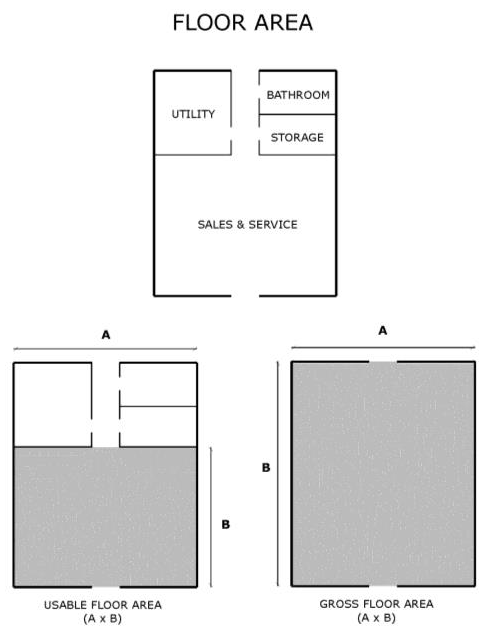
Gross floor area (GFA): The area within the perimeter of the outside walls of the building under consideration, without deduction for hallways, stairs, closets/storage rooms, thickness of walls, columns, or other features.
(2)
Residential floor area: For the purposes of computing the minimum allowable floor area in a residential dwelling unit, the sum of the horizontal areas of each story of the building shall be measured from the exterior faces of the exterior wall. The floor area measurement is exclusive of areas of basements, unfinished attics, attached garages, breezeways, and enclosed or unenclosed porches.
(3)
Usable floor area (UFA): That area used for or intended to be used for the sale of merchandise or services, or for use to serve patrons, clients or customers. Floor area which is used or intended to be used principally for the storage of merchandise, or areas such as hallways, stairways, elevator shafts, space for utilities or sanitary facilities, shall be excluded from this computation of UFA. Measurement of UFA shall be the sum of the horizontal areas of the several floors of the building, measured from the exterior faces of the exterior walls. When a detailed floor plan is not available, a factor of 80 percent shall be used to estimate the useable floor area for purposes of calculating parking requirements and other standards based on useable floor area. Figure 90-206-1.
(Ord. No. 5-11, § 2, 8-1-11)
Sec. 90-207. - Definitions "G".
Garage: An accessory building or portion of a principal building designed or used solely for the storage of motor vehicles, boats, and similar vehicles owned and used by the occupants of the building to which it is accessory.
Glare: The effect, measured at the lot line, of excessive brightness sufficient to cause annoyance, discomfort, or loss in visual performance and visibility.
Good neighbor plan: A written implementation program that identifies and proposes measures to reduce potential negative impacts on nearby residents and businesses. The coordination and collaboration of owners or operators with interested parties both before and after the development process allows for a proactive approach to create a positive working relationship between the community and the applicant by requiring the formulation of a written implementation program. A Good Neighbor Plan must include:
(1)
Documentation of communications with neighboring businesses and residents;
(2)
Policies for addressing neighborhood concerns;
(3)
List of rights and responsibilities for residents, when applicable;
(4)
Policy for loitering;
(5)
Policy for litter;
(6)
Policy for crime prevention and awareness;
(7)
Policy for landscape maintenance;
(8)
Description of supportive services, when applicable;
(9)
Description of services provided for children, when applicable; and
(10)
List of partners providing supportive services, when applicable.
Grade:
(1)
Grade, average: The arithmetic average of the lowest and highest grade elevations in an area within six feet of the foundation line of a building or structure.
(2)
Grade: The ground elevation established for the purpose of regulating the number of stories and the height of buildings.
(3)
Grade, natural: The elevation of the ground surface in its natural state, before construction begins.
Greenbelt: A strip of land located between the property line and the front or secondary front yard building or parking setback line dedicated to for the planting of shrubs, trees and/or grasses to serve as an obscuring screen or buffer between the property and the adjacent roadway.
(Ord. No. 5-11, § 2, 8-1-11; Ord. No. 1-23, § 2, 2-6-23)
Sec. 90-208. - Definitions "H".
Home occupation: Any use customarily conducted entirely within the dwelling and carried on by the occupants thereof. It shall not include employees other than members of the immediate family residing within the dwelling. The use must be clearly incidental and secondary to the dwelling purposes. It shall not change the character thereof nor endanger the health, safety and welfare of any other person residing in the area because of noise, noxious odors, unsanitary or unsightly conditions, fire hazards and any other similar item, involved in or resulting from such occupation, profession or hobby. Single chair beauty salons, barbershops and instruction in a craft or fine art, are permitted on an individual basis. No article or service shall be sold or offered for sale on the premises except as is produced by such occupation. Such occupation shall not require any alterations or construction features, equipment, machinery, outdoor storage or signs not permitted in the residential areas.
No home occupation shall generate more than the normal residential traffic either in amount or type. One non-illuminated nameplate, not more than two square feet in area, may be attached to the building and shall contain only the name and occupation of the residents of the premises. Day care centers, tea rooms, veterinarian's offices, tourist homes, animal hospitals, and kennels and any other similar businesses or occupations shall not be deemed to be home occupations. Garage sales are limited to a maximum of six calendar days per year.
Hospital: An institution where sick or injured persons are given medical care and, in the course of same, are housed overnight, fed and provided nursing and related services. This definition shall include any related, accessory facilities such as laboratories, outpatient departments, training facilities, central service facilities and staff offices which are integral parts of the facility. This definition shall not include drug rehabilitation facilities, halfway houses, convalescent or nursing homes, institutions for mentally ill individuals, or other similar facilities.
Hotel: A series of attached, semidetached, or detached rental units which provide lodging on a temporary basis, and are offered to the public for compensation. The term "hotel" shall include tourists cabins and homes, motor courts, and motels. A hotel shall not be considered or construed to be a multiple-family dwelling.
(Ord. No. 5-11, § 2, 8-1-11)
Sec. 90-209. - Definitions "I".
Impervious surface: Any manmade material which covers the surface of land and substantially reduces the infiltration of stormwater to a rate of five percent or less. Impervious surfaces include, but are not limited to, pavement, buildings, and structures.
Indoor recreation facility: An establishment which provides indoor exercise facilities and/or indoor court and field sports facilities, and which may include spectator seating in conjunction with the sports facilities such as skating rinks, swimming pools, indoor golf facilities, pool or billiard halls and bowling alleys. Auditoriums and stadiums are not included.
Industrial:
(1)
Heavy industrial: A use engaged in the basic processing and manufacturing of materials or products predominantly from extracted or raw materials, or a use engaged in storage of, or manufacturing processes using flammable or explosive materials, or storage or manufacturing processes that potentially involve hazardous or commonly recognized offensive conditions.
(2)
Light industrial: A use engaged in the manufacture, predominantly from previously prepared materials, of finished products or parts, including processing, fabrication, assembly, treatment, packaging, incidental storage, sales, and distribution of such products, but excluding basic industrial processing.
(Ord. No. 5-11, § 2, 8-1-11)
Sec. 90-211. - Definitions "K".
Kennel: Any lot or premises on which three or more dogs, cats, or other domestic animals age four months or older are kept, either permanently or temporarily, either for sale, breeding, hobby, sporting activity, protection or pets, subject to the regulations set forth herein regulating private kennels.
(Ord. No. 5-11, § 2, 8-1-11)
Sec. 90-212. - Definitions "L".
Land Division Act: P.A. 288 of 1967, as amended (MCLA 560.101), as amended.
Loading space: An unobstructed area within a building or on the premises and located outside of any public street, way or required parking space, designated and used for the maneuvering, standing, loading or unloading, or delivery of items from or to a certain location.
Lot:
(1)
Lot: A parcel of land occupied, or intended to be occupied, by a main building or a group of such buildings and accessory buildings, or utilized for the principal use and uses accessory thereto, together with such yards and open spaces as are required under the provisions of this chapter. A lot may or may not be specifically designated as such on public records. For purposes of meeting the dimensional standards of this chapter, a lot does not include public rights-of-way or private road easements, but does include access easements for a service drive. A lot may be a single lot of record, a portion of a lot of record, a combination of contiguous lots of record, contiguous portions of lots of record, a parcel of land described by metes and bounds.
(2)
Lot of record: A lot which actually exists in a subdivision plat as shown on the records of the county register of deeds, or a lot or parcel described by metes and bounds, the description of which has been so recorded. A lot may also mean a portion of a condominium project, as regulated by the Condominium Act, designed and intended for separate ownership and use. The term "lot" includes the term "plot" or "parcel."
(3)
Lot area: The total horizontal area within the lot lines of a lot excluding public or private road rights-of-way or road easements.
(4)
Lot coverage: The part or percent of the lot occupied by buildings or structures, including above ground accessory buildings or structures such as decks and porches.
(5)
Lot depth: The mean horizontal distance from the front street line to the rear lot line.
(6)
Lot frontage: A straight line connecting the points where the side lot lines intersect the street right-of-way or private road easement.
(7)
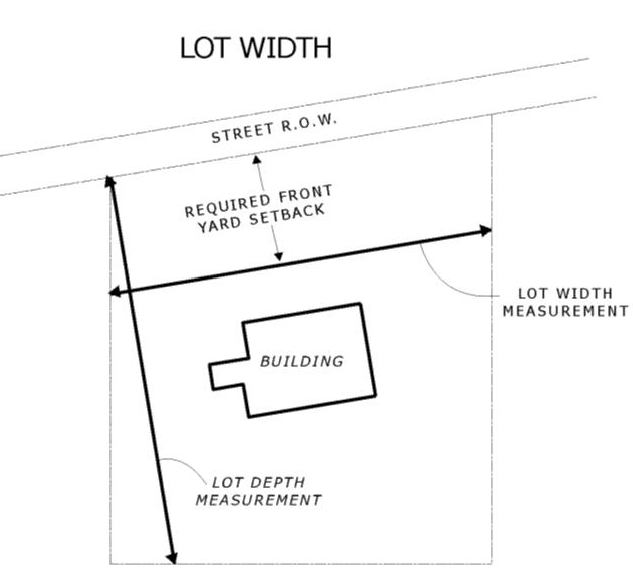
Lot width: The horizontal distance between the side lot lines, measured at the two points where the minimum required front setback line intersects the side lot lines. Figure 90-212-1.
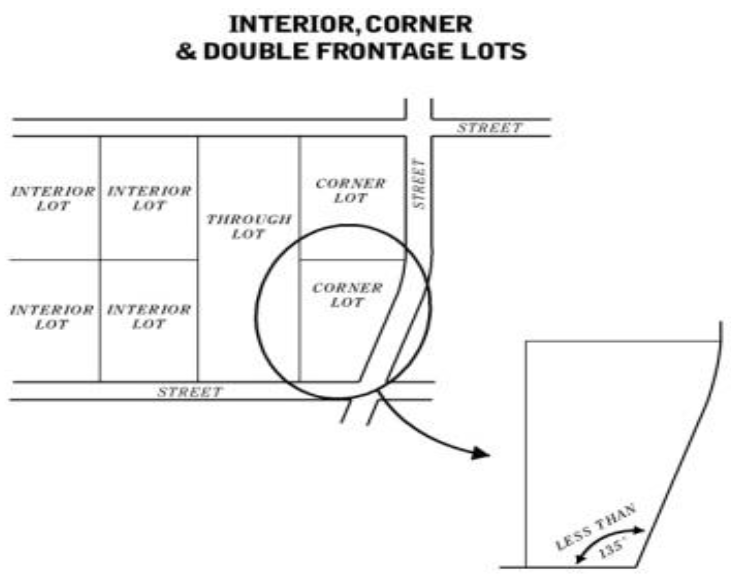
Lot type: Figure 90-212-2.
(1)
Corner lot: A lot located at the intersection of two streets or a lot bounded on two sides by a curving street, any two chords of which form an angle of 135 degrees or less. The point of intersection of the street lot lines is the "corner." For a curved street line, the corner is that point on the street lot line nearest to the point of intersection of the tangents described above.
(2)
Double frontage lot: An interior lot having frontages on two more or less parallel streets as distinguished from a corner lot. In the case of a row of double frontage lots, one street will be designated as the front street for all lots in the plat. If there are existing structures in the same block fronting on one or both of the streets, the required front yard setback shall be maintained along both street frontages.
(3)
Interior lot: A lot other than a corner lot with only one lot line fronting on a street.
Lot line:
(1)
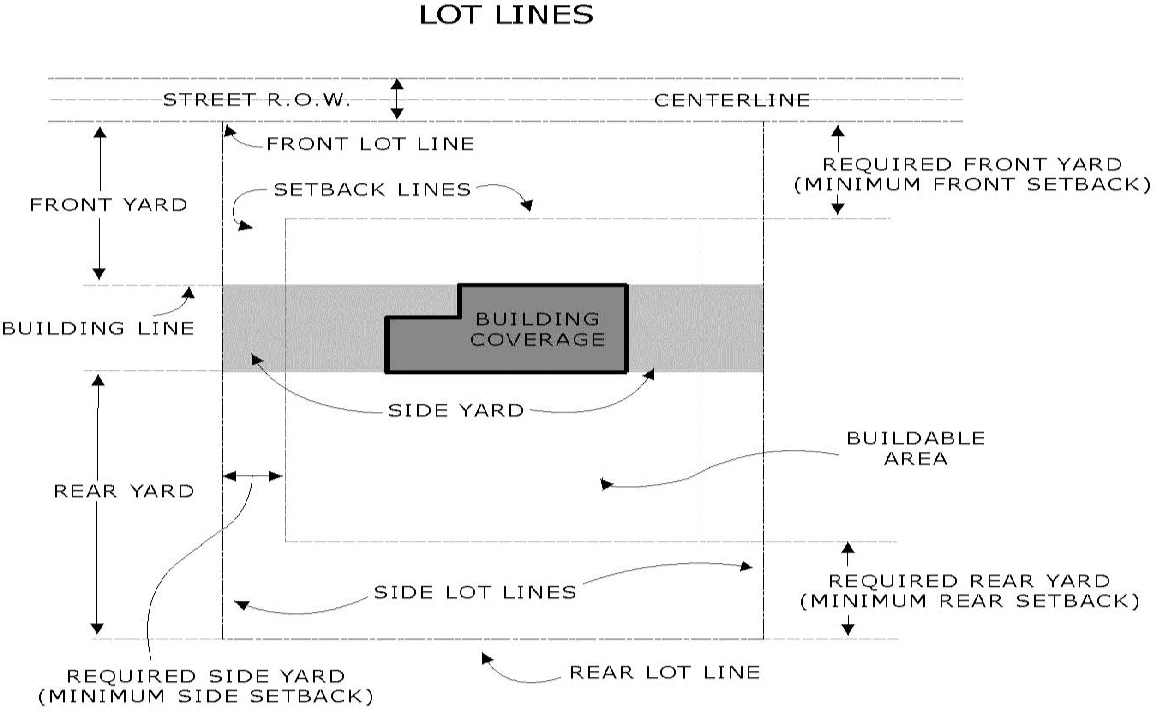
Front lot line: The front lot line shall mean any line separating the lot from the street right-of-way. In the case of a double frontage lot, the front lot line shall be that line separating the lot from the street designated as the front street in the plat or in the request for a building permit. Figure 90-212-3.
(2)
Rear lot line: The rear lot line is that boundary which is opposite and most distant from the front lot line. In the case of an irregular shaped lot, the rear lot line shall be that assumed line parallel to the front lot line not less than ten feet long lying farthest from the front lot line and wholly within the lot.
(3)
Side lot line: Any lot line not a front lot line or a rear lot line. A side lot line separating a lot from another lot or lots is an interior side lot line.
(Ord. No. 5-11, § 2, 8-1-11)
Sec. 90-213. - Definitions "M".
Manufactured home:
(1)
Manufactured home: A detached residential dwelling unit designed for transportation after fabrication on streets or highways on its own wheels or a flat bed or other trailer, and further designed to be occupied as a dwelling without the necessity of further substantial construction or alteration, except for incidental assembly, unpacking, foundation work or construction, utility connections, skirting construction, site preparation and other minor work, construction or installation.
(2)
Manufactured home lot: A parcel or lot within a manufactured home park designed for the accommodation of one manufactured home.
(3)
Manufactured home park: A parcel of land which has been designed and/or improved for the placement of manufactured homes for residential use.
Master plan: The comprehensive long-range plan, adopted by the Wyoming planning commission and city council, intended to guide growth and development within the City of Wyoming and that includes analysis, recommendation, and proposals for some or all of the following: population, economy, housing, transportation, community facilities and land use. This term is interchangeable with land use plan.
Mezzanine: An intermediate floor in any story occupying not to exceed one-third of the floor area of such story.
Motel: A series of attached, semi-detached, or detached rental units containing a bedroom, bathroom and closet space which provide for overnight lodging and are offered to the public for compensation and cater primarily to the public traveling by motor vehicle. A motel may include a restaurant or cocktail lounge, public banquet halls, ballrooms or meeting rooms.
(Ord. No. 5-11, § 2, 8-1-11)
Sec. 90-214. - Definitions "N".
Nonconforming:
(1)
Nonconforming building: A building or portion thereof lawfully existing at the effective date of this chapter or amendments thereto, that does not conform to the provisions of this chapter for the district in which it is located.
(2)
Nonconforming lot: Any lot which was of record at the time of adoption of this chapter that does not meet the requirements of this chapter for lot width and depth and available space for yards.
(3)
Nonconforming site: A site that lawfully occupied land on the effective date of this article or any amendments thereto, that does not conform to the site regulations of the district in which it is located, including landscaping and parking requirements.
(4)
Nonconforming use: A use that lawfully occupied a building or land on the effective date of this article or any amendments thereto, that does not conform to the use regulations of the district in which it is located.
Nuisance: An offensive, annoying, unpleasant, or obnoxious thing or practice, a cause or source of annoyance, especially a continuing or repeating invasion of any physical characteristics of activity or use across a property line which can be perceived by or affects a human being, or the generation of an excessive or concentrated movement of people or things, such as, but not limited to: noise, dust, smoke, odor, glare, fumes, flashes, vibration, shock waves, heat, electronic or atomic radiation, objectionable effluent, noise of congregation of people and traffic.
Nursery school, day care and child care center: See: "child care/residential care facilities."
(Ord. No. 5-11, § 2, 8-1-11)
Sec. 90-215 - Definitions "O".
Open space: An area that is intended to provide light and air, and is designed for either environmental, scenic, or recreational purposes. Open space may include, lawns, decorative planting, walkways, gazebos, active and passive recreation areas, playgrounds, fountains, swimming pools, woodlands, wetlands and watercourses.
Open space shall not be deemed to include driveways, parking lots or other surfaces designed or intended for vehicular travel, but may include a recreational clubhouse or recreation center.
Outdoor display, sales, or storage: Outdoor display, sales, or storage that is accessory to a permitted commercial use or a business operated substantially outside of any building, including: retail sales of garden supplies and equipment (including, but not limited to, trees, shrubbery, plants, flowers, seed, topsoil, trellises, and lawn furniture); sale of building and lumber supplies; automobiles, recreational vehicles, boats, mobile homes, garages, swimming pools, playground equipment, mowing equipment, farm implements, construction equipment and similar materials or equipment; rental and leasing establishments; and year-round flea markets, farmer's markets, roadside stands, and auctions.
Overhead door: Any at-grade door in excess of 64 square feet in surface area.
(Ord. No. 5-11, § 2, 8-1-11)
Sec. 90-216. - Definitions "P".
Parking and loading:
(1)
Loading space: An off-street space on the same lot with a building or group of buildings, for temporary parking for a commercial vehicle while loading and unloading merchandise or materials.
(2)
Off-street parking lot: A facility providing vehicular parking spaces along with adequate drives and aisles for maneuvering so as to provide access for entrance and exit for parking of more than two vehicles.
Passenger vehicle: A privately owned and licensed motor vehicle intended primarily for the transport of people.
Pawn broker: A person, corporation, partnership or firm whether operating under an assumed name or any other designation, which loans money on deposit or pledge of personal property or other valuable thing, other than securities or printed evidence of indebtedness, or who deals in the purchasing of personal property or other valuable things on condition of selling the same back again at a stipulated price.
Performance guarantee: A security, in the form of cash deposit, certified check, irrevocable bank letter of credit, or surety bond, in an amount sufficient to cover the estimated cost of improvements required as part of an application for development that is deposited with the municipality to ensure that the improvements are satisfactorily completed.
Personal service establishment: A use that performs services on the premises, such as barber and beauty shops; watch, radio, television, clothing and shoe repair shops; tailor; photographic studios; locksmiths; and similar establishments requiring some minor retail activity.
Pet, domestic: See: "animals, domestic".
Place of Worship: A site used for the regular assembly of persons for the conduct of religious services and related accessory uses. Accessory uses may include rectories, living quarters for church ministry and other members of the religious order who carry out their duties primarily on the site, religious education classes, day care, outdoor recreation facilities, religious office space and youth centers. Rescue missions, tent revivals and other temporary assemblies are not included in this definition.
Pool or billiard hall: An establishment wherein three or more pool or billiard tables are provided for use by patrons. See also "indoor recreation facility."
Porch:
(1)
Enclosed porch: A covered projection from the main wall of a building, enclosed on three sides by permanent or detachable glass sash, but not used as general living space. A porch shall become general living space when the enclosed space is heated or air-conditioned and when the percentage of window area to wall is less than 50 percent.
(2)
Open porch: A covered projection from the main wall of a building, open on three sides except for wire screening. A porch shall not be considered open if enclosed by either permanent or detachable glass sash.
Principal building and use:
(1)
Principal building (also called a "main building"): A building or, where the context so indicates, a group of buildings in which is conducted the principal use of the lot on which the building is situated.
(2)
Principal use (also called a "main use"): The primary use to which the premises are devoted and the primary purpose for which the premises exist.
Private ponds: An outdoor body of standing water, accumulated in an artificially constructed basin or depression in the earth, partly or completely above or below the grade of the ground surface existing prior to construction, capable of holding water to a depth greater than 24 inches filled to capacity. Temporary basins or depressions excavated in conjunction with construction of building foundations or building basements and swimming pools, and stormwater detention ponds having permanent water surfaces, are not included in this definition.
(Ord. No. 5-11, § 2, 8-1-11; Ord. No. 12-24, § 3, 11-4-24)
Sec. 90-218. - Definitions "R".
Recreation:
(1)
Outdoor recreation: Tennis courts, athletic fields, shuffleboard, horseshoe courts, miniature golf, golf driving range, children's amusement park or similar recreation uses.
(2)
Recreation vehicles:
(a)
Boats and boat trailers: Boats, personal watercrafts, canoes and rafts, and the normal equipment to transport the same on the highway.
(b)
Folding tent trailer: A canvas folding structure, mounted on wheels and designed for travel and vacation use.
(c)
Motorized home: A portable dwelling designed and constructed as an integral part of a self-propelled vehicle.
(d)
Pickup camper: A structure designed primarily to be mounted on a pickup or truck chassis and with sufficient equipment to render it suitable for use as a temporary dwelling for travel, recreational, and vacation uses.
(e)
Snow mobile and all-terrain vehicles: Snow mobile and all-terrain vehicles, and the normal equipment to transport them on the highway.
(f)
Travel trailer: A vehicular, portable structure built on a chassis, designed to be used as a temporary dwelling for travel, recreational and vacation uses.
Residential care facilities: See: "child care/residential care facilities".
Recycling facilities: A facility in which recyclables, such as newspapers, magazines, books, and other paper products; metal; asphalt products; wood products, other similar materials, liquids and solid wastes are reprocessed and treated to return such products to a condition in which they may be used again as a new product or separated for disposal.
Residential facilities to house persons on parole or probation: Any single-family, multiple family, hotel/motel or similar facility which houses more than two persons on parole or probation to the State of Michigan, the United States or any court thereof having jurisdiction over that person for an offense other than a misdemeanor offense as defined by law. This definition shall not apply to a single-family residence occupied by persons meeting the definition of family as provided in this chapter and shall only apply to each individual building in a multiple building apartment complex.
Restaurant: Any establishment whose principal business is the sale of food and beverages to the customer in a ready-to-consume state, and whose method of operation is characteristic of a carry-out, drive-through, fast food, standard restaurant, or bar/lounge, or combination thereof, as defined below. This classification includes businesses whose primary product is confectionaries (i.e., ice cream shops) and nonalcoholic beverages (i.e., a coffee shop).
(1)
Restaurant, carry-out: A business establishment whose method of operation primarily involves sale of food, beverages, and/or frozen desserts in disposable or edible containers or wrappers in a ready-to-consume state for consumption primarily off the premises.
(2)
Restaurant, drive-through: A business establishment whose method of operation includes the delivery of the prepared food to the customer in a motor vehicle, typically through a drive-through window, for consumption off the premises.
(3)
Restaurant, standard: A business establishment whose method of operation involves either the delivery of prepared food by waiters and waitresses to customers seated at tables within a completely enclosed building or the prepared food is acquired by customers at an order counter or cafeteria line and is subsequently consumed by the customers at tables within a completely enclosed building.
Retail store: Any building or structure in which goods, wares, or merchandise are sold to the consumer for direct consumption and not for resale.
Right-of-way: A street, alley or other thoroughfare or easement intended to be occupied by a street, crosswalk, railroad, electric transmission line, oil or gas pipeline, water main, sanitary or storm sewer main, shade trees, or other facility or use, permanently established for passage of persons or vehicles and under the legal authority of the agency having jurisdiction over the right-of-way.
(Ord. No. 5-11, § 2, 8-1-11; Ord. No. 2-12, § 1, 1-16-12; Ord. 14-16, 11-7-16)
Sec. 90-219. - Definitions "S".
Salvage yards: An outdoor facility exceeding 200 square feet where inoperable automobiles, machinery, appliances, and other products are stored to be dismantled or processed.
Satellite television antenna or dish: A structure or an apparatus capable of receiving communications from a transmitter or a transmitter relay located in a planetary orbit.
School: An institution for the teaching of children or adults including primary and secondary schools, colleges, professional schools, dance schools, business schools, trade schools, art schools, and similar facilities.
(1)
Private or business: Any building or group of buildings, the use of which meets state requirements for primary, secondary, or higher education, offers instruction in the several branches of learning and study required to be taught in the public schools and which does not secure the major part of its funding from any governmental agency.
(2)
Business, trade, technical, industrial or vocational: A school established to provide for the teaching of industrial, aviation, clerical, managerial, or artistic skills. This definition applies to schools that are owned and operated privately for profit and that do not offer a complete educational curriculum (e.g., beauty school, modeling school).
Secondhand dealer:
(1)
Any person, including any corporation or other entity, whose business is that of dealing in buying, selling, storing or exchanging secondhand goods, articles or merchandise of any kind, including lead pipe, tools, lighting fixtures, plumbing fixtures, radios, watches, jewelry, precious stones, scrap metals, musical instruments, electrical motors, electrical appliances, firearms, automotive parts and accessories, bicycles, wearing apparel, micrometers, or any article of personal property or other valuable thing. This definition does not include:
a.
Householders selling articles owned and possessed by themselves or executors or administrators of any such householder.
b.
New articles, wares or merchandise from manufacturers, wholesale distributors or jobbers for retail sale to customers.
c.
Used car dealers.
d.
Secondhand or used tires when such tires are removed from vehicles to which such tires are attached in the presence of the person receiving them.
(2)
This definition does not apply to persons whose principal business is that of dealing in new goods, articles and merchandise and who do not buy secondhand goods, articles and merchandise outright, but occasionally accept in trade or repossess household appliances, watches, jewelry, precious stones and musical instruments.
(3)
Outdoor secondhand sales, except as otherwise permitted, are prohibited.
(4)
Temporary businesses established for the purchase or sale of secondhand merchandise are prohibited.
(5)
Nonprofit organizations selling donated goods are required to obtain special use approval.
Security and Crowd Management Plan: A written implementation program that identifies and proposes measures to maintain safety and security for large assemblies of people in buildings, such as event centers, convention centers, bars, nightclubs, and other similar uses. This plan benefits the patrons within the building while also minimizing potential negative impacts on nearby residents and businesses.
Self-storage warehouse or facility: A building or group of buildings in a controlled-access and fenced compound that contains varying sizes of individual, compartmentalized, and controlled-access stalls or lockers for the storage of customer's goods or wares.
Semi-trailer: A trailer, which may be enclosed or not enclosed, having wheels generally only at the rear, and supported in front by a truck tractor or towing vehicle.
Senior assisted living: A type of semi-independent housing facility for senior citizens containing congregate kitchen, dining, and living areas, but with separate sleeping rooms. Such facilities typically provide special support services, such as transportation and limited medical care.
Senior apartments and senior independent living: Multiple-family dwelling units occupied by persons 55 years of age or older. Units will include individual kitchen facilities; however, common dining and community facilities may be provided.
Service truck: A pick-up or van that is used in conjunction with a repair or maintenance business, such as a plumbing, electrical or carpentry business.
Setback line: A line marking the setback distance from the lot line which establishes the minimum required front, side, or rear yard of a lot.
Shopping center: A structure of group of structures located on the same lot or parcel which is developed in accordance with an overall plan and designed and built as an interrelated project that provides a variety of commercial uses and also provides for common off-street parking, pedestrian access and vehicular movements. Buildings constructed on out lots shall not be considered part of the shopping center unless access and parking easements are provided.
Sign: For definitions of specific sign types and terms, see article 7.
Sight distance: The length of roadway visible to the driver. Generally related to the distance or time (perception/reaction time) sufficient for the driver to execute a maneuver (turn from driveway or side street, stop or pass) without striking another vehicle or object in the roadway. Required sight distance shall be based on the standards of the City of Wyoming Engineering Department.
Site plan: A scaled drawing containing all required information and drawn in compliance with Table 90-504, illustrating existing conditions and containing the elements required as applicable to the proposed development to ensure compliance with zoning provisions.
Special use approval: A use of land not permitted by right, but which is permitted within a particular zoning district after demonstration of compliance with specific special land use standards, as determined by the planning commission.
Story:
(1)
Full story: That portion of a building, other than a basement or mezzanine, included between the surface of any floor and the floor next above it, or if there is no floor above it, then the space between the floor and the ceiling above it.
(2)
Half story: The part of a building between a pitched roof and the uppermost full story, having a floor area which does not exceed 50 percent of the floor area of the story immediately below. Trilevel shall be considered as one and one-half stories. Figure 90-219-2.
Street:
(1)
Alley: A dedicated public way which affords only a secondary means of access to abutting property and is not intended for general traffic circulation, parking, standing or loading.
(2)
Collector street: A street used to carry traffic from local streets to arterials, including principal entrance streets of large residential developments or having a planned right-of-way width of at least 80 feet.
(3)
Cul-de-sac: A local street of short length, having one end permanently terminated by a vehicular turnaround.
(4)
Local street: A street used primarily for access to abutting properties.
(5)
Major thoroughfare: A street designed as a regional, major or minor arterial on the Wyoming Thoroughfare Plan, as adopted by the planning commission, in accordance with Act 285 of the Public Acts of Michigan of 1931 (MCL 125.31 et seq., as amended).
(6)
Marginal access street: A local street that is parallel and adjacent to arterials and which provides access to abutting properties and protection from through traffic.
(7)
Private road: A street that is owned, and maintained by the landowners served and has not been dedicated to the city, county or state as a public street.
(8)
Public street: A public dedicated right-of-way which affords traffic circulation and principal means of access to abutting property, including avenue, place, way, drive, line, boulevard, highway, road, and other thoroughfare, except an alley.
Structure: Anything constructed or erected, the use of which requires location above the ground or attached to something having location on the ground. A structure will include buildings (see "buildings"), fences, walls, decks, towers, pools, and other similar above ground structures.
Structural alteration: Any change in the supporting members of a building or structure, such as bearing walls or partitions, columns, beams or girders, or any change in the width or number of exits, or any substantial change in the roof.
Subdivision: The division of a tract of land into two or more lots, building sites, or other divisions for the purpose of sale or building development, in accordance with the Land Division Act and the Wyoming City Code - Subdivision Regulations, section 74-176, as amended.
Supportive housing program:
(1)
Emergency shelter: Any facility whose primary purpose is to provide temporary shelter for the homeless in general or for specific populations of the homeless.
(2)
Permanent supportive housing: Long-term, community-based housing that has supportive services for homeless persons with disabilities. This type of supportive housing enables special needs populations to live independently as possible in a permanent setting. Permanent housing can be provided in one structure or in several structures at one site or in multiple structures at scattered sites.
(3)
Transitional housing program: A project, including dwelling units but not group quarters, with the purpose of facilitating the movement of homeless individuals and families to permanent housing within a reasonable amount of time (e.g. 24 months).
Swimming pool: A permanent structure or container located either above or below grade designed to allow holding of water to a depth of greater than 24 inches, intended for swimming, bathing or relaxation. The definition of swimming pool includes spa, hot tubs and similar devices.
(Ord. No. 5-11, § 2, 8-1-11; Ord. No. 3-12, § 1, 3-5-12, Ord. No. 14-16, 11-7-16; Ord. No. 1-23, § 3, 2-6-23; Ord. No. 8-25, § 2, 7-7-25)
Sec. 90-220. - Definitions "T".
Truck terminal: A structure to which goods, except raw or unprocessed agricultural products, natural minerals, equipment or other resources, are delivered for immediate distribution or to be amalgamated or divided for delivery in larger or smaller units to other points, or for distribution, amalgamation, or division involving transfer to other modes of transportation. Also, a semi-trailer storage yard facility.
(Ord. No. 5-11, § 2, 8-1-11)
Sec. 90-221. - Definitions "U".
Underground storage tank system: A tank or combination of tanks, including underground pipes connected to the tank or tanks, which is, was, or may have been used to contain an accumulation of hazardous substances, as defined in Part 213 of the State of Michigan Natural Resources and Environmental Protection Act, 1994 Public Act 451, as amended.
Urgent care center: A medical clinic that treats humans or animals with expanded hours that is specially equipped to diagnose and treat a broad spectrum of illnesses and injuries. Urgent care centers accept unscheduled, walk-in patients seeking medical attention during all posted hours of operation.
Use: See "accessory use, building or structure" and/or "principal building or use".
(Ord. No. 5-11, § 2, 8-1-11)
Sec. 90-222. - Definitions "V".
Variance: A relaxation or modification of the requirements of this chapter, authorized by the zoning board of appeals, under the provisions of this chapter and Act 110 of the Public Acts of 2006, as amended.
(1)
Non-use variance: A variance approved by the zoning board of appeals relaxing one or more requirements of this chapter related to buildings, lots, setbacks, and other dimensional requirements.
(2)
Use variance: A variance approved by the zoning board of appeals allowing a use of land not otherwise permitted in a zoning district.
Vehicle related uses:
(1)
Service station: A building or structure designed or used for the retail sale or provision of fuels (which must be stored only in underground tanks), and may include the sale of lubricants, air, batteries, water and other operating commodities for motor vehicles, and the customary space and facilities for the installation of these commodities on or in vehicles, and including space for facilities for the temporary short-term storage, minor repair, or servicing. A service station may also include retail sales of convenience and grocery items.
(2)
Vehicle wash establishment: A building, or portion thereof, with a primary purpose of washing motor vehicles.
Veterinary clinic: An institution which is licensed by the Michigan Department of Health to provide for the care, diagnosis, and treatment of sick or injured animals, including those in need of medical or surgical attention. A veterinary clinic may include customary pens or cages for the overnight boarding of animals indoors and such related facilities as laboratories, testing services, and offices.
(Ord. No. 5-11, § 2, 8-1-11)
Sec. 90-223 - Definitions "W".
Warehouse: A building used for long-term and short-term storage and wholesale of manufactured products, supplies, and equipment related to the operation of a single business. The use will include truck loading and unloading, provided the area dedicated to the outdoor storage of trucks and trailers is no more than the area of the warehouse building. Where the area dedicated to the outdoor storage of trucks and trailers exceeds the area of the warehouse building, the use shall be considered a truck terminal.
Wireless communication:
(1)
Attached wireless communication facility (antennae): Any wireless communication facility affixed to an existing structure, such as a building, tower, water tank, utility pole, etc., utilized to receive and transmit federally or state licensed communications services via dually licensed segments of the radio frequency spectrum. This definition shall not include support structures.
(2)
Wireless communication facility: All facilities, structural, attached, accessory or otherwise, related to the use of the radio frequency spectrum for the purposes of transmitting or receiving radio signals and may include, but is not limited to, radio and television towers, telephone devices and exchanges, microwave relay towers, telephone transmission equipment buildings, and commercial mobile radio service facilities. Not included within this definition are: citizen band radio facilities, short wave facilities, ham and amateur radio facilities, television reception antennae, satellite dishes, and governmental facilities which are subject to state and federal law or regulations that preempt municipal regulatory authority. A wireless communication facility shall not be included under the existing definition of "essential services."
(3)
Collocation: The location by two or more wireless communications providers, public authority or other dually authorized party of wireless communications facilities on a common structure, tower or building, in a manner that reduces the overall need for additional or multiple freestanding single use communications facilities and/or support structures within the City of Wyoming.
(4)
Wireless communication support structure (tower): Any wireless communication facility erected or modified to support attached wireless communication facilities, or other antennae or facilities, including supporting lines, cables, wires, braces and masts intended primarily for the purpose of mounting an attached wireless communication facility or similar apparatus above grade. This includes, but is not limited to, any ground or roof-mounted pole, monopole, light pole, utility pole, wood pole, spire, other similar structure or combination thereof, subject to the requirements of this chapter.
(Ord. No. 5-11, § 2, 8-1-11)
Sec. 90-225. - Definitions "Y".
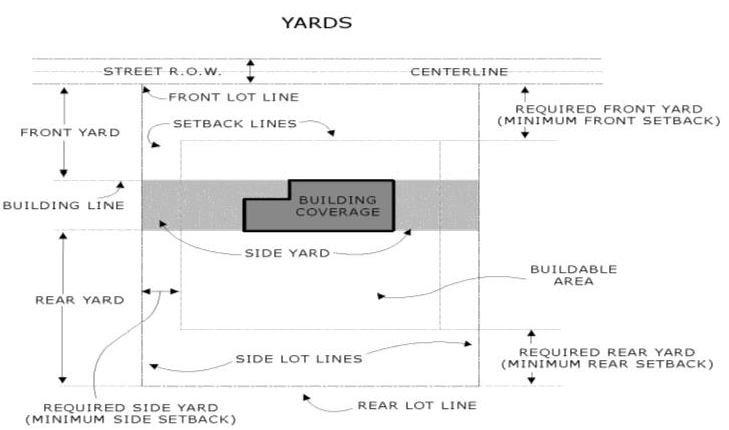
Yard: Figure 90-225-1.
(1)
Front yard: The space between the front line of the building and the front lot line, extending from one side lot line to the other side lot line. A corner lot will be considered to have two front yards: a primary front yard and a secondary front yard.
(2)
Rear yard: The space between the rear line of the building and the rear lot line, extending from one side lot line to the other side lot line. In the case of a corner lot, the rear yard may be opposite either street frontage, but there shall be only one rear yard.
(3)
Required yard: That portion of a lot that meets the required minimum front, side, or rear setback of the zoning district in which the property is located.
(4)
Side yard: A yard on the same lot with a building between the side lot line and the nearest side line of the building and extending from the rear to the front yard. A side yard will also be referred to as an interior side yard where it adjoins another lot.
(5)
Yard: An open space, unoccupied and unobstructed from the ground upward, except as otherwise provided herein, and being on the same lot with a building. The measurement of a yard shall be construed as the minimum horizontal distance between the lot line and the building or structure.
(Ord. No. 5-11, § 2, 8-1-11)
Sec. 90-226. - Definitions "Z".
Zoning Enabling Act: The Michigan Zoning Enabling Act, P. A. 110 of 2006, as amended.
(Ord. No. 5-11, § 2, 8-1-11)

