
Wyoming City Zoning Code
ARTICLE 4B
BUSINESS, OFFICE, INDUSTRIAL, AND PARKING ZONING DISTRICTS
B-1 Local Business District
B-2 General Business District
B-3 Planned Shopping Business District
RO-1 Restricted Office District
I-1 Light Industrial District
I-2 General Industrial District
I-3 Restricted Industrial District
P-1 Vehicular Parking District
Michigan Zoning Map, together with all notations, which map is hereby adopted and made a part of this chapter. The zoning map may be maintained by the city in such form as shall from time to time be deemed appropriate including an electronic database or information system. Unless otherwise shown on the zoning map, the district boundary lines follow lot lines or the centerlines of streets or alleys or such lines extended and the corporate limits of the city as they existed on January 3, 1979, and as subsequently revised. If the exact location of any district boundary line cannot be determined by the zoning map, it shall be resolved by the board of zoning appeals.
(Code 1983, § 60.3; Ord. No. 20-06, § 1, 7-3-06)
DIVISION 8. - P-1 VEHICULAR PARKING DISTRICT
In the P-1 vehicular parking district, only automobile parking is permitted.
(Code 1983, § 60.66)
Sec. 90-401B. - Principal permitted uses.
(1)
Banks.
(2)
Savings and loans.
(3)
Mortgage companies.
(4)
Uses similar to the above.
(5)
Clothing services as follows:
(a)
Laundry agency.
(b)
Self-service laundry and dry cleaning.
(c)
Dry cleaning establishment using not more than two clothes cleaning units, neither of which shall have a rated capacity of more than 40 pounds, using cleaning fluid which is nonexplosive and nonflammable.
(d)
Dressmaking.
(e)
Millinery.
(f)
Tailor and pressing shop.
(g)
Shoe repair shop.
(6)
Equipment services as follows:
(a)
Radio or television shop.
(b)
Electric appliance shop.
(c)
Watch repair shop.
(d)
Shoe repair shop.
(e)
Uses similar to the above.
(7)
Food service (excluding drive-in type businesses), the business of which shall be conducted entirely within an enclosed building, except that outdoor seating areas shall be permitted (such seating areas may be located in required yard setbacks, provided that such seating shall not impede pedestrian walkways or parking lots, and shall not include table service; all such seating shall be removed when out of season), as follows:
(a)
Grocery, baked goods and delicatessen.
(b)
Restaurant.
(c)
Ice cream stand or shop.
(d)
Uses similar to the above.
(8)
Offices as follows:
(a)
Business.
(b)
Medical.
(c)
Professional.
(9)
Personal services as follows:
(a)
Barbershop.
(b)
Beauty shop.
(c)
Health salon.
(d)
Photographic studio.
(e)
Uses similar to the above.
(10)
Retail service and retail stores generally as follows:
(a)
Drugstore.
(b)
Hardware store, paint and wallpaper
(c)
Stationer.
(d)
News dealer.
(e)
Apparel shop.
(f)
Household appliances.
(g)
Flower shop.
(h)
Gift shop.
(i)
Variety stores.
(j)
Bookstores, recordings and videos for sale or rental, except those defined as an adult bookstore.
(11)
Accessory buildings and uses customarily incidental to the above uses.
(12)
Off-street parking.
(13)
Municipal buildings and uses.
(14)
Physical culture facilities, gymnasiums, and reducing salons
(15)
Veterinary hospitals and clinics, excluding outdoor use of property for exercise yards, pens, and other similar uses.
(16)
Nursery schools, day nurseries, and child care facilities for the care of seven or more people.
(Code 1983, § 60.52; Ord. No. 2-96, § 1, 2-20-96; Ord. No. 8-00, § 2, 5-15-00; Ord. No. 3-11, § 2, 5-2-11; Ord. No. 1-23, § 7, 2-6-23; Ord. No. 9-23, § 1, 6-5-23)
Sec. 90-402B. - Permitted uses after special approval.
The following uses may be permitted in the B-1 business district subject to the approval of the planning commission:
(1)
Public utility buildings, telephone exchange buildings, electric transformers.
(2)
Radio and television towers.
(3)
Secondhand dealer.
(4)
Drive through restaurants.
(5)
Urgent care centers.
(6)
Outdoor cookers (when accessory to a brick-and-mortar restaurant) (see section 90-332).
(7)
Transitional housing for more than ten individuals.
(8)
Permanent supportive housing for more than ten individuals.
(Code 1983, § 60.53; Ord. No. 02-08, § 1, 2-4-08; Ord. No. 02-09, § 1, 4-6-09; Ord. No. 3-11, § 3, 5-2-11; Ord. No. 17-14, § 1, 8-4-14; Ord. No. 1-23, § 8, 2-6-23)
Sec. 90-403B. - Required conditions.
The following conditions are required for all uses in the B-1 business district:
(1)
All business, service, processing or storage shall be conducted wholly within a completely enclosed building. All lighting in connection with permitted business uses shall be so arranged as to reflect away from all adjoining residence buildings or residentially zoned properties.
(2)
All business or service establishments shall be for the purpose of dealing directly with consumers. All goods produced or processed on the premises shall be sold at retail on the premises where produced or processed.
(Code 1983, § 60.54)
Sec. 90-404B. - Development standards.
Sec. 90-405B. - Specific requirements.
(1)
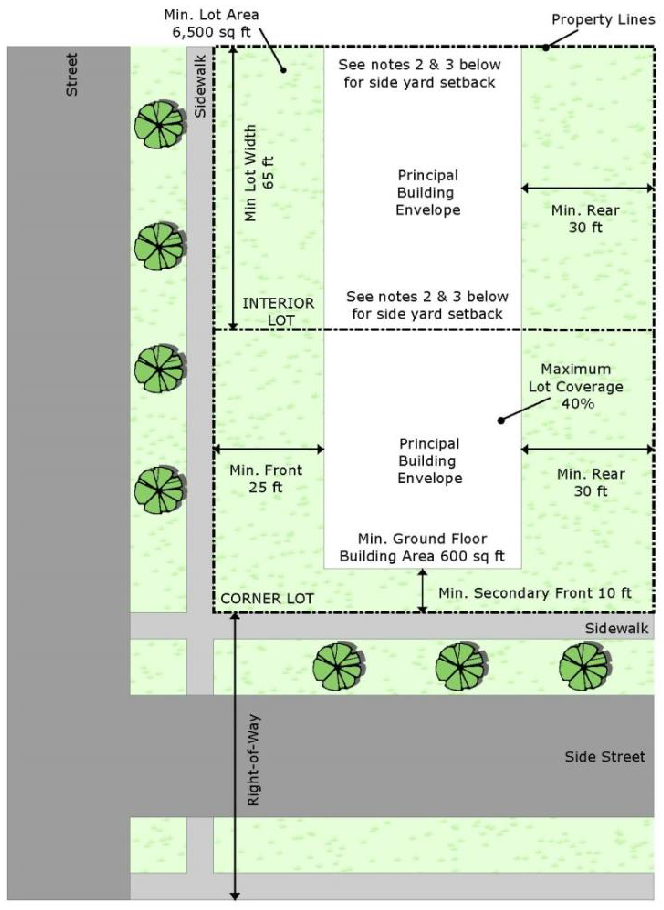
Lots existing prior to June 3, 1991 may be utilized for building purposes provided that they are at least 40 feet in width, 4,000 square feet in area and that minimum required yard setbacks can be met.
(2)
Not required unless property abuts a residentially or industrially zoned district, in which case the minimum yard setback shall be 20 feet for that side yard abutting the residentially or industrially zoned district.
(3)
Where a B-1 business district borders a residentially zoned district, excepting where there is a public street or alley located between the districts, there shall be provided along the lot line bordering the residentially zoned district a solid fence or ornamental wall six feet in height above grade constructed of wood, concrete block, brick or comparable material on which there shall be no advertising. However, such fencing shall be reduced to a height of three feet for the nearest 20 feet in length that is perpendicular to a public street right-of-way. Where a public alley is located between the B-1 business district and the residentially zoned district, no fence or wall is required in those locations where a building housing a permitted use is located adjoining the alley or where driveway access is provided to the public alley. Where a public street is located between the B-1 business district and the residentially zoned district, no fence is required.
(4)
(a)
For the secondary front yard, there shall be a minimum front yard setback of ten feet except for along major thoroughfares where the minimum setback shall be 25 feet.
(b)
A landscaped greenbelt, as described in section 90-64, shall be provided in the required front yard and secondary front yard unless parking is otherwise permitted as noted above.
Sec. 90-406B. - Additional regulations.
(1)
General requirements.
(a)
Façade standards. Section 90-322.
(b)
Accessory buildings. Section 90-311.
(c)
Fence regulations. Section 90-312.
(d)
Landscaping for non-residential uses. Section 90-328.
(e)
Projections into yards. Section 90-306.
(f)
Screening of roof top equipment. Section 90-318.
(g)
Signs. Article 7.
(h)
Off-street parking. Article 6.
(i)
Mechanical appurtenances. Section 90-310.
(j)
Dwellings in non-residential zones. See section 90-319.
(k)
Refuse disposal. Section 90-321.
(2)
Development procedures.
(a)
Special land uses. Section 90-507.
(b)
Site plan. Section 90-500.
(c)
Site condominiums. Section 90-509.
(3)
Administration and enforcement.
(a)
Board of zoning appeals. Article 10.
(b)
Permits. Section 90-1008.
(c)
Non-conforming lot and uses. Article 9.
Sec. 90-407B. - Principal permitted uses.
(1)
All principal permitted uses in the B-1 business district.
(2)
Retail businesses whose principal activity is the sale of new merchandise within a completely enclosed building. Up to 15 percent of the sales area may be used for the sale of used merchandise.
(3)
Business service establishments, such as office machine, printing and copying.
(4)
Any service establishment of an office, showroom or workshop nature, such as a decorator, upholsterer, caterer, exterminator, building contractor and similar establishments that require outlet, except that no outdoor storage yards shall be permitted.
(5)
Physical culture facilities, such as gymnasiums and reducing salons.
(6)
Automobile, truck, motorcycle, trailer, recreation vehicle or boat showrooms, excluding outdoor storage or display of sales product.
(7)
Business schools or private schools operated for a profit.
(8)
Automobile repair and service entirely within an enclosed building, except body shops, painting and refinishing, automobile washes, automobile gasoline and automobile service stations.
(9)
Hotels and motels.
(10)
Printing and publishing.
(11)
Bus passenger station.
(12)
Funeral homes or mortuaries.
(13)
Veterinary hospitals and clinics, excluding outdoor use of property for exercise yards, pens and other similar uses.
(14)
Commercial greenhouses of less than 1,000 square feet in floor area.
(15)
Business recreation uses as follows:
(a)
Indoor theater.
(b)
Bowling alley.
(c)
Skating rink.
(16)
Accessory buildings and uses customarily included incidental to the above uses.
(17)
Off-street parking.
(18)
Reserved.
(19)
Reserved.
(20)
Nursery schools, day nurseries and child care facilities for the care of seven or more people.
(21)
Reserved.
(22)
Athletic training facility.
(Code 1983, § 60.55; Ord. No. 15-99, § 2, 11-15-99; Ord. No. 03-07, § 1, 2-5-07; Ord. No. 7-09, § 6, 12-21-09; Ord. No. 14-12, §§ 2, 3, 1-7-13; Ord. No. 12-13, § 5, 9-3-13; Ord. No. 5-14, § 1, 3-17-14; Ord. No. 15-23, § 2, 12-4-23; Ord. No. 12-25, § 4, 10-20-25)
Sec. 90-408B. - Permitted uses after special approval.
The following uses may be permitted in the B-2 business district, subject to the approval of the planning commission:
(1)
All permitted uses after special approval in the B-1 business district.
(2)
Amusement machine parlors.
(3)
Automobile car wash establishments.
(4)
Drive through restaurants.
(5)
Automobile gasoline and automobile service stations.
(6)
Wholesale stores, storage facilities, warehouses, distributing plants, freezers and lockers. Not permitted in the downtown development authority area.
(a)
Open air business uses. Not permitted in the downtown development authority area, with the exception of outdoor dining with table service.
(b)
New or used motor vehicles, except those trucks exceeding 5,500 pounds in vehicle weight, or recreation vehicles, including boats, snowmobiles, travel trailers, campers, motor homes, tents and accessory equipment sales or rental, wherein motor vehicles or recreation vehicles are stored or displayed outside.
(c)
New or used mobile homes, excavation equipment, machinery or farm implement sales. Not permitted in the downtown development authority area.
(d)
Commercial greenhouses exceeding 1,000 square feet of floor area. Not permitted in the downtown development authority area.
(11)
College or university.
(12)
Radio or television tower.
(13)
Uses similar to the principal permitted uses of section 90-407B and not listed elsewhere in this chapter as a principal permitted use or permitted use after special approval.
(14)
Boardinghouses. Not permitted in the downtown development authority area.
(15)
Cocktail lounges, nightclubs, dancehalls, and bars.
(16)
Adult businesses as defined in section 14-2 of this Code. Not permitted in the downtown development authority area.
(17)
Billiard rooms and pool halls. Not permitted in the downtown development authority area.
(18)
Sales of used merchandise, pawnshop or secondhand dealers, and rental of new or used merchandise excluding motor vehicles.
(19)
Multiple family.
(20)
Places of worship.
(21)
Community centers.
(22)
Outdoor cookers (when accessory to a brick-and-mortar restaurant) (see section 90-332).
(23)
Transitional housing for more than ten individuals.
(24)
Permanent supportive housing for more than ten individuals.
(25)
Emergency shelter within 0.25 mile of a dedicated transit stop, medical clinic, or hospital.
(26)
Event center.
(Code 1983, § 60.56; Ord. No. 15-97, §§ 3, 4, 6-16-97; Ord. No. 21-98, § 2, 10-5-98; Ord. No. 15-99, § 3, 11-15-99; Ord. No. 12-00, § 2, 7-17-00; Ord. No. 10-01, § 3, 5-21-01; Ord. No. 15-01, § 2, 8-6-01; Ord. No. 19-03, § 1, 10-6-03; Ord. No. 02-07, § 1, 1-8-07; Ord. No. 03-07, § 2, 2-5-07; Ord. No. 7-09, § 6, 12-21-09; Ord. No. 3-11, §§ 4, 5, 5-2-11; Ord. No. 17-14, § 2, 8-4-14; Ord. No. 1-23, § 9, 2-6-23; Ord. No. 12-24, § 4, 11-4-24; Ord. No. 8-25, § 4, 7-7-25; Ord. No. 12-25, § 5, 10-20-25)
Sec. 90-409B. - Development standards.
Sec. 90-410B. - Specific requirements.
(1)
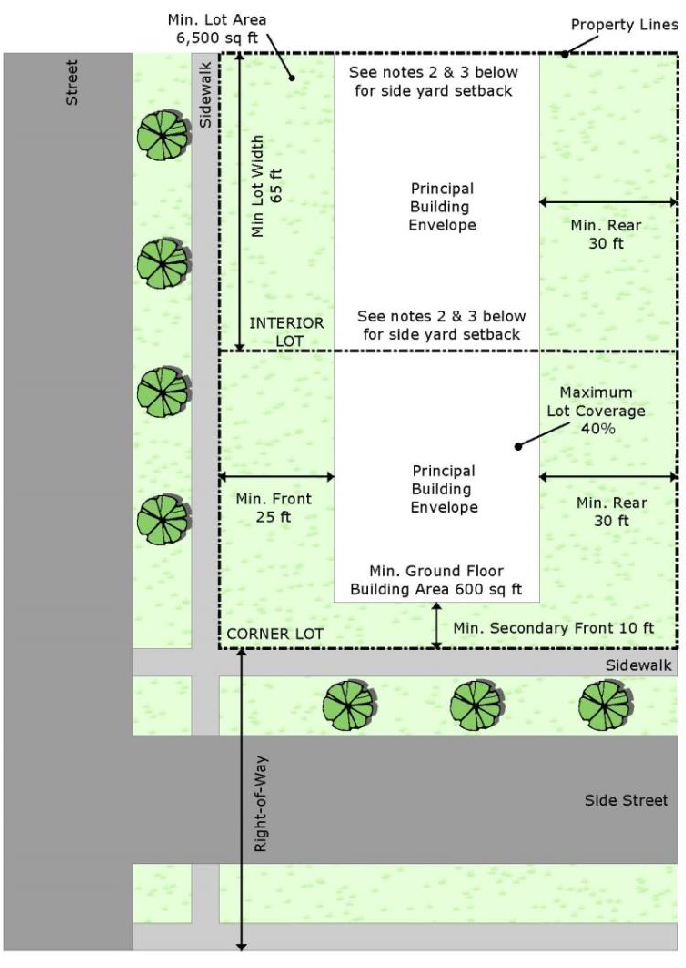
Lots existing prior to June 3, 1991 may be utilized for building purposes provided that they are at least 40 feet in width, 4,000 square feet in area and that minimum required yard setbacks can be met.
(2)
Not required unless property abuts a residentially or industrially zoned district, in which case the minimum yard setback shall be 20 feet for that side yard abutting the residentially or industrially zoned district.
(3)
Where a B-2 district borders a residentially zoned district, excepting where there is a public street or alley located between the districts, there shall be provided along the lot line bordering the residentially zoned district a solid fence or ornamental wall six feet in height above grade constructed of wood, concrete block, brick or comparable material on which there shall be no advertising. However, such fencing shall be reduced to a height of three feet for the nearest 20 feet in length that is perpendicular to a public street right-of-way. Where a public alley is located between the B-2 business district and the residentially zoned district, no fence or wall is required in those locations where a building housing a permitted use is located adjoining the alley or where driveway access is provided to the public alley. Where a public street is located between the B-2 business district and the residentially zoned district, no fence is required.
(4)
(a)
For the secondary front yard, there shall be a minimum front yard setback of ten feet except for along major thoroughfares where the minimum setback shall be 25 feet.
(b)
Parking shall not be permitted in the required front yard and secondary front yard setbacks, except that parking may be permitted in conjunction with site plan approval in that portion of the required front yard located more than 25 feet from the street right-of-way of property which abuts 28th Street.
(c)
A landscaped greenbelt, as described in section 90-328, shall be provided in the required front yard and secondary front yard unless parking is otherwise permitted as noted above.
(5)
For all properties which border 28th Street, the front lot line shall be deemed as bordering 28 th Street, the minimum front yard shall be 50 feet, the minimum lot width shall be 100 feet and the minimum lot depth shall be 200 feet.
Sec. 90-411B. - Additional regulations.
(1)
General requirements.
(a)
Façade standards. Section 90-322.
(b)
Accessory buildings. Section 90-311.
(c)
Fence regulations. Section 90-312.
(d)
Landscaping for non-residential uses. Section 90-328.
(e)
Projections into yards. Section 90-306.
(f)
Screening of roof top equipment. Section 90-318.
(g)
Signs. Article 7.
(h)
Off-street parking. Article 6.
(i)
Mechanical appurtenances. Section 90-310.
(j)
Dwellings in non-residential zones. See section 90-319.
(k)
Refuse disposal. Section 90-321.
(2)
Development procedures.
(a)
Special land uses. Section 90-507.
(b)
Site plan. Section 90-500.
(c)
Site condominiums. Section 90-509.
(3)
Administration and enforcement.
(a)
Board of zoning appeals. Article 10.
(b)
Permits. Section 90-1008.
(c)
Non-conforming lot and uses. Article 9.
Sec. 90-412B. - Principal permitted uses.
In the B-3 business district the following uses are permitted:
(1)
All principal permitted uses in the B-1 business district.
(2)
Department, variety and general merchandise stores.
(Code 1983, § 60.57; Ord. No. 14-12, § 4, 1-7-13; Ord. No. 12-25, § 6, 10-20-25)
Sec. 90-413B. - Permitted after special approval.
The following uses shall be permitted in the B-3 business district, subject to the approval of the planning commission:
(1)
All principal permitted uses allowed in the B-2 business district.
(2)
Radio, television, microwave or wireless communication towers.
(3)
Community centers.
(4)
Secondhand dealers.
(5)
Drive through restaurants.
(6)
Outdoor cookers (when accessory to a brick-and-mortar restaurant) (see section 90-332).
(7)
Transitional housing for more than ten individuals.
(8)
Permanent supportive housing for more than ten individuals.
(Code 1983, § 60.58; Ord. No. 15-97, § 5, 6-16-97; Ord. No. 21-98, § 3, 10-5-98; Ord. No. 02-09, § 2, 4-6-09; Ord. No. 7-09, § 7, 12-21-09; Ord. No. 3-11, § 9, 5-2-11; Ord. No. 17-14, § 3, 8-4-14; Ord. No. 1-23, § 10, 2-6-23; Ord. No. 12-25, § 7, 10-20-25)
Sec. 90-414B. - Site plan review and special conditions.
Site plan review is required of all principal uses in accordance with this chapter. The submitted site plan must encompass the total property of the applicant that is zoned B-3 business district. All designs in the site plan must be compatible with the designs of the adjoining sites.
(Code 1983, § 60.59)
Sec. 90-415B. - Development standards.
Sec. 90-416B. - Specific requirements.
(1)
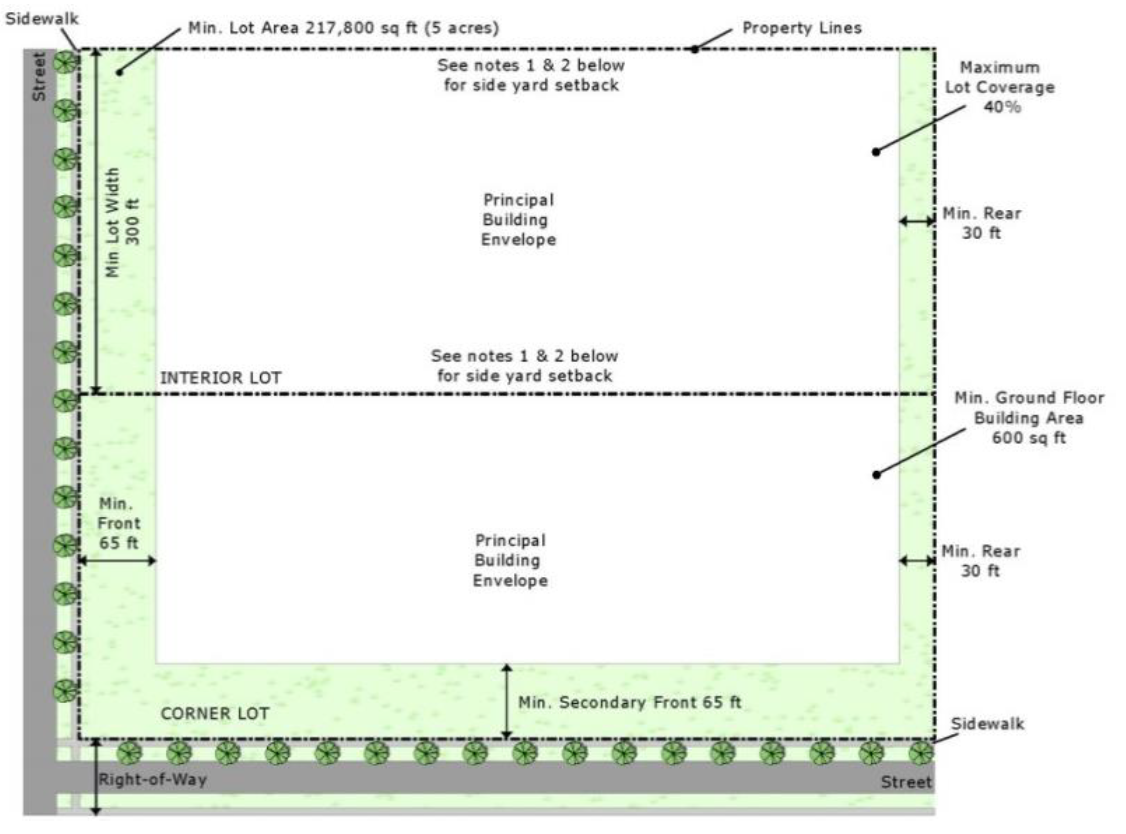
Not required unless property abuts a residentially or industrially zoned district, in which case the minimum yard setback shall be 20 feet for that side yard abutting the residentially or industrially zoned district.
(2)
Where a B-3 business district borders a residentially zoned district, excepting where there is a public street or alley located between the districts, there shall be provided along the lot line bordering the residentially zoned district a solid fence or ornamental wall six feet in height above grade constructed of wood, concrete block, brick or comparable material on which there shall be no advertising. However, such fencing shall be reduced to a height of three feet for the nearest 20 feet in length that is perpendicular to a public street right-of-way. Where a public alley is located between the B-3 business district and the residentially zoned district, no fence or wall is required in those locations where a building housing a permitted use is located adjoining the alley or where driveway access is provided to the public alley. Where a public street is located between the B-3 business district and the residentially zoned district, no fence is required.
(3)
(a)
For the secondary front yard, there shall be a minimum front yard setback of 65 feet.
(b)
Parking shall not be permitted in the required front yard and secondary front yard setbacks, except that parking may be permitted in conjunction with site plan approval in that portion of the required front yard located more than 25 feet from the street right-of-way of all property in the B-3 business district.
(c)
A landscaped greenbelt, as described in section 90-328, shall be provided in the required front yard and secondary front yard unless parking is otherwise permitted as noted above.
Sec. 90-417B. - Additional regulations.
(1)
General requirements.
(a)
Façade standards. Section 90-322.
(b)
Accessory buildings. Section 90-311.
(c)
Fence regulations. Section 90-312.
(d)
Landscaping for non-residential uses. Section 90-328.
(e)
Projections into yards. Section 90-306.
(f)
Screening of roof top equipment. Section 90-318.
(g)
Signs. Article 7.
(h)
Off-street parking. Article 6.
(i)
Mechanical appurtenances. Section 90-310.
(j)
Dwellings in non-residential zones. See section 90-319.
(k)
Refuse disposal. Section 90-321.
(2)
Development procedures.
(a)
Special land uses. Section 90-507.
(b)
Site plan. Section 90-500.
(c)
Site condominiums. Section 90-509.
(3)
Administration and enforcement.
(a)
Board of zoning appeals. Article 10.
(b)
Permits. Section 90-1008.
(c)
Non-conforming lot and uses. Article 9.
Sec. 90-418B. - Principal permitted uses.
In the RO-1 restricted office district, the following uses are permitted:
(1)
Office buildings for any of the following occupations: Executive, administrative, professional, accounting, clerical, stenographic, drafting and office equipment and supply sales;
(2)
Medical offices, including clinics;
(3)
Financial institutions;
(4)
Nursery schools, day nurseries, and child care facilities for the care of seven or more people, provided there is an on-site outdoor play area of at least 600 square feet and a fence of at least four feet in height to enclose the rear yard; and
(5)
Accessory buildings and uses customarily incidental to the above uses.
(Code 1983, § 60.220; Ord. No. 15-23, § 3, 12-4-23)
Sec. 90-419B. - Lot and area requirements.
All uses permitted in the RO-1 restricted office district as principal or special use approvals shall be subject to the same lot and area requirements as for B-1 business district as indicated in section 90-404B.
(Code 1983, § 60.222; Ord. No. 10-14, § 1, 6-2-14)
Sec. 90-420B. - Permitted uses after special approval.
The following uses shall be permitted in the RO-1 restricted office district, subject to the approval of the planning commission: all permitted uses in the B-1 business district. Uses allowed under this provision must be located within office buildings and are restricted to no more than 25 percent of the building's first floor square footage. Drive-through services are not permitted, except for financial institutions.
(Ord. No. 11-07, § 1, 4-2-07)
Sec. 90-421B. - Development standards.
Sec. 90-422B - Specific requirements
(1)
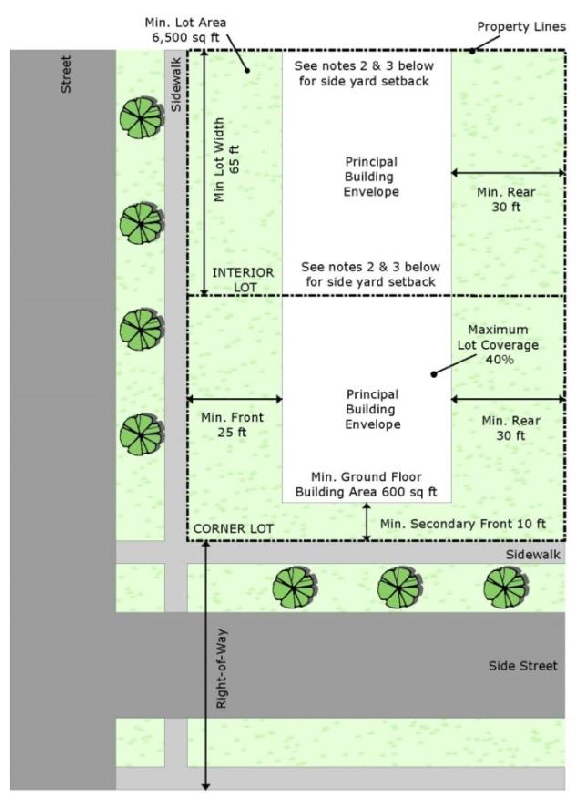
Lots existing prior to June 3, 1991 may be utilized for building purposes provided that they are at least 40 feet in width, 4,000 square feet in area and that minimum required yard setbacks can be met.
(2)
Not required unless property abuts a residentially or industrially zoned district, in which case the minimum yard setback shall be 20 feet for that side yard abutting the residentially or industrially zoned district.
(3)
Where a B-1 business district borders a residentially zoned district, excepting where there is a public street or alley located between the districts, there shall be provided along the lot line bordering the residentially zoned district a solid fence or ornamental wall six feet in height above grade constructed of wood, concrete block, brick or comparable material on which there shall be no advertising. However, such fencing shall be reduced to a height of three feet for the nearest 20 feet in length that is perpendicular to a public street right-of-way. Where a public alley is located between the B-1 business district and the residentially zoned district, no fence or wall is required in those locations where a building housing a permitted use is located adjoining the alley or where driveway access is provided to the public alley. Where a public street is located between the B-1 business district and the residentially zoned district, no fence is required.
(4)
(a)
For the secondary front yard, there shall be a minimum front yard setback of ten feet except for along major thoroughfares where the minimum setback shall be 25 feet.
(b)
Parking shall not be permitted in the required front yard and secondary front yard setbacks, except that parking may be permitted in conjunction with site plan approval in that portion of the required front yard located more than 25 feet from the street right-of-way of property which abuts 28th Street.
(c)
A landscaped greenbelt, as described in section 90-328 shall be provided in the required front yard and secondary front yard unless parking is otherwise permitted as noted above.
(5)
For all properties which border 28th Street, the front lot line shall be deemed as bordering 28 th Street, the minimum front yard shall be 50 feet, the minimum lot width shall be 100 feet and the minimum lot depth shall be 200 feet.
Sec. 90-423B. - Additional regulations.
(1)
General requirements.
(a)
Façade standards. Section 90-322.
(b)
Accessory buildings. Section 90-311.
(c)
Fence regulations. Section 90-312.
(d)
Landscaping for non-residential uses. Section 90-328.
(e)
Projections into yards. Section 90-306.
(f)
Screening of roof top equipment. Section 90-318.
(g)
Signs. Article 7.
(h)
Off-street parking. Article 6.
(i)
Mechanical appurtenances. Section 90-310.
(j)
Dwellings in non-residential zones. See section 90-319.
(k)
Refuse disposal. Section 90-321.
(2)
Development procedures.
(a)
Special land uses. Section 90-507.
(b)
Site plan. Section 90-500.
(c)
Site condominiums. Section 90-509.
(3)
Administration and enforcement.
(a)
Board of zoning appeals. Article 10.
(b)
Permits. Section 90-1008.
(c)
Non-conforming lot and uses. Article 9.
Sec. 90-424B. - Principle permitted uses.
The following uses shall be permitted in the B-3 business district, subject to the approval of the planning commission:
(1)
The wholesaling, or warehousing of any item except for the sale or leasing of motor vehicles.
(2)
Industrial establishments as follows:
(a)
The assembly, fabrication, manufacture, packaging or treatment of such products as food products (excluding butchering and animal slaughtering), candy, beverage alcohol production (without accessory dining), drugs, cosmetics and toiletries, musical instruments, optical goods, toys, novelties, electrical instruments and appliances, radios and phonographs; pottery and figurines or other ceramic products using only previously pulverized clay.
(b)
The assembly, fabrication, manufacture or treatment of such products from the following previously prepared materials: Bone, canvas, cellophane, cloth, cork, felt, fiber, glass, leather, paper, plastics, precious or semiprecious metals or stones, sheet metal (excluding large stampings such as automobile fenders or bodies), shell, textiles, wax, wire, wood (excluding saw and planing mills) and yarns.
(c)
Tool and die shops; metal-working machine shops involving the use of grinding or cutting tools, manufacturing of tools, dies, jigs and fixtures; publishing, printing or forming of box, carton and cardboard products.
(d)
Laboratories, research or testing.
(e)
Central dry cleaning plants and laundries.
(3)
Public utility buildings, telephone exchange buildings and electric transformers.
(4)
Accessory buildings and uses customarily incidental to the above uses.
(5)
Off-street parking.
(6)
Office type uses.
(7)
Billboards, when abutting a freeway or major thoroughfare.
(8)
Municipal buildings and uses.
(9)
Building and construction contractors with no outside storage.
(10)
Distribution centers.
(Code 1983, § 60.60; Ord. No. 2-96, § 2, 2-20-96; Ord. No. 06-06, § 1, 2-6-06; Ord. No. 03-07, § 3, 2-5-07; Ord. No. 12-25, § 8, 10-20-25)
Sec. 90-425B. - Permitted uses after special approval.
The following uses may be permitted in the I-1 light industrial district subject to the approval of the planning commission:
(1)
Truck terminals.
(2)
Trucks exceeding 5,500 pounds in vehicle weight and truck trailer sales and display, rental and repair.
(3)
Recreational vehicle storage yards.
(4)
Mineral extraction, borrow pit or topsoil removal.
(5)
Radio, television, microwave or wireless communication towers.
(6)
Service stations, including accessory restaurant uses within the building. Drive-through window access may be permitted.
(7)
Athletic training facility.
(8)
Beverage alcohol production with accessory dining, including breweries, distilleries, and wineries.
(Code 1983, § 60.61; Ord. No. 21-98, § 6, 10-5-98; Ord. No. 8-12, § 1, 7-2-12; Ord. No. 12-13, § 2, 9-3-13)
Sec. 90-426B. - Open storage.
All manufacturing activities in the I-1 light industrial district shall be conducted within an enclosed building, except that external storage of materials shall be permitted, provided that the storage area shall be visibly screened from all streets and adjoining commercial and residential properties with a noncombustible fence or wall, or with a non-deciduous planted screen, at least five feet in height and at least 80 percent solid, and of such design and constructed of such material and maintained in such a manner as shall be in keeping with the character of the area. Front yard and side yard areas adjacent to street frontage shall not be used for the external storage of materials. In instances where the building inspector determines that any wall required by this chapter will satisfy any portion of this open storage screening requirement, the building inspector may waive such applicable portion of this open storage screening requirement.
(Code 1983, § 60.62)
Sec. 90-427B. - Development standards.
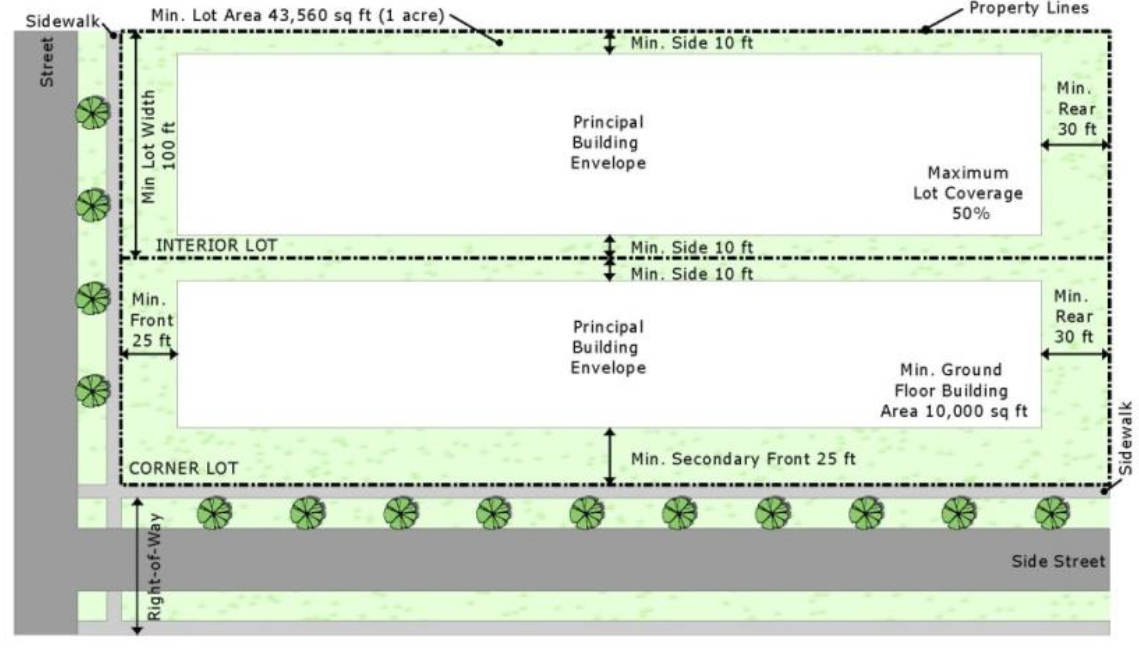
Sec. 90-428B. - Specific requirements.
(1)
(a)
For the secondary front yard, there shall be a minimum setback of 25 feet.
(b)
Parking shall not be permitted in the required front yard and secondary front yard setbacks, except that parking may be permitted in conjunction with site plan approval in that portion of the required front yard located more than 25 feet from the street right-of-way of property which abuts 28th Street.
(c)
A landscaped greenbelt, as described in section 90-328, shall be provided in the required front yard and secondary front yard unless parking is otherwise permitted as noted above.
(2)
For the side yard property which abuts a residentially zoned district, the minimum side yard setback shall be 25 feet of which a minimum of ten feet shall be landscaped.
(3)
For all properties which border 28th Street, the front lot line shall be deemed as bordering 28 th Street, the minimum front yard shall be 50 feet, the minimum lot width shall be 100 feet and the minimum lot depth shall be 200 feet.
(4)
Where an I-1 light industrial district borders a residentially zoned district, excepting where there is a public street or alley located between the districts, there shall be provided along the lot line bordering the residentially zoned district a solid fence or ornamental wall six feet in height above grade constructed of wood, concrete block, brick or comparable material on which there shall be no advertising. However, such fencing shall be reduced to a height of three feet for the nearest 20 feet in length that is perpendicular to a public street right-of-way. Where a public alley is located between the I-1 light industrial district and the residentially zoned district, no fence or wall is required in those locations where a building housing a permitted use is located adjoining the alley or where driveway access is provided to the public alley. Where a public street is located between the I-1 light industrial district and the residentially zoned district, no fence is required.
(5)
All manufacturing activities in the I-1 light industrial district shall be conducted within an enclosed building, except that external storage of materials shall be permitted, provided that the storage area shall be visibly screened from all streets and adjoining commercial and residential properties with a noncombustible fence or wall, or with a non-deciduous planted screen, at least five feet in height and at least 80 percent solid, and of such design and constructed of such material and maintained in such a manner as shall be in keeping with the character of the area. In instances where the building inspector determines that any wall required by this chapter will satisfy any portion of this open storage screening requirement, the building inspector may waive such applicable portion of this open storage screening requirement.
Sec. 90-429B. - Additional regulations.
(1)
General requirements.
(a)
Façade standards. Section 90-322.
(b)
Accessory buildings. Section 90-311.
(c)
Fence regulations. Section 90-312.
(d)
Landscaping for non-residential uses. Section 90-328.
(e)
Projections into yards. Section 90-306.
(f)
Screening of roof top equipment. Section 90-318.
(g)
Signs. Article 7.
(h)
Off-street parking. Article 6.
(i)
Mechanical appurtenances. Section 90-310.
(j)
Dwellings in non-residential zones. See section 90-319.
(k)
Refuse disposal. Section 90-321.
(2)
Development procedures.
(a)
Special land uses. Section 90-507.
(b)
Site plan. Section 90-500
(c)
Site condominiums. Section 90-509.
(3)
Administration and enforcement.
(a)
Board of zoning appeals. Article 10.
(b)
Permits. Section 90-1008.
(c)
Non-conforming lot and uses. Article 9.
Sec. 90-430B. - Principal permitted uses.
In the I-2 industrial district, the following uses are permitted:
(1)
All principal permitted uses in the I-1 light industrial district.
(2)
All permitted uses after special approval in the I-1 light industrial district except radio, television, microwave or wireless communication towers, service stations, including accessory restaurant uses within the building. and athletic training facilities.
(3)
The assembly or manufacture of automobiles, automobile bodies, automotive engines, cigars and cigarettes, electrical fixtures, batteries and other electrical apparatus and hardware.
(4)
Metal stamping, pressing and buffing plants.
(5)
Plastering and polishing shops, painting and sheet metal shops, tire vulcanizing and recapping shops, undercoating and rustproofing shops, welding shops, and millwork lumber and planing mills.
(6)
Any other uses similar to any of the above uses.
(7)
Accessory buildings and uses customarily incidental to the above uses.
(8)
Off-street parking.
(9)
Billboards, when abutting a freeway or major thoroughfare.
(Code 1983, § 60.63)
Sec. 90-431B. - Permitted uses after special approval.
The following uses may be permitted in the I-2 industrial district subject to the approval of the planning commission:
(1)
Open storage yards of building and construction contractors and lumberyards.
(2)
Breweries, distilleries, canning factories, chemical plants, and handling, storage, processing or disposal of solid or liquid waste materials.
(3)
Salvage yards and recycling facilities.
(4)
Kennels.
(5)
Outdoor theaters.
(6)
Mining, excavating or other removal of sand, earth, minerals or other material naturally found in the earth.
(7)
Body shops.
(8)
Sanitary landfill sites.
(9)
Radio, television, microwave or wireless communication towers.
(10)
Residential facilities to house persons on parole or probation.
(11)
Service stations, including accessory restaurant uses within the building. Drive-through window access may be permitted.
(12)
Athletic training facility.
(Code 1983, § 60.64; Ord. No. 21-98, § 7, 10-5-98; Ord. No. 2-12, § 3, 1-16-12; Ord. No. 8-12, § 2, 7-2-12; Ord. No. 12-13, § 3, 9-3-13; Ord. No. 14-16, 11-7-16)
Sec. 90-432B. - Open storage.
Front yard areas and side yard areas adjacent to street frontage in the I-2 industrial district shall not be used for the external storage of materials.
(Code 1983, § 60.65)
Sec. 90-433B. - Auto plant property development.
(1)
General. Auto plant property may be used, developed, redeveloped or improved, including the demolition of any building, only as provided in this section.
(2)
Definitions. The following words, terms and phrases, when used in this section, shall have the meanings ascribed to them in this subsection, except where the context clearly indicates a different meaning:
(a)
Auto plant property means a parcel of property located within the I-2 industrial district (industrial, general) that exceeds 85 acres in size, or which contains a building that exceeds 1,000,000 square feet in area, 40 percent of such property or building having not been used for manufacturing for at least a consecutive 12-month period.
For purposes of this section, parcels of property that were under common ownership and that functioned as a unified unit when last in full productive use will be treated as a single parcel of property.
(3)
Purpose. In recognition of the unique characteristics comprising an auto plant property, including:
(a)
The infrastructure on and around the property, including highway access, railroad connection and industrial water and sewer facilities;
(b)
The business community surrounding such properties that have been specifically established to provide support services; and
(c)
The environmental challenges often associated with such properties, the purpose of this section is to ensure that auto plant properties are used for industrial purposes that will:
1.
Prevent such properties from falling into deterioration and blight;
2.
Provide an anchor for the surrounding area by providing support to the businesses that have developed to accommodate such properties; and
3.
Create jobs for the city's highly skilled workforce.
(4)
Permitted uses. Subject to the requirements of this section, the requirements of this article, and applicable provisions of this zoning code, an auto plant property shall be used for permitted uses, but no special approval uses, allowed in the I-2 industrial district.
(5)
Procedure.
(a)
Where the building(s) on an auto plant property:
1.
Is more than 40 years in age;
2.
Has minimal insulation;
3.
Has areas with ceilings less than 35 feet in height;
4.
Has over 500,000 square feet of overall space;
5.
Lacks the plumbing, HVAC, electrical or other services distributed throughout the building as reasonably needed to continue its use as a manufacturing facility, or
6.
Shows other indicia of functional obsolescence, partial or complete demolition shall be required unless a plan for complete re-use of such building, which includes all renovation needed to eliminate the functional obsolescence, is presented.
(b)
Site plan review is required prior to the proposed development, redevelopment, improvement or reuse of, or the demolition of any building on, any auto plant property. Site plans shall be prepared showing the changes to result from the entirety of any intended development project.
In accordance with section 90-500 of this zoning code, a site plan submitted under this section shall contain the following items of information:
1.
A legal description of the property.
2.
The gross land area and the zoning of the surrounding area, including the location of structures and other improvements.
3.
A full-dimensioned map of the land showing topographic information at a contour interval of two feet or less.
4.
Location of existing and proposed buildings and structures in the development area, the uses to be contained therein, the number of stories, gross building areas, distances between the lot line, setback lines and approximate location of vehicular entrances and loading points.
5.
Streets, driveways, easements, service aisles and parking areas, including the general layout and design of parking lot spaces.
6.
Pedestrian walks, malls and open areas for parks and recreation.
7.
A location and height of walls, fences and screen planting, including a general plan for landscaping.
8.
Types of surfacing, such as paving, turfing or gravel to be used.
9.
Grading plan.
10.
Existing and proposed utilities.
11.
Elevations of any proposed buildings and structures indicating the architecture.
12.
Such other information as may be required to assist in the consideration of the proposed development.
(c)
Site plans submitted under this section shall be reviewed by the planning commission in accordance with section 90-500 of this zoning code. Upon completion of its review, the planning commission shall provide a recommendation to the city council.
(d)
The city council shall review the planning commission's recommendation and approve, deny, or approve with conditions a site plan submitted under this section.
(e)
The planning commission, with the approval of the city council, may alternatively allow for multiple preliminary site plans for phases of a proposed project if a concept plan is first approved that meets the criteria determined by the planning commission to meet the spirit and intent of this section and if, due to development uncertainty, it is impractical to require a complete site plan.
(6)
Architectural/design standards.
(a)
The development, redevelopment or improvement of any building(s) located on an auto plant property shall use an architectural style that reflects a common theme or pattern that is aesthetically consistent and is compatible with surrounding properties.
(b)
Buildings of up to 60 feet in height shall be permitted.
(c)
All walls exposed to public view from a public street or adjacent residential area shall be constructed of not less than 75 percent brick, face brick, stone, cast stone, or other quality materials as determined by the planning commission from finished grade to roof level. High quality materials on other exposed exterior surfaces such as brick, stone, wood or stucco are encouraged.
(7)
Landscaping standards.
(a)
A 25-foot-wide minimum greenbelt, landscaped with trees and plantings compatible with surrounding properties, shall be provided along public streets currently abutting or running through an auto plant property.
(b)
A 15-foot-wide minimum landscaped greenbelt shall be provided along all internal streets in accordance with section 90-328 of this zoning code.
(8)
Parking requirements. The required number of parking spaces for an auto plant property shall comply with standards established within the zoning code. The parking space requirements may be reduced by up to 25 percent, as part of site plan approval, where the following condition is met:
(a)
The applicant has provided a parking study, conducted by a qualified traffic engineer, that demonstrates that another standard would be more appropriate based on an actual number of employees, expected level of customer traffic, availability of transit, or actual counts at a similar establishment.
Parking spaces shall be at least nine feet wide and 18 feet in depth.
(9)
Additional requirements.
(a)
Except for required yards adjoining a public street, all required yards may be used for off street parking, loading or the outdoor storage of equipment, excluding supplies and inventory.
(b)
Outdoor storage areas shall be screened from view from public streets by a six foot high opaque fence. To the extent possible, stored items shall not exceed the height of the fence.
(c)
Dumpster areas shall be screened from view in accordance with section 90-58 of this zoning code.
(d)
Signs shall be permitted as provided in the I-3 restricted industrial district.
(10)
Waiver. The planning commission, with the concurrence of the city council, may waive the requirements of subsections (6) and (7) above, under the following circumstances:
(a)
The presence of existing natural vegetation provides suitable landscaping or screening.
(b)
The building is LEED-NC silver certified/rated and proposed facade materials are compatible with surrounding buildings.
(c)
There are architectural features or design standards incorporated into a proposed development plan that differ from the requirements of this section but that generally achieve the objectives of this section.
(d)
For other good reasons where open space, special care of landscaping on areas adjacent to or across the street from residentially zoned or used property, the overall site design, special architectural features, or other unique aspects of the site plan might together be determined to comply with the general intent of this section and merit such waiver.
(Ord. No. 9-10, § 1, 10-4-10; Ord. No. 3-12, §§ 4, 5, 3-5-12)
Sec. 90-434B. - Development standards.
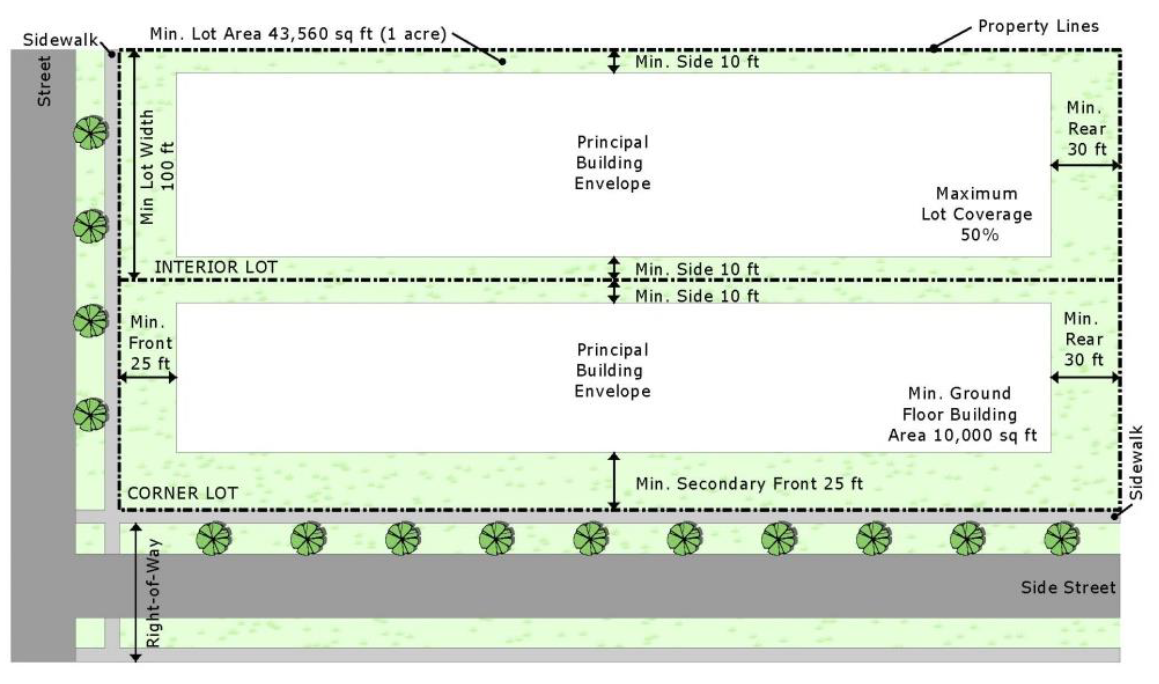
Sec. 90-435B. - Specific requirements.
(1)
(a)
For the secondary front yard, there shall be a minimum setback of 25 feet.
(b)
Parking shall not be permitted in the required front yard and secondary front yard setbacks, except that parking may be permitted in conjunction with site plan approval in that portion of the required front yard located more than 25 feet from the street right-of-way of property which abuts 28th Street.
(c)
A landscaped greenbelt, as described in section 90-328, shall be provided in the required front yard and secondary front yard unless parking is otherwise permitted as noted above.
(2)
For the side yard property which abuts a residentially zoned district, the minimum side yard setback shall be 25 feet of which a minimum of ten feet shall be landscaped.
(3)
For all properties which border 28th Street, the front lot line shall be deemed as bordering 28 th Street, the minimum front yard shall be 50 feet, the minimum lot width shall be 100 feet and the minimum lot depth shall be 200 feet.
(4)
Where an I-2 industrial district borders a residentially zoned district, excepting where there is a public street or alley located between the districts, there shall be provided along the lot line bordering the residentially zoned district a solid fence or ornamental wall six feet in height above grade constructed of wood, concrete block, brick or comparable material on which there shall be no advertising. However, such fencing shall be reduced to a height of three feet for the nearest 20 feet in length that is perpendicular to a public street right-of-way. Where a public alley is located between the I-2 industrial district and the residentially zoned district, no fence or wall is required in those locations where a building housing a permitted use is located adjoining the alley or where driveway access is provided to the public alley. Where a public street is located between the I-2 industrial district and the residentially zoned district, no fence is required.
(5)
All manufacturing activities in the I-2 industrial district shall be conducted within an enclosed building, except that external storage of materials shall be permitted, provided that the storage area shall be visibly screened from all streets and adjoining commercial and residential properties with a noncombustible fence or wall, or with a non-deciduous planted screen, at least five feet in height and at least 80 percent solid, and of such design and constructed of such material and maintained in such a manner as shall be in keeping with the character of the area. In instances where the building inspector determines that any wall required by this chapter will satisfy any portion of this open storage screening requirement, the building inspector may waive such applicable portion of this open storage screening requirement.
Sec. 90-436B. - Additional regulations.
(1)
General requirements.
(a)
Façade standards. Section 90-322.
(b)
Accessory buildings. Section 90-311.
(c)
Fence regulations. Section 90-312.
(d)
Landscaping for non-residential uses. Section 90-328.
(e)
Projections into yards. Section 90-306.
(f)
Screening of roof top equipment. Section 90-318.
(g)
Signs. Article 7.
(h)
Off-street parking. Article 6.
(i)
Mechanical appurtenances. Section 90-310.
(j)
Dwellings in non-residential zones. See section 90-319.
(k)
Refuse disposal. Section 90-321.
(2)
Development procedures.
(a)
Special land uses. Section 90-507.
(b)
Site plan. Section 90-500.
(c)
Site condominiums. Section 90-509.
(3)
Administration and enforcement.
(a)
Board of zoning appeals. Article 10.
(b)
Permits. Section 90-1008.
(c)
Non-conforming lot and uses. Article 9.
Sec. 90-437B. - Principal permitted uses.
The following uses are permitted in the I-3 restricted industrial district within an enclosed building. All uses permitted in the I-1 light industrial district except billboards.
(Code 1983, § 60.250)
Sec. 90-438B. - Permitted uses after special approval.
The following uses may be permitted in the I-3 restricted industrial district, subject to the approval of the planning commission:
(1)
Uses containing more than ten truck bays, except that all truck terminals, truck tractor and trailer sales and display, rental and repair are prohibited.
(2)
Radio, television, microwave or wireless communication towers.
(3)
Athletic training facility.
(Code 1983, § 60.251; Ord. No. 21-98, § 4, 10-5-98; Ord. No. 12-13, § 4, 9-3-13)
Sec. 90-439B. - Open storage.
All manufacturing activities in the I-3 restricted industrial district shall be conducted within an enclosed building. External storage of materials is prohibited. Equipment may be located within the rear and side yard, provided it is completely screened from all streets and adjoining properties, except for drive openings, with a solid fence six feet in height. In instances where the building inspector determines that any fence or screening required by this chapter will satisfy any portion of this equipment fencing requirement, the building inspector may waive such applicable portion of this equipment fencing requirement. The storage of motor vehicles is permitted in the rear and side yards without the equipment fencing requirement.
(Code 1983, § 60.252)
Sec. 90-440B. - Limitation on traffic movement.
No driveway access is allowed from industrially zoned property to Burlingame Avenue or 56 th Street.
(Ord. No. 20-96, § 1, 10-7-96; Ord. No. 29-97, § 1, 12-15-97; Ord. No. 17-02, § 1, 9-3-02; Ord. No. 21-02, § 1, 11-4-02)
Sec. 90-441B. - Building materials.
The front of each building and sides of buildings facing streets shall be finished with face brick, or its equivalent, from finished grade to roof level, except that the planning commission may approve a proportion of differing materials if submitted with a building elevation.
(Code 1983, § 60.254; Ord. No. 29-97, § 1, 12-15-97)
Sec. 90-442B. - Yard screening requirements.
Wherever property borders a major thoroughfare in the I-3 restricted industrial district, there shall be provided a combination berm/landscaping screen along the bordering area, except for driveway openings. Berming shall be undulating, with a minimum height of four feet. Landscaping shall be a minimum of 80 percent solid and a minimum of six feet high wherever there is no berming. The berming/landscaping screen is primarily intended to screen parking lots, truck bay areas, and rear yards and as such is not necessarily required to be solid for the entire bordering area. The berming/landscaping plan shall be subject to approval by the planning commission.
(Ord. No. 20-96, § 2, 10-7-96)
Sec. 90-443B. - Loading dock areas.
Loading dock areas may not face the front yard of a site. All loading dock areas shall be adequately screened from any adjoining streets with all screening to be included in the site design.
(Ord. No. 29-97, § 1, 12-15-97)
Sec. 90-444B. - Development standards.
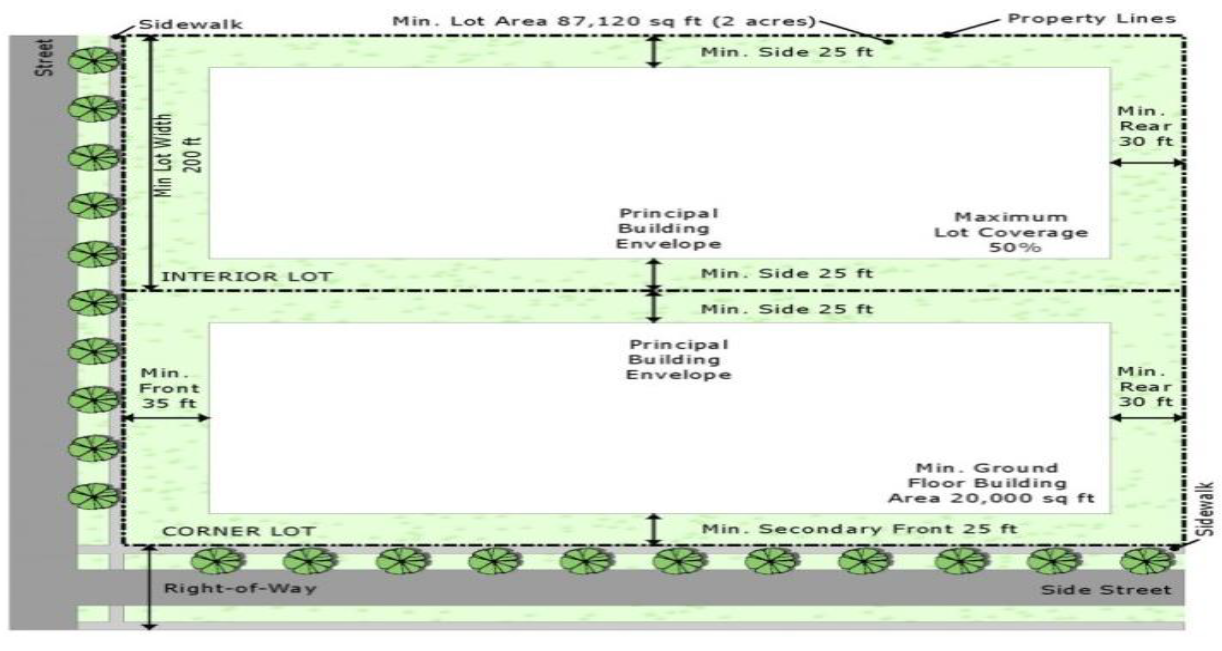
Sec. 90-445B. - Specific requirements.
(1)
(a)
For the secondary front yard, there shall be a minimum setback of 25 feet.
(b)
A landscaped greenbelt, as described in section 90-328, shall be provided in the required front yard and secondary front yard unless parking is otherwise permitted as noted above.
(2)
Wherever a residential zoning district is across the street from the I-3 restricted industrial district, there shall be provided along the bordering area a 24-foot-wide landscaped greenbelt containing one or a combination of berming, shrubbery and tree growth of materials approved by the planning department, to provide screening to a minimum height of five feet and at least 80 percent solid.
(3)
Regardless of any smaller minimum setback requirements in the I-3 restricted industrial district, no building may be closer than 50 feet to Gezon Parkway, as existing or planned; a 25-foot-wide landscaped greenbelt is required adjoining the existing or proposed Gezon Parkway, except for driveways; and minimum side yard setbacks for lots fronting on Gezon Parkway shall be 25 feet.
(4)
Where an I-3 restricted industrial district borders a residentially zoned district, excepting where there is a public street or alley located between the districts, there shall be provided along the lot line bordering the residentially zoned district a solid fence or ornamental wall six feet in height above grade constructed of wood, concrete block, brick or comparable material on which there shall be no advertising. However, such fencing shall be reduced to a height of three feet for the nearest 20 feet in length that is perpendicular to a public street right-of-way. Where a public alley is located between the I-3 restricted industrial district and the residentially zoned district, no fence or wall is required in those locations where a building housing a permitted use is located adjoining the alley or where driveway access is provided to the public alley. Where a public street is located between the I-3 restricted industrial district and the residentially zoned district, no fence is required.
(5)
Open storage. All manufacturing activities in the I-3 restricted industrial district shall be conducted within an enclosed building. External storage of materials is prohibited. Equipment may be located within the rear and side yard, provided it is completely screened from all streets and adjoining properties, except for drive openings, with a solid fence six feet in height. In instances where the building inspector determines that any fence or screening required by this chapter will satisfy any portion of this equipment fencing requirement, the building inspector may waive such applicable portion of this equipment fencing requirement. The storage of motor vehicles is permitted in the rear and side yards without the equipment fencing requirement. (Code 1983, § 60.252)
(6)
Limitation on traffic movement. No driveway access is allowed from industrially I-3 zoned property to Burlingame Avenue or 56th Street.
(7)
Building materials. The front of each building and sides of buildings facing streets shall be finished with face brick, or its equivalent, from finished grade to roof level, except that the planning commission may approve a proportion of differing materials if submitted with a building elevation.
(8)
Yard screening requirements. Wherever property borders a major thoroughfare in the I-3 restricted industrial district, there shall be provided a combination berm/landscaping screen along the bordering area, except for driveway openings. Berming shall be undulating, with a minimum height of four feet. Landscaping shall be a minimum of 80 percent solid and a minimum of six feet high wherever there is no berming. The berming/landscaping screen is primarily intended to screen parking lots, truck bay areas, and rear yards and as such is not necessarily required to be solid for the entire bordering area. The berming/landscaping plan shall be subject to approval by the planning commission.
(9)
Loading dock areas. Loading dock areas may shall not face the front yard of a site. All loading dock areas shall be adequately screened from any adjoining streets with all screening to be included in the site design.
(Code 1983, § 60.254; Ord. No. 20-96, § 1, 10-7-96; Ord. No. 29-97, § 1, 12-15-97; Ord. No. 17-02, § 1, 9-3-02; Ord. No. 20-96, § 2, 10-7-96; Ord. No. 21-02, § 1, 11-4-02)
Sec. 90-446B. - Additional regulations.
(1)
General requirements.
(a)
Façade standards. Section 90-322.
(b)
Accessory buildings. Section 90-311.
(c)
Fence regulations. Section 90-312.
(d)
Landscaping for non-residential uses. Section 90-328.
(e)
Projections into yards. Section 90-306.
(f)
Screening of roof top equipment. Section 90-318.
(g)
Signs. Article 7.
(h)
Off-street parking. Article 6.
(i)
Mechanical Appurtenances. Section 90-310.
(j)
Dwellings in non-residential zones. See section 90-319.
(k)
Refuse disposal. Section 90-321.
(2)
Development procedures.
(a)
Special land uses. Section 90-507.
(b)
Site plan. Section 90-500.
(c)
Site condominiums. Section 90-509.
(3)
Administration and enforcement.
(a)
Board of zoning appeals. Article 10.
(b)
Permits. Section 90-1008.
(c)
Non-conforming lot and uses. Article 9.
Sec. 90-446B. - Limitation of the use.
The following shall apply to the use of the P-1 vehicular parking district:
(1)
Parking areas shall be used for parking of private passenger vehicles only.
(2)
No business involving the repair or servicing of vehicles, or sale or display thereof, or other storage shall be permitted from or upon such premises.
(3)
Not more than two buildings for shelter of attendants may be erected upon the premises and each such building shall be not more than 50 square feet in area and not more than 15 feet in height.
(4)
No outdoor advertising signs shall be erected on the premises. One directional sign at each point of ingress or egress may be erected which may also bear the name of the operator of the lot and enterprise it is intended to serve. Such sign may also include any charge for use of the parking area. Such sign shall not exceed 15 square feet in area, shall not extend more than ten feet in height above the nearest curb and shall be entirely upon the parking area.
(Code 1983, § 60.67)
Sec. 90-447B. - Greenbelt.
A yard space of not less than five feet in width between the street property line and parking area in the P-1 vehicular parking district shall be preserved as a greenbelt and maintained with grass, shrubbery or a combination thereof.
(Code 1983, § 60.68)
Sec. 90-448B. - Protective wall.
Where the P-1 vehicular parking district has a common boundary with residentially zoned property, there shall be a continuous solid masonry or concrete wall four feet in height or solid fence six feet in height or planted screen six feet in height and 80 percent dense. The planning commission shall have the right of approval of which of these options shall be used.
(Code 1983, § 60.69)
Sec. 90-449B. - Bumper rail.
There shall be a bumper rail of either wood, metal or concrete, not more than two feet in height and securely anchored into the ground, on all sides of the parking area in the P-1 vehicular parking district where there is a protective wall required. Such bumper rail shall be located at such a distance so that vehicles will not strike the protective wall.
(Code 1983, § 60.70)
Sec. 90-450B. - Lighting.
Lighting shall be arranged so as to reflect away from residentially zoned properties which are adjacent to the P-1 vehicular parking district.
(Code 1983, § 60.71)
Sec. 90-451B. - Additional regulations.
(1)
General requirements.
(a)
Off-street parking. Article 6.
(2)
Development procedures.
(a)
Site plans. Section 90-500.
(3)
Administration and enforcement.
(a)
Board of zoning appeals. Article 10.
(b)
Permits. Section 90-1008.
(c)
Non-conforming lot and uses. Article 19.

