
Wyoming City Zoning Code
ARTICLE 4A
RESIDENTIAL ZONING DISTRICTS
R-1 Residential District
R-2 Residential District
R-3 Residential District
R-4 Residential District
R-5 Residential District
R-6 Residential District
R-7 Residential District
ER Estate Residential District
The location and boundaries of the districts are hereby established on a map entitled "City of Wyoming, Michigan Zoning Map", together with all notations, which map is hereby adopted and made a part of this chapter. The zoning map may be maintained by the city in such form as shall from time to time be deemed appropriate including an electronic database or information system. Unless otherwise shown on the zoning map, the district boundary lines follow lot lines or the centerlines of streets or alleys or such lines extended and the corporate limits of the city as they existed on January 3, 1979, and as subsequently revised. If the exact location of any district boundary line cannot be determined by the zoning map, it shall be resolved by the board of zoning appeals.
(Code 1983, § 60.3; Ord. No. 20-06, § 1, 7-3-06)
Sec. 90-401A. - Principal permitted uses.
In the R-1 Residential District, the following uses shall be permitted:
(1)
Single-family detached dwellings. For mobile home standards see section 90-307.
(2)
Churches and church facilities normally incidental thereto, provided that ingress and egress from the site is onto a major thoroughfare or collector street. Church sites shall be a minimum of three acres.
(3)
Publicly owned facilities, except public elementary, intermediate or high schools.
(4)
Off-street parking.
(5)
Accessory buildings and uses customarily incidental to the principal permitted uses.
(6)
Foster care facilities, nursery schools, day nurseries and child care facilities for the care of not more than six people as defined by the Michigan Family Independence Agency.
(7)
Home occupations.
(8)
Accessory Dwelling Units incidental to the principal permitted dwelling unit.
(Code 1983, § 60.41; Ord. No. 15-97, § 2, 6-16-97; Ord. No. 18-98, § 3, 8-17-98; Ord. No. 3-25, § 3, 1-21-25)
Sec. 90-402A. - Permitted uses after special approval.
The following uses shall be permitted subject to the approval of the planning commission:
(1)
Private parks, country clubs, golf courses and golf driving ranges adjoining a golf course or country club.
(2)
Telephone exchange buildings, electric transformer stations and substations and gas regulator stations.
(3)
Nursery schools, day nurseries and child care facilities for the care of seven or more people.
(4)
Cemeteries.
(5)
Mineral extraction, borrow pit and topsoil removal.
(6)
Commercial greenhouses.
(7)
Adult education facilities not operated for profit.
(8)
Agricultural uses.
(9)
Public, parochial, or private elementary, intermediate or high schools.
(10)
Community centers.
(Code 1983, § 60.42; Ord. No. 18-98, § 1, 8-17-98; Ord. No. 7-09, §§ 1, 5, 12-21-09; Ord. No. 12-25, § 1, 10-20-25)
Sec. 90-403A. - Development standards.
| Minimum Lot Area (1) | 10,000 sq. ft. | 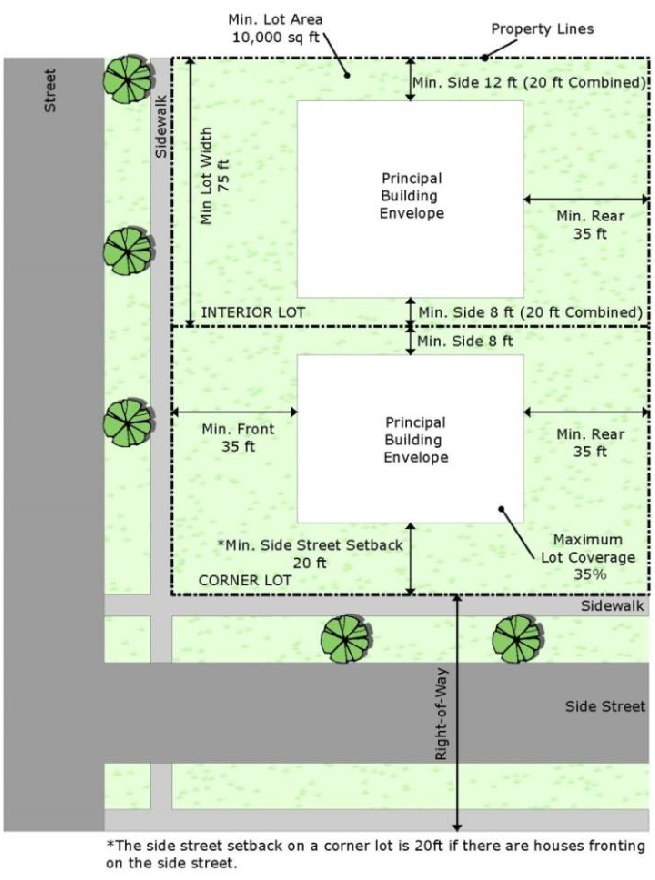 |
| Minimum Lot Width | 75 ft. | |
| Minimum Front Yard (2)(6) | 35 ft. | |
| Minimum Rear Yard (3) | 35 ft. | |
| Minimum Side Yard (3)(4)(5) | 8 ft. | |
| Minimum Combined Side Yard (5) | 20 ft. | |
| Minimum Ground Floor Building Area | ||
| One-Story | 1,280 sq. ft. | |
| 1½-Story | 960 sq. ft. | |
| Two-Story | 780 sq. ft. | |
| Bi-Level | 864 sq. ft. | |
| Split Level | 1,280 sq. ft. | |
| Tri-Level | 1,280 sq. ft. | |
| Maximum Building Height | 35 ft. | |
| Minimum Number of Parking Spaces/Unit | 2 | |
| Maximum Lot Coverage | 35% |
Sec. 90-404A. - Specific requirements.
(1)
Regardless of any smaller minimum lot area requirement, for subdivisions platted subsequent to January 31, 1989, where both operable public water and public sewer are not provided, the minimum lot area for single-family housing shall be 12,000 square feet, with a minimum lot width of 75 feet, except that minimum lot area shall be 20,000 square feet if public water is not provided to the lot.
(2)
Where 25 percent or more of the lots in a block frontage are occupied by buildings, the average setback line of the existing buildings on both of the adjacent lots, when there are existing buildings on both of the adjacent lots, shall be the minimum required setback for any new building or for a new addition to an existing building.
(3)
Nonresidential uses shall contain ten-foot wide greenbelt adjoining the side and rear lot lines, with a minimum three-foot high berm or fencing provided in the greenbelt area where adjoined by both onsite parking and off-site residences. The berming or fencing requirements may be waived by the planning director in instances where existing property line solid fencing, natural features or other site or land use factors make this requirement unnecessary.
(4)
Side yard building setback for principal non-residential buildings shall be a minimum 25 feet.
(5)
Side yard requirements shall not be less than 20 feet if the side yard abuts a street having residences fronting.
(6)
For uses other than one- and two-family in all the residential districts, there shall be a 25-foot wide front yard greenbelt and a 25-foot wide secondary front yard greenbelt. The greenbelt shall be landscaped in accordance with the provisions of section 90-328.
(7)
Attached garages and basements are required for all single-family dwellings in the R-1 district with the following exceptions, as determined by the chief building official:
(a)
Basements are not required for bi-level or tri-level structures.
(b)
Basements are not required if the existing water table makes such construction infeasible.
(c)
Basements and attached garages are not required for structures built on lots existing prior to August 2, 1988, the effective date of this subsection.
(Ord. No. 3-25, § 5, 1-21-25; Ord. No. 9-25, § 5, 7-7-25)
Sec. 90-405A. - Additional regulations.
(1)
General requirements.
(a)
Buildings. Section 90-311.
(b)
Accessory Dwelling Units. Section 90-333.
(c)
Fence Regulations. Section 90-312.
(d)
Landscaping for non-residential uses. Section 90-328.
(e)
Projections into yards. Section 90-306.
(f)
Parking of recreational vehicles. Section 90-314.
(g)
Commercial vehicles in residential districts. Section 90-315.
(h)
Signs. Article 7.
(i)
Off-street parking. Article 6.
(Ord. No. 3-25, § 6, 1-21-25)
Sec. 90-406A. - Principal permitted uses.
In the R-2 Residential District, the following uses shall be permitted:
(1)
Single-family detached dwellings. For mobile home standards see section 90-307.
(2)
Churches and church facilities normally incidental thereto, provided that ingress and egress from the site is onto a major thoroughfare or collector street. Church sites shall be a minimum of three acres.
(3)
Publicly owned facilities, except public elementary, intermediate or high schools.
(4)
Off-street parking.
(5)
Accessory buildings and uses customarily incidental to the principal permitted uses.
(6)
Foster care facilities, nursery schools, day nurseries and child care facilities for the care of not more than six people as defined by the Michigan Family Independence Agency.
(7)
Home occupations.
(8)
Accessory Dwelling Units incidental to the principal permitted dwelling unit. Sec. 90-334.
(Code 1983, § 60.41; Ord. No. 15-97, § 2, 6-16-97; Ord. No. 18-98, § 3, 8-17-98; Ord. No. 3-25, § 8, 1-21-25)
Sec. 90-407A. - Permitted uses after special approval.
The following uses shall be permitted subject to the approval of the planning commission:
(1)
Private parks, country clubs, golf courses and golf driving ranges adjoining a golf course or country club.
(2)
Telephone exchange buildings, electric transformer stations and substations and gas regulator stations.
(3)
Nursery schools, day nurseries and child care facilities for the care of seven or more people.
(4)
Cemeteries.
(5)
Mineral extraction, borrow pit and topsoil removal.
(6)
Commercial greenhouses.
(7)
Adult education facilities not operated for profit.
(8)
Agricultural uses.
(9)
Public, parochial, or private elementary, intermediate or high schools.
(10)
Community centers.
(Code 1983, § 60.42; Ord. No. 18-98, § 1, 8-17-98; Ord. No. 7-09, §§ 1, 5, 12-21-09; Ord. No. 12-25, § 2, 10-20-25)
Sec. 90-408A. - Development standards.
| Minimum Lot Area (1)(10) | 8,400 sq. ft. | 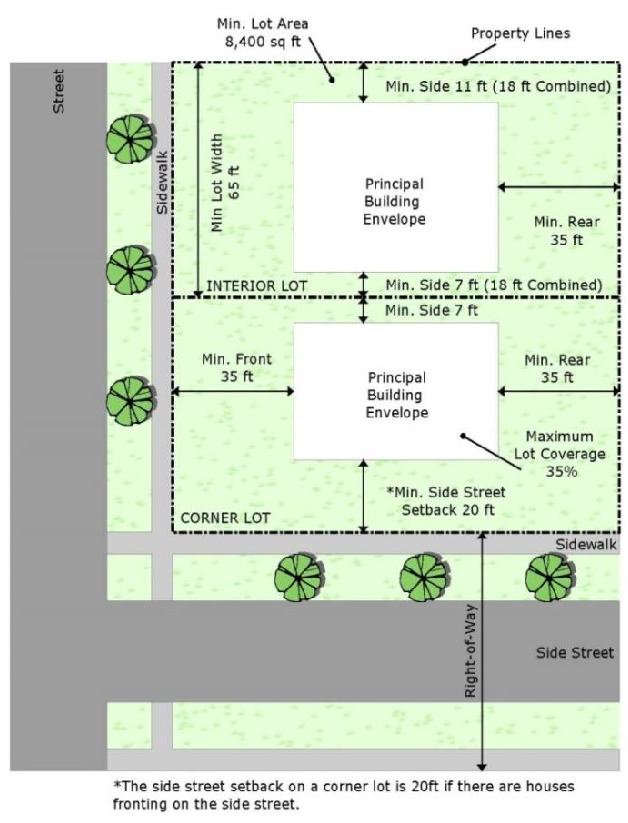 |
| Minimum Lot Width | 65 ft. | |
| Minimum Front Yard (2)(6) | 35 ft. | |
| Minimum Rear Yard (3) | 35 ft. | |
| Minimum Side Yard (3)(4)(5) | 7 ft. | |
| Minimum Combined Side Yard (5) | 18 ft. | |
| Minimum Ground Floor Building Area per dwelling unit (8)(9)(10) | ||
| One-Story | 1,040 sq. ft.. | |
| 1½-Story | 864 sq. ft. | |
| Two-Story | 672 sq. ft. | |
| Bi-Level | 672 sq. ft. | |
| Split Level | 1,040 sq. ft. | |
| Tri-Level | 1,040 sq. ft. | |
| Maximum Building Height | 35 ft. | |
| Minimum Number of Parking Spaces/Unit | 2 | |
| Maximum Lot Coverage | 35% |
Sec. 90-409A. - Specific requirements.
(1)
Where 25 percent or more of the lots in a block frontage are occupied by buildings, the average setback line of the existing buildings on both of the adjacent lots, when there are existing buildings on both of the adjacent lots, shall be the minimum required setback for any new building or for a new addition to an existing building.
(2)
Nonresidential uses shall contain ten-foot wide greenbelt adjoining the side and rear lot lines, with a minimum three-foot high berm or fencing provided in the greenbelt area where adjoined by both onsite parking and off-site residences. The berming or fencing requirements may be waived by the planning director in instances where existing property line solid fencing, natural features or other site or land use factors make this requirement unnecessary.
(3)
Side yard building setback for principal non-residential buildings shall be a minimum 25 feet.
(4)
Side yard requirements shall not be less than 20 feet if the side yard abuts a street having residences fronting.
(5)
For uses other than one- and two-family in all the residential districts, there shall be a 25-foot wide front yard greenbelt and a 25-foot wide secondary front yard greenbelt. The greenbelt shall be landscaped in accordance with the provisions of section 90-328.
(6)
Attached garages and basements are required for all single-family dwellings in the R-2 Residential District with the following exceptions, as determined by the chief building official:
(a)
Basements are not required for bi-level or tri-level structures.
(b)
Basements are not required if the existing water table makes such construction infeasible.
(c)
Basements and attached garages are not required for structures built on lots existing prior to August 2, 1988, the effective date of this subsection.
(7)
In R-2 Residential Districts, for subdivisions platted prior to the date of this chapter and having constructed dwelling units thereto, the minimum floor area per dwelling unit shall be 864 square feet.
(8)
Minimum habitable floor area per dwelling unit shall be 1,040 square feet in the R-2 Residential District zone. Habitable floor area shall be living area as defined in the Michigan Building Code and shall include hallways, closets and bathrooms.
(9)
In R-2 Residential District located east of the U.S. 131 Freeway, for single-family subdivisions platted after the effective date of this footnote (September 3, 1991), the minimum lot size shall be 7,400 square feet; the minimum lot width, 60 feet; the minimum one-story ground floor area, 960 square feet; and the minimum habitable floor area, 960 square feet.
(Ord. No. 3-25, § 9, 1-21-25; Ord. No. 9-25, § 6, 7-7-25)
Sec. 90-410A. - Additional regulations.
(1)
General requirements.
(a)
Buildings. Section 90-311.
(b)
Accessory Dwelling Units. Section 90-334.
(c)
Fence Regulations. Section 90-312.
(d)
Landscaping for non-residential uses. Section 90-328.
(e)
Projections into yards. Section 90-306.
(f)
Parking of recreational vehicles. Section 90-314.
(g)
Commercial vehicles in residential districts. Section 90-315.
(h)
Signs. Article 7.
(i)
Off-street parking. Article 6.
(Ord. No. 3-25, § 10, 1-21-25)
Sec. 90-411A. - Principal permitted uses.
In the R-3 Residential District the following uses are permitted:
(1)
All principal permitted uses in the R-1 and R-2 Districts, subject to the terms and conditions therein. For mobile homes see section 90-307.
(2)
Two-family dwellings (principal permitted use).
(3)
Accessory buildings and uses customarily incidental to the above uses.
(4)
Off-street parking.
Sec. 90-412A. - Permitted uses after special approval.
The following uses shall be permitted in the R-3 Residential District subject to the approval of the planning commission: All permitted uses after special approval in the R-1 and R-2 Districts.
(Code 1983, § 60.44)
Sec. 90-413A. - Development standards.
| Minimum Lot Area (1)(8)(10) | 12,000 sq. ft. | 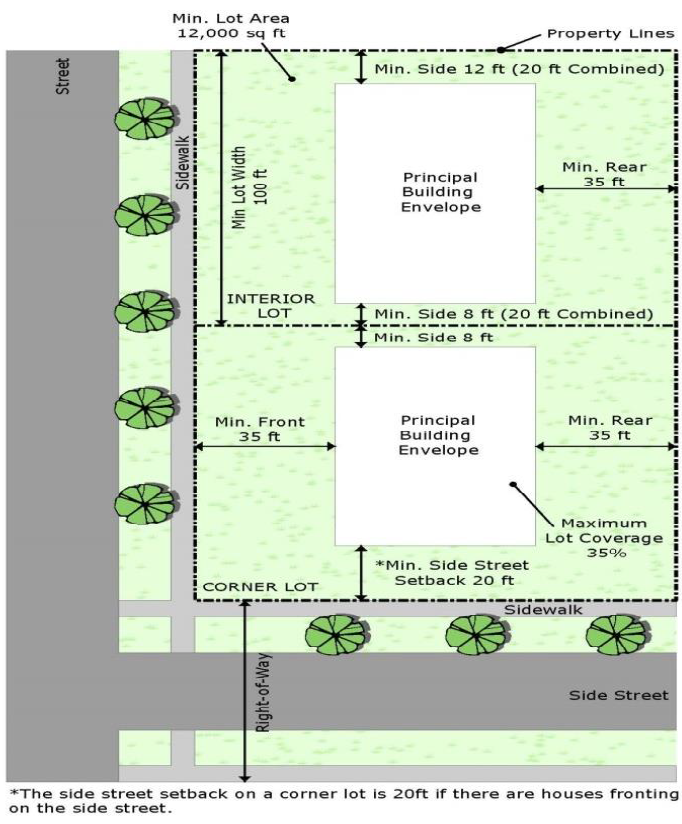 |
| Minimum Lot Width | 100 ft. | |
| Minimum Front Yard (2)(6) | 35 ft. | |
| Minimum Rear Yard (3) | 35 ft. | |
| Minimum Side Yard (3)(4) | 8 ft. | |
| Minimum Combined Side Yard (5) | 20 ft. | |
| Minimum Ground Floor Building Area | (8)(9)(10) | |
| One-Story | 900 sq. ft. | |
| 1½-Story | 720 sq. ft. | |
| Two-Story | 672 sq. ft. | |
| Bi-Level | 672 sq. ft. | |
| Split Level | 900 sq. ft. | |
| Tri-Level | 900 sq. ft. | |
| Maximum Building Height | 35 ft. | |
| Minimum Number of Parking Spaces/Unit | 2 | |
| Maximum Lot Coverage | 35% |
Sec. 90-414A. - Specific requirements.
(1)
Where 25 percent or more of the lots in a block frontage are occupied by buildings, the average setback line of the existing buildings on both of the adjacent lots, when there are existing buildings on both of the adjacent lots, shall be the minimum required setback for any new building or for a new addition to an existing building.
(2)
Nonresidential uses shall contain ten-foot wide greenbelt adjoining the side and rear lot lines, with a minimum three-foot high berm or fencing provided in the greenbelt area where adjoined by both onsite parking and off-site residences. The berming or fencing requirements may be waived by the planning director in instances where existing property line solid fencing, natural features or other site or land use factors make this requirement unnecessary.
(3)
Side yard building setback for principal non-residential buildings shall be a minimum 25 feet.
(4)
Side yard requirements shall not be less than 20 feet if the side yard abuts a street having residences fronting.
(5)
For uses other than one- and two-family in all the residential districts, there shall be a 25-foot wide front yard greenbelt and a 25-foot wide secondary front yard greenbelt. The greenbelt shall be landscaped in accordance with the provisions of section 90-328.
(6)
Attached garages and basements are required for all single-family dwellings in the R-3 district with the following exceptions, as determined by the chief building official:
(a)
Basements are not required for bi-level or tri-level structures.
(b)
Basements are not required if the existing water table makes such construction infeasible.
(c)
Basements and attached garages are not required for structures built on lots existing prior to August 2, 1988, the effective date of this subsection.
(7)
For R-3 districts incorporating subdivisions platted prior to the date of this chapter, the minimum standards for duplexes are as follows: Lot width, 70 feet; lot area, 8,400 square feet; and building floor area of 720 square feet per dwelling unit.
(8)
Minimum habitable floor area per dwelling unit shall be 900 square feet in the R-3 residential district zone. Habitable floor area shall be living area as defined in the Michigan Building Code and shall include hallways, closets and bathrooms.
(9)
In R-3 district located east of the U.S. 131 Freeway, for single-family subdivisions platted after the effective date of this footnote (September 3, 1991), the minimum lot size shall be 7,400 square feet; the minimum lot width, 60 feet; the minimum one-story ground floor area, 960 square feet; and the minimum habitable floor area, 960 square feet.
(Ord. No. 3-25, § 11, 1-21-25; Ord. No. 9-25, § 7, 7-7-25)
Sec. 90-415A. - Additional regulations.
(1)
General requirements.
(a)
Buildings. Section 90-311.
(b)
Accessory Dwelling Units. Section 90-334.
(c)
Fence Regulations. Section 90-312.
(d)
Landscaping for non-residential uses. Section 90-328.
(e)
Projections into yards. Section 90-306.
(f)
Parking of recreational vehicles. Section 90-314.
(g)
Commercial vehicles in residential districts. Section 90-315.
(h)
Signs. Article 7.
(i)
Off-street parking. Article 6.
(Ord. No. 3-25, § 12, 1-21-25)
Sec. 90-416A. - Principal permitted uses.
In the R-4 residential district, the following uses are permitted:
(1)
All principal permitted uses in the R-3 district.
(2)
All permitted uses after special approval in the R-3 district.
(3)
Multiple-family dwellings, including apartments, townhouses and row houses, provided all such dwellings shall have at least one property line abutting a major thoroughfare or have vehicular access to a major thoroughfare through property zoned R-4 or R-5. All ingress and egress shall be directly onto such major thoroughfare.
(4)
Private educational facilities.
(5)
Convalescent and nursing homes.
(6)
Foster care group homes.
(7)
Boardinghouses (rooming houses).
(8)
Accessory buildings and uses customarily incidental to the above uses.
(9)
Off-street parking.
(10)
Nursery schools, day nurseries and child care facilities for the care of seven or more people, provided there is an on-site outdoor play area of at least 600 square feet and a fence of at least 4 feet in height to enclose the rear yard.
(Code 1983, § 60.45; Ord. No. 1-23, § 5, 2-6-23; Ord. No. 15-23, § 1, 12-4-23)
Sec. 90-417A. - Permitted uses after special approval.
The following uses may be permitted in the R-4 residential district subject to the approval of the planning commission:
(1)
Medical clinics.
(2)
Medical office complexes.
(3)
Dental clinics.
(4)
Community centers.
(5)
Transitional housing for more than ten individuals.
(6)
Permanent supportive housing for more than ten individuals.
(7)
Emergency shelters within 0.25 mile of a dedicated transit stop, medical clinic, or hospital.
(Code 1983, § 60.46; Ord. No. 13-01, § 1, 6-4-01; Ord. No. 7-09, § 2, 12-21-09; Ord. No. 1-23, § 6, 2-6-23)
Sec. 90-418A. - Screening requirement.
Where required parking lots for any use permitted in an R-4 Residential District are erected, a solid masonry or concrete wall or other barrier of material approved by the planning commission, which shall be a minimum of three feet in height, shall be required along such parking lot boundary line to prevent car headlights from shining into other residential zones.
(Code 1983, § 60.47)
Sec. 90-419A. - Development standards.
In the R-4 residential district where multiple-family dwellings are permitted, the required floor space per unit shall be as follows:
(plus 80 square feet for each bedroom over three bedrooms in a dwelling unit)
However, not more than five percent of the units may be of the efficency type.
Sec. 90-420A. - Specific requirements.
(1)
Minimum land area for each dwelling unit in the R-4 Residential District shall be:
(2)
In the R-4 Residential District for every lot on which a multiple, row or terrace dwelling is erected, there shall be a yard space on each side of the lot. This yard space shall be increased beyond the yard spaces indicated by two feet for each ten feet or part thereof, by which the length or width of the multiple, row or terrace dwelling exceeds 40 feet in overall dimension, along with the adjoining side lot line. Where two or more multiple, row or terrace dwellings are erected upon the same lot, there shall be a minimum of 20 feet in width between structures. This yard width shall be increased by two feet for each ten feet or part thereof, by which each multiple, row or terrace dwelling structure, having common yards, exceeds 40 feet in length on that side of the dwelling structure facing the common yard, or this yard space shall be increased by two feet for each five feet or part thereof, by which each permitted multiple dwelling structure, having common yards, exceeds 40 feet in height on that side of the dwelling structure facing the common yard, whichever is greater.
(3)
In the R-4 Residential District parking shall not be permitted in the 25 feet of the front yard depth closest to the abutting street.
(4)
Nonresidential uses shall contain ten-foot wide greenbelt adjoining the side and rear lot lines, with a minimum three-foot high berm or fencing provided in the greenbelt area where adjoined by both onsite parking and off-site residences. The berming or fencing requirements may be waived by the planning director in instances where existing property line solid fencing, natural features or other site or land use factors make this requirement unnecessary.
(5)
In the R-4 Residential District and for uses other than one- and two-family there shall be a 25-foot wide front yard greenbelt and a 25-foot wide secondary front yard greenbelt. The greenbelt shall be landscaped in accordance with the provisions of section 90-328.
(Ord. No. 12-24, § 5, 11-4-24; Ord. No. 9-25, § 8, 7-7-25)
Sec. 90-421A. - Additional regulations.
(1)
General requirements.
(a)
Buildings. Section 90-311.
(b)
Accessory Dwelling Units. Section 90-334.
(c)
Fence Regulations. Section 90-312.
(d)
Landscaping for non-residential uses. Section 90-328.
(e)
Projections into yards. Section 90-306.
(f)
Parking of recreational vehicles. Section 90-314.
(g)
Commercial vehicles in residential districts. Section 90-315.
(h)
Signs. Article 7.
(i)
Off-street parking. Article 6.
(Ord. No. 3-25, § 13, 1-21-25)
Sec. 90-422A. - Principal permitted uses.
In the R-5 Residential District, the following uses are permitted:
(1)
All principal permitted uses in the R-4 Residential District.
(2)
High-rise, multiple-family residential structures, subject to the following conditions:
(a)
The proposed site shall have at least one property line abutting a major thoroughfare. All ingress and egress to the site shall be directly from such thoroughfare.
(b)
The entire area of the site shall be designed to serve the residents of the site; and any accessory buildings, uses or services shall be developed primarily for the use of residents of the site. Uses considered as accessory uses include parking structures, swimming pools, recreation areas, pavilions, cabanas and other similar uses.
(3)
Accessory buildings and uses customarily incidental to the above uses.
(4)
All permitted uses after special approval in the R-4 Residential District.
(5)
Off-street parking.
(Code 1983, § 60.48)
Sec. 90-423A. - Permitted uses after special approval.
The following uses may be permitted in the R-5 residential district, subject to the approval of the planning commission: Retail and service uses located within high-rise multiple-family structures.
(Code 1983, § 60.49)
Sec. 90-424A. - Screening requirement.
Where required, parking lots of any use permitted in an R-5 Residential District are erected such that the headlights of the cars in the parking lot will face any residentially zoned property, a solid masonry or concrete wall or other barrier of material approved by the planning commission, which shall be a minimum of three feet in height, shall be required along the parking lot boundary line.
(Code 1983, § 60.50)
Sec. 90-425A. - Development standards.
In the R-5 district where multiple-family dwellings are permitted, the required floor space per unit shall be as follows:
(plus 80 square feet for each bedroom over three bedrooms in a dwelling unit)
However, not more than five percent of the units may be of the efficency type.
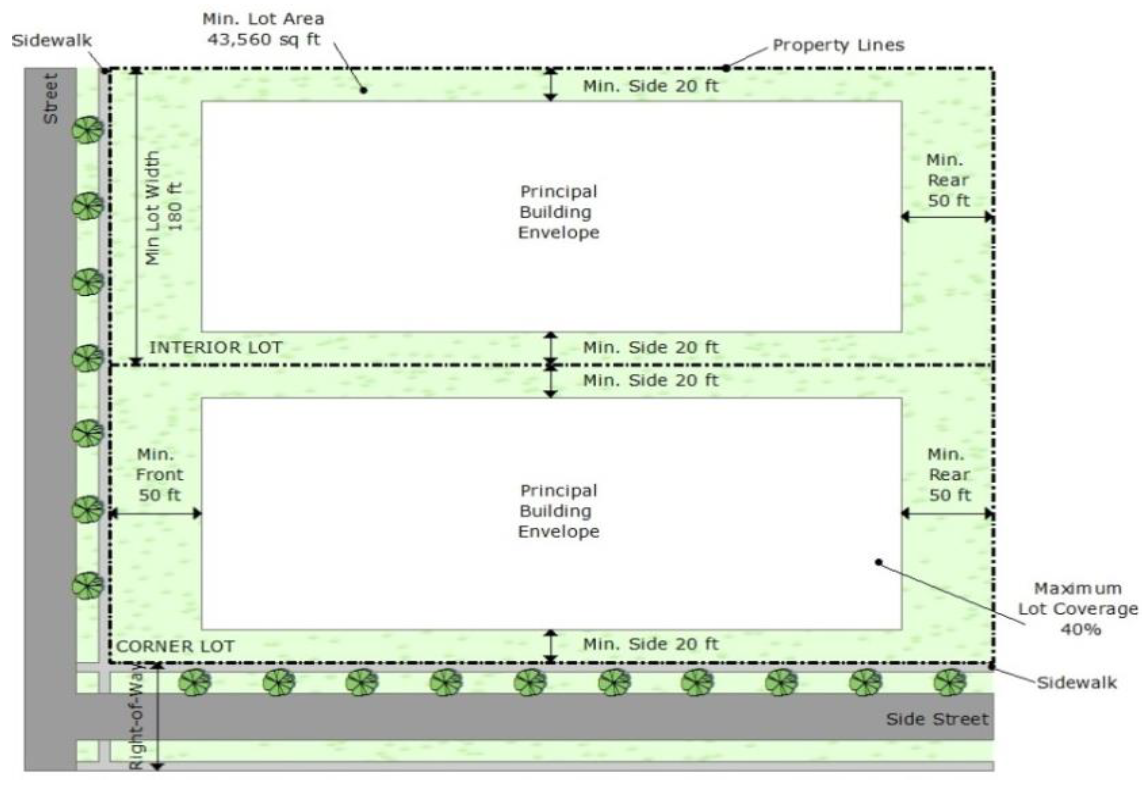
Sec. 90-426A. - Specific requirements.
(1)
Minimum land area required for each dwelling unit in the R-5 residential district shall be the same as required in the R-4 district for buildings less than four stories in height. Where building height is four stories or greater, minimum land area per dwelling unit shall be based upon dwelling unit size and building height as follows:
(2)
In the R-5 residential district for every lot on which a multiple, row or terrace dwelling is erected, there shall be a yard space on each side of the lot. This yard space shall be increased beyond the yard spaces indicated by two feet for each ten feet or part thereof, by which the length or width of the multiple, row or terrace dwelling exceeds 40 feet in overall dimension, along with the adjoining side lot line. Where two or more multiple, row or terrace dwellings are erected upon the same lot, there shall be a minimum of 20 feet in width between structures. This yard width shall be increased by two feet for each ten feet or part thereof, by which each multiple, row or terrace dwelling structure, having common yards, exceeds 40 feet in length on that side of the dwelling structure facing the common yard, or this yard space shall be increased by two feet for each five feet or part thereof, by which each permitted multiple dwelling structure, having common yards, exceeds 40 feet in height on that side of the dwelling structure facing the common yard, whichever is greater.
(3)
In the R-5 residential district parking shall not be permitted in the 25 feet of the front yard depth closest to the abutting street.
(4)
Nonresidential uses shall contain ten-foot wide greenbelt adjoining the side and rear lot lines, with a minimum three-foot high berm or fencing provided in the greenbelt area where adjoined by both onsite parking and off-site residences. The berming or fencing requirements may be waived by the planning director in instances where existing property line solid fencing, natural features or other site or land use factors make this requirement unnecessary.
(5)
In the R-5 residential district and for uses other than one- and two-family there shall be a 25-foot wide front yard greenbelt and a 25-foot wide secondary front yard greenbelt. The greenbelt shall be landscaped in accordance with the provisions of section 90-328.
(Ord. No. 9-25, § 9, 7-7-25)
Sec. 90-427A - Additional regulations
(1)
General requirements.
(a)
Accessory buildings. Section 90-311.
(b)
Fence regulations. Section 90-312.
(c)
Landscaping for non-residential uses. Section 90-328.
(d)
Projections into yards. Section 90-306.
(e)
Parking of recreational vehicles. Section 90-314.
(f)
Commercial vehicles in residential districts. Section 90-315.
(g)
Signs. Article 7.
(h)
Off-street parking. Article 6.
(2)
Development procedures.
(a)
Special land uses. Section 90-507.
(b)
Site plan. Section 90-500.
(c)
Site condominiums. Section 90-509.
(3)
Appeals and administration.
(a)
Board of zoning appeals. Article 10.
(b)
Permits. Section 90-1008.
(c)
Non-conforming lot and uses. Article 9.
Sec. 90-428A. - Principal permitted uses.
In the R-6 residential district, the following uses are permitted:
(1)
Mobile homes.
(2)
Mobile home parks, which shall be subject to the requirements as established and regulated by Act No. 96 of the Public Acts of Michigan of 1987 (MCL 125.2301 et seq., as amended).
(3)
Public, parochial or private elementary, intermediate and high schools offering courses in general education, not operated for profit.
(4)
Churches and church facilities normally incidental thereto, provided that ingress and egress from such site is into a major thoroughfare or collector street. The minimum site size shall be three acres.
(5)
Accessory uses and buildings customarily incidental to the above uses.
(6)
Off-street parking. Article 6.
(Code 1983, § 60.51)
Sec. 90-429A. - Additional regulations.
(1)
General requirements.
(a)
Accessory buildings. Section 90-311.
(b)
Fence regulations. Section 90-312.
(c)
Landscaping for non-residential uses. Section 90-328.
(d)
Projections into yards. Section 90-306.
(e)
Parking of recreational vehicles. Section 90-314.
(f)
Commercial vehicles in residential districts. Section 90-315.
(g)
Signs. Article 7.
(h)
Off-street parking. Article 6.
(2)
Development procedures.
(a)
Special land uses. Section 90-507.
(b)
Site plan. Section 90-500.
(c)
Site condominiums. Section 90-509.
(3)
Appeals and administration.
(a)
Board of zoning appeals. Article 10.
(b)
Permits. Section 90-1008.
(c)
Non-conforming lot and uses. Article 9.
Sec. 90-430A. - Purpose of article.
The R-7 residential district is intended to provide areas for development of higher quality multiple-family housing, including condominiums, which, based on greater setbacks, varying building styles and lower overall density, will be more compatible with adjoining single-family zoning districts than conventional multiple-family housing.
(Code 1983, § 60.260)
Sec. 90-431A. - Principal permitted uses.
In the R-7 residential district, the following uses are permitted:
(1)
All principal permitted uses in the R-3 district.
(2)
Multiple-family dwellings, including apartments, townhouses and row houses, provided all such dwellings shall have at least one property line abutting a major thoroughfare or have vehicular access to a major thoroughfare through property zoned R-4, R-5 or R-7. All ingress and egress shall be directly onto such major thoroughfare.
(Code 1983, § 60.260)
Sec. 90-432A. - Permitted uses after special approval.
The following uses may be permitted subject to the approval of the planning commission:
(1)
All permitted uses after special approval in the R-1, R-2 and R-4 residential districts.
(2)
Private educational facilities.
(3)
Convalescent and nursing homes.
(4)
Foster care group homes.
(5)
Boardinghouses (rooming houses).
(Code 1983, § 60.261)
Sec. 90-433A. - Screening requirement.
Where required parking lots for any use permitted in an R-7 residential district are erected, a solid masonry or concrete wall or other barrier of material approved by the planning commission, which shall be minimum of three feet in height, shall be required along such parking lot boundary line to prevent car headlights from shining into other residential zones.
(Code 1983, § 60.262)
Sec. 90-434A. - Development standards.
In the R-7 residential district where multiple-family dwellings are permitted, the required floor space per unit shall be as follows:
(plus 80 square feet for each bedroom over three bedrooms in a dwelling unit)
However, not more than five percent of the units may be of the efficency type.
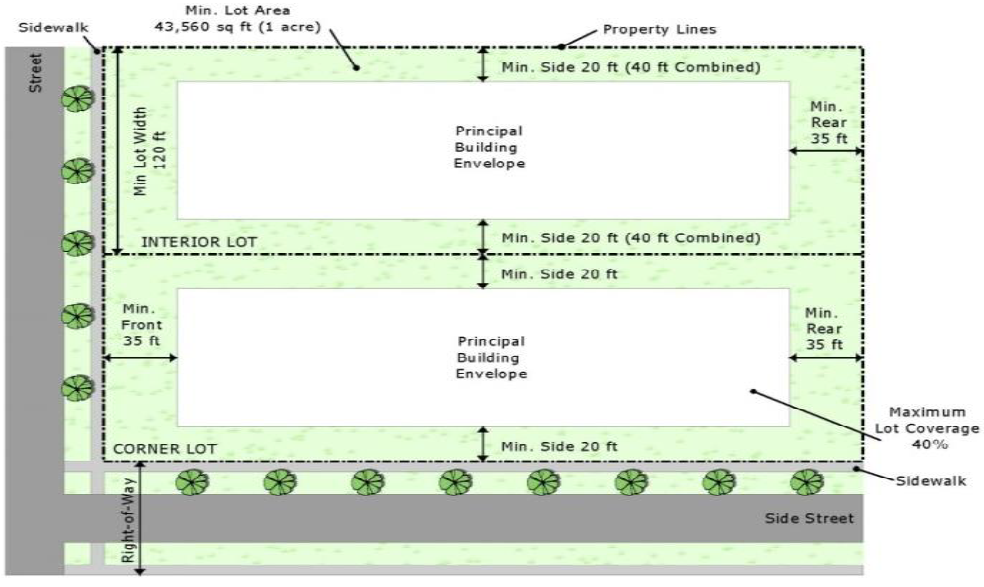
Sec. 90-435A. - Specific requirements.
(1)
Minimum land area for each dwelling unit in the R-7 residential district shall be:
(2)
In the R-7 residential district for every lot on which a multiple, row or terrace dwelling is erected, there shall be a yard space on each side of the lot. This yard space shall be increased beyond the yard spaces indicated by two feet for each ten feet or part thereof, by which the length or width of the multiple, row or terrace dwelling exceeds 40 feet in overall dimension, along with the adjoining side lot line. Where two or more multiple, row or terrace dwellings are erected upon the same lot, there shall be a minimum of 20 feet in width between structures. This yard width shall be increased by two feet for each ten feet or part thereof, by which each multiple, row or terrace dwelling structure, having common yards, exceeds 40 feet in length on that side of the dwelling structure facing the common yard, or this yard space shall be increased by two feet for each five feet or part thereof, by which each permitted multiple dwelling structure, having common yards, exceeds 40 feet in height on that side of the dwelling structure facing the common yard, whichever is greater.
(3)
In the R-7 residential district parking shall not be permitted in the 25 feet of the front yard depth closest to the abutting street.
(4)
Nonresidential uses shall contain ten-foot wide greenbelt adjoining the side and rear lot lines, with a minimum three-foot high berm or fencing provided in the greenbelt area where adjoined by both onsite parking and off-site residences. The berming or fencing requirements may be waived by the planning director in instances where existing property line solid fencing, natural features or other site or land use factors make this requirement unnecessary.
(5)
In the R-7 residential district and for uses other than one- and two-family there shall be a 25-foot wide front yard greenbelt and a 25-foot wide secondary front yard greenbelt. The greenbelt shall be landscaped in accordance with the provisions of section 90-328.
(6)
Screening requirement. Where required parking lots for any use permitted in an R-7 residential district are erected, a solid masonry or concrete wall or other barrier of material approved by the planning commission, which shall be minimum of three feet in height, shall be required along such parking lot boundary line to prevent car headlights from shining into other residential zones.
(Code 1983, § 60.262; Ord. No. 9-25, § 10, 7-7-25)
Sec. 90-436A. - Additional regulations.
(1)
General requirements.
(a)
Accessory buildings. Section 90-311.
(b)
Fence regulations. Section 90-312.
(c)
Landscaping for non-residential uses. Section 90-328.
(d)
Projections into yards. Section 90-306.
(e)
Parking of recreational vehicles. Section 90-314.
(f)
Commercial vehicles in residential districts. Section 90-315.
(g)
Signs. Article 7.
(h)
Off-street parking. Article 6.
(i)
Refuse Disposal. Section 90-321.
(2)
Development procedures.
(a)
Special land uses. Section 90-507.
(b)
Site plan. Section 90-500.
(c)
Site condominiums. Section 90-509.
(3)
Appeals and administration.
(a)
Board of zoning appeals. Article 10.
(b)
Permits. Section 90-1008.
(c)
Non-conforming lot and uses. Article 9.
Sec. 90-437A. - Principal permitted uses.
(1)
Single-family detached dwellings. For mobile home standards see section 90-307.
(2)
Churches and church facilities normally incidental thereto, provided that ingress and egress from the site is onto a major thoroughfare or collector street. Church sites shall be a minimum of three acres.
(3)
Publicly owned facilities.
(4)
Off-street parking.
(5)
Accessory buildings and uses customarily incidental to the principal permitted uses.
(6)
Foster care facilities, nursery schools, day nurseries and child care facilities for the care of not more than six people as defined by the Michigan Family Independence Agency.
(7)
Home occupations.
(8)
Accessory Dwelling Units incidental to the principal permitted dwelling unit. Sec. 90-334.
(Code 1983, § 60.41; Ord. No. 15-97, § 2, 6-16-97; Ord. No. 18-98, § 3, 8-17-98; Ord. No. 3-25, § 14, 1-21-25)
Sec. 90-438A. - Permitted uses after special approval.
The following uses shall be permitted subject to the approval of the planning commission:
(1)
Private parks, country clubs, golf courses and golf driving ranges adjoining a golf course or country club.
(2)
Telephone exchange buildings, electric transformer stations and substations and gas regulator stations.
(3)
Nursery schools, day nurseries and child care facilities for the care of seven or more people.
(4)
Cemeteries.
(5)
Mineral extraction, borrow pit and topsoil removal.
(6)
Commercial greenhouses.
(7)
Adult education facilities not operated for profit.
(8)
Agricultural uses.
(9)
Public, parochial, or private elementary, intermediate or high schools.
(10)
Community centers.
(Code 1983, § 60.42; Ord. No. 18-98, § 1, 8-17-98; Ord. No. 7-09, §§ 1, 5, 12-21-09; Ord. No. 12-25, § 3, 10-20-25)
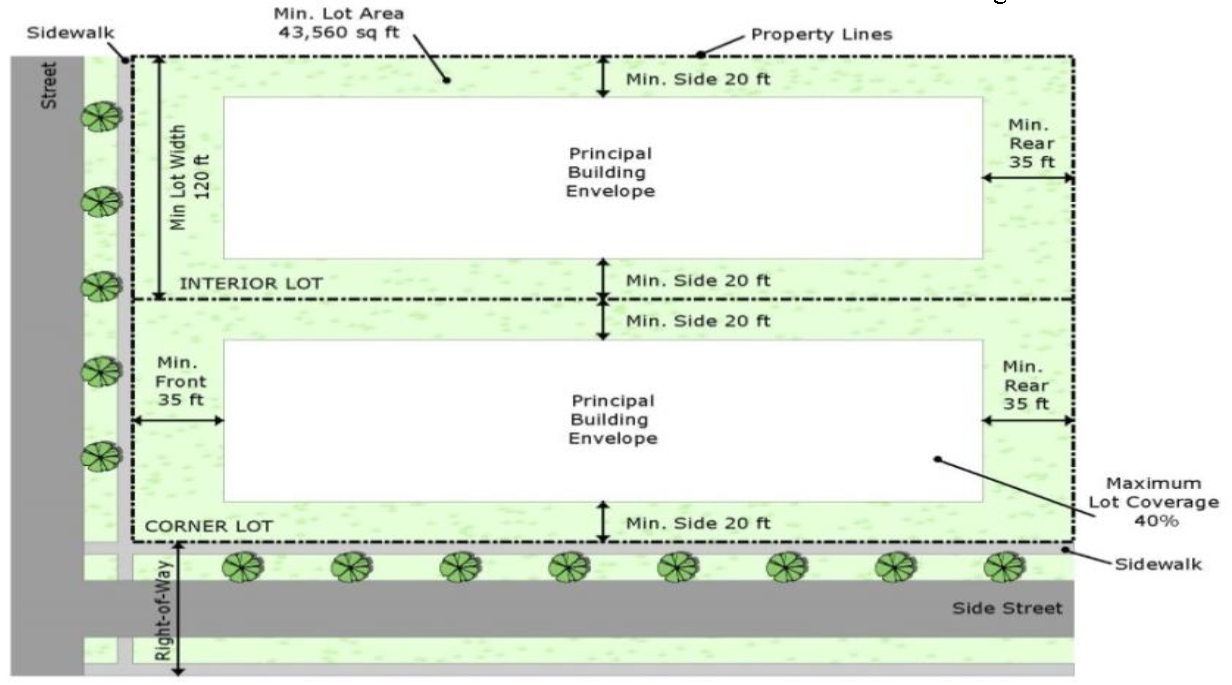
Sec. 90-439A. - Development standards.
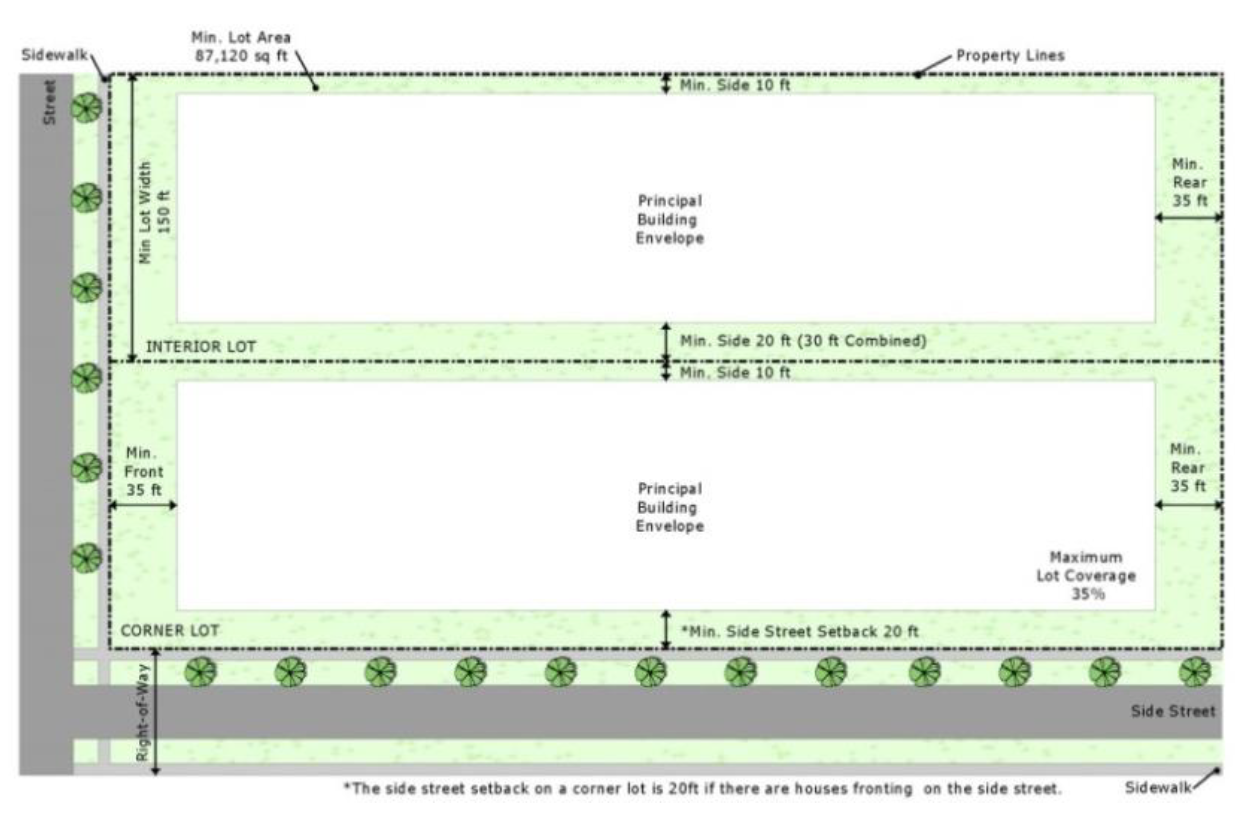
Sec. 90-440A. - Specific requirements.
(1)
In the ER estate residential district, for subdivisions with a minimum of five lots platted subsequent to the effective date of the section, all the minimum requirements of section 90-403A that apply to the R-1 district may be substituted for those of the ER district, provided the appropriate piping and related facilities for water and sewer systems are supplied by the developer for the plat and approved by the engineering department. Internal streets which meet city requirements shall be constructed for access to the lots. If hookups to the city water or sanitary sewer are unavailable to the plat, individual lot wells and/or septic systems may be added
However, minimum lot size shall be 20,000 square feet if the water system cannot be connected to the city water systems. In addition, in the ER district, property owners may establish an open space preservation development. For each whole two-acre parcel that, under the applicable regulations of the city, could otherwise be created on up to 80 percent of the parent parcel, the landowner may create parcels at a lesser size if all of the following are established.
(a)
All lots shall have a minimum of 20,000 square feet.
(b)
All lots shall have a minimum of 150 feet in width along a public street.
(c)
A minimum of 20 percent of the overall land area shall perpetually remain in an undeveloped state by means of a conservation easement or restrictive covenant that runs with the land.
(d)
The development of land under this option is subject to the other applicable ordinances, laws and rules, including rules relating to suitability of groundwater for on-site water supply, suitability of soils for on-site sewage disposal, and restriction of development due to floodplains or designated wetlands.
(e)
This option may be utilized once within the boundary of the original parcel.
(f)
Approval of the open space preservation development shall be subject to site plan approval by the planning commission. All required information, including a yield plan showing the maximum number of housing units under the ER district's standard provisions, shall be submitted to the planning department prior to review.
(2)
Regardless of any smaller minimum lot area requirement, for subdivisions platted subsequent to January 31, 1989, where both operable public water and public sewer are not provided, the minimum lot area for single-family housing shall be 12,000 square feet, with a minimum lot width of 75 feet, except that minimum lot area shall be 20,000 square feet if public water is not provided to the lot.
(3)
Where 25 percent or more of the lots in a block frontage are occupied by buildings, the average setback line of the existing buildings on both of the adjacent lots, when there are existing buildings on both of the adjacent lots, shall be the minimum required setback for any new building or for a new addition to an existing building.
(4)
Nonresidential uses shall contain ten-foot wide greenbelt adjoining the side and rear lot lines, with a minimum three-foot high berm or fencing provided in the greenbelt area where adjoined by both on-site parking and off-site residences. The berming or fencing requirements may be waived by the planning director in instances where existing property line solid fencing, natural features or other site or land use factors make this requirement unnecessary.
(5)
Side yard building setback for principal non-residential buildings shall be a minimum 25 feet.
(6)
Side yard requirements shall not be less than 20 feet if the side yard abuts a street having residences fronting.
(7)
For uses other than one- and two-family in all the residential districts, there shall be a 25-foot wide front yard greenbelt and a 25-foot wide secondary front yard greenbelt. The greenbelt shall be landscaped in accordance with the provisions of section 90-328.
(8)
Minimum habitable floor area per dwelling unit shall be 1,500 square feet in the ER district zone. Habitable floor area shall be living area as defined in the Michigan Building Code and shall include hallways, closets and bathrooms
(9)
Attached garages and basements are required for all single-family dwellings in the ER district with the following exceptions, as determined by the chief building official:
(a)
Basements are not required for bi-level or tri-level structures.
(b)
Basements are not required if the existing water table makes such construction infeasible.
(c)
Basements and attached garages are not required for structures built on lots existing prior to August 2, 1988, the effective date of this subsection.
(Ord. No. 3-25, § 15, 1-21-25; Ord. No. 9-25, § 11, 7-7-25)
Sec. 90-441A. - Additional regulations.
(1)
General requirements.
(a)
Accessory buildings. Section 90-311.
(b)
Fence regulations. Section 90-312.
(c)
Landscaping for non-residential uses. Section 90-328.
(d)
Projections into yards. Section 90-306.
(e)
Parking of recreational vehicles. Section 90-314.
(f)
Commercial vehicles in residential districts. Section 90-315.
(g)
Signs. Article 7.
(h)
Off-street parking. Article 6.
(2)
Development procedures.
(a)
Special land uses. Section 90-507.
(b)
Site plan. Section 90-500.
(c)
Site condominiums. Section 90-509.
(3)
Appeals and administration.
(a)
Board of zoning appeals. Article 10.
(b)
Permits. Section 90-1008.
(c)
Non-conforming lot and uses. Article 9.

